Introduction
Campylobacteriosis is the most frequently reported zoonotic disease in humans in the European Union (EU) in recent years (Hugas et al., Reference HUGAS, TSIGARIDA, ROBINSON and CALISTRI2009; Westrell et al., Reference WESTRELL, CIAMPA, BOELAERT, HELWIGH, KORSGAARD, CHRÍEL, AMMON and MÄKELÄ2009). The European Food Safety Authority (EFSA) has concluded that approximately 180,000 cases occur annually in the EU (EFSA, Reference EFSA2009). Broiler chickens are an asymptomatic Campylobacter carrier. The most important primary contamination site of Campylobacter is at farm level, because Campylobacter exists widely in the outside environment (Jacobs- Reitsma, 2000) and primarily colonises the caeca and small intestine (Rowe and Madden, Reference ROWE and MADDEN2000). Approximately 80 to 90% of human gastroenteritis cases are caused by C. jejuni (Vandamme, Reference VANDAMME2000) that colonise the caecum in large amounts, ranging from 106 to 108 cfu/g (Saleha, Reference SALEHA2002). The main symptoms of campylobacteriosis in humans are diarrhoea, cramping, abdominal pain, and fever. Intestinal colonisation of broiler chickens with Campylobacter during rearing is responsible for the contamination of the carcasses after processing (Herman et al., Reference HERMAN, HEYNDRICKX, GRIJSPEERDT, VANDEKERCHOVE, ROLLIER and DE ZUTTER2003; Rosenquist et al., Reference ROSENQUIST, SOMMER, NIELSEN and CHRISTENSEN2006; Reich et al., Reference REICH, ATANASSOVA, HAUNHORST and KLEIN2008). Worldwide, an average prevalence of Campylobacter contamination on poultry carcasses is reported to be in the range of 60–80% (Suzuki and Yamamoto, Reference SUZUKI and YAMAMOTO2009; EFSA, Reference EFSA2010a). Carcass contamination occurs during defeathering and evisceration, by contaminated faeces leaking from the cloaca and visceral rupture of the caeca carrying a high Campylobacter load (Allen et al., Reference ALLEN, WEAVER, RIDLEY, HARRIS, SHARMA, EMERY, SPARKS, LEWIS and EDGE2008; Boysen and Rosenquist, Reference BOYSEN and ROSENQUIST2009). Campylobacter spp. is the major cause of human acute bacterial gastroenteritis worldwide (Westrell et al., Reference WESTRELL, CIAMPA, BOELAERT, HELWIGH, KORSGAARD, CHRÍEL, AMMON and MÄKELÄ2009) and the species most frequently implicated is C. jejuni (Keener et al., Reference KEENER, BASHOR, CURTIS, SHELDON and KATHARIOU2004; Humphrey et al., Reference HUMPHREY, O'BRIEN and MADSEN2007).
Poultry remain an important vehicle of bacterial human pathogens, leading to food borne diseases by contaminated poultry product consumption and incriminated by epidemiological reports all over the world. Contaminated broiler meat with C. jejuni is a major source of human campylobacteriosis (Wingstrand et al., Reference WINGSTRAND, NEIMANN, ENGBERG, E.M., P., WEGENER and MOLBAK2006). Primary infection of broilers probably occurs through horizontal transmission from the environment (Jacobs-Reitsma et al., Reference JACOBS-REITSMA, VAN DE GIESSEN, BOLDER and MULDER1995). Potential sources and vectors for contamination include infected livestock and free-living animals (van de Giessen et al., Reference VAN DE GIESSEN, BLOEMBERG, RITMEESTER and TILBURG1996; Ellis-Iversen et al., Reference ELLIS-IVERSEN, JORGENSEN, BULL, POWELL, COOK, HUGAS, TSIGARIDA, ROBINSON and CALISTRI2009), rodents and flies (Hald et al., Reference HALD, SKOVGARD, PEDERSEN and BUNKENBORG2008), contaminated surface water (Messens et al., Reference MESSENS, HERMAN, DE ZUTTER and HEYNDRICKX2009), personnel and farm equipment (Ramabu et al., Reference RAMABU, BOXALL, MADIE and FENWICK2004) at the farm. The frequent contamination of broiler chicken meat with Campylobacter is associated with the fact that Campylobacter exists widely in nature, and therefore the digestive tracts of broiler chickens are the principal reservoirs at farm level. Campylobacter is considered to be a commensal organism in many avian species, including those grown commercially, and its spread among chickens is very rapid (Keener et al., Reference KEENER, BASHOR, CURTIS, SHELDON and KATHARIOU2004). Small amounts of caecal contents (5 mg) can remarkably increase the numbers of Campylobacter on eviscerated broiler carcasses (Berrang et al., Reference BERRANG, SMITH, WINDHAM and FELDNER2004) because the bacteria are found abundantly in the large intestine, cloaca, and caeca, where 105 to 109 cfu/g of faecal content have been observed (Corry and Atabay, Reference CORRY and ATABAY2001). It was reported that all 30-45 d old broiler chickens are colonised by Campylobacter spp. (Stern et al., Reference STERN, BANNOV, SVETOCH, MITSEVICH, MITSEVICH, VOLOZHANTSEV, GUSEV and PERELYGIN2004). Most flocks become infected at an age of two to four weeks only (Jacobs-Reitsma et al., Reference JACOBS-REITSMA, VAN DE GIESSEN, BOLDER and MULDER1995; Evans and Sayers, Reference EVANS and SAYERS2000; van Gerwe et al., Reference VAN GERWE, MIFLIN, TEMPLETONBOUMA, WAGENAAR, JACOBS-REITSMA, STEGEMAN and KLINKENBERG2009). The majority of the birds in a flock are colonised within only a few days after the first chick is infected (van Gerwe et al., Reference VAN GERWE, MIFLIN, TEMPLETONBOUMA, WAGENAAR, JACOBS-REITSMA, STEGEMAN and KLINKENBERG2009). These broiler chickens carry high C. jejuni numbers in their intestinal tract, especially in the caeca (between 106 and 108 CFU/g or higher), and remain colonised until slaughter (Beery et al., Reference BEERY, HUGDAHL and DOYLE1988; Jacobs-Reitsma et al., Reference JACOBS-REITSMA, VAN DE GIESSEN, BOLDER and MULDER1995; Evans and Sayers, Reference EVANS and SAYERS2000).
Reducing the proportion of Campylobacter infected poultry flocks and/or reducing their numbers in live poultry will lower the risk to consumers considerably (Keener et al., Reference KEENER, BASHOR, CURTIS, SHELDON and KATHARIOU2004; Westrell et al., Reference WESTRELL, CIAMPA, BOELAERT, HELWIGH, KORSGAARD, CHRÍEL, AMMON and MÄKELÄ2009). A Danish quantitative risk assessment reported that reduced contamination level would decrease the number of campylobacteriosis cases 30 times (i.e., a 97% reduction; Rosenquist et al., Reference ROSENQUIST, NIELSEN, SOMMER, NORRUNG and CHRISTENSEN2003). This indicates that measures taken to reduce Campylobacter colonisation in the intestinal tract of poultry during primary production have potential for reducing contamination of poultry products and thus the incidence of human campylobacteriosis. Consequently, it becomes necessary to control the occurrence of Campylobacter in poultry meat (EFSA, Reference EFSA2008). There is a need for the poultry industry to employ intervention strategies that predictably reduce Campylobacter levels in pre-harvest poultry and poultry carcasses. Regulatory oversight and monitoring of Campylobacter levels is the responsibility of regulatory agencies to promote a safer poultry product. The present review highlights current control measures of Campylobacter colonisation in poultry production.
Campylobacter colonisation in poultry
Infection of commercial poultry with Campylobacter spp. was reported in broiler chickens (Prescott and Gelmer, Reference PRESCOTT and GELMER1984), ducks (Kasrazadeh and Genigeorgis, Reference KASRAZADEH and GENIGEORGIS1987), turkeys (Acuff et al., Reference ACUFF, VANDERZANT, HANNA, EHLERS, GOLAN F.A. and GARDNER1986), egg production flocks (Figueroa et al., Reference FIGUEROA, HIDALGO, TRONCOSCO, ROSENDE and SOTO1983) and parent breeding stock (Shanker et al., Reference SHANKER, LEE and SORRELL1986). Of the three species, C. jejuni predominates, with C. coli and C. lari infrequently recovered from the intestinal tract of poultry. It is regarded as a commensal of the avian host, colonising the avian gastrointestinal tract to a high level (9 log10 CFUg -1 contents) without producing clinical signs. The ability of Campylobacter to colonise in chickens, and other poultry, has been well documented, with primary sites of colonisation being the caeca, colon and cloaca (Beery et al., Reference BEERY, HUGDAHL and DOYLE1988).
Experimental infection may induce mortality and transient diarrhoea in chicks following infection at one-day-old with a known enteroinvasive and pathogenic strain of C. jejuni (Ruiz-Palacios et al., Reference RUIZ-PALACIOS, ESCAMILLA and TORRES1981). Subsequent exposure to the organism results in either watery droppings (Neil et al., Reference NEIL, CAMPBELL and GREENE1984) or the absence of clinical signs (Welkos, Reference WELKOS1984). Neonatal infection with pathogenic strains of C. jejuni possessing virulence factors may produce focal hepatic necrosis and distension of the jejunum (Clark and Bueschkens, Reference CLARK and BUESCHKENS1988) or focal haemorrhage (Welkos, Reference WELKOS1984). Generally, flocks infected with C. jejuni show no clinical abnormality. Infected broiler flocks excrete C. jejuni from the second or third week during the growing cycle (Acuff et al., Reference ACUFF, VANDERZANT, GARDNER and GOLAN1982).
A significant contribution to the high prevalence of Campylobacter jejuni in poultry may be attributed to the fact that poultry is mostly an asymptomatic carrier. The bird's intestine seems to offer a suitable biological niche for the survival and dissemination of this Gram-negative, spiral-shaped bacterium. This might be partially related to the higher body temperature in chickens (>40°C) as it has been shown that the expression of several vital proteins of Campylobacter differs at 37 and 42 °C (Young et al., Reference YOUNG, DAVIS and DIRITA2007).
Epidemiology of Campylobacter infection in poultry
Pre-harvest control depends mainly on an understanding of the reservoirs of infection, mechanisms of transmission and the interaction of C. jejuni with the host and commercial housing (Shane, Reference SHANE2000). Although feed and drinking water can be contaminated by faecal droppings during the rearing period and can serve as transmission route (Bull et al., 2006). Nevertheless, feed is not regarded as a source of infection because of the low moisture content and Campylobacter cannot survive in poultry feed (Newell and Fearnley, Reference NEWELL and FEARNLEY2003). However, drinking water can be a real contamination vector for broiler chickens (Shanker et al., Reference SHANKER, LEE and SORRELL1990). Moreover, non-chlorinated water supplied to broilers has been implicated as a vehicle of transmission (Kapperud et al., Reference KAPPERUD, SKJERVE, VIK, HAUGE, LYSAKER, AALMEN, OSTROFF and POTTER1993).
Campylobacter is sensitive to detergents, disinfectants and dry conditions in poultry houses during the empty period, hence only a small number of bacteria could survive during flock intervals (Evans and Sayers, Reference EVANS and SAYERS2000). Clean fresh litter is considered to be harmful to C. jejuni due to its dry and aerobic conditions (Newell and Fearnley, Reference NEWELL and FEARNLEY2003; Hutchinson et al., Reference HUTCHINSON, WALTERS, AVERY, MUNRO and MOORE2005). Although litter can be contaminated by broiler faecal droppings, this cannot be considered as a transmission vector because poultry houses are generally cleaned and disinfected and the litter is replaced between flocks. Nevertheless, Campylobacter can survive in the surrounding soil (Bull et al., 2006) and the farmer or other personnel can act as a vector for Campylobacter (Newell and Fearnley, Reference NEWELL and FEARNLEY2003). It was reported that movement of personnel and equipment between breeder, broiler and turkey growing farms, associated with modern integrated production, may contribute to introduction of infection if clothing, boots and equipment are contaminated with moist faecal material from a flock excreting C. jejuni (Shane, Reference SHANE2000). Moreover, in free range husbandry systems, outdoor access can be a major environmental source for flock contamination because it is possible that Campylobacter is present under a viable but non-culturable (VNC)-form (Rivoal et al., Reference RIVOAL, RAGIMBEAU, SALVAT, COLIN and ERMEL2005) whereby VNC represents a resting or dormant stage extremely difficult to detect, which could become virulent under appropriate conditions (Moore, Reference MOORE2001).
Farm animals, including cattle, pigs, sheep, goats and poultry in addition to wild birds, rodents, cats and dogs are often considered an important Campylobacter reservoir, (Oporto et al., Reference OPORTO, ESTEBAN, ADURIZ, JUSTE and HURTADO2007). Although the broiler contamination by wild and domesticated animals does not seem to be direct, except in free-range facilities, faecal shedding of the bacteria have been identified out in several studies (Stanley and Jones, Reference STANLEY and JONES2003; Hutchinson et al., Reference HUTCHINSON, WALTERS, AVERY, MUNRO and MOORE2005) as a potential origin of environmental contamination (Nicholson et al., Reference NICHOLSON, GROVES and CHAMBERS2005). Additionally insects could play a part in the Campylobacter epidemiology (Skov et al., Reference SKOV, SPENCER, HALD, PETERSEN, NAUERBY, CARSTENSEN and MADSEN2004) and could act as mechanical vectors, transmitting pathogens from reservoir environment or animals to broiler flocks (Ekdahl et al., Reference EKDAHL, NORMANN and ANDERSSON2005; Nichols, Reference NICHOLS2005). Campylobacter can be present in the poultry reproductive system, but the assumption of vertical transmission is not accepted as a major source of pathogen transmission (Chuma et al., Reference CHUMA, MAKINO, OKAMOTO and YUGI1997; Sahin et al., Reference SAHIN, LUO, HUANG and ZHANG2003) because of poor Campylobacter survival on eggshells and its inability to penetrate, survive and multiply in eggs under natural conditions. However, vertical transmission of Campylobacter has been reported in some papers (Callicott et al., Reference CALLICOTT, FRIÐRIKSDÓTTIR, REIERSEN, LOWMAN, BISAILLON, GUNNARSSON, BERNDTSON, HIETT, NEEDLEMAN and STERN2006).
Poultry welfare and Campylobacter infection
The housing system and husbandry of poultry were shown to affect the prevalence of campylobacter contamination in poultry farms and poultry meat. It was shown that the prevalence of Campylobacter was higher in organic systems than conventional systems (Van Der Zee et al., 2005; Näther et al., Reference NÄTHER, ALTER, MARTIN and ELLERBROEK2009) suggesting a higher risk of environmental contamination. Attention should be given to laying farms in Europe because their minimum standards for laying hens welfare can be achieved by either alternative housing systems or enriched cages according to the Council of the European Union (Council Directive 1999/74/EC). Alternative housing systems for laying hens will be used intensively from the start of 2012. This could represent a higher risk of Campylobacter prevalence and contamination for laying hens. Consequently, monitoring of Campylobacter levels is important to promote a safer poultry product in alternative housing systems, especially as there is little data on the incidence of Campylobacter in laying hens and further research are now required to investigate Campylobacter colonisation in laying hen farms.
Control of Campylobacter in poultry
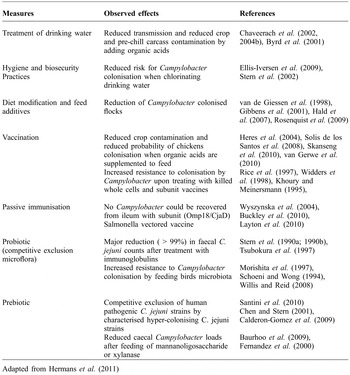
On farm preventive measures for controlling of Campylobacter colonisation in poultry can be achieved by means of various methods. These include water treatment, hygienic and biosecurity measures, supplementing plant-derived additives to the feed, vaccination, passive immunisation, application of prebiotic, and probiotics (competitive exclusion microflora). It was reported that there is a difference between Campylobacter prevention and control measures (Hermans et al., Reference HERMANS, VAN DEUN, MESSENS, MARTEL, VAN IMMERSEEL, HAESEBROUCK, G., HEYNDRICKX and PASMANS2011), which happen at a different stage of the colonisation process. Preventive measures aim at reducing the probability of Campylobacter colonisation in birds (Table 1). However, colonisation-reducing measures
Preventive measures aim at reducing the probability of Campylobacter colonisation in birds.

Adapted from Hermans et al. (Reference HERMANS, VAN DEUN, MESSENS, MARTEL, VAN IMMERSEEL, HAESEBROUCK, G., HEYNDRICKX and PASMANS2011)
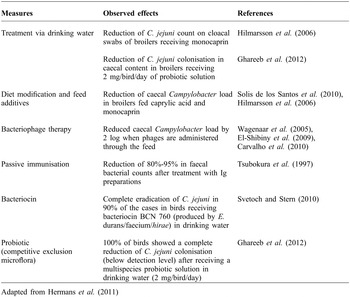
reduce caecal Campylobacter load in colonised birds prior to slaughter, and consequently the surface contamination of the carcasses are reduced (Table 2). For this purpose several approaches have been devised over the past few years, e.g. bacteriophages (Wagenaar et al., Reference WAGENAAR, VAN BERGEN, MUELLER, WASSENAAR and CARLTON2005), bacteriocins (Line et al., Reference LINE, SVETOCH, ERUSLANOV, PERELYGIN, MITSEVICH, MITSEVICH, LEVCHUK, SVETOCH, SEAL, SIRAGUSA and STERN2008), organic acids (Byrd et al., Reference BYRD, HARGIS, CALDWELL, BAILEY, HERRON, MCREYNOLDS, BREWER, ANDERSON, BISCHOFF, CALLAWAY and KUBENA2001; Chaveerach et al., Reference CHAVEERACH, KEUZENKAMP, LIPMAN and VAN KNAPEN2004b; Van Deun et al., Reference VAN DEUN, HAESEBROUCK, VAN IMMERSEEL, DUCATELLE and PASMANS2008) and their derivatives (Hilmarsson et al., Reference HILMARSSON, THORMAR, THRAINSSON and GUNNARSSON2006) or medium chain fatty acids (Hermans et al., Reference HERMANS, MARTEL, VAN DEUN, VERLINDEN, VAN IMMERSEEL, GARMYN, MESSENS, HEYNDRICKX, HAESEBROUCK and PASMANS2010) have been proposed. So far there is no effective, reliable and practical intervention measure available to reduce colonisation of the broiler gut with Campylobacter (Lin, Reference LIN2009). Research has focussed on applying beneficial microorganisms (probiotics) as microbial antagonists as an alternative at the primary production level. Few studies have evidenced a possible role of probiotics in preventing the shedding of C. jejuni at the farm level, although in vitro studies reported a strong antimicrobial activity of several probiotic strains towards this pathogen (Chaveerach et al., Reference CHAVEERACH, LIPMAN and VAN KNAPEN2004a; Ghareeb et al., Reference GHAREEB, AWAD, MOHNL, PORTA, BIARNÉS and SCHATZMAYR2012). Moreover, genetic selection could contribute in combating Campylobacter colonisation in poultry (Kapperud et al., Reference KAPPERUD, SKJERVE, VIK, HAUGE, LYSAKER, AALMEN, OSTROFF and POTTER1993). Poultry lines characterised by an improved overall immunological responsiveness may resist the colonisation of Campylobacter (Swaggerty et al., Reference SWAGGERTY, PEVZNER, HE, GENOVESE, NISBET, KAISER and KOGUT2009). Moreover, improving the health and welfare of the animals can have a role in reducing the probability of Campylobacter colonisation in their gut (Bull et al., Reference BULL, THOMAS, HUMPHREY, ELLIS-IVERSEN, COOK, LOVELL and JORGENSEN2008).
Colonisation-reducing measures are approaches to reduce caecal Campylobacter load in colonised birds prior to slaughter, consequently the surface contamination of the carcasses are reduced.

Adapted from Hermans et al. (Reference HERMANS, VAN DEUN, MESSENS, MARTEL, VAN IMMERSEEL, HAESEBROUCK, G., HEYNDRICKX and PASMANS2011)
Treatment of drinking water
By treating the drinking water of poultry flocks, the risk of infection might be reduced through a reduction in exposure from water and in the crop. In this way, Campylobacter is less likely to reach the caeca and transmission throughout the flock might be reduced or prevented. The in vitro studies realised by Chaveerach et al. (Reference CHAVEERACH, P.D., LIPMAN and VAN KNAPEN2002) have pointed out the bactericidal activity of organic acids used individually or in combination. The four studied acids (formic, acetic, propionic and hydrochloric), alone or in combination at different formulation ratios, were mixed with a commercial broiler feed into bottles containing 250 ml of tap water. The acid combinations have shown an interesting bactericidal activity at pH 4.0 with Campylobacter numbers declining below 1 log cfu.ml-1 within 1 h, and the reduction was higher than the decreasing effect observed with the different acids used individually.
Chaveerach et al. (Reference CHAVEERACH, KEUZENKAMP, LIPMAN and VAN KNAPEN2004b) studied drinking water acidification in vivo by using the same four organic acids as a prophylactic measure. During all the experiment, no Campylobacter was found in acidified drinking water. Although acidification seems to be an effective measure to control water contamination, most chickens were still infected at the end of the experiment, demonstrating the impact of other sources. Byrd et al. (Reference BYRD, HARGIS, CALDWELL, BAILEY, HERRON, MCREYNOLDS, BREWER, ANDERSON, BISCHOFF, CALLAWAY and KUBENA2001) studied drinking water acidification during pre-slaughter feed withdrawal. The addition of 0.5% lactic acid in drinking water significantly reduced crop contamination with Campylobacter as compared with the controls (62.3% vs. 85.1%). Moreover, addition of monocaprin, the mono-acylglycerol of capric acid (Thormar et al., Reference THORMAR, HILMARSSON and BERGSSON2006), to drinking water for the last three days before slaughter resulted in a reduced C. jejuni count on cloacal swabs of both artificially and naturally infected birds (Hilmarsson et al., Reference HILMARSSON, THORMAR, THRAINSSON and GUNNARSSON2006). This treatment did not prevent Campylobacter spread from artificially infected to non-infected birds. Other trials have shown that chlorination of water may be helpful to control Campylobacter colonisation (Ellis-Iversen et al., Reference ELLIS-IVERSEN, JORGENSEN, BULL, POWELL, COOK, HUGAS, TSIGARIDA, ROBINSON and CALISTRI2009).
Hygienic measures and biosecurity
Practical biosecurity measures at the farm level have been determined as the primary strategy to prevent colonisation of housed broiler flocks with Campylobacter entering the processing plant and hence the food chain (Gibbens et al., Reference GIBBENS, GIBBENS, PASCOE, EVANS, DAVIES and SAYERS2001; Rivoal et al., Reference RIVOAL, RAGIMBEAU, SALVAT, COLIN and ERMEL2005). Nevertheless, many authors have shown that biosecurity measures alone are only partly effective in controlling Campylobacter (Sahin et al., Reference SAHIN, LUO, HUANG and ZHANG2003; Van Gerwe et al., Reference VAN GERWE, BOUMA, JACOBS-REITSMA, VAN DEN BROEK, KLINKENBERG, STEGEMAN and HEESTERBEEK2005). However, hygienic farming practices constitute a strategy aiming at preventing the introduction of Campylobacter into a flock by a combination of hygiene and biosecurity measures. A Belgian quantitative microbial risk assessment showed that the incidence of human campylobacteriosis in Belgium would be reduced by 32%, 53% and 77% when the Campylobacter flock prevalence is reduced by 25%, 50% or 75% respectively (Messens et al., Reference MESSENS, HARTNETT, GELLYNCK, VIAENE, HALET, HERMAN and GRIJSPEERDT2007).
Measures that are important to protect the flock include washing hands, wearing protective clothing and disinfected boots, careful cleaning of the poultry house and disinfection protocols, provision of Campylobacter-free water, feed and the removal of spent litter between two flocks. Details on the biosecurity measures designed to control Campylobacter have been reported by Allen and Newell (Reference ALLEN and NEWELL2005). Application of these specific hygienic measures during the rearing period may significantly reduce the risk of Campylobacter infections in broiler flocks (van de Giessen et al., Reference VAN DE GIESSEN, BLOEMBERG, RITMEESTER and TILBURG1996; Evans and Sayers, Reference EVANS and SAYERS2000).
After the introduction of hygienic and biosecurity measures, including the control of rodents and insects, on two Dutch broiler farms, the percentage of Campylobacter-colonised flocks decreased from 66% at one farm and 100% at the second farm to 22% and 42%, respectively (van de Giessen et al., Reference VAN DE GIESSEN, TILBURG, RITMEESTER and VAN DER PLAS1998). In the UK, the implementation of an intervention trial, based on a standard hygiene protocol for personnel and proper disinfection of the broiler house prior to stocking, reduced the prevalence of Campylobacter infection in the broiler population from 80% to <40% (Gibbens et al., Reference GIBBENS, GIBBENS, PASCOE, EVANS, DAVIES and SAYERS2001). It has been demonstrated that the prevalence of broiler flocks colonised with Campylobacter can be reduced from 51.4% to 15.4% by placing fly screens in broiler houses (Hald et al., Reference HALD, SOMMER and SKOVGARD2007). In Denmark, strategies to control Campylobacter were intensified in 2003 (Rosenquist et al., Reference ROSENQUIST, BOYSEN, GALLIANO, NORDENTOFT, ETHELBERG and BORCK2009), with a focus on biosecurity, allocation of meat from colonised flocks to the production of frozen meat products (having reduced Campylobacter counts on their surface due to the freezing procedure) as much as possible and campaigns to inform consumers. This implemented control strategy caused, in part, a decrease of Campylobacter re-colonised flocks from 43% in 2002 to 27% in 2007, a reduction in Campylobacter-positive samples of chilled broiler meat after processing from 18% in 2004 to 8% in 2007 and a drop in registered human campylobacteriosis cases by 12% from 2002 to 2007. These findings suggest that proper application of biosecurity measures can lead to reduced colonisation in poultry. However, because broiler chickens are under constant contamination pressure, biosecurity measures alone will not be sufficient to solve the problem. The limited action of hygiene procedures is based on the fact that, in conditions where broilers are confronted with environmental factors that are scarcely controllable such as range of open-air, wild birds and faeces of domestic animals in case of organic and free-range flocks, biosecurity is difficult to apply. In these production systems, Rivoal et al. (Reference RIVOAL, RAGIMBEAU, SALVAT, COLIN and ERMEL2005) have shown that, even if strict hygiene measures allow broiler flocks to be Campylobacter-negative during the first weeks of age (the indoor period), birds are almost always colonised at slaughter, after the access of birds to the open-air range. Nevertheless, even if high levels of environmental exposure to Campylobacter may overwhelm best practice biosecurity measures, so that these practices cannot guarantee infection prevention, they can help to delay the onset of Campylobacter colonisation and are consequently essential.
Diet modification and feed additives derived from plants
Modification of the feed composition may promote gastrointestinal health and thus contribute to the control of Campylobacter in poultry. Plant-derived antimicrobial feed additives can be administered from the first day of life to prevent Campylobacter colonisation in broiler chickens and to reduce transmission throughout the flock. The observed effects of this application are largely due to their effects in the crop of the birds.
Organic acids such as formic, acetic, propionic and hydrochloric might be used as feed additives in addition to their use in the drinking water to reduce the prevalence of Campylobacter in poultry. The in vitro studies realized by Chaveerach et al. (Reference CHAVEERACH, P.D., LIPMAN and VAN KNAPEN2002) have pointed out the bactericidal activity of organic acids used individually or in combination. The four studied acids (formic, acetic, propionic and hydrochloric), alone or in combination at different formulation ratios, were mixed with a commercial broiler feed into bottles containing 250 ml of tap water. The acid combinations have shown an interesting bactericidal activity at pH 4.0, with Campylobacter numbers declining below 1 log cfu.ml-1 within 1 h, and the reduction was higher than the decreasing effect observed with the different acids used individually. Another study by Heres et al. (Reference HERES, ENGEL, URLINGS, WAGENAAR and VAN KNAPEN2004) has tested fermented feed containing high concentrations of organic acids (5.7% lactic and 0.7% acetic) on susceptibility of chickens to Campylobacter and Salmonella. Broilers fed with fermented feed until 21 days of age needed a ten times higher dose of Campylobacter to achieve the same proportion of infected chickens as the control population. Nevertheless, the protective effects seem relatively limited and dependent on the infection dose according to the pathogen inoculated. On the other hand, caprylic acid leads to reduced colonisation in 10-day-old chicks when given preventively (Solis de los Santos et al., Reference SOLIS DE LOS SANTOS, DONOGHUE, VENKITANARAYANAN, DIRAIN, REYES-HERRERA, BLORE and DONOGHUE2008). In contrast, addition of butyrate to the feed was not able to reduce caecal Campylobacter colonisation in a seeder model using two-week-old broilers (Van Deun et al., Reference VAN DEUN, HAESEBROUCK, VAN IMMERSEEL, DUCATELLE and PASMANS2008). Skanseng et al. (Reference SKANSENG, KALDHUSDAL, MOEN, GJEVRE, JOHANNESSEN, SEKELJA, TROSVIK and RUDI2010) found little effect when supplementing formic acid alone in the feed, but a combination of 2% formic acid with 0.1% sorbate prevented C. jejuni colonisation in chicks.
Medium-chain fatty acids are triglycerides in which two or three of the fatty acid chains attached to glycerol are medium chain in length. They are caproic acid (C6), caprylic acid (C8), capric acid (C10) and lauric acid (C12). Recently, it was demonstrated that the addition of a medium-chain fatty acid mixture to the feed at 1% reduces the probability of Campylobacter colonisation in broiler chickens (van Gerwe et al., Reference VAN GERWE, BOUMA, KLINKENBERG, WAGENAAR, JACOBS-REITSMA and STEGEMAN2010). Solis de los Santos et al. (Reference SOLIS DE LOS SANTOS, DONOGHUE, VENKITANARAYANAN, METCALF, REYES-HERRERA, DIRAIN, AGUIAR, BLORE and DONOGHUE2009) demonstrated that caprylic acid supplemented at 0.7% for 3 or 7 d in the feed consistently decreased caecal C. jejuni counts when compared with positive controls in market-age chickens. In contrast, Hermans et al. (Reference HERMANS, MARTEL, VAN DEUN, VERLINDEN, VAN IMMERSEEL, GARMYN, MESSENS, HEYNDRICKX, HAESEBROUCK and PASMANS2010) found no effect in caecal Campylobacter numbers of broilers fed medium-chain fatty acids (caproic, caprylic or capric acid) from three days before euthanisation in 28-day-old broilers. Direct injection of a concentrated sodium caprate solution into the broiler caecum did not prevent colonisation and did not reduce caecal Campylobacter numbers. It was suggested that intestinal mucus is likely to protect C. jejuni in the broiler caecum against the bactericidal effects of organic acids seen in vitro. However, a considerable reduction (by several log) in caecal Campylobacter numbers was reported when caprylic acid was given from three days before slaughter, in infected market-age broilers (Solis de los Santos et al., Reference SOLIS DE LOS SANTOS, HUME, VENKITANARAYANAN, DONOGHUE, HANNING, SLAVIK, AGUIAR, METCALF, REYES-HERRERA, BLORE and DONOGHUE2010). Moreover, addition of monocaprin to the feed from the last three days before slaughter reduced C. jejuni count on cloacal swabs of both artificially and naturally infected birds (Hilmarsson et al., Reference HILMARSSON, THORMAR, THRAINSSON and GUNNARSSON2006).
Heres et al. (Reference HERES, ENGEL, VAN KNAPEN, WAGENAAR and URLINGS2003) studied the effect of feed fermentation on the Campylobacter contamination of broiler chickens. They used a moistened commercial standard broiler feed (feed: water ration = 1: 1.4) supplemented with a Lactobacillus plantarum. The resulting product (fermented liquid feed) lead to a significant reduction of Campylobacter susceptibility in chickens. This effect was considered due to the high organic acid concentrations and the resulting pH decrease in the feed in addition to its positive impact on the chicken intestinal microflora (Heres et al., Reference HERES, ENGEL, URLINGS, WAGENAAR and VAN KNAPEN2004).
Because of contradictory in vivo results, the contribution of feed additives to control caecal Campylobacter colonisation in poultry is still in question.
Bacteriophage therapy
Bacteriophages are viral parasites highly specific for bacterial species, and as such, have a minimal impact on the microbial populations. Those specific to Campylobacter spp. are frequently found in the intestinal contents of poultry, along with their hosts, where they are particularly prevalent in free-range and organic birds exposed to the environment. From the intestinal content of birds, purified bacteriophages may be transferred to the surface of poultry meat, at slaughter. Here they are able to survive for more than 10 days and are therefore naturally present on foods for human consumption. Campylobacter-specific bacteriophages offer the prospect of a sustainable measure to reduce the numbers of Campylobacter colonisation in poultry.
Use of bacteriophages for reducing caecal infection in poultry is promising, and results have indicated a drop by three log in the number of caecal Campylobacter of exposed chicken (Wagenaar et al., Reference WAGENAAR, VAN BERGEN, MUELLER, WASSENAAR and CARLTON2005).
Atterbury et al. (Reference ATTERBURY, DILLON, SWIFT, CONNERTON, FROST, DODD, REES and CONNERTON2005) demonstrated a correlation between the presence of natural environmental phages and a reduction in the Campylobacter population in broiler caeca. However, Goode et al. (Reference GOODE, ALLEN and BARROW2003) emphasised the limitation of phage use at farm level i.e. the potential for fast selection of resistant Campylobacter following the simultaneous pathogen and bacteriophage release. These authors suggested limiting the use of bacteriophages at the slaughter stage. On the other side, Wagenaar et al. (Reference WAGENAAR, VAN BERGEN, MUELLER, WASSENAAR and CARLTON2005) consider the release of phage-infected Campylobacter in the environment to be acceptable, since phages have been shown to reside in Campylobacter populations present on naturally infected poultry. El-Shibiny et al. (Reference EL-SHIBINY, SCOTT, TIMMS, METAWEA, CONNERTON and CONNERTON2009) observed a two-log CFU/g reduction in caecal Campylobacter levels (after two days). Despite the fact that Campylobacter, after a sudden drop, seems to re-establish itself to nearly its original counts, results indicate that bacteriophages can possibly be successfully applied in broilers just before slaughter to reduce the caecal bacterial load. Further research in this area showed that administering phages in the feed is more efficient than oral gavage (Carvalho et al., Reference CARVALHO, GANNON, HALFHIDE, SANTOS, HAYES, ROE and AZEREDO2010). This study revealed an initial drop, after two days exposure, of approximately two log in the numbers of C. jejuni in the faecal material of infected one week old birds.
The use of phage products in broilers seems to be a promising way to reduce caecal colonisation with C. jejuni. However, questions regarding both immediate and long-term efficacy, consumer safety and application methods arise (Hagens and Loessner, Reference HAGENS and LOESSNER2010). In the study of El-Shibiny et al. (Reference EL-SHIBINY, SCOTT, TIMMS, METAWEA, CONNERTON and CONNERTON2009) it was shown that 2% of the Campylobacter population exposed to virulent phages in the chicken developed phage-resistance. Carvalho et al. (Reference CARVALHO, GANNON, HALFHIDE, SANTOS, HAYES, ROE and AZEREDO2010) isolated Campylobacter strains that were phage-resistant at a frequency of 13% from chicks previously treated with phages. Unusually and before the observation of phage resistance, a lower frequency (6%) of Campylobacter strains were resistant to phage, indicating that Campylobacter can acquire phage resistance naturally.
Vaccination and passive immunisation (administration of antibodies against Campylobacter)
Vaccination of poultry against Campylobacter has been considered to be a more effective measure than strict hygiene practices by some studies (de Zoete et al., Reference DE ZOETE, VAN PUTTEN and WAGENAAR2007), because of the observation of a Campylobacter-specific immune response in chickens (Rice et al., Reference RICE, ROLLINS, MALLINSON, CARR and JOSEPH1997). It was shown that chicken immunisation with a virulent Salmonella vaccine strain carrying C. jejuni cjaA gene, encoding for highly immunogenic proteins, may be an attractive and efficient approach for bird vaccination (Wyszyńska et al., 2004).
Experimental studies have shown that chick colonisation can be inhibited by using antibodies. Campylobacter specific maternal antibodies protect young chickens from colonisation (Sahin et al., Reference SAHIN, LUO, HUANG and ZHANG2003). Furthermore, Tsubokura et al. (Reference TSUBOKURA, BERNDTSON, BOGSTEDT, KAIJSER, KIM, OZEKI and HAMMARSTROM1997) showed a prophylactic and therapeutic effect against C. jejuni, for at least five days post-infection, by oral administration of bovine and chicken immunoglobulin preparations given to 22-days-old chickens. Nevertheless, the use of maternal antibodies could be hindered by their short protection period, as they are unable to cover the whole rearing period. Wilkie (Reference WILKIE2006) purified and concentrated egg yolk antibodies from C. jejuni vaccinated hens. Three hours after experimentally infecting day-of-hatch broiler chicks with 5 x 10⁷ cfu C. jejuni, yolk antibodies were administered via oral gavage or in the feed at a final concentration of 0.5% (w/w) until day 11 post-challenge. Despite measurable antibody activity in vitro, no significant reduction in the intestinal colonisation by C. jejuni could be demonstrated.
Bacteriocin administration
Bacteriocins are antimicrobial polypeptides produced by bacteria that have inhibitory activity against the growth of closely related bacteria (Kim and Rajagopal, Reference KIM and RAJAGOPAL2001). Because of their ability to kill bacteria, bacteriocins can be described as antibiotics, although their mode of action is different (Cleveland et al., Reference CLEVELAND, MONTVILLE, NES and CHIKINDAS2001). Their narrow spectrum activity is the reason why bacteriocins are able to kill only closely-related bacteria. Bacteriocin concentrations produced by probiotic bacteria, which can inhibit bacteriocin-sensitive organisms, are effective when the number of probiotic bacteria is at least 8.0 log CFU/ml (Schillinger and Lucke, Reference SCHILLINGER and LUCKE1989).
Svetoch and Stern (Reference SVETOCH and STERN2010) recently reviewed bacteriocin applications to reduce the caecal Campylobacter counts in broiler chickens of colonised flocks. Applying purified encapsulated bacteriocin from either L. salivarius NRRL B-30514 or P. polymyxa NRRL-B-30509 to the feed during three days before euthanisation led to a reduction of caecal Campylobacter colonisation in broiler chickens, orally gavaged with C. jejuni at day-of-hatch, by at least six log. Supplementing the bacteriocin BCN 760 in drinking water at 3.5–25 mg per bird for three days before slaughter was the most effective, resulting in a complete elimination of C. jejuni in 90% of the cases or a reduction of over six log. Santini et al. (Reference SANTINI, BAFFONI, GAGGIA, GRANATA, GASBARRI, GIOIA and BIAVATI2010) reported both marked in vitro and in vivo activity for Bifidobacterium longum PCB 133 toward Campylobacter. After two weeks of daily administration, excreted B. longum PCB 133 counts were still high in the faeces of orally gavaged chicks, even after a wash-out period of six days, and C. jejuni numbers were significantly reduced by one log after this administration period.
Probiotics
Probiotics can be defined as live microbial feed supplements that beneficially affect the host animal by improving its intestinal health (Fuller, Reference FULLER1989). The beneficial effect of probiotics are: (1) to help in maintaining a beneficial microflora in the gastrointestinal tract by competitively inhibiting the growth of pathogenic microorganisms (Jin et al., Reference JIN, HO, ABDULLAH and JALALUDIN1996) and (2) to increase nutrient utilisation through improved intestinal health resulting in greater intestinal enzyme activities and nutrient availability (Nahashon et al., Reference NAHASHON, NAKAUE and MIROSH1996).
It has been shown in several studies that probiotic bacterial cultures can be used for prophylactic measures, as well as for co-treatment or postoperative treatment of infections caused by food-borne pathogens (Chen and Walker, Reference CHEN and WALKER2005). The ability of probiotic bacteria to produce antimicrobial substances which inhibit and destroy spoilage and toxic food borne organisms and human pathogens in mixed culture has been known for a long time. To date, only a few studies have shown a possible role of probiotics in preventing the shedding of C. jejuni at the level of primary production, although in vitro studies reported a strong antimicrobial activity of several probiotic strains towards this pathogen (Chaveerach et al., Reference CHAVEERACH, LIPMAN and VAN KNAPEN2004a). In the last few years, several efforts have been dedicated to define targeted microbial mixtures that could have preventive activity against Campylobacter infections. The use of a probiotic containing Lactobacillus acidophilus and Enterococcus faecium in chicks during the first three days of rearing reduced both C. jejuni faecal shedding and colonisation by 70% and 27%, respectively in market-age broilers experimentally infected with C. jejuni 6 h after the first oral administration of the probiotic (Morishita et al., Reference MORISHITA, AYE, HARR, COBB and CLIFFORD1997). Exposure to competitive exclusion cultures of Citrobacter diversus, Klebsiella pneumoniae and E. coli effectively prevented or reduced C. jejuni colonisation in chickens after Campylobacter inoculation (Schoeni and Wong, Reference SCHOENI and WONG1994). Chang and Chen (Reference CHANG and CHEN2000) reported significant in vitro inhibition of C. jejuni by a mixture of four Lactobacillus species. Willis and Reid (Reference WILLIS and REID2008) showed that C. jejuni was present at a lower level in broiler chickens fed with a standard diet supplemented with a probiotic formulation containing L. acidophilus, L. casei, B. thermophilus, and E. faecium (108 cfu/g) compared to the control.
Recently, a B. longum strain (isolated from human intestine) showed marked antimicrobial activity against Campylobacter strains both in vitro and in vivo (Santini et al., Reference SANTINI, BAFFONI, GAGGIA, GRANATA, GASBARRI, GIOIA and BIAVATI2010). Furthermore, a multispecies avian-specific probiotic, which contains Enterococcus faecium, Pediococcus acidilactici, Bifidobacterium animalis, Lactobacillus salivarius and Lactobacillus reuteri, isolated from healthy chicken gut, was shown to reduce caecal colonisation of Campylobacter jejuni in broiler chickens in vivo and showed high antimicrobial activity in vitro (Ghareeb et al., Reference GHAREEB, AWAD, MOHNL, PORTA, BIARNÉS and SCHATZMAYR2012). These studies indicate that the use of probiotic of avian origin is promising to control Campylobacter jejuni in broiler chickens during rearing at farm level.
Competitive exclusion
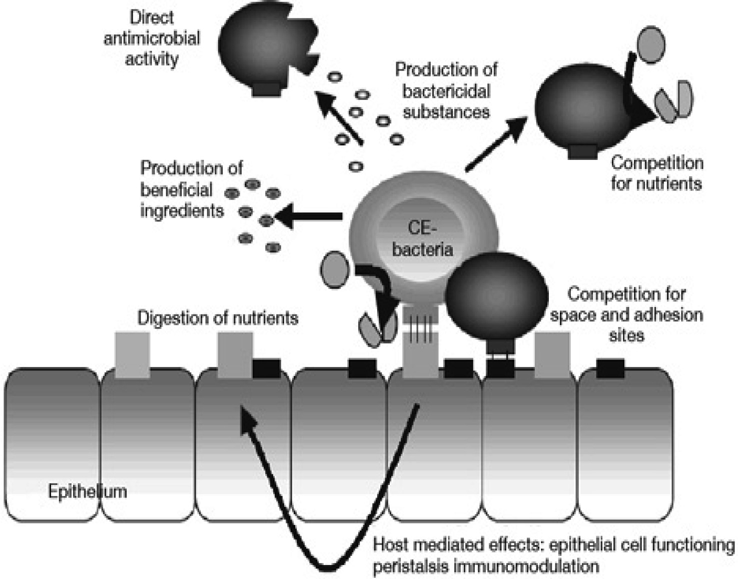
Competitive exclusion (CE) is a concept that takes advantage of bacterial antagonism to reduce animal intestinal colonisation by pathogenic microorganisms. The study of defined or undefined flora acting via competitive exclusion mechanisms was first initiated in the 1970s by Nurmi and Rantala (Reference NURMI and RANTALA1973). They observed that the introduction of gut contents (originating from adult cockerels) to 1-2 d old chicks could protect young birds against Salmonella infantis infection. Figure 1 summarises the possible interactions between competitive exclusion flora and potential pathogens in broiler caeca. A twofold competition may operate in the gastrointestinal tract, i.e. competition for nutrients and for adhesion sites. Moreover, CE bacterial formulations may have a direct antimicrobial effect by the production of lactic acid, volatile fatty acid, hydrogen peroxide or bacteriocins.
Competitive exclusion is a prophylactic measure that aims to increase the resistance of chicks to Campylobacter infection. Undefined bacterial mixtures have been demonstrated to effectively control Campylobacter infections in young chicks artificially challenged with a chicken C. jejuni isolate (Soerjadi-Liem et al., Reference SOERJADI-LIEM, SNOEYENBOS and WEINACK1984).
Interactions between competitive exclusion flora and potential pathogens in broiler caeca. Adapted from van der Wielen (Reference VAN DER WIELEN2002).

Prebiotics
Prebiotics are non-digestible ingredients such as fructo-oligosaccarides (FOS, oligofructose and inulin) and mannan oligosaccharides (Bio-MOS) which are widely used in the poultry industry (Patterson and Burkholder, Reference PATTERSON and BURKHOLDER2003). They act as quantitatively available substrates for gastrointestinal tract microflora within the gut of the host (Roberfroid et al., Reference ROBERFROID, VANLOO and GIBSON1998), enhance the growth of beneficial bacteria (Bifidobacterium and Lactobacillus) and inhibit pathogenic bacteria like Escherichia coli and Salmonella spp. (Fukata et al., Reference FUKATA, SASAI, MIYAMOTO and BABA1999; Xu et al., Reference XU, HU, XIA, ZHAN and WANG2003). However, fewer studies have been conducted to evaluate the efficacy of probiotics to reduce the Campylobacter colonisation in poultry. The addition of mannanoligosaccharide to the feed of naturally infected birds and xylanase in artificially infected broilers, resulted in a significant decrease in caecal C. jejuni counts in both cases (Fernandez et al., Reference FERNANDEZ, SHARMA, HINTON and BEDFORD2000; Baurhoo et al., Reference BAURHOO, FERKET and ZHAO2009).
Conclusions
The unacceptable high frequency of Campylobacter jejuni transmission from poultry to humans encourages scientists to consider and create alternative intervention strategies to control pathogens in poultry production. Intestinal colonisation of broiler chickens with Campylobacter during rearing is responsible for the contamination of the carcasses after processing. An average prevalence of Campylobacter contamination on poultry carcasses is reported to be in the range of 60–80% (EFSA, Reference EFSA2010b). De-feathering and evisceration, by contaminated faeces leaking from the cloaca and visceral rupture of the caeca carrying a high Campylobacter load resulted in carcass contamination.
Measures taken to reduce Campylobacter colonisation in the intestinal tract of poultry during primary production have the potential for reducing contamination of poultry products and thus the incidence of human campylobacteriosis. Several approaches have been examined over the past few years, all with varying degrees of success. However, to date there is no reliable and practical intervention measure available to reduce colonisation of the broiler gut with Campylobacter at the farm level. Reduction of intestinal colonisation of chickens by dietary manipulation could be successful and are certainly worth the effort, as indicated by the results from experimental studies or field data. Using this farm-friendly, applied approach is highly efficacious in therapeutic oral treatment of broiler chicken, as shown in trials where a multispecies probiotic was efficiently capable of reducing Campylobacter jejuni colonisation in the gut of broiler chickens. Further research using dietary change on the colonisation of C. jejuni is required.
To conclude, probiotic and prebiotic applications in combination with enhanced biosecurity and fly control could be an important strategy to eradicate this human pathogen from poultry flocks. However, more research should be performed to investigate the real effectiveness and economical costs of these methods on large scales to achieve this strategy. In addition monitoring Campylobacter levels by regulatory agencies and decontamination of slaughtered carcasses can promote a safer poultry product and reduce human risk.