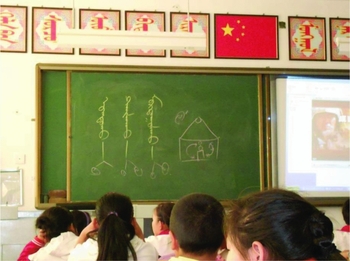
This article addresses identity issues among Indigenous youth, specifically, young Russian-born Buriat-Mongolian students, who struggled to understand their sense of cultural identity while living and studying in Chinese Inner Mongolia, an area dominated by the Han Chinese since the fall of the Qing Dynasty in 1911 (Bulag, Reference Bulag2000). For centuries, Siberian Buriats have lived under Russian rule. While in China, these Russian-born Buriats also experienced Han hegemonic practices towards themselves and other Mongolian minorities. As a transnational group, Buriat youth in this study found that their cultural identity was often threatened in China. When questioned, young Buriats identified with their ancestral homeland, the Republic of Buriatia and with their national homeland, the Russian Federation. Results indicate that land serves as a key identity marker.
The importance of land as an identity marker for Indigenous people is well documented (Cunningham & Stanley, Reference Cunningham and Stanley2003). Buriat homelands are located in Russia, in present-day southern Siberia (Humphrey, Reference Humphrey and Smith1996). This study reports that Indigenous Russian-born Buriat focal youth identified strongly with their homeland. Buriat youth respected their homeland as sacred and alive and they honoured their ancestors who lived and are buried on Buriat land. Yet simultaneously, while studying in China, these young Buriats also at times labelled themselves as coming from Russian lands.
There is little is written concerning how modern Indigenous youth may make use of their colonial heritage as a shield when studying and living under the rule of another hegemonic nation. For Buriats, land, not language, served as a crucial way to identify themselves, and to differentiate themselves from other Mongolian youth. Although Russians invaded Buriat lands, young Buriats used this to their advantage while living under the domination of Han Chinese in China. At times, they identified ‘Russian lands’ as stronger than Chinese lands to defend themselves in China, yet they also called upon their memories of Buriat homelands to assert themselves as Buriats in China. They separated themselves from other Mongolians by identifying themselves as ‘from Russia.’ Analysing context was key to understanding the why and when Buriats choose to self-identify using Russian or Buriat as their homeland. Notably, a Buriat elder commented that Buriat land would accommodate and even transform a non-Buriat — which further validated the sacred power of Buriatia.
The first part of the paper introduces the Buriats, their community in China, the focal children, my researcher positionality and the research site in China. I describe Russian colonisation, and why Mongolian medical practices are valued by Buriats. The following section discusses methodology and theoretical framework. Next, I present and analyse data, addressing Indigenous youth and resistance from a sociocultural perspective, correlating with the work of North American scholars studying contemporary cultural changes among Indigenous youth in North America; Teresa McCarty (Reference McCarty2003), Tiffany Lee (Reference Lee2009), Sheila Nicholas (Reference Nicholas2009), among others. Regarding ethnic and cultural tensions between Mongolian peoples and the Han Chinese, I refer to the excellent work of Uradyn Bulag and David Sneath; likewise, regarding Buriat and Russian tensions I refer to Caroline Humphrey, and others.
Buriat People
Today, most modern day Buriats live in three countries: Siberian Russia, northern Outer Mongolia and/or Chinese Inner Mongolia (Montgomery, Reference Montgomery2005). Approximately 400,000 Buriats live in the Russian Federation; they are the Russian Federation's largest Asian ethnic minority and the titular nationality of Buriatia (Khilkhanova & Khilkhanov, Reference Khilkhanova and Khilkhanov2004). Lake Baikal, the world's deepest freshwater lake, lies inside Buriat traditional homelands.
Buriats speak a northern Mongolian language (Poppe, Reference Poppe1965). In addition to linguistic differences, since ancient times Buriats both resemble and differ from other Mongolian peoples by their ways of life, which range from nomadic herding and hunting to (later) sedentary agricultural practices (Krader, Reference Krader1954). From antiquity, Buriats, like other Mongolians, have been followers of what the Western world calls shamanism, or what the Mongols call tengriism (Bira, Reference Bira2004). For hundreds of years, many Buriats have combined these practices with a form of Tibetan Buddhism, (Montgomery, Reference Montgomery2005).
The Migration Story
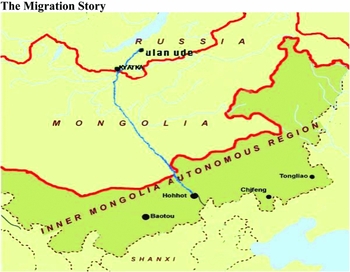
The microcommunity of Buriats I observed for my research first migrated to Hohhot, Inner Mongolia, China, in 2004. Three families made the initial journey (see Figure 1). Two families came from Ulan Ude and one came from a small town, Kyakhta, located on the border of Russia with Outer Mongolia. They came to China to educate their children; other Buriats had told them and about the so-called superior resources of Chinese education.
Migration route from Buriatia, Russian Federation to Inner Mongolia, China.

Post-Soviet education for Indigenous people has deteriorated since the break-up of the USSR in the early 1990s (Bloch, Reference Bloch2004). Economic wellbeing of many nonmainstream citizens, has also deteriorated. Along with some initial euphoric responses at the fall of the Soviet Union, the Buriat strove to reaffirm their language and traditions. Buriats depicted here decided to seek what they perceived as culturally and academically appropriate instruction for their children in China, as it was not available in Russia. Their educational goals were twofold: (1) language fluency and literacy via a bilingual school and (2) alternative Mongolian medical studies at a unique medical institute. Both schools are located in Inner Mongolia's capital city.
In 2003, one of the three Buriat families from the Republic of Buriatia (hereafter Buriatia) had met a Chinese-born Buriat man, Bata (all names are pseudonyms). He had regularly travelled to Ulan Ude on business for several years. Bata convinced some Buriats to migrate to Hohhot, arguing that superior educational resources existed in Chinese Inner Mongolia. A fusion of traditional Tibetan, Mongolian and Chinese medical practices could be learned at a medical institute in Hohhot. These Russian Buriats, being Yellow Hat Buddhists, decided that giving their children this honourable profession — a doctor being also a spiritual healer for Buddhists (Laird, Reference Laird2006) — was an ideal educational opportunity. Consequently, families made plans and trekked to Hohhot. They were met and helped by Bata and his extended family.
Soviet Mongolians (Buriats and Outer Mongolians) had lost these ancient Indigenous-healing arts during Stalin's purges in the 1930s (Montgomery, Reference Montgomery2005). Likewise, the Chinese had shut down Indigenous medical institutions during the Cultural Revolution (1966–1976) (Dikötter, Reference Dikötter2010). After the Open Door Policy in the early 1980s, Chinese authorities again allowed and supported to some extent this type of ancient medical training. Because of the Inner Mongolian ancient historical connection with Tibetans, Mongolians and Chinese (Laird, Reference Laird2006), Hohhot remains one of the few places on earth where Tibetan/Mongolian healing arts can be learned. Studies are offered inside the Hohhot Medical College. To qualify, students must be literate in Old Mongolian and Chinese.
To pre-prepare young Buriat students as Mongolian medical students, much language training was required. To become literate in Chinese and Old Mongolian, Bata suggested that Buriat children first attend a Mandarin–Mongolian bilingual school in Hohhot. This school, built in the late 1980s, promoted Indigenous language education, reaffirming communist policies toward China's so called ‘minority peoples’ (Feng, Reference Feng2007). This wellfunded bilingual school held special intensive Chinese language classes for foreign students and employed many competent teachers of Mongolian.
Researcher's Position
I became acquainted with a small community of Buriats in March 2006, while teaching English at a Hohhot university. A colleague introduced me to several Buriat women because I am a Russian speaker. She thought I would enjoy making new friends. She also knew that these Buriat mothers spoke neither English nor Chinese; they felt isolated and lonely. We became friends via our common language, Russian. While observing Buriat children, I became fascinated by the practices and politics of language acquisition. Later, I returned to the United States to begin doctoral studies. Ultimately, I conducted fieldwork focusing upon the challenges these Buriat children faced while attending school in China.
As a White American woman, my shared language (Russian) and my long term, cordial relationships with Buriat families helped me gain insight into the Buriat situation in China. As a scholar and friend, I have been transparent and remain dedicated to Buriat friends. Likewise, Buriat extended families in China and Russia have collaborated with me, befriended me, travelled with me and educated me. They patiently explained concepts concerning their culture and history and validated my work. Some parents asked me to help their children learn English and to understand aspects of Western culture. Buriat children have told me I am their adopted auntie; I am also perceived as an informal English tutor, and a family friend. Our amicable relationship has existed since 2006.
Focal Children
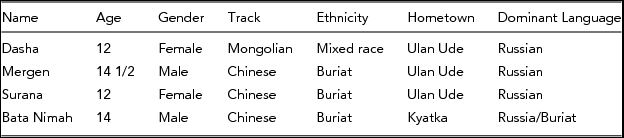
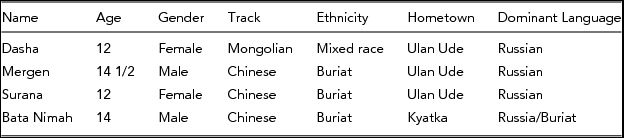
This ethnographic study focused upon four focal participants, Buriat youth, aged 12–15 years, from Buriatia, Russian Federation (see Table 1). Some had resided previously in Ulan Ude (Mergen, Dasha), the capital city, or in the outskirts of Ulan Ude (Surana), and one (Bata-Nimah) coming from Kyakhta, near the Outer Mongolian and Russian border (see map). I found the children by informally asking around the Buriat community. One parent mentioned my project to another, and shortly after establishing myself again in Hohhot, I had many enthusiastic participants, including parents, teachers and city locals (Han, Mongol or Buriat). During fieldwork, I interviewed Buriat school graduates, and Mongolians and Buriats attending university. I also interviewed Buriats in Buriatia.
Focal Children/Participants
Children as Vulnerable Populations
Conducting research with children presents unique ethical and methodological challenges. Recently, the trend has been to focus on ethics to the detriment of methods (Lambert, Glacken, & McCarron, Reference Lambert, Glacken and McCarron2013). Yet, in acknowledging children's vulnerability, immaturity and developmental stages, there are ways to maximise children's ability to express their views. To empower children and obtain child led data, it is possible to combine traditional adult methods with innovative child friendly methods (Balen, Holroyd, Mountain, & Wood, 2000/Reference Balen, Holroyd, Mountain and Wood2001). This means thinking up data collection methods that children perceive as fun and interesting so they are motivated to participate in research. I offered paired focal children a creative, English language lesson, which separated me from their parents as another adult authority figure.
Interviews and Conversational Style with Children
I wanted Buriat children's voices to be heard, paying attention to my participants’ interpretations of events, and how they made meanings from their stories, to the social elements of situations (Clandinin & Connelly, Reference Clandinin, Connelly, Denzin and Lincoln1998). I conducted open-ended interviews, listening to many stories, using an informal conversational style. The school setting lent itself to chatting during class breaks (ten minutes), the morning exercise and patriotic exercise break (20 minutes) or walking backing and forth to school (15 minutes). Chat interviews took place whenever and wherever the context facilitated. This helped me capture a holistic picture of children's lives and thoughts. Beginning with a general open question, I'd ask a child to tell or explain something: how was this school different from that in Buriatia; did she or he miss friends back home; and so on. Conversations often wandered off topic; I simply listened.
Research Site
The Inner Mongolians, under Chairman Mao's directives, established the first minority autonomous region in China over 70 years ago (Bulag Reference Bulag2000, Reference Bulag2003). Today, modern China remains keen on keeping ‘borderland minorities,’ from attempting to secede (Han Reference Han2011). In the 1980s, bilingual practices and educational concessions for Chinese minorities were reaffirmed and enhanced (Tsung Reference Tsung2009). The school site (hereafter school), an outcome of these policies, attracted Mongolians. Although the school was well funded, many local Inner Mongolians told me that studying at a Han Chinese school was better, because the ‘Chinese (language) is more important’ and because ‘We must live under them (the Chinese).’
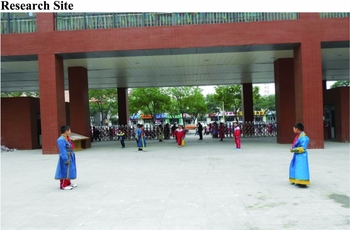
The research school, a combined primary and middle school, was a state-funded bilingual boarding school with 1700 students (see Figure 2). In 2012, 60 Outer Mongolian and Buriat international students enrolled; most studied in Temut Mongolian, except English and Mandarin language classes.
Entrance to research site: Bilingual school in Hohhot.

In 2012, more than 90 per cent of the students were urban Chinese Mongolian children from Hohhot. The remaining Chinese Mongolian students came from northern grasslands; foreign Mongolian students came from Outer Mongolia and Russia. This bilingual school could also be described as a heritage language school. Buriat parent commented, ‘It's really for those Chinese Mongols who don't understand much Mongolian, but because teachers use both languages, it's good for us, too.’
Two Tracks
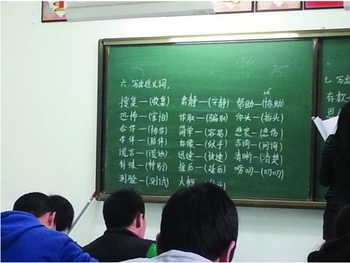
Administrators created a special Mandarin Language Track for international students. This section consisted of two levels, year one and year two, housing 22–30 students. In 2012, only Outer Mongolians and Russian Mongolians were enrolled (see Figures 3 and 4).
Track 1 in the Bilingual school.

Track 2 in the Bilingual school.

Most Buriat parents viewed this track as a quick, comprehensive way for their children to gain fluency in Mandarin Chinese. Buriat children also studied Mongolian with language tutors for three hours on Sundays. This track did not follow Chinese state curriculum standards, focusing instead upon intensive Mandarin language studies designed to allow non-Chinese speakers to pass the state Chinese Language Proficiency Examination (HSK). Other classes: math, science, physical education, art were optional.
In the Chinese track, the teacher spoke in Mandarin Chinese, but frequently code-switched, using Temut Mongolian. Khalks (Outer Mongolians) could understand this variety easily, but Buriat Russian students struggled, looking up words in their dictionaries. Their knowledge of Buriat varied — all were Russian dominant. Buriat-Mongolian was linguistically too distant for them to understand Temut-Mongolian. Three Buriats: Surana (Year 1) Bata-Nimah, and Mergen (Year 2) were enrolled in this track; only Dasha, was enrolled in the standard Grade 4 Temut Mongolian track. This linguistic struggle certainly had impact on the focal children's sense of self-efficacy and could also be a factor in how they chose to identify themselves in certain contexts.
Primary classrooms were crowded (55–65 students). Dasha, enrolled in Grade 4, studied nine subjects a week in Temut, including: math, geography, music/art, computer, PE, ethics and English, Chinese and Mongolian languages. Dasha's mother had placed her daughter in the Mongolian Track because ‘I wanted her to really learn Mongolian well, not just pick it up from classmates and tutors. Because we live in China she will naturally learn Chinese.’ Dasha, a Russian monolingual, did not receive any special Mandarin tutoring. Dasha reported that it was ‘hard, really hard at first, to understand anything at all’ during her first year. She struggled at school, often got into fights with her classmates, and told me numerous times that she wanted to ‘go home to Russia.’ Dasha as well as other Buriats, perceived Russian Buriatia as a Buriat place, their sacred homeland.
Russian Colonisation
In the 17th century, the Buriats in Siberian lands fell under the Russian imperial yoke. In the 17th century, Buriats living in western areas were forcibly converted to Russian Orthodox Christianity; all were made to pay taxes to Imperial Russia. Over time, Buriat lands and pastures were invaded by greater and greater numbers of Russian and non-Russian immigrants. Cossacks, priests, peasants, explorers, convicts, exiles, outcasts and even revolutionaries, invaded. Nonnatives soon outnumbered the Indigenous population (Forsyth, Reference Forsyth1992).
Russians colonisation often negatively impacted the Buriat. The invaders changed traditional, nomadic lifestyles. They forced Buriats to adopt the Russian lifestyle and language. Russian leaders and later Soviet authorities, criticised, even condemned, Buriat spiritual practices (Montgomery, Reference Montgomery2005). Russian politics also impacted Buriats everywhere. During the Russian Revolution, the Russian Civil War, political extremism and purges under Stalin, as well as industrialisation and the two world wars, Buriats in Russia, Mongolia and China suffered and struggled to survive.
During the Stalinist years (1937–1953), Buriats endured an overwhelming forced assimilation of the Russian language and culture, which included denigration of their language and culture. Many also suffered and/or lost their lives in Stalin's Great Purges. The Buriat language was no longer taught in schools, lamas and religious leaders were tortured and killed, and many innocent people lost their livelihoods and/or their lives (Humphrey, Reference Humphrey and Smith1996). By the early 20th century, immigrant outsiders far outnumbered Buriats in their homeland. With this outnumbering came Soviet urbanisation and collectivisation. Buriat language and culture lost power and prestige (Humphrey, Reference Humphrey and Smith1996). Nevertheless, in 1924, the Buriats established autonomy and created the Buriat Republic (Montgomery, Reference Montgomery2005). In 1937, Stalin forced the new republic to shrink her borders. Soviet rule imposed Cyrillic, replacing classical (vertical) Mongolian script. Indigenous cultural knowledge was lost (Khilkhanova & Khilkhanov, Reference Khilkhanova and Khilkhanov2004).
Why Study Mongolian Medicine?
With the 17th century adoption of Tibetan Yellow Hat Buddhism, literacy and education in the form of Buddhist temples and monastery schools offered Buriats moral and spiritual knowledge, and a way to consolidate and preserve Indigenous knowledge (Montgomery, Reference Montgomery2005). Buddhism spread slowly among Buriats, who merged their shamanistic beliefs with Buddhist beliefs (Forsyth, Reference Forsyth1992). Buriat Buddhist doctrines emphasised literacy. One reason for educating Buriat youth in China rested upon the Buddhist devotion of their parents, who wanted their children to become practicing Buddhists who served as traditional healers skilled in Mongolian medical arts. This parental wish reflected the sense that Soviet ideology, promoting western science and medicine, was no longer respected or idealised among post-Soviet Buriats.
During the Soviet era Soviet science had reached an ascendency (Quijada, Reference Quijada2012). Many Soviet educated Buriats had sought to become members of the educational elite. When the USSR collapsed, however, Buriats recognised the importance of regaining religious and spiritual practices (Balzer, Reference Balzer1999). This rethinking of Soviet ideology extolling western science and knowledge has now confronted traditional Buriat worldviews, which include and fuse shamanistic practices with Buddhism. Buriat concepts of illness and soul sickness are being renegotiated in post-Soviet times. Many Buriats have turned toward alternative, traditional forms of healing.
Methodology and Framework
Ethnography was the methodology; Bakhtin's dialogism, together with a sociocultural perspective, comprised my theoretical framework. Ethnographic methods situate, locate and interpret findings concerning homeland and identity. I was the prime instrument of data collection (Wolcott, Reference Wolcott1999). Data collection included: participant observations, observations, interviews (formal and informal), along with artefact collection, audio recordings and chat/texting via Internet and cell phone.
Data were generated via fieldwork, incorporating participant observations, observations, informal conversations, interviews and participation in school/family activities. I collected artefacts; documentary evidence regarding the policies, politics and philosophies of bilingual education in Inner Mongolia. I photographed classroom artefacts (school announcements schedules, artwork, graffiti) and home artefacts (Buddhist texts, books, magazines).
Intertwining the data generated an information matrix, leading to various themes. Many emphasised how historical and political context impacted the environment in which the focal children lived. This matrix led me to use Bakhtin's theories of dialogism for analysis. In the field, my role varied. I was not merely a passive observer but also I had different degrees of researcher involvement (Spradley, Reference Spradley1980). In various contexts, I was perceived as family friend, an auntie figure, and also as a friendly foreign English teacher. Also, I understood children to be vulnerable populations and acted accordingly (Christenson & Prout, Reference Christensen and Prout2002). In my roles with children, I listened carefully and respectfully to them, allowing them agency and voice. Also, I interacted with children by chatting and soliciting their help; for example, with smartphones and other technology. With the parents, I often became an active participant, seeking to do what they were doing, and to learn from them as well.
Fieldwork lasted 18 months and involved watching focal children for one to six hours a day several times a week in school, from late August 2012 through May 2013, with a winter break of five weeks. I ate, travelled and lived with Buriats. During holidays, I celebrated with them.
During the school year, six hours a week were spent in homes and other domains. When visiting, I watched the children study, read, chat or play. Whenever possible, I engaged with the children and/or their parents/guardians as a conversationalist or friend, watching movies or Internet clips, leafing through fashion magazines or sitting and talking at a kitchen table.
During school functions, I attended school celebrations, official meetings and activities. This helped me to cross check the data. One summer, I spent a month in Buriatia, primarily in Kyakhta, with a Buriat family. As researcher, I brought together etic and emic analyses of communication (Wolcott, Reference Wolcott1999). As outsider, I gained insights into the communicative acts of the Buriat focal children, by observing what may be considered ordinary life at home and at school with a critical lens. I was keenly aware of my position as researcher and my race and gender and ethnicity while conducting fieldwork, and while analysing data. To increase validity, I relied upon input from my research allies, as well as observances from participants. I checked and rechecked my observations and perceptions with the Buriat community.
Data Analysis
To analyse narrative data, I relied upon Bakhtin's theories of dialogism and ideological becoming. Bakhtinian theories firmly place individuals in a social context, while simultaneously connecting them in time and space to past and present (Clark & Holquist, Reference Clark and Holquist1984). Bakhtin was interested in the nature of language, which he perceived as situated utterance: talk in context. Dialogism and ideological becoming both affirm the social, dynamic nature of language acquisition and identity construction (Clark & Holquist, Reference Clark and Holquist1984).
In The Dialogic Imagination, Bakhtin (Reference Bakhtin, Emerson and Holquist1981) postulated that inner speech coming from socially embedded utterances reached outward, intertwining individual consciousness within a dynamic and complex social environment. As humans, we have an ongoing and unique give and take exchange with others. This exchange rests upon several dimensions (past and present), and can be expressed on different levels (written or spoken). Grounded in the past speech and languages of others, people continue to give and receive; both sides are dependent upon each other's words for interactions to live, develop, and grow. For Bakhtin, even the language of intangible thought contains inner dialogism, as it is also filled with the intention of others. Bakhtin's dialogic theory essential states that people do not have identities unless they are in communication with others. Humans have the unique potential to communicate through time and space, via a variety of modes: oral, literate and digital. Bakhtin's followers perceive meaning, culture and identity as social constructs. Bakhtin concentrated his focus on a natural setting: the everyday experience (Holquist, Reference Holquist1990).
Bakhtian dialogism offers a dynamic opportunity to create new meaning. In dialogical, heteroglossic, polyphonic interactions ‘. . .several consciousnesses meet as equals and engage in a dialogue that is unfinalisable’ (Bakhtin, Reference Bakhtin, Emerson and Holquist1981, p. 238–9). Such speech is dynamic, shaping social groups. Bakhtin, in his essay Marxism and the Philosophy of Language, also recognised that some people and societies try to monopolise and monologise thought and dialogue (Clark & Holquist, Reference Clark and Holquist1984). Bakhtin used the term dialogism to refer to both speech and written discourse in referring to the presence of two distinct voices in one utterance. This implies that the intentions of speaker and listener are mixed, meaning can be created out of past utterances and that utterances, can be analysed by how those engaged position themselves in relation to one another.
People are constantly responding to their inner and outer dialogic worlds, seeking to make meaning. As we do this, the unlimited possibilities in language can transform our thoughts and actions. Bakhtin's second idea, ‘ideological becoming,’ represents a constantly turning dharma wheel. This wheel conveys imprints meanings upon our consciousness. Via dialogues and relationships with others, we learn to think about ideas and actions, to interpret language and utterances and to understand the intentions and emotions of others. We interact, we negotiate and we build perspectives, ultimately resulting in an ideology of self and world. We then use this stance to struggle, negotiate or agree with the ideological positioning of others. Thus, it is a complex way of talking about the way people perceive themselves; an ongoing and multifaceted identity performance.
Bakhtin emphasised multidimensional agency via ideological becoming. He asserted that ideological becoming, a creative dynamic that invokes identity performance, goes beyond the individual. Ideological becoming can be thought of as a reciprocal exchange. It not only demonstrates how the social world influences the individual, but also how the individual influences the social (Clark & Holquist, Reference Clark and Holquist1984). Thus, ideological becoming can be perceived as evolving meanings that permeate consciousness, as people strive to engage in dialogue with others.
These two concepts firmly place individuals in a social context, while simultaneously interlacing the speaker in historicity: historical time and present time (Clark & Holquist, Reference Clark and Holquist1984). For example, when speaking to the boys, Mergen and Bata-Nimah, who were standing separately from the Inner and Outer Mongolians, they said:
M: We are Buriat Mongolians, from Russia. People from there are more civilized.
BN: Yeah, these boys from UB, they're peasants. And the Chinese Mongols – they're not Mongols, they became Chinese a long time ago.
VS: Are you more Russian or more Buriat?
M: I was born in Buriatia; I'm Buriat.
BN: Me, too. But we can't let them forget that Russia ruled them (China).
From a Bakhtian perspective, the boys were making strong assertions based upon past historical events, as they understood them. They were aware of Russian hegemonic power over Outer Mongolia, and of prior Russian political influence over the Mao's regime. Buriat boys did not see themselves as having assimilated, as they claimed the Inner Mongolians had done. Instead, when identifying themselves, they first affirmed their Buriat identity via their birth on Buriat land. They named their nationality as Russians, because the Russian Federation had, in their eyes, immense political power. Land, rather than language, cultural practices or religion, was the primary marker for these Buriat boys’ cultural identity in both cases. To assert a powerful identity, the Buriats first identified with the Russian State, positioning themselves as Russian countrymen.
Bakhtin (Reference Voloshinov1973, Reference Bakhtin and Emerson1981, Reference Bakhtin, Emerson and Holquist1984) was interested in the nature of language, which he perceived as situated utterance: talk in context. Moreover, for Bakhtin (Reference Bakhtin, Emerson and Holquist1981), individual consciousness arises out of our particular experiences with communicative activities, making our consciousness, like our speech and literacy acts, profoundly dialogical in nature. Dialogism and ideological becoming both affirm the social, dynamic nature of language acquisition and identity construction (Clark & Holquist, Reference Clark and Holquist1984).
For example, the young Buriat girl Dasha told me over tea in her home: ‘Russians are better than Chinese or Mongolians. We taught the Chinese how to put their country together, my ma told me that.’ Here, Dasha is reflecting history through her mother's opinions: her mother's dialogue and historical reality. Dasha's mother, in turn, had lived under Soviet rule, and had told her: ‘. . .parts of China had been occupied by Soviet military forces.’ Dasha also told me that her mother said: ‘Chairman Mao. . .used to take orders from Stalin.’ Dasha's mother, in turn, had received this information from her parents/elders, and passed it down to her children. Dasha, like the two Buriat boys, identified as Russian to appear as strong as or stronger than her Chinese-Mongolian peers. Notably, my conversation with Dasha took place after she came home one day and told her mother that she had argued with classmates, who had told her that China would rule the world.
The same afternoon, I asked Dasha, whether she was Russian or Buriat. Dasha answered, ‘I'm both. But in China, uh, I was born in Russia, you know? I can't let them think I'm a Mongolian girl. Here they think Mongols are stupid.’ Here, Dasha used her mother's dialogue to create an ideological shield to defend herself from any sense of being discriminated against as a Buriat Mongolian girl living in China. For this reason, she again identified Russia as her place of birth, emphasising it over her Buriat homeland.
Language and communicative practices impacted both Buriat language learning and identity inside the social context of the bilingual classroom. Although young, the Buriat children's language choices were inherently political. So were the assessments and decisions their teachers conferred upon them. Indigenous youth make conscious and unconscious choices as to how to identify with school languages and school ways (Deyhle, Reference Deyhle1998). Their teachers also chose how to respond to their students’ diverse ways of identifying themselves in their classrooms.
Saranchana, a Mongolian language teacher and ethnic Inner Mongolian, carefully commented, ‘I know Dasha always says she is Russian, not Mongol. . .maybe because our country's leaders are Han, not Mongol.’ Saranchana, an ethnic Inner Mongolian woman, was proud of her Mongolian heritage and happy to be teaching in Mongolian at this school. Yet, she discreetly acknowledged the unequal political situation between Mongolians and Han, thus excusing Dasha for not being overtly Mongolian.
Dialogism
Bakhtin looked outward, towards others in society rather than inward, toward a private self, seeking to understand how the self enters into society. In The Dialogic Imagination, Bakhtin (Reference Bakhtin, Emerson and Holquist1981) postulated that inner speech coming from socially embedded utterances reached outward, intertwining an individual consciousness within a dynamic and complex social environment. This key notion asserts that people coalesce with others when engaging in social dialogue. Bakhtin felt that, as humans, we engage in an ongoing give and take of exchange with others on several dimensions (past and present), which can be on several levels (written or spoken).
Bata Nimah told me, for example, ‘With the Outer Mongolians I can be Mongolian too, but with those Chinese — I'm always Russian. I pretend I speak nothing but Russian. I tell them that I come from Russia — not Mongolia.’ The boy's choices of identity performances and utterances depended upon the social milieu and interlocutors. Bata Nimah had told me that Outer Mongolians were ‘true’ Mongols because Genghis Khan had been born there, and because they were ‘free’— no longer ruled by either China or Russia. Bata-Nimah again used land as a way to identity Mongolians, and these positive traits made him, in some contexts, also want to be perceived as a Mongolian, too. In China, Bata-Nima sensed that he would be considered inferior if he identified as a Mongol, so he was ‘always Russian.’ Significantly, he again used land as the identity marker; ‘I come from Russia.’
Bakhtin's theory of dialogue (or dialogism) encompasses more than the modern notion of conversation. Bakhtin (Reference Bakhtin, Emerson and Holquist1981) envisioned dialogue as a fully contextualised, living process of exchange between the addressor and the addressee. It is a dynamic, multidimensional and ongoing process that never finishes. Dialogue can encompass a speaker and her interlocutor(s), an author and her text, or even a text and the society at large. From a sociocultural point of view, Bakhtin's idea of dialogism repeatedly emphasises how individuals are constructed by others (Holquist, Reference Holquist1990). This premise is upheld by Bata-Nimah's statement that he cannot be Mongolian around the Han Chinese. His sense of self, and his sense of security, was determined by those around him in the present and in the past. He perceived Russia as more politically powerful than his Buriat homeland or other Mongolian lands. We all need the presence of other(s) to define our own experiences, and to define our self and our reality. Therefore, meaning, culture and identity are social constructs (Duff, Reference Duff2002). Bakhtin concentrated his focus on a natural setting: the everyday, humdrum human experience (Holquist, Reference Holquist1990). This point of view is also in accord with socioculturalist and bilingual researchers, who insist on the study of bilingual and multilingual children in a naturalistic environment (Duff, Reference Duff2002).
Bakhtian dialogism implies that meaning can be transferred over time but it might not remain stable as time and place shift. In dialogical, heteroglossic, polyphonic interactions, context is crucial for identity. Hence, at times, Surana, who I interviewed in Buriatia, would tell me she was a Mongolian girl, or a Buriat girl or a Russian girl. She could not always decide which identity suited her best:
VS: Do you think you are Buriat? Or Buriat Mongolian? Or Russian? Or Russian Buriat?
SU: “It changes, you know? For holidays, I must be Buriat. At home, too. But in UB or at school, I am seen as Mongolian. When I attend school in Russia I don't like them to call me Buriat: I want to be Russian, like everybody else.”
Surana's choices were dynamic, shaped by her youth, and her affinity to various peer and social groups. Bakhtin, in his essay Marxism and the Philosophy of Language, also recognised that some people and societies try to monopolise and monologise thought and dialogue via master narratives (Clark & Holquist, Reference Clark and Holquist1984). Thus, although language is a powerful conveyor of dialogue, some social situations may have the opposite effect. For example, Surana told me, sitting in an empty Russian classroom one day, the following:
VS: What makes a Buriat a Buriat?
SU: I was born in Buriatia, my parents are Buriats.
VS: But Buriatia is Russian territory?
SU: “Those Russians think that all Siberia is their property - but it's not. Buriatia is ours. Baikal belongs to Buriats, not Russians.”
Surana has now clearly defined herself in terms of her homeland, as well as her family. Moreover, she has clearly expressed her dissatisfaction with Russian hegemonic practices — the invasion and colonisation of Buriat ancestral lands. From dialogues she has heard from her extended family, Surana knew that Russians colonised Buriatia; nevertheless, she refused to validate their claim. In effect, she renounced the Russian State's master narrative claiming mastery over Buriatia.
Ideological Becoming
Bakhtin's second construct, ideological becoming, I equate as a dharma wheel. This wheel conveys meanings, imprinting upon human consciousness all our choices of dialogic offerings that come to us as we live out our lives. Via our dialogues and relationships with others, we learn to think about ideas and actions, to interpret language and utterances and to understand the intentions and emotions of others. We interact with those more powerful and less powerful than ourselves; we negotiate and build perspectives — and this ultimately results in the creation of an ideology of self and world. We then use this stance to struggle, negotiate or agree with the ideological positioning of others. Such interaction ultimately impacts everyone involved. Some is conscious; some is unconscious. Thus, ideological becoming serves as a complex way of talking about the way people perceive themselves as they relate to others and the world.
Ideology is not invisible. The American Heritage Dictionary (2000) defines ideology as ‘(1) The body of ideas reflecting the social needs and aspirations of an individual, group, class, or culture; (2) A set of doctrines or beliefs that forms the basis of a political, economic or other system.’ Bakhtin's ‘ideological becoming’ serves as a kind of active and engaged understanding; it fits either above category, as the term refers to ways that we can view the world, ourselves in relations to others, and our system of ideas.
Buriat focal children may not have been versed in ideological philosophy but they understood how politics had impacted their ancestors and how it impacted their lives as well. Bata-Nimah, at home in Kyakhta during holidays, commented: ‘I liked studying in China, but those Chinese are everywhere. They're invading our land, our Buriat land, and they are worse than the Russians.’
When I asked him why, his father interrupted, stating: ‘We have lived here with Russians a long time, we understand each other — but the Chinese, they're greedy. They eat everything up.’
Using Bakhtin's ideological construct, Bata-Nimah and his father's ideological stance are social processes, understood via ongoing social and interactive events between Buriats and Chinese. In the same conversation, I learned that his father was trading timber to the Chinese. Bata-Nimah's father said: ‘They'll take every last tree away, and leave us to die. The Russians will suffer with us, but the Chinese, they just do business. They have no love of the (Buriat) land.’
Here, the son reflects the father's ideological stance toward the Chinese, both as a Buriat and as a Russian. Both believed that tolerating the Russians was the lesser evil. The father had internally accepted Russian colonisation; moreover, the yoke of Russian hegemony was familiar and less destructive than that of the Chinese. Father and son strongly identified themselves with Buriat lands. Bata-Nimah's father sold Buriat timber to survive. He felt that ethnic Russians, living on Buriat lands, would not harm his homeland as much as the Chinese. In fact many Buriats said that local Russians respected Buriat land. One grandmother explained: ‘Our land is alive and the spirit is open to all, even the Russians. . .when they live here, they gradually become a little bit Buriat.’ Her words evoke Buriat inherent faith in the power of their land.
The Power of Buriat Homeland
For Buriats, homeland symbolises more than the place where one was born. Buriat parents brought their children home to Buriatia, to reacquaint them with family, cultural practices and spiritual rituals that must be conducted in Buriatia. They also perceived the land, especially Lake Baikal, as a living and sacred ancestor. Surana's family brought her home before she had had a chance to grasp Mandarin Chinese. Their decision was economic: Chinese education was more expensive than Russian education. Surana's parents also explained that they missed their daughter terribly: They feared she was going to become someone unlike a Buriat, if she were too long away from Buriatia.
One Buriat aunt brought her nephew Mergen home after he was involved in a conflict with Han Chinese boys. She had believed initially that China was a safe and advantageous environment for her orphaned nephew. After he got into a fight in China, she re-evaluated her thinking and decided that being home in Buriatia was safer — as a more spiritually and physically accommodating place. She told me that her nephew, if he came home, would live ‘in the right way because he was on Buriat soil.’
From January 2014 to February 2014, I observed how content Surana seemed to be in Buriatia, as compared to Inner Mongolia. She smiled more, she talked more and said she was Buriat, not Russian. She displayed relaxed body language — she did not tense her shoulders or slump. That she was home among family had something to do with her equanimity. Her sense of place gave her strength. ‘I'm home,’ she said to me, smiling, ‘And I want to take you to Baikal.’
During fieldwork, every Buriat participant mentioned Lake Baikal, calling it alive, sacred and powerful. The focal children often visited the lake. Their sense of place serves as a way of constructing a past, of telling about cultural and personal history. It also served to construct social traditions, which in turn, generated personal and social (ethnic) identities. As Basso (Reference Basso1996) stated: ‘We are, in a sense, the place worlds we imagine’ (p.7).
Surana's emotional ease strongly reflected her sense of self (as an Indigenous Buriat) being linked to a sense of place (her Indigenous homeland). Sense of place is complex, often underestimated and misunderstood. Today, more than at any other time in history, peoples around the world are migrating, either voluntarily or involuntarily (Sowell, Reference Sowell1996).
For Indigenous Peoples, a sense of place can be subtle, evoked by a smell or colours in the sky, reminding those who are not home that they are indeed, dislocated, even lost. The sense of place the Buriats have for their Indigenous homeland reaches deeply into cultural spheres and into cultural identity. Feeling connected to the land, links Buriats with Buriat notions of wisdom, history, spirituality and language (personal communication, January 2014). By attempting to understand the ways in which Buriats perceived their land, it becomes more possible to understand how Buriats imagine themselves as a people.
Buriat land serves as a marker for the people, past and present. Markers must be respected, honoured, and visited. Lake Baikal represented the living heart of all Buriats, while ancestors who have passed reside above the lands in the sky where they have lived and died. Spirits could be accessed via sacred places. Places where events took place, where people lived, are as important, or more important, than when these things happened. By honoring land, Buriats acknowledge the importance of community and kin. They also review their history as a people, and reflect upon their cultural norms. Other Indigenous peoples feel likewise: Scott Momaday has written eloquently about how the land has multiple forms of significance among Native Americans, making knowledge of place equate with knowledge of self (Basso, Reference Basso1996: 34).
Discussion
Among the Buriat, the people's sense of place is linked and woven to their sense of the past, their strength as a people, and their perception of self. Buriat identity persists through their link with their land; it is more powerful today than their linguistic link. Language and land are both utilised by Buriat adults to encourage their young people to comply with appropriate standards of behaviour, and to help these youth establish a strong sense of self as Buriats.
Buriat youth have not lost their respect and love for their homeland. Despite being far from Buriatia, young Buriats felt connected to Buriat land. Young Buriats named places where sacred sites were located. They told about visiting these places with family to camp and to conduct ceremonies. Such Buriat kinship sites serve as vital mnemonic markers for their cultural identities as individuals, as families and as Buriat people. Bakhtin (Reference Bakhtin, Emerson and Holquist1981) called such places chronotopes; ‘. . .points in the geography of a community where time and space intersect and fuse. . .chronotopes thus stand as monuments to the community itself, as symbols of it, as forces operating to shape its members images of itself ’ (p.7). Bakhtin asserted that place creates, influences and impacts human identity.
For example, bringing Mergen home was not simply a way for his aunt to keep an eye on the boy. In an interview, she explained to me that it was also an acknowledgement of the sacred homeland's power to help Mergen straighten up and become a better Buriat boy. For Surana and Bata-Nimah, coming home was a way to recharge their sense of self as well. Dasha's mother often bemoaned the fact that she did not have adequate time or financial resources to send her daughter back to Buriatia.
Knowledge of the moral dimensions of living upon Buriat lands passed on to younger generations. Young Buriats heard stories about kin and ancestors doing things in specific places in Buriatia. I watched as young Buriats participated in Buddhist and shamanistic ceremonies in specific places. In effect, Buriat parents were recharging their children's cultural imaginations, and re-appropriating their sense of self into the Buriat consciousness.
In China, Buriat children reported themselves as strangers. They felt displaced, unwelcome and uneasy. At times, these young Buriats felt threatened by the alien Han culture surrounding them. Significantly, when threatened, these young Buriats spoke of their homeland as ‘Russia’ rather than Buriatia, because the children understood Russia was politically more powerful than Buriatia. Some also knew that the Russians had ‘guided’ Chinese communists in earlier times.
Buriat young people also understood that their job, as dutiful children, was to understand alien ideas and languages. Parents set a goal and they wanted to succeed, so they endured without complaint. When these young Buriats returned home, they passively accepted their Russian citizenship — while actively re-establishing their relationship to the Buriat physical, spiritual and mental world. This sense of the moral dimension of ancestral land is known to Indigenous Peoples. Context was key to identification with land. Being ‘Russian’ in China served as an outer shield only; as Surana demonstrated, being ‘Russian’ in Russia was resented.
Language learning is never free of a political context. Indigenous youth, living a place where their ancient homeland had been colonised hundreds of years before they were born, face challenges regarding how they will self-identify under hegemonic systems. Young Buriats had multifaceted challenges: They not only had to learn another dominant language under difficult circumstances, but also they had to face the reality of another hegemonic nation. Studying in a bilingual school, these children struggled in defining themselves, and in acknowledging the invaluable nature of their Indigenous identities. More ethnographic studies of the Buriat and other Siberian Native Peoples are needed, to understand transition among Russian-based Indigenous cultures.
Acknowledgments
Sincere thanks to Dr Tiffany Lee and Dr Rebecca Blum Martinez at the University of New Mexico for their advice and comments. Also, ongoing thanks to Erzhena Garmazhapova, a Buriat friend, and her extended family, who patiently have guided and continue to guide the researcher throughout Russia, Mongolia, and Chinese Inner Mongolia.
About the Author
Valerie Sartor received her PhD in 2014 from the University of New Mexico. From 2014–2015, she served as a Fulbright Scholar in Irkutsk, a Siberian city located in the Russian Federation. Her research interests focus on multilingual nonmainstream youth and the teaching of academic writing to nonnative speakers of English.