Introduction
Knowledge of the reproductive biology of a species is important for its successful conservation. In many cases, an indication of the factors responsible for the rarity of a species may help to set appropriate conservation measures. Demographic and reproductive traits such as low colonization ability (Byers and Meagher, Reference Byers and Meagher1997), reduced seed output or hampered seedling establishment due to herbivory (Münzbergová, Reference Münzbergová2005; Scheidel and Bruelheide, Reference Scheidel and Bruelheide2005) often differentiate rare plants from their widespread congeners (Kunin and Gaston, Reference Kunin and Gaston1993; Farnsworth, Reference Farnsworth2007). Investigation of mating system and seed output may thus provide valuable indications of recent status and perspectives of species populations (Purdy et al., Reference Purdy, Bayer and MacDonald1994; Isaksson, Reference Isaksson2009).
Tephroseris is a genus of approximately 50 species primarily distributed in northern Eurasia (Jeffrey and Chen, Reference Jeffrey and Chen1984; Nordenstam, Reference Nordenstam, Kadereit and Jeffrey2007). From the chromosome numbers previously reported for many species of this genus, it is most likely that x = 24 is at least a common, or even the exclusive, basic chromosome number for the genus (Liu and Yang, Reference Liu and Yang2011). In the family Asteraceae and tribe Senecioneae, a wide variety of mating systems and reproductive strategies has been recorded (Czapik, Reference Czapik1996; Nordenstam, Reference Nordenstam, Kadereit and Jeffrey2007; Noyes, Reference Noyes2007; Cron et al., Reference Cron, Balkwill and Knox2009). The self-incompatibility systems studied within the family Asteraceae, documented also in Tephroseris and the closely related genus Senecio (Hiscock and Tabah, Reference Hiscock and Tabah2003; Isaksson, Reference Isaksson2009), were found to be sporophytic, which is a multi-allelic one-locus system, often with complicated hierarchical dominance relationships between alleles.
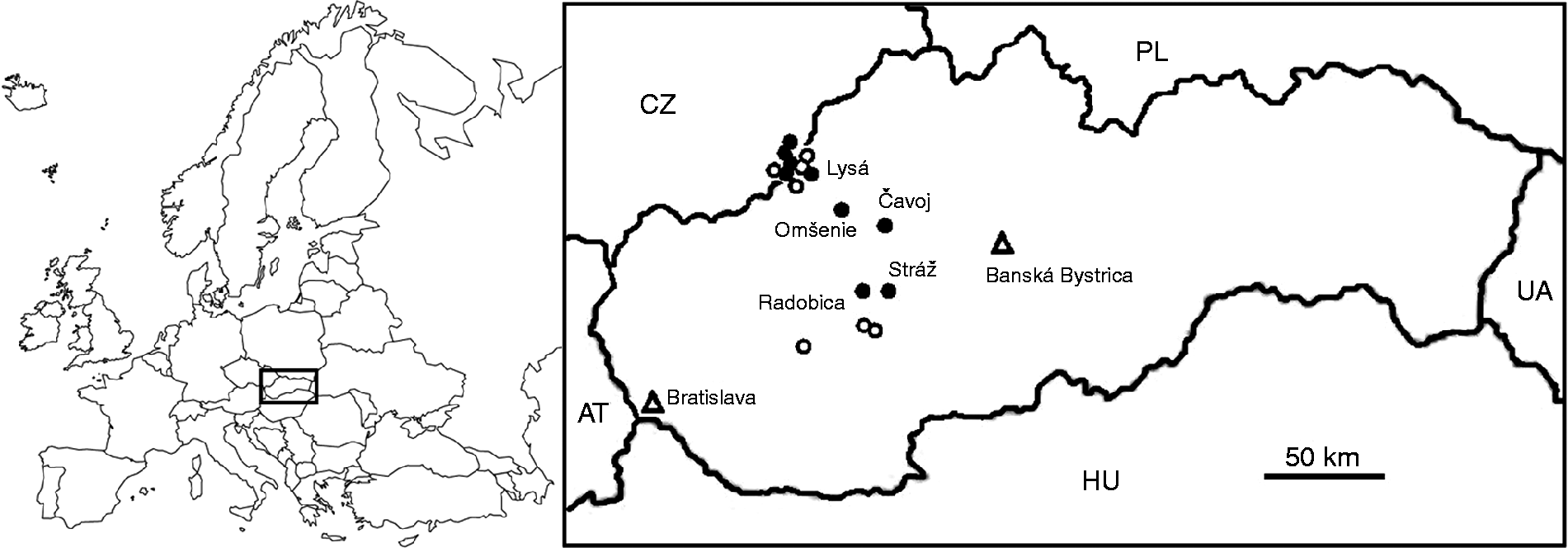
Our study focuses on the reproductive biology of a narrow endemic subspecies, Tephroseris longifolia subsp. moravica Holub (Asteraceae). This taxon belongs to the group of Tephroseris longifolia (Jacq.) Griseb. et Schenk s.l., which has the centre of its distribution area in the eastern Alps (Austria, Slovenia, northern Italy) but reaches also France, Switzerland, Germany, Czech Republic, Slovakia, Hungary, Serbia, Croatia, Bosnia and Albania (Greuter, 2006–Reference Greuter2009). Five subspecies can be distinguished within T. longifolia s.l. (Greuter, 2006–Reference Greuter2009), differing in both their distribution areas and habitat characteristics (Wagenitz, Reference Wagenitz and Hegi1987; Aeschimann et al., Reference Aeschimann, Lauber, Moser and Theurillat2004). T. l. moravica is considered to be endemic to the western Carpathians (Kliment, Reference Kliment1999). Recently, nine populations of T. l. moravica were recorded in western Slovakia and eastern Czech Republic, and seven populations are considered to be extinct (Fig. 1). The taxon is included in the European list of important species (Council Directive 92/43/EHS on the conservation of natural habitats and of wild fauna a flora, Annex II: Animal and plant species of community interest whose conservation requires the designation of special areas of conservation; Decree of Ministry of Environment of SR No. 24/2003 implementing the Act No. 543/2002 Coll. on Nature and Landscape Protection, Annex IV and Annex V) and the Red List of endangered and rare plant species of the Slovak and Czech Republic (Holub, Reference Holub, Čerovský, Feráková, Holub, Maglocký and Procházka1999). Its populations have been monitored annually since 2004 for the number of both flowering and vegetative individuals, while a strong inter-annual dynamics has been recorded (Janišová et al., Reference Janišová, Škodová, Smatanová, Jongepierová, Kochjarová and Franc2005; Chmelová, Reference Chmelová2007; Gbelcová, Reference Gbelcová2010). The main aim of this paper is to provide basic information on the reproductive biology of T. l. moravica, namely: (1) to clarify its mating system; (2) to estimate the seed output; (3) to determine germination percentages in cultivation; (4) to assess seedling emergence and survival in natural conditions. The investigations on the mating system were studied simultaneously in three subspecies of T. longifolia s.l. (T. l. moravica, T. l. longifolia and T. l. pseudocrispa).
Distribution of Tephroseris longifolia subsp. moravica in the Czech Republic and Slovakia. Solid circles show sites with recent evidence of taxon occurrence. Open circles show extinct populations where the historic taxon occurrence was documented by a herbarium specimen.

Materials and methods
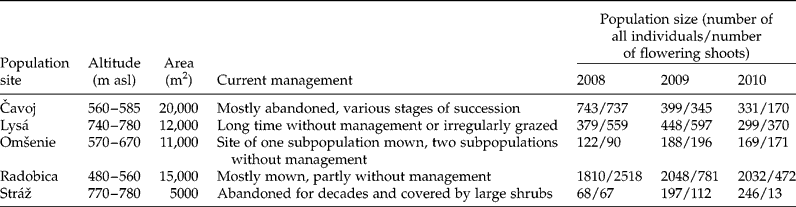
T. l. moravica is a long-lived perennial plant. It flowers in May and the seeds ripen in June. The inflorescence is a corymb consisting usually of 5–10 capitula (one terminal and the others located on primary or secondary branches). The 4-mm-long achenes (seeds hereafter) have a 5–6-mm-long pappus. T. l. moravica is diploid 2n = 48 (with the basic chromosome number x = 24; Kochjarová, Reference Kochjarová1997; Liu and Yang, Reference Liu and Yang2011). The studied population sites differed in population size, their area and management (Table 1). T. l. moravica occupied mainly ecotone habitats, forest clearings, shrubby forest margins and shaded parts of the sub-xerophilous to mesophilous grasslands (Janišová et al., Reference Janišová, Hegedüšová, Král and Škodová2012).
Population sites of T. longifolia subsp. moravica: location, management and population size

Plants of T. l. moravica (grown from the seeds), T. l. longifolia and T. l. pseudocrispa (both grown from transplanted vegetative rosettes) were cultivated in two experimental gardens (field conditions) in Banská Bystrica [central Slovakia, 375 m above sea level (asl)] and Bratislava (western Slovakia, 329 m asl). They were grown in pots (diameter 12–14 cm) in a substrate of commercial garden soil mixture. The location of source populations of T. l. longifolia and T. l. pseudocrispa can be found in Appendix 1.
To examine the mating system we performed isolation and emasculation experiments on cultivated plants in 2009 and 2010. Altogether, 86 corymbs (16 plants of T. l. moravica, 65 plants of T. l. longifolia and 5 plants of T. l. pseudocrispa) were isolated by covering them with empty tea bags before and during anthesis to prevent cross-pollination (test for autogamy). To confirm or exclude an aposporic formation of seeds in T. l. moravica we performed emasculation by cutting off the upper part of the capitulum containing the anthers just before anthesis, using a razor blade. In cultivation as well as in the field, seed output from open pollination was recorded. An artificial hybridization was performed between cultivated individuals of T. l. moravica and two other subspecies of T. longifolia s.l. The corymbs of the crossed plants were enclosed together within a tea bag prior to flowering. No human activity (rubbing the inflorescences together) supported the pollen exchange. The bags were removed after ripening of seeds. Mature seeds were collected and classified as well-developed or undeveloped. Although most of the tea bags were undamaged at the time of collection, entry of insects (mostly earwigs, ants and aphids) into the bags was quite frequent and some seeds were even damaged by granivory.
As T. l. moravica populations are limited in number and size, seeds for estimation of seed output and germination were collected only from the two biggest natural populations (Čavoj/66 plants, Radobica/98 plants) and from a cultivated population of self-established plants originating from four individuals of the Omšenie population (Omšenie II). Seed output was characterized by three variables, total number of seeds per capitulum, number and percentage of well-developed seeds per capitulum. Well-developed capitula with undispersed seeds were collected on 23 June 2008, while the type of habitat (ecotone versus grassland) and position of capitulum within the corymb (terminal versus primary branch versus secondary branch) were recorded. Several morphological characteristics related to the size of the mother plant were recorded: number of both flowering and vegetative shoots, height of stem and number of capitula in the corymb. Capitula were dried in a warm place for a week. Number of seeds per capitulum was recorded while distinguishing the well-developed, undeveloped and damaged seeds. While the well-developed seeds were large in size, plump and well pigmented (dark brown), poorly developed seeds were narrow, flimsy and weakly pigmented (usually yellowish or greenish). Poorly developed seeds always lack embryos while well-developed seeds may or may not contain an embryo, therefore the well-developed seeds were checked by pinching them gently with forceps and only the firm ones were selected for the experiments. In capitula heavily damaged by granivorous insects it was impossible to distinguish well-developed seeds from undeveloped ones, thus the seed output was counted only in undamaged or slightly damaged capitula. Two-way ANOVA was used to study differences among habitats and capitulum position, while the effect of population (Čavoj versus Radobica) was analysed separately by a t-test on arcsine transformed data.
Germination experiments were conducted on seed samples originating from two natural populations (Čavoj, Radobica) and cultivated population Omšenie II. For each population, two sets of 300 well-developed seeds were selected at random. One set was frozen at − 25°C for testing later (after 3 months) to investigate the effect of deep freeze storage on seed germination. The second set was stored in dry and warm conditions (room temperature) for 4 months. Both treatments were germinated in Petri dishes (6 replicates with 50 seeds) on wet filter paper for 12 weeks. Petri dishes with a diameter of 9 cm and distilled water (4.5 ml per dish) were used. Prior to sowing, the seeds were disinfected for 5 min in a weak solution of permanganate and then washed with distilled water. The germination experiment was performed from November 2008 to March 2009 in the laboratory with a natural daily photoperiod, the dark period temperatures 16–19°C and the light period temperatures 19–24°C. Emergent seedlings were counted and removed every 1 or 2 days. Based on visual inspection and pinching, all well-developed seeds were assumed to contain embryos; however, the seed viability was not tested. Germination was measured as cumulative percentage of the well-developed seeds that germinated. Data on germination percentages were square-root and arcsin transformed. Two-way ANOVA included the fixed factors population (3 levels) and type of storage (2 levels), respectively. Tukey's post-hoc tests were used for pairwise comparisons. Starting day of germination was analysed by two-way ANOVA without previous transformation.
Seedling emergence and survival of T. l. moravica in field conditions was studied in fifty 25 × 25 cm plots arranged in transects. In each of five investigated population sites (Čavoj, Lysá, Omšenie, Radobica and Stráž), two transects were established with five experimental plots each (ten plots per site). The control plots of the same size were situated in the adjacent area to each of the plots. In June 2009, three capitula with well-developed seeds (i.e. approximately 3 × 63 = 189 seeds, calculated from the average number of well-developed undamaged seeds per capitulum) were spread in each plot. The seedlings were checked in May 2010 and in August 2010 and their position within the plot was recorded on a map. Two variables were distinguished: (1) number of seedlings that emerged since sowing (calculated as cumulative number of seedlings recorded in the plot in May and August 2010 minus number of seedlings found in the adjacent control plot); (2) number of seedlings that survived until August 2010 (calculated as number of seedlings and juveniles recorded during the August census minus number of seedlings and juveniles recorded in the adjacent control plot). One-way ANOVA was used to check differences among sites and individual transects (after adding 0.5 to each recorded value, square-root and then arcsin transformation was used).
Results
Mating system and hybridization in T. longifolia s.l.
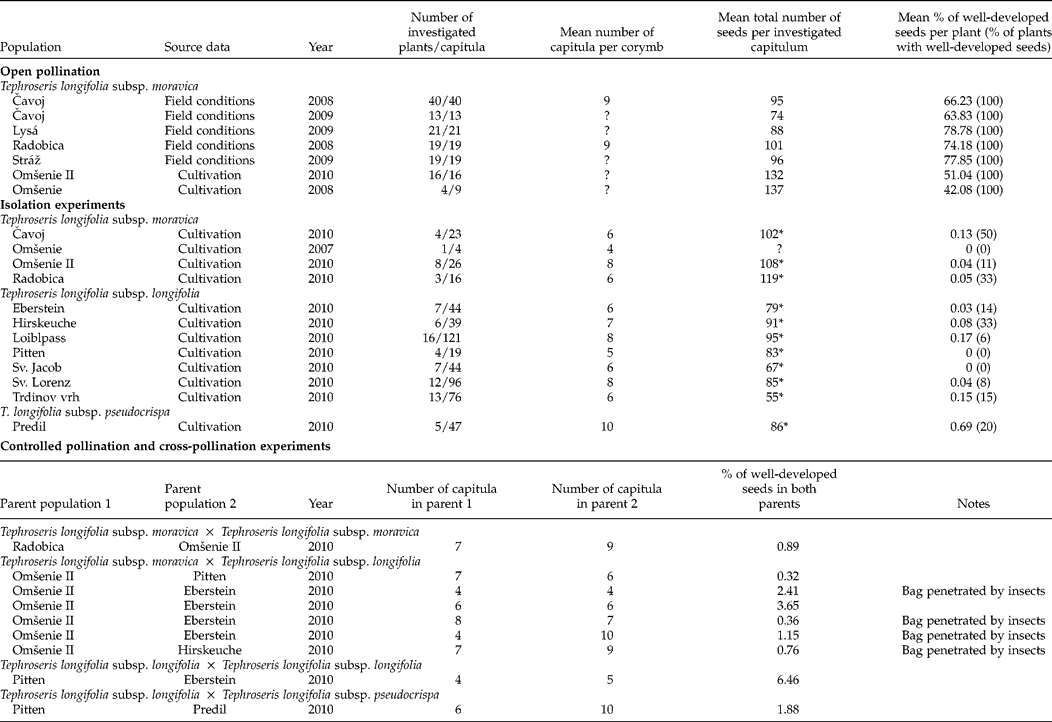
In the isolation experiments, well-developed seeds were recorded in 4 from 16 cultivated plants (25%) and 0 from 5 plants in a natural population (0%) of T. l. moravica; 7 from 65 cultivated plants (11%) of T. l. longifolia; and 1 from 5 cultivated plants (20%) of T. l. pseudocrispa. In T. l. moravica and T. l. longifolia, the number of well-developed seeds per corymb did not exceed two (maximum of 0.25% of well-developed seeds per corymb). In T. l. pseudocrispa, 28 well-developed seeds (3.26%) were recorded in one plant; the other four plants had all undeveloped seeds. Emasculation of five plants of T. l. moravica in a natural population and one plant of T. l. moravica in cultivation revealed that none of the plants were able to form well-developed seeds. Under open pollination in T. l. moravica (non-isolated corymbs) we observed high seed output during both years of experiments: all of 112 investigated plants in natural populations and 25 cultivated plants formed well-developed seeds, the percentage of well-developed seeds per capitulum being from 21 to 95% (average 75%) in field conditions and from 15 to 88% (average 49%) in cultivation (Table 2). In hybridization experiments, all controlled pollinated (two pairs of plants) as well as cross-pollinated plant combinations (seven pairs of plants) produced well-developed seeds (Table 2). The percentage of well-developed seeds per capitulum (between 0.32 and 3.65%) was markedly lower than that recorded for open pollination, but higher than in the isolation experiments.
Results of experiments focusing on mating system in the studied populations of Tephroseris longifolia subsp. moravica, T. l. subsp. longifolia and T. l. subsp. pseudocrispa
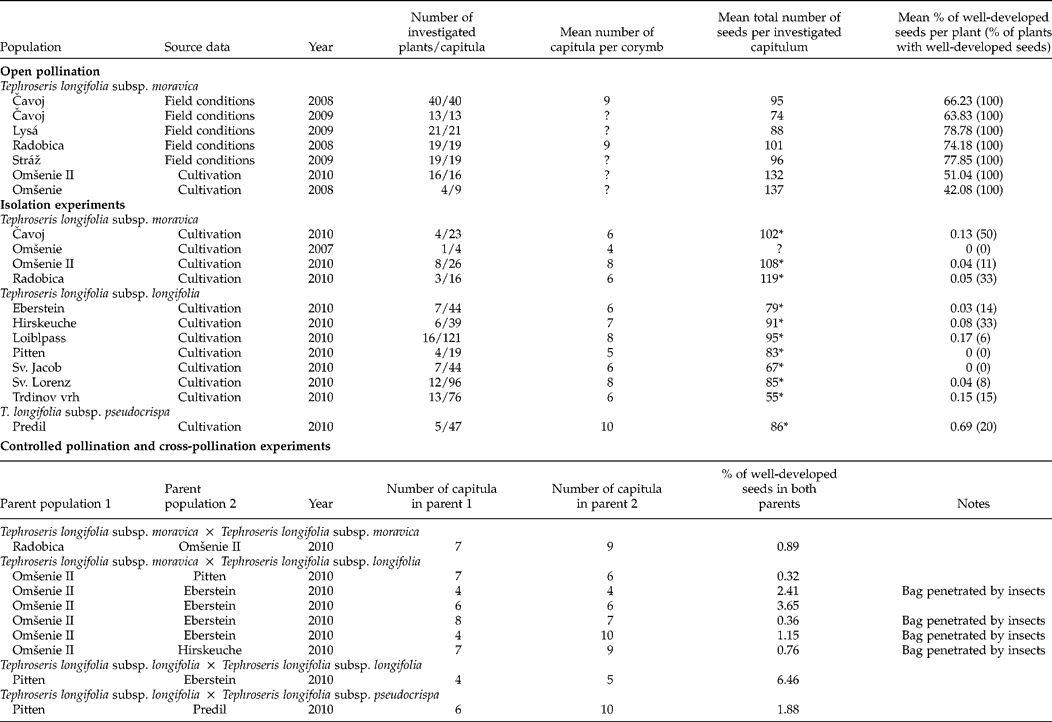
* *Means calculated from subsample of 10 capitula.
Seed output in T. l. moravica
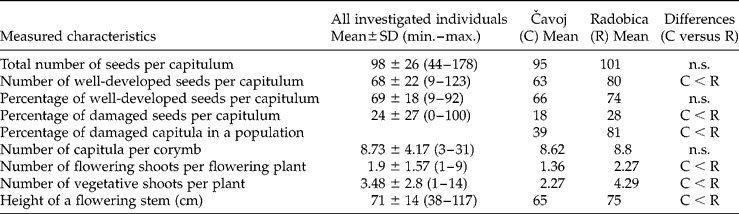
There was no difference in total number of seeds per capitulum between the populations (Table 3), mean values being 95 in Čavoj and 101 in Radobica populations. However, there was a significant difference between habitats (three-way ANOVA, P = 0.005), capitula had more seeds in ecotone habitats (mean value of 103 seeds) than in grassland (92 seeds). Capitula with different positions within a corymb differed significantly in total number of seeds (P = 0.002), terminal capitula having the highest number (mean value of 113 seeds). Capitula on primary branches had an intermediate number (97) and capitula on secondary branches had the smallest total number of seeds (87). The effect of factor interactions was non-significant (population × position: P = 0.611, habitat × position: P = 0.301, population × habitat × position: P = 0.600), although the interaction population × habitat had the borderline value P = 0.055, indicating that the difference in total number of seeds per capitulum between habitats was dependent on population (valid for Radobica and not for Čavoj population). Total number of seeds per capitulum was not significantly correlated with morphological characteristics of the mother plants (number of flowering and vegetative shoots, height of stem and number of capitula in the corymb).
Characteristics of T. longifolia subsp. moravica individuals related to their size and seed output in two studied populations
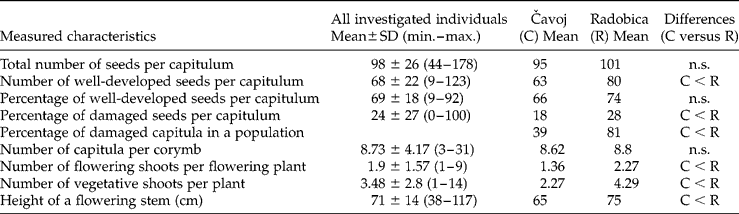
Mean percentage of well-developed seeds per capitulum was 66.23% in Čavoj and 74.18% in Radobica populations (t-test, P = 0.076). Neither habitat and position of capitulum, nor their interaction, had a significant effect on percentage of well-developed seeds (two-way ANOVA, habitat: P = 0.615, position: P = 0.257, habitat × position: P = 0.626). The populations differed in number of well-developed seeds per capitulum (t-test, P = 0.003) with higher values in Radobica (mean 80 seeds) than in Čavoj (63 seeds). The effect of habitat on number of well-developed seeds was not significant (two-way ANOVA, P = 0.104). The position of a capitulum within the corymb showed a significant effect on the number of well-developed seeds (P = 0.011), terminal capitula showed the highest values and capitula on primary and secondary corymb branches did not differ (Tukey's multiple comparison test: terminal versus primary branch P = 0.041, terminal versus secondary branch P = 0.009 and primary branch versus secondary branch P = 0.994). The interactions of habitat and capitulum position had no significant effects on percentage and number of well-developed seeds (P = 0.834). The percentage and number of well-developed seeds were not significantly correlated with morphological characteristics of the mother plants (number of flowering and vegetative shoots, height of stem and number of capitula in the corymb). They were positively correlated with total number of seeds per capitulum (Pearson correlation coefficient, r = 0.59 for number of well-developed seeds and r = 0.65 for percentage of well-developed seeds). In the population of cultivated plants (Omšenie II), total number of seeds per capitulum was larger (mean number 141, range 109–179 seeds), but the percentage of well-developed seeds was lower (mean value 42.08%, range 30–63%) than in natural populations in Čavoj and Radobica. The output of well-developed seeds per flowering shoot estimated from mean number of well-developed seeds per capitulum (68 seeds) and mean number of capitula per corymb (8.7 capitula) was 592 (1125 seeds per flowering plant, calculated as 592 × 1.9 which is the mean number of flowering shoots per flowering plant).
In all studied populations, a certain proportion of seeds were damaged by the caterpillar of a granivorous butterfly from the family Pyralidae. The butterfly has been identified as Phycitodes albatella Ragonot 1887. Adult butterflies (wing span 16–21 mm) deposit eggs in the upper stem and leaf-axils. The orange-coloured larva tunnels into the capitulum and out to the developing seeds where it feeds. Mature larvae exit host capitula in summer to pupate. Evidence of infestation is obvious: the pappus of seeds is threaded with a web. Larval feeding frequently destroys most seeds within the mined capitulum. Seeds damaged by the granivorous butterfly in 2008 represented 18% of seed output in the population of Čavoj and 28% in the population of Radobica. The proportion of capitula attacked was significantly higher in Radobica (80.6%) than in Čavoj (39.4%, P = 0.027), and it was higher in grasslands (71%) than in ecotone habitats (59%), although this difference was non-significant (P = 0.058). The probability of attack by granivores was not affected by the position of the capitulum within the corymbs. Once the capitulum was attacked by the granivorous butterfly, the number of damaged seeds ranged from 1 to 87 (mean 33 seeds). As a consequence, the mean reduction of seed number in attacked capitula was 37% (range 0.85–100%).
Germination in laboratory conditions
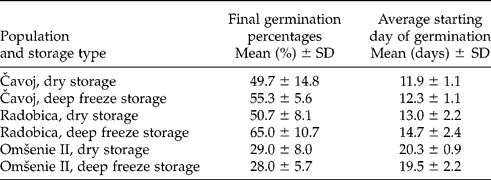
Seeds from natural populations in Čavoj and Radobica had significantly higher germination percentages (30–62%, mean 50% for Čavoj and 51% for Radobica) than seeds from cultivated plants (population Omšenie II, 18–42%, mean 29%, two-way ANOVA, P < 0.001; Table 4). There was no difference between Radobica and Čavoj in germination percentages of seeds stored dry at room temperatures. Deep freeze storage for 3 months appeared to stimulate germination in seeds from the two natural populations (Čavoj and Radobica, Table 4), although its effect was non-significant (P = 0.052). The interaction of population and deep freeze storage was also non-significant (P = 0.154).
Germination in laboratory conditions. Final germination percentages and average starting day of germination for three populations of T. longifolia subsp. moravica under dry storage in room temperature for 4 months and deep freeze storage for 3 months
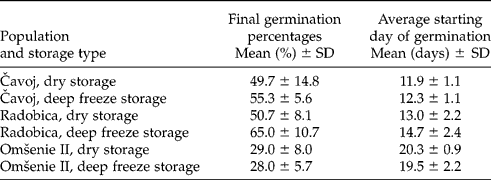
Seeds stored in dry and warm conditions started to germinate on days 5–8 after sowing, while seeds stored in deep freeze started to germinate a few days later (on the seventh day in Čavoj and between days 8 and 11 in Radobica). Seeds from the population in Čavoj germinated slightly earlier in all treatments than seeds from Radobica (Table 4). Seeds from the cultivated population Omšenie II started to germinate the latest (on days 10–11 after sowing in the two studied treatments). Most seeds germinated within 30 days of sowing. Deep freeze storage and its interaction with population had a non-significant effect on the average starting day of germination (P = 0.446 and P = 0.248, respectively).
Seedling emergence and survival in field conditions
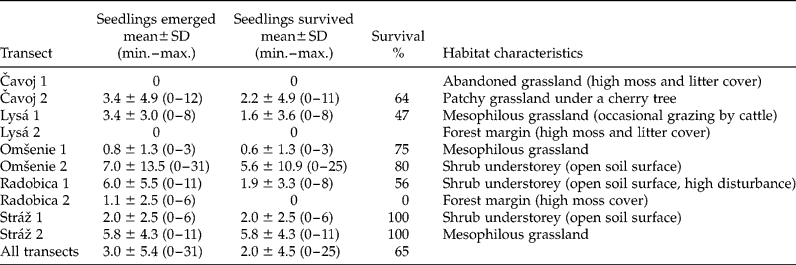
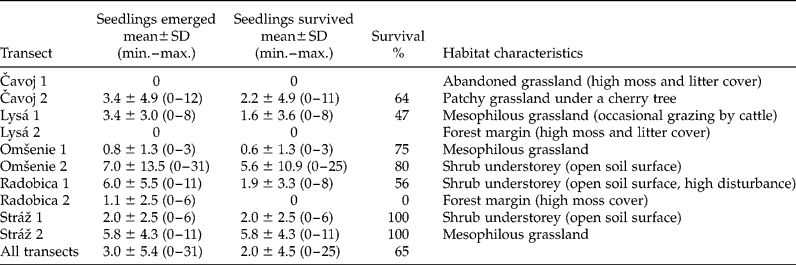
In each plot, 0–31 seedlings were recorded in May 2009 (11 months since sowing) and 0–25 seedlings or juveniles survived until the census in August 2010 (14 months since sowing). If expressed as proportion of the sown seeds, the maximum percentage of emerged seedlings was 16.4% and maximum percentage of survived seedlings was 13.23%. The studied populations did not differ significantly in percentage of emerged seedlings (one-way ANOVA, P = 0.109), or in percentage of survived seedlings (one-way ANOVA, P = 0.167). Seedling emergence (Table 5) was the highest in habitats with open soil surface (forest and bush understorey), and the lowest in habitats with high litter or moss layers. Seedling survival (Table 5) was the highest in transects least disturbed by man and animals (dense bush stands and remote areas). The highest seedling survival was recorded in populations of Stráž where all seedlings emerged by May survived until the August census. On the other hand, mortality of seedlings was the highest in populations of Radobica and Lysá, where experimental plots were strongly disturbed by moles and game animals (Radobica) and by cattle grazing (Lysá). Seedling emergence and establishment were much slower in natural conditions than in cultivation (14 months after sowing in situ the seedlings had hardly developed true leaves and were still very tiny).
Seedling emergence and survival of Tephroseris longifolia subsp. moravica in field conditions. Number of seedlings emerged in plots between the sowing in June 2009 and census in August 2010 and number of seedlings survived until August 2010 are shown for each transect consisting of five experimental plots
Discussion
Mating system and hybridization
Our results of isolation experiments showed that the studied subspecies of T. longifolia s.l. are not autogamous taxa. The low number of well-developed seeds obtained in some isolated capitula (Table 2) could be the result of accidental pollen transfer (insect penetration) or sporadic break-down of the self-incompatibility system. These sporadic break-downs can be attributed to specific characteristics of sporophytic self-incompatibility systems, the so-called ‘leaking’ (Lewis, Reference Lewis, Williams, Clarke and Knox1994; Hiscock, Reference Hiscock2000), when even self-pollination produces a small number of seeds. Similar to our results, few seeds were set by self-pollinated plants of closely related Tephroseris integrifolia (Isaksson, Reference Isaksson2009). Based on our results, T. l. moravica should be treated as an allogamous taxon with a sporophytic self-incompatibility system. However, it is necessary to test these results on a larger data set. The results of our emasculation experiment (in spite of the small sample size) suggest that apomictic reproduction does not occur in the studied taxon. There are no records in the scientific literature of apomixis in the genus Tephroseris (Czapik, Reference Czapik1996; Noyes, Reference Noyes2007).
The low percentage of well-developed seeds in both controlled pollination and cross-pollination experiments could be a consequence of differences in phenology of cross-pollinated populations. The number of well-developed seeds was higher in the controlled pollination, 16 (0.89%) for T. l. moravica and 47 (6.46%) for T. l. longifolia, where the phenological development of pollinated plants was most similar. Another possible reason for the low seed production is the methodology used (the corymbs were enclosed without rubbing). However, similar to our results, a markedly decreased number of well-developed seeds in controlled pollination and cross-pollination experiments in comparison to that obtained from open pollination was recorded in the Cyanus triumfetti group, in spite of rubbing the capitula together (K. Olšavská, unpublished results). Considering the low number of investigated plants and the methodology used, our results should be taken as preliminary.
Seed output
Population, habitat and position of capitula within corymbs had no effect on percentage of well-developed seeds. As a consequence of terminal capitula being the largest, the number of well-developed seeds ripened in them was higher than in the capitula on side branches. The possible explanation is that plants invest in the formation of an early flowering large terminal capitulum in order to utilize available pollinators and to prolong the period of seed dispersal.
Mean number of seeds per capitulum, 95 in Čavoj and 101 in Radobica populations, are similar to numbers reported by Chmelová (Reference Chmelová2007) from the Czech populations of Tratihušť and Hodňov (96 seeds) and Kochjarová (Reference Kochjarová1998) from populations of Lysá, Stráž and Radobica (80–128 seeds). The mean percentage of well-developed seeds (66.23% in Čavoj and 74.18% in Radobica) is similar to that found by Kochjarová (Reference Kochjarová1998; 53.89–78.67%) and slightly lower than that recorded by Chmelová (Reference Chmelová2007; 84.62%). The estimated mean number of well-developed seeds per plant was higher in our study (1125 seeds) than in Kochjarová (Reference Kochjarová1998; 727–822 seeds).
Along with seed abortions, granivory represents one of the predispersal losses that may cause significant reductions in total seed yields in wild populations. In 2008, the granivorous butterfly P. albatella reduced the number of seeds by almost one-third in the Radobica population. According to Tlusták (unpublished), in 1996 two-thirds of seeds were damaged by insects in Czech populations of Tratihušť, Uhličky and Hluboče. Although the granivores alone could hardly cause the extinction of T. l. moravica populations, in combination with other factors (such as unsuitable weather conditions during several subsequent years, low flowering intensity of a population due to demographic fluctuations, etc.) they could reduce population generative reproduction even to zero. It is also known from other species of Asteraceae (genus Cirsium), that herbivory in combination with the demographic characteristics may strongly influence population dynamics and species distribution (Münzbergová, Reference Münzbergová2005).
Germination in laboratory conditions
Dry storage evidently affects germination of T. l. moravica by fast reduction of germination percentages with storage duration. Several authors recorded higher germination percentages immediately after seed ripening, e.g. 70% by Kochjarová (Reference Kochjarová1998) and 72% by Chmelová (Reference Chmelová2007). If stored at low temperature or buried in soil, high germination ability of T. l. moravica seeds can be maintained for longer (Chmelová, Reference Chmelová2007; personal observations), although the upper survival time limit remains unknown.
Seeds from natural populations (Čavoj and Radobica) had significantly higher germination percentages and germinated faster than plants from a cultivated population (Omšenie II). Together with a higher percentage of undeveloped seeds in the capitula of cultivated plants (Table 2), the poorer germination characteristics can strongly reduce their fitness. The reasons for the reduced fitness in cultivated plants may include, for example, lack of pollinators in non-natural conditions, different climate and soil conditions or inbreeding depression (Jennersten, Reference Jennersten1988; Isaksson, Reference Isaksson2009).
Seedling emergence and survival in field conditions
It seems that T. l. moravica has very low seedling emergence in all natural populations and its recruitment from seeds is much dependent on the availability of microsites suitable for germination. In our experiment, the most suitable habitats for germination included understorey of trees and shrubs with open soil surface and loose, shaded grasslands. Thick moss and litter layers suppressed seedling emergence in both studied habitat types – forest margins (ecotone) and grasslands. The general mechanisms of germination prevention by litter are well understood (Facelli and Pickett, Reference Facelli and Pickett1991). Another important factor may be the reduced rooting capacity for seedlings within the bryophyte layer, as proposed by van Tooren (Reference van Tooren1988). The presence of gaps with little competition from other species may also be very important for successful seedling establishment of T. l. moravica. However, heavy disturbance (e.g. by grazing or trampling animals) or increased occurrence of slugs feeding on forb seedlings may affect seedling survival of T. l. moravica and strongly reduce the number of established plants even in otherwise suitable microsites.
Conclusion
According to our results, T. l. moravica is an allogamous taxon without apomictic reproduction. Each flowering shoot may produce several hundreds of well-developed seeds. This number is usually reduced by the incidence of granivorous pests. The germination rapidly decreases in time, so if unsuitable weather conditions hinder the germination of seeds immediately after their dispersal, their chances of germinating later in the year are low. Seedling emergence in situ is very low in all studied sites. Proper conservation management could increase the availability of suitable microsites for germination and thus support seedling recruitment.
Acknowledgements
We are grateful to A. Čarni, J. Kochjarová, K. Krajčovičová, J. Kulfan, K. Olšavská, J. Panigaj, M. Slaničanová, J. Smatanová, L. Sutcliffe, B. Šingliarová, D. Treplanová and A. Tribsch. This research was supported financially by grants VEGA 2/0017/08 and VEGA 2/0074/11.
Appendix 1
Geographical location of source populations of T. l. longifolia and T. l. pseudocrispa used in isolation and cross-pollination experiments: Eberstein (Austria, 570–622 m asl, 46°47′51”N, 14°33′07”E), Hirskeuche (Austria, 740–775 m asl, 46°28′14”N, 14°29′25”E), Loiblpass (Austria, 990–1005 m asl, 46°26′41”N, 14°15′28”E), Pitten (Austria, 320–340 m asl, 47°42′28”N, 16°10′53”E), Sv. Jakob (Slovenia, 780–790 m asl, 46°06′19”N, 14°22′11”E), Sv. Lorenz (Slovenia, 780–790 m asl, 46°04′18”N, 14°17′59”E), Trdinov vrh (Slovenia, 1130–1180 m asl, 45°45′35”N, 15°19′22”E), Predil (Italy, 880–907 m asl, 46°27′00”N, 13°34′31”E).