

Introduction
Children with autism spectrum disorders (ASD) are challenged by difficulties with reciprocal social interaction, communication, and rigid, inflexible and repetitive behaviours (American Psychiatric Association, 2000). While not currently of diagnostic significance, there is also evidence that they experience some difficulties in the execution of perceptual motor tasks (Mayes & Calhoun, 2007). One such task is handwriting, which students with ASD, like other students, are required to employ in the course of their education activities. There is now a growing body of evidence that the handwriting of children with ASD is compromised by poor letter formation and overall legibility (Cartmill, Rodger, & Ziviani, 2009; Fuentes, Mostofsky, & Bastain, 2009; Fuentes, Mostofsky, & Bastain, 2010; Myles, Huggins, Rome-Lake, Hagiwara, Barnhill, & Griswold, 2003). As a result, keyboarding is often recommended as an alternative for these children. This study aimed to explore the utility of this practice.
Handwriting and Children With ASD
The handwriting difficulties experienced by children with ASD are well documented. Hans Asperger described ‘atrocious handwriting’ in three of his four original cases of children with the condition later known as Asperger syndrome (Frith, Reference Frith1991). Myles et al. (2003) found that children and youth with Asperger syndrome produce significantly fewer legible letters and words than typically developing peers. These findings were reinforced by both Cartmill et al. (Reference Cartmill, Rodger and Ziviani2009) and Fuentes et al. (Reference Fuentes, Mostofsky and Bastain2009) who found children with ASD to have significantly poorer letter formation than their typically developing peers. Cartmill et al. (Reference Cartmill, Rodger and Ziviani2009) also found that increased consistency of letter formation in children with ASD was associated with decreased speed, suggesting a need to sacrifice letter formation in order to achieve adequate speed. Beversdorf et al. (Reference Beversdorf, Anderson, Manning, Anderson, Nordgren, Felopulos and Bauman2001) attributed macrographia (abnormally large handwriting) in high-functioning adults with ASD to motor difficulties associated with cerebellar and basal ganglia dysfunction. Motor difficulties were also considered to be a possible causal factor by Fuentes et al. (Reference Fuentes, Mostofsky and Bastain2009), who found the handwriting performance of children with ASD to be predicted by their performance on a timed movement task. In contrast, Fuentes et al. (Reference Fuentes, Mostofsky and Bastain2010) found that the main predictor of handwriting performance in adolescents with ASD to be perceptual reasoning. Cartmill et al. (Reference Cartmill, Rodger and Ziviani2009) found visual perception, verbal memory and spelling with different allographs to be moderately correlated with the handwriting legibility of children with ASD.
Handwriting and Keyboarding in Educational Settings
Broun (Reference Broun2009) observes that handwriting difficulties of children with ASD can impact negatively on their academic participation, as they often become increasingly reluctant to write and may habitually write as few words as possible. Furthermore, she notes that some behavioural difficulties experienced by these children may result from the stress and frustration associated with handwriting. When handwriting performance compromises school participation, keyboarding is frequently recommended as an alternative (Broun, Reference Broun2009; Freeman, MacKinnon, & Miller, 2004). The use of word processing technology in the classroom is consistent with the principles of ‘Universal Design for Learning’, a contemporary educational framework that advocates the flexible use of technologies to accommodate diverse learning styles (Center for Applied Special Technology, 2008). Lightweight portable word processors (e.g., AlphaSmart™ or Neo™ portable computer companions) are often used in the classroom because they are more robust, portable and less expensive than laptop computers. However, as laptop computers are becoming less expensive and more lightweight, they are also being increasingly used.
Handwriting difficulties have been found to have a detrimental impact on the quality of written compositions (Jones & Christensen, 1999). These findings were attributed to children's need to focus on the mechanics of handwriting, which were not yet automatic, thereby distracting the child's attention from composition. Freeman, MacKinnon, and Miller (2005) suggested that by simplifying text production, keyboarding may enable children to focus on the content and meaning of their work, thus improving the quality of their written compositions. This claim has been supported by a meta-analysis of 26 studies from 1992 to 2002 of student compositions when using computers as compared to paper and pencil that concluded that on average students who used computers were more engaged and motivated and produced written work that was of greater length and higher quality (Goldberg, Russell, & Cook, 2003). The positive impact of computers on writing was significantly associated with school grade level, with the magnitude of effect size increasing with grade level. In contrast, in a more recent study involving younger students (Years 5 and 6) who had not received keyboarding instruction, Connelly, Gee, and Walsh (2007) found the quality of compositions to be superior when handwriting than when keyboarding. The authors conclude that explicit keyboarding instruction is needed to unlock the full potential of the word processor on children's writing. Freeman et al. (2004, 2005) and Priest and May (Reference Priest and May2001) also maintain that sufficient explicit keyboarding instruction is essential for the development of keyboarding automaticity. In most cases, simply providing keyboarding devices to students with handwriting difficulties is thought to be insufficient (Freeman et al. Reference Freeman, MacKinnon and Miller2005). Christiansen (2004) found the provision of keyboarding instruction to be more effective than journal writing practice in improving the quality of compositions of high school students. The participants in this study who received keyboarding instruction produced compositions that were more creative, technically accurate, logically sequenced and organised, and showed greater sensitivity to the intended audience. A review by Freeman et al. (Reference Freeman, MacKinnon and Miller2005) concluded that children need to be able to keyboard as fast as they can write for keyboarding to be an effective alternative to handwriting. Keyboarding automaticity is most likely, though not exclusively, achieved through a touch-typing approach (Freeman et al., Reference Freeman, MacKinnon and Miller2005).
A number of advantages of keyboarding over handwriting have been highlighted in the literature, including the ease with which it allows for editing, re-evaluation of work, and collaborative writing. Furthermore, the advantages bestowed by spell and grammar check functions, and improved neatness and legibility are considered to increase a child's confidence and motivation (Handley-Moore, Deitz, Billingsley, & Coggins, 2003; Preminger, Weiss, & Weintraub, 2004; Priest & May, 2001; Rogers & Case-Smith, 2002).
Despite these advantages, questions have been raised regarding the efficacy of introducing keyboarding to children with handwriting difficulties because these children may also have difficulties in learning to keyboard. Handwriting speed has been found to correlate with keyboarding speed in both typically developing children (Preminger, Weiss, & Weintraub, 2004; Rogers & Case-Smith, 2002) and adults (Weintraub, Gilmour-Grill, & Weiss, 2010). Although handwriting and keyboarding share some common underlying skills, such as isolated finger movements (Preminger et al., Reference Preminger, Weiss and Weintraub2004), they have also been found to rely on some different underlying skills. Specifically, handwriting proficiency has been associated with visual motor integration, visual perception (Preminger et al., Reference Preminger, Weiss and Weintraub2004) and finger function (Weintraub et al., Reference Weintraub, Gilmour-Grill and Weiss2010), whereas keyboarding proficiency has been associated with bilateral coordination, kinaesthetic ability, visual and motor memory skills (Preminger et al., Reference Preminger, Weiss and Weintraub2004) and eye movements (Weintraub et al., Reference Weintraub, Gilmour-Grill and Weiss2010). The findings of Rogers and Case-Smith (Reference Rogers and Case-Smith2002) were that 75% of the 20 slowest handwriters in a group of 40 typically developing children achieved faster text production using keyboarding than handwriting. Rogers and Case-Smith (Reference Rogers and Case-Smith2002) therefore conclude that keyboarding has the potential to improve the written output of some children with handwriting difficulties, particularly in view of the fact that handwriting and keyboarding depend on different skills.
Potential barriers to the introduction of keyboarding to students with handwriting difficulties include the cost and portability of these devices, potential technical and printing problems, the availability of technical support and the teachers’ capacity to adapt learning tasks to the portable word processor (Freeman et al., Reference Freeman, MacKinnon and Miller2004). Furthermore, Copley and Ziviani (Reference Copley and Ziviani2004) found that assistive technology, such as portable word processors, when prescribed for use by students with disabilities in the classroom, is often abandoned for a variety of reasons including insufficient staff training and support, inadequate assessment and planning and time constraints.
As far as we are aware, no studies to date have explored the utility of introducing keyboarding to children with ASD who struggle with handwriting. As computer-based activities are often an interest area for children with ASD (Carrington & Graham, 2001), the potential use of keyboarding as a writing tool for them warranted investigation. The aims of this study were to:
1. compare students’ motivation and preferences for and use of keyboarding as compared to handwriting
2. identify ways in which the portable word processors have been a help or a hindrance in the classroom and for homework
3. compare students’ keyboarded and handwritten output in terms of speed of text production, quality of written compositions and legibility.
Methodology
Participants
Twenty-two students (21 boys and 1 girl) with ASD from mainstream primary (elementary) school classrooms, who had been using a portable word processor for a minimum of 6 months to circumvent their difficulties with handwriting, were recruited. Twenty-two parents and 20 teachers (two of the teachers had two of the participating students in their respective classes) also participated by completing parent and teacher questionnaires. The students’ ages ranged from 8 years 3 months to 13 years 1 month (M = 10.83 ± 1.4 years). They were required to have a diagnosis within the pervasive developmental disorder classification (i.e., autistic disorder, Asperger syndrome or pervasive developmental disorder not otherwise specified) provided by a registered paediatrician, psychiatrist or neurologist according to the Diagnostic and Statistical Manual of Mental Disorders (4th ed., text rev.; DSM-IV-TR; American Psychiatric Association, 2000). Ten of the students had a nonspecific diagnosis of ASD; 10 were diagnosed with Asperger syndrome; one with pervasive developmental disorder not otherwise specified, and one with high-functioning autism. In Queensland schools, students with ASD receive support from special education or learning support teachers (either visiting or based at the school) and teacher aides. Speech language therapy, occupational therapy and physiotherapy services are available if requested by their classroom teachers. The intensity and nature of support varied according to individual needs. The length of time that the students had been using the portable word processing devices ranged from 6 to 24 months (M = 16.53 ± 7.50 months). Eighteen of the 22 students used lightweight portable word processors such as AlphaSmart™ or Neo™ portable computer companions and four used laptop computers.
Instrumentation
Teacher, parent and student questionnaires were devised for the study. These included a mixture of closed multiple-choice questions using a 5-point Likert scale and open-ended questions. The teacher questionnaire, which is shown in Appendix A, included questions on his/her perceptions of (a) the student's motivation and ability when keyboarding as compared to handwriting; (b) the student's preferences for using keyboarding as compared to handwriting; (c) the frequency with which the student used keyboarding as compared to handwriting in the classroom; (d) how helpful the portable word processor had been and ways in which it had been helpful or unhelpful; (e) factors that contributed to or limited the use of the portable word processor in the classroom (e.g., adequate training in the use of the device, technical support, access to facilities such as printers, capacity to adapt classroom activities); and (f) details of keyboarding training and support in using the portable word processor provided to the student. The parent questionnaire, which is shown in Appendix B, included questions on their perceptions of (a) the child's motivation and ability when keyboarding as compared to handwriting; (b) the child's preferences for using keyboarding as compared to handwriting for homework; (c) the frequency with which the child used keyboarding as compared to handwriting for homework; and (d) perceptions of how helpful the portable word processor had been. The student questionnaire, which is shown in Appendix C, was written in child-friendly language and used a pictorial format to make it more readily comprehensible for children. It included questions on (a) their motivation and ability with regard to handwriting as compared to keyboarding; (b) their use of keyboarding as compared to handwriting; (c) the frequency of use of handwriting versus keyboarding; and (d) things that bothered them about handwriting and keyboarding.
The Handwriting Speed Test (Wallen, Bonney, & Lennox 1996), which was normed on 1292 children from New South Wales, was used to measure speed of handwriting. The test involves writing the sentence ‘The quick brown fox jumps over the lazy dog’ repeatedly for 3 minutes. The number of letters written per minute can be reported as standard scores and percentile ranks. In a study of 212 children, the Handwriting Speed Test was found to have high interrater reliability (intraclass coefficient, or ICC, of .99), intrarater reliability (ICC of .99) and test–retest reliability (ICC of .89).
A keyboarding speed test was a test devised for the project and involved the use of keyboarding to write the sentence ‘The quick brown fox jumps over the lazy dog’ repeatedly for 3 minutes. This was designed to be similar to the Handwriting Speed Test and again was scored as letters produced per minute. The spell and grammar check functions of the keyboarding device were disabled to equate more readily with the handwriting task. During the performance of this keyboard task a record was made as to whether the child employed touch-typing as opposed to ‘hunt and peck’.
Written composition assessment. Two composition tasks involved writing a story on a topic of the student's choice for a period of up to 10 minutes using (a) a pencil and paper, and (b) a portable word-processing device. The spell and grammar check functions of the portable word processor were again disabled to equate to the handwriting task. As students with ASD are often challenged by creative writing and have difficulty coming up with original ideas (Harbinson & Alexander, 2009), a prompt sheet consisting of pictures representing movies, hobbies, pets and sports was provided. A selection of standardised remarks was used to encourage the student as needed (e.g., ‘You're doing a great job, keep going.’). If the student finished in less than 10 minutes, the investigator waited for one minute while making encouraging remarks before finishing the task. As there were no appropriate commercially available scales to rate the standard of their compositions, a rating scale was devised for the study based on the criteria from the Queensland English Syllabus (Queensland Studies Authority, 2006). The length of the written compositions (number of words) was recorded. The quality of this written composition was rated on logical organisation and structuring of ideas (staying on topic, sequencing of information, use of introduction and conclusion — 8 marks), spelling and grammar (spelling and grammatical errors, use of known spelling patterns, use of correct tense — 10 marks); vocabulary (use of vocabulary specific to subject matter, technical words, adjectives, adverbs and conjunctives — 10 marks), and punctuation (appropriate use of full stops, question marks, exclamation marks, commas, apostrophes, quotations marks, paragraphs, capital letters — 10 marks). The handwritten compositions were converted verbatim to typed text prior to scoring by a rater who was blind to the condition (i.e., whether handwriting or keyboarding had been used during the composition of the piece), thus reducing a potential source of bias. (As the spell and grammar check functions on the portable word processor had been turned off, in most cases both the handwritten and keyboarded compositions had spelling and grammatical errors). In order to check the reliability of these marking criteria, a second rater independently marked the compositions. The ICCs were .90 for the handwritten compositions and .83 for the keyboarded compositions and .87 overall.
Legibility. In order to determine whether or not the students’ handwriting legibility was an issue that may impact on the decision to introduce keyboarding, the legibility of the students’ handwritten compositions was assessed using the Test of Legible Handwriting (TOHL; Larsen & Hammill, 1989). The raw scores can be converted into standard scores or percentile rank scores. In order to check the reliability of the grading of the students’ handwriting, the compositions were independently marked by two raters (ICC = .81).
Procedure
The project received appropriate institutional review board approval, and the students, their parents and their teachers provided informed written consent to participate. The assessment procedures, questionnaires and marking criteria were pilot tested on 3 students. Outcomes of the piloting process also included the introduction of additional rewards and motivators, visual schedules and standardised motivating statements to engage the students, and revision of the questionnaires and marking criteria. The parent questionnaires were sent home with the student. The teacher questionnaires were mailed to the teacher. A research assistant visited the students at their school in order to administer the student questionnaire, the Handwriting Speed Test, the handwritten composition, the keyboarding speed test and the keyboarded composition. In order to control for any effects related to the order in which the tasks were presented, the sequencing of the tasks was alternated as per two differing schedules with the keyboarding tests being administered first for half the students and the handwriting tests being administered first for the remaining students.
Data Analysis
The data from the teacher, parent, and student questionnaires were analysed descriptively (Moore & McCabe, 2000). The data from the handwriting and keyboarding speed and composition tests were examined using histograms and QQ plots of the residuals to check for normal distribution. As the data appeared to be normally distributed, paired-sample t tests were used to compare the following group means: (a) handwriting and keyboarding speed (letters per minute); (b) length of the handwritten and keyboarded compositions (number of words); and (c) scores for quality of handwritten and keyboard compositions. A conservative alpha level of .01 was used to reduce the chance of making a Type I error.
Results
Perceived Motivation and Ability for Keyboarding as Compared to Handwriting
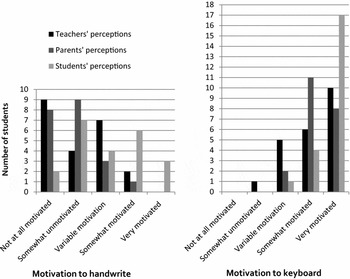
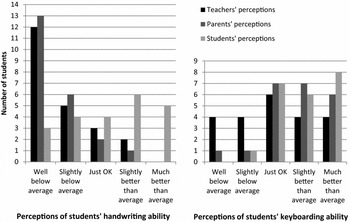
Results of parent, teacher, and student questionnaires in respect to the motivation of students towards handwriting and keyboarding are shown in Figure 1, and perceived handwriting and keyboarding abilities in Figure 2.
Motivation for Handwriting as Compared to Keyboarding.

Perceptions of Students’ Handwriting and Keyboarding Ability.

Responses of students to closed-response multiple-choice questions about what bothered them about handwriting included sore hand (10 students), the feeling of the pencil (6) and the feeling of their hand on the paper (4). In response to ‘other’ aspects of handwriting that bothered them, students’ responses included ‘handwriting is messy’ (2), ‘the feeling of my elbow on the desk’ (1), ‘pencil and paper slide off desk’ (1), ‘handwriting is boring’ (1), ‘dislikes having to use cursive writing’ (1), and ‘lead getting on the side of my hand’ (1). Responses of students to closed-response multiple-choice questions about what bothered them about keyboarding included the device not working properly at times (3), ‘it takes too long to set up’ (2), ‘having to wait to use the printer’ (2), embarrassment about using the device (2), not liking the feeling of it (1), having to wait to put work on the computer (1). In response to ‘other’ aspects of keyboarding that bothered them, students’ responses included ‘keyboarding hurts my hands’ (1), ‘the Alphasmart ™ keeps turning off’ (1), and ‘other people asking why I get to use the Alphasmart ™’ (1).
Students’ Preferences for and Frequency of Use of Keyboarding as Compared to Handwriting
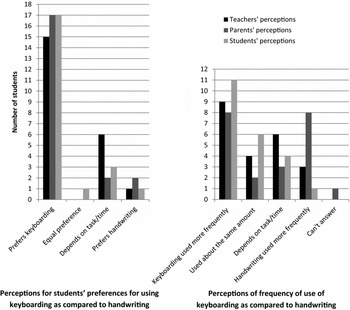
The students’ preferences for using keyboarding as compared to handwriting and the frequency with which they used keyboarding as compared to handwriting are shown in Figure 3.
Perceptions of Preferences for and Frequency of Use of Keyboarding as Compared to Handwriting.

Perceived Helpfulness of Keyboarding
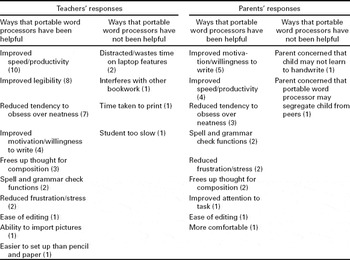
The majority of teachers described the keyboarding devices as very helpful (12 or 55%) or somewhat helpful (7 or 32%). Similarly, the majority of parents described the keyboarding devices as being very helpful (13 or 59%) or somewhat helpful (4 or 18%). Three (13%) teachers and 2 (9%) parents described the keyboarding devices as sometimes helpful, other times unhelpful. None of the parents or teachers described the keyboarding devices as somewhat or not at all helpful. Three (14%) parents didn't know how helpful the portable word processor was as their children did not bring the device home. Table 1 summarises responses of teachers and parents to the question ‘Please describe ways that the portable word processor has been helpful/not helpful to the student in producing written work’.
Ways in Which Portable Word Processors Have Been Helpful or Unhelpful

Note. Number of responses provided in parentheses.
Teachers’ Perspectives on Factors That Help or Hinder Use of Portable Word Processors in Their Classrooms
In response to the question about how difficult it was to adapt learning tasks to enable the student to use the portable word processor, 1 (5%) teacher replied that she used the portable word processor only when the learning task was immediately adaptable to keyboard use, 1 (5%) teacher reported that it was very time-consuming and difficult, 1 (5%) teacher indicated that it was somewhat time-consuming and difficult, 11 (50%) reported that it was sometimes difficult and sometimes easy, 5 (22%) reported that it was somewhat quick and easy, and 3 (14%) reported that it was very quick and easy. When asked about the support that classroom teachers had received on how to use the portable word processor, 2 (9%) rated it as ‘not enough’, 2 (9%) rated it as ‘just adequate’, 15 (68%) rated it as ‘good’ and 3 (14%) rated it as ‘excellent’. Six (27%) teachers said that they would like more information on the functions of the portable word processor. All teachers said that students had access to equipment such as computers and printers. However, 11 (50%) teachers commented that access to the printers could be problematic at times because the printers were shared, in another building, or often off-line. Two teachers (9%) commented that access to computers in the classroom was poor as many students shared the computers.
Keyboarding Training, Keyboarding Method and Support Provided to Students in Using Portable Word Processors
Teachers’ questionnaires indicated that 14 (64%) students had received some form of formal individualised keyboarding training, 2 (9%) had received keyboarding training only with the rest of the class during technology lessons, and 6 (27%) had received no formalised keyboarding training. In response to a question about the quality of the individualised keyboarding training, 1 (5%) teacher described it as ‘excellent’, 9 (41%) as ‘good’, 4 (9%) as ‘just adequate’ and 1 (5%) as ‘not enough’. Fourteen (64%) students had used some form of keyboarding training software. At one school in which the special education teachers were particularly committed to the introduction of keyboarding for their students with disabilities, teachers reported that they had changed to using a traditional typing program rather than keyboarding training software, because they found that keyboarding training software progressed too quickly for students with special needs and with insufficient repetition to develop automaticity. Twelve (55%) students were observed to use a touch-typing method and 10 (45%) used a hunt and peck method. Students who used touch-typing had a mean keyboarding speed of 82.85 (± 75.90) letters per minute, whereas students who used a hunt and peck method had a mean keyboarding speed of 52.90 (± 25.12) letters per minute. This difference in keyboarding speed was not statistically significant (t = 1.60, p = .087, d = 15.59). In response to a question about the level of support provided to the students using the portable word processor, teachers replied that 2 (9%) students had not received enough support, 2 (9%) had received just adequate support, 15 (68%) had received good support and 3 (14%) had received excellent support. However, support on the use of the portable word processor was described as at least adequate for the majority (91%) of the students.
Handwriting Abilities of the Students
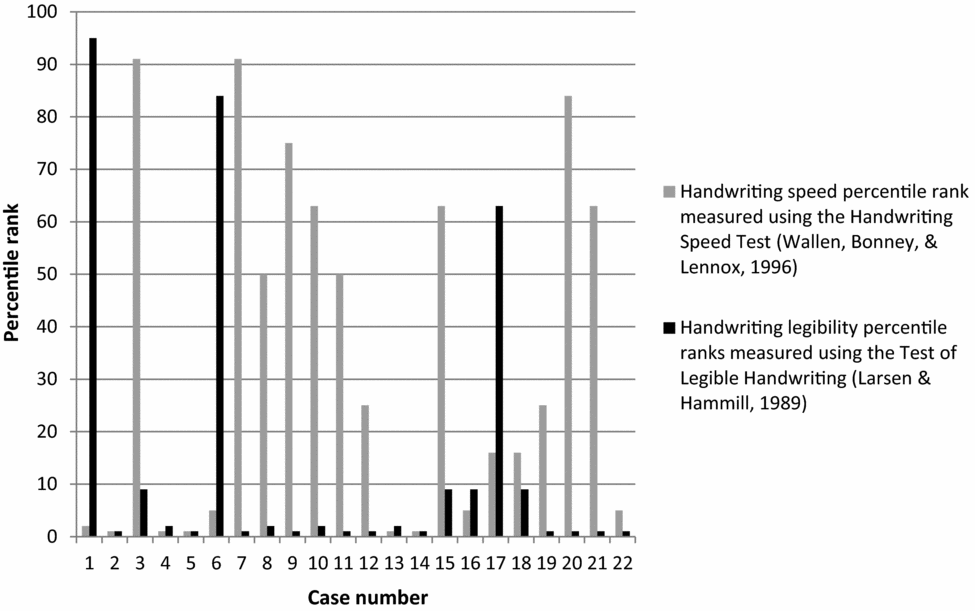
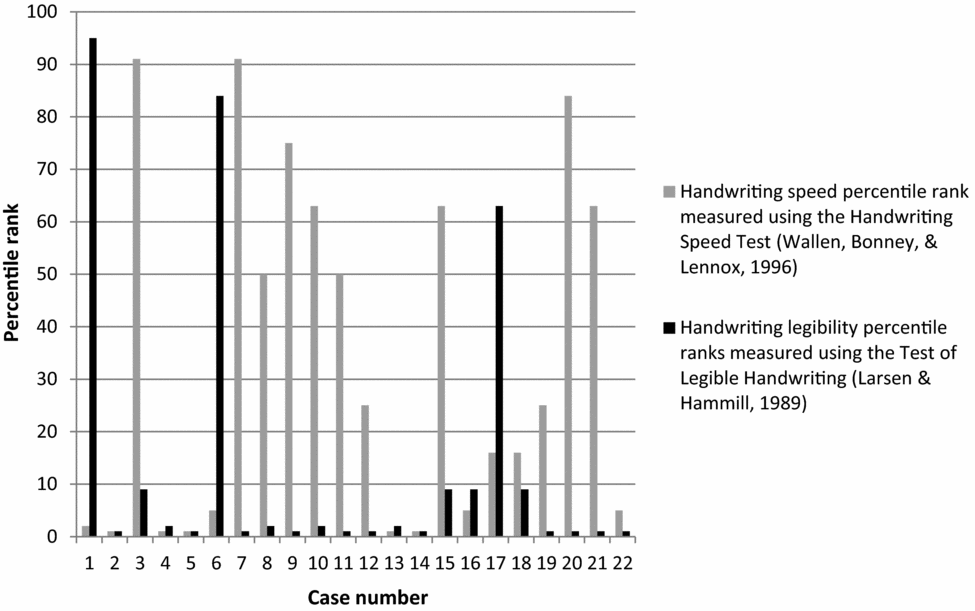
Handwriting legibility percentile rank scores as measured using the Test of Legible Handwriting (Larsen & Hammill, 1989) and handwriting speed percentile ranks as measured by the Handwriting Speed Test (Wallen et al., Reference Wallen, Bonney and Lennox1996) for each of the 22 students are shown in Figure 4.
Handwriting Speed and Handwriting Legibility Expressed in Percentile Rank.
Comparison of the Students’ Keyboarding and Handwriting Skills
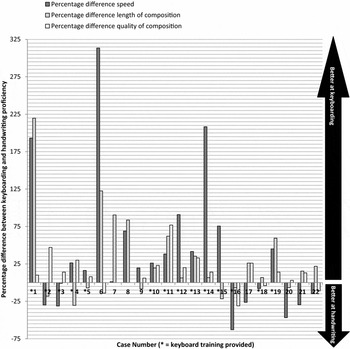
Percentage differences in handwriting and keyboarding speeds and the length and quality of handwritten and keyboarded compositions for each of the 22 students are shown in Figure 5. Positive scores indicate that the student was better at keyboarding and negative scores indicate that the student was better at handwriting. The case numbers of students who received keyboarding training are asterisked.
Percentage Differences Between Handwriting and Keyboarding with Regard to Speed, Length of Composition and Quality of Composition

The group mean keyboarding speed of 69.9 letters per minute (± 47.52) exceeded the group handwriting speed, which was 50.9 letters per minute (± 19.73). However, this difference was not statistically significant (p = .054). Similarly, the mean length of the keyboarded written composition of 84.09 words (± 47.74) exceeded the mean length of the handwritten compositions, which was 66.82 words (± 34.06). This difference was also not statistically significant (p = .053). The mean ratings for quality of the written compositions was rated as higher for the keyboarded compositions, 26.27 (± 4.97), than for handwritten compositions, 23.91 (± 5.28). Again, this difference (p = .010) did not reach statistical significance.
Discussion
Overall, teacher, parent and student questionnaires indicated that students were considerably more motivated to keyboard than to handwrite. Student responses differed, however, to those of teachers and parents in that the students were more likely to report being motivated by handwriting. This response may reflect a tendency to social compliance. Nevertheless, 21 (95%) students rated themselves as being somewhat or very motivated to keyboard as compared to 9 (41%) students who rated themselves as being somewhat or very motivated to handwrite. As a reluctance to write has been observed to impact negatively on academic participation, motivation is considered critical to academic success (Broun, Reference Broun2009). Although perceptions of handwriting and keyboarding abilities of these students were variable, their handwriting skills were much more likely to be rated as below average relative to keyboarding skills, particularly by parents and teachers.
Students listed more issues that annoyed them about handwriting than keyboarding. Concerns about handwriting included physical discomfort (painful hand) or sensory issues (feeling of hand or elbow on paper, feeling of pencil) and concerns regarding the messiness of their handwriting. Hypotonia has a reported prevalence rate of 51% in this population (Ming, Brimacombe, & Wagner, 2007). Tseng and Cermak (Reference Tseng and Cermak1993) observe that children with low muscle tone tend to exert more effort when grasping writing implements in order to achieve control. As the prolonged use of an excessively tight pencil grip could conceivably result in hand pain, further investigation into the links between hypotonia and pain during handwriting among children with ASD is warranted. Concerns about the sensation associated with handwriting were also surprisingly common. Children with ASD have been consistently found to have significantly more symptoms of tactile sensitivity than their typically developing peers (Ashburner, Ziviani, & Rodger, 2008; Rogers, Hepburn, & Wehner, 2003; Tomchek & Dunn, 2007). Possible associations between tactile sensitivity and reluctance to handwrite in this population also invite further investigation. Concerns about keyboarding centred mainly on technical issues such as the device not working properly, or concerns about appearing different to other students (e.g., embarrassed, or others asking them why they used the device). This suggests that educators need to be sensitive to the social impact of introducing keyboarding devices and to consider equipment maintenance issues.
The majority of parents and teachers perceived the use of portable word processors as helpful. Keyboarding was perceived as effective in improving written output by enhancing speed, productivity and legibility, and freeing up thought for composition. Improved motivation when keyboarding was also perceived to be an advantage (increased willingness to write, reduced stress and reduced tendency to obsess over neatness). A commonly reported need to reduce obsessions over neatness suggests that messy handwriting may be a significant source of anxiety for many students with ASD. As a high prevalence of clinically significant perfectionism has been reported in this population (Ashburner, Ziviani, & Rodger, 2010), it is possible that messy handwriting is particularly distressing for students with perfectionist tendencies. Teachers and parents valued the functions of portable word processing devices including spell and grammar check, editing functions and the capacity to import pictures. There were fewer perceived disadvantages of keyboarding. In two cases, teachers were concerned that the students tended to be distracted by the features of their laptops (this has been described as an advantage of Neo™ or AlphaSmart™ portable word processors over laptops). In one instance, lack of keyboarding speed was perceived to be a problem. This concurs with the conclusions of Freeman et al. (Reference Freeman, MacKinnon and Miller2005) regarding the importance of keyboarding proficiency for successful use of keyboarding technology. One parent had concerns that the introduction of keyboarding may have interfered with her child's capacity to learn to handwrite and may have segregated him from his peers. However, this sentiment was not shared by other parents who felt that keyboarding had enhanced their child's capacity for written expression.
Although the majority of teachers, parents and students perceived the students as preferring to keyboard rather than to handwrite, fewer students were reported to actually use their keyboarding device more frequently than they used handwriting. This suggests that some students may not be using keyboarding as often as they would like. As stated earlier, the teacher's ability to adapt learning tasks, equipment availability and staff training and support have been identified as potential barriers to the use of technology in the classroom (Copley & Ziviani, 2004; Freeman et al., Reference Freeman, MacKinnon and Miller2004). Many teachers (14 or 63%) reported that it could be difficult at least some of the time to adapt learning tasks to the portable word processor, suggesting that this issue could be a barrier to the introduction of keyboarding. Although the majority of teachers (20 or 91%) reported that they had received at least adequate support in learning to use the portable word processor, 6 (27%) reported that they would like to learn more about the functions of the device. Access to facilities was also a barrier in some instances, with 11 (50%) teachers reporting that access to printers could be problematic and 9 (41%) indicating that students often need to compete to use the computer in the classroom. The fact that keyboarding training was not always provided or was not individualised for students with ASD may also have been a barrier. Although schools invest a considerable amount of time into the teaching of handwriting, the provision of keyboarding tuition in many of the schools involved in this study appeared to be variable and haphazard. Keyboarding software was not used consistently and one school preferred to use a traditional typing program. The students who used a touch-typing method achieved better speed than those who used a hunt and peck method, although the difference did not reach statistical significance. It is possible that more students may have mastered touch-typing had they received more intensive keyboarding training.
The finding that legibility was an issue for 18 (82%) students is consistent with the findings of Myles et al. (Reference Myles, Huggins, Rome-Lake, Hagiwara, Barnhill and Griswold2003), Cartmill et al. (Reference Cartmill, Rodger and Ziviani2009) and Fuentes et al. (Reference Fuentes, Mostofsky and Bastain2009). For 6 (27%) students, both the legibility and speed were at or below the 5th percentile, suggesting substantial difficulties with handwriting. Two students who did achieve above average handwriting legibility had handwriting speeds that were at or below the 5th percentile. This is consistent with the findings of Cartmill et al. (Reference Cartmill, Rodger and Ziviani2009) who found that better letter formation may be achieved by some students with ASD at the expense of speed.
As stated earlier, Freeman et al. (Reference Freeman, MacKinnon and Miller2005) maintained that students need to able to keyboard as fast as they can handwrite for keyboarding to be an effective alternative to handwriting. Sixty-four percent of these students did achieve keyboarding speeds that were superior to their handwriting speeds, but 32% did not. As all students in this study had commenced keyboarding relatively recently (within 6 to 24 months), it is likely that many will acquire better keyboarding speeds with experience, though this assumption needs to be tested. As 7 (32%) students had substantial difficulties with handwriting legibility (ranging from 1st to 9th percentile), it could be argued that although their keyboarding was not yet efficient in terms of speed, keyboarding offered the advantage of enabling them to produce written work that could be more easily read by others.
Four of the 8 students who had not received keyboarding training had successfully acquired keyboarding speeds that were faster than their handwriting speeds. In contrast, 4 students who had received training continued to struggle to achieve keyboarding speeds that were equivalent to their handwriting speeds. This suggests that although keyboarding training is helpful, some students acquire keyboarding skills without being trained.
Although the quality of keyboarded compositions was not significantly greater than the quality of the handwritten compositions, this difference approached statistical significance at an alpha level of >.01 (p = .01). It is likely that the quality of their keyboarded compositions would have been further improved by turning on the spell and grammar check functions of the portable word processors. The superior quality of some of the students’ compositions when keyboarding could be attributed to greater automaticity in text production. It is also possible that some of the students had such poor handwriting legibility that they were unable to read their own handwritten work, and therefore had difficulty detecting their own errors. Keyboarding may therefore have enhanced their capacity to edit their own work.
Although anecdotally many occupational therapists and specialist teachers report that they often recommend keyboarding for students with ASD who have handwriting difficulties, substantial difficulties encountered in recruiting for this study indicated a lack of widespread use of keyboarding by these students in Queensland primary schools. This suggests that recommendations regarding the introduction of keyboarding often don't translate into practice. There was, however, an extraordinarily high rate of interest from parents who wanted their children to participate in the study because they struggled with handwriting and enjoyed working on the computer. Unfortunately, most of these children did not meet the inclusion criteria of having regularly used portable word processors for at least 6 months. Nevertheless, this level of interest suggests that many parents favour the use of keyboarding by their children with ASD.
Limitations of This Study and Recommendations for Further Research
The intention of this study was to explore the utility of introducing keyboarding to students with ASD who struggle with handwriting in real-life classrooms. However, as there were many variables that were unable to be controlled that may have impacted on the keyboarding competency of the participants, the results of this study cannot be generalised to the broader population of students with ASD. These include the wide variation in students (e.g., cognitive abilities, indicators of autism), the amount and quality of training, the extent to which keyboarding devices were integrated into the program, technical support, and the length of time students had been using keyboarding devices. Further research controlling for these variables is therefore recommended. Research that investigates the issues relating to the most appropriate methods of teaching keyboarding and the most appropriate time to introduce keyboarding to children with ASD with handwriting difficulties would also further inform educational practices.
Implications for Practice
The majority of students with ASD in this descriptive study perceived keyboarding to be more motivating, and in many cases keyboarding effectively overcame substantial difficulties in achieving legibility. Keyboarding has become the predominant means of written communication in many daily life contexts including secondary and tertiary education, home, community and workplace settings. As technologies that rely on keyboarding competency, such as mobile phones and personal computers, pervade almost all aspects of modern life, keyboarding is arguably an essential life skill. In addition to circumventing their challenges with handwriting, the introduction of keyboarding therefore offers students with ASD the opportunity to acquire a skill that is likely to be vital to their participation in many future life roles. Students with ASD often find transition to high school exceptionally challenging due to the demands to attend to multiple subjects with increasingly complex written communication tasks (Adreon & Stella, 2001). As keyboarding is a skill on which high school students rely heavily, students with ASD may therefore benefit from having a ‘head start’ in the development of this skill during primary school. Offering students choices in the way that they express their learning in writing is also consistent with the principles of Universal Design for Learning (Center for Applied Special Technology, 2008).
Strategies to overcome potential barriers to the use of keyboarding warrant serious consideration. In order to address the concerns of students regarding things that bothered them about keyboarding, educational teams should ensure that the portable word processors are properly maintained and that issues related to malfunction are promptly addressed. Potential embarrassment associated with the use of a portable word processing device might be avoided by ensuring that the use of these devices by students with ASD is presented in a positive light to other students, or alternatively offering keyboarding as an option to any students who prefer this means of written communication. Although some students are capable of acquiring keyboarding skills independently, more consistent access to keyboarding training is recommended to assist students to develop touch-typing skills (Freeman et al., Reference Freeman, MacKinnon and Miller2005). Improved access to printers and classroom computers is also recommended. Special education support staff, such as special educators and occupational therapists, may improve their assistance to classroom teachers by (a) providing more information on the functions of portable word processors, and (b) helping teachers to adapt learning tasks to the portable word processor.
The ability to communicate in writing is crucial to school success. For the majority of the students with ASD in this study, keyboarding was fundamentally more motivating and offered a means of sidestepping persistent and frustrating handwriting difficulties.