

1. INTRODUCTION
In this article we examine the drivers of behaviour of actors involved in conflicts over large-scale development projects. The article uses the Merowe Dam in North Sudan as a case study. In addition to widespread displacement, the case presents an ongoing conflict which developed asymmetrically with regard to the groups affected, and which resulted in a number of litigation efforts both within and outside Sudan. This represents a unique opportunity to examine the role played by the involvement of transnational non-governmental organizations (NGOs) in seeding the struggle and in the development of relevant legal norms. We use a modified version of the Spiral Model to understand (i) how conflicts arise in the first place; (ii) what determines their trajectory; and, consequently (iii) the best way to manage them in the future. These questions are examined with reference to the three main actors involved: people affected by the Merowe Dam and its reservoir, who call themselves the Dam Affected People (DAPs); the Government of Sudan (GoS); and the international litigation NGOs (INGOs). The basic assumption of our theoretical model is that the extent of congruence or divergence in norms between governments and affected people is likely to determine the trajectory of a conflict, and also it may also dictate the success or failure of mobilization.
The article uses a combination of discourse analysis, legal analysis, norm mapping, and semi-structured in-depth interviews conducted with six key informants to reach conclusions. The interviews were conducted with:
• three local activists, each belonging to one of the affected groups and having been involved in the various committees organized to negotiate with the GoS;Footnote 1
• the activist who spearheaded the litigation efforts outside Sudan;Footnote 2 and
• representatives from two of the INGOs leading these efforts.Footnote 3
The case of the struggle over the negative impacts of the construction of the Merowe Dam on communities who inhabit the surrounding area unveils a complex picture of conflicting norms and unusual patterns of government response. As expected in cases such as this, mobilization over the rights of the affected people resulted in a mixed bag of successes and failures. While the context of the struggle and the legal matrix against which the story has unfolded is shared, the scale of injustices visited on each of the affected groups was markedly different, even when the distance of the particular locality from the dam is taken into consideration. The extent to which each of these groups affirmed its preferences and realized its entitlements also differed.
The suggestion in this article is that internal political dynamics may have played a greater role in advancing or halting the efforts of the various groups than the apparent or real internalization of environmental justice norms. This may put into question the assumption inherent in the Spiral Model that the responses of governments (including undemocratic ones) are the result of the internalization of norms, which is consequently dependent on external pressure. It is to be noted that in the case of Sudan, norms of justice relevant to the construction of dams were recognized and to some extent reflected in legislation and national policy documents. Implementation, however, was lacking and government responses benefited from the inherent conflict between norms of development, economic growth, and access to water and energy. We find that, rather than international norms influencing norm uptake in Sudan, as anticipated by the Spiral Model, the struggle against the Merowe Dam has in fact contributed to a nascent exploration of norms currently being pursued by transnational litigation INGOs as a direct result of being involved in the mobilization over this cause. The logical policy implication is thus to shift the focus back to issues of governance, domestic capacity building, and legal reforms alongside the conventional focus on the development of international norms and their diffusion. Of particular interest in the latter respect, from the point of view of participants in the struggle, is ensuring access to a remedy against gross violations of accepted legal standards at the international level.
We present the theoretical model we used to analyze the case study in Section 2 together with some explanation of the methodology based on the theoretical design. In order to provide the appropriate context for the discussion that follows, we set out the administrative structure and legal framework that governs environmental protection in Sudan in Section 3. The following section presents the factual background of the resettlement and resistance of the affected communities. Section 5 is dedicated to responses to mobilization against the Merowe Dam by the GoS as well as by the litigation INGOs that adopted the struggle. A discussion follows in Section 6 and a short conclusion is offered in closing.
2. THEORETICAL FRAMEWORK AND METHODOLOGY
This research builds upon the rich and diverse body of literature looking at norms from a constructivist perspective.Footnote 4 We adopt the definition of norms as ‘standards of behaviour defined in terms of rights and obligations’.Footnote 5 Using this approach, we also encompass the traditional international relations concepts of self-interest, power, and language as central components for decision making, in this case by the DAPs and the GoS. As stated by Goertz and Diehl, ‘[n]orms and their impact on behaviour cannot be studied apart from issues of power and self-interest’Footnote 6 – which will become clearly evident throughout this article.
In order to understand the responses of the different actors involved in the struggle, including the INGOs, we use a modified version of the Spiral Model developed by Risse, Ropp and SikkinkFootnote 7 (see Figure 1 – The Basic Form of the Spiral Model). This model was developed originally to consider different stages of reactions by governments to ‘boomerang effect’ mobilizations over human rights issues.Footnote 8 The model captures the processes by which domestic struggles to overcome human rights abuses can be addressed by the involvement of transnational advocacy networks and indeed international norms. Initially viewed as a ‘boomerang effect’, where domestic groups would repeatedly reach out to transnational groups, in the 1990s the model evolved to capture a more robust and detailed process for human rights change. In its simplest form, the Spiral Model works through five consecutive phases: repression, denial, tactical concessions, prescriptive status and, finally, rule-consistent behaviour. The phases emphasize the importance of pressure from the bottom up (domestic, in this case by the DAPs) and the top down (transnational, in this case by the INGOs involved in the litigation efforts). Although not without weaknesses and criticisms,Footnote 9 the model provides a useful framework to analyze the development, movement, and growth of norms employed by the DAPs, the GoS, and the INGOs involved in the Merowe Dam struggle.
The Basic Form of the Spiral Model
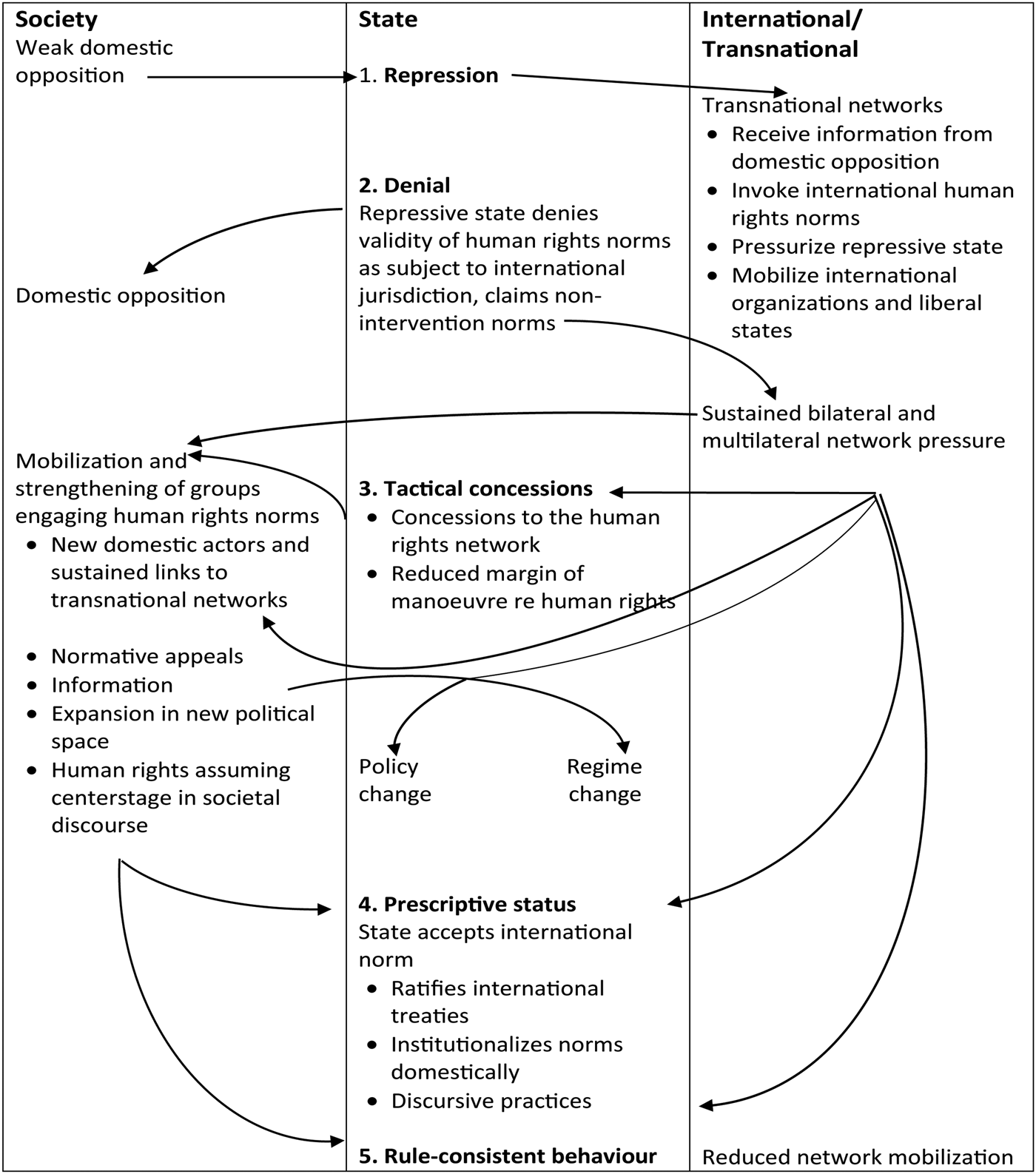
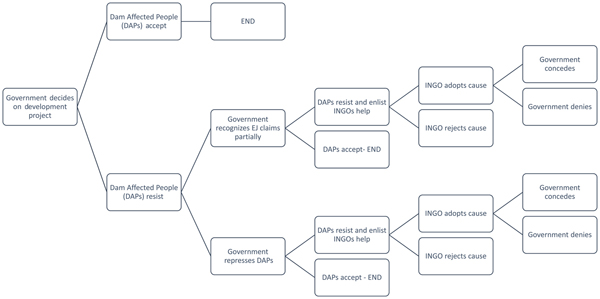
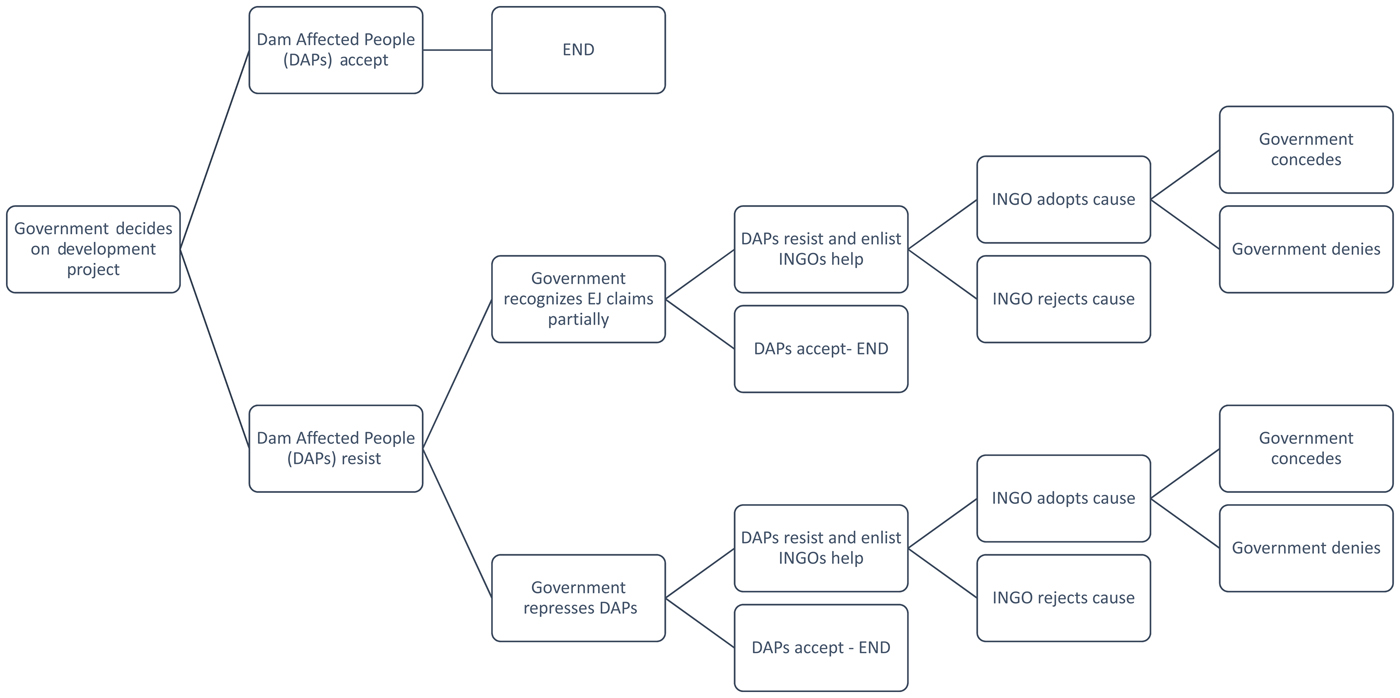
The Spiral Model is adapted here to better understand responses to environmental mobilization (See Figure 2 – Decision Making within the Spiral Model). Zeitoun and his co-authors studied the effects of the construction of the Merowe Dam on the DAPs, using notions of environmental justice, and concluded that such notions do not lend themselves to considerations of repressive responses to struggles by undemocratic governments.Footnote 10 However, repression can itself be understood as one strategy from a set of strategies open to utilization by governments, which can include recognition as well as strategies of denial and partial accommodation through tactical concessions, as reflected in the basic form of the Spiral Model in Figure 1.
Decision Making within the Spiral Model
The Spiral Model explains how international norms can be used as a pressure point to shift a government from repression and denial towards concessions and, eventually, rule-consistent behaviour. Given the human rights context of the Spiral Model, the pressure exerted by transnational networks on non-responsive governments in this respect manifests in directing international public attention to the violations of a particular government and getting other states and international organizations to integrate concerns for respect for human rights in their dealings with the government in question.Footnote 11 Bringing about litigation in international forums is an important tool, which was utilized successfully by transnational networks against authoritarian governments in Latin America in the 1970s and 1980s.Footnote 12 Traditionally, such litigation initiatives targeted non-responsive governments directly in order to reaffirm the validity of the international norms in question. The case brought before the African Commission on Human and People's Rights (ACHPR) against the GoS is a classic example. We have also included an analysis of the case brought by the Justice Broker against the German company Lahmeyer as an example of litigation that brings about indirect pressure on a government and which also serves the purpose of raising public awareness of violations of international norms committed by the government.
What has emerged from the Merowe struggle, however, presents a fascinating challenge to the Spiral Model. Here, the GoS strategically and perhaps pre-emptively invoked strong international norms to justify actions that resulted in human rights abuses. Given this minimum level of internalization of norms, instead of dismissing the response of the GoS to the environmental struggle against the Merowe Dam as an extension of its existing repressive practices, this analysis seeks to understand it as belonging to a continuum of acceptable and unacceptable responses, including violent repression.
The Decision-Making Model in Figure 2 posits that the congruence or divergence in norms between the different actors (the GoS, the DAPs and the INGOs) is determinative of their interaction with other actors. Given this underlying assumption, we opted to do a norm-mapping exercise in order to better understand the decision-making process of the GoS.Footnote 13 This theoretical framework also accommodates the possibility that the DAPs may at any given point accept the conceptualization of justice propounded by the government or reject it (totally or partially) and resist it accordingly. Once the DAPs decide to resist, the INGOs may decide to adopt the struggle or not to adopt it, depending on whether there is sufficient convergence between the two actors with regard to the norms to which they wish to give effect. In the particular case of the Merowe Dam, the litigation INGOs involved worked within human rights frameworks that were then utilized in order to seed the resistance of the DAPs in its environmental context. We therefore found it necessary to explore the reasons for the adoption of this particular cause. The use of in-depth interviews in this research is geared towards understanding the motives of the actors involved and their perception of the struggle and the attitude of the GoS.Footnote 14 In order to develop a theoretical understanding of mobilization in this case, representative interviews of key informants were sufficient, even though further interviews would have offered better corroboration of the data. It is therefore suggested that further empirical testing of the tentative conclusions in this article would be a valuable contribution towards understanding mobilization in the case of the Merowe Dam.
We were also interested in understanding whether the scaling up of the struggle by the Justice Broker who brought the two cases before the ACHPR and before the German courts is likely to give rise to new global environmental norms of environmental corporate responsibility. We hope that a better understanding of decision making – as per this theoretical framework – can inform international norm-development policies and the management of similar struggles by affected people, transnational networks and governments.
A note on norm mapping
A growing body of literature examines norms through the lens of environmental justice and indeed focuses specifically on the struggles of populations affected by hydropower dams.Footnote 15 Organizations such as the World Commission on Dams (WCD) are examples of collaborative effortsFootnote 16 which can result in the setting and employing of norms that benefit all involved parties.Footnote 17 As the most comprehensive and often-cited norms of dam building, the WCD process ‘can be regarded as an instance of transnational rule-making that is functionally equivalent to multilateral environmental negotiations’.Footnote 18 Despite their status as mere guidelines without binding effect, they have acquired a normative and discursive value in that departures from them may give rise to calls for justification.Footnote 19 As such, reference will be made throughout this article to relevant WCD standards.
In assessing the adherence to international norms on the construction of dams, the World Bank Operational Policies on Involuntary DisplacementFootnote 20 also provide a useful reference point against which we can assess the behaviour of the GoS. These quasi-administrative standards are, strictly speaking, internal guidelines set up to ensure that the organization fulfils its own mandate of development and poverty alleviation when funding appropriate projects in borrower countries.Footnote 21 However, the World Bank operational policies often consolidate and indicate the emergence and universality of certain benchmark practices related to dam construction even if the same are only sometimes legally binding, depending on whether they are incorporated in loan or credit agreements.Footnote 22 There certainly seems to be a consensus that although the norms involved in dam building may lack ‘teeth’, they still matter and play an important role.Footnote 23
Norms relating to dam construction operate on three levels: international, national, and local. The analysis of the Sudan Merowe Dam case suggests that the various actors in environmental conflicts focus on different norms drawn from six distinct clusters – namely, environmental/environmental justice, human rights, developmental, social and indigenous rights, corporate responsibility, and state powers. There is a measure of overlap between these categories, especially between environmental justice norms and human rights (for example, participation and accountability) on which the framing of the environmental struggle by the DAPs tended to coalesce. What becomes clear is that the landscape of norms is becoming increasingly crowded, and allows for what we term ‘norm shopping’ to justify positioning and related actions. Particularly in the field of environmental justice, there is extreme scope for multiple, competing, and/or overlapping norms. Rather than fostering more equitable and just outcomes, this leads to a confusing and complex backdrop, allowing for parallel trajectories.
The integration of international norms on environmental protection, human rights, development and economic growth has been a serious challenge for the international community, which has endeavoured to bring them together through the concept of sustainable development. Following the 1992 Rio Conference on Environment and Development,Footnote 24 norms of sustainable development were codified in a number of international instruments,Footnote 25 culminating in the new Sustainable Development Goals (SDGs) adopted in 2015.Footnote 26 These initiatives, however, often understood the elements of sustainable development as independent yet mutually reinforcing, but not necessarily interconnected, competing, conflicting or irreconcilable. For example, linking aid for developing countries to democratization assumes that achieving development in undemocratic contexts, while possible, is not as valuable as achieving it in contexts where human rights are protected. Similarly, by rejecting the idea that development can be used as an excuse for reducing human rights, the SDGs seem to juxtapose the two, thereby presupposing their independence from each other. In the context of the Merowe Dam, the GoS invoked the right to development, economic growth, access to energy and clean water not as a justification for violating human rights but as a necessary means of achieving respect for them.
The concept of sustainable development itself is multifaceted and ‘has come a long way from the original meaning of sustainable use of natural resources to one with more anthropocentric and … socio-economic substance’.Footnote 27 However, it has developed in a piecemeal fashion and has tended to evolve divergently depending on the overarching purpose of a particular initiative and the interests of the main actors behind it. Noting the integration challenge inherent in the concept of sustainable development, Kent argues that the difficulty is in designing laws and policies that go beyond specific goals and strike a balance between various considerations from many fields.Footnote 28 We therefore present our arguments regardless of the sustainable development framework, which we believe suffers from the same syndrome of fragmentation of international law discussed in this article.
3. THE ADMINISTRATIVE STRUCTURE AND LEGAL FRAMEWORK IN SUDAN
The GoS created a number of administrative units both within and outside its existing structure to be in charge of the construction of the Merowe Dam. The first unit created was the Merowe Dam Implementation Unit (MDIU), which operated under the Ministry of Agriculture and Irrigation.Footnote 29 This was later replaced by the Dam Implementation Unit (DIU), which was created under the direct supervision of the Office of the Presidency and not subject to the usual legal constraints applicable to administrative units within the executive branch.Footnote 30 According to Scudder,Footnote 31 parastates such as the DIU are the most logical institutional mechanisms for planning and implementing large-scale hydro power structures and they often enjoy the political backing as well as the direct involvement of the head of the state.Footnote 32 What is unusual about the DIU seems to be both its exclusion from all scrutiny and the apparent classification of the unit and the Merowe Dam as national security concerns, as was explained by all interviewees from the DAP group. They stated that ‘[t]he DIU behaved like a security apparatus’; ‘[we were] struggling against an entity that is beyond law and scrutiny and that enjoy[ed] the protection of the state and its laws’; and ‘I was told by an editor of a newspaper that “the intelligence services regard the Merowe Dam issue as a red line. There can be no reporting on it whatsoever”’.Footnote 33
Notwithstanding the nature of the DIU, it is important to note that national legislation exists which promulgates standards governing development projects in the country. The Environment Protection Act (2001)Footnote 34 (EPA) defines the functions of various federal and state bodies with regard to ensuring environmental protection. Article 17 EPA places a clear obligation on all parties interested in projects that are likely to have a negative effect on the ‘environment or natural resources’ to submit an environmental impact assessment (EIA). This document is required to detail project alternatives as well as actions planned to mitigate the negative effects of the project. Article 3 EPA defines the environment as being inclusive of the social, cultural, and livelihood systems in place. This definition clearly incorporates the norms of sustainable development promoted in the 1992 Rio Declaration on Environment and DevelopmentFootnote 35 and subsequent developments. Notable in this respect, however, is the absence of any procedural provisions in the EPA to ensure transparency and adequate participation by stakeholders in decision making with respect to development projects.
In addition, Article 43 of the 2005 Interim Constitution guarantees the usual list of rights of citizens, including the right to own property and not to be divested of it ‘save by law in the public interest and in consideration of prompt and fair compensation’.Footnote 36 A combination of earlier legislative enactments had the same effect prior to the adoption of the Interim Constitution.Footnote 37 Also relevant to the case of the Merowe Dam is the organization and recognition of land rights in Sudan. Askouri notes that, in addition to the above, 17 pieces of legislation were enacted specifically in relation to the construction of the dam.Footnote 38
4. RESETTLEMENT AND RESISTANCE
The construction of the Merowe Dam by the GoS in 2009, on the fourth cataract of the river Nile, fully or partially submerged 80% of a 250 kilometre (km) stretch along the banks of the Nile, from the North of Abu Hamad to the Hamadab area to the South of Nouri. The 67-metre-high dam has a reservoir of 174 km and a surface area of 400 to 800 square metres. The DAPs who inhabit this area are understood to be 65% Manasir, 7% Hamdab, and 28% of both Manasir and Hamdab who inhabit the area of Amri (hereinafter referred to as ‘the Amri’). For historical reasons, the affected areas have sustained a somewhat independent existence from the centre and their inhabitants have been able to develop a self-sufficient agricultural economy despite inhospitable conditions and the scarcity of agricultural lands.Footnote 39 While the struggle of these communities against the dam evolved as issues of resettlement and compensation became obvious grounds for conflict, the locals initially saw the construction of the dam itself as a welcome development and a promise of further economic growth in the area.Footnote 40 In addition, and because of the challenging conditions in the area, most communities were initially receptive to the idea of resettlement and were duly engaged by the GoS in talks regarding possible sites for relocation.Footnote 41
Despite the shared concerns of the affected groups and their demands, the response of the GoS to the mobilization effort of each group differed markedly. The Hamdab inhabited the area closest to the dam and were resettled first. Their experience was characterized by very limited resistance and, in general, a failure to stave off the efforts of central government to uproot their communities in favour of constructing the Merowe Dam. However, their early resettlement had a profound effect on the trajectory of the Amri and Manasir struggles, which started in 2005 and are ongoing.Footnote 42 Both groups had lost trust in the GoS at an early stage in the conflict, organized and coordinated their efforts efficiently, and assumed unwavering positions in respect of acceptable terms for resettlement. In addition, and as explained by the Hamdab activist, ‘[i]n 2003, the government had a stronger hold in terms of internal security. Amri and Manasir benefited from the conflict between the Islamists over power; and the internet and telecommunications boom also made a difference’.Footnote 43
The subsequent failure of the Amri struggle, juxtaposed against the evident success of the Manasir struggle, demonstrates the failure of the Spiral Model to capture the effects of mobilization in a country like Sudan. The Amri group inhabited an area downstream of the Hamdab and was the second group to be resettled, followed by the Manasir who inhabit an area much further removed from the dam. While the Amri communities consistently reached out to transnational networks and international NGOs, the Manasir Executive Committee (MEC) adopted a more accommodating approach towards the GoS. This approach ultimately worked, given the political climate, as explained by the Manasir activist: ‘We have to use whatever tools are available to us; patience, manipulation, negotiation’.Footnote 44 In a clear departure from the predictions of the Spiral Model, the ability of the Manasir to negotiate effectively with the GoS can hardly be attributed to transnational mobilization and resulted instead from a unique set of internal political dynamics.
Hildyard notes that the Hamdab resettlement package was a total failure, given the poor soil and the inadequacy of basic infrastructure and facilities in the new villages.Footnote 45 According to Bosshard and Hildyard, the poverty rate in the population increased from 10% to 65% in the two years of resettlement.Footnote 46 By 2009, the irrigation scheme in the area had failed completely and farmers were forced to spend from their own pockets to effect workaround solutions. The failure of the Hamdab resettlement was hardly unexpected, with representatives of the group informing the GoS as early as 2002 that the designated location was not suitable and insisting on the readiness of projects as a pre-condition for relocation.Footnote 47 In order to manage the situation, the GoS resorted to a number of coercive measures aimed at deflating Hamdab resistance. As explained by a Hamdab activist, ‘[t]he government exerted all sorts of pressures to induce people to move, including excessive taxation on crops and means of production. They also infiltrated our committees and arrested activists. We had no option but to move’.Footnote 48
The resettlement of the Amri group proved to be even more problematic and has since formed part of the two litigation initiatives discussed in Section 5.2 below. Conflict erupted in 2006 between the group and the body in charge of the implementation and construction of the Merowe Dam (the DIU) over property surveys conducted in the area between 2003 and 2006 for the purposes of determining compensation packages and resettlement entitlements. This culminated in an unprovoked attack, on 22 April 2006, by the police on peaceful protestors gathered to discuss further action regarding the negotiations with the DIU. The attack resulted in three deaths and 13 casualties. Later in the year, Amri villages were flooded without warning, following a decision by the dam authorities to close the dam gates during the high-rise season. In their 2006 letter of complaint to the United Nations (UN) Special Rapporteur for Adequate Housing, the committee representing the demands of the Amri people (the Amri Committee) characterized the incident as ‘a deliberate strategy by the Dam Implementation Unit and the Government of Sudan to force the Amri communities to accept a resettlement package that they have up to date rejected’.Footnote 49 In addition, and following the reluctant acquiescence of the Amri people to be resettled in accordance with the project plans, it became apparent that the DIU grossly underestimated their numbers and needs. Consequently, over 1,360 families remained without housing.
The initial kernel of the conflict between the Amri community and the GoS was adequate compensation. However, by 2008 – and perhaps because they were emboldened by the gains achieved by the Manasir in their fight for recognition of the local option – 600 families decided to resettle on the banks of the Hamdab lake in old Amri to avoid the dire conditions in the new resettlement projects.Footnote 50 This was confirmed by the activist from Amri, who stated: ‘After the flooding, families were forced to move to these unsuitable resettlement areas … many of them had since returned to old Amri and the focus has changed to rehabilitating the old villages’.Footnote 51
It is not entirely clear when the first conflict between the last of the three affected groups (the Manasir) and the GoS occurred. It is likely to have been instigated by a disagreement between the Manasir and the DIU over the assessment of compensation and resettlement options for those affected pursuant to the Presidential Decree on Resettlement and Compensation of the Merowe Dam Affected Communities of 2002. Askouri estimates the start of the conflict to be some time during 2004.Footnote 52 However, the issuing of Presidential Decree No. (277) in September 2003,Footnote 53 which prepared for recognition of the Manasir local option (to remain in the non-submerged lands around the lake) by re-vesting ownership of the Manasir lands in the River Nile State, indicates that a conflict of some sort had already arisen and was being negotiated. In any event, the GoS once more focused on ensuring that those representing the groups would be amenable to its own agenda.Footnote 54 The community eventually formed the MEC, members of which were elected by each village in the area. As explained by the Manasir activist: ‘The DIU wanted particular people to deal with … they did not accept the chosen representatives and refused to recognize the duly elected MEC’.Footnote 55
In any event, in as early as 2004 the now representatively constituted MEC wrote to both the DIU and the financiers and companies involved in building the dam to stop work on the resettlement projects until a plan for resettlement (including an assessment of the local option) and compensation were agreed. By the end of 2005, the relationship between the MEC and the DIU had deteriorated considerably, perhaps precipitated by the earlier experience of the Hamdab group, who had suffered significantly as a result of agreeing to the DIU plan for resettlement. According to the Manasir activist, ‘[p]eople lost faith in the DIU, because it refused to recognize the MEC representative and had misinformed the people, and were not forthcoming with information about the resettlement projects’.Footnote 56
The year 2005 was also politically sensitive for the ruling party in Khartoum. In addition to the conditions in Darfur and international attention focused on the ethnic cleansing in the region,Footnote 57 that year witnessed the successful signing of the Comprehensive Peace AgreementFootnote 58(CPA) between the GoS and the Sudan People Liberation Movement – the opposition group at the time that had led the fight in the south of the country for decades. The CPA guaranteed a number of political freedoms and there was a general sense of a permissive political climate. This had undoubtedly made the GoS in Khartoum wary of possible challengers. Askouri suggests that the MEC – dominated by the Popular Congress Party (PCP), which broke away from the ruling National Congress Party (NCP) in 1998 – may have made the GoS especially nervous given the conditions on the ground.Footnote 59 He explains:
The split in Islamist rows both benefited and disadvantaged the Manasir struggle. It was beneficial because it provided impetus for the PCP to organize for the case and against the government. It was also useful because members of the PCP had inside information about the project. But the split also caused a division between people in the communities.Footnote 60
The conception of the GoS of the various dynamics in play is summarised by Ibrahim Mahmud Hamid, Minister of Humanitarian Affairs, who stated that the affected people ‘think that even the Comprehensive Peace Agreement may affect them, that a new government will come and solve things for them’. He added that ‘[s]ome groups in the opposition want to use [the Merowe Dam matter] as a political issue’.Footnote 61
This charged atmosphere between the MEC and the DIU almost resulted in an armed confrontation in Sani Valley in November 2005. Shortly afterwards, Presidential Decree No. (70) of 2006Footnote 62 was issued. This instrument recognized the MEC and provided the basis for recognizing the Manasir local option, which was later given effect to by the Nile State Governor in Decree No. 37.Footnote 63 A number of other decrees were issued by the Nile State to implement the local option and postpone work on the resettlement projects until the local option resettlement started. By June 2006, the Manasir were signing an agreement with the Nile State to affirm the above decrees. This period of the Manasir interaction with the GoS is characterized by tug-of-war patterns that do not lend themselves to seamless analysis. It could be the case that the GoS negotiated with the Manasir when it had to and otherwise resorted to the same coercive and oppressive practices it used with the other groups when it could. According to the Manasir activist: ‘In 2006, the new Nile State Governor recognized the MEC as representative of the Manasir, possibly because of fear over security escalations in the area. This, despite the fact that the DIU continued to reject the MEC’.Footnote 64
Notwithstanding the gains made by the MEC, armed forces under the command of the DIU were once more sent to the Manasir area in March 2007 to terrorize the people into surrendering to the DIU terms of resettlement following its violation of the Nile State Governor's decrees, which called for halting work on the resettlement projects until agreement was reached. The events culminated in a showdown between the two sides when the Manasir held the DIU force hostage in the Kurbukan Valley. The situation was diffused only through the mediation of members of the MEC, who were later themselves imprisoned over the incident.Footnote 65 This was followed by another agreement between the Manasir and the GoS in May 2007 (the Friendship Hall Agreement), which promised to implement the local option for the Manasir and called for a property survey to be carried out for the purposes of assessing compensation. By August 2008, the Manasir land had been intentionally flooded before the property survey was conducted.
The difficulties in the relationship between the DIU and the MEC notwithstanding, Askouri suggests that with the issuing of Presidential Decree No. (70) on 8 April 2006,Footnote 66 the Manasir struggle had already succeeded.Footnote 67 This is because the Decree returned the lands to the affected people (via the Nile State) and recognized the local option as well as the authority of the MEC, which by then embodied a true representation of the local sentiment on the Merowe Dam. Current demands of the Manasir include access to electricity and water facilities, the construction of a road that can serve the area, and the establishment of agricultural and fish-farming projects capable of sustaining the needs of the local population.Footnote 68
5. RESPONSES TO MOBILIZATION EFFORTS AGAINST THE MEROWE DAM
5.1. Norm Shopping
Briefly, the GoS is invoking norms based on development and economic growth to justify the building of hydropower dams and the adoption of a national plan of environmental management that calls for population redistribution, natural resource management, economic management, land ownership, and urban planning. Additionally, the GoS has been seen to strategically ‘blame’ other international norms for any domestic failings, such as those giving rise to trade embargos, international sanctions, and foreign debt.Footnote 69
There is a marked dissonance between categories of international norms relating to environmental protection, development and human rights.Footnote 70 On some issues, the conflict exists within self-contained groupings of international norms, as is the case when different actors use environmental justice references to justify different goals. For example, there is clear evidence of water resource management for developing countries being prioritized as an element of environmental justice at the international level.Footnote 71 This allows the GoS to invoke environmental justice considerations to fend off criticism over the construction of dams.Footnote 72 While it is acknowledged that building dams to facilitate water resource management gives rise to concerns over distributive justice, the logic of the need for dams to guarantee water resources for a growing population is sound.Footnote 73
Generally, development norms such as access to sustainable energy, economic growth, and access to technology tend to encapsulate the GoS approach more than any other normative framework.Footnote 74 The GoS invokes these norms very regularly to justify dam-related projects, stating that the development of large-scale dams will lead to reducing poverty at the population level, will increase access to power and urbanization, and will harness the latest technology and research to improve environmental outcomes. The government's rhetoric also emphasizes access to sustainable resources and the prevention of desertification, disaster preparedness and flood protection as justifications for its dam-related projects.Footnote 75 The Nile Basin Initiative (NBI) has additionally invoked human rights and development norms to justify water management projects.Footnote 76 In a similar fashion, the GoS explicitly referred to dam construction as an example of fulfilling the people's right to development in some cases.Footnote 77 Still, despite the utilization of the normative claims proffered to justify the GoS programme of dam construction, it has been suggested that such construction is seen as an alternative to oil production following the cessation of the South,Footnote 78 and that its aim is the further consolidation of the hegemonic control of the regime.Footnote 79
The DAPs, in turn, focus on norms surrounding livelihoods, housing, and participation.Footnote 80 Finally, transnational NGOs have drawn heavily on indigenous rights, freedom of assembly, and accountability in formulating their litigation strategies.Footnote 81 This was, at times, also reflected in the DAPs’ formulation of the conflict:
The case of the Manasir at its core is a case of a struggle for land. The political aspect of this is the right to self-determination. The Manasir, unlike the Amri and Hamdab, is a tribe unto itself and you cannot be a tribe if you do not have a tribal land. It was the local people who formulated the issue as one of tribal honour in defending tribal lands.Footnote 82
Having said that, it is interesting to note that in the case of the Merowe Dam the affected people and the government converged on the need for development and economic growth, which were not necessarily seen as posing a direct threat to the relationship of the affected people with the land. This is not usually the case in conflicts over the construction of dams.Footnote 83 Representatives of the DAPs commented:
People in the area were for the construction of the dam. We did not want to deprive the country from the general benefit brought by the dam provided our demands are met.Footnote 84
People did not oppose the expropriation of lands for the public interest, but compensation is essential.Footnote 85
The story of the dam is in the consciousness of the people in the area. The people here were expecting a dam and with it development to the area … We had no problem negotiating over a project that is in the public interest. The problem was that we were completely marginalized and excluded from this benefit and that someone else was making decisions about our lives.Footnote 86
On another level, DAPs take issue with the absence of opportunities for participation guaranteed in a number of international instruments, including those that have subsequently formed part of national policies.Footnote 87 In its 2011 Universal Periodic Review submitted to the UN Human Rights Council, the GoS explained how the country had given attention to the environmental dimension of development and the enactment of legislation, laws and regulations to protect the environment. It also mentioned its accession to a number of international conventions protecting the environment and the creation of environmental tribunals throughout the country.Footnote 88 Even though the EIA for the Merowe Dam did not in fact include any social impact assessment, the government maintained that ‘[f]easibility studies had been conducted prior to the initiation of dam construction works to ensure that the views of persons affected by the projects were taken into account’.Footnote 89 Yet, the following excerpts from government officials and experts are indicative of the generally dismissive attitude of the concerns of DAPs:
[Addressing representatives of the affected people] … Another problem is this focus on agriculture. It is not essential that people relocate from their flooded area to work in agriculture. They can work in mining, fishing or other industries. Why restrict people to one livelihood source?Footnote 90
[The relocated communities] had the deal of their lives. [The government] gives them big pieces of land; they build new houses for them.Footnote 91
I think this is one of the best-organised projects with the best-organised response for those that have been affected … I have been there to see their places, they have proper houses, they have proper facilities, they have farms, everything. And even it is better than the old villages. They have been compensated generously.Footnote 92
One of the major points of conflict between the GoS and populations affected by the Merowe Dam is the issue of forced displacement. The World Bank Operational Policy on Internal Displacement recognizes that in some exceptional cases displacement is necessary.Footnote 93 This was also echoed in the national Guidelines of Internal Displacement (1999), which provide for an exception where the displacement is justified by compelling and overriding public interest. The difficulty, naturally, is in defining the ‘overriding public interest’. It is hard to dispute that, although the government has formulated a National Policy for Internally Displaced Persons (2009), which places on it an obligation to ‘prevent causes of displacement’,Footnote 94 the GoS seems to act on a presumption of the government's entitlement to displace populations regularly.Footnote 95 It has indeed expressed its belief that displacement may be necessary to open up usable land.Footnote 96 Whether the use by the GoS of population displacement to meet its economic growth is compliant with national law is a debatable point.Footnote 97 However, the lack of effective accountability measures prevents this apparent conflict between developmental and human rights norms from ever being debated and resolved at the national level.Footnote 98
5.2 Seeking Accountability in International and Regional Forums
The Spiral Model, as modified for the purpose of this study, predicts (or maps) the involvement of transnational networks following governmental repression of domestic opposition. The opposition enlists the help of international NGOs and actors within such networks in order to affect some sort of pressure on unresponsive governments to change their policies with respect to violations of accepted norms. In the same spirit, Ali Askouri, as the Justice Broker in this case study, utilized his connections with the outside world to bring two cases concerning the Merowe Dam in Germany and before the ACHPR respectively.Footnote 99 The first of these cases – brought before the public prosecutor in Germany against the German company Lahmeyer International, which consulted on the Merowe Dam project – was of particular importance both to the Justice Broker and the affected communities. The litigation in Germany was led by a single NGO, the European Center for Constitutional and Human Rights (ECCHR), and in the African Commission by a consortium of litigation NGOs.
ECCHR and Askouri v. Senior Employees of Lahmeyer International
In May 2010, the ECCHR submitted a criminal complaint against two senior employees of Lahmeyer International to the public prosecutor in Frankfurt am Main in the German Bundesland of Hessen. The complaint asserted the complicity of senior employees of the company in the flooding of more than 30 villages, the displacement of over 4,700 families and the destruction of their livelihoods. In April 2011, the German prosecutor opened a formal investigation against three suspects and heard evidence from several witnesses.Footnote 100 In investigating the incidents of flooding of the Amri and Manasir lands in 2006 and 2008 respectively, the prosecutor relied mainly on section 313(1) of the German Criminal Code,Footnote 101 which states that ‘[w]hosoever causes a flood and thereby endangers the life or limb of another person or property of significant value belonging to another shall be liable to imprisonment from one to ten years’. Additional offences were also identified, including abandonment of a person in a defenceless situation, consequently threatening his life (section 221(1)); criminal damage to another's property (section 303(1)); destruction of buildings (section 305(2); using threats or force to cause a person to do, suffer or omit to do an act (section 240(1)), as well as infringement of section 17 of the Animal Protection Act.Footnote 102 Discussing the legal basis under which the investigation was brought, the ECCHR representative interviewed for this study explained that ‘[n]o one has applied [these sections of the German Criminal Code dealing with flooding] to an extra-territorial case before’.Footnote 103
The crux of the complaint was that, in both incidents of flooding, the resettlement agreements and plans had not yet been finalized and some communities had not yet been resettled, but the flooding took place anyway as part of the planned schedule for the construction of the dam. The complaint contended that those in charge at Lahmeyer had prior knowledge that the floods they provoked and approved would destroy the villages.Footnote 104 From the account of the Justice Broker, the underlying complaint is that the communities were intentionally flooded out when they refused to agree to the unfair resettlement propositions, and that the Lahmeyer employees were complicit in the actions of the GoS as a result of their position as consultants on the project and their expert knowledge of the dam construction business. The complaint also highlighted issues of corporate corruption and the systematic use of force to displace affected populations. Both the French partner company, Alstom, and Lahmeyer were previously implicated in cases of bribery and the use of force in similar projects.Footnote 105
The complaint was eventually dismissed on 20 April 2016 because there was no evidence to conclude that the accused knew of the displacement of the Amri and the Manasir and deliberately harmed them, or knew and accepted that they should be affected by the flooding. In coming to this decision, the prosecutor took on notice the fact that the contract between Lahmeyer and the DIU did not extend to responsibility over displacement and that Lahmeyer had no control over the timing of the closing of the dam, which was agreed in the contract between the DIU and the Chinese construction consortium. The prosecutor was also of the opinion that there was insufficient evidence that flooding had been caused by omission. This opinion, too, was founded on the company's contract with the DIU and the risks expressly assumed by Lahmeyer.
This case had to take into consideration the provisions of the German Code, on the basis of which the complaint was brought before the courts. The complaint also invoked international standards for the construction of dams and resettlement but did, however, acknowledge that these standards do not amount to enforceable law.Footnote 106 Additionally, even though corporate social responsibility norms were not directly invoked, the central themes of the case focused on the idea of a duty of care and professional diligence.
The decision of the prosecutor in fact made no mention of international norms. However, it did refer to the Sudanese municipal Law of Resettlement and Compensation of People Affected by the Construction of Merowe Dam of 2002 in the context of the fact that the EIA conducted by Lahmeyer did not include a resettlement plan. Nonetheless, the prosecutor was of the opinion that, as this Law had become effective in the same year, the absence of a resettlement plan could not be used to prove that the accused knew about the circumstances surrounding the delayed resettlement. The decision to dismiss the case against Lahmeyer, therefore, affirms the importance of national laws beyond their direct influence on decisions and strategies for mobilization. Zeitoun and his co-authors observed that rather than relying on a host of available international norms, mobilization over the Merowe Dam focused primarily on issues of compensation and dignity, seemingly drawn from national frameworks.Footnote 107 This decision further indicates that for the indirect effect of transnational mobilization on the behaviour of governments to occur as per the Spiral Model, it is essential that a minimum level of environmental (and other) protection already exists in national legislation. This makes the theory advanced by the Spiral Model a tautology in this case, as the little protection that is available is the result of prior internalization of international environmental norms.
The legal parameters within which the complaint had to be brought also meant that certain issues could not be specifically pleaded or relied upon. This was the case, for example, with suggestions that, in the light of the country's political climate, the GoS was unlikely to uphold human rights in the process of dam construction, as explained by the Justice Broker in the following excerpt:
I wanted to make the point that by 2003 and because of the massive violations in Darfur, it was not reasonable for Lahmeyer to expect the Government of Sudan to affect the resettlement of the affected people in a fair, just and transparent way. This is in addition to the incidents of the wilful killing of Amri people in 2006 which were not specifically pleaded in the case.Footnote 108
Following the dismissal of the case, the ECCHR called for legal reforms. According to the NGO, the prosecutor had applied an unduly restrictive test to the issue of intent as relevant to culpabilityFootnote 109 Despite the eventual collapse of the investigation, bringing the case was in itself quite significant on a number of fronts. The ECCHR representative stated that, at the time of accepting the case, ‘no thematic areas of focus had developed yet [for the NGO]. This case contributed to the focus of the organization’.Footnote 110 She also expressed her personal expectations regarding the development of the case: ‘I was hoping that the German prosecutor would investigate the case so there would be a discussion on the criminal responsibility of German companies … a political discussion’.Footnote 111
In addition to corporate responsibility under German criminal law, the ECCHR is interested in issues of victim participation in proceedings and state responsibility for the regulation of the activities of domestic companies abroad.
Although test cases can contribute meaningfully to our understanding of norms, especially in the context of corporate responsibility, the success of the strategy from the point of view of the people affected was questioned:
Given the current status of international law, it is a waste of time [for the affected local communities] to attempt to pursue justice against international companies … These communities cannot change this. But, international NGOs should organise campaigns to change these laws and to establish specific, simple and clear procedures that allow communities negatively affected by the work of these companies to bring them to account at minimum cost. Such efforts should be supported by a specified budget and there should be a specific court to look into these issues like the International Criminal Court.Footnote 112
Ali Askouri and Another (on behalf of the Persons Affected by the Construction of the Merowe and Kajbar Dams) v. Sudan (2015–Present)
The second litigation initiative is the case brought by a number of human rights litigation NGOs (the Egyptian Initiative for Personal Rights (EIPR), the Cairo Institute for Human Rights Studies (CIHRS) and the Center for the Study of Law, Justice, and Society (Dejusticia)) against the GoS before the ACHPR.Footnote 113 The complaint concerns multiple violations committed in the course of the construction of the Merowe Dam, as well as the planned construction of the Kajbar Dam, and was brought in the name of the Justice Broker and other individuals from the affected communities. At the time of writing, a decision by the ACHPR is still pending. This case seems to have been born out of an interest in the institutional potential of the ACHPR and as part of a wider North African litigation initiative to use the existing infrastructure to advance jurisprudence on human and political rights.Footnote 114
Under the procedural rules of the ACHPR, parties to a complaint are under a strict obligation of confidentiality, which remains in place until a decision is eventually made. In addition, the gestation period for cases can be as long as seven years and it is common for governments not to comply with the decisions of the Commission. The effect of these institutional features is two-fold: (i) efforts to study the case in greater depth are complicated by the obligation of confidentiality; and (ii) the fact that a case was brought against the GoS as well as any details of the litigation cannot be used to seed the struggle and promote it while a decision is pending.Footnote 115
Given the framework of the African Charter on Human and Peoples’ Rights (African Charter)Footnote 116 and the space allowed by the Commission to bring about a broadly formulated complaint,Footnote 117 we expect pleadings in the case to coalesce around displacement leading to loss of homes, land and property (economic rights), environmental degradation (environmental rights, environmental justice), arbitrary killings and arrests, as well as limited freedom of expression, assembly and political participation, and, most importantly, lack of access to justice (civil and political rights). We are also informed that the Kajbar Dam context raises concerns over indigenous rights and social and cultural recognition. It is in this context that the lack of free and informed consent on the expropriation of land from indigenous people is likely to be raised. The case presents a good opportunity to examine the formulation of the struggle over the construction of the dam in a shared forum, but given the different contexts of those affected by the Kajbar Dam (indigenous people) and the communities affected by the Merowe Dam:Footnote 118
[The complaint] is very much set up as an indigenous peoples’ rights case, because the framework has a lot of resonance in human rights law and there is already some openness to the application of that framework which grew up in the Inter-American system … Because we are dealing with one community that is more clearly Nubian, that would fit in quite without controversy in the rights framework. But, then we have another community in the case of Merowe who do not identify that way. So there is conflict there but the framing has evolved to saying that this is about the displacement of people because of an international product and it is not the case that the people have to fit into a particular box to determine that their rights have been violated.Footnote 119
A number of international norms likely to be invoked include adequate compensation for the loss of livelihoods, land, and income-generating property such as palm trees. We also expect norms to feature that made an earlier appearance in the communication of the Amri community with the UN Special Rapporteur for Adequate Housing, such as the right to health. The African Charter includes express provisions on the right to property, health and a private family life (read as guaranteeing a right to housing).Footnote 120 Given the framework of indigenous rights, we expect resort to the right of cultural development in Article 22 of the African Charter and perhaps claims for loss of culture linked to the loss of land. Despite the focus on indigenous rights, and because of the substantial jurisprudence of the Commission in this area, it is likely that a submission would highlight the multiple violations of political and civil rights with regard to arbitrary arrests and wrongful deaths. This is the norm for submissions before the Commission. The bulk of the Commission's jurisprudence relates to extra-judicial killings, arbitrary arrests, torture and access to justice.Footnote 121 There are also clear provisions in the African Charter on each of these categories.Footnote 122 The remedies sought are likely to reflect the following:
We want remedies for the communities that have been displaced and the individuals that have been injured. We want to stop the construction of the Kajbar dam and to be able to use a decision as and when it is rendered to push back against Sudan dam-building activities more broadly.Footnote 123
As is the norm in similar cases, we expect demands for reparation for victims of killings, arbitrary detention and other ill-treatment, and an investigation into and prosecution for those violations. Most importantly with regard to Sudan, we anticipate an insistence on institutional and structural reforms to enable victims of similar violations to have access to remedies.
Documentation available from the ACHPR shows the GoS clearly using instability and conflict as a justification for not improving the human rights situation more expeditiously. It does not engage in an outright denial of allegations, but offers contextual justifications and explanations, and makes tactical, even token concessions. It is important, however, to keep in mind that these litigation efforts involve a country the sitting head of state of which has two outstanding arrest warrants from the International Criminal Court for war crimes and crimes against humanity. In this respect, the expectations of the affected people and the litigation NGOs involved with regard to the outcome of the case seem to be correspondingly modest. Given the political climate in the country, the primary goal of the NGOs is apparently to utilize the Commission system in the hope that it may become ‘more creative and more effective over time in terms of translating rights’.Footnote 124
[The ACHPR] will never be able to influence the Government of Sudan to do anything about the Merowe Dam. Look at the response of the African countries about the ICC [International Criminal Court] indictment over Darfur. Local people do not trust the African Commission and see it as an institution captured by a club of unaccountable states.Footnote 125
It is very hard to make the case that African Commission litigation is an effective vehicle for advocacy on a particular issue.Footnote 126
6. DISCUSSION
As is common in large-scale development projects, the reaction of those affected by the Merowe Dam shifted from hopeful reception to outright rejection. This shift in response was the result of the failure of the GoS to engage these communities in a bona fide multi-stakeholder process as called for by the guidelines developed by the WCD and other international standards. This failure, however, did not happen because the GoS rejected established international norms relevant to dam construction. On the contrary, there is evidence from legal instruments and policy documents that the GoS acknowledged the existence of these norms and generally accepted them. The divergence in experience between the different groups of affected people with regard to government responses to their claims instead depended largely on the political climate in the country and on internal political dynamics tying these various groups to the GoS.
An examination of the legal matrix in Sudan applicable to the Merowe Dam conflict shows that the recognition of rights is the only dimension of environmental justice that is reflected in national law. For example, the EPA makes no mention of procedural guarantees regarding transparency, participation, and accountability. According to the WCD principles, gaining public acceptance extends to addressing risks and safeguarding entitlements in addition to recognizing rights.Footnote 127 In order to achieve these goals, the participation of affected people is seen as key, and good faith negotiations are essential. The WCD guidelines also emphasize the need for robust and effective legal and dispute mechanism resolutions to manage conflict, which were totally absent in the case of the Merowe Dam.
The inadequacy of Sudanese laws and regulations in this respect is evident when assessed against the World Bank Operational Policy on Involuntary Displacement (OP 4.12).Footnote 128 This policy has been heavily criticized by environmentalist NGOs and scholars as being somewhat regressive in terms of guaranteeing acceptable living standards for those displaced by development projects.Footnote 129 Yet, laws and regulations in Sudan still fall short of the OP 4.12 standard, as confirmed in the GoS Resettlement Policy Framework developed for the World Bank project on Sustainable Livelihoods for Displaced and Vulnerable Communities in Eastern Sudan in 2016.Footnote 130 According to this document, laws in Sudan are characterized by (i) the absence of a requirement for compensation prior to resettlement, as well as the lack of provisions on restoring or enhancing livelihood;Footnote 131 (ii) the absence of provisions on modalities for affecting relocation and guaranteeing adequate infrastructure in resettlement locations; and (iii) the absence of an obligation to conduct ongoing consultations with affected people (at present, the requirement is for consultation prior to the expropriation of the land but not on an ongoing basis throughout the project). This lack of adequate legal mechanisms may explain the failure of local litigation initiatives (including the resort to arbitration). However, there is ample evidence that the GoS attempted to adhere to its own rudimentary norms of development, environmental justice, and human rights.
While the discourse of the government highlighted the safeguards that exist under national laws, it also tended to acknowledge norms that were championed by the affected people, such as participation. The GoS may at times have downplayed the importance of these norms, or even have sought to manipulate the outcome of the required processes of engagement by choosing representatives from these communities whom it can control, but it still seemed to accept the relevant norms in a general sense. This is interesting, not least because the political leadership of the GoS is facing accusations of far more serious breaches of international standards, especially with respect to the Darfur war. If the pull of norms is to be adequately understood, the pertinent question to ask is what made the GoS care about the existence of these norms in the first place? In this case, the apparent internalization of relevant norms (without good faith implementation) may have served the purpose of providing the GoS with sufficient credibility to fend off criticisms over the building of the dam.
The Merowe Dam case study departs from the basic assumptions of the Spiral Model. The expected immediate gains flowing from the involvement of transnational networks (or the Justice Broker) did not transpire. While the GoS resorted to tactical concessions on an ad hoc basis, there is no evidence to suggest that the litigation initiatives in Germany and before the ACHPR contributed to changing the behaviour of the GoS towards the affected people. Moreover, even though the GoS was not particularly moved to respond to the intervention of the UN Rapporteur for Adequate Housing following the Amri complaint, it did in fact agree to a number of concessions in the case of the Manasir following security threats in the area. For example, at the time of writing, the GoS had completed the building of two new villages for resettlement around the reservoir lake for the Manasir on land the ownership of which is claimed by the Amri on historical grounds.Footnote 132 However, none of the pressing housing issues raised by the Amri Committee in its complaint to the UN Special Rapporteur for Adequate Housing were addressed. The interviews with activists also suggest that the special history that the Manasir and their leadership had with the government did affect their ability to manoeuvre the conflict to their advantage. Because the concessions made by the GoS in acquiescing to the Manasir demands for recognition of the local option and resettlement around the reservoir lake came about as a result of political wrangling and not following recognition of applicable legal norms or norms of justice, it is not expected that this particular form of resistance is likely to translate into policy or regime change as predicted by the Spiral Model.
It is also clear from the interaction between the DAPs and the litigation NGOs that the involvement of the latter is dependent on whether resistance is likely to translate into broader change which goes beyond the specific case of the affected people both materially and geographically. Without immediate advocacy benefits for the causes involved, this may result in marginalization of the involvement of these international organizations as well as transnational networks in similar cases. The Merowe Dam case indicates that resorting to international or regional litigation as a viable resistance strategy should be approached with caution in a context like Sudan. Rather, the focus of resistance should be on internal efforts. However, given the importance of these actors in the development of international norms, it would be advisable to focus efforts on making international and regional forums more responsive to the needs of affected people in similar cases. For, notwithstanding the limited impact of litigation efforts on the particular case of the Merowe Dam resistance, they did evince new thinking when it comes to environmental conflicts.
Despite its eventual dismissal, the significance of the case in Germany against Lahmeyer International is three-fold. Firstly, it symbolizes a move away from dependency on unresponsive states for observing human rights and other norms towards a long overdue enquiry into the responsibility of multinational corporations for human rights violations. Secondly, it brings to the forefront the global context within which these violations happen and highlights the focus on economic growth (including that of economies of developed countries) regardless of the effect that this may have on social conditions in developing countries. Finally, it indicates that rather than international norms being influential in determining the trajectory of struggles against large-scale development projects, these struggles do in fact influence the development of international norms quite tangibly. The effect of the African Commission case is harder to gauge, because of the long gestation period for decisions as well as the procedural bar on disclosure of information regarding ongoing litigation. What we can be sure of, however, is that the case is likely to influence the development of norms on indigenous rights to include other groups with comparable experience of large-development projects in the African context.
Furthermore, the Merowe Dam case study seems to highlight an additional issue with the underlying assumptions of the Spiral Model. Given the possibility of pressure from ‘abroad’, governments such as the GoS tend to develop a discordant attitude towards the rights of the affected people. This involves having two uncoordinated dialogues: of a domestic and an international nature. By making use of a jumble of conflicting norms on the international plane, the GoS strategically, and perhaps pre-emptively, invoked established (and often overlapping) international norms to justify actions that resulted in human rights abuses. In this way, the GoS seems to have already reached rule-consistent behaviour with regard to some international environmental and developmental norms but with a different set of ‘rules’ which are not necessarily disputed by the DAPs. This creates an almost parallel trajectory of the Spiral Model, with the DAPs engaged in one struggle, and the GoS responding (legitimately) to another.
7. CONCLUSION
Contrary to the expectations of our theoretical model, which expands on the Spiral Model, the government's responses to mobilization efforts by the local communities affected by the Merowe Dam over issues of resettlement and compensation had very little to do with normative convergence or divergence. There is ample evidence that the GoS has reached rule-consistent behaviour with regard to recognition of the rights of DAPs. There is also evidence that the GoS accepts the existence of international norms on participation and accountability despite the total lack of robust and effective legal and dispute resolution mechanisms to manage conflicts when they arise. The normative gap between the GoS and the DAPs is also minimal when it comes to their conceptions of development and the need for economic growth.
Rather than a normative gap, what seems to be the driving force behind the conflicts that erupted between the GoS and the DAPs is the absence of good faith in the government's interaction with these communities and the conceptualization of the DAPs as only tangentially relevant to the process of dam construction. Given the contemporary political history of the country, it would be misguided to treat the Merowe Dam case as an isolated incidence of injustice over the construction of the dam. Instead, it evinces wider issues of state capture by the ruling regime and a generally dysfunctional relationship between the government and its people. The pattern of accommodating governmental responses to the Manasir struggle (as distinct from the other groups) as well as the characterization of the conflict by government officials as potentially political indicate the presence of an internal political dimension rarely explored in the literature.
The trajectory of the Manasir struggle mirrors the expectation of the Spiral Model in that, at some clear junctures in the struggle, the GoS indeed made tactical concessions – often involving the granting of rights to the Manasir on an ad hoc basis or at the expense of other groups.Footnote 133 Unlike the predictions of the Spiral Model, however, none of these concessions are likely to lead to either policy or regime change, given the lack of principled engagement on the Manasir side.
In general, the success of the Manasir struggle against resettlement in the case of the Merowe Dam can be attributed to a number of factors that are overlooked by transnational networks. The conclusion of the CPA in 2005 opened a minute political space for the group to use in its mobilization efforts, and technological advances allowed them to use social media platforms to rally support for the MEC. Most of the mobilization efforts, however, seem to have targeted members of the group itself as opposed to the wider public.Footnote 134 Incidents of potential armed confrontation, such as the Sani Valley in 2005 and the Kurbukan Valley in 2007 – which came about as a result of cooperation among the Manasir communities and which subsequently led to the GoS acceding to their demands – indicate how the focus on local community mobilization is a winning strategy. There also seems to be evidence that the Manasir struggle benefited from the split in Islamist ranks. This political dimension might provide the better explanation for the trajectory of the Manasir struggle, including aspects of it that flout the expectations of the Spiral Model such as the reluctance to enlist the help of INGOs. In their attempt to ‘manipulate’ the GoS to grant them their demands, the group seems to have accepted the position of the government as the ultimate arbiter of rights, which needs to be placated and cajoled rather than alienated and threatened by resorting to international pressure.
Our research also shows that, given the constraints within which institutions such as the ACHPR operate, regional litigation efforts are unlikely to play an important role in environmental conflicts over the construction of dams in Sudan or in Africa in the near future. This may alter significantly if attention is given to reforming these regional institutions so that they are more responsive to advocacy campaigns. Procedural rules on disclosure and submission, as well as the enforcement of decisions, may be areas that are ripe for reform. Nevertheless, it is important to continue to bring claims against multinationals in their national legal systems where possible. The mere possibility of bringing litigation against corporations such as Lahmeyer International may inspire accountability that is not necessarily conditional on the safeguards already available in the laws of a country like Sudan. Having said that, the inadequacy of legal protection under Sudanese law was what eventually led to the collapse of the case.
In sum, it is hard to isolate the success or failure of environmental conflicts in countries such as Sudan from issues of governance, domestic capacity building, and legal reform. This research suggests that, despite their obvious allure, the promotion of international environmental norms in this area may have very little impact in light of the persistence of competing international norms on development and economic growth. This may imply that what is required is a policy shift that refocuses attention away from the development and promulgation of environmental norms at the international level to issues of domestic institutional building and norm development at the national level.