Introduction
Behçet's disease is a systemic inflammatory disorder characterised by recurrent oral and genital ulcers, relapsing uveitis, and mucocutaneous, articular, neurological, urogenital, vascular, intestinal and pulmonary manifestations.Reference Onder and Gürer1 This disease has a unique geographical distribution, with an unusually high incidence in the countries of the Mediterranean, Middle East and Far East.Reference Reynolds2
Although the causes and pathogenesis of Behçet's disease are still uncertain, the onset of the disease is believed to be triggered by the involvement of external environmental factors in people with a particular genetic background.Reference Zierhut, Mizuki, Ohno, Inoko, Gül and Onoé3 Whatever the stimulus, the target tissue seems to be blood vessels, with various consequences of vasculitis being seen in many different organ systems.Reference Rizzi, Bruno and Dammacco4
Since the underlying lesion in Behçet's disease is considered to be vasculitis, it would be understandable if hearing loss occurred secondary to vasculitis involving the inner ear. The evaluation of hearing loss in Behçet's disease patients has been reported, but thus far it is generally only audiological assessment which has been documented.Reference Soylu, Aydoğan, Soylu and Ozsahinoğlu5, Reference Ak, Harputluoglu, Oghan and Baykal6 Although cochlear function is frequently compromised in Behçet's disease, reports on otoacoustic emission (OAE) findings in Behçet's disease patients are scarce.Reference Muluk and Birol7–Reference Dagli, Eryilmaz, Tanrikulu, Aydin, Gonul and Gul9
Otoacoustic emissions are acoustic signals produced by the outer hair cells of the organ of Corti.Reference Kemp10 Otoacoustic emission testing has an important place in the audiological diagnostic test battery used for clinical evaluation of hearing disturbances. Compared with conventional audiometry, OAE testing is simpler and more efficient. It is also non-invasive and objective, and enables assessment of cochlear function. Transient evoked OAEs are a highly sensitive, frequency-specific indicator of cochlear pathology.Reference Kemp10, Reference Probst, Lonsbury-Martin and Martin11 They are strongest and easiest to detect in the primary speech frequency band (1–4 kHz). Transient evoked OAEs can be recorded in almost all persons with a hearing threshold of up to 20–30 dB HL.Reference Kemp10, Reference Probst, Lonsbury-Martin and Martin11
The aim of this study was to determine the characteristics and incidence of hearing loss with cochlear involvement in patients with Behçet's disease.
Materials and methods
Twenty-four consecutive patients with Behçet's disease (18 men and six women; 48 ears) who were regularly followed by our dermatology department were included in this study. All patients fulfilled the diagnostic criteria of the International Study Group for Behçet's Disease.12 Twenty-four healthy volunteers (18 men and six women; 48 ears) comprised the control group. All patients and controls underwent a complete otorhinolaryngological examination, and a detailed clinical history was taken. Any patients with previous otological disease, acoustic trauma, vascular disease, middle-ear disease or ear surgery were excluded from the study.
To evaluate hearing, pure tone (0.25, 0.5, 1, 2, 4 and 8 kHz) and high frequency (10 and 12.5 kHz) audiometry was performed using a Madsen Orbiter 922 diagnostic audiometer (Madsen Electronics, Taastrup, Denmark) in a soundproof booth. Pure tone air conduction hearing thresholds were determined at audiometric frequencies (0.25, 0.5, 1, 2, 4, 8, 10 and 12.5 kHz) in the patient and control groups. Pure tone averages (PTAs) were calculated at 0.5, 1, 2 and 4 kHz. A hearing level of less than 25 dB in the tested frequencies was regarded as normal; sensorineural hearing loss (SNHL) was defined as a hearing threshold of 25 dB HL or more in at least two frequencies.
Transient evoked OAE (TEOAE) responses were recorded using a laptop computer connected to Otodynamics ILO 292 Echoport equipment (Otodynamics, Herts, UK) and EZ-Screen software (Exhibition Software, Texas, US). Recordings were performed in a soundproof booth.
A TEOAE response was regarded as positive and acceptable for analysis if it satisfied all the following criteria:Reference Yilmaz, Yilmazer, Erkan, Aslan and Ozluoglu13 (1) the mean amplitude of the cochlear response (dB SPL) was higher than the noise in the external canal;Reference Yeo, Park, Park and Suh14 (2) the reproducibility rate of the responses was greater than 50 per cent;Reference Yeo, Park, Park and Suh14–Reference Chapchap and Segre17 (3) the rate of stimulus stability was greater than 75 per cent;Reference Chang, Vohr, Norton and Lekas18–Reference Chang, Jang and Rhee20 (4) the stimulus amplitude was 75 dB SPL;Reference Yeo, Park, Park and Suh14, Reference Chang, Jang and Rhee20 (5) the overall signal-to-noise ratio of response was 3 dB SPL;Reference Chapchap and Segre17, Reference Lalaki, Markou, Tsalighopoulos and Daniilidis21 and (6) the response signal-to-noise ratio at the frequencies 1, 1.4, 2, 2.8 and 4 kHz was 3 dB SPL for at least two frequencies.Reference Chang, Vohr, Norton and Lekas18
We recorded the TEOAE responses, stimulus stability, stimulus intensity and reproducibility for both the patient and control groups.
Statistical analysis
Statistical analysis was performed on results for ears rather than patients, because a single patient could have ears with different results. The Statistical Package for the Social Sciences version 11.5 software (SPSS Inc, Chicago, Illinois, USA) was used for statistical evaluation. The Mann–Whitney U test was used to compare results for the frequencies 0.25, 0.5, 1, 2, 8, 10 and 12.5 kHz in the study and control groups. Student's t-test was used to analyse the differences between study and control groups in the frequencies 4 kHz and pure tone averages of the audiologic tests and signal-to-noise ratio for the frequencies 1.0 to 4.0 kHz of the TEOAEs and in the stimulus intensity, reproducibility, stability, and response parameters of TEOAEs. The effect of disease duration on hearing threshold was analysed by Spearman's correlation coefficient. Statistical differences with probabilities of less than 0.05 were considered significant.
Results
Both study and control groups comprised 24 individuals and 48 ears. Patients' ages ranged from 21 to 58 years (mean ± standard deviation (SD), 37.04 ± 8.11). Patients' mean disease duration ± SD was 6.75 ± 4.78 years (range, three months to 16 years). The control group's mean age ±SD was 35.38 ± 7.63 years (range, 24–57). There was no statistically significant difference between the patient and control groups' mean age or sex distribution (p > 0.05). Pure tone audiometry detected SNHL in 15 of the 48 Behçet's disease ears (31.3 per cent), occurring bilaterally in six patients and unilaterally in three. Sensorineural hearing loss was detected in only one control subject (2.08 per cent), unilaterally. Two typical audiometric configurations were detected: high frequency (eight ears) and plateau (seven ears).
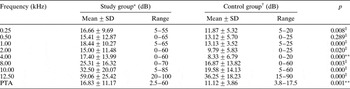
All Behçet's disease patients with SNHL on pure tone audiometry also had high frequency hearing loss. Twenty-six Behçet's disease ears (15 patients: four unilateral, 11 bilateral) had normal pure tone audiometry but high frequency hearing loss. Table I gives pure tone and high frequency audiometry results for the patient and control groups. The frequency-specific audiometry results of the controls were significantly better than those of the Behçet's disease patients at all frequencies except 0.5 kHz (Figure 1). Pure tone audiometry thresholds were found to be statistically significantly higher in the Behçet's group, compared with controls (p = 0.001). No correlation was found between disease duration and audiometric thresholds for any frequencies (p > 0.05).
Comparison of pure tone and high frequency audiometry results in patient and control groups. Each frequency group contained 48 subjects.

Pure tone and high frequency audiometry results

*n = 48; †n = 48; ‡Mann–Whitney U test; **Student's t-test. SD = standard deviation; PTA = pure tone average
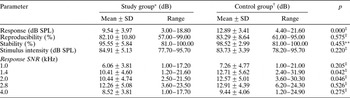
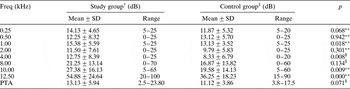
The transient evoked OAE (TEOAE) findings for Behçet's patients and controls are shown in Table II. Transient evoked OAEs were absent in eight Behçet's disease ears with hearing thresholds exceeding 25–30 dB HL. Only two Behçet's disease patients with hearing loss and no TEOAE response actually complained of hearing loss. Four Behçet's disease patients with no recordable TEOAE response, and two patients with hearing loss detected on audiometry, did not complain of any hearing loss. After exclusion of ears with no recorded OAE response, a total of 40 Behçet's disease ears were re-evaluated regarding frequency-specific and pure tone audiometry results; these values are shown in Table III. According to these data, these Behçet's disease patients had increased hearing thresholds at 1, 4, 10 and 12.5 kHz. In addition, the Behçet's disease group showed significant reductions in TEOAE amplitudes at 1.4 and 2 kHz, compared with controls (p = 0.042 and 0.046, respectively) (Figure 2). The average TEOAE amplitude of the Behçet's disease patients (who satisfied the positive OAE criterion) was significantly decreased, compared with the control group. There were no differences between the patient and control groups regarding TEOAE reproducibility, stimulus intensity and stability values.
Comparison of transient evoked otoacoustic emission signal-to-noise ratios (SNRs) in patient and control groups. Each Behçet's disease SNR group contained 40 ears, while each control SNR group contained 48 ears.

Transient evoked otoacoustic emission results

*n = 40; †n = 48; ‡Student's t-test; **Mann–Whitney U test. SD = standard deviation; SNR = signal-to-noise ratio
Pure tone and high frequency audiometry results*

* After exclusion of ears with no recorded otoacoustic emission response. †n = 40; ‡n = 48. **Mann–Whitney U test; §Student's t-test. Freq = frequency; SD = standard deviation; PTA = pure tone average
Discussion
Behçet's disease is a chronic, relapsing, immune-mediated vasculitis affecting both small and large vessels.Reference Rizzi, Bruno and Dammacco4 The heterogeneous clinical presentation of Behçet's disease may be attributable to small vessel vasculitis involving many diverse organs and tissues.Reference Reynolds2 The International Study Group for Behçet's Disease have recommended that the criteria for Behçet's disease diagnosis comprise recurrent oral ulceration plus any two of the following four features: genital ulcers, eye lesions, skin lesions and skin hypersensitivity reaction (pathergy).12 The presence of other signs (such as arthritis or gastrointestinal, vascular or central nervous system involvement) may support the diagnosis.12, 22 Involvement of the inner ear in Behçet's disease, as a result of generalised vasculitis, has been reported.Reference Andreoli and Savastano23 A single terminal branch of the posterior cerebral circulation supplies the cochlea.Reference Arts, Cummings, Flint, Harker, Haughey, Richardson and Robbins24 Therefore, unsurprisingly, vascular diseases are thought to be the most common cause of hearing loss related to Behçet's disease. Hearing loss has been reported to occur in between 27 and 80 per cent of Behçet's disease patients.Reference Soylu, Aydoğan, Soylu and Ozsahinoğlu5, Reference Ak, Harputluoglu, Oghan and Baykal6, Reference Elidan, Levi, Cohen and BenEzra25 Sudden deafness may be the first sign of such audiological involvement.Reference Gemignani, Berrettini, Bruschini, Sellari-Franceschini, Fusari and Piragine26 The cochlea is more frequently involved than the central nervous system.Reference Gemignani, Berrettini, Bruschini, Sellari-Franceschini, Fusari and Piragine26, Reference Pollak, Luxon and Haskard27
The literature is inconsistent regarding audiometric results for patients with Behçet's disease. After performing audiometry on Behçet's disease patients with hearing disturbances, Pollak et al. found no typical audiometric configuration, while Kulahli et al. and Ak et al. found hearing loss involving high frequencies.Reference Ak, Harputluoglu, Oghan and Baykal6, Reference Pollak, Luxon and Haskard27, Reference Kulahli, Balci, Koseoglu, Yuce, Cagli and Senturk28 In our study, two typical audiometric configurations (high frequency and plateau) were detected in Behçet's disease patients with hearing loss. In Behçet's disease patients undergoing frequency-specific pure tone audiometry, Soylu et al. found the mean and SD to be significantly higher only at 0.25, 0.5, 2 and 4 kHz, while Ak et al. found the same results only at 0.25, 0.5, 4, 6 and 8 kHz.Reference Soylu, Aydoğan, Soylu and Ozsahinoğlu5, Reference Ak, Harputluoglu, Oghan and Baykal6 In our study, control subjects' hearing thresholds were significantly better at 0.25, 1, 2, 4 and 8 kHz, compared with the Behçet's disease patients. In addition, the difference between the two groups' pure tone average results was found to be statistically significant. We found SNHL to be present in 31.3 per cent of the Behçet's disease ears based on pure tone audiometry, and in 85.4 per cent of these ears based on high frequency audiometry.
Although many studies have reported pure tone audiometric findings in Behçet's disease patients, reports on OAE results are scarce.Reference Soylu, Aydoğan, Soylu and Ozsahinoğlu5–Reference Dagli, Eryilmaz, Tanrikulu, Aydin, Gonul and Gul9, Reference Andreoli and Savastano23, Reference Elidan, Levi, Cohen and BenEzra25, Reference Gemignani, Berrettini, Bruschini, Sellari-Franceschini, Fusari and Piragine26 As hearing loss in Behçet's disease is thought to be secondary to cochlear involvement rather than central nervous system pathology, the importance of OAE findings in this group of patients is self-evident. Otoacoustic emissions are reverberating sound waves caused by the so-called ‘electromechanical’ movement of outer hair cells, especially following auditory stimulation.Reference Kemp10, Reference Probst, Lonsbury-Martin and Martin11 Otoacoustic emission testing is non-invasive, results are relatively easy to record, and the data provide an objective measure of cochlear function.
For clinical purposes, OAEs are evoked using either transient (for transient evoked OAEs (TEOAEs)) or tone pair (for distortion product OAEs) sound envelopes. During TEOAE testing, the probability of detecting any emission is low in frequency regions where hearing loss exceeds 25–30 dB HL. Transient evoked OAE responses are strongest and easiest to detect in the primary speech frequency band (1–4 kHz), and are highly sensitive to cochlear pathology in a frequency-specific fashion.Reference Kemp10 Conventional audiometry and OAE tests are considered to be complementary, rather than to provide a substitute for each other, as in the case of TEOAE and distortion product OAE testing.
Considering the above, studies assessing OAEs in addition to conventional audiological testing may provide further information about hearing disturbances in Behçet's disease patients. In just such a study, Muluk and Birol detected SNHL in 25 per cent of 40 Behçet's disease ears assessed with pure tone audiometry, and in 60 per cent of such ears assessed with high frequency audiometry.Reference Muluk and Birol7 They reported that hearing thresholds were significantly higher in the study group, and 1.0 to 4.0 kHz TEOAE amplitude values were significantly lower, compared with controls. They concluded that this increase in hearing thresholds and decrease in TEOAE amplitudes, resulting in SNHL, were probably due to lesions located in the cochlea.
Bayazit et al. found that Behçet's disease patients had hearing thresholds within the normal limits, but that their distortion product OAE amplitudes at 1 and 2 kHz were significantly higher compared with controls, which may indicate an impairment in OAE suppression mechanisms.Reference Bayazit, Yilmaz, Gunduz, Altinyay, Kemaloglu and Onder8 Accordingly, these authors speculated that outer hair cell function seemed to be spared in patients with Behçet's disease, with an increased activity in the apical regions of the cochlea. Another study, by Dagli et al., reported that pure tone thresholds and distortion product OAE responses were significantly different in Behçet's disease patients, compared with controls.Reference Dagli, Eryilmaz, Tanrikulu, Aydin, Gonul and Gul9
In our Behçet's disease patients, pure tone audiometry results were significantly different at all frequencies except 0.5 kHz, compared with controls. However, of the nine patients with audiometrically proven hearing loss, only two complained of hearing loss. Interestingly, four patients with audiometrically proven hearing loss and no response on TEOAE testing did not complain of hearing loss. The remaining three patients may not have complained of hearing loss because their PTA values were around 20 dB.
When audiometrical analysis was performed on two groups (after exclusion of 8 ears with hearing loss and no recordable TEOAE responses), hearing thresholds were found to be increased at only 1, 4, 10 and 12.5 kHz in the Behçet's disease group. When these patients' TEOAEs were re-evaluated, the amplitudes were found to be statistically significantly lower at 1.4 and 2 kHz, compared with controls. On the other hand, Behçet's disease patients were found to have a statistically significant difference in pure tone audiometry thresholds at 1 and 4 kHz, compared with controls. However, TEOAE amplitudes for these frequencies were similar in both groups.
These results differ from those of Muluk and Birol, who also utilised TEOAEs.Reference Muluk and Birol7 Other studies give contradicting results. Bayazit et al. assessed the results of distortion product OAEs in rheumatoid arthritis patients, and found that, despite the presence of significant differences at low and high frequency pure tone audiometry, distortion product OAE amplitudes obtained in the rheumatoid arthritis and controls groups were similar.Reference Bayazit, Yilmaz, Gunduz, Altinyay, Kemaloglu and Onder8 These authors stressed that a consistent correlation between pure tone audiometry and OAE results should not be expected. We agree with Bayazit and colleagues; furthermore, we believe that the hearing deterioration observed in Behçet's disease patients on low and high frequency pure tone audiometry might not be explained by outer hair cell dysfunction, since TEOAE amplitude reductions were detected only at 1.4 and 2 kHz.
Distortion product OAE testing could be undertaken to further characterise the cochlear pathology, complementing TEOAE analysis. The fact that we did not attempt to test distortion product OAEs in our patients and controls may have constituted a weakness in our study. Because we could not define a specific pattern of TEOAE recordings, we felt that distortion product OAE analysis would add little information, and may further complicate data interpretation.
Kemp, in an excellent review of OAE testing, emphasised the point that OAEs may originate from different locations in the cochlea, and may fortuitously summate or interfere with each other.Reference Kemp10 Furthermore, transmission back to the ear canal also depends on individual middle-ear characteristics. Since the interplay between these factors cannot be accurately modelled, OAEs remain an imperfect measure of cochlear function, but as yet the best one available. Different studies' discrepant results may also be due to as yet undiscovered parts of the OAE puzzle.
• Behçet's disease is a systemic inflammatory disorder characterised by recurrent oral and genital ulcers, relapsing uveitis, and mucocutaneous, articular, neurological, urogenital, vascular, intestinal and pulmonary manifestations
• This study investigated hearing loss in patients with Behçet's disease
• Behçet's disease patients with hearing loss have no typical audiometric configuration
• The possibility of inner-ear involvement should be kept in mind in Behçet's disease patients, who should be evaluated with pure tone and high frequency audiometry and with transient evoked otoacoustic emission testing, even if they do not exhibit any hearing difficulty
Since SNHL is often encountered in Behçet's disease patients, the clinical examination of these patients should pay special attention to the inner ear. Transient evoked OAE testing may provide better subclinical evidence of cochlear damage, compared with pure tone audiometry, by detecting hearing losses of less than 30 dB HL. In our Behçet's disease patients, although pure tone audiometry showed hearing loss at 1 and 4 kHz, TEOAE testing indicated outer hair cell dysfunction only at 1.4 and 2 kHz. As a result, the possibility of inner-ear involvement should be kept in mind, and Behçet's disease patients should be evaluated with pure tone and high frequency audiometry and TEOAE testing, even if they do not exhibit any hearing difficulty.