Introduction
Persistent social, economic and environmental problems in rural areas all over the world have called for alternative approaches to combat rural poverty and to enhance sustainable development (De Janvry and Sadoulet, Reference De Janvry and Sadoulet2007; Altieri et al., Reference Altieri, Funes-Monzote and Petersen2012; FAO, 2017a). In particular, farming communities still face economic dependency, social marginalization and environmental degradation (Fuchs and Glaab, Reference Fuchs and Glaab2011; Vignola et al., Reference Vignola, Harvey, Bautista-Solis, Avelino, Rapidel, Donatti and Martinez2015; FAO, 2017b). Many international development efforts have moved towards initiatives that address poverty reduction and natural resource management in the context of community transformation. These efforts include participatory elements (Gutierrez-Montes et al., Reference Gutierrez-Montes, Emery and Fernandez-Baca2009; Stone and Nyaupane, Reference Stone and Nyaupane2018; Berchoux and Hutton, Reference Berchoux and Hutton2019) that especially target human and social factors. Organic agriculture is—according to various authors (Scialabba, Reference Scialabba2007; Willer et al., Reference Willer, Yussefi-Menzler and Sorensen2008; Altieri et al., Reference Altieri, Nicholls, Henao and Lana2015; Ssebunya et al., Reference Ssebunya, Schader, Baumgart, Landert, Altenbuchner, Schmid and Stolze2019)—a way to induce sustainable development, as it targets environmental, economic and social aspects (IFOAM, 2014).
The production of cotton, a leading cash crop for marginalized farming communities (Eyhorn et al., Reference Eyhorn, Mäder and Ramakrishnan2005; Shui, Reference Shui2006), has considerable potential to enhance sustainable community development when converted to organic. In conventional cotton production, farming communities face difficult economic, ecological and social circumstances: cotton farmers often live in poor and marginalized communities, which regularly face exclusion from education and health care. Cotton prices are usually low and fluctuating, payment is often insecure, and input costs are high (Eyhorn et al., Reference Eyhorn, Mäder and Ramakrishnan2005). Along with high costs, agro-inputs—extensively applied in conventional cotton production—cause environmental degradation and health problems in farming communities (Bachmann, Reference Bachmann2012). Certified organic cotton initiatives (COCIs) promise to minimize negative effects for cotton farmers and their communities (Bachmann, Reference Bachmann2012), and numerous organic cotton initiatives have been established in different world regionsFootnote 1.
Various studies (Eyhorn et al., Reference Eyhorn, Mäder and Ramakrishnan2005, Reference Eyhorn, Ramakrishnan and Mader2007; Eyhorn, Reference Eyhorn2007; Méndez et al., Reference Méndez, Bacon, Olson, Petchers, Herrador, Carranza, Trujillo, Guadarrama-Zugasti, Cordón and Mendoza2010; Bachmann, Reference Bachmann2012; Makita, Reference Makita2012; Panneerselvam et al., Reference Panneerselvam, Halberg, Vaarst and Hermansen2012; Altenbuchner et al., Reference Altenbuchner, Larcher and Vogel2014; Altenbuchner et al., Reference Altenbuchner, Vogel and Larcher2017) support this claim and show multiple benefits of a transition to organic cotton farming on the household level. However, the effects of such a transition on farming communities are quite unclear, as are the community-wide effects. In particular, the potential of COCIs to trigger self-sufficient community development in connection with the empowerment of farmers and human and social capital is still unclear. Additionally, the interrelations of different measures carried out by COCIs as well as the inherent trade-offs on the community level are further aspects that have not yet been adequately researched.
Different approaches are used to investigate sustainable development and rural livelihoods (Gutierrez-Montes et al., Reference Gutierrez-Montes, Emery and Fernandez-Baca2009). Social and human factors are increasingly central to analyses of community change (Pretty, Reference Pretty2003; Svendsen and Sørensen, Reference Svendsen and Sørensen2007; Donohue and Biggs, Reference Donohue and Biggs2015). Therefore, when trying to grasp the complexity of community transformation and its role in sustainable community development from a systems perspective (Pigg et al., Reference Pigg, Gasteyer, Martin, Keating and Apaliyah2013; Stone and Nyaupane, Reference Stone and Nyaupane2018), the community capitals framework (CCF) (Emery and Flora, Reference Emery and Flora2006) provides a helpful tool. The CCF analyses the dynamic development of a community based on the development of seven community capitals, including human and social capital. In particular, the relationship among the different forms of capital, which can potentially trigger spiraling-up effects, is decisive when analyzing the potential of self-sufficient developments in farming communities induced by COCIs. Thus, the question arises if there are diffuse, multiple community-wide benefits in the form of spiraling-up effects and what encourages or limits the emergence of these positive interrelations across various capital types.
In this paper, we investigate three case studies in different contexts and world regions from the perspective of the CCF (Emery and Flora, Reference Emery and Flora2006). COCIs from Peru, Tanzania and India are analyzed. In particular, this paper pursues the following research goals:
(1) assess the effects of certified organic cotton farming initiatives on community capitals in the three case studies,
(2) identify triggers of community capital development by assessing spiraling-up effects in the three case studies and
(3) detect factors limiting spiraling-up effects and community transformation in the study regions.
The CCF and the spiraling-up effect in the context of certified organic cotton initiatives
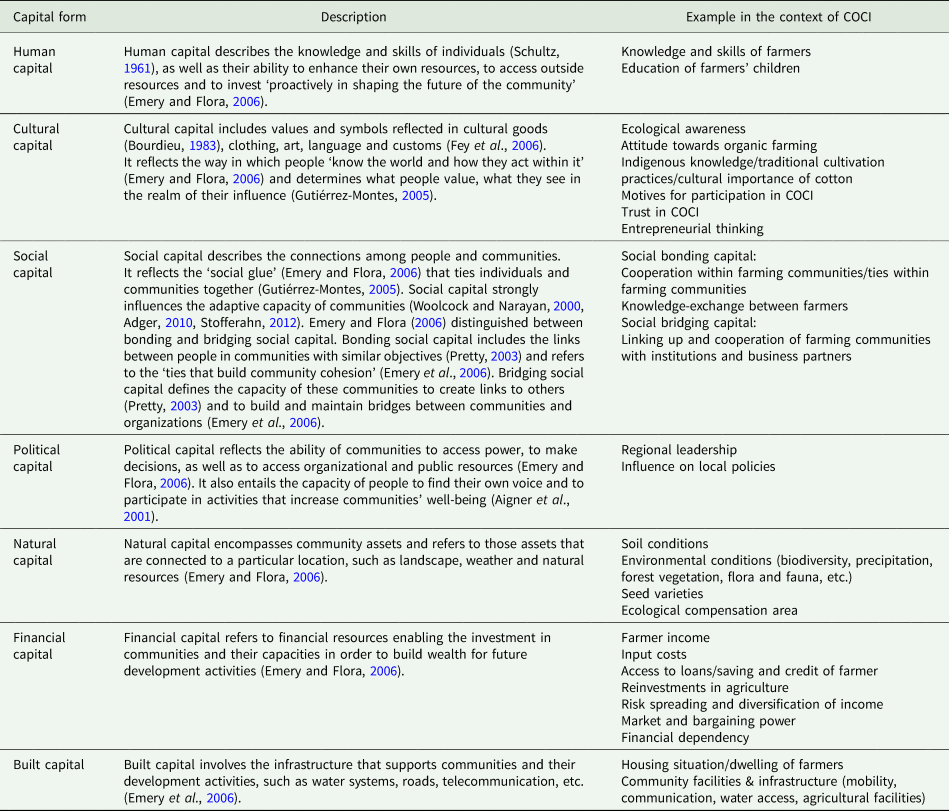
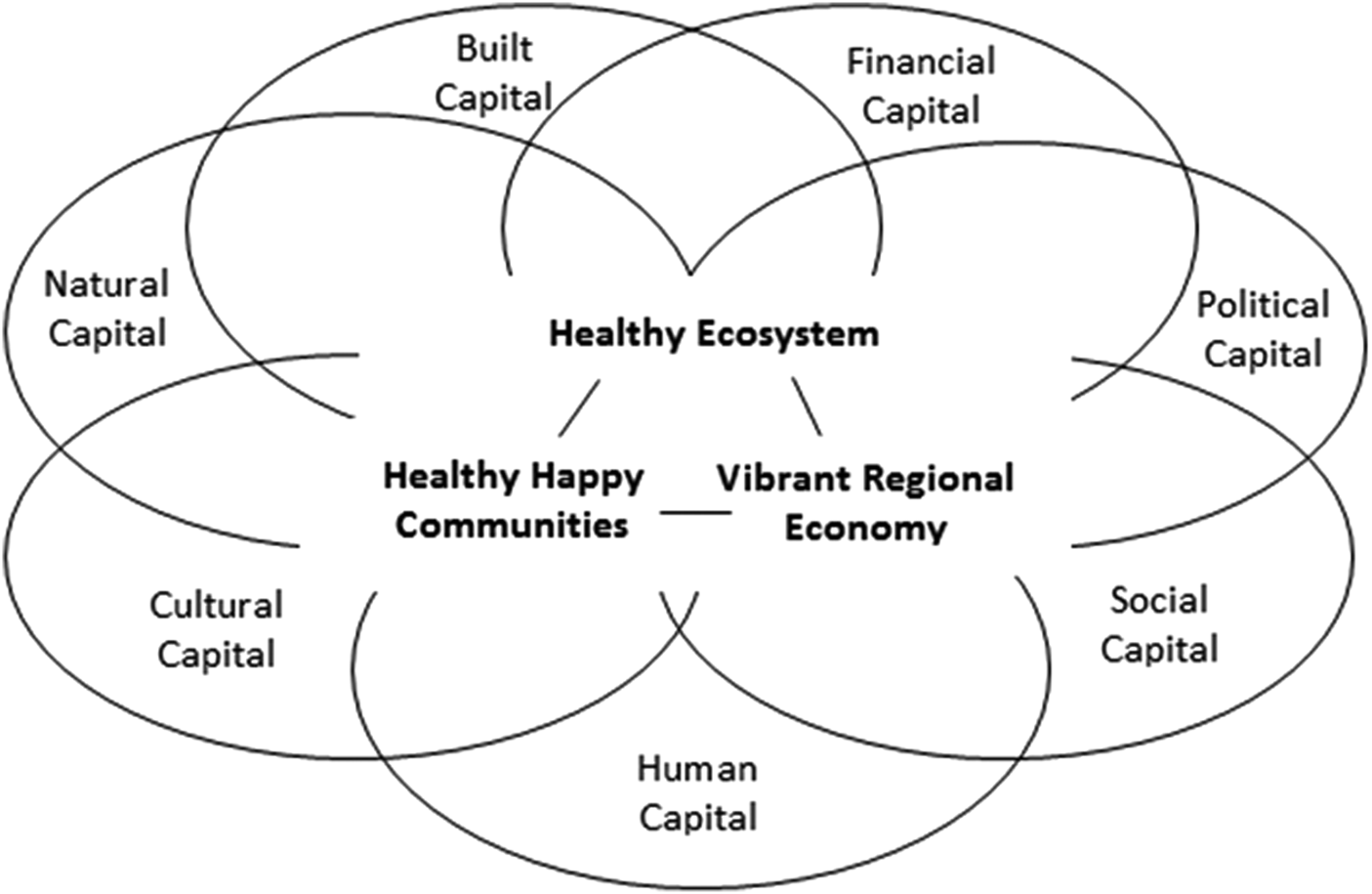
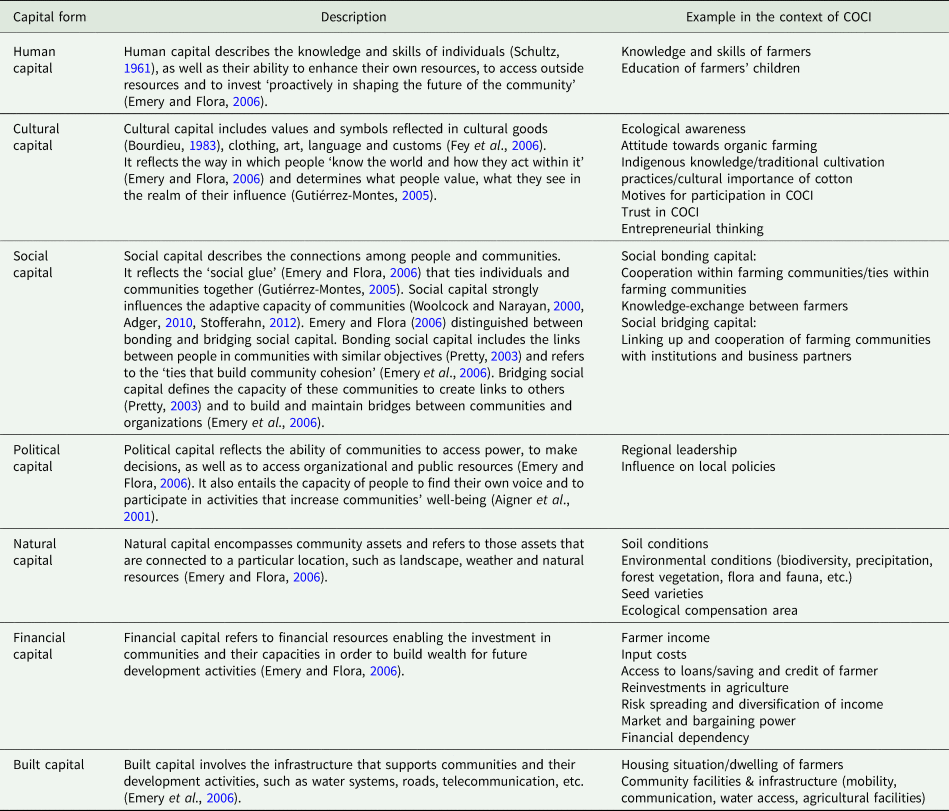
In this paper, the CCF (Emery and Flora, Reference Emery and Flora2006) is used to identify the capacity of COCIs to trigger positive effects on various forms of community capital as well as to initiate spiraling-up effects. Conceptions of community capitals and sustainable livelihoods have different perspectives on which capital forms to include (Bosworth and Turner, Reference Bosworth and Turner2018; Berchoux and Hutton, Reference Berchoux and Hutton2019). While the term capital was initially used to describe purely economic production factors, Bourdieu (Reference Bourdieu and Kreckel1983) extended the term by introducing other types of capital, such as social and cultural capital. Other authors (Coleman, Reference Coleman1988; Emery and Flora, Reference Emery and Flora2006; Svendsen and Sørensen, Reference Svendsen and Sørensen2007; Megyesi et al., Reference Megyesi, Kelemen, Schermer, Renting and Oostindie2010; Donohue and Biggs, Reference Donohue and Biggs2015; Nogueira et al., Reference Nogueira, Ashton and Teixeira2019) developed the concept further, enhancing the focus on nonphysical capital forms. The CCF distinguishes seven different types of community capital (see Fig. 1), including social, human and cultural capital, enabling a broad view stretching from livelihood perspectives to community-level assets, including interactions between these assets. Different authors (De Haan, Reference De Haan2012; Donohue and Biggs, Reference Donohue and Biggs2015; Berchoux and Hutton, Reference Berchoux and Hutton2019) have made the criticism that rural poverty and sustainable development cannot be understood without a multilevel perspective. The CCF represents a superordinate level from which to describe, analyze and compare the effects of COCIs on the development and transformation of farming communities by analyzing the different forms of capital individually (see Table 1) as well as by detecting interactions of capital forms that potentially result in spiraling-up effects.
Description of community capital forms and examples in the context of COCIs
Community capitals (Emery and Flora, Reference Emery and Flora2006).

The process of ‘spiraling-up’ can be described as follows: there is a positive impact on several community capitals and/or gains in one community capital lead to gains in another community capital (Gutiérrez-Montes, Reference Gutiérrez-Montes2005; Pigg et al., Reference Pigg, Gasteyer, Martin, Keating and Apaliyah2013). This means that adapted and appropriate measures can lead to a process of ‘assets’ building on assets' (Emery and Flora, Reference Emery and Flora2006; Stofferahn, Reference Stofferahn2012) as well as to self-sufficient positive community development (Pigg et al., Reference Pigg, Gasteyer, Martin, Keating and Apaliyah2013) and farmer empowerment. In the context of farming communities, it is of special interest to detect whether through COCIs, multiple community effects are possible or if these effects are limited to single community capitals or effects on the household level.
In the case of multiple community effects, the direction of change is decisive (Stone and Nyaupane, Reference Stone and Nyaupane2018): spiraling-up can halt or reverse the process that is commonly associated with rural communities in developing countries, where an outflow of financial capital leads to a loss of human and social capital, described as a ‘spiral of decline’ (Emery and Flora, Reference Emery and Flora2006). In this regard, human and social capital are seen as key factors in mobilizing other types of capital (Megyesi et al., Reference Megyesi, Kelemen, Schermer, Renting and Oostindie2010; Stofferahn, Reference Stofferahn2012). Therefore, it is especially important to determine whether—and which—capital forms can be positively influenced by the investments of COCIs in human and social capital.
This research also aims to detect trade-offs that may occur when investing in different forms of capital in farming communities. As the lack of comparative research and meta-analysis in livelihood studies is often criticized (De Haan, Reference De Haan2012), in this paper, the CCF is used to identify the potential of COCIs to trigger community transformation in the form of spiraling-up effects. This is accomplished by analyzing three different case study regions. Through this comparison, insight is developed into the complexity (multidimensionality) and effectiveness of different interventions of COCIs as well as the potential intended or unintended community-wide effects of COCIs.
Study regions
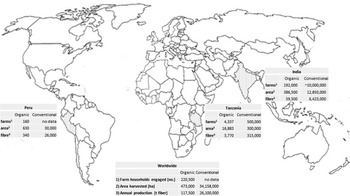
The field study was designed to include three regions with different agro-ecological conditions, farming systems, cultural traditions and initiatives promoting certified organic farming. The three study regions selected were San Martín in Peru, Shinyanga in Tanzania and Odisha in India. In 2016/17, India was the biggest producer of organic cotton with ~60,000 t cotton fiber, Tanzania produced 3770 t annually, whereas Peru accounted for ~340 t of the annual global production of organic cotton (see Fig. 2).

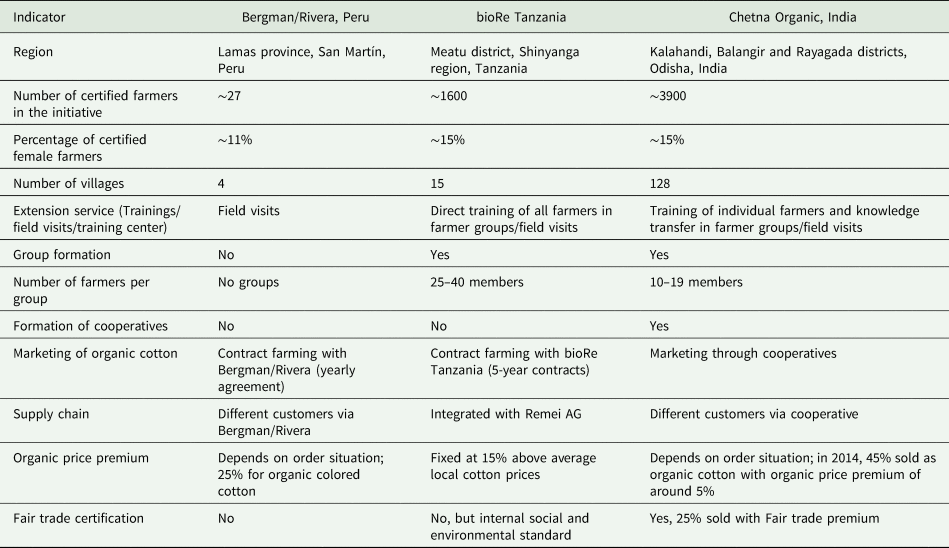
The study region in Peru is situated in the department of San Martín in the province of Lamas. Cotton does not play a leading role as a cash crop in the region, and its cultivation was initially mainly encouraged by nongovernmental organizations (Schjellerup, Reference Schjellerup1999). In general, farmers in the study region cultivate cotton in an organic manner due to cultural conditions and topographic siting (very hilly); on average, they cultivate three hectares each (Schjellerup, Reference Schjellerup1999). The study region in Tanzania is situated in the North, in the Meatu district, Shinyanga region. Most of the population in Tanzania is employed in agriculture. Cotton production provides a livelihood for ~500,000 agricultural households (Mwangulumba and Kalidushi, Reference Mwangulumba and Kalidushi2012) (see Table 2). In Tanzania, cotton is mainly produced by smallholder farmers with landholdings ranging from 0.5 to 10.0 hectares (Baffes, Reference Baffes2002). The study region in India is situated in Odisha, in the districts of Balangir, Kalahandi and Rayagada. In Odisha, agriculture still employs 65 to 70% of the population (Upadhyay, Reference Upadhyay2013). Similar to Tanzania, agriculture in Odisha, India is also dominated by poor, small and marginal farmers, 80% of whom have one to two hectares (Upadhyay, Reference Upadhyay2013). In Odisha, ~85,000 farmer families cultivate cotton on ~124,000 hectares (Directorate of Agriculture and Food production Odisha, 2013). In comparison with the study regions in Peru and Tanzania, in Odisha, both the Indian and the regional government support COCIs as rural development tools because many farmers classified by the Indian government as disadvantaged (i.e., Scheduled Tribes (ST), Scheduled Castes (SC) and Other Backward Classes (OBC)) cultivate cotton.
Structure and engagement of the selected organic cotton initiatives Bergman/Rivera, bioRe Tanzania and Chetna Organic

In all three study regions, the initiatives are engaged with disadvantaged and marginalized farmers, including indigenous and tribal communities. However, there are major differences in the structure and type of engagement in the study regions (see Table 2). Bergman/Rivera (San Martín, Peru) is the smallest initiative of the investigated case studies, with ~160 farmers. In the Lamas province, Bergman/Rivera worked with ~27 farmers in four villages during the time of the field study (2015), of whom three were female members. In the region, Bergman/Rivera concentrates on the purchase of naturally colored cotton, which is grown in the wild around the area (endemic crop). Bergman/Rivera is a Swedish-Peruvian company with its head office in Lima, purchasing organic cotton from other regions in Peru and further processing it. Bergman/Rivera sells its textiles in urban areas of Peru and internationally (e.g., in Japan). bioRe Tanzania works in 15 villages with ~1600 certified farmers, of whom 15% are female. bioRe Tanzania is an autonomous company strongly linked to a similar initiative in India as well as to the Swiss retailer Remei AG. Therefore, much of what is produced is sold directly to Remei AG in Switzerland. The biggest initiative is Chetna Organic (Odisha, India), working in 128 villages with ~3900 certified (mainly male) and 3300 noncertified (mainly female) farmers. Chetna Organic Odisha is part of a larger Indian organic cotton initiative that also works in two other Indian states and has a head office in Hyderabad. Through Chetna Organic India, farmers are linked to Indian and international buyers.
Methods
The analysis is based on three case studies carried out in Peru in 2015, in Tanzania in 2013 and in India in 2014. The case studies were conducted on the basis of a holistic qualitative approach to grasp the dynamics of nonphysical capitals in communities (Svendsen and Sørensen, Reference Svendsen and Sørensen2007; Brondizio et al., Reference Brondizio, Ostrom and Young2009), to gain insight into organic farming communities in a comprehensive manner (Dudley, Reference Dudley2005) and to understand topics crucial to the farmers themselves (Darnhofer, Reference Darnhofer2006). Qualitative methods included qualitative interviews with farmers, expert interviews and participant observation.
For the qualitative, cross-sectional interviews, a stepwise selection of farmers in each case study region was performed on the basis of purposive sampling (Silverman, Reference Silverman2006; Tongco, Reference Tongco2007). The selection was performed based on the following criteria: location in the study region, gender, ethnic affiliation and membership in organic cotton initiatives or relation to members (i.e., spouses or other family members). Purposive sampling (Silverman, Reference Silverman2006; Tongco, Reference Tongco2007) was carried out by a stepwise selection of farmers representing combinations of different interviewees' characteristics until theoretical saturation was reached (Flick, Reference Flick2009). In the Meatu district, Tanzania, 25 interviews were conducted with certified bioRe Tanzania farmers and their family members. In Southern and Western Odisha, India, 30 interviews were held with certified and noncertified members of Chetna Organic farmer groups or their family members. In San Martín, Peru, 25 farmers working with Bergman/Rivera and their family members were interviewed. All interviewed farmers in Tanzania were from the Sukuma tribe. In Odisha, farmers from ST, SC and OBC, as classified by the Indian government, were interviewed. In Peru, members of indigenous groups (Lamistas) and so-called Mestizos (mixed white European and Amerindian ancestry) were interviewed.
The qualitative interviews are based on semistructured interview guides (Bernard, Reference Bernard2002) combined with a standardized questionnaire with closed questions (Atteslander, Reference Atteslander2003). The open questions focused on the impacts of COCIs and included questions about changes experienced over time in the environment, the household and the community, including economic, environmental and social aspects. Additionally, questions about the attitude of farmers (what is your motivation to do organic farming?) were included, as were questions about challenges experienced by farmers. The goal was to gain insight into cultural aspects and potentially unintended negative effects of COCIs. The interviews are based on the perceptions of farmers and, as they were conducted at one point in time, the results are partly based on farmers' retrospective perspective. The interviews covered the time period since the COCIs began in the respective region. This duration was taken into account when analyzing the interviews. Furthermore, the findings were triangulated with observations and expert interviews (see below), i.e., experiences of farmers were compared and collated with outsiders' observations (researcher and experts). The analysis of the qualitative, cross-sectional interviews was performed according to the following steps:
First, to address the research objective (1), the different effects on community capitals in the three case study regions were analyzed according to the content analysis approach (Quinn, Reference Quinn2002; Lamnek, Reference Lamnek2005; Kuckartz, Reference Kuckartz2007). For this step, we used the software Atlas.ti. The coding was performed top-down (as derived from the questionnaire) as well as bottom-up (emerging during the analysis) by one coder to secure consistency. The codes used are equivalent to the examples given in Table 1 for community capital in the context of COCIs. The time period over which the effects are assessed begins with the introduction of the COCIs in the respective region.
We analyzed whether there are effects on the respective community capital. If there are positive effects (=increase, strengthened, e.g., increase in the skills of farmers and therefore in human capital), we assessed the scope (do they reach only some farmers? Do they affect all farmers?) as well as the importance of these effects (e.g., in human capital, we evaluated the depth of the knowledge: does it include only some aspects of farming or different themes in farming, or does it go beyond agricultural themes?). In combination with the number, scope and importance of the effects as related to each community capital, we evaluated whether there is a slight or a strong/significant change in this respective capital form.
Second, according to research objective (2), we identified the interventions carried out by COCIs that caused these effects and grouped them into bundles of interventions (triggers). Third, we analyzed which triggers generated which direct effects on the different capital forms and, using this information, which triggers generated indirect effects on other capital forms, thus tracing spiraling-up effects (research objective 2). These results were triangulated by analyzing the initial reason/trigger for each effect on the community capitals. Fourth, according to research objective (3), we identified factors limiting the induced spiraling-up effects as well as trade-offs in the context of the investigated case study regions.
Finally, to further improve the soundness of the findings, the results were triangulated with participant observations and expert interviews: participant observation (Bernard, Reference Bernard2002) comprised participation in different workshops and gatherings, as well as conversations. Visits to other cotton initiatives and informal conversations with smallholder farmers and/or groups outside the investigated initiatives gave the researcher the opportunity to gain insight into the situation of farming communities and to fully understand the context of cotton production in the case study regions. Expert interviews (Gläser and Laudel, Reference Gläser and Laudel2009) were conducted both with field staff of the respective organic cotton initiatives (e.g., local extensionists, head of certification, state coordinator, etc.) as well as with experts from governmental institutions (e.g., Ministerio de Agricultura-INIA, Tanzania Cotton Board-TCB), nongovernmental organizations (e.g., Textile Exchange, SMScotton, Trade-Craft, Cotton Connect) and scientists (Universidad San Martín, All India Coordinated Cotton Improvement Project-AI CCIP), working in the field of organic and conventional cotton production in the respective country and internationally. These interviews (12 in Peru, 6 in Tanzania and 7 in India) and feedback loops with these experts helped develop a full understanding of the respective context and to reflect the findings.
Results
Effects of certified organic cotton initiatives on community capitals
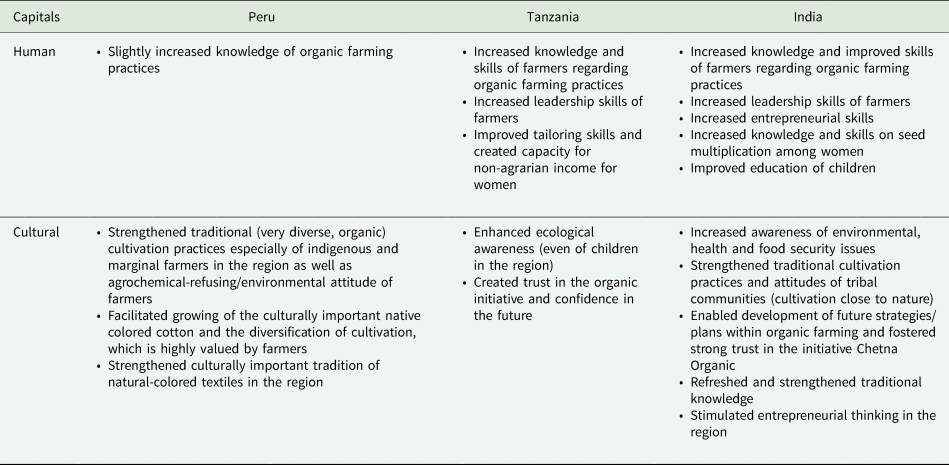
According to research objective (1), in this section, the effects of COCIs on community capitals are listed, differentiated by the seven capital forms of the CCF (see Tables 3–5). In the case of Peru, human capital increased only slightly; however, in Tanzania and especially in India, it rose substantially (see Table 3), mainly in the form of increased knowledge and skills of farmers regarding organic farming practices. A male farmer from Tanzania (4) stated:
At the beginning we were trained to do crop rotation and how to improve the fertility of the soil. We were following what they [COCI in the region] were saying, because the government, they don't visit you, they don't give you any advice. The staff visited us and you are advised on how to cultivate in an organic way. The transition period was 2 years and after that I was fully organic. At the beginning there was also soil erosion, but now I am able to control it.
Impacts of COCIs on human and cultural capitals in the study regions

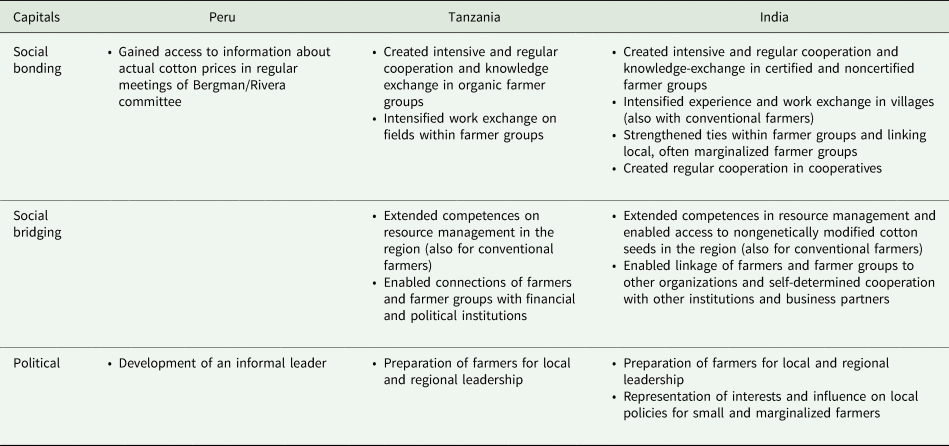
Impacts of COCIs on social and political capital in the study regions

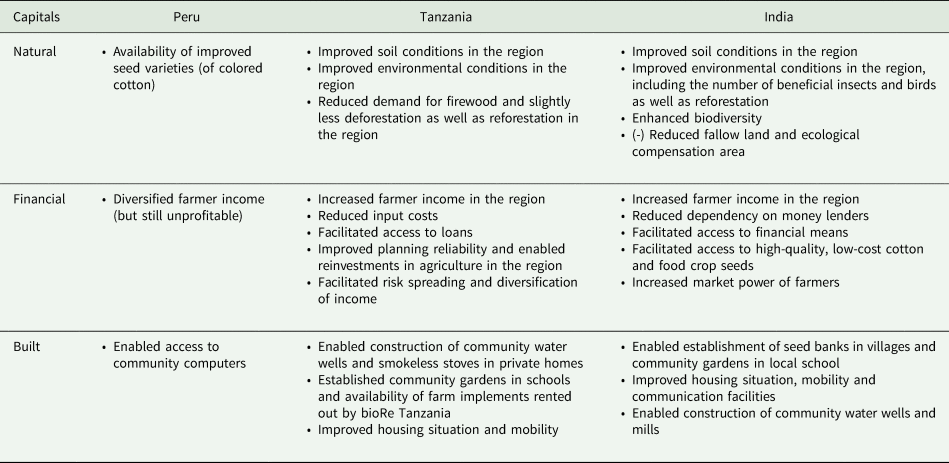
Impacts of COCIs on natural, financial and built capital in the study regions

For instance, regarding farmers' leadership skills, a realized takeover of farmers' responsibility in groups and cooperatives, internally and against outside agents, was filtered out of qualitative interviews in India and Tanzania and collated with observations made during interviews and in meetings. A female farmer from India (1) noted:
I am taking care of the seed bank. I am the main trainer and the leader of the group. We have many group activities, and we jointly decide about the activities we are undertaking. Additionally, we are discussing regular savings, bank repayments and village-level issues, and I represent the group at village-level meetings.
In all three study regions, there were positive effects on cultural capital (see Table 3). In Peru, growing culturally important native colored cotton was supported. ‘[We decided to work with Bergman-Rivera to] not stop producing brown cotton, because if we stop planting in a few years it will not exist anymore …’ Male farmer from Peru (1)
In Tanzania, a higher environmental awareness was realized. ‘The price influenced my involvement in organic cotton production. Because the price is higher compared to conventional cotton. … Now, even if there were no price premium, I would still grow organic cotton because the training we are getting, and improvements to the soil fertility and the environment are better through the training we get.’ Male farmer from Tanzania (25)
Communities in India showed a higher awareness of environmental, health and food security issues. Entrepreneurial thinking has been stimulated, and tribal communities have been strengthened in their traditional cultivation practices. A male farmer from a tribal community in India (17) explained:
I didn't use any pesticide and fertilizer before Chetna. I was only using farmyard manure. I used botanical extract. Traditionally, we are using, like father and grandfather. … Chetna was giving us some improved knowledge to enhance productivity. They are giving us some technical ideas about how to do composting, or to manage pests and how to preserve traditional seeds.
Bonding social capital (see Table 4) increased only marginally in the case of Peru, showing a low level of cooperation within the committee of Bergman/Rivera, while in Tanzania and especially in India, this form of capital increased significantly, as cooperation and knowledge transfer occurred in organic farmer groups (Tanzania and India) and cooperatives (India) formed by COCIs. A male farmer from India (9) stated:
Before Chetna, there was no institution in the village. We were working on an individual level. But after Chetna started, we formed so many groups and after that we formed a cooperative.… Usually, first of all, we organize a group-level meeting, the SHG [Self Help Group] meeting once in a month, then we conduct a village-level meeting. All the group members participate in the village meetings. … There are 7 SHGs [Self Help Groups] in the village. Each SHG has its meeting, then we conduct a meeting on the village level and then on the cooperative level, which is once a month. And quarterly, every 3 months, we are meeting in Hyderabad with all the board members. We sit together and conduct a meeting. The information-sharing process is slow from village to cooperative, from cooperative to COFA [association]. Then back to cooperative and to village. This type of cooperation and communication process is there.
Additionally, cooperation with conventional farmers was intensified. ‘We are sharing in the group meeting and in village meeting and with other people, the neighboring villages. They [conventional farmers] are also interested to join us. … We exchange knowledge on organic agriculture with them.’ Male farmer from India (7)
Bridging social capital (see Table 4) was not created in the case of Peru. In the case of Tanzania, there was a slight increase in bridging social capital, as organic farmer groups are enabled to connect with financial institutions in the region. In India, through farmer groups and cooperatives, there is self-determined cooperation with other institutions and business partners. A male farmer from India (9) specified:
The cooperative is mainly for marketing. The role of the cooperative group is that we sort out fair trade and organic buyers. If we don't find enough international buyers, for the rest of the cotton, we arrange local, how to sell the cotton of all farmer members to local buyers. All the farmers’ products are collectively collected and then sold to buyers through the cooperative together.
Political capital (see Table 4) slightly increased in the case of Peru through the development of one informal leader. In Tanzania, as well as in India, political capital increased to a higher degree, as farmer groups prepared for local and regional leadership. Additionally, through the formation of cooperatives, there is a representation of diverse interests, and farmers can influence local policies.
In the case studies of Tanzania and India, the initiatives triggered a major change in farming practices, sharply increasing communities' natural capitals (increased soil fertility, less erosion, more beneficial insects and birds, etc.) (see Table 5). A male farmer from Tanzania (7) indicated:
In organic farming we insist on crop rotation to maintain the fertility of the soil, by rotating the crops. You find that leguminous crops add fertility to the soil. … So it is improving and there is no degradation, no loss of fertility because I am following crop rotation. … And when there is soil erosion in my fields, I am trying to make sure to control it.
In the case of Peru, agrochemicals remain banned (some farmers would consider using herbicides due to the labor-intensive weeding process); environmentally friendly, highly diversified cultivation practices are supported and natural capital is conserved. ‘[Bergman-Rivera] helps us to continue selling our [colored] cotton products … we sell then one and another kind of products [Cocoa, Banana, Sacha Inchi, Maize, etc. ], and in between that cotton comes in, and it helps us a little [to continue colored cotton production]….’ Male farmer from Peru (1)
Farmer communities in all three case studies were able to increase their financial capital (see Table 5). Financial capital in Peru improved only marginally, and despite a price premium of 25%, certified organic cotton cultivation is still not profitable for farmers. In India, financial capital increased to a high degree and even more so in Tanzania. The improvement strongly depends on yield developments after conversion. In Peru, yields stagnated as organic farming practices had previously been applied by farmers. ‘We always kept organic cotton, we don't [and didn't] use chemicals at all… So there is no change at all [in yields].’ Male farmer from Peru (1)
In Tanzania, earnings increased through the introduction of systematic (organic) farming practices. These practices were especially effective because financial means for obtaining agrochemicals were strongly limited before the conversion to organic cultivation. A male farmer from Tanzania (30) stated:
The effect of these farming practices are … when the soil fertility is improved it means that at the end, the harvest becomes bigger. So that is what I have experienced in my fields. … I did not apply chemicals and pesticides because they are expensive. I was just growing on cotton without spraying those even when I was a conventional farmer. … And bioRe is buying at a higher price.
In India, returns often decreased as agrochemicals, applied heavily beforehand, were banned and could not fully be substituted by organic inputs, mainly during the conversion period. A male farmer from India (12) said:
Before Chetna, we spent more money on inputs. Now, there are less expenditures on input. All the things we make in the house. So we have less expenditure. … But in the first year we lost yield. Then in the second year it slowly increased. But as of now it is not normal. It is still below. … But if you compare with expenditure overall, it is the same.
Additionally, different changes occurred in built capital (see Table 5), such as access to community computers (Peru), the construction of community water wells and smokeless stoves in private homes (Tanzania) and the establishment of seed banks in villages and community gardens in local school (India).
While we mainly observed positive effects for communities, certified organic farming also triggered some negative changes in the case study regions. For example, in the case of India, organic farming results in a higher work load for farming communities, especially for women, which reduces the chance to build up human capital through more knowledge-oriented actions (training, exchange of information). Furthermore, in India, organic farming leads to a reduction in the size of the ecological compensation area (natural capital). In the case of Peru and Tanzania, a certain dependency on certified organic cotton farming initiatives could be observed, limiting the autonomous development of human and social capital. In general, different degrees of spiraling-up effects could be observed in all three case studies. In the following section, the triggers of these spiraling-up effects are described.
Triggers of community capital changes in the context of certified organic cotton initiatives
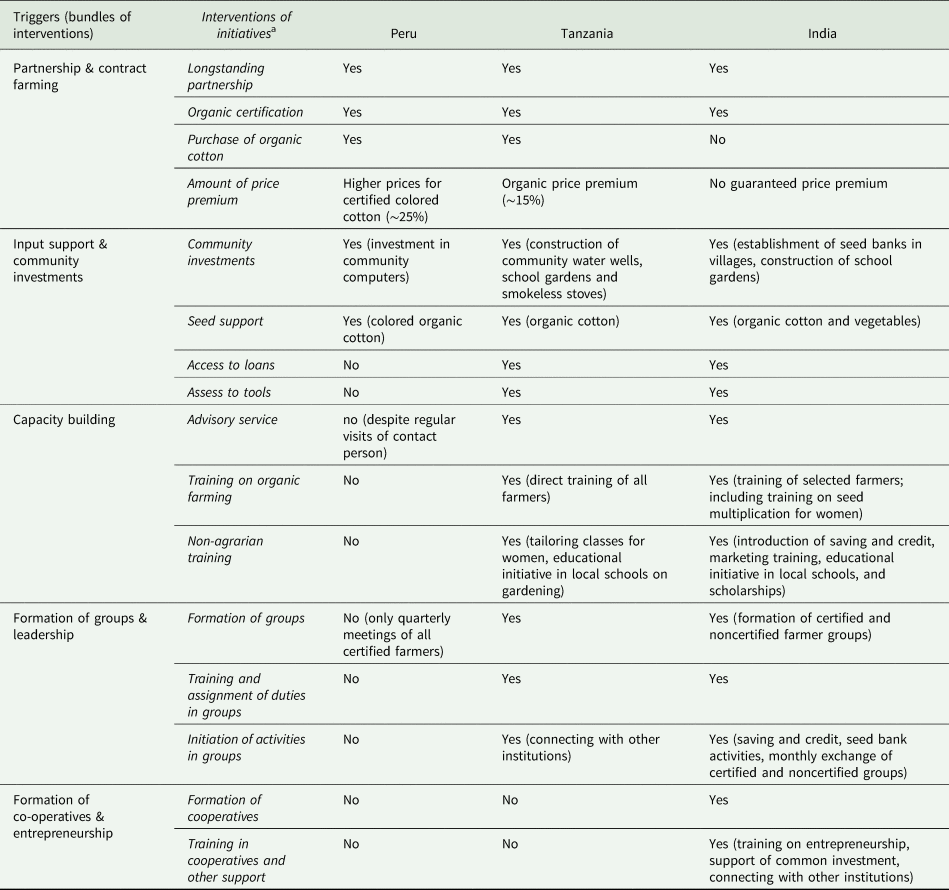
The analysis identified different interventions carried out by COCIs that generate effects on community capitals in the study regions. According to research objective (2), these interventions were grouped into five bundles of interventions (triggers) according to the type of intervention: the five triggers identified are partnership and contract farming (security net), input support and community investments, capacity building (through training and advisory services), formation of groups and leadership as well as formation of cooperatives and entrepreneurship (see Table 6).
Triggers of community capital changes in the context of COCIs

a At time of research and simplified.
Partnership & contract farming. All three initiatives have a long-standing partnership in the respective regions and provide organic certification for farmer groups. Bergman/Rivera in Peru and bioRe Tanzania are doing contract farming and purchase organic cotton directly from their farmers at a guaranteed price premium. Chetna Organic does not directly purchase organic cotton; however, they support farmers in their marketing activities.
Input support & community investments. Community investments are made in all three case study regions. Bergman/Rivera provides community computers, bioRe Tanzania constructs community water wells, school gardens and smokeless stoves and Chetna Organic establishes seed banks in villages and school gardens. In Peru, Bergman/Rivera provides new breeds of (organic) colored cotton seeds. bioRe Tanzania organizes the redistribution of organic cotton seeds from local ginneries and continually tries to increase the quality of the breeds used. In India, where access to organic seeds is especially problematic due to the widespread use of genetically modified cotton seeds, Chetna Organic tries to increase seed self-sufficiency through local trials and organizes seed distribution via cooperatives. Additionally, local seed banks for vegetables have been established.
Often, access to affordable loans is highly limited (Jabbar et al., Reference Jabbar, Ehui and Von Kaufmann2002; Khandker and Faruqee, Reference Khandker and Faruqee2003; Giné, Reference Giné2011; NSSO, 2014). In the study region of Tanzania, interviewed farmers did not have access to loans at all, while in India, farmers in the study region usually only had access to middlemen offering high-interest loans. In the study region of Peru, access to loans is usually not very limited, although it is harder for remote and/or indigenous farmers to access loans due to administrative obstacles and lack of experience in this regard. While Bergman/Rivera (Peru) does not set any measures in this regard, bioRe Tanzania provides access to loans for full organic farmers and Chetna Organic, India provides administrative support when farmers apply for bank loans. While Peru does not provide any access to agricultural machinery or tools, bioRe Tanzania rents out different agricultural tools and machinery and in India, Chetna Organic provides female-adapted tools, bins, etc. for farmers.
Capacity building. In all three study regions, access to information is generally very limited, especially for remote, indigenous/tribal and female farmers. To improve this situation, initiatives provide training and/or advisory services. To implement organic farming practices necessary for organic certification in the study regions of Tanzania and India, both bioRe Tanzania and Chetna Organic offer comprehensive advisory services, including training and field visits. While bioRe Tanzania directly trains all farmers in certified groups, Chetna Organic selects farmers from each group, and these farmers are responsible for knowledge transfer in the groups. Bergman/Rivera (Peru) does not provide specific, systematic training because farmers already apply organic farming practices and reject the usage of agrochemicals. A contact person is, however, appointed to respond to questions.
Formation of groups & leadership. While Bergman/Rivera, Peru does not implement any measures in this regard, bioRe Tanzania and Chetna Organic, India strongly encourage the formation of groups, mainly to organize knowledge transfer as well as internal control systems (ICS).
Formation of cooperatives & entrepreneurship. While in Peru and Tanzania, the initiatives practice contract farming, in the case of Chetna Organic, India, farmer-organized and -owned cooperatives and associations are formed, which are responsible for the sale of organic cotton and the coordination of other activities. To enable this self-organization, additional support and training on entrepreneurial and marketing knowledge is granted by Chetna Organic.
Spiraling-up effects through certified organic cotton initiatives in the case study regions
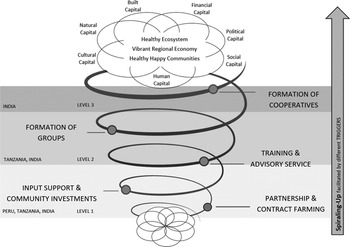
The study revealed three levels of engagement of the investigated COCIs: Bergman/Rivera, Peru has the lowest level of engagement, followed by bioRe Tanzania and Chetna Organic, India. Figure 3 shows that these different levels of engagement result in diverse degrees of spiraling-up effects (research objective 2): while partnership & contract farming, as well as input support & community investments, only induced slight spiraling-up effects (Level 1—in Peru, Tanzania and India), training and advisory services as well as formation of groups generated strong spiraling-up effects (Level 2—in Tanzania and India). The formation of cooperatives triggered further decisive spiraling-up effects and community transformation (Level 3—in India).
Triggers of spiraling-up effects on communities through COCIs in the study regions.

In the following, these triggers and therefore induced spiraling-up effects are outlined in detail.
Partnership & contract farming (Level 1)
In the case study regions, the investigated initiatives established long-term business partnerships with farmers. Those relationships built up trust (which induced a slight increase in cultural capital) and facilitated organic certificationFootnote 2 in all three case study regions.
Through the purchase of certified organic cotton and the provision of a price premium in Peru and TanzaniaFootnote 3, farmer communities were able to increase their financial capital (in the case of bioRe Tanzania to a high degree, and slightly in the case of Bergman/RiveraFootnote 4). Through the strong increase in financial capital in the case of TanzaniaFootnote 5, farmers invest in built capital, such as infrastructure, housing and school equipment. A male farmer from Tanzania (10) stated:
I will never stop working with bioRe because bioRe is a good company. …I felt comfortable, there was no problem because of the good price [for cotton] bioRe is paying. It is higher compared to the other companies. …One of the changes in the family is the construction of a house and I can buy new school uniforms and pens for my children. … that is the success from organic production. … My plan is to build a new house in the nearby town, so that I rent out that house so that I get more money for my family.
Investments in school equipment in turn induce a slight increase in human capital. The case of Bergman/Rivera shows that organic certification by itself, without additional measures, does not induce spiraling-up effects/community transformation.
Input support & community investments (Level 1)
Important measures impacting community capitals and triggering spiraling-up effects in the study regions are input support related to seeds and loans as well as investments in community infrastructure.
Seed support. In all three case studies, the provision of seeds primarily increases natural capital, as more diverse varieties and nontreated nongenetically modified seeds in higher qualities are used. The growth in natural capital results in (1) increased financial capital in all study areas as there are lower expenses, higher yields and a more diverse income, (2) increased cultural capital, as traditionally important native colored cotton is conserved in Peru and more diverse and locally adapted seeds are introduced in India and Tanzania. The alternative access to seeds established or intensified the cooperation between certified organic farmers and conventional/noncertified farmers (e.g., linked due to neighboring and kinship relationships etc.), which has also helped to build social capital. By promoting the planting of trees, including the provision of seedlings, the initiatives in Tanzania and India additionally invest in the natural capital of farmer communities, creating cultural capital by raising farmers' awareness.
Access to loans. bioRe Tanzania and Chetna Organic, India support access to loans. This primarily financial capital, which enables agricultural (e.g., tools and machinery such as mills, etc.) and non-agricultural investments (e.g., development of community infrastructure, shops, etc.), also creates built capital. Additionally, both bioRe Tanzania and Chetna Organic connect farmer groups with financial institutions, which create bridging social capital. ‘Other farmers always take loans from other people, in which they have to pay much more money back, then they received. But, with bioRe, if we take an amount, we have to pay back the same amount, so this enables us to invest in farming.’ Male farmer from Tanzania (10)
Community investments and access to tools. Further changes in the built capital of communities were triggered by the provision of access to agricultural tools and machinery for farmers as well as direct investments in community infrastructure by the organic initiatives (see Table 6). Through this built capital, including the usage of school gardens and community computers, farmers and their children also slightly increase their human capital.
Capacity building through training and advisory services (Level 2)
Capacity building through training and advisory services enabled an increase in knowledge and the application of organic farming practices in communities (human capital). Due to different degrees of training and advisory services (see Table 6), the initiatives in Tanzania and India could increase human capital to a high degree, while in Peru, human capital increased only marginallyFootnote 6. The accumulation of human capital revealed a strong spiraling-up effect in farmer communities:
First, by supporting the human capital of farmers, the case study areas in Tanzania and India developed a higher environmental awareness (cultural capital). Second, through the creation of human capital, farmers are enabled to convert to organic cultivation practices, which leads to an increase in communities' natural capital (i.e., better soil quality, avoided release of toxic agrochemicals, etc.). A male farmer from Tanzania (18) explained:
When I had questions at the beginning, during the transition time, I was asking the extensionist who was coming every month. … He was advising me in crop rotation and in understanding beneficial insects. … The thing that is helping the presence of these beneficial insects in my field are these botanicals [biopesticides], which do not kill the insects directly, and planting this trap crops, such as sunflower. Most of the insects do shift to the sunflower, even when you spray these botanicals [biopesticides].
Experiencing positive environmental changes and an increase in natural capital, farmers developed a higher environmental understanding/awareness and a high appreciation of organic farming, additionally increasing their cultural capitalFootnote 7. A male farmer from India (20) indicated:
When we started doing organic farming, the soil was hard, so it took time to make it soft and fertile. We got training on organic farming and we were using more and more compost, to recover the soil. … I was feeling pride, I am getting and eating safe food, safe soil and doing something for the environment. … As an organic farmer I have to do a lot of work, for me, for the village and for the environment. … I have a big dream. We want to cover this district as an organic district. We have to think about it with the neighboring villages and the neighboring farmers.
Improved environmental conditions (natural capital) also had an impact on the financial capital in the investigated communities (higher yields and/or lower expenses for farming householdsFootnote 8). More financial capital enabled investments in built capital and human capital.
Third, through the improvements in human capital in the investigated communities in Tanzania and India, bonding social capital increased as farmers intensified their cooperation in order to share knowledge and experiences. The exchange of experience increased human capital even more, as competences were further shared/transmitted not only between organic farmers but also with conventional farmers.
Formation of groups & leadership (Level 2)
bioRe Tanzania and Chetna Organic, India strongly encourage the formation of groupsFootnote 9, which triggers spiraling-up effects by initially creating bonding social capital. Through bonding social capital mainly in combination with capacity building, decisive spiraling-up effects are initiated.
First, bonding social capital increases human capital through knowledge exchange. Knowledge exchange, in turn, also influences other capital forms, as awareness is raised (cultural capital) and farmers support each other in the application of organic farming practices, which improves their environmental conditions (natural capital). Through more natural capital, financial capital increases and investments in built capital and human capital are enabled.
Second, bonding social capital facilitates new possibilities for farmers to cooperate. For instance, Chetna Organic, India initiates many activities to foster self-sufficiency, e.g., saving and credit in groups, which reduces farmers' debts, increases farmers' financial capital and enables common investments in built capital (e.g., in processing machinery and group-organized seed banks for food crop seeds). Through the establishment of seed banks in groups, many positive changes for the communities are achieved, and these changes also target women. A female farmer from India (1) described:
[Through the female self-help group] generally the whole group helps each other on the field. The second thing is the seed bank. That seed bank is run by the group. What we are sowing we take from that seed bank. Usually, we donate some seed we have harvested for the next year. If you have taken 1 kg, you have to give back 1.5 kg…. Before we did not work together. … I am responsible to collect the monthly saving amount, because we have a saving account and we are collecting an amount each month for investments of our group.
Farmer groups gain independence and empowerment (human capital), and biodiversity is enhanced and conserved (natural and cultural capital). Additionally, expenses for market seeds are saved, and food crop seeds can be sold to others, which enhances financial capital.
Third, through group formation, formal and informal leadership is established by increasing farmers' political capital. Fourth, group formation, i.e., bonding social capital, enables linking communities with other institutions, which creates bridging social capital that again facilitates, e.g., access to financial institutions; this, in turn, increases farmers' financial capital and consequently built capital through enabled investments.
Formation of cooperatives and entrepreneurship (Level 3)
While in Peru and Tanzania, initiatives practice contract farming, in the case of Chetna Organic, India, cooperatives are formed to market organic cotton. Initially in Peru and Tanzania, farmers experienced more security and a larger increase in financial capital; however, a strong dependency on the initiatives could also be observed. In India, through the formation of cooperatives, decisive spiraling-up effects are triggered by increasing farmers' independence and self-sufficiencyFootnote 10. Through additional cooperation in cooperatives, bonding social capital is initially created, which in turn results in different effects.
First, through the creation of bonding social capital, local leadership is formed and political capital is generated. Second, through cooperatives, i.e., bonding social capital, farmers are able to connect with other institutions, such as banks and governmental organizations, and bridging social capital is created, which in turn impacts financial and built capital.
Third, in cooperatives, farmers take over responsibilities, apply entrepreneurial knowledge and organize marketing activities, which creates long-lasting empowerment and human capital and changes farmers' attitudes and entrepreneurial thinking (cultural capital). The self-organized marketing of cotton production and the use of bonding social, human and cultural capital in cooperatives increases financial capital and in turn enables investments in built capital. Additionally, cooperatives organize different services on a local level, such as seed distribution and seed trials, further reducing dependencies and costs (financial capital), and they make joint investments in additional processing machineries (built capital). A male farmer from India (7) stated:
I got training on organic farming and cooperative management, how to manage a cooperative. And I also attended so many meetings on the cooperative level and got exposure visits to other areas, to other farmers, who are experienced. … I also come back and share everything among the members. … Initially Chetna supported us with funds. After the formation of the cooperative, we raised our own funds. Every member has to pay a contribution and share. And we are in the cotton business and subsidize seeds for our members in the cooperative.
Leading farmers in cooperatives also plan to extend their marketing activities to other organic products (e.g., organic vegetables). This plan shows the increased entrepreneurial (self-empowered) thinking of farmers (human and cultural capital).
Factors limiting spiraling-up effects in the case study regions
According to research objective (3), in this section, we analyze institutional, economic, environmental, social and cultural preconditions influencing community capital developments and identify factors limiting spiraling-up effects and community transformation. These results derive from the qualitative interviews of farmers combined with expert interviews from the respective COCIs as well as other organizations working in the field of organic farming in the study regions. These results also include observations made during field work.
Natural conditions. In the case study region, limiting factors are poor soils, continuing deforestation and increasing extreme weather events. Farmers depend heavily on weather conditions (e.g., on natural irrigation through rainfall) and are therefore still strongly exposed to environmental risks. Favorable natural conditions for organic production are, for instance, high biodiversity, which in India, for example, enables the usage of the neem tree (Azadirachta indica) for the preparation of biopesticidesFootnote 11.
Genetically modified cotton. In India, the widespread use of Bt cotton hinders progress, especially regarding seed multiplication, which has negative implications for community capital development in the case study region. A male farmer from India (9) said:
Regarding Bt cotton… [We are discussing] how to protect the organic farmers … The cooperative suggests to make boarder crops from organic to conventional to protect organic from Bt cotton. Initially, the standard was 100 m. But it is not possible, because all of the farmers are small and marginal farmers. 100 m would be 1 acre. That is difficult for us.
The chief extensionist from Chetna, India (20) further explained:
One problem in this area is that non GMO seeds are not available on the regular market. So farmers are asking for seeds from Chetna. But also, we sometimes have problems getting non GMO seeds, so we are doing seed multiplication and trying to reach seed self-sufficiency.
Farm size and rural development policies. Many farmers face a lack of land due to their low social (and economic) status (e.g., low castes in India and indigenous farmers in Peru). This hampers development efforts in the communities. bioRe Tanzania only includes farmers with more than 3.6 hectares, excluding certain smallholder farmers from development. In Odisha, governmental support and Indian policies for disadvantaged groups (such as tribes and lower castes) enable Chetna Organic to support marginalized farming communities and to include very small farmers. As there is a lack of rural development policies in Tanzania, smaller (and the smallest farmers) are not supported in the case of bioRe Tanzania, which limits further development. In all three study regions, understaffed governmental advisory systems additionally hamper development potential.
Importance of cotton for income and fluctuating demand. For rural communities in the case study regions of India and Tanzania, cotton is (by far) the most important cash crop. Therefore, the potential of organic cotton initiatives to influence community capitals is much greater in India and Tanzania than in communities in PeruFootnote 12. Although there is currently an increase in demand for certified organic cotton, strong fluctuations in world markets—as experienced in the past—and high market prices for competing crops can hamper development efforts and the success of organic cotton initiatives.
Cultural preconditions. This study found that both a strong dedication to organic production and farmers' attitudes are important (cultural capital). In particular, the case of Tanzania showed that organic principles are often violated when outweighed by economic motivations. In this regard, indigenous and tribal traditions such as near-natural agricultural production (e.g., refusal to use agrochemicals both in Peru and within tribal communities in India) support the intentions of organic initiatives. Nutritional habits favoring legumes, as in India (where there is regular consumption of valuable intercrops such as red (Cajanus cajan) and green gram (Vigna radiata)) facilitates the use of organic production methods. In Tanzania, this approach was mainly rejected, and organic methods were harder to introduce.
Migration. An important issue in all three study regions is that, e.g., in Peru, farmers' children and young people generally migrate to nearby cities. Therefore, young people are less included in the initiative and development potentials are missed. In all three study regions, there is a lack of insurance or pension systems, which makes farmers very vulnerable.
Gender aspects. In all three cases, independent of ethnic affiliation, a similar pattern regarding gender aspects was observed: female farmers have less decision-making power on the household and community level while also completing a larger share of work. The land is in the hands of men, and as landownership is the entry point into certification, women are widely excluded from training and group involvement. As noncertified and therefore mainly female farmers are not involved in cooperatives and associations, women are also excluded from economic decision-making and entrepreneurship. Additionally, as women carry a higher work load in farming communities, they have less time and capacity for training. This gender bias strongly limits positive effects on communities. A female farmer from India (1) indicated:
In my group, there are twelve female members … often they are not participating in meetings because of their duties at home. … We have to do weeding and cleaning, sowing. This type of work is for women farmers. … It is generally the female person [who spends more time on the field]. In the morning, we have to maintain the housework, cleaning, making meals for the male farmers and taking care of the children. … Generally, in organic farming, the contribution of women farmers is increasing. Because you have to apply many more times organic compost, than those conventional farmers. … Composting is female work and my contribution increased in organic practices. … It is always challenging for us. But we have to go for both, we have to do the work at home, it is compulsory, because the men cannot help in that work. So after that work, we have to go to the field. It is always difficult. … I am expecting more training and exposure to all [also female] members. And I expect something for personal entrepreneurship development.
Discussion and conclusion
Introducing organic farming ‘by itself’ does not guarantee significant changes in community capitals or community transformation. When implementing specific interventions and measures, however, community transformation is possible through the introduction of certified organic cotton farming. In Peru, the results revealed only slight effects on community capitals; however, comprehensive changes were triggered in Tanzania and even more so in India (Research objective 1). The results showed that community developments depended on five parameters: the extent of partnership (e.g., contract farming), input support (e.g., seeds, loans, community infrastructure), capacity building (through training and advisory services), group building and formation of cooperatives and associations (Research objective 2). The more interventions were made in these categories, the more changes in community capitals were observed. Especially through capacity building and group formation, strong spiraling-up effects were initiated.
The results show that financial and built capital can be influenced quickly and relatively easily through initiatives by providing input support and organic price premiums. However, for long-lasting, self-sufficient and self-determined community developments, investments to raise human and social capital are necessary. These findings verify previous studies indicating that only financially supporting communities (through built capital, without impacting social and human capital) tend to be less successful (Emery et al., Reference Emery, Fey and Flora2006). Human and social capital are seen as key factors in mobilizing other types of capital (Megyesi et al., Reference Megyesi, Kelemen, Schermer, Renting and Oostindie2010). Usually, rural development strategies first increase financial capital or built capital; however, these are often not cumulative (Emery and Flora, Reference Emery and Flora2006), and while all forms of capital are essential for development, none is sufficient in and of itself (Ostrom, Reference Ostrom2000). Through the creation of human capital in trainings, both financial capital, physical capital (natural capital) and other nonphysical forms of capital (cultural and social capital) are decisively impacted. Through the formation of groups in the case of Tanzania and India, social capital was first created, which in turn led to an increase in other nonphysical capitals (human, cultural and political capital) as well as physical capital (built and natural capital) and financial capital.
In this regard, an important trade-off was observed: As confirmed by the literature (Key and Runsten, Reference Key and Runsten1999; Singh, Reference Singh2002; Singh, Reference Singh2005; Birthal, Reference Birthal2008; Pritchard and Connell, Reference Pritchard and Connell2011; Wang et al., Reference Wang, Wang and Delgado2014), contract farming brings various benefits for farmers and leads to quick financial stability and security; however, it creates dependency. A slower but more empowering approach is the one shown in the Indian case study. The formation of cooperatives created bonding social capital and influenced other capital forms, making farmers more independent.
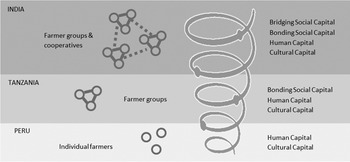
The analysis revealed the important role of institution-building in the creation of nonphysical capital forms, such as human, cultural and social capital, in the study regions. Figure 4 shows the creation of human, cultural and social capital through the organizational structure of the initiatives, prompting institution-building to varying degrees.
Creation of human, cultural and social capital through institution building in the case study regions.

In the Peruvian case, there is no institution building. The initiative Bergman/Rivera cooperates with farmers on an individual level, triggering only slight changes in human and cultural capital. bioRe Tanzania encourages the formation of farmer groups, which increases bonding social capital and human capital. Human capital generated by training is further built up through knowledge sharing in groups. These results verify other studies, which have shown that social capital can influence human capital through information distribution and cooperation among individuals or groups (Brondizio et al., Reference Brondizio, Ostrom and Young2009; Wu and Tsai, Reference Wu and Tsai2014), without implying high expenses for farmers or initiatives. Social capital enables farmers to initiate and continue measures and activities by themselves, which allows for the long-lasting self-determined development of communities. In this way, farmers actively use human and social capital to increase their financial and natural capital. This result verifies other studies, which have revealed that the best entry point for triggering spiraling-up effects is social capital (Emery and Flora, Reference Emery and Flora2006).
In India, through the formation of farmer groups, cooperatives and associations, in addition to the initiative's creation of human and bonding social capital, bridging social capital is also created. Farmers are able to connect with other organizations and institutions. Additionally, in the case of India, farmers gain important capabilities and human capital through the self-organized commercialization of cotton, combined with the respective skills they gain through training. These gains decrease farmers' dependency on outside agents and on the initiative and facilitate continuing organic marketing, even if Chetna Organic were to stop supporting activities in the region. This finding is in line with the notion that social capital is an essential complement to the concepts of natural, built and human capital (Ostrom, Reference Ostrom2000). Additionally, group formation, especially beyond the local level (such as the formation of cooperatives and associations), gives farming communities a ‘voice’. This voice is especially important when farming communities are marginalized due to their ethnic affiliation. For a poor and marginalized population, social networks are one of the main resources for managing risk and vulnerability (Woolcock and Narayan, Reference Woolcock and Narayan2000). Additionally, we revealed that cultural capital is of high importance in addition to human and social capital. COCIs can support and create cultural capital by training and increasing the ecological awareness of farming communities. This approach gives farmers an intrinsic motivation to remain in COCIs even when economic incentives are not provided.
The investigated case studies showed that organic farming initiatives trigger spiraling-up effects, especially by building up human and social capital. Strong effects occur especially when the initiatives combine organic measures with social activities, measures and goals. When training is not carried out regularly and systematically by initiatives, as in the case of Peru, much potential is lost. Further factors limiting spiraling-up effects and community transformation are unfavorable natural conditions, the spread of genetically modified cotton, lack of rural development policies, low cotton demand on world markets and migration and gender inequality. Although organic farming promises the empowerment of women (IFOAM, 2007; Farnworth and Hutchings, Reference Farnworth and Hutchings2009), the potential of female farmers is not yet realized within the investigated initiatives. Women remain disadvantaged, and inequalities are even partly reinforced due to the systematic exclusion of women from training and decision-making institutions (Research objective 3).
COCIs enable organic certification and connect rural farmers, often the weakest segment in the value chain (FAO, 2017a), to international buyers; they also enable farming communities to reap the benefits of the integration of agriculture into markets. To enable the application of organic farming practices and therefore organic certification, certain investments by COCIs in human capital are, in most cases, a prerequisite. Investments in the built and financial capital of farming communities can be a supportive tool even if they do not initiate spiraling-up effects. To create long-lasting, self-sufficient community development, however, further investments in human, social and cultural capital—often not a primarily goal of COCIs when not supported by other institutions—are necessary. These investments entail more efforts (of time, as well as personally and financially) when setting up COCIs. Therefore, there is a need for more incentives for such initiatives to go beyond the economic aspects of organic farming (i.e., focusing on certification) to use the potential of COCIs to trigger community transformation. By supporting organic initiatives, rural development policies can influence the effectiveness of such initiatives, e.g., by supporting interventions such as capacity building, group formation and the formation of cooperatives to build up human, social and cultural capital and to empower farming communities to reduce their dependency on outside agents.
We revealed that COCIs have considerable potential to trigger community capital development and spiraling-up effects in rural communities. The degree of farmers' involvement, as well as the roles of groups, cooperatives and women in the initiatives' institutions are decisive for the effectiveness of the initiatives' activities, as well as their abilities to use and create cultural capital and to build up human and social capital through capacity building. Organic initiatives, such as COCIs, can be an important rural development tool to integrate farming communities into international value chains and in this way address economic aspects—important for the constancy of initiatives—and at the same time empower farmers in their communities (human and social capital) and support their way of living (cultural capital).