Introduction
Clinostomum (Digenea, Clinostomidae) is a cosmopolitan genus of digenetic trematodes prevalent in freshwater and estuarine aquatic environments worldwide. Its life cycle includes several stages and three different hosts (Osborn, Reference Osborn1911; Schell, Reference Schell1985; McAllister et al., Reference McAllister2010). Adult flukes live in the digestive tract, oesophagus, pharynx and/or mouth of fish-eating birds, typically Charadriiformes and Ciconiiformes (Kanev et al., Reference Kanev, Radev, Fried, Gibson, Jones and Bray2002), or, less commonly, within reptiles, mammals, or even humans (Yamashita, Reference Yamashita1938; Belliappa, Reference Belliappa1944; Witenberg, Reference Witenberg1944; Ortlepp, Reference Ortlepp1963; Hara et al., Reference Hara2014). To date, various species of Clinostomum have been reported from over 40 species of birds from six continents, from great blue herons (Ardea herodias herodias) to African darters (Anhinga rufa) (supplementary table 1). Eggs are released by definitive hosts into an aquatic environment, where they hatch into miracidia and develop into sporocysts upon penetration into rams horn snails (typically of the genus Helisoma) (Cort, Reference Cort1913; Hunter and Hunter, Reference Hunter and Hunter1935; Smyth and Smyth, Reference Smyth and Smyth1980). Members of other snail genera and families (e.g. Lymnaea, Radix, Bulinus, Biomphalaria) have also been reported as hosts, albeit less commonly (supplementary table 2; Esch et al., Reference Esch, Curtis and Barger2001; Caffara et al., Reference Caffara2011; Pinto et al., Reference Pinto2015; Rosser et al., Reference Rosser2017). Sporocysts release free-swimming cercariae that can infect a broad range of amphibian and freshwater fish species (supplementary table 3; Hoffman, Reference Hoffman1999; McAllister et al., Reference McAllister2010), within which they form loosely encysted metacercariae (Kanev et al., Reference Kanev, Radev, Fried, Gibson, Jones and Bray2002). Metacercariae can live in second intermediate hosts for up to four years (Elliott and Russert, Reference Elliott and Russert1949) and develop into adults once a suitable definitive host consumes the infected amphibian/fish host (Kalantan and Arfin, Reference Kalantan and Arfin1987; Bruni and Angelini, Reference Bruni and Angelini2016).
Although trematodes in the genus Clinostomum are broadly distributed geographically and have been studied extensively, the taxonomy of this group has been the subject of extensive debate and discussion. Thus far, there are 31 recognized species of Clinostomum recorded from all continents other than Antarctica (see supplementary tables 1–3), of which 20 include some degree of support using genetic techniques (Locke et al., Reference Locke2015; Caffara et al., Reference Caffara2017; Briosio-Aguilar et al., Reference Briosio-Aguilar2018; Rosser et al., Reference Rosser2018; Sereno-Uribe et al., Reference Sereno-Uribe2018). For the 14 species reported in North America (see supplementary table 3), differentiation among species is often believed to differ based on their use of second intermediate hosts, with nine species infecting only fishes, one infecting only amphibians, and two using both host groups. Cort (Reference Cort1913) suggested that Clinostomum from frogs (C. attenuatum) differed sufficiently from those found in fishes (C. marginatum) to be considered a distinct species, which he hypothesized matured in different definitive hosts (bitterns and herons, respectively). This division was supported subsequently by several other researchers (Bear, Reference Bear1933; Yamaguti, Reference Yamaguti1933; Hunter and Hunter, Reference Hunter and Hunter1935; McAllister et al., Reference McAllister2010), although recent studies provide evidence that some Clinostomum species infect both fish and amphibians (McAllister, Reference McAllister1990; McAllister et al., Reference McAllister2010; Bonett et al., Reference Bonett2011; Caffara et al., Reference Caffara2011; Locke et al., Reference Locke2015). Bonett and colleagues (Reference Bonett2011) detected C. marginatum in both fishes (Micropterus salmonoides) and salamanders (Eurycea tynerensis and E. spelaea) in Oklahoma. While DNA sequence analyses have helped to validate the taxonomic identity, differentiated between species, and uniqueness of several previously identified species of Clinostomum, both in the New and Old World (Caffara et al., Reference Caffara2011; Sereno-Uribe et al., Reference Sereno-Uribe2013, Reference Sereno-Uribe2018; Locke et al., Reference Locke2015; Pinto et al., Reference Pinto2015; Pérez Ponce de León et al., Reference Pérez Ponce de León2016; Rosser et al., Reference Rosser2018), the extent of their specificity to a second intermediate host remains conjectural.
Metacercariae of Clinostomum increase substantially in size within the second intermediate host (Osborn, Reference Osborn1911; Hopkins, Reference Hopkins1933). Over 20 weeks in the laboratory, for instance, Osborn (Reference Osborn1912) reported that C. marginatum metacercariae in a bass (Micropterus sp.) grew to 4001 μm in length, which was nearly the size of an adult fluke (4530 μm). Similarly, Hopkins (Reference Hopkins1933) found that the average length of metacercariae in field-collected pirate perch (Aphredoderus sayanus) increased from 200 μm in summer to > 2500 μm by winter (> 10-fold increase). Perhaps as a result of its notable growth capacity and large body size, Clinostomum infections are associated with host pathology. In fisheries, this parasite has gained notoriety as the causative agent of ‘yellow grub disease’ (Szalai and Dick, Reference Szalai and Dick1988; Hoffman, Reference Hoffman1999; Overstreet and Curran, Reference Overstreet and Curran2004; Bullard and Overstreet, Reference Bullard and Overstreet2008; Wang et al., Reference Wang, Chen and Shih2017). Infected fish are often rejected for consumption because of the large and conspicuously yellow metacercariae, which can escape their cysts to become mobile while freshly captured fishes are displayed to consumers (Paperna, Reference Paperna1991). In amphibians, Clinostomum metacercariae have been linked to muscular dystrophy and scoliosis in heavily infected individuals (Belló et al., Reference Belló2000; Perpiñán et al., Reference Perpiñán2010). For instance, histological examination of Ambystoma tigrinum (tiger salamander) revealed multifocal intramuscular, subcutaneous and coelomic trematodiasis, with associated necrosis and inflammation (Perpiñán et al., Reference Perpiñán2010). In a summary of 64 amphibian morbidity events in the USA during 1996–2001, Green et al. (Reference Green2002) reported that Clinostomum sp. infections were the second most common cause of morbidity, with infected animals often having large dermal nodules on their skin. In contrast, Bruni and Angelini (Reference Bruni and Angelini2016) reported no short-term effects of C. complanatum exposure on the survival or dermal appearance of newts (Triturus carnifex), emphasizing the importance of further research to understand the patterns of infection among hosts and their influence on host fitness.
Despite the ubiquity of Clinostomum spp. infections in aquatic systems, large-scale field surveys of infection patterns in multiple amphibian and/or fish species are relatively rare. In one of the largest previous surveys of amphibian hosts, Gray and colleagues (Reference Gray2007) examined 64,310 amphibians non-invasively for gross external signs of infection by Clinostomum attenuatum, focusing on the presence of nodules visible through the skin. This included three species (Bufo cognatus, Ambystoma tigrinum mavortium and Spea multiplicata) and two age classes (adult and juvenile) in the Southern Great Plains of the USA. They found extremely low prevalence in all species in both land-use areas (cropland and grasslands), with only 249 amphibians showing visible signs of infection (0.4%). Other field studies have reported a higher prevalence of Clinostomum spp.; for instance, Miller et al. (Reference Miller2004) reported that 14 of 21 (66.7%) amphibians were infected with C. attenuatum, including 7/11 Spea multiplicata, 2/2 Bufo cognatus, and 5/8 Ambystoma tigrinium mavortium, in wetlands in Texas. In fishes, Wang et al. (Reference Wang, Chen and Shih2017) reported a 9.8% prevalence of Clinostomum complanatum metacercariae in 1503 hosts from four families in Taiwan; the highest infection loads occurred in fishes of the Cyprinidae family. Overall, these surveys illustrate that patterns of infection vary among host species, at least in some cases, with higher prevalence in fishes relative to amphibians (Elliott and Russert, Reference Elliott and Russert1949; McAllister, Reference McAllister1990; Gray et al., Reference Gray2007; Bonett et al., Reference Bonett2011; Caffara et al., Reference Caffara2014; Wang et al., Reference Wang, Chen and Shih2017). However, few studies have directly compared infections across multiple species and different host groups (fish versus amphibians) in similar habitats.
In this study, we explored patterns of infection prevalence, intensity and host species use by Clinostomum sp. in 125 ponds within the Bay Area region of California, USA. Using large-scale field surveys over a five-year period, we tested the influence of host species identity and life stage on infection prevalence among five species of amphibians (n = 11,364 individuals) and seven species of fishes (n = 996). We used a combination of morphological and molecular methods to reveal the identity of parasites isolated from fishes and amphibians. To complement our field studies we used an experimental approach to evaluate the susceptibility and sensitivity of two amphibian species to varying numbers of Clinostomum sp. cercariae under controlled conditions. Over a period of 40 days, we estimated infection success, metacercarial growth, and host survival and growth. This work has implications for understanding the ecological and taxonomic patterns of Clinostomum infections and pathology in amphibian and fish hosts.
Materials and methods
Field surveys of infection among species, sites and years
Between May and August 2012–2017, we collected amphibians and fishes from temporary and permanent freshwater ponds in the Bay Area of California (Alameda, Contra Costa, and Santa Clara counties). Wetlands were selected to represent a range of sizes and hydroperiods, while containing freshwater gastropods as well as amphibian and/or fish hosts. The majority of the wetlands were built or modified to support cattle grazing (Garone, Reference Garone2011), and are now managed as part of regional and county parks, research reserves, or as private land. In general, selected sites ranged in perimeter from < 50 m to > 500 m, with depths ranging from 0.5 to 5.0 m, with a surrounding habitat of oak woodland and annual grassland (McDevitt-Galles and Johnson, Reference McDevitt-Galles and Johnson2018).
With regards to amphibians, our focus was on late-stage larvae and recently metamorphosed individuals, although we did examine adults opportunistically. During transects along the wetland edge, we used a combination of dip nets and hand-capture to collect ~10 individuals of each amphibian species per pond. The majority of the amphibian transects were conducted from late June to early August, with the exception of Anaxyrus boreas transects, which were conducted from early to mid-June due to the earlier emergence of the species. For bullfrogs (Lithobates catesbeiana), we captured metamorphs and adults at night with the aid of a headlamp. For fishes, we used habitat-stratified dip net sweeps (45.7 cm D-frame with 1.2 mm mesh), hauls with one of two seine nets (1.2 × 1.8 m or 4.5 × 1.8 m, each with 3 mm mesh), and rod and reel to collect ~10 adult individuals per taxon per visit. We ensured that our sampling methods adequately captured host and parasite richness using rarefaction curves and richness estimators (Johnson et al., Reference Johnson2013). See Johnson et al. (Reference Johnson2013) for additional details on sampling methods. Fishes were sampled in years 2013 through 2017, whereas amphibians were sampled across all years (2012–2017).
After collection, we euthanized hosts humanely using buffered MS-222 (dose = 1 g/500 ml of water), measured their snout–vent length (SVL; amphibians) or total length (fishes) using digital calipers, and examined all major organs and tissues (e.g. heart, liver, intestines, rectum, stomach, tongue, mandible, kidneys, gills, and fat bodies) for macroparasites under an Olympus SZX10 stereo dissecting microscope (Olympus Corporation, Tokyo, Japan). Parasites were heat-killed and preserved in 70% ethanol for morphological examination and in 95% molecular-grade ethanol for molecular analysis, with subsequent storage at −20°C. We counted and identified the parasites under 60–200× magnification using the keys of Lehmann (Reference Lehmann1954), Schell (Reference Schell1985), Sleigh (Reference Sleigh1991), Hoffman (Reference Hoffman1999), Gibson et al. (Reference Gibson, Jones and Bray2002), Duszynski et al. (Reference Duszynski, Bolek and Upton2007) and Anderson et al. (Reference Anderson, Chabaud and Willmott2009) as well as characteristic morphological features. Specifically, Clinostomum spp. have a stout body, oral sucker surrounded by a collar that is smaller in size when compared to the ventral sucker, and a bulbous oesophagus with little to no pharynx (Schell, Reference Schell1985; Hoffman, Reference Hoffman1999; Caffara et al., Reference Caffara2011). After organ removal, we inspected the body cavity, muscles and host skin tissue layers for larval parasites, such as encysted trematode metacercariae (see Calhoun et al., Reference Calhoun, McDevitt-Galles and Johnson2018).
To statistically explore patterns of Clinostomum sp. infection among naturally occurring hosts, we subset our dataset pond-by-year combinations in which at least one host was infected, regardless of the host species. This included information on 4745 individual amphibian hosts representing five species (A. boreas, P. regilla, L. catesbeiana, Taricha granulosa, T. torosa) and 513 fishes representing five species (Gambusia affinis, Micropterus salmoides, Lepomis macrochirus, L. microlophus, L. cyanellus). For analyses of infection prevalence, we considered the unit of analysis to be a host population, defined here as a unique combination of pond, sample year, and host species. To assess how infection prevalence varied with host species and life stage, we used generalized linear mixed models (GLMMs) with a binomial distribution and a logit link while accounting for the pond-by-year sampling event as a random intercept term to address the non-independence of hosts collected from the same pond-by-year combination (Bolker et al., Reference Bolker2009). As the response variable, we used the cbind function in R (R Core Team, 2014) to combine vectors for the number of infected and uninfected hosts in a given population (Crawley, Reference Crawley2002). This has the advantage of inherently accounting for sample size, such that more heavily sampled populations are appropriately weighted, and avoiding the need to set arbitrary sample size thresholds. For all analyses, quantitative fixed effects were scaled prior to inclusion by subtracting the mean and dividing by the standard deviation. Models were built using the glmer function in the lme4 package (R Core Team, 2014; Bates et al., Reference Bates2015; Kuznetsova et al., Reference Kuznetsova, Brockhoff and Christensen2017).
For analyses of amphibian hosts specifically, we included fixed effects for species identity and life stage (both as factors), the latter of which was divided between juveniles (late-stage larvae and recent metamorphs) and adults. For amphibians, the analysis included 189 populations from 51 pond-year combinations. To compare patterns of infection between amphibians and fishes, we included 300 fish and amphibian populations from 65 pond-years. Using a similar modelling approach to that described above, we tested how host type (fish vs amphibian) influenced infection prevalence, with host species identity initially incorporated as a random intercept term. After detecting an overall difference between fishes and amphibians, we used species identity as a fixed effect, followed by Tukey pairwise comparisons using the glht function in the multcomp package as a post-hoc analysis of which species pairs differed (Hothorn et al., Reference Hothorn2013; Bretz et al., Reference Bretz, Westfall and Hothorn2016). Our overall goals were to investigate prevalence variation between fish and amphibians, as well as among individual amphibian and fish species.
Genetic analysis
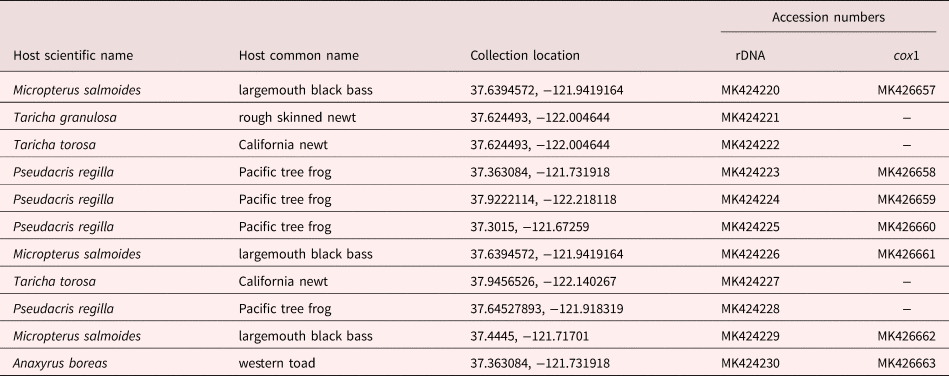
We obtained genomic DNA from 11 samples of Clinostomum sp. obtained from various fish and amphibian hosts from different ponds in the study area and metacercariae collected from experimental amphibians (table 1). DNA was isolated according to Tkach and Pawlowski (Reference Tkach and Pawlowski1999) or using a ZR Genomic DNA™ Tissue Micro Prep (Zymo Research, Irvine, California, USA) following the manufacturer's instructions. Following preliminary morphological identification using Schell (Reference Schell1985) and Jones et al. (Reference Jones, Bray and Gibson2005), we used a single Clinostomum metacercaria (or a fragment in the case of larger individuals) for each DNA extraction. DNA fragments of approximately 1140 base pairs and spanning the 3′ end of 18S nuclear rDNA gene, complete internal transcribed spacer region (ITS1 + 5.8S + ITS2) and a few nucleotides at the 5′ end of the 28S gene as well as the partial mitochondrial cox1 gene covering the traditional ‘barcoding’ region, were amplified by polymerase chain reaction (PCR) on a BioRad T-100 (Hercules, California, USA) thermal cycler. Forward primer ITSF (5′-CGCCCGTCGCTACTACCGATTG-3′), and reverse primer digl2r (5′-CCGCTTAGTGATATGCTT-3′) from Tkach and Snyder (Reference Tkach and Snyder2007) were used for rDNA amplifications; forward primers Cox1-Schist5′ (5′-TCTTTRGATCATAAGCG-3′) from Lockyer et al. (Reference Lockyer2003) and reverse primer acox650r (5′-CCAAAAAACCAAAACATATGCTG-3′) from Kudlai et al. (Reference Kudlai2015) were used for cox1 amplifications. We ran PCR reactions using OneTaq Master Mix (New England Biolabs, Ipswich, Massachusetts, USA) following the manufacturer's instructions, with an annealing temperature of 53°C for rDNA amplifications and 43°C for cox1 amplifications. PCR products were purified using ExoSAP-IT (Affymetrix, Santa Clara, California, USA), and sequencing reactions were prepared using the PCR primers mentioned above as well as the internal reverse primer d58r (5′-CACGAGCCGAGTGATCCACCGC-3′) designed by V. Tkach. Purified PCR products were cycle-sequenced using a BigDye terminator v. 3.1 cycle sequencing kit (Applied Bio Systems, Foster City, California, USA). Sequencing reactions were alcohol-precipitated and run on an ABI Prism 3130™ automated capillary sequencer. We assembled contiguous sequences using Sequencher™ (GeneCodes Corp., ver. 4.1.4), and submitted to GenBank (see table 1 for accession numbers). Obtained sequences (n = 13) were compared with all previously published sequences of Clinostomum spp. (from hosts collected worldwide) available in GenBank using the BLAST search and alignments in MEGA7 software (Kumar et al., Reference Kumar, Stecher and Tamura2016) with the goal of determining which species of Clinostomum were infecting our collected hosts. Specifically, we were interested in determining if the occurrence of Clinostomum sp. in our dataset supported current taxonomic and life history views that C. marginatum and C. complanatum can be found in fishes and amphibians whereas C. attenuatum infects amphibians only.
Hosts, collection locations (all in California) and GenBank accession numbers of the sequenced Clinostomum marginatum metacercariae. Scientific and common names of hosts were confirmed using https://amphibiaweb.org/ and http://www.fishbase.org/search.php.

Multiple-dose exposure experiment of amphibian larvae
To assess how infection success varied between amphibian species, over time and as a function of cercariae dosage, we experimentally exposed larvae of two amphibian species to one of four dosages of Clinostomum sp. cercariae. We collected multiple egg masses of P. regilla and A. boreas from local field sites, allowed them to hatch, and maintained them separately by species in 40 l containers until larvae reached Gosner (Reference Gosner1960) stage 28. At that point, randomly selected larvae were transferred individually into containers filled with 400 ml of treated water (UV-sterilized, carbon-filtered, dechlorinated tapwater; hereafter referred to as treated water) and maintained at 18–20°C. Larvae were fed ad libitum a diet consisting of equal parts TetraMin (Tetra, Melle, Germany) fish food and ground Spirulina flakes. We changed the water and containers twice per week and maintained the light : dark cycle at 12 : 12 hours.
To obtain cercariae for experimental exposures, we placed field-collected snails (Helisoma trivolvis) previously identified as infected with Clinostomum into 50 ml centrifuge tubes with 40 ml of treated water; released cercariae were harvested within 1–2 hours of peak shedding, which typically occurred around 12.00 and 14.00 (approximately six hours after sunrise; Wang et al., Reference Wang, Chen and Shih2017). We randomly assigned each individual amphibian larva to one of five treatments: 0 cercariae (control; P. regilla n = 20, A. boreas n = 20), 20 cercariae (P. regilla n = 23, A. boreas n = 20), 40 cercariae (P. regilla n = 40, A. boreas n = 20), 100 cercariae (P. regilla n = 20, A. boreas n = 10), or 200 cercariae (P. regilla n = 5, A. boreas n = 5). Collected cercariae were pipetted into individual containers with amphibian larvae and allowed to infect them over a period of 24 hours (the maximum lifespan of most cercariae; Schell, Reference Schell1985), after which we increased the water volume in the containers to 800 ml. Animals in the control treatment were ‘sham’ exposed to a similar amount of treated water without cercariae. At three time points (1.5 days [36 hours], 20 days and 40 days post exposure [P. regilla only]), we humanely euthanized a subset of animals, measured their SVL, and quantified the number of Clinostomum metacercariae using systematic necropsy. At each time point, a subset of metacercariae (n = 30) was photographed and measured to estimate parasite growth over time. Specifically, we heat-killed each metacercaria after mechanical excystment and measured it under a coverslip with a calibrated ocular micrometer on an Olympus B51 compound microscope (Olympus Corporation, Tokyo, Japan).
To evaluate the effects of Clinostomum cercariae exposure on host survival, we used a generalized linear model with a binomial distribution and logit link to test how host species (P. regilla vs A. boreas), exposure dosage (0, 20, 40, 100 or 200 cercariae), and their interaction influenced the likelihood a host survived to 20 days post exposure. We were not able to include hosts examined at 1.5 days post exposure because no infection was detected in any of those hosts (n = 3 P. regilla and 3 A. boreas). Among individuals that survived to 20 days, we used a general linear model (GLM) with a Gaussian distribution and an identity link to test for effects of host species, dosage, and their interaction on body size (SVL). To understand how parasite load (the number of detected metacercariae) varied by treatment, we used a GLMM with fixed effects for host species (as a factor), exposure dosage (as a numeric term), and their interaction (non-significant interactions were removed and models re-run). Because parasites per host were overdispersed, we used an overdispersed Poisson model by including an observation-level random effect (in this case the host identity), which functions similarly to a negative binomial model (Crofton, Reference Crofton1971; Lawless, Reference Lawless1987). Only exposed hosts that survived the 20-day trial were included. While we expected exposure dosage to positively affect the number of detected metacercariae, we sought to evaluate how infection success (number of metacercariae detected relative to number of cercariae administered) varied with exposure dosage, which can reveal evidence of density-dependent establishment. We therefore included an offset term for dosage, such that our analysis effectively tested how treatments affected the proportion of cercariae successful in establishing in each host (although this could also be done using the calculated proportional success of cercariae, the use of an offset term more effectively preserves the discrete nature of the response variable as a count of parasites).
Finally, we compared P. regilla hosts exposed to 40 cercariae and then examined at either 20 days post exposure (n = 19) or 40 days post exposure (n = 14) to test how time post exposure influenced the number of metacercariae detected. The modelling approach was similar to that described above (overdispersed Poisson GLMM), but the only fixed effect was days post exposure. Among a subset of P. regilla examined at either 20 or 40 days post exposure, we determined the effect of time (20 vs 40 days) and dosage (20, 40, 100, 200 cercariae) on metacercariae size using a linear model. As the response variable, we calculated metacercariae area using the formula for an ellipse and log10(x + 1)-transformed these values before analysis. Results were comparable using metacercariae length.
Results
Field surveys
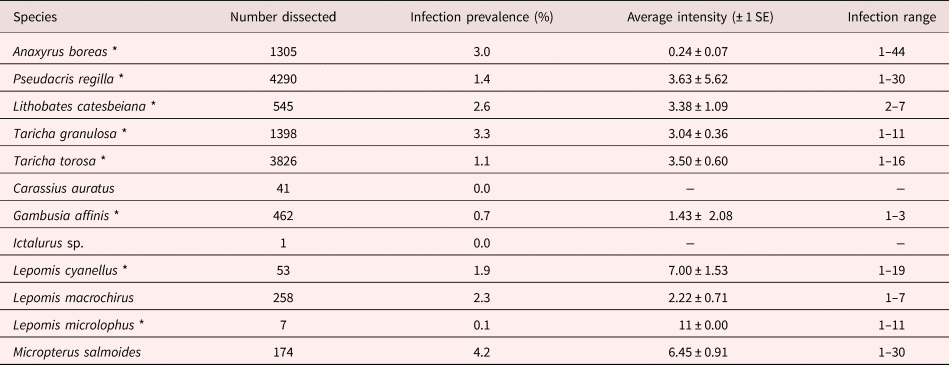
Over six years (2012–2017) we examined 11,364 amphibians (1305 A. boreas, 4290 P. regilla, 545 L. catesbeiana, 1398 T. granulosa, and 3826 T. torosa) from 125 ponds, many of which were visited over multiple years. This collection also included 996 fishes (462 G. affinis, 174 M. salmoides, 258 L. macrochirus, 53 L. cyanellus, 41 C. auratus, 7 L. microlophus, and 1 Ictalurus sp.) from 25 ponds. Overall, Clinostomum infection prevalence was low but varied among host species, sites and sample year. For amphibians, 198 individuals were positive for Clinostomum (198/11,364; 1.7%), including 3.3% of T. granulosa (46/1398), 3.0% of A. boreas (39/1305), 2.6% of L. catesbeiana (14/545), 1.4% of P. regilla (58/4290) and 1.1% of T. torosa (41/3826). Of fishes, 9.2% were positive (92/997), including 24.1% of M. salmoides (42/174), 8.9% of L. macrochirus (23/258), 35.8% of L. cyanellus (19/53), 1.5% of G. affinis (7/462), and 14.3% of L. microlophus (1/7) (table 2). Neither C. auratus nor Ictalurus sp. supported Clinostomum infections, although these species had lower sample sizes (n = 41 and n = 1, respectively, each from only a single study pond). Overall, Clinostomum intensity (only infected animals ± 1 SE) was low (4.1 ± 0.3 SE) and varied among host type, whereas fishes contained more metacercariae than amphibians across life stages (average intensity 5.2 ± 0.60 SE; n = 92; range 1–30 compared with 3.5 ± 0.3 SE; n = 198; 1–30, respectively; see table 2 for species-level average intensity and metacercariae range).
The overall total average infection prevalence, average intensity, and infection range (± 1 SE) of Clinostomum marginatum detected in five amphibians and seven fish across the five-year study in freshwater ponds in California. Total number of hosts infected with Clinostomum marginatum.

* New host species record.
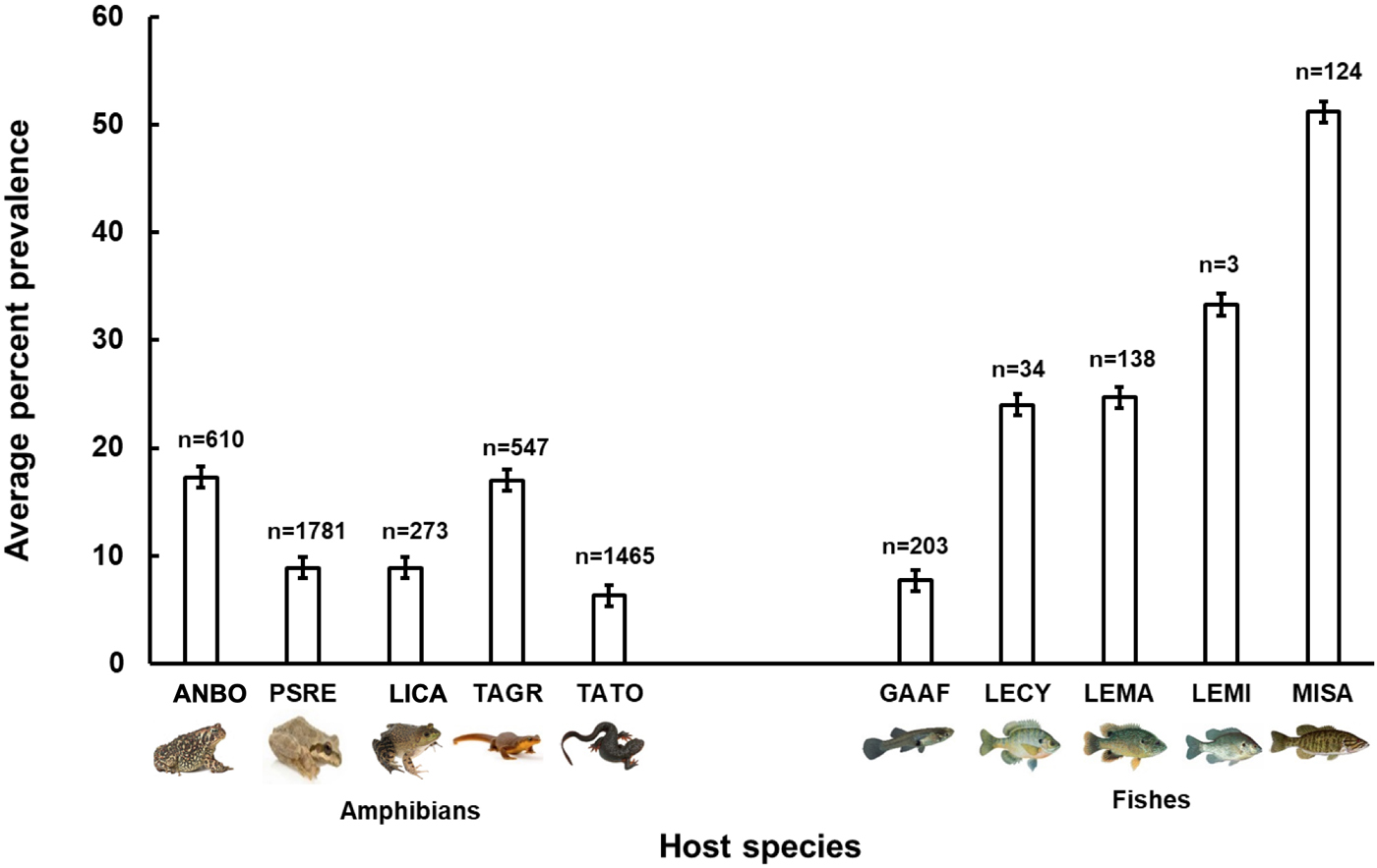
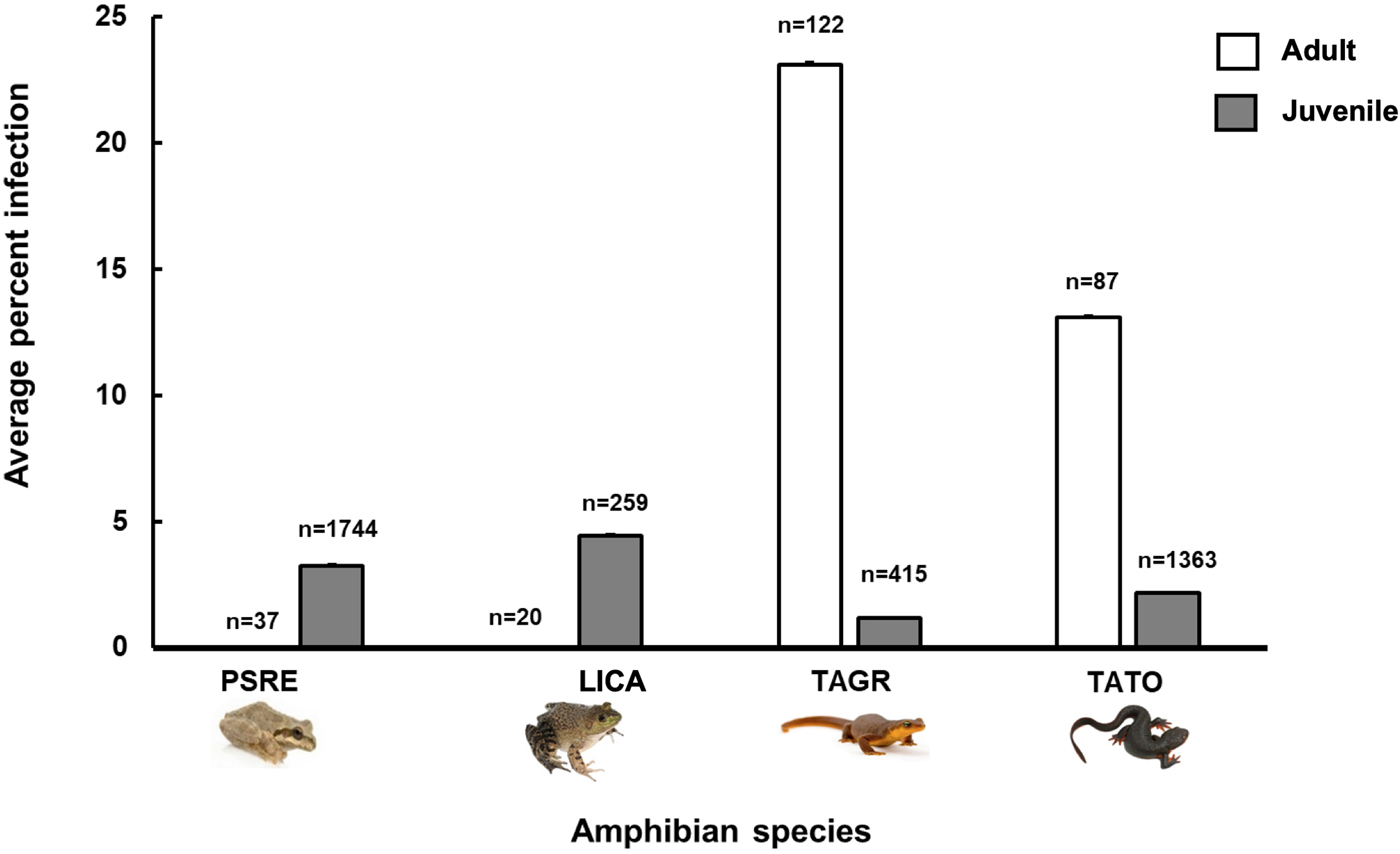
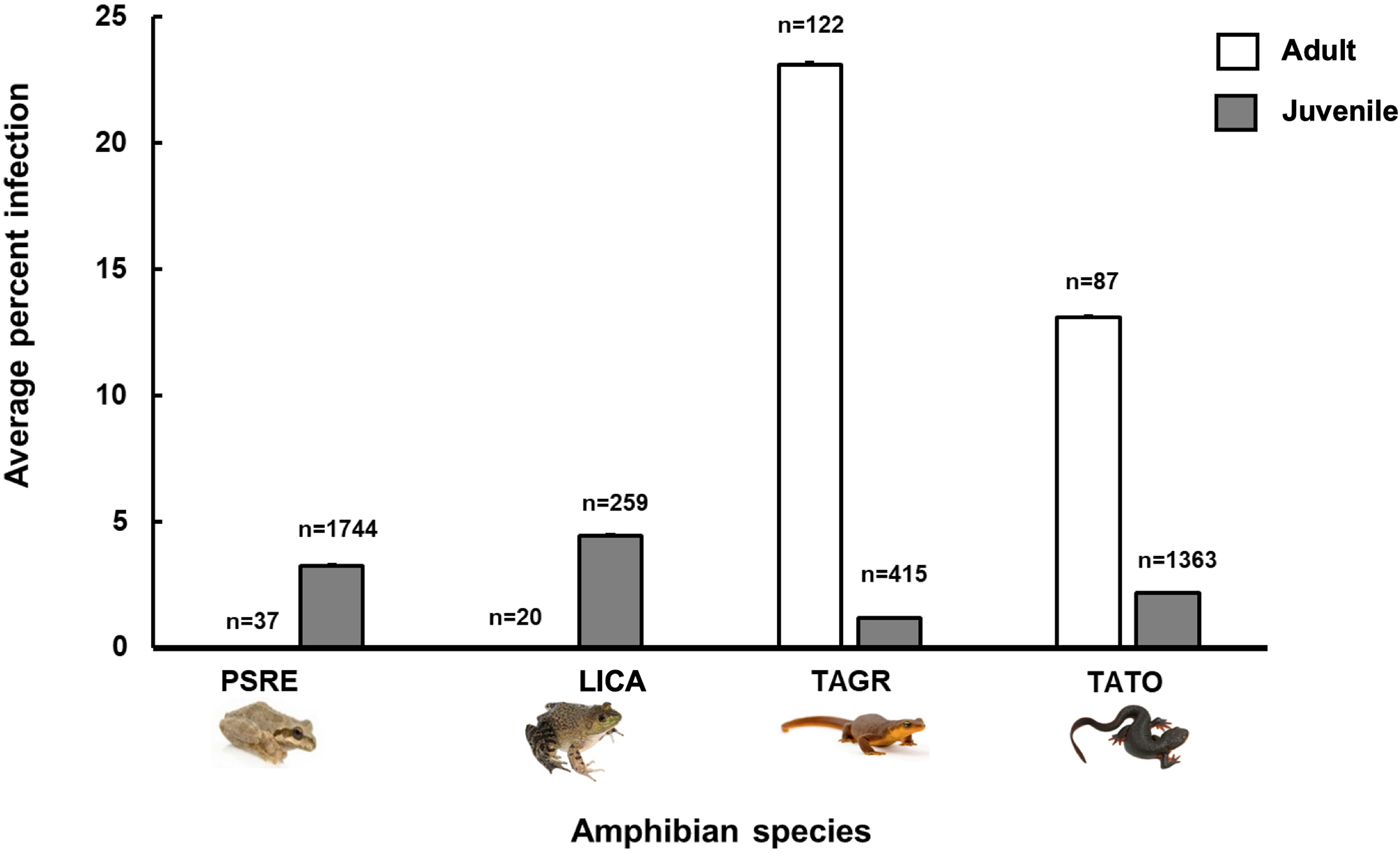
Among the 189 amphibian populations with at least one infected host (i.e. unique pond, sample year, host species combinations), both host species identity and life stage signifantly influenced infection prevalence. Host species identity had a strong effect on infection (likelihood ratio test comparing models with and without host species, chi-square = 27.81, df = 4, P < 0.0001). Populations of T. granulosa supported the highest average prevalence (9.2%; n = 82 pond-years; 565 individuals dissected), followed by A. boreas (5.1%; n = 63 pond-years; 615 individuals dissected) (fig. 1). Although T. torosa and P. regilla were among the most commonly encountered amphibian species, they supported the lowest average prevalence values (2.9%; n = 180 pond-by-year combinations; 1483 individuals dissected and 3.0%; n = 169 pond-by-year combinations; 1793 individuals dissected, respectively) (fig. 1). Adult amphibians exhibited higher infection prevalence relative to juveniles of the same species (Binomial GLMM: life stage [adult] = 2.486 ± 0.352, P < 0.00001) (fig. 2). For instance, the average prevalence among adult T. granulosa was 33.7% ± 0.05 SE (21 pond-years; 135 dissected individuals) compared with 0.8% ± 0.03 SE in juveniles (61 pond-years; 430 dissected individuals). Focusing on juvenile amphibians specifically (omitting adults, for which it is difficult to know if they completed larval development at the site of collection), A. boreas had higher prevalence than each of the other four species, whereas P. regilla had more infection relative to T. torosa (Tukey pairwise comparisons, all P < 0.05). No other pairwise comparisons were significantly different (P > 0.05).
Average percent infection prevalence (± 1 SE) of Clinostomum marginatum for five species of amphibians and fishes across life stage by pond-by-year combination where an infected host was present. Number of individuals dissected is reported. The pond-year combination for each host was as follows: Anaxyrus boreas (ANBO) n = 63; Pseudacris regilla (PSRE) n = 169; Lithobates catesbeiana (LICA) n = 37; Taricha granulosa (TAGR) n = 82; T. torosa (TATO) n = 180; Gambusia affinis (GAAF) n = 21; Lepomis cyanellus (LECY) n = 6; L. macrochirus (LEMA) n = 24; L. microlophus (LEMI) n = 2; and Micropterus salmoides (MISA) n = 19. Both Carassius auratus and Ictalurus sp. supported no C. marginatum infection. Images from http://aquaticparasites.org/

Average percent infection prevalence (± 1 SE) of Clinostomum marginatum for four species of amphibians and two life stages (juvenile and adult) by pond-by-year combination where an infected host was present. Number of individuals dissected is reported. The pond-year-combination for each host was as follows: adult Pseudacris regilla (PSRE) n = 7 and juvenile n = 139; adult Lithobates catesbeiana (LICA) n = 9 and juvenile n = 20; adult Taricha granulosa (TAGR) n = 12 and juvenile n = 43; adult T. torosa (TATO) n = 11 and juvenile n = 108. No adult Anaxyrus boreas were dissected, and therefore they are not reported here. Images from http://aquaticparasites.org/
Clinostomum infection was much more common in fishes compared with amphibians (Binomial GLMM: host type [fish] = 1.530 ± 0.702, P = 0.029). Of the five species with detected infections, L. cyanellus had highest average prevalence (49.3%; n = 6 pond-by-year combinations; 35 dissected individuals), followed by M. salmoides (27.2%; n = 19 pond-by-year combinations; 127 dissected individuals), and L. microlophus (25.0%; two pond-by-year combinations; three dissected individuals, although note the low sample size for this species). Lepomis macrochirus and G. affinis both supported low average prevalence, despite being two of the most commonly encountered fish species (19.4%; n = 24 pond-by-year combinations; 142 dissected individuals and 3.3%; n = 21 pond-by-year combinations; 205 dissected individuals, respectively) (fig. 1). Tukey pairwise comparisons with both fish and amphibian species indicated that sunfishes (genus Lepomis, especially L. macrochirus and L. cyanellus) and M. salmoides had higher infection prevalence than each of the amphibian species, as well as G. affinis.
Upon dissection of hosts, Clinostomum metacercariae were detected in a broad range of organs and tissues. In amphibians, metacercariae were large and loosely encysted in translucent cysts, often located between the epidermis and dermis (encompassing the stratum corneum and stratum germinativum but above the adipose tissue and lymph spaces; Duellman and Trueb, Reference Duellman and Trueb1994) and frequently forming large, easily noticeable nodules. In other cases, metacercariae were more deeply embedded in the muscle layer just underneath the subcutaneous tissue layer, and were less conspicuous. In amphibians, over half of animals infected contained metacercariae located between the epidermis and dermis near the mandible (52.6%). Other infection locations in amphibian hosts included the body cavity, oesophagus, gills (juvenile), kidneys, eyes, liver, intestinal mesentery, mouth, small intestine, tail (found in Taricha spp.), tongue and urinary bladder. The location of metacercariae also tended to vary by host species. In T. torosa and T. granulosa, for instance, most metacercariae were found around the mandible, whereas within L. catesbeiana the primary locations of infection were between the epidermis and dermis near the tail reabsorption site or hind limbs. Among fishes, Clinostomum occurred throughout the fins, body cavity, muscle tissue, between epidermal and dermal tissues, gills, liver, intestine, mouth and operculum of infected hosts. Muscle tissue was the most common location for metacercariae, accounting for 51.1% of the encountered parasites. Similar to amphibians, metacercariae in fishes were easily visible because they formed large nodules, which often appeared yellow in colour.
Genetic analysis
In total, we obtained DNA sequences from eight Clinostomum specimens from amphibians and three from fish (see table 1 for GenBank accession numbers), including specimens obtained in experiments using cercariae from naturally infected snails. As the ITS2 region did not sequence well in five of the specimens, we compared the more variable complete ITS1 regions with flanking parts of 18S and 5.8S genes for all 11 sequenced samples. Based on the 733 bp long alignment all Clinostomum metacercariae obtained from both fishes and amphibians were identical in ITS1 region with the exception of a single base difference in one individual. Our ITS1 sequences were identical to previously published sequences of adult and larval specimens of Clinostomum marginatum (Rudolphi, 1819) from multiple host species and locations available in GenBank (Caffara et al., Reference Caffara2011; Sereno-Uribe et al., Reference Sereno-Uribe2013; Pérez Ponce de León et al., Reference Pérez Ponce de León2016; Rosser et al., Reference Rosser2017). We were able to successfully amplify and sequence partial cox1 gene from seven of our extracts from different hosts and locations (table 1). Upon trimming to the length of the shortest sequence, the cox1 alignment was 574 bp long. Based on comparison with previously published sequences available in GenBank our sequences clearly belonged to C. marginatum, based on levels of intraspecific variability of 0–2.3%. These metacercariae were found in both amphibian and fish hosts.
Experimental exposures
Of the amphibian larvae exposed to Clinostomum cercariae (not including controls), 65.5% of A. boreas (n = 36) and 87.5% of P. regilla (n = 69) became infected with one or more metacercariae. Among infected amphibians, the intensity ± 1 SE of encysted metacercariae varied across taxa, with a mean of 17.6 ± 2.8 (1–117) in P. regilla and 6.8 ± 1.2 (1–25) in A. boreas. Clinostomum metacercariae were detected between the epidermis and dermis and as deep as muscle tissues in both host species, similar to our observations in field-collected hosts. Neither exposure dosage nor host species (or their interaction) significantly influenced the likelihood a tadpole survived to 20 days post exposure (binomial GLM, all P > 0.5). Survival was generally high and similar between exposed and control hosts; for A. boreas, 80% of control hosts (n = 16) and 88.5% of parasite-exposed hosts (n = 46) survived to 20 days, whereas for P. regilla, 70% of controls (n = 10) and 80% of exposed hosts (n = 59) survived. Among surviving hosts, only host species identity affected SVL, with no added influence of cercariae exposure dosage (LM, P. regilla coefficient = −1.41 ± 0.249, P < 0.0001; dose = 0.003 ± 0.0023, P = 0.246). On average, ± 1 SE, A. boreas larvae were 11.50 ± 0.17 mm (n = 62), compared with 10.13 ± 0.19 mm for P. regilla (n = 69), regardless of parasite exposure.
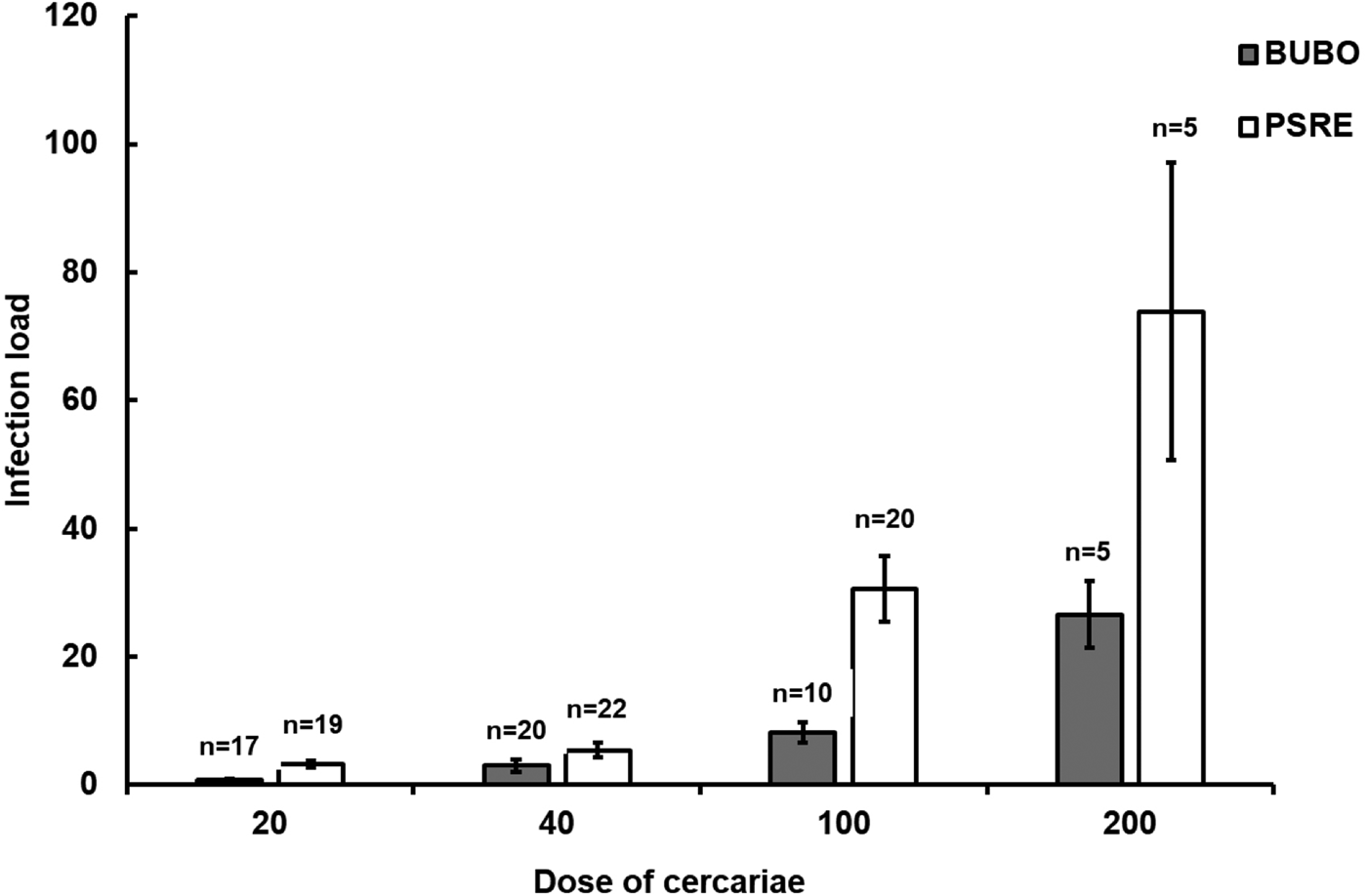
Exposure dosage and host species jointly influenced the number of detected metacercariae 20 days post exposure (Poisson GLMM: P. regilla = 1.066 ± 0.175, P < 0.00001; scale (dose) = 0.347 ± 0.079, P < 0.00001) (fig. 3). Because this model included an offset for exposure, these results indicate that the proportion of parasites successful in establishing within a host increased with both cercariae dosage and with host species (P. regilla > A. boreas). Time post-exposure also strongly affected the number of detected metacercariae. Among a subset of hosts exposed to 20 cercariae and examined at 36 hours post exposure (three P. regilla and three A. boreas), no metacercariae were detected. Similarly, for hosts that died within 10 days of exposure (seven P. regilla and eight A. boreas), only a single P. regilla exposed to 200 cercariae showed evident signs of infection (with three metacercariae). Based on the analysis of P. regilla hosts exposed to 40 cercariae and examined at 20 or 40 days post exposure (n = 25 and 10, respectively), time had a strongly positive effect on parasite load (Poisson GLMM: scale (days) = 0.449 ± 0.128, P = 0.0004). More specifically, the average number of metacercariae per host ± 1 SE more than doubled, from 6.21 ± 1.24 on day 20 to 14.2 ± 1.96 on day 40, despite an identical initial exposure level. These patterns probably reflect increases in our ability to detect metacercariae with time, rather than a real increase in infection (given that all exposures occurred within the first 24 hours).
The infection load (± 1 SE) of Clinostomum marginatum metacercariae recovered at 20 days per infected species of amphibian, Pseudacris regilla (PSRE) and Anaxyrus boreas (ANBO), per dose of cercariae (20, 40, 100, 200). Number of individuals dissected is reported.

The average size of Clinostomum metacercariae increased between days 20 and 40 post exposure. The estimated area of metacercariae increased 650% during this period, from 0.0125 ± 0.0008 mm2 to 0.0812 ± 0.0009 mm2, with no effect of exposure dosage (LM on log10(area + 1): scale(days) = 0.400 ± 0.033, P < 0.00001; scale(dose) = 0.0038 ± 0.033, P = 0.91). The average length of measured metacercariae across doses ± 1 SE at 20 days was 179.44 ± 9.41 μm, with an average width of 89.44 ± 4.67 (n = 9). At 40 days (n = 13), the average length and width were 383.08 ± 21.07 μm and 263.46 ± 17.81 μm, respectively.
Discussion
Patterns of infection among species and over time in California
We detected Clinostomum marginatum infections in 10 host species (five amphibian and five fish species) over a five-year period of field sampling in the Bay Area of California, of which eight represent new host records (table 2). Our field surveys highlighted the importance of both host species and life stage in influencing parasite occurrence and prevalence. Overall, infection prevalence was low, with only 1.7% of amphibian and 9.2% of fish hosts showing infection. Of the 125 ponds sampled, many of which were visited in multiple years (average of three visits), only 40 supported C. marginatum in one or more host species. Fish hosts tended to exhibit a higher prevalence and intensity relative to amphibians, even at sites where both groups co-occurred (1.6× higher). Among the amphibians, a somewhat surprising result was that adults tended to support a higher likelihood of Clinostomum infection relative to larval amphibians, particularly for the two species of Taricha (fig. 2) (average prevalence in adults = 22.2% and in juveniles = 1.7%). For waterborne parasites such as Clinostomum cercariae, we expected that most amphibians post metamorphosis would experience lower infection risk (presence or load), given that contact with water is maximized during larval development, although there is still potential for infection risk. Even though we cannot be certain what drives the elevated level of C. marginatum infections in adult amphibians, this result could be a function of detection (as trematode metacercariae grow with age they may be easier to detect; see experimental results) or changes in properties of the adult amphibian skin, which has been demonstrated in experimental studies with other trematodes to be less susceptible to cercariae invasion (Johnson et al., Reference Johnson, Kellermanns and Bowerman2011).
The patterns of infection observed in the current study are broadly similar to previous surveys for both amphibians and fishes. Fish supporting a higher prevalence of C. marginatum is consistent with the longer lifespan and typically larger body size of fishes (Poulin and Mouritsen, Reference Poulin and Mouritsen2003; Calhoun et al., Reference Calhoun, McDevitt-Galles and Johnson2018). For instance, channel catfish can live for as long as 15 years, often leading to high levels of ‘yellow grub’ infection and metacercariae persisiting for long periods (see Edney, Reference Edney1940). Based on our field results, T. granulosa supported the highest average parasite prevalence (9.2%), followed by A. boreas (5.1%). In parallel, Gray et al. (Reference Gray2007) detected more infection by Clinostomum attenuatum in salamanders (Ambystoma tigrinum mavortium, 0.5%) compared with toads (Bufo cognatus, 0.4%) or frogs (Spea multiplicata, 0.4%). However, the Clinostomum detection method used by Gray et al. (Reference Gray2007) differed from our study, as they only inspected the epidermis of the animals externally for parasistes, which could explain the higher prevalences in our study (we often detected parasites deep in the muscle tissues). In a field study from Illinois, Crawford and Kuhns (Reference Crawford and Kuhns2008) found substantially higher Clinostomum spp. prevalence among two larval salamander species (33.3% in A. jeffersonianum and 6.8% in A. texamum), and Kuperman et al. (Reference Kuperman2004) reported that 70% of non-native African clawed frogs (Xenopus laevis) were infected in southern California, with a range of 1–4 metacercariae (n = 230 hosts). With respect to fish hosts, we found an overall infection prevalence of 9.2% (n = 996), which aligns closely with the 9.8% prevalence reported by Wang et al. (Reference Wang, Chen and Shih2017) in a study of river fishes in Taiwan. They found Cyprinidae fishes supported the highest average intensity; Candidia barbata supported the highest average intensity (14.4; 1–107; n = 31), in parallel to our findings for L. cyanellus (7.0 ± 1.5 SE; 1–19; n = 18). Also, similar to our findings, previous work has detected a low level of macroparasite taxonomic richness and load within the invasive mosquitofish (3.3% prevalence in the current survey). Over four years, Calhoun et al. (Reference Calhoun, McDevitt-Galles and Johnson2018) reported that G. affinis supported 42–78% fewer parasite taxonomic groups and 97% fewer total parasites compared with other fishes in California ponds. In a study of Clinostomum marginatum in fishes from eastern Kansas, Klaas (Reference Klaas1963) found bullhead catfishes to be the most commonly infected fishes, followed by M. salmoides (7.2%), L. macrochirus (4.4%) and L. cyanellus (1.7%) (see also Becker and Cloutman, Reference Becker and Cloutman1975). We did not find infection in either C. auratus or Ictalurus sp., which have been reported to support infections. This is probably because both fishes were collected from a single pond over several years. Thus, if that site did not support infection in frogs or newts, we would not be able to assess for these species.
Similar to our study, Bonett and colleagues (Reference Bonett2011) analysed the prevalence, intensity and genetic diversity of Clinostomum spp. in fishes (M. salmoides; n = 34) and salamanders (Eurycea tynerensis; n = 74) in an Oklahoma pond and adjacent stream. They detected C. marginatum in both species, complementing the current findings from California. Moreover, they reported a higher infection prevalence and intensity in fish hosts relative to amphibians (91% of M. salmoides and 56% of E. tynerensis). Largemouth black bass exhibited a mean intensity of 5.0 ± 4.7 SD metacercariae, compared with 2.2 ± 1.9 SD for infected salamanders.
Genetic insights into parasite taxonomy
Based on both nuclear rDNA and mitochondrial cox1 sequences the samples obtained in this study belonged to C. marginatum. We detected C. marginatum infections in both amphibians and fishes from multiple freshwater ponds in California, including samples obtained using naturally infected snails from those ponds. We point out, however, that the total number of sequenced samples in this study was low, and future efforts to expand on this foundation will be essential to evaluate whether additional species co-occur. Previous molecular analyses have provided some resolution regarding the taxonomic status of species within the genus Clinostomum (Dzikowski et al., Reference Dzikowski2004; Caffara et al., Reference Caffara2011; Locke et al., Reference Locke2015; Pérez Ponce de León et al., Reference Pérez Ponce de León2016; Sereno-Uribe et al., Reference Sereno-Uribe2018). Using 18S rRNA isolates of C. complanatum from Israel and C. marginatum from the USA, Dzikowski and colleagues (Reference Dzikowski2004) demonstrated the validity of the two species as they differed at 22 bases. More recently, Caffara et al. (Reference Caffara2011) used the genetic markers ITS1 and COI, which have been determined to be more specific genes to differentiate species (compared with 18s rRNA alone), as well as morphological characteristics of metacercariae and adults to argue that C. marginatum is a separate species from C. complanatum. These findings support the contention of a geographical distinction between the American and European species. Using similar methods, Sereno-Uribe et al. (Reference Sereno-Uribe2013) used both mitochondrial and ribosomal markers on specimens from freshwater fishes and birds in Mexico to validate C. complanatum, while also identifying a new species: Clinostomum tataxumui. A large-scale survey of Clinostomum specimens from amphibian and fish hosts across New World and Old World regions further supported the geographical separation of species (Locke et al., Reference Locke2015), although without a clear separation between infections of amphibian and fish hosts. Pinto et al. (Reference Pinto2015) argued that the diversity of Clinostomum species is probably underestimated, based on a molecular study of cercariae from Biomphalaria spp. in Brazil. This opinion is supported by the most recent descriptions of four additional new species from North America (Briosio-Aguilar et al., Reference Briosio-Aguilar2018; Rosser et al., Reference Rosser2018).
Despite recent explorations of Clinostomum genetic history, few studies have examined species-level identifications within the same system in comparison of intermediate fish and amphibian hosts. Our study emphasized the importance of genetic data to identify species of Clinostomum in aquatic systems where multiple species of intermediate hosts frequently co-occur. Although classical studies contend that species identity varies as a function of intermediate host identity (amphibians vs fishes), our findings indicated that C. marginatum often infects amphibians as well as fishes in the same habitats. Prior to recent molecular studies (Caffara et al., Reference Caffara2011; Sereno-Uribe et al., Reference Sereno-Uribe2013, Reference Sereno-Uribe2018; Pérez Ponce de León et al., Reference Pérez Ponce de León2016; Rosser et al., Reference Rosser2016, Reference Rosser2017), Clinostomum species determination was often based on geographical location (New vs Old World) and intermediate host identity (fishes vs amphibians) (Yamaguti, Reference Yamaguti1933; Hunter and Hunter, Reference Hunter and Hunter1935; McAllister, Reference McAllister1990). Alongside the findings of Bonnet et al. (Reference Bonett2011), our results indicate that C. marginatum frequently infects both amphibians and fishes that co-occur in the same aquatic environment.
Although there have been multiple reports of C. marginatum infections in fish intermediate hosts, our results highlight three new host records in fishes (G. affinis, L. cyanellus, L. microlophus) and five new host records in amphibians (A. boreas, P. regilla, L. catesbeiana, T. granulosa, T. torosa) (table 2). Most of the amphibian host species in our study have previously reported infections by either Clinostomum attenuatum or Clinostomum spp. (supplementary table 3). For instance, P. regilla and L. catesbeiana have previously supported infection by Clinostomum spp. (Muzzall, Reference Muzzall1991; Lemke et al., Reference Lemke2008) and C. attenuatum (Cort, Reference Cort1913; Jinks and Johnson, Reference Jinks and Johnson1970). These results collectively indicate that the use of second intermediate host identity alone is probably insufficient to differentiate the species of Clinostomum, and therefore the previously suggested high degree of intermediate host specificity should be interpreted with caution.
Experimental results for parasite growth and host pathology
Based on our experimental results, metacercariae of C. marginatum grew approximately 6.5-fold within P. regilla host over 20 days. This finding is notable in that metacercariae of most trematode species tend to grow relatively little within second intermediate hosts (Schell, Reference Schell1985). For instance, Fibricola seolensis recovered from experimentally infected tadpoles grew 116% over 20 days (Mitchell et al., Reference Mitchell, Tilman and Groth2002), whereas Centrocestus formosanus from infected fishes grew by 54% over 50 days. Others have even reported a decrease in growth; the width of Ornithodiplostomum ptychocheilus metacerariae in experimentally infected Pimephales promelas (fathead minnows) decreased by 31% (Sandland and Goater, Reference Sandland and Goater2000). Species of Clinostomum exhibit remarkably high levels of growth within intermediate hosts, in part associated with characteristics of the parasites’ tegument (Lo et al., Reference Lo, Chen and Wang1985; Abidi et al., Reference Abidi1988; Aho, Reference Aho, Esch, Bush and Aho1990). For instance, Lo et al. (Reference Lo, Chen and Wang1985) noted that C. complanatum metacercariae had blood vessels penetrating the cysts, whereas in C. complanatum Abidi et al. (Reference Abidi1988) reported a stretching capability in the tegument of metacercariae. Both of these studies suggest that increased access to host nutrients probably assists in the growth and development of Clinostomum marginatum.
Despite this remarkable growth in metacercariae, we found no evidence of pathological effects in amphibian larvae exposed to Clinostomum cercariae, even at relatively high levels of exposure (200 cercariae). There was no difference in survival between exposed and unexposed hosts, and even among infected individuals there was no obvious effect on host growth. This result is consistent with previous studies showing little damage of initial exposure dosage on host fitness (Klaas, Reference Klaas1963), although other studies have reported pathology such as localized haemorrhages associated with infection (Elliott and Russert, Reference Elliott and Russert1949; Adeyemo and Agbede, Reference Adeyemo and Agbede2008; Roberts, Reference Roberts2012). For instance, Clinostomum tilapiae in infected fishes causes inflammation and lesions, in some cases leading to host death (Adeyemo and Agbede, Reference Adeyemo and Agbede2008). Similarly, Roberts (Reference Roberts2012) found that fishes infected with clinostomatids had inhibited growth and increased weight loss. Given that we examined hosts over a limited time period (20 days), it is possible that more significant pathology would have occurred over longer time periods (including early larval development and/or especially the transition to metamorphosis).
Another interesting finding of the experimental study was that hosts exhibited density-dependent infection success, such that infection success (the percentage of administered cercariae that formed metacercariae) increased monotonically with exposure dosage. For example, at a dosage of 40 cercariae, P. regilla supported an average ± 1 SE of 8.7 ± 1.2 metacercariae per host (21.7% infection success), whereas infection success increased to 30.7% when hosts were exposed to 100 cercariae (metacercariae count of 30.7 ± 5.1). In contrast, Johnson et al. (Reference Johnson2012) exposed 12 species of amphibians to a range of Ribeiroia ondatrae cercariae (0–200) and reported that the proportion of established metacercariae (relative to the number of cercariae administered) was independent of exposure dose. Similar results are consistently found in the Microphallus spp. trematode system in multiple dose exposures in snails (Potamopyrgus antipodarum) (Osnas and Lively, Reference Osnas and Lively2004) and in cercariae to amphipods (Gammarus insensiblis) (Brown et al., Reference Brown2003). Whereas many studies have reported that infection success decreases with exposure dosage (Koprivnikar et al., Reference Koprivnikar2017; Orlofske et al., Reference Orlofske2017), the ecological or physiological mechanisms underlying an increase in parasite establishment with density remain conjectural. The explanation for this trend could be twofold. In part, results could reflect an increase in the detection of metacercariae over time. For the subset of animals dissected at 36 hours post infection, no metacercariae were detected; however, at 20 days post infection, P. regilla hosts supported an average load of 9.5 metacercariae across treatments, highlighting probable differences in researchers’ ability to observe metacercariae (as a function of growth within the host). Secondly, parasite performance could also be dose dependent, such that hosts exposed to higher levels of cercariae could exhibit a reduced capacity to resist or clear infections by Clinostomum. Future studies that incorporate immune parameter measurements could effectively disentangle the biological mechanisms underlying these observations.
Supplementary material
To view supplementary material for this article, please visit https://doi.org/10.1017/S0022149X18001244
Author ORCIDs
D.M. Calhoun, 0000-0002-9483-2064.
Acknowledgements
We gratefully acknowledge the following members of the field and dissection teams who assisted in collection and dissection of amphibians, fishes and snails: Wynne Moss, Katie Richgels, Jeremy Henderson, Evan Esfahani, Mary Jade Farruggia, Dina Soltow, Aaron Klingborg, Megan Housman, Margaret Summerside, Neal Handloser, Dane McKittrick, Sarah Goodnight, Sara Paull, Jay Bowerman, Sarah Kupferberg, Emily Hannon, Christina Garcia, Jackie Gregory, Bryan LaFonte, Keegan McCaffrey and Audrey Omeimrin. We thank two reviewers and the editor for their comments on the final manuscript.
Financial support
This work was supported through funding from the National Institutes of Health (R01-GM109499), National Science Foundation (DEB-1149308), and the David and Lucile Packard Foundation.
Conflict of interest
None.
Ethical standards
The authors assert that all procedures contributing to this work comply with the ethical standards of the relevant national and institutional guides on the care and use of laboratory animals.