Introduction
In the late 1960s and early 1970s, the western part of the historic region of Mazovia was subjected to the first systematic programme of fieldwalking in Poland. The outcome of this programme was the discovery of numerous traces of intensive iron production. These were manifested on the surface by the presence of abundant slag fragments and lumps. The surface material indicated the existence of a highly specialised centre of iron smelting, which, if not producing on a very large scale, nevertheless generated iron in at least above-average quantities. The so-called Mazovian Centre of Metallurgy (MCM)—as this phenomenon came to be termed—comprises more than 250 settlements (Woyda Reference Woyda and Dulinicz2005). Most of these sites are associated with the Przeworsk culture and dated to the Late Pre-Roman and Roman periods (2nd century BCE–4th century CE). However, several multi-cultural settlements have also yielded Jastorf culture materials, dating to the Early and initial phase of the Late Pre-Roman period (late 4th–early 2nd century BCE) (for general overviews of both cultural groups, see Andrzejowski Reference Andrzejowski, Lund Hansen and Bitner-Wróblewska2010; Dąbrowska and Mączyńska Reference Dąbrowska, Mączyńska and Beck2003; Grygiel Reference Grygiel, Woźniak, Grygiel, Machajewski and Michałowski2013, Reference Grygiel2015; Kontny Reference Kontny and Rzeszotarska-Nowakiewicz2016; Maciałowicz Reference Maciałowicz and Rzeszotarska-Nowakiewicz2016). At one settlement, the ability of the Jastorf population to produce iron was confirmed, although the scale of this phenomenon is at present difficult to estimate (Cieśliński et al. Reference Cieśliński, Baczewski, Cywa, Mueller-Bieniek and Woźniak2025; Mueller-Bieniek et al. Reference Mueller-Bieniek, Cieśliński, Drogosz and Woźniak2025). Archaeological features connected with iron production (primarily slag-pit furnaces) are difficult to date, owing to the very rare occurrence of artefacts in their fills. They are usually dated typologically, through association with other archaeological features in their vicinity. The state of radiocarbon dating of samples from settlements is also unsatisfactory, in terms of their quantity and, sometimes, quality; until quite recently analyses had been carried out for only three sites (Janiszewski Reference Janiszewski2018). The older determinations in the 1970s were performed on charcoal not subjected to anthracological analysis, therefore the old wood effect is probable. Also the measurement error for conventional 14C determinations is high.
The settlements within the area of the MCM (Figure 1) generally range from one to several hectares in size. Excavations have demonstrated that they are for the most part divided into two distinct areas: a residential and economic zone, and a more or less separated production zone. In the former, remains of buildings (both post-built constructions and sunken-featured buildings), numerous pits of various kinds, wells, and other features have been identified.
The extent of the Mazovian Centre of Metallurgy. Red dots indicate settlements associated with metallurgy. Zaborów—the research site—has been marked.

Figure 1. Long description
The map displays the western part of the historic region of Mazovia, highlighting the Mazovian Centre of Metallurgy. Red dots indicate settlements associated with metallurgy, while green dots mark other settlement points. Triangles represent cemeteries, and orange dots signify coin finds. The map includes key locations such as Zaborów, marked with an arrow, and major cities like Warszawa. The area is characterized by numerous iron-working settlements, with a concentration of red dots indicating intensive iron production. The map also shows rivers and other geographic features, providing context to the distribution of these settlements.
The economic zone contained large concentrations of remains of bloomery furnaces and—to a lesser extent—other features associated with other sectors of economy, such as different types of hearths, among them probably lime kilns. In the better-investigated settlements, clay extraction pits (for the construction of furnace shafts) and areas used for the segregation and preparation of bog iron ore (roasting, washing) have also been documented.
The number of bloomery furnaces recorded at individual sites ranges from several hundred to several thousand. On the basis of geomagnetic surveys, partly verified through excavation, it is assumed that in the largest settlements of the region traces of several thousand bloomery furnaces are to be expected. In terms of production volume, the MCM can be regarded as the second largest iron-smelting complex in the Barbaricum (Lehnhardt Reference Lehnhardt2019; Orzechowski Reference Orzechowski2013; Woyda Reference Woyda and Dulinicz2005).
New findings relating to ancient metallurgy have been brought by the investigations of the settlement complex at Zaborów, Leszno commune (Central Poland), consisting, among other elements, of a cremation cemetery (IV/21) and an extensive production settlement (V/22). During the works, excavations were carried out on an area of ca. 337 square meters of the settlement and over seven hectares of its surface were examined using non-invasive methods (e.g., magnetic prospection). As a result, relics of intensive iron production (slag-pit furnaces) and other industrial features (lime kiln, clay pits, etc.) were discovered. The archaeological materials obtained (mainly ceramics) made it possible to distinguish two main horizons of the site’s functioning: the older one dated to early pre-Roman period (the late 4th and first half of 3rd century BCE), associated with the population of the Jastorf culture, and the younger one, dated from late pre-Roman period to beginning of late Roman period (1st century BCE–2nd/3rd century CE)—attributed to the Przeworsk culture. Groundbreaking results were yielded by the radiocarbon analysis of charred seeds samples from slag-pit furnaces. They indicate that centralised mass iron production in the area east of the Oder River is at least 100 years older than previously assumed, with its origins in the Jastorf rather than the Przeworsk culture (Cieśliński et al. Reference Cieśliński, Baczewski, Cywa, Mueller-Bieniek and Woźniak2025; Mueller-Bieniek et al. Reference Mueller-Bieniek, Cieśliński, Drogosz and Woźniak2025).
The present paper presents and discusses the dating of a lime kiln from the production settlement at Zaborów V/22 (feature 122). Such features are found on settlements of the Pre-Roman and Roman periods in Central Europe, including sites attributed to the Przeworsk culture (Uschmann Reference Uschmann2006). Lime had a wide range of applications, including construction (whitewashing of walls), crafts (e.g., leather processing), agriculture (e.g., fertilizing fields, disinfecting the hooves of animals), as well as food preservation. Unfortunately, lime kilns only exceptionally contain precisely datable archaeological artefacts. Generally, lime kilns are dated on the basis of material found in their vicinity or by reference to the broad chronology of the settlement in which they occur. Only a limited number of furnaces have so far been dated using scientific dating methods. In his monograph on Iron Age lime kilns in Central Europe, out of 265 catalogued sites with several hundred recorded lime kilns, Kay-Uwe Uschmann (Reference Uschmann2006) was able to refer to only one radiocarbon and one thermoluminescence date. More recent literature has, of course, provided information on further kilns subjected to radiocarbon dating, e.g., from the Przeworsk culture settlement at Kleszczów 2 (Wójcik Reference Wójcik, Skowron and Olędzki2008) and the Wielbark culture site at Ostrowite (Sikora, Kittel, Wroniecki Reference Sikora, Kittel and Wroniecki2018). This does not alter the fact, however, that our knowledge of the chronological framework of lime production, or of diachronic changes in the morphology of the kilns, remains far from satisfactory.
Description of the lime kiln (feature 122)
The feature is the bottom, sunken part of a lime kiln. At the level of exposure it had an oval shape, measuring 3.3 × 2.5 m, and trapezoidal cross-section (Figure 2). The maximum depth of the pit was 1.4 m. The middle and lower part of the feature was filled with rubble of structural clay daub—the remains of a surface kiln construction. Within this filling, especially in the lower part, lay residues of the charge: fuel (burned oak and pine wood) as well as small fragments of raw material or product. Semi-circular impressions visible on larger pieces of daub indicate that the above-ground structure had been supported by a wooden frame. The upper part of the pit was filled with a layer of dark brown soil, concave in profile and about 50 cm thick.
Study site (feature 122)—cross-section of the excavation. Dark brown soil layer on the top of the feature is visible.

The archaeological material discovered within the kiln comprises nearly 250 pottery fragments, animal bone fragments, a clay spindle whorl, and small metallurgical waste (slag, so-called magnetic lumps). Most of the pottery, together with the remaining finds, was recorded in the upper, dark brown part of the filling.
Samples
Eleven samples—ten charcoal fragments and one organic sediment sample—were selected for radiocarbon dating. The samples were collected from all parts of the feature 122. Most of these, particularly those from the lower sections, likely represent remains of wood used as fuel and, possibly, fragments of construction elements from the above-ground part of the kiln. The origin of material in the upper fill of the pit is less clear and may represent a secondary deposit (see below). Prior to dating, all material was subjected to anthracological analysis to identify the tree species and determine the parts of the wood from which the charcoal fragments selected for study originated. This procedure aimed, among other things, to minimize the influence of the old wood effect on the results. The majority were charcoal from Pinus sylvestris, with two samples from Quercus sp. (GdA-8725.1.1 and GdA-8729.1.1).
Four samples from the feature were selected for luminescence dating: two daub fragments from the above-ground part of the lime kiln (GdTL-5424 and GdTL-5425) and two sherds of vessels associated with the Przeworsk culture (GdTL-5422 and GdTL-5423). In addition, a sediment sample was collected from the vicinity of the location where the ceramic artefacts were recovered.
Methods
The presence of artefacts in the fill of a feature allows for an attempt to date it within the framework of the relative chronology of the archaeological culture to which it has been assigned. The most significant are fragments of pottery, found at various levels within the pit fill. Other finds discovered within the pit (e.g., a clay spindle whorl) do not provide more precise data in this regard.
The cultural-chronological classification of the ceramic materials was carried out using a comparative method, drawing on published analyses of pottery from both cultural groups represented at the site: the Jastorf culture in the Polish Lowlands and the Przeworsk culture. The cultural division was made by identifying in the pottery features characteristic of each unit, including technological elements (composition of the ceramic paste, types of tempering materials, surface treatment) and macromorphological traits—the construction of the vessel body, the shape of rims and bases, and ornamentation.
Among the total ceramic assemblage, only a small number of sherds allowed for the reconstruction of vessel shapes, usually incomplete. Consequently, their classification within commonly used typologies was limited. This fact was significant when attempting to determine the chronological framework of the set, as dating of pottery is based on the correlation of diagnostic (typical) vessel forms with other chronological indicators (e.g., ornaments, elements of attire).
The samples selected for 14C measurements were prepared according to standard acid-base-acid (ABA) preparation and for the sample of organic sediment (GdA-8040.1.1) the NaOH-soluble fraction was separated. The carbon was extracted and converted to graphite with an AGE-3 system and elemental analyzer VarioMicroCube by Elementar (Němec et al. Reference Němec, Wacker and Gäggeler2010; Wacker et al. Reference Wacker, Němec and Bourquin2010). The graphite was then analyzed at the Gliwice Radiocarbon Laboratory with the MICADAS AMS system (Synal et al. Reference Synal, Stocker and Suter2007; Ustrzycka et al. Reference Ustrzycka, Piotrowska, Kłusek, Pawełczyk, Michczyńska, Michczyński, Kozioł and Jędrzejowski2025) using oxalic acid (OXA II, SRM4990C{NIST}) for standard normalization and correction for isotope fractionation. Phthalic anhydride, without any chemical pretreatment, was combusted and used as a background (blank) material. The ages were calibrated using OxCal v4.4.4 (Bronk Ramsey Reference Bronk Ramsey2009) and an IntCal20 calibration curve (Reimer et al. Reference Reimer, Austin, Bard, Bayliss, Blackwell, Bronk Ramsey, Butzin, Cheng, Edwards, Friedrich, Grootes, Guilderson, Hajdas, Heaton, Hogg, Hughen, Kromer, Manning, Muscheler, Palmer, Pearson, van der Plicht, Reimer, Richards, Scott, Southon, Turney, Wacker, Adolphi, Büntgen, Capano, Fahrni, Fogtmann-Schulz, Friedrich, Köhler, Kudsk, Miyake, Olsen, Reinig, Sakamoto, Sookdeo and Talamo2020).
Two fragments of daub from the kiln structure and two sherds from its fill were subjected to luminescence dating at the Gliwice Luminescence Laboratory. To determine the luminescence age, both the equivalent dose and the dose rate must be known. The equivalent dose was evaluated using the optically stimulated luminescence (OSL) method, employing automated Risø TL/OSL DA-20 reader. Although thermoluminescence (TL) is also commonly used for dating archaeological ceramic artefacts, OSL employing the single-aliquot regenerative (SAR) protocol was applied in this study (Moska et al., Reference Moska, Bluszcz, Poręba, Tudyka, Adamiec, Szymak and Przybyła2021). Since the firing temperature was apparently sufficiently high to completely reset the OSL signal in quartz grains, this method enables reliable determination of the age of ceramic firing. For the OSL measurements, quartz grains in the 4–11 μm fraction were extracted from the ceramic samples, whereas for the lime kiln samples, quartz grains in the 125–200 μm fraction were used. Sample preparation followed standard procedures, including treatment with hydrochloric acid (HCl), hydrogen peroxide (H2O2), heavy-liquid separation for the coarse-grain fraction, and subsequent etching with hydrofluoric acid (HF) for the coarse grains and hexafluorosilicic acid (H2SiF6) for the fine-grain fraction, in accordance with methodologies described in the literature (Moska et al. Reference Moska, Bluszcz, Poręba, Tudyka, Adamiec, Szymak and Przybyła2021). To assess the dose rates, high-resolution gamma spectrometry with an HPGe detector (manufactured by Canberra) and the μDOSE system were used to determine the activities of 238U, 232Th, and 40K. In determining the dose rate for the ceramics, the activity of radionuclides in the surrounding sediment was also considered. The cosmic dose rate was calculated following Prescott and Hutton (Reference Prescott and Hutton1994). All dose rates were calculated using an online dose-rate calculator that incorporates the latest conversion factors (Tudyka et al. Reference Tudyka, Koruszowic, Osadnik, Adamiec, Moska, Szymak, Bluszcz, Zhang and Poręba2023). The final equivalent dose (De) values for all samples were calculated using the Central Age Model (CAM) implemented in the R package Luminescence (Kreutzer et al. Reference Kreutzer, Burow, Dietze, Fuchs, Schmidt, Fischer, Friedrich, Riedesel, Autzen and Mittelstrass2020), as the De distributions were narrow with negligible overdispersion, indicating a well-bleached and homogeneous dose population.
Results
Archaeological dating
Archaeological dating is based on the stylistic and typological analysis of fragments of ceramic vessels. Almost all pottery fragments discovered in the lime kiln can be attributed to the Przeworsk culture. These are sherds of hand-made vessels (without the use of a potter’s wheel). Among them, fragments of large pots with thick walls and partially or completely roughened surfaces predominate. The better-preserved specimens represent forms with a biconical body and a distinct rim. They correspond to vessels of Group V in Liana’s classification (Reference Liana1970) or Type VII according to Lasota-Kuś (Reference Lasota-Kuś2023). These forms are dated to the later part of the early Roman period and the beginning of late Roman period (ca. 2nd–early 3rd century CE). A similar chronological horizon may also be associated with fragments of a large biconical vessel with a smooth surface, decorated with a band of incised “hanging” triangles filled with impressed ornamentation. The remaining fragments of Przeworsk culture pottery discovered in the fill of feature 122—such as sherds of vessels with rounded bodies and indistinct rims—do not provide more precise data for dating the feature.
A small percentage of the total pottery assemblage consists of fragments from other chronological periods. The earlier horizon is represented by single sherds of the Jastorf culture vessels from the Pre-Roman period (the late 4th and first half of 3rd century BCE) (Grygiel Reference Grygiel2018). The latest one is a small fragment of a wheel-thrown vessel from the early Middle Ages (beginning of the 2nd millennium CE) (Kobylińska Reference Kobylińska, Urbańczyk and Trzeciecki2016). These materials were recorded in the upper part of the feature.
Radiocarbon and luminescence dating
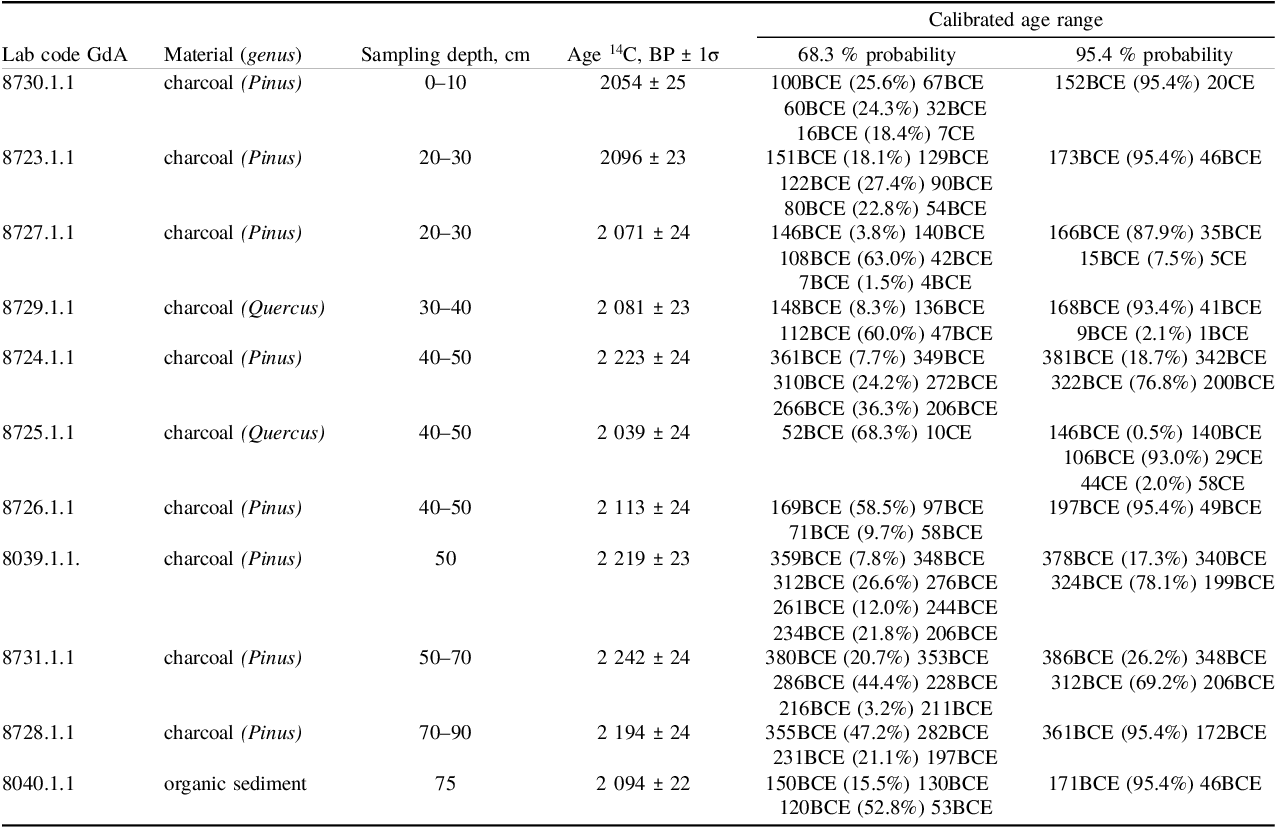
The results of radiocarbon measurements are shown in Table 1.
Results of 14C measurements. Calibrated age ranges obtained using OxCal software.

Table 1. Long description
A table with 8 rows and 6 columns. The columns are labeled Lab code GdA, Material (genus), Sampling depth, cm, Age 14C, BP ± 1σ, 68.3 % probability, and 95.4 % probability. The table lists radiocarbon measurements and calibrated age ranges for charcoal and organic sediment samples. Each row provides details for a specific sample, including the lab code, material genus, sampling depth in centimeters, age in radiocarbon years before present (BP) with a standard deviation, and calibrated age ranges with probabilities.
The tested samples indicate two time intervals. The samples (8039.1.1, 8724.1.1, 8728.1.1 and 8731.1.1) gave almost the same dates, falling in the range of 4th to 2nd century BCE (Figure 3).
Multiple plot of modelled radiocarbon and luminescence BCE/CE ages, obtained on samples from feature 122 in Zaborów. Two phases—Jastorf and Przeworsk—of the lime kiln’s functioning are visible.

Figure 3. Long description
A graph showing calibrated dates for radiocarbon and luminescence ages from samples in Zaborów. The horizontal axis represents calibrated dates in BCE/CE, ranging from 2000 BCE to 1000 CE. The vertical axis lists different radiocarbon and luminescence dates - the data points and probability distributions indicate the calibrated dates for each phase. The Przeworsk culture horizon is at the top, and the Jastorf culture horizon is at the bottom.
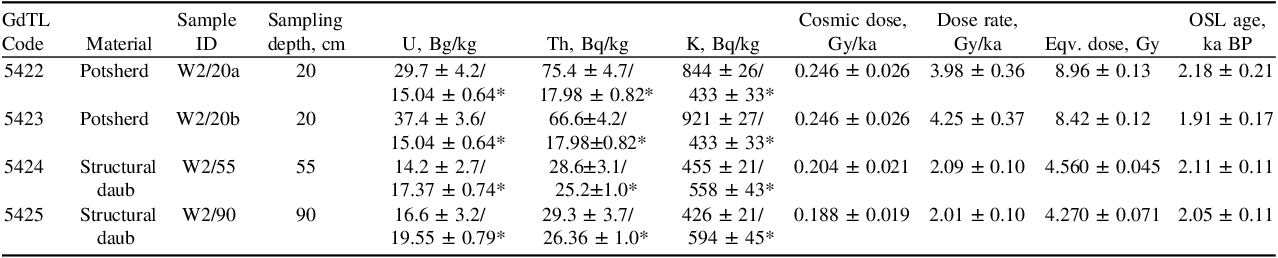
The results of OSL dating allow the analyzed samples to be assigned to the two time phases described above. The younger samples are coherent, and their probability distributions cover the period from 2nd century BCE to 1st century CE. Table 2 presents the luminescence dating results of the samples collected from the lime kiln and the sherds from its fill as well as the measurements of radionuclide activity, dose rates and equivalent doses. The luminescence dating results of two pottery fragments (GdTL-5422, GdTL-5423) and two samples of structural daub from the lime kiln (GdTL-5424, GdTL-5425) indicate a similar chronological range. The obtained age estimates fall between 1.91 ± 0.17 ka and 2.18 ± 0.21 ka.
Radioactivity, annual dose rates, palaeodoses and luminescence ages. Dose rates reported for pottery and structural daub samples were calculated taking into account the radioactivity of the surrounding sediments (marked with an asterisk). OSL ages are reported in ka BP with 1 σ uncertainty, consistent with the radiocarbon results presented in Table 1 (1950 as 0 BP).

Table 2. Long description
A table with six columns and four rows comparing radioactivity, dose rates, and luminescence ages for pottery and structural daub samples. The columns are labeled GdTL Code, Sample Material, Sample ID, Sampling depth (cm), U (Bg/kg), Th (Bq/kg), K (Bq/kg), Cosmic dose (Gy/ka), Dose rate (Gy/ka), Eqv. dose (Gy), and OSL age (ka BP). The rows present data for different samples with their respective measurements.
Discussion
The key factor in determining the dating of the feature based on its inventory is establishing the time of formation of the layers that fill it. The structural daub found in the lower and middle parts of the pit is undoubtedly associated with the period of the furnace’s operation. It represents part of the above-ground construction that collapsed into the pit after the product had been removed. The age of the clay elements of the kiln is determined based on two OSL analyses (GdTL-5424 and GdTL-5425). A weighted mean was calculated using the inverse of the variance as the weighting factor, which is a standard statistical procedure when dates originate from a single, contemporaneous context and show no significant divergence. This calculation produced a value of 2.08 ± 0.08 ka, indicating an average age of the construction daub. When converted to an absolute date (with 1950 as the reference year), this corresponds to approximately 130 BCE, with an uncertainty range (1 σ) extending from 210 BCE to 50 BCE. This date corresponds with chronology of the Przeworsk culture pottery recovered from middle sections of the feature; however, the assemblage is not sufficiently distinctive to allow precise dating. A radiocarbon date obtained from organic sediment at a depth of 75 cm (GdA-8040.1.1) is also consistent with the approximate age of the clay construction of the kiln and the ceramic materials. In contrast, two 14C dates obtained from charcoal at depths of 50–70 cm (GdA-8731.1.1) and 70–90 cm (GdA-8728.1.1) indicate the 4th–3rd centuries BCE. While the so-called “old wood effect” (Dean 1978) cannot be ruled out, it seems that older charcoal was incorporated into the kiln fill as a result of post-depositional processes.
Inconsistent results were also obtained from the archaeological, radiocarbon and OSL analyses of materials from the dark brown layer at the top of the feature, which reaches a depth of approximately 50 cm. This layer appears to have formed through the gradual accumulation of material from the site surface as the fill of feature 122 naturally subsided due to geological processes. The composition of the layer (soil mixed with charcoal, animal bones and small slag fragments), together with the chronologically diverse assemblage of artefacts, confirms its secondary character. This interpretation is supported by the heterogeneous OSL dates obtained from two ceramic fragments (GdTL-5452 and GdTL-5453), as well as by radiocarbon dates from charcoal clustering either in the 4th–3rd centuries BCE or in the period from the 2nd century BCE to the early 1st century CE.
The combined application of radiocarbon and OSL dating proved important for the interpretation of feature 122, as each method addresses a different aspect of the depositional history. Radiocarbon dating of charcoal provides information on the age of the burned organic material, which may predate its final deposition due to factors such as the old wood effect or redeposition processes. In contrast, OSL dating determines the time of last exposure of mineral grains to light, and thus directly reflects the moment of sediment deposition or the firing of clay structural elements. In the case of the analyzed kiln, OSL dates obtained from construction materials offer a reliable estimate for the period of its operation, while radiocarbon dates reveal the presence of both contemporaneous and redeposited, older material within the fill.
Both absolute dating methods consistently indicate that the material from the kiln derives from two chronological periods. The older one dates to the 4th–3rd centuries BCE, while the younger ranges from the 2nd century BCE to the first half of the 1st century CE. This distribution corresponds to the time frame of the two main stages of the site’s functioning, associated with the Jastorf and Przeworsk cultures (Figure 3), as determined by a series of radiocarbon dates and the relative chronology of the archaeological materials. The absolute dates for the lime kiln are also broadly consistent with the dating of the movable artefacts recovered from its fill. Among the radiocarbon and luminescence dates, those attributable to the younger pre-Roman and early Roman periods predominate. The analyzed feature can therefore probably be attributed to the Przeworsk culture, as is clearly indicated by the luminescence dating of its structural elements. The presence of a relatively large amount of chronologically older material in the feature’s fill, however, requires explanation. The location of the feature 122 within the site is key in this respect. In its immediate vicinity, several relics of iron-smelting furnaces have been identified, and in course of reconnaissance analysis one of them (feature 107) has yielded a radiocarbon date also indicating the 4th–3rd centuries BCE (GdA-7659.1.1: 2235 ± 43 BP; 393–196 cal BCE at 94.8% probability; unpublished data). This date was obtained from a charred seed, subjected to the same pretreatment and dating protocol as samples from presented lime kiln (feature 122), and the age is consistent with the “older” dates. Therefore, feature 107 was constructed within a former production area of a Jastorf culture settlement. Fragments of slag, undoubtedly originating from destroyed furnace pits, were identified across the analyzed area. At smelting sites, charcoal may occur both at the bases of furnace pits and in the surrounding cultural layer. The latter usually derives from furnaces dismantled after use or may represent traces of fuel stored near the smelting workshops, since continuous access to fuel would have been necessary to maintain suitable conditions for the process.
The chronologically earlier charcoal from the lime kiln pit most probably derives from a secondary deposit. These older fragments likely entered the deepest and central parts of the feature during the digging of the furnace pit. Their presence in the upper, darker part of the structure may be explained by the accumulation of material within the kiln cavity, originating from the surrounding Jastorf cultural layer.
Conclusions
A comparison of the results of chronological analyses of pottery found in feature 122 with dates obtained using the OSL and radiocarbon methods indicates that it can be attributed to the Przeworsk culture and dated to the end of the pre-Roman period (1st century BCE) or the beginning of the Roman period (first half of the 1st century CE). This conclusion is complicated by the presence of a few potsherds and charcoal in the fill of kiln pit and accumulation layer covering it, which have been dated to an earlier stage of use of the site associated with the Jastorf culture in the early pre-Roman period (late 4th–early 3rd century BCE). These older materials are therefore interpreted as secondary deposits resulting from redeposition and accumulation processes.
In the interpretation presented above, a key role was played by the correlation of dates obtained through two different dating methods. Optically stimulated luminescence (OSL) dating was applied to the clay structural elements of the lime kiln dome, thereby indicating the period of the feature’s operation. Radiocarbon determinations, in turn, were carried out on charcoal and organic sediment samples collected from various stratigraphic levels of the feature’s fill, which made it possible to elucidate the processes of its accumulation.
An important conclusion arising from the methodology applied is the value of dating archaeological features using multiple methods and, wherever possible, based on a broad range of analyses. This observation is particularly relevant to large pits identified at multi-layered, long-occupied sites, such as settlements, where chronologically older material often accumulates in the fill as a result of post-depositional processes. When only a limited number of analyses is available (e.g., a single radiocarbon date), there is a risk that unrepresentative material will be selected for testing. In such cases, the resulting dates may be misleading and distort the reconstructed picture of the past.
In conclusion, it is worth emphasizing that the state of research on the dating of lime kilns remains unsatisfactory. The case study of feature 122 from Zaborów presented here is an attempt to change this picture; in terms of the range of dating methods applied and the substantial number of samples, it is currently the best-analyzed Iron Age lime kiln in the whole of Central, Northern, and Eastern Europe. A key research postulate is to continue this type of work on a broader scale, both in terms of the number of analyzed features and the geographical distribution of archaeological sites. Only in this way will we be able to better understand the phenomenon of lime production, which constitutes one of the more intriguing aspects of studies on technological development.
Acknowledgments
The research was made possible through the subsidy of the Silesian University of Technology (14/020/BKM25/0061). The mission is funded by the University of Warsaw and the Museum of Ancient Mazovian Metallurgy in Pruszków.