Although prosody makes a crucial contribution to the perception of foreign accent (Boula de Mareüil & Vieru-Dimulescu, 2006), tonal and rhythmic properties of speech (e.g., melody and timing) have long been disregarded in research on both second language (L2) acquisition and language contact (Piske, MacKay, & Flege, Reference Piske, MacKay and Flege2001; Vaissière & Boula de Mareüil, 2004). Until now, only a few studies have investigated prosodic transfer from a native to a nonnative system, be it in the context of instructed foreign language learning (e.g., Chen & Mennen, Reference Chen, Mennen, Barbosa, Madureira and Reis2008; Gabriel, Hu, Diao, & Thulke, Reference Gabriel, Hu, Diao and Thulke2012; Ordin, Polyanskaya, & Ulbrich, Reference Ordin, Polyanskaya, Ulbrich, Cosi, De Mori, Di Fabbrizio and Pieraccini2011; Rao, Reference Rao2011; White & Mattys, Reference White and Mattys2007) or within the scope of (usually migration-induced) linguistic contact (e.g., Bordal, Reference Bordal, Gess, Lyche and Meisenburg2012; Deterding, Reference Deterding2001; Fagyal, Reference Fagyal2010). A remarkable result of a contact scenario that involved the learning of a foreign language by immigrants is Porteño, a variety of Spanish spoken in the Argentinean capital of Buenos Aires that is generally characterized as being “Italianized” due to massive streams of immigration between the 1860s and the beginning of the 20th century (Fontanella de Weinberg, Reference Fontanella de Weinberg1987; Vidal de Battini, Reference Vidal de Battini1964). On the basis of historical evidence and demographic data, McMahon (Reference McMahon2004) interpreted the prosody of contemporary Porteño as a result of transfer from the first language (L1) to the L2 in the course of the acquisition of the target language, Spanish, by the Italian immigrants (henceforth, this will be referred to as McMahon’s [Reference McMahon2004] transfer hypothesis). Assuming that this view is correct, the prosodic characteristics that the contact variety Porteño shares with Italian varieties should presently also rise in the speech of Italian native speakers who learn Castilian. Our goal is to test McMahon’s (Reference McMahon2004) transfer hypothesis with respect to speech rhythm and intonation, more precisely with regard to the tonal shape of yes-no questions. To that end, we compare data of identical material recorded from (a) native speakers of Porteño, (b) native speakers of Castilian Spanish, (c) Italian native speakers learning Castilian Spanish (henceforth referred to as L2 Spanish speakers), and (d) the L1 speech of the aforementioned Italian native speakers.
PROSODIC PROPERTIES OF SPANISH AND ITALIAN
The prosodic shape of a language is essentially determined by the systematic use of durational effects and fundamental frequency (F0)—that is, by timing (speech rhythm) and melody (intonation). In languages with lexical stress (see Liberman & Prince, Reference Liberman and Prince1977), such as Spanish and Italian, both F0 and timing are essentially linked to prosodic prominence on the word level—that is, to the marking of metrically strong syllables. The role of intensity as the third correlate of stress (besides F0 and duration) cannot be denied but will not be considered in our study. As for the timing aspect, the languages of the world are traditionally classified as belonging to either the stress-timed or the syllable-timed group (Abercrombie, Reference Abercrombie1967; Pike, Reference Pike1945). Footnote 1 According to this view, the perceptual contrast between the two types of languages is due to the isochrony of speech intervals: Whereas in syllable-timed languages, such as French or Spanish, all syllables tend to be of equal duration, in stress-timed languages such as English, (stress-delimited) feet are generally of the same length. After it was shown by Dauer (Reference Dauer and Gamkrelidze1987) and Roach (Reference Roach and Crystal1982), among others, that (stress- or syllable-based) isochrony was not systematic in either of the two targeted groups of languages, research on speech rhythm largely developed in two directions. One current line of investigation concentrates on phonological factors and interprets the timing of a given language as a surface reflex of its phonological properties (e.g., more or less complex syllabic structures and the presence or absence of vowel reduction; see Dasher & Bolinger, Reference Dasher and Bolinger1982; Dauer, Reference Dauer and Gamkrelidze1987). A second approach, represented by scholars such as Dellwo and Wagner (Reference Dellwo, Wagner, Solé, Recasens and Romero2003); Grabe and Low (Reference Grabe, Low, Warner and Gussenhoven2002); Ramus, Nespor, and Mehler (Reference Ramus, Nespor and Mehler1999); and White and Mattys (Reference White and Mattys2007), among many others, is more phonetically oriented and concentrates on the ratio of consonantal and vocalic intervals in the speech signal. Footnote 2 Seen from this angle, the contrast between stress-timed and syllable-timed languages is evidenced by different percentages of vocalic material in the speech signal (%V; Ramus et al., Reference Ramus, Nespor and Mehler1999) and by the values that depict the durational variability of vocalic and consonantal intervals (so-called rhythm metrics): The nonnormalized metrics ΔV and ΔC, proposed by Ramus et al. (Reference Ramus, Nespor and Mehler1999), express the standard deviation of vocalic and consonantal intervals, respectively; the variation coefficients VarcoV and VarcoC are speech-rate-normalized versions of ΔV and ΔC (Dellwo & Wagner, Reference Dellwo, Wagner, Solé, Recasens and Romero2003; White & Mattys, Reference White and Mattys2007). The pairwise variability index (PVI; Grabe & Low, Reference Grabe, Low, Warner and Gussenhoven2002) differs from both ΔV/ΔC and VarcoV/VarcoC in computing the durational variability in successive vocalic (or consonantal) intervals instead of calculating the variability of vocalic (or consonantal) intervals over the whole acoustic signal. In the literature, the PVI has been applied in both its nonnormalized, or raw, form (rPVI) and its speech-rate-normalized version (nPVI). Grabe and Low (Reference Grabe, Low, Warner and Gussenhoven2002) argued that only vocalic durations (in contrast to consonantal intervals) are affected by speech rate, and they consequently suggested using a speech-rate-normalized PVI for vowels (VnPVI) and a nonnormalized PVI for consonants (CrPVI). However, because Dellwo and Wagner (Reference Dellwo, Wagner, Solé, Recasens and Romero2003) showed that consonantal durations may also be dependent on speech rate, we follow Kinoshita and Sheppard (Reference Kinoshita, Sheppard, Lee and Zee2011) in normalizing the PVI also for consonantal intervals (CnPVI).
As for intonation, languages are commonly divided into a first group of so-called tone languages, which allow for the tonal marking of lexical contrasts (e.g., Mandarin Chinese), and a second group of “intonation only languages” (Gussenhoven, Reference Gussenhoven2004, p. 12), which lack this property and make systematic use of F0 for the marking of clause type and information structure, among other things. Within the intonation-only group, languages differ with respect to the determining factors of F0 movements, which either depend on the position of lexical stress (e.g., as in Spanish and Italian) or are determined by larger (i.e., phrasal) units, as is the case for languages lacking lexical stress, such as French or Turkish. One of the prevailing transcription systems for F0 movements is the tone and break indices (ToBI) labeling system, which was originally developed for the analysis of English intonation (Silverman et al., Reference Silverman, Beckman, Pitrelli, Ostendorf, Wightman, Price and Hirschberg1992) and, in the meantime, was adapted for the description of several other languages, among them Spanish (Beckman, Díaz-Campos, McGory, & Morgan, Reference Beckman, Díaz-Campos, McGory and Morgan2002; Prieto & Roseano, Reference Prieto and Roseano2010, among others) and Italian (Grice, D’Imperio, Savino, & Avesani, Reference Grice, D’Imperio, Savino, Avesani and Jun2005). The ToBI system is based on the autosegmental-metrical model of intonational phonology (Gussenhoven, Reference Gussenhoven2004; Ladd, Reference Ladd1996, Reference Ladd2008; Pierrehumbert, Reference Pierrehumbert1980), which distinguishes between a phonological representation on the one hand, consisting of underlying tonal targets that are represented on a separate tonal tier, and the concrete pitch contour on the other hand, produced by the speaker as a result of the phonetic interpolation between the underlying tonal targets. Two types of tonal units are generally assumed: (a) pitch accents, which associate with metrically strong syllables, and (b) boundary tones, which mark the edges of larger prosodic units such as the intermediate phrase (ip) or the (hierarchically higher) intonation phrase (IP). Regarding pitch accents, a distinction is made between the so-called nuclear pitch accent, which marks the most prominent syllable in an ip or IP, and the prenuclear pitch accent(s) that precede(s) the nuclear accent. The combination of a nuclear pitch accent and an IP boundary tone is usually referred to as the nuclear configuration; different nuclear configurations may convey distinct pragmatic meanings. The tonal targets can be low (L), high (H), or complex (e.g., high-low or falling: HL); their association with the syllabic, the ip, or the IP level is indicated through the diacritics *, -, and %, respectively (see Ladd, Reference Ladd1996, Reference Ladd2008, for a more detailed description). An illustration of the association of the tonal targets with the different levels of the prosodic hierarchy, originally proposed by Selkirk (Reference Selkirk1986), is given in Gabriel, Meisenburg, and Selig (2013; see also Rao, Reference Rao2009, for a more detailed discussion).
On cursory examination, the prosodies of the two languages under discussion, Spanish and Italian, appear quite similar. Regarding speech rhythm, they both are traditionally classified as syllable-timed (Ramus et al., Reference Ramus, Nespor and Mehler1999); as for their intonational systems, they both belong to the second subgroup of intonation-only languages (Grice et al., Reference Grice, D’Imperio, Savino, Avesani and Jun2005; Prieto & Roseano, Reference Prieto and Roseano2010), with the F0 contour determined by the position of metrically strong syllables. They nevertheless present considerable durational and tonal differences that may be transferred in the process of L2 acquisition, as is suggested by previous studies on the prosody of the contact variety Porteño (Colantoni & Gurlekian, Reference Colantoni and Gurlekian2004). A crucial difference between Spanish and Italian consists of the fact that Italian tends to mark lexical stress by lengthening the relevant syllable, in particular open-accented and preboundary syllables (Krämer, Reference Krämer2009), whereas in Spanish such durational effects are used considerably less often (Alfano, Savy, & Llisterri, Reference Alfano, Savy, Llisterri, Romito, Galatà and Lio2009). It is interesting to note that it has been reported that the lengthening of stressed syllables also occurs in Porteño Spanish. Estebas-Vilaplana (Reference Estebas-Vilaplana2010) shows that, in Porteño declarative sentences, the nuclear syllable (i.e., the perceptually most prominent syllable in the IP) is significantly longer than in Castilian Spanish (comparable lengthening effects have been found in other varieties of Spanish also at lower prosodic levels; see Rao, Reference Rao and Ortega-Llebaria2010). Such durational effects clearly have an impact on the ratio of vocalic to consonantal material in the speech signal and thus on speech rhythm in general, given that the greater durations of certain syllables are reflected in a higher proportion of vocalic material in the speech signal (%V) as well as in the greater durational variability of vocalic and/or consonantal intervals (VnPVI, VarcoV, CrPVI, CnPVI, and VarcoC). This is confirmed by comparative studies that show that the values for both the proportion of vocalic material and the variability of V/C intervals are higher for Italian than for Spanish (e.g., Ramus et al., Reference Ramus, Nespor and Mehler1999). Regarding the speech rhythm of Porteño Spanish, Toledo (2010) showed, on the basis of read speech data, that the values for %V are higher in Porteño than in the four European Spanish varieties examined in his study (i.e., Spanish from Sevilla, Aragón, Granada, and the Canary Islands). In a recent pilot study that used a limited data set comprised of two speakers per variety, Benet, Gabriel, Kireva, and Pešková (Reference Benet, Gabriel, Kireva, Pešková, Ma, Ding and Hirst2012) examined the durational properties of Porteño and compared them with those of the L2 Spanish produced by Italian native speakers. Preliminary results indeed corroborated McMahon’s (Reference McMahon2004) transfer hypothesis, showing that Porteño and L2 Spanish Italian speakers pattern with Italian, exhibiting greater values for %V and higher variability of vocalic (VarcoV and VnPVI) and consonantal (CnPVI) intervals than L1 Castilian Spanish speakers.
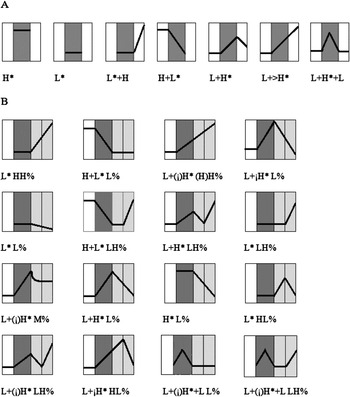
As for intonation, Spanish and Italian differ in the alignment of pitch accents—that is, concerning the shape of the F0 movement associated with stressed syllables. Although, in the overwhelming majority of Spanish dialects, prenuclear pitch accents (i.e., those preceding the nuclear syllable) are realized as a late-rising F0 movement with the peak aligned after the temporal limits of the metrically strong syllable (Prieto & Roseano, Reference Prieto and Roseano2010), Italian prenuclear accents are characterized by an early rise with the F0 peak aligned with the right edge of the stressed syllable (Grice et al., Reference Grice, D’Imperio, Savino, Avesani and Jun2005). Indeed, the property of early peak alignment in prenuclear syllables has also been attested in the Argentinean contact variety Porteño (Colantoni & Gurlekian, Reference Colantoni and Gurlekian2004; Gabriel et al., Reference Gabriel, Feldhausen, Pešková, Colantoni, Lee, Arana, Labastía, Prieto and Roseano2010; Pešková, Feldhausen, Kireva, & Gabriel, Reference Pešková, Feldhausen, Kireva, Gabriel, Braunmüller and Gabriel2012). It is worth noting in this context that early peak alignment is used in many other Spanish dialects for various pragmatic functions (e.g., for narrow focus marking in Castilian Spanish; see Face, Reference Face2002). In the ToBI transcription system, the differences in pitch peak alignment in rising F0 movements are marked through the diacritic >, with L+>H* representing the delayed peak and L+H* standing for early peak alignment. Schematic representations of all the tonal units used in our analysis are given in Figure 1. Another common characteristic of Italian and Porteño is the realization of the nuclear accent in neutral declaratives as falling (H+L*) or low (L*; see Gabriel et al., Reference Gabriel, Feldhausen, Pešková, Colantoni, Lee, Arana, Labastía, Prieto and Roseano2010). An additional important feature of Porteño Spanish intonation is the existence of the tritonal pitch accent L+H*+L (Gabriel et al., Reference Gabriel, Feldhausen, Pešková, Colantoni, Lee, Arana, Labastía, Prieto and Roseano2010), which is not attested in any other Spanish variety (see Prieto & Roseano, Reference Prieto and Roseano2010, for an overview of the intonation of 10 varieties of European and American Spanish) but does occur in some Italian dialects (e.g., in the variety spoken in Pisa; Gili Fivela & D’Imperio, 2010). This L+H*+L tone is characterized by a rise and fall within the limits of the metrically strong syllable and occurs predominantly in emphatic and contrastive contexts (Feldhausen, Pešková, Kireva, & Gabriel, Reference Feldhausen, Pešková, Kireva, Gabriel, Lee and Zee2011). Regarding the tonal shape of absolute interrogatives (yes-no questions), the contact variety Porteño also patterns with some Italian dialects (see Savino, 2009; Sorianello, Reference Sorianello2006) in exhibiting a short, rising F0 movement followed by a sharp fall at the end of the IP, labeled L+¡H* HL% within the ToBI system (¡ indicates an upstepped pitch accent). Footnote 3 However, the surface manifestation of this (underlying) nuclear configuration can be a rising F0 movement (L+¡H* H%)—namely, if the utterance ends in a word with final stress, given that there is no space to realize the fall (Gabriel et al., Reference Gabriel, Feldhausen, Pešková, Colantoni, Lee, Arana, Labastía, Prieto and Roseano2010). In Castilian Spanish, neutral yes-no questions are characterized by L*+H prenuclear accents and a L* HH% nuclear configuration, whereas biased yes-no questions display a high degree of variability depending on specific pragmatic functions (e.g., L+¡H* L% for echo yes-no questions, H+L* L% for imperative yes-no questions, and L* H% for confirmation yes-no questions; Estebas-Vilaplana & Prieto, Reference Estebas-Vilaplana, Prieto, Prieto and Roseano2010; Face, Reference Face2008). By contrast, both Porteño and Italian lack this amount of tonal variability among neutral and biased absolute interrogatives (see Gabriel et al., Reference Gabriel, Feldhausen, Pešková, Colantoni, Lee, Arana, Labastía, Prieto and Roseano2010, for Porteño; Grice et al., Reference Grice, D’Imperio, Savino, Avesani and Jun2005; Savino, 2009; and Sorianello, Reference Sorianello2006, for Italian). That said, there has been little research on the intonation of L2 Spanish produced by Italian native speakers. However, Devís Herraiz (2008) has observed that native speakers of Venetian Italian who learn Castilian Spanish in Madrid partially transfer the falling final contour of absolute interrogatives from their mother tongue to the target language.
Schematic representations of prenuclear pitch accents (panel A) and nuclear configurations (panel B). The dark gray parts represent metrically strong (accented) syllables; the white parts illustrate the unstressed ones. The light gray parts depict the final contours that follow the nuclear syllables.

The goal of our study was to corroborate the preliminary aforementioned findings regarding rhythmic and tonal transfer from L1 Italian to L2 Spanish on the basis of a larger data set (six speakers per variety), thereby solidifying McMahon’s (Reference McMahon2004) transfer hypothesis for Porteño Spanish. Here and in the following we use the term transfer, in accordance with Thomason and Kaufman’s (Reference Thomason and Kaufman1988) substratum transfer, to indicate the influence of a source language on the acquisition of a target language. In line with the research discussed previously, we hypothesized that Italian, Porteño, and L2 Spanish would exhibit higher values for %V, VarcoV, and VnPVI as well as high rates of occurrence of L+H* prenuclear accents and falling final contours in yes-no questions, as compared to Castilian Spanish, which, in turn, displays lower scores for %V, VarcoV, and VnPVI and exhibits L*+H prenuclear accents and a L *HH% nuclear configuration in yes-no questions. Such findings would support the notion that the prosodic characteristics of the contact variety of Porteño arose as a result of L2 Spanish acquisition on the part of L1 Italian speakers.
METHOD
Subjects
We analyzed data recorded from 18 speakers in total—that is, six per variety: L1 Castilian Spanish, L1 Porteño Spanish, L2 Spanish produced by Italian native speakers, and L1 Italian. The subjects for L1 Castilian Spanish (4 male, 2 female; M age = 33.5 years, age range: 26–51 years) were recorded in September 2011 in Madrid. Footnote 4 Four of them were born in the capital; the two others were born in Gijón and Valladolid but were raised in the capital from the ages of 1 and 3, respectively. The Porteño subjects (4 male, 2 female; M age = 31.16 years, age range: 29–35 years) were born and raised in Buenos Aires, where this variety is spoken. The data for Italian and L2 Spanish were collected from the same speakers (3 male, 3 female; M age = 31.66 years, age range: 28–39 years) in September 2011 in Madrid, where they had been living for 1−2 years. Their level of L2 Spanish was defined by themselves as middle-advanced or advanced; almost all of them received some official instruction, either at school or at the university. However, the most important criteria in judging their level of proficiency, apart from their self-assessment, were fluency and conversational skills in Spanish rather than grammatical flawlessness. They were born and raised in the following Italian cities: Borgomanero, Genoa, Ferrara (north Italy), Frosinone (central Italy), Maddaloni, and Catanzaro (south Italy). Footnote 5 The Italian varieties were chosen according to the regions from which most Italian immigrants to Buenos Aires came (Fontanella de Weinberg, Reference Fontanella de Weinberg1987; Lipski, Reference Lipski2004). Regarding the educational status of the speakers, all had either completed a university degree or were still students.
Material and Procedure
The data collected for the four varieties under discussion comprised recordings of scripted and semispontaneous speech used for the purposes of the rhythmic and intonational analyses, respectively. Regarding the scripted speech, three different sets of scripted data were collected. First, the subjects were asked to read aloud the fable “The North Wind and the Sun” in Spanish and Italian. Depending on the speakers’ individual production, the number of syllables per speaker varied slightly, ranging from 200 to 210 for Spanish and from 220 to 230 for Italian (due to the fact that disfluencies were excluded from the analysis; see the following section). To indicate whether there were rhythmic differences between the varieties under consideration that are independent of language-specific phonological properties such as syllable structure or vowel reduction (see the previous section) and to examine whether the lengthening effects typical of Italian were present in Porteño and in L2 Spanish, we constructed a set of 14 sentences exclusively consisting of consonant-vowel (CV) syllables (henceforth referred to as CV sentences; e.g., Spanish: Lili come la pera “Lili eats the pear”; Italian: Mina voleva salire “Mina wanted to go out”). The total number of syllables of the CV sentences per speaker amounted to 128 for Spanish and 129 for Italian. The occurrences of vowels were controlled for to avoid possible effects of intrinsic vowel length (see Lehiste, Reference Lehiste1970): Spanish: 31% [a], 27% [i], 21% [e], 15% [o], 2% [u], 3% [aj], 1% [ɔj]; Italian: 30% [a], 28% [i], 21% [e], 15% [o], 2% [u], 3% [aj], 1% [ɔj]. To completely control for the latter effect, we recorded a set of 10 CV pseudowords, identical for Spanish and Italian and embedded in language-specific carrier dialogues (hereafter referred to as CV pseudowords; the total of syllables per subject = 69); only the CV pseudowords were considered for the analysis. An example for Spanish is given in (1). The Porteño variants are given in parentheses; pseudowords are highlighted in bold characters:
(1) Interviewer: ¿Qué comiste allá? Cuéntame (contame).
“What did you eat there? Tell me.”
Subject: Comí un plato que se llama Latimo Bolegamo .
“I ate a dish called Latimo Bolegamo.”
For the collection of semispontaneous data, we used the so-called intonation survey (Prieto & Roseano, Reference Prieto and Roseano2010), an inductive method that consists of confronting the speaker with a series of hypothetical everyday situations to which he or she is supposed to react verbally. For our purposes, only the 16 yes-no questions contained in the survey were analyzed; an example for Spanish is given in (2); Porteño variants are in parentheses:
(2) Interviewer: Entras en una tienda (Entrás en un negocio) donde nunca has estado (estuviste) antes y preguntas (preguntás) si tienen mandarinas.
“You enter a store that you have never been in before and ask if they have any tangerines.”
Subject (choice of possible responses): ¿Tienen mandarinas? ¿Venden aquí mandarinas? ¿Venden por casualidad mandarinas aquí?
“Do you have tangerines? Do you sell tangerines here? Do you sell tangerines here by chance?”
The set of 16 absolute interrogatives contains five neutral yes-no questions and 11 biased questions (see the Appendix for a complete list of situations).
During the recording session, the subjects received instructions to read the scripted materials at least twice to familiarize themselves with the data; the semispontaneous data (yes-no questions) were collected using the intonation survey as explained previously. All recordings were made with a Marantz hard disk recorder (PMD671) and a Sennheiser microphone (ME64) and took place in a quiet room. Subsequently, the data were transferred to a computer and analyzed using Praat (Version 5.3; Boersma & Weenink, Reference Boersma and Weenink2011).
Data Segmentation and Measures for the Rhythmic Analysis
The entirety of the scripted material (i.e., fable, CV sentences, and CV pseudowords) was segmented into consonantal and vocalic intervals by means of an auditory analysis. The exact positions of boundaries between vowels and consonants were defined on the basis of formant structure and pitch period and set at the point of zero crossing of the waveform (White & Mattys, Reference White and Mattys2007). In accordance with Grabe and Low (Reference Grabe, Low, Warner and Gussenhoven2002) and White and Mattys (Reference White and Mattys2007), we considered prepausal and phrase-final intervals for the analysis because effects of final lengthening were likely to be reflected in the measures. Glides were treated as belonging to the vocalic interval if there was no friction detected (Grabe & Low, Reference Grabe, Low, Warner and Gussenhoven2002). The beginning of plosives and affricates following a pause was placed at 0.05 s before the burst of the plosive, given that their boundaries cannot be defined on the basis of the aforementioned criteria (Mok & Dellwo, Reference Mok, Dellwo, Barbosa, Madureira and Reis2008). Material affected by any kind of speech disfluency or silent pauses (about 5%) was excluded.
On the basis of the segmentation, the following rhythm metrics were calculated for all three data sets using the software Correlatore 2.1 (Mairano & Romano, Reference Mairano, Romano, Schmid, Schwarzenbach and Studer2010): (a) the proportion of vocalic material (%V); (b) normalized variability coefficients for vocalic and consonantal intervals (VarcoV and VarcoC); (c) the normalized pairwise variability index, for both vocalic (VnPVI) and consonantal intervals (CnPVI); and (d) the raw pairwise variability index for consonantal intervals (CrPVI). We compared the data over the %V/VarcoV plane and the VnPVI/CnPVI plane, as White and Mattys (Reference White and Mattys2007) and Kinoshita and Sheppard (Reference Kinoshita, Sheppard, Lee and Zee2011), respectively, have shown the adequateness of these measures for a comparison of the L1 with the L2. To determine whether potential rhythmic differences between the four varieties under investigation depend on the presence or absence of the lengthening effects discussed in the previous section, we calculated the rhythm metrics for the CV sentences both including and excluding the accented and preboundary syllables.
Labeling for the Intonational Analysis
All yes-no questions were segmented into syllables, while considering the resyllabification rules of Spanish and Italian and the speakers’ individual productions (e.g., a sequence such as está en casa “is at home” may be produced as either [ɛs.ta.ɛn.ka.sa] or [ɛs.tan.ka.sa]). Any syllable preceding a nuclear syllable of the ip or IP was counted as a prenuclear syllable. All prenuclear pitch accents and nuclear configurations were analyzed according to the ToBI labels summarized in Figure 1. Because we were working with semispontaneous data, the production of voiceless segments could not be obviated, as is the case for scripted materials (as used in, e.g., Face, Reference Face2002). The F0 contours produced by the speakers, however, allowed for labeling of all prenuclear pitch accents and nuclear configurations.
RESULTS
Speech Rhythm
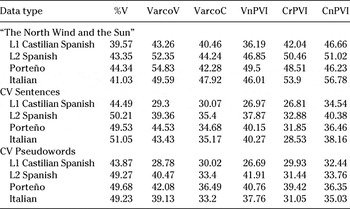
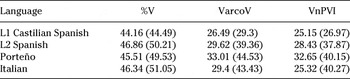
Table 1 summarizes the mean values for the analyzed rhythm metrics for L1 Castilian Spanish, L2 Spanish, Porteño, and Italian, comparing the four varieties over the %V/VarcoV and the VnPVI/CnPVI planes. Note that Italian, Porteño, and L2 Spanish generally exhibit greater values for %V, VarcoV, and VnPVI than L1 Castilian Spanish.
Mean values for %V, VarcoV, VarcoC, and the PVIs for all three data types in L1 Castilian Spanish, L2 Spanish, Porteño, and Italian

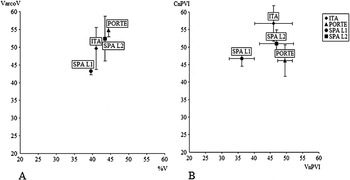
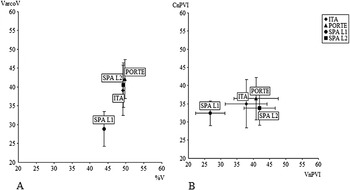
Figure 2 depicts the results for the read text (the fable “The North Wind and the Sun”). As can be seen in panel A, the contact variety (Porteño), the learner variety (L2 Spanish), and L1 Italian exhibit higher %V and VarcoV values as compared to L1 Castilian Spanish. Panel B shows that Porteño, L2 Spanish, and Italian display almost the same VnPVI values on the horizontal axis, in contrast to L1 Castilian Spanish, which is characterized by its low variability of vocalic intervals. As for the vertical axis, the CnPVI scores for L2 Spanish are situated between those of Italian and L1 Castilian Spanish.
Panel A of the graph depicts the %V/VarcoV values and panel B the VnPVI/CnPVI values for the fable “The North Wind and the Sun” for L1 Castilian Spanish (SPA L1), Porteño (PORTE), L2 Spanish (SPA L2), and L1 Italian (ITA). The error bars represent the standard deviation around the mean.

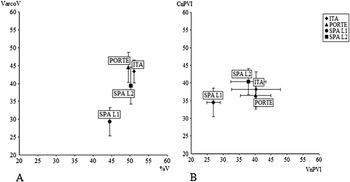
Figure 3 illustrates the rhythmic values obtained from the analysis of the read CV sentences. As can be seen in panel A, Porteño, L2 Spanish, and Italian form a cluster in the higher right-hand corner of the chart, whereas L1 Castilian Spanish displays considerably lower %V and VarcoV scores. In panel B, L2 Spanish and Porteño pattern with L1 Italian in that they exhibit greater values for the VnPVI than L1 Castilian Spanish does. Regarding the CnPVI scores, Porteño shows intermediate values between those of L1 Castilian Spanish and L1 Italian. However, in contrast to Figure 2 (panel B), L2 Spanish exhibits higher CnPVI scores than L1 Italian does. It is interesting to note that, when accented and preboundary syllables are excluded from the analysis, the L1 Castilian Spanish values largely remain unchanged across both conditions. The other varieties, however, exhibit considerably lower values for %V and for the variability of vocalic intervals (i.e., lower VarcoV and VnPVI scores); see Table 2.
Panel A of the graph depicts the %V/VarcoV values and panel B the VnPVI/CnPVI values for the CV sentences for SPA L1, PORTE, SPA L2, and ITA. The error bars represent the standard deviation around the mean.

Rhythmic values for CV sentences without accented and preboundary syllables

Note.
Comparative values (with accented and preboundary syllables; see Table 1) are provided in parentheses.
The distribution of the four varieties under consideration largely remains unchanged when taking into account the CV pseudowords. As shown in Figure 4 (panel A), L1 Castilian Spanish strongly contrasts with Porteño, L2 Spanish, and L1 Italian, once again exhibiting the lowest values for %V and VarcoV. According to Figure 4 (panel B), the high VnPVI scores for Porteño, L2 Spanish, and L1 Italian indicate once more the high variability of vocalic intervals the three varieties have in common, in sharp contrast to L1 Castilian Spanish. As for the CnPVI values, Figure 4 (panel B) shows that L2 Spanish exhibits intermediate scores between those of L1 Castilian Spanish and L1 Italian, comparable to the ratio depicted in Figure 2 (panel B).
Panel A of the graph depicts the %V/VarcoV values and panel B the VnPVI/CnPVI values for the CV pseudowords for SPA L1, PORTE, SPA L2, and ITA. The error bars represent the standard deviation around the mean.

To check if the differences between the values obtained were significant, we ran a Bonferroni test (see Dunn, Reference Dunn1961), which offers a multiple comparison of the %V, VarcoV, and VnPVI values obtained for each variety. For all three data types, the differences between L1 Castilian Spanish on the one hand and the other three varieties on the other turned out to be statistically significant, except for the comparison of the %V and VarcoV values obtained from the analyses of the read text. Footnote 6
According to the results of our rhythmic analysis, the contact variety (Porteño), the learner variety (L2 Spanish), and L1 Italian show higher values for %V and variability of vocalic intervals (VarcoV and VnPVI) than L1 Castilian Spanish. However, the distribution is clearer for the %V/VarcoV plane than for the PVIs.
Intonational Tunes of Yes-No Questions
Regarding the intonational tunes of yes-no questions, our main interest was to examine the realization of the prenuclear accents and the nuclear configuration of the four varieties under discussion. The results for the 16 yes-no questions per subject that were analyzed are presented in what follows.
Prenuclear Accents
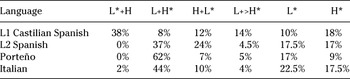
The total number of prenuclear pitch accents amounted to 137 for L1 Castilian Spanish, 155 for L2 Spanish, 130 for Porteño, and 160 for Italian (depending on the speakers’ individual productions; see the examples given in the previous section). Six different prenuclear accents are attested in the data: two monotonal accents (L*, H*) and four bitonal ones (L*+H, L+H*, H+L*, L+>H*). As can be seen in Table 3, L1 Castilian Spanish differs from the other three varieties in exhibiting L*+H as the most frequent prenuclear accent (F0 valley on the accented syllable with a subsequent rise on the posttonic one). That L*+H only occurs at a rate of 38% in the Castilian Spanish yes-no questions is due to the fact that biased yes-no questions are also taken into account. Considering only the five neutral interrogatives, the percentage for L*+H rises to 69%. In contrast, the learner variety, L2 Spanish, and the contact variety, Porteño, pattern with L1 Italian in displaying L+H* as the most common prenuclear accent.
Percentages of prenuclear accents in L1 Castilian Spanish, L2 Spanish, Porteño, and Italian

To check if the differences obtained were statistically significant, we computed the odds ratio for the occurrences of the prenuclear accents L+H* and L*+H in the four varieties; L1 Castilian Spanish was set to reference category (for a detailed description of the odds ratio, see Edwards, Reference Edwards1963). The comparison of the relevant values shows that the differences in distribution of L+H* and L*+H in the prenuclear position in L1 Castilian Spanish on the one hand and the remaining three varieties on the other are statistically significant (odds ratio for L+H*: Porteño = 18,935, Italian = 9,138, L2 Spanish = 6,849; p < .001; for L*+H: Porteño, Italian, and L2 Spanish grouped together = 0.011, p < .001).
Nuclear Pitch Configurations
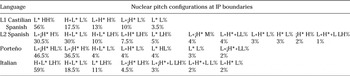
In our data, 90 nuclear configurations at IP boundaries were attested for L1 Castilian Spanish, 94 for L2 Spanish, 99 for Porteño, and 93 for Italian; Table 4 summarizes the distribution of these nuclear pitch configurations for each language. Footnote 7 Nuclear configurations at ip boundaries were excluded from the analysis because of their low occurrences (a total of 24 items for L1 Castilian Spanish, 27 for L2 Spanish, 29 for Porteño, and 32 for Italian). The most common nuclear configuration for L1 Castilian Spanish is L* HH%, although not all 16 yes-no questions are neutral ones. Considering exclusively the neutral yes-no questions, the occurrence of L* HH% amounts to 86%. Footnote 8 As for the remaining 11 biased yes-no questions, all of the possible nuclear configurations were attested (L* HH%, H+L* L%, L+H* H%, L+¡H* L%, and L* L%).
Percentages of prenuclear accents in L1 Castilian Spanish, L2 Spanish, Porteño, and Italian

As opposed to L1 Castilian Spanish, Porteño shows a rising-falling interrogative contour with an upstepped L+¡H* nuclear pitch accent and an HL% boundary tone as the most frequent tonal pattern (46.5%). Also taking into account the interrogatives ending in words with final stress (surface realization L+¡H* H%: 36.5%), the percentage of occurrences of this nuclear configuration amounts to 83%. As mentioned previously, an important Italian characteristic of Porteño Spanish is the existence of the tritonal accent L+H*+L, which is only attested in 2% of the cases, due to the small amount of emphatic or contrastive contexts in the data (e.g., ¿¡Juan, intendente de Buenos Aires!? “Juan, mayor of Buenos Aires!?” uttered in the context of Situation 16 from the intonation survey [see the Appendix] and produced with the nuclear configuration L+H*+L L%).
The most frequent nuclear configurations for L2 Spanish are, first, the rising contour L+¡H* H% (occurring in 30.5% of the cases) and the falling contour H+L* L% (30%). Of the 28 yes-no questions presenting the nuclear configuration L+¡H* H%, 18 (64%) end in words with final stress and 10 (36%) in words with nonfinal stress. The tritonal accent L+H*+L was also attested in the learner variety (see Table 4); as in Porteño, it occurs in the nuclear position in emphatic or contrastive contexts. Comparing the realization of the nuclear configurations of the yes-no questions in the L2 speech with the same ones in the L1 Italian data for each speaker, we found that the L2 speakers rarely used the same nuclear configurations in their L1 (Italian) and their L2 productions.
According to our results, the speakers of the northern Italian varieties spoken in Borgomanero, Genoa, and Ferrara realized the complex boundary tone LH% in roughly two thirds of the cases and the monotonal falling tone L% in about one third. The speaker from Frosinone produced 13 of the 16 yes-no questions with the falling-rising boundary tone LH% and the remaining three as low (L%). The speakers of southern varieties (Maddaloni and Catanzaro) realized almost all yes-no questions with the falling-rising boundary tone LH%. Thus, as shown in Table 4, the most widespread final interrogative contour across the Italian varieties under consideration was H+L* LH% (59%), followed by H+L* L% (18.5%). The tritonal pitch accent L+H*+L is also attested, appearing in the nuclear position in emphatic or contrastive contexts, as is the case for Porteño and L2 Spanish.
In sum, by and large, Italian and Porteño are characterized by the use of L+H* as the most frequent prenuclear accent in yes-no questions. The L2 speakers seem to transfer this prenuclear accent from L1 Italian to L2 Spanish, as L+H* also occurs most frequently in the L2 speech data. In L1 Castilian Spanish, by contrast, L*+H is the most widespread prenuclear accent. Regarding the realization of prenuclear accents, the contact variety (Porteño) and the learner variety (L2 Spanish) pattern with Italian rather than with L1 Castilian Spanish. The tritonal accent L+H*+L occurred in the Porteño, L2 Spanish, and L1 Italian data. As for the realization of nuclear configurations, the L2 speakers rarely used the same nuclear pitch configuration in both their mother tongue and their L2 speech.
DISCUSSION
We hypothesized that L2 Spanish, Porteño, and Italian would show high values for %V, VarcoV, and VnPVI as well as high rates of L+H* prenuclear accents and falling final contours in yes-no questions, in contrast to L1 Castilian Spanish. The analysis of our read and semispontaneous data confirmed the predictions for speech rhythm but not entirely for intonation. Following McMahon’s (Reference McMahon2004) transfer hypothesis, which interprets Porteño prosody as the result of transfer from the L1 that occurred when Italian immigrants learned Spanish as a L2, and assuming that L2 speakers transfer prosodic patterns from their L1 to the target language, we expected that speech rhythm in the learner variety, L2 Spanish, and the contact variety, Porteño, would show similar values for %V, VarcoV, and VnPVI and would pattern with Italian rather than with L1 Castilian Spanish. Our results largely confirmed this expectation. The fact that the rhythmic differences between L2 Spanish, Porteño, and Italian on the one hand and L1 Castilian Spanish on the other dramatically reduce as soon as accented and preboundary syllables are excluded from the analysis (as shown with the example of our CV sentences, see the Results section and Table 2) suggests that the learners transfer the Italian lengthening rule from their L1 to the target language, Spanish. As can be seen in Figures 2, 3, and 4, the standard deviations for Italian and L2 Spanish are larger on both axes than those for L1 Castilian Spanish and Porteño. As for the nonnative variety, these outcomes confirm previous findings in the literature on L2 speech rhythm (e.g., Dellwo, Gutiérrez Díez, & Gavaldà, 2009; White & Mattys, Reference White and Mattys2007). Regarding the Italian data, this might be an effect of the fact that our sample contains data from different Italian varieties.
According to the outcomes of the intonational analysis, the prenuclear accents in the interrogatives uniformly surfaced as L+H* in Italian, Porteño, and L2 Spanish on the one hand and as L*+H in L1 Castilian Spanish on the other. Nevertheless, the situation is less clear for the final contours attested in the absolute interrogatives. In strictly realizing yes-no questions with a falling pitch movement (HL%), independent of the pragmatic value of the interrogative in question (i.e., neutral or biased; see Gabriel et al., Reference Gabriel, Feldhausen, Pešková, Colantoni, Lee, Arana, Labastía, Prieto and Roseano2010), Porteño appeared to have generalized one of the possible interrogative patterns from Italian. The L2 Spanish data, in contrast, displayed a high degree of variability. As reported in the Results section, some of the learners produced a falling contour, thus showing possible transfer from L1 Italian, whereas others realized a final rise (H%) at the end of the yes-no question; this partly corresponded to the situation in the target language, which consistently used a final rise for (neutral) absolute interrogatives. As previously mentioned, final contours other than HH% also exist in Castilian Spanish interrogatives, albeit with special pragmatic meanings, as is the case for the falling final F0 movement that occurs in biased interrogatives (e.g., in echo and in imperative yes-no questions). Thus, the greater variability in Castilian Spanish question intonation poses a problem for the learners to the extent that they need to acquire a large variety of subtle tonal differences that depend on different pragmatic nuances for one and the same clause type (here: an absolute question). To explain our findings, we refer to Eckman’s (Reference Eckman, Ioup and Weinberger1987) markedness differential hypothesis (MDH), which was already applied to prosody by Rasier and Hiligsmann (Reference Rasier and Hiligsmann2007). The MDH predicts that marked patterns of the target language are more difficult for the L2 speaker to learn in the course of L2 acquisition and that unmarked L1 patterns are more likely to be transferred into L2 speech. In Italian, L+H* is the most common prenuclear accent, and the lengthening rule applies to all stressed open and preboundary syllables. Because entities that are widely distributed in a given language are interpreted as being unmarked (Greenberg, Reference Greenberg1966), both the use of prenuclear L+H* and the application of the consequent lengthening rule can be interpreted as unmarked properties of Italian. Consequently, features such as these are likely to be transferred when Italian native speakers learn Spanish as a L2. This would explain the fact that we found rhythmic transfer from Italian both in L2 Spanish and in Porteño and that L+H* most frequently occurred in prenuclear position in the yes-no questions of the two varieties (i.e., contact and learner) of Spanish. By contrast, the final F0 contours of Castilian Spanish yes-no interrogatives display a large variety of different nuclear configurations that convey specific pragmatic meanings. This great variability necessarily results in lower rates of occurrences for the single nuclear configurations, which in turn can be interpreted as more marked and should be more difficult to acquire by the L2 speakers. Additionally, previous research done on the L2 acquisition of yes-no and wh-questions containing specific pragmatic meanings has shown that learners generally have difficulties acquiring intonational features related to semantics (see Jun & Oh, 2000; Ramírez Verdugo & Romero Trillo, 2005). Learners thus may overgeneralize certain targetlike F0 patterns from one to another pragmatic context, resulting in a generally more heterogenic picture, as is the case for our L2 Spanish data. The fact that in contemporary Porteño only one contour (L+¡H* HL%) is attested for all types of yes-no questions can thus be interpreted as a fact of further overgeneralization of one Italian tune, resulting in a regularization of the intonational system of the variety. Footnote 9
CONCLUSIONS
We have shown for speech rhythm that Porteño and L2 Spanish pattern with Italian in exhibiting dramatically higher values for both the percentage of vocalic material in the speech signal (%V) and the variability of vocalic intervals (VarcoV and VnPVI). This finding speaks in favor of the transfer hypothesis for Porteño Spanish (McMahon, Reference McMahon2004), which interprets its Italianized prosody as a result of transfer from L1 Italian during the process of L2 acquisition by immigrants. Prosodic transfer also shows up in the realm of intonation: The fact that both Porteño and L2 Spanish pattern with Italian with regard to the surface realization of prenuclear pitch accents clearly speaks to the same conclusion. The less clear picture for question intonation can be explained with recourse to the different marked pragmatic meanings that interrogatives may convey. Further research, based on a larger corpus, will hopefully shed more light on the intriguing interplay of markedness and pragmatics in the acquisition of L2 prosody, thereby taking into account nuclear configurations not only at the IP level but also at lower prosodic levels (e.g., in the context of prosodic phrasing).
APPENDIX A LIST OF THE 16 SITUATIONS FROM THE INTONATION SURVEY USED FOR THE ELICITATION OF YES-NO QUESTIONS
Neutral Yes-No Questions
-
1. You enter a store that you have never been in before and ask if they have any tangerines.
-
2. You enter a store that you have never been in before and ask if they have any almonds.
-
3. You call Manuel at home, but another person answers the phone. You ask if Manuel is at home.
-
4. You call Natalia at home, but her father answers the phone and he says that she is not there. Somewhat later you try again, but her father answers again. You ask him if Natalia got home in the meantime.
-
5. You are looking for Natalia, but you don’t find her. You see a friend of yours who knows her, and you ask him if he has seen her.
Biased Yes-No Questions
-
6. You are talking with Juan about María, but you hear that someone is coming. Ask Juan if the person who is coming is María.
-
7. The electrician intended to come at 10 am, but you had to make purchases, and thus you left your daughter home waiting for him. When you get home, you see that the electrician has not yet come. You are surprised and ask your daughter if the electrician has not yet come.
-
8. You leave a restaurant where you have eaten with your friend, and you see that your friend stops in front of a cake shop. Very surprised, you ask him if he is still hungry.
-
9. Juan promised to come for dinner. You ask him to confirm.
-
10. You had dinner with Natalia. Afterwards, you ask her if she would like a coffee.
-
11. Ask your friend if he wants to go for a drink with you.
-
12. Ask your little nephews if they would like a cookie.
-
13. Someone told you the time, but you didn’t understand him/her very well. You think that she/he said one o’clock. Ask him/her to confirm.
-
14. Somebody asks you something, but you don’t understand quite well. Ask him/her whether she/he really asked you where you were going.
-
15. Someone tells you that a friend of yours, Natalia, is going on a holiday, but you know that she never goes on holidays. You incredulously ask him/her if it is really Natalia who is going on a holiday.
-
16. Someone tells you that a friend of yours, Juan, is applying for the position of the mayor. You cannot believe it, and you ask if it is really him who is applying for that position.