In line with the evolutionary perspective, given that one’s survival and development depends on belonging to a group, social acceptance is an essential human need (Gilbert, Reference Gilbert2000). Indeed, living in group is inherent to human evolution and so is the improbability of surviving while isolated (Baumeister & Leary, Reference Baumeister and Leary1995). In this way, social rank theory suggests that being socially attractive and able to promote the interest and approval of others is a primary need (Gilbert, Price, & Allan, Reference Gilbert, Price and Allan1995). Therefore, humans tend to desire being valued, esteemed, wanted, accepted and chosen by others for certain roles (e.g., ally, sexual partner, or leader; Gilbert, Reference Gilbert and Baldwin2005). As a result, feelings of social undesirability, associated with criticism and exclusion from the group, are a main threat that leads to defensive responses such as shame (Gilbert, Reference Gilbert, Gilbert and Miles2002).
The female body shape has always been a central domain in self and social evaluations, as it is an indicator of health, reproductive potential and social rank (Gatward, Reference Gatward2007). Furthermore, modern Western societies continue to value this aspect, highlighting the link between female attractiveness and thinness (Buote, Wilson, Strahan, Gazzola, & Papps, Reference Buote, Wilson, Strahan, Gazzola and Papps2011). A thin body shape is nowadays strongly associated with positive traits of personality, power, success and happiness (e.g., Strahan, Wilson, Cressman, & Buote, Reference Strahan, Wilson, Cressman and Buote2006). In this line, the perception of a significant discrepancy between one’s real body image and the desired one (i.e., body image dissatisfaction) has been associated with unfavorable social comparisons (Myers & Crowther, Reference Myers and Crowther2009; Trampe, Stapel, & Siero, Reference Trampe, Stapel and Siero2007). The same is to say that body shape is a dimension particularly used to obtain social attention and acceptance by others (Gilbert et al., Reference Gilbert, Price and Allan1995; Troop, Allan, Treasure, & Katzman, Reference Troop, Allan, Treasure and Katzman2003). For that reason, body shape is currently overvalued in women’s social comparisons and in the establishment of their rank within the group (Buote et al., Reference Buote, Wilson, Strahan, Gazzola and Papps2011; Ferreira, Pinto-Gouveia, & Duarte, Reference Ferreira, Duarte, Pinto-Gouveia and Lopes2013). Moreover, unfavorable comparisons based on physical appearance tend to trigger feelings of inferiority and unattractiveness, and, consequently, high levels of shame (Goss & Gilbert, Reference Goss, Gilbert, Gilbert and Miles2002).
Shame is a painful affect that derives from the perception that certain characteristics, behaviors or personal attributes can be seen by others as unfavorable and unattractive (Gilbert, Reference Gilbert2000). When this emotion is outwardly focused it is conceptualized as external shame, which relates to how one believes to exist in the mind of others, or how others evaluate oneself. According to Gilbert (Reference Gilbert, Gilbert and Miles2002), these shame experiences can also be internalized through negative perceptions and judgments of one’s own attributes or behaviors. Indeed, internal shame refers to negative self-evaluations and self-directed affects (e.g., perceptions of an unvalued, defective or inadequate self; Gilbert, Reference Gilbert, Andrews and Gilbert1998; Tangney & Fischer, Reference Tangney and Fischer1995).
According to the evolutionary model, shame is an adaptive, powerful, self-conscious and socially-focused emotion that plays an important function on one’s quality of life, by allowing the identification and correction of behaviors or personal characteristics that may be evaluated by others as negative (e.g., Gilbert, Reference Gilbert, Gilbert and Miles2002; Tangney & Fischer, Reference Tangney and Fischer1995). However, high levels of shame are intimately linked to serious social difficulties (e.g., isolation or alienation) and to distinct psychopathological conditions (e.g., Gilbert, Reference Gilbert2000, Reference Gilbert, Gilbert and Miles2002), namely eating psychopathology, both in nonclinical (e.g., Gee & Troop, Reference Gee and Troop2003) and clinical samples (e.g., Grabhorn, Stenner, Stanger, & Kaufold, Reference Grabhorn, Stenner, Stangier and Kaufhold2006; Pinto-Gouveia, Ferreira, & Duarte, Reference Pinto-Gouveia, Ferreira and Duarte2014; Swan & Andrews, Reference Swan and Andrews2003).
The perceived need to appear perfect to others (i.e., perfectionistic self-presentation) can be considered a compensatory mechanism that one uses to deal with feelings of inferiority, inadequacy and fear of rejection (Hewitt et al., Reference Hewitt, Flett, Sherry, Habke, Parkin, Lam and Stein2003). In this line, Peterson (Reference Peterson2003) suggests that the need to present a perfect image and to conceal perceived flaws and defects aims to avoid shame experiences and may emerge as a strategy to achieve acceptance and to fit in the group. However, the association between shame and perfectionistic self-presentation has been scarcely studied.
This need to display a perfect image is a maladaptive interpersonal tendency that involves three dimensions: perfectionistic self-promotion (active promotion of perfect abilities), nondisplay of imperfection (avoidance of displaying perceived flaws) and nondisclosure of imperfection (reluctance of verbally expressing personal imperfections; Hewitt et al., Reference Hewitt, Flett, Sherry, Habke, Parkin, Lam and Stein2003).
Research suggests that, like the perfectionism trait, perfectionistic self-presentation is associated with a wide range of psychopathological conditions (e.g., Hewitt & Flett, Reference Hewitt, Flett, Flett and Hewitt2002), namely eating disorders (e.g., Steele, O’Shea, Murdock, & Wade, Reference Steele, O'Shea, Murdock and Wade2011). More specifically, studies have highlighted the positive relationship between strive for perfection, body dissatisfaction, and disordered eating (e.g., Hewitt, Flett, & Ediger, Reference Hewitt, Flett and Ediger1995; McGee, Hewitt, Sherry, Parkin, & Flett, Reference McGee, Hewitt, Sherry, Parkin and Flett2005). Furthermore, recent research demonstrated that perfectionistic self-presentation specifically related to body image is particularly present in women and is linked to increased body dissatisfaction and drive for thinness (Ferreira, Duarte, Pinto-Gouveia, & Lopes, Reference Ferreira, Duarte, Pinto-Gouveia and Lopes2013). However, although promising, studies in this particular domain are yet scarce.
This study aimed to clarify the relationships between external and internal shame, body image-related perfectionistic self-presentation, and pathological eating attitudes and behaviors. Additionally, the main aim of the current paper was to explore the role of body image-related perfectionistic self-presentation in drive for thinness. The mediator role of body image-related perfectionistic self-presentation in the effects of external shame and internal shame on drive for thinness was therefore examined.
Method
Participants
The study’s sample comprised 280 female students, with ages ranging from 13 to 23 years old. The participants presented a mean age of 17.33 (SD = 2.89) and a mean of 10.61 (SD = 2.94) years of education. Furthermore, their BMI’s mean was 21.06 (SD = 2.94).
Measures
Eating Disorders Inventory (EDI; Garner, Olmsted, & Polivy, Reference Garner, Olmsted and Polivy1983; Machado, Gonçalves, Martins, & Soares, Reference Machado, Gonçalves, Martins and Soares2001)
The EDI comprises 64 items in 8 subscales and assesses behavioral and psychological dimensions of eating disorders. In this study, only the drive for thinness (DFT), bulimia (B) and body dissatisfaction (BD) subscales were analyzed. These subscales presented adequate internal consistencies both in the original and Portuguese validation studies. In this study, the obtained Cronbach’s alphas for the subscales were α DFT = .75, α B = .72, and α BD = .87.
The Other as Shamer Scale (OAS; Goss, Gilbert, & Allan, Reference Goss, Gilbert and Allan1994; Matos, Pinto-Gouveia, & Duarte, Reference Matos, Pinto-Gouveia and Duarte2011)
The OAS is an 18-item self-report measure of external shame, i.e., of the respondent’s perception of to what extent others evaluate him or her negatively. This scale has shown good reliabilities in the original version (α = .92) and in the Portuguese validation study (α = .91). In the current sample, the Cronbach’s alpha was .92.
Internal Shame Scale (ISS; Cook, Reference Cook1994, Reference Cook2001; Matos, Pinto-Gouveia, & Duarte, Reference Matos, Pinto-Gouveia and Duarte2012)
This questionnaire assesses internalized shame (how one evaluates oneself) and is composed by two dimensions (internal shame and self-esteem subscales). In the current study only the internal shame subscale was used, having had a Cronbach’s alpha of .95, similarly to the original study (α = .95) and Portuguese version (α = .95).
Perfectionistic Self Presentation Scale – Body Image (PSPS-BI; Ferreira et al., Reference Ferreira, Duarte, Pinto-Gouveia and Lopes2013)
The PSPS-BI is a 19-item scale that was developed to assess the need to present a perfect physical appearance to others through the exhibition of a flawless image and the concealment of perceived body defects. It is composed by two dimensions: display of body perfection (DBP; the need to display a perfect physical appearance to others) and concealment of body imperfections (CBI; the need to hide or conceal perceived body flaws). This scale presented good psychometric characteristics in the original study and in the present sample (α global score = .88; α DBP = .79; α CBI = .91).
Procedures
Participants were recruited from several middle and high schools and Coimbra’s University. The collection of data respected ethic issues. Previously to the completion of the self-report measures, the project was approved by the ethic committees of the involved educational institutions. Students and their parents (if the participants were underage) were informed about the purpose and confidential character of their participation and gave their informed written consent. The majority of the approached students accepted to participate in the study. Students who chose not to participate were given a task by the teacher. The measures were completed in approximately 30 minutes on a class period, in the presence of the teacher and one of the researchers who ensured the adequate fulfillment of the scales. Those participants who presented difficulties in the interpretation and fulfillment of the measures, or who presented more than 15% of missing responses, were later excluded from the study.
Analytic Strategy
Data analyses were performed using SPSS v.20.0.
Pearson correlation coefficients were performed to explore the association between study variables (Cohen, Cohen, West, & Aiken, Reference Cohen, Cohen, West and Aiken2003).
The mediation analyses were conducted using the on-line version of MedGraph (Jose, Reference Jose2013). MedGraph is a program designed to explore whether a proposed mediation process is significant (Sobel's z-score and confidence interval). Furthermore, it also provides information about the effect size (total, direct, indirect, and indirect to total ratio standardized coefficients, and R 2 estimates), and displays the mediational triangle in graphical form. The first analysis aimed to examine the mediator effect of body image-related perfectionistic self-presentation (MedV) on the relationship between external shame (IV) and drive for thinness (DV). The second mediation explored whether body image-related perfectionistic self-presentation (MedV) mediated the association between internal shame (IV) and drive for thinness (DV).
Results
Preliminary Analysis
Analyses of Skewness and Kolmogorov-Smirnov values and visual inspection of the graphic distributions confirmed the assumption of normality (Kline, Reference Kline1998; Tabachnick & Fidell, Reference Tabachnick and Fidell2007). Preliminary data analyses corroborated that the data presented assumptions of linearity, homoscedasticity, independence of errors and multicolinearity (Kline, Reference Kline1998).
Correlations
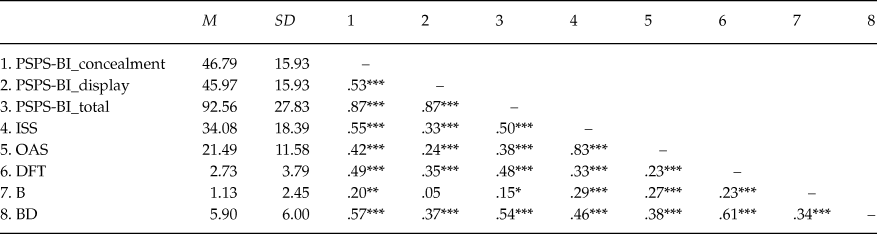
Both dimensions (display of body perfection and concealment of body imperfections) and total score of the perfectionist self-presentation measure (PSPS-BI) revealed positive associations with high magnitudes between them.
Results also showed that the perfectionism measure is positively linked to the shame measures (ISS and OAS), with moderate to high magnitudes.
Results also revealed that the body image-related perfectionistic dimensions and the shame variables presented positive correlations with drive for thinness and body dissatisfaction, with magnitudes ranging from .22 to .57.
Furthermore, although the bulimia subscale was associated to all study variables except display of body perfection, its correlation magnitudes were low.
Correlations between variables (N = 280)

Note: PSPS-BI_concealment = Concealment of body imperfections dimension of the Perfectionistic Self Presentation Scale – Body Image; PSPS-BI_display = Display of body perfection dimension of the Perfectionistic Self Presentation Scale – Body Image; ISS = Internalized Shame Scale; OAS = The Other as Shamer Scale; DFT = Eating Disorders Inventory (EDI)’s Drive For Thinness subscale; B = EDI’s Bulimia subscale; BD = EDI’s Body Dissatisfaction subscale.
* p < .05; **p < .01; ***p < .001.
Mediation Analyses
In order to explore the effect of body image-related perfectionistic self-presentation on the associations between internal shame and drive for thinness, and external shame and drive for thinness, two mediation analyses were performed using MedGraph (Jose, Reference Jose2013).
The mediational effect of body image-related perfectionistic self-presentation on the relationship between external shame and drive for thinness
The effect of body image-related perfectionistic self-presentation (PSPS-BI) on the association between external shame (OAS) and drive for thinness (DFT) was tested (see Figure 1).
Results concerning the total model showed that the 95% CI (.035 to .078) did not include the value of zero, revealing a significant (p < .05) mediational effect of PSPS-BI on the association between OAS and DFT. Additionally, the Sobel z-value was also significant (z = 5.123; p < .001), and the total model explained 23% of drive for thinness.
Furthermore, the effect size measures showed that the total standardized coefficient of the model was .223, with a direct effect of .051, and an indirect effect of .192. The indirect to total ratio was shown to be .860. That is, 86% of the effect of OAS on drive for thinness was explained by the indirect effect of OAS through body image-related perfectionistic self-presentation on drive for thinness.
The mediator effect of body image-related perfectionistic self-presentation (PSPS-BI). a = the relation between the independent variable and the mediator, b = the relation between the mediator and the dependent variable, c’ = the direct effect of the independent variable on the dependent variable, c = the indirect effect of the independent variable on the dependent variable controlling for the mediator;
*p < .05, **p < .01, ***p < .001.

The mediational effect of body image-related perfectionistic self-presentation on the relationship between internal shame and drive for thinness
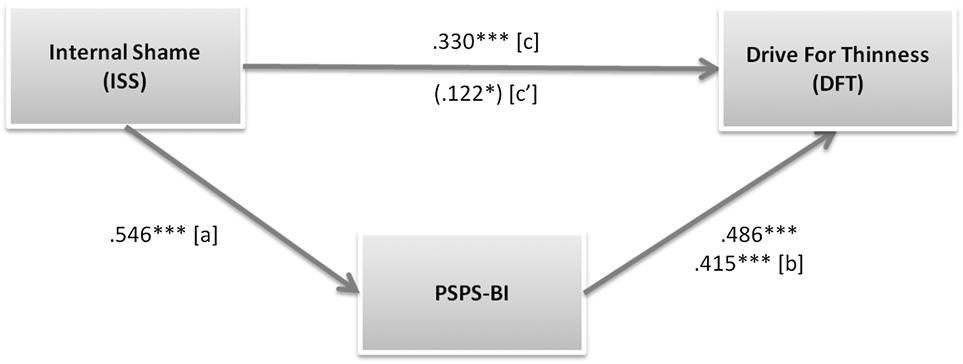
Body image-related perfectionistic self-presentation (PSPS-BI) was also tested as a mediator of the association between internal shame (ISS) and drive for thinness (DFT) (see Figure 2).
Results demonstrated that the 95% CI (.029 to .057) did not include zero, revealing that PSPS-BI significantly (p < .05) mediates the effect of ISS on DFT. Sobel z-value was also revealed to be significant (z = 5.660; p < .001), and the total model explained 24% of drive for thinness.
The total standardized coefficient of the model was .330, the direct effect presented a value of .122, and the indirect effect of .227. Results indicated an indirect to total ratio of .686, which reflected that 68.6% of the effect of ISS on drive for thinness was explained by the indirect effect of ISS through body image-related perfectionistic self-presentation on drive for thinness.
The mediator effect of body image-related perfectionistic self-presentation (PSPS-BI). a = the relation between the independent variable and the mediator, b = the relation between the mediator and the dependent variable, c’ = the direct effect of the independent variable on the dependent variable, c = the indirect effect of the independent variable on the dependent variable controlling for the mediator;
*p < .05, **p < .01, ***p < .001

Discussion
Perfectionistic self-presentation defines the social expression of perfectionism. That is, the attempt at presenting the self as perfect through the public concealment of personal defects and/or by the promotion of attributes perceived as capable to gather positive attention and respect by others (Hewitt et al., Reference Hewitt, Flett, Sherry, Habke, Parkin, Lam and Stein2003). Although perfectionism has long been considered a central aspect of disordered eating attitudes and behaviors, mediational studies between this construct and these conditions are scarce (Bardone-Cone et al., Reference Bardone-Cone, Wonderlich, Frost, Bulik, Mitchell, Uppala and Simonich2007). Furthermore, the association between shame and perfectionistic self-presentation has also been little explored.
The current study was designed to overcome these gaps and to contribute to literature in the eating psychopathology field by using a specific measure of perfectionistic self-presentation regarding body image. Thereby, the main goal was to test the mediator effect of the interpersonal maladaptive style of perfectionism related to body image in the relationship between internal and external shame, and drive for thinness (a central feature and main risk factor for eating disorders; Fairburn, Reference Fairburn2008).
Results revealed a positive association between the PSPS-BI’s scores and the shame measures. These results seem to strengthen the notion that perfectionistic self-presentation acts as a compensatory mechanism to deal with feelings of inadequacy or shame, and as a strategy to promote social acceptance (Hewitt et al., Reference Hewitt, Flett, Sherry, Habke, Parkin, Lam and Stein2003; Peterson, Reference Peterson2003). This is a relevant finding given that the link between these variables has been scarcely explored.
Correlation analyses also revealed that the two shame measures presented positive and strong associations (> .80) with each other. Although this may be considered a methodological limitation, this correlation magnitude is consistent with prior research and theoretical framework. In fact, the tendency to develop a perception that one exists negatively in the mind of the others (i.e., external shame) is highly associated with the perception of existing negatively in one’s own mind (i.e., internal shame).
Additionally, a positive relationship was found between the shame measures (external and internal shame), body dissatisfaction, and drive for thinness (e.g., Gee & Troop, Reference Gee and Troop2003; Grabhorn et al., Reference Grabhorn, Stenner, Stangier and Kaufhold2006; Pinto-Gouveia et al., Reference Pinto-Gouveia, Ferreira and Duarte2014; Swan & Andrews, Reference Swan and Andrews2003). This is also in line with previous studies that emphasize the link between body dissatisfaction, weight control behaviors, and shame experiences. Recent studies suggest that drive for thinness may emerge in a context characterized by perceptions of inferiority and inadequacy, and seems to function as a strategy to achieve a thinner appearance and promote social acceptance (Pinto-Gouveia et al., Reference Pinto-Gouveia, Ferreira and Duarte2014).
Furthermore, it was verified that a greater need to present a perfect body image is positively related to main features of eating psychopathology (e.g., body image dissatisfaction and drive for thinness). This seems to be in accordance to previous studies (e.g., McGee et al., Reference McGee, Hewitt, Sherry, Parkin and Flett2005), pointing that interpersonal perfectionism acts as an important risk factor for eating psychopathology.
The conducted mediational studies highlight body image-related perfectionistic self-presentation as a pertinent variable for the comprehension of drive for thinness. Indeed, results showed that body image-related perfectionistic self-presentation is a significant mediator of the effects of external and internal shame on the engagement in weight control behaviors. Specifically, results showed that 86% of the effect of external shame on drive for thinness was explained by the indirect effect of external shame through the perception of needing to present a perfect body image. Furthermore, in the case of internal shame, about 70% of its effect on the engagement of maladaptive eating behaviors was explained by the indirect effect of internal shame through body image-related perfectionistic self-presentation. These findings suggest that women who report higher levels of (external and internal) shame may subsequently perceive a need to present a perfect body image to others, and this perception may, in turn, lead to higher levels of maladaptive eating behaviors.
These results should not be interpreted without considering some limitations. Firstly, the cross-sectional nature of the study restricts the causality between variables. Moreover, due to the novel character of the current investigation, the mediator effect of body image-related perfectionistic self-presentation should be retested in future studies. Given the non-clinical nature of this study’s sample, future studies should also further test these relationships in populations with eating disorders.
However, the presented data seems to represent an important contribution to the study of the relationship between shame and perfectionism in the domain of body image and eating disordered conditions.
In summary, the current findings seem to support that excessive control over eating may emerge as a maladaptive strategy to deal with shame when mediated by an endorsement in the belief that presenting a perfect body image is crucial to be accepted and valued by others. These results comprise important clinical implications by suggesting that the need to present a perfect body image should be targeted while treating individuals with eating psychopathology.