Introduction
The high prevalence of obesity is a major public health issue for both developed and developing countries.Reference Finucane, Stevens and Cowan 1 – 4 For many developing countries, the increased prevalence of obesity has contributed to the ‘double burden’ of disease in which undernutrition and overnutrition co-exist.Reference Marshall 5 – Reference Kimani-Murage, Kahn and Pettifor 8 There are several explanations as to why countries that were formerly known for a high prevalence of undernutrition are now facing a high prevalence of overnutrition. Economically, many transitional countries have experienced sufficient economic growth and are undergoing a ‘nutrition transition’ characterized by an increased intake of Western, processed foods and an increase in sedentary labor, increasing the risk for obesity.Reference Cardoso, Bovet and Viswanathan 9 – Reference Wells 12 At the same time, evidence exists that suggests that periods of poor nutrition, in utero or during early childhood, increase the risk for obesity and other metabolic disorders.Reference Martins, Hoffman and Fernandes 13 – Reference Prentice and Moore 17 Therefore, the focus of this study is to assess the metabolism and nutritional status of North Korean children who may have experienced nutritional deprivation early in life and are now living in food-affluent South Korea.
Chronic undernutrition that is severe enough to cause permanent growth retardation or stunting (i.e. height-for-age z-score<−2.00) has been reported to be a risk factor for obesity in some studies,Reference Martins, Hoffman and Fernandes 13 , Reference Popkin, Richards and Montiero 18 – Reference Grillo, Siqueira and Silva 20 but not in others.Reference Cameron, Wright and Griffiths 21 , Reference Gigante, Victora and Horta 22 Mechanisms to explain such associations are limited, but those that do exist suggest that poor nutrition early in life results in metabolic adaptations that may influence energy balance and, in turn, increase the risk for obesity.Reference Hoffman, Sawaya and Verreschi 23 – Reference Leonard, Sorensen and Mosher 26 Therefore, it is important to understand the metabolic profiles of children and adults who were exposed to poor nutrition in early childhood as a means to determine the relationship between growth retardation and chronic metabolic diseases later in life.
Studies of specific components of energy expenditure, such as REE or substrate oxidation, suggest that poor growth is associated with obesogenic metabolic adaptations. In terms of resting energy metabolism, some studies have reported no association between past exposure to undernutrition and energy expenditure.Reference Hoffman, Sawaya and Verreschi 23 , Reference Wren, Blume and Mazariegos 27 However, others have reported a lower rate of energy expenditure in growth-retarded children compared with normal-height children.Reference Grillo, Siqueira and Silva 20 , Reference Friedman, Rodriguez and Boyer 28 The primary reason for divergent results is most likely due to the fact that not all reported studies correctly adjusted for body composition, making such comparisons challenging. Studies of substrate oxidation are more consistent. One of the first studies of poor growth and substrate oxidationReference Hoffman, Sawaya and Verreschi 23 found that stunted children oxidized fat at a lower rate than normal-height children from the same socio-economic environment. Kensara et al.Reference Kensara, Wooton and Phillips 25 reported that adult men from the Hertfordshire Cohort who were born small compared with others in the same cohort had a lower rate of daily resting fat oxidation. In addition, a study of Buryat adults in southern Siberia found that adults who were significantly shorter than their peers had a lower rate of fat oxidation.Reference Leonard, Sorensen and Mosher 26 Although the specific causes of growth retardation in these studies are unknown, one particular study about ‘nutritional growth retardation’ compared with children with ‘familial short stature’ reported that growth-retarded children metabolized fat at almost 50% of the rate of the control group.Reference Friedman, Rodriguez and Boyer 28 However, one study from CameroonReference Said-Mohamed, Bernard and Ndzana 29 reported no significant association between growth retardation and rate of fat oxidation, but known confounding factors such as diet and body composition were not controlled in the statistical analyses.
Given the consistency of some, but not all, studies on the relationship between stunting and metabolism, it was of interest to pursue this question in children who have experienced both nutritional deprivation early in life and a common migration from an impoverished environment to one of moderate wealth, from North to South Korea. Children who were born in North Korea and now reside in South Korea are living in a society with affluent food supply after being born and raised in a society with severe food shortage. 30 – Reference Lee, Nam and Hoffman 32 This situation creates a unique opportunity to study energy metabolism following nutritional deprivation perhaps both in utero and during early childhood within the context of drastic shift in nutritional environment. Moreover, considering the fact that approximately a third of children in North Korea may be growth retarded, 30 the potential medical and economic implications are important, given that such physiological adaptations may predispose this population to chronic metabolic diseases, especially if they move to affluent societies.
Subjects and methods
Subjects
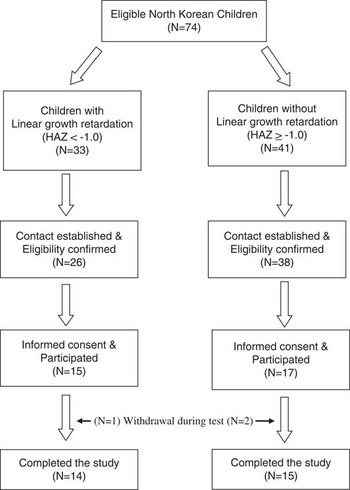
Participants for this study were recruited from a previous study of nutritional status of North Korean children between the ages of 8 and 18, living in the Seoul and Incheon areas of South Korea. The previous study recruited a non-random sample of 154 North Korean children through the snowball method through special programs for North Korean children and schools with a large number of North Korean children. Among the 154 children, only 74 children had a complete medical record at the time of entry to South Korea. The Seoul and Incheon areas housed ∼37% of North Koreans relocated in South Korea, which made the two cities good sampling places. Random sampling was impossible because the full list of North Koreans in South Korea is highly confidential. The age range was selected to represent children who were born around the time of the severe food shortage in North Korea. Children with reported and apparent illness were not included in the study.Reference Lee, Nam and Hoffman 32 , Reference Lee and Nam 33 The recruiting scheme is shown in Fig. 1, and a total of 74 children from the previous study were found eligible based on age, medical condition and data availability at the time of entry to South Korea. All the children were asked to complete a medical history, and only those children with no reported acute or chronic medical conditions (e.g. infections of any kind, type 1 or type 2 diabetes, hypertension, cancer, etc.) were included in the present study. Information on height and weight and other medical problems at the time of entry to South Korea for all 74 children was obtained from their medical records. Height and weight information at the time of entry was used to group participants according to the degree of linear growth retardation. The study successfully recruited 14 children to the linear growth retardation group and 15 to the control group.
Participant recruitment process.

The authors assert that all the procedures contributing to this work comply with the ethical standards of the relevant national guidelines on human experimentation and with the Helsinki Declaration of 1975, as revised in 2008, and has been approved by the Inha University Hospital Institutional Review Board. Written informed assent and consent were obtained from all the children and their parent/guardian, respectively.
Study protocol
Children who participated in this study were asked to eat a regular diet, avoid vigorous physical activities the day before the measurements and visit the university with their parent/guardian, following a 12 h fast, on the morning of clinical measurements. Anthropometric measurements were made before the energy metabolism measurements after which lunch was provided. Normal dietary intake was assessed using the 24-h recall method with food models. Although the 24-h recall method has its limitation, it is one of the better methods to assess diet in a specific time span and with children.Reference Gibson 34 Food quotient (FQ) was calculated using the equation suggested by Black et al. Reference Black, Prentice and Coward 35
Height was measured with a standard stadiometer (Samhwa, Seoul, Korea) with the child standing without shoes or socks and his/her buttocks and back against the wall and the head positioned at a 90° angle.Reference Gibson 34 Body weight was measured using a digital scale (InBody 720; Biospace Corp., Seoul, Korea) that also estimated body composition [fat mass (FM) and fat-free mass (FFM)] using bio-electrical impedance. A validation study found that the bioimpedance method utilized in the machine used in this study produced comparable data with good validity and precision to those from dual-energy X-ray absorptiometry in assessing FM, FFM and percent body fat.Reference Lim, Hwang and Lee 36 Height and weight at the time of entry to South Korea were obtained from government medical records. HAZ, weight-for-age z-score (WAZ), BMI-for-age z-score were calculated using WHO growth standards. 37
Resting energy expenditure (REE) and substrate oxidation were measured using an indirect calorimeter (TrueOne 2400; ParvoMedics Corp., UT, USA) with a mask. Metabolic measurements were carried out in a clinical research laboratory that was maintained thermo-neutral and quiet. Upon arriving at the laboratory, each child was instructed to rest for 30 min and to remain quiet and still during the measurement. The measurement lasted 30 min and average values of 10 min from the most steady stage were used. A standard mixture of 96% O2 and 4% CO2 was used for calibration of the indirect calorimeter before each measurement and the accuracy of the calorimeter was tested with an alcohol burn on a regular basis.
Statistical analysis
A sample size calculation was used to determine that seven children per group would be a sufficient sample to detect a difference in respiratory quotient (RQ) of 0.03 with a standard deviation 0.02 based on previously published studies.Reference Hoffman, Sawaya and Verreschi 23 , Reference Leonard, Sorensen and Mosher 26 Therefore, the sample size of this study provided sufficient statistical power.
All data are expressed as means, standard deviations and percentages for basic subject characteristics. Two distinct groups were created from the anthropometric data to assess the relationship between energy metabolism and growth. First, linear growth retardation was defined as having an HAZ<−1.00, and normal height was defined as having an HAZ⩾−1.00. Second, stunted growth was defined as having an HAZ<−2.00, and non-stunted growth was defined as having an HAZ⩾−2.00. A Mann–Whitney U test was used to determine differences between groups, and Fisher’s exact test was used to determine associations between groups. Multiple linear regression analyses were conducted to determine the association between growth status and metabolic parameters while controlling for potential confounding factors including age, sex, body composition and antecedent diet (FQ). These specific factors were included the analysis as they are independent predictors of REE and substrate metabolism.Reference Johnstone, Murison, Duncan, Rance and Speakman 38 – Reference Astrup, Buemann and Christensen 40 Statistical significance was set at a P-value <0.05, and all statistical analyses were conducted with IBM SPSS 19 for windows (IBM Corp., NY, USA).
Results
Subject characteristics
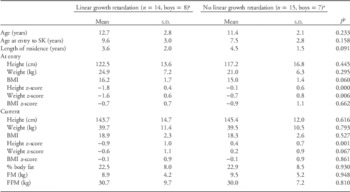
The mean age of the children was 12 years, and mean time having lived in South Korea was 4 years. No significant differences in length of residence between the linear growth retardation and the no linear growth retardation groups were found (Table 1). When the children entered South Korea, the average HAZ was −1.8 (s.d. 0.4) for the linear growth retardation group and −0.1 (s.d. 0.6) for the no linear growth retardation group (P=0.000). WAZ was also below zero. The linear growth retardation group reported significantly lower WAZ than the no linear growth retardation group (P=0.006). BMI-for-age z -scores, on the other hand, did not show any significant associations by group (Table 1).
Characteristics of the children by linear growth status (mean values and standard deviations)

FM, fat mass; FFM, fat-free mass.
a Linear growth retardation, HAZ of WHO reference <−1.0; no linear growth retardation, HAZ of WHO reference ⩾−1.0.
b Differences between the groups were examined by the Mann−Whitney U test.
HAZ, WAZ and BMI-for-age z-scores at the time of current measurement moved to the right from those at the time of entry to South Korea, although the average scores all stayed below zero. Although HAZ remained significantly lower among the group with linear growth retardation than the group without linear growth retardation (P=0.001), WAZ difference became non-significant. WAZ, BMI-for-age z-scores, percent body fat, FM and FFM, however, did not show significant associations by group at the time of measurement.
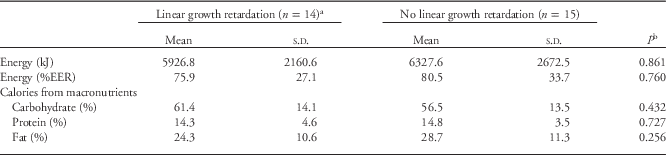
Dietary intake for both groups is shown in Table 2. No statistical differences by group were found in total energy, percent estimated energy requirement and percent calories from macronutrients.
Dietary intake of the children (mean values and standard deviations)

EER, estimated energy requirement
a Linear growth retardation, HAZ of WHO reference <−1.0; no linear growth retardation, HAZ of WHO reference ⩾−1.0
b Differences between the groups were examined by the Mann−Whitney U test.
REE and substrate oxidation
There were no significant differences in REE between the growth-retarded or normal-height children (Table 3) when expressed as kcal/day, kcal/unit body weight or kcal/unit FFM. Regarding substrate oxidation (Table 3), the RQ was significantly higher in the growth-retarded group (mean 0.84, s.d. 0.03) compared with the control group (mean 0.81, s.d. 0.04).
Respiratory quotient (RQ) and resting energy expenditure (REE) of the children (mean values and standard deviations)

REE, resting energy expenditure; RQ, respiratory quotient.
a Linear growth retardation, HAZ of WHO reference <−1.0; no linear growth retardation, HAZ of WHO reference ⩾−1.0.
b Differences between the groups were examined by the Mann − Whitney U test.
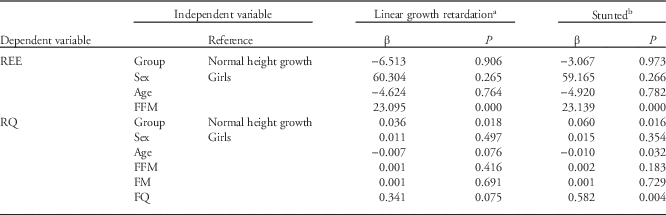
Results from multiple linear regression analysis of energy metabolism and substrate oxidation are summarized in Table 4. First, there was no difference in REE between the growth-retarded or normal-height children, independent of sex, age or body composition. In addition, when children were grouped as being stunted or ‘non-stunted’, there was no significant difference in REE. Children who were classified as ‘growth retarded’ or ‘stunted’ had significantly higher RQ, even after adjusting for sex, age, FFM, FM and FQ (P=0.018 and 0.016, respectively; Table 4).
Beta coefficient and P-value for the association between growth retardation and metabolic data in multiple linear regressions

FFM, fat-free mass; FM, fat mass; FQ, food quotient; REE, resting energy expenditure; RQ, respiratory quotient.
a Linear growth retardation, HAZ of WHO reference <−1.0 (n=14).
b Stunted, HAZ of WHO reference <−2 (n=4).
Discussion
It is estimated that ∼30% of children in the Democratic People’s Republic of North Korea are growth retarded as a result of nutritional deprivation associated with food insecurity due to various socio-political factors. 30 Previous epidemiological and clinical studies have reported an association between poor growth and metabolic adaptations that may favor fat deposition and obesity later in life.Reference Martins, Hoffman and Fernandes 13 – Reference Bruce and Hanson 16 , Reference Popkin, Richards and Montiero 18 – Reference Grillo, Siqueira and Silva 20 In brief, based on our study of children from North Korea who migrated to South Korea, children who were short or stunted had a significantly lower rate of fat oxidation compared with children with normal height, but no differences in REE or indicators of obesity were found. Thus, with the possibility that the two Koreas may reunite, it is important to understand the concept of ‘metabolic programming’ for growth-retarded North Koreans, given that this sizeable population that experienced poor growth may one day enter a society with abundant food and numerous social differences. This situation is also true for many countries experiencing rapid economic development and nutritional transition. Basically, the migration of growth-retarded or stunted children and adults to a more economically developed society and environment may allow for underlying risk factors for chronic metabolic diseases to become manifest.
With respect to resting energy metabolism, the data from our study are consistent with others that reported no significant differences in REE, independent of FFM, between growth-retarded children and peers of normal height.Reference Grillo, Siqueira and Silva 20 , Reference Hoffman, Sawaya and Verreschi 23 , Reference Wren, Blume and Mazariegos 27 , Reference Friedman, Rodriguez and Boyer 28 One study of nutritionally growth-retarded children found a lower REE (using a ratio of REE per unit body weight) in the growth-retarded group compared with those who were short, but not stunted.Reference Friedman, Rodriguez and Boyer 28 In addition, the study by Grillo et al. Reference Grillo, Siqueira and Silva 20 concluded that stunted girls had consistently lower FFM at each respective time point, but did not report the REE adjusted for FFM. It has been recommended that multiple linear regression analysis be used in lieu of ratios to minimize potential statistical bias of creating a ratio from two variables whose correlations do not have a zero intercept.Reference Allison, Paultre and Goran 41
In terms of macronutrient metabolism, data from our study support the hypothesis that poor growth results in metabolic adaptations, as the growth-retarded and stunted children had a significantly lower rate of fat oxidation compared with normal-height children. These results are consistent with other studies in adults who were shorter than their peers from the same socio-economic and genetic background,Reference Leonard, Sorensen and Mosher 26 as well as children who were stunted compared with normal-height peers from the same shanty towns.Reference Hoffman, Sawaya and Coward 42 In addition, a group of nutritionally growth-retarded children were reported to have lower rates of resting fat oxidation compared with children with familial shortness.Reference Friedman, Rodriguez and Boyer 28 Thus, our data add to a diverse set of studies in both developed and developing settings that suggest that nutritional deprivation severe enough to cause an interruption in the growth process may promote, or at least be associated with, a metabolic adaptation that favors fat deposition. This is of particular clinical and biological importance as a difference in the RQ of 0.03 units translates into a 30% lower rate of fat oxidation compared with normal-height children, thus suggesting that excess fat intake will not be oxidized as quickly, increasing the possibility of fat storage. Previous studies have reported that relatively small differences in substrate oxidation (i.e. decreased rate of fat oxidation) may promote fat deposition that leads to obesity.Reference Zurlo, Lillioja and Esposito-Del Puente 43 – Reference DeLany, Bray and Harsha 45 In fact, Hoffman et al. Reference Hoffman, Martins and Roberts 46 and Martins et al. Reference Martins, Hoffman and Fernandes 47 reported that stunted children with a low rate of fat not only gained more body fat but also deposited greater adipose tissue in the truncal region, during 4 years of follow-up.
Given the relationship between low rates of fat oxidation and excess adiposity, it was of interest to assess the current nutritional status of growth-retarded children from North Korea. In brief, there were no significant differences between growth-retarded or stunted children and normal-height children with respect to BMI z-score or percent body fat. Martins et al. Reference Martins, Hoffman and Fernandes 13 and Sichieri et al. Reference Sichieri, Dos Santos Barbosa and Moura 48 both reported that stunted children were more likely to have excess FM or a higher BMI compared with normal-height children; yet, others have found no association between growth retardation and obesity.Reference Cameron, Wright and Griffiths 21 , Reference Gigante, Victora and Horta 22 , Reference Benefice, Garnier and Simondon 49 – Reference Mukuddem-Petersen and Kruger 52 However, even among the negative studies, some did report that stunted children,Reference Benefice, Garnier and Simondon 49 , Reference Mukuddem-Petersen and Kruger 52 or children who were or born small for gestational age,Reference Koziel and Jankowska 51 had a tendency to accumulate more central fat compared with control children.
The disparities in some results from various studies of poor growth and obesity may be due to a number of methodological, statistical and environmental factors. For example, assessing obesity using BMI z-score v. a precise measure of body composition can be problematic, given that BMI is an index of adiposity and not an assessment of adiposity.Reference Doak, Hoffman and Norris 53 , Reference Timaus 54 Furthermore, it is necessary to be cognizant of the fact that assessing obesity in stunted children who live in traditional, rather than obesogenic, environments may not have the dietary and activity triggers that create a positive energy balance and, therefore, remain normal weight despite having an adapted metabolism. In our study, children in both the groups studied had lived in South Korea for approximately the same length of time, although the growth-retarded girls have been in South Korea for about 1.5 years less than the normal-height girls. Basically, either not enough time has passed for the growth-retarded children to deposit excess FM or the dietary environment in South Korea is such that obesity is difficult to develop in these children, regardless of their height and metabolic profile. Finally, it is plausible that the level of statistical power afforded in this study may not have been sufficient to detect the difference in obesity or REE between the two groups.
There are limitations to this study that should be discussed to more fully appreciate the results presented. First, the children studied were not randomly selected from a large population, as a complete listing of North Korean children living in South Korea is unavailable for security reasons. However, an attempt to recruit a random sample from the participant pool of a previous study was made. Second, although the sample size of our study was not as large as some,Reference Hoffman, Sawaya and Verreschi 23 , Reference Leonard, Sorensen and Mosher 26 , Reference Said-Mohamed, Bernard and Ndzana 29 it was consistent with four of six previously published studiesReference Grillo, Siqueira and Silva 20 , Reference Kensara, Wooton and Phillips 25 , Reference Wren, Blume and Mazariegos 27 , Reference Friedman, Rodriguez and Boyer 28 and was almost twice as large as our calculated sample size. Perhaps more importantly, our results are consistent with studies of the same sample size or larger. Third, it was not possible to control the children’s diet before the metabolic measurements to accurately control for macronutrient intake. Nevertheless, including the percent of energy as fat of the habitual diet did provide us with the ability to account for dietary differences in the regression analysis of substrate oxidation. Fourth, differences in the pubertal status may contribute to the degree of differences in total FM.Reference DeLany, Bray and Harsha 45 Yet, we were unable to adjust for pubertal status as Tanner stage was available only for a small number of children. Nonetheless, age and sex were included as proxies for pubertal stage in the linear regression analyses of both REE and RQ and were not found to be significant predictors of either outcome. Finally, this study did not have information on exactly how and when the children became stunted, although insufficient food intake would be the most plausible reason as the children grew up in a food-deprived country. Nonetheless, locating the critical time span for metabolic adaptation was not possible. Although these limitations may influence to some degree the generalizability of the results, they do not minimize or invalidate the results presented.
In summary, we determined that growth-retarded North Korean children had a lower rate of fat oxidation compared with taller or normal-height peers, but no differences in REE or development of obesity were found. This important piece of data, and the first from an Asian population, extends previous studiesReference Hoffman, Sawaya and Verreschi 23 , Reference Leonard, Sorensen and Mosher 26 that reported similar metabolic adaptations in stunted children and short adults in different geographical parts of the world. Precise biochemical or physiological mechanisms are still unknown and remain difficult to study, given the invasive nature of methods required to understand nutrient metabolism at a more biochemical level. Nonetheless, the results presented support the rationale for continued research on developing a more refined understanding of how children who have experienced chronic undernutrition in early childhood grow and develop, especially when exposed to food environments with sufficient availability of energy, fat and sugar. The need for this research is especially important when one considers the potential implications that could occur when a large population of growth-retarded children and adults in North Korea become exposed to an affluent food environment upon reunification of the two Koreans. Thus, given that hundreds of thousands of children in the world are growth retarded, continued research on this topic is necessary to understand how to best manage the challenges of the double burden in developing countries.
Acknowledgments
The authors thank G.J. Heo, D.H. Park and J.H. Geon for technical assistance, and all participants for their contribution to this research.
Financial Support
This study was supported by Basic Science Research Program through the National Research Foundation of Korea (NRF) funded by the Ministry of Education, Science and Technology (C00310, SKL); Inha University Faculty Grant (50400-01).
Conflicts of Interest
None.
Ethical Standards
The authors assert that all procedures contributing to this work comply with the ethical standards of the relevant national guidelines on human experimentation and with the Helsinki Declaration of 1975, as revised in 2008, and has been approved by the Inha University Hospital Institutional Review Board