Introduction
Retirement is a key life transition that is often planned and expected for decades before its arrival. The timing of retirement is important to individuals, families, employers, government programmes and the labour supply of the economy (Fisher et al., Reference Fisher, Chaffee and Sonnega2016). Some prior research suggests that wealth losses and unemployment resulting from the 2008 Great Recession impacted retirement timing for older Americans (Goda et al., Reference Goda, Shoven and Slavov2011; McFall, , Reference McFall2011; Szinovacz et al., Reference Szinovacz, Martin and Davey2014). However, little is known about retirement expectations and their alignment with realised retirement timing across diverse socio-demographic groups of Americans in recent cohorts. The Health and Retirement Study (HRS) presents a unique opportunity to examine retirement expectations and realities around the Great Recession, and to compare gender, race/ethnicity, education and birth cohort differences in expected and realised retirement timing in the past two decades.
Forces shaping retirement timing
In 1910, the average age of retirement for men was 73 years old (Quinn et al., Reference Quinn, Cahill and Giandrea2011), as Americans spent most of their lives working to avoid poverty. Then, for several decades, retirement age gradually declined due to increased safety nets protecting against poverty in old age (such as Social Security, pensions and Medicare), as well as more wealth for individual savings (Cahill et al., Reference Cahill, Giandrea, Quinn, Ferraro and George2015). When retirement age reached its lowest point in the 1990s (half of men retired by age 62 in 1994), many Americans could expect around two decades of life in retirement (Cahill et al., Reference Cahill, Giandrea, Quinn, Ferraro and George2015). Then the pattern began to reverse, with retirement gradually occurring at later ages due to improved health and less physically strenuous occupations (Quinn et al., Reference Quinn, Cahill and Giandrea2011). Public policies and employee benefit packages again played an important role. For example, the elimination of mandatory retirement age, increases in the age of eligibility for full Social Security benefits, and the transition from defined benefit to defined contribution pensions enabled and incentivised later retirement (Munnell, Reference Munnell, Clark, Munnell, Williams and Orszag2006; Fronstin and Adams, Reference Fronstin and Adams2012; Coe et al., Reference Coe, Khan and Rutledge2013; Fisher et al., Reference Fisher, Chaffee and Sonnega2016). Indeed, baby-boomers plan to work longer than previous cohorts given differences in policies, pensions, educational attainment, health and wealth over time (Mermin et al., Reference Mermin, Johnson and Murphy2007).
As individuals relied more on savings rather than pensions, their retirement savings were at increased financial risk, which became highly relevant during the Great Recession in 2008. Several studies that examined the effects of the Recession on retirement timing found that wealth losses were associated with modestly higher expected retirement age (Hurd and Rohwedder, Reference Hurd and Rohwedder2010; McFall et al., Reference McFall2011), lower probabilities of retirement (Ondrich and Falevich, Reference Ondrich and Falevich2016) and increased reported probabilities of working at age 62 (Goda et al., Reference Goda, Shoven and Slavov2011). At the same time, the Recession also resulted in increased and prolonged unemployment, which pushed some into early retirement (Johnson, Reference Johnson2012; Gorodnichenko et al., Reference Gorodnichenko, Song and Stolyarov2013).
The Recession was experienced differently depending on socio-economic status (Szinovacz et al., Reference Szinovacz, Martin and Davey2014). Americans of high socio-economic status were adjusting retirement plans in response to changes in wealth, while those of low and middle socio-economic status were responding to employment insecurity (Szinovacz et al., Reference Szinovacz, Martin and Davey2014). One study found that, while married men experienced 14–17 per cent lower probability of retiring when they lost housing wealth during the Great Recession, this effect was offset in households that had pensions (Ondrich and Falevich, Reference Ondrich and Falevich2016) – typically households with high socio-economic status. However, much remains unknown regarding how the Recession differentially shaped retirement expectations and timing in specific socio-demographic sectors of the population.
Despite these trends in average retirement age, there remains much individual variation in retirement form and timing. The model of retirement timing by Fisher et al. (Reference Fisher, Chaffee and Sonnega2016), based on a thorough review of the literature, includes family-related antecedents to retirement such as marital status and care-giving responsibilities, work-related antecedents such as job characteristics and workplace norms, and individual antecedents such as health, income, wealth and personal preferences. Given the great social and economic disparities in the United States of America (USA), these factors are not uniformly distributed across the population of retirement-age adults. For example, Black Americans tend to retire earlier than white Americans due to poor health, unstable employment histories and experiences of workplace discrimination (Burr et al., Reference Burr, Massagli, Mutchler and Pienta1996; McNamara and Williamson, Reference McNamara and Williamson2004). Therefore, while later retirement is generally seen as economically beneficial for individuals, employers and society (Cahill et al., Reference Cahill, Giandrea, Quinn, Ferraro and George2015), it is not equally obtainable across different socio-demographic groups.
Expectations about retirement timing
Subjective or expected retirement timing is a commonly used construct in research to understand how individuals are planning for retirement and how certain factors influence retirement timing (Fisher et al., Reference Fisher, Chaffee and Sonnega2016). It has generally been understood that expectations about retirement timing vary according to the same factors that shape actual retirement (Coile and Gruber, Reference Coile and Gruber2002). While these factors influencing expectations about retirement are relatively well-established, less is known about the accuracy with which expectations predict actual labour force status. Evidence from Europe suggests that older adults tend to work longer than expected and retire later than planned (Den Boer et al., Reference Boer JCL, Zijderveld and Bruers2018; Ilmakunnas and Ilmakunnas, Reference Ilmakunnas and Ilmakunnas2018). In the USA, data from the HRS revealed that about 10 per cent of respondents had a labour force status in Wave 2 (1994) that contradicted their expectations from Wave 1 (1992) (Dwyer and Hu, Reference Dwyer, Hu, Mitchell, Hammond and Rappaport1998). There is a need for more recent and comprehensive examination of the alignment of retirement expectations and realisations in the USA.
Unmet expectations about retirement could have adverse consequences for happiness, wealth and health in old age. Indeed, the lifecourse framework emphasises the importance of the timing of role entries and exits, and whether timing aligns with socially prescribed norms (George, Reference George1993; Quick and Moen, Reference Quick and Moen1998). One study using data from the HRS collected before the Great Recession found that working longer than expected and retiring earlier than expected were both associated with significant increases in depressive symptoms (Falba et al., Reference Falba, Gallo and Sindelar2009). Further, a paper using more recent data from that same study found that life satisfaction was lower for men with unmet expectations for retirement by age 62 (Clarke et al., Reference Clarke, Marshall and Weir2012). Given these consequences, it is important to understand the probability of facing unmet expectations about retirement timing in current cohorts of middle aged and older adults in the USA.
Discrepancies between retirement expectations and actual retirement timing tend to be driven by health (both unexpected shocks and long-standing poor health status), and to a lesser extent by finances, involuntary job loss and changes within the family (McGarry, Reference McGarry2004; Munnell et al., Reference Munnell, Sanzenbacher and Rutledge2018). Given the social patterning of these factors in the USA, certain socio-demographic groups may be at increased risk of experiencing unmet expectations about retirement. For example, despite expectations for long work lives, baby-boomers may be facing more challenges in retiring when planned compared to older cohorts, because baby-boomers experienced the Great Recession when nearing retirement age. In addition, there is evidence to suggest that women have to exit the labour force early to fulfil care-giving responsibilities more often than men (Dentinger and Clarkberg, Reference Dentinger and Clarkberg2002). Also indicating increased risk for unmet expectations, prior research shows that Black Americans may have less agency over retirement timing given comparatively less stable employment, lack of pensions, poorer health and employment discrimination (Burr et al., Reference Burr, Massagli, Mutchler and Pienta1996; McNamara and Williamson, Reference McNamara and Williamson2004). Much remains to be learned about how the dynamics of the Great Recession, coupled with the ageing baby-boomers, have shaped changes in retirement expectations and their alignment with realised labour for status across diverse sub-groups of ageing Americans.
This study
This study used nationally representative longitudinal data from 1992 to 2016 to answer the research question:
• What are the retirement timing expectations and behaviours of recent cohorts of older adults in the USA and how do they differ between socio-demographic groups?
Therefore, the first objective of this study was to examine expectations about working full time at age 62 by gender, race/ethnicity, educational attainment and birth cohort.
Our next research question was:
• How do retirement timing expectations align with behaviours, and are there more unmet expectations in certain socio-demographic groups?
The second objective was therefore to test group differences in the association between expectations and realised labour force status at 62. We then compared the probability of unexpectedly working and unexpectedly not working by gender, race/ethnicity, educational attainment and birth cohort. By comparing birth cohorts, who reached age 62 in different periods, we examine whether unmet expectations about retirement changed around the Great Recession. We hypothesise that disadvantaged groups will experience higher rates of unmet expectations about work at age 62.
Methods
Data and sample
Data for this analysis came from the HRS, the longest running nationally representative longitudinal survey of older adults (ages 51+) in the USA (Sonnega et al., Reference Sonnega, Faul, Ofstedal, Langa, Phillips and Weir2014). HRS data collection began in 1992 with individuals born between 1931 and 1941 and their spouses; several other cohorts have since been added to the sample (Sonnega et al., Reference Sonnega, Faul, Ofstedal, Langa, Phillips and Weir2014). While participants must be non-institutionalised at baseline, they are eligible for biennial follow-up interviews even if they enter institutional settings (Sonnega et al., Reference Sonnega, Faul, Ofstedal, Langa, Phillips and Weir2014). The HRS is conducted and distributed by the Institute for Social Research at the University of Michigan and is funded by the National Institute of Aging (grant number NIA U01AG009740) (Sonnega et al., Reference Sonnega, Faul, Ofstedal, Langa, Phillips and Weir2014). We used the RAND dataset (Version 1), which has been cleaned and compiled by Rand Corporation (Bugliari et al., Reference Bugliari, Campbell, Chan, Hayden, Hayes, Hurd, Karabatakis, Main, Mallett, McCullough, Meijer, Moldoff, Pantoja, Rohwedder and St.Clair2019).
Our observation window spanned from Wave 1 (1992) to Wave 13 (2016). To be eligible for our analysis, respondents needed to have reported expected probability of working full time at age 62 when they were between ages 51 and 61 and reported actual labour force status in the first wave after reaching age 62. There were 13,737 respondents who had an interview between ages 51 and 61 and after age 62. Of these, 168 were not eligible because they were not working full time between 51 and 61 and thus did not receive the question about expectations. Expectations were only asked of self-respondents, so those too ill or cognitively impaired to respond without a proxy were not included in this study (Wallace et al., Reference Wallace, Regula, Mary, Ofstedal, Steffick, Fonda and Langa2000). An additional 393 respondents were missing expectations of working at age 62 because they responded via a proxy, had low numeracy, did not know or refused to respond. Two hundred and thirteen people were missing labour force status at the first wave after reaching age 62 and 829 respondents were excluded because their labour force status was part-time work, which obscures the distinction between working and retiring. Dropping respondents missing on socio-demographic covariates and respondents with zero weights brought the final analytic sample to a total of 12,049. This analytic sample had similar distributions of gender and educational attainment to the greater HRS sample of eligible cohorts. The analytic sample had more non-Hispanic white respondents, but race/ethnicity was adjusted by survey weights to better reflect the distribution in the US population of older adults.
Measuring
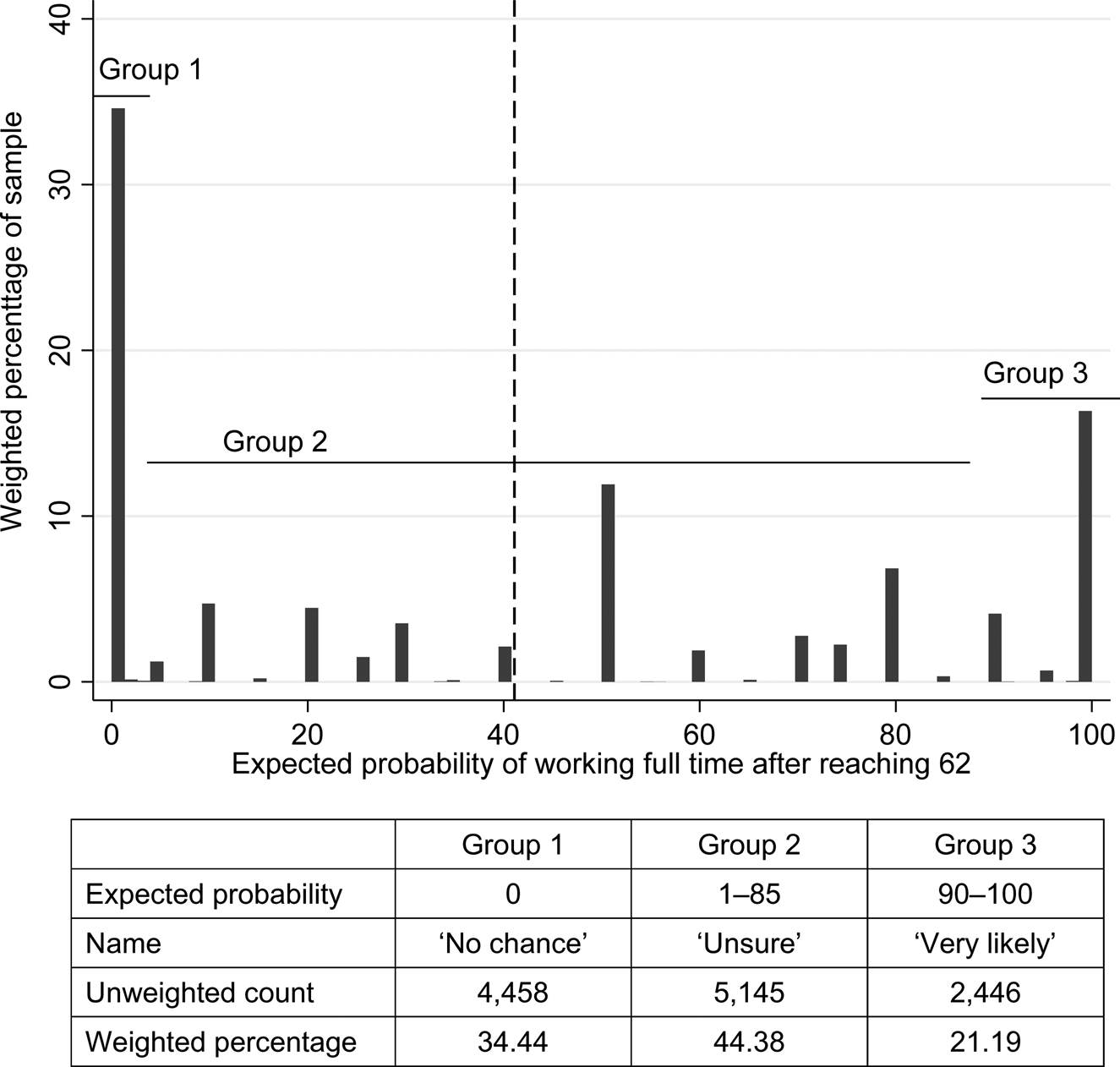
We used respondent's first reported probability of working full time after reaching age 62, which ranged from 0 to 100. We grouped expected probabilities into three groups (Figure 1). Almost 35 per cent of the sample made up Group 1 (‘no chance’), who reported exactly a zero expected probability of working full time at age 62. Group 2 (‘unsure’) encompassed the 44 per cent of the sample and reported expected probabilities of work ranging from 1 to 85. About 21 per cent of the sample fell into Group 3 (‘very likely’), reporting 90–100 expected probability of working full time at age 62.
Distribution of expected probabilities of working full time at age 62 (mean = 41.08).

We compared these expectations against reality – actual labour status at the first wave after reaching age 62. Respondents were coded as either working full time (based on working 35 hours or more per week) or not working full time (retired, unemployed, disabled or not in the labour force). In our analytic sample, those in the full-time group at age 62 worked a mean of 43.90 (standard deviation (SD) = 10.68) hours per week, while those not working full time worked a mean of 18.09 (SD = 11.16) hours per week. Among Group 1 who expected no chance of working full time at age 62, working full time represents unmet expectations; among Group 3 who thought it was very likely they would be working full time at age 62, not working represents unmet expectations.
Age in years (centred at 51) was based on the baseline wave when respondents reported expected probabilities. Race and ethnicity were also self-reported at baseline and grouped into four categories: non-Hispanic white, non-Hispanic Black, Hispanic and non-Hispanic other. Highest level of education was categorised as having less than a high school degree, a high school degree or General Educational Development (GED), some college or an associate degree, and a college degree or higher.
The final socio-demographic variable of interest in this analysis was birth cohort. Baby-boomers (made up by HRS's Early and Mid Baby Boomer cohorts) were born between 1948 and 1959. Pre-baby-boomers (made up by HRS Original Cohort and War Babies) were born between 1931 and 1947. Though numerically uneven, the cohorts were dichotomised this way to capture those who were reaching retirement age around the Great Recession (baby-boomers) compared to those who reached retirement age before this economic downturn. Baby-boomers in our sample reported their expectations about work on average in 2004 (interquartile range 2004–2005) and reported their labour force status at age 62 on average in 2012 (interquartile range 2012–2014). Therefore, for most baby-boomers in this sample, the Great Recession occurred after they reported their expectations but before their realised retirement timing. The pre-baby-boomer cohort on average reported their expectations in 1995 (interquartile range 1992–1998) and reported their labour force status at age 62 in 2002 (interquartile range 2000–2008).
Statistical analysis
For the first objective of this study, we examined the weighted and unweighted distribution of the socio-demographic covariates in our sample. We then examined expected probabilities of working at 62 and labour force status at 62 within each socio-demographic group. Adjusted Wald tests calculated the differences in the mean expected probability of working full time at age 62 by gender, race/ethnicity, educational attainment and birth cohort. In addition, we calculated cross-tabulations of these socio-demographic factors and the three expected probability groups.
For the second objective, we ran a series of six logit regression models to test the association between expectations and realised labour force status. The first of these models (Model A) predicted working full time at age 62 by the three expected probability groups while adjusting for gender, race/ethnicity, education, birth cohort and age when reported expectation. To test if expectations were equally associated with realised labour force status across socio-demographic groups, we ran five more models (Models B–E) that each interacted the expected probability groups with a socio-demographic covariate (see Equation 1). We re-ran these logit models adding three highly relevant background factors – total wealth (assets minus debts divided by 10,000), self-employment status and occupation type (categorised as white-collar high skill, white-collar other, blue-collar high skill and blue-collar other, consistent with prior HRS research; Cahill et al., Reference Cahill, Giandrea and Quinn2013) – all reported in the wave of expectations.
We calculated the marginal predicted probabilities of unmet expectations for each socio-demographic sub-group based on the interaction models. For Group 1 (0 expected probability), we calculated the predicted probability of working full time and for Group 3 (90–100 probability), we took the inverse of the predicted probability of working full time to capture the probability of not working. In both cases, all other covariates were held constant at their distribution in the sample, which approximately represents the US population of adults over age 50.

For additional robustness checks, we tested whether results were sensitive to the thresholds used for creating expectation groups. We re-ran the complete analysis with two alternative groupings: terciles (0, 1–60, 62–100) and ten probability points in the high and low expectation groups (0–10, 15–85, 90–100). In addition, we examined whether results would differ when including part-time workers in the group of respondents not-working full time at age 62.
All statistical analyses were conducted in Stata 15 (StataCorp, 2017). To yield unbiased estimates and adjust for complex sampling, all analyses took into account clusters and stratification, and weighted respondents based on their outcome wave (when labour force status was measured after respondents reached 62) (Stata's svy commands). Specifically, we used RAND variable ‘raehsamp’ as the primary sampling unit and ‘raestrat’ as the sampling strata identifier, specifying that strata with one sampling unit should be scaled using the average variance from strata with multiple units. The HRS respondents that met our inclusion criteria were treated as a non-fixed sub-population using Stata's svy, subpop command (Aneshensel, Reference Aneshensel2013).
Results
Sample
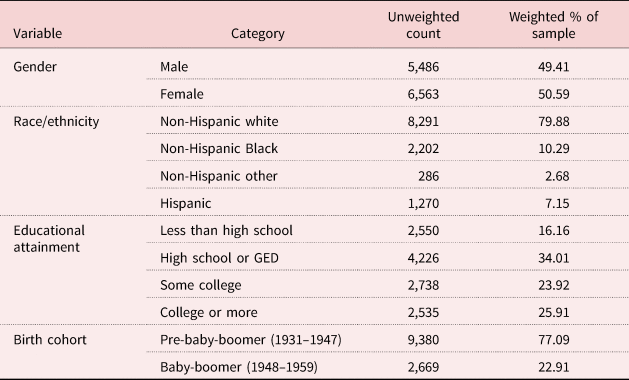
Our final sample consisted of 12,049 individuals who on average reported their expectations at age 54.74 (SD = 4.02). As can be seen in Table 1, about 51 per cent were female, 80 per cent were non-Hispanic white and 50 per cent had a high school-level education or less. About 23 per cent of the weighted sample was from the baby-boomer birth cohort (born between 1948 and 1959), while the remaining 77 per cent of the sample were pre-baby-boomers (born between 1931 and 1947).
Sample characteristics, distributions of expectations about working full time at age 62 and percentage working full time after reaching age 62

Notes: N = 12,049. GED: General Educational Development.
Expectations about work at age 62
The weighted mean expected probability of working full time at age 62 (range 0–100) was 41.08 (SD = 53.19). The distribution of expectations had notable grouping at 0, 50 and 100 (Figure 1). As mentioned, we grouped respondents by expectations as follows: Group 1 (‘no chance’, zero probability, 34.44% of sample), Group 2 (‘unsure’, 1–85 probability, 44.38% of sample) and Group 3 (‘very likely’, 90–100 probability, 21.19% of sample).
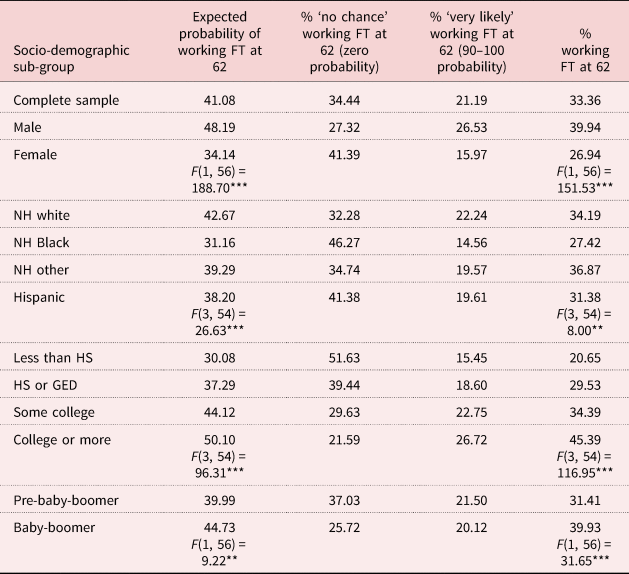
As shown in Table 2, the mean expected probability of working full time at age 62 was significantly higher for men than women (48.19 versus 34.14, p < 0.0001). More women thought there was no chance they would be working at age 62 (41.39% versus 27.32%) and more men thought it was very likely they would be working at 62 (26.53% versus 15.97%). There were also significant differences in expectations by race/ethnicity (F(3, 54) = 26.63, p < 0.0001), with the highest mean expected probability of working full time at age 62 found in non-Hispanic white respondents (42.67) and the lowest expectations found in non-Hispanic Black respondents (31.16). Of all race/ethnicity groups, Black respondents had the highest percentage who thought there was no chance they would be working full time at age 62 (46.27%) and the lowest percentage who thought it was very likely they would be working at age 62 (14.56%). The mean expected probability of working full time at age 62 went up significantly with education (F(3, 54) = 96.31, p < 0.0001), as did the percentage of respondents who thought it was very likely they would be working at age 62.
Expectations about working full time (FT) at age 62 and labour force status at age 62 across socio-demographic groups

Notes: NH: non-Hispanic. HS: high school. GED: General Educational Development.
Significance levels: * p < 0.05, ** p < 0.01, *** p < 0.001.
Baby-boomers had significantly higher mean expected probabilities of working full time at age 62 (44.73) compared to pre-baby-boomers (39.99) (F(1, 56) = 9.22, p = 0.0036). This trend remained consistent and significant when controlling for age when expectations were reported (p = 0.006). Interestingly, increasing age at expectation (range 51–61 years old) was associated with significantly lower expectations of working full time at age 62 (p < 0.001). Cross-tabulations revealed that, compared to earlier cohorts, a higher percentage of baby-boomers were unsure (1–85 probability) about whether they would be working at age 62 (54.16 versus 41.47). Percentages reporting zero probabilities of working at age 62 and 90–100 probabilities were both lower for baby-boomers compared to pre-baby-boomers (see Table 2).
Probability of work at age 62
Table 2 also shows the percentage in each socio-demographic sub-group that was working full time after reaching age 62. As might be expected, a significantly higher percentage of men were working full time at this age compared to women (39.94% versus 26.94 per cent, F(1, 56) = 151.53, p < 0.0001). White adults were more likely to be working than Black adults at age 62 (34.19% versus 27.42 per cent, F(1, 56) = 19.75, p < 0.0001), but white respondents were not significantly different from Hispanic respondents (34.19% versus 31.37 per cent, F(1, 56) = 1.95, p = 0.1676) or those of other races/ethnicities (34.19% versus 36.87 per cent, F(1, 56) = 0.40, p = 0.5275). The likelihood of working at age 62 differed dramatically by education (F(3, 54) = 116.95, p < 0.0001). Only 20.65 per cent of those without high school degrees were working full time at age 62 compared to 45.38 per cent of those with college degrees. Finally, baby-boomers were more likely to work full time at age 62 compared to previous cohorts (39.93% versus 31.41%, F(1, 56) = 31.65, p < 0.0001).
Comparing work expectations with reality
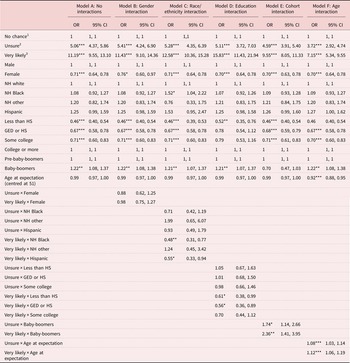
We next ran logit models to compare expectations with actual labour force status at age 62 (see Table 3). In Model A, which was adjusted for gender, race/ethnicity, education, birth cohort and age at expectation, expected probability groups were highly associated with actual labour force participation (odds ratios = 5.06 and 11.18 for Groups 2 and 3 versus Group 1, p < 0.0001). In other words, those who thought it was very likely (90–100 probability) that they would be working full time had 11 times higher odds (95% confidence interval = 9.55, 13.10) of actually working full time at 62 compared to those who thought there was no chance (0 probability) they would be working full time at that age.
Odds ratios for working full time at age 62 when interacting expectations with socio-demographic factors

Notes: 1. No chance: Group one, expect zero probability of working full time at age62. 2. Unsure: Group two, 1–85 probability of working full time at age 62. 3. Very Likely: Group 3, 90–100 probability ofworking full time at age 62. NH: non-Hispanic. HS: high school. GED: General Educational Development. OR: odds ratio. CI: confidence interval.
Significance levels: *p < 0.05, **p < 0.01, ***p < 0.001.
With the same socio-demographic adjustments, we then estimated models that included interactions to find that expectations of working full time at age 62 were less consistent with actual labour force participation for minority race/ethnicity respondents compared to white respondents (Model C interaction F(6, 51) = 2.39, p = 0.0411), especially Black and Hispanic respondents (interaction F(4, 53) = 3.30, p = 0.0173). In addition, expectations for labour force participation at age 62 were less likely to be realised for low compared to high education groups (Model D interaction F(6, 51) = 2.49, p = 0.0347), for earlier cohorts compared to baby-boomers (Model E interaction F(2, 55) = 5.44, p = 0.0070), and for those closer to age 51 compared to those closer to age 61 (Model F interaction F(2, 55) = 9.47, p = 0.0003). There were no significant gender differences in the relationship between expectations and realised labour force participation (Model B interaction F(2 ,55) = 0.31, p = 0.7334).
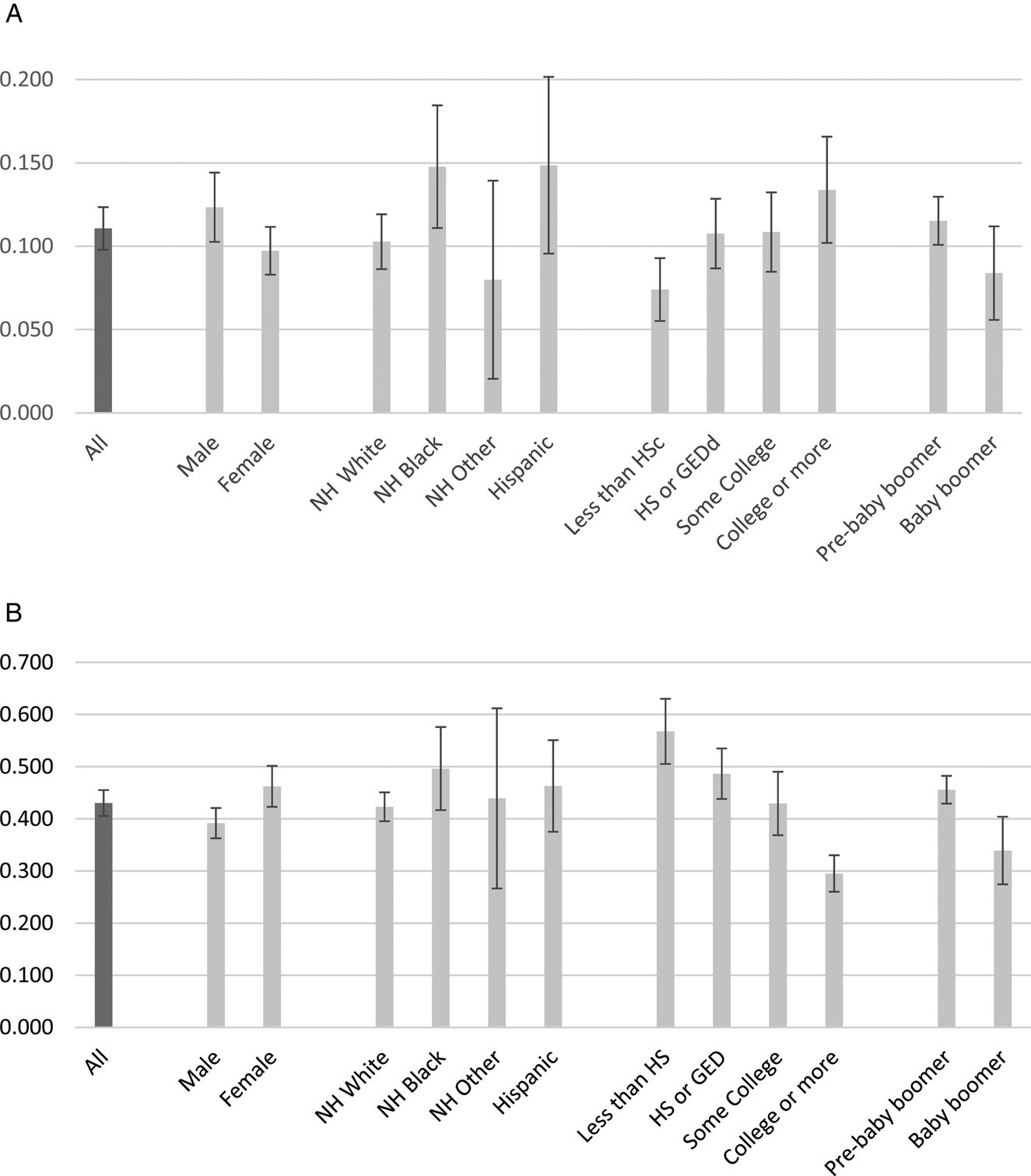
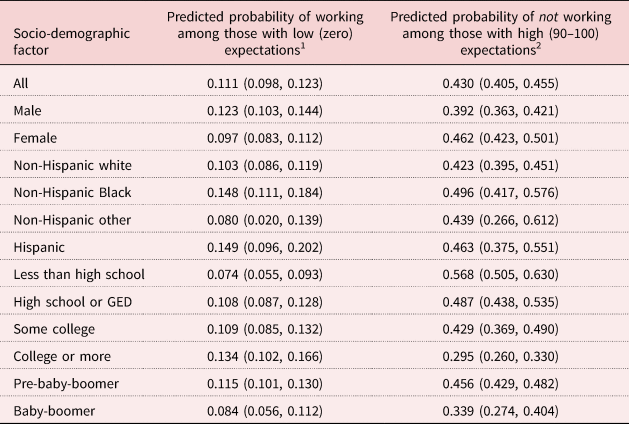
Figure 2 depicts predicted probabilities (shown in Table 4) from the main interaction models. For each socio-demographic sub-group, we calculated the adjusted probability of unexpectedly working among those who thought there was no chance they would be working and of unexpectedly not working among those who thought it was very likely they would be working. The first finding to note is that Americans had higher probability of unexpectedly not working (0.430) compared to unexpectedly working at age 62 (0.111). While the gender interaction did not reach statistical significance, men who thought there was no chance of working at age 62 had a slightly higher probability of unexpectedly working than women with that same expectation (0.123 versus 0.097). Among those who expected to be working, women were more likely than men to be unexpectedly not working (0.462 versus 0.392).
Distribution of unexpectedly working and unexpectedly not working by socio-demographic sub-groups. (A) Predicted probabilities of working at age 62 among those who thought there was no chance (zero probability) they would be working. (B) Predicted probabilities of not working at age 62 among those who thought it was very likely (90–100 probability) they would be working.
Notes: Predicted probabilities of working in (A) are marginal estimates for Group 1 (expected probability = 0, ‘no chance’) from the logit interaction models in Table 3. Predicted probabilities of working in (B) are one minus the marginal estimates for Group 3 (expected probability = 90–100, ‘very likely’) from the logit interaction models in Table 3. NH: Non-Hispanic. HS: high school. GED: General Educational Development.

Distribution of unexpectedly working and unexpectedly not working by socio-demographic sub-groups (as shown in Figure 2)

Notes: Values in parentheses are 95 per cent confidence intervals. 1. Predicted probabilities of working are marginal estimates for Group 1 (expected probability = 0, ‘no chance’) from the logit interaction models in Table 3. 2. Predicted probabilities of working are one minus the marginal estimates for Group 3 (expected probability = 90–100, ‘very likely’) from the logit interaction models in Table 3. GED: General Educational Development.
The race/ethnicity interaction, which did reach statistical significance at the p < 0.05 level, followed a different pattern: Black and Hispanic adults had higher probabilities of experiencing both types of unmet expectations compared to white respondents and those of other races and ethnicities. For example, the probability of working among those in Group 1 (zero expectation of working) was 0.103 for white respondents, but was 0.148 and 0.149 for Black and Hispanic respondents, respectively. Therefore, Black and Hispanic older adults have nearly 50 per cent higher probability of unexpectedly working at age 62 compared to white older adults. Differences in unexpectedly not working were comparatively smaller. Among those in Group 3 (90–100 expected probability), the probability of not working was 0.423 for white respondents, but was 0.496 and 0.463 for Black and Hispanic respondents, respectively.
Among those with low expectations of working at 62, those with college degrees had the highest probabilities of unexpectedly working (0.134), and those without high school degrees had the lowest probability of unexpectedly working (0.074). There was also a clear education pattern among those with high expectations of working at age 62, with each increasing education level exhibiting lower probabilities of unexpectedly not working (0.567 for less than high school, versus 0.487, 0.429 and 0.295 for college degrees or more). In other words, high educational attainment is associated with a high probability of unexpectedly working and a low probability of unexpectedly not working.
Interestingly, despite the Recession, baby-boomers had lower probabilities of both types of unmet expectations compared to pre-baby-boomer cohorts (see Figure 2 and Table 4). This finding may be due to the fact that more baby-boomers fell into the ‘unsure’ expectation group compared to pre-baby-boomers (54.97 and 41.62%, respectively).
Sensitivity analysis
Adding wealth, self-employment and occupation type as covariates in our models slightly attenuated the strong association between expectations and realised labour force status (Model A: F(2, 55) = 259.63, p < 0.0001 versus F(2, 55) = 498.37, p < 0.0001). However, interactions between expectations and each of gender, race/ethnicity, education and birth cohort were consistent with the original analysis. In addition, two alternative methods of categorising expectations into groups led to overall similar results. When using terciles of expected probabilities (expanding Group 3 to include probabilities 62–100), there were more baby-boomers in Group 3 compared to pre-baby-boomers. Expectations were still highly associated with realised labour force status, and all interactions were similar to prior models, suggesting that expectations between 62 and 90 operate similarly to those between 90 and 100. In the next test, Group 1 contained probabilities 0–10 (rather than only zero) and Group 3 contained probabilities 90–100 (as in original analysis). All results matched the original analysis apart from the interaction between expectation groups and education, which was not statistically significant (p = 0.0637). This finding suggests that the higher rates of unexpectedly working among those with low education were driven by those with zero expected probabilities, as differences by education were undetectable when including expectations between 1 and 10. With most results consistent across strategies, we present the original grouping because it provides relatively equal sample size to all three groups with logical distinctions of high and low expectations. When including part-time respondents in the group not working full time at age 62, expectation groups were still highly associated with realised labour force status, although with a slightly reduced effect size. Consistent with the main analysis, the interaction between expectation groups and gender was not significant, while interactions were significant in the same direction for race/ethnicity, education and birth cohort.
Discussion
This study is one of the first to use nationally representative longitudinal data to examine differences in unmet work expectations at age 62 across socio-demographic sub-groups of Americans following the Great Recession. We found that expectations about retirement timing are socially patterned and certain socio-demographic groups experience substantial deviations between expected and actual labour force status in late life. Understanding how well expectations align with reality in distinct sub-populations is important because the alignment of retirement with prior expectations impacts life satisfaction in the retirement years (Clarke et al., Reference Clarke, Marshall and Weir2012). In addition, failure to predict labour force exits hinders individuals’ ability to estimate the duration of their retirement and plan their finances accordingly.
Our research highlights two different types of unmet expectations: unexpectedly working and unexpectedly not working. We found that it was more common for those with high expectations of working to be unexpectedly out of work at age 62 than for those with low expectations of working to be unexpectedly still in the labour force. In different socio-demographic groups, these two outcomes presented distinct patterns, suggesting that they are driven by separate processes. Evidence from prior research suggests that later-than-expected retirement is associated with flexibility in hours and loss of retiree health insurance, which may be less disruptive than the forces behind earlier-than-expected retirement (namely forced retirement and illness) (Panis et al., Reference Panis, Hurd, Loughran, Zissimopoulos, Haider, StClair, Bugliari, Ilchuk, Lopez, Pantoja and Ret2002). Therefore, these opposing types of unmet work expectations may be useful constructs for future research investigating the health and life satisfaction consequences of economic events that alter retirement timing.
When looking at differences by socio-demographic groups, we found that Black and Hispanic respondents were more likely to experience both types of unmet expectations compared to white respondents. These racial/ethnic differences in unmet work expectations ultimately result from structural factors. In the USA, there are racial/ethnic differences in access to stable and desirable employment over adulthood because minorities tend to experience lower educational opportunities, more workplace discrimination, residential segregation and other structural constraints (Bailey et al., Reference Bailey, Krieger, Agénor, Graves, Linos and Bassett2017). Driven by these macro-level factors, racial/ethnic differences in poor health or unemployment likely contribute to the slightly higher rates of earlier-than-expected retirement among Black and Hispanic adults compared to white respondents (Burr et al., Reference Burr, Massagli, Mutchler and Pienta1996; McNamara and Williamson, Reference McNamara and Williamson2004). Indeed, there is evidence that Black and Hispanic people experience more involuntary labour market exits than do white people due to joblessness that transitions to retirement (Flippen and Tienda, Reference Flippen and Tienda2000). The fact that racial/ethnic minorities experienced even larger differences in later-than-expected retirement may be due to lower wealth (Bailey et al., Reference Bailey, Krieger, Agénor, Graves, Linos and Bassett2017) and less stable labor force histories that hinder pension coverage and saving for retirement (Flippen and Tienda, Reference Flippen and Tienda2000). Misalignment between expected and realised retirement complicates financial planning and thus may contribute to racial/ethnic disparities in poverty risk in old age. Given evidence of the life satisfaction consequences of unmet expectations about retirement, enabling individuals to better align retirement plans with reality represents a promising area for intervention to address racial/ethnic disparities in quality of life in old age (Yang, Reference Yang2008; Skarupski et al., Reference Skarupski, Fitchett, Evans and Mendes de Leon2013).
In our study, older Americans with lower education levels stopped working earlier than expected more often than peers with higher education. This finding is in line with a study in Norway that showed that low education and blue-collar workers often cannot stay in the workforce as long as they would prefer (Solem et al., Reference Solem, Syse, Furunes, Mykletun, De Lange, Schaufeli and Ilmarinen2016). Similar to the racial/ethnic differences noted above, this pattern could be driven by those with lower education having more periods of joblessness, poorer health and lower incomes over their working lives (Aaron and Callan, Reference Aaron and Callan2011). In addition, the jobs of workers with lower education tend to have low flexibility and high physical demands, which may prevent working into old age (Mermin et al., Reference Mermin, Johnson and Murphy2007). Conversely, working longer than expected was more common among the advantaged group – those with high education. This aligns with previous research that has consistently found education to be positively related to retirement age (De Preter et al., Reference De Preter, Van Looy and Mortelmans2013; Fisher et al., Reference Fisher, Chaffee and Sonnega2016). High education may result in later-than-expected retirement due to desirable employment opportunities, high-quality working environments, and generous salary and benefit compensation (Potočnik et al., Reference Potočnik, Tordera and Peiró2010; Fisher et al., Reference Fisher, Chaffee and Sonnega2016). Therefore, working longer than expected in this group may be a voluntary decision, rather than a necessity for income or benefits.
Perhaps surprisingly, pre-baby-boomers experienced more of both types of unmet work expectations compared to baby-boomers. This means that, despite wealth losses and increased unemployment during the Great Recession, baby-boomers retiring at that time did not experience more earlier-than-expected or later-than-expected retirement compared to cohorts who had previously retired. This finding is in line with some previous research that found that stock market changes and unemployment rates around the recession did not affect expected retirement age (Szinovacz et al., Reference Szinovacz, Davey and Martin2015). However, it contradicts several other findings that report the Recession did result in changes in retirement timing (Hurd and Rohwedder, Reference Hurd and Rohwedder2010; Goda et al., Reference Goda, Shoven and Slavov2011; McFall et al., Reference McFall2011; Ondrich and Falevich, Reference Ondrich and Falevich2016).
Baby-boomers in our study were more likely than their predecessors to be unsure about their work status at age 62 (reporting a 1–85 probability of working full time). This increased uncertainty could be due to how changes in Social Security policies and an unsteady economy make confident predictions more difficult. Indeed, declines in the stock market during the Recession have been found to result in increased insecurity in or postponement of retirement planning (Szinovacz et al., Reference Szinovacz, Davey and Martin2015). This is concerning because those who plan for retirement ultimately have more wealth when they stop working (Lusardi and Mitchell, Reference Lusardi and Mitchell2007). Baby-boomers with zero probability (‘no chance’ group) or 90–100 probabilities (‘very likely’ group) were more accurate in their expectations than pre-baby-boomers, which raises the possibility that baby-boomers exhibited higher standards of certainty before being willing to report an expectation at either extreme of the probability range. There is clear evidence that baby-boomers are working longer than previous cohorts (Mermin et al., Reference Mermin, Johnson and Murphy2007), and our findings suggest that this later retirement may be properly anticipated. Higher expectations for and probabilities of working full-time age 62 were likely shaped by public and employer policies such as the increasing age for full Social Security benefits and the switch to defined contribution pensions, while other policies such as abolished mandatory retirement age were in effect for all cohorts observed in this study (Munnell, Reference Munnell, Clark, Munnell, Williams and Orszag2006; Fisher et al., Reference Fisher, Chaffee and Sonnega2016).
In the past, survey research has often used work expectations as a tool for understanding how certain factors like health shocks or financial incentives influence retirement timing. For example, one study asked respondents about the probability they would be working at age 70 conditioned on good health and then conditioned on poor health to try to understand the causal effect of health on retirement (Hudomiet et al., Reference Hudomiet, Hurd and Rohwedder2018). Expectations are also useful for forecasting trends in retirement before they occur. In these cases, expectations of retirement timing are proxying actual retirement timing, under the assumption that expected retirement is consistent with realised retirement. Our findings reveal how using expectations to represent actual timing systematically mis-measures retirement timing among minority races, those with high and low educational attainment (compared to middle levels), and older birth cohorts.
These findings should be considered in light of our study's limitations. We were not able to ascertain the specific reason for leaving or staying in the workforce, and thus we cannot directly parse out competing processes such as working longer due to insufficient savings or due to enjoyable workplaces. In addition, our paper considers not working at age 62 to represent retirement, but it may represent temporary unemployment for some. While we were able to include part-time workers in a sensitivity analysis, this study is limited by the fact that respondents were only asked about expectations for full-time work, despite the growing importance of part-time positions around retirement age. This study does not identify changes in expectations between when they are first reported and age 62. However, changes in expectations that led retirement behaviours to misalign with original expectations are interesting in the same way as traditional unmet expectations. Both scenarios beg the question of why preferences and behaviours changed between these time-points. Another limitation is that our sample was restricted by including only those with expectations and labour force status. Most missingness on these items comes from birth cohorts that were not surveyed both before and after age 62, meaning that our results are only generalisable to those born between 1931 and 1959. Attrition before age 62 due to poor physical or cognitive health may result in an underestimate of expectedly and unexpectedly not working for these cohorts.
Despite these limitations, our findings clearly highlight how certain social groups face difficulty in predicting retirement timing. This unpredictability likely hinders retirement planning, and such consequences of unmet expectations may differ across diverse groups of older adults. Future research should explore the lifecourse processes that explain socio-demographic differences in unmet retirement expectations, additional factors predicting unmet expectations, and interventions that improve individuals’ accuracy in predicting retirement timing and their agency in controlling when they exit the labour force. Interventions that reduce the high rates of unexpectedly not working hold promise to improve the financial, physical and mental health of these older adults and their families, along with the solvency of the Social Security programme.
Acknowledgements
The views expressed in this work are those of the authors and do not necessarily represent the views of any institution or organisation.
Author contribution
LRA conceptualised the project, cleaned the data, analysed the data and wrote the manuscript. PJC helped conceptualise the paper and edit the manuscript. NKM helped conceptualise the paper and edit the manuscript.
Financial support
This work was supported by T32 from the National Institute on Aging (grant number 2T32AG027708-06A1); and the Angus Campbell Scholar Award at the University of Michigan Institute for Social Research.
Conflict of interest
The authors declare no conflicts of interest.
Ethical standards
This study is exempt from Institutional Review Board review because it uses existing, deidentified data.