How effective is terrorism? This question has generated lively scholarly debate and is of obvious importance to policy-makers. However, most existing studies of terrorism are not well equipped to answer this question for a simple reason—they lack an appropriate comparison. Few studies of terrorism have compared conflicts in which terrorism is used with those in which it is not. This article examines the outcomes of civil wars to assess whether rebel groups that use terrorism fare better than those who eschew this tactic.Footnote 1 I argue that terrorism is not a particularly effective tactic for winning outright, nor for obtaining concessions at the bargaining table. On balance, terrorists undermine rather than enhance their military effectiveness by attacking civilians indiscriminately. If it does not help rebels achieve their ultimate political goals, one might reasonably ask why rebels ever employ terrorism? A second finding of this research provides a possible answer. Wars in which terrorism is used last longer than others, suggesting that terrorism enhances rebel organizations' survival. Rebels thus appear to face a dilemma: what helps them survive comes at the expense of the larger political goals for which they ostensibly fight.
In the next section I review the literature and debate over the effectiveness of terrorism and argue that civil wars provide a fruitful testing ground for evaluating the relative success of terrorism. I then present definitions and explain how “terrorist” rebel groups are distinguished from others, as well as how I use war outcomes to gauge “success.” Next I examine the strategic uses of terrorism to evaluate theoretically its advantages and disadvantages, and to generate hypotheses about its effects on war outcomes. In the following section I discuss how selection effects and endogeneity issues affect this study. After describing the data, I turn to empirical findings. I take a brief detour to look at terrorism as a dependent variable to address endogeneity concerns and then return to the main analysis of the effect of terrorism on war outcomes. The data support hypotheses that although civil wars involving terrorism last longer than other wars, terrorist rebel groups are less likely than those who eschew terrorism to achieve outright victory or concessions at the negotiating table. Terrorism may be somewhat less ineffective against democracies, but even in this context, terrorists do not win.
State of the Debate
A number of authors have argued that terrorism works. Pape, for example, argues that suicide terrorism is on the rise because terrorists have learned that it pays, generating “gains for the terrorists' political cause” about half the time.Footnote 2 Similarly, Kydd and Walter argue that terrorism more generally “is a form of costly signaling” and that “terrorism often works.”Footnote 3 Thomas argues that terrorism gives rebels the “power to hurt,” inducing governments to negotiate and make concessions.Footnote 4 Some scholars suggest that although terrorism can sometimes backfire and effects may be nonlinear, it is, on balance, effective.Footnote 5
Others, however, maintain that terrorism is not particularly effective. Abrahms argues that the prevailing view of terrorism as a potent coercive strategy rests on scant empirical footing, and that campaigns of violence that primarily target civilians almost never succeed.Footnote 6 Jones and Libicki conclude that “there is rarely a causal link between the use of terrorism and the achievement of [group] goals.”Footnote 7 Merari and Cronin both argue that, although terrorist groups may achieve partial or tactical (for example, recruitment) objectives, they almost never achieve their strategic goals in full.Footnote 8
Some of this debate hinges on what one counts as success: only full achievement of the group's goals, or any political concession, or achievement of intermediate goals meant eventually to help a group achieve its goals?—an issue I return to below.Footnote 9 Whether terrorism is considered effective also depends on what the chances of success, however defined, are if terrorism is not used. Not surprisingly, terrorists achieve higher levels of success when groups have limited objectives that do not impinge on the core interests of the target state.Footnote 10 So perhaps terrorism only “works” when achieving political change is relatively easy. Success rates cannot be judged without some sort of context.
Claims that terrorism “works” or “does not work” reflect a causal argument; that terrorism leads, or does not lead, to political change in favor of the group using it. Implicit in any causal argument is an argument about variation: using terrorism leads to more change (or no more change) than not using terrorism. But few empirical studies examine variation on the independent variable; most look only at terrorist organizations, with no comparison with otherwise similar groups that do not use terrorism.Footnote 11
I use data on civil wars to introduce variation. Civil wars represent a universe of cases in which a group has a serious enough perceived grievance against the state to launch a violent rebellion in which some groups choose to use terrorism as part of their repertoire of tactics whereas others do not. Data on civil wars are relatively well developed, allowing me to explore and control for a number of factors that are likely to affect both this tactical choice and the outcome I wish to explain.
The study of terrorism and the study of civil wars have generally proceeded in isolation from one another.Footnote 12 However, if one thinks of prominent cases such as the LTTE in Sri Lanka, the PLO or Hamas in Palestine, the IRA in Northern Ireland, the PKK in Turkey, or the MNLF and MILF in the Philippines, it is clear that much terrorism takes place in the context of civil war. Indeed, the vast majority—75 to 85 percent by most estimates—of all terrorism is domestic.Footnote 13 This article merges insights from the two literatures.
This raises the thorny question of the definition of terrorism, however, because some scholars maintain that in the Venn diagram of political violence, terrorism and civil war do not overlap, whereas for others they overlap completely.
Definitions
“Terrorist” Rebel Groups
Defining terrorism is notoriously difficult; as the cliché goes, one person's terrorist is another's freedom fighter, and this is particularly true in the context of civil wars. Because it is such a loaded term, its definition is highly contested.Footnote 14 I define terrorist rebel groups as those who employ a systematic campaign of indiscriminate violence against public civilian targets to influence a wider audience. The ultimate aim of this type of violence is to coerce the government to make political concessions, up to and including conceding outright defeat. This definition allows for distinctions among rebel groups and does not include in the definition other variables whose relationship to terrorism I wish to examine.Footnote 15
For many scholars of terrorism, though by no means all,Footnote 16 a defining characteristic of terrorism is that it deliberately attacks civilians.Footnote 17 This distinguishes terrorism from “normal” rebel attacks on military targets. However, civilian targeting is ubiquitous; almost all rebel groups (and almost all governments involved in civil wars) target individuals as a form of “control” to force cooperation and deter civilians from providing aid to the opponent.Footnote 18 Violence against civilians is thus too broad a criterion by itself to distinguish terrorist rebel groups from others. Moreover, this type of selective violence against civilians to punish or deter collaboration with the other side is not what most people think of when they think of “terrorism.”
By narrowing the definition to deliberately indiscriminate violence, I exclude this more common form of violence and focus on that which makes terrorism so terrifying: its randomness; and so outrageous: the intentional targeting of innocent civilians (as opposed to collaborators). This definition also captures what the literature often refers to as the “symbolic” nature of terrorism: that it aims not to influence the victims of the violence but to send a political message to a wider audience.Footnote 19 Stanton distinguishes strategies of “coercion” from the above-mentioned control by focusing on the “the use of violence as a means of forcing the opponent to take a particular desired action—to agree to negotiations, to reduce its war aims, to make concessions, to surrender.” This strategy is “intended not to coerce civilians themselves, but to coerce the opponent into making concessions.”Footnote 20 An attack on a public market, for example, is intended to influence the government, not shoppers.
Stanton's strategies of “destabilization” and “cleansing,” which she distinguishes from coercion, also sound like terrorism to some degree. These involve attacks on civilians intended to destabilize a country or to force people to flee by terrorizing the population. However, Stanton's operational coding of these strategies involve massacres and “scorched earth” campaigns (burning homes and crops), which, although terrifying to their victims are farther from our intuitive understanding of terrorism than the indiscriminate attacks she codes under coercion.Footnote 21 Thus, not all who “terrify” a population are “terrorist” as I use the term here—groups such as the RUF in Sierra Leone or the Lord's Resistance Army in Uganda are not coded as terrorist under my definition, for example. Some terrorist groups (such as the FMLN or the IRA, depending on one's political leanings) might thus be considered morally preferable to some nonterrorist groups.Footnote 22 Indeed, it is important not to let judgments of the morality of a group's cause influence the use of the term terrorism.
War Outcomes and Relative Success
Civil wars end in one of four ways: either the government or the rebels win outright, or they reach a peace agreement of some sort, or the rebellion peters out. These possibilities can be thought of as representing a continuum of success for the rebel group. Government victory and rebel victory obviously lie at opposite ends of this continuum, as depicted in Figure 1. Peace agreements represent a second-best outcome from the rebels' perspective. Agreements entail concessions and compromise by both sides, but since rebels fight to change the status quo, whereas governments fight to maintain it, government concessions represent at least partial political victory for rebels. Moreover, agreements require the government to accept rebels as legitimate negotiating partners, itself a significant concession. Indeed, many civil wars coded as ending in an agreement could easily be considered rebel victories in political if not military terms. For example, the peace agreement between South Africa and the ANC represented the fulfillment of that group's primary goal, the end of apartheid.Footnote 23
A Continuum of rebel political success

Second worst from the rebels' perspective are wars that end when a formerly full-scale rebellion fizzles out with violence ending or dropping to such low levels that the conflict is no longer considered ongoing. Although the rebel group may still exist, it is not causing much trouble at this low level of violence. Most rebellions in this category have been largely defeated, though not eliminated outright.Footnote 24 Examples include Sendero Luminoso in Peru, which ended its fight after the capture of its leader; and the MQM in Pakistan, which “decided to pursue a peaceful strategy rather than a violent one” after the Pakistani military dealt “a serious blow to the militants.”Footnote 25
Scholars in the effectiveness debate differ on how to treat conflicts that have not yet ended. Should ongoing conflict count as failure because rebels have not yet achieved their goals,Footnote 26 or success because they have avoided defeat?Footnote 27 In relation to a group's ultimate political objectives, one can treat ongoing conflict as a baseline category of intermediate success; neither side has been able to defeat the other, no significant concessions have been agreed to, and the rebels continue to inflict pain on the country. However, rebel groups are organizations, and as such they seek to survive.Footnote 28 Ongoing war therefore represents success on that dimension. As I shall show, the goals of political change and organizational survival may be in tension.
Advantages and Disadvantages of Terrorism
Terrorism has both advantages and disadvantages. I argue that the advantages tend to help rebels survive rather than to win, whereas the disadvantages make it harder for terrorists to achieve political concessions or to win outright. Much of the literature considers the usefulness of terrorism in isolation. The implicit comparison is thus effectiveness relative to doing nothing. But how effective is terrorism relative to other tactics a rebel organization could employ? All rebel groups attack military targets; terrorist rebel groups, as defined here, are distinguished by the fact that they also purposively attack civilians indiscriminately to influence a wider audience.Footnote 29
There are several potential audiences to consider. The primary audience is the government, which rebels hope to induce to make concessions or to give up the fight. There are also secondary audiences, those whose support rebels attempt to win, and those rebels hope to induce to put pressure on the government. Within the country, there is an “aggrieved” population on whose behalf the rebel organization claims to fight.Footnote 30 There are also civilians on the other side of the conflict—those who support the government or generally consent to be governed by it. For lack of a better term, I refer to this group as the “mainstream.” It includes both those who benefit from and support the state and its use of violence against the rebel group and “fence-sitters.” Finally, there are international audiences—particularly those (great or regional powers, neighboring states, relevant diasporas) in a position to aid or pressure either side of the conflict.
Terrorism has obvious disadvantages as a military tactic. Attacking civilians indiscriminately in public places is not useful for taking or holding territory or the capital. It is thus much less effective than other tactics for winning outright. Unlike attacks on the government's military forces, or even other types of attacks on civilians (such as ethnic cleansing of territory, or attacks to prevent collaboration with the enemy), indiscriminate attacks on public targets such as markets or buses have no direct military value.
The terrorism literature identifies a number of less direct ways through which it is thought to “work.” These include (1) attrition, (2) advertising the cause, (3) provocation, (4) outbidding, and (5) spoiling.Footnote 31 Of these, attrition is arguably the most important because it entails the most direct (or least indirect) link between rebel actions and the achievement of political goals. The other strategies aim at intermediate goals, including mobilizing support, and/or preserving organizational survival, often in competition among groups claiming to represent the same aggrieved population. I discuss each of these strategies in turn, considering both the advantages and disadvantages of terrorism for the rebels' larger military effort.Footnote 32
Attrition
Terrorism is used as part of an attrition strategy, meant to inflict pain on the other side so as to undermine the adversary's will, rather than its capacity, to fight.Footnote 33 However, terrorist attacks are not the only way to fight a war of attrition. Insurgency or guerrilla warfare tactics classically employ hit-and-run attacks to dog the adversary's forces and undermine its will to continue the fight. Unlike other forms of insurgency, terrorism, by definition, does not target military forces, and thus does not degrade the government's military capacity.
Terrorist attacks do entail some advantages in their sheer ability to inflict pain in a cost-effective manner. It is less costly (in material terms) to attack “soft” civilian targets than “hard” military ones. Because terrorism attacks targets that are inherently hard to defend, preventing every single attack is difficult. As Condoleeza Rice described counterterrorism efforts (paraphrasing the IRA): “They only have to be right once. We have to be right 100 percent of the time.”Footnote 34 It takes relatively few people to organize and carry out a terrorist attack, making full elimination of terrorist groups difficult; mere remnants can continue to inflict damage.
Terrorism is also a relatively cheap way to impose costs on civilians such that the mainstream population pressures its government to give in to terrorist demands. There is some evidence that this can be effective, up to a point,Footnote 35 perhaps particularly so in democracies (see hypothesis 4). However, terrorism can also induce pressure on the government not to concede by rallying the mainstream population around the flag. Moreover, many governments have a stated policy never to negotiate with terrorists. This is often observed only in the breach, and governments are always reluctant to negotiate with and grant concessions to any rebel group. The rhetoric of nonnegotiation with terrorists can nonetheless make it especially politically difficult to do so.
Terrorism is also thought to be a communication device, meant to signal strength and resolve, to convince the opponent that the war of attrition will be long and costly.Footnote 36 Compared with not attacking at all, terrorism may indeed be effective as a costly signal, but compared with attacks against the military, the effectiveness of terrorism as a signal of resolve is unclear at best, whereas terrorism signals weakness rather than strength.
Terrorism signals a willingness to use extreme tactics that violate widely held norms and this may be interpreted as a signal of resolve. However, extremism and resolve are not necessarily the same thing. Willingness to attack civilians signals willingness to impose these costs in the future. To the extent that the government cares more about the loss of civilian life than the loss of soldiers' lives, this may provide a signaling advantage to terrorist tactics.
There are also downsides to sending such signals, however. By deliberately violating the norm against targeting noncombatants, terrorists place themselves beyond the pale, painting themselves as untrustworthy—likely to break their promises rather than abide by a negotiated agreement.Footnote 37 The targets of terrorism may also infer from the extreme nature of the tactics used that the groups' demands are also extreme; that terrorists seek to destroy their society.Footnote 38 Opponents will therefore view negotiations as an act of appeasement. Use of extreme tactics may credibly signal resolve to carry on the fight, but it undermines the credibility of promises to reward concessions with peace.
Terrorism can also make it harder for rebels to accept concessions. Terrorist rebel groups may be particularly suspicious of the government in any potential negotiations to end the conflict. This may be, in part, because of a selection effect if only particularly hardline groups choose terrorist tactics. But it could also be induced by this choice. Having committed terrorist attacks, rebels may not believe that they will be accepted into a peaceful postwar political order.Footnote 39 Government promises of amnesty or of a power-sharing role for rebels may therefore not be credible to terrorist rebel groups. Mistrust and problems of credible commitment plague all civil wars,Footnote 40 but terrorism makes them even worse. For a number of reasons, then, signaling extremism can make one's would-be negotiating partner less, rather than more, willing to make political concessions.
As a signal of strength, moreover, terrorist attacks are clearly inferior. Despite the empirical (non)finding presented shortly, the deeply embedded conventional wisdom is that terrorism is a “weapon of the weak.” To be credible, signals have to be costly. Precisely because it is less costly to attack “soft” civilian targets than hardened military ones, terrorism signals military impotence rather than strength.
In sum, terrorism is a cheap way to inflict costs in a war of attrition, and is hard to eliminate fully, fostering organizational survival. On the other hand, it creates pressures on the government not to concede, and its very affordability undermines its value as a credible signal.
Rebellion, particularly insurgency or guerrilla warfare, as Mao famously stressed, requires a supportive population.Footnote 41 Though Mao would disagree, the terrorism literature generally maintains that terrorism is a strategy used to mobilize support.Footnote 42 Do indiscriminate attacks on civilians enhance or undermine popular support?Footnote 43
Advertising the Cause
One way terrorism is thought to mobilize support is by publicizing grievances—“propaganda of the deed”—to put the cause on the political agenda.Footnote 44 Because they are more outrageous, terrorist attacks usually generate more publicity than attacks against the military. This attention can create a sense of urgency about resolving a political issue.
At whom is such a strategy aimed? Publicizing grievances probably plays less of a role in situations that have escalated to the level of civil war than in lower-level conflicts. In civil wars, both the aggrieved and the mainstream population are already aware of the grievances. Terrorism can, however, publicize grievances to international audiences; or in some conflicts over secession or autonomy, to advertise the plight of an aggrieved population whose lives are quite remote to citizens in other parts of the country.
The disadvantages of targeting civilians to generate their support are obvious. Those who see such attacks as justified given their view of the righteousness of the cause, are those most likely already to support the rebellion. Terrorism “preaches to the choir.” Those potential supporters who remain to be mobilized—less radical or politicized members of the aggrieved population, “fence-sitters,” and the international community—are more likely to feel revulsion at the taking of innocent life.Footnote 45 Moreover, as Abrahms argues, the publicity gained by terrorism often focuses on the “senseless” or irrational nature of the violence rather than the grievances or demands the terrorist group wishes to make.Footnote 46 In the battle for legitimacy and “hearts and minds,” terrorism is counterproductive.Footnote 47
Provocation
The literature also suggests that terrorism can be used to mobilize support by provoking the state to overreact.Footnote 48 This strategy hopes to induce the government to crack down on the aggrieved population, creating new grievances and exacerbating old ones, causing an increase in support for the rebel organization. Because they violate norms of warfare, terrorist attacks may be more likely than attacks on military targets to provoke an overreaction. However, using terrorism for this purpose is risky for two reasons. First, successful provocation requires that the aggrieved will blame the government for the crackdown, rather than the rebel group that provoked it.Footnote 49 Second, by attacking civilians, terrorist attacks make it easier for the government to justify—both domestically and internationally—draconian measures to crush the rebellion. The opprobrium directed against a government that employs extreme measures will be lower when it is fighting a terrorist rebel group than a nonterrorist rebel group.Footnote 50 For provocation to work, the rebels must be able to goad the government into a “middling level of brutality.”Footnote 51 A government strongly committed to human rights is difficult to provoke, whereas one willing to employ extreme brutality in its fight will be able to wipe out the rebels and the constituency they claim to represent.Footnote 52 In this Goldilocks equation, terrorism may induce governments to move from “too soft” to “just right,” but can also make governments “too hard,” allowing them to justify measures to crush the rebels rather than creating a backlash of support in their favor.
Outbidding
Terrorism is thought useful as a means of competing with other rival groups that claim to represent the same aggrieved population. Outbidding is intended to mobilize popular support for a group by demonstrating commitment to the cause and ability to fight for the interests of the aggrieved.Footnote 53 But why should the aggrieved population support groups that use terrorism over those who do not? Kydd and Walter respond that it is advantageous to be represented by an agent who will drive a harder bargain than oneself, and extreme tactics signal a tougher negotiating stance.Footnote 54 This argument discounts the cost of continued conflict to the aggrieved population, however. Supporting a group whose reservation price is higher than one's own by definition rules out settlements one would prefer to ongoing conflict. If one fears the government will never compromise (Kydd and Walter's second answer), then one should prefer not a more extreme agent, but a militarily more competent one. Given that terrorism signals military weakness rather than strength, it is unclear how attacking civilians rather than military targets might win political support.Footnote 55 Although competition among groups and factions is undoubtedly an important motive for rebel behavior, it is questionable how terrorism serves these competitive purposes better than other tactics.
Spoiling
Spoiling is another manifestation of competition among rebel groups. It occurs when a more extreme group is threatened by the prospect of peace between the government and a more moderate group. By launching a terrorist attack and inducing doubt about the moderates' ability or willingness to control terrorism, extremists can derail peace.Footnote 56 This can help ensure the survival of an extremist group that might otherwise become obsolete in the face of peace. Spoilers presumably hope for an eventual outcome more favorable to their cause than the one moderates were willing to accept, but spoiling does nothing to ensure this more favorable outcome rather than a less favorable one. Terrorism driven by spoiling thus contributes to survival but does nothing to help a group achieve its political goals.
Hypotheses
This evaluation of the pros and cons of terrorism relative not to inaction but to other types of attacks (notably attacks on military targets), leads to several hypotheses. On balance, terrorism generally undermines military effectiveness. It has no direct value for winning the war outright; it does not degrade the government's military capability, nor can it be used to take and hold territory. It is a cheap way to inflict costs on the enemy and may help signal resolve, but its low cost also signals weakness. It may help advertise the cause, but it also drives potential supporters away. It can provoke a government into self-destructive overreaction, but it can also help the government justify draconian measures in their fight against rebels.
H1
Terrorist rebels are less likely than nonterrorist rebels to achieve military victory.
Terrorism also makes the second-best outcome for rebels less likely. Governments will grant fewer concessions to a less militarily effective opponent. Moreover, rebels' use of extreme tactics makes it harder for the government to negotiate an agreement and exacerbates the problems of trust and credible commitment that plague all civil wars.
H2
Rebels using terrorism are less likely than those who eschew terrorism to achieve negotiated settlements.
There are, however, some advantages to terrorism for organizational survival. Terrorist rebel groups are hard to eliminate entirely, and spoiling can prevent peace with more moderate groups from making extremist groups obsolete. For both these reasons, and because terrorism prevents negotiated settlements that would otherwise end the war more quickly, terrorism should increase civil war duration.
H3
Wars involving terrorist rebels are likely to last longer than those involving nonterrorist rebels.
I argue that terrorism is, on balance, ineffective for achieving political goals. But there are several reasons to think that terrorism might be relatively more effective against democracies than against autocracies. First, democratic governments are likely more sensitive to civilian loss of life.Footnote 57 If terrorism works by inflicting pain on civilians who then pressure their government to make concessions, then it stands to reason that the more accountable the government is to popular pressure, the more likely this strategy will work.
Second, democracies are thought to have trouble repressing or preventing and policing terrorist groups.Footnote 58 Because they start on the “soft” end of the spectrum, democracies should be more likely provoked into the “just right” level of brutality discussed earlier, whereas nondemocracies will be provoked into a response that is “too hard” and that brutally but effectively represses rebellion.
Terrorism may also be less likely to backfire by undermining support among the aggrieved when its victims are seen as “complicitous” in government policy because they have voted the government into power in democratic elections.Footnote 59
H4
Terrorism will be more effective against democratic governments than against nondemocratic governments.
Selection and Potential Confounders
Because I look at the use of terrorism only in the context of civil wars, this study does not cover all terrorist organizations, raising issues of selection bias. The analysis excludes transnational terrorist groups that attack primarily across borders rather than in their home state.Footnote 60 It also excludes organizations involved in conflicts that do not meet the standard 1,000 battle death threshold of a civil war.Footnote 61 The smallest and weakest groups are thus excluded.Footnote 62 Focusing on the deadliest groups is defensible on policy grounds and is necessary for empirical comparison with nonterrorist groups. It does, however, limit generalizability because I evaluate terrorism by only groups capable of mounting civil war, not terrorism relative to other options for those without this capability. The notion that terrorism is used only by those with no other option is belied, however, by the terrorist rebel groups examined in this study, who by definition can mount a civil war.
The selection of organizations involved in civil wars likely overrepresents ethnonationalist organizations, which are more likely to have clear political or territorial goals that are more easily negotiable than the goals of other types of terrorist organizations.Footnote 63 The data used here also exclude coups,Footnote 64 which are quite unlikely to involve terrorism and which may be more often successful than other types of rebellion. All of these selection issues bias the study toward finding terrorism successful, and against my own argument.
The temporal bounds of the data used in this study (post–1989) do not cover the era of decolonization, and therefore exclude a set of highly successful rebellions; virtually all of these cases led to independence. Some notable cases of terrorist success (for example, Algeria) are thus omitted. If terrorism was used disproportionally in anticolonial wars of this era (an open empirical question), excluding this era will bias the results away from finding terrorism effective. On the other hand, anticolonial struggles enjoyed particular legitimacy; relationships in that era may not apply to more recent conflicts.
Arguably more important as a concern than selection bias are the thorny issues of endogeneity and spuriousness for although terrorism inflicts random violence, it is not a tactic chosen at random. To assess its effectiveness accurately, I must therefore pay particular attention to any variables that might affect both the use of terrorism and the outcome of the war. The literature on the causes of terrorism, particularly on why terrorism appears in some places rather than others, suggests several potential confounders. I explore the relationships between these factors and the use of terrorism in greater depth elsewhere, but I discuss them briefly here.Footnote 65
The most obvious potential confounding variable is the strength of the rebel group relative to the government. If, as is commonly asserted, terrorism is a “weapon of the weak,”Footnote 66 failure to take this into account will make terrorism look less effective than it really is.
The relationship between democracy and terrorism has generated significant theoretical and empirical debate.Footnote 67 Many see a positive relationship between democracy and terrorism, in part because terrorism is thought to be more effective against democracies, as discussed earlier.
Terrorism is also thought to be a tactic used by groups with particularly extreme aims. This argument is often tautological: groups that use extreme tactics such as terrorism are considered extremist, therefore extremist groups use terrorism. But it is possible to assess group aims independent of their tactics by focusing on how far rebels' stated aims are from the status quo. I argue elsewhere that in wars over a particular region, secessionist rebels can be considered more extreme than those fighting for autonomy, whereas in wars over control of the state, those who seek to transform society in fundamental ways (for example, by instituting Sharia in a secular state, or communism in a capitalist state, or vice versa) are more extreme than those merely engaged in a power struggle to take the reins of power (the fight between Lissouba and Sassou Nguesso in Congo–Brazzaville is a good example).Footnote 68
Secessionist aims are particularly important to consider because scholars such as Pape and Stanton suggest that terrorism should be especially likely in secessionist conflicts.Footnote 69 Fazal suggests just the opposite, however; because separatists desire to become accepted members of the international system, they have incentives to avoid targeting civilians indiscriminately.Footnote 70 Scholars have also noted links between religious conflict and terrorism,Footnote 71 and between population and/or gross domestic product (GDP) per capita and terrorism.Footnote 72 Terrorism as defined here may be less likely in Africa than elsewhere,Footnote 73 and may be more likely where rebels do not have the advantage of rough terrain that enables other forms of insurgency.Footnote 74 The outbidding argument suggests that terrorism is more likely when there are several rebel groups active as part of the same struggle.Footnote 75
This set of variables by no means exhausts the list of factors that might make rebel groups more likely to choose terrorism—this is obviously an important question in its own right. For the purposes of this article, however, my focus is on variables that likely also affect the outcome of war, and whose omission could thus lead to spurious findings about the effectiveness of terrorism.Footnote 76
The Data
The data analyzed here consist of 104 rebel groups involved in full-scale civil wars active between 1989 and 2004. Much of the data come from Cunningham, Gleditsch, and Salehyan's Non-State Actor data set (hereafter CGS),Footnote 77 which builds on and expands the well-known Uppsala-PRIO Armed Conflict Data (hereafter UCDP)Footnote 78 by identifying each nonstate (or rebel) actor.Footnote 79 These data are particularly useful for several reasons. First, the unit of analysis is the government-rebel group dyad, rather than the conflict as is common in many data sets on civil war. Second, the relative strength of the government and each rebel group is coded. The CGS data are time varying, allowing for variables that change over the course of the conflict, for example, changes in the relative strength of the actors, or changes in democracy or economic variables.
The dependent variable is war outcome for each dyad, covering the five possibilities discussed here: government victory, rebel victory, agreement (including peace agreements and ceasefire agreements), wars that fizzle out to “low or no activity” by dropping below twenty-five battle deaths per year, and ongoing conflicts. Outcomes data are from UCDP through 2003; I updated through 2009 and corrected a few cases based on case-specific research.Footnote 80
The measure of the main independent variable, whether a rebel group uses terrorist tactics, comes from Stanton's coding of “high casualty terrorism,” a measure of a group's systematic use of “small-scale bombs … to attack unambiguously civilian targets” excluding attacks on infrastructure (for example, power stations, pipelines, bridges) which impose costs on civilians, but in which casualties are rare.Footnote 81 I use this more restrictive, high-casualty-only measure of terrorism because it best captures the deliberate and indiscriminate killing of civilians on which my definition and theory focus. Of the 104 cases examined here, twenty-four (23 percent) use high-casualty terrorism.
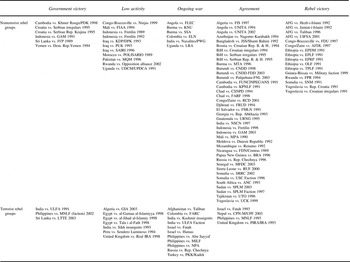
This measure captures groups generally classified as “terrorist” by other sources, such as the LTTE in Sri Lanka, the Taliban in Afghanistan (after 2003), the FARC in Colombia, the Provisional IRA in Northern Ireland, and so on. One advantage of Stanton's data over databases more commonly used in the terrorism literature is that this minimizes some of the well-known geographical biases in the terrorism data, particularly their overrepresentation of terrorism in Western democracies and underrepresentation or spotty coverage of groups in Africa and other strategically less important (to the US) places. The main disadvantage of this measure is that it is limited to full-scale civil wars active between 1989 and 2004, thus providing the bounds of the empirical analysis. Merging the Stanton and time varying CGS data yields 104 cases and 566 observations over time.Footnote 82 The cases are listed in Table A1 in the appendix.Footnote 83
Stanton found surprisingly little variation over time within conflicts in the types of strategies rebels and governments used in terms of targeting civilians. With very few exceptions, groups that used terrorism did so throughout the conflict, whereas those who eschewed the tactic early on continued to avoid it later.Footnote 84 This in itself is quite interesting, and suggests that rebel organizations' choices about using terrorism are remarkably “sticky.”
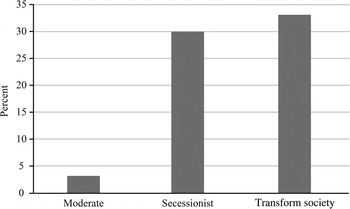
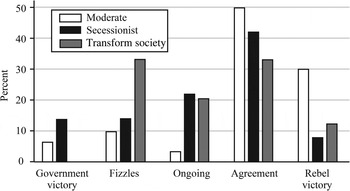
The CGS data include a five-point indicator of rebel group strength relative to the government, ranging from much weaker to much stronger. This variable summarizes assessments of the rebel group's ability to mobilize supporters, arms procurement ability, and fighting capacity, which Cunningham and colleagues argue capture the rebel group's ability to target government forces, or “offensive strength.”Footnote 85 To capture the effects of war aims, I include two dummy variables. The first marks whether the group seeks full independence and is taken from Coggins's data on secessionist movements.Footnote 86 The second differentiates among groups fighting for control of the center, marking those who aim to transform society in fundamental ways. This I coded myself, based on case descriptions in the CGS data coding notes, Minorities at Risk (MAR), START's Terrorist Organization Profiles (TOPs), UCDP's case summaries, and case-specific sources.Footnote 87 Together, the independence and transform society dummy variables can be compared with an omitted category of relatively “moderate” rebels who aim either for autonomy, or who are engaged in power struggles at the top without a desire to transform society.Footnote 88 Because this is a newly coded variable, Figures 2 and 3 provide information about its relationship with both terrorism and war outcomes, respectively. From this bivariate look at the data, we see that moderate rebels appear to be less likely to use terrorism and more likely to succeed, making inclusion of this variable particularly important to avoid spuriousness.
War aims and percent terrorist

War aims and percent in each war outcome

Democracy is measured with a dummy variable marking cases with a Polity score of 6 or higher. Measures of the natural log of population and the natural log of GDP per capita are included. A measure of whether the rebel group's religion differs from that of the government captures distinctions within as well as between major religions (distinguishing among Protestant, Catholic, and Orthodox Christians, and among Sunni and Shia Islam, for example).Footnote 89 A dummy variable identifies civil wars fought in Sub-Saharan Africa. A (logged) measure of mountainous terrain in the country captures the effect of rough terrain.Footnote 90 A dummy variable (from CGS) marks conflicts in which multiple rebel groups were active, as a proxy for outbidding dynamics. I also control for the age of wars in 1989 to capture the fact that some were already underway when the data on terrorism begin.Footnote 91
In all of the results reported, I calculate robust standard errors with cases clustered by country. Results are robust, and often stronger, if clustered by conflict instead of country.
Which Groups Use Terrorism?
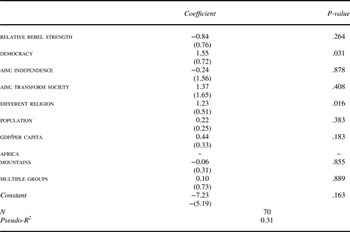
Before turning to tests of the hypotheses, I take a brief detour to address the issue of spuriousness, examining the effects of potentially confounding variables on the use of terrorism. Of the rebel groups examined in this study, fewer than a quarter used terrorism as a tactic in their fight against the government, whereas the rest did not. What accounts for this variation? Table 1 shows the results of logistic analysis with terrorist rebel group as the dependent variable.Footnote 92
Determinants of terrorism in civil war (logit)

Notes: Africa predicts “failure” perfectly—thirty-four observations in Africa therefore dropped, leaving an N of 70. Robust standard errors (clustered by country) reported in parentheses.
This analysis of terrorism as the dependent variable, rather than the independent variable as it is in the rest of the article, suggests that terrorism is most likely in civil wars in democracies, where rebels face governments representing a different religion,Footnote 93 and is seldom seen in Africa (indeed in the data used in this study, there are no cases of high-casualty terrorism by African rebel groups).Footnote 94
Given how deeply entrenched it is, the conventional wisdom that terrorism is more likely to be used by weaker groups receives surprisingly weak support. The relationship between relative strength and terrorism is negative, but it is never statistically significant.Footnote 95 I also find that the apparent link between a group's war aims and its use of terrorism seen in Figure 2 disappears once other variables are controlled for. Those fighting for secession are, if anything, less likely to use terrorism, whereas those aiming to transform society appear more likely to do so, but neither effect is significant. Together, these findings indicate that the extremity of a group's aims are not necessarily associated with the extremity of its tactics. I find no relationship between rough terrain and terrorism, nor between the number of groups involved in the conflict (outbidding) and terrorism.
Although these findings shed some light on questions about when and where terrorism arises, fuller theoretical and empirical analysis of why some rebels resort to terrorism whereas others refrain from targeting civilians in this way is beyond the scope of this study.Footnote 96 However, now that we have some sense of which rebel groups are most likely to use terrorism, we can return to the question that motivates this article—is terrorism an effective tactic for rebels in civil war?
Do Terrorist Rebels Win? The Effects of Terrorism on War Outcomes
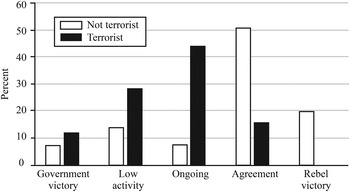
Figure 4 shows the percentage of terrorist and nonterrorist rebellions ending in each outcome. Although these bivariate relationships obviously do not yet take into account potentially confounding variables, the figures do suggest preliminary support for H1 to H3. Most tellingly, of the groups examined here none of those that deliberately killed large numbers of civilians through terrorist attacks won its fight outright.Footnote 97 Peace agreements, which I argue represent significant concessions to the rebel cause, are also much less frequent when rebels use terrorism. Meanwhile, government victories and wars ending through low or no activity are slightly more common in civil wars involving terrorism. Wars in which rebels used terror were much more likely to be ongoing as of 2009 than were wars with nonterrorist rebels, suggesting that terrorism makes wars particularly difficult to terminate.
Terrorism and percent in each war outcome

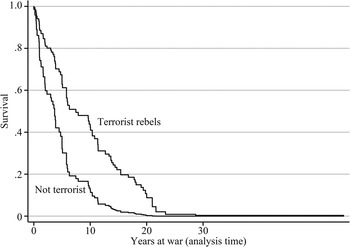
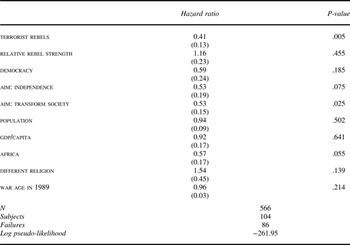
I employ several different multivariate models to test the effects of terrorism on the duration and outcome of war, controlling for the possible confounding variables discussed earlier.Footnote 98 Because it is most straightforward (and forms a baseline for subsequent models), I first discuss H3, on terrorism and the duration of war. Table 2 shows the results of a Cox proportional hazards model. In duration models such as this one, hazard ratios are interpreted relative to 1. Hazard ratios less than 1 indicate variables associated with longer wars; those with hazard ratios greater than 1 with shorter wars. The hazard ratio of 0.41 for terrorism indicates an estimated 59 percent reduction in the hazard of war termination, all else equal—an effect that is highly statistically significant.Footnote 99 Figure 5 shows the same results graphically, depicting the survival function for wars in which terrorism is and is not used.Footnote 100 As expected, civil wars in which rebels use terrorism last longer than those in which rebels do not; terrorism contributes to organizational survival.
Terrorism and the duration of war

Terrorism and the duration of war (Cox PH model)
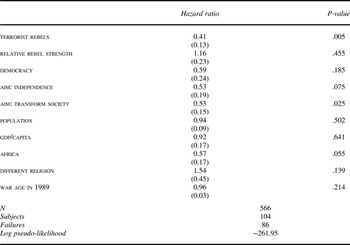
Note: Robust standard errors (clustered by country) reported in parentheses.
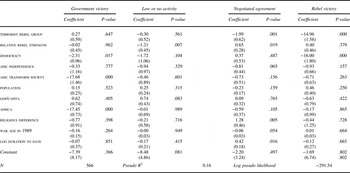
There are several ways to test the effect of terrorism on war outcomes as opposed to duration. None of them is perfect, however, so I use different models to triangulate. Because the rank ordering of outcomes as a measure of rebel success represents an argument rather than an established fact, and especially because my argument is that terrorism's effect on outcomes is nonmonotonic (since terrorism increases the duration of war), I first employ a multinomial logistic regression model (Table 3), in which no assumption is made about the order of the five outcomes categories.Footnote 101 I also control for the log of the duration of war to date (or “time at state”) to account for the effects of time and duration dependence.Footnote 102
Terrorism and war outcomes (multinomial logistic—relative to ongoing war)

Note: Robust standard errors (clustered by country) reported in parentheses.
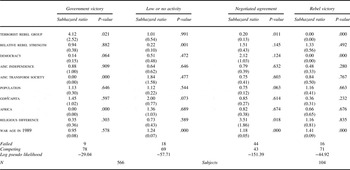
The basic pattern in the bivariate analysis represented in Figure 4 generally holds, even when potential confounders are controlled for. Although there is no significant difference between ongoing war (the omitted baseline category) and rebel defeat or wars that fizzle out, the “good” outcomes for rebels—peace agreements and rebel victory—are both significantly less likely, relative to ongoing war, when rebels employ terrorism as a tactic, supporting H1 and H2. Multinomial logit coefficients are difficult to interpret on their own. Table 4 shows the predicted probability of each outcome for terrorist and nonterrorist rebels, and the difference between them (holding all else constant at mean or modal values). The predicted probability of a war ending in an agreement is 6.6 percent for rebels that do not resort to terrorism, but only 1 percent for those who do. The predicted probability of a rebel victory is low for all rebellions, but drops from 3.4 to 0 percent for those who employ terrorism.Footnote 103
Terrorism and war outcomes (predicted probabilities)

Note: **Difference significant at the p < .05 level.
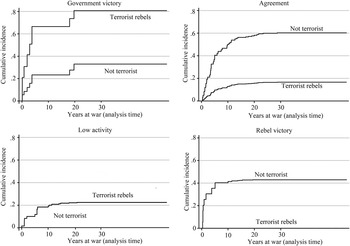
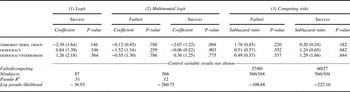
I also test these hypotheses with a competing risks model.Footnote 104 As before, I control for potentially confounding variables such as relative rebel strength, democracy, etc. The results, presented in Table 5, indicate the same pattern as the multinomial logit. The reported subhazard ratios are, as in Table 2, interpreted relative to 1; those significantly less than 1 indicate variables associated with a lower risk of each war outcome, those greater than 1 with a higher risk. This analysis indicates that the use of terrorism increases the risk of government defeat by more than four times. Unlike the multinomial logit results, this effect is statistically significant. Terrorism has no appreciable effect on the likelihood of war fizzling out. Meanwhile, the use of terrorism reduces the likelihood that rebels reach a negotiated agreement by 80 percent, and given that there are no cases of rebel victories by terrorist rebels, the competing risks model predicts that terrorism reduces the chance of a rebel victory to zero;Footnote 105 both results easily pass tests of statistical significance. In other words, I again find strong support for H1 and H2.Footnote 106
Terrorism and war outcomes (competing risks)

Note: Robust standard errors (clustered by country) reported in parentheses.
Figure 6 shows the results of the competing risks analysis graphically, plotting the cumulative incidence rate of each outcome over time for terrorist and nonterrorist rebels, holding other variables at their mean or modal values.Footnote 107 As can be seen, the incidence of the best outcomes for rebels, negotiated agreement and rebel victory, are lower for those who resort to terrorism, whereas the worst outcome, government victory, is higher for terrorist rebels. In sum, rebel groups who deliberately and indiscriminately kill civilians are, all else equal, much less likely to win outright or to achieve concessions in the form of an agreement than are nonterrorist rebel groups, but are no less likely to fizzle out or be defeated rather than to live to fight another day.Footnote 108
Terrorism and war outcomes (competing risks)

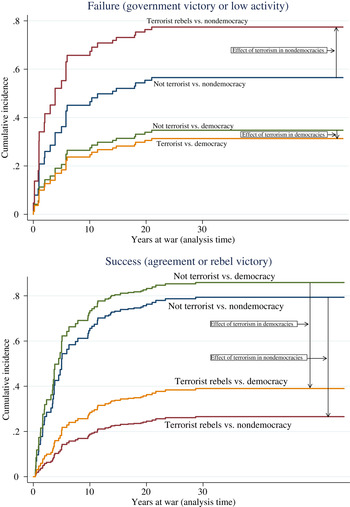
I turn, finally, to analysis of the relative effects of terrorism against democratic and nondemocratic governments. An initial look at the cases is consistent with H4; of the terrorist rebel groups that succeeded in reaching a negotiated agreement, three out of four fought democratic governments.Footnote 109 Because there are relatively few cases of civil war in democracies (the government is democratic in a third of the observations in these data), it is difficult to examine the finer-grained distinctions among war outcomes. I therefore combine the two best outcomes for rebels (“success” here consists of rebel victory and negotiated agreements) and the two worst outcomes (“failure” combines low activity and government victory). An interaction term between terrorism and democracy allows us to see whether terrorism is more effective against democracies. Table 6 presents the results of logistic regression in which ongoing wars are dropped from the analysis (Model 1); a multinomial regression of these two categories compared with ongoing war (Model 2); and a competing risks model of these combined outcomes. These models include the same controls as previous analyses (control variable results not shown in the interest of space).
Effectiveness of terrorism against democracies

Note: Robust standard errors (clustered by country) reported in parentheses.
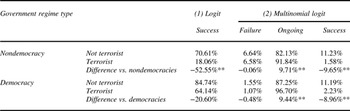
In all of these models, the negative effects of terrorism on rebel success are reduced in democracies, as H4 suggests; however, the size and statistical significance of the difference in effect depends on the model. The coefficients and subhazard ratios for terrorism capture estimated effects against nondemocracies and are consistent with the findings reported here.Footnote 110 The coefficients and subhazard ratios for the interaction term must be interpreted along with the base term for democracy.Footnote 111 Results for the logit and multinomial logit are easiest to see in the predicted probabilities reported in Table 7. In the logit model, the use of terrorism is associated with a statistically significant 53 percent decrease in the probability of success when the government is nondemocratic, but only a (no longer significant) 21 percent decrease against democracies. In the multinomial logit model, the reduction in the probability of success associated with terrorism is much less stark: from 10 percent against nondemocracies to 9 percent against democracies.Footnote 112 The competing risks analysis results are most easily seen in the cumulative incidence functions plotted in Figure 7. The top graph shows an increased incidence of failure when terrorist rebels fight nondemocracies (top two lines), but little substantive difference in the incidence of failure between terrorist and nonterrorist rebels when the government is democratic (bottom two lines). The bottom graph reveals that although terrorism reduces the incidence of success against both types of government, the gap is slightly, but not markedly, larger against nondemocracies than against democracies.
Terrorism and democracy (competing risks)

Effectiveness of terrorism and democracy (predicted probabilities)

Note: **Difference significant at the p < .05 level.
I thus find only mixed support for H4 overall. The negative effects of terrorism are smaller against democracies, but not always significantly so. Terrorist rebels may be somewhat more likely to succeed against democratic governments than nondemocratic governments, but they are still less likely to succeed than rebels who do not use terrorism.
Conclusion
Research on terrorism has exploded since 2001 for obvious reasons. However, the ability of this literature to answer fundamental questions has been hampered by a lack of variation on the phenomenon. This project uses variation within civil wars, namely the fact that some rebel groups use terrorism whereas others do not, to help resolve the debate about the effectiveness of terrorism.
I argue that when it comes to achieving a rebel group's political goals, the disadvantages of terrorism generally outweigh its advantages. It is a cheap way to inflict pain on the other side, and terrorist groups are hard to eliminate completely, but it is useless for taking or holding territory. It may help signal commitment to a cause, but because it is cheap, it signals weakness rather than strength. It may be useful for provoking an overreaction by the government, but it also helps justify draconian measures to crush the rebellion. Its outrageous nature may help bring attention to a cause, but it also undermines legitimacy and alienates potential supporters. Terrorism may help achieve tactical results, but these apparently do not translate into strategic success. It may also be useful at lower levels of conflict or for groups that do not have the ability to wage full-scale war (a question I cannot yet address with available data). Empirically, I find much more support for the argument that terrorism is likely to backfire than for the notion that it is effective. Rebels who use terrorism do not win outright, and they are less likely to achieve concessions in a negotiated outcome. This negative effect may be somewhat attenuated when rebels fight against democracies rather than autocracies. But even in democratic states, terrorist rebels groups do not achieve victory and are unlikely to obtain concessions at the negotiating table. The short answer to the question “Do terrorist rebels win?” is “No.”
If terrorism is so ineffective, one might reasonably ask why rebel groups use it, especially rebels who are not fighting democratic governments.Footnote 113 The answer may lie in the finding that civil wars in which terrorism is used last significantly longer than others. The use of terrorism contributes to rebels' organizational survival. Rebels thus appear to face a dilemma—using terrorism as a tactic is good for the immediate goal of survival, but comes at the expense of the long-term political goals for which they are, ultimately (or ostensibly) fighting.
This study begins to shed light on the causes of terrorism, as well as its effects. I examine this question only briefly in this article, focusing on variables that might also affect war outcomes, to avoid spurious results. The results are intriguing, however. They cast doubt on the conventional wisdom that terrorism is a “weapon of the weak.” Among rebels fighting full-fledged civil wars, there is surprisingly little evidence that weaker groups are more likely to use terrorism than stronger ones. Nor is terrorism more likely, again contrary to conventional wisdom, in secessionist wars, or when rebels profess extreme aims. Terrorism is more likely, however, in civil wars in democracies, as many have argued, and where religion divides rebels from the government they fight. It is much less likely to be used in Africa, a finding that remains to be explained theoretically. Expanding the analysis of why some groups turn to terrorism whereas others do not is an obvious avenue for further research.
Extensions of this study to further our understanding both of where terrorism arises, and how successful it is, will require new data. Data are currently available for only a relatively short period (1989–2004) and for full-fledged civil wars. Extending the analysis temporally before the end of the Cold War and to include more recent conflicts, and especially to lower level conflicts will strengthen the analysis, and in particular allow fuller testing, for example, of the notion that terrorism is a “weapon of the weak.”Footnote 114 Further research is also needed to establish how rebel groups navigate the tradeoff between organizational survival and politically efficacy.
In the meantime, the empirical evidence presented in this study suggests that terrorism is likely to be a persistent problem—elongating the destruction and suffering that civil wars entail—but not a potent force for political change. Terrorism may help rebel groups survive, but it does not help them get what they want politically.
Appendix
The Cases. (government vs. rebels & year ended)
Supplementary Material
Supplementary material for this article is available at http://dx.doi.org/10.1017/S200281831500089.