Nothing we have seen is a greater challenge to the peace and stability of African societies than the epidemic of AIDS […] We face a major development crisis, and more than that, a security crisis.
James WolfensohnFootnote 1Introduction
On 10 January 2000, the then US Vice-President Al Gore chaired a landmark Security Council Meeting devoted to the security impact of HIV/AIDS in Africa. It was the first time in the history of the UN that an issue related to health rather than the military had been considered a potential threat to international security. Following the January 2000 meeting, national governments adopted a number of high-profile declarations of commitment and multilateral agreements. These documents articulated ideas, policy principles and norms, aiming to tackle the emerging threat of HIV/AIDS. By this time, HIV/AIDS had placed itself firmly in the international security agenda.
The present article is focused on the impact of this singular international phenomenon, namely the global securitisation of HIV/AIDS, on the domestic structure of three African states: Botswana, Mozambique and South Africa.Footnote 2 These countries are geographically located in the epicentre of the global HIV/AIDS epidemic, Southern Africa. However, notwithstanding their common HIV/AIDS burden, Botswana, Mozambique and South Africa present fairly different political cultures/identities and social institutions which reflected upon the distinctive way they responded to the influence of international HIV/AIDS actors and norms. So, by investigating the latter's impact in these rather diverse settings, this article aims to empirically evaluate variations in the effects of norm adaptation across states. It addresses three interrelated questions:
1. What explains the similarities and differences in the effects of international HIV/AIDS norms on the conduct of these Southern African states?
2. What are the policy outcomes resulting from the interaction between the international proponents of the securitising of HIV/AIDS and their domestic audiences in Botswana, Mozambique and South Africa?
3. To what extent have HIV/AIDS securitisation attempts been more successful in one domestic setting than in another?
In response to these questions, I present three models of state reaction to the securitisation of HIV/AIDS found in the three empirical cases: 1) the model of active engagement exemplified by Botswana; 2) the model of instrumental acceptance pursued by Mozambique and, finally; 3) the model of ideological resistance illustrated by the South African case. These archetypes are analytical simplifications of the socialisation outcomes identified in each of the above case studies. Through their examination, this article hopes to demonstrate that the widely used notion of ‘Sub-Saharan Africa’ (or more specifically ‘Southern Africa’) poorly reflects the diversity of policy responses and local interpretations of HIV/AIDS. I argue that, despite a certain level of pre-colonial/colonial homogeneity and a densely intertwined post-independence regional history, Southern African states have developed very distinct national characters. This is more evident in the case of Mozambique, due to the distinctive influence of Portuguese colonialism, Marxism-Leninism, civil war and (internationally-driven) post-conflict reconstruction in the formation of its national ethos. However, it is also true in the cases of Botswana and South Africa, in spite of their similar colonial backgrounds and shared regional past. The approach of the British colonial power to the ethnically homogeneous and politically stable protectorate of Bechuanaland (currently Botswana) differed significantly to that which was applied to the racially divided and fiercely disputed region which is now South Africa. Contrasting with Botswana's case, racial strife between the Boer white supremacists and the indigenous black population played a fundamental role in understanding South Africa's history and politics. These historical differences had an enormous impact on the formation of these states' particular political cultures and social configurations.
The HIV/AIDS securitisation norm (HASN) – a conceptual framework for understanding the global securitisation of the epidemic
In a previous study, I argued that international HIV/AIDS norms – or ‘standards of appropriateness’Footnote 3 – have changed considerably since the early 1980s.Footnote 4 I showed how these cognitive maps evolved from an early biomedical, and then developmental approach, to one based on the securitisation of the epidemic. Drawing upon a new theoretical synthesis between the constructivist literature on international norms and the securitisation scholarship, I then developed an argument in which it was ultimately claimed that the global securitisation of HIV/AIDS became embedded in the international normative/policy understandings about the epidemic. In the following, this article elaborates on the analytical framework of the HIV/AIDS securitisation norm (from now on HASN). This framework will subsequently guide my analysis of the domestic incorporation of HASN in Botswana, Mozambique and South Africa.
The advocates of the securitisation model, as articulated in the works of the so-called Copenhagen School,Footnote 5 built on the speech-act theoryFootnote 6 to understand how securitising actors engage in argumentative practices to convince (socialise) audiences about the threatening character of a particular issue. Consistent with Austin's early formulations, Wæver and his Copenhagen colleagues pioneered the definition of security as a form of speech-act. For him, the utterance of security entails the claim that some issue represents an existential threat to a valued referent object and that the exceptionality of the threat would justify extreme measures to deal with it. Therefore, to label something in security terms is nothing more than a discursive articulation in which social/political actors try to inculcate a particular quality (threat, emergency, etc.) into an issue. In this regard, securitisation, as an analytical concept, is a very helpful tool in unfolding processes whereby issues are moved from the realm of normal politics (politicisation) to that of emergency (securitisation). The securitisation framework is used here as a theoretical device with which the author traces incidences of securitisation towards the HIV/AIDS epidemic at the system level and in the domestic structure of the three case studies.
International norms can assume various forms and most of them fall in the realm of politicisation. This means that they are in general part of normal public debate and policy decision-making and do not represent an urgent matter requiring actions outside the usual political procedures. However, depending upon circumstantial changes, issues can be moved further up in the list of policy priorities, requiring a special type of politics and increased allocation of human and material resources. The HIV/AIDS epidemic is an interesting example, whereby an issue has been gradually moved from the politicised to the securitised category. In this sense, one can say that the process of constituting international security norms is analogous to the image of a pendulum that swings from politicisation to securitisation and vice versa in terms of the perceived levels of urgency and threat that are allocated to a specific issue. In the case of HIV/AIDS, the pendulum has already swung from politicisation to securitisation and, as long as the disease is eventually controlled, it can move back to the sphere of politicisation.Footnote 7
Conceptually, HASN is divided in two integrated parts: 1) one that defines the idea of HIV/AIDS as a security issue, which presupposes rights and obligations (norm); and 2) one which prescribes the right policies to be implemented at the international, regional and national levels to combat the threat posed by the epidemic (rule). In this respect, one can say that the (international) norm is deterministic in terms of defining a unique and uncontested understanding of what the HIV/AIDS epidemic is and also normative in the sense of knowing what are the supposedly best policies to be put in place by states. In this regard, it is important to note that my use of norm is broadly analytical. It refers to the appreciation of the (almost) consensual agreement by governments, IOs and NGOs that HIV/AIDS indeed represents a special type of emergency and that governments should implement the internationally devised best practices to fight the epidemic.
The explicit and tacit rules/norms/principles governing HASN were consolidated in successive conferences where states' representatives met and reached agreements intended to foster a particular understanding of the global epidemic. In these conferences, the signatories of joint declarations agreed upon general principles, identified specific recommendations for state behaviour and established decision-making procedures at the multilateral and state levels. The Declaration of Commitment issued at the UN General Assembly Special Session on HIV/AIDS (UNGASS), in June 2001, and its follow-up, in May/June 2006, are watershed documents in this regard.
The UNGASS meeting of 2001 was preceded by two key high-profile summits which firmly introduced the notion of HIV/AIDS as a security problem and urged governments to act accordingly. In December 2000, HIV/AIDS was the theme of the African Development Forum (ADF), held in Addis Ababa, Ethiopia. The overall objective of this ADF meeting was to increase HIV/AIDS awareness among state leaders and increase their level of commitment to face the impact of the epidemic on Africa's development. In April 2001, African states met in Abuja, Nigeria, to discuss the special challenges posed by HIV/AIDS. On this occasion, the security implications of the HIV/AIDS crisis in Africa were more clearly acknowledged as a means of further influencing donor states and global governance structures to move towards the securitisation of the epidemic. The resulting Abuja Declaration of 27 April 2001 was endorsed by all fifty three members of the Organisation of African Unity (OAU). They jointly declared that HIV/AIDS ‘[…] is not only a major health crisis but an exceptional threat to Africa's development, social cohesion, […] as well as the greatest global threat to the survival and life expectancy of African peoples […]’.Footnote 8
As part of the agreements set up at UNGASS, the establishment of the Global Fund to fight HIV/AIDS, Tuberculosis and Malaria, represented a substantial step towards the actual implementation of HASN. The fund was formally established in 2001 by the UN and the G8 group of industrialised nations as the global war cashbox against the three most serious epidemic diseases in the world. Most developed and some middle-income states have established bilateral assistance mechanisms for assisting national HIV/AIDS plans in poor countries. Initially, these initiatives were located in classic foreign aid agencies, such as Britain's Department for International Development (DFID) and the US Agency for International Development (USAID). With the introduction of the Global Fund, some of these states have shifted a large share of (in some cases most of) their financial assistance to the Fund. The Global Fund is an unprecedented case of comprehensive multilateral action to finance the global fight against the three main global killers, namely malaria, tuberculosis and HIV/AIDS.Footnote 9
From 2001 onwards, HASN became permanently infused into the international normative understandings of the epidemic. With the signature of the UNGASS Declaration of Commitment ‘a critical mass of states’Footnote 10 embraced the new norm proclaiming the securitisation of HIV/AIDS. At the global level, three main securitising actors were involved in the promotion of HASN, namely the UNAIDS, the US Government (notably under George W. Bush's administration) and transnational networks of NGOs working with HIV/AIDS. These agents have strong and quite frequently contested views on appropriate behaviour in responding to the epidemic. These normative contestations are very important elements in understanding the social and political makeup of the HIV/AIDS Securitisation Norm.
UNAIDS
In the foreword of UNAIDS' 2004 Report on the Global AIDS Epidemic, Dr Peter Piot, the executive director of UNAIDS since its creation, assertively affirmed that ‘as our report indicates, we know what works’. Piot's confidence on the guiding role played by UNAIDS is based on this organisation's unmatched capacity to acquire comprehensive global information and technical expertise on the evolution of the HIV/AIDS epidemic. This factor alone becomes an important institutional asset in terms of building its legitimacy as a global norm leader or, employing Foucault's terminology, as an institution of truth.Footnote 11
In very sensitive and complex issue-areas in which international policy coordination is needed, policymakers must rely on the advice given by recognised epistemic communities, including authoritative multilateral institutions that are capable of globally providing and disseminating information. This dependency upon international sources of expertise is even greater in states lacking the capacity to produce local knowledge about issues, as in the case of many developing states. This type of technical/bureaucratic authority on HIV/AIDS confers UNAIDS with a great deal of symbolic power Footnote 12 to influence states' national policies as well as allowing it to spread that power on a global scale.
In this respect, Barnett and Finnemore observed that ‘even when they lack material resources, IOs exercise power as they constitute and construct the social world’.Footnote 13 The authors resorted to Weberian assumptions about how bureaucracies produce and use knowledge to develop a constructivist approach to think of the role of IOs as autonomous and powerful non-state actors in world politics. Their claim about the important agency role of IOs offers an alternative approach to traditional perspectives. These conventional views see them exclusively as static structures, which are either an institutionalised representation of the balance of power logic between states (neo-realists) or used by them to maximise the benefits of collective action (neo-liberals). According to Mearsheimer, for example, ‘what is most impressive about international institutions is how little independent effect they seem to have had on state behaviour’.Footnote 14
The present study argues that IOs, in general, and UNAIDS, in particular, embody elements of agency and structure pointed out by both schools. It agrees with the constructivist assumption that the power of IOs derives from their capacity to produce autonomous knowledge and promote normative change. Since its creation, UNAIDS has led the global response to HIV/AIDS, defining new concepts and policy priorities that are adopted widely by states and non-state actors alike. In this sense, unlike the (neo) realist view, UNAIDS' behaviour cannot be seen simply as the result of a compromise between its powerful member states. Rather, it produces a kind of autonomous social/scientific interpretation that has proven strong enough to suppress other competing views concerning the epidemic.
Following its creation, in the mid 1990s, the UNAIDS did not articulate a unified message concerning the security threat posed by the global epidemic. At this early stage, both researchers and high political authorities had not yet fully recognised, either through systematic scientific work or international policy debate, the potential impact that the epidemic could have on global security. The UN system at the beginning of the 1990s was going through a process of normative adaptation to the new post-Cold War international order. The transformation in the meaning of security was an integrative part of these changes. The UNDP, not accidentally one of the UNAIDS cosponsors, took the lead in 1994 by formulating and adopting the idea of human security as a core principle in promoting peace and development after the end of bipolarity. The expanding international acceptance of the concept of human security as a viable alternative to the national security logic of the Cold War resonated with pre-existing interpretations of HIV/AIDS. The human security perspective attracts attention to issues directly related to the impact of the epidemic, such as poverty, famine, social instability, etc. The renaming (or reframing) of HIV/AIDS in terms of human security can be partially seen as the result of these broader normative changes in the understandings about security.
The definitive turn in the language used to name, interpret and dramatise HIV/AIDS took place only in the late 1990s. During this period, a growing circle of high profile politicians, transnational activists, and academics began consistently to make it clear that, indeed, the global HIV/AIDS epidemic was a serious threat to security.Footnote 15 From that point onwards, the UNAIDS embedded this view and started to take the securitisation of HIV/AIDS as a teaching mission, whereby this organisation would work to supply states and other HIV/AIDS actors with information about the best HIV/AIDS policies and organisational practices at the state level.Footnote 16
For example, in April 2004, the UNAIDS sponsored discussions in Washington among governments of affected countries, key donor states and multilateral organisations, aiming to achieve further international harmonisation on the HIV/AIDS global response. As a result of those talks, the participants agreed upon a set of guiding principles that became known as ‘The Three Ones’. Basically, ‘The Three Ones’ is a blueprint of general policies to be implemented by all governments affected by the HIV/AIDS epidemic. Its strategic message is for donor states, multilateral agencies and governments affected by HIV/AIDS to coordinate their response to the epidemic within a single normative and institutional framework.
Each of the three basic pillarsFootnote 17 of the ‘The Three Ones’ is constituted by other principles for national authorities and their partners to follow. These principles are offered to states as a basis for optimising their national responses and improving coordination among all the actors involved (UNAIDS, 2004b). Shortly after the 2004 meeting, UNAIDS started to engage with other leading states in building commitment towards the fulfilment and wide adherence to these improved standards for state behaviour. Within the agreement that led to the adoption of ‘The Three Ones’, UNAIDS was recognised as the main facilitator between stakeholders as well as the institution with the responsibility of monitoring its implementation by national governments.
What the above suggests is that UNAIDS is a primary source of norm creation and diffusion by virtue of its widely recognised authority to orient and coordinate state and non-state actors towards the best policies to face the HIV/AIDS threat. Nonetheless, the constitution of what is referred to here as HANS is not only the work of an autonomous bureaucracy with knowledge claims about the epidemic. It is also the result of the interaction between powerful Western governments, namely the US government, and transnational networks of HIV/AIDS activists who operate strategically both inside and outside the institutional structure provided by UNAIDS. Their political agendas can contain shared as well as conflicting understandings about HIV/AIDS. This chapter will now explore the role played by some of these actors in the process of HASN formation as well as the political contexts within which they operate.
The US government
In 1999, the Bill Clinton administration designated the global HIV/AIDS epidemic a threat to the security of the US. It was the first time that a US President had provided such a designation to a disease. Clinton's decision followed the release of an influential report produced by the US government's National Intelligence Council (NIC) on ‘The Global Infectious Disease Threat and Its Implications for the US’. This document described in detail the direct and indirect impact that the HIV/AIDS epidemic could have in the US and global security in the next 20 years.
Following the more aggressive approach of the international community to HIV/AIDS, the US administration stepped up its involvement in the global response to the epidemic. The President's Emergency Plan for AIDS Relief (PEPFAR) was launched in January 2003 by the US President, George W. Bush. It is a unilateral initiative of the US government which had a great impact in the global response to HIV/AIDS. The Plan is the largest global intervention of a single state to fight HIV/AIDS. Its contours were established by the US Leadership against AIDS, Tuberculosis and Malaria Act of 2003. Among other things, the Plan involves large-scale HIV preventive efforts based on behaviour change that follows the ‘ABC’ model (Abstinence, Be faithful and Condoms, in that order of priority). Although it was not the main focus of the plan, treatment with ARVs was also included as a complementary way to enhance prevention efforts by motivating patients to be tested.Footnote 18 In fact, abstinence-until-marriage programmes are the cornerstone of the Plan, receiving a substantial share (33 per cent) of the HIV prevention funds.Footnote 19 Despite the US active investment in the formulation and adoption of multilateral arrangements, such as ‘The Three Ones’, the UNGASS, and the Global Fund to Fight HIV/AIDS, Tuberculosis and Malaria, PEPFAR works mainly through bilateral aid programmes with target states.
Since the launch of the plan, the Bush administration has redefined its HIV/AIDS global strategy in terms of three main axes. The first axis keeps the traditional foreign aid approach through the activities developed by the US Agency for International Development (USAID). Here, the links between the US government and domestic NGOs with a transnational impact, which specialised in global HIV/AIDS relief and advocacy (mostly faith-based organisations), are more clearly perceived. Faith-based organisations have been implementing HIV/AIDS policies and programmes for USAID for decades. Their strategic partnership has been constituted as a fundamental mechanism for the US government's penetration in the domestic structure of the states afflicted by the epidemic.
The second axis explores the multilateral track. It operates mainly through the participation of US officials in key decision-making structures of international bodies, such as UNAIDS, the World Bank and the Global Fund. Financially, these multilateral bodies rely heavily on the support of the US. For example, from 1995 to 2005, the US government contributed US$ 182,390,000 to support UNAIDS' policies and programmes. This amounts to more than 20 per cent of the total contributions during this period, making the US the principal sponsor of this organisation.Footnote 20 The Global Fund is also very dependent on US funding. The US government committed US$ 2.5 billion to the Fund for the period 2001–2008 which represents 30 per cent of all the money pledged by states.Footnote 21 These numbers are far from impressive nonetheless if compared with the US expenditure on bilateral programmes run by USAID. In fact, the ten years (1995–2005) of US contributions to UNAIDS corresponds to just a small fraction (less than 10 per cent) of what the Bush administration spent on HIV/AIDS bilateral programmes for the year 2004 alone.
Finally, the third axis, and the largest, is PEPFAR. The Plan is run from the State Department by a Global Coordinator, Randall Tobias, also dubbed the AIDS Czar. Tobias' Office is hierarchically on top of all the other HIV/AIDS structures in the US government. He reports directly to the Secretary of State, Condoleezza Rice, who oversees the Plan's progress. Its management is part of the overall national security apparatus of the US government. As Garret notes, ‘[PEPFAR] is located inside the State Department, where its mission is defined in both foreign aid and national security terms’.Footnote 22 The plan targets five key areas, prevention by sexual abstinence being the number one priority.
USAID, the US diplomatic representations and the US Center for Disease Control and Prevention (CDC) are the key actors in charge of managing PEPFAR in target states. Institutionally, USAID has several advantage points given its geographical reach, well-developed infrastructure, and extensive experience in providing HIV/AIDS assistance to developing states in Africa and elsewhere. The US Embassies are, in general, the headquarters of PEPFAR within states and the US Ambassador the frontline commander in the war against the epidemic. The CDC is an important actor in terms of its international recognition as an alternative source of policy guidance to national governments fighting HIV/AIDS. It is the most important agency in the US government for providing health information and improving public health through scientific research. It works in cooperation with governments throughout the world, advocating particular HIV/AIDS policies and strategies. As shown later, the introduction of a new (and more controversial) HIV testing policy in Botswana was, to a large extent, the result of CDC's influential role vis-à-vis the Botswana's government.
The motivations behind the President's HIV/AIDS Plan are mixed, nonetheless. Within the North American establishment, rhetorical security articulations concerning HIV/AIDS are continually interacting with other ideational and material foreign policy interests. Depending on the political circumstances of their interaction, they can either reinforce or contradict each other. For example, as part of PEPFAR, USAID is working on a complex system to purchase AIDS drugs and distribute them to 2 million people by 2008. It will be the biggest international aid scheme in USAID's history, with the release of US$ 7 billion from PEPFAR to be used on AIDS drugs and related services.Footnote 23
However, expensive patented drugs mostly from North American pharmaceutical companies are to be used in this program. Referring to concerns with drug safety, the US government has been putting up extra barriers to buying cheap generic drugs from developing countries, namely India and Brazil. The alleged links between the US Executive and pharmaceutical corporations has raised suspicion among governments, transnational AIDS activists and multilateral institutions about the real agenda of PEPFAR. Moreover, in the 15 countries included in Bush's global HIV/AIDS programme,Footnote 24 development agencies and NGOs fear that the huge parallel structure put in place by USAID will duplicate pre-existing systems for the management of HIV/AIDS funds and projects, such as the abovementioned ‘Three Ones’. The problem is that PEPFAR's management strategies have been neglecting these multilateral mechanisms, bypassing National HIV/AIDS Councils and other established country coordinating structures.
The influence of evangelical Christians in the President's decision to set up a HIV/AIDS global plan should also be added to the equation. Influential evangelical lobbying groups are behind the selective way the money is allocated to HIV/AIDS programmes in target states. Religious conservatives, including not only Protestants but also traditionalist Catholics and Jews, are the most loyal supporting base of President Bush's Republican Party. The powerful influence of religious right wingers goes deep into the US Congress as well as into the Judiciary and the Executive. As a result of their strong lobby, at least one third of PEPFAR's US$ 15 billion is earmarked for projects that stress abstinence until marriage as the primary preventive measure against the epidemic. In states financially supported by the US, assistance to HIV/AIDS programmes is attached to these moral strings.
Building on the above analysis, one could understandably argue that conflicting worldviews between secular pragmatism and religious morality undermine the understanding of HASN as a single and bounded community of knowledge. However, this article suggests that, rather than falsifying the conceptual relevance of HASN, this sort of dialectic engagement between its moral and pragmatic understandings reveals interesting empirical dynamics of norm formation and socialisation at the level of the international system. In the same manner, the dynamic interaction between ethical, technical and economic arguments with regard to the worldwide provision of AIDS treatment is also part of the wider intersubjective social processes that originated what is referred to here as HASN. As the next section shows, transnational civil society groups are important channels for the communication of international HIV/AIDS norms from the system to the state level and vice versa.
Transnational networks of NGOs
Transnational HIV/AIDS activists are also very important instruments of HASN diffusion. Although often lacking material and economic power to make a difference, networks of activists promote norm change and adaptation by globally disseminating ideas, information and strategies.Footnote 25 Since the early 1990s, transnational NGOs with an interest in HIV/AIDS have increased in number and in the scope of their activities. In addition to their traditional ways of exerting influence, more recently they have been directly involved in the decision-making structures of important multilateral bodies, namely UNAIDS and the Global Fund. They are also important actors in promoting norm implementation at the state level.Footnote 26 By their participation in National HIV/AIDS Councils, by lobbying governments of Western states as well as by linking up with civil society groups at the grass-roots level, transnational advocacy networks engage in discursive practices with domestic actors. In participating in these social and political interactions, they aim to ultimately transform behaviour and policies to match international prescriptions.
However, despite their important contribution in opening up an alternative political space for the inclusion and dissemination of HASN, the role of transnational HIV/AIDS actors in global governance should be better contextualised. These networks are immersed in (and are constituted by) the larger power relations which underlie the normative makeup of HASN. This means that those groups have to operate in (and adapt to) an environment which is dominated by a complex grid of ideational and material forces. The engagement of transnational NGOs in HIV/AIDS activities is determined not only by their own self-defined missions but also by the terms lain down by international organisations and states, in particular UNAIDS, the US and other donors. The rhetorical strategies available to these advocates are therefore characterised by various political constraints. Yet, these limitations provide them with opportunities to mobilise resources and allies. As in a strategic process of framing,Footnote 27 they use the hegemonic grammar of the epidemic (security) to galvanise support and to talk the language that their transnational constituencies and patrons certainly understand.
The normative framework of HASN has been fractured by conflicting worldviews about HIV/AIDS. These views have ideologically divided the international community of HIV/AIDS activists into two main sets of organisations. The first and wider group supports a pragmatic and secular approach to HIV/AIDS and is aligned closer to UNAIDS and to most of the UN member states. The distinctive feature of these HIV/AIDS networks is that they seek to be widely recognised as an autonomous and legitimate political space for civil action regardless of either creed or ideological stance. They also stand for the scientific guidelines proposed by UNAIDS and WHO, regarding, for example, the promotion of condoms as the best prophylactic available to anyone to counter the spreading of the epidemic. Contrary to the US government's stance, they are also supportive of a treatment strategy focused on generic AIDS drugs instead of branded ones.
The International Council of Aids Services Organizations (ICASO) is one such organisation. Since 1991, ICASO has connected and represented HIV/AIDS NGOS networks from all five continents. Through its five regional secretariats spread throughout the globe, coordinated by a central bureau in Canada, ICASO brings the voices of community-based organisations from all over the world to the higher levels of decision-making at the state and multilateral levels. Their main arena of negotiation is under the institutional umbrella of UNAIDS' Programme Coordinating Board, in which it is one of the NGO sector's representatives, and the UN' Economic and Social Council (ECOSOC). They discuss internationally and try to apply nationally the outcomes of those debates by lobbying governments at the domestic level and by disseminating information to other networks of NGOs. ICASO is an interesting example of a transnational channel for the transmission of HASN that works in both directions, bringing ideas and experiences from the grassroots levels to the international system and also promoting policy outcomes emanating from the HASN decision-making centres back to the recipient states. Through widely exposing the actual or potential violations of HASN, ICASO also operates as a sort of watchdog of donor states' commitments towards the fight against HIV/AIDS.
The second group is formed by HIV/AIDS activists pursuing a different normative agenda. Either for instrumental or ideational reasons, these networks of NGOs associated themselves with the US government's global HIV/AIDS policies. Although holding the status of ‘non-governmental’, most of these organisations get money from the Bush administration's PEPFAR plan and either directly or indirectly they work to achieve its goals. In most of these cases, instead of using its own embassies and international assistance agencies, the US government takes on these networks to actually implement its HIV/AIDS policies abroad. The funds are allocated to them either directly by US government's agencies, such as USAID, or indirectly by multilateral agencies and other international partners.
Transnational networks linked to evangelical and right-wing religious sects are the most active advocacy groups promoting compliance with the HIV/AIDS principles of the US government. World Relief, World View, HOPE, CARE, Samaritan's Purse, Catholic Relief Services and Opportunity International are some of the North American based international Christian organisations that are very active in HIV/AIDS related projects. Each of them will receive around US$ 100 million from PEPFAR to develop HIV/AIDS projects in target countries. World Relief, for example, is subordinate to the US National Association of Evangelicals, which is formed by around 50 member denominations and hundreds of evangelical churches all over the US. World Relief's stated mission is ‘to work with, for and from the Church to relieve human suffering, poverty and hunger worldwide in the name of Jesus Christ’.Footnote 28
Additionally, there is a wide range of smaller international NGOs moving between the two groups. As the securitisation of HIV/AIDS got underway, they were attracted by the new funding mechanisms being put in place by the Global Fund and the US' PEPFAR. These organisations saw in the massive influx of cash to HIV/AIDS programmes an opportunity to ‘stay in business’ and expand their activities. Whatever humanitarian motives may have caused their creation, these NGOs have to generate surplus to stay active. This means that their financial needs sometimes precede any prior commitments with certain policy principles, as in the case of NGOs that are reducing their condom distribution programs to qualify for PEPFAR money.Footnote 29
Going beyond the idea that ‘transnational civil society actors matter’ in international politics, what the particular phenomenon of HIV/AIDS transnational activism shows is that these actors are not always autonomous sources of normative change in international relations. They can also be instrumentally coopted by powerful states interested in using them to advance their foreign policy objectives. Therefore, the puzzle here has been to empirically differentiate between the political agendas and policy processes of HIV/AIDS transnational NGOs from those of states and multilateral institutions. The above evidence suggests nonetheless that these boundaries are far from being unambiguous.
The policy ideas emanating from the global HIV/AIDS polity do not form a harmonious and coherent set of recommendations. They are on many occasions competing, contradictory and/or overlapping. PEPFAR's moral logic and the parallel (normative and bureaucratic) structure it put in place is the main source of conflict. The myriad of transnational HIV/AIDS actors with their sometimes chameleonic identities and alliances also add complexity to the understanding of HASN. As noted next, at the domestic level these transnational grievances unfold in distinct manners while interacting with local actors and their pre-existing belief systems and political cultures.
The Impact of HASN in Botswana, Mozambique and South Africa
The subsequent analysis provides evidences that sustain the hypothesis that the externally induced securitisation of HIV/AIDS (here called HASN) resulted in three models (or outcomes) of state reaction. Given their equally dramatic HIV/AIDS situation, Botswana, Mozambique and South Africa have been subjected to substantial pressure from the international community to securitise their HIV/AIDS epidemics.Footnote 30 Moreover, they are all major recipients of bilateral and multilateral aid to combat the epidemic, such as the Global Fund, the World Bank's Global HIV/AIDS Program of Action, and the US' PEPFAR. Despite this common international pressure, they present quite distinct colonial experiences, political cultures, and levels of economic development, which allows the present analysis to engage with a wide variety of domestic configurations.
Botswana: The model of active engagement
Botswana is the case of a well-established developmental state in Southern Africa. It presents a top-down corporativist system of state-society relations which have impaired the formation of an autonomous and outspoken civil society sector.Footnote 31 Since independence from Britain, in 1966, the consecutive governments of the Bechuanaland Democratic Party (BDP) have gradually built robust state institutions and an efficient system for the delivery of social services. The BDP has elected all three Botswanan presidents to date, Seretse Khama, Quett Masire and Festus Mogae. Its dominance derives from it being the party that peacefully led Botswana to independence and economic growth.Footnote 32
Due to Botswana's smooth transition from colonial rule, which helped to create a political culture friendly to Western values, HASN's leaders encountered a receptive political environment for the promotion of new ideas. Similarly, the (unusual for Southern African standards) ethnic and linguistic homogeneity of Botswana's society created the right conditions for the establishment of a strong national identity and the wide recognition of the BDP state as the legitimate representative of the interests of the Botswanan people.Footnote 33
Botswana does not have a long history of a strong civil society movement. It dates back to after its independence, in 1966, but since then civil society has grown very timidly in the country.Footnote 34 Bauer and Taylor, for example, assert that ‘the general consensus around civil society in Botswana seems to be that it has been “historically absent” in the country, only showing some signs of life from the early 1990s onwards’.Footnote 35 Botswana's model of democracy, based on a strong state bureaucracy driven by a well-established political elite, has undermined the thriving of an autonomous and vibrant civil society sector. Since independence, the government has controlled the growth of civil society organisations through incorporating them into the state's bureaucratic structures. According to Holm and Darnolf, ‘civil society exists as an extension of the bureaucracy rather than as a set of independent actors confronting politicians and civil servants’.Footnote 36 In this respect, the relationship between state and civil society actors in Botswana can be characterised as a top-down process in which the latter has become highly reliant on the paternalistic approach of the former.
This also applies to the HIVAIDS civil society sector. In Botswana, the challenges posed by the HIV/AIDS epidemic were conducive to the development and rapid growth of several local NGOs. However, due to Botswana's characteristic state-dominated domestic structure, they have had limited impact in policy-making. These organisations face challenges similar to those of other countries in Southern Africa. These include lack of resources, high staff mobility and shortage of technical and management professionals. Given these shortcomings, local HIV/AIDS NGOs have been either coopted by the state agencies they seek to influence or absorbed by transnational norm leaders with an interest in shaping HIV/AIDS policies. In both cases, local NGOs find themselves deeply constrained in their ability to independently affect the process and outcomes of decision-making.
Due to Botswana's centralised system of decision-making and a highly state-dependent civil society sector, the national executive, in particular the president himself, was a key target of the international and domestic promoters of HASN. In fact, the tipping point after which the domestic cascading of the norm occurs was only reached in Botswana with the election of Festus Mogae in 1999. In the time following his election, Mogae became fully engaged in promoting the securitisation of the epidemic. The domestic salience of HASN in Botswana was to a large extent due to Mogae's openness to transnational ideas. In this respect, his sympathetic stance towards Western-based knowledge of the epidemic, coupled with the need for coherent policy prescriptions in a perceived situation of crisis, are crucial elements in explaining the successful securitisation of HIV/AIDS in Botswana. Mogae's particular beliefs and perceptions of externally defined HIV/AIDS principles deeply influenced his policy choices. As seen in the forthcoming case studies of South Africa and Mozambique, when presented with similar external pressures to securitise HIV/AIDS, decision-makers can display quite distinct reactions. Acharya notes, for example, that ‘localization does not extinguish the cognitive prior of the norm-takers but leads to its mutual inflection with external norms’.Footnote 37 In the case of Botswana, key elements of Mogae's belief system and decision-making style shaped his sensitivity to the securitisation demands of international actors.
In contrast to the Marxist-Leninist and strong anti-colonial background of Thabo Mbeki, in South Africa, and Joaquim Chissano, in Mozambique, Mogae's worldview was informed by knowledge, values and concepts originated in the Western liberal community as well as in the lessons learnt from his country's smooth transition to independence. During his period abroad, Mogae was trained within the Western European tradition of political liberalism and welfare capitalism. He graduated in economics at Oxford University then served as governor for Botswana at the International Monetary Fund (IMF), African Development Bank and World Bank. From 1976 to 1980, he worked for the IMF in Washington DC. Mogae's professional socialisation within these multilateral bodies helped to shape his political identity, which would influence his future behaviour as Botswana's leader. His close links with these dominant Western institutions, which are often perceived as political instruments to legitimise and further perpetuate a type of global apartheid against disempowered African societies, set him aside from other southern African leaders, namely Thabo Mbeki, in South Africa, and Robert Mugabe, in Zimbabwe. Unlike Mogae, these former liberation fighters frequently defy Western hegemonic orthodoxies, which they identify as forms of neo-colonial interference in Africa. As seen later, Mbeki's combative stance towards mainstream knowledge about HIV/AIDS is an example of this.
Mogae's early conversion into a strong securitising actor led to the domestic salience of HASN and its consequent cascading throughout Botswana's domestic system. As a result, Botswana can be seen as a success story concerning international attempts to securitise HIV/AIDS in states with extremely high HIV/AIDS prevalence rates. This means that within Botswana's domestic system HASN has acquired ‘a taken-for-granted quality and are no longer a matter of broad public debate’.Footnote 38 Currently, HIV/AIDS is widely recognised by both the government and civil society as a real threat to the survival of Botswana as a viable nation. A clear sign of Botswana's full engagement with HASN prescriptions, the Botswanan government has declared HIV/AIDS a national emergency and, in 2002, it launched the first comprehensive plan on the African continent to roll-out AIDS drugs.
Transnational HIV/AIDS actors have played a significant role in Botswana as conduits of HASN's prescriptions from the international to the domestic levels. Through advocacy networking Footnote 39 and strategic coordination with local organisations, these groups helped to domestically embed the HIV/AIDS principles and policies, which were agreed by the national government in multilateral forums of negotiation. With the support of the US, faith-based groups were also important securitising actors while instigating, at the grassroots level, the moral agenda of transnational Christian associations. However, due to Botswana's state-dominated domestic system, with just a few entry points in the policy-making structures, the impact of transnational/domestic winning coalitions in changing the conduct of top decision-makers in the government has been fairly limited when compared with the more influential role played by the US government's agencies, powerful international donors and UNAIDS.
Notwithstanding Botswana's positive engagement with HASN leaders, with clear results in terms of the domestic securitisation of the epidemic, the particular manner in which Mogae's administration has been conducting the implementation of the norm's prescriptions reveals a preference for the principles and policy ideas supported by the securitising front led by the US government. For example, unlike Mozambique and South Africa, which have approved cheaper generic versions of many ARVs, Botswana adopted a national treatment plan based on the provision of expensive patented AIDS drugs. A public-private partnership between the Bill and Melinda Gates Foundation, the US pharmaceutical giant, Merck, and the Botswanan government (named ACHAP) was behind the government's decision to pursue a national treatment programme based on branded AIDS drugs.
Similarly, in 2003, Botswana became the first state in Africa to promote a bold paradigmatic change in its national response, while adopting routine HIV testing in all its public health facilities. This more unilateral form of monitoring the spread of HIV has been criticised by HIV/AIDS NGOs who are concerned with the human rights of people living with HIV/AIDS (PLWHA). The system of routine HIV testing is, in fact, a recommendation of the US' CDC without the full backing of UNAIDS and other important transnational HIV/AIDS actors. Concerning HIV/AIDS prevention, after the partial failure of the government's early strategy, which was in line with the WHO/UNAIDS programme of sexual education combined with the massive distribution of condoms, the US-sponsored ‘abstinence and faithfulness’ (AB) plan gained prominence in a revamped strategy to halt the spread of HIV among Botswanan youngsters.
These examples suggest that the persuasion strategies of the US have been more effective in the Botswanan domestic context vis-à-vis the approach of UNAIDS and its transnational allies. In this respect, the long-term collaboration between the US' highly-regarded CDC and Botswana's Ministry of Health (through the so-called BOTUSA project) played a fundamental role in building very strong institutional and knowledge-based bounds between the Botswanan and US governments in the area of public health. Additionally, the openness of the national government to negotiate with a wide range of international actors (free from the ideological constraints verified in South Africa) favoured the establishment of international/national partnerships such as ACHAP. Finally, the stability of Botswana's economy and political system, allied to the proactive and norm-friendly stance taken by Mogae's administration, attracted wealthy US donors, as in the case of the Bill and Melinda Gates Foundation, who were willing to invest generous resources in supporting the government's response to the epidemic.
Mozambique: the model of instrumental adherence
Mozambique is the case of an institutionally weak state in Southern Africa. Its colonial and post-colonial experiences were quite distinct from those of its regional neighbours. While in Botswana, for example, the transition to independence was peaceful and marked by the formation of a stable and representative political system, in the Mozambican case the Portuguese left behind a country destroyed by war and with a burdensome colonial legacy.Footnote 40
After independence in 1975, Mozambique was engulfed in a prolonged civil war that led to the destruction of the country's social fabric as well as its economy and state institutions. In the early 1990s, the internationally-led process of state-building created a stable, yet superficially established system of democratic rule. Despite the formal handover of power after the 1994 elections, the Mozambican government is still today highly dependent on external (technical and financial) support to run the country effectively and to exert its sovereignty rights.
During the colonial period, the exclusion of the indigenous people from any kind of political representation or from the expression of native views had an important influence in the political evolution of Mozambique after independence. The authoritarian legacy of the colonial power contributed to the formation of an unrepresentative form of political leadership in the post-colonial state based on an imported ideology, Marxism-Leninism.Footnote 41 By the time of independence, the idea of a Mozambican nation was alien to the majority of Mozambique's population (90 per cent illiterate and 97 per cent rural) who were integrated in ethnic clans as their universe of social and political allegiances.Footnote 42
The dynamics of HASN's penetration into Mozambique's domestic structure resembles more general understandings of African politics and society that regard the state as being deprived of effective sovereignty and functioning as a kind of ‘incubator’Footnote 43 for developing the dominant social group.Footnote 44 The ruling political elite, the Mozambican Liberation Front (Frelimo), has traditionally used its privileged position as the highest (indigenous) authority in the country to engage in tactics of extraversion Footnote 45 with international donors and other sources of development aid.Footnote 46 The use of political influence for private gain accelerated in the mid 1990s with the increase in international aid for reconstruction. In Mozambique, external dependence became a mode of political action. This is also the case concerning HIV/AIDS interventions.
In the Mozambican context, the securitisation of HIV/AIDS did not reach the tipping point in which full normative change occurs. The adoption of HASN was mostly circumscribed to the level of discourse without a clear commitment by the country's political elites with the norm's prescriptions. Given the Mozambican elites vulnerability to international pressures, they discursively engaged with securitising actors and appeared to be convinced by their arguments. However, notwithstanding Mozambique's full participation in all the multilateral agreements which claimed for the securitisation of HIV/AIDS, the government's strong words were not translated into effective action.
Despite Frelimo's formal declaration that HIV/AIDS represented a national emergency and the subsequent launch of a comprehensive national plan to fight the epidemic, HIV/AIDS activities are still today mostly centralised in the capital city, Maputo. Conversely, the rural areas controlled by the Mozambican National Resistance (Renamo) are the most affected by the epidemic.Footnote 47 In Renamo's traditional strongholds, the population has poor access to basic health facilities and in some places the government is conspicuous by its absence. In many cases, the provision of HIV/AIDS care and prevention services in those areas is delegated to international actors such as international NGOs and faith-based organisations without the involvement of the Mozambican government.
Mozambique's President Joaquim Chissano has shown an impressive capacity to adapt to new political circumstances over the years while simultaneously maintaining (or even improving) levels of international cooperation. A former devotee of Marxism-Leninism, Chissano has turned himself into an enthusiastic promoter of market liberalism in Southern Africa. This extreme ideological conversion is an interesting illustration of the pragmatism driving Frelimo's leadership since the socialist dream collapsed in the mid 1980s. Mozambique's accession to the exclusive group of Commonwealth states is a clear example of Chissano's political/ideological malleability. Despite Mozambique's Portuguese colonial heritage, Chissano successfully claimed Mozambique's membership in this Anglophone club of Commonwealth nations. It was mostly justified on the grounds that Mozambique had historically cooperated with the Commonwealth states against both the Rhodesian and Apartheid regimes and had paid a huge political cost as a result. In fact, Chissano believed that joining this prestigious organisation would bring economic benefits and significantly raise the country's international profile.Footnote 48
Similarly, the potential seriousness of the HIV/AIDS problem has been perceived by top leaders in the government as a comparative advantage, and used by the government to benefit from the massive global mobilisation of resources to fight the epidemic. In this sense, the imported ideas about the security implications of HIV/AIDS were reconstructed by Frelimo's elites to fit with pre-existing patterns of their relationship with external actors. In this way, it can be seen that the adoption of HASN's prescriptions by Mozambique's leaders was aimed at gaining outside support and relieving the state from both domestic and international pressure. The new Mozambican President, Armando Guebuza, the winner in the 2004 election, maintained Frelimo's traditional line of high-profile declarations of commitment to HASN followed by discrete leadership.Footnote 49
In Mozambique, the model of state corporativism inherited from Portugal and preserved by Frelimo hampered the establishment of strong local civil society groups with autonomous political agendas. Moreover, international NGOs' and multilateral agencies' effective monopoly of professional skills as well as material, logistic and technical resources has prevented the government's institutions and local civil society groups from pursuing any alternative to their imported programmatic agendas.Footnote 50 Local NGOs working with HIV/AIDS were usually either formed or coopted by international NGOs to direct the implementation of projects as if they were their ‘local partners’. In fact, they were merely local reproductions of the institutional formats, methodologies, and mandates of their international counterparts, which were totally unknown to the traditional forms of civil society organisation in Mozambique.
The government of Frelimo lacks national ownership of HIV/AIDS policies. The initiatives of the public and civil society sectors in tackling the epidemic are completely dominated by the agendas of powerful state donors, multilateral organisations and international HIV/AIDS NGOs. Due to Mozambique's poorly established indigenous NGO sector, transnational non-profit (both secular and religious) organisations play simultaneously the roles of domestic pressure groups and foreign development partners. Similarly, the National Council for the Fight against AIDS (CNCS), which is the HIV/AIDS state bureaucracy set up exclusively to deal with the security threat posed by HIV/AIDS, is heavily permeated by foreign individuals and institutions. In this regard, UNAIDS plays a central role in policy deliberation and agenda setting. Given the long-term presence of the UN in the country, UNAIDS has been a very influential actor in Mozambique. The very close institutional (and personal) relationship established between Frelimo's administration and the UN peace-building operation (ONUMOZ) consolidated the latter's position as a hegemonic institution of truth Footnote 51 within Mozambique's structure of decision-making.
The prominence of UNAIDS inside the Mozambican HIV/AIDS structures has somehow limited the US' capacity to influence policy-making. Contrasting to Botswana, in Mozambique the US pressure for a semi-compulsory and more aggressive system of HIV testing was blocked by the firmly established model of pre-counselling and voluntary testing devised and promoted by UNAIDS and WHO. The financial incentives of PEPFAR have nonetheless had a significant impact on Frelimo's policy orientations. This was demonstrated by the inclusion of a stronger emphasis on the (US-supported) ‘AB’ prevention strategy in the government's revised HIV/AIDS Plan for 2004–2009. With regard to HIV/AIDS treatment, the Mozambican government aligned closer with the UNAIDS camp to ensure that the securitisation machinery introduced by PEPFAR would not interfere in the pre-existing treatment plan based on generic AIDS drugs.
Despite being surrounded and permeated by powerful HASN leaders, Frelimo's ruling elites managed to negotiate the terms of HASN incorporation in the country. As shown in the cases of ARV treatment and HIV prevention policies, the government rhetorically (and skilfully) manoeuvred in between the normative and policy divide separating the US and UNAIDS with clear gains while advancing its own policy preferences. One could argue, in this regard, that the many years of experience in dependency politics have served the interests of Mozambique's governing party well while dealing with international sources of HASN diffusion.
Notwithstanding the partial failure of its cascading within Mozambique's domestic structure, the introduction of HASN into the political discourse of Frelimo promoted substantial change in the government's policy agenda. The fact that Frelimo's leadership formally embraced the internationally-proposed securitisation of HIV/AIDS means that this norm has been legitimised inside Mozambique's domestic politics. According to Cortell and Davis, for example, in these situations ‘the domestic debate shifts from being concerned with whether the norm is legitimate to one concerning why it should not be consistently applicable’.Footnote 52 Similarly, the establishment of the government's special agencies, such as the CNCS, devoted to the formulation and implementation of policies consistent with the tenets of HASN, is also indicative of its growing (yet still incipient) salience in the country.
South Africa: the model of ideological resistance
The difference between South Africa and the other cases discussed here is the legacy of the Apartheid regime and how social/racial fragmentation helped spread the virus as well as created huge ideological barriers to fight it. The defining impact of Apartheid in shaping the political culture of South African society is a key factor in understanding why some decision-makers, such as the President himself and the Minister of Health, have taken a rather deviant stance towards the HIV/AIDS epidemic. Those actors are embedded in social structures and norms that have a profound influence on their behavioural choices. In that sense, the examination of how the behaviour of individuals is influenced by their social milieu is fundamental in understanding the broader determinants of responses to the epidemic in the country.
In the South African political context, external norms concerning HIV/AIDS were framed (adapted) by political elites to meet the existing normative order based on the contestation of white/Western domination. In this sense, the characteristic of the South African decision-making system of power that is centralised in a few powerful individuals posed huge barriers to the securitising efforts of international HASN leaders. As analysed later, this led to tactical alliances with like-minded HIV/AIDS civil society groups within South Africa, aiming to bring about pressure to achieve domestic policy change.Footnote 53
South Africa is an exceptional case of (fairly) peaceful democratic transition to black majority rule after the country had been ruled by a racist white minority under the brutal regime of Apartheid. The new regime (referred to as the ‘Rainbow Nation’) was personified by the emblematic figure of the African National Congress (ANC), Nelson Mandela, who became the first black president of the democratic state. Despite the fond allusion to a rainbow to describe the multiracial and inclusive character of post-Apartheid South Africa, the country is still deeply burdened by the legacies of Apartheid. The South African society is, in many respects, as distinct and segregated along racial lines as ever, which leads to increased state-society tensions. This is clearly exemplified by the ardent black nationalism of most ANC leaders. Concerning HIV/AIDS policies, these tensions became apparent due to the racialisation of the epidemic by the country's political leadership. President Thabo Mbeki took a controversial stance while firmly contesting Western scientific knowledge about the epidemic. His rationale is primarily ideological and should be situated in a wider refutation of Western (white) views of Africa.
Mbeki's background of fighting white oppression against the black population deeply influenced his political choices while in the South African presidency, including decisions made in the area of HIV/AIDS. Recurrent themes in his speeches are references to the deep-seated legacies from the Apartheid era as a source of the social and economic problems faced by South African society. He regularly refers to the racial and colonial factors as underlying causes of conflict between political and social forces in the country and to the role played by Western governments in Africa.
Mbeki's interpretations of the HIV/AIDS epidemic in South Africa cannot be disassociated from the broader political context of South Africa's anti-Apartheid struggle and its (normative) legacies. For him, the epidemic exposes all the global disparities that threw the African continent into continued dependence. The South African president has been an outspoken critic of the unequal distribution of wealth generated by globalisation and the responsibility of developed states in perpetuating this situation.Footnote 54
In this respect, Mbeki's resistance to HASN entrepreneurship in South Africa can be understood in terms of a wider ideological contestation against the diktat of mainstream scientific knowledge and the resultant dogmatism of Western paternalistic solutions to the African problems. His speeches clearly echo widely held perceptions about the relationship between Africans and their former white colonial rulers. Responding to this historical legacy, Mbeki redefines both the common Western knowledge about the HIV/AIDS epidemic and what would be the appropriate responses to it. The HIV/AIDS epidemic was interpreted by the South African leader through the same mindset, which was the result of long-term historical and sociological processes.
The public support of the health minister, Manto Tshabalala-Msimang, to unconventional methods of HIV/AIDS treatment and prevention shows her disregard for widely accepted Western (white) orthodoxies about how to combat the epidemic. Similarly, rape charges involving former deputy president, Jacob Zuma, who was also the first chair of the National HIV/AIDS Council, are emblematic of the cultural mismatch Footnote 55 between local understandings about the epidemic and the mainstream (scientific) knowledge of international supporters of HASN.Footnote 56 These examples are interesting social constructions derived from intersubjective processes that are not grasped by rational accounts of human behaviour.
In South Africa, the internationally proposed securitisation of HIV/AIDS faced a domestic context permeated by strong racial divisions and a political leadership sceptical (even hostile) towards HASN entrepreneurs. Thus, the securitisation efforts of these actors failed to convince decision-makers in the government of the emergencial threat posed by the epidemic.
Both UNAIDS and the US government have faced significant obstacles in attempting to penetrate South Africa's structures of decision-making. UNAIDS has had more visible progress in this regard nonetheless. Despite fierce policy divergences, UNAIDS' Theme Group has managed to gradually establish some multilateral channels to improve communication between the government and the international partners, such as the Donor Communication Forum (DCF). Nevertheless, these channels have been circumscribed to the lower levels of policy-making without the engagement of the government's top leadership. This lack of effective communication has clearly undermined the socialisation attempts of the international HASN leaders based in South Africa.
The widespread (mis) representation of the US government as a new form of colonial/imperial power led to a certain degree of suspicion (even hostility) towards PEPFAR's HIV/AIDS initiatives in the country. The close links between Bush's administration and the pharmaceutical industry (for example, PEPFAR's Global Aids Coordinator, Randal Tobias, was a former chief executive officer (CEO) of the US pharmaceutical company Eli Lilly) were interpreted by ANC's ruling elites as a capitalist plot against black Africans. The US government's backing of the Pharmaceutical Manufacturers Association (PMA) in the court case against the South African government has also compromised bilateral relations in the area of HIV/AIDS policies.
The US recommendations concerning HIV prevention and testing have also faced persistent resistance within South Africa. Notwithstanding the engagement of a significant number of Christian organisations at grassroots levels, the ‘AB’ strategy was supplanted by the more pragmatic view of UNAIDS and its partners. Since very early on in the national response, both government officials and HIV/AIDS NGOs realised that deep-rooted gender imbalances in South African society would create significant barriers to abstinence practices of women and girls. According to HIV/AIDS activists, in this type of male-dominated social environment, the use of condoms would be more easily negotiated between sexual partners.Footnote 57 With regards to HIV testing, the US/CDC's lobby for the introduction in South Africa of routine semi-compulsory testing has also been fairly ineffective given the ANC's strong emphasis on the individual human rights of the South African citizens.
Transnational advocacy networks have been more successful than other securitising actors in promoting normative/policy change within South Africa's domestic structure. HIV/AIDS NGOs, such as the Treatment Action Campaign (TAC), aligned their political agendas with those of their transnational counterparts with significant results in terms of forcing the South African government to reassess its policy options. In 2002, for example, TAC sued the government given its refusal to roll-out ARV treatment (even after the advent of cheaper generic drugs). Despite the Mbeki administration's reluctance to accept the benefits of ARVs, the government was forced by the South African Constitutional Court to provide AIDS drugs through the public health system. Similarly, after 2002, Mbeki began to distance himself from the views of the so-called denialists.Footnote 58 This slight change in the confrontational language of South Africa's leader was due to the intense transnational/domestic mobilisation led by TAC. Through a global campaign of shaming Footnote 59 and sustained criticism against Mbeki's response to the epidemic, TAC managed to embarrass the government vis-à-vis the wider international community.
Although the actual cascading of HASN has not yet occurred within South Africa, there are clear signs that the engagement of the international and domestic community of HASN leaders has triggered some normative change in the country. Since October 2006, there have been significant changes in South Africa's HIV/AIDS policies away from its former contentious position. Under a revamped strategy, deputy president Phumzile Mlambo-Ngcuka has emphasised the importance of HIV/AIDS drugs and the unequivocal links between HIV and AIDS. Similarly, the deputy minister of health, Nozizwe Madlala-Routledge, has been leading an aggressive campaign against HIV/AIDS which has gather widespread support among HIV/AIDS civil society groups. The government has also sought to cooperate more closely with HIV/AIDS NGOs, such as TAC, and other international HASN leaders.
These recent moves towards the securitisation of HIV/AIDS point to an incipient depoliticisation of norm compliance within the South African establishment. Whether this process will eventually lead to the further cascading of HASN is still uncertain. In fact, Mbeki's controversial decision in August 2007 to remove Madlala-Routledge of her post, following a number of public clashes with the health minister over HIV/AIDS policies,Footnote 60 shows that the ANC government remains very active in its attempts to block HASN entrepreneurship within South Africa.
Conclusion
The main argument put forward in this article is that in the Southern African context similar transnational/international pressures for the securitisation of the HIV/AIDS epidemic had very dissimilar results in terms of domestic policy outcomes. In this respect, differences in the domestic social, political and cultural structures of the three case studies proved to be essential elements in understanding their distinct responses to HASN.
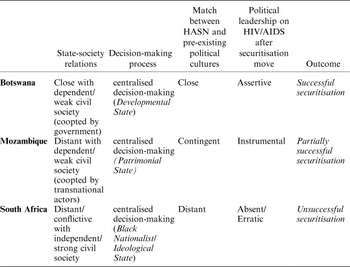
Moreover, the study identified the domestic conditions which either facilitated or hampered the successful transposition of HIV/AIDS from the area of politicisation (normality) to that of securitisation (exceptionality). Four main factors were identified: 1) the form of state-society relations; 2) the decision-making process (either centralised or decentralised); 3) the political culture of the three states; and, finally, 4) the personal characteristics of key leaders in the government.
Analytical variables and case studies

These findings are in line with some constructivist domestic structure approaches in international relations which produced research on domestic variation in state responses to international influences and norms.Footnote 61 It contradicts, on the other hand, structural explanations, whether realist or liberal, that do not account for domestic influences in state behaviour. It also disconfirms the (rather ethnocentric) notion put forward by some constructivist authorsFootnote 62 affirming the indistinctive universal effectiveness of socialisation processes across a wide range of domestic social and cultural systems. This view sustains that, given the intrinsic universal value of certain types of international norms (such as international human rights norms), violator states under similar socialisation pressure will eventually move towards positive change.
On the contrary, what the case studies revealed is that, depending on variations in the domestic structure of states, securitisation attempts can be integrally accepted (Botswana), instrumentally used (Mozambique), or totally rejected (South Africa). The article identified three models of state behaviour towards HASN, which corresponded to the particular domestic political processes of Botswana, Mozambique and South Africa. These models were, in fact, the actual outcomes of the securitisation attempts of international HASN leaders in each one of the three case studies. Therefore, the fully successful, partially successful, or totally unsuccessful securitisation of HIV/AIDS in Botswana, Mozambique and South Africa, respectively, were a function of both the argumentative (and other negotiation) practices between securitising actors and their audiences and the facilitating structural factors that shaped (and were shaped by) the social interaction among them.