Introduction
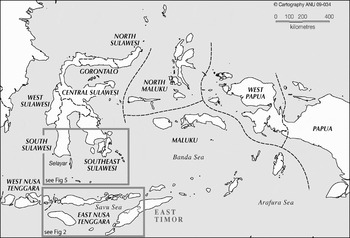
This paper explores the inter-communal relations in Oelua village, located on the northwest coast of Roti island, East Nusa Tenggara province. Here, Muslim maritime traders who are descended from migrant Bugis, Butonese and Makassarese reside together with indigenous Rotinese Christians. The homelands of the Bugis, Butonese and Makassarese are in South and Southeast Sulawesi, and each of these three ethnic groups have distinct cultural traits and languages, adhere to Islam, and have a long history of out-migration to other parts of Indonesia.Footnote 1 This is the first village study of its kind to examine the social and economic dynamics of a post-migration, mixed ethno-religious community in Eastern Indonesia (see Figure 1).Footnote 2 Harald Broch conducted a small study on the inter-ethnic relations in a village on Bonératé atoll in the Flores Sea.Footnote 3 Broch's study, based on fieldwork conducted in 1978, included migrants from mainland Sulawesi, and elsewhere in the region, and local Bonératé people. But both migrants and locals shared the same religion (Islam) and most migrants were swidden agriculturalists like the local population. While researchers have studied Bugis and Butonese long-distance sailing communities,Footnote 4 so far there are no published village studies on Bugis, Butonese or Makassarese people who have permanently migrated and settled outside their homelands as Muslim maritime traders. There are two ethnographic studies of Bugis migration, but these relate to Bugis agriculturalists, not Bugis seafarersFootnote 5 and a quantitative study of migrant Bugis traders in urban markets.Footnote 6
Eastern Indonesia, with boxed provinces relevant to this paper

To set up the theoretical framework of this paper, I begin with an analysis of the varying ways states have historically dealt with difference in the Malay Archipelago, and more broadly within Southeast Asia. I define states as the self-regulating units or polities of the western and eastern Malay Archipelago, the Dutch colonial state, and the modern nation state of Indonesia. All of these states display characteristics of plural societies, however, there are distinct differences in the space they have allowed for ethnic and cultural difference. In relation to contemporary states, I discuss the conflict and violence that has occurred between migrant and non-migrant groups of different ethnicities and religions since the late 1990s, in the period leading up to, and immediately after, the demise of the Suharto New Order regime. In this context, I examine how entrepreneurial migrant groups such as the Bugis, Butonese and Makassarese in their relations with non-migrant groups have been represented in government, academic and media discourses.
I then provide an historical overview of Christianity and Islam in the Eastern Lesser Sunda islands (now comprising Nusa Tenggara Timur or NTT province), where many multiethnic, Christian–Muslim settlements exist today, in urban centres and in scattered, rural, mostly coastal areas. My concern is with how two broad groups – Rotinese Christians and Rotinese Muslims – live together successfully with their differences in the village of Oelua. Using an ethnographic analysis, I discuss the ‘mechanisms of agreement across difference’ that have shaped and reproduced a low-conflict community. Following Marc Ross, I use the term ‘low-conflict’ rather than ‘harmonious’ or ‘peaceful’ as it suggests the notion of a continuum of conflict as opposed to a dichotomy and allows that all societies have at least some conflict.Footnote 7 Low-conflict societies do not just happen; they are managed in ways that promote low-conflict relations as part of the cultural and social milieu. Importantly, ‘the low-conflict society is not one without disputes and differences, but more often one where differences that arise are managed in such a way that extreme rancour, polarisation, and outright violence are avoided’.Footnote 8
I end the paper suggesting that there is much to be learned from the people of Oelua and how they conceive and manage difference. I argue that the findings of this case study of a single village could be used to further a research agenda aimed at understanding how mixed, low-conflict communities evolve and are sustained at the village level. This research could then be used more broadly to inform national and regional political agendas for governing difference in contemporary Indonesia. I make these suggestions in the context of Indonesia's current and ongoing transition from past national projects of unity in diversity to new (and as yet unidentified) forms of governing difference, particularly under regional autonomy.
How states have conceived difference over time
Ethnically diverse settlements are prevalent in contemporary Indonesia due to a long history of movement and migration. Over the past half millennium, migratory flux both into and out of the Southeast Asian region has been precipitated by a range of complex factors. Wang Gungwu argues that the region's long history of migration has fostered the tradition of merantau.Footnote 9 People have moved and migrated voluntarily for trade and commerce; forcibly moved due to slave raiding and trading, and to work as contract labourers on commercial plantations; as well as part of state-sponsored transmigration and resettlement programmes. This long established historical movement and migration raises the question of how both states and societies have dealt with difference, and how this changes over time.
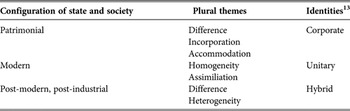
Ralph Grillo has devised a useful typology for classifying and comparing the way in which polities or states conceive and handle difference.Footnote 10 The typology consists of three different kinds of plural polities or three configurations of state and society —patrimonial, modern and post-modern or post-industrial (see Table 1).
States and pluralism: Three configurations

Source: Adapted from Ralph D. Grillo, Pluralism and the politics of difference (Oxford: Oxford University Press, 1998), p. 17.
Pre-colonial and colonial polities/states in Southeast Asia were typical of patrimonial states in Grillo's typology. Drawing on Max Weber's concept of patrimonialism, Grillo explains that rulers of ‘patrimonial’ states were:
generally concerned less with their subjects' ethnic identity and cultural values than with their ability to render tribute, taxes and labour. Ethnicity was not absent from such systems, but ethnic identity was not a key motif in the formation of state and society. The … predominant way in which difference was handled, was incorporation through accommodation.Footnote 11
In much of Southeast Asia, including the western half of the Malay Archipelago, pre-colonial polities were small, autonomous entities ruled by elite groups that relied upon surplus agrarian production (mostly wet rice), profits from inter-island trade, or both. The success of these polities was largely predicated on the control of population rather than territory, because up until the early twentieth century in island Southeast Asia, land was abundant but people were not.Footnote 12 A population increase made a polity grow more powerful through accumulated labour power and the ability to produce a greater economic surplus.
In the eastern half of the Malay Archipelago, pre-colonial ‘states’ did not rely on revenues from wet-rice cultivation, but primarily from tolls and taxes on trade, tribute and labour service.Footnote 14 The rulers of these small self-regulating units or states engaged in relations of trade, exchange and tribute with other states (based on political and ritual ties), and with foreign traders from the western half of the archipelago, and from China, India and later Europe. From the twelfth century through to the mid-seventeenth century, Wehali state on Timor, for example, obtained ceremonial tribute and trade profits by extracting and exporting sandalwood from Timor's interior.Footnote 15 Other eastern states participated in regional inter-island trade networks and built their power largely through coercive strategies, like slavery and raids, and by establishing marriage alliances. The states of Ternate and Tidore in the Moluccas became powerful maritime trading entities by extracting taxes and tribute from a network of smaller states in the eastern archipelago. The rulers of these two states consolidated their power by exclusively allying with the Dutch in the trade of spices beginning in the seventeenth century. This enabled them to finance the build up of their naval fleets and in turn to expand their control of neighbouring territories.Footnote 16
Due to labour scarcity, rulers of Southeast Asian states (whether inland agrarian or coastal states) therefore attempted to sedentarise populations, and this would have required an accommodation of difference.Footnote 17 A positive side effect of the need for labour power was therefore that it ‘tended to reduce ethnic contempt’, and as a result ‘systems of kinship and social organisation were remarkably inclusive’.Footnote 18 The rulers of Southeast Asian polities were generally welcoming towards newcomers, particularly people who were potential sources of labour, or who could facilitate trade links and commercial ties.Footnote 19 Many centuries of patrimonial states in island Southeast Asia that depended upon labour power therefore suggests the fostering of deeply enduring social and cultural norms of accepting people from different places of origin, race, ethnicity and religion. The region no doubt had incidents of inter-religious,Footnote 20 ethnic and racial discord, however, many thousands of villages across the Malay Archipelago appear to have sustained cooperative relations of coexistence when viewed from a historical perspective.
In the 200 years of mercantilism in Indonesia, the Dutch traders of the United East India Company (known as the VOC — from the Dutch Vereenigde Oostindische Compagnie) were ‘patrimonial’ in Grillo's typology in so far as they were largely concerned with extracting resources rather than attempting to transform ‘native’ subjects.Footnote 21 During the 150-year period of direct Dutch rule beginning in the early nineteenth century, the Dutch-controlled government was ambivalent in the way it conceived difference. As noted by Grillo,Footnote 22 though at certain times and in certain places colonial governments viewed native subjects as a homogenous group, more commonly the ideology and practice of colonialism categorised local populations into ‘hierarchically ordered and stereotyped categories’. While the Dutch colonial government continued to extract resources in the Dutch East Indies, they eventually combined this with efforts to socially transform colonial subjects, such as under the so-called Ethical policy in nineteenth-century Java.
In Grillo's typology, modern industrial societies with powerful and intrusive secular states contrast strongly with patrimonial states. Modern states display:
a keen interest in the form and content of social relations and social identities … the predominant plural theme has been homogeneity, and the creation of a common culture and identity within a uniform nation-state. Ethnicity provides the ideological rationale for the existence of such a state, and thus for the building blocks of an international order.Footnote 23
In Southeast Asia, from the early to mid-twentieth century, rapid social, political and economic changes took place with independence movements and the forging of new nation-states, each seeking new identities. As a modern nation-state, Indonesia has sought to foster a common identity and homogenous culture. Her two leaders after independence, in particular President Suharto, did what is typical of modern nation-state leaders — they eschewed difference and promoted homogenisation.Footnote 24 Sukarno, Indonesia's first president (1945–65) laid down the principles and values of the new nation. In 1945, President Sukarno declared Pancasila as a national philosophy of universal values for the birth of the Republic of Indonesia. Pancasila (literally ‘the five pillars’) has five principles — belief in God, humanitarianism, national unity, democracy and social justice. It was meant as a unitary philosophy to build a nation based on secularist values such as ethnic, religious and regional tolerance. On Independence Day, in 1950, Sukarno adopted the national motto ‘unity in diversity’ or more literally ‘we are many, but we are one’ (Bhinneka tunggal ika in Sanskrit). Like Pancasila, this motto was intended to convey ‘a sense of active pluralism’.Footnote 25
During Suharto's presidency (1966–98) the central government curtailed the space for difference, because of a concern with the higher ideal of social and political harmony and unity. In coming to power, Suharto's government ruthlessly ensured that any threat of Communism was eliminated, and it remained wary of political Islam. The central government soon set about turning Pancasila into a national ideology, propagating and enforcing it through the education system, bureaucracy, army and mass organisations, with the aim of establishing an ideological monopoly on the national identity.Footnote 26 Through a unifying framework that aimed to convert local differences into state-sponsored ‘diversity’, the government prescribed the parameters of diversity in terms of culture, tradition and custom, visually codified through costume, performance, architecture, tourist objects and other ethnic markers.Footnote 27 Thus the national government, rather than the Indonesian people, circumscribed the means of expressing diversity and excessively emphasised unity.Footnote 28 In this way, the state repressed different ethnocultural groups.
A specific example of the way in which the state attempted to engineer the idea of a homogenous, unified Indonesian citizenry, was via allowing unchecked spontaneous migrations throughout the archipelago as well as implementing a formal transmigration programme. Gerry van Klinken argues that the prevailing state view since independence has been to ‘bring people into contact with one another, teach them modern values [so that] they will quickly develop into a homogenous nation of “Indonesians”’.Footnote 29 The transmigration programme fulfilled this goal, being an ambitious internal migration and settlement programme whereby approximately 4 million Indonesians were moved during the period 1969–86 alone.Footnote 30 While it had the stated aim of social welfare by reducing population pressures on the densely populated islands of Java and Bali, the transmigration programme's un-stated aim was to foster a national consciousness of a homogenous imagined community of Indonesians. As Brian Hoey argues, this programme was ‘intended to spread population, consisting mostly of ethnic Javanese, more evenly over the region and to … promulgate a homogenizing national culture’.Footnote 31 It allowed the government to expropriate customary land to be made available to migrants without adequately compensating indigenous people in the name of development and progress.Footnote 32 The government also made land acquisitions to accommodate unsponsored migrants, and this contributed to outbreaks of conflict and violence between migrants and non-migrants in the late New Order period.
Conflict and violence towards migrant groups in Indonesia
Since Indonesia's transition to democracy began in the late 1990s, there have been several serious incidents of conflict and violence — sometimes leading to significant population displacements. From 1999 to 2001, violent conflicts produced more than 1 million internally displaced people.Footnote 33 This conflict and violence has occurred both within communities of unsponsored migrants as well as state-sponsored migrants, and in some cases it has triggered unprecedented reverse migrations. Violent conflict that has sometimes escalated to war, and caused population displacement, is not a new phenomenon in the long history of the Malay Archipelago, nor after the formation of its modern states. However, the nature and the scale of people displaced just prior to, and in the post-Suharto era stands out when viewed over the course of the twentieth century. Among other factors, the conflicts of recent years in Indonesia can be understood as a consequence of the continued failure of the social and political system to adequately accommodate difference.Footnote 34
The root causes of conflict and violence in the post-Suharto period are predominantly related to how resources are distributed between unsponsored migrants and local populations, rather than religious differences. In 2001, the Non Governmental Organization Down to Earth reported that according to official sources only 6.5 per cent of people displaced due to ethnic conflict and violence in the three years following Suharto's resignation were state-sponsored transmigrants.Footnote 35 Rather, most of the displaced people originally migrated ‘of their own accord, and acquired land directly from the local population, by more or less legitimate means’.Footnote 36 Many of these communities of unsponsored migrants had a long history of living relatively harmoniously with the non-migrant populations in those places, their ancestors having migrated from their places of origin long before the Suharto era of government. The scholarly consensus is that the underlying tensions of the conflicts were usually related to differential access to opportunities, resources and entitlements between migrant and non-migrant groups. Some conflicts became religious over time because the dividing line between migrants and indigenous people coincided with that between Christians and Muslims.Footnote 37 Much of the conflict and violence in the post-Suharto period therefore appears not to have been based on religious animosity between per se between Christians and Muslims, and might only unfold under the pretext of religious differences.
Some violence occurring over the last decade has been targeted towards particular migrant ethnic groups who are entrepreneurial and who have tended to migrate spontaneously more than other groups. Their visibility and perhaps success in local economies has made them a target of negative sentiment, especially in times of economic hardship. As Fox notes, in recent years the upsurge of local resentment has been directed mostly against long-term unsponsored migrants who operate as small-scale traders.Footnote 38 In contrast, transmigrants, who were mostly Javanese under the Suharto government's transmigration programme, usually settled as farmers or worked as civil servants, which Fox argues may explain why to date they have not suffered the same fate as unsponsored migrants who are entrepreneurial in orientation.Footnote 39 Among the most successful and dynamic of the inter-island migrant traders in contemporary Eastern Indonesia are the Bugis, Butonese and Makassarese. As small-scale traders they have spontaneously migrated from their homelands in Sulawesi to other areas of Indonesia since the late seventeenth century.
In the academic literature and in the popular press, migratory small-scale traders with origins in Sulawesi have tended to be represented as invariably exercising dominating economic and political power over local, non-migrant populations.Footnote 40 All three ethnic groups, Bugis, Butonese and Makassarese, have become notorious for their widespread migratory behaviour and entrepreneurial activities throughout Indonesia, and have acquired the somewhat derogatory acronym of ‘BBM’ — Bugis-Buton-Makasar.Footnote 41 These small-scale traders from Sulawesi have often secured a strong position in local economies and over time have come to dominate or to be perceived to dominate these economies at the cost of opportunities for local populations.Footnote 42 The Bugis have also been accused of engaging in environmentally unsustainable practices in areas to which they migrate.Footnote 43 Gene Ammarell argues that beginning in the early colonial period and throughout the twentieth century, by strategically allying with elites, the Bugis have ‘impos[ed] upon local peoples ways they promoted as economically and politically progressive and socially and culturally correct’ in places they have settled throughout the Malay Archipelago.Footnote 44
Representations of migrants as exerting dominating power over non-migrant populations may also arise through state ideology and policy. Migratory small-scale traders may be understood as subjects who slotted particularly well into New Order agendas of economic development and internal ethnic colonisation. Some authors argue that the New Order government constructed migrant entrepreneurs from Sulawesi (especially the Bugis) as agents of the modernisation process, as opposed to other subjects in the ‘periphery’ (that is, outside Java and particularly in the eastern provinces) that were constructed as ‘backward’ and in need of ‘development’. For example, the government tended to view tribal minorities and subsistence farmers this way, and to blame their traditional values and practices for impeding ‘development’. By contrast, Greg Acciaioli argues that Bugis migrants in central Sulawesi see themselves as the ideal social, political and economic state citizens.
[They] celebrate themselves as the bearers of progress … bringing to realisation the developmentalist ethos that provided the rationale of New Order government policies, especially those that encouraged migration throughout the archipelago, as if it were a level playing field in which mobile entrepreneurs would lead backward local populations in the economic struggle for progress.Footnote 45
According to this argument, by internalising identities as ‘agents of development’, the Bugis migrants in central Sulawesi may have fuelled communal tensions between themselves and the non-migrant population, in addition to tensions over economic disparities (whether perceived or real), and land acquisitions.
The history of Christianity and Islam in the Eastern Lesser Sunda islands
In most of the islands in Eastern Indonesia, Christianity is the majority religion that eventually took hold, despite the region having earlier Islamic influences. Some of the earliest states in the Malay Archipelago to convert to Islam were in the east, including Ternate, Gorontalo and Butung (Buton) in the period of the late fifteenth through to the mid-sixteenth centuries. Islam preceded Christianity (Catholicism) probably only by a matter of a few decades.Footnote 46
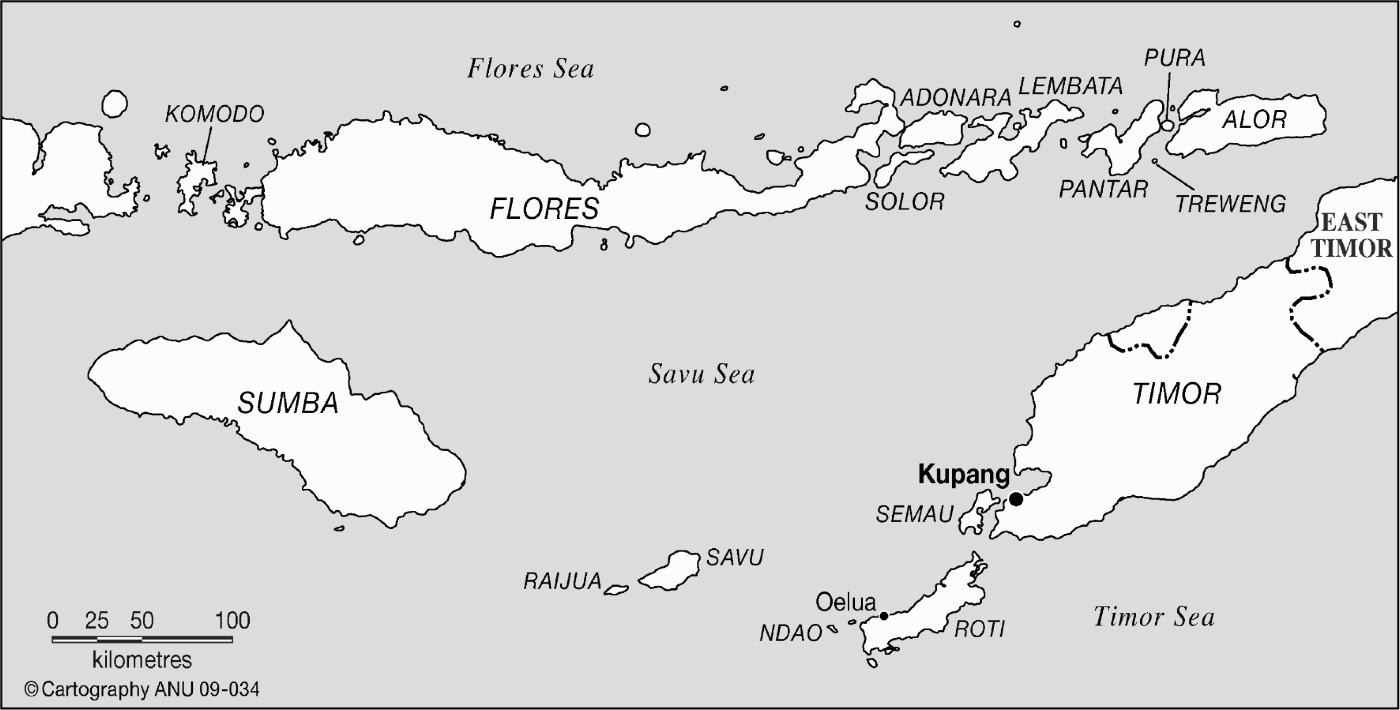
The islands once referred to as the Eastern Lesser Sunda islands that make up what is now NTT province, include the main island groups of Flores and Alor on roughly the same latitude, as well as an arc of islands below them — Timor, Semau, Roti, Ndao, Sabu, Raijua and Sumba (see Figure 2). Islam was initially disseminated in the Eastern Lesser Sundas in one of two ways: either as a result of alliances with more powerful eastern states that had already converted to Islam; or due to direct contact with outside traders and religious teachers from Java and the Indian subcontinent. The small island of Solor was on the ancient spice trade route from Java to the Moluccas and the sandalwood route to Timor. Islam was present on Solor and east Flores due to influences from Javanese Muslims from some time in the first half of the sixteenth century. Islamic influence on Solor perhaps also derived from it being a dependency of the Sultanate of Ternate in the Moluccas.Footnote 47 Another route for the arrival of Islam in the Eastern Lesser Sundas was ‘along the western end of Flores via the Sultanate of Bima [in Sumbawa, West Nusa Tenggara], which was allied with Makassar’.Footnote 48 Although Portuguese merchants were active in the Solor area since 1511, Portuguese Dominican missionaries did not arrive there until 1561,Footnote 49 after having already made their first converts in Flores and Timor in 1556.Footnote 50 The more systematic spread of Christianity in the Eastern Lesser Sundas began in the eighteenth century, via the Portuguese as well as Dutch influence.Footnote 51
The islands of East Nusa Tenggara province
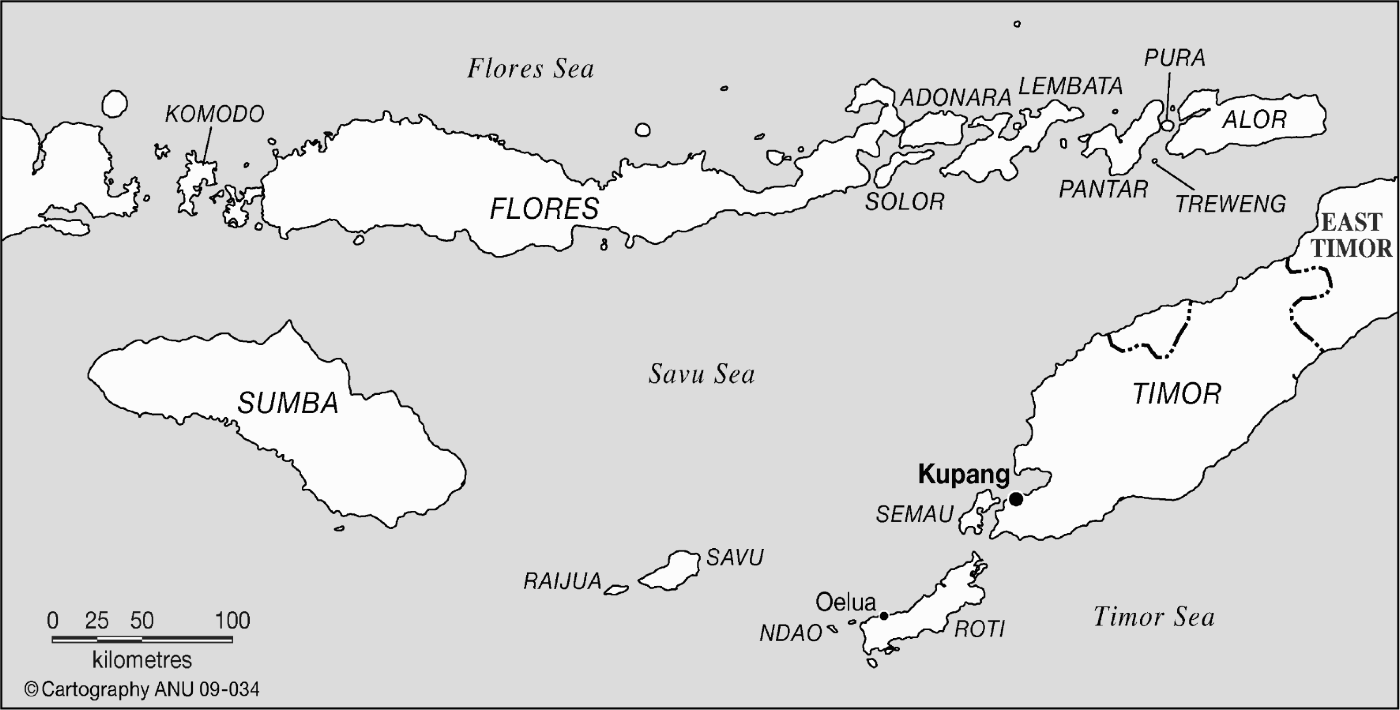
The Dutch (in the form of the VOC) first arrived in the Eastern Lesser Sundas in 1613, vying with the Portuguese and the Black Topasses (mixed descendants of local and Portuguese origin) for control of the sandalwood trade in Timor. In 1653, the VOC based itself at Fort Concordia in Kupang, West Timor, a fort built and abandoned by the Portuguese. From this time, the VOC began establishing relations of trade and alliance with local rulers on the island of Roti. They had three main motives for doing so: to recruit a native army to assist them in defending Kupang and extending their rule of Timor; to use Roti as a military retreat if they were driven from Timor; and to obtain food supplies for their garrison at Kupang and their few Timorese allies.Footnote 52 By the early eighteenth century, Rotinese rulers began to demand that the Dutch supply them with schoolmasters (most of whom initially came from Ambon). The teachers became the exchange for grain, in what was the beginning of the establishment of Roti's formal education system.Footnote 53
Also in the same period, the Rotinese began to seek out Christianity and propagate it throughout Roti. Unlike the Portuguese, the Dutch in the VOC era were not interested in ‘saving souls’. (Active missionary work only began in the early nineteenth century.) The local rulers on Roti began converting to Protestant Christianity of their own accord, thereafter establishing the religion in their political domains. They saw the strategic value of their subjects becoming Christians — among the advantages were elevating one's social status, and protecting one from being condemned into slavery (Rotinese domains and the Dutch often demanded tribute in the form of slaves, or simply stole people as slaves).Footnote 54 The Rotinese adopted Christianity derived from the basic traditions of the Dutch Reformed Church, in Roti known as The Synod of the Evangelical Church of Timor (GMIT – Gereja Masehi Injili di Timor). Most indigenous Rotinese today (95 per cent of the inhabitants of Roti-Ndao district in 2002) continue to adhere to Protestant Christianity.Footnote 55
Islam has not, therefore, directly influenced the Rotinese from pre-colonial times, unlike some other islands in the Eastern Lesser Sundas that have been historically influenced by Islam since the early sixteenth century. There are, however, coastal villages on Roti and other islands in East Nusa Tenggara province that have a more recent history of Islam. This is due to the in-migration and settlement of Muslim maritime trading peoples – the Bugis, Butonese and Makassarese – whose homelands in Sulawesi had rulers who were among the first to embrace Islam in the eastern Malay Archipelago.Footnote 56 Oelua, on Roti island, where this study was conducted, is one of these villages, being influenced by Islam from the late nineteenth to early twentieth centuries.
Oelua village: Its people and history
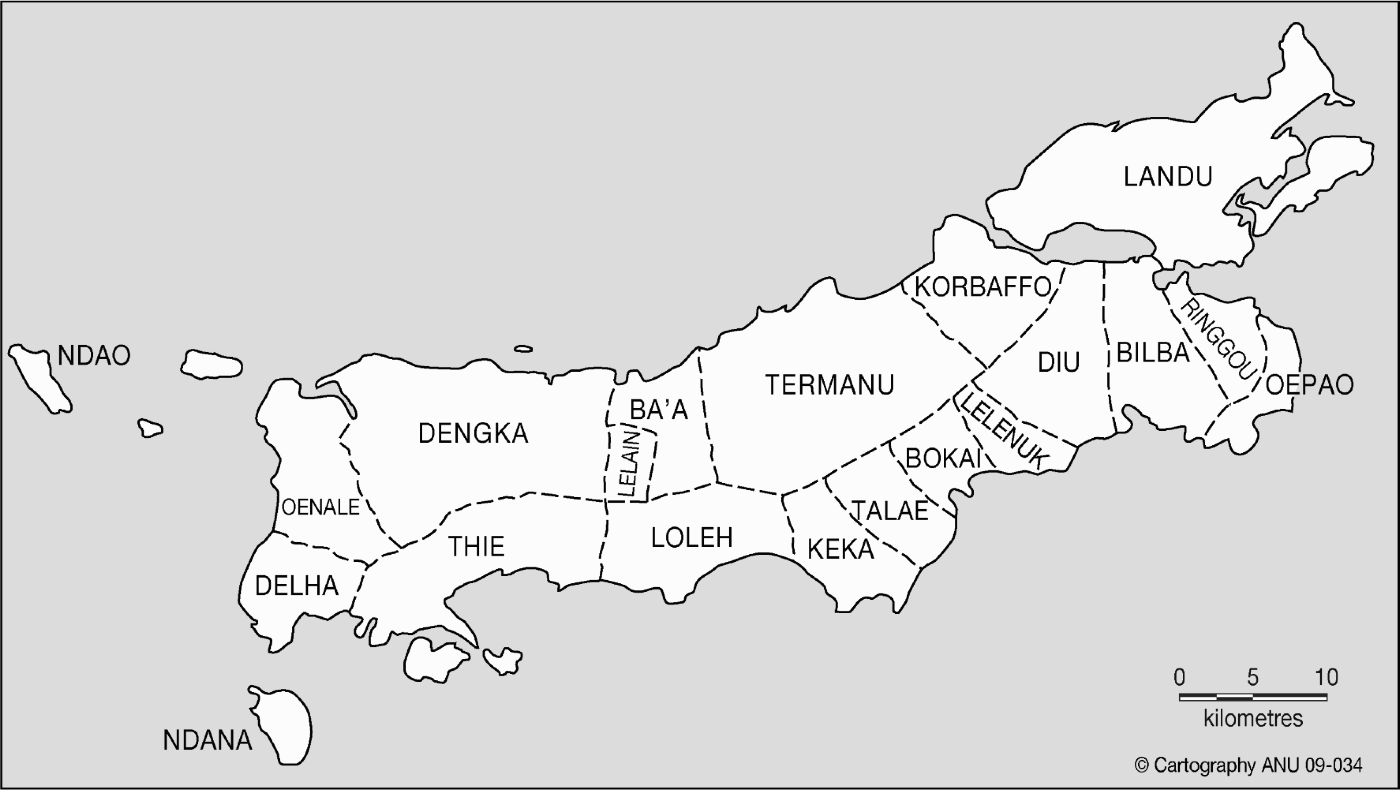
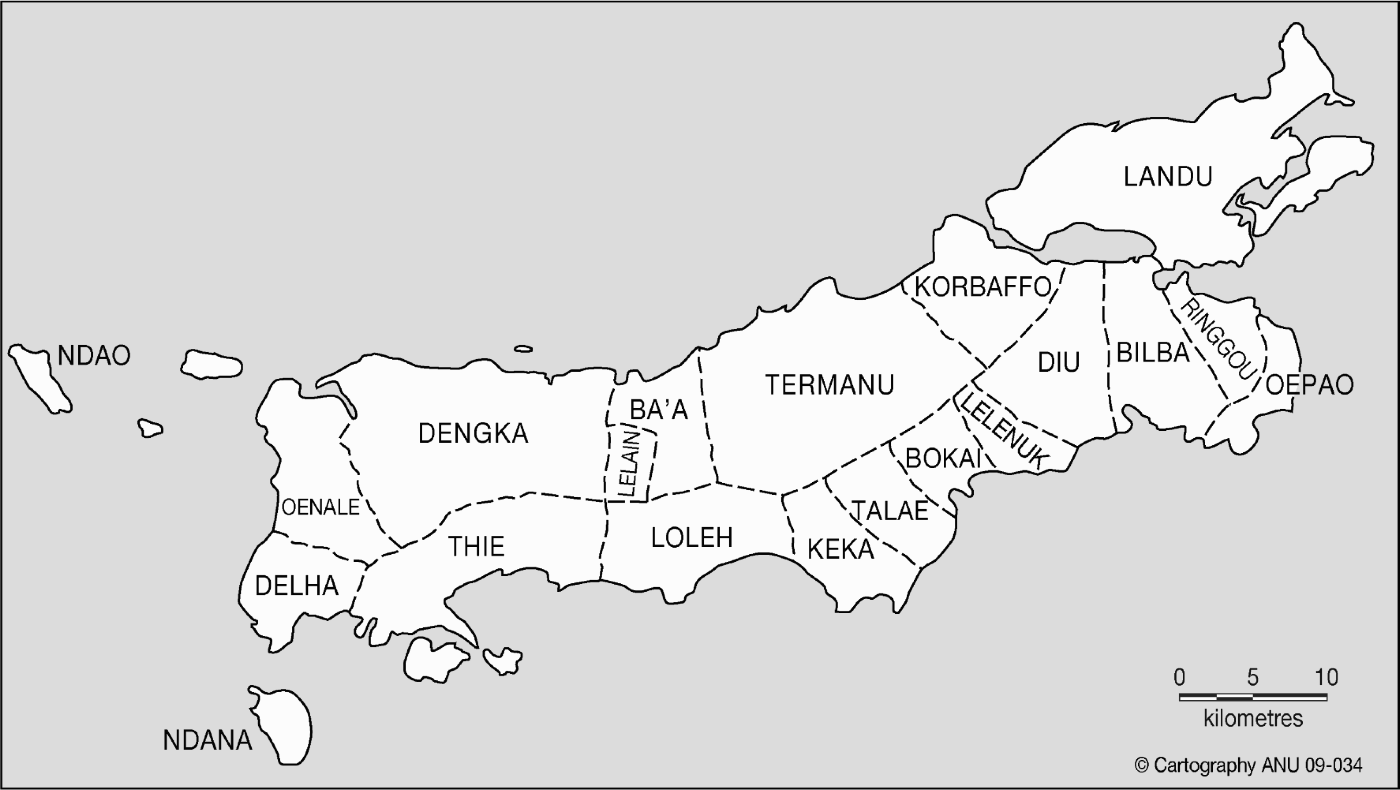
Dutch relations with Roti in the seventeenth and eighteenth centuries shaped political and social developments on the island, the effects of which still have a bearing on contemporary territorial politics and identities. Dutch–Roti relations were fraught because of the internal politics and rivalries over rule and territory on Roti, and the Dutch often resorted to brutal intervention during early contact. Fox has documented the complex historical relations that evolved between the VOC and the Rotinese rulers of several petty states.Footnote 57 Each of these had a court attended by representatives of clan groups and respected elders. Through a long process over the course of two centuries, the Dutch attempted to resolve disputes between clan groups, which resulted in them dividing Roti into 18 separate, semi-autonomous states.Footnote 58 The Dutch formally recognised these states or domains as self-governing under particular dynastic lines and appointed clan leaders with traditional powers of dispute settlement as heads of state, with the title of regent or radja (the Dutch colonial title) or manek (the Rotinese title).Footnote 59 Today these traditional political domains continue to be an important marker of Rotinese identities, despite the Indonesian government officially dissolving them after independence. Oelua village is in Dengka domain, and villagers therefore identify as ‘Dengka people’ (see Figure 3).
The traditional political domains of Roti
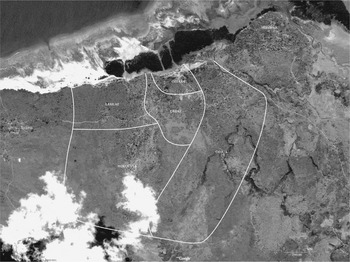
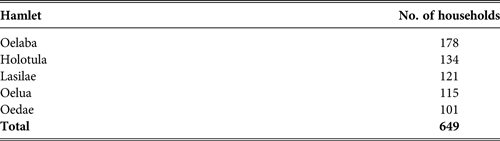
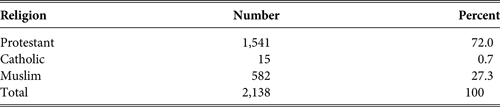
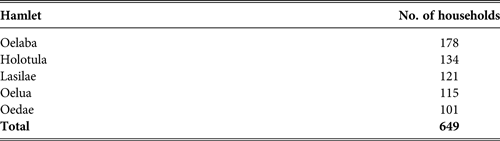
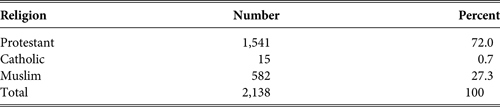
Oelua's population as at 2002 was just over 2,000 people, with 649 households (see Table 2). Oelua village has five hamlets — Holotula, Lasilae, Oedae, Oelua and Oelaba (see Figure 4). Four hamlets consist predominantly of indigenous Rotinese Christians, while the fifth hamlet, Oelaba, consists of mostly Rotinese Muslim households of mixed ethnic heritage — 27 per cent or about one quarter of the village population (see Table 3). This proportion of Muslims is higher than the NTT provincial proportion of 9 per cent, as at the 2000 Census.Footnote 60
The hamlets of Oelua

Number of households per hamlet, Oelua, 2004
Source: Village government statistics, Oelua.
Population of Oelua, by religious affiliation, 2001
Source: BPS, Rote Barat Laut dalam angkai, 2002 (Busalangga: Badan Pusat Statistik, Kecamatan Rote Barat Laut, 2002), p. 39.
The livelihood orientation of the indigenous Rotinese Christians reflects the general characteristics of the Rotinese economy as a whole. Economic activities of Rotinese Christians include dry-field cultivation, irrigated and un-irrigated rice cultivation, gardening, livestock keeping, inshore fishing, seaweed farming and lontar palm harvesting. The lontar palm (Borassus species) proliferates in Roti and Sabu and is intensively utilised for many purposes, sustaining higher population densities than the swidden agricultural economies of Sumba and Timor.Footnote 61
By contrast, Rotinese Muslims in Oelaba hamlet are long-distance maritime traders. This distinguishes them from land-based agriculturalists in the same three ethnic groups of Bugis, Butonese and Makassarese. As maritime peoples, it is also important to note that they are not fishermen. While they do not tend to earn their living from fishing, it is possible that they have some kind of historical association with harvesting sedentary marine products – notably the trepang or sea cucumber and trochus or top shells – in the present day eastern islands of Indonesia and northern Australian waters (along with the Sama Bajau).Footnote 62
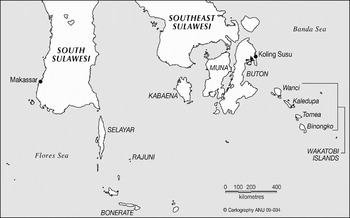
Muslim families in Oelaba hamlet have ancestors who mostly originated from the South and Southeast Sulawesi area (see Figure 5). Most migrants appear to have been Butonese, coming from Kabaena, Muna, Buton and the Wakatobi islands — a string of four main islands (and clusters of smaller islands within the main group) including Wanci, Kaledupa, Tomea and Binongko.Footnote 63 They extend in a southeasterly direction from the larger island of Buton, and are also known as the Tukang Besi islands. In South Sulawesi, places of origin of Oelaba ancestors include the port city of Makassar and the islands to its southeast — Selayar, Rajuni and Bonératé.
Muslim migrants' places of origin, South and Southeast Sulawesi

The three largest Muslim families in Oelaba are the Min, Baco and Mancora families, originally from Buton, Makassar and Selayar respectively. The other main place of origin of the Oelaba Muslims ancestors is Alor islands — mainly from Pantar, Pura and Treweng in East Nusa Tenggara province (see Figure 2). Some Oelaba residents say their ancestors were Bugis migrants from Java and Sumatra (Padang).
From Oelaba elders' narrations of the migratory histories of their ancestors, the first maritime traders to have some contact with Oelaba were from Buton. This was perhaps as early as the last decades of the nineteenth century, but probably not in large numbers. Migration and settlement by Butonese and Muslim maritime migrants from other ethnic groups and locations continued and increased into the early to mid-twentieth century.Footnote 64 The following two short family histories, as related by Oelaba elders, give a sense of the unique migration trajectories of Oelaba Muslim ancestors.
One of the Min family members said that he is a fourth-generation descendant of the first Butonese Muslim migrant to the region. His great-grandfather was La Ode Laura who originated from Koling Susu, on Buton. La Ode Laura migrated to Unwana near Hundihuk (a coastal hamlet of Netanaen, to the west of Oelaba) sometime in the late nineteenth century, but he continued to sail throughout the region and became known locally by the name of Mudi, after his profession, juru mudi or pengumudi perahu (helmsman). He married a woman from Oenale domain, but he also had wives in Binongko and Kaledupa, Southeast Sulawesi. One of his sons was named Mudi Min, after which subsequent generations adopted Min as their family name.Footnote 65
The fact that La Ode Laura was known locally as Mudi suggests that his sailing profession was viewed as a novelty in the area. This lends support to the story that he was the first, if not one of the first, Butonese sailors to semi-permanently settle in Dengka domain, to intermarry with local women, and perhaps to appreciate that Roti offered a unique trading niche.
The Baco family history of migration to the Timor area began with their male ancestor, Tonto Salama from Makassar — the then Kingdom of Goa in South Sulawesi. Tonto was recruited by the Dutch to fight with their armed forces at Besikama on the southern coast of central-west Timor. Reportedly, he had four male heirs who came in search of him when he did not return home. They never found him, and they too never returned to Goa, all eventually settling in Timor, Semau, Roti or Ndao. The four heirs each carried the title of daeng — a term of address indicating a royal bloodline. Daeng Madi Lao settled in Roti and the manek of Thie reportedly granted him power to guard the tiny offshore island of Dana.
This family history reflects a completely different migration trajectory from that of Mudi Min, indicating that their ancestors came to the Eastern Lesser Sundas because of an involuntary, random set of circumstances. The VOC based in Kupang had long recruited native persons into their armies to fight in wars and rebellions against the Timorese and the Black Topasses.Footnote 66 The Baco's ancestor Tonto perhaps assisted the Dutch colonial government in the pacification of Timor during the first two decades of the twentieth century when it was nominally under their administrative control. In relation to Tonto's heir, Daeng Madi Lao, who settled on Roti, the fact that the manek of Thie domain assigned him as custodian of Dana indicates that he recognised newcomers with a similar high social rank, as well as perhaps appreciating the ability of a permanent resident with sailing skills to fulfil such a role.
More generally, Butonese migration to Oelaba occurred because of a combination of environmental, technological and economic factors. One of the main factors influencing what is referred to as a Butonese diaspora is the ecological conditions in their homelands. The Butonese have long been sailors and traders, and this with their tendency to migrate has been precipitated partly by the difficulty of sustaining an adequate livelihood in their islands of origin. Many of the Butonese migrants to Oelaba have come from the Wakatobi islands. These are isolated, mostly coral limestone islands with low rainfall and poor soils for which subsistence agriculture alone has not been adequate to sustain the growing population. The tiny Wakatobi islands therefore have a history of regularly ‘exporting’ their populations, a practice that continues to this day.
Another factor precipitating migration was the introduction of new technologies in sailing and trading. By the early twentieth century, the Butonese had developed a trading vessel known as the perahu lambo, which Adrian Horridge speculates was inspired by the western designed small trading cutters.Footnote 67 He argues that the lambo encouraged Butonese migration because it enabled them to establish a special niche in inter-island small-scale shipping and trade in Eastern Indonesia.Footnote 68 The lambo was smaller and more manoeuvrable than other traditional wooden sailing boats in use at that time, it could easily be docked at small ports where larger boats could not, and it had a rig that made year round sailing possible.Footnote 69 Horridge suggests that these maritime technological advances were an important influence on a Butonese diaspora throughout the twentieth century.Footnote 70
Lontar syrup and betel nut are also important reasons as to why Muslim maritime traders initiated a trading relationship with the Rotinese.Footnote 71 When Butonese traders first arrived in Roti (most by perahu lambo by the 1930s), they would have observed the mixed economy of the indigenous Rotinese, much as one can today. From the time of first contact, for the Muslim maritime traders the surplus lontar syrup has been an important staple trading product which they have transported from Roti to other islands. Demand for lontar syrup (a food product derived from boiling the juice of the lontar palm) has long existed in other parts of Eastern Indonesia, including the traders' places of origin where lontar palms are not found. Meanwhile betel nut is one of the maritime traders' staple trading products into Roti, where it does not grow in abundance. The giving and receiving of the areca nut (and its accompaniments of lime and betel pepper, preferred over the betel leaf used elsewhere in Southeast Asia for the same period) is a culturally important, ancient, symbolic and material way of reinforcing social relationships in Rotinese society — used customarily to signify respect of a host for their guest and vice versa. Another factor that likely drew Muslim maritime traders to Roti is that the natural material required to make the sailcloth for their perahu sails was readily available. This was the gewang palm leaves from the palm of the same name, which were used to make sailcloth prior to the introduction of polypropylene. A mid-nineteenth-century Dutch source notes that ‘fairly good sailcloth [karong lajar] of palm leaf peel is made mostly in Oinale’.Footnote 72
This history of migration and settlement of maritime traders to Oelaba has a bearing on contemporary issues of identity and belonging. Due to strong kinship ties and affinity to place, the descendants of Muslim migrants in Oelaba (orang Oelaba) – the majority of whom are of mixed Rotinese descent and who were born in Roti – do identify as Rotinese (or Dengkanese). At the same time, however, they distinguish themselves in various ways from indigenous Rotinese Christians living in other hamlets in the village. In their everyday speech orang Oelaba refer to the indigenous Rotinese as ‘orang di atas’ or ‘orang gunung’, that is, literally ‘people up above’, or ‘mountain people’. In reality, the indigenous Rotinese live higher up the gently sloping incline in the village, further from the sea.Footnote 73 Rotinese of mixed heritage also make distinctions in terms of ethnic background, livelihood orientation, religion, and the frequency and competency with which they and their children use Rotinese language.Footnote 74Orang di atas tend to speak Rotinese routinely, rather than Indonesian and consequently their children also speak Rotinese well.Footnote 75 By comparison, Rotinese of mixed heritage claim that their own children are not fluent Rotinese speakers because they tend to speak Indonesian at home with their parents. Residents of Oelaba say that they use Indonesian language more routinely than indigenous Rotinese because of the influence of ‘merantau’ — of leaving one's home area to make one's way in life. They have therefore had more exposure to people from other regions of Indonesia making it necessary to communicate in the national language, than their fellow Rotinese who do not sail and trade.
For orang Oelaba, a Rotinese identity is mixed with a sense of pride and identification with their ethnic heritage from places other than Roti. While pride in their ethnic heritage is clearly apparent amongst Oelaba Muslims, a distinct sense of primordial ethnic identity is not, whether that be Rotinese or non-Rotinese origins. Fox argues that the long history of intermarriage in communities of migrant maritime groups of mixed ethnic heritage in Eastern Indonesia has resulted in distinct ethnic identities dissolving into a common identity tied to Islam.Footnote 76 Affinity and identity associated with Islam is certainly evident in Oelaba, and hence religion is an important distinguishing group marker for Muslim residents to assert their difference from the majority indigenous Rotinese. The common identity and solidarity amongst non-indigenous Rotinese is therefore a Muslim identity, and while individuals may also identify as part Butonese, Bugis, Makassarese, or Alorese, for instance, these ethnic identities are not invoked as strong intra-group markers. Furthermore, some Oelaba Muslims see themselves and others as having hybrid identities. A Muslim woman of mixed Rotinese heritage, for example, said that responding to questions about her ethnic background (a very common form of inquiry in Indonesia) and defining her ethnic identity is not straightforward. This is because her indigenous Rotinese grandmother married a Bugis migrant (reportedly from Sumatra where they or their ancestors had probably migrated in an earlier wave of Bugis migration), and then her mother married a man of mixed Rotinese and Makassarese descent. She said that she cannot claim that she is Rotinese, nor can she say that she is from Sulawesi — Buginese or Makassarese. Referring to not just herself, but all people of mixed Rotinese descent in Oelaba, she said, ‘we are in the middle’.
From a whole of village perspective, Oelua has a history of low-conflict relations between its many different ethnic groups and between Christians and Muslims. There have been no major outbreaks of communal conflict or violence in living memory. The International Crisis Group (ICG) found, however, that in the largely Christian communities in Eastern Indonesia, underlying communal tensions do exist, such as long-held ‘suspicions of a central government plot to promote Islam’.Footnote 77 While the ICG notes that such underlying communal tensions can easily be triggered by conflicts in other parts of Indonesia and may not actually reflect local realities, they also note that there has been actual (although rare) incidents of provocation that have fuelled violence towards migrant groups in Eastern Indonesia.Footnote 78 Philippus Tule, for example, reports that migrant Muslims desecrated the host in several towns on the island of Flores in NTT in the early to mid 1990s.Footnote 79 Local mobs later identified and killed the perpetrators, and looted Muslim shops and houses. The ICG argued, however, that:
the communal tensions on Flores, and in particular the suspicions of the Catholic majority about the intentions of the tiny Muslim minority, have less to do with reality on the ground and much more with national developments as played out in the print and broadcast media.Footnote 80
Violence has occurred between Christians and Muslims within very close proximity to Oelua in recent years, however, and village leaders actively sought to ensure that retaliatory violence did not break out in their village. The incident occurred in Kupang, West Timor in late November 1998, when local Christians staged a peaceful demonstration and parade that was in response to Muslim radicals violently attacking churches in Jakarta. The Kupang demonstration was reported to have turned violent when people in several trucks of unknown origin joined the parade and began attacking people and property.Footnote 81 Further retaliatory violence then erupted in Roti, in the district capital of Ba'a, about 15 kilometres away from Oelua. Long-term residents of Kupang and Ba'a – Muslims originating mainly from Sulawesi who were mostly of Makassarese and Buginese descent – were the target of Christian aggression and violence and their shops, houses and places of worship were burned and looted. Fearing for their lives, they fled the province, only daring to return after many months. Indonesian Chinese in Ba'a, who as a group are predominantly Christian, were not a target of the violence and reportedly scrawled the Christian cross on the doors and windows of their shops and houses to clearly distinguish themselves from neighbouring Muslims. Customary and religious leaders in Oelua, wary that the conflict might spread unwittingly to their village, chose not to immediately call the sub-district police but rather encouraged Christian residents to guard the mosque and likewise Muslim residents to guard the numerous churches in the village. Both Christian and Muslim village leaders have a common goal to maintain congenial relations between residents of different religious faiths in Oelua, and they were active in implementing preventive measures to ensure that the situation did not change during those particularly volatile times.
In Oelua, there are discernible ‘mechanisms of agreement across difference’ that have enabled migrant and non-migrant groups to live together as a low-conflict community. These include three specific practices of: land, technology, labour and surplus transfers; indigenous customs and laws (adat) and conflict management; and social mixing and interpersonal relations. To successfully establish these ‘mechanisms of agreement’ necessarily requires groups to engage in processes of negotiation and compromise and therefore involves relations of power.
Transfers of land, technology, labour and surplus
Over a period of several decades, the successive manek of the political domain of Dengka agreed that Muslim migrants and their descendants could settle on village land. The manek lived in the hamlet of Oelaba, close to the eastern harbour of the village. The Muslim migrants and their descendants had no legal claim to any land until the post-independence period when the last two manek of Dengka granted the land and trees in three stages to the local followers of Islam in Oelaba (see Table 4).
Land and trees granted in Oelaba by the manek of Dengka

Source: Legal document that 80 households signed in 1961, Oelaba hamlet.
In 1955, the second last manek of Dengka made a small land grant for the site of a new mosque. Several years later in 1961, the last manek of Dengka granted the trees on the area of land in Oelaba hamlet where the Muslim migrants and their descendants had already settled, and within several more months of the same year, he granted the parcel of residential land.Footnote 82 This is where most of the descendants of Muslim migrants reside to this day. The land is common property owned by the Islamic faith (tanah wakhaf), and protected by Ministry of Religion decrees, administered through a coordinating body in the district Office of Religion in Ba'a. The manek did not request anything in return from the migrants, indicating good relations and perhaps a reciprocal act that spoke of the appreciation of the benefits that the migrants had brought to the village, at that time for a period of already several decades.Footnote 83 From the time that the migrants first settled in Oelaba, indigenous Rotinese Christians (as harvesters and producers) and the Muslim migrant population (as maritime traders) have formed mutually beneficial economic relationships, for example, the lontar syrup economy. This division of labour facilitated economic development in the village and created social and economic ties between maritime traders and producers from Oelua and other villages in western Roti.
In addition to the symbiotic, interdependent relationships between producers and traders, the Muslim migrants and their descendants have shared their sailing and trading knowledge, skills and technologies with Rotinese Christians in Oelua and the neighbouring hamlet of Hundihuk. Some Rotinese Christian men consequently gave up farming and lontar tapping and adopted maritime trading livelihoods — which subsequent generations have continued. This technology transfer and the sharing of livelihood pursuits contrasts with a pattern commonly observed in Indonesia – of occupational and ethnic segregation – with certain ethnic groups tending to have particular jobs thus creating ethnically derived competition and ethnic stereotyping.Footnote 84
Indigenous Rotinese Christians have respectful attitudes towards the people of Oelaba, and continue to acknowledge that their Rotinese Christian forefathers learned their sailing skills from Oelaba residents' ancestors. As a way to denote positive recognition of Oelaba Muslims, some indigenous Rotinese Christians redistribute their individual surplus to a communally pooled ‘social surplus’ initiated by community leaders. As a gesture of goodwill, when the Muslim households of Oelaba annually contribute a share of their profits from marine products to the village mosque, some of the Christian boat owners do the same, including the indigenous Rotinese Christian village head and his brother.Footnote 85 They donate this money to the mosque in the spirit of formally acknowledging their historical livelihood ties, as well as the ongoing relationships of mutual assistance, for instance, when they are repairing their boats and need to call upon extra labour. This is an example of the indigenous Rotinese explicitly recognising the value of the ‘outsider’ minority Muslim group.
These transfers and an ethic of sharing illustrate the way in which Muslim migrants and their descendants have sought to build associational power relations with the indigenous Rotinese Christians. Associational power can be conceptualised as either ‘power to’ or ‘power with’ rather than ‘power over’. As opposed to power in its instrumental forms, such as domination or manipulation, the social theorist Hannah Arendt is concerned to extend understandings of power relations to encompass all types of social relationships. Arendt acknowledges power as establishing itself through associational ties, and thereby as having positive, empowering and enabling effects.Footnote 86 Non-confrontational modes of associational power such as negotiation require a two-way process of communication that individuals or groups deploy in order to get things done.Footnote 87 In Oelua, both parties have exercised the ‘power to’ achieve mutually beneficial outcomes in a process of negotiating and sharing power. The Muslim migrants and their descendants have occupied a different economic niche to the majority indigenous Rotinese Christians and have added value to the local economy while enhancing producer livelihoods by facilitating trade of local produce. At the same time, they have not attempted to retain their livelihood pursuits of sailing and trading as exclusively their own, but opened them up to the indigenous Rotinese Christians. The situation in Oelua provides a different view from the dominant representations of entrepreneurial migrant ethnic groups of Bugis, Butonese and Makassarese gaining control of local economies and making economic gains to the detriment of non-migrant groups.
Indigenous customs, laws and conflict management
Adat is the local customs and traditions that are particular to place, embodying cultural values, norms, laws and regulations. In Indonesian society, adat is a central community-based institution administered through extended family grouping units or clan groups. In Rotinese these clans are called leo, and their leaders, mane leo. Indigenous Rotinese are born into a leo, and after marriage women follow the leo of their husbands. The mane leo have a broad-ranging role as ‘moral guardians’, charged with ensuring the welfare and prosperity of clan members. This entails promoting certain aspects of local culture in accordance with ancestral traditions, particularly in the organisation of significant lifecycle events such as marriage and death.
In the post New Order era of regional autonomy, adat has been officially reinstated as a legitimate political and social institution after the Suharto government attempted to undermine its authority. Through widespread reforms in 1979 (Law no. 5), the New Order regime abolished the traditional system of government based on adat structures at the village level, and replaced it with a uniform Indonesia-wide government structure. This included an elected village head and village council, which was supposed to supersede village hierarchies, based on heredity, and deny authority to traditional adat decision-making structures. Consequently, it may be assumed that in general the high level of authority that adat structures had long held was circumscribed to a degree. In practice, however, the effects of these government reforms on the structure and organisation of village life varied considerably, and in many places adat practices were not easily erased. In Oelua, for example, adat has always defined and continues to define social and economic relations, with minimal interference from the modern state. This is partly because elected village representatives have tended also to be leaders of powerful and prominent clans who have a vested interest in maintaining adat practices.Footnote 88 Since 1999, however, new local autonomy laws (no. 22 and no. 25 1999) designed to transfer authority and responsibility to local governments and the people, have resulted in renewed government interest and support for adat.Footnote 89 As elsewhere, adat is being strengthened in Oelua at the village level, as well as at sub-district and district levels, due to the government's desire to integrate their programmes with adat structures and practices.
In Oelua, adat has long regulated inter-communal relations, including for those Muslims who do not attach significance to their leo (and hence to adat) like indigenous Rotinese Christians and other Rotinese Muslims do. Significantly, under certain circumstances, indigenous Rotinese leaders insist on common adat rules for all villagers regardless of ethnicity or religion. At other times, differential rules are followed in order to accommodate the diverse groups within the Rotinese Muslim community. The Muslims who migrated to Oelua do not seem to have continued their own ancestral customs from their place of origin, or if they did, there is little trace of them left today. A list of 27 clans in the records of the village government office in Oelua includes five non-Rotinese clans — Alor, Makassar, Selayar, Butung (Buton) and Min. It appears, however, that this is an attempt to acknowledge the mixed heritage of the Rotinese Muslims in the village on paper only. In practice, Rotinese Muslims do not tend to attach meaning or significance to the non-Rotinese clans of their migrant ancestors, as they have not maintained formal linkages that obligate them to these clans across space or time.Footnote 90 However, if Rotinese Muslims choose to identify with a leo, the recognised lines of descent are maternal, from the first generation of intermarriage between their indigenous Rotinese grandmother with their Muslim migrant ancestor. It is a matter of choice of each Rotinese Muslim family as to whether they adopt a leo of their Rotinese ancestors, and therefore actively engage with Rotinese adat.Footnote 91
By contrast, indigenous Rotinese men who convert to Islam maintain their obligations to Rotinese adat in relation to their leo, regardless of their change in religious status. There are three families with male household heads who are indigenous Rotinese Muslims. Their fathers independently chose to convert to Islam as opposed to converting because of marriage. This usually occurred through their exposure to Muslims and Islamic teachings on sailing-trading ventures. When indigenous Rotinese Christians become Muslims, their commitment to their leo remains unchanged. Most (but not all) of the descendants of indigenous Rotinese Muslim families continue to follow Islam, and many of the next generation have married Muslims of mixed Rotinese heritage.
Common adat rules are activated in everyday situations that concern both Rotinese Muslims and Rotinese Christians. Two prominent examples where indigenous Rotinese insist on applying common adat rules for all are for dispute resolution and marriage proposals between members of the two groups. In relation to resolving disputes, indigenous Rotinese prefer to use adat law, which generally overrides state law. Mane leo are responsible for ensuring that clan members maintain, and where necessary, restore good relations within and between the clan households and those of other clans, in accordance with adat law. In Oelua, adat laws exist in relation to marriage proposals and bridewealth payments, elopement, pregnancy outside of wedlock, divorce, crops destroyed by livestock, stealing of livestock, quarrelling and fighting, slander, deception, provocateurs who cause public disturbances, destruction of land and forest, drinking and gambling, failing to join a mutual aid (gotong royong) activity,Footnote 92 children failing to attend school without permission, and children not progressing to junior high school. In some cases, the punishment for these offences is pre-determined — usually in the form of a monetary fine or a sanction. In other cases, such as disputes between two or more parties, the appropriate punishment and compensation must be negotiated in a formal process.
The Rotinese had a long-standing tradition of more than two centuries of adjudicating disputes at the local level via a ‘court system’, which was operative in the domains of Roti up until 1968. (The following year, Roti adopted the national government system of sub-district administrative areas and administrators, which officially replaced the traditional political domains and their local rulers.) Fox reports that while most disputes were expected to be resolved informally by local elders or clan leaders, those cases that came before the court were usually between members of different clans or of different lineages within the same clan that required a higher level of judgement and mediation.Footnote 93 Cases included disputes over marriage and divorce, inheritance, land and property, as well as ‘cases of the insult or mockery of the “name” of an individual and thus of a person's clan or lineage’.Footnote 94 Contemporary versions of dispute resolution processes that have their origins in this tradition of court procedures still exist in Roti today. The process of mediating between parties and resolving disputes necessarily involves negotiated performances and the use of what Fox calls ‘verbal frames’.Footnote 95 These verbal frames define how to practise adat — they constitute a set of procedural options for determining how to deal with a particular situation. The following vignette describes how a dispute was resolved between individuals not only from different clans, but also from different ethnic and religious groups.
The matter was in relation to an incident in the local market that escalated into a dispute between two petty traders — a male Alorese Muslim trader and a female indigenous Rotinese Christian trader. The Alorese trader left his stall under the care of the Rotinese trader while he went to purchase something in another part of the market, but when he returned and couldn't find his matches, he accused the Rotinese trader of stealing them while he was gone. It turned out that all along, however, his matches were with his cigarettes in the place where he usually stores them. The accusations he made were interpreted as sullying the self-respect of not only the Rotinese woman, but of her entire clan. To resolve this issue according to Rotinese adat, a meeting was required between the two parties in the presence of the heads of each leo who were to act as mediators, and provide the appropriate guidance in accordance with adat law. A Muslim community leader of mixed Butonese and Rotinese descent in the immediate neighbourhood represented the Alorese trader, while the head of leo Henutein who is also the village head represented the complainant. A lively (and seemingly heated) discussion proceeded for 2 hours, during which both sides debated the appropriate compensation for a wronged party under the circumstances. Finally they agreed that the offending party was to pay a fine equivalent to one buffalo, or one goat and rice. The beast would be slaughtered and cooked, and the two parties would eat it together in a ceremonial peace meal. But, in the end, they agreed that a handshake between the two parties was sufficient to settle the matter and the meeting was closed.
This vignette illustrates how processes of adat law are deployed to resolve conflict and restore good relations. Although a seemingly petty offence, in Rotinese society, verbal insults that affect one's name are considered a horrendous offence, and far more serious than a physical assault. Moreover, this case study shows how Rotinese processes of adat law include the use of third parties who represent the disputant and the accused. This indicates that the process of resolving conflict and the style of managing difference are just as important as the outcome, which social scientists have identified as a factor characterising low-conflict societies. Managing conflict constructively ‘is characterised by cooperative processes (not just attention to outcomes) that focus on the ability of different parties to define shared interests and to communicate openly in order to establish empathy between the disputants’.Footnote 96 What can be further observed from this vignette is that verbal frames can be interpreted in a range of ways, so that how they are filled and what substitutes will be accepted as actual fulfilment is the subject of negotiation between the parties involved.Footnote 97 The offending party agreed to pay compensation in accordance with the appropriately selected verbal frame (the stipulated ceremonial meal) as part of performing adat, but was not expected to fulfil this in practice. The final outcome of adjudication is therefore based on symbolic rather than punitive measures.Footnote 98 The constancy of language and rhetoric continues to provide the link to ancestral traditions, while actual practice evolves to suit changing social and cultural expectations.
While these common adat rules for resolving disputes can apply to Rotinese Muslims, differential rules apply within their own distinct religious grouping. Rotinese Muslims adhere to generic Islamic cultural norms and standards, moulded by local interpretations and conditions, to deal with disputes, disagreements and incidents that concern only themselves. For cases that Muslim elders cannot resolve, they request the state to intervene rather than defaulting to Rotinese adat legal processes. Rotinese Muslims are therefore only obligated to follow common adat rules in matters that involve direct interpersonal relations with indigenous Rotinese.
The way that these adat rules are applied in Oelua is akin to a ‘politics of recognition’Footnote 99 whereby differences of Rotinese Muslims are not eliminated or transcended. Rather, the low-conflict community promotes socially and culturally differentiated groups, who mutually respect one another and affirm one another in their differences.Footnote 100 Unlike a politics of recognition, an assimilationist ideal assumes that equal social status for all persons requires treating everyone according to the same principles, rules and standards. An historical strategy of assimilation in Oelua would have aimed to bring the ‘outsider group’ – Muslim migrants and their descendants – into the social norms, expectations and practices of the existing, naturally privileged or ‘dominant group’ — the indigenous Rotinese Christians. As Iris Marion Young argues, ‘assimilation always implies coming into the game after it is already begun, after the rules and standards have already been set, and having to prove oneself according to those rules and standards. In the assimilationist strategy, the privileged groups implicitly define the standards to which all will be measured.’Footnote 101
Social mixing and interpersonal relations
In Oelua, social mixing between indigenous Rotinese Christians and migrant Muslims from different ethnic groups has occurred over a long period, and has been facilitated through processes such as intermarriage. Up to five generations of migrants and their descendants have intermarried with the indigenous Rotinese Christian Protestant population. Most commonly, Muslim migrant men married Rotinese Christian women, resulting in many families having Rotinese maternal heritage. As well as marrying indigenous Rotinese, the descendants of Rotinese Muslims have also married each other, so there is a high degree of kin relations within the hamlet. Indigenous Rotinese Christian leaders use a language of belonging to describe Rotinese Muslims, as opposed to language that connotes notions of ‘us’ and ‘them’. As a Christian indigenous Rotinese community leader said ‘We consider those here in Oelaba, all of them are the children of Roti, because all of them have mothers from Roti.’ Such inclusionary language, or ‘authoritative talk’, that community leaders use to describe a minority group is significant as it fosters a community's ability to accept difference. As Will Kymlicka and Wayne Norman argue, a diverse society is not only dependent on the justice of its institutions, ‘but also on the virtues, identities and practices of its citizens, including their ability to co-operate, deliberate and feel solidarity with those who belong to different ethnic and religious groups’.Footnote 102
Group differences in relation to religious practices are mutually respected in Oelua. In some cases, usual taboos are relaxed in favour of creating congenial social relations. While Muslims do not usually tolerate the presence of pigs, for example, the Muslim residents of Oelaba allow pigs owned by their Christian neighbours to roam freely through the hamlet.Footnote 103 Due to the prevalence of intermarriage, the Christian and Muslim hamlets within Oelua village are well connected through extended kin networks. Rotinese Muslims, the majority of who have Christian kin from their indigenous Rotinese maternal lineage, enact their inter-denominational kin relationships at the time of lifecycle events such as death or marriage when the entire extended family comes together. Like most Muslim communities elsewhere around the world, however, Oelaba Muslims strictly adhere to taboos on eating pork. Christians consider these taboos when they are hosting lifecycle events for extended kin across religious groups. When Christians and Muslims gather at a Christian household to feast, for example, the Christian hosts arrange for the preparation of halāl Footnote 104 food for their Muslim relatives and neighbours. This local custom is significant as it is constitutes the symmetrical power relations around giving and receiving between the two religious groups. If this custom were absent, the Rotinese Muslims would default to being permanent hosts — being able to give without being able to take, a situation antithetical to the reciprocity principles of Rotinese society. In these instances, kinship is what cuts across religious and ethnic differences. Tule similarly argues that kinship is a unifying force in Kéo in Central Flores, and he argues further that this enables an inter-faith relationship between Catholics, Muslims and ‘local believers’ (i.e., those who are not adherents of either faith), as opposed to formal theological or political dialogue.Footnote 105 By inter-faith relationship in this context Tule (drawing on the writings of Pope John Paul II) means a process whereby: ‘believers of different religions bear witness before each other in daily life to their own human and spiritual values, and help each other to live according to those values’.Footnote 106
Intermarriage and religious conversions
Religious conversions have occurred over several generations in Oelua, with many of these a result of intermarriage. Most commonly, indigenous Rotinese Christian women have converted to Islam on marrying Muslim men. Christian men have also converted to Islam at the time of marriage, and while rare, Muslims (men and women) have also converted to Christianity.
A common rule applied to indigenous Rotinese Christians and Rotinese Muslims alike in Oelua is that they must adhere to the adat requirements for a marriage proposal to an indigenous Rotinese woman. With respect to this common rule, a Rotinese Muslim community and religious leader said ‘[If] we propose to their children, they have traditions and customs here, and those we must follow…’ However, negotiating marriage to indigenous Rotinese women tends to be a long-drawn-out affair. The bride's family approaches the groom's family on at least two occasions, and often many more times before reaching agreement about the sum of the bridewealth. If the bride's family agrees to everything on the first meeting, other villagers interpret this as if they wish to marry their daughter off quickly, which can be a cause of shame. Both sides use an adat spokesperson from their family who understands adat laws and customs for marriage. The groom-to-be's family must make an early down payment of the bridewealth to the bride's family at the time of the initial agreement. A marriage proposal ceremony then formalises and makes public the intention to marry. At this important customary event, using ritual language, the mane leo and male figures in the family, including the adat spokesperson, negotiate the details of the bridewealth.
Unlike indigenous Rotinese Christians, many Rotinese Muslims have not intensively engaged with adat in their formative years, and consequently they have had to adopt alternative strategies in order to negotiate marriage proposals successfully. Rotinese Muslim leaders claim that they are not well practised in using the mandatory ritual language on ceremonial occasions in the same way that indigenous Rotinese leaders are. As one respondent said, ‘they [indigenous Rotinese] are clever in using customary language — if we use the wrong language (or say the wrong thing) there is a fine’.Footnote 107 When a Rotinese Muslim wishes to marry an indigenous Rotinese, if the family identifies with a leo they can call their mane leo to represent them at the village ceremony, otherwise they call upon a respected indigenous Rotinese elder to negotiate on behalf of their family instead. (This elder is ideally a Muslim but can also be a Christian.) One such elder in Oelaba is Pak Hazim who converted from Christianity to Islam as a boy. Men like Pak Hazim and his father before him became important mediators in negotiations between Rotinese Muslims and indigenous Rotinese Christians, particularly when following adat procedures is necessary to achieve an outcome, for example, in the case of marriage proposals.
Pak Hazim's father was born in Oelua village around 1920. When he was still a young man in the 1950s he changed his religion from Christianity to Islam, after being exposed to Muslims and learning about the Islamic faith through his livelihood activity of sailing and trading. At the time, he was the hamlet head of Oelaba, and others in the hamlet, including his indigenous Rotinese wife, followed his lead and converted to Islam. After his first wife died, Pak Hazim's father married a Muslim woman. At this time, when Pak Hazim was just 10 years old, he and his siblings also became Muslims. After the death of his second wife, Pak Hazim's father re-married for a third time (to a Rotinese Christian woman) and re-converted to Christianity. His children and their children remained Muslims.
Just like his father, Pak Hazim starting sailing at a young age. He became a boat builder, boat captain and boat owner. His sailing career involved trading journeys to Sulawesi, Maluku, and as far as Surabaya, Java. Pak Hazim married twice, both times to Rotinese Christian women who converted to Islam. He has two children from his first wife, no children from his second wife, and ten grandchildren all of whom are Muslims. Also following his father's path, Pak Hazim became hamlet head of Oelaba and a respected community leader as the mane leo of Manggi. Even though he had become a Muslim, he maintained his role and fulfilled his duties as an adat leader. He was often called upon to assist in the negotiations of the bridewealth when a Muslim man from Oelaba wished to propose to a Christian woman from another hamlet or village. If it was a bride-to-be from a high status indigenous Rotinese family, it was especially important that a person of equal status from the Muslim community was involved in the negotiations, and this was often Pak Hazim. He became a valued mediator between Rotinese Christians and Muslim migrants and descendants of migrants, in situations of cross-cultural marriage because he not only understood Rotinese adat, but he also had first-hand experience of both the Christian and Islamic faiths.
While common adat rules are applied for marriage proposals to indigenous Rotinese women, differential rules later apply in accommodating the different circumstances arising from marriages that also involve religious conversion. After Rotinese Muslim families have fulfilled the adat requirements for their son to marry an indigenous Rotinese woman, the marriage proceedings continue in the Islamic tradition. In Oelaba, a woman who converts from Christianity to Islam must follow certain conventions on the day of her wedding. This includes a ceremonial bathing with prayer water that may include a body scrub with red earth as an act of purification. She is not actually circumcised, but a knife is placed on her stomach as a symbolic gesture. She is obliged to change her Christian name to an Islamic name, which her family-in-law chooses on her behalf. After she fulfils these prerequisites, the official nuptial ceremony takes place in the sub-district government Office of Religion, the groom's house, or the house of his parents, in the presence of the imam (the leader of communal prayer) and the parents of the bride and groom and close family members. The wedding reception is also held in the groom's house or the house of his parents. By contrast, when Muslims and Christians marry someone of the same denomination, the wedding reception takes place in the bride's parents' house or one of their relatives. In both cases, three days later the newly wedded couple move to either a household of their own or the house of the husband's parents.
For unions between Rotinese Christian couples, after the (unofficial) marriage proposal ceremony they are required to partake in an official marriage registration ceremony (known as Register Acara Perkawinan Adat). Rotinese Muslims marrying each other or Rotinese Muslim men marrying Rotinese Christian women are exempt from such ceremonies. The purpose is to legally endorse the marriage using adat law in the presence of the village government. The village head described it as officially verifying that the groom's family has fulfilled all the stipulations of adat in relation to their responsibilities towards the bride's family. These stipulations go beyond the marriage proposal, covering the period up to and including the day of the wedding. At this time, the bridewealth is distributed to stipulated parties in the presence of all concerned. The official state sanctioned nuptials for indigenous Rotinese Christians take place in one of the village Protestant churches. A representative attends from the sub-district office of religion to register the marriage in accordance with state regulations. The wedding reception follows in the house of the bride's parents, and the next day guests gather in the house of the groom's parents to continue the previous evening's festivities. Prior to guests arriving, family members conduct a ‘thanks to God’ ceremony for the newly wedded couple — an act referred to as balas gereja (reciprocating to the church).
The fact that the indigenous Rotinese Christians only apply common adat rules to particular circumstances in their relations with the Rotinese Muslims, discussed here in relation to marriage proposals, is again testimony to their non-assimilationist ideals. These ideals reflect a politics of difference that is about incorporation as well as recognition of the ‘outsider’ group. Fox noted in the 1970s that: ‘[a]mong themselves, Rotinese tend to assert their differences and to exaggerate them’,Footnote 108 thereby affirming their social and political distinctiveness. Differences noted by Fox more than 30 years ago that I observed Rotinese continuing to pride themselves on today, include their distinctive ways of speaking and nuances of customary law, which can even vary between villages in the same domain. This cultural tendency to assert difference may well contribute to the non-assimilationist ideals of the indigenous Rotinese in their relations with Rotinese Muslims.
Conclusion
Despite the diverse religious and ethnic make-up of Oelua, people live together as a low-conflict community. Oelua is an instructive case, and the ingredients of ‘living together’ are associated with the way in which the villagers have embraced difference by creating ample opportunities for interacting in the public sphere; nurturing interdependent intra-village social and economic relations; and fostering associational ‘power with’ relationships. I have argued that locally specific mechanisms of agreement in Oelua cut across axes of difference and shape people's capacity to live together. Examples of these mechanisms of agreement and their associated practices include: formal land grants to the Muslim collective; Muslim migrants sharing knowledge and skills with Rotinese Christians; the use of customary law to settle interpersonal, inter-ethnic disputes; establishing common and differential rules for applying indigenous Rotinese adat; and mutually beneficial trader-producer relationships. Many of these mechanisms foster an ethic of inclusiveness and a ‘politics of recognition’ that flow in both directions between the two groups. The findings are based on observed associations rather than causality, and the degree of local specificity of these mechanisms is unknown. It raises the question: are some or all of these mechanisms generic? How might they be related to low-conflict mixed communities elsewhere in Indonesia? The mechanisms of agreement could be operationalised as a template of general principles to be used for hypothesis testing in other mixed villages. This could produce comparative learning, and an evidence base of the ways villagers build and retain low-conflict inter-communal relations.Footnote 109
The findings suggest that fostering an ethic of inclusiveness goes well beyond making voluntary, legally sanctioned land grants. In particular, a non-assimilationist ideal on the part of indigenous Rotinese has been an important factor in establishing and maintaining low-conflict relations in the village. The indigenous inhabitants of Oelua and their leaders welcomed migrants to settle in their village and ever since they have successfully relied upon adat and adat laws to negotiate interpersonal relations such as resolving disputes and intermarriage between themselves and the migrants and their descendants. At the same time, Muslim migrants have maintained their differences without dominating the host group. Importantly, they have not assumed that their own rules and standards are universal and neutral. Neither the indigenous Rotinese nor the maritime migrants and their descendants have promoted a single unitary identity in Oelua, but have allowed a shared place-based identity to grow while at the same time accepting and maintaining their ethnic, religious and cultural differences. In contrast with the assimilationist ideal, whereby the outsider group of Muslims is expected to adopt all the norms, expectations and practices of the existing dominant group, the opposite has occurred in Oelua. Individuals in the majority group of indigenous Rotinese have chosen to change their religious, cultural and economic practices through influences from the outsider, minority group. What is significant, therefore, is that rather than one group setting a universal standard against which all else is measured, there has been a two-way inter-ethnic and religious exchange that has produced exceptions to standard practices, and fostered an ethic of social and economic inclusion.
The data presented here provides a representation of migrant entrepreneurial groups in Indonesia that challenges the prevalent notions that they inevitably come to dominate local economies and establish ‘power over’ relationships with non-migrant groups. In general, enabling, associational power is less commonly recognised than power in its instrumental mode of domination that limits and constrains the actions of others.Footnote 110 The way that power relations are represented in sites of mixed ethno-religious communities is important because of the potential negative effects for inter-communal relations. An essentialist view of the identity of migratory, entrepreneurial, ethnic groups from Sulawesi can become consolidated in the communities in which these groups migrate to, and within wider society. If migrant entrepreneurial groups are stereotyped as dominating groups, might this have the potential to seed underlying tensions and conflict, or to accelerate situations of inter-group tension (that occur from time to time in any community) to bigger and more serious proportions?
The analysis in this paper highlights the fact that the villagers of Oelua have embraced difference in a way that contrasts starkly with the Indonesian state project of eschewing difference during the 32-year Suharto regime. The situation described here in Oelua – where differences between groups has been encouraged and allowed to flourish – is contrary to the state's national ideology that aimed to create a homogenous public. While claiming neutrality, the modern Indonesian state under Suharto propagated a notion of a homogenous imagined community that favoured the political and economic interests of Jakarta and, more implicitly, privileged the cultural identity of the majority ethnic group, the Javanese. Political philosophers argue that in most cases, when states inculcate a universalist ideal of social unity they allow some groups to define the normative values and appear neutral, but in fact reproduce cultural imperialist relations of privilege and oppression.Footnote 111 The Suharto government, in Young's terms, promoted ‘the normative ideal of [a] homogeneous public’ to create the illusion of a harmonious nation.Footnote 112 The government sought, unsuccessfully, to achieve this homogeneity and unity through the method of assimilation. As John McGarry and Brendan O'Leary explain, states attempt to eliminate differences by assimilating ‘the relevant ethnic communities into a new transcendent identity’.Footnote 113 The state's normative ideal of homogeneity sought to repress difference, resulting in exclusion, oppression and domination, and sometimes this was expressed through violence. As Young articulates, the obverse of this is ‘an ideal of politics as deliberation’ that attends to rather than represses difference.Footnote 114
In the late twentieth and early twenty-first centuries, the plural theme of homogeneity long promoted by modern states is being increasingly contested in many societies. Moreover, the dominant plural themes in Oelua are more akin to those of a post-industrial state in Grillo's typology of states and pluralism — emphasising difference and heterogeneity rather than homogeneity and assimilation. Grillo argues that in post-industrial states of the North ‘there has been a new emphasis on difference, in terms of the demands made on society by many of its members, and what has been described as an upsurge in ethnic and cultural pluralism’.Footnote 115 A post-New Order era of regional autonomy in Indonesia has similarly witnessed an ethnic revival accompanied by new demands from various ethnocultural groups for the state to recognise difference. In this context, I suggest that under regional autonomy, which is moving towards some kind of as yet vague form of cultural pluralism, there is much to be learned from diverse, rural communities such as Oelua. These communities can provide lessons for the Indonesian government as it begins to embrace and emphasise difference, rather than continuing to pretend that all Indonesians are the same.