1. Introduction
Amdo Tibetan, a dialect complex of closely related Tibetan varieties spoken in the Chinese provinces of Qinghai, Gansu and Sichuan is, demographically, linguistically and culturally, one of the most important dialects of Tibetan. The historical phonology of syllable onsets of Amdo Tibetan is well studied (Róna-Tas Reference Róna-Tas1966; Sun Reference Sun1987), notably for its fascinating retentions and innovations of the complex consonant clusters of Old Tibetan (OT). The rhymes (syllable nuclei and coda) have received less attention.
This study aims to reconstruct the phonetic evolution of rhymes from Old TibetanFootnote 1 to modern-day Amdo Tibetan dialects. Most interestingly, Amdo Tibetan will be shown to derive from a language which, like other Tibetan dialects, has phonemic vowel length.
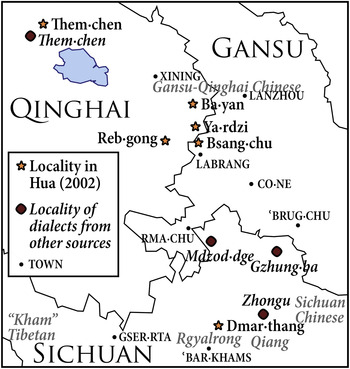
The primary source of data for this study is Hua (Reference Hua2002), a glossary of six Amdo dialects: Bsang·chu (Bsa), Reb·gong (Reb), Ya·rdzi (Yar), Ba·yan (Bay), Dmar·thang (Dma) and Them·chen (The).Footnote 2 Work on individual dialects is consulted when possible: For Bsa, reference is made to Hua and Longbojia (Reference Hua and Longbojia1993), a dictionary of the dialect of Labrang town; for Dma, to Sun (Reference Sun1986), describing a similar dialect from Mdzod·dge;Footnote 3 for The, to Haller (Reference Haller2004).Footnote 4 Mostly fragmentary data on other dialects are referred to where relevant. The locality of the dialects referred to in this study is represented on Figure 1.
Map of Tibetan dialects referred to in this study and neighbouring languages

Idiosyncratic changes happen in dialects, making perfect correspondence impossible; a work of the scope of Hua (Reference Hua2002) (and the other monographs) necessarily contains its share of misprints and mistranscriptions. No claim of exhaustiveness is made concerning their classification and explanation, with one partial exception: because of the importance of rhymes giving modern i and e in this study, alternations and irregular correspondences between these two vowels are studied in detail.
Among the six dialects described in Hua (Reference Hua2002), Bay is highly deviant: among its many anomalies, the form for numerals ‘eight’ (OT brgyad, #1067) and ‘hundred’ (OT brgya, #1098) had hbj- initials: hbiε and hbia,Footnote 5 the form for ‘hand’ (OT lag·pa #139) has as initial ɬ-; the word smon·lam is pronounced hno.lan.
The other five dialects in Hua (Reference Hua2002) show mostly regular phonological correspondences to each other, and they are considered as belonging to the same group, named Core Amdo for the purpose of this study. As Bay is nevertheless close to Core Amdo dialects, it will be presented and discussed along with other dialects from Hua (Reference Hua2002). However, no reconstruction decision will be based on it.
The reflexes of Tibetan rhymes in di- or polysyllabic words often depend on the position of the syllable containing the rhyme, a non-final syllable often having radically divergent outcomes from a final one (see Jacques Reference Jacques and Sun2014 and Sun Reference Sun2006 for some extreme examples). Fortunately, the effect of this phenomenon is very limited in Amdo Tibetan, and cases where this happens will be mentioned in an ad hoc manner.
This study begins with Section 2, where corresponding sets of rhymes are identified among the Amdo dialects, represented as rhymes of the proto-language, called Core Amdo (CA). In Section 3, it will be demonstrated that the vowel system of Core Amdo goes back to one with phonemic vowel length. With this insight, in Section 4 I try to give a relative chronology of the phonetic changes from Old Tibetan to the Core Amdo dialects, along with some absolute dating with recourse to loanwords.
2. Internal correspondences in Amdo
In this section, I will present the correspondence of rhymes among Core Amdo dialects. For each correspondence set, a reconstructed rhyme will be given (i.e. the most recent ancestor of Core Amdo dialects, labelled Core Amdo, will be reconstructed). The usual precautions apply: that Core Amdo is meant as a convenient representation of the reconstructible features, and may never have existed as a spoken variety. In other words, by the time that some features reconstructed for Core Amdo came into being, changes may have already created some of the dialect divisions in the Core Amdo area.
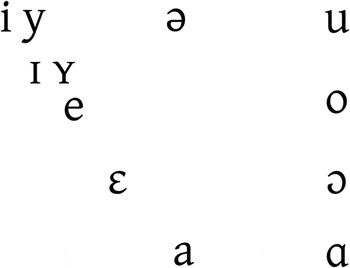
The reconstructed Core Amdo system has 12 vowels, as shown in Figure 2. Of the Core Amdo vowels, *a, *e, *o, and *ə can be followed by codas – one of *p, *t, *k, *m, *n, *ŋ, *r. The other vowels can only occur in open syllables.
Vowels in reconstructed Core Amdo

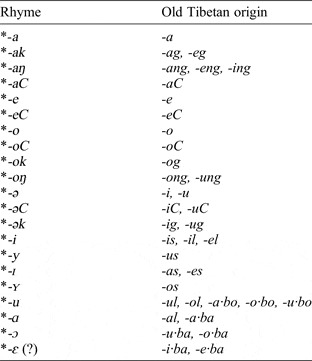
For the convenience of the reader, a chart showing the most common correspondence from Old Tibetan to Core Amdo is shown in Table 1.
Most common rhyme correspondence between Old Tibetan and Core Amdo

In Section 2.1 I discuss the consonant codas in Core Amdo with regard to their origin, their realizations and their influences on the syllable nucleus. This is followed by discussion of vowels that can take codas, vowels deriving from a lost Old Tibetan coda, and then vowels derived from syllable fusion. Lastly, the conclusion highlights the characteristic changes of each dialect – and archaisms of Bay – and the evolution of Old Tibetan rhymes to Core Amdo.
2.1. Overview of rhymes with consonant coda
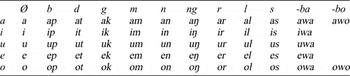
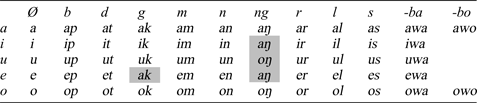
In Core Amdo, only four vowels occur in closed syllables: *a, *ə, *e and *o. Therefore one example will be shown for every coda with each of the four nuclei.
2.1.1. *-t, *-n, *-r
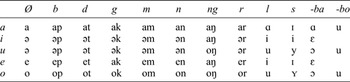
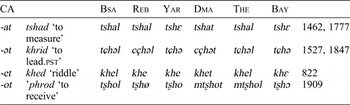
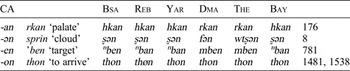
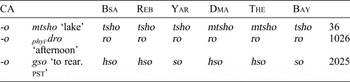
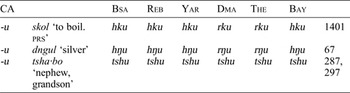
First, I will examine the coronal codas, starting with *-t (Table 2). The coda *-t, which always comes from OT -d, has its pausal forms transcribed -l in Bsa and The, -t in Dma, and lost in Yar and Bay; the Reb forms present an interesting mix: the coda is lost after mid vowels, but retained as -l after /a/ and /ə/. The lost codas create new vowels in Reb, Yar and Bay: /ø/ < *ot in Reb, /ε/ < *at in Yar, and /ε/ < *at,et as well as /ɔ/ < *ot in Bay.
Modern reflexes of CA *-t

This coda is notoriously volatile in Amdo dialects. Even in dialects where it is preserved, it is in some instances lost or totally assimilated. For Mdzod·dge, Sun (Reference Sun1986: 36) indicated that the alternant of /-d/ is [Ø] in a word-internal preconsonantal environment, where the following consonant is neither a nasal nor homorganic (coronal). For Bsa, Reb and The, it is mentioned in Hua (Reference Hua2002) that this coda is often lost in connected speech. Similarly, in the Them·chen dialect, as described in Haller (Reference Haller2004: 32), it is mentioned that in rapid speech -l is assimilated to the following morpheme: wəs-sʰuŋ < wəl-sʰuŋ ‘went’ (“OT”: bud·song).
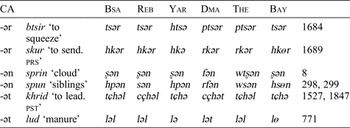
The coda *-n remains /-n/ in all the dialects surveyed (Table 3). In Reb, Yar and Bay, *-an and *-en have merged, giving what is transcribed as -an. The outcome looks strange but is not: -an is phonetically front in all three dialects: [æn].
Modern reflexes of CA *-n

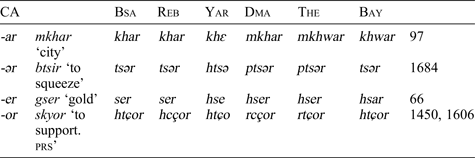
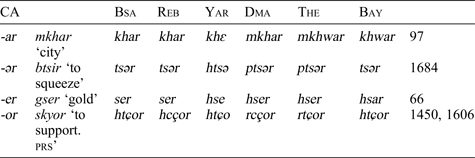
The coda *-r is lost in Yar but preserved in all other dialects (Table 4). Yar and Bay show an interesting contrast: in Yar, *-r behaves like *-t, or indeed *-p as well, as we will soon see, vanishing with the only trace on the vowel quality of *a; in Bay *-r behaves like *-n, in that *-ar and *-er have merged as -ar, phonetically [-ær].
Modern reflexes of CA *-r
2.1.2. *-p, *-m
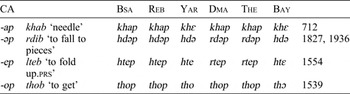
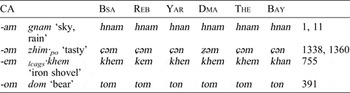
Labial codas (Tables 5 and 6) behave similarily to coronal codas. They remain /-p/ and /-m/ in Bsa, Reb, Dma and The; in the agricultural dialects of Yar and Bay, *-p is lost, along with *-t, while *-m merged with *-n as /-n/.
Modern reflexes of CA *-p

Modern reflexes of CA *-m

There is an interesting issue of rule ordering between Yar and Bay: in Yar, -en is lowered to -an before *-m became -n, so *-em gives -en, different from *-en; in Bay, it is the other way round: *-m and *-n merged first, so *-em became -an along with *-en.
2.1.3. *-k, *-ŋ
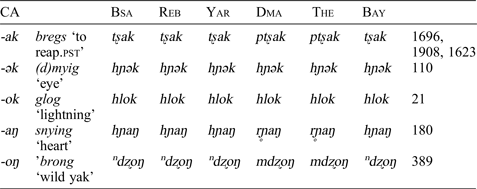
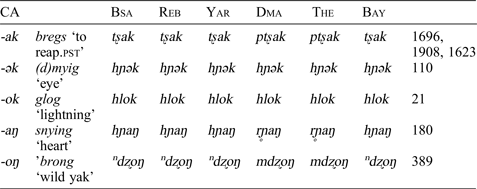
Rhymes with CA *-k and *-ŋ (Table 7) transparently derive from Old Tibetan rhymes in -g(s) and -ng(s), but they have the peculiarity that they witness further mergers in nuclear quality: OT -ag and -eg merge as -ak; OT -ang, -eng and -ing merge as -aŋ; OT -ong and -ung merge as -oŋ. Thus, while there are four possible nucleus vowels before other codas, there are only two before *-ŋ (*a, *o) and three before *-k (*a, *ə, *o). Regularly, all the CA rhymes with *-k and *-ŋ remain unchanged in the dialects.
Modern reflexes of CA *-k and *-ŋ
The categorical transcription as /-k/ conceals two important and rather uniform phonetic facts about the non-nasal velar coda: spirantization and uvularization. Spirantization refers to the phenomenon of /-k/ almost always having a realization ranging from fricative to approximant. Uvularization refers to the fact that the realization is a uvular /q ~ χ ~ ʁ/ after the back vowels /a/ and /o/.
The modern realizations of the rhymes transcribed with a velar stop coda are shown in Table 8, with data taken from the phonology section of Hua Reference Hua2002. The items with a dash are not mentioned in Hua's discussion of allophones of vowels and coda consonants. In Brag·dmar Them·chen (Haller Reference Haller2004), the reflexes of the rhymes are, respectively, [ʌχ], [ɪç] and [oχ] in phonetic transcription. In Mdzod·dge (Sun Reference Sun1986) the phonetic realizations are, respectively, [ɑʁ], [ɤɣ], [oʁ]. In Labrang, “some people” (Gesang-Jumian and Gesang-Yangjin Reference Gesang-Jumian and Gesang-Yangjin2002: 204) pronounce the reflexes of the rhymes as [ɐχ], [ɯx] and [oχ].
Phonetic transcriptions of CA *-k rhymes (Hua Reference Hua2002)

The evidence from these dialects suggests that inconsistencies in Table 8 probably reflect occasional errors,Footnote 6 and the two processes can be reconstructed at the level of Core Amdo.
Judging from the current evidence, a strong case can be made that the uvular pronunciation of OT -g after the vowels a and o can be reconstructed for Old Tibetan. In almost every dialect of Tibetan, there is something that shows the effect of a uvular coda for -ag or -og.
-
• In Western Tibetan (Zemp Reference Zemp2006), there is a complementary distribution between coda -k and -q: -q after a and o; -k after e, i and u. The rhyme -ek is secondary (mostly loans): Old Tibetan -eg turned into -jaq in Western Tibetan, like CA *-ak < OT -eg (Jacques Reference Jacques2009).
-
• In Lhasa Tibetan, the coda-less variant of words of the Old Tibetan rhyme -og is ɔʔ (Goldstein and Nawang Reference Goldstein and Nawang1970; DeLancey Reference DeLancey, Thurgood and LaPolla2003): the former uvular coda leaves its trace in the retracted tongue root of the vowel.
-
• In Shigatse Tibetan (Haller Reference Haller2000; Jäschke Reference Jäschke1883: 5–6; Qu Reference Qu1991: 157), og gives oa, which can be compared with Contemporary Standard German -ɐ < -ʁ, or the Tiberian Hebrew offglide inserting rule (Prince Reference Prince1975: 9), where a vowel a is inserted word-finally between a non-low vowel and a consonant belonging to the class ʕ, ḥ, h: šolēaḥ < *šolēḥ ‘sending’.
-
• In Co·ne Tibetan (Jacques Reference Jacques and Sun2014: 279–80), spoken in Nyin·pa, OT -ag, -eg, -og has the coda -q when not word-final.
-
• Among non-Amdo “archaic” dialects from eastern Tibet, Kha·long (Sun Reference Sun, Bielmeier and Haller2007) shows reflex -əχ from OT -ag, -eg and -oχ from OT -og. The neighbouring Gser·pa (Sun Reference Sun2006) shows word-final -ɯa for all three.Footnote 7
There remains an important phenomenon that influenced the outcome of OT -ng and -g: what would have become -aŋ and -ak sometimes in fact has the outcome -oŋ and -ok. This labialization varies dialectally – it is less frequent in Dma than elsewhere and completely absent in Mdzod·dge (Sun Reference Sun1986)Footnote 8 – and idiolect-internally with several factors: it is frequent when followed by the nominalizing suffix -wa (< OT -pa or -ba), and rare elsewhere; in the former case, it is frequent in everyday nouns and unattested in literary loans and adjectives. For the absence of rounding in adjectives, the reason probably has to do with the grammar of adjectives: they occur without suffix as stative verbs and suffixed (with -wa besides other suffixes inherited from OT) as nominal appositions: ⁿdʐapar maŋwo (more usually maŋ(w)a) ‘a lot of photos’, ⁿdʐapar maŋ kə ‘photos abound’ (Sung and Rgyal Reference Sung and Rgyal2005: 167; cf. Haller Reference Haller2004: 54). A quasi-inflectional ablaut (moŋ~maŋ) in this case would be hard to maintain.Footnote 9
2.2. *a
2.2.1. Open rhyme
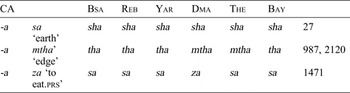
In open syllables, CA *a (Table 9), which comes from OT a, gives /a/ in all dialects. In Dma (Hua Reference Hua2002: 36) and Mdzod·dge (Sun Reference Sun1986), both Southeastern varieties spoken in Sichuan, *a in an open syllable is raised, approaching [æ]. Hence this vowel is noted æ in Sun Reference Sun1986: the words in Table 9 are transcribed respectively as sʰæ, ⁿthæ and sæ.
Modern reflexes of CA *-a

2.2.2. Closed rhyme
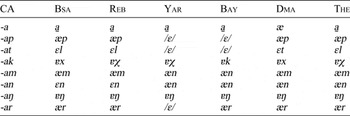
In closed syllables, OT a always gives CA *a. Additionally, *-ak may come from OT -eg(s), *-aŋ from OT -eng(s) and -ing(s).
Compared with the usually low central quality in open syllables, *a shows a higher vowel quality in closed syllables. In Yar and Bay, where some codas were lost, the erstwhile allophonic difference has been phonologized as another vowel /ε/. In Table 10, the reflexes are given in phonetic transcription (following the phonology section of respective dialects in Hua Reference Hua2002), and the phonologized reflexes are given in pairs of slashes.Footnote 10
Phonetic realizations of rhymes with CA *a

In Mdzod·dge, CA *-an and *-at become -en and -ed. Furthermore, the reflex of CA -aŋ and -ak are phonetically [ɑɴ] and [ɑʁ] in Mdzod·dge, with a low back vowel. These rhymes are transcribed, unlike in Hua (Reference Hua2002), as -aŋ and -aɡ, with the vowel /a/, which corresponds to CA *ɑ in open syllables.
2.3. *e
2.3.1. Open rhyme
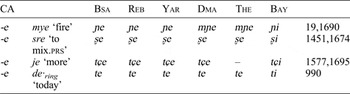
Core Amdo vowel *e derives from the Old Tibetan vowel e. Generally, it remains e in all dialects included in Hua (Reference Hua2002) except Bay, where it is raised to i. This is the case for the most reliable words, i.e. those least liable to interdialect loan or sporadic change (Table 11). The same is true for most nouns, including loans (Table 12).
Modern reflexes of CA *-e

CA *-e in loan nouns

However, in some words the Bay form shows an unexpected e. Some are mere misprints, for example Bay tshe < OT tshe ‘life’ (#204) besides tshi ɕi.ma < tshe phyi·ma ‘the next life’ (#854); or interdialectal borrowings, such as the decade forms ɕe ‘forty’ and re ‘sixty’ (#1086, #1090), which confirms the general impression that Bay decade forms are borrowed. There is nevertheless one type of e < CA *e < OT e that is regular, namely when it comes before a non-fusional OT pa/ba: hde.wa < OT sde·pa ‘village’ (#99), hɡe.wa < OT dge·ba ‘good conduct’ (#854).
2.3.2. Abnormal raising of Old Tibetan rhyme -e
However, open-syllable -e in Old Tibetan does not always give e as expected: it has sometimes become i in modern dialects. Several generalizations can be made about the situation in Hua Reference Hua2002. The phenomenon is absent in verbs, which either indicates its origin as interdialectal borrowing, or points to morphophonological constraints. Among 11 monosyllabic words, no raised forms are attested. Among 25 polysyllabic words with first-syllable -e, and 23 with last-syllable -e, there are nine and 12 raised forms respectively, showing a bias towards last-syllable raising.
There is a dialectal difference in frequency, where it is absent in Bsa and Reb, but frequent in the agricultural dialect of Yar (9 cases), and the nomad dialects of Dma and The (5 and 4 cases). The count above does not include two cases: that of religious terms like OT mchod·me ‘butter lamp’ (#891, i in Bsa, Reb, Yar and Bay), rdo·rje ‘vajra’ (#900, i in all dialects except Yar); and that of cases which I call here i-ə-e, exemplified with the word OT sta·re ‘axe’ (#746), which shows a surprising number of i-reflexes, as is shown in Table 13.
The word sta·re in Amdo dialects

The Them·chen dialect in Haller (Reference Haller2004), similarly, has ʂtari. Here a hypothesis is proposed that these forms showing i are secondary. The form with ə reflects OT *sta·ri,Footnote 12 the majority form in non-Amdo dialects.Footnote 13 As it is probable that ə is in fact a phonologically high /ɨ/ (discussed in Section 2.5), the forms with i can be considered blends, i.e. interdialectal intermediate forms, sharing the frontness of e and the height of ə. A similar case is given by OT snye·ma ‘ear (of grain)’ (#491), with i-reflex in Bsa, Yar and Bay, and ə in Reb, where, similarly, three Ngari dialects (Dge·rgyas, Mtsho·chen and Sger·rtse) show forms reflecting an OT i.
2.3.3. Closed rhyme
In modern Amdo dialects, the vowel quality in closed syllables is akin to that in open syllables, a high and tense cardinal [e]. However, there are some traces of a former lowering: the lowering of *en, merging with *an as [æn] in Reb and Yar. Bay shows more extensive traces of a lowering: *ep, et become ε as *ap, at, *en (em), er become [æn], [ær] as *an (am), ar. In Bay, in every former closed syllable *a merges with *e, giving a sound in between.
2.4. *o
The Core Amdo rhyme *o remains unchanged in all Amdo dialects (Table 14). In closed syllables, *o always has the same quality as in open syllables, a closed [o]. In Bay, on the contrary, *op, *ot give an open rhyme with a lowered vowel ɔ.
Modern reflexes of CA *-o

2.5. *ə
The Core Amdo vowel *ə comes from Old Tibetan vowels i and u. It remains ə in all Core Amdo dialects. Although its most frequent allophone is transcribed [ə], the vowel is likely to be phonologically high, better transcribed as /ɨ/, considering its origin and allophonic behaviour.
Unlike Core Amdo dialects, Bay retains the distinction of the two Old Tibetan vowels, albeit with numerous secondary developments. Even though Bay is not taken into account in the reconstruction of Core Amdo, it sheds important light on the development of Core Amdo dialects, and will be treated here in particular.
I start by the more archaic closed rhymes, proceeding then to open rhymes, where the Bay reflexes depend on the initial. As is shown in Table 15, in Core Amdo dialects, Old Tibetan i and u merge into *ə. In Bay, on the contrary, i gives ə, while u gives ɵ.
Modern reflexes of OT *i/u (CA *ə) in closed syllables

In open rhymes, four classes of initials need to be distinguished: neutral (velar and /n/), palatal, apical (alveolar and retroflex) and labial. The regular outcome in Bay is shown in Table 16.
Regular reflexes in Bay open syllables of OT -i/u

After a velar initial, the rhyme -u gives ə: hɡə < dgu ‘nine’ (#1068); htɕa.ⁿɡə < spyang·khu ‘wolf’ (#408); mdzə.ɣə < mdzu·gu ‘finger’ (#141), with a regressive assimilation. There are no words with a velar initial and -i rhyme in Hua Reference Hua2002: however, it is reasonable to suppose that -u and -i merged after a velar initial, as in Core Amdo dialects. Note that an Old Tibetan syllable of form Ku(b/d) would have given Kɵ,Footnote 15 which would have formed a near-minimal pair. The only example with n-, similarly, turns -u into ə: nə.ma < nu·ma ‘breast’ (#126).
After a palatal initial, the rhyme -i gives i, and -u y: tɕhy < chu ‘water’ (#36, 59); ʑy < gzhu ‘bow’ (#785); tɕhy < khyu ‘herd’ (#1129); ɕhi < shi ‘to die’ (#1931); ɲi < myi ‘human being’ (#205); hɲi.lan < rmyi·lam ‘dream’ (#930). However, after a voiceless palatal affricate, the outcome of OT -i is an apicalized ɿ Footnote 16 : tɕɿ < gri ‘knife’ (#680); htɕɿ < skyi ‘to borrow’ (#1722); tɕhɿ < khyi ‘dog’ (#364).
After an apical initial (save n-), -u and -i are respectively apicalized to -ʮ and -ɿ, examples for which abound: hlʮ < klu ‘nāga’ (#848); tshʮ < 'thu ‘to collect.prs’ (#1511, 1694, 2088); tsʮ < du ‘how many’ (#1221); ⁿdʐʮ < 'bru ‘cereals’ (#488); zɿ < gzi ‘onyx’ (#75); hla.htsɿ < gla·rtsi ‘musk’ (#397).
After a labial initial, -u gives u: hɲək.pu < (d)myig·spu ‘eyebrow, eyelash’ (#108, 109); wu.tsa cf. OT bu ‘son’ (#283); ⁿbu < ‘bu ‘insect, worm’ (#435). Only one morpheme with a labial initial and -i exists in the materials: the negative prefix mə < mi (#2101).
In conclusion, a previous stage of open rhymes can be reconstructed as identical to closed rhymes: ə for -i, and ɵ for -u. In open rhymes, ɵ preserves its labial feature if it changes into a different rhyme (y, ʮ or u) by dint of the initial; otherwise, it has merged with ə < -i.
There remain two issues about the development of what corresponds to Core Amdo *ə in Bay. First, in disyllables, some first-syllable open -u and -i remain -ɵ and -ə, as in closed rhymes: tɕhə.mo < khyi·mo ‘bitch’ (#365) besides tɕhɿ < khyi ‘dog’ (#364); hdʑɵ.ma < rgyu·ma ‘intestine’ (#186); hɕə.ⁿɡo < dpyi·mgo ‘hipbone’ (#189). I hypothesize that originally, only second-syllable -ɵ and -ə underwent the change into other rhymes. The other cases of first-syllable changed rhymes are due to reanalysis of compounds.
Second, a labial preinitial (m-, b-) in Old Tibetan sometimes influences the vowel quality of the reflex of i, making the vowel sound like OT u (Zhang Reference Zhang2009): ʑy < bzhi ‘four’ (#1063); tɕhɵn.ba < mchin·pa ‘liver’ (#181). This effect should be considered secondary, bearing in mind the fact that in Bay and other dialects, such preinitials often induce a labialization on the following consonant: Bay khwar, The mkhwar < mkhar ‘fortified city, castle’ (#97).
2.6. *i, *y, *ɪ, *ʏ
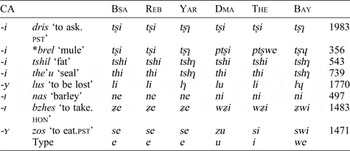
This subsection discusses the rhymes which, among other possible origins, come from Old Tibetan rhymes with a coda -s (Table 17). All of these rhymes become i in The. Additionally the Old Tibetan rhymes il, el, e‘u give the same reflexes as is in all the Amdo dialects surveyed.
Modern reflexes of Core Amdo rhymes *-i, *-y, *-ɪ and *-ʏ

In Yar and Bay, agricultural dialects heavily influenced by Chinese, Core Amdo high front vowels are apicalized under certain conditions. The apicalized vowels are transcribed /ʮ/ ([z̩ʷ]) when rounded and /ɿ/ ([z̩]) when not. In both dialects, this is the case after apical consonants. Additionally, in Bay, all non-palatal initials cause apicalization: khɿ < ‘khel ‘to hit (the target)’ (#1505), cf. Bsa, Reb, Yar, The khi.
In The, a labialized consonant or a w lowers a following i to e, as is seen with the word *brel (OT drel) ‘mule’ (#356) in the examples. Compare li < lus ‘to be lost’ (#1770) with wkwe < brkus ‘to steal.pst’ (#1963).
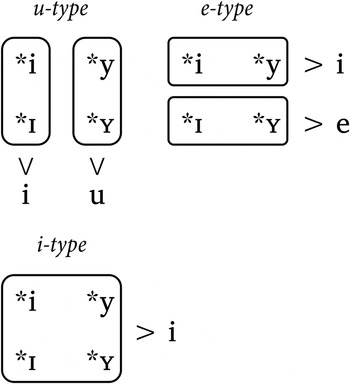
With these secondary developments in mind, the forms in the five Core Amdo dialects can be reduced to three types. We reconstruct four Core Amdo rhymes for the rhymes concerned in this subsection: *i, *ɪ, *y, *ʏ. Concerning their origins, *i < OT is, il, el; *y < OT us; *ɪ < as, es; *ʏ < os. The three types of developments, conveniently labelled with the reflex of *ʏ (< OT os), are listed as follows and illustrated in Figure 3:
-
• i-type: all four rhymes giving i. (The, Them·chen (Haller Reference Haller2004), Rtse·khog (Qu Reference Qu1991))
-
• e-type: *i,y gives i, *ɪ,ʏ gives e same as *e. (Bsa, Reb, Yar)
-
• u-type: *i,ɪ gives i, *y,ʏ gives u same as *u. (Dma, Mdzod·dge (Sun Reference Sun1986), Rma·chu (Zhoumaocao Reference Zhoumaocao2004), A·rig (Qu, Reference Qu1991))Footnote 17
Major types of outcome for Old Tibetan rhymes in -s

As is mentioned for CA *e (2.3.2), forms which regularly will give e in modern dialects sometimes in fact give i. Similarly, in Bay, *ɪ, ʏ regularly gives rise to i, y, which differs from *i, y by the lack of apicalization: Bay ⁿdʐi < OT ‘bras ‘rice’ (#489), cf. tʂʮ < OT brel ‘busy’ (#1351). (Note the effect of the labialized initial br-.)
Hence, Bay in fact belongs to a sui generis we-type, similar to e-type in that *ɪ and *e have identical reflexes. The difference between Bay and e type is that the differences between all four Core Amdo rhymes are reflected in Bay, with the rounded rhymes being reflected by a -w-. Another minor type is represented by Suǒlā (所拉) dialect in Dkar·mdzes (Qu Reference Qu1991). In this dialect, *ʏ is reflected as u, while *y remains *y.Footnote 18 The extreme diversity, compared to the general closeness of Amdo dialects, points to a late date of the collapse of the four-vowel system in modern-day dialects.
2.7. *u
The Core Amdo vowel *u remains u in all the dialects concerned. It has three OT origins: ol, ul and merged disyllables ending in a·bo, o·bo or u·bo.
Modern reflexes of CA *-u

For -o·bo, see for example Mdzod·dge (Sun Reference Sun1986) ku < OT go·bo ‘vulture’. For -u·bo, the only examples are words of kinship: The hu < OT phu·bo ‘elder brother’, Bay nu < OT nu·bo ‘younger brother’.
2.8. *ɑ
The Core Amdo vowel *ɑ (Table 19) merged with *a in all the dialects described in Hua (Reference Hua2002) except Dma. The distinction between *ɑ and *a is also preserved in Mdzod·dge (Sun Reference Sun1986) as /a/ (for CA *ɑ) versus /æ/ (for CA *a). The distinction is present in the speech of elder speakers in Labrang town, too, lest it be considered a south-eastern-only phenomenon (Gesang-Jumian and Gesang-Yangjin Reference Gesang-Jumian and Gesang-Yangjin2002). It has two Old Tibetan origins: -al and -a·ba.
Modern reflexes of CA *-ɑ

There are two cases where the Old/Written Tibetan equivalent of a disyllabic word has an open -a rhyme, but the corresponding Dma form shows [ɑ]: vowel harmony and recomposition.
The first process, vowel harmony, is also present in Mdzod·dge, where it is subject to a rigorous analysis in Sun (Reference Sun1986: 73–84). According to Sun, this process applies only to a disyllabic word, where /æ/ (< CA *a), /e/ and /o/, as the vowel of the first syllable, are respectively lowered into /a/ (< ɑ), /ε/ and /ɔ/, if one of the following conditions holds:
-
• The second syllable contains the vowel /ɤ/ (< CA *ə), /u/ or /i/ (called dominant vowels by Sun): tom ‘bear’ and tʂʰɤg ‘youngling’ are composed to make tomtʂʰɤg ‘bear cub’ > [tɔmtʂʰɤɣ].
-
• The second syllable consists of the nucleus /a/ or /o/ and a velar coda. In other words, the second syllable is of rhyme -aŋ, -oŋ, -aɡ or -oɡ: ser ‘gold’ and ɕhoɡ ‘paper’ are composed to make serɕhoɡ > [sεɾɕʰoʁ] ‘gold foil’.
-
• Only when the first syllable nucleus is æ, a vowel /a/ in the second syllable assimilates the æ to a: ⁿdæ ‘bullet’ and ra ‘fence’ make ⁿdæra > [ⁿdara] ‘bandoleer’.
In Dma, /a/ in the first syllable of a disyllabic word changes into [ɑ] when the second syllable:
-
• contains the vowel /ə/, /u/ or /i/, ex. rɑ.lək < ra·lug ‘goats and camels’ (#348), rŋɑ.ptɕə < lnga·bcu ‘fifty’ (#1087), ptʂɑ.ɕhi < bkra·shis ‘auspiciousness’ (#923), kɑ.rju ‘bowl’ < dkar·yol (#685);
-
• is of rhyme -aŋ, -oŋ or -ak, ex. wɕɑ.tshaŋ < bya·tshang ‘birds’ nest’ (#412), rŋɑ.moŋ < rnga·mong ‘camel’ (#358), xhɑ.nak < sha·snag ‘lean meat’ (#540).
-
• When the second syllable has the nucleus ɑ: rtɑ.rɑ < rta·ra(·ba) ‘horse corral’ (#628).
Not all Dma forms noted in Hua (Reference Hua2002) show effects of vowel harmony: rn̥a.khoŋ < sna·khung ‘nostril’, rma.xhu < rma·shul ‘scar’. Despite examples like this, it is likely that the process is automatic in Dma, just as in Mdzod·dge, as, for a non-phonemic process, it is left to the transcriber's choice whether to transcribe it. Dma forms with [ɑ] resulting from vowel harmony are reconstructed with CA *a.
The second case of apparent OT a – CA *ɑ correspondence involves recomposition, which can be illustrated with compounds from the word OT ra·ba ‘enclosure’. Gardens, for example, are enclosures of plants (OT ldum(·bu)). In Old Tibetan, a language which prefers disyllabic nouns, only the root ra enters the compound form: ldum·ra (Pt. 1085 l. r3, 7). In Core Amdo, ra·ba has already fused into *rɑ, which can directly enter disyllabic compounds. Speakers conscious of the derivation will change the second syllable from *ra to *rɑ for better transparency, giving Dma rdəm.rɑ (#648). This ɑ should be reconstructed at the level of Core Amdo.
2.9. *ɔ, *ε
These rhymes come from Old Tibetan disyllables, i·ba, u·ba, e·ba and o·ba (Table 20). They appear here last because there are difficulties with the reconstructions, which remain for now tentative.
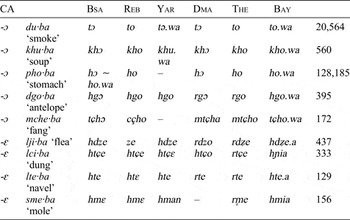
Modern reflexes of CA *-ε, *-ɔ

As can be seen in Table 20, the modern reflexes involved are quite irregular. There are two patterns, however, that emerge from this irregularity:
First, Yar often shows non-fusional forms where other Core Amdo dialects show them. This can be attributed to a later layer of loans from a Bay-like dialect, as names of tools, for example, all show non-fusional forms: so.wa < OT zo·ba ‘bucket’ (#695, cf. Dma tɕhə.zɔ), jo.wa < OT yu·ba ‘handle’ (#767, cf. Dma jɔ).
Second, there is a systematic difference between the lexical set lji·ba, lci·ba, on the one hand, and lte·ba, sme·ba on the other. The first group shows e in Reb and o in Dma; the second shows ε in Reb and e in Dma. The nature of the distinction is unclear, due to the paucity of the data: the first group always has palatal initials and the second always non-palatal; however, the first group comes from OT -i·ba etymologically and the second from -e·ba. The first reason implies that the given reconstruction as *ε is reasonable, while the second implies two fusional vowels, maybe *ø from -i·ba and *ε from -e·ba.
Mdzod·dge Tibetan (Sun Reference Sun1986) shows a more regular derivation: always -ɔ < -u·ba, -o·ba; ε < -i·ba, -e·ba. While further research, with fresh data, is needed, a preliminary reconstruction is offered here, as in Mdzod·dge.
2.10. Conclusion
Now I will recapitulate the characteristic sound changes from Core Amdo to individual Amdo dialects.
-
• For Bsa, *ɑ merged with *a, *ε with *e, but *ɔ remained *ɔ. Vowels from OT coda -s show e-type reflexes: *ɪ,ʏ > e = *e, *i, y > i. Codas are preserved intact.
-
• For Reb, *ɑ merged with *a, *ɔ with *o, but *ε seems to be preserved as *ε. Vowels from OT coda -s show e-type reflexes. All codas are preserved intact, except for *et, ot which gives e = *e and ø.
-
• For Yar, there is one case of preservation of ε, otherwise *ɑ, ɔ, ε gives *a, o, e. Vowels from OT coda -s show e-type reflexes. Codas *-p, -t, -r are lost, changing a main vowel *a to a phonologized ε. Coda *m merged with *n. In an open syllable, a modern i is apicalized after an apical initial.
-
• For Dma, *ɑ is preserved, no doubt helped by the fact that *a raised to near [æ]. *ɔ is similarly preserved, while *ε goes to [e] (however, some words show [o], a point which needs further investigation). Vowels from OT coda -s show u-type reflexes: *y, ʏ > u = *u; *i, ɪ > i. Codas are preserved intact.
-
• For The, *ɑ, ɔ, ε merged with *a, o, e. Vowels from OT coda -s show i-type reflexes: *i, ɪ, y, ʏ > i. Codas are preserved intact. Additionally, what would have become wi gives we, in a secondary lowering.
Bay, which lies outside the reconstruction scope of Core Amdo, shows two major archaisms not reconstructed for Core Amdo: non-fusion of OT V·pa, V·ba structures, and non-merger of OT i and u. The high vowels i and u are centralized to ɵ and ə, precursors to the Core Amdo merged forms. In final rhymes corresponding to Core Amdo open rhymes, ɵ and ə underwent secondary changes, according to the place of articulation of the initial.
Concerning the vowels from Old Tibetan coda -s, Bay shows a conservative type: *i > i, *y > wi ~ y, *ɪ > e = *e, *ʏ > we ~ ø. Thus, *ɪ, ʏ raised together with *e to become i, y, with the difference that apicalization is not possible with rhymes of this origin.
In Bay, *ɑ merged with *a, codas *-p, -t are lost, merging *a and *e to ε and lowering *o to ɔ. Coda *-m merged with *-n.
The Old Tibetan origin of Core Amdo rhymes is capitulated in Table 21. To avoid cluttering, C stands for m, n, r, p and t, the latter two written b and d in Tibetan orthography. Also, as OT post-final -s, -d are systematically disregarded in rhymes,Footnote 19 and are not mentioned in the table.
Old Tibetan origins of Amdo Tibetan rhymes

3. Vowel length in pre-Core Amdo
Core Amdo has 12 vowels, a large number, especially when compared with its five-vowelled ancestor, Old Tibetan. This is an unstable system, which then collapsed into a six-vowelled system in an innovating dialect like The. The issue is explaining how such a complex system could come into being in the first place.
Note that the 12 vowels of Core Amdo naturally fall into two classes: those which can take a coda and those which cannot. The first class comprises *a, *ə, *e and *o; the second class comprises *ɑ, *i, *u, *ɪ, *y, *ʏ, *ε and *ɔ. There are profound differences between these two classes of vowels, both diachronical and synchronical.
Diachronically, vowels of the first class always correspond to Old Tibetan vowels: they occur in closed syllables when the etymon has a coda, and in open syllables when the etymon does not. Those of the second class, however, either come from Old Tibetan rhymes with a disappeared coda (V < VC), or coalesced Old Tibetan disyllables (V < VCV): *ɑ (al, a·ba), *i (il, el, is), *u (ul, ol, a·bo, o·bo), *ɪ (as, es), *y (us), *ʏ (os), *ε (i·ba, e·ba), *ɔ (u·ba, o·ba).
Synchronically, in conservative dialects where the reflexes of the two classes are kept distinct, like Mdzod·dge (Sun Reference Sun1986: 88), the two classes of vowels exhibit drastically different morphological behaviour. In Mdzod·dge, the genitive/ergative case of a noun is constructed either with ablaut or suffixation. Ablaut applies only to nouns where the final syllable is an open syllable containing reflexes of the first class of vowels: /æ/ ( < CA *a), /e/, /o/ or /ɤ/ (< *ə); suffixation applies to closed syllables and open syllables with the second class of vowels: /a/ (< CA *ɑ), /i/ (< *i, *ɪ), /u/ (< *u, *y, *ʏ), /ε/ or /ɔ/.
The key to the distinction lies in the vowel /ɑ/. How can its two etymons, al and a·ba, result in the same rhyme? Two hypotheses can be formed in principle:
-
• al > /aː/, a·ba /awa/ > /aː/; then /aː/ > /ɑ/.
-
• al > /alˠ/ > /aw/, a·ba > /aw/; then /aw/ > /ɒ/ > /ɑ/.
The first hypothesis is to be preferred. If a·ba gave /aw/ as per the second hypothesis, u·ba would have given /uw/, a long way from the desired reflex *ɔ. More pertinently, the intermediate step of the first hypothesis is identical to attested situations in tonal dialects of Tibetan, such as Shigatse (Haller Reference Haller2000; Gesang-Jumian and Gesang-Yangjin Reference Gesang-Jumian and Gesang-Yangjin2002). In Shigatse Tibetan, both OT al and a·ba have become /aː/: ɕáá < OT sha·ba ‘deer’, phàá < bal ‘wool’.
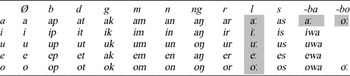
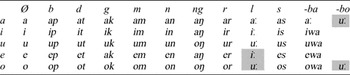
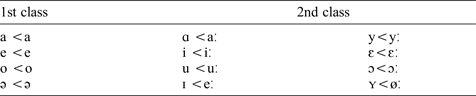
Now that it has been determined that *ɑ < /aː/, the other vowels in the second class also come from long vowels: *i and *u, as Vl > VV; *i also comes from is so *ɪ, *ʏ, *y should have similar origins; as for *ε and *ɔ, they should also be considered as coming from long vowels, in order to explain the shared properties of the second class.
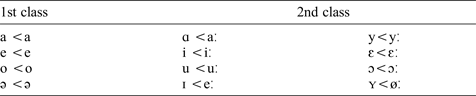
Thus, the older forms of Core Amdo vowels can be reconstructed as is shown in Table 22. Note *ɪ < /eː/ and *ʏ < /øː/. It is not necessary to reconstruct an additional degree of height in a vowel system that distinguishes length.
Reconstruction of pre-Core-Amdo vowels
4. Evolution of Amdo Tibetan rhymes
4.1. Phonological history of Amdo Tibetan rhymes
The phonetic evolution of a language can usually be analysed as a series of atomic changes, or sound laws. These changes occur in a relative chronology which can be partially reconstructed by internal means. We can know that one change necessarily comes before another, because, in the terms of generative phonology, one rule feeds another (its outcome fits the prerequisites for the other) or bleeds another (it changes something that could have been the input for the other), so that different orders for the changes do not give the same result. However, the requirements for chronological precedents do not form a total order: between two rules which are not related (transitively) by feeding or bleeding, one cannot tell which one happens first in the language. For ease of presentation, I will first introduce the changes in one plausible chronology, and a diagram representing these precedence requirements will be given afterwards. Finally, I will discuss the external evidence that permits a more accurate relative or absolute dating of the changes.
Postfinal -s could have been lost at any stage of the evolution, so it is systematically disregarded in the following account.
We start from a literal reconstructionFootnote 20 of Old Tibetan, as Stage 0 (Table 23).
Old Tibetan (Stage 0)

The mergers of velar rhymes are likely to be early, as they are attested in dialects that do not display other Amdo sound changes, like Khalong Tibetan (Sun Reference Sun, Bielmeier and Haller2007), or one of the source dialects of Tibetan loans in Japhug Rgyalrong (Jacques Reference Jacques2004). They take us to Stage 1 (Table 24).
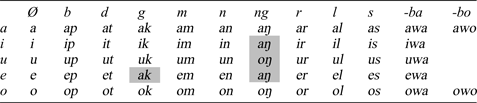
Change 1 (/ŋ/-Merger) /V[+round]ŋ/ sequences become /oŋ/; /V[-round]ŋ/ sequences become /aŋ/;
Change 2 (/k/-Merger) /ek/ becomes /ak/.
After velar mergers (Stage 1)
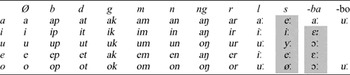
Long vowels in Amdo originate in the following two sound changes, which take us to Stage 2 (Table 25).
Change 3 (Shigatse-/-l/-Loss) Coda /-l/ disappears, with compensatory lengthening of the vowel.Footnote 21
Change 4 (Falling-Contraction) A /VwV/ sequence of falling or identical vowel sonority Footnote 22 coalesces into a long vowel.
The kinship terms *nu < OT nu·bo ‘younger brother’ (#291) and *phu < phu·bo ‘older brother’ (#289) are understood as already having undergone an irregular assimilation *CoCo < *CuCo, cf. Yar, Bay o.mo < bu·mo ‘daughter’ (#285). Hence *nu < *no.wo < OT nu·bo.
Birth of long vowels (Stage 2)

Afterwards, these primary long vowels are raised, giving Stage 3 (Table 26).
Change 5 (Mid-Long-Raising) Mid long vowels are raised to their high counterparts.
Mid-Long-Raising is necessarily preceded by Shigatse-/-l/-Loss and Falling-Contraction, as it is fed by those two sound changes.
After Mid-Long-Raising (Stage 3)

A new set of long vowels appeared, from /Vs/ sequences and rising diphthongs, giving Stage 4 (Table 27).
Change 6 (/s/-Loss) Coda /-s/ disappears, with compensatory lengthening and fronting of the vowel. /a/ is fronted as /eː/.
Change 7 (Rising-Contraction) A /VwV/ sequence of rising vowel sonority coalesces into a mid-low long vowel sharing the frontness and roundness of the original.
/s/-Loss is necessarily preceded by Mid-Long-Raising, as /s/-Loss feeds Mid-Long-Raising, but doesn't show its effects.
New long vowels (Stage 4)

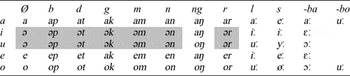
The short high vowels are merged, which marks the passage into Stage 5 (Table 28).
Change 8 (Short-High-Merger) The short high vowels /i/ and /u/ merge into /ə/.
Short-High-Merger is necessarily preceded by /s/-Loss and Rising-Contraction, as it bleeds the latter two changes, which, on the contrary, do not show its effects. Similarly, it is necessarily preceded by /ŋ/-Merger.
After Short-High-Merger (Stage 5)

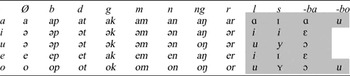
We get Core Amdo (Stage 6, Table 29) by the loss of vowel length. The formulation below probably includes some phonetic changes that happened previously.
Change 9 (Length-Loss) Long vowels become short vowels. Mid-low and high vowels conserve their vowel quality, mid-high vowels are raised to near-high, and /aː/ becomes /ɑ/.
Length-Loss is necessarily preceded by Short-High-Merger, as it feeds Short-High-Merger.
Core Amdo (Stage 6)

4.2. Relative dating
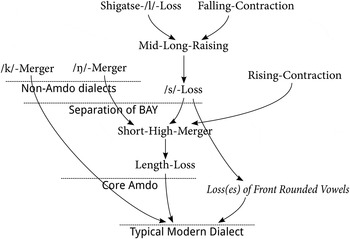
Based on the relations of feeding and bleeding, the chronological precedence of the proposed sound changes is shown in Figure 4.Footnote 23 Included in the sound changes is the differentiated loss of front rounded vowels, which is necessarily preceded by /s/-Loss, which generates these vowels.
Relative dating of relevant sound changes

Also shown in Figure 4, as cross-sections, are the shared innovations marking the different stages of the evolution of Amdo Tibetan rhymes:
-
• /ŋ/-Merger and /k/-Merger is shared by non-Amdo dialects as well.
-
• Bay separated from mainstream Amdo Tibetan after having undergone /ŋ/-Merger, /k/-Merger, as well as /s/-Loss and the sound changes that precede it.
-
• The Core Amdo reconstructed in this essay is characterized by /k/-Merger, Length-Loss and preceding changes.
-
• Finally, most modern dialects show the (albeit differentiated) loss of front rounded vowels.
4.3. Absolute dating
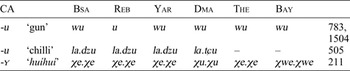
A few Chinese borrowings permit a better dating of the changes: *wu < pào (炮) ‘gun’ (#783), *ladʑu < làjiāo (辣椒) ‘chilli’ (#505) and *χʏχʏ < huíhuí (回回) ‘Chinese-speaking Muslims’ (#211). Their modern reflexes are shown in Table 30. The lowered vowel e in modern reflexes of *χʏχʏ is likely due to effects of the initial χ.
Chinese loans in Amdo Tibetan

It is likely that làjiāo passed into Amdo Tibetan unmediated from Chinese. Neighbouring languages and dialects rarely show borrowing from Chinese làjiāo. Salar lazi (Lin Reference Lin1992), and Modern Written Uyghur laza, are both from Chinese làzi (辣子). Hence the source form for the syllable jiāo must be either /tɕoː/ or something that sounds like /tɕoː/ to a Tibetan ear, cf. Beijing Chinese tɕjau, Lanzhou Chinese tɕɔ (Zhang and Mo Reference Zhang and Mo2009), ‘Phags-pa Chinese tsiεw (Coblin Reference Coblin2007: #572).
Similarly for pào, Beijing pʰau, Lanzhou pʰɔ, ‘Phags-pa pʰaw (#531) which gives CA *-u. The loan form of pào, however, is not a direct loan from the Chinese, as is testified by its initial w- < p- (cf. the common Amdo pronunciation of OT pad·ma as wan.ma), contrary to the aspirated Chinese form, cf. Gzhung·ba Tibetan pɵː, Ham·phen puː (Suzuki Reference Suzuki2009). The Gzhung·ba form, furthermore, supports the mid vowel height of the original, cf. Gzhung·ba nɵː < OT nor, zɵː < OT zog, ʈɵː < OT sgro·ba.Footnote 24 An original -oː corresponding to CA *-u can be fairly attributed to Mid-Long-Raising, which, hence, must happen after the introduction of these two loans. While guns (including cannons) are ancient, the introduction of chilli is a quite datable event, necessarily after the Columbian explorations. More precisely, the first appearance of chilli in Chinese gazetteers is in 1671, while the first appearance in provinces bordering linguistic Tibet (Sichuan, Gansu, Yunnan) is 1737 in Gansu (Jiang and Wang Reference Jiang and Wang2005). It can be safely assumed that chilli entered Amdo after or around 1737. The terminus post quem for Mid-Long-Raising can be hence determined as being around the first part of the eighteenth century.
Concerning huíhuí, it gives the differentiated vowel reflexes just as a native word coming from Old Tibetan -os. The loss of front rounded vowels, hence, must be later than the date of the borrowing of huíhuí. The presence of Chinese-speaking Muslims in Amdo Tibet, however, is older than the introduction of chillis, while huíhuí was in use already during the Yuan dynastyFootnote 25 so this word has a rather limited utility for dating, the loss of the front rounded vowels necessarily postdating Mid-Long-Raising. However, it gives a nice confirmation of the dating of the sound changes.
5. Conclusion
Jacques (Reference Jacques and Sun2014) represents a welcome change in the study of Tibetan dialects: it is a rare, if not the first (I do not know of any others) effort to reconstruct the steps of “atomic” phonetic changes and the relative order thereof, from the Ursprache of Co·ne, a sister of Written Tibetan with a comparable phonological system, to the present-day Co·ne dialect. In order to provide a classification of Tibetan languages based on diagnostic innovation (Sun Reference Sun2003: 798), this kind of step-by-step history should ideally be reconstructed for every documented dialect. This study, I hope, could be a step in the right direction.
The hypothesis that Amdo Tibetan historically had vowel length achieves a better explanation power than previous accounts of the diachrony of Amdo rhymes. By supposing an intermediate step, it provides a better formulation of the rules and conditions of sound laws linking Old Tibetan to Amdo Tibetan.Footnote 26
This reconstruction of the phonological history of Amdo Tibetan also permits a clearer vision of the evolution of Amdo Tibetan morphology, especially the forms of fused case forms of nouns, which will be the subject of a forthcoming study.
As a final note, I wish to bring to the attention of Tibetan dialectologists a characteristic vowel division of Amdo Tibetan: OT -is = -el = -il ≠ -es. Exactly the same division is attested in Zhongu Tibetan (Sun Reference Sun2003: 790), as ə vs. i. It is suggested that, for other non-tonal lengthless varieties of Tibetan, an intermediate step with distinctive length can be fruitfully postulated.