Introduction
Woodground ichnofossils show a range of morphologies that reflect a variety of living strategies. The diversity of these strategies is more apparent in modern than in fossil ichnocoenoses. Fossil suites from marginal marine environments are exemplified by clasts and surfaces that exhibit putative bivalve borings (e.g., Kelly and Bromley, Reference Kelly and Bromley1984; Plint and Pickerill, Reference Plint and Pickerill1985; Savrda and King, Reference Savrda and King1993; Savrda et al., Reference Savrda, Ozalas, Demko, Huchison and Scheiwe1993; Mikuláš et al., Reference Mikuláš, Pek and Zimák1995; Pirrie et al., Reference Pirrie, Marshall and Crame1998; Pickerill et al., Reference Pickerill, Donovan and Portell2003). Modern intertidal settings can show additional borings into the xylic substrata, including those of shrimp, isopods, barnacles, and even sponges (Gingras et al., Reference Gingras, MacEachern and Pickerill2004). The bivalve borings, referable to Apectoichnus longissimus (Kelly and Bromley, Reference Kelly and Bromley1984) and Teredolites clavatus Leymerie, Reference Leymerie1842, are almost exclusively associated with woody substrata and marginal to shallow marine environments (Bromley et al., Reference Bromley, Pemberton and Rahmani1984; Kiteley and Field, Reference Kiteley, Field, Tillman and Siemers1984; Savrda, Reference Savrda1991; Savrda et al., Reference Savrda, Ozalas, Demko, Huchison and Scheiwe1993; Pirrie et al., Reference Pirrie, Marshall and Crame1998; Pickerill et al., Reference Pickerill, Donovan and Portell2003; Mayoral et al., Reference Mayoral, Santos, Vintaned, Wisshak, Neumann, Uchman and Nel2020; among others). However, Shipway et al. (Reference Shipway, Altamia, Rosenberg, Concepcion, Haygood and Distel2019) described a new freshwater species of teredinid bivalve that bores into carbonate substrata. Apectoichnus Donovan, Reference Donovan and Ewin2018 and Teredolites Leymerie, Reference Leymerie1842 are each characterized as elongate tunnels with approximately circular cross sections, but Teredolites differs from Apectoichnus in its overall turbinate morphology (Leyremie, Reference Leymerie1842; Kelly and Bromley, Reference Kelly and Bromley1984; Pickerill et al., Reference Pickerill, Donovan and Portell2003; Donovan, Reference Donovan2018).
Geologic setting
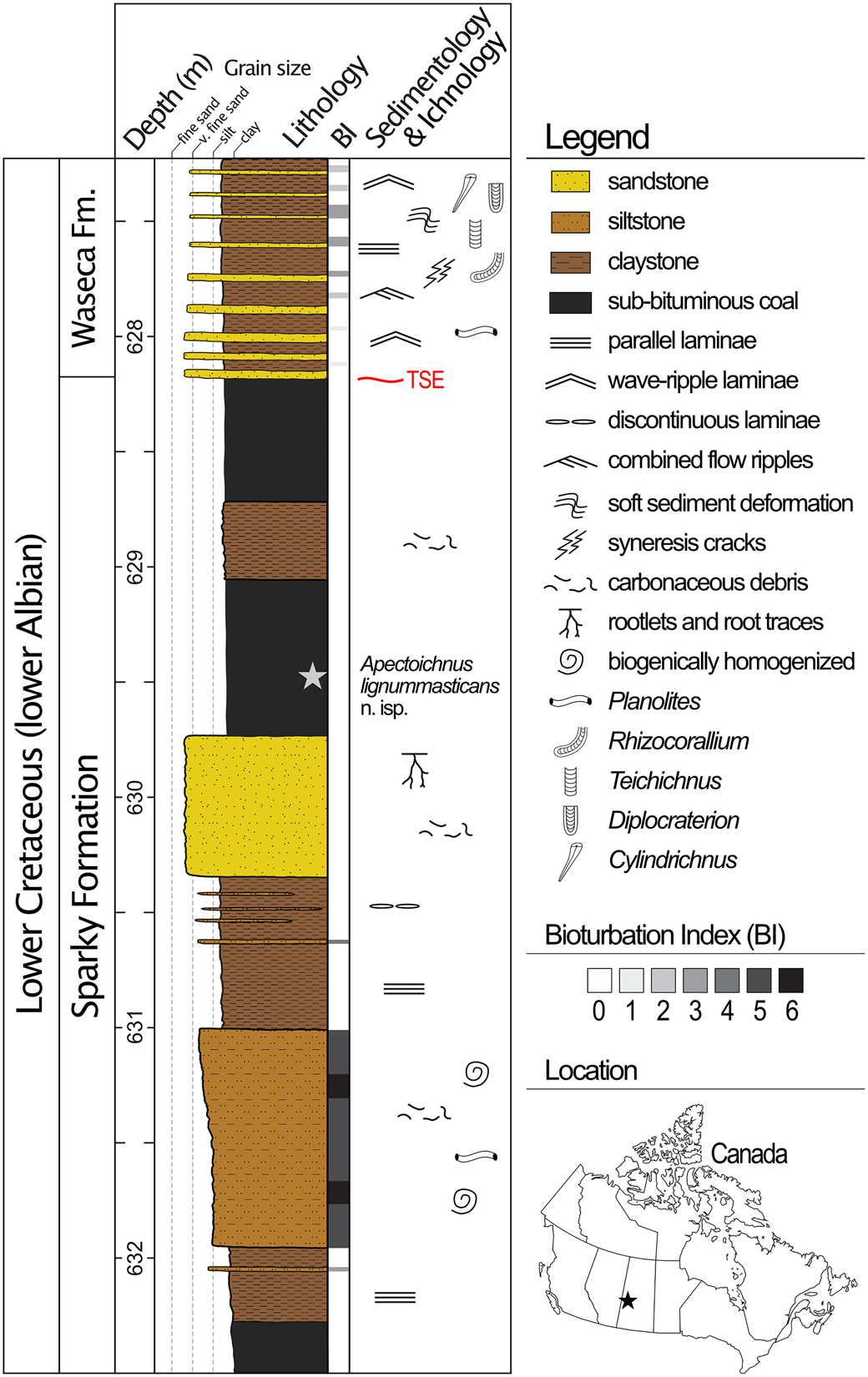
Apectoichnus lignummasticans new ichnospecies occurs within the Lower Cretaceous (early Albian stage) Sparky Formation of the Mannville Group in the Western Canadian Sedimentary Basin. The Mannville Group was deposited during an overall transgression of the Boreal Sea. The Sparky Formation has bounding discontinuities that correspond to marine flooding surfaces, which separate it from the underlying General Petroleum and overlying Waseca formations (Morshedian et al., Reference Morshedian, MacEachern and Dashtgard2012; Fig. 1). The trace fossils were present in a wood clast in a coal bed within a cored well bore from west-central Saskatchewan. The coal bed in which Apectoichnus lignummasticans n. isp. was found was truncated during a marine incursion and is demarcated by a transgressive surface of erosion. Locally bioturbated, shallow-marine sandstone and mudstone units overlie the bored surface (Fig. 1).
Stratigraphic occurrence of the holotype and hypodigm of Apectoichnus lignummasticans n. isp. in west-central Saskatchewan, Canada, from well-bore 16-15-44-20W3M, 52°47′45.0″N, 108°48′55.6″W (NAD83). Other ichnotaxa: Planolites Nicholson, Reference Nicholson1873, Rhizocorallium Zenker, Reference Zenker1836, Teichichnus Seilacher, Reference Seilacher, Schindewolf and Seilacher1955, Diplocraterion Torell, Reference Torell1870, Cylindrichnus Toots in Howard, Reference Howard1966. TSE = transgressive surface of erosion.

Materials and methods
Specimens
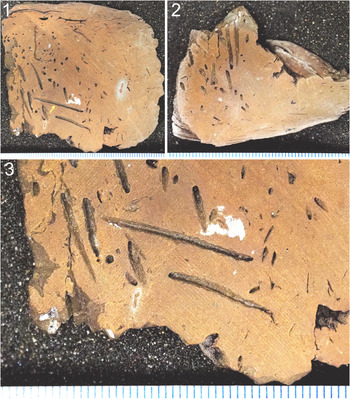
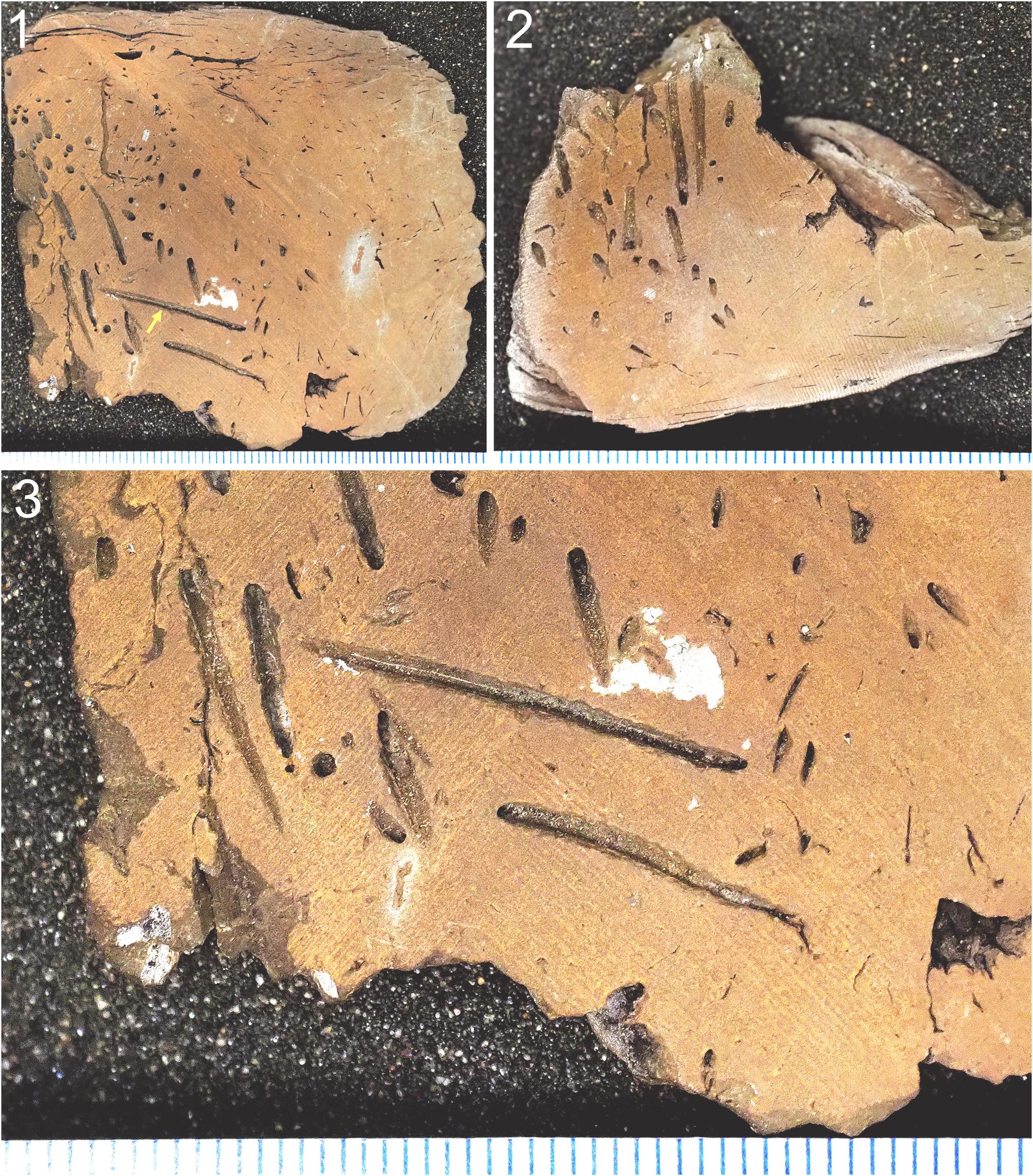
The specimens were observed in a core from a wellbore near Bushy Lake, west-central Saskatchewan, Canada (Fig. 1). Two samples, UAI 0179 (Fig. 2.1, 2.3) and 0180 (Figs. 2.2, 3), comprise a single piece of gregariously bored wood that is 98 x 67 x 15 mm at its maximum. The trace fossils occurred within the Lower Cretaceous Mannville Group (Sparky Formation) in association with a transgressive surface of marine erosion.
Apectoichnus lignummasticans n. isp. assemblage in fossil wood: (1) sample UAI 079 (arrow indicates holotype); (2) Sample UAI 080; (3) close-up of UAI 079 showing the holotype and surrounding forms. Scale bars show 1 mm divisions.
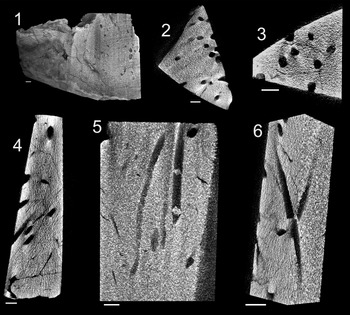
Micro-CT images of UAI 080: (1) overview of the scanned specimen; (2, 3) aligned tunnels displaying circular cross sections; (4) oblique expression of the tunnels; (5) longitudinal view of the tunnels showing an approximately constant diameter; (6) three randomly oriented and closely spaced tunnels that do not interpenetrate. Scale bars = 2 mm.

Computed tomography scan analysis
Computed Tomography (CT) is a nondestructive method whereby X-rays are directed through a rotating sample. X-ray attenuation that occurs at each angle is recorded and used for tomographic reconstruction (see Wildenschild and Sheppard, Reference Wildenschild and Sheppard2013 for detailed discussion). Previous studies have used similar techniques quite effectively in analyzing various bioerosion features (e.g., Beuck et al., Reference Beuck, Vertino, Stepina, Karolczak and Pfannkuche2007, Reference Beuck, Wisshak, Munnecke and Freiwald2008; Schönberg and Shields, Reference Schönberg, Shields, Wisshak and Tapanila2008; Tapanila, Reference Tapanila, Wisshak and Tapanila2008). CT scanning is particularly suitable for substrata with empty borings due to the low attenuation of the tunnels relative to the substratum. This results in images with burrows that are easy to visualize and can be analyzed spatially across multiple dimensions. Although the specimens cannot be viewed directly in full relief, Micro-CT imaging allows observation of additional detail, trace morphology, and overall trace length.
Scanning was performed on a Skyscan 1172 Micro-CT. The X-ray source was set to 92 kV and 106 μA, and an Al+Cu filter was used to mitigate beam hardening. Data acquisition occurred at a resolution of 17 μm, with images taken at 0.5° increments over a 180° rotation. Tomographic reconstruction was performed using ©NRecon reconstruction software (Micro Photonics, Inc.), which includes procedures to reduce ring and beam-hardening artifacts, which are the most prominent noise features when CT scanning (Ketcham and Carlson, Reference Ketcham and Carlson2001). Reconstructed scans were rendered and analyzed using ©CTvox Micro-CT volume rendering software (Blue Scientific) and a movie was made using the Flight Recorder functionality. The movie is available as Supplemental Data 1.
Repositories and institutional abbreviations
Specimens examined in this study are housed in the Ichnology Research Group Trace Fossil Collection in the Department of Earth and Atmospheric Sciences, University of Alberta (UAI), Alberta, Canada. BM(NH) = The Natural History Museum, London.
Systematic ichnology
Borehole excavation in different substrata requires different behaviors and abilities (e.g., Dorgan, Reference Dorgan2015). Thus, although ichnotaxa differ markedly from biological taxa, no paleontological, paleoecological, or taphonomic goal is achieved by lumping together traces excavated in lithic, osteic, and xylic substrata. This view was contested by Donovan and Ewin (Reference Donovan and Ewin2018), who considered Teredolites clavatus (xylic substratum) and Gastrochaenolites turbinatus Kelly and Bromley, Reference Kelly and Bromley1984 (lithic substratum) to be synonyms because they are morphologically comparable. For the reasons discussed above, we consider substratum to be useful in taxonomic differentiation and advocate retaining both ichnotaxa (see also Zonneveld et al., Reference Zonneveld, Bartels, Gunnell and McHugh2015; Wisshak et al., Reference Wisshak, Knaust and Bertling2019).
Ichnogenus Apectoichnus Donovan, Reference Donovan and Ewin2018
Type ichnospecies
Teredolites longissimus Kelly and Bromley, Reference Kelly and Bromley1984.
Emended diagnosis
Elongate borings in xylic substrata and associated resins, nearly circular in cross section, with an approximately constant diameter. Borings are straight to sinuous or contorted and intertwined and predominantly occur parallel to the fibers of xylic substrata (modified from Donovan, Reference Donovan2018; Mayoral et al., Reference Mayoral, Santos, Vintaned, Wisshak, Neumann, Uchman and Nel2020).
Remarks
Kelly and Bromley (Reference Kelly and Bromley1984) proposed Teredolites longissimus as a new ichnospecies commonly associated with boring bivalves. This combination was recently challenged by Donovan (Reference Donovan2018) who proposed the ichnogenus Apectoichnus to describe wood borings that lack the clavate morphology of Teredolites clavatus. Donovan (Reference Donovan2018) retained the species-level taxonomy of Apectoichnus longissimus and thus, prior to the present work, Apectoichnus has been a monospecific ichnogenus. Subsequent contributions have validated the ichnotaxon Apectoichnus (e.g., Donovan and Ewin, Reference Donovan and Ewin2018; Donovan and Portell, Reference Donovan and Portell2019; Wisshak et al., Reference Wisshak, Knaust and Bertling2019). Mayoral et al. (Reference Mayoral, Santos, Vintaned, Wisshak, Neumann, Uchman and Nel2020) revised the diagnosis of Apectoichnus to include amber and other solid resins as possible host substrata. We further emend the genus-level diagnosis to recognize that the trace fossils are generally aligned wood fiber-parallel, which was previously considered diagnostic at the ichnospecies level (Mayoral et al., Reference Mayoral, Santos, Vintaned, Wisshak, Neumann, Uchman and Nel2020).
Apectoichnus longissimus (Kelly and Bromley, Reference Kelly and Bromley1984)
Holotype
BM(NH) Bensted Collection 38019, Kentish Rag, Lower Cretaceous (Aptian stage), Hythe, Kent, England, UK (Kelly and Bromley, Reference Kelly and Bromley1984, figs. 9B, 11A, B).
Emended Diagnosis
Apectoichnus with large (> 2 mm) diameter and relatively small length-to-width ratio.
Remarks
Previous ichnospecific ichnotaxobases include length-to-width ratios > 5 and a tendency for the borings to align parallel to the wood fibers (see Mayoral et al., Reference Mayoral, Santos, Vintaned, Wisshak, Neumann, Uchman and Nel2020). These characteristics are observed in the nonmolluscan borings examined herein and are therefore considered diagnostic at the ichnogenus level.
Diagnosis
Straight to gently curved Apectoichnus with small (< 2 mm) diameter and relatively large (usually > 10) length-to-width ratio.
Occurrence
Lower Cretaceous (early Albian stage) Mannville Group (Sparky Formation), near Bushy Lake, west-central Saskatchewan, Canada (Dominion Land Survey 16-15-44-20W3M; 52°47′45.0″N, 108°48′55.6″W [NAD83]; 630.0 m depth).
Description
The holotype and associated borings comprise an assemblage of Apectoichnus lignummasticans n. isp. emplaced in fossil wood. The gently curved holotype is displayed in the elevation view of sample UAI 0179 (Fig. 2.1, 2.3). It has a preserved length of 22.8 mm, which is the longest of the assemblage, and a diameter of 0.9 mm (length-to-width ratio ~25). An additional 20 borings were measured. Although the specimens cannot be viewed directly in full relief, Micro-CT imaging allows observation of additional detail, trace morphology, and overall trace length (Fig. 3). The preserved lengths vary considerably, averaging ~ 12 mm. The assemblage displays a range in diameter from 0.4–1.2 mm (mean = 0.9 mm, N = 21). The length-to-width ratio ranges from 7–38 (mean = 15, N = 21); 17 of the ratios are between 10 and 25.
Etymology
The species name is derived from the Latin lignum masticando (‘wood chew’).
Remarks
Although size alone is not normally an ichnotaxonomic character, the small diameters of Apectoichnus lignummasticans n. isp., paired with large length to width ratios, make it readily discernible from Apectoichnus longissimus. The small diameters and the large length-to-width ratios of Apectoichnus lignummasticans n. isp. are not ascribable to the teredinid bivalves that made Apectoichnus longissimus. The absence of radial bioglyphs that are sometimes associated with teredinid borings, and the lack of space available for calcareous boring linings or anterior caps further suggest a nonbivalve trace maker. The morphology of the structure is more consistent with mobile wood-boring marine arthropods (e.g., isopods, discussed below).
Discussion
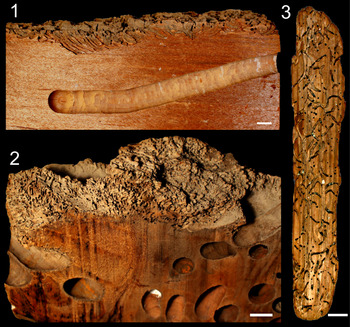
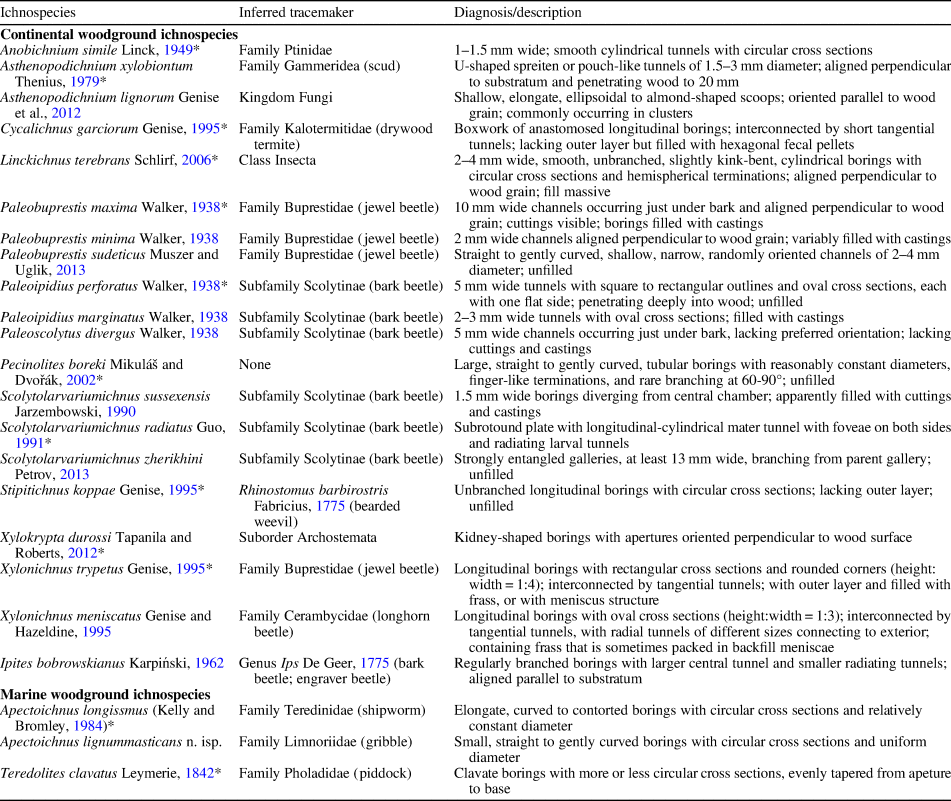
Above we ascribe the occurrence of Apectoichnus lignummasticans n. isp. to marine and marginal-marine animals, owing to its similarity to borings made by the extant limnoiid isopod genus Limnoria Rathke, Reference Rathke1799 (Fig. 4). Nevertheless, it is worth emphasizing that Apectoichnus lignummasticans n. isp. is morphologically different from terrestrial wood-boring ichnofossils (Table 1). The most common wood-boring species of Limnoria are L. lignorum Rathke, Reference Rathke1799, L. tripunctata Menzies, Reference Menzies1951, and L. quadripunctata Holthuis, Reference Holthuis1949 (e.g., Menzies and Turner, Reference Menzies and Turner1957; Jones, Reference Jones1963; Borges et al., Reference Borges, Merckelbach and Cragg2014). Limnoria lignorum has a particularly widespread distribution due to its broad environmental tolerance (Borges et al., Reference Borges, Merckelbach and Cragg2014). Environmental factors, e.g., temperature, salinity, and oxygen content, are directly related to the survival, distribution, and boring activity (i.e., egestion rate) of Limnoria; however, the most important constraint is the presence of an adequate food supply (i.e., wood) (Menzies, Reference Menzies1957). Mortality rates of Limnoria increase rapidly from 10–20°C, but boring activity is optimized in warmer water temperatures (20°C) and is significantly reduced below 10°C (Menzies, Reference Menzies1957; Eltringham, Reference Eltringham1965). The limiting salinity for boring activity varies inversely with water temperature and ceases altogether in salinities < 10 ppt (Eltringham, Reference Eltringham1961); the optimal salinity at 20°C ranges from 30–34 ppt (Borges et al., Reference Borges, Cragg and Busch2009). The amount of boring activity could also be directly related to dissolved oxygen content and is significantly reduced at levels < 3.0 ppm (Anderson and Reish, Reference Anderson and Reish1967).
Extant Limnoria lignorum borings: (1, 2) teredinid-bored wood with Limnoria lignorum borings on the exterior (note that the borings generally follow the grain of the wood); (3) example of branching Limnoria lignorum borings. Scale bars = 1 cm.

Summary of formally recognized ichnospecies associated with wood substrata. *type ichnospecies.

The presence of bored woodgrounds in the rock record is associated with transgressive coastal settings (Panos and Skacel, Reference Panos and Skacel1966; Bromley et al., Reference Bromley, Pemberton and Rahmani1984; Savrda, Reference Savrda1991; Shanley et al., Reference Shanley, McCabe and Hettinger1992; Savrda et al., Reference Savrda, Ozalas, Demko, Huchison and Scheiwe1993; Gingras et al., Reference Gingras, MacEachern and Pickerill2004). Indeed, the colonization of in situ woodgrounds by marginal marine and marine organisms requires a rise in relative sea level (e.g., Gingras et al., Reference Gingras, MacEachern and Pickerill2004). Importantly, Limnoria can survive for only ~ 24 hours without water and thus commonly inhabits the intertidal zone (Menzies, Reference Menzies1957); populations are generally highest at low-tide levels where log-ground and woodground substrata are readily available.
Acknowledgments
The authors thank the Natural Science and Engineering Research Council of Canada (NSERC) for Discovery Grants awarded to MKG and JPZ that helped fund this research. Shell Canada generously donated the core that was used in this study. The manuscript has benefited greatly from the thoughtful comments of S. Donovan and two anonymous reviewers.
Accessibility of Supplemental Data
Data available from the Dryad Digital Repository: https://doi.org/10.5061/dryad.gf1vhhmm6.