Situating Late Preclassic Cerros
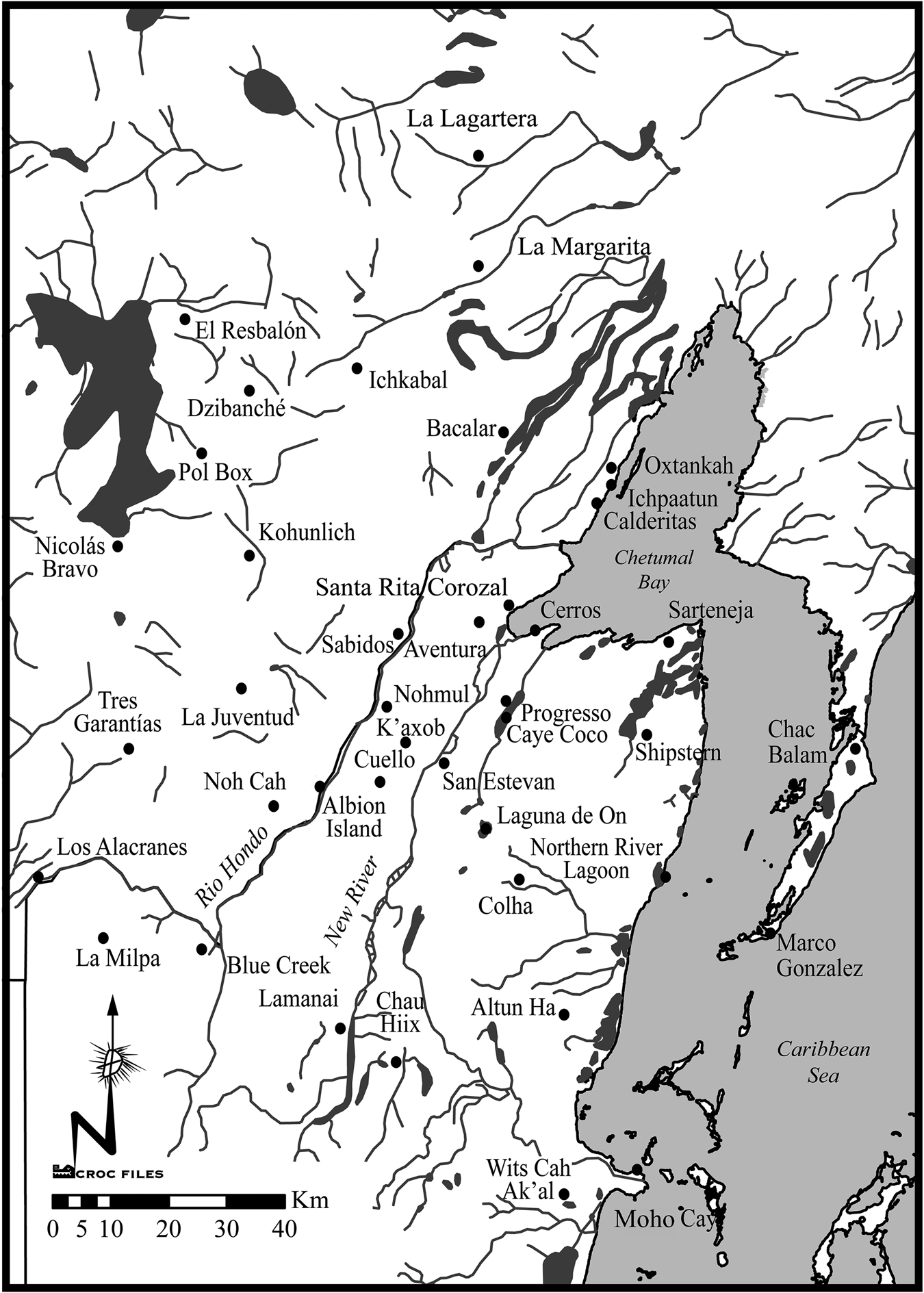
Located on Corozal Bay in northern Belize (Figure 1), the Late Preclassic port of Cerros (Cerro Maya) has been the subject of archaeological research for more than four decades (Freidel Reference Freidel, Stark and Voorhies1978, Reference Freidel1979; Robertson and Freidel Reference Robertson and Freidel1986; Schele and Freidel Reference Schele and Freidel1990; Walker Reference Walker2005; Walker, ed. Reference Walker2016).Footnote 1 David Freidel proposed early on that Structure 5C, a two-tiered temple with modeled facades, was a venue for the establishment of royal kingship (Freidel and Schele Reference Freidel, Schele, Benson and Griffin1988a, Reference Freidel and Schele1988b); this concept challenged notions of Preclassic Maya social complexity. Subsequent research has confirmed the antiquity of early kingship among the Lowland Maya (cf. Estrada-Belli Reference Estrada-Belli, Freidel, Chase, Dowd and Murdick2017; Hansen Reference Hansen and Houston1998) and that Cerros was one of many early stratified communities.
Map of Chetumal Bay region.

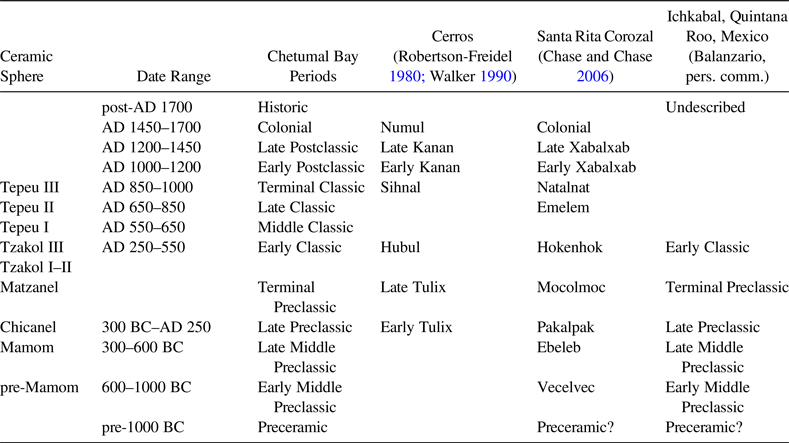
People began settling the region at least 2,000 years before pottery was first produced (Lohse Reference Lohse2010), mostly living on the margins of freshwater ecotones. Early pottery production began about 3,000 years ago at sites such as Cuello (Kosakowsky Reference Kosakowsky1987; Kosakowsky and Pring Reference Kosakowsky and Pring1998), Colha (Valdez Reference Valdez1987), and Santa Rita Corozal (Chase and Chase Reference Chase, Chase, Morris, Jones, Awe and Helmke2006), with widespread occupation documented in the region by the late Middle Preclassic (Reese-Taylor Reference Reese-Taylor and Walker2016; Table 1). By the Late Preclassic, most of northern Belize was occupied, and pyramidal constructions dotted the landscape. Sites in southern Quintana Roo, Mexico, such as Oxtankah (de Vega Nova Reference de Vega Nova2013a, Reference de Vega Nova2013b), Dzibanché, Kinichna, Kohunlich, and Ichkabal (Nalda Reference Nalda and Nalda2004, Reference Nalda, Shaw and Mathews2005) also exhibited extensive public architecture by this period. Ichkabal, with its massive Middle Preclassic platforms topped by Late Preclassic temples, probably dominated the region politically in the Late Preclassic period. Its influence waned after AD 200, when power shifted to nearby Dzibanché in the Early Classic (Nalda Reference Nalda, Shaw and Mathews2005; Sandra Balanzario, personal communication 2019).
Cerros Chronology.

The Late Preclassic period on Chetumal Bay dates generally to about 300 BC–AD 250 (Reese-Taylor and Walker Reference Reese-Taylor, Walker, Masson and Freidel2002), although our Bayesian study suggests the Cerros component was shorter (Table 1). We posit that the waterfront village was first settled after 200 BC. By 50 BC the site was being transformed into a large polity; this transformation was substantially complete before AD 100 (Robertson Reference Robertson and Walker2016; Walker Reference Walker2005). Chetumal Bay was clearly a focal point for the Late Preclassic economy (Walker, ed. Reference Walker2016), with regional trade established in durable goods such as chert, obsidian, and shell, and in perishable products such as fish, salt, tree crops, and maize. To the north, Oxtankah was established as a port facility at least by the Late Preclassic, if not earlier (de Vega Nova Reference de Vega Nova2013a, Reference de Vega Nova2013b). Santa Rita Corozal was certainly a permanent coastal village in the Middle Preclassic (Chase and Chase Reference Chase, Chase, Morris, Jones, Awe and Helmke2006), yet to the east the Cerros peninsula remained unoccupied until about 200 BC. Perhaps those who first settled there sought out unoccupied land or hoped to control access to trade along the three river systems that enter into Chetumal Bay. Whatever the original impetus, elite residents built a dock and waterfront village first, developing a substantial port facility in only a few generations (Cliff Reference Cliff1982; Robertson and Walker Reference Robertson, Walker, Morris, Badillo, Batty and Thompson2015). Debra Walker has proposed that these first settlers emigrated from a substantial distance, perhaps prompted by the territorial interests of Ichkabal lords (Reference Walker and Walker2016:75). Although this remains a proposal in need of testing, Robin Robertson (Reference Robertson and Walker2016:128, Fig. 7.1) has reported that the major ceramic types in the Late Preclassic Tulix complex share more modes with types from Yucatan than they do with contemporary pottery in northern Belize. This suggests an ongoing orientation to the north, both during initial settlement and through sustained interaction.
Even quicker than its rise, Cerros exhibited a dramatic collapse at the end of the Late Preclassic period. Construction stopped by AD 100, perhaps while work was still in progress on some structures. The era saw dramatic population displacements throughout the Maya Lowlands, clearly associated with drought and warfare (Dunning et al. Reference Dunning, Wahl, Beach, Jones, Luzzader-Beach, McCane and Iannone2014; Kováç Reference Kováč, Arnauld and Breton2013; Reese-Taylor and Walker Reference Reese-Taylor, Walker, Masson and Freidel2002). Perhaps because it was dependent on northern overlords for capital investment, monumental construction at Cerros ceased entirely, at the same time as the cessation of major construction at Ichkabal. Only minor modifications were made at the site core in subsequent eras, yet residential debris provides evidence of limited Classic and Postclassic occupations (Walker Reference Walker1990, Reference Walker and Mock1998). In the wake of Cerros's abandonment, Santa Rita Corozal prospered in the Early Classic, as did Dzibanché to the north, which became the Early Classic seat of the Kaanul dynasty.
The rapid growth and brief apogee of Cerros are not exceptional in the archaeological record; people often relocated for economic or other reasons. Inomata and colleagues (Reference Inomata, Triadan, Aoyama, Castillo and Yonenobu2013:467–8), for example, noted rapid growth at Ceibal as builders expanded the early E Group between 850–800 BC and then roughly doubled the site size in a hundred years, a pattern repeated across the Maya Lowlands. What is significant here is that the Bayesian technique can resolve archaeological timelines to the shared histories of individual life spans, even in the absence of written documents; thus, we turn next to the radiocarbon evidence.
Characterizing the Radiocarbon Dataset from Cerros
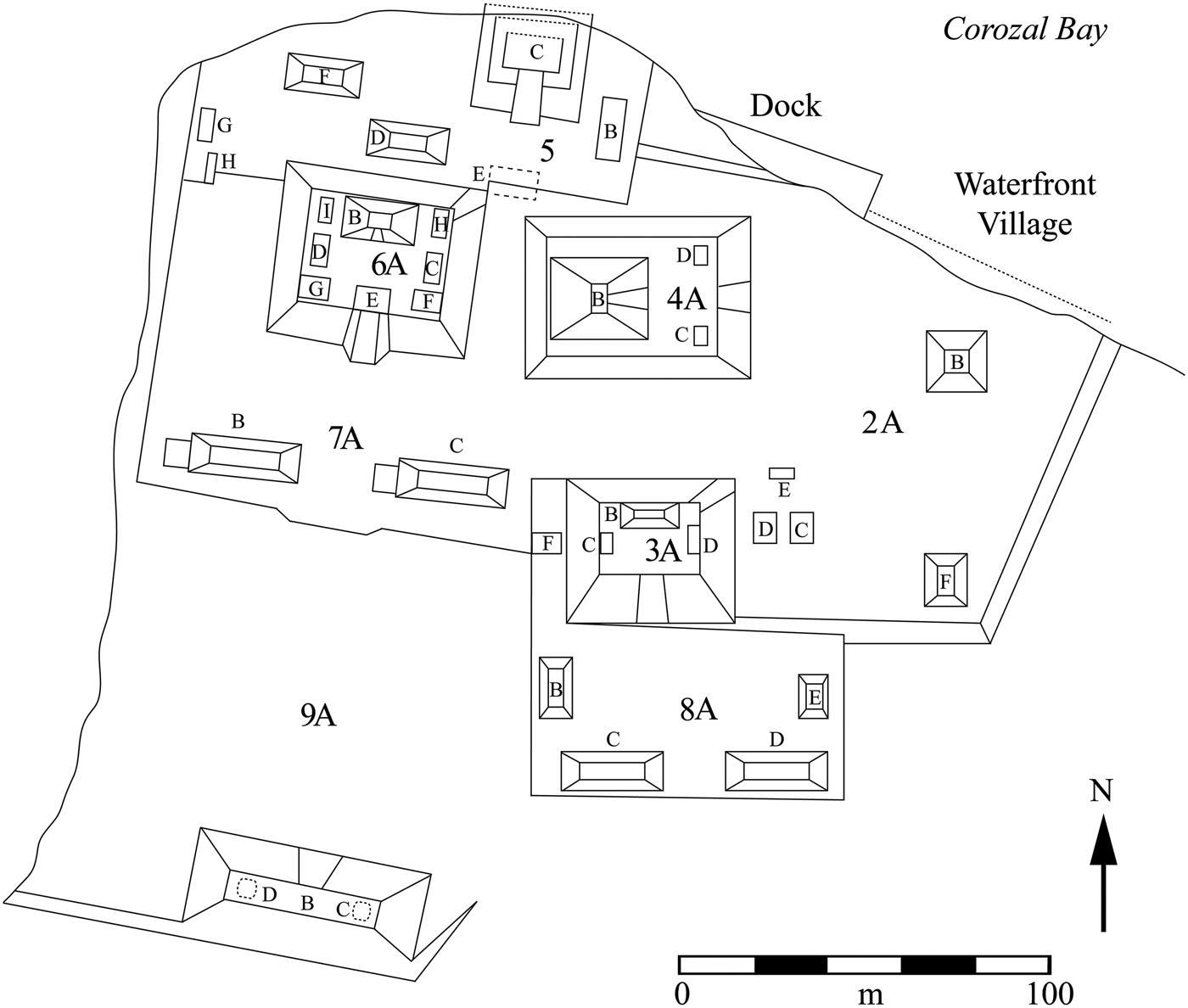
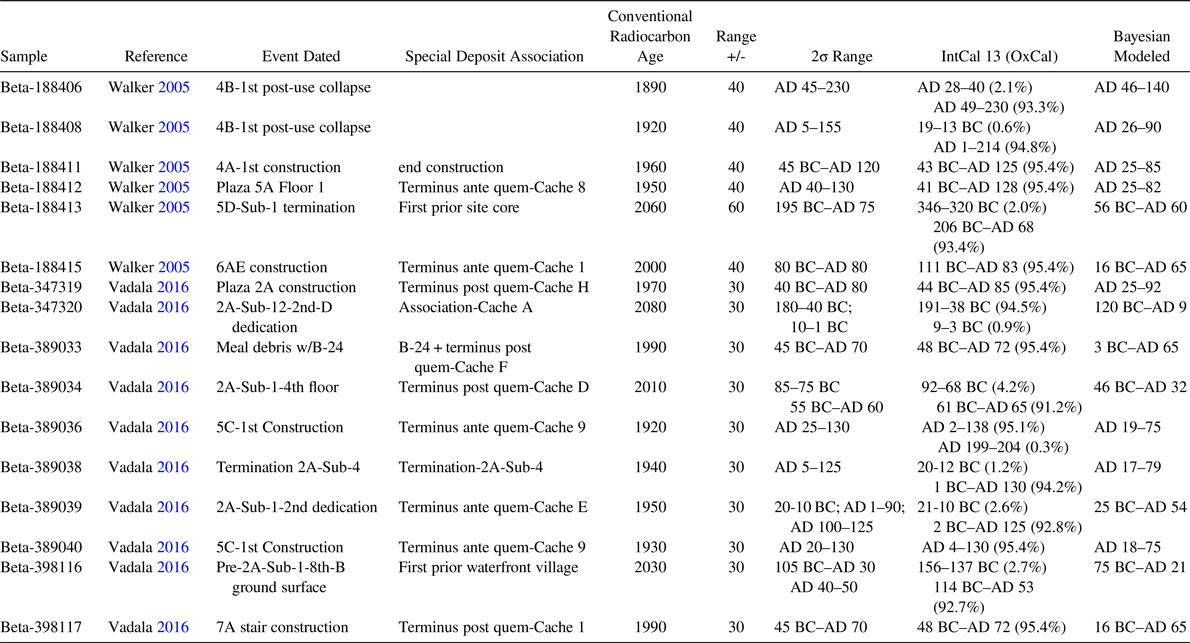
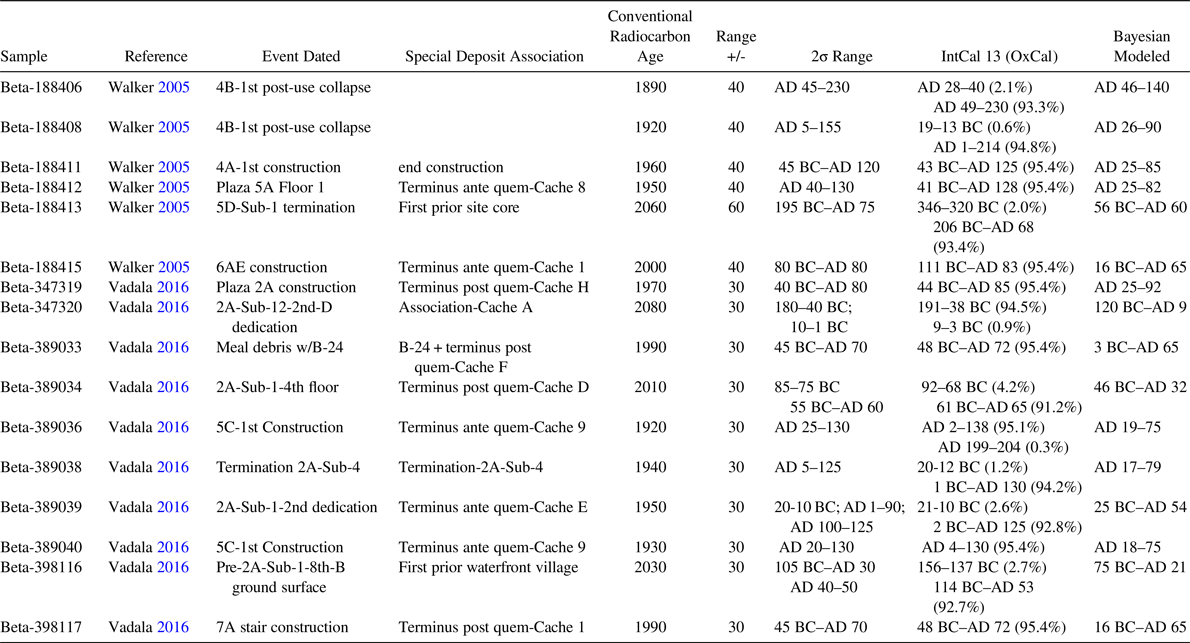
Based on six 1970s radiocarbon dates, the original Cerros Project researchers hypothesized that the dock and waterfront village had been settled about 400 BC, long before construction began in the site core (Figure 2). Construction at the site core lacked radiometric assay, and so only pottery and architectural style were left to define the end of occupation. Walker (Reference Walker2005:12) excavated at Cerros from 1993 to 1995, focusing on the end of the Preclassic occupation. The Cerros Cooperative Archaeological Development Project (CCADP) explored the site core, collecting radiocarbon samples drawn from Structures 4, 5, and 6. Six of these samples produced a tight range of 14C AMS dates (Table 2), indicating that much of the site core was constructed rather rapidly after 50 BC and abandoned by AD 200. Yet even with these new dates, the site chronology remained uncertain, because there was no chronological anchor between the site core and excavations at the waterfront village.
Map of Cerros site core.

Radiocarbon Dates Used in Study.
Robertson-Freidel (Reference Robertson-Freidel1980) originally proposed a three-part ceramic sequence based on the presumed length of occupation. More recently, after considering the conflated dating and reviewing stratigraphic relationships between certain ceramic types, Robertson (Reference Robertson and Walker2016) combined the three complexes into one—Tulix—with early and late facets. Early Tulix (200–50 BC) is represented by pottery from the waterfront village; the small pyramid 2A-Sub 4, now buried below Plaza 2A; and the 5C-2nd temple. Late Tulix (50 BC–AD 200) characterizes the balance of the site core. The original ceramic chronology was further complicated because the material did not fit well with presumed northern Belize contemporaries, a fact recognized early on by Robertson (Reference Robertson and Walker2016:147n3). It was unclear whether this difference was spatial or temporal. The revised dates, in tandem with a northward-focused ceramic affiliation, suggest it was a bit of both.
When Jeffrey Vadala began his research in 2011, it appeared the site had experienced centuries of gradual social change that accelerated after 50 BC. This model of social change follows the work of many other archeologists in the Maya area. Scholars have argued that social complexity emerged slowly and gradually elsewhere (Demarest Reference Demarest2004; Pope Reference Pope and Robinson1987). Freidel's (Reference Freidel1979) seminal piece on interaction spheres asserted this thesis, arguing that the isolated community developed slowly at first; over long stretches of time, interactions between small communities enhanced trade, and social development ensued at a modest pace.
Most of the 100+ charcoal samples collected in the 1970s were curated and available when Vadala began his research. Ultimately, he chose 16 samples—10 of which appear here (Table 2), along with 6 from Walker's earlier research (Reference Walker2005, Reference Walker2013)—to construct the Bayesian modeled radiocarbon chronology. Six prior Cerros Project non-AMS dates from the 1970s were excluded from this analysis. The material for Vadala's research stems from two major contexts: (1) special deposits in residential buildings and plazas along the waterfront village east of the site core and (2) formal caches laid in conjunction with major construction in the site core. Each special deposit either contained charred materials or could be correlated with dated deposits.
The Bayesian Technique and a Reduced Time Frame
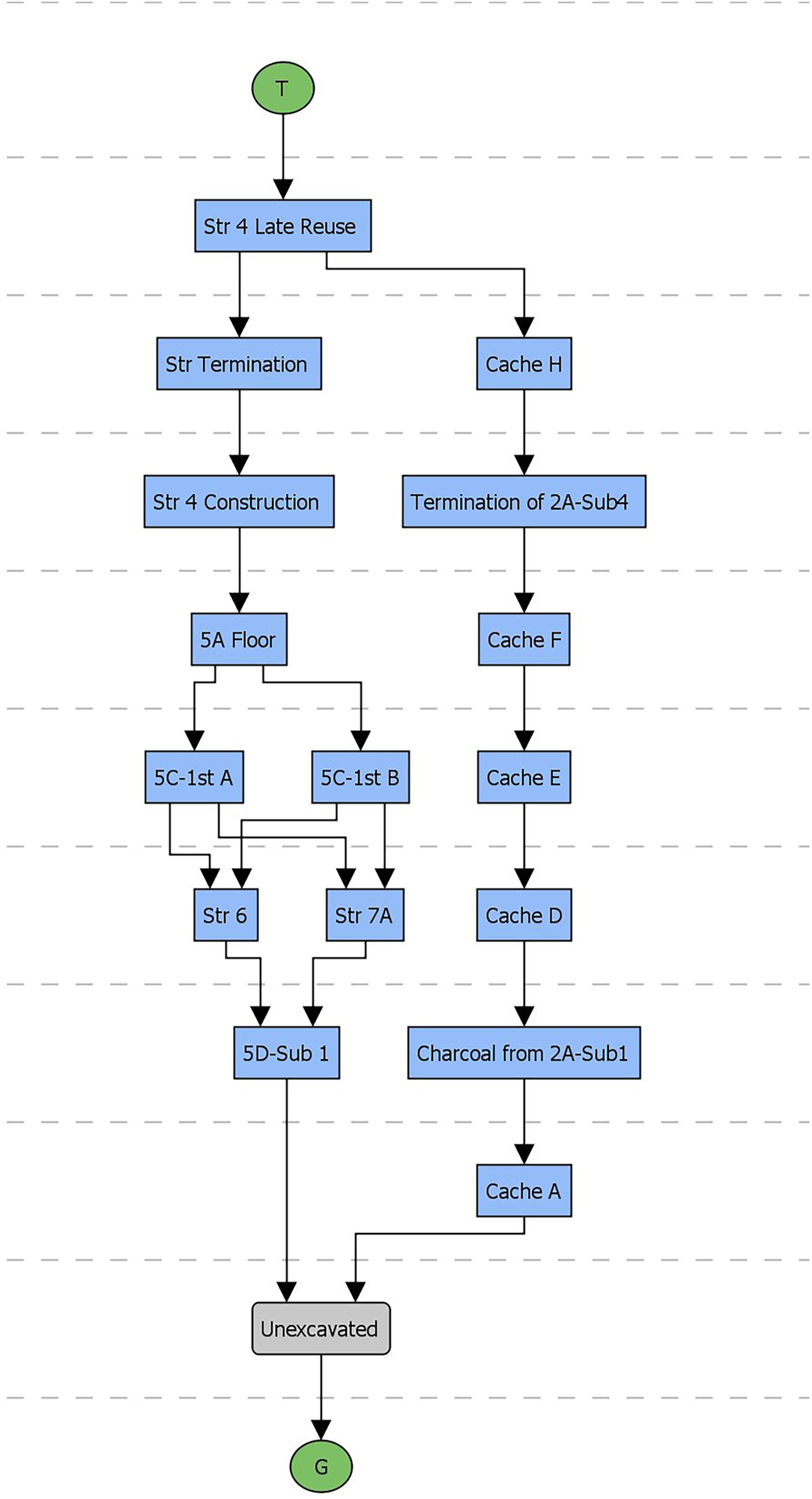
Vadala's (Reference Vadala2016) dissertation used Bayesian modeling techniques to reduce error and create a discrete chronology of primary context events that fit within the 300-year span (cf. Inomata et al. Reference Inomata, Triadan, Aoyama, Castillo and Yonenobu2013, Reference Inomata, MacLellan and Burham2015; Figure 3). Bayesian modeling methods, which have been discussed extensively elsewhere (Bayliss et al. Reference Bayliss, Ramsey, Van der Plicht and Whittle2007; Ramsey Reference Bronk Ramsey1995, Reference Bronk Ramsey2009), are summarized here. The task requires a detailed understanding of radiocarbon dating methods, statistical analysis, and the stratigraphic sequence. Using curated documents, we characterized linkages between excavation trenches and determined depositional relationships between AMS dates. This allowed us to model a known sequence of events (priors) that ordered the associated dates. With sufficient priors, Bayesian statistical software (OxCal) reduced error ranges enough to elicit a clear sequence of events even within the relatively short occupation. Bayesian modeling may not be more accurate than traditional AMS dating, but it is widely considered to be more precise (Bayliss Reference Bayliss2009:127). Following Bayliss (Reference Bayliss2009:129), we developed a Harris matrix (Figure 4) to represent the priors as a chain of stratigraphic and interconnected events.
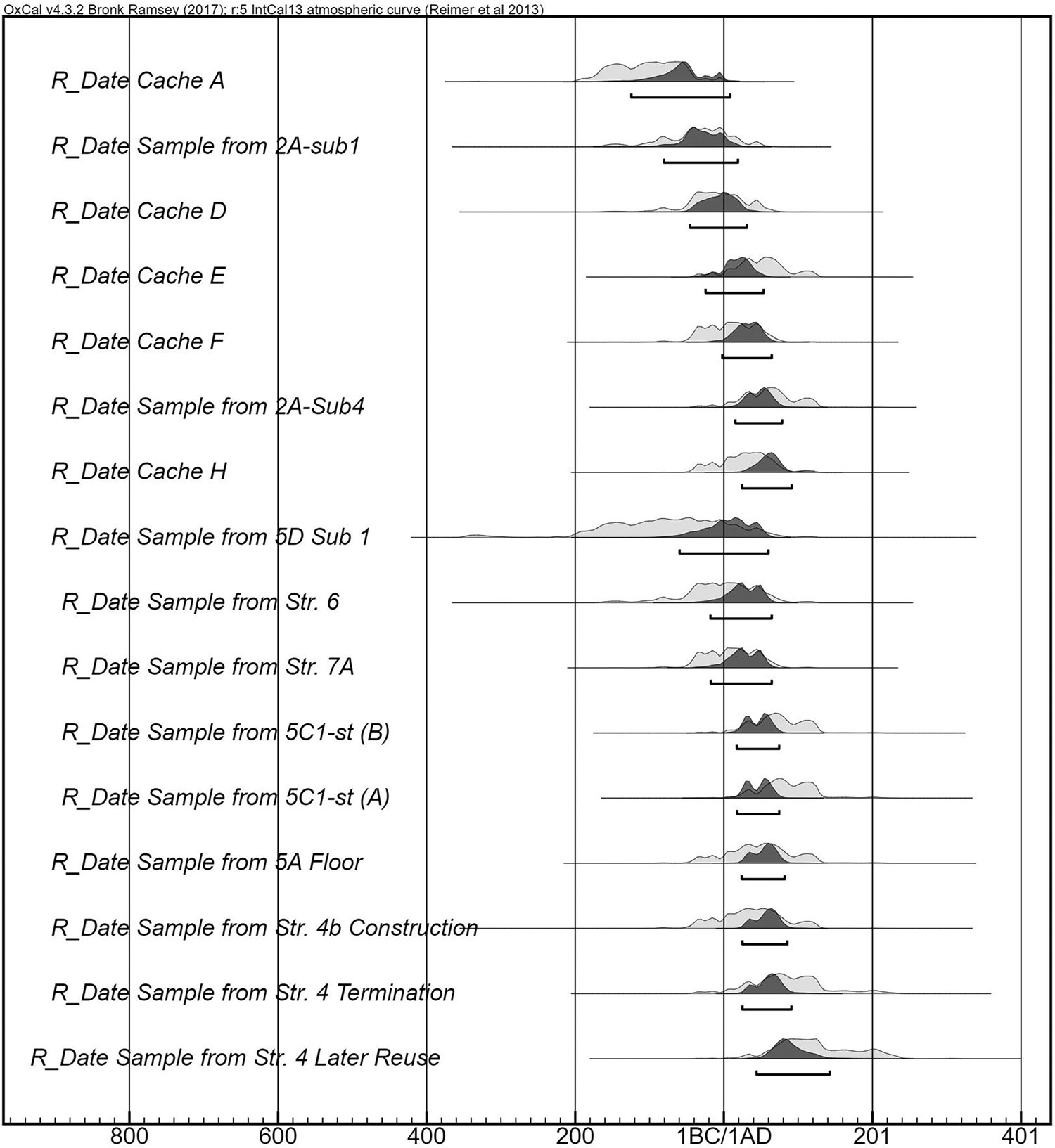
Bayesian modeled radiocarbon dates.

Harris matrix model for Bayesian analysis.

Based on these newly compiled dates, we came to two immediate conclusions about the Late Preclassic occupation. First, Bayesian modeling reduced the Late Preclassic occupation length from 600 to about 300 years (200 BC–AD 100). Second, modeling demonstrated that most major construction took place within a brief and highly active period, with a final massive construction phase occurring around AD 1–50. This is noteworthy because it demonstrates that monumental construction and the emergence of social hierarchy were rapid processes occurring over a few generations within related familial groups. The shortened timeline implies a rapid transformation from village to polity with a brief but significant regional social influence. Specifically, the new dates isolate a series of ritual actions and construction events, with most activity happening between 50 BC and AD 80. Significantly, the site may have made the transition from a small coastal village with a trading dock to a large port with monumental architecture in just a few generations.
Bayesian modeling refined the chronology sufficiently to chart human life spans. Influenced by the Hungarian sociologist Karl Mannheim's (Reference Mannheim and Kegan1952 [1928]) historical approach that focuses on social generations, here we calculate the maximum number of generations involved in these depositional events and demonstrate how such a chronology can provide insights into social and landscape changes. This approach inspired a diachronic social analysis that isolated the motivations of key social generations and outlined how their actions influenced site history (Vadala Reference Vadala2016). Our approach contrasts with archaeological studies that investigate long blocks of time to understand large-scale social processes—the longue durée (Braudel Reference Braudel1958)—such as cultural diffusion, regional trade, or state-level social relations. In such studies, chronologies are used primarily as organizational tools to understand macrolevel social change (Fabian Reference Fabian1983). The social generation is a microlevel approach that prioritizes what Alfred Gell (Reference Gell1992), following James McTaggart (Reference McTaggart1908), called “A-series time,” the lived experience of time that contextualizes small-group social interaction. Similar studies have been conducted in the Maya region (Hutson Reference Hutson2009; Normark Reference Normark2004; Vadala and Milbrath Reference Vadala and Milbrath2016). Here, we describe key caching events that calibrate the Bayesian chronology and correlate them with the social generations discussed in our microlevel analysis.
Caches and Their Depositional Context
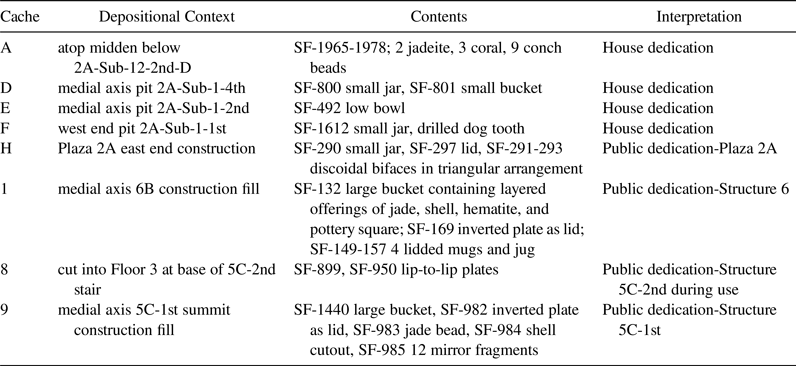
Although the social analysis presented here highlights two formal caches, we used AMS dates from all relevant datable special deposits to increase the precision of the Bayesian model (Table 2). For convenience, all special deposits used here are described as caches, although some were found associated with floors rather than buried beneath them (Coe Reference Coe1959). Observed in ethnographic contexts and labeled dedicatory rituals, contemporary Maya caching events are ritual affairs occurring during the final stages of architectural construction. They involve specialists (shamans), kin groups, procession, songs, incense burning, the collection and burial of sacred artifacts, often alongside animal sacrifice, to provide energy to the spirit of the newly constructed architecture, which is considered animate (Vogt Reference Vogt and Mock1998). Shortly after these ritual acts end, the artifacts are buried, paralleling ancient caching practices; thus, the radiocarbon date directly marks the caching event. Furthermore, given that caching was tied to architectural modification, they also date specific construction events. In this study, AMS dates are from charred plant remains found in direct association with special deposits or that are tied to them stratigraphically, marking contemporary ritual action.
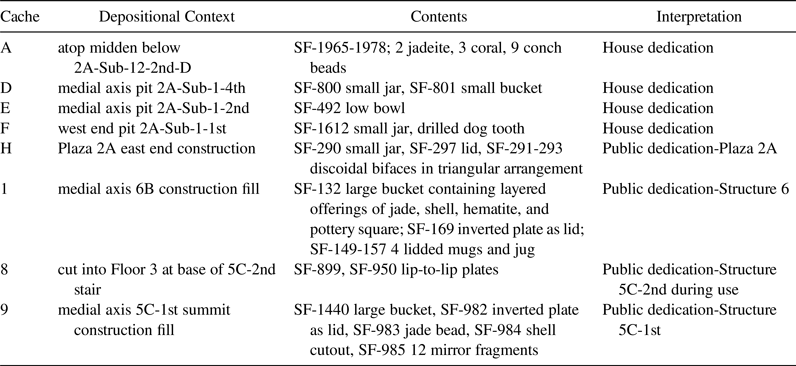
As detailed in Vadala (Reference Vadala2016), some special deposits were found in the waterfront village, where they were associated with building events and simple aspects of daily life. They were given alpha designations (Walker Reference Walker2005) and included cooking pots, small dry-storage jars, buckets, serving bowls, and drinking mugs. In contrast, formal caches refer to large-scale building platforms that would have dwarfed the small residences. These were given numeric designations by the original Cerros Project. The larger size of these offerings represents community use, not individual food and beverage consumption (Robertson-Freidel Reference Robertson-Freidel1980). Scholars argue that the ancient Maya performed both public and private rites in monumental buildings, in contrast to the domestic rites in residential architecture, yet caching activity demonstrated an analogous purpose at any scale (cf. Robin et al. Reference Robin, Meierhoff, Kestle, Blackmore, Kosakowsky, Novotny and Robin2012). At Cerros, caches in public architecture lay on the medial axis and could be associated with specific construction events. Monumental caches detailed here were revealed within Structures 5C and 6B (Table 3).
Cerros Caches Used in Study.
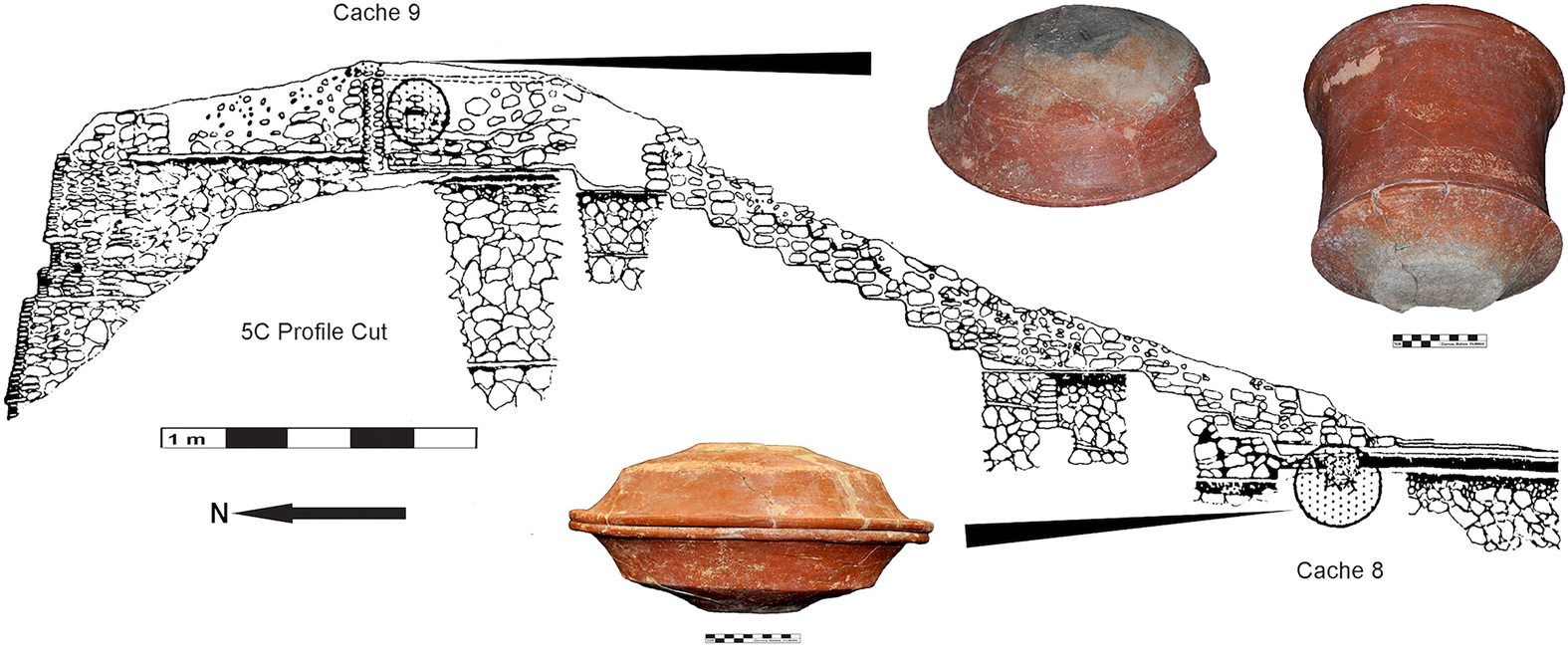
Caches 8 and 9 were recovered from the Structure 5 acropolis (Figure 5). This early public building revealed Late Preclassic architectural conventions, including triadic design and stucco sculptures depicting zoomorphic deities on a stepped pyramid. The caches are contextualized by the interior temple, 5C-2nd, which originally comprised a small acropolis built atop truncated platform 5A-Sub 1. This acropolis was part of a triadic arrangement with 5B and 5D. Structure 5D was excavated by the CCADP (Mitchum Reference Mitchum and Walker1995; Reese Reference Reese1996; Walker et al. Reference Walker, Freidel, Robertson, Estrada-Belli and Runggaldier2021), providing two radiocarbon dates framing the period of use. Excavated detail at the southern edge of the associated plaza also suggests that Structure 6 was designed and built in a single construction event while 5C-2nd was still in use. The masks and building design of 5C-2nd were the subject of a detailed analysis by Freidel and Linda Schele (Reference Freidel and Schele1988b), who proposed the origin of Maya kingship in Preclassic shamanic ritual. The caches may be material remains of such ritual practices.
North–south profile of 5C-1st locating Caches 8 and 9. (Color online)

Cache 8 was deposited during the life of 5C-2nd, whereas Cache 9 was deposited within construction fill of 5C-1st, which entombed the earlier building. Cache 8 consisted of two large Matamore Dichrome plates placed lip to lip and interred at the base of the outset stair of 5C-2nd. If it contained an offering, it was perishable. Cache 9 was deposited less than a generation later and sealed in construction fill when the masonry walls of the 5C-2nd superstructure were buried within 5C-1st. It consisted of a large lidded Cabro Red bucket that contained a jadeite bead, a worked shell, and hematite mirror fragments. The care with which the 5C-2nd masked facades were interred suggests that entombment within the shrine-like 5C-1st was intentional (Freidel Reference Freidel, Robertson and Freidel1986; Walker et al. Reference Walker, Freidel, Robertson, Estrada-Belli and Runggaldier2021). The caches therefore referenced both constructions. Neither of these caches contained charred material for dating, yet Cache 9 was clearly deposited during the construction of 5C-1st, and various 14C samples were obtained from fire rituals associated with the burial of 5C-2nd, including burnt seeds that clearly date the interment event (Beta-389040; Table 2). Radiocarbon samples from 5D framed the date for the deposition of Cache 8 on the shared 5A Plaza floor.
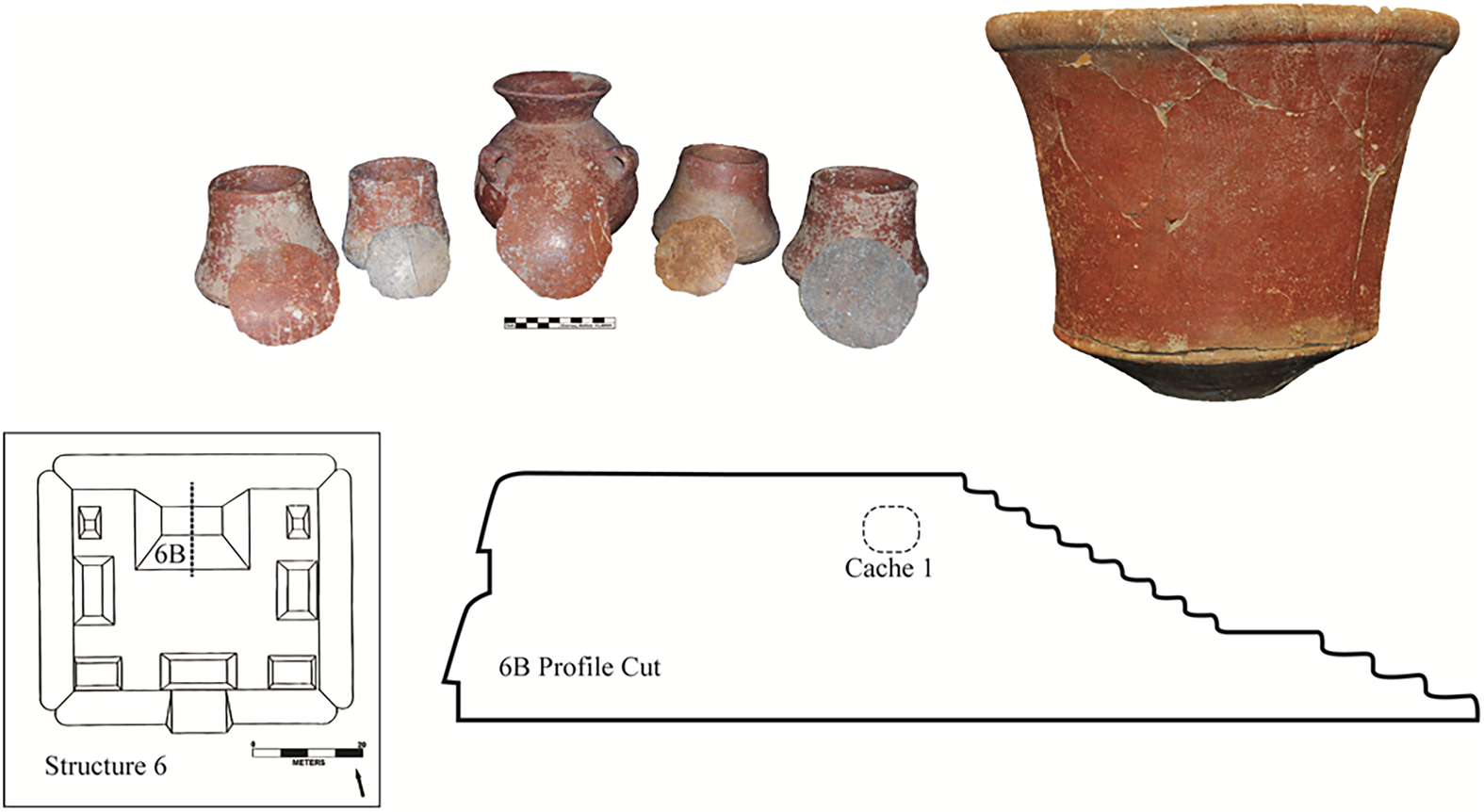
Cache 1 was deposited in Structure 6 about the time Cache 8 was laid (Figure 6). This complex is comprised of an 8 m high, south-facing truncated platform holding eight superstructures interpreted as an Eightfold House configuration (Reese Reference Reese1996). Similar contemporary Eightfold Houses are known from several sites including Uaxactun Group H (Kováç Reference Kováč, Arnauld and Breton2013). As Freidel and Schele (Reference Freidel, Schele, Benson and Griffin1988a) have argued, by the time Structure 6 was built, social inequality had developed. Created to provide ritual practitioners a large raised, isolated central space, the Eightfold House played an important role in the segregation of social groups, and consequently in the transfer of local historical knowledge as Cerros continued to prosper (Vadala and Milbrath Reference Vadala and Milbrath2016).
North–south profile of 6B locating Cache 1. (Color online)

According to excavated detail, it appears that Structure 6 was designed and built in one construction episode (Freidel Reference Freidel, Robertson and Freidel1986; Reese Reference Reese1996). The principal superstructure, 6B, was a two-tiered temple that mirrored the form and scale of 5C-2nd, but was situated in a private space 8 m above plaza level. Cache 1 was interred in an analogous position to Cache 9, nested in construction fill on the approximate centerline of the 6B summit. Cache 1 consisted of a large lidded Savannah Bank Usulutan bucket containing layered offerings of jade and shell. Hematite mirror fragments scattered through the deposit were originally mounted on a square ceramic backing that was also found in the vessel. Situated around the bucket were four lidded drinking mugs and a lidded three-handled jug. Schele and Freidel (Reference Schele and Freidel1990) argued that Cache 1, the most complex cache discovered at Cerros, was buried during the accession of a new local lord. If they are correct, the accession would have occurred during construction of Structure 6 and before 6B was completed.
Although Cache 1 did not produce charred material, the CCADP later retrieved one 14C date from the central summit of 6E, delimiting the construction date for 6E. This date is the only temporal link for the Eightfold House, although if it was designed and built as a single construction, 6E should be nearly contemporary with 6B. The truncated platform 6A rests on an acropolis-like feature termed Plaza 7A. An additional 14C sample obtained from the Plaza 7A staircase construction provides minimal sequencing for this portion of the site. Because Plaza 7A underlay Structure 6, the 7A staircase date provided a prior to calibrate the radiocarbon age of Structure 6. These two dates constitute the only temporal ties between Structures 5, 6, and 7.
Bayesian Generational Chronology
Because Bayesian modeling can reduce chronologies to lifetimes rather than centuries, we were able to examine historical and subjective aspects of specific events. This follows the suggestion that archaeologists “need to move from the measurement of elapsed time to a sense of successive events, and then to how people experienced the flow of time and saw themselves in time, both looking back to the past and forward to the future” (Bayliss et al. Reference Bayliss, Ramsey, Van der Plicht and Whittle2007:2). How can an archaeologist examine how people saw themselves in time? We took inspiration from generational sociological analysis and the contemporary Maya philosophical concept of k'ex, or generational change. Both consider how relations between social groups and social generations change over time. Ethnographic characterizations of contemporary Maya people suggest that the ancient Maya also had a belief system focused on generational change, succession, and knowledge transmission. More specifically, Robert S. Carlsen and Martin Prechtel note that many contemporary Maya use a central religious concept called k'ex, referring to generational change, continuity, ancestral relations, and the transference of the soul from one generation to the next, thereby allowing for “continuity of life” (Reference Carlsen and Prechtel1991:26). In the Atiteco Maya region, k'ex is connected to the practice of naming grandchildren after grandparents. Focusing on the logic behind this naming convention, Carlsen and Prechel (Reference Carlsen and Prechtel1991:26, 28–29) found that when a grandparent died, life essence was thought to regenerate in the grandchildren. Considering a wide body of ethnographic contexts, Susan Gillespie asserted that k'ex has historically important social effects, noting “the ethnographic information indicates that everyone, even a newborn, is an ancestor reincarnated” (Reference Gillespie2002:73). Gillespie (Reference Gillespie2002:71–72) found that it was one of many important Maya beliefs describing how the living establish social continuity with ancestors while maintaining a non-individualized group or social persona.
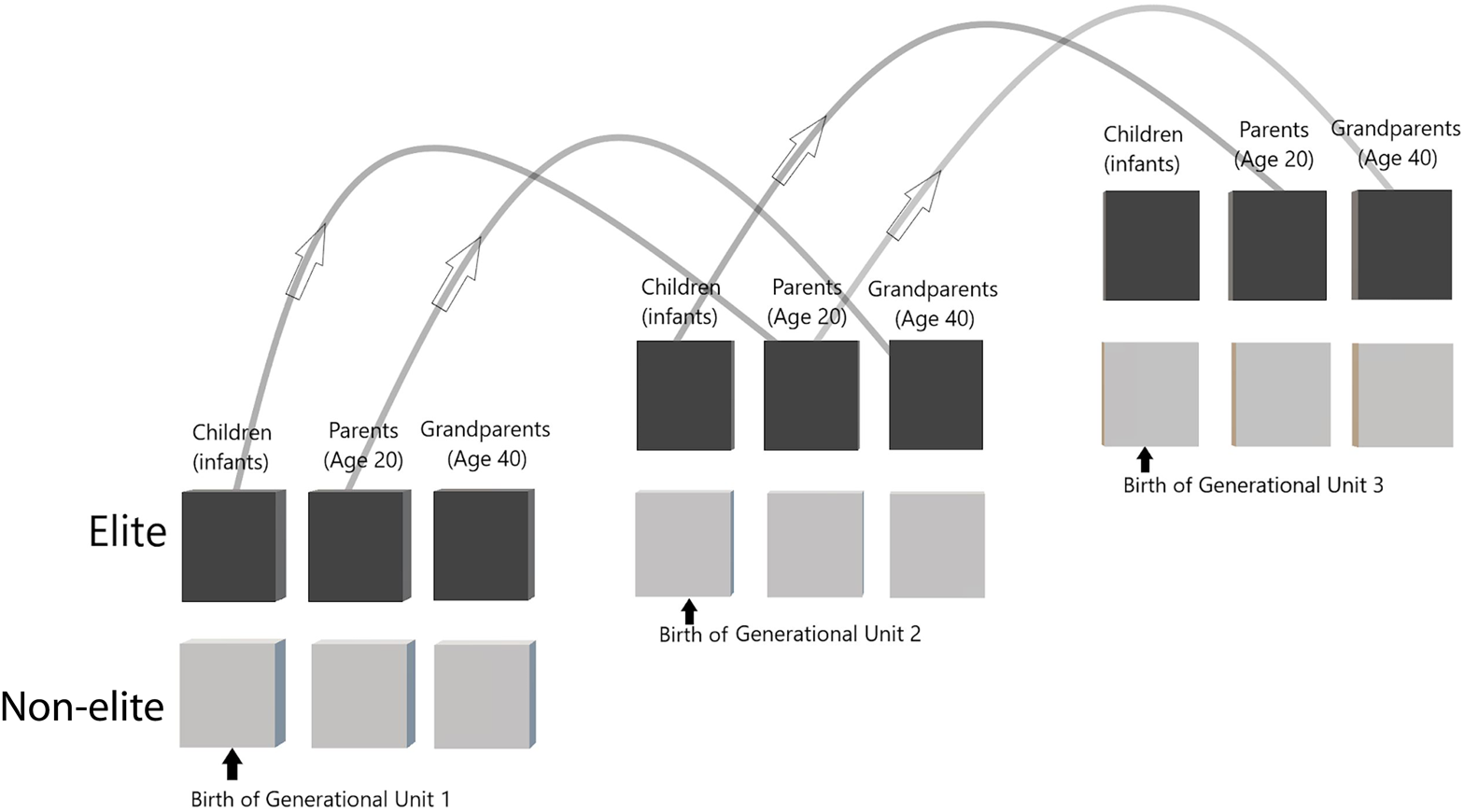
To examine generational linkages, we borrow from sociological approaches that define a social generation as a cohort of people distinguished by the 20-year period in which they were born (Mannheim Reference Mannheim and Kegan1952 [1928]:287–288; Strauss and Howe Reference Strauss and Howe1991:58–68). From this starting point, we investigate generational change across time. This means our analysis highlights factors that shape the experience of the past, present, and future while also considering how these factors, in turn, reflexively affect historical narratives embedded in social change (Bourdieu and Wacquant Reference Bourdieu and Wacquant1992; Mannheim Reference Mannheim and Kegan1952 [1928]:287–288; Strauss and Howe Reference Strauss and Howe1991:58–68). Here, we model, contextualize, and characterize Maya social generations as heterogeneous arrays of social groups with differentially inherited positionalities. Accounting for the social position of each group in terms of class and age, we explore how their perceptions of events shaped connections to earlier generations while also engaging the future.
In the graphic representation of our model (Figure 7), each block represents a generational unit, or GU. Individuals can be understood as conceptually located within a given GU. We numbered the GUs beginning with GU-1 (200–160 BC) based on the period under consideration, recognizing that an unbroken line of earlier generations existed as ancestors. We represent the poles of social status as elite and non-elite to keep our model substantial enough to parse social status relationships. That said, we recognize that each of these groups probably comprised various factions vying for social mobility in a fluid local field of social interaction that was also shaped by regional dynamics (Bourdieu and Waquant Reference Bourdieu and Wacquant1992). In this model, the infant unit is in the left column, with the upper block representing elite infants and the lower block their non-elite contemporaries. Following these are parent blocks and grandparent blocks with the same elite and non-elite class designations. In total, the array represents the contextualization of each individual with regard to class and other GUs. Although not represented in Figure 7, indirect connection to ancestral forbearers remained important to the ancient Maya (cf. McAnany Reference McAnany1995).
Idealized model of generational units (GUs).

With this model in mind, we explore how key social generations (1) produced relationships with contemporaries, (2) maintained relationships with the past through tradition, or (3) broke with the past to generate new futures and new arrays of social relations. Although Bayesian modeling has increased this model's chronological precision, it is not sufficient to identify specific GUs. Therefore, we consider how clusters of contemporary GUs historically influenced each other and the development of social organization. Our analysis uses GU clusters to frame the Cerros chronology and highlight the most important events in sequences of human lives. In sum, we explore how these relational networks shaped motivations, values, and actions during the rise of Cerros and its ensuing short cultural apogee.
The caching and building events described in the next section document the efficacy of the GU approach in isolating historical social transformations in lived experience (decades to lifetimes) rather than the 100- to 1,000-year periods most archaeologists study. Freidel and Schele (Reference Freidel, Schele, Hanks and Rice1989) touched on similar themes of social history and group motivation, yet without a detailed chronology, their interpretation of archaeological materials was less precise. Our research corroborates many of their assertions but grounds the interpretations with tighter chronological control. More significantly, our chronology expands the understanding of ancient Maya social process by contextualizing social order transformations in relation to a series of historic events.
Constructing a Bayesian Generational Chronology
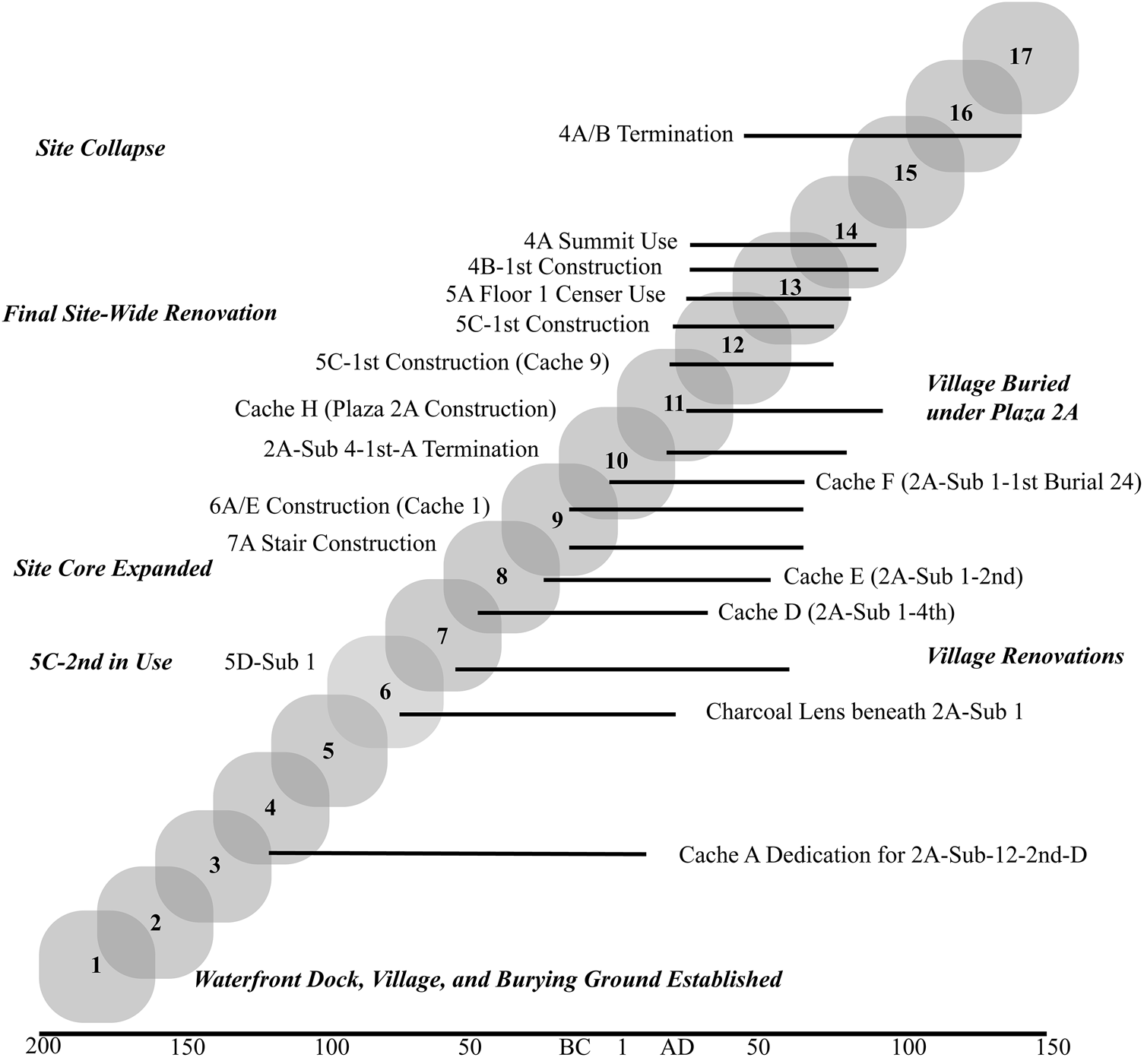
Having established a GU as a generation or cohort, we assumed a 40-year average life expectancy (Haviland Reference Haviland1972; Kates Reference Kates1994); thus, two GUs fall within the maximum estimated human life span. During a given life span, a GU would (1) influence the motivations and values of its members (birth to age 20) and (2) directly influence the incoming GU (age 20 to death). We further assumed that each ritual act was led by an adult participant (>20 years) who understood the process of caching. By this age residents were knowledgeable adults who were appropriately enculturated and capable of leading or participating in rituals. Most were establishing families, raising children, and influencing the development of the subsequent GU. To illustrate, we plotted GUs sequentially in a stepped fashion along a traditional chronology timeline (Figure 8). Each GU was aligned horizontally based on the table of calculated life spans and then stepped vertically. Bayesian modeled event dates were aligned with the first GU that could have been responsible for their deposition. Similarly, we noted broader historical phases on the vertical axis, such as the final site-wide renovation, to illustrate how GU clusters influenced larger events.
Timeline of construction events correlated with generational units.

Limits on generational precision affect some contexts more than others. In a less precise example described later, we characterize the historic relationship that the GU cluster 6–9 had with the founding GUs 1–5. In cases with smaller and overlapping clusters—GUs 9–12 and 11–13—we examined the potential of contemporary elder GUs to directly influence younger GUs, their children, and grandchildren. Lacking enough precision to affirmatively pinpoint the relations between overlapping GUs, our analysis nevertheless examines in general terms the potential historical relationships that GUs 11–13 had with their near-past represented by GUs 9–12.
Bayesian Modeling Results
The application of Bayesian modeling methods had the effect of reducing lengthy 2σ date ranges to as little as 50 years (Figure 3), a marked improvement over the 150- to 300-year ranges for standard dating methods. We note that the first date has a longer range because there are no priors to buffer lower-end scatter. Date ranges for 6A, 5C-1st, Plaza 5A, and 4B-1st look very similar because they are all bounded by Plaza 7A construction and the termination of Structure 4. Although dates from these contexts are similar, they vary only within a 50-year range. Overall, most date ranges fall within a 200-year period; most caching activity and related constructions occurred between 100 BC and 100 AD, and only a small portion of the uncertainty range associated with the first prior falls before 100 BC. We used these dates to plot social generations (Figure 8), beginning with GU 1, born in the range of 200 BC, and continuing through GU 17, born about AD 140 into the period of abandonment. The initial GU date of 200 BC was chosen to align with the complete 2σ range of the earliest securely dated feature (Table 2). The final generation roughly correlates with economic collapse at the site, although some residents remained at Cerros (Walker Reference Walker and Mock1998).
During the early occupation of the waterfront village, GUs 4–6 probably are responsible for the earliest special deposit, Cache A, and the subsequent construction of Structure 2A-Sub 12 near the waterfront. Slightly later, GUs 7–9 had direct interaction with Caches D and E, which were deposited during renovations at Structure 2A-Sub 1. In the subsequent monumental phase, special deposits in Structure 5C, 5D, and 6 appear to be temporally connected as well. In both cases, there is a maximum span of 2.5 GUs between caching events, implying that the participating social groups were probably contemporaries. With a generational distance of roughly 2.5 GUs, grandparents who had participated in early caching events could directly influence their children and grandchildren. Given such intergenerational connections between events, we can conclude the events were within the realm of social or collective memory (Connerton Reference Connerton1989). In other words, these events represent memories shared broadly across social groups, rather than individual memories.
Discussion: Bayesian Chronology and Social Influences
Within the 300-year Bayesian modeled chronology, several points can be made. First, the revised date range for Cache A—a jade and shell wristlet laid under the floor of a residence—indicates it was deposited later than previously understood. The Bayesian-modeled range (121 BC–AD 11) marks a considerably later start to ritual activities in the nucleated village than the original AMS date range suggested (400–50 BC). It is most probable that Cache A was laid after 100 BC, where most of the Bayesian statistical predictions fall. Given that only small amounts of occupation debris were detected beneath Cache A, the site most likely was first settled shortly before the special deposit was laid.
Second, despite substantial overlap, a clear chronological sequence is obvious. Prior chronologies could not be used to establish the sequence of events, because the y-intercept and 2σ ranges overlap to a large degree (Table 2). Although some overlap still exists, a clearer sequence is easily discerned in the Bayesian modeled dates. This remaining overlap is important, because it indicates that multiple caching and building episodes were concentrated in the period AD 1–50. Overall, this set of dates can be used to represent events that span most of the Late Preclassic occupation, beginning with the earliest cache and ending with abandonment contexts.
Third, the final burst of activity associated with major construction ended sooner than previously thought. Schele and Freidel (Reference Schele and Freidel1990) suggested that major construction in the site core began around 50 BC, which agrees with our results. Although earlier researchers proposed that the site collapsed by AD 200, our results indicate that major construction ended much earlier, lasting only about five or six generations in total. Even without generational considerations, the short temporal distance between caching events, in some cases less than a lifetime, indicates that earlier caching events directly influenced subsequent ones. To illustrate how a generational chronology can provide important interpretations regarding social connections, we focus on two near-contemporary caching events: Cache 1 during 6B construction (Figure 6) and, one generation later, Cache 9 during 5C-1st construction (Figure 5).
Monumental construction commenced about 80–1 BC during the life spans of GUs 6–9. At this time, the landscape consisted of a coastal village clustered around a few small public buildings, dominated by 5C-2nd. Constructed on a coastal promontory, this early temple was very important to the GUs who built it. Before the construction of this temple, GUs 1–5 probably made solar observations on the promontory itself to track the sun at the onset of the rainy season (Vadala and Milbrath Reference Vadala and Milbrath2016). The building was used for a similar purpose, with only minor modification for several generations (Walker et al. Reference Walker, Freidel, Robertson, Estrada-Belli and Runggaldier2021). Structure 5C-2nd exhibited important solar and astronomical imagery that highlighted how it was positioned in antiquity (Schele and Miller Reference Schele and Miller1986:108, Fig. 11.1; Vadala and Milbrath Reference Vadala and Milbrath2016). During GUs 6–9, 5C-2nd could host large groups in the open plaza fronting the acropolis (Freidel and Schele Reference Freidel, Schele, Benson and Griffin1988a, Reference Freidel, Schele, Hanks and Rice1989; Vadala Reference Vadala2016), a landscape conducive to building community solidarity. At that time, social fluidity was commonplace among locals, yet there were probably some high-status individuals (Vadala and Milbrath Reference Vadala and Milbrath2016). Focusing on mask iconography, Freidel and Schele demonstrated that these architectural facades were evidence of the ideological connections that elites shared with their contemporaries elsewhere. More specifically, specific iconographic memes that mark early kingship were retained in Classic period rulers’ ritual regalia. The elites of GUs 6-9, it appears, intentionally adopted a Maya symbol set to participate in early forms of divine rulership and also built ties to the greater regional political system.
Between 40 BC and AD 60, GUs 9–12 maintained ties to the broader region while altering the local landscape dramatically by building the Structure 6 complex. An impressive architectural design, the Eightfold House replicated a form known from several contemporary polities including Uaxactun (Kováç Reference Kováč, Arnauld and Breton2013) and Tikal (Reese Reference Reese1996). Although it transformed the landscape substantially, Structure 6 can be viewed as a continuation of the efforts of GUs 6–9, because like their predecessors, the architects replicated regional stylistic norms in their building design. By evoking images of divine rulership, the elites of GUs 9–12 were able to maintain regional ties and reassert their position in the hierarchy. They clearly considered how their actions affected perceptions of the past. The architectural space of 6B mirrors the form and spatial dimensions of 5C-2nd, although it rested on a much larger isolating substructure. Remnant plaster masks on 6B indicate facades similar to those on 5C-2nd. Clearly the architects of GUs 9–12 used their knowledge of 5C-2nd to build 6B. Tradition, or the direct influence from living members of GUs 6–9, may have dictated that the ruling social generation pay homage to the images of gods created on 5C-2nd. In essence, GUs 9–12 intentionally set out to preserve their ancestral history while creating their own space. Their use of historical knowledge may have been intended to appeal to powerful local traditionalists who remembered events associated with 5C-2nd.
More evidence for generational continuity and regional engagement by GUs 9–12 was found in Cache 1 itself, clearly the most sumptuous concealed offering recovered at Cerros (Table 3). It was placed into construction fill on the central axis of 6B, reflecting a common Maya practice. In addition, the cache included imported durable goods such as jade, obsidian, hematite, and shell. Many such caches exhibited directional layouts associated with cosmological beliefs (Chase and Chase Reference Chase, Chase and Houston1998: Krejci and Culbert Reference Krejci, Patrick Culbert and Grube1995). Freidel and Schele (Reference Freidel, Schele, Benson and Griffin1988a) took note of the cosmologically inspired organization. The adoption of Lowland Maya architectural styles and the ritual caching practices indicate that GUs 9–12 were creating lateral and chronological connections, adhering to the larger regional system. Cerros was effectively becoming territorialized by contemporary Late Preclassic polities.
Similarly, GUs 9-12 created connections between contemporary social groups. The GUs who built Structure 6 and deposited Cache 1 planned for their actions to affect future action. Writing about architectural design, Brian Massumi (Reference Massumi1998) argued that, when designing new buildings, architectural specialists engage the future life or the virtual future of the architecture. Similarly, when designing Structure 6, GUs 9–12 anticipated that the memory of interring Cache 1 would contextualize future ritual action there. In other words, the architects knew that subsequent GUs would walk over the location, remembering the cache itself and the ritual action associated with it. Likewise, Rosemary Joyce (Reference Joyce, Sean Goldsmith, Garvie, Selin and Smith1992) has argued that caches at Palenque were deposited in key locations to specifically affect future ritual action.
As Structure 6 functioned to insert Cerros into the larger political region, it also reflected a transformational break with the past. The opportunity to modify the architectural landscape on such a massive scale may have been related to a hurricane event that leveled much of the coastal village (Cliff Reference Cliff1982:282–287; Walker Reference Walker and Walker2016:59). With the early village in ruins, GUs 9-12 were free to initiate a dramatic reorganization of the site core. Perhaps because so much of the village lay in ruins, they had space to construct an Eightfold House on an acropolis that visually dominated the site. GUs 9–12 intended to transform the village landscape by constructing massive temples visible from across Corozal Bay.
Virtual reality simulations demonstrate that the Structure 6 acropolis completely blocked temple 5C-2nd from view and restricted access to it (Vadala Reference Vadala2016). These simulations also indicate that access to the truncated platform summit would have been easy to control, which was probably intentional. Limiting access allowed elites to control participation in ritual actions on the summit, in contrast to the wide public access available at 5C-2nd. The 6A summit had one principal staircase access, and it accommodated fewer people. GUs 9–12 may have been attempting to forge new identities by introducing a larger, more tightly controlled religious center that obscured the old center from view. The organization and placement of these constructions may have been related to an intentional effort to obscure the previous incarnation of Cerros as a small village with less social stratification.
GUs 9–12 were apparently attempting to create their own architectural space distinct from the past landscape, solidifying their efforts with other important actions. Within a generation, 5C-2nd was buried within 5C-1st. Perhaps because of this important history, GUs 9–12 subsequently memorialized 5C-2nd by intentionally encasing it within 5C-1st. Most likely, GUs 11–13 were responsible for the careful burial and preservation of 5C-2nd, including the placement of Cache 9 within it during construction. Preservation techniques used by the builders demonstrated that GUs 11–13 had great reverence for their architectural forbearers. After encasement, the original form of 5C-2nd was remembered only by the oldest living generations; they were aware that they would be the last to experience it.
The burial of 5C-2nd and the construction of 5C-1st were contextualized by a fresh series of caching events, including deposition of Cache 9. Either GUs 9–12 or their children, GUs 11–13, deposited the cache. The scale, position, and contents of Cache 9 within 5C-1st are analogous to the position of Cache 1 within 6B. Both are buckets, yet the Cache 9 vessel is a smaller monochrome Cabro Red vessel, clearly of local production, whereas Cache 1 is a resist-decorated Savannah Bank Usulutan, either an import or produced by a highly qualified local artisan. Both caches were positioned under upended Matamore Dichrome plates as lids. It is in the quantity of contents where the similarity ends: Cache 9 held fewer exotic goods than Cache 1. Nevertheless, the same classes of objects were interred, including shell, jadeite, hematite, and obsidian. Less than a generation separated the deposition of the two caches, so that GUs 9–12 probably had great influence on the organization of both caches. In sum, it appears GUs 11–13 intended to mirror Cache 1 in terms of organization, if not in scale, establishing a direct link to Cache 9. This would have created a sense of historical continuity for GUs 11–13, connecting them in time and space to their ancestors.
Conclusion
Although earlier researchers argued that Late Preclassic Cerros grew slowly between 400 and 50 BC and then became a major polity, new Bayesian modeled dates documents a later initial occupation and more rapid initial growth. We have demonstrated the site was first occupied about 200 BC, remained a small village for roughly 100–150 years, and then underwent a rapid transformation to a major polity in only five or six generations. This highly specific new picture of rapid development and abandonment differs from general archaeological models in which societies acquire complexity slowly over many generations. Cerros rose and fell in an interval of time that more closely approximates the rapid rise of the Aztec Triple Alliance, which lasted from the 1300s to the conquest (Gillespie Reference Gillespie1989).
Bayesian analysis made possible the high-precision chronology needed for this research. Situating AMS dates within Bayesian-modeled stratigraphic columns enabled the development of specific generational inferences. Bayesian modeling reduced error ranges sufficiently to chart the order of known events and allowed us to investigate generational social groups. More specifically, the refined chronology allowed us to map caching and construction events against an influx of Lowland Maya regional ritual practices and architectural trends.
Using our sociologically inspired generational approach, we argue that Cerros elites were influenced by regional architecture and cosmological norms, leading them to organize an effort to radically alter the social and physical landscape. By embracing contemporary regional styles, elites aimed to rebuild in a manner that mirrored other Preclassic Maya polities. First an effort to integrate within the regional economy, it later became an attempt to break with the past and realign with burgeoning Late Preclassic power systems. As the trading center grew, residents incorporated dominant Maya values, religious practices, and architectural styles. By doing so, local elites were able to maintain power while reinventing their position within the broader Late Preclassic Maya social order.
Elites developed and maintained dominance in part by transforming the public landscape to intentionally segregate social groups. Construction of the Eightfold House, for example, dwarfed 5C-2nd and blocked it from view. The 8 m high basal platform with a single staircase restricted access to the summit, thereby segregating the populace during ritual action. In sum, the Eightfold House segregated the public visually from their past monuments (5C-2nd) and privatized ritual events on the upper plaza by limiting foot traffic.
Elites also appealed to local traditions. While working to integrate local beliefs into the regional system, ruling groups intentionally concretized their political futures through organizing historically important ritual caching events within architectural spaces that were built to memorialize the history of the site while framing future ritual events. This functioned through intergenerational knowledge transmission. As in the case of the similarly organized Caches 1 and 9, specific social generations organized caching events while passing on proper caching procedures to subsequent generations. Because caching events were temporally proximate and cache depositions shared key categorical elements, those events should be viewed as interrelated generational affairs wherein one generation either followed or transformed the values of an earlier generation. Caching events were remembered within the generational unit, therefore shaping subsequent events. In other words, caching events affected and, in many cases, determined, the organization and placement of subsequent caches. As Tim Ingold (Reference Ingold1993:157–158) has suggested elsewhere, Cerros residents engaged a landscape that fully “incorporated” events and local history.
By locating caching events precisely in time and space and relating them to the specific GUs who created them, this study charted social change in historically situated values, motives, and collective memories that undergirded social evolution at Late Preclassic Cerros. Because we explored the actions of specific social groups as GUs, we regard our work to be a microlevel historical analysis, in contrast to the more common macrolevel analysis archaeologists use to understand larger temporal trends. This study demonstrates that detailed microhistoric analyses can be explored for prehistoric peoples with accurately recorded archaeological data and sufficiently refined methodologies. Such analyses provide important insights into social memory, knowledge transmission, and the creation of history. Looking to the future, new technological developments, such as machine learning and artificial intelligence, may someday further refine site chronologies, opening new doors for even more detailed historical studies.
Acknowledgments
We would like to thank Susan Milbrath and Susan Gillespie for reading earlier versions of this article, Augusto Oyuela-Caycedo for his theoretical guidance, several anonymous reviewers who provided constructive comments, and the Wenner-Gren Foundation for providing Vadala generous funding through Grant 8873.
Data Availability Statement
Documents and images related to the project, pivotal to this research, may be accessed at the website https://www.floridamuseum.ufl.edu/cerros/.