


In the UK, approximately 6% of those aged 65 years and over were born abroad, most of whom now live in inner-city areas. It has been suggested that ethnic elders face a ‘triple whammy’ in terms of age, ethnicity and socio-economic deprivation (Reference Rait, Burns and ChewRait et al, 1996). Given the forthcoming expansion of the older ethnic minority, information is required about their health needs (Reference Abas, Phillips and CarterAbas et al, 1998; Reference AchesonAcheson, 1998). There have been few community studies directly comparing dementia prevalence in different ethnic groups. Those that have been published are small and no study has concurrent controls and data on age, first language and level of education. Two small studies from the USA suggest that the prevalence in the African American population may be higher than that in Whites (Reference Heyman, Fillenbaum and ProsnitzHeyman et al, 1991; Reference Perkins, Annegers and DoodyPerkins et al, 1997). One study comparing the prevalence of dementia between community-dwelling people living in Nigeria and African Americans living in Indianapolis found a significantly decreased rate in Nigeria (2.3% v. 4.8%; Reference Hendrie, Osuntokun and HallHendrie et al, 1995). In the UK, higher rates of dementia found in ethnic elders compared with the White indigenous population have been attributed to the effect of age, gender and language (Reference McCracken, Boneham and CopelandMcCracken et al, 1997; Reference Perkins, Annegers and DoodyPerkins et al, 1997). A more recent pilot UK study, however, suggested a higher rate of dementia in African-Caribbeans compared with the rate of age— and gender-matched White residents (Reference Richards, Brayne and DeningRichards et al, 2000). Most studies of Black and White elders in the USA and UK show no difference in the prevalence of depression (Reference Ebrahim, Patel and CoatsEbrahim et al, 1991; Reference Murrell, Himmelfarb and WrightMurrell et al, 1993; Reference Bhatagner and FrankBhatagner & Frank, 1997; Reference Blazer, Landerman and HaysBlazer et al, 1998). Some studies, however, have found depression prevalence to be slightly higher in Black elders (Reference Richards, Brayne and DeningRichards et al, 2000) and in those of Bengali ethnicity (Reference Silveira and EbrahimSilveira & Ebrahim, 1995). Gujarati elders may have a lower prevalence when compared with native White elders (Reference Ebrahim, Patel and CoatsEbrahim et al, 1991; Reference Silveira and EbrahimSilveira & Ebrahim, 1998). The Irish population has poorer mental and physical health than other ethnic minority groups (Reference Cochrane and BalCochrane & Bal, 1989; Reference LeaveyLeavey, 1999). In this study we compared the prevalence and risk of dementia and depression among UK-born and migrant groups in an inner-London borough.
METHOD
This is a cross-sectional community study of a representative sample of people aged 65 years or older in Islington, North London. This area has a Jarman Underprivileged Area Score of 49, which is the sixth most deprived score in England and Wales (Reference JarmanJarman, 1983). The ethnic breakdown is 81.1% White, 8.7% African-Caribbean, 1.9% Black others (Office of Population Censuses and Surveys, 1991). The enumeration districts (smallest unit of population into which the UK is divided for the census) in Islington were sampled randomly using computer-generated numbers. Following an introductory letter, a researcher visited each household within the selected districts to ask if a person aged 65 years or over was resident and available for interview. If consent was given they made an appointment for interview. If no one was in, the interviewer visited on at least three occasions, including evenings and weekends, until they found the person. All 24-h staffed residential facilities in the area were included.
The interview
We used the shortened version of the Comprehensive Assessment and Referral Evaluation (Short-CARE; Reference Gurland, Golden and TeresiGurland et al, 1984) to elicit psychiatric symptoms and diagnoses. This is a valid and reliable questionnaire for older people in the community. It has diagnostic scales for depression and dementia and a scale for activity limitation (designed to identify those who need help with day-to-day living). The description of dementia has been validated against an outcome of deteriorating cognition or death (Reference Kay, Henderson and ScottKay et al, 1985). Validation has been completed cross-nationally but not in specific ethnic groups.
We used the Client Sociodemographic and Service Receipt Inventory (CSSRI) amended for use in older people (Knapp, 1995). Items included gender, age, marital status, accommodation, self-designated ethnicity, country of birth, mother tongue, number of years of education, level of schooling and provision of services in the past 3 months. To classify ethnicity, the interviewers showed the list of ethnic classification in the 1991 census and asked which best described the participant.
In addition, we asked “Do you have any health problems?” as a screening question for subjective health problems. If the answer was “ yes”, a further question was asked: “Can you tell me what they are?”. The answers were noted and a nurse or doctor categorised for analysis (e.g. cardiovascular, diabetic, psychiatric). The interviewer asked whether respondents had drunk alcohol in the past 6 months. If so, a second stage-screening questionnaire was completed (Reference Luttrell, Watkin and LivingstonLuttrell et al, 1997). Present and past smoking habits were recorded.
Analysis
In order to increase statistical power we grouped country of birth (COB) into six categories: UK, Ireland, Greece/Turkey/Cyprus (Cyprus), other European country, Africa/Caribbean and others. We calculated prevalence, relative risk (RR) and 95% confidence intervals (CI) of morbidity. We used χ 2 analysis to test for significant associations in categorical data and the Mann—Whitney test for associations between ordinal and categorical variables. We carried out a post hoc analysis of known risk factors for depression or dementia to test for difference. Logistic regression analysis was used to identify significant independent predictors of depression and dementia. For both analyses we entered: living in residential accommodation; age; years of education (divided at median); gender; English as first tongue; owner-occupation; and having drunk alcohol in the past 6 months. For dementia we entered: African/Caribbean and Irish COB; diabetes; current smoker; cardiovascular drugs; and self-reported cardiovascular ill health. For depression we entered: Cyprus COB; living alone; subjective health problems; and needing help in the activities of daily living (ADL).
RESULTS
Demography
We interviewed 1085 older people (85.3% response rate), of whom 644 (59.4%) were women. Their ages ranged from 65 to 102 years. Of the 197 not interviewed, 64.3% were women. The reasons for non-participation were: 77.7% (n=153) refused an interview; 8.1% (n=16) could not be contacted; 7.6% (n=15) did not speak English; 1.0% (n=2) had other communication problems; and for 5.6% (n=11) a relative refused on their behalf.
Ethnicity and country of origin
Ethnicity and COB are given in Table 1. Respondents were born in 50 countries. Ninety-three (94.9%) people born in Africa/Caribbean were Black. Five people declined to designate an ethnicity. We found only a minor difference between respondents' COB and ethnic group. In order to avoid repetition, the following analyses present only COB data.
Self-designated ethnicity and country of birth

| Self-designated ethnicity | No. (%) | Country of birth | No. (%) |
|---|---|---|---|
| White British | 703 | Britain | 667 |
| (64.8) | (61.5) | ||
| Irish | 125 | Ireland | 139 |
| (11.5) | (12.8) | ||
| Greek Cypriot | 60 | Cyprus | 71 |
| Turkish Cypriot | (5.5) | (6.5) | |
| 8 | |||
| (0.7) | |||
| Black African | 10 | Africa/Caribbean | 98 |
| (0.9) | (9.1) | ||
| Black Caribbean | 60 | ||
| (5.5) | |||
| Black British | 25 | ||
| (2.3) | |||
| Black others | 2 | ||
| (0.2) | |||
| White others | 61 | Europe | 60 |
| (5.6) | (5.5) | ||
| Asian | 16 | Other countries | 50 |
| (1.5) | (4.6) | ||
| Indian | 8 | ||
| (0.7) | |||
| Bangladeshi | 1 | ||
| Chinese | 1 | ||
| Total | 1080 | 1085 |
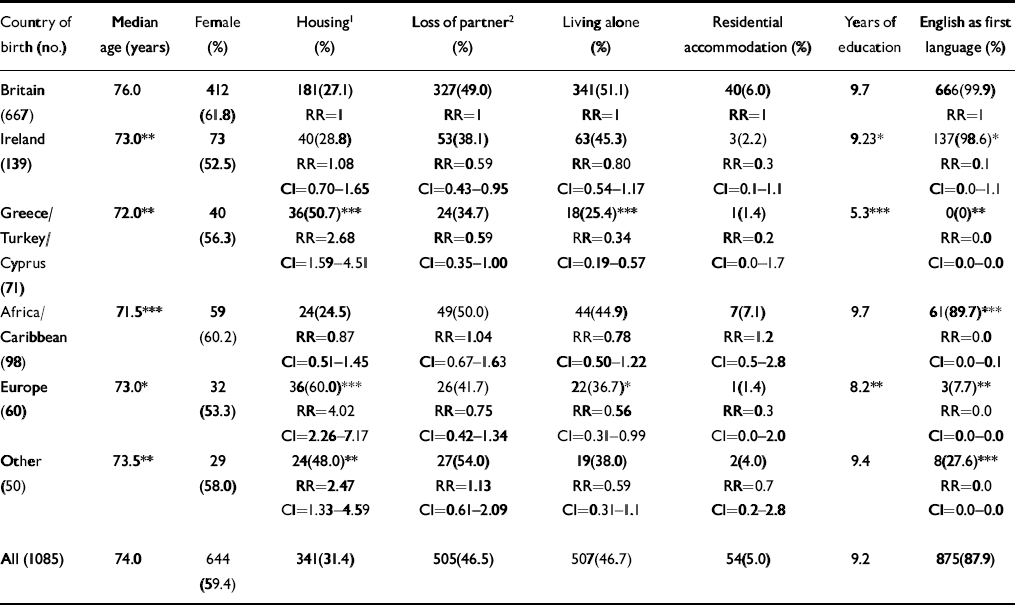
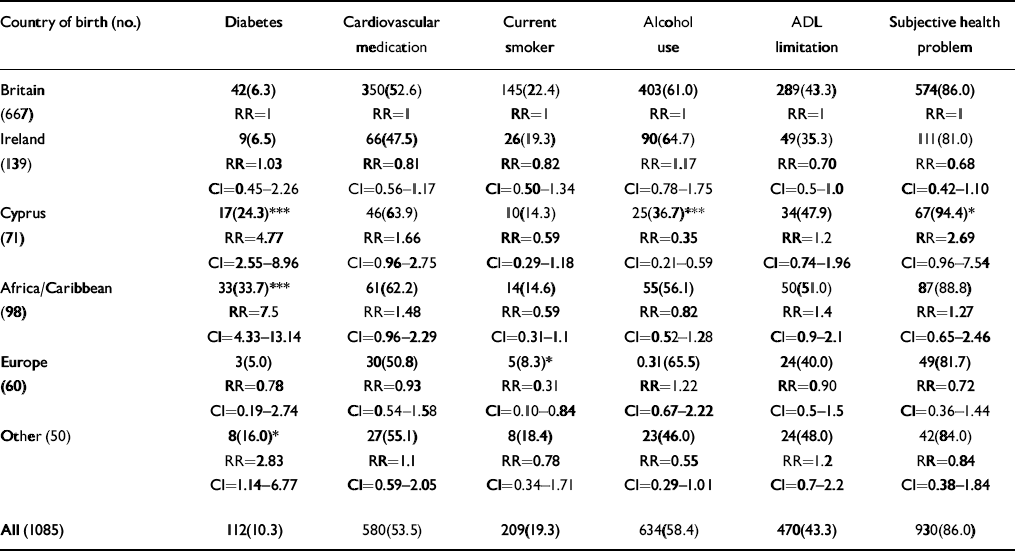
Compared with the UK-born group, all of the migrant groups were significantly younger, particularly African—Caribbeans (Table 2). We found no difference in housing tenure (owner-occupied dwellings) between the UK-born, Irish and African—Caribbeans. All non-UK-born groups were significantly less likely to speak English as a first language. Those born in Ireland, Europe and particularly Cyprus had significantly fewer years of education. However, the Cypriot, European and other groups were significantly more likely to be home-owners. The Cypriot and Europe-born groups also were much less likely than the UK-born group to be living alone. Diabetes was recorded for 10.3% of the whole population. Significantly higher rates were found in the Cypriot group (24.3%) and in the African—Caribbeans (33.7%) (Table 3). We found little difference between groups in recorded use of cardiovascular medication, current smoking and drinking alcohol (Table 3). The Cypriot group was less likely to report alcohol consumption in the previous 6 months (Table 3). Of those interviewed, 46.5% had given up smoking. The Cypriots (28.2%, P=0.001) and African—Caribbeans (24.5%, P=0.00001) were less likely to have given up smoking than the UK-born (48.5%).
Country of birth and socio-demographic features: number (percentage) and relative risk (RR) with 95% confidence intervals (CI) relative to UK-born
| Country of birth (no.) | Median age (years) | Female (%) | Housing1 (%) | Loss of partner2 (%) | Living alone (%) | Residential accommodation (%) | Years of education | English as first language (%) |
|---|---|---|---|---|---|---|---|---|
| Britain | 76.0 | 412 | 181(27.1) | 327(49.0) | 341(51.1) | 40(6.0) | 9.7 | 666(99.9) |
| (667) | (61.8) | RR=1 | RR=1 | RR=1 | RR=1 | RR=1 | ||
| Ireland | 73.0** | 73 | 40(28.8) | 53(38.1) | 63(45.3) | 3(2.2) | 9.23* | 137(98.6)* |
| (139) | (52.5) | RR=1.08 | RR=0.59 | RR=0.80 | RR=0.3 | RR=0.1 | ||
| Cl=0.70-1.65 | Cl=0.43-0.95 | Cl=0.54-1.17 | Cl=0.1-1.1 | Cl=0.0-1.1 | ||||
| Greece/ | 72.0** | 40 | 36(50.7)*** | 24(34.7) | 18(25.4)*** | 1(1.4) | 5.3*** | 0(0)** |
| Turkey/ | (56.3) | RR=2.68 | RR=0.59 | RR=0.34 | RR=0.2 | RR=0.0 | ||
| Cyprus | Cl=1.59-4.51 | Cl=0.35-1.00 | Cl=0.19-0.57 | Cl=0.0-1.7 | Cl=0.0-0.0 | |||
| (71) | ||||||||
| Africa/ | 71.5*** | 59 | 24(24.5) | 49(50.0) | 44(44.9) | 7(7.1) | 9.7 | 61(89.7)*** |
| Caribbean | (60.2) | RR=0.87 | RR=1.04 | RR=0.78 | RR=1.2 | RR=0.0 | ||
| (98) | Cl=0.51-1.45 | Cl=0.67-1.63 | Cl=0.50-1.22 | Cl=0.5-2.8 | Cl=0.0-0.1 | |||
| Europe | 73.0* | 32 | 36(60.0)*** | 26(41.7) | 22(36.7)* | 1(1.4) | 8.2** | 3(7.7)** |
| (60) | (53.3) | RR=4.02 | RR=0.75 | RR=0.56 | RR=0.3 | RR=0.0 | ||
| Cl=2.26-7.17 | Cl=0.42-1.34 | Cl=0.31-0.99 | Cl=0.0-2.0 | Cl=0.0-0.0 | ||||
| Other | 73.5** | 29 | 24(48.0)** | 27(54.0) | 19(38.0) | 2(4.0) | 9.4 | 8(27.6)*** |
| (50) | (58.0) | RR=2.47 | RR=1.13 | RR=0.59 | RR=0.7 | RR=0.0 | ||
| Cl-1.33-4.59 | Cl=0.61-2.09 | Cl=0.31-1.1 | Cl=0.2-2.8 | Cl=0.0-0.0 | ||||
| All (1085) | 74.0 | 644 | 341(31.4) | 505(46.5) | 507(46.7) | 54(5.0) | 9.2 | 875(87.9) |
| (59.4) |
Health and country of birth: number (percentage) and relative risk (RR) with 95% confidence intervals (CI) relative to UK-born
| Country of birth (no.) | Diabetes | Cardiovascular medication | Current smoker | Alcohol use | ADL limitation | Subjective health problem |
|---|---|---|---|---|---|---|
| Britain | 42(6.3) | 350(52.6) | 145(22.4) | 403(61.0) | 289(43.3) | 574(86.0) |
| (667) | RR=1 | RR=1 | RR=1 | RR=1 | RR=1 | RR=1 |
| Ireland | 9(6.5) | 66(47.5) | 26(19.3) | 90(64.7) | 49(35.3) | 111(81.0) |
| (139) | RR=1.03 | RR=0.81 | RR=0.82 | RR=1.17 | RR=0.70 | RR=0.68 |
| Cl=0.45-2.26 | Cl=0.56-1.17 | Cl=0.50-1.34 | Cl=0.78-1.75 | Cl=0.5-1.0 | Cl=0.42-1.10 | |
| Cyprus | 17(24.3)*** | 46(63.9) | 10(14.3) | 25(36.7)*** | 34(47.9) | 67(94.4)* |
| (71) | RR=4.77 | RR=1.66 | RR=0.59 | RR=0.35 | RR=1.2 | RR=2.69 |
| Cl=2.55-8.96 | Cl=0.96-2.75 | Cl=0.29-1.18 | Cl=0.21-0.59 | Cl=0.74-1.96 | Cl=0.96-7.54 | |
| Africa/Caribbean | 33(33.7)*** | 61(62.2) | 14(14.6) | 55(56.1) | 50(51.0) | 87(88.8) |
| (98) | RR=7.5 | RR=1.48 | RR=0.59 | RR=0.82 | RR=1.4 | RR=1.27 |
| Cl=4.33-13.14 | Cl=0.96-2.29 | Cl=0.31-1.1 | Cl=0.52-1.28 | Cl=0.9-2.1 | Cl=0.65-2.46 | |
| Europe | 3(5.0) | 30(50.8) | 5(8.3)* | 0.31(65.5) | 24(40.0) | 49(81.7) |
| (60) | RR=0.78 | RR=0.93 | RR=0.31 | RR=1.22 | RR=0.90 | RR=0.72 |
| Cl=0.19-2.74 | Cl=0.54-1.58 | Cl=0.10-0.84 | Cl=0.67-2.22 | Cl=0.5-1.5 | Cl=0.36-1.44 | |
| Other (50) | 8(16.0)* | 27(55.1) | 8(18.4) | 23(46.0) | 24(48.0) | 42(84.0) |
| RR=2.83 | RR=1.1 | RR=0.78 | RR=0.55 | RR=1.2 | RR=0.84 | |
| Cl=1.14-6.77 | Cl=0.59-2.05 | Cl=0.34-1.71 | Cl=0.29-1.01 | Cl=0.7-2.2 | Cl=0.38-1.84 | |
| All (1085) | 112(10.3) | 580(53.5) | 209(19.3) | 634(58.4) | 470(43.3) | 930(86.0) |
Dementia and country of birth
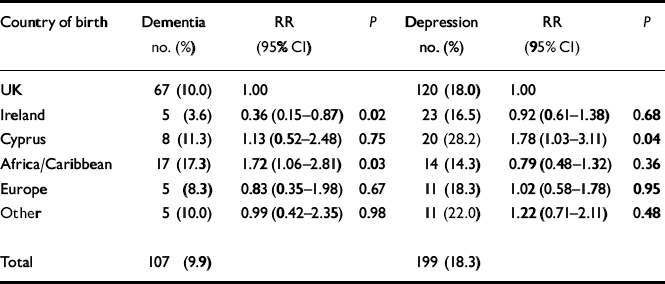
The prevalence of dementia and relative risk of each migrant group compared with the UK-born is given in Table 4. We found no association between migration per se and dementia (10% UK v. 9.6% migrants). However, in comparison with UK-born subjects we found statistically significant differences in two migrant groups: the prevalence of dementia was higher in the African-Caribbeans and lower in the Irish (Table 4).
Prevalence and relative risk (RR) of depression and dementia by country of birth
| Country of birth | Dementia no. (%) | RR (95% CI) | P | Depression no. (%) | RR (95% CI) | P |
|---|---|---|---|---|---|---|
| UK | 67 (10.0) | 1.00 | 120 (18.0) | 1.00 | ||
| Ireland | 5 (3.6) | 0.36 (0.15-0.87) | 0.02 | 23 (16.5) | 0.92 (0.61-1.38) | 0.68 |
| Cyprus | 8 (11.3) | 1.13 (0.52-2.48) | 0.75 | 20 (28.2) | 1.78 (1.03-3.11) | 0.04 |
| Africa/Caribbean | 17 (17.3) | 1.72 (1.06-2.81) | 0.03 | 14 (14.3) | 0.79 (0.48-1.32) | 0.36 |
| Europe | 5 (8.3) | 0.83 (0.35-1.98) | 0.67 | 11 (18.3) | 1.02 (0.58-1.78) | 0.95 |
| Other | 5 (10.0) | 0.99 (0.42-2.35) | 0.98 | 11 (22.0) | 1.22 (0.71-2.11) | 0.48 |
| Total | 107 (9.9) | 199 (18.3) |
In logistic regression analysis the significant independent predictors of dementia were: living in residential accommodation (OR=3.2, CI=2.44-4.30, P<0.0001); age (OR=1.1, CI=1.06-1.14, P<0.0001); African-Caribbean (OR=3.6, CI=1.43-9.16, P<0.007); and years of education (OR=0.6, CI=0.32-0.98, P<0.04). COB Ireland was no longer a predictor when other factors were corrected.
Depression
A total of 18.3% of the population had a diagnosis of depression. Women (22.5%) were more likely than men (12.2%) to have depression (OR=2.08, 95% CI=1.46-2.99, P=0.00002). A higher proportion of widowed (23%) and separated/divorced (21.6%) respondents had depression than those who were single (13%) or married/cohabiting (14.6%) (single and married v. the rest: 14% v. 23%, OR=1.8, CI=1.3-2.5, P<0.001).
There was no significant difference overall according to COB or between the rates of depression in those born in the UK compared with others. The Cypriots alone of the migrant groups had a significantly raised rate of depression (28.2% v. 18.0%). No one from Cyprus spoke English as a first language. Those born in Cyprus were significantly more likely to have self-reported physical health difficulties (94.4% v. 86.2%) but were no more likely to have limitations in ADL.
Using a forward stepwise logistic regression the significant independent predictors of depression were: needing help with ADL (OR=3.0, CI=2.11-4.26, P<0.0000); being female (OR=2.0, CI=1.41-3.0, P=0.002); subjective ill-health (OR=2.3, CI=1.5-4.52, P=0.02).
DISCUSSION
To our knowledge this is the first study in the UK to examine the prevalence of dementia and depression among older people in the indigenous population and ethnic and migrant groups using a large community sample.
Limitations
The definition of race and ethnicity as variables in epidemiological research is contentious (Reference BhopalBhopal, 1997). To avoid the problems of misclassification we have tried to make this process as transparent as possible. Community-based studies such as ours, carried out in an inner-city area, will invariably include a complex constellation of migrant and minority ethnic groups. Statistical power in relatively small samples often is achieved by combining groups, with some loss of precision. In this study we attempted to balance this by collecting both self-assessed ethnicity and COB and then assigning migrants to the most appropriate category. For example, a small number of Irish-born people gave their self-assigned ethnicity as British but were grouped as Irish migrants. The COB categories that we have chosen reflect as tightly as possible geographical region, cultural similarity and generally perceived group identity. In the analysis, we found only minor differences between the choice of ethnicity or COB as the explanatory variable. We chose not to examine only the simple dichotomy of migrant status because this might mask important putative differences between migrant groups. Most of our interviewees spoke good English. We attempted to interview those who did not (n=28) by using their families as interpreters. We were unable to interview 15 people because they did not speak enough English.
Despite African-Caribbean migrants being significantly younger with relatively few residents in residential accommodation, we found that they had a significantly raised prevalence of dementia compared with UK-born and other minority groups. This excess remained when we excluded the small number of people from Africa and the Caribbean who were Asian or White.
Cross-cultural assessment of dementia in older people has particular pitfalls related to language and literacy skills, particularly the use of culturally biased screening instruments that rely on language recognition and familiarity with test situations in people with cognitive impairment (Reference LindesayLindesay, 1998). In this study, the findings do not appear to arise either through language or literacy difficulties. When known risk factors for various types of dementia are considered, being born in Africa/Caribbean and migrating remains a significant independent predictor of dementia.
African-Caribbeans
The excess of hypertension in the African-Caribbean population in the West is well-documented (Reference Cooper and RotimiCooper & Rotimi, 1997), as is an increased mortality in this group from cerebrovascular disease (Reference Wild and McKeigueWild & McKeigue, 1997). We did not complete a diagnostic assessment in this part of the study and therefore cannot subtype the dementias. It seems reasonable to speculate, however, in this relatively young population with an excess of diabetes and high risk of cerebrovascular disease, that many of the dementias may be vascular contributions. Despite the known excess of hypertension in this population, there was not a significant increase, in our population, of Black older people who reported that they had cardiovascular illness or who were taking antihyptertensive medication. This suggests that, despite the excess of morbidity and mortality in this group, hypertension in Black people is insufficiently detected or treated. Energetic screening and treatment of this high-risk population for hypertension and associated risks of diabetes, obesity and smoking has the potential to prevent some of these vascular dementias. This is important because of individual disability and suffering, the lack of ability to reverse vascular dementias, the effect on carers (Reference Livingston, Manela and KatonaLivingston et al, 1996) and the economic consequences of dementia (Reference Livingston, Manela and KatonaLivingston et al, 1997). More research is required not only to clarify the subtypes of dementia in this population but also to find out more about appropriate and effective ways of implementing preventative strategies.
A much lower proportion of people born in Africa/Caribbean than their counterparts had given up smoking, suggesting that the communication of public health messages is unsatisfactory. Black patients perceive racial discrimination in health care (Reference Hutchinson and GilvarryHutchinson & Gilvarry, 1998). Thus the number of consultations in general practice by Black elders is higher than their White counterparts (Reference BlakemoreBlakemore, 1982; Reference BarkerBarker, 1994), yet referral to secondary health care and social services of ethnic elders is less than the indigenous population (Reference Manthorpe and HettiaratchyManthorpe & Hettiaratchy, 1993; Reference BarkerBarker, 1994; Reference Shah and Dighe-DeoShah & Dighe-Deo, 1997).
We were unable to show that minority ethnic (or migrant) status in itself constitutes a risk factor for depression. Depression, however, may present with different patterns of symptoms in different cultures. The language of distress used by African Americans differs from that on which structured diagnoses are made and may lead to an underestimate of levels of distress and anxiety (Reference Heurtin-Roberts, Snowden and MillerHeurtin-Roberts et al, 1997). When screening for depression in older people, lower cutpoints have been found to be appropriate for older Black people living in the UK (Reference Abas, Phillips and CarterAbas et al, 1998). This may account for the apparent low prevalence of depression, in our study, in those born in Africa or the Caribbean.
Greek Cypriots
The Cypriot (predominantly Greek Cypriot) group appears to be the only migrant group at higher risk for depression, despite the absence of known risk factors for depression, such as living alone, loss of partner and being female. The associates of vulnerability in this group appear to be fewer years of education, subjective and objective ill health and lack of English as a first language. They may experience greater isolation and be less able to access appropriate treatment. More work is required to understand the factors related to depression in this group.
Clinical implications
Ethnicity and migrant status are not in themselves predictors of dementia or depression in older people. Despite being significantly younger, people of Africa/Caribbean COB were much more likely to have dementia and neither education nor language appeared to account for this. It is likely that this is due to vascular risk factors. With energetic treatment there is the potential for primary or secondary prevention of such dementia.
Clinical Implications and Limitations
CLINICAL IMPLICATIONS
-
• There is an excess of dementia in those born in Africa/Caribbean.
-
• This may be associated with hypertension that is not satisfactorily treated and it is essential that this high-risk group is identified and offered treatment.
-
• People who are of African-Caribbean origin were less likely to give up smoking. It is important to find effective health promotion in this population.
LIMITATIONS
-
• The dementias were not subtyped.
-
• We do not have data regarding blood pressure.
-
• People of differing countries of birth were grouped and analysed together.
Acknowledgements
We thank the people of Islington for welcoming our researchers into their homes and answering numerous questions.




eLetters
No eLetters have been published for this article.