INTRODUCTION
Studies of marine mammal diet are useful to understand the food web interactions. They can provide some insight on cetacean feeding behaviour and trophic relationships (Clarke, Reference Clarke1986a). The diet of some delphinids seems to change according to areas (Silva, Reference Silva1999), sometimes reflecting the prey abundance and distribution.
Delphinids occur in oceanic and coastal waters, and they are very common in the South Atlantic Ocean (Jefferson et al., Reference Jefferson, Webber and Pitman2008). Sixteen out of the 19 delphinid species reported for Brazil occur in Rio de Janeiro State, including the species presented in this study: Atlantic spotted dolphin (Stenella frontalis Cuvier, 1829), rough-toothed dolphin (Steno bredanensis Lesson, 1828), bottlenose dolphin (Tursiops truncatus Montagu, 1821), short-beaked common dolphin (Delphinus delphis Linnaeus, 1758), Fraser's dolphin (Lagenodelphis hosei Fraser, 1956) and striped dolphin (Stenella coeruleoalba Meyen, 1833).
In southern Brazil, most sightings of S. coeruleoalba were recorded in shallow (30–100 m) waters (Moreno et al., Reference Moreno, Zerbini, Danielewicz, Santos, Simões-Lopes, Lailson-Brito and Azevedo2005). However, among the species of the genus Stenella, S. frontalis is reported as the most coastal species, inhabiting nearshore shallow waters, although this dolphin can also be seen in deeper waters. Records of the latter species indicate a discontinuous distribution along the Brazilian coast, with a gap from 6°S until 21°S (Moreno et al., Reference Moreno, Zerbini, Danielewicz, Santos, Simões-Lopes, Lailson-Brito and Azevedo2005). The presence of T. truncatus in shallow waters and bays is common on the central and south coast of Brazil (Barreto, Reference Barreto2000), and D. delphis also seems to present oceanic and coastal habits with depths ranging from 18–70 m (Tavares, Reference Tavares2006). Steno bredanensis and L. hosei present oceanic habits predominantly (Jefferson et al., Reference Jefferson, Webber and Pitman2008), even though, in Brazil, S. bredanensis has been seen in shallow waters as well, from 2 to 43 m of depth (Bastida et al., Reference Bastida, Rodríguez, Secchi and Silva2007).
Despite the records of those delphinids on the south-eastern Brazilian coast, their biology is poorly known, as well as their feeding habits. Santos et al. (Reference Santos, Rosso, Santos, Lucato and Bassoi2002) reported the prey largehead hairtail (Trichiurus lepturus) and the squid (Loligo plei) for T. truncatus and D. capensis, and also the cephalopod Octopus vulgaris for T. truncatus collected in southern waters (25°S). Santos & Haimovici (Reference Santos and Haimovici2001) studied the consumption of cephalopods by some delphinid species in the southern area of Rio de Janeiro, including T. truncatus, D. delphis, S. frontalis and S. bredanensis. In the latter study, consumption of the squid Loligo plei was reported for all the investigated species, as well as the predation on O. vulgaris by T. truncatus. Di Beneditto et al. (Reference Di Beneditto, Ramos, Siciliano, Santos, Bastos and Fagundes-Netto2001) analysed the feeding habits of six delphinid species stranded on the Rio de Janeiro coast. The stomach contents of S. frontalis indicated a teuthophagous diet, while for T. truncatus an ichthyophagous diet was observed. Only largehead hairtails were found in the stomachs of S. bredanensis and only loliginid squids were found in the stomach of L. hosei.
This study provides new data on the feeding habits of six delphinid species collected along Rio de Janeiro State coast, using stomach contents retrieved from animals found stranded between 1994 and 2007.
MATERIALS AND METHODS
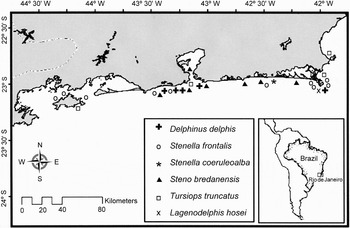
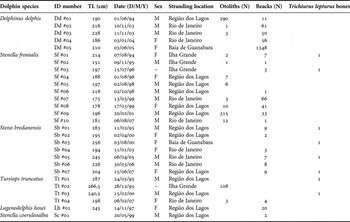
Stomach contents of 28 delphinids were analysed, including Stenella frontalis (N = 10), Steno bredanensis (N = 7), Tursiops truncatus (N = 4), Delphinus delphis (N = 5), Lagenodelphis hosei (N = 1) and Stenella coeruleoalba (N = 1) (Table 1). The animals were found stranded on the beaches of Rio de Janeiro State (Figure 1), between 23°06′S 44°18′W and 22°14′S 41°54′W, from 1994 to 2007. Dolphins were necropsied and classified in stages 2 and 3 according to Geraci & Lounsbury (Reference Geraci and Lounsbury1993). The stomachs were collected and kept frozen until analyses.
Map indicating the locations of the small cetacean strandings in Rio de Janeiro State.

Data on delphinids found stranded on the beaches of Rio de Janeiro State (N = 28). Total length (TL), stranding date and location, sex and number of items (N) found in each stomach. (M) Male; (F) Female.

All stomach compartments were examined and the contents were washed through 1 mm mesh sieves. The items found in the stomach contents were stored in 70% glycerin for cephalopod beaks, and fish otoliths and bones were stored dry.
Fish otoliths and cephalopods beaks were identified to the lowest possible taxonomic level, using a local reference collection and published studies (Bastos, Reference Bastos1990; Corrêa & Vianna, Reference Corrêa and Vianna1992/1993; Lêmos et al., Reference Lêmos, Corrêa and Pinheiro1995; Santos, Reference Santos1999; Di Beneditto, Reference Di Beneditto2000). The minimum number of fish species in each stomach was estimated as the highest number of either right or left otoliths, added to the half of the otoliths when side could not be determined. Similarly, the maximum number of upper or lower beaks was used to estimate the minimum number of cephalopods ingested.
Fish and cephalopods had their total length (cm) and mantle length (mm), respectively, and total weight (g) estimated based on the major axis length (mm) of fish otoliths and rostral or hood length (mm) of cephalopods beaks, calculated using regression curves found in the literature (Clarke, Reference Clarke1986b; Bastos, Reference Bastos1990; Santos, Reference Santos1999; Di Beneditto, Reference Di Beneditto2000; Bassoi, Reference Bassoi2005). To avoid errors associated with the erosion by gastric acids, only undamaged otoliths and beaks were measured.
The relative importance of prey taxa in the diet was estimated for each delphinid species using: (1) frequency of occurrence (%FO), expressed as the percentage of stomachs in which the prey occurred; (2) percentage number of a prey (%N), in relation to the total number of prey consumed; (3) percentage weight of a prey (%W), in relation to the total weight ingested; and (4) index of relative importance (IRI), meaning (%N + %W) × %FO (Pinkas & Iverson, Reference Pinkas and Iverson1971).
The Shapiro–Wilk W test was used in order to test data normality. Differences between the size and weight of preys consumed by each dolphin species were compared using the Kruskal–Wallis test (P < 0.05) and a posteriori comparison of medians.
RESULTS AND DISCUSSION
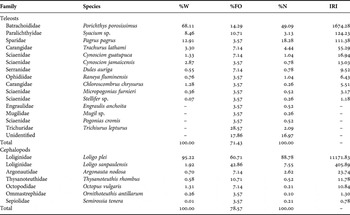
Remains of at least 1337 preys were retrieved from the 28 stomachs. Seven different cephalopod species from six families and fifteen fish species belonging to ten families were identified (Table 2). When the contribution of cephalopods and fish was compared, the former group was shown to be of greater importance than the latter. The cephalopod group occurred in 78.6% of the stomachs with food remains and comprised 954 individuals (71.4%), while the teleost group occurred in 64.3% of the stomachs, comprising 383 specimens (28.6%). However, such comparisons should be seen with caution because cephalopod beaks probably remain undigested for a longer time than fish bones and otoliths (Clarke, Reference Clarke1996).
Overall importance of prey species identified from stomach contents of dolphins stranded on the beaches of Rio de Janeiro State (N = 28). The importance is expressed as percentage weight (%W), frequency of occurrence (%FO), percentage number (%N) and the index of relative importance (IRI) for all stomachs combined.

Four fish species did not have their weights estimated. That was the case for the Argentine anchoita (Engraulis anchoita) and mullets (Mugil sp.), since the otoliths were found to be excessively damaged. The black drum (Pogonias cromis) did not have its regression curve found in the literature for this region, and the largehead hairtail (Trichiurus lepturus) had its presence verified by remaining bones rather than otoliths.
Among cephalopods, the squid Loligo plei was the most important prey species (N = 847). It constituted 95.2% of the cephalopod weight ingested. The second most important cephalopod species was the squid Loligo sanpaulensis. Concerning fish, three taxa were the most important: the Atlantic midshipman (Porichthys porosissimus), the flounder (Syacium sp.) and the common seabream (Pagrus pagrus).
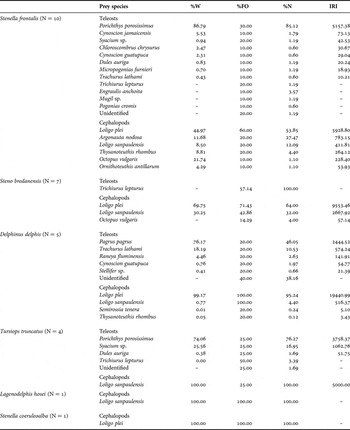
Fish seem to constitute an important prey group for some delphinids, as has been largely seen for Sotalia guianensis (Santos et al., Reference Santos, Rosso, Santos, Lucato and Bassoi2002; Di Beneditto & Ramos, Reference Di Beneditto and Ramos2004; Di Beneditto & Siciliano, Reference Di Beneditto and Siciliano2007). In this study, bottlenose dolphins seem to be preferentially ichthyophagous, preying upon demersal fish (Table 3). Regarding occurrence in T. truncatus stomachs, fish presented a higher contribution than cephalopods (80%). Two fish species constituted 99.6% of the fish weight ingested, the Atlantic midshipman and the flounder. This is the first record of Syacium sp. and Dules auriga in T. truncatus stomachs in Brazil. Studies in other countries also found that the diet of T. truncatus was characterized by demersal fish as the most important preys, followed by cephalopods (Gannon & Waples, Reference Gannon and Waples2004; Santos et al., Reference Santos, Fernández, López, Martínez and Pierce2007).
Ranking of prey species for each predator, according to the index of relative importance (IRI) values. The preys were identified from stomach contents of dolphins stranded on the beaches of Rio de Janeiro State (N = 28). The importance is expressed using the percentage weight (%W), the frequency of occurrence (%FO), the percentage of the number of specimens found (%N) and the IRI.

Concerning S. frontalis, the consumption of cephalopods and fish were almost equivalent, representing 51.8% and 48.3% of the ingested biomass, respectively. When the weight consumed by this predator is taken into account, the fish Atlantic midshipman and the squid L. plei were the most important preys. Among the 18 species consumed by this delphinid, only four had already been reported as its preys in Brazil, including L. plei as the most important prey for S. frontalis (Di Beneditto et al., Reference Di Beneditto, Ramos, Siciliano, Santos, Bastos and Fagundes-Netto2001).
The squid L. plei occurred in all D. delphis stomachs, representing the major cephalopod species ingested according to its weight (W = 99.2%), followed by the squid L. sanpaulensis. Among fish, the common sea bream was the most important prey (W = 76.2%). The five fish species found in D. delphis stomachs and the squid Thysanoteuthis rhombus increase the range of species consumed by this dolphin in Brazil. The cephalopods L. plei, L. sanpaulensis and Semirossia tenera had already been reported as D. delphis preys on the Brazilian coast, as well as five others species of cephalopods and one of fish (T. lepturus) that were not found in this study, thus characterizing a teuthophagous diet (Santos & Haimovici, Reference Santos and Haimovici2001; Santos et al., Reference Santos, Rosso, Santos, Lucato and Bassoi2002; Santos & Haimovici, Reference Santos and Haimovici2002). In other areas of the world, D. delphis has shown a preference for small schooling fish, with pelagic habits rather than demersal (Silva, Reference Silva1999; Pusineri et al., Reference Pusineri, Magnin, Meynier, Spitz, Hassani and Ridoux2007).
When the IRI is taken into account, Steno bredanensis also had the squid L. plei as the major prey, followed by L. sanpaulensis. Although it has not been possible to obtain an IRI ranking number for the fish largehead hairtail due to the lack of length and weight estimations, this fish also constituted an important prey species for S. bredanensis, considering its large occurrence in stomachs (57.1%). This fish is a common species on the Brazilian coast (Figueiredo & Menezes, Reference Figueiredo and Menezes2000) and other authors had already reported this species as an important prey for dephinids (e.g. T. truncatus and S. guianensis; Di Beneditto et al., Reference Di Beneditto, Ramos, Siciliano, Santos, Bastos and Fagundes-Netto2001; Di Beneditto & Ramos, Reference Di Beneditto and Ramos2004), especially for S. bredanensis (Di Beneditto et al., Reference Di Beneditto, Ramos, Siciliano, Santos, Bastos and Fagundes-Netto2001).
The stomach content analyses of Lagenodelphis hosei and Stenella coeruleoalba were restricted to one stomach for each species. The former had consumed 14 individuals of L. sanpaulensis and the latter had preyed upon only two squids of the species L. plei. It is important to remark the presence of coastal preys in the stomach of dolphins with oceanic habit. However, a greater number of sampled specimens would be necessary for the achievement of strong conclusions related to this finding.
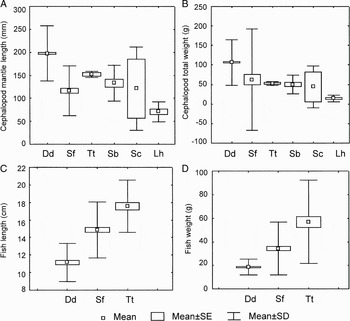
Regarding the average weight and length estimated for cephalopods, significant differences were verified between D. delphis and the other two predators: S. frontalis and S. bredanensis, since D. delphis preyed on larger cephalopods than the other delphinid species (Kruskal–Wallis test, P < 0.05; a posteriori comparison of medians, P < 0.001). Additionally, with reference to the weight and length of the fish consumed, significant differences were observed for all predators (P < 0.001), since T. truncatus preyed on the largest fish, followed by S. frontalis and D. delphis (Kruskal–Wallis test, P < 0.05; a posteriori comparison of medians, P < 0.001) (Figure 2).
Estimation of length and weight of the fish and cephalopods consumed by delphinids stranded in Rio de Janeiro State (attention to different scales). (A) Cephalopod mantle length (mm); (B) cephalopod total weight (g); (C) fish length (cm); (D) fish weight (g); (Dd) Delphinus delphis (N = 5); (Sf) Stenella frontalis (N = 10); (Tt) Tursiops truncatus (N = 4); (Sb) Steno bredanensis (N = 7); (Sc) Stenella coeruleoalba (N = 1); (Lh) Lagenodelphis hosei (N = 1).

The investigated dolphin species showed a large overlap of preys; however, they seemed to feed on different size-classes. Most fish and cephalopod preys were smaller than the size normally caught by fisheries. Nevertheless, it is important to consider that the foraging area of these dolphins could be the same area used by fishing operations. This would represent a risk for incidental catches, since the captures have been a threat for coastal dolphin populations in Brazilian waters (Reeves et al., Reference Reeves, Smith, Crespo and Notarbartolo di Sciara2003).
Although the dolphins preyed upon several species, a dominance of few preys could be observed, since one or two comprised the major biomass ingested (weight percentage). This dominance can be the result of either a preference for a few prey species or just the consumption of the most available prey, or even a result of both aspects. Because dolphins stranded in different locations and seasons, as well as due to the small sample size, it was not possible to achieve further conclusions.
The family Loliginidae, specially the squids Loligo plei and L. sanpaulensis are the most abundant cephalopods on neritic areas along the south-eastern Brazilian coast (Haimovici & Perez, Reference Haimovici and Perez1991). Some studies have shown that these two squids seem to form reproductive aggregations in shallow waters during the spring and summer, for spawning (Costa & Fernandes, Reference Costa and Fernandes1993; Perez et al., Reference Perez, Aguiar and Oliveira2002; Rodrigues & Gasalla, Reference Rodrigues and Gasalla2008). These aggregations occur under the influence of the South Atlantic Central Water (SACW), which brings nutrient-rich waters onto the shelf. For L. plei, the larger-sized and matured individuals concentrate closer to the coast, taking advantage of the high temperature and high food availability to spawn associated with SACW intrusion. The opposite occurs with L. sanpaulensis, since the size of the individuals and the predominance of mature specimens increase with depth, and decrease again after 100 m of depth (Rodrigues & Gasalla, Reference Rodrigues and Gasalla2008).
Most of the preys were coastal and demersal, indicating coastal habits of the predators. Three cephalopods species consumed by S. frontalis constituted exceptions (Argonauta nodosa, Thysanoteuthis rhombus and Ornithoteuthis antillarum), since they occur farther than the 200 m isobath and are typically epipelagic (Haimovici & Perez, Reference Haimovici and Perez1991). The short-beaked common dolphin, D. delphis, also ingested Thysanoteuthis rhombus. The presence of cephalopods that occur farther than the 200 m isobath in stomach contents of S. frontalis strengthened a previously raised hypothesis that the species also preys on oceanic species. Cadmium concentrations of S. frontalis suggested that the species may have access to oceanic preys in Brazilian waters (Dorneles et al., Reference Dorneles, Lailson-Brito, dos Santos, Silva da Costa, Malm, Azevedo and Torres2007a). In fact, these findings corroborate the information obtained through sightings in Brazilian oceanic waters, since S. frontalis were also observed in deep water regions (Moreno et al., Reference Moreno, Zerbini, Danielewicz, Santos, Simões-Lopes, Lailson-Brito and Azevedo2005). Some investigations have demonstrated the possibility of using cadmium as an auxiliary tool for understanding feeding ecology of marine mammals (e.g. Bustamante et al., Reference Bustamante, Morales, Mikkelsen, Dam and Caurant2004; Lahaye et al., Reference Lahaye, Bustamante, Spitz, Dabin, Das, Pierce and Caurant2005). The information with regard to cadmium concentrations of squid-eating odontocetes from Brazilian waters indicates the occurrence of lower concentrations in coastal species, which are well known to prey on loliginids, than in oceanic cetaceans that feed on cephalopods that belong to other taxonomic families (Dorneles et al., Reference Dorneles, Lailson-Brito, dos Santos, Silva da Costa, Malm, Azevedo and Torres2007a,Reference Dorneles, Lailson-Brito, Secchi, Bassoi, Lozinski, Torres and Malmb). Therefore, our results corroborate these studies on cadmium concentrations, since cadmium levels found in T. truncatus and S. bredanensis were lower than those verified in oceanic dolphins, such as those belonging to the genus Stenella (Dorneles, 2007a).
Since it was not possible to estimate length and weight of some preys, and consequently the IRI could not be calculated, the importance of fish in the diet could be underestimated. Moreover, cephalopod beaks tend to remain for longer periods of time in cetacean stomachs (Clarke, Reference Clarke1996). Nevertheless, it can be concluded that these invertebrates represent an essential source of energy for these dolphin species.
ACKNOWLEDGEMENTS
The authors thank the Instituto de Biofísica Carlos Chagas Filho (UFRJ), CEPSUL (ICMbio) and Laboratório de Mamíferos Aquáticos e Bioindicadores (UERJ) teams. Thanks also to Dr Marcelo Vianna for his help and to biologist Rafael Carvalho for helping with map production. This work was supported by the Brazilian Research Council—CNPq (A.F.A, grant number 304826/2008-1) as well as by the Rio de Janeiro State Government Research Agency—FAPERJ (‘Pensa Rio’ Program) (C.L.C.M., grant number E-26/100.968/2008), (A.C.A., grant number E-26/102.982/2008). José Lailson-Brito is a researcher of the ‘Prociência’ Program—FAPERJ/UERJ.