I. INTRODUCTION
Transition metal carbides (TMCs) including TiC, ZrC, HfC, and TaC have high melting temperature (≥3000 °C), high hardness (20–30 GPa), high modulus (≥400 GPa), good strength, and good wear-erosion properties. Reference Weimer1,Reference Pierson2 Generally, TMCs have a wide range of stoichiometry with the carbon:metal ratio ranging from 0.5 to 1.0. Reference Toth3,Reference Storms4 Out of all TMCs, ZrC as a monolith and also as a composite with ZrB2 has many potential applications including metal melting crucibles, nuclear reactors, and also structural components in re-entry vehicles. Reference Adamovskii5,Reference Vasudevamurthy, Knight, Roberts and Adams6 One of the problems encountered in processing of dense ZrC ceramics is the high temperature required. Early work indicated that hot pressing (HP) is required to produce reasonably dense ZrC at 2000–2300 °C. Reference Barnier, Brodhag and Thevenot7 Nonisothermal sintering of ZrC at ∼2300–2900 °C led to reasonably dense samples with considerable grain growth. Reference Lanin, Marchev and Pritchin8 Recently, it was shown that reactive hot pressing (RHP) of different molar ratios of carbon to zirconium powder mixtures at 40 MPa can yield high relative density (RD) of the carbide phase at temperatures as low as 1200 °C, depending on the stoichiometry. Reference Nachiappan, Rangaraj, Divakar and Jayaram9 The minimum limit of carbon that can be accommodated in the rock-salt phase has been shown to be as low as 33 mol%, which is an extension of the phase range reported earlier in binary Zr–C phase diagrams. Reference Sara10,Reference Massalski and Okamoto11 While full densification was achieved for ZrC0.5 and ZrC0.67 compositions at 1200 °C, more stoichiometric compositions retain greater porosity, which reaches a maximum of 15% for ZrC, even at temperatures as high as 1600 °C. Reference Nachiappan, Rangaraj, Divakar and Jayaram9 It was argued that the formation and plastic flow of transient nonstoichiometric carbide (ZrC x ) during RHP could be responsible for the ease of densification, both in monolithic ZrC and as well as in ZrB2–ZrC composite at 1200 °C. Reference Nachiappan, Rangaraj, Divakar and Jayaram9,Reference Rangaraj, Suresha, Divakar and Jayaram12 Such plastic flow has also been proposed in work that addresses the effect of Zr and graphite addition on densification of ZrC0.9 at 1800–2000 °C, with a yield of ≥98.4% RD. Reference Wang, Guo, Kan, Zhang and Wang13
Most recently, it has been shown that the low temperature densification of Zr–C powder mixtures during RHP is driven primarily by three factors Reference Chakrabarti, Rangaraj and Jayaram14 : (i) the initial plastic flow of Zr through creep, (ii) reduction in densification rate due to gradual increase in stress shielding by the development of a contiguous skeleton of an undeformable mixture of carbon and ZrC x and (iii) concurrently, the development of porosity due to molar volume reduction upon reaction. According to this model, ZrC0.5, which contains the largest amount of starting metal (84 vol%) and displays the smallest amount of volume contraction during formation (8%), reaches near theoretical density at 40 MPa, 1200 °C, while the corresponding figures for stoichiometric ZrC are ∼73 vol% and ∼19%, respectively, leading to a final RD of only ∼87%. Reference Nachiappan, Rangaraj, Divakar and Jayaram9,Reference Chakrabarti, Rangaraj and Jayaram14 This complex evolution of volume fraction of product phase and porosity reveals that it is desirable to densify the compact as much as possible before a significant reaction takes place. Because, once the reaction begins and the volume fraction of metal drops below a critical value, the porosity developed during the final stages of reaction can no longer be readily removed by deformation of the residual metal. In these previous studies, experiments were typically carried out by a two-stage RHP at 800–1200 °C, and the role of pressure was not explored. The modeling of density and phase evolution has been carried out recently by using uniaxial compression data on Zr and by making simple assumptions about the stress shielding influence of the nonmetallic phase. Reference Chakrabarti, Rangaraj and Jayaram14,Reference Chakrabarti, Rangaraj and Jayaram15 While these models are far from exact, they appear to display the correct trends in densification reasonably well and are suited to explore the role of pressure.
Generally, conventional HP of ceramics is carried out at 20–50 MPa, largely because of the limitations of graphite dies. However, the flow stress of Zr metal at 1000 °C is only ∼2.3 MPa for a strain rate of 0.001 s−1. Reference Chakravartty, Banerjee and Prasad16–Reference Chakravartty, Prasad and Asundi18 It therefore remains to be seen if even lower pressures can result in a dense product for nonstoichiometric compositions, such as ZrC0.5, while, conversely, it would be useful to know the pressure required to complete densification at the stoichiometric composition, namely, ZrC, for which the low starting metal volume fraction would rapidly lead to the formation of a rigid, percolating network of the carbide hindering complete densification. The objective of the current work is to examine through a series of experiments and analytical modeling how pressure affects densification at a RHP temperature of 1200 °C, which is high enough to complete most of the reaction as shown by the experimental studies. Reference Chakrabarti, Rangaraj and Jayaram14 For comparison, the densification of prereacted powders of nonstoichiometric carbide phase by HP is also studied.
II. EXPERIMENTAL PROCEDURE
Mole fractions of Zr and C powder mixtures used to yield monolithic ZrC x ceramic through RHP are 1:0.5, 1:0.67, 1:0.8, and 1:1, leading to ZrC0.5, ZrC0.67, ZrC0.8, and ZrC, respectively. Reference Nachiappan, Rangaraj, Divakar and Jayaram9,Reference Chakrabarti, Rangaraj and Jayaram14
A. Material and processing
In the present study, commercially available powders of Zr: purity 98 wt% (Hf 1 wt%), particle size 2–10 μm (M/s Yashoda Special Metals, Hyderabad, India) and graphite: purity 99 wt%, particle size 7–10 μm (M/s Alfa Aesar, Ward Hill, MA) are used. Powders are mixed in the required quantity in ethanol with ZrO2–8 mol% Y2O3 milling media for 24 h in a plastic bottle and dried at 100 °C for 60 min. For the HP studies of prereacted powders of ZrC0.5 at different pressures, the dried powder mixture (Zr:C in 1:0.5 molar ratio) was filled in a graphite crucible whose insides were lined with flexible graphite foil and reacted at 1600 °C for 60 min in argon using a graphite heating element furnace, at a heating rate of 5–10 °C/min rate, followed by cooling at 10 °C/min. The reacted mixture was powdered using an agate mortar and pestle in hexane medium. On the other hand, for the RHP experiments, thoroughly mixed different molar ratio of Zr:C powders were used directly. All powders were cold compacted in a hardened steel die of 13 mm inner diameter and cold compacted at 50 MPa pressure. The thicknesses of the samples are ∼5 mm. The green densities of samples were calculated by measuring the diameter, thickness, and weight. The compacted samples were placed in a high-density graphite die (inner diameter of 13.4 and 60 mm length). Direct contact between samples and the die wall/punch was avoided by using 0.2 mm thick graphite foil.
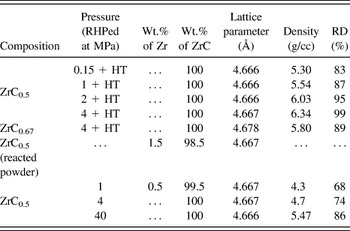
The RHP and HP experiments were carried out under flowing argon in a resistance-heating element hot press, designed and fabricated indigenously. Reference Sheshadri, Narayanaswamy, Dwarakanatha Rao, Rangaraj and Singh19 The pressure ranged from 0.15 to 100 MPa applied through a suitable dead weight at room temperature (RT). To attain pressures of 70 and 100 MPa, the graphite die of internal diameter 6.8 mm was placed inside the bigger diameter die (two-die set up) and SiC was used for the top/bottom plungers as shown in Fig. 1. The RHP experiments were carried out at 1200 °C based on an earlier study, Reference Nachiappan, Rangaraj, Divakar and Jayaram9,Reference Chakrabarti, Rangaraj and Jayaram14,Reference Chakrabarti, Rangaraj and Jayaram15 which indicated that lower temperatures led to the retention of significant amounts of unreacted phases. The temperature was raised at an average heating rate of 4–6 °C/min up to 1000 °C, held for 60 min to complete densification with minimal reaction and then raised to 1200 °C and held for 60 min, after which the sample was cooled at 8 °C/min. Details of the starting compositions and experimental conditions are given in Table I. Selected samples are heat-treated at 1600 °C for 60 min in argon atmosphere.
Schematic diagram of the two-die graphite/plunger/powder assembly. (a) and (b) graphite dies, (c) graphite plungers, (d) SiC plungers, (P) powder mixture.

Composition, wt% of Zr, C, ZrC lattice parameter, density, and RD of ZrC0.5, ZrC0.67, ZrC0.8, and ZrC samples.

B. Characterization of the reactive hot pressed (RHPed) samples
RHPed samples were ground by 0.3–0.5 mm to remove the graphite foil from the surfaces and final polishing was carried out using different grit sizes of SiC abrasive paper and diamond paste. Postprocessing characterization began with density measurements through Archimedes method by boiling the samples in water for 60 min and cooling to RT. X-ray diffraction (XRD) (Bruker x-ray diffractometer, operated at 40 kV and 35 mA, Karlsruhe, Germany) was performed on flat surfaces for phase identification and precision lattice parameter measurements using Cu Kα radiation. Quantification of unreacted and reaction formed phases was carried out using materials analysis using diffraction (MAUD) Rietveld analysis software. Reference Lutterotti20,Reference Lutterotti, Bortolotti, Ischia, Lonardelli and Wenk21 Rietveld analysis software MAUD estimated the final composition, i.e., unreacted Zr, C, and reaction formed ZrC x in wt%. To convert the wt% of ZrC x to mol. fraction we have used the relationship between the ZrC stoichiometry and the lattice parameter by fitting the data in Refs. Reference Nachiappan, Rangaraj, Divakar and Jayaram9 and Reference Chakrabarti, Rangaraj and Jayaram14. Lattice parameter of the reaction formed ZrC x was estimated by Rietveld method and using the above mentioned relationship, arrived at the average stoichiometry of the ZrC from which we have calculated the theoretical density of ZrC x of that particular stoichiometry. It is then possible to convert the wt% to mol. fraction directly using standard procedures for the mixture of unreacted Zr, C, and reaction formed ZrC x and also the theoretical density of the mixture can be estimated. Polished sample surfaces, and also selected etched samples (H2O:HNO3:HF in volume proportion of 5:5:2 for 15 s) were observed using scanning electron microscopy (SEM) (ESEM-Quanta, FEI, Hillsboro, OR). The average grain size of ZrC reported has been measured through image analysis of the SEM micrographs by the line intercept method by counting a minimum of 100 grains.
III. RESULTS
In this section, the XRD analysis results are first reported, followed by densification as a function of applied pressure and also modeling and microstructural observations.
A. XRD analysis
The XRD patterns of the ZrC0.5 composition RHPed at 4 MPa, 1000 °C for 60 min, and 0.15–4 MPa, 1200 °C for 60 min are shown in Figs. 2(a)–2(e). The sample RHPed at 1000 °C shows 18 wt% residual Zr [Fig. 2(a)], the samples produced at 1200 °C also shows residual metal in smaller quantities. As the pressure increased from 0.15 to 4 MPa, the metal content decreased from 6 to 0.5 wt% [Table I and Figs. 2(b)–2(d) and 2(f)]. This clearly indicated that the applied pressure played a small role in completion of reaction of RHPed samples at 1200 °C for ZrC0.5 composition. However, the samples heat-treated at 1600 °C for 60 min showed completion of reaction [Table II and Figs. 2(b′)–2(e′)]. The observed lattice parameter of RHPed ZrC0.5 samples is ∼4.668 Å, whereas RHPed followed by heat treatment at 1600 °C yields ∼4.666 Å, which are similar to the values reported earlier Reference Nachiappan, Rangaraj, Divakar and Jayaram9 and are consistent with the full incorporation of residual Zr metal into the carbide phase at 1600 °C.
XRD patterns of ZrC0.5 RHPed for 60 min at (a) 1000 °C, 4 MPa, and 1200 °C at (b) 0.15 MPa, (c) 1 MPa, (d) 2 MPa, and (e) 4 MPa. The plots (b′), (c′), (d′) and (e′) are heat-treated at 1600 °C.

Zr–0.5C composition RHPed/heat treatment at 1600 °C for 60 min, and also Zr–0.5C composition prereacted at 1600 °C for 60 min followed by HP at 1200 °C for 60 min.

HT: Heat treatment at 1600 °C for 60 min.
The XRD patterns of ZrC0.67, ZrC0.8, and ZrC compositions RHPed at 4 MPa, 1200 °C for 60 min are shown in Fig. 3. The amount of Zr in ZrC0.67 was ∼0.5 wt%, while no unreacted Zr was observed in ZrC0.8 and ZrC compositions. However, unreacted carbon content of 0.5 and 1.5 wt% was observed, respectively, in ZrC0.8 and ZrC compositions. This residual metal was absent, both after heat treatment of ZrC0.67 sample at 1600 °C and also when the RHP pressure was increased to 10 and 20 MPa (Table I). Similarly ZrC0.8 and ZrC compositions produced at higher pressures (40–100 MPa) have progressively diminishing carbon content. The change in lattice parameter of the carbide phase as the pressure increased was similar to that reported earlier Reference Nachiappan, Rangaraj, Divakar and Jayaram9 and also lattice parameter of the stoichiometric ZrC is similar to that reported in JCPDS file 35-0784 (4.693 Å). The experimental conditions, unreacted phases and lattice parameters of different compositions are given in Table I.
XRD patterns of different compositions RHPed at 4 MPa, 1200 °C for 60 min at (a) ZrC0.5, (b) ZrC0.67, (c) ZrC0.8, and (d) ZrC.

B. Densification
Measured density and RD of ZrC0.5, ZrC0.67, ZrC0.8, and ZrC compositions RHPed at 0.15–100 MPa, 1200 °C for 60 min are plotted in Fig. 4. A comparison of the effect of pressure on densification indicates that full densification can be attained in ZrC0.5 at a pressure as low as 4 MPa, which is much lower than previously reported. Reference Nachiappan, Rangaraj, Divakar and Jayaram9,Reference Chakrabarti, Rangaraj and Jayaram14 As the stoichiometry increases to ZrC0.67, densification shifts to progressively higher pressures (20 MPa) as shown in Table I and also in Fig. 4(a), while attained densities show an asymptotic trend with increasing pressure and drop to 97% for ZrC0.8 and 93% for ZrC at 100 MPa. To highlight the extent of reactive densification, an enlarged view of the densification trends of ZrC0.5 composition at 1200 °C is shown for both, prereacted powders of ZrC0.5 (1600 °C) as well as also the same composition made by RHP, at 1, 4, and 40 MPa in Fig. 4(b). As shown in Fig. 4(b) and Table II, the prereacted powder reaches a maximum RD of only ∼86% at 40 MPa in the present work, while virtually no densification occurs at 1–4 MPa. The heat treatment of RHPed ZrC0.5 samples at 1600 °C shows little change in density [Table II and Fig. 4(b)]. For comparison, the RD of Zr metal hot pressed at 4 MPa, 800 and 1000 °C for 60 min are 72 and 97%, respectively, demonstrating that such low pressures are indeed sufficient to densify Zr (Table III).
Pressure–density plots: (a) different molar ratios of Zr–C RHPed at 1200 °C for 60 min and (b) enlarged view of Zr–0.5C RHPed at 0.15–4 MPa, and also prereacted ZrC0.5 powder hot pressed at 1–40 MPa.

Experimental condition, experimental RD and model RD of hot pressed Zr for 60 min.

C. Densification modeling
The model of RHP is constructed on the basis of the four processes that act in parallel during RHP: (a) creep of Zr metal, (b) reaction between Zr and C, (c) progressive increase, due to (b) in the volume fraction of the hard inclusion phases, and finally, (d) the volume reduction that occurs (b). The predictions of a RHP model have been described and validated earlier. Reference Chakrabarti, Rangaraj and Jayaram14,Reference Chakrabarti, Rangaraj and Jayaram15 Constitutive equations for the modeling of creep of Zr are shown in Eqs. (1)–(8) with one change with respect to the earlier work. The modified model of Helle et al. Reference Helle, Easterling and Ashby22–Reference Dong and Schmauder24 used earlier was extended to incorporate the effect of Nabarro-Herring creep at pressures below 5 MPa (Ref. Reference Helle, Easterling and Ashby22) in addition to the usual power law creep (PLC) that prevails at higher pressures. The reaction between Zr and C was modeled on the basis of the Jander equation and the fraction reacted (α) is computed. Reference Schmalzried25 As the volume fraction of rigid phase (C and ZrC x ) and soft phase (Zr) changes dynamically during reaction, the volume fraction of rigid phase (V i) is estimated for each time step from the estimated fraction reacted (α) and mass conservation. Resulting creep retardation from increase in rigid phase volume fraction is incorporated through the factor R C. Reference Duva23,Reference Dong and Schmauder24
It is also known that in mixture of rigid and soft phase, rigid phase will form a percolating network and therefore will have a load shielding effect of the rigid network. Finally at a particular volume fraction called rigidity threshold, densification will stop altogether. To account for that, we conceive a reverse situation wherein the soft Zr phase controls densification. Beyond 16 vol% Zr, the metal will form a percolating network of its own and be capable of creeping and therefore densifying. Below 16%, the network of Zr will become isolated and will no longer contribute to densification through creep in our model. Reference Chakrabarti, Rangaraj and Jayaram15 Volume contraction in the reaction between Zr and C is modeled through Eq. (7) where α is reaction conversion and dV is volume change estimated for reaction between Zr and C (Table IV). Details of the model are discussed elsewhere. Reference Chakrabarti, Rangaraj and Jayaram15
 $${\dot D_{{\rm{PLC}}}} = 5.3{\left( {{D^2}{D_0}} \right)^{{1 \over 3}}}{1 \over {\sqrt 3 }}{\left[ {{{D - {D_0}} \over {1 - {D_0}}}} \right]^{{1 \over 2}}}\left( {{{{{\dot \varepsilon }_0}} \over {\sigma _0^n}}} \right){\left( {{{{P_{{\rm{eff}}}}} \over {3{R_{\rm{C}}}}}} \right)^n},\quad D \lt 0.9\quad ,$$
 $${\dot D_{{\rm{PLC}}}} = {3 \over 2}\left( {{{{{\dot \varepsilon }_0}} \over {\sigma _0^n}}} \right){{D\left( {1 - D} \right)} \over {{{\left[ {1 - {{\left( {1 - D} \right)}^{{1 \over n}}}} \right]}^n}}}{\left( {{{3P} \over {2n{R_{\rm{C}}}}}} \right)^n},\quad D > 0.9\quad ,$$
 $${R_{\rm{C}}} = {\left( {1 - {{{V_{\rm{i}}}} \over {C1\left( {2 - {1 \over n}} \right)}}} \right)^{ - \left( {{{c2} \over n} + c3} \right)}} - c4\left( {{V_{\rm{i}}} + {1 \over {5n}}} \right)\quad ,$$
 $${P_{{\rm{eff}}\,\, = \,\,{{P\left( {1 - {D_0}} \right)} \over {{D^2}\left( {D - {D_0}} \right)}}}}\quad ,$$
 $${\dot D_{{\rm{NHC}}}} = 24.9\left( {1 - {V_{\rm{i}}}} \right){{\rm{\Omega }} \over {KT\overline {{G^2}} }}{\left( {{D^2}{D_0}} \right)^{{1 \over 3}}}{1 \over {\sqrt 3 }}{\left[ {{{D - {D_0}} \over {1 - {D_0}}}} \right]^{{1 \over 2}}}\left( {{D_{\rm{V}}}} \right){P_{{\rm{eff}}}},\quad D \lt 0.9\quad ,$$
 $${\dot D_{{\rm{NHC}}}} = 31.5\left( {1 - {V_{\rm{i}}}} \right){{\rm{\Omega }} \over {KT\overline {{G^2}} }}\left( {1 - D} \right)\left( {{D_{\rm{V}}}P} \right),\quad D > 0.9\quad ,$$
 $${\dot D_{{\rm{VC}}}} = \dot \alpha \,{\rm{d}}V\quad ,$$
 $${\dot D_{{\rm{Total}}}} = {\dot D_{{\rm{PLC}}}} + {\dot D_{{\rm{NHC}}}} + {\dot D_{{\rm{VC}}}}\quad ,$$
in the equations, D is the instantaneous RD, D 0 starting RD, “n” the PLC stress exponent, P applied pressure, Ω atomic volume, mean grain size, D V lattice diffusivity and ε0, σ0 are material specific properties. R C represents creep retardation factor due to the increasing volume fraction of the rigid inclusions (i.e., C and reaction formed ZrC x which is considered as rigid) with progressing reaction and is defined in Eq. (3). Reference Duva23,Reference Dong and Schmauder24 Values of the modeling parameters are taken from earlier studies. Reference Sargent and Ashby26,Reference Knorr and Notis27
Volume fraction of starting Zr and volume shrinkage in RHP.

The pressure–temperature program of ZrC0.5, ZrC0.67, ZrC0.8, and ZrC compositions RHPed at 4 MPa, 1200 °C for 60 min is given in Fig. 5(a). The RD–time variation during RHP of the same compositions at 4 MPa is given in Fig. 5(b) and also the ZrC0.8 composition with varying pressure from 4 to 100 MPa is given in Fig. 5(c). It has been shown through earlier work that in the RHP of ZrC, large relative densities result from plastic flow in the Zr metal alone. Reference Chakrabarti, Rangaraj and Jayaram14 In those studies, the applied pressure was 40 MPa. To establish the effectiveness of the Zr metal on densification at much lower pressure (4 MPa for 60 min), the predicted densities by the model after HP of Zr at 800 and 1000 °C are 72 and 93% RD, respectively, which match well with experimental results (Table III).
(a) Pressure–temperature program for RHP, (b) RD versus time in RHP at 1200 °C for 60 min and 4 MPa pressure for all the four compositions, and (c) model predictions of RD versus time for one of the middle composition ZrC0.8 RHPed at 1200 °C for 60 min and different pressures.

D. Microstructure of RHPed samples
SEM micrographs (backscattered) of ZrC0.5, ZrC0.67, ZrC0.8, and ZrC compositions RHPed (1200 °C) at 4, 10, and 100 MPa, respectively, are shown in Fig. 6. ZrC0.5 composition reached full density (Table I), with a small amount of partially reacted Zr that can be seen as white spots in Fig. 6(a), while the ZrC0.67 sample does not show Zr, but a small amount of porosity can be seen in Fig. 6(b). The ZrC0.8 and stoichiometric ZrC [Figs. 6(c) and 6(d)] show some dense regions along with more porosity even at 100 MPa pressure. SEM micrographs (backscattered) of etched surfaces of ZrC0.5 composition RHPed at 4 MPa, and also of samples heat-treated at 1600 °C are shown in Fig. 7. The grain size of ZrC0.5, as RHPed is 4.2 ± 1.5 μm, and increases to 6.6 ± 2 μm after heat treatment. These values are almost similar to those reported earlier. Reference Nachiappan, Rangaraj, Divakar and Jayaram9
SEM micrographs of RHPed samples at 1200 °C for 60 min (a) ZrC0.5 at 4 MPa, (b) ZrC0.67 at 10 MPa, (c) ZrC0.8 at 100 MPa, and (d) ZrC at 100 MPa.

SEM micrographs of etched surface of Zr–0.5C RHPed at 4 MPa, 1200 °C for 60 min (a) and heat-treated at 1600 °C (b).

IV. DISCUSSION
A. Nonstoichiometric ZrC x
The XRD results described above confirm that single phase ZrC x is eventually formed throughout the range 0.33 < x < 1.0, though unreacted Zr is present in the samples densified at 1000 °C. As reported earlier, studies on thermodynamic calculations for the Zr–C phase diagram report a minimum carbon content corresponding to ZrC0.61 at 727 °C and ZrC0.57 at 1850 °C. Reference Guillermet28 Experimental determinations of the phase boundaries have shown that the lower limit of carbon corresponds to ZrC0.62 in the temperature range 1900–3000 °C Reference Sara10 and is ZrC0.6 at 500 °C. In contrast, the stability phase field calculated at 0 K from first principles Reference Hugosson, Jansson, Johansson and Eriksson29 ranges from ZrC0.5 to ZrC1. The simple hexagonal close pack (hcp)-Zr is converted to rock-salt ZrC x by adding as little as 33 mol% carbon, which is similar to that, reported by us earlier Reference Nachiappan, Rangaraj, Divakar and Jayaram9 and seen in the present work also. The lattice parameter varies from 4.667 to 4.697 Å as we go from ZrC0.5 to ZrC and is similar to earlier work. Reference Nachiappan, Rangaraj, Divakar and Jayaram9–Reference Massalski and Okamoto11,Reference Chakrabarti, Rangaraj and Jayaram14
B. Densification
Here, we focus our discussion on the pressure dependence of densification of different molar ratios of Zr:C. Firstly, the ability of the Zr metal to creep is demonstrated by the HP of monolithic Zr at 4 MPa, which achieves ∼72% RD at 800 °C and ∼97% RD at 1000 °C (Table III). Considering that reaction with carbon is incomplete at 1000 °C, it might be expected that a significant amount of Zr (starting with 84 vol%) would remain unreacted during RHP, and that ZrC0.5 should therefore get enhanced densification due to plastic flow of Zr at such low pressures. The above hypothesis is verified by RHP of ZrC0.5 composition, which, at 4 MPa, 1000 °C, 60 min reaches ∼93% RD with 18 wt% residual Zr present (Table I). Thus, it is clear that flow in Zr metal is responsible for the significant densification observed in the RHP of ZrC even at low applied pressures. A significant factor in the ease of densification above the transus (882 °C) is the greater diffusivity and number of slip systems in the more open body centered cubic (BCC) structure relative to the hcp phase. Creep studies of Zr at just below (810 °C) and just higher (910 °C) than the α to β allotropic transformation temperature Reference Sargent and Ashby26 reveal an increase in creep rate by an order of magnitude with a 100 °C rise in temperature. The high temperature stress–strain behavior of Zr at different strain rate studies showed that the yield stress of Zr drops from ∼30 MPa at 800 °C to ∼7 MPa at 900 °C and ∼2 MPa at 1000 °C. Reference Zwigl and Dunand17,Reference Chakravartty, Prasad and Asundi18 Thus, part of the reason for the pronounced increase in densification of pure Zr from 800 to 1000 °C might come from the phase transition. The low flow stress for Zr ensures that significant creep can occur even in the presence of significant stress shielding from a developing carbide skeleton. The minimal densification of prereacted ZrC0.5 at 1200 °C and 4 MPa (74% RD from a starting value of ∼65%) confirms that plasticity of the reaction formed carbide does not play a significant role in densification. Consequently, it can be concluded that the nonstoichiometric ZrC0.5 composition reaches full density due to plastic flow of the Zr during RHP.
Model results of RHP of ZrC0.5 also show that for 4 MPa pressure, significant densification is observed at even 1000 °C (Table I) in agreement with the experiment. Figure 8 shows the RD predicted by the model after RHP at the indicated pressures and at 1200 °C for 60 min. The trends in density with pressure and stoichiometry are correctly predicted by the model. For ZrC0.8 and ZrC, the quantitative agreement is also within 2–3% at the higher pressures, while it is better than 5% for ZrC0.67. For the most easily densified composition, ZrC0.5, the model underestimates the densities more and predicts pressures of 4 MPa to reach ∼90% RD whereas in practice ∼99% RD are achieved at 4 MPa. We believe that part of the discrepancy may be attributed to the significant densification that takes place under virtually free-sintering conditions (i.e., low pressures) during heating and that the HP model used for Zr does not adequately represent the densification behavior of free powders.
Pressure–RD plot of Zr–C compositions RHPed at 1200 °C for 60 min.

As long as the reaction progresses sufficiently slowly (i.e., there remains a significant amount of Zr), it should be possible to achieve substantial densification at low pressures. More stoichiometric compositions that start with less metal (Zr–C: 73 vol% Zr) and which suffer from more de-densification during reaction (Table IV) are much less densified compared to the ZrC0.5. Increasing the pressure improves the densification but only up to a limit as shown in Fig. 4(a). This saturation in final density comes about because in RHP, densification is a competition between two processes, namely, plastic flow of metal assisted densification and reaction derived de-densification. This de-densification or internal void creation is clearly seen in all the model predictions toward the end of the cycle before the density becomes constant. As RHP progresses, the Zr metal gets consumed and the densification rate from residual Zr decreases whereas de-densification through reaction continues. So at one point de-densification overcomes the densification and the material develops greater porosity thereafter. Increasing pressure delays this point of saturation somewhat but with a limit that arises from the rigidity threshold of the material. As the reaction progresses, the soft Zr metal is replaced by reaction product ZrC x which acts as a rigid material at this temperature and pressure as established earlier. At sufficiently higher volume fractions, the rigid material shields the soft metal from the applied pressure, most of which is now transmitted through this rigid phase. Therefore, any remaining Zr does not participate in densification and reaction derived de-densification continues unabated. We have included the rigidity threshold in our model to capture this behavior as discussed previously. Reference Chakrabarti, Rangaraj and Jayaram15 Initially, when the reaction is far from complete and a large amount of Zr remains, the higher pressure does lead to higher densification, and the 100 MPa sample temporarily achieves full density earlier than at lower pressures. But the lower pressure samples (except 4 MPa which only reaches ∼80% RD at this stage) also achieve full densification, albeit at a somewhat later stage. At higher pressures, the densification rate of Zr is higher and therefore the higher pressure sample can resist the de-densification longer, i.e., the critical point where the densification from Zr is overtaken by the de-densification from reaction is reached later. We can see that 20 MPa sample starts to de-densify from 50 min onwards whereas 70 MPa sample only starts to densify from 75 min onwards. Consequently, 70 MPa sample ends up with higher RD than the 20 MPa sample. But this difference is minimal between 70 and 100 MPa. Therefore the densification trajectories with time are similar and finally result in almost the same final RD. Therefore our model shows that pressures higher than 70 MPa pressure during RHP will always provide diminishing return in terms of the final achievable density.
Thus, the present study indicates that the selection of starting composition is most important to achieve the highest final densities. As small a pressure as 2–4 MPa is sufficient to yield dense samples of ZrC0.5 and 10 MPa for ZrC0.67. Higher applied pressure during RHP improves densification but this effect is less important beyond ∼70 MPa. A possible multistep approach to achieve even higher densities in the compositions of higher stoichiometry might be to hot press at pressures ∼70–100 MPa at low temperatures (such as 800 °C), which should maximize RD before reaction starts and then to increase the temperature gradually to 1200 °C while maintaining high pressure to complete the reaction while ensuring plastic flow of remaining metal continues despite the formation of a contiguous carbide skeleton.
This method is promising for making large and special shapes due to the relatively lower cost of HP at such low temperatures.
V. CONCLUSION
The effect of applied pressure on densification of two extreme ZrC0.5 and ZrC compositions indicated that the carbon is deficient monolithic ZrC x in which x ∼ 0.5 can be densified at 4 MPa, 1200 °C. The pressures that are even 25 times higher may not be sufficient to densify the fully stoichiometric carbide phase. Free sintering, post RHP, can lead to homogenization of the composition at 1600 °C. Thus, this method is promising for making dense nonstoichiometric ZrC x at low temperature and applied pressure. Numerical modeling results are in reasonable agreement with the experiment for most of the compositions and suggest that, in this low temperature domain of ∼1200 °C, increased pressure is not a viable option to bring about theoretical density in stoichiometric ZrC.
ACKNOWLEDGMENTS
This work was made possible by the financial support from the Science and Engineering Research Board (SERB-Department of Science and Technology), Government of India, New Delhi. The authors are indebted to Mr. P.M.A. Jaman (CSIR-NAL) for the assistance in hot-pressing experiments and Dr. Anjana Jain for XRD measurements.