INTRODUCTION
In September 2014, the US “National Strategy for Combating Antibiotic Resistant Bacteria” was released in accordance with a 2013 Presidential mandate. 1 An overarching goal is reduction in the unnecessary use of antibiotics to help slow down the emergence of antibiotic-resistant bacteria and extend the useful life of existing antibiotics. The strategy calls for expansion and monitoring of antibiotic stewardship programs and advancement of the development and use of rapid diagnostic tests—including those that distinguish between viral and bacterial infections. This review article discusses the challenges to US physicians in diagnosing respiratory tract infections (RTIs) and considers opportunities to optimize antibiotic use in outpatient settings, including the use of point-of-care testing. The potential of a point-of-care diagnostic test, such as C-reactive protein (CRP), is discussed through a review of the European Union experience and opinions of US and international experts gained at a meeting of the Alliance for the Prudent Use of Antibiotics titled Improving Antimicrobial Stewardship in Outpatient Settings: Potential for Biomarkers Such as CRP, held on May 21, 2014, in Boston, Massachusetts.
BACKGROUND
Antibiotics are prescribed during 101 million ambulatory patient visits annually in the United States, representing 10% of all visits to physicians. They are most commonly prescribed for respiratory conditions (41% of all outpatient antibiotics), followed by skin/mucosal conditions (18%) and urinary tract infections (9%).Reference Shapiro, Hicks, Pavia and Hersh 2 Despite the frequency of RTIs among outpatients, antibiotic prescribing is often unnecessary. The problem for physicians is differentiating those patients who may benefit from antibiotics from those who will not benefit and only suffer from their cost and adverse effects. In 1 study, the use of antibiotics for respiratory conditions in which they are rarely indicated remained high (46%), even when the authors excluded patients with comorbidities.Reference Shapiro, Hicks, Pavia and Hersh 2 This study highlighted the need for better antibiotic stewardship that targets respiratory conditions in ambulatory care. Since up to 40% of antibiotic prescriptions may be unnecessary in this setting, prescribing behaviors must change in order to ensure that antibiotic effectiveness will continue.Reference Hooton and Levy 3
The Diagnostic Conundrum
Clinical symptoms and signs are of very limited help in deciding who would benefit from antibiotics in the patient with RTI. Most symptoms and signs that are traditionally taught as associated with pneumonia are actually not predictive of pneumonia in general practice. In 1 study, the authors followed 391 patients with lower RTI.Reference Holmes, MacFarlane, MacFarlane and Hubbard 4 Cough was the cardinal feature, and symptoms were present for 21 days or fewer. However, only a minority (≤25%) had an abnormality on auscultation, which was the strongest determinant for antibiotic prescribing. Although less than 25% of patients had abnormal chest signs suggesting pneumonia, antibiotics were prescribed in 71% of patients.
Even if the chest radiograph shows an infiltrate, radiologists cannot reliably differentiate bacterial from nonbacterial pneumonia on the basis of the radiographic appearance.Reference Jartti, Rauvala, Kauma, Renko, Kunnari and Syrjälä 5 There are also logistical problems in obtaining and waiting for chest radiograph results. Routine laboratory tests such as complete blood counts can also be inconclusive in making a decision to prescribe antibiotics. Perhaps more importantly, there is no consensus as to what diagnostic tests to order.Reference Mandell, Wunderink and Anzueto 6
Unnecessary Antibiotic Prescribing
When researchers examined prescribing practices for patients with acute cough in 13 European countries, the variation in antibiotic prescribing between networks was substantial—ranging from 20% to more than 90% of patients.Reference Butler, Hood and Verheij 7 This variation remained even after adjustment for illness severity, comorbidity, temperature, age, duration of illness prior to consultation, and smoking status. Importantly, overall recovery was not meaningfully influenced by variation in antibiotic prescribing. Wide differences in antibiotic prescribing have also been observed in the United States.Reference Shapiro, Hicks, Pavia and Hersh 2 The factors responsible for these variations include patient (or parent) factors, such as misconceptions about what antibiotics do; physician (or other healthcare provider) factors, such as perceived patient (or parent) pressure to prescribe; healthcare economic factors, such as cost- or time-saving pressures to prescribe rather than explain; and industry factors, such as misleading advertising.Reference Hooton and Levy 3
Does a Specific Respiratory Infection Site Make a Difference?
Acute bronchitis
Despite clear evidence, guidelines, quality measures, and more than 15 years of educational efforts stating that the antibiotic prescribing rate for acute bronchitis should be zero, the antibiotic prescribing rate for this condition was 71% and increased during observation.Reference Barnett and Linder 8 , Reference Smith, Fahey, Smucny and Becker 9 Patient expectations often play a role in antibiotic prescribing despite evidence that its use is unnecessary for this infection. One simple approach to reducing patient dissatisfaction is to call it a “chest cold” rather than acute bronchitis.Reference Phillips and Hickner 10
Acute sinusitis
Distinguishing patients whose sinusitis is due to the natural history of rhinovirus from those patients who may benefit from antibacterial antibiotics is difficult.Reference Chow, Benninger and Brook 11 The Infectious Diseases Society of America guidance to prescribe antibiotics includes those patients who have persistent symptoms of sinusitis and are not improving after 10 or more days; those who are worsening or develop new-onset fever, daytime cough, or nasal discharge following improvement from viral upper RTIs; or those patients in whom the symptoms have been severe for 3 or more days with high, ongoing fever (≥39°C) and purulent nasal discharge. This guidance is for strictly defined bacterial sinusitis in which antibiotics improve symptoms. Even in these patients, there is no evidence that antibiotics prevent complications. Thus, the Infectious Diseases Society of America recommends that if diagnostic uncertainty remains or if symptoms are mild, consider observation.Reference Chow, Benninger and Brook 11
Exacerbations of chronic obstructive pulmonary disease
Antibiotics for exacerbations of chronic obstructive pulmonary disease have shown large and consistent beneficial effects across outcomes of patients admitted to an intensive care unit. However, in a 2012 Cochrane review of outpatients and inpatients who were not in intensive care units, the results were inconsistent.Reference Vollenweider, Jarrett, Steurer-Stey, Garcia-Aymerich and Puhan 12 The authors stated, “These inconsistent effects call for research into clinical signs and biomarkers that help identify patients who benefit from antibiotics and patients who experience no effect, and in whom downsides of antibiotics (side effects, costs and multi-resistance) could be avoided.”Reference Vollenweider, Jarrett, Steurer-Stey, Garcia-Aymerich and Puhan 12
Acute pharyngitis and otitis media
These infection sites are not considered here because they largely affect children and the role for antibiotics in these illnesses has been reviewed elsewhere.Reference Shulman, Bisno and Clegg 13 , Reference Lieberthal, Carroll and Chonmaitree 14
Opportunities to Improve Outpatient Antibiotic Prescribing: New Approaches Used in European Trials
Physician/patient communication
The European experience found that maintaining clear communication with the patient when making decisions whether or not to prescribe antibiotics for RTIs is essential in reducing unnecessary antibiotic use. Although patients frequently desire and even expect antibiotics, physicians often overestimate a patient’s (or parent’s) expectation of antibiotic treatment. Physicians do not typically ask patients about their expectations of prescriptions and may misconstrue patient expectation as pressure to prescribe.Reference Coenen, Michiels, Renard, Denekens and Van Royen 15 Patient satisfaction is determined more by the quality of explanation and physical examination than whether or not they receive a prescription for an antibiotic. As noted above, using a different term such as a “chest cold” rather than acute bronchitis can reduce patient dissatisfaction.Reference Phillips and Hickner 10
Biomarkers
Biomarkers hold promise in advancing the development and uptake of diagnostics to guide antibiotic prescribing. Currently, there are 2 biomarkers that may improve the assessment of lower RTI in primary care: CRP and procalcitonin. Use of either biomarker better predicts the diagnosis of pneumonia in patients who present with acute cough than any individual or combination of clinical symptoms and signs in lower RTI.Reference Hopstaken, Muris, Knottnerus, Kester, Rinkens and Dinant 16 However, the use of these 2 biomarkers has important differences.
-
Procalcitonin. Studies examining the use of procalcitonin (mostly in hospitals) have shown that, without a change in outcome, antibiotic consumption was significantly reduced across different clinical settings and diagnoses, including acute RTI, but also pneumonia and sepsis. Monitoring with procalcitonin has also been used to help determine duration of antibiotic therapy and, to a limited extent, prognosis. Procalcitonin is purported to be more specific for bacterial infections than CRP but has not necessarily performed better compared with CRP in patients with pneumonia.Reference van Vugt, Broekhuizen and Lammens 17 The value of procalcitonin in outpatient settings is also profoundly affected by the lack of availability of a point-of-care test.
-
Point-of-care CRP. Point-of-care tests have been promoted, primarily in Europe, as a way to better optimize antibiotic prescribing and improve outcomes. Characteristics of point-of-care tests that have the highest acceptability to clinicians include those tests that perform well on accuracy, time to result, simplicity, and cost. One great difference between procalcitonin and CRP is that, whereas point-of-care CRP is currently available in some European countries, procalcitonin measurements have been hard to adapt to the point-of-care format.
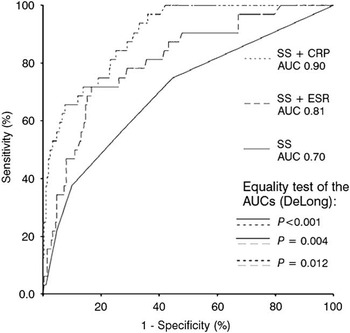
Overall, in more than a dozen studies conducted in several EU countries and reviewed in a meta-analysis, point-of-care CRP testing significantly reduced antibiotic prescribing at the initial visit for patients with RTIs—without an adverse effect on outcome or patient satisfaction.Reference Huang, Chen, Wu, Wei and Guo 18 In 1 study, the addition of CRP at the optimal cut-off concentration of at least 30 mg/L improved diagnostic information over the use of a sedimentation rate or the use of a patient’s symptoms and signs alone (Figure 1).Reference Hopstaken, Muris, Knottnerus, Kester, Rinkens and Dinant 16 In a more recent study, using CRP concentration at the optimal cut-off of at least 30 mg/L improved diagnostic information over a patient’s symptoms and signs alone; the measurement of procalcitonin concentration was only marginally better than the use of a patient’s signs and symptoms. CRP measurement proved to be better than procalcitonin measurement in this study.Reference van Vugt, Broekhuizen and Lammens 17
Receiver operating characteristic curves for 3 models, showing additional diagnostic value in outpatients with acute cough with area under the curve (AUC) for symptoms and signs (SS); SS+erythrocyte sedimentation rate (ESR); and SS+C-reactive protein (CRP). Reprinted with permission.Reference Hopstaken, Muris, Knottnerus, Kester, Rinkens and Dinant 16

Not all studies have shown value in CRP measurement, although a 2005 systematic review noted problems in methodology in a number of the studies.Reference Van der Meer, Neven, van de Brock and Assendelft 19 Although research indicates that CRP testing is helpful in reducing unnecessary prescriptions, the solitary use of CRP testing will not be able to assess the need for antibiotics.
Diagnostic Algorithm Using Point-of-Care CRP
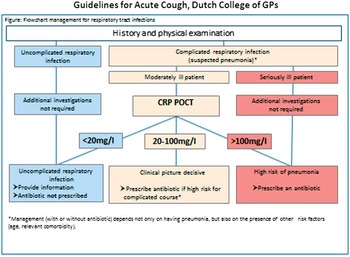
The diagnostic algorithm using point-of-care CRP should be used together with assessment of signs and symptoms and focus on situations where there is a shared amount of uncertainty between physician and patient (Figure 2). An excellent illustration is provided by a recent study that examined 2 methods for optimizing antibiotic use in outpatients with lower RTIs: point-of-care CRP and prescriber training in communication skills. Results showed that the general practitioners who had communication training and used point-of-care CRP had the greatest reduction in antibiotic use (only 23% of baseline use)—with no differences in patient outcomes compared with other groups.Reference Cals, Butler, Hopstaken, Hood and Dinant 20 The utility of point-of-care CRP diagnostics may be enhanced with a rapid influenza test or with rapid testing for multiple viral pathogens, such as a multiplex viral polymerase chain reaction testing. This combined approach may assist in the antibiotic decision-making process, since knowledge of a specific viral pathogen may help explain a patient’s elevated CRP level and mitigate the need for an antibacterial antibiotic.
Guidelines for acute cough, Dutch College of General Practitioners (GPs). CRP POCT, C-reactive protein point-of-care test. Used with permission © 2013, Dutch College of General Practitioners (www.nhg.org).

Challenges to Implementing Point-of-Care Diagnostics in the United States
The United States has a culture of empirical antibiotic therapy that promotes resistance and limits the effective life of antibiotics once they come on line. The recently released US strategy to combat antibiotic resistance calls on all healthcare providers to improve antibiotic stewardship and to advance development of rapid diagnostics. 1 At the May 2014 Alliance for the Prudent Use of Antibiotics Summit in Boston, international opinion leaders discussed the challenges and opportunities for research in this area. Currently, the point-of-care platform for CRP testing is not available in the United States. Despite considerable success in Europe using CRP, experts felt that further research is needed in the United States, including determining the clinical settings, specific populations, and conditions with the greatest applicability. In the United States, resistance to using point-of-care CRP may be encountered by regulatory agencies and/or clinical laboratories that are responsible for quality assurance/competencies, since any point-of-care testing would require a Clinical Laboratory Improvement Amendments of 1988 waiver.
Cultural differences in American antibiotic prescribing practices and communication with patients are factors that may also affect the determination of CRP value. Because financial challenges incurred by implementing point-of-care CRP testing are directly linked to the reimbursement systems, cost-effectiveness studies will be needed under US conditions, although there is evidence for cost-effectiveness of CRP use from Europe.Reference Cals, Ament and Hood 21
CONCLUSIONS
There is broad consensus on the need to develop and gain acceptance of new diagnostics to better guide antibiotic therapy. The expert meeting concluded that the EU experience with point-of-care testing was promising, but that to increase acceptability in the United States, any potential diagnostic such as point-of-care CRP will need to undergo clinical trials in various outpatient settings in the United States and will need to perform well on aspects of accuracy, time to result, simplicity, and cost.
The new US strategy produced by the National Security Council and Office of Science and Technology Policy is represented in President Obama’s FY 2016 Budget submission calling for nearly doubling the amount of funding for combating antibiotic resistance to more than $1.2 billion for the Departments of Health and Human Services, Agriculture, Defense, and Veterans Affairs. For the Centers for Disease Control and Prevention, the budget submission calls for $280 million to support antibiotic stewardship, outbreak surveillance, antibiotic use and resistance monitoring, and research and development related to combating antibiotic resistance (http://content.govdelivery.com/accounts/USCDC/bulletins/ecb3e4). With an executive order and dedicated resources behind it, physicians can expect more pressure to improve their use of antibiotics, but also more support from new antibiotic stewardship programs and guidelines in conjunction with the roll-out of new diagnostic tools.
Acknowledgments
The Alliance for the Prudent Use of Antibiotics and the authors thank the participants in the May 21, 2014, meeting of key opinion leaders:
Robert P. Gaynes, MD (Co-Moderator), Professor of Medicine (Infectious Diseases), Emory University; Stuart B. Levy, MD (Co-Moderator), Distinguished Professor of Molecular Biology and Microbiology and of Medicine, Director, Center for Adaptation Genetics & Drug Resistance, Tufts University School of Medicine, President, Alliance for the Prudent Use of Antibiotics; Christopher Butler, MD, Professor of Primary Care, Cardiff University (UK), Director, NISCHR Clinical Research Centre, General Practitioner; John P. Haran, MD, Assistant Professor of Emergency Medicine, University of Massachusetts Medical School, Attending Physician, Department of Emergency Medicine, University of Massachusetts Medical Center; Lauri Hicks, DO Commander, United States Public Health Service, Medical Epidemiologist, Respiratory Diseases Branch, US Centers for Disease Control and Prevention (CDC), Medical Director, CDC “Get Smart: Know When Antibiotics Work” program; Andy I. M. Hoepelman, MD, PhD, Head, Department of Internal Medicine & Infectious Diseases, Professor of Medicine, University Medical Center Utrecht (Netherlands); Rogier Hopstaken, MD, PhD, General Practitioner and Researcher, CAPHRI School for Public Health and Primary Care, Maastricht University Medical Centre, Foundation of Primary Health Care Centres (Netherlands); Romney M. Humphries, PhD, D(ABMM), M (ASCP)CM, Associate Director of Clinical Microbiology, Assistant Professor, Pathology & Laboratory Medicine, University of California Los Angeles (UCLA); Nathan A. Ledeboer, PhD, Assistant Professor of Pathology, Medical Director, Clinical Microbiology, Medical Director, Molecular Diagnostics, Medical College of Wisconsin; Jean Patel, PhD, D(ABMM), Deputy Director, Office of Antimicrobial Resistance, US CDC; Matthew Thompson, MBChB, MPH, DPhil, MRCGP, Professor and Vice Chair for Research, Family Medicine Family Medicine Research Section, University of Washington; Randy Wertheimer, MD, Jaharis Chair of Family Medicine, Tufts University School of Medicine, Chief of Family Medicine, Cambridge Health Alliance.
Financial support. Alere (unrestricted educational funds).
Potential conflicts of interest. All authors report no conflicts of interest relevant to this article.