Ahigh level of physical activity has been pointed out as relevant behaviour in preventing obesity and metabolic and cardiovascular outcomes since the first decade of life;Reference Booth, Laye, Lees, Rector and Thyfault 1 , Reference Rubin and Hackney 2 however, despite this, its prevalence in paediatric populations has decreased in recent years.Reference Kemper, Twisk and van Mechelen 3
During adolescence, physiological processes in humans are guided by biological maturation, affecting the development of organs and tissues, as well as physical growth.Reference Rubin and Hackney 2 Hypertrophy and hyperplasia of adipose tissue are strongly affected by maturational events during this period of life, mainly in adolescents who are already obese,Reference Knittle, Timmers, Ginsberg-Fellner, Brown and Katz 4 whereas obesity is intimately related to metabolic outcomes from early life.Reference Herouvi, Karanasios, Karayianni and Karavanaki 5 , Reference Huang 6 A wide variety of chronic diseases manifested in adulthood begin to develop in early life, and childhood obesity seems to have an important role in these pathogenic processes.Reference Herouvi, Karanasios, Karayianni and Karavanaki 5 , Reference Huang 6 Indeed, atherosclerosis is an inflammatory disease in which immune mechanisms and metabolic variables act together in the formation of atheroma.Reference Hansson 7 Early stages of atheroma have been identified in young populations,Reference Hansson 7 and thus measures of artery intima-media thickness and assessment of dyslipidaemia constitute surrogate markers of cardiovascular disease since early life.Reference Herouvi, Karanasios, Karayianni and Karavanaki 5
The literature is consistent in emphasising that prevention of chronic diseases in adulthood is essentially supported by actions initiated in early life,Reference Lira, Rosa Neto, Antunes and Fernandes 8 , Reference Fernandes, Coelho-E-Silva, Spiguel Lima, Cayres, Codogno and Lira 9 which should be focussed on promoting physical activity and preventing obesity.Reference Rubin and Hackney 2 , Reference Zago and Zanesco 10 , Reference Pahkala, Laitinen and Heinonen 11 Most studies that have focussed on the interaction between obesity, physical activity, and markers of chronic diseases in adolescence are based on cross-sectional designs, whereas only a few of these studies take into account the effect of biological maturation. Moreover, physical activity and body fatness are commonly assessed using imprecise tools such as questionnaires and anthropometric variables, respectively. Therefore, the actual effects of physical activity and body fatness on cardiovascular and metabolic outcomes during adolescence remain unclear.
In the context of the preceding trends, the objectives of this study were (i) to analyse whether changes in physical activity and body fatness are related to modifications in cardiovascular risk factors among adolescents, and (ii) to identify whether these possible effects related to physical activity and body fatness are independent of each other.
Materials and methods
Sample
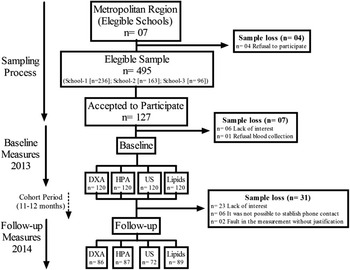
The sample included adolescents between 11 and 14 years of age who agreed to participate in the cohort study entitled “Effect of habitual physical activity and body fatness on the cardiovascular system of adolescents: cohort of 12 months”, conducted in Presidente Prudente city, State of Sao Paulo, Brazil (200,000 inhabitants and human development index=0.806). Additional information about sampling procedures is provided elsewhere.Reference Cayres, de Lira, Machado-Rodrigues, Freitas Júnior, Barbosa and Fernandes 12 In brief, seven large public and primary schools in the metropolitan region of the city were invited to participate in the study, and participants were recruited from the three schools that agreed to participate; the final decision about participation of the school was taken by the principal of the school. In the three participating schools, all adolescents between 11 and 14 years of age were invited to participate in the present study (overall students n=495). The following inclusion criteria were adopted: aged between 11 and 14 years; regularly enrolled in the school unit; absence of any known diseases; no regular medicine use; and signature of parents/legal guardians. Baseline measures were obtained from 120 adolescents, whereas follow-up measures were obtained from 89 adolescents (25.8% dropouts) (Fig 1).
Stages of the sampling procedure. DXA=bone densitometry; HPA=habitual physical activity; US=ultrasonography.

This cohort study was previously approved by the Ethics Committee for Research involving human subjects of the Sao Paulo State University (UNESP [process: 322.650/2013]) from Presidente Prudente, Brazil.
Variables
Body fatness
Whole-body fatness (%) was estimated using a densitometry scanner (Lunar-DPX-NT, General Electrics; General Electric Healthcare, Little Chalfont, Buckinghamshire, United Kingdom). Before each day of assessment, the accuracy of the device was assessed following the recommended procedures of the manufacturer. During the test, the adolescents remained immobile for 15 minutes in the supine position, with their arms and legs extended on the stretcher. The patients removed their shoes and any metal objects before evaluation. The radiation was not dangerous to health.Reference Laskey, Crisp, Cole and Compston 13 Body fatness was estimated using the software GE Medical System Lunar (version 4.7). All measurements at baseline and follow-up were taken by the same trained researcher, in a room with constant temperature. Baseline measures included 120 adolescents, whereas in data of 86 adolescents were assessed at follow-up.
Habitual physical activity
The amount of habitual physical activity was estimated through step counts (Yamax Digiwalker SW200) for seven consecutive days; the battery status of each device was previously tested by a voltmeter (Minipa ET-1002). This equipment was fixed to the clothes near the hip. The participants were instructed to remove the equipment while sleeping and during activities performed in water, such as swimming and showering. The device is sensitive to movements on the vertical axis, and in this way the number of steps is computed. Before sleeping, after removing the equipment, the adolescents were instructed to register the number of steps per day on a specific recording sheet. At both moments of the study, only adolescents with 7 consecutive days of physical activity were analysed, and thus the baseline measures were composed of 120 adolescents, whereas at follow-up data of 87 adolescents were assessed.
Intima-media thickness
At both time points – baseline and follow-up – the carotid and femoral intima-media thickness (in mm) were measured (right side) by the same medical doctor, with good experience in such measures, in a private hospital. The devise used was a Doppler ultrasound (Philips HD 11 XE; Philips, Barueri, Brazil), equipped with a high-resolution, multi-frequency linear transducer, adjusted for 12 MHz. All the recommendations of the Brazilian Society of CardiologyReference Silva, Tasca and Weitzel 14 – for example, artery location, insonation angle, Doppler frequency, and gate width – were adopted. For carotid artery assessment, the neck was lightly hyper-extended and inclined at an angle of ~45°. In parallel, during femoral artery measurement, the leg was extended on the stretcher, and the measurement was taken near the inguinal line. Reproducibility measures were provided by carotid intima-media thickness (intraclass correlation coefficient: 0.57; p-value=0.029) and femoral intima-media thickness (intraclass correlation coefficient: 0.91; p-value=0.001) in 13.3% of the sample (n=16 adolescents). Baseline measures were obtained from 120 adolescents, whereas follow-up measures were obtained from 72 adolescents.
Blood pressure
Systolic and diastolic blood pressures were measured using the oscillometric method, with an automatic equipment (HEM 742 INT, Omron Healthcare Inc., Intellisense; Bannockburn, Illinois, United States of America), validated by Christofaro et alReference Christofaro, Fernandes, Gerage, Alves, Polito and Oliveira 30 . All measures were performed by a trained healthcare professional. The volunteers remained at rest while sitting down for 10 minutes as the midpoint of the right humerus of the arm was assessed using a sleeve of suitable size for the circumference of the arm; three measurements were obtained with an interval of 1 minute between them, and the mean of the last two measurements was considered.Reference Pickering, Hall and Appel 15 Baseline measures were obtained 1 from 20 adolescents, whereas follow-up measures were obtained from 89 adolescents.
Metabolic variables
Blood samples were collected in the morning, after 12 hours of fasting, by a trained nurse in a private laboratory that met all the quality control standards adopted by the Brazilian Health Ministry. Total cholesterol and its fractions – high-density lipoprotein-cholesterol, low-density lipoprotein-cholesterol, and triacylglycerol – were assessed using an enzymatic kit processed in an autoanalyzer (Dimension RxL Max, model Siemens Dade-Behring, Deerfield, Illinois, United States of America). Baseline measures were obtained from 120 adolescents, whereas follow-up measures were obtained from 89 adolescents. High-sensitive C-reactive protein was determined by the turbidimetric method (LabMax 240; LABEST brand, model LabMax 240 Chema Diagnostica, Monsano, Italy).
General data, anthropometry, and biological maturation
Ethnicity, sex, chronological age, and anthropometric variables were recorded during a face-to-face interview by a trained health researcher. Body mass was measured using a digital scale (Filizzola PL 150 model; Filizzola Ltda, Sao Paulo, Brazil) with a precision of 0.1 kg. Height was estimated using a stadiometer (Sanny model; American Medical of the Brazil Ltda, Sao Paulo, Brazil) with a precision of 0.1 cm, following previous recommendations.Reference Gordon, Chumlea and Roche 16 Body mass index (kg/m2) was subsequently calculated as weight (kg) divided by height squared (cm). Leg length and sitting height were also assessed using standardised techniques,Reference Gordon, Chumlea and Roche 16 and waist circumference was measured using a metallic tape (Sanny®, American Medical of the Brazil Ltda, Sao Paulo, Brazil) in centimetres.Reference Katzmarzyk, Srinivasan and Chen 17 All measurements were performed without shoes and with light clothing.
Biological maturation was estimated using mathematical equations to estimate age at peak height velocity,Reference Mirwald, Baxter-Jones, Bailey and Beunen 18 which is an important event during the process of biological maturation. Age at peak height velocity was expressed in time (years) (negative score [time to reach peak height velocity] and positive score [the adolescent had already reached peak height velocity]). All analysed adolescents were prepubertal (negative values) at baseline.
Statistical analyses
First, normality of the data set was assessed using the Kolmogorov–Smirnov test; in this study, the normality of change values were assessed and, when necessary, logarithm transformed. The numerical variables are presented as means, standard deviations, and 95% confidence intervals. Changes are expressed as the crude differences between follow-up and baseline measures (follow-up values minus baseline values). The Pearson’s correlation (r) and its 95% confidence interval tested the relationships between changes in physical activity, body fatness, and metabolic and cardiovascular outcomes. Partial correlation and linear regression analysed the same relationships adjusted simultaneously by baseline physical activity, change in physical activity, sex, baseline chronological age, baseline biological maturation, and changes in biological maturation for body fatness changes, and baseline body fatness, changes in body fatness, sex, baseline chronological age, baseline biological maturation, and changes in biological maturation for physical activity changes. The statistically significant relationships in the partial correlation are presented in the linear regression (expressed as β and its 95% confidence interval). Statistical significance (p-value) was set at a p-value <0.05, and all analyses were performed using BioEstat (release 5.0) statistical software.
Results
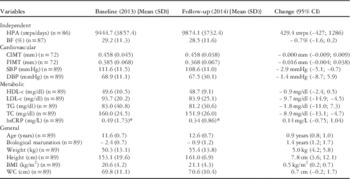
After 12 months of follow-up, 89 adolescents (12.5±0.7 years-old) were assessed at both pre- and post-testing time points (43 boys and 46 girls). The amount of physical activity (mean difference: 429.4 steps [95% confidence interval: −427 to 1286]) and body fatness (mean difference: −0.7% [95% confidence interval: −1.6 to 0.2]) remained stable during the 12-month period (Table 1) and were not related to each other (r=−0.074; p-value=0.502).
Descriptive analyses of the variables in the 1-year longitudinal study (Brazil, 2013–2014).

95% CI=confidence interval of 95%; BF=body fatness; BMI=body mass index; CIMT=carotid intima-media thickness; DBP=diastolic blood pressure; FIMT=femoral intima-media thickness; HDL-c=high-density lipoprotein-cholesterol; HPA=habitual physical activity; hsCRP=high-sensitive C-reactive protein; LDL-c=low-density lipoprotein-cholesterol; SBP=systolic blood pressure; TC=total cholesterol; TG=triacylglycerol; WC=waist circumference
* Variable presented as median and interquartile range due non-parametric distribution
On the other hand, there were differences in systolic blood pressure (mean difference: −2.9 mmHg [95% confidence interval: −5.1 to −0.7]), low-density lipoprotein-cholesterol (−9.7 mg/dl [95% confidence interval: −14.9 to −4.5), and total cholesterol (−8.9 mg/dl [95% confidence interval: −13.1 to −4.7]). Anthropometric variables and biological maturation were also different between baseline and follow-up measures.
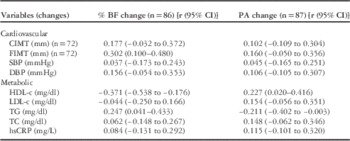
In the univariate analysis, changes in femoral intima-media thickness (r=0.302 [95% confidence interval: 0.100–0.480]), high-density lipoprotein-cholesterol (r=−0.371 [95% confidence interval: −0.538 to −0.176]), and triacylglycerol (r=0.247 [95% confidence interval: 0.041–0.433]) were significantly related to body fatness changes, whereas changes in physical activity were related to changes in high-density lipoprotein-cholesterol (r=0.227 [95% confidence interval: 0.020–0.416]) and triacylglycerol (r=−0.211 [95% confidence interval: −0.402 to −0.003]) (Table 2).
Pearson’s correlations between changes in body fatness (BF), physical activity (PA), and metabolic and cardiovascular variables in adolescents (Brazil, 2013–2014).

95% CI=confidence of interval of 95%; CIMT=carotid intima-media thickness; DBP=diastolic blood pressure; FIMT=femoral intima-media thickness; HDL-c=high-density lipoprotein-cholesterol; hsCRP=high-sensitive C-reactive protein; LDL-c=low-density lipoprotein-cholesterol; r=coefficient of Pearson’s correlation; SBP=systolic blood pressure; TC=total cholesterol; TG=triacylglycerol
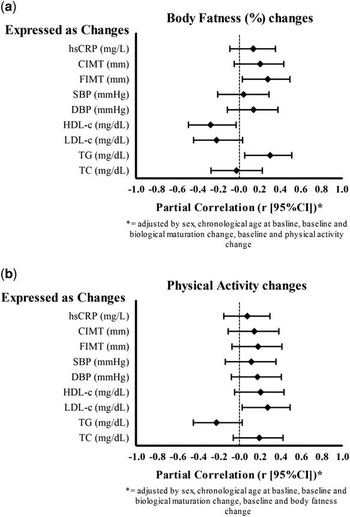
In the partial correlations, after adjustments for sex, age, biological maturation, body fatness for physical activity, and physical activity for % body fatness, the changes in femoral intima-media thickness (r=0.277 [95% confidence interval: 0.029–0.493]), high-density lipoprotein-cholesterol (r=−0.279 [95% confidence interval: −0.494 to −0.031]), and triacylglycerol (r=0.299 [95% confidence interval: 0.053–0.511]) still remained significantly related to body fatness changes, whereas only changes in low-density lipoprotein-cholesterol (r=0.270 [95% confidence interval: 0.022–0.487]) were still related to changes in physical activity (Fig 2a and b).
Partial correlation between changes in body fatness, physical activity, and metabolic and cardiovascular variables in adolescents (Presidente Prudente, Sao Paulo, Brazil, 2014). * ( a ) Adjusted by sex, chronological age at baseline, baseline and biological maturation change, baseline and physical activity change. * ( b ) Adjusted by sex, chronological age at baseline, baseline and biological maturation change, baseline and body fatness change. 95% CI=confidence interval of 95%; CIMT=carotid intima-media thickness; DBP=diastolic blood pressure; FIMT=femoral intima-media thickness; HDL-c=high-density lipoprotein-cholesterol; hsCRP=high-sensitive C-reactive protein; LDL-c=low-density lipoprotein-cholesterol; SBP=systolic blood pressure; TC=total cholesterol; TG=triacylglycerol.

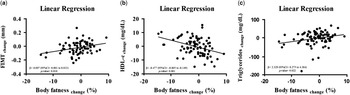
In this sample, for each percentage increase in body fatness, femoral intima-media thickness increased by 0.007 mm (95% confidence interval=0.001–0.013). Similar longitudinal relationships were found for high-density lipoprotein-cholesterol (β=−0.477 mg/dl [95% confidence interval=−0.805 to −0.149]) and triacylglycerol (β=2.329 mg/dl [95% confidence interval=0.275–4.384]) (Fig 3a, b and c).
Relationship between body fatness and metabolic and cardiovascular variables in adolescents (Presidente Prudente, Sao Paulo, Brazil, 2014). 95% CI=confidence interval of 95%; FIMT=femoral intima-media thickness; HDL-c=high-density lipoprotein-cholesterol.

Discussion
A longitudinal study carried out with adolescents where modifications in body fatness had a greater effect on vascular architecture and lipid metabolism than modifications in the amount of physical activity, even after controlling for biological maturation.
Increased body fatness is a detrimental component in the development of harmful metabolic outcomes from childhood,Reference Herouvi, Karanasios, Karayianni and Karavanaki 5 , Reference da Silva, Bianchini and Antonini 19 and body fatness is commonly, inversely related to physical activity.Reference Gutin, Yin, Humphries and Barbeau 20 In the present study, in the non-adjusted model, both body fatness and changes in physical activity were related to modifications in high-density lipoprotein-cholesterol and triacylglycerol, but in the multivariate models changes in body fatness significantly affected the relationship between modifications in these lipid outcomes and modifications in the amount of physical activity. The effect attributed to physical activity on these lipid variables was predominantly mediated by modifications in body fatness, corroborating with the idea that maintenance of higher amounts of physical activity acts on the control of body fatness during adolescence, and hence decreases the harmful effects on metabolic variables.Reference Gutin, Yin, Humphries and Barbeau 20 – Reference Ekelund, Brage and Froberg 22
The mediating effect of body fatness on the relationship between amount of physical activity and modifications in high-density lipoprotein-cholesterol is particularly relevant, because of the important role of high-density lipoprotein-cholesterol in vessel structure, acting in the control of low-density lipoprotein-cholesterol concentrations, inflammation, and bioavailability of nitric oxide.Reference Cayres, de Lira, Machado-Rodrigues, Freitas Júnior, Barbosa and Fernandes 12 , Reference Yuhanna, Zhu and Cox 23 Disagreeing with our findings regarding the mediating effect of adiposity, Kraus et alReference Kraus, Houmard and Duscha 24 identified, after 8 months of intervention, that the amount of exercise affected both size and concentration of lipoproteins in adults, independent of modifications in weight and body mass index. Similarly, in a cross-sectional design, the amount of physical activity assessed in free-living conditions was related to lipid variables in European adolescents (both sexes and aged from 9 to 16 years-old), even after adjustment for sum of skinfolds.Reference Ekelund, Brage and Froberg 22 The conflicting findings could be justified by the fact that, in both studies,Reference Ekelund, Brage and Froberg 22 , Reference Kraus, Houmard and Duscha 24 body fatness was assessed using less accurate methods, and therefore the effect of adiposity in the multivariate models was probably underestimated.
The present study revealed a positive relationship between arterial thickening and increases in body fatness, agreeing with previous studies;Reference Herouvi, Karanasios, Karayianni and Karavanaki 5 however, in contrast with other studies,Reference Jourdan, Wühl and Litwin 25 carotid artery was not related to body fatness in these adolescents. This phenomenon observed in the femoral artery could be attributed, at least in part, to its calibre – smaller diameter than the carotid artery – which generates higher oscillations in blood flow and consequently higher shear stress than other vessels.Reference Rothwell 26 Patterns of haemodynamic flow such as the above-mentioned ones can initiate local inflammatory processes, and thus modifications in vascular structure.Reference Hansson 7 , Reference Cayres, de Lira, Machado-Rodrigues, Freitas Júnior, Barbosa and Fernandes 12 , Reference Rothwell 26 , Reference Wu, Ringgaard, Oyre, Hansen, Rasmus and Pedersen 27 The interaction between metabolic events commonly linked to obesity and the local inflammation attributed to these haemodynamic characteristics could be used to support the findings related to femoral intima-media thickness.
Some limitations should be highlighted and taken into account when considering the results of this study. The absence of measurements of physical activity intensity is a weakness. Although a pedometer provides information on the amount of physical activity, the absence of data regarding intensity is a limitation of the method, as people with similar values of step counts can present differing amounts of time engaged in high-intensity activities.Reference Tudor-Locke and Bassett 28 The absence of a relationship between changes in physical activity and body fatness could also be explained, at least in part, by the absence of measures of intensity. In cross-sectional studies involving adolescents, the amount of physical activity measured using an accelerometer was not related to body fatness,Reference Ekelund, Brage and Froberg 22 but the amount of physical activity performed at vigorous intensity was related and moderate intensity was not related to body fatness. Therefore, the amount of physical activity seems to be beneficial to adolescents’ health only when accompanied by activities performed at high intensities, agreeing with the current paediatric guidelines.Reference Cayres, de Lira, Machado-Rodrigues, Freitas Júnior, Barbosa and Fernandes 12 , Reference Kostka, Furgal and Gawronski 21 Moreover, the effect of sedentary behaviours on metabolic and cardiovascular variables should be explored in future studies, as physical activity and sedentary behaviours are important variables related to the health of young people and act in independent ways on health markers.Reference Machado-Rodrigues, Leite and Coelho-e-Silva 29 The absence of markers of arterial stiffness constitutes a limitation in this study as well. Finally, the high dropout rate (25.8%) after 12 months should be considered in future studies because of its impact on the power of the statistical analysis.
Practical implications
It is highlighted that physical activity engagement since the first decade of life is beneficial, and can positively affect adulthood. Body fatness, on the other hand, is an important mediator of cardiovascular outcomes and it seems to mediate this relationship regardless of engagement in physical activity. Taking these factors into account, futures studies should investigate the role of intensity of physical exercise on inflammation and cardiovascular outcomes in paediatric populations.
Although the importance of physical activity to promote healthy growth in paediatric populations was highlighted, this 1-year longitudinal study demonstrated that changes in adolescents’ body fatness were more important than changes in the amount of physical activity on cardiovascular and metabolic risk.
Acknowledgements
The authors thank the support from Laboratory of Investigation in Exercise – LIVE, Department of Physical Education, UNESP, Presidente Prudente, Brazil, and all members involved in data collection. Authors’ Contribution: C.S.U. conceptualised and designed the study, drafted the initial manuscript, and approved the final manuscript as submitted. K.H.C.G., V.L.C.M., C.J., M.-R.A.M., and B.M.F. revised the manuscript and approved the final manuscript as submitted. F.R.A. designed the data collection instruments, coordinated and supervised data collection, critically reviewed the manuscript, and approved the final manuscript as submitted. All the authors approved the final manuscript as submitted and agreed to be accountable for all aspects of the study.
Financial Support
The authors thank the State of Sao Paulo Research Support Foundation – FAPESP (Process: 2013/06052-2 [master’s fellowship to SUC] and Process: 2015/04961-0 [doctorate degree to SUC]) and the Brazilian Ministry of Science and Technology, National Counsel of Technological and Scientific Development – CNPq (Process: 476295/2013-0 [research funding to RAF] and Process: 303725/2014-1 [Researcher on Productivity – Level 2 to RAF]).
Conflicts of Interest
None.
Ethical Standards
The study had been previously approved by the Human Research Ethics Committee (process: 322.650/2013) and was in accordance with the National Health Council (Resolution no. 466/12).