INTRODUCTION
Okra (Abelmoschus esculentus (L.) Moench) is grown mainly for its edible immature pods in the tropics but, in most African countries, young leaves and mature seeds are consumed and, where the young leaves are often picked and used as a vegetable, they are at least as important as the fruiting pods. The leaf yield in such areas is 3–6 t/ha (Schippers Reference Schippers2000). Okra young fruiting pods and young leaves are a good source of protein, energy, vitamins and minerals, particularly Ca, P and Mg. The young leaves contain 2·0 g protein, 0·99 mg carotene, 0·10 mg thiamine, 0·10 mg riboflavin and 25 mg vitamin C/100 g edible portion (Grubben Reference Grubben1977; Hamon & Charrier Reference Hamon, Charrier, Charrier, Jacquote, Hamon and Nicholas1997). These nutritive values are between 11 and 90% greater in the leaf than in the pod. A secondary use of okra is for oil (oil content is about 200 mg/g) and amino acids from the mature seeds (Purseglove Reference Purseglove1977); the latter compare favourably with those in poultry meat, eggs and soybeans (Schippers Reference Schippers2000).
Okra, because of its growth habit and importance in the diets of most Africans, is often found as an annual or perennial in mixtures with staple food crops such as yams (Dioscorea spp.), cassava (Manihot esculenta Crantz) and maize (Zea mays L.) in most agricultural zones of sub-Saharan Africa (Ikeorgu et al. Reference Ikeorgu, Ezumah and Wahua1989; Lamont Reference Lamont1999; Olasantan Reference Olasantan1999, Reference Olasantan2001; Olasantan & Bello Reference Olasantan and Bello2004). In tropical agriculture, productivity and conservation of okra can be sustained by using its young leaves and immature pods as a human food and animal feed. However, picking the young edible leaves of okra as a vegetable necessitates some leaf removal during growth, and might be expected to affect plant productivity by decreasing the supply of assimilates to developing pods. This requires that a strategy for harvesting young leaves be developed while sustaining acceptable immature pod or mature seed yield in okra cultivation.
Okra growth, young leaf yield and immature pod yields are a function of the variety, time of apical bud and leaf removal and the frequency and severity of the removal (Olasantan Reference Olasantan1986, Reference Olasantan1988; Lamont Reference Lamont1999; Schippers Reference Schippers2000). However, branch production has been reported to be the most important contributor to young leaf and immature pod yields in both recent and traditional cultivars (Olasantan Reference Olasantan1988, Reference Olasantan2001). Studies on apical bud and leaf removal have demonstrated that the treatments enhanced okra vegetative growth and development (Olasantan Reference Olasantan1986, Reference Olasantan1988; Schippers Reference Schippers2000). Those studies reported decreased plant height, increased leaf and branch production, smaller leaves and prolonged vegetative growth. The effects of apical bud and leaf removal on dry matter accumulation were less consistent as exhibited by increased branch and leaf production. Concurrent with these increases in vegetative growth, the removal treatments delayed fruiting and decreased pod yields, but had no effects on pod size. In these latter studies, although the treatments increased branch production, the uppermost branches did not produce good pods, irrespective of the variety or time of treatment imposition. Similar effects of apical bud and leaf removal on vegetative growth and fruit yields have been reported in cucumber (Cucumis sativus L.) (Parr & Hussey Reference Parr and Hussey1962), pigeon pea (Cajanus cajan (L.) Millsp.) and soybean (Glycine max (L.) Merr.) (Wakankar & Yadua Reference Wakankar and Yadua1975; Tayo Reference Tayo1980, Reference Tayo1982), tomatoes (Lycopersicon esculentum L.) (Stacey Reference Stacey1983), sweet potato (Ipomoea batata (L.) Lam.) (Dahniya et al. Reference Dahniya, Hahn and Oputa1985) and pumpkin (Cucurbita maxima Duch. Ex. Lam.) (Olasantan Reference Olasantan2007).
The previous studies on okra addressed only the effects of apical bud and leaf removal and did not investigate the changes in growth caused by pruning. Furthermore, changes in the morphological production of pods caused by pruning were not examined. Information pertaining to pod production on the plant and intra-plant dry matter allocation in response to pruning would be of great value because it would provide further insight into the leaf and pod yield attainment response of okra plants to young leaf harvest. The present study was, therefore, carried out to investigate the effect of pruning for edible leaves on other growth parameters and immature pod yields of okra, with a view to promoting its commercial exploitation.
MATERIALS AND METHODS
Field experiments were carried out at the University of Agriculture, Abeokuta, Nigeria (7°15′N, 3°25′E, 159 m asl) during the 2004, 2005 and 2006 cropping seasons. Abeokuta is located in the forest–savannah transition zone of south-western Nigeria with an annual rainfall ranging from 850 to 1150 mm and characterized by a bimodal rainfall pattern that peaks in June and September with a short dry spell in August and long dry spell in November–March. The early cropping season is from March–July with a long day length, while the late season is from September–November with a short day length. The temperature of the area is generally cool from June–September and hot from October–April with a mean of c. 32·5°C and a low diurnal variation of 5–10°C. The weather records during the period of study were measured at a meteorological station 0·25 km from the experimental site. The soil at the site is an oxic paleudulf of the Iwo series with 83, 5 and 12% sand, silt and clay, respectively, moderate fertility and pH of 6·5.
The experimental site was disc ploughed and harrowed, pulverized and levelled manually; the plants were grown on the flat throughout. An annual improved variety of okra, coded NHAe 47-4, was used. The okra variety is a day-neutral plant with deep green, broad leaves and moderate canopy height. It is popular for its early maturity, high leaf area index, spineless green pods and high pod yield. Its pods are prized for their unique flavour, high mucilaginous content, low fibre and moderate size. These attributes are highly acceptable to most farmers and they are valued by consumers; the variety is the most well-known fresh market cultivar in south-western Nigeria (Olasantan & Olowe Reference Olasantan and Olowe2006). The variety is also moderately resistant to okra mosaic virus during the wet season (Alegbejo Reference Alegbejo2003). The seeds used in the experiments were collected from the National Institute of Horticultural Research, Ibadan, Nigeria.
The study was designed to investigate the effect of pruning from the upper foliage of the plants for their edible leaves. The treatments, apart from the control with no apical bud removal and pruning, comprised removal of apical buds of the main stems and pruning of the subsequent branches that emerged, leaving the lowest one, two or three branches of each plant intact. This represented three-quarters, half or a quarter pruning of the foliage of every apically debudded plant. The remaining one branch of a three-quarters pruned plant represented ‘lower’ branch, while the two branches of half pruned plants represented ‘lower’ and ‘upper’ branches and the three branches of quarter pruned plants represented ‘lower’, ‘middle’ and ‘upper’ branches. Okra seeds were sown on 11 August 2004, 21 April 2005 and 27 April 2006, using a randomized complete block design with three replicates in each year. Rows were 1 m apart and seeds were sown 0·25 m apart within rows to give 80 plants per plot. The apical bud removal and pruning started 4 and 6 weeks after planting (WAP), respectively. Each plot contained six rows.
The treatment entailed cutting off the uppermost primary branches with a sharp knife, leaving the remaining ones intact. Primary branches that emerged subsequently from the decapitated main stems were removed from time to time to maintain the specified number of branches per plant until the production of new branches ceased. Secondary branches that emerged subsequently from the undetached primary branches were left intact. A basal treatment of 60 N, 30 P and 30 K kg/ha as 20:10:10 NPK compound fertilizer was drilled in furrows 0·2 m from plant rows and covered with soil at 2 WAP. All plots were weeded manually, and foliar flea pests such as Syllepta derogata F., Podagrica uniforma J. and Podagrica sjostedti J. (Colleoptera: Chrysomelidea) were controlled with regular sprays of 500 ml/ha of Nuvacron (containing 400 g active ingredient/litre monocrotophos) in 500 litres of water. The crops were rainfed throughout.
Ten plants per plot were sampled for plant height, number of leaves, number of primary branches (control plants), number of secondary branches and leaf area estimation starting 8 WAP. Five plants were removed per plot at 12 WAP for shoot dry weight determination. Leaf area was estimated from its relationship with mid-lobe length using the linear equation described by Asif (Reference Asif1977). Mid-lobe length of three leaves per plant from the lower, middle and upper portions of the foliage for the 10 plants sampled per plot was measured. The areas of 150 leaves of varying sizes were determined by graph paper tracing. The estimated regression line between leaf area (Y) and mid-rib length (X) is:

where values in parentheses are s.e. of the coefficients of the variables.
An additional determination of fresh leaf yield of the detached primary branches, number of days from planting to first or 50% flowering and first pod harvest, number of harvests, length of harvest duration and weekly pod yield proportion was made. In 2005 and 2006, the undetached primary branches of treated plants were tagged for pod yield and dry weight determination. Every third day, pods were harvested when immature, high in mucilage and at least 25 mm long, before becoming fibrous, and at each harvest the numbers and fresh weights of marketable pods were recorded immediately. Immature fresh pods without blemishes (absence of defect, decay, insects and dirt) were regarded as marketable. The weekly pod yield was determined and expressed as proportional pod yield as follows:

Growth and pod yield data were subjected to analysis of variance procedures at Statistical Analysis System (SAS) Institute (SAS 1990). Where significant differences were found, mean differences were indicated through standard error of the difference between two sample mean values (s.e.d.).
RESULTS
Weather conditions
The total amount of rainfall during the 3 years ranged from 715 to 1155 mm with a yearly average of 954 mm and about two-thirds of the amount occurred between May and September (Table 1). The maximum and minimum temperatures were equal to or greater than 28 and 22°C, respectively, with the maximum temperature ranging from 28·0 to 33·0°C and minimum temperature from 22·0 to 26·7°C during crop growth between April and October. The relative humidity during the same period ranged from 72 to 82 %.
Rainfall, temperature and relative humidity during the experimental period (mean of 2004–06) at Abeokuta, Nigeria

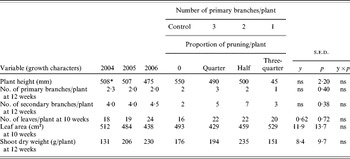
The pattern of growth and pod yield responses to pruning treatments were similar in the 3 years and data were averaged over years. However, statistical analysis indicated that yearly seasonal variation had effect on some variables of vegetative and yield characteristics of okra. The okra plants grown in 2006 produced significantly (P<0·05) greater numbers of leaves, shoot dry weight, number of pod harvests, pod weight and pod yield than those grown in 2004 or 2005 (Tables 2 and 3). Conversely, leaf area, length of harvest duration and fresh leaf yield were significantly (P<0·05) higher in plants grown in 2004 compared with those plants grown in 2005 or 2006, especially in 2005. The variables of vegetative characters, flowering and fruiting patterns and yield characters were affected by pruning treatment and year×treatment interactions.
Yearly and pruning (average of three years) effects on the vegetative characters of okra at Abeokuta, Nigeria
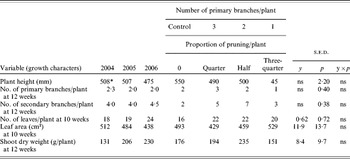
s.e.d. (d.f.=22; P<0·05) are for the following comparisons; y, year; p, pruning; y×p=combination of year and pruning.
* Means/10 plants, except for shoot dry weight with means/5 plants.
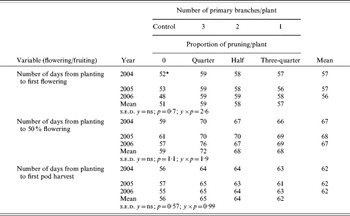
Effect of combination of year and pruning treatment on earliness to flowering and fruiting in okra at Abeokuta, Nigeria
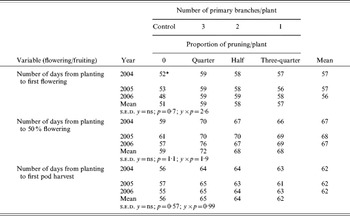
s.e.d. (d.f.=22; P<0·05) are for the following comparisons: y, year; p, pruning; y×p=combination of year and pruning.
* Means/10 plants.
Effect of pruning on vegetative characteristics
The estimated variables of vegetative characteristics were significantly affected (P<0·05) by different pruning proportions of apically debudded plants (Table 2). Pruning significantly (P<0·05) reduced plant height by 50–100 mm and increased the number of secondary branches and leaves by 33–71 and 20–38%, respectively, compared with the control plants. Apically debudded plants with three-quarter pruning had the shortest main stems, the biggest leaves, the least numbers of leaves and secondary branches, and the smallest shoot dry weight. A quarter or half pruning significantly (P<0·05) increased the number of secondary branches by 40–57%, leaves by 10% and shoot dry weight by 22–36%, but decreased leaf area by 13–20% more than three-quarters pruning.
Effect of pruning on flowering and fruiting patterns
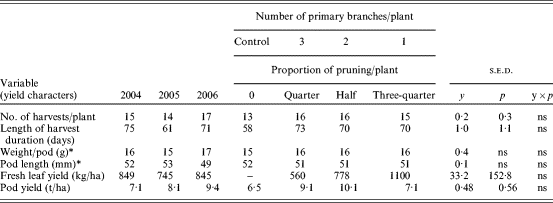
The variables of number of days from planting to first or 50% flowering and to first pod harvest, length of harvest duration and number of harvests varied significantly (P<0·05) with proportion of pruning (Tables 3 and 4). The control plants always produced flowers 3–11 days earlier and reached fruiting and harvesting stage 8–10 days earlier than plants with different proportions of pruning (Table 3). However, the number of harvests and duration of harvests were significantly (P<0·05) lower (by 2–4 times and 12–15 days, respectively), in the control plants when compared with the treated plants (Table 4). The number of days from planting to flowering or harvesting and length of harvest duration consistently increased with proportions of pruning.
Yearly and pruning (average of 3 years) Effects on harvesting patterns, fresh young leaf and pod yield characters of okra at Abeokuta, Nigeria
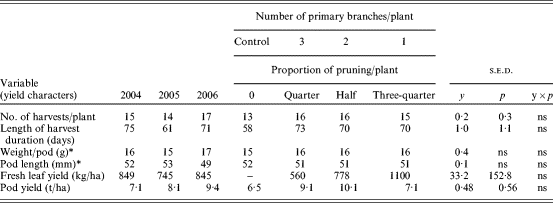
s.e.d. (d.f.=22; P<0·05) are for the following comparisons: y, year; p, pruning; y×p=combination of year and pruning.
* Means/64 plants.
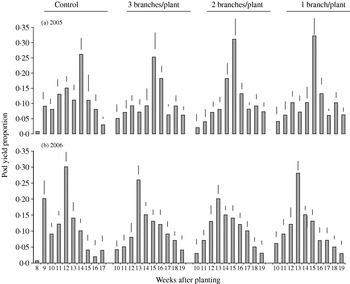
Although the pattern of pod yield responses to pruning treatments were similar over years, the patterns of fruiting and harvesting differed and the results for 2005 and 2006 are presented in Fig. 1. In 2005, the peak of fruiting and harvesting occurred between 11 and 14 WAP in the control plants and between 14 and 16 WAP in the treated plants, irrespective of the severity of pruning. However, in 2006, the peak of fruiting and harvesting was earlier; it was between 9 and 12 WAP in the control plants and between 12 and 15 WAP in the plants with different proportions of pruning. Averaged over years, the control plants significantly (P<0·05) produced 0·35–0·50 of their total pod yields at 12–13 WAP, while the treated plants significantly (P<0·05) produced 0·40–0·60 of their total pod yields at 13–17 WAP. Furthermore, the duration of harvests covered 10 weeks (10–19 WAP) in the treated plants, whereas it was 8 weeks (9–16 WAP) in the control plants. In the treated plants, pod formation started to decline after 17 weeks of planting, whereas it was after 15 weeks in the control plants irrespective of the proportion of pruning.
Weekly percent total fruit yield of okra when different proportions of the primary branches were removed in (a) 2005 cropping season and (b) 2006 cropping season. Bars are standard errors of means (6 d.f.) branch removal.

Effect of pruning on fresh leaf and pod yields
With the exception of pod length and weight per pod, pruning significantly (P<0·05) affected fresh leaf yield and pod yields of okra plants (Table 4). The fresh leaf yield per treated plant increased as the severity of pruning was increased. Three-quarter pruning significantly (P<0·05) enhanced fresh leaf yield by 49 and 29% more than pruning a quarter and half of the foliage, respectively. Also, half pruning significantly (P<0·05) increased fresh leaf yield by 28% more than a quarter pruning.
The trend of pod yield response to pruning differed from that of the fresh leaf yield. Averaged over 3 years, pod yield was significantly higher (P<0·05) in okra plants with a quarter or half pruning than in the corresponding plants with three-quarter pruning or in the control plants. Pruning a quarter and half of the foliage increased pod yields by 29 and 36%, respectively, compared with the control plants. Also, pruning a quarter and half of the plants increased pod yields by 22 and 30%, respectively, when compared with three-quarters pruned plants. Although the difference was not significant (P<0·05), apically debudded plants with three-quarters pruning produced about 10% greater pod yield than the control plants.
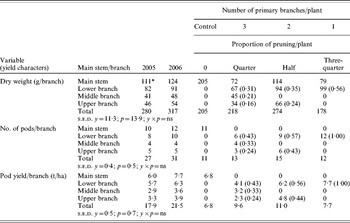
The mean values of shoot dry weight, number of pods and pod yield per primary branches over 2005 and 2006 varied significantly (P<0·05) with type and position of the branches (Table 5). In all the variables, okra grown in 2006 always produced significantly (P<0·05) greater values than okra grown in 2005. The dry weight, number of pods and fresh pod yield per okra branch were about 10–15% greater in 2006 than in 2005. The lowest branches always had the highest values of these variables, while the uppermost branches had the least values. The remaining branches of every apically debudded plant with a quarter pruning treatment produced about 0·68 of the total dry weights with 0·31, 0·21 and 0·16 occurring in the lower, middle and upper branches, respectively. The corresponding values for the total pod yields were 43, 33 and 24% for the lower, middle and upper branches, respectively. Furthermore, apically debudded plants with half pruning accumulated about 0·59 of the total dry weights in the remaining branches with 0·35 and 0·24 occurring in the lower and upper branches, respectively. For pod yield, 0·56 and 0·44 of the total pod yields were produced in the lower and upper branches, respectively.
Yearly and pruning (average of 2005 and 2006) effects on dry weight, number of pods and pod yield per branch of okra plant at Abeokuta, Nigeria

s.e.d. (d.f.=14; P<0·05) are for the following comparisons: y, year; p, pruning; y×p=combination of year and pruning.
* Means/5 plants.
Values in parentheses are the proportion of the total dry weight, number of pods and pod yield/branch of the treated okra plants.
Effect of year×treatment interactions on vegetative and yield characteristics
The effect of interactions between year and pruning treatment was not significant (P<0·05) for all the variables of vegetative and yield characteristics (Tables 2, 4 and 5), except numbers of days from planting to flowering and fruiting (Table 3). The numbers of days from planting to first or 50% flowering and to first pod harvest in response to pruning treatment varied significantly (P<0·05) with yearly cropping seasons with greater variations occurring in the okra plants grown in 2006 cropping season than in 2004 or 2005 cropping season.
DISCUSSION
There was an increase in the leaf area of apically debudded okra plants with three-quarter pruning and the increase was proportional to the severity of pruning. A three-quarter pruning thus enhanced leaf expansion in the remaining branches in order to compensate for the reduction in the numbers of leaves and, according to Adams & Langton (Reference Adams and Langton2005), this could be a cause of an increase in the leaf dry weight. Cockshull (Reference Cockshull1966) reported that increase in leaf area is frequently accompanied by an increase in specific leaf area (leaf area per unit leaf dry weight), and this has been shown to improve light interception (Heide et al. Reference Heide, Bush and Evans1985). Leaf size is normally affected by changes in light intensity (Björkman & Holmgren Reference Björkman and Holmgren1963; Wahua Reference Wahua1985) and leaf water potential (Boyer Reference Boyer1969). In the debudded plants with three-quarter pruning, mutual shading of leaves would have reduced, and consequently the amounts of light energy available for leaf expansion would have increased since the remaining leaves would be photosynthesizing more than they would be respiring (Wahua Reference Wahua1985; Olasantan Reference Olasantan2007).
There was also an increase in the fresh leaf yield of the debudded okra plants where three-quarters of the foliage was pruned, and this caused a reduction in the numbers of pods and pod yields compared with plants with a quarter or half pruning. The reduction in the number of pods and pod yields of plants with three-quarter pruning as recorded in the present experiment could be due to a number of factors. These include reduction in the numbers of secondary branches and leaves and consequently the photosynthetic area of the treated plants and the amount of assimilate available for developing pod (Olasantan Reference Olasantan1988). While a significant increase in shoot dry weight was observed in plants with a quarter or half pruning at the vegetative growth stage, a further increase in pod numbers and pod yields was noticed later when compared with the control plants. This could be due to the increase in the number of secondary branches and leaves, and improvement in light interception that possibly resulted in an increase in vegetative development and fruiting sites at different positions on the secondary branches. The present observation disagrees with the previous findings that no increase in pod yields of okra was observed with leaf removal (e.g. Olasantan Reference Olasantan1988), and it confirms the physiological difference between effects of leaf removal and pruning on growth and pod yields of okra. Overall, pruning a quarter or half of the foliage provided a good strategy for growing okra for both leaves and pods and seemed to be the best option to achieve the highest yields of okra plants.
The reduction in shoot dry weight, pod numbers and pod yields of the upper primary branches relative to the middle or lower branches of the treated plants could be attributed to a number of mechanisms, which include a shift in dry matter allocation in favour of the middle and lower branches for their growth, and consequently for pod formation and pod yields. One possibility is that the middle and lower branches replaced the main stem sooner and continued growth and produced flowers and pods for a longer time than the upper branches. It is also possible that the age of the middle and lower branches and their closeness to the base of the main stem might have assisted them by producing greater dry weight, pod numbers and pod yields than the upper branches. This suggests that the uppermost primary branches are more desirable for cutting for their edible leaves as a vegetable. When they were not removed in the control plants, some amount of assimilates available for developing pod in the lower and middle branches would have been diverted for their development, and this would possibly create some competition for growth factors.
Furthermore, although pruning three-quarters of the plant increased individual numbers and weights of harvested fresh leaves, not all the leaves were desirable for consumption due to high fibre. The quality of young leaves of okra as a vegetable decreases with age as the fibre content increases (Olasantan Reference Olasantan1988; Schippers Reference Schippers2000). The leaves of the uppermost primary branches are usually smaller and younger and are less fibrous and more succulent than those of the older, lower branches, and are often found to be the most prized and valued by consumers as a vegetable in terms of size, softness, palatability, and nutritional values, as has also been found for sweet potato (Dahniya et al. Reference Dahniya, Hahn and Oputa1985) and pumpkin (Olasantan Reference Olasantan2007). Hamm & Charrier (Reference Hamon, Charrier, Charrier, Jacquote, Hamon and Nicholas1997) and Schippers (Reference Schippers2000) reported that young leaves of okra contain 2·0 g proteins, 0·99 mg carotene and 25·2 mg vitamin C/100 g edible portion, and these values are about 11–90% greater than those in the pod. This shows that the type of primary branches to be removed for their edible leaves should be considered if okra is to be grown for both leaf and pod yields. It is recommended that a quarter or half of the foliage from the upper parts of the plant should be harvested for their edible leaves to ensure reasonable production and quality of leaves and pods. It appears that okra can tolerate some degree of pruning before any substantial loss of pod yield occurs, so that pruning a quarter or half of the foliage for human consumption during growth may not necessarily be detrimental to pod harvests.
There was a significant delay in flower and pod formation and in first pod harvest, and an increase in the length of harvest duration of debudded plants with different proportions of pruning compared with the control plants. Okra plants that were pruned were ready for the first flower production 3–11 days and pod harvest 8–10 days later than the control plants. Also, debudded plants with pruning treatment had 12–15 days longer harvest duration than the control plants. In the present work, fruiting was delayed by about 1–2 weeks in the apically debudded plants with pruning; however, it then started and increased, reaching a level greater than that of the control plants 17–19 WAP. The delay in pod formation in the treated plants was caused by the formation of new branches and leaves and extension of vegetative growth because it would appear that the main stems become incapable of producing flowers or pods once the apical bud is damaged, irrespective of the severity of pruning. Formation of flowers and pods in the treated plants did not commence until the new branches started flowering and fruiting.
The pod yields of the control plants decreased after 15 weeks, while that of the treated plants started to decline after 17 weeks. This indicates that debudded plants with different proportions of pruning require more time for vegetative growth, to be able to produce flowers and pods, and for pod harvests. It was noted that debudded plants, especially those with a quarter or half pruning, eventually produced more marketable pods than the control plants because they had later pod harvests. In the present study, most pods harvested from the treated plants after 15 weeks were without blemishes and of adequate size, therefore marketable.
The conclusions from this work are that okra can be grown for both young leaves and pods by adopting appropriate strategy for leaf removal without detrimental effects on pod production. Pruning could be used to extend vegetative growth, delay and stagger pod production, and increase young leaf and pod yields. The strategy could also be used to ensure a better market price and to help growers to avoid a glut on the market. However, in areas where both young leaves and pods of okra are used as human food, a quarter or half pruning from the upper parts of the plant is the optimum proportion to be removed for development and maximum production of edible young leaves and pods.
The first author acknowledges E. A. Oboba and K. O. Yusuf for providing field assistance.