The importance of the moldboard plow, in conjunction with the use of tractors and mechanization of farm operations, in expanding the land area under cultivation and increasing farm productivity is of historical significance. However, the vulnerability of plowed soil to accelerated erosion, compaction, oxidation of soil organic matter, emission of greenhouse gases (especially carbon dioxide) and other environmental issues (i.e., loss of soil biodiversity) led to the development of no-till (NT) farming.
KeenReference Keen1 observed that the benefits of plowing were mostly attributed to weed control. The rationale of plowing was questioned by FaulknerReference Faulkner2, Reference Faulkner3 because of serious erosion during the Dust Bowl era, even when herbicides were not yet available. Despite the intense debate on plowingReference Jack4 or notReference Faulkner2, Reference Faulkner3, it was the discovery of herbicides after World War II that made NT farming a practical reality. Indeed, NT farming evolved in the late 1950s and early 1960s primarily to reduce risks of accelerated soil erosionReference Bennett5, Reference Steinbeck6 and non-point source pollution from row cropping in the US Corn BeltReference Harrold, Triplett and Youker7–Reference Phillips and Young14. Experiments on direct drilling in Europe started in the early 1970s with the availability of paraquatReference Soane, Ball, Arvidsson, Basch, Moreno and Roger-Estrade15. The historical roots of moldboard plowing, which cuts and turns over the soil, lie in a gradual replacement of the ard (a scratch tool or a modified v-shaped stick) by a metallic tool during the 7th centuryReference Lal, Reicosky and Hanson16, Reference Lal17. The ard, developed for alluvial soils of arid and semi-arid climates of the Fertile Crescent and valleys/flood plains of the Indus and Nile, was not a suitable tool for the humid climates and fine-textured soils of northern Europe. Thus, the moldboard plow gradually replaced the ard. The moldboard plow used in the US was designed by Thomas Jefferson in 1784, patented by Charles Newfold in 1796, and marketed in the 1830s as a cast iron plow by a blacksmith named John DeereReference Lal, Reicosky and Hanson16.
Any system that eliminates all pre-seeding seedbed preparation is called NT or direct seeding. Three principal components of NT farming are: (i) elimination of all pre-seeding tillage (i.e., primary, secondary and tertiary), (ii) retention of crop residues, and (iii) control of weeds by herbicides. Weed control is a major challenge, especially in soils of the tropics, in the presence of perennial weeds and for organic farming. Thus, use of cover crops and residue mulch is a strategic option. Establishing an aggressive cover crop can smother weeds, while improving soil structure, nutrient cycling and availability. Soil and water conservation, specifically erosion control, has been the principal advantage of stubble mulchReference McCalla and Army18, Reference McCalla, Army and Witfield19 and NT farmingReference Harrold, Triplett and Youker7, Reference Harrold, Triplett and Youker8, Reference Meyer and Mannering20–Reference Harrold and Edwards24. The concept of NT farming was expanded during the 1990s to conservation agriculture, which is comprised of five components: (i) elimination of pre-seeding tillage, (ii) adoption of complex crop rotations, including cover crops and agroforestry, (iii) use of integrated nutrient management strategies, (iv) control of weeds and other pests by integrated pest management, and (v) conservation, harvesting and recycling of water.
Globally, NT farming has been adopted in about 125 million hectares (Mha) out of a total of 1500 Mha of cropland area (Table 1)Reference Kassam, Friedrich, Shaxson and Pretty25, Reference Friedrich, Derpsch and Kassam26. The rate of adoption was very high during the first decade of the new millennium in commercial and large-scale farms of South America (Table 1). In turn, conservation agriculture in the 1990s evolved into sustainable land management during the 2000s. Sustainable land management is defined as a knowledge-based combination of technologies, policies and practices that integrate land, water, biodiversity and environmental concerns (including input and output externalities) to meet rising food and fiber demands, while sustaining ecosystem services and livelihoodsReference Wood and Dumanski27, 28. Five components of sustainable land management are: (i) adoption of conservation agriculture principles, (ii) adoption of a judicious land use, (iii) adaptation to climate change, (iv) mitigation of climate change, and (v) enhancement of soil/ecosystem resilience.
Estimates of land area under conservation agriculture (adapted from Kassam et al.Reference Kassam, Friedrich, Shaxson and Pretty25 and Friedrich et al.Reference Friedrich, Derpsch and Kassam26).

Ecosystem Services
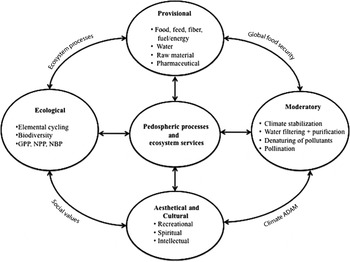
Ecosystem functions refer to the habitat, biological, or system properties or processes of ecosystems. Ecosystem goods (i.e., food) and services (i.e., water filtration and pollution abatement) refer to the benefits that humans derive from ecosystem functionsReference Costanza, d'Arge, de Groots, Farber, Grasso, Hannon, Limburg, Naeem, O'Neill, Paruelo, Raskin, Sutton and van den Belt29, Reference Boyd and Banzhaf30. Specifically, ecosystem services are the conditions and processes through which natural ecosystems sustain and fulfill human demandsReference Daily31. Principal ecosystem services, outlined in Fig. 1, include provisional (food, feed, water, etc.), moderatory (climate stabilization, water filtration, pollutant denaturing, etc.), ecological (elemental cycling, biodiversity, etc.), and aesthetical and cultural (recreational, spiritual, etc.)32–34. Numerous ecosystem services essential to human wellbeing are provided by the soil. However, there are important trade-offs and synergies that need to be objectively consideredReference Power35.
Types of ecosystem services.

Soil is a four-dimensional (length, width, depth and time) geo-membrane at the lithosphere/atmosphere interface that is a medium for plant growth and moderator of all ecological processes essential to functioning of terrestrial and associated aquatic processes. Depending on the predominance of specific soil-forming factorsReference Dokuchaev36, Reference Jenny37, soils provide a range of ecosystem services across the landscape. Soil quality, defined as the capacity to perform ecosystem functions, depends on the activity and species diversity of soil biota, which transforms and recycles matter and energy. A gram of fertile soil may contain millions of microorganisms, including protozoa, algae, fungi and numerous other known and unknown species. Major ecosystem services of a soil are generated by numerous biogeochemical cycles driven by solar and chemical energy and operating at different scales, ranging from global (carbon, nitrogen and water cycles) to molecular (chemical transformations).
Land use and management strongly impact soil's ability to provide ecosystem services. Conversion of land from natural systems to agroecosystems, a necessity to support the human population and its ever-increasing demands driven by growing affluence, can provide, but also curtail, numerous ecosystem functions and services. Therefore, a sustainable strategy must be to minimize the adverse impacts of land-use conversion for production of feed, food, fiber, fuel, and other goods and services to meet human demands. It is precisely in this context that widespread, but prudent adoption of NT farming, conservation agriculture (CA), and sustainable land management can play a pivotal role.
Natural Capital of Soil and Ecosystem Services
Sustainable use of finite soil resources necessitates a thorough understanding of the role of soil processes in relation to ecosystem functions, including but not limited to human wellbeing. In this context, Robinson et al.Reference Robinson, Lebron and Vereecken38 proposed the concept of ‘natural capital’ of soil within the framework of ecosystem services. A clear distinction in the use of terms is essential, because many terms have multiple definitionsReference Dominati, Patterson and Mackay39. The term ‘natural capital’ is an extension of the economic idea of manufactured capital to include environmental goods and services. As an analogy, natural capital of soil would consist of its properties such as clay and soil organic matter contents, soil depth, water retention capacity, etc. Thus, ecosystem services from soil would include tangibles such as net primary production, agronomic yield, climate moderation through carbon sequestration, methane oxidation, etc. Accordingly, Robinson et al.Reference Robinson, Lebron and Vereecken38 proposed that principal components of soil's natural capital would include: (i) mass (solid, liquid, and gaseous), (ii) energy (thermal), and (iii) organization or entropy. All three components have quantitative and qualitative attributes. Furthermore, sustainability of agroecosystems depends on strategic management that integrates the natural capital of soil across different scales from molecular to global. These are among several major ecological challenges that must be scientifically addressedReference Lavelle40. Furthermore, apparent conflict among ecosystem services (i.e., food versus fuel and agronomic productivity versus biodiversity) must also be resolved. For example, mandating the use of biofuel in one place may increase emission of greenhouse gases at another due to land-use changesReference Lambin and Meyfroidt41. Implementation of ‘The Billion-Ton Biofuels Vision’Reference Somerville42 contradicts the use of NT technology, because cellulosic ethanol production may require removal of residues from croplands. It is also debated whether food security and biodiversity are mutually exclusive goalsReference Chappell and LaValle43. These conflicts may be addressed through ‘ecological intensification’ based on the use of biological regulation to manage agroecosystems at field, farm and landscape scalesReference Doré, Makowski, Malézieux, Munier-Jolain, Tchamitchian and Tittonell44. In this context, natural ecosystems may provide examples of a number of interesting properties that could be incorporated into agroecosystems. Monitoring and assessment of sustainable land management as tools to promote sustainable use of soil resources are widely promoted by development organizations (World Bank and FAO) and bilateral programs (USAID)Reference Schwilch, Bestelmeyer, Bunning, Critchley, Herrick, Kellner, Liniger, Nachtergaele, Ritsema, Schuster, Tabo, Van Lynden and Winslow45.
Soil degradation, i.e., a decline in the capacity of a soil to maintain ecosystem functions, is an important factor in evaluating ecosystem services and remains a major global issueReference Bai, Dent, Olsson and Schaepman46. Divergent views of agronomists and social scientists about the impact of degradation on ecosystem services must be resolvedReference Koning and Smaling47. Apparent divergence in opinion and approaches is based on two contrasting views of increasing human population versus limited natural resources: (i) the BoserupianReference Boserup48–Reference Tiffen, Mortimore and Gichuki50 view emphasizing the significance of human ingenuity in addressing ecological problems, and (ii) the Malthusian view reiterating that resources are finite and population increase can lead to degradation of natural resources. Drechsel et al.Reference Drechsel, Kunze and de Vries51 surmised through analyses of data from 36 countries in sub-Saharan Africa that Malthusian mechanisms indeed are at work and are leading to soil nutrient depletion, accelerated erosion and reduced fallow periods caused by population pressure. This view illustrates the unsustainable population–agriculture–environment nexus on the African continent. The issue of severe decline in fertility of soils of Africa was also pointed out by SanchezReference Sanchez52, as well as of global soil degradation by Bai et al.Reference Bai, Dent, Olsson and Schaepman46. Should the Boserupian view be considered sound, agricultural scientists and policy makers urgently need to identify and implement successful strategies to overcome current challenges. Difficulties encountered in implementing such strategies without effective community participation could exacerbate soil degradation and desertificationReference van Rooyen53. Thus, HurniReference Hurni54 and Hurni et al.Reference Hurni, Giger and Meyer55 proposed adoption of NT farming approaches with due consideration of social and economic dimensions of land-related issues.
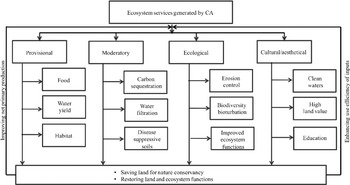
Adoption of sustainable soil management technology can address these issues. Principal requirements of sustainable soil management are: (i) maintaining soil organic carbon (SOC) concentration at a level above the critical threshold in the root zone, (ii) optimizing soil physical quality including structure and water retention/transmission characteristics, (iii) managing plant nutrients, (iv) enhancing favorable soil biological properties, (v) improving root growth and proliferation, and (vi) reducing risks of soil erosion and other degradation processesReference Dexter56. Most of these requirements are met with a judicious and continuous use of NT for a long period (Fig. 2). Conversion to NT is especially useful in restoring/sustaining soil physical quality and reducing risks of water runoff and soil erosion, as indicated by soil bulk density, SOC dynamics, root growth, tilth, friability and hard-settingReference Powlson, Gregory, Whalley, Quinton, Hopkins, Whitmore, Hirsh and Goulding57, Reference Dexter58.
Range of ecosystem services generated by conservation agriculture (CA).

Ecosystem Services and Conservation Agriculture
By mimicking nature, discriminate and judicious implementation of NT can generate essential ecosystem services to meet specific demands of the growing human population, while also reducing risks of soil and environmental degradation. Principal ecosystem services provided and sustained through a long-term adoption of NT are discussed below.
Food security
Efficient use of inputs and agronomic productivity can be greatly enhanced by improving the concentration of SOC to optimal levels covering a wide range of crops and soilsReference Aune and Lal59–Reference Loveland and Webb63. Enhancement of SOC to an optimum level increases crop yield by: (a) increasing plant available water capacity and nutrient supply (macro and micro) by promoting recycling and reducing losses, (b) restoring soil structure and tilth by bioturbation and microbial processes, and (c) decreasing soil erodibility and increasing water infiltrability, thereby reducing the risks of runoff and accelerated erosion. Despite notable improvements in soil quality, agronomic response to restoration of SOC in the root zone depends on a multitude of factors, including soil moisture and temperature regimes, availability of macro- and micro-nutrients, and various other soil propertiesReference Lal64, Reference Lal65. Syntheses of global data from field experiments have shown a corresponding increase in yields of a variety of crops with an incremental increase in SOC in the root zoneReference Lal64–Reference Lal66. In general, low agronomic yields from degraded soils of sub-Saharan Africa, South Asia and other regions where SOC has been severely depleted by perpetual use of extractive farming are attributed to severe curtailment of beneficial rhizospheric processes in soil.
Improvement in the soil quality and resilience through restoration of SOC can also enhance adaptation of agricultural and food systems to climate change. Enhancing water-use efficiency and crop yield through an increase in SOC is one adaptation strategy. Increasing water-use efficiencyReference Polley67 is crucial to harnessing the benefits of an increase in atmospheric carbon dioxide concentration, or the so-called carbon dioxide fertilization effect. Water-use efficiency can be specifically improved in dryland farming by adopting NT systemsReference Peterson and Westfall68.
Climate moderation
In view of the lack of appropriate metrics to account for emission of greenhouse gases within a land-use system, Anderson-Teixeira and DeLuciaReference Anderson-Teixeira and DeLucia69 proposed the concept of Greenhouse Gas Value. It accounts for potential greenhouse gas release upon conversion of a vegetation cover, annual greenhouse gas flux, and the projected greenhouse gas exchanges caused by land-use conversion and management. Greenhouse Gas Values provide a quantitative index of the emission-related consequences of any land use and management decision. Conversion of plow tillage to NT can enhance SOC concentration and stockReference West and Post70–Reference Smith, Martina, Cai, Gwary, Janzen, Kumar, McCarl, Ogle, O'Mara, Rice, Scholes, Sirotenko, Howden, McAllister, Pan, Romanenkov, Schneider, Towprayoon, Wattenbach and Smith73 by reducing runoff, erosion and mineralization of soil organic matter. In South Africa, Mchunu et al.Reference Mchunu, Lorentz, Jewitt, Manson and Chaplot74 observed that topsoil SOC stock was 26% higher under NT than under plowed soil, while NT reduced soil loss by 68% and SOC loss by 52%. However, the assessment of net gains in SOC must also consider the hidden C costs of inputs (such as fertilizers, pesticides, irrigation and other farm operations)Reference Lal75. In most cases, there is an increase in SOC concentration in the surface layer of soil managed by NT for a long time. However, there have been examples of lower concentration of SOC in the sub-soil layers of land managed with NT compared with that by plow tillageReference Baker, Ochsner, Venterea and Griffis76–Reference Angers and Eriksen-Hamel78. Determining differences in the accrual of SOC stock among tillage systems must be evaluated on a whole-profile basis rather than in the surface layer aloneReference Blanco-Canqui and Lal77, and the experimental design must also use an adequate number of replicationsReference Kravchenko and Robertson79. Over and above the effect of tillage methods and crop-residue management, SOC retention is also influenced by water management and irrigation systemReference Wang, Liu, Andersen and Jensen80. However, further increase in temperature under changing climate may decrease SOCReference Fantappiè, L'Abate and Costantini81, regardless of tillage system.
In general, adoption of NT on degraded agricultural lands has the potential to sequester SOC, while building fertility and restoring soil functionsReference Franzluebbers82. In addition to SOC (and carbon dioxide) dynamics, there are questions about other greenhouse gases (i.e., nitrous oxide and methane), which are also affected by tillage systems. In some soils, NT can lead to increased emission of nitrous oxideReference Baggs, Stevenson, Pihlatie, Regar, Cook and Cadisch83–Reference Rochette85. Irrespective of tillage, however, emission of nitrous oxide is highly variable and rates differ between arid and humid climates and fine- and coarse-textured soils. Smith et al.Reference Smith, Hernandez-Ramierz, Armstrong, Bucholtz and Stott86 observed that nitrous oxide emission from under corn (Zea mays) was the lowest from a precision-tillage treatment (2.4 kg N ha−1 yr−1) compared to conventional tillage (4.9 kg N ha−1 yr−1) or with cover crop (5.0 kg N ha−1 yr−1). Precision tillage involved additional farm operations to modify the seedbed. Impact of a cover crop on nitrous oxide emission can be highly variable, and some studies have shown reduced emission from systems with cover cropsReference Liebig, Tanaka and Gross87. The issue of high spatial variability in nitrous oxide emission is an important considerationReference Röver, Heinemeyer, Munch and Kaiser88. Depending on soil type and management, nitrous oxide emission can also be greater from plow tillage than from NTReference Peterson, Mutegi, Hansen and Munkholm89, Reference Chatskikh, Olesen, Hansen, Elsgaard and Petersen90. High stratification of SOC under NT along with enhanced bioturbation can lead to improvements in soil structure and tilth. A NT-managed soil with good structure can oxidize methane and make the NT system a net sink for atmospheric methaneReference Lal91.
With the high global warming potential of methane and nitrous oxide, it is important to quantify the full greenhouse gas effects of land use and soil management systemsReference Anderson-Teixeira and DeLucia69, Reference Dalal, Wang, Robertson and Parton92. Therefore, a complete life cycle assessment of greenhouse gas emissions is appropriateReference Grant and Beer93. Whereas NT can play an important role in building a climate-resilient farm, the role of associated components (i.e., water, energy, fertilizers, residues and cover crops) must also be consideredReference Jackson, Hanjra, Khan and Hafeez94. Residue management (burning/removal or incorporation) can also impact the greenhouse gas budget of a farming/cropping systemReference Grant and Beer93.
While conservation management of world soils has a large technical potential to sequester SOC and offset anthropogenic emissionsReference Lal95, there are numerous challenges to realizing this potentialReference Lal96. In general, challenges posed by humans (e.g., land rights, social equity and cultural traditions) are often more severe than those posed by biophysical constraints (e.g., soil type, climate, terrain and slope gradient).
Biodiversity
Soil is an important habitat for biota. Soil organisms, comprising an extremely diverse and complex biological community, are affected by land use and soil management systemsReference Barrios97. A strong link exists between biodiversity and human wellbeingReference Faith, Magallón, Hendry, Conti, Yahara and Donoghue98. Thus, habitat needs for other species must not be jeopardized in a managed ecosystemReference Nelson, Sander, Hawthorne, Conte, Ennaanay, Wolny, Manson and Polasky99. Soil biota generate numerous ecosystem services, such as elemental cycling, denaturing of pollutants, soil aggregation, and insect and disease controlReference Brussaard, Behan-Pelletier, Bignell, Brown, Didden, Folgarait, Fragoso, Freckman, Gupta, Hattori, Hawksworth, Klopatek, Lavelle, Malloch, Rusek, Soderstrom, Tiedje and Virginia100–Reference Wardle, Bardgett, Klironomos, Setela, Van der Putten and Wall107. While agricultural intensification generally decreases biodiversityReference Omer, Pascual and Russell108, adoption of NT enhances biodiversity and strengthens soil functions and ecosystem servicesReference Six, Feller, Denef, Ogle, Moraes Sa and Albrecht109. In strong contrast to NT, plow tillage can diminish microbial biomass and enzyme activityReference Kandeler, Palli, Stemmer and Gerzabek110. Thus, to enhance biodiversity, a NT farming system will be better than one with plow tillage. In general, NT has the potential to diversify the suite of ecosystem services through judicious managementReference Swinton, Lupi, Robertson and Hamilton111, notably less soil disturbance. Specific indicators of biodiversity are needed for croplands in diverse biomesReference Feld, da Silva, Sousa, de Bello, Bugter, Grandin, Hering, Lavorel, Mountford, Pardo, Pärtel, Römbke, Sandin, Jones and Harrison112. It may be appropriate to assess biodiversity in multi-functional landscapesReference O'Farrell and Anderson113, and species identity may be even more important than species diversityReference Nadrowski, Wirth and Scherer-Lorenzen114.
Elemental cycling
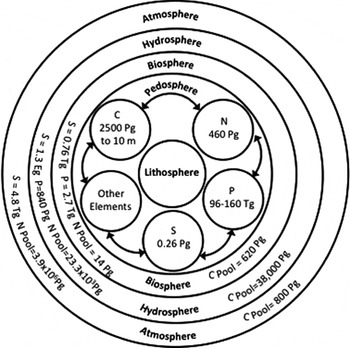
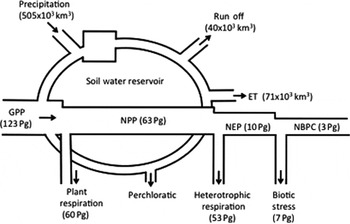
The earth/soil has numerous elements with their own cycles, either singularly or coupled. Coupled cycling of elements is the rule, rather than an exception. Major elements (carbon, nitrogen, phosphorus and sulfur) have coupled cycling within the pedosphere, and among the pedosphere, lithosphere, atmosphere, hydrosphere and biosphere through an inter-connected web of global cycles (Fig. 3)Reference Lal91, Reference Paul115–Reference Stevenson117. By conserving carbon and water, NT strengthens the coupled cycling of numerous elements. Coupled cycling of carbon and water at a global scale indicates the inter-dependence of these elements (Fig. 4)Reference Lal91, Reference Lal95, Reference Falkowski, Scholes, Boyle, Canadell, Canfield, Elser, Gruber, Hibbard, Högberg, Linder, Mackenzie, Moore, Pedersen, Rosenthal, Seitzinger, Smetacek and Steffen118–Reference Bengtsson121. Within a landscape, long-term use of NT strengthens elemental cycling. For example, NT stratifies SOC by concentrating it within the surface layer, conserving water by reducing runoff and evaporation, increasing water storage in the root zone, increasing plant-available water capacity, and increasing net primary production by reducing risks of drought and decreasing losses of plant nutrients by runoff, leaching and erosion. The return of crop residues to soil, an integral component of NT, is crucial to elemental cycling and reducing the requirement for nutrient replenishment with chemical fertilizers.
Schematic of the coupled cycling of elements within the pedosphere. Fluxes of elements in the pedosphere with those in the biosphere, hydrosphere and atmosphere are well knownReference Paul115. Data on carbon pools are from LalReference Lal91. Data on nitrogen pools are from Robarts and WetzelReference Robarts and Wetzel116 and those of P and S are from StevensonReference Stevenson117.

Schematic of the coupled cycling of carbon and water. Data for C fluxes are from multiple sourcesReference Lal91, Reference Lal95, Reference Falkowski, Scholes, Boyle, Canadell, Canfield, Elser, Gruber, Hibbard, Högberg, Linder, Mackenzie, Moore, Pedersen, Rosenthal, Seitzinger, Smetacek and Steffen118, Reference Jansson, Wullschleger, Kalluri and Tuskau119 and those for water are from Ogle et al.Reference Ogle, Swan and Paustain120 and BengtssonReference Bengtsson121.

Soil erosion, sedimentation and non-point source pollution
Surface mulch on unplowed and consolidated soil decreases erodibility, increases resilience and drastically reduces erosivity (e.g., rain drop impact, shearing force of overland flow and blowing wind, and wind-driven rain). Data in Table 2 from the North Appalachian Experimental Watersheds at Coshocton, Ohio, indicate the relative effectiveness of NT farming in erosion control, especially for some exceptional rainstorm eventsReference Harrold and Edwards122. Data in Table 3 from western Nigeria also show the effectiveness of NT in reducing runoff and soil erosion up to a slope gradient of 15% in an environment characterized by highly erosive tropical rainsReference Lal123.
No-till effects on soil erosion from cropland watersheds at Coshocton, OhioReference Robarts and Wetzel116.

Prevailing: straight/sloping rows, low fertility.
Improved: contour rows, moderately high fertility.
Minimum tillage: plow and plant.
No-tillage: chemical weed control, corn stover mulch, manure.
Mulching effects on surface runoff and soil erosion from an Alfisol in western Nigeria from April to August 1973 (recalculated from LalReference Lal123).

Rainfall=781 mm.
1=Plowed fallow, 2=corn, plowed, mulched, 3=corn, plowed, 4=corn, no-till, 5=cowpea, plowed.
Despite the conservation effectiveness of NT, it does have some disservices. Surface applications of fertilizers and pesticides/herbicides can accentuate the risk of transport in runoff, especially during the first few events after applicationReference Wauchope, Estes, Allen, Baker, Horsnby, Jones, Richards and Gustafson124–Reference Shipitalo and Owens126. In Ohio, risk of herbicide transport in water runoff was high for an erosive rainfall event that occurred within 10 days of application, and detectable levels could be observed 50–60 days after application. Shipitalo et al.Reference Shipitalo, Malone and Owens127 observed concentration of atrazine and alachlor in runoff high enough to be of concern even for NT, and concentration of herbicides in the first few runoff events after application can be well above drinking water standards. In addition, flow of pesticide-containing water through macropores and preferential pathways can be an issue with NT systemsReference Edwards, Shipitalo and Norton128. If an intense rainstorm were to occur soon after surface application of chemicals to soil with well-developed macroporosity, water transmitted into tiles and shallow ground water by macropores could contain significant concentration of chemicalsReference Shipitalo, Dick and Edwards129.
Conservation Agriculture and Relationship among Multiple Ecosystem Services
Strong links exist among diverse ecosystem services, but managing exclusively for one (i.e., food production) can lead to a substantial decline in another (i.e., biodiversity). Therefore, it is important to understand theoretical relationships among ecosystem services. Bennett et al.Reference Bennett, Peterson and Gordon130 proposed three sets of issues to understand relationships among ecosystem services: (i) nature of ecosystem service (i.e., flow across a landscape or specific processes that regulate the nature of the relationship), (ii) trade-offs and synergism (i.e., effective ways to mitigate trade-offs or change of relationship among ecosystem services over time, with management and across scales), and (iii) regulating services and regime shift (i.e., nature of shifts or variation in ecosystem services with decline in regulating services). Trade-offs may occur among ecosystem services, and specific disservices in agroecosystems must be carefully evaluated at appropriate temporal and spatial scales, since the negative impacts are difficult to reverse (i.e., erosion, non-point source pollution)Reference Power35. Trading ecosystem carbon storage for foodReference West, Gibbs, Monfreda, Wagner, Barford, Carpenter and Foley131 has important managerial implications that require an objective and careful evaluation. Thus, agricultural ecosystems must be appropriately managed to optimize diversity, composition and functioning of remaining natural ecosystems in the landscapeReference Zhang, Ricketts, Kremen, Carney and Swinton132. In some cases, adoption of organic agriculture may strengthen specific ecosystem services such as pollination, biological control and nutrient cyclingReference Sandhu, Wratten and Cullen133. Yet, low productivity of organic systems is an issue in the world with an ever increasing population and escalating demand for ecosystem services.
Payments for Ecosystem Services
Innovative agricultural systems must be developed to maximize ecosystem function and services and minimize disservices. Therefore, linkages and inter-dependence between food production and other ecosystem services for recommended management practices must be critically assessed. Adoption of recommended management practices by land managers, especially resource-poor farmers, can be promoted through payments for ecosystem services (i.e., carbon sequestration, water resources, improvement and biodiversity enhancement). Establishment of a rational price (i.e., carbon credits or green water credits) may require identification of soil/site-specific indicatorsReference Dale and Polasky134 at different spatial scales and with hierarchical perspective. These indicators can provide the basis of an appropriate framework. High negative external costs associated with food productionReference Porter, Costanza, Sandhu, Sigsgaard and Wratten135 could be minimized through the use of appropriate indicators. One option would be to determine suitability of a provision by collective management or cooperative solution based on resource characteristicsReference Stallman136. Another option would be to reduce disservices and negative costs through payments for enhancing ecosystem services and reducing disservices. A third option would be a market-based approachReference Kroeger and Casey137.
Market-based approaches could reduce risks of the ‘tragedy of the commons’. The strategy would be to harness market potential to provide ecosystem service incentives to land managers. Markets could be used as a tool for organizing the supply of ecosystem services to and from agroecosystemsReference Kroeger and Casey137. Being myopic by nature, humans’ desires to make quick economic gains by cutting corners could degrade soils and jeopardize natural resources. Thus, assessing societal value of ecosystem services would be relevant, especially in developing countriesReference Kumar138 with predominantly resource-poor farmers and smallholders. A just pricing system for ecosystem services could promote the adoption of NT and recommended management practices.
A market-based tool could be used either as: (i) economic incentive or (ii) performance paymentReference Ferraro139. The latter, paid in cash or kind, could be made conditional on achieving a well-defined action or outcome. For example, carbon credits could be sold only if farmers were to adopt and maintain NT for a specific duration of time (e.g., 6–10 years), and payments could be made at the end of the designated period. Determining the rational value of a specific ecosystem service would be critical to the success of the program. Undervaluing a service (such as SOC sequestration) could lead to its misuse and depletion. No one protects or safeguards an under-valued resource. The market-based approach for voluntary carbon trading was not successful, because of the unfair price governed by the lack of cap on fossil fuel combustion. However, payments to farmers for providing essential ecosystem services (e.g., adapting and mitigating abrupt climate change, improving water quality and its renewable supply, and enhancing biodiversity) based on a fair and just price would incentivize land managers toward adoption of sustainable technologies.
Constraints to Adoption of No-till
Despite numerous advantages, cropland area under NT is hardly 9% worldwide, mostly in countries where large-scale commercial farming is practiced (e.g., USA, Canada, Brazil, Argentina, Chile, Paraguay and Australia). Adoption of NT is practically negligible by resource-poor, smallholders of sub-Saharan Africa, South and South-East Asia, Central America, Caribbean and Pacific Islands. Yet, these are also the regions where the potential benefits of NT are highReference Lal140. Reasons for low adoption of NT vary among developing and developed economies, climatic regions, soil types and farming systems. In developing economies, farmers may not have access to herbicides and appropriate seeding equipment. Competing uses of crop residues for fodder and fuel may be another constraint. Land ownership and tenure, important to investment in long-term improvement in soil restoration, is another issue that limits adoption. Furthermore, NT farming may require more skills and experience in its implementation.
In temperate regions, spring-time soil temperature is often sub-optimal and seedling emergence and crop establishment are slower under NT compared with plow-based seedbed preparation. Thus, crop yield can be depressed under colder, wetter climatesReference Ogle, Swan and Paustain120, Reference DeFelice, Carter and Mitchell141. Nonetheless, intensified rotations with NT in the US Great Plains can be more profitable than plow-based systems, even when grain yields are slightly lowerReference Dhuyvetter, Thompson and Halvorson142. However, even a slight yield decrease may be perceived as risky to farmers. There is also a range of socio-cultural/economic reasons for low adoption of NTReference Ervin and Ervin143.
Conclusions
Ecosystem services providing benefits to the environment must be sustained to meet the increasing and diverse demands of humanity. Soil provides all four categories of ecosystem services (e.g., provisioning, moderating, ecological and cultural/aesthetical) and its resource must be sustainably used and restored, because it is a finite resource and prone to degradation and depletion. Sustainable management of soil involves: (i) replacing what is removed, (ii) restoring what has been degraded, and (iii) responding prudently to off-site effects of management-induced alterations in ecosystem services (e.g. greenhouse gas emission, non-point source pollution and sedimentation) and disservices.
Adoption of NT has its own potential and challenges. Despite more than 50 years of research in temperate and tropical climates, NT farming is adopted on only 124.8 Mha (∼9% of cropland area). Frustratingly, adoption of NT has been especially low with resource-poor farmers and smallholders in developing countries, where it would otherwise be desperately useful.
Among numerous constraints to the adoption of NT is the competing use of crop residues harvested for cattle feed, cooking fuel, construction, and other domestic and commercial uses. Thus, a market-based approach is needed to promote adoption of NT through economic incentives or performance payments for ecosystem services, which could also reduce disservices or trade-offs. To be effective, however, rational value of a specific ecosystem service (i.e., SOC sequestration) must be objectively assessed. Undervaluing an ecosystem service would jeopardize the finite soil resource and aggravate disservices. No-till farming, conservation agriculture and sustainable land management are proven innovative options that maintain or enhance ecosystem services and reduce risks of disservices. Adoption of NT should be expanded to sustain or improve ecosystem services to meet the needs of a growing world population.