INTRODUCTION
There is an increasing need to process small-mass samples (less than 100 μg carbon) for accelerator mass spectrometry-radiocarbon (AMS-14C) measurements, such as for a specific organic compound in aerosols and dissolved organic carbon (DOC) in water (Liu et al. Reference Liu, Li, Zhang, Liu, Ding, Shen, Shen, He, Ding, Wang, Chen, Szidat and Zhang2014; Lang et al. Reference Lang, McIntyre, Bernasconi, Früh-Green, Voss, Eglinton and Wacker2016). Most AMS-14C labs choose solid graphite targets for small-mass sample 14C measurements because they last longer in a solid ion source, resulting in lower statistical counting error and thus higher measurement precision. As reported in previous research, using H2 reduction can successfully graphitize as small as 2 μg C ultra-small mass samples (Santos et al. Reference Santos, Southon, Griffin, Beaupre and Druffel2007). The modified sealed-tube Zn reduction method has also shown the ability in graphitization for small-mass samples ranging from 4 to 100 μg carbon (Khosh et al. Reference Khosh, Xu and Trumbore2010; Xu et al. Reference Xu, Gao and Salamanca2013). However, the graphitization of small mass carbon sample is still a challenge for AMS 14C labs in China. Since the modified sealed-tube Zn reduction method has been applied for the regular-sized carbon samples (more than 100 μg C) in our lab (Ding et al. Reference Ding, Shen, Yi, Wang, Ding, Liu, Fu, Liu and Liu2015), we are now able to apply this method to smaller mass samples. In this work, we report the performance of small-mass samples from Oxalic Acid I (OXI), Oxalic Acid II (OXII), and coal ranging from ~15 to 100 μg C, using the modified sealed tube Zn reduction method at GIGCAS.
METHODS
OXI and OXII are modern carbon standards commonly used in AMS 14C labs. OXI is usually used as the primary standard and OXII as a secondary standard. Coal and carbonate are often treated as background for organic carbon and inorganic carbon, respectively. The two endmembers represent modern carbon and old carbon, which will be used in the background correction for small-mass sample AMS-14C measurements. In this work, we chose OXI and OXII as modern carbon standards, and coal as background. It should be mentioned that the coal used in our lab as blank of organic materials is pretreated in a special way by heating under 900°C in the N2 atmosphere. We have found that it has a stable 14C age of 48,000–50,000 yr. When it is used, it is treated in the same way as regular samples. A regular-sized sample of calcite carbonate was also measured as a supplement to our lab background estimates.
Reactor Tube
The reactor tubes used for small-mass samples are described in Table 1. They are 150 mm long, 6 mm outside diameter (o.d.), 4 mm inside diameter and are sealed at one end with a small indentation approximately 1 cm from the sealed-bottom Pyrex (borosilicate) tubes. The tubes are designed and manufactured in our lab. A smaller glass tube which is 20 mm long, 3 mm o.d., and 2 mm inside diameter is placed inside.
Dimensions of reaction tubes used for the small-mass samples graphitization at GIGCAS. Numbers in parentheses are the sizes of sealed tubes. Amounts of Zn, TiH2, and Fe catalyst used in the graphitization are listed in the last three columns.

The tubes are first filled with MQ water and cleaned by an ultrasonic cleaner, and then dried in a vacuum drying chamber. Then, the tubes are prebaked at 500°C for 4 hr, and then at 550°C for 3 hr. After tubes have been baked, about 9.8–11.4 mg of Zn (Aldrich, #324930) and 3.3–4.9 mg of TiH2 (Alfa Aesar, #12857) are weighed separately into the bottom of 6 mm o.d. reactor tube. Then, 4–5 mg of Fe catalyst (Alfa Aesar, 350 mesh, #39813) is placed into the inside small tube that is finally inserted into the larger 6 mm o.d. reactor tube. Before use, the Fe catalyst was precleaned by an oxidation-reduction method. About 1 g Fe catalyst placed in a glass tube was heated at 450°C in atmosphere environment for 1 hr. After this, the air was pumped away, Fe catalyst was reduced under 500°C in H2 atmosphere for 2 hr. The oxidation and reduction were performed in a vacuum line. Reaction tubes were then baked in an oven at 300°C for 2 hr to eliminate absorbed CO2 gas and possible organic matters. Agglomeration of Fe in the small tube is observed. However, this can be loosened by shocking the tube. The reaction tube was finally sealed by Parafilm wrap and kept in an electrical damp proof box (i-Cabi, #AD-050).
Small-Mass Sample Preparation and Measurement
Reference materials of mass 0.2–0.3 mg C are weighed out into quartz tubes using a microgram balance. Excess CuO (Aladdin, #CAS 1317-38-0, about 20 mg), which was baked under 900°C for 2 hr previously, is added into the quartz tubes. After quartz tubes are pumped to 1.0×10⁻³ torr, the baseline of our evacuating vacuum line, tubes are sealed by a torch and then heated in an oven at 900°C for 2 hr to convert carbon into CO2 gas. CO2 gas from the combusted samples is split to produce a number of smaller samples. We also used a sample of treated coal as a blank. This coal was heated in an oven at 350°C under vacuum in order to decrease the contamination of modern carbon. Regular size samples ~1 mg C were also processed.
CO2 is extracted and purified from a combusted sample cryogenically using a liquid nitrogen trap in a simple extracting vacuum line, as described by Xu et al. (Reference Xu, Trumbore, Zheng, Southon, McDuffee, Luttgen and Liu2007). Purified CO2 is quantified by measuring the CO2 pressure in a known-volume reservoir using a micromanometer (AMS 5812, #0150-A) capable of measuring 0–5 psi. The relationship between the CO2 pressure and C mass (P-M curve) has been constructed by measuring the pressure of weighted OXII by a microgram balance. The purified CO2 is split into different chambers with a stable volume ratio by pressure equilibration. Sometimes, it needs more than one time before the proper amount of CO2 is obtained. Quantified CO2 is frozen into a reactor tube using liquid nitrogen, and the reactor tube is then sealed using a torch at about 60 mm from the bottom. The volume of the sealed reactor tube is calculated to be about 0.75 cm3.
Sealed reactor tubes are placed at an angle on a ceramic board with 12 grooves and heated in an oven at 500°C for 4 hr, and then at 550°C for 3 hr. The optimal graphitization temperature in our lab is determined by the ion yield of 12C+1 current of the regular mass samples (0.5~1.0 mg C) measured in Peking University (Liu et al. Reference Liu, Ding, Fu, Pan, Wu, Guo and Zhou2007). After graphitization, the reactor tubes are cracked open. The inside tube is slightly slid to the sealed end first, and then the outside tube was cracked open. It is possible that small glass particles will get into the inside tube. Graphite in the inside small tube is poured onto a small sheet of aluminium foil that is prebaked at 550°C for 2 hr and tightly wrapped. Then, the graphite samples are sent to the Keck Carbon Cycle AMS lab (KCCAMS) at the University of California, Irvine, and measured within three days after arrival. There is no obvious difference between these samples and the regular mass graphite done in UCI. The graphite is measured quickly so they absorb very little outside carbon. However, the influence of the storage duration to the small mass size carbon maybe different, and we will verify this need in future.
RESULTS AND DISCUSSION
Performance of Graphite in Ion Source and δ13C Correction
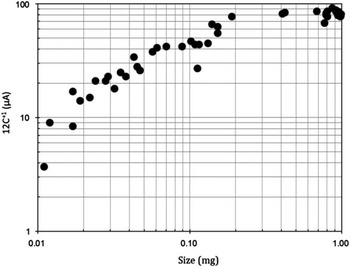
A 12C+1 current from the AMS 14C measurement usually indicates the yield of graphite, based on studies by Santos et al. (Reference Santos, Southon, Griffin, Beaupre and Druffel2007). The higher yield of the graphite is, the higher 12C+1 current will be obtained as it is compared to the same size graphite in Irvine (Santos et al. Reference Santos, Southon, Griffin, Beaupre and Druffel2007). The performance of AMS measurement the small-mass samples (0.5 NEC 0.5MV 1.5SDH-1 machine) at the KCCAMS facility has been described in earlier reports (Santos et al. Reference Santos, Southon, Griffin, Beaupre and Druffel2007; Xu et al. Reference Xu, Gao and Salamanca2013). Generally, the machine generates high beam currents of ~80–100 μA 12C+1 for regular-size samples of ~1 mg C, but maximum 12C+1 currents of about 1 μA/1 μg C for samples ranging between 15 and 100 μg C for graphite produced by the H2 reduction method (Santos et al. Reference Santos, Southon, Griffin, Beaupre and Druffel2007), and maximum 12C+1 currents of about ~0.5 μA/1 μg C for graphite obtained by the sealed tube Zn reduction method (Khosh et al. Reference Khosh, Xu and Trumbore2010). As shown in Figure 1, small-mass samples ranging between 15 and 100 μg C produced at GIGCAS are strongly mass dependent as expected due to dilution by the same amount of iron. Maximum 12C+1 currents of ~0.5 μA/1 μg C are obtained (Figure 1) in our lab, which is similar to the current of ~0.5 μA/1 μg C of the same size range samples reported by Khosh et al. (Reference Khosh, Xu and Trumbore2010).
Plot of the maximum 12C+1 beam current versus sample size ranging 15–100 μg C processed at GIGCAS.

When the sample is measured at KCCAMS, the mass-dependent C isotope fractionation is corrected automatically using AMS δ13C values regardless of sample size when the machine calculates the results (Khosh et al. Reference Khosh, Xu and Trumbore2010). The difference in δ13C value between that of the original material and AMS measurement can be as much as 20‰ (Santos et al. Reference Santos, Southon, Griffin, Beaupre and Druffel2007), which could cause a great influence on the 14C value, especially for small-mass samples. The AMS δ13C correction includes all the C isotope fractionation occurring at formation, chemical preparation, graphitization, and AMS measurement.
Background Correction
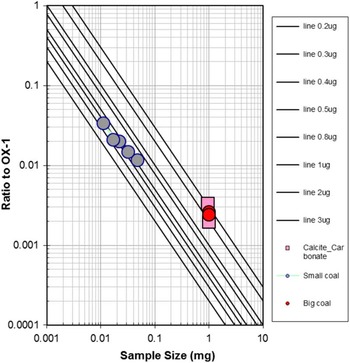
We adopt the nonmatching method described by Santos et al. (Reference Santos, Southon, Griffin, Beaupre and Druffel2007) to make our small-mass sample corrections for both modern and dead background components. The modern C background is corrected based on coal, a 14C-free material covering the range of ~15–100 μg C, and the dead-C background is corrected based on a set of similar-sized modern standard OXI and OXII. Results show that the modern-carbon background component from these blank measurements varies between 0.25 and 0.60 μg C (Figure 2). The dead-carbon background component is quantified from carbon size (m) and ΔF (1–f m /1.04, f m represents the measured 14C value) which is the deviation of the measured fraction modern carbon for small OX-I samples from that of large normalizing OX-I ones. A dead-carbon background about ~0.3–0.9 μg C (0.6±0.3 μg C, m×ΔF) is obtained by this calculation. For comparison, the modern-carbon background component value is about 0.3 μg C, and the dead-carbon background component varied between 0.15 and 0.30 μg C for similar-sized samples at KCCAMS (Khosh et al. Reference Khosh, Xu and Trumbore2010).
Modern C background estimates. Solid lines represent 0.2, 0.3, 0.4, 0.5, 0.8, 1.0, 2.0, and 3.0 μg of modern C contamination. Red solid squares and circles represent normal size calcite carbon and coal processed at GIGCAS, respectively. (Colors refer to online version.)

The difference in the amount of dead-carbon background and modern-carbon background suggests improvements can still be made. As suggested by Khosh et al. (Reference Khosh, Xu and Trumbore2010), preheating the reaction tube in open air at 300°C could be helpful to decrease the modern-carbon contamination, which mostly comes from absorbed air CO2. We have kept this cleaning procedure in our experiment, but it seems it could be improved. In future studies, we will try to heat the reaction tube in the vacuum line at 350°C for 10 min before the quantified CO2 is frozen into the tube. Keeping the preheated reaction tubes in an airtight cabinet with a 1 N NaOH solution may also be helpful. Dead carbon contamination appears to be a problem at GIGCAS. As discussed with Dr Xu at KCCAMS, the contamination is likely from the vacuum line. Evaporated oil from the oil pump in the vacuum system is absorbed in the vacuum line. Cleaning the line, flashing the line with purified N2, and preheating the line may greatly decrease the contaminants absorbed in the vacuum system.
The background correction is important when processing actual small samples (samples that yield only 15–100 μg C), especially for older samples. The modern carbon contamination could shift the 14C age from about 50 ka to 30 ka for the small old samples [e.g. ~0.96 μg modern carbon contamination (f m =1.04) contained in 50 μg C old sample (f m =0)]. It is also important to mention that modern carbon background and dead carbon background may be improved when we process actual small samples without using the splitting method, as the time of active pumping would be reduced. However, the difference in splitting sample and actual small sample would be very small in a cleaner vacuum line. Before the small samples in the vacuum line are processed, the vacuum of the line is checked. In our short small-sample vacuum line, the vacuum can keep beyond 3.0×10⁻² mbar for more than 30 min after the line is pumped to 1.0×10⁻⁴ mbar and isolated from pumping. In this case, sample splitting is usually finished in 15 min for 4–5 small samples. Under this condition, the contamination from the line would be very similar for both actual small samples and split ones.
Precision and Accuracy
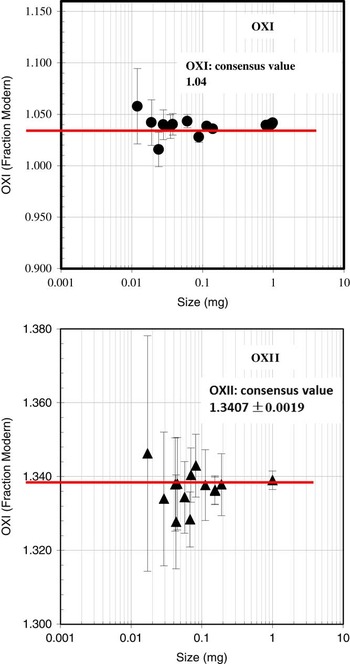
The accuracy and precision of small-mass samples were test using primary standards (OXI) and secondary standards (OXII) covering a 15–100-μg C range. The ratios of 14C/12C were normalized to that of regular size (1 mg C) OXI standard using the nonmatching method described by Santos et al. (Reference Santos, Southon, Griffin, Beaupre and Druffel2007). Figure 3 shows the results of OXI and OXII standards after the dead-carbon background and modern-carbon background corrections have been made. Final results show that the most of small-mass samples are consistent with the corresponding consensus values, suggesting that the estimates for both modern-carbon and dead-C backgrounds for this method are good in the GIG lab.
Fraction modern results for OXI, OXII ranging from 15 to 100 μg C. Solid lines represent the consensus values of the standards. Error bars are±1σ. All results have been isotopic fractionation corrected using the simultaneous on-line AMS δ13C measurement.

The precision of small-mass samples is size dependent. For samples in the 15–20 μg C range, results of±15–25‰ were obtained, while for the range of 20–50 μg C samples were about ±5–10‰, and samples of 50–100 μg C were±3–10‰, which has been shown to be as low as±2–4‰ at KCCAMS using their sample-preparation lines (Khosh et al. Reference Khosh, Xu and Trumbore2010). The lower precision compared with that of KCCAMS is mainly reflected in OXII. The dead carbon background correction is estimated to be 0.9 μg C for OXII rather than 0.6 μg C, which we used both in both OXI and OXII correction, which leads to a mean value of OXII below the consensus value and greater error and uncertainties. The graphite quality of OXII concerned with the graphitization yield from CO2 likely contributes to the less mass dependent of the fraction modern of OXII. Controlling the amount of TiH2 precisely based on the size may be helpful to improve the yield the graphite in the future.
SUMMARY
The small-mass sample graphitization method using a modified sealed tube Zn reduction has shown satisfactory accuracy and precision of AMS 14C measurement for 15–100 μg C samples processed at GIGCAS, after the modern-carbon background and dead-carbon background correction made. The graphite generates a maximum 12C+1 current of ~0.5 μA/1 μg C, which is close to that obtained for graphite prepared at KCCAMS (Khosh et al. Reference Khosh, Xu and Trumbore2010). The modern-carbon background component varies between 0.25 and 0.60 μg C, and dead-carbon background component is ~0.3–0.9 μg C. For comparison, they are 0.3 μg C, and 0.15–0.30 μg C, respectively, at KCCAMS. Although the small amount of background is corrected in our calculations, the larger background both in modern-carbon and dead-carbon motivate us to make some improvements in the future.
Acknowledgments
The authors are very thankful for the suggestions and support during the process of this work at GIGCAS provided by Dr Xu at KCCAMS, UCI. The work is financially supported by a project of the Chinese Academy of Sciences Equipment Function Development and Technological Innovation (No. YZ2011046) and the National Natural Science Foundation (No. 41403098).