

1. Introduction
The poor prefer progressive taxation, whereas the rich prefer regressive taxation (Marhuenda and Ortuño-Ortín, Reference Marhuenda and Ortuño-Ortín1995). Following this principle, developing countries should raise revenue from progressive rather than regressive taxes to benefit a majority of the people who are poor. However, the reverse is true. Developing countries are more likely to rely heavily on revenue from regressive taxation, for example, the value-added tax (hereafter VAT), and have failed to raise revenue from progressive income taxes (Aizenman and Jinjarek, Reference Aizenman and Jinjarek2009; International Monetary Fund (hereafter IMF) 2011; Bahl Reference Bahl, Bird and Martinez-Vazquez2014; Kato and Toyofuku Reference Kato and Toyofuku2018). What barriers do developing countries face when raising revenue from progressive taxes?
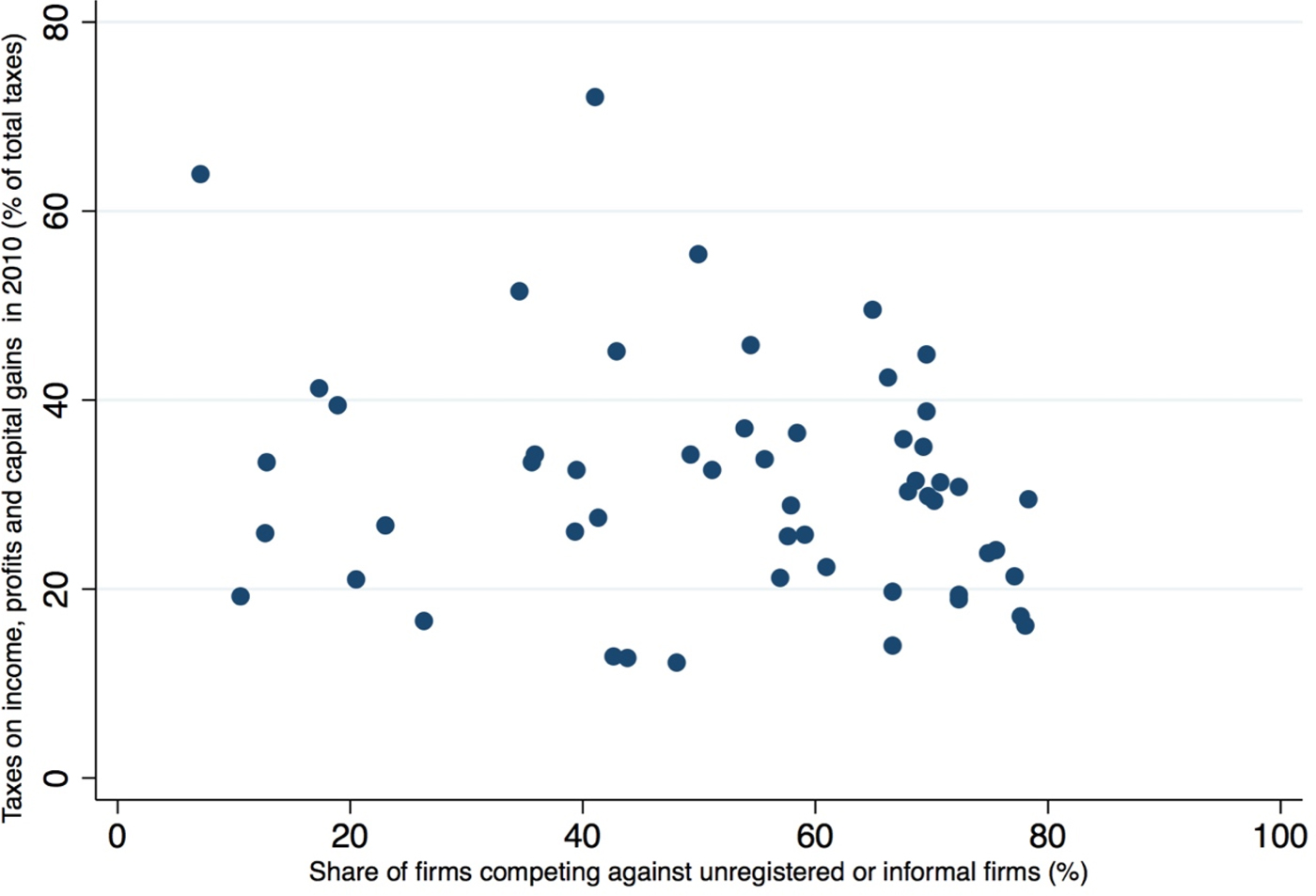
The literature on the tax policies of developing countries has offered several explanations. Some scholars blame the relatively large size of the informal sector in developing countries. However, the size of the informal sector has an insignificant impact on the share of progressive tax revenue, at least among developing countries (see Fig. 1).
The Informal Sector and Progressive Tax Dependency in Developing Countries

A more important explanation is that strong opposition from the wealthy may distort the government's tax policies. When a government collects taxes, its first step is to register all companies and people to ensure that they file their income accurately. This is, however, not easy for developing countries. The wealthy want to escape paying taxes, and the government lacks the ability to tax the rich (Mahon Reference Mahonforthcoming). Unlike the situation began in the early twentieth century, the rich formerly had no need to compensate for their unfair privileges (Scheve and Stasavage, Reference Scheve and Stasavage2016). The rich were originally burdened by relatively heavy taxes compared with the poor, who instead had to contribute militarily on the battlefield. However, today in many countries, a majority of the people no longer needs to contribute militarily, and exemption from military service no longer privileges the rich.
Another change since the early twentieth century has been an increase in capital mobility or globalization. The rich can easily move their assets and companies to other countries (Tanzi, Reference Tanzi1995; Keen and Konrad, Reference Keen, Konrad, Auerbach, Chetty, Feldstein and Saez2013; Swank, Reference Swank2016), which can severely damage a country's economy. As long as these people and companies remained at home, the government could ensure employment. Moreover, dissatisfaction among the rich could threaten the democratic regime itself. Developing countries hesitate to force the rich to pay heavy taxes. Therefore, scholars have tended to believe that resistance from the wealthy explains the low revenue from progressive taxation.
Using the case of Thailand, this paper argues that developing countries with a heavy reliance on regressive taxation may also lower the income tax burden on the poor and attempt to gain their electoral support. Thailand experienced democratization in 1992 just after the introduction of the VAT. Unlike many countries that introduced the VAT before democratization (see Table 6 of Kato and Tanaka (Reference Kato and Tanaka2018a, Reference Kato and Tanaka2018b)), Thailand faced an authoritarian reversal and struggled with unstable regimes. A critical difference from the successful transition cases in Latin America (see Mahon Reference Mahonforthcoming) is that Thailand repeated tax reforms for the poor after the 1992 democratization. As a result, Thailand fails to collect taxes not only from the wealthy but also from the poor.
Thailand has experienced several tax reforms since 1999. The Thai government set the range of personal income tax exemption in 1999 and has repeatedly increased the range. The government also introduced a reduced corporate income tax rate for small or medium companies in 2002; it set the range of corporate income tax exemption in 2008, which has since increased. In addition, Thailand has increased the range of the VAT exemption for small companies. Overall, these tax reforms were clearly designed to reduce the tax burden on the poor. The importance of this case is that these reforms did not create severe damages on the tax revenue in Thailand. This, in turn, suggests that Thailand collected little revenue from the poor even before the tax reforms. Unlike a developed country with an equal society, in Thailand, a majority of the people are poor and cannot afford to contribute to the government's revenue. Moreover, the case study finds that about three-quarters of the people in Thailand do not report their incomes or pay much taxes because of weak state capacity. Therefore, Thailand had little incentive to give up collecting taxes from the poor. In addition, the process of Thailand's tax reform implementation reveals how the growth of representation may hamper the broadening of the tax base to cover the poor in developing countries. In the case of Thailand, since 1999, governments whose supporting base was the poor have implemented the most tax reforms, although tax policies have not dominated the election campaigns. Not every government has increased the tax burden on the poor since 1999, because they were afraid to lose the support of the poor or a majority of the people. This paper bases details of the process of tax reforms on interviews with policy-makers in Bangkok; it examined the country's tax regulations and collected tax data at both the local and national level.
Although such tax reforms are not common in developing countries, this case study raises the possibility that other developing countries also experience difficulty broadening the income tax base over the rich but also over the poor. These countries have little incentive to force the poor, including those working in the informal sector, to pay income taxes. This is in part because they can expect few benefits, at least in the short run, and because they might lose the support of the poor and lose an election, especially under majority rule.
This paper is structured as follows. In the next section, I explore the barriers, which developing countries face in raising revenue from a progressive tax. The paper then outlines the analytical framework, which explains why developing countries are unlikely to raise progressive tax revenues. In the case study section that follows, this paper traces the process of tax reform in Thailand and examines the intentions of those reforms. Using the case study of Thailand, the final section concludes with a discussion of the implications of the findings for broader theorizing about the cases in other developing countries.
2. Barriers faced by developing countries in the collection of taxes from the poor
Why do developing countries have difficulty in collecting taxes from the poor? Some people and companies in developing countries file fraudulent income tax returns and some do not report their income at all (Bird and Zolt, Reference Bird and Zolt2005). These situations may not be unique to developing countries, but, compared with developed countries, many of these countries fail to share the norm that all people are obliged to pay taxes (Besley and Persson, Reference Besley and Persson2014). Moreover, the governments in developing countries lack the ability to monitor people's lives, accuse people of tax evasion, and correct the norm. As a result, with the exception of the wealthy, people might not fear the tax authorities for under-reporting or un-reporting their income.
In addition, inequality in developing countries weakens a government's incentive to collect taxes from poorer people. Although a majority of the people may demand greater redistribution, the government in an equal society might hesitate to decrease the tax rate for the median voter, because reform causes huge losses to government tax revenue. However, in an unequal society, a limited number of people monopolize the wealth, and the majority of the people have no power to contribute to tax revenue regardless of the tax schedule. In such a society, a government incurs little damage, even if it decreases the tax rate on these people. Such governments, therefore, may not incur costs by checking unregistered poor people, because the expected return is small. Furthermore, they might adopt policies to decrease the tax rate on the poor, because such reforms would attract greater support from the poor and would possibly increase their chances for re-election.
3. Argument
Based on the above discussion, this paper articulates the following argument.
First, developing countries do not have the abilities to monitor the incomes of all of their people. Therefore, in these countries, a substantial number of the people under-report or un-report their incomes; and poor people do not need to fear being caught for such infractions.
Second, the contribution to tax revenue in developing countries by a majority of the people is limited, because their societies are unequal. Therefore, governments do not hesitate the cut the tax burdens of a majority of the people or the poor.
The lack of ability and the incentives to collect taxes from the poor in developing countries allow these poor people to be exempted from paying taxes. As a result, developing countries adopt large deductions and exempted ranges for the poor and small or medium companies.
4. Case study of Thailand
Scholars have analyzed the tax systems in developing countries and/or new democracies primarily by using panel-data or cross-national data (e.g. Mahon Reference Mahonforthcoming; Timmons, Reference Timmons2010; Swank Reference Swank2016; Kato and Toyofuku Reference Kato and Toyofuku2018). These studies have used the amount of tax revenue collected from each tax, but have not focused on the processes: how have the tax schedules, allowances, and deductions in each tax changed over time? Reforms of each tax are bargaining products and show a government's intentions and the problems faced. By examining how and why the Thai government has repeatedly reformed its tax system since 1999, this paper reveals the problems of the tax system in Thailand.
Like other developing countries, Thai tax revenue is highly dependent on regressive taxation. According to the tax revenue data from the Revenue Department Thailand,Footnote 1 the VAT revenue has been about twice as high as revenue from a personal income tax since Thailand introduced the VAT in 1992. Second, Thailand is an exceptional case, which has repeatedly experienced tax reforms. This permits an examination of the Thai government's concerns and people's demands regarding taxation and suggests why the Thai government has failed to increase personal income tax revenue from the poor.
4.1 The Government's lack of ability to monitor people's lives
In Thailand, one of the easiest ways to appeal for people's support is to argue against graft and corruption. The military coup in February 1991 gained the support of the Bangkok people by claiming it would weed out fraud (Murray, Reference Murray1996). The elimination of corruption was a key election promise Thaksin made when he won the 2001 election (Croissant and Pojar, Reference Croissant and Pojar2005). However, he lost his position, in part because people grew discontented with his alleged corruption. Thaksin was questioned about the tax evasion of his wife and her brother.
However, tax evasion is actually popular and common in Thailand. According to Thai Publica, in the 2014 fiscal year, the number of working people was 38.8 million, but only 10.3 million people submitted income tax returns; in other words, 28.5 million people did not submit income tax returns.Footnote 2 Even bureaucrats admit that the Thai people do not share the norm that all people have tax-paying responsibilities (interview of Thai bureaucrats on 23, 24, and 28 February 2017).
Tax evasion is also popular among companies. Many companies believe that the payment of taxes is not rigid but is negotiable (interview of Thai consultants on 16 February 2017). A popular way for a tax officer to increase tax revenue is to secretly visit a restaurant or a shop that does not report income, count how many orders were taken during the day, and negotiate with the owner (interview of Thai bureaucrats on 20 and 23 February 2017). This suggests that, with the exception of the wealthy, most will not receive greater punishment than being required to pay the tax they legally owe, even if they are caught cheating on their taxes. Every year tax officers make an effort to raise tax revenue, but their efforts are devoted to finding big- and medium-sized companies and wealthy people un-reported or under-reported. Therefore, they cannot afford to check the incomes of small-companies or poor people.
4.2 Tax reforms since 1999
Developing countries are likely to adopt large deductions and exempted ranges.Footnote 3 The uniqueness of the Thai case is that it has increased this range repeatedly since 1999, which allows an examination of the impact of these treatments on tax revenue and politics. Why did the government implement tax reforms as early as the 1992 democratization?
The year 1992 is a benchmark year for Thai democracy as well as its tax structure. The elections had already been conducted; however, in 1992, Thailand finally enacted the law that the prime minister must be an elected Member of Parliament. In the same year, Thailand introduced the VAT for the first time to replace a business tax. Although there were 21 business tax rates for different types of goods and services in the business tax system, the tax rate became unified under the new VAT system. Since 1992, tax revenue in Thailand has relied heavily on the VAT. The year 1992 is also important because the gross domestic product (GDP) share of taxes involved in trading began to decrease. The share of trade duty was originally 3.2% in 1993 but decreased by 0.9% in 2014 according to the Fiscal Policy Office, ThailandFootnote 4, which raised the importance of the taxes collected from within the country.
From 1992 through 1998, there were few changes in the Thai tax system. In 1999, however, Thailand implemented personal income tax reform and VAT reform. Since then, the tax system has changed time and time again. Overall, the changes have intended to increase the number of people and companies exempted from taxation or to narrow the tax base. Let us examine the changes in the personal income tax, the corporate tax, and the VAT individually.Footnote 5
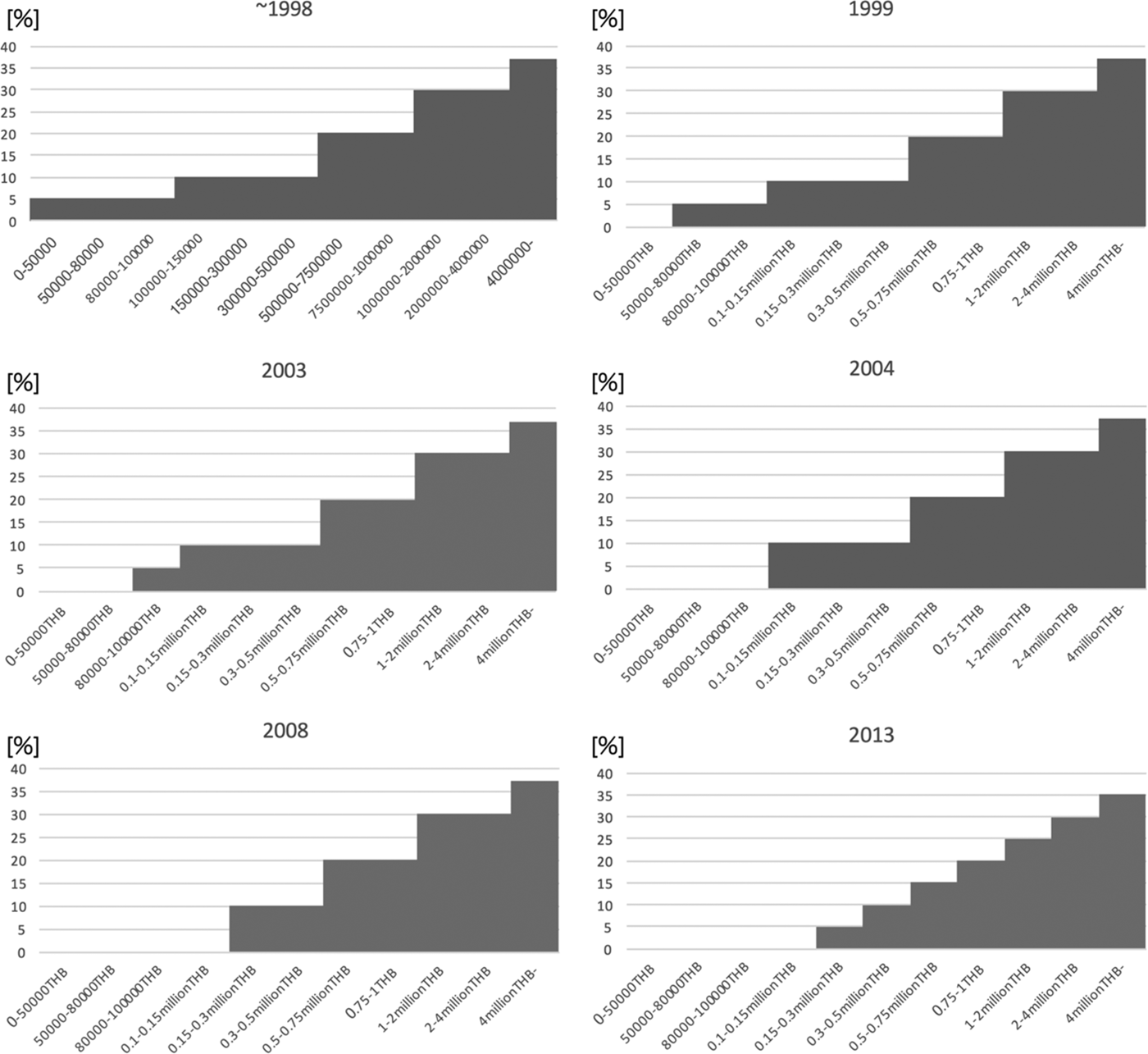
As in other countries, Thailand had certain pre-existing exemptions for the personal income tax prior to 1999, such as deductible expenses (40% but not exceeding 60,000 THB) and a basic exemption for each taxpayer and spouse (30,000 THB each). However, the proportion of people who were not required to pay personal income tax legally was approximately 20%, far less than one-half of the population. In 1999, however, the proportion of people who became legally exempt from personal income taxation increased rapidly because of changes in the personal income tax schedule. Figure 2 summarizes how Thailand's personal income tax schedule has changed since 1992. In 1999, the Chuan II Democratic Party Government issued Royal Decree No. 352, which stated that household incomes that did not exceed 50,000 THB were exempt from personal income taxation. In addition, in 2002, Thaksin issued Royal Decree No. 412, which increased the exempted amount from 50,000 to 80,000 THB beginning in 2003. In 2005, Thaksin issued Royal Decree No. 430, which again increased the exempted amount to 100,000 THB beginning in 2004. In addition to these decrees, in 2004, Thaksin introduced new exemptions, including an elderly exemption and a parental exemption. In 2008, Samak, Thaksin's successor and considered his puppet, issued Royal Decree No. 470, increasing the range of exempted income tax to 150,000 THB. In 2013, Yingluck, Thaksin's sister, issued Royal Decree No. 575, which seemingly did not increase the exempted income amount but permitted double-income households to file separately. The tax schedule had originally been applied to the joint income of the entire household; thus, this substantially increased the number of households that were exempt from paying personal income taxes.
Changes in Personal Income Tax Schedules

The corporate tax in Thailand also carried out special measures for small companies during this period. Until 2002, there was a flat, corporate, income tax rate regardless of the size of the company. Following the changes in the personal income tax, the corporate income tax system also started to change after 2002. Before the decrease in the corporate tax rate in 2012, Thai governments decreased the corporate tax rate for small- and medium-sized companies.Footnote 6 In 2002, Thaksin issued Royal Decree No. 394 that established reduced tax rates for small- and medium-sized companies, whereas Royal Decree No. 431 again reduced the rates for small- and medium-sized companies to commence in 2005. Further, in 2008, Samak issued Royal Decree No. 470, which stated that companies whose net profits were less than 150,000 THB and whose paid-up capital was less than five million THB were now exempt from corporate income taxation. Yingluck issued Royal Decree No. 564 in 2013, which stated that companies whose net profits were less than 300,000 THB, whose paid-up capital was less than five million THB, and whose income did not exceed 30 million THB were now exempt from corporate income tax. In addition, she decreased the corporate income tax rate from 30% to 23% for the year 2012 and to 20% for 2013 under Royal Decree No. 530 (in 2011).
The VAT is no exception. The VAT is principally a regressive type of taxation. However, when the government introduced the VAT in 1992 at a rate of 7%, it simultaneously established exemptions for small businesses. Companies whose annual turnover was less than 600,000 THB were exempt from the VAT, and those whose annual turnover was less than 1.2 million THB were required to pay only 1.5%. Faced with the 1997 financial crisis, Chuan attempted to overcome this situation by raising the regressive tax rate by issuing Royal Decree No. 309 and increasing the VAT rate from 7 to 10% in 1997. However, just 2 years later, he issued Royal Decree No. 353 (1999), decreasing the VAT rate from 10 to 7% and changing the conditions for companies that were exempt from the VAT from no more than 0.6 million THB annual turnover to no more than 1.2 million THB. In late 2005, Thaksin changed the system once again from 1.2 million THB to 1.8 million THB by Royal Decree No. 432.
Why did the government introduce the exempted amount in the personal income tax schedule in 1999 and why have subsequent governments repeatedly increased that amount of tax exemption? There is no doubt that the 1999 tax reforms can be attributed to the Asian financial crisis in 1997, which severely damaged the Thai economy, and to tax revenue that had decreased by approximately 10% over the previous year in 1998. We cannot simply assess the 1999 tax reforms as policies for economic recovery, however, because the government did not implement the corporate income tax reform until 2002. Research on taxation has long demonstrated that heavy taxes have a negative effect on the pace of economic expansion. However, the focus of this research is the corporate tax, not the personal income tax (Rebelo, Reference Rebelo1991; Rivera-Batiz and Romer, Reference Rivera-Batiz and Romer1991; Carroll et al., Reference Carroll, Holtz-Eakin, Rider and Rosen1998; Gentry and Hubbard, Reference Gentry and Hubbard2000; Lee and Gordon, Reference Lee and Gordon2005). Therefore, economic recovery was not the only reason for the 1999 tax reforms.
More important, the reforms were counter to the basic policy of the IMF. At that time, the IMF expected developing countries to conduct reforms of their tax systems as follows:
Fiscal consolidation is occurring gradually as recovery takes hold; budgetary deficits are being eliminated, despite the costs of financial sector reforms, and policies are returning to the principles of minimizing domestic financing and avoiding excessive public debt. While efforts are being made to expand social spending, cuts have been achieved in inefficient infrastructure projects and other unproductive spending, including military appropriations. Steps are being taken to reform tax systems, especially through the removal of tax exemptions to broaden the revenue base (emphasis added) and a revamping of the tax administration to increase the efficiency of collection and reduce corruption (IMF Staff, 2000).
Facing the crisis in 1997, Thailand received financial support and advice from the IMF. The IMF sent a team to investigate the tax systems in Thailand from February to March 1998. Therefore, it should have been difficult for the government to ignore IMF opposition. However, Thailand implemented the 1999 and successive reforms that decreased the number of the people who were obliged to pay taxes.
Why did the Thai government implement such reforms against the will of IMF? One reason was that the alleviation of people's dissatisfaction with the economic recession was an urgent necessity for the government to remain in power. Frustrated with the economic recession, people joined demonstrations against the government and forced the former Prime Minister Chavalit Yongchaiyudh to step down in October 1997. After his resignation, the top priority for the new Prime Minister Chuan Leekpai was to ease the people's dissatisfaction. He actively implemented several policies for economic recovery; personal income tax and VAT reforms were among these policies. After overcoming the crisis, no government attempted to decrease the range of exemptions. Rather, the populist governments of Thaksin, Samak, and Yingluck increased the exempted range, in part to use it for redistribution to retain the support of their base, the poor.Footnote 7 For example, before the 2014 coup, the Yingluck government even tried to introduce negative tax rates for poor people, insisting that this policy would narrow the economic gap, although they failed to achieve this.Footnote 8 The main beneficiaries of the 1999 reforms were poor people, and these reforms were implemented to gain the support of a majority of the people or at least to alleviate their frustration with the government.
4.3 The impact of the tax reforms on people's lives
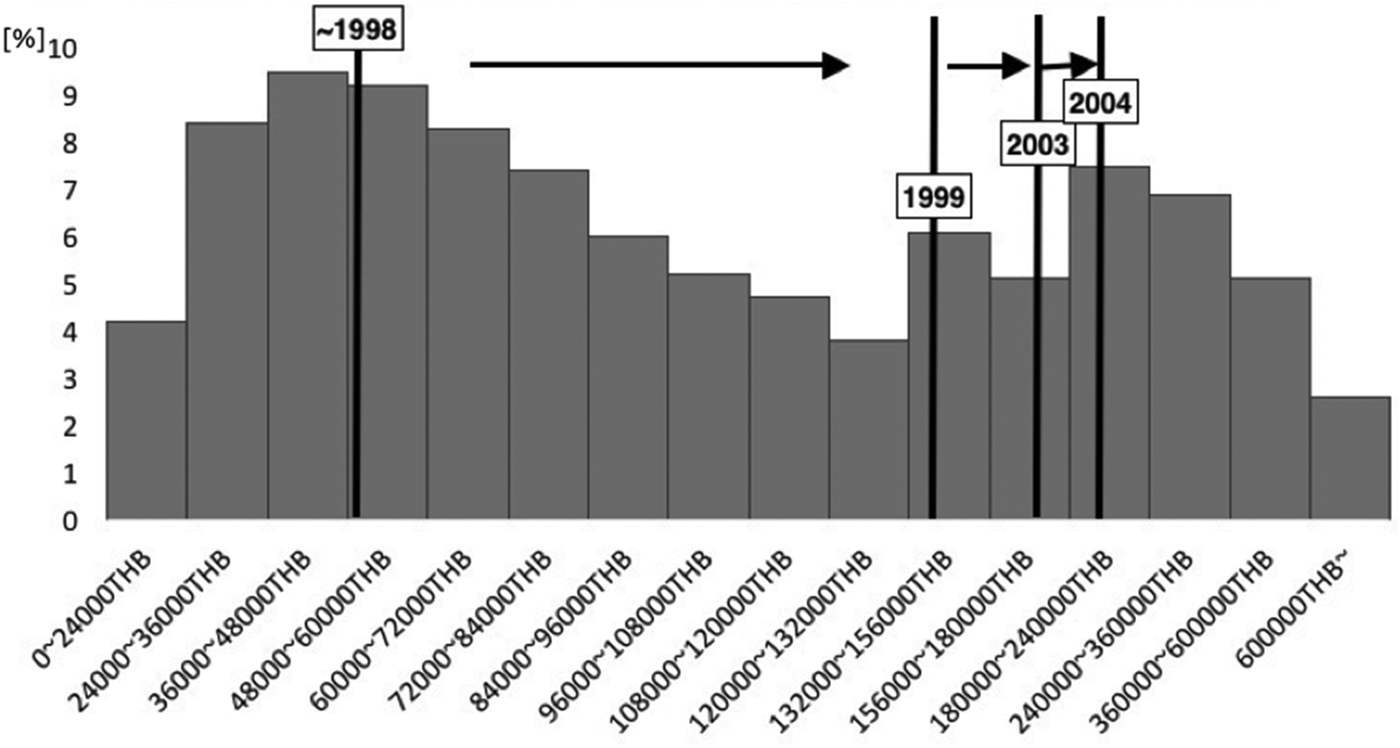
How much did such reforms influence peoples’ lives? Figure 3 shows the 2001 income distribution in Thailand, based on a government report.Footnote 9 Although I could not obtain detailed income distribution data for 1999,Footnote 10 the GDP did not increase significantly between 1999 and 2001 in Thailand. Therefore, I estimate the impact of the 1999 personal income tax reform on people's lives using the income distribution data from 2001. Before the 1999 change, some people were already exempt from personal income taxation because of deductions and allowances. Even if a household did not qualify for any special allowances, it was not necessary to pay a personal income tax between 1992 and 1998 as long as one's annual income did not exceed 50,000 THB, thanks to deductible expenses (40% of income but not exceeding 60,000 THB) and basic allowances (30,000 THB).Footnote 11 The proportion of people whose yearly income was below 50,000 THB in 2001 was approximately 23% of the total population (see Fig. 3), approximately 3% in Bangkok and its surrounding cities, approximately 15–20% in the central and southern regions, and approximately 30–35% in the northern and north-eastern regions.Footnote 12 This suggests that in every region there was never a majority of people who were legally exempt from personal income taxation prior to 1999. This situation changed dramatically in 1999. Households whose yearly joint incomes were less than 140,000 THB did not need to pay personal income tax thanks to the new tax schedule, in addition to deductible expenses and basic allowances. Thus, a majority of people in Thailand were no longer required to pay personal income tax as a result of this 1999 reform (see Fig. 3), although the number of households whose income was less than 140,000 THB was still estimated to be less than one-half of the population in Bangkok and its surrounding cities. The government subsequently repeatedly increased the exempt amount of taxes in the schedules in 2004 and 2008. In 2013, people whose yearly personal incomes were less than 240,000 THB were exempted from personal income tax because of the change in the tax schedule, which applied to more than 85.3% of the country's population. With this reform, the vast majority of people in all regions, including Bangkok and its surrounding cities, became legally exempt from paying personal income tax.Footnote 13 Although the proportion of people who were exempt from personal income taxation was far less than half the population prior to 1999, this proportion has been increasing dramatically since then.
Thai Household Income Distribution (Annual) in 2001

When one considers that three-quarters of the people were still not reporting their income in 2014, some may claim that personal income reforms had no substantial impact on the people in Thailand, because most had no experience with submitting tax returns.Footnote 14 To examine this claim, I looked at the historical, salary data of Japanese companies in Thailand, most of which reported their employees’ salaries to the government before the 1997 financial crisis. According to a survey conducted by the Japanese Chamber of Commerce Bangkok, many Japanese companies in Thailand in 2000 paid unskilled laborers a monthly wage of 6000–6999 THB in the manufacturing industry and 7000–7999 THB in the non-manufacturing industry. The starting salary for unskilled laborers with a junior high school degree was 4500–4999 THB monthly in the manufacturing industry and 5000–5499 THB in the non-manufacturing industry.Footnote 15 Based on these data, many of the unskilled laborers in Japanese companies were paying personal income tax before 1999, but became exempt from paying such taxes after the personal income tax reform of 1999. A look at the salaries of unskilled laborers in these companies reveals that a certain number of people working at companies and factories, including blue-collar laborers, did benefit from the 1999 tax reform.
The repeated reforms increased the number of the workers exempted from paying personal income taxes. According to Thai Publica, in the 2014 fiscal year, the number of people who submitted income tax returns was 10.3 million, and, of these, 6.3 million were exempt from paying personal income tax.Footnote 16 Including the 28 million people who did not submit income tax returns in 2014, only 12% of the workers were substantial taxpayers in Thailand.
Not only has the number of the workers increased but so has the number of companies that are exempt from paying taxes, especially since 2011 when governments began to exempt not only small- but also medium-sized companies from paying corporate income taxes. According to Thai Public, on 5 January 2016, Mr. Prasong Poontaneat, the Commissioner of Internal Revenue, remarked that 81% of companies registered by the Department of Business Development would not need to pay corporate income taxes in 2017. There must be many companies that do not submit tax returns, and therefore the impact on companies is unclear. However, it is certain that those tax reforms narrowed the tax base.
4.4 The impact on tax revenue
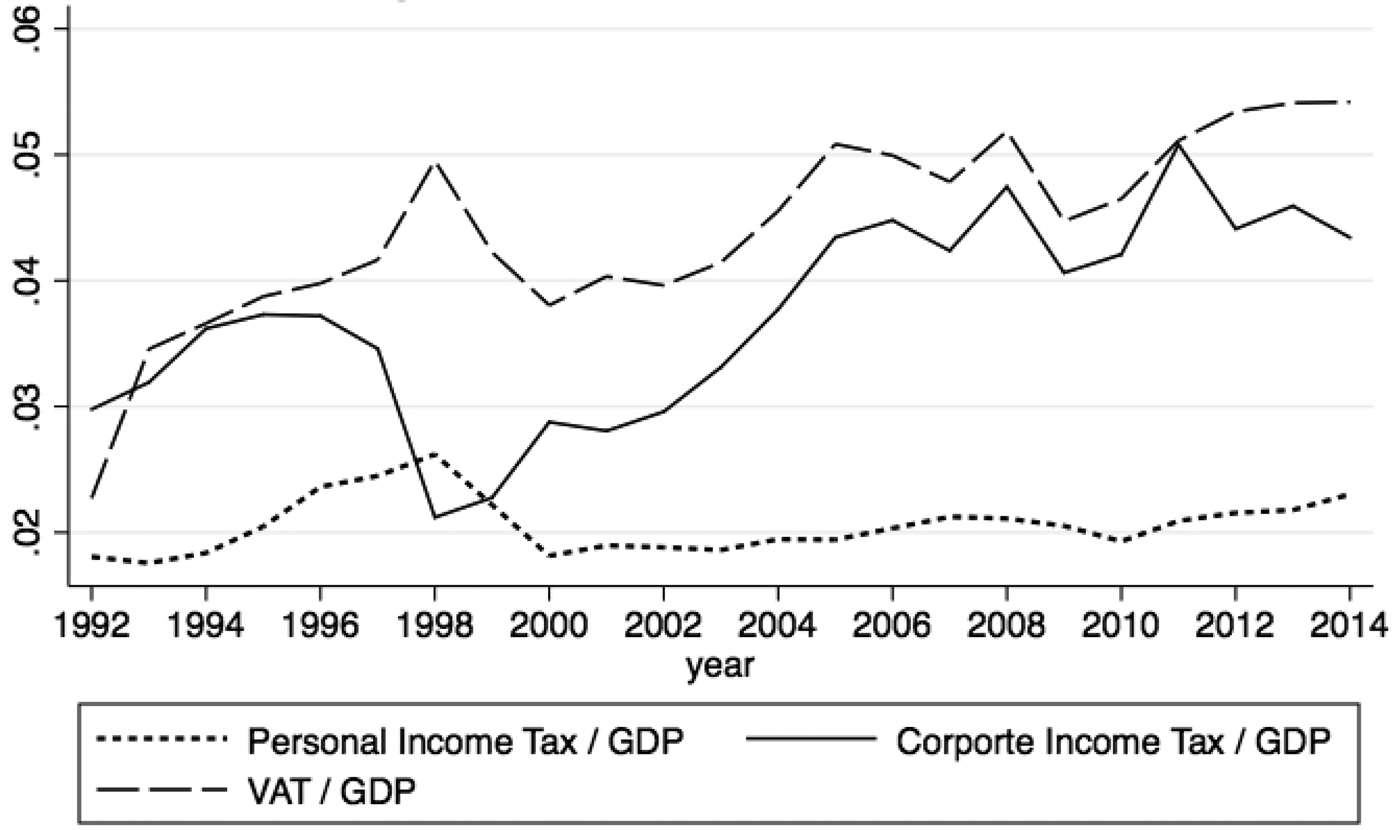
Despite dramatic reforms, those tax reforms did not influence tax revenue very much. Figure 4 plots the share of each tax revenue in GDP.Footnote 17 It is difficult to specify the reason for the decline in the share of personal income tax and the VAT in 1999. It should in part be due to the 1999 tax reforms but also because of the damage caused by the 1997 Asian financial crisis.
Tax Revenue in Thailand
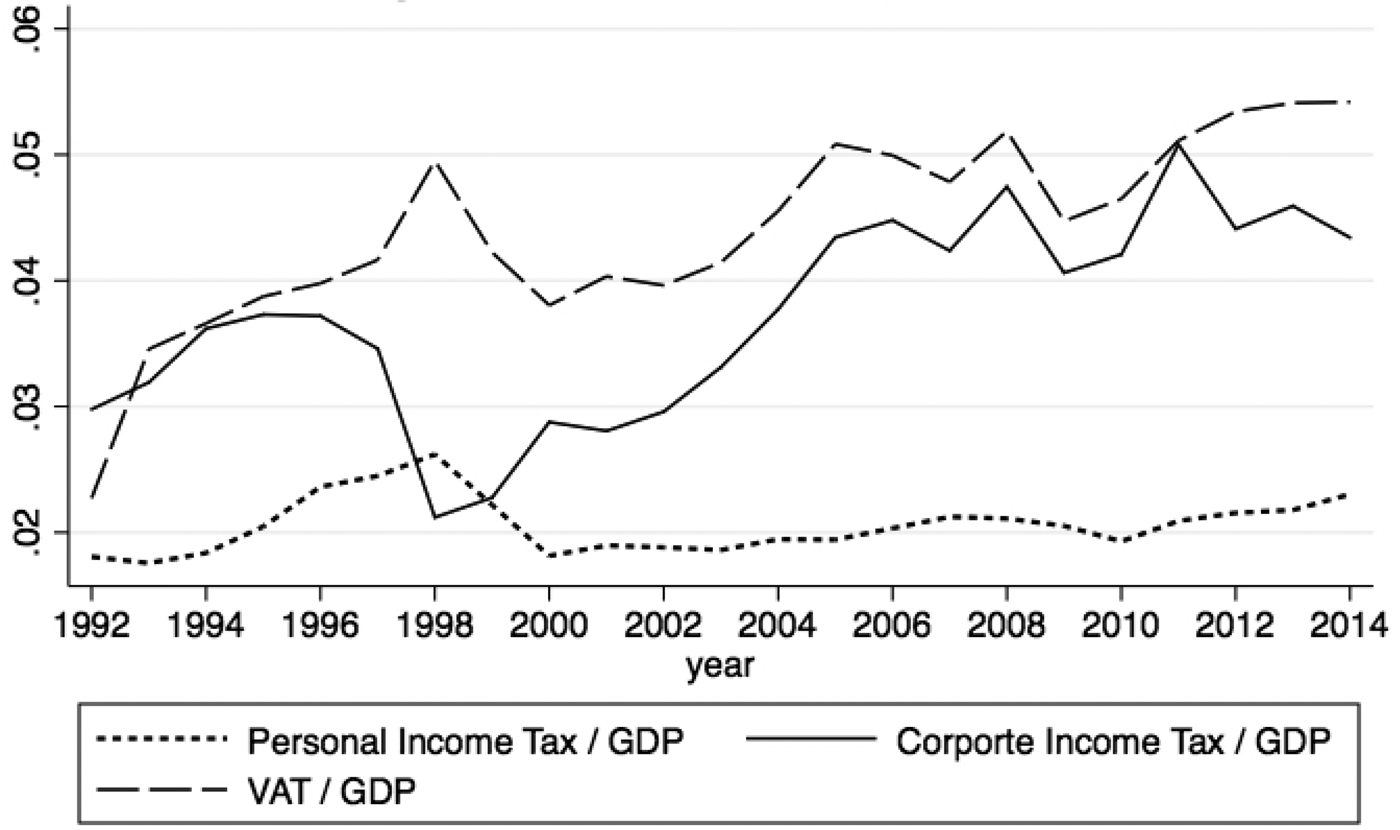
However, one thing is clear from Figure 4: the personal income tax revenue has neither increased nor decreased its share of GDP since 2000. This is curious for the following two reasons. First, personal income tax share did not increase, despite the economic growth in the early 2000s, although the VAT and the corporate income tax increased their share during this period. Second, personal income tax revenue has not decreased its GDP share since 2000, despite the repeated reforms. The changes to the personal income tax hindered the increase in revenue but did not damage tax revenue, because most people were poor. From the outset, tax revenue had depended on a small cadre of elites who monopolize wealth rather than the poor masses. Therefore, governments did not need to hesitate in conducting reforms to increase the range of tax exemptions because the loss of tax revenue caused by the reforms was limited, at least in the short run. Exempting poor people from taxation is an effective way for the Thai government to alleviate their dissatisfaction with government and/or win their support with minimum losses. However, this policy might deprive the government of a chance to increase revenue as its economy grows.
5. Conclusions
An examination of the case of Thailand from 1992 to 2013 found that the 1999 and later tax reforms implemented by the Thai government aimed to increase the range of tax exemptions and thereby exempt the majority of people from paying income tax. Why did the government reform the tax system in this way? Of course, they originally reformed the tax system for economic recovery and growth. However, they also implemented these reforms to alleviate people's dissatisfaction with their lives and their government and to retain their support. If society were equal, the financial loss resulting from those reforms would be huge; however, Thai society is unequal. The financial loss in Thailand was not severe because, from the very outset, tax revenue did not depend on the majority of people who are poor but on a small number of wealthy people. Therefore, the Thai government did not need to hesitate to exempt poor people from income taxation. Consequently, Thailand legally and substantially narrowed the tax base for decades.
The evidence from the Thai tax reforms has a wider implication for other developing countries. An unequal society, a large number of people who do not pay their taxes, and a large tax deduction and exempted tax range are common in those countries. The literature on tax systems in developing countries has demonstrated that the GDP share of revenue from progressive taxes remains low in unequal countries. However, the main focus of these works was elites who oppose a progressive tax system. Indeed, the Thai people also criticized the tax fraud or evasion of the wealthy, which are severe problems in Thailand. However, this case study suggests other problems: many poor people, in fact, do not pay progressive taxes, either legally or illegally. The problem of weak state capacity has mainly been discussed in relation only to the resistance of the elite and the rich to pay taxes, but these governments also have difficulty in collecting taxes from the poor. In these countries, many people do not submit income tax returns. It is difficult to force them to do so because their numbers are so much larger than the wealthy, and officials cannot check all of them. Even worse, developing countries, especially under majority rule, have little incentive to force the poor to pay taxes. In an unequal society, most people are poor, and their salaries are small, unlike in developed countries. In such cases, even if governments exempt a majority of the people from taxation, the overall tax revenue will not be greatly damaged. Therefore, democratic governments in unequal countries may have an incentive to exempt poor people from taxation rather than to impose taxes on poor people in order to win the next election or at least not to lose public support, which hinders the expansion of the tax base.
Acknowledgements
The author is grateful to Junko Kato, James Mahon, Akira Suehiro, Eiji Murashima, Yoshifumi Tamada, Yasuhito Asami, Kitti Limskul, and Nattapong Puttanapong for their thoughtful comments and advice, and anonymous interviewers for their cooperation. She also thanks Warittha Ratanacharee for her assistance. This research is supported by a Nomura foundation grant.
All interviews were conducted in Bangkok whereas names are remained anonymous with the requests of interviewees. Interview of Thai consultants on 16 February 2017. Interview of Thai bureaucrats on 20, 23, 24, 27, and 28 February 2017.
Tomoko Matsumoto is a junior associate professor at Tokyo University of Science. She researches public opinion and its political influence, focussing especially on government stability, tax policies, and social mobility at the time of democratization.