A recurring theme in the American “culture wars” is the allegation that formal education, especially higher education, is biased against political conservatism. To hear conservatives tell it, the American education system, with its multiculturalist dogmas, dominance by liberal faculty, hostility to traditional sexual morality, knee-jerk irreligiosity, and suspicion of market capitalism, is among the central battlegrounds in a decades-long conflict between conservative and liberal values. Footnote 1
This essay has good news and bad news for conservatives who wield this allegation. In one respect, this allegation is correct: American formal education is biased against conservatives. However, this bias is not the result of ideological hostility to conservative thought or ideals. American formal education is not biased against conservatism, but it is biased against conservatives. The source of this bias is a set of academic expectations and practices that exert negative pressure on conservatives’ typical learning orientation. The notion of a learning orientation will be described more fully below, but roughly, a person’s learning orientation is that set of dispositions made manifest by tasks requiring learning. Our learning orientations explain how we engage with experts or authorities, assess evidence for or against claims, respond to academic adversity, and assign value to what we learn. As an abundance of recent psychological evidence indicates, conservatives and liberals vary on many cognitive and affective dimensions, including those dimensions that likely influence individuals’ learning orientations. Conservatives and liberals typically have, I propose, contrasting learning orientations, and formal education systems are “biased” in favor of the characteristic learning orientations of liberals and against the characteristic learning orientations of conservatives. Anti-conservative bias is therefore epistemological, not ideological, in its origins.
It is partially because this bias is epistemological rather than ideological that anti-conservative bias is not unjust. It turns out that there is a non-accidental relationship between conservative learning orientation and conservative political ideology. But bias against the former does not entail bias against the latter. More generally, whether bias against conservative learning orientation in formal education is unjust bias against conservatives is a matter of institutional, not natural, justice. Institutions will invariably treat individuals unequally along some dimension or other. I survey a number of ways in which the anti-conservative bias in education might be unjust, and find that they all fail to constitute injustice. More specifically, the bias in question is neither procedurally nor distributively unjust to conservatives. The unequal treatment of conservatives is therefore not an unjust inequality.
My discussion unfolds as follows: Sections I through IV are an extended exercise in applied social science. After mustering the evidence for anti-conservative bias in formal education, I then provide an overview of the psychological research about the personality attributes that divide conservatives and liberals, and I propose that these attributes in turn ground differences in conservative and liberal learning orientations. These differences, I conclude, provide the most parsimonious explanation for anti-conservative bias in formal education. Sections V and VI argue that this bias is nevertheless not unjust. I conclude that while it is possible to fashion a system of formal education that would not be biased against conservative learning orientations, such a system would be unsuited to the needs of advanced industrial democracies like our own and would serve neither liberal nor conservative students well.
A few caveats: I lament from the outset the exclusive focus here on American education and ideological difference. Most of the research concerning political bias has investigated American students, instructors, and educational institutions, and this is not surprising since American conservatives have been especially vociferous in their claims of bias against them. Second, virtually all of the evidence of bias comes from higher education. While I would welcome evidence from elementary or secondary education about anti-conservative bias, it will become apparent later that the kind of bias I have in mind is likely to manifest itself primarily in higher education.
Third, this essay make use of “conservative” and “liberal” as terms denoting certain broad sets of political or ideological commitments held by Americans. Conservatives typically endorse less government intervention and regulation in the economy, preferring instead market mechanisms and low levels of taxation; strong military defense, including a willingness to use military force to advance American interests or values; and “traditional” moral stances, including opposition to homosexuality, abortion, affirmative action, and gun control, as well as a prominent role for religion (especially Christianity) in public affairs. Liberals, in contrast, endorse a larger role for government intervention and regulation in the economy, particularly in pursuit of greater economic equality; the use of diplomacy and international institutions as the primary vehicle of U.S. foreign policy; greater latitude for individual choice concerning sexual conduct, the formation of families, and so on; and a smaller role for religion in public life. Footnote 2
In using these terms, I recognize that they do not exhaustively categorize Americans’ political commitments. Many Americans hold some combination of conservative and liberal views. Furthermore, “conservative” and “liberal” do not denote timeless, cross-cultural essences. What is deemed “conservative,” say, in one place and at one point in history may be relabeled “liberal” in another setting. Furthermore, the vocabulary deployed in the American political context may not map readily onto vocabulary deployed in other contexts, for example, “Right” versus “Left.” Hence, while I doubt that the claims I make about educational bias against the learning orientation held by American conservatives can be easily extrapolated to “conservatives” in Europe, Asia, and so on, I expect that they may well hold true with respect to those who share the ideological commitments held by American conservatives, even if they are not identified, by themselves or others in their cultures, as conservatives.
Lastly, complications arise from the fact that American conservatives differ from libertarians. American conservatives, on the one hand, are social conservatives who espouse minimal government involvement in economic affairs but often defend the use of law or government policy to support traditional moral stances that, arguably, restrict personal liberty. Libertarians, on the other hand, are minimalists in both the economic and social spheres, favoring extensive personal liberty in both. In my estimation, the kinship between American conservatism and libertarianism is not as strong as supposed because, for contemporary American conservatives, their support of free enterprise is primarily sociocultural. That is, they perceive a minimally regulated market as a distinctly American birthright, as the sole economic system “compatible with political liberty . . . a decisive instrument in preserving freedom through maintaining private control of economic power.” Footnote 3 That American conservatives see support for free markets through a sociocultural lens is further reflected in their denunciations of economic liberals in terms of long-vilified social categories (Marxist, socialist, “elitist”). I suggest, then, that for American conservatives, economic liberty is not a freestanding commitment. Rather, it is an instantiation of their social conservative commitments, an economic ideology they associate with traditional American values. Footnote 4 Thus, what I say about conservatives here probably will not apply to libertarians, who endorse both economic and social liberty.
I. Anti-Conservative Bias: The Evidence
Let us begin by considering the social facts that might constitute evidence for the existence of bias against conservatives in formal education, at least in the United States.
First, college and university faculty are much more liberal than the population as a whole, and this gap appears to be widening over time. Footnote 5 Just over half of faculty identify as Democrats, whereas about 35 percent of the larger public does. Conversely, 14 percent of faculty identify as Republicans, whereas about 30 percent of the larger public so identify. And even those academics who profess no party affiliation appear to lean Democratic: John Kerry won 77 percent of the vote of faculty in 2004, and Barack Obama won about 80 percent in both 2008 and 2012. In addition, faculty are much more likely to describe themselves as progressive, liberal, or leftist. Neil Gross estimates that between 50 and 60 percent of professors can “reasonably be described as leftist or liberal, at a time when only 17 percent of Americans fall into that category.” Footnote 6
Second, those who attend college are noticeably more liberal than the general population. In recent years, the percentage of entering college freshmen who identify as liberal has hovered around 30 percent, whereas the percentage of college freshmen who identify as conservative has been around 20 percent. In the larger U.S. population, slightly fewer identify as liberal (about 21 percent), but more strikingly, about twice as many (around 40 percent) identify as conservative. Footnote 7 Moreover, even if college freshmen are only slightly more likely to self-identify as liberal, a full 45 percent of the college student population identifies as liberal. Footnote 8 The views of college students on specific political issues mark them as significantly more left-leaning than the general population. A full three quarters of entering college students back same sex marriage, and solid majorities support legalized abortion, a universal national health care plan, and increased taxation on the wealthy. Footnote 9 While college age individuals tend to become more liberal in general, exposure to liberal college faculty does not appear to be responsible for this tendency. Rather, such shifts are due to exposure to the political attitudes of other students. Footnote 10
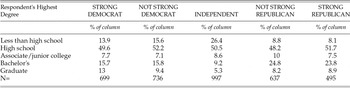
Lastly, level of education is increasingly predictive of voting patterns. Saloner Footnote 11 provides Table 1, based on 2006 General Science Survey data.
Relation between Education Attainment and Political Affiliation in the United States, General Social Science Survey Data 2006. This table is reprinted (with minor editing) with permission of the site administrator of the Inequalities blog. It appeared in the post by Brendan Saloner entitled “Does College Make You Liberal,” dated March 12, 2012.

This table indicates that having less than a high school education makes one more likely to be a Democrat, whereas being college educated makes one more likely to be a Republican. This might seem to contradict the assertion that anti-conservative bias exists in formal education. However, these facts should not obscure two other important observations. First, those who are college educated are more politically polarized than those who are less educated, as indicated by the small number of independents with bachelor’s degrees. Second, the probability of being Republican peaks in respondents who hold a bachelor’s degree and declines in respondents who attain a graduate degree (a fact that my own explanation of the sources of anti-conservative bias will be especially situated to explain).
Furthermore, while income, race, gender, and other factors play substantial roles in predicting voter behavior, a voter’s level of education has become the most significant predictor of whether an American voter tilts Republican or Democratic. Over the past two decades, Democrats have consistently made gains among those voters with at least a bachelor’s degree and hold a double-digit lead in party identification among those with post-baccalaureate degrees. Conversely, Republicans have been gaining ground among voters, especially white voters, with the lowest levels of education. In the 2012 presidential election, President Obama won in eleven of the twelve states with the higher percentage of bachelor’s degree holders, whereas Mitt Romney triumphed in eleven of the twelve states with the lowest percentage of bachelor’s degree holders. Given the historical associations between liberalism and the Democratic Party, and between conservatism and the Republican Party, these voting trends imply a growing correlation between political ideology and level of education. This evidence supports the claim that “today’s real political class warfare is increasingly fought between those who completed their highest levels of study in different kinds of classrooms.” Footnote 12
The kind of evidence for anti-conservative bias assembled here suggests that conservative claims of overt discrimination, indoctrination, and the like, whatever merit these claims may have in isolation, lack the scope necessary to explain this evidence. Conservatives themselves usually see anti-conservative bias as an ideological crusade by liberals. Of course, many episodes thought to be evidence of such a crusade turn out to be more ambiguous than conservatives allege, and in general, existing evidence does not support the conclusion that conservatives are regularly mistreated on college campuses because of their ideology. Footnote 13 But even if there are some Ward Churchills in education, the trouble is that the evidence mustered here implies that instances of apparent discrimination or indoctrination are simply too infrequent to serve as a basis for so widespread a phenomenon. This evidence transcends institutions of different kinds, time periods, and so on, implying that the explanation of anti-conservative bias cannot rest on idiosyncratic features of this college or that university, this “tenured radical” or that one. Rather, a plausible explanation needs to be more naturalistic and systemic, appealing to more durable features of the educational system and those engaged in it. In this respect, accounts that appeal to broader facts are more plausible. These might include that conservatives prefer business to academia thanks to the greater income potential in the former, or Neil Gross’ suggestion that the reputation of academics as liberal leads to liberal students self-selecting into higher education. While these broader explanations have the appropriate scope, I will argue that my own explanation, appealing to characteristic contrasts between liberal and conservative learning orientations, is better situated to explain the body of facts cited in this section.
II. The Liberal-Conservative Personality Divide
To see how such structural bias might come about, we need to consider the evidence concerning personality differences between conservatives and liberals. In recent years, many studies have concluded that while conservatives and liberals do not correlate with discrete personality types, they nevertheless have identifiable behavioral tendencies. Though the explanations for these correlations have tended to reflect the intellectual fashions of the times (Freudian or psychodynamic in the 1930’s, Marxist in the 1950’s, etc.), there is a growing body of evidence that personality and ideology are closely intertwined — that “there is an underlying ‘match’ or ‘resonance’ between general psychological characteristics and the specific contents of ideological beliefs and opinions.” Footnote 14 Because I am attempting to outline how personality influences learning orientation, my focus will be on the specific personality differences between conservatives and liberals that might in turn serve to explain differences in how conservatives and liberals engage with learning tasks.
Perhaps the most consistent finding in this area concerns conservative-liberal differences concerning fear, uncertainty, and risk taking. Liberals are, by and large, more intrigued by novel experiences, less risk averse, and less put off by uncertainty. Conservatives, in contrast, prefer order, structure, and closure. The world presents itself to conservatives as a noticeably more threatening place, a place where nuanced judgments about others’ motives and behaviors is not worth the risk that unfamiliar others may pose. Better, in the conservative mind, to sometimes err by misclassifying the unthreatening than the reverse, thereby exposing oneself and one’s community to avoidable risk. Footnote 15
Jost et al. summarized these findings and suggested that they illuminate the origin of conservatives’ opposition to large-scale social change and to economic equality:
We regard political conservatism as an ideological belief system that is significantly (but not completely) related to motivational concerns having to do with the psychological management of uncertainty and fear. Specifically, the avoidance of uncertainty (and the striving for certainty) may be particularly tied to one core dimension of conservative thought, resistance to change. . . . Similarly, concerns with fear and threat may be linked to the second core dimension of conservatism, endorsement of inequality. . . . they are psychologically interrelated, in part because motives pertaining to uncertainty and threat are interrelated. Footnote 16
Elements of the conservative ideology, on this model, reflect elements of the conservative personality. Conservatives are more strongly attracted to orderly environments where who is a confederate or an ally can be more easily ascertained. Their ideological commitments are thus driven by a psychological need to reduce uncertainty or threat. For conservatives, life in a stable hierarchy is reassuring, while social change is disruptive or chaotic. Conversely, life in such a hierarchy does not answer to characteristic liberal proclivities toward openness and novelty.
A second important set of personality differences concerns cleanliness and disgust. Helzer and Pizzaro found that when individuals are provided environmental cues related to hygiene or cleanliness (for instance, inviting test subjects to use hand sanitizer before filling out a questionnaire) they reported more conservative political attitudes. Footnote 17 Furthermore, many studies suggest that conservatives are more attuned to perceived threats to purity or cleanliness than liberals. Footnote 18 Conservatives’ aversion to perceived environmental impurities appears to function as a “behavioral immune system,” serving to ward off contact with damaging or lethal pathogens. Footnote 19 And while researchers have not found much evidence to link a greater tendency toward disgust to conservative causes such as reducing the capital gains tax, the tendency to find eating worms or images of gouged eyes disgusting is positively correlated with support for conservative causes such as opposition to gay marriage and abortion. Footnote 20
A third and final difference between conservative and liberal personalities concerns the role that positive or negative stimuli play in shaping attitudes. Both conservatives and liberals respond to positive stimuli, but conservatives are more acutely sensitive to negative stimuli. Very roughly, carrots galvanize both liberals and conservatives, but conservatives respond more forcefully to sticks. As a wide body of recent research indicates, conservatives tend to “self-regulate” more commonly through inhibition, and tend to endorse approaches to social problems predicated on constraints or penalties designed to avoid harms to social order. Liberals, in contrast, tend to self-regulate predominantly through “activation,” that is, through the pursuit of positive outcomes, and tend to endorse social policies that encourage desirable outcomes via collaboration. Footnote 21 In one study, individuals were exposed to pro-voting messages with positive framing (“Voting lets you be heard”) or negative framing (“Voting prevents your values from being undermined”). Conservatives found the negative framing more persuasive than the positive framing, whereas liberals found the positive framing more compelling than the negative. Footnote 22 This motivational contrast also gives credence to the journalistic trope of conservative Republicans as the party of the stern father, issuing directives reinforced by sanctions, and liberal Democrats as the party of the nurturing mother, relying on gentle, positive reinforcement.
Such findings invite speculation about the origins of these conservative-liberal personality differences. For many decades, researchers attributed these differences to parenting styles. Recent research suggests, however, that, as with many facets of human psychology, it may well be impossible to distill the explanatory contribution of genetics, environment, acculturation, and so on, to these personality differences. For example, corroborated neuroimaging studies conducted by Kanai et al. found that conservatives have greater brain volume in the right amygdala region, a portion of the brain responsible for processing and managing fear, whereas liberals generally have more gray matter in the anterior cingulated cortex, a region of the brain involved in the monitoring and resolution of conflict. Footnote 23
For our purposes, the origins of these differences matter far less than their reality, and in my estimation, while one might quibble with the details of these findings, the general outline is clear: Liberals are more motivated by creativity, curiosity, and stimulation, whereas conservatives are more orderly, motivated by rule following. In terms of the “Big Five” traits commonly deployed by psychologists to analyze personality, Footnote 24 liberals and conservatives do not appear to diverge systematically with respect to three of these traits (extraversion, agreeableness, and neuroticism). However, conservatives and liberals diverge substantially with respect to two of these traits, liberals registering higher with respect to openness to experience, conservatives higher with respect to conscientiousness. Footnote 25
This body of research illustrates that the relationships among the affective, cognitive, and evaluative dimensions of human psychology are tighter than we might think. Conservatism and liberalism, qua political ideologies, are forms of “motivated social cognition,” that is, individuals adopt them largely because of underlying needs and motives generated by the basic architecture of their cognition and affect. Footnote 26 Our political stances are therefore not psychologically partitioned from our epistemic and emotional dispositions. The conservative aversion to change, belief in tough-minded social sanctions, acceptance of inequality, and so on, is a manifestation of a larger psychological universe in which the avoidance of harm, anxiety about uncertainty, and aversion to the filthy or contaminated are both cognitively and motivationally salient. The liberal willingness to countenance social experimentation, confidence in collective progress, and attraction to inclusiveness is a manifestation of a larger psychological universe in which the pursuit of optimal social outcomes, a tolerance for uncertainty, and openness to change are both cognitively and motivationally salient.
III. The Learning Orientation Divide
If (as I have hypothesized) the personality differences between conservatives and liberals encompass cognition and affect, then it is reasonable to hypothesize that conservatives and liberals will approach tasks involving cognition and affect differently. Success in formal education of course requires particular cognitive aptitudes. But we also know that learning is a profoundly affective or emotional process. Successful learners are bright, yes, but they are also blessed with certain patterns of emotional self-regulation conducive to academic success. Academic learning is therefore an area where we could plausibly predict that conservatives and liberals will behave differently.
More specifically, conservatives and liberals are likely to differ in learning orientations. As I shall use this term, it refers to the cluster of attitudes concerning learning that individuals bring to bear on learning tasks. Learning orientations should not be confused with the notion of a learning style (verbal, auditory, kinesthetic, etc.). Nor is a person’s learning orientation her set of academic aptitudes (quantitative reasoning and so on). Rather, a learning orientation is a set of evaluative dispositions that organize and direct the choices and efforts that individuals make in connection with learning. A person’s learning orientation guides her choices and efforts concerning what to learn, for example, which subjects merit her attention. One’s learning orientation shapes attitudes about what techniques or approaches one uses in the learning process. It determines how an individual understands her relationship with her learning partners (teachers and parents, primarily). More broadly, learning orientations incorporate attitudes about who can learn and under what circumstances, as well as attitudes about the value of learning. Martinez proposes that learning orientations contain five components: Footnote 27
-
(1) Learning beliefs: the student's beliefs about her level of knowledge or comprehension, her beliefs about the mechanisms or settings in which knowledge is acquired, her evaluation of her learning competencies, and so on.
-
(2) Learning control: the student's attitudes about the degree of control or agency she has over her own learning choices and progress.
-
(3) Learning enjoyment: the extent to which the student welcomes or fears learning opportunities of various kinds.
-
(4) Learning effort: the amount and kind of strategies and performance efforts the student directs toward learning.
-
(5) Learning intentions: the goals or aims that the student associates with her learning efforts.
In formal education settings, learning orientations help to explain a wide range of student behaviors. To take a homey example: The philosophy student who visits her professor during office hours to discuss how she can improve her performance in essay writing suggests a number of elements of her learning orientation. Her visiting office hours indicates her belief that she can improve her performance — that essay writing is a learnable skill; her approach to academic adversity; her view of the professor as a willing collaborator instead of an antagonist; and so on. Of course, we cannot infer the student’s learning orientation from a single instance of academic behavior. Still, this example underscores how, residing behind a wide range of academic behaviors, is a complex bundle of attitudes about learning, its value, and how it is attained — in short, a person’s learning orientation. Differences in individuals’ learning orientations are likely to be implicated in explaining why some students ask questions in class, enjoy group work, or express doubt about the views defended by their instructor or other academic authorities, while others do not. Footnote 28
A person’s learning orientation thus functions as the normative component of her operative epistemology, and as such, influences what sorts of learning environments she thrives in and finds most welcoming. It is, we might say, her learning personality. As the previous section established, the personality differences between conservatives and liberals are far-reaching. We therefore have good reason to expect that conservatives will differ from liberals in their learning orientations. Moreover, conservatives and liberals will find different learning environments more conducive to their characteristic learning orientations.
Unfortunately, the question of how personality differences of the sort that separate conservatives and liberals influences academic learning is not as well studied as we might like. However, what research exists corroborates what would be predicted by our earlier findings about such personality differences in general. Very roughly, conservatives are apt to prefer highly structured learning environments that avoid ambiguity and reinforce social norms (especially those concerned with avoiding harm or dilution of social hierarchy), environments overseen by strong authority figures that reward conscientiousness more than creativity. In contrast, liberals are likely to be drawn toward learning environments that reward creativity and tolerate ambiguity, environments designed to incorporate multiple, novel points of view and oriented more toward collective success than sanctioning individuals’ transgressions of norms. In one highly suggestive study, participants played a computerized game called BeanFest. The principal task of the game was to determine which characteristics of “beans” were good (producing positive scores when a player approached them) and which characteristics were bad (producing negative scores when a player approached them). While conservatives and liberals were about equally successful in identifying positive versus negative bean characteristics, conservatives played the game differently from liberals. Conservatives deployed an avoidant strategy, making contact with fewer beans overall, and as a result, their success in learning the bean characteristics was predominantly due to their knowledge of what made for a negative bean. Conservatives and liberals thus manifested a “learning asymmetry”: Conservative participants were hampered in gathering overall information about the beans and so false beliefs that a particular characteristic made a bean negative were not likely to be corrected by subsequent game playing.
Consequently, more conservative individuals tended to correctly identify more negative beans, but to miscategorize relatively more positive beans as negative. In effect, they overestimated the number of negative beans in the world. As liberals were willing to approach more beans, they gained more information about the beans and did not exhibit as strong of a learning asymmetry. They developed a more comprehensive perception of the “bean” world. Footnote 29 Shook and Fazio connect the avoidant game playing strategy, and the low information decision making it effects, with facets of the conservative personality, including aversion to the unfamiliar, a proclivity to perceive the world as dangerous, and a fear of loss.
This result reinforces the related finding that conservatism is most at home in settings or situations involving quick, low effort cognition. Eidelman et al. hypothesized that certain core conservative values, including an emphasis on personal responsibility rather than situational explanation, the acceptance of hierarchy, and a preference for the status quo, “map closely onto nonideological psychological processes,” especially fast and efficient information processing. To test this, Eidelman’s team placed test subjects in situations that restricted the subjects to fast or automatic information processing and then gauged the political attitudes subjects expressed immediately subsequent to those situations. For instance, participants were intoxicated with alcohol or subject to time pressure. The researchers found that when subjects’ capacity to engage in deliberative, effortful thought were disrupted in these ways, they expressed more conservative political attitudes than they did otherwise, suggesting that “when time and effort are in short supply,” thereby compelling “low-effort information processing,” conservative ideological responses increase. Footnote 30 Conversely, encouraging abstract, effortful thought appears to counteract conservative political commitments by increasing openness toward nondominant groups. Footnote 31
Variations in learning orientation also appear to be predictive of the ideological distribution of faculty in various disciplines. Based on the personality differences adduced thus far, we would expect that conservatives would gravitate toward, and be successful in, disciplines that (a) have high levels of intellectual consensus instead of disciplines where conclusions are ambiguous, uncertain, or provisional; (b) emphasize concrete rather than abstract thinking; and (c) minimize exposure to outside cultures or ideas that could be perceived as threatening. We would expect, then, conservatives to be poorly represented in fields like philosophy, anthropology, and psychology — strongly theoretical fields with low levels of intellectual consensus but high levels of exposure to the spectrum of human thought and practice. Conversely, applied fields with high levels of consensus that deal primarily with stable objects rather than human beings are likely to be more hospitable to conservatives and to their characteristic learning orientation. In a landmark study by Ladd and Lipset, they identified a
rather neat progression from the most left-of-center subject to the most conservative, running from the social sciences to the humanities, law, and the fine arts, through the physical and biological sciences, education, and medicine, and to business, engineering, the smaller applied professional schools such as nursing and home economics, and finally agriculture, the most conservative discipline group. Footnote 32
A paradigm case of a left-leaning discipline might therefore be sociology, with significant intellectual dissensus, an abundance of abstract theory, and an abiding interest in the descriptive study of culture. Agriculture, on the other hand, is a discipline with few fundamental controversies that emphasizes homogenous tactile objects rather than the heterogeneity of human cultures.
IV. Explaining Anti-Conservative Bias
We have, then, good reason to believe that conservatives and liberals tend to vary significantly as learners. I will now indicate why differences in learning orientation provide the most likely explanation of the anti-conservative bias documented earlier.
First, we must keep in mind the scope of the phenomena that stand in need of explanation. A great deal of ink has been spilled to explain the predominantly liberal tendency of faculty in higher education. However, as I noted in Section I, anti-conservative bias manifests itself in other ways, including who attends college and the general correlation between duration of education and political ideology. A suitable explanation of anti-conservative bias ought to encompass all of these phenomena.
The explanatory story I favor is this: As formal education proceeds, the skills and aptitudes it rewards become increasingly biased in favor of the learning orientation characteristic of liberals and against the learning orientation characteristic of conservatives. That is, conservatives are, to use a biological metaphor, selected against in formal education. But the target of selection is not conservative ideology, but conservatives’ learning orientations, which are non-accidentally associated with their ideology.
Consider, for instance, various models of educational and intellectual development. One prominent model is Bloom’s revised taxonomy. Footnote 33 In this taxonomy, modes of learning are categorized based on the requisite order in which these modes should be pursued in order for learners to master a body of knowledge. According to Bloom’s model, mastery begins with learners memorizing some body of claims and proceeds toward understanding these claims and applying them to unfamiliar phenomena. At the highest level of mastery, learners analyze these claims, evaluate their veracity or plausibility, and create new artifacts reflecting their knowledge. So when elementary students study, say, the U.S. Constitution, they are typically asked to remember (what are the three branches of government established in the U.S. Constitution?), understand (why were the Articles of Confederation rejected in favor of the Constitution?), or apply (how is the form of democratic government established by the Constitution different from other forms of democracy?). Such study emphasizes the lower learning modes in Bloom’s taxonomy. Secondary students might be asked to analyze the Constitution (what elements of the Constitution serve to limit popular government?). College-level students may be asked to engage in evaluation (does the Constitution adequately protect the interests of those with unpopular beliefs?) or in creative tasks (develop a constitution to govern the dealings among you and your suitemates).
More relevant for our purposes is what sorts of learning orientations are likely to succeed in these different learning modes. Thanks to their conscientiousness, preference for the concrete and the definite, and so on, conservatives are likely to find memorizing, understanding, and applying congenial. Conservatives thrive as learners when the direction of inquiry is evident and principal claims remain stable. Liberals, in contrast, are likely to find the tasks associated with evaluation, analysis, or creativity more engaging, inasmuch as these require more counterfactual thought, welcome envisioning alternatives to the status quo, allow for ambiguous conclusions, and demand effortful thought. Liberals are thus relatively advantaged as formal education proceeds.
We see a similar progression — pressure exerted against conservatives’ characteristic learning orientations as formal education proceeds — in William Perry’s well-known theory of intellectual development. Footnote 34 Perry’s theory conceptualizes intellectual development in terms of learners’ understanding of the sources and validity of knowledge claims. In the earlier stages of learner development, learners are largely preoccupied with epistemic authority, first placing unconditional trust in authority and later attempting to discern which authorities are trustworthy. As learners progress in their development, learning and knowledge are increasingly seen in sociodynamic terms. On Perry’s scheme, learners “break” from authority and begin to appraise claims to knowledge on their own. Learners pass through a relativistic stage (“everyone has his or her opinion”) to stages where neither dogmatism nor skepticism reign (“there are no indisputably correct answers, but not every answer is equally well supported by the evidence”). Learners’ developmental arc culminates in a stage of what we might call provisional commitment: Learners endorse their own beliefs or convictions but respect others’ intellectual commitments and are prepared to learn from their engagements with others’ commitments.
Perry’s theory illustrates how, as formal education proceeds, those with the characteristically conservative learning orientation are likely to find formal education less congenial and more confounding. The conservative learning orientation places greater trust in authorities, so to the degree that at earlier stages of formal education students are expected to place greater trust in authority, conservatives are likely to be comfortable in those earlier stages. But as learners’ epistemological stances develop, authority gives way to multiplicity of perspective, collaboration, and critical thinking. For learners at ease with authority but ill at ease with autonomy, the later stages of Perry’s developmental scheme are likely to be disorienting.
Finally, we find further corroboration of the thesis that formal education selects against the conservative learning orientation from the literature on the hierarchy of learning orientations themselves. Footnote 35 This model categorizes learners into four basic orientations:
-
(1) Resistant learners: hostile to academic learning, resistant learners are alienated from formal education and perceive it as essentially irrelevant to their personal goals. Having had few positive academic experiences, they associate formal education with boredom and frustration and typically avoid learning opportunities.
-
(2) Conforming learners: passive and unquestioning, conforming learners assimilate others’ knowledge and reproduce it in order to satisfy others’ expectations. They usually avoid engagement with the content of what they are taught, rely on a long-established set of learning techniques and procedures, and avoid academic risk. Conforming learners are happy to let others set the terms of their learning environments and prefer structured learning environments governed by unambiguous standards.
-
(3) Performing learners: motivated by external goals such as grades or career preparation, performing learners adopt a short-term outlook on their learning. They resemble conforming learners in being averse to risk and in avoiding academic challenges, but they are willing to consider alternative learning strategies when they do not succeed. Performing learners are often very diligent and willing to expend effort, but only so long as such effort culminates in the satisfaction of short-term external goals.
-
(4) Intentional learners: enjoy meeting high standards and gain self-esteem from succeeding on tasks that require effort and the manifestation of their mastery of learning tasks. They desire expertise and continually modify their learning approaches and techniques in order to acquire said expertise. Intentional learners have a heterogeneous body of strategies they deploy in order to address academic adversity and respond positively to loosely structured but content-rich environments that prioritize problem solving.
Unlike Bloom’s taxonomy and Perry’s developmental theory, this model of intentional learning is not meant as a developmental ladder, that is, it is not necessarily expected that students will begin as resistant or conforming learners, say, and advance toward being performing or intentional learners. However, the model predicts that as formal education proceeds and presents stiffer challenges to students, those at the lower end of this continuum will suffer while those at the higher end will thrive. And we can reasonably surmise where conservative and liberal learners are likely to be found on this continuum: Conservatives, with their aversion to risk, preference for highly structured learning environments, and acceptance of hierarchy are likely to be conforming learners, or if they are especially conscientious, performing learners. In contrast, thanks to their typical openness, comfort in dealing slowly with large bodies of information, and preference for less structure, liberals are more likely to become intentional learners. Again, as formal education proceeds, it is likely to exert pressure against the characteristic learning orientations of conservatives and to advantage the characteristic learning orientations of liberals.
My explanation of anti-conservative bias, appealing to the forces that act upon individuals and their learning orientations, enables us to explain the phenomena associated with this bias more elegantly than rival explanations appealing to overt discrimination, self-selection, and the like. For none of these explanations has a sufficiently wide scope to explain the phenomena in question. The facts that college faculty skew liberal, that college students themselves are more liberal than the general population, and that liberalism is increasingly associated with higher levels of education are broad social facts. The research about learning orientations and their relationship to political ideology indicate similarly broad psychological facts. Furthermore, the explanation appealing to learning orientations can explain some of the idiosyncratic features of these social facts. For example, we observed in Section I that Republicans are more likely than Democrats to hold bachelor’s degrees but noticeably less likely to have graduate degrees or to become university faculty. On my view, the bias within formal education against conservative learning orientations operates throughout formal education. However, it is likely that certain elements of the conservative learning orientation (diligence, acquiescence to authority, etc.) serve conservatives well in formal education up until the point when the learning tasks students are asked to perform become tasks for which those with the characteristic liberal learning orientation are likely to be better suited. This tipping point, I would propose, appears to come somewhere near the beginning of the undergraduate years, when the learning tasks students are asked to perform shift more dramatically from emphasizing retention and application to emphasizing analysis, evaluation, and creativity.
Neil Gross, whose research has produced an impressive body of information about the relationship between education and political ideology, agrees with me that appealing to overt discrimination to explain anti-conservative educational bias is inadequate. However, he rejects “cognitive” explanations like mine in favor of self-selection — that is, the liberal reputation that American academia has developed has made college education more attractive to liberals, whereas “young conservatives see academe as foreign territory.” Footnote 36 However, Gross only aims to explain the political composition of faculty, not the political attitudes of students nor the correlations between education and voting patterns. Thus, my explanation is better suited to a wider range of phenomena. Furthermore, Gross neglects a central component of my explanatory analysis, namely the role of learning orientations. Gross questions whether personality predicts the likelihood that a person will attend graduate school, but my analysis proposes that personality predicts learning orientation, which in turn predicts the likelihood that one will find formal education, especially higher education, inviting and worthy of one’s efforts. Finally, my explanation encompasses Gross’s. No doubt some measure of self-selection in terms of who attends college, becomes a faculty member, and the like, is at play too, but such self-selection occurs against a wider education context that favors liberals and their learning orientation. We do not select our vocations and occupations in a vacuum, and liberals’ learning orientations make it more likely that they will be drawn to, and find success in, formal education.
V. Real, But Not Unjust
With this explanation of anti-conservative educational bias in hand, we may now turn to normative matters: Is such bias unjust to conservatives?
An initial difficulty here is how we are to classify whatever injustice might be at stake in this matter. The putative injustice done to conservatives by formal education systems is neither retributive nor restorative in character. Indeed, it is not a matter of any form of “natural” justice at all. Rather, the sort of injustice at issue here is a form of institutional injustice, that is, whether some individuals are wrongly treated by institutions. Footnote 37 Rawls famously proclaimed that the “primary subject of justice is the basic structure of society,” and more exactly, justice’s primary subject is “the way in which the major social institutions distribute fundamental rights and duties and determine the division of advantages from social cooperation.” Footnote 38 Educational systems, I take it, fall within the ambit of justice because they are among the principal institutions that generate rights, impose duties, and allocate the fruits of social cooperation.
Unfortunately, I do not have a theory of institutional justice. Fortunately, I do not believe we need such a theory in order to appraise whether the anti-conservative educational bias I have identified is unjust. Institutions and the rules or practices that define them can be unjust in one of two ways. An institution is procedurally unjust when its rules or practices are unfairly applied, implemented, or established. An institution is distributively unjust when its rule or practices are themselves unfair with respect to how they allocate rights, resources, or opportunities. In the case of formal education, the rules or practices in question cut an extremely wide berth: They include curricula, pedagogical techniques, disciplinary policies, admission policies, grading and promotion criteria, hiring criteria, and so on. Here we focus in particular on the rules or practices relevant to determining who participates in, and succeeds in, formal education settings. Let us designate — again being mindful that this category encompasses a large and heterogeneous set of rules and practices — all those rules and practices that bear on students’ academic success “academic standards.”
Do we have reason to believe that the academic standards responsible for anti-conservative bias in education are procedurally unjust? I do not see that such a case can be made. First, this anti-conservative bias is not due to academic standards resting on invidious social distinctions or on animus toward selected groups. That institutions of higher education ask students to become knowledgeable about cultures whose practices may shock or disgust them or to defend conclusions concerning questions where the evidence is equivocal may make higher education more challenging for those with the learning orientation characteristic of conservatives. But such academic standards neither single out conservatives for harsher treatment nor reflect any belief in the inherent inferiority of conservatives as people or as learners. In this respect, anti-conservative educational bias cannot be readily analogized to racism or sexism.
Another possibility is that such standards might be procedurally unjust if they were applied arbitrarily in ways that were detrimental to conservatives. But again, conservative fears notwithstanding, little evidence exists to suggest that academic standards are routinely bent in favor of liberals or against conservatives.
Alternatively, academic standards might be unjust if they were somehow hidden from view or inadequately publicized, such that students of whatever political persuasion are hampered in ascertaining what the relevant standards ask of them. Again, this is unlikely. Say what one will in criticizing the academic catalog typical of a modern university, one cannot complain that it conceals from view standards of admission, grade and graduation requirements, academic expectations, and so on. Perhaps conservatives will argue that the standards in question are not formal standards but informal ones, more culturally inscribed standards concerning how one succeeds in academic life. But even here, it is difficult to see how these informal standards are discriminatory, rooted in animus, arbitrarily applied, or unjustly publicized. Indeed, what I have said here concerning the relationship between learning orientations on the one hand and academic comfort or success on the other is echoed in popular work about how students succeed. In his bestselling What the Best College Students Do, Ken Bain Footnote 39 offers a continuum of learning orientations divided into surface learners, who give minimal effort in the hope to survive; strategic learners, who aim for grades rather than understanding; and deep learners, who, motivated by curiosity and the yearning for discovery, pursue difficult tasks and questions, and reason that grades and achievement will take care of themselves. The “deep learner” Bain describes is someone with attributes drawn primarily from the liberal, rather than conservative, learning orientation. These deep learners enjoy questions as much as answers, take risks in their academic choices, ask “big questions” for which evidence is scant or equivocal, and develop empathy for others. Prospective conservative students may not be predisposed toward Bain’s deep learning and the liberal orientation it represents, but they cannot complain that the need to develop such an orientation in order to succeed at the later levels of formal education is somehow clouded in secrecy.
Conservatives may propose that anti-conservative bias is procedurally unjust because the academic standards that generate it have been established in unjust ways. Particularly in a democracy, this argument goes, the institutions responsible for the allocation of benefits and opportunities must be answerable to the popular will. The academic standards that generate anti-conservative bias could have been, as a matter of historical fact, established via procedures that preclude conservatives’ input. In reply, it should be noted that this argument has force mainly for public institutions. Private institutions do not have the same duty to be responsive to the popular will. But even in the case of public institutions, however, the claim that these academic standards have been established without conservative input or oversight is not empirically plausible. The modern public university, for example, is governed in a complex way, with faculty enjoying significant, though not unlimited, control over academic matters, while administrators have principal responsibility for financial and bureaucratic matters. Both groups are ultimately answerable to the public and its representatives, for example, boards of trustees or state legislatures. Defending this complex form of governance is well beyond the scope of this article. Nevertheless, at its best, it strikes a balance between the interests of the wider public and the scholarly expertise of faculty. In any event, conservative voices have multiple opportunities to influence these academic standards, and it is far from rare for conservatives to propose curricular modifications and the like. (Primary and secondary education function in a similar way, though with more local control vested in school boards.)
On the whole then, there is little basis for concluding that the academic standards that result in bias toward conservatives are procedurally unjust. But there is no greater basis for concluding that such standards are distributively just either.
One might try to argue that such standards are unjust because they allocate rights, resources, or opportunities on the basis of attributes that individuals have due to luck, and more specifically, that they do not choose or cannot avoid. On the luck egalitarian view, one of the central aims of justice is that variations in how well-off people are (or more weakly, what opportunities are realistic for them) should stem from their choices rather than conditions they could not choose. Footnote 40 While a person’s learning orientation has a number of causes, it is not largely within a person’s control, since it is the result of genetics, upbringing, and socialization. We might conclude that bias against learning orientations is unjust simply because it results in goods being distributed on the basis of luck.
This argument fails, however. Note that education represents an interesting test case for luck egalitarianism. For within educational settings, rights, resources, and opportunities are routinely — and with very little outcry — allocated on the basis of features that individuals neither choose nor control. There is good reason to think that, at least by the time young people enter into primary education, a good bit of their academic aptitude is already fixed by genetics, upbringing, and so on. As a result, it will often be true that educational rights, resources, and opportunities are distributed on the basis of luck. This occurs both at the “high end” of the educational scale, that is, for goods provided to those with strong aptitudes, and at the “low end” of the educational scale, that is, for goods provided to those with weak aptitudes. Students are admitted to programs for the academically gifted or to the most selective colleges in no small measure due to facts they do not choose or control. Similarly, students are eligible for low cost school lunches or disability-based instruction due to facts they do not choose or control. Indeed, a formal education system ensuring that rights, resources, or opportunities are allocated so as to mitigate all of luck’s effects is extremely hard even to imagine.
What this suggests is that the claim that outcomes or opportunities should never hinge on luck is exaggerated. It is implausible to suppose that a society’s duty to mitigate the effects of luck requires that it mitigate all of these effects in every domain in which they are manifest. Rather, whether mitigating luck’s effect is obligatory seems to depend on the nature of these effects and how a person’s life prospects are affected overall. For instance, the mitigation of luck is more morally urgent when, if it is not mitigated, individuals would be denied the opportunity to compete for particular high status positions in society or to have a minimally decent life as judged by that society’s standards. I do not offer here a precise view as to when luck merits mitigation. Rather, I propose that whatever view we take of this matter, it does not appear that the bad luck conservatives suffer due to their learning orientations is likely to be of the kind, or to rise to the level of, luck that necessitates mitigation. For on the whole, conservatives have not been deprived of opportunities for status, achievement, or wealth in the United States. Conservatives have held majorities in one or both chambers of the U.S. Congress over the past generation. Four (or possibly) five of the justices of the Supreme Court are avowed conservatives. The majority of those in the top quintile of income self-identify as conservatives. If formal education has been biased against conservatives due to the pressures exerted against their characteristic learning orientations, it has by and large failed to oppress conservatives or marginalize them in American society. Hence, the disparate impact of these academic standards does not ground the conclusion that anti-conservative bias has resulted in outcomes that, though due to luck, merit being mitigated.
Likewise, the mere fact that conservatives are disparately impacted by the relevant academic standards does not offer a reason to think that such bias is unjust. Such an appeal has promise in making sense of the injustice of anti-conservative bias because rules or policies can be unjust when they disproportionately impact particular groups even without intending to do so or without even mentioning the groups so impacted. An environmental policy that, while facially neutral, caused disproportionate harm to women or to Asian-Americans could be unjust by virtue of such disparate impact. Since the academic standards in question disparately impact conservatives, they may have a claim of injustice on these grounds.
However, claims of injustice cannot be sustained in this case. Disparate impacts are not relevant to justice per se. No question of distributive justice arises, for example, if a policy or rule disproportionately harms Star Trek fans, the right-handed, or Buick owners. This is because disparate impact is relevant to justice only contextually; that is, it is relevant only if the impact befalls a group with some historical claim to having been the victims of systematic or targeted injustice. Difficult issues arise when we ask if, say, African-Americans, women, or gays and lesbians are entitled to compensation for past social injustice. However, it cannot be denied that societies owe it to such mistreated groups not to enact policies that compound the disadvantages they suffer due to past injustice. Indeed, to compound such disadvantages by adopting policies that disparately impact such groups is to be guilty of an injustice in the present, albeit one made possible only by past injustice. Were it not for the fact that past injustice created “suspect classes” within our society, we would have little moral reason to be concerned that a rule or policy disparately impacts women, African-Americans, or gays and lesbians. But, as a class, conservatives have no reasonable claim to belong to a suspect class historically targeted for discrimination or opprobrium as these other groups have suffered.
Finally, conservatives might argue that the injustice is not so much an injustice done to them but to the polity as a whole. Anti-conservative bias results in fewer conservatives in higher education (and perhaps fewer conservatives with college educations). Conservatives might therefore be underrepresented in the opinion-making classes within society. And one might argue, in a Millian or “classical liberal” vein, that the relative paucity of conservatives in those classes tilts public discourse in a liberal direction so that conservative beliefs and values do not get a fair hearing in the “marketplace of ideas.” Our political discourse and our polity thus suffer because the clash of competing political ideologies needed for vigorous debate is concealed by liberal orthodoxy. Such an argument does not hold up to empirical scrutiny, though. Conservative opinion holds sway in a number of major media outlets, such as the Wall Street Journal and FOX News. Conservative voices also outnumber liberal ones in settings where “official” opinion making takes place, such as the Sunday morning political talk shows. Thus, even if liberal voices may well outnumber conservative voices within educational circles, this imbalance is counterbalanced by the presence of conservative opinion makers in the larger culture. The prominence of liberals in education does not threaten the Millian ideal of a marketplace of ideas.
One last worry about justice: As in all scientific investigations, teasing out causal relations from statistical generalizations can be perilous. I have posited, roughly, a causal story in which learning orientations (and the political values associated with these) explain how educational systems oriented toward certain academic outcomes exhibit bias toward conservatives. Of course, the causal story could be that such education systems fashion individuals’ learning orientations so that rather than these orientations being an independent input into those systems, they are the results of those systems. If so, then perhaps learning orientations are effects rather than causes in this tale. This fact might in turn be thought to be a contributor to injustice. For if an institution benefits those who exhibit feature F, but one would not exhibit F unless one is influenced by that institution, then it might be seen as unjust that benefits flow to those with F.
It is not obvious that this principle is intuitively on the right track. Organized basketball benefits those who are able to make free throws at a high percentage, but it is not unjust that good free throw shooters benefit from an ability that a player develops in the course of her interaction with organized basketball. The military rewards skilled marksmen, but it is not unjust for skilled marksmen to benefit from an ability they may well not have had without military training. If F is a feature relevant to success within an otherwise just institution, then the fact that F is a feature acquired by involvement with that institution does not by itself make benefitting from F unjust. But even if this principle is correct, I doubt that formal education and learning orientations manifest the pattern suggested by this principle. Doubtless, learning orientation is shaped to some extent by individuals’ interactions with formal education systems. Individuals are shaped by the institutions with which they interact, so, it would be surprising if educational systems did not contribute to individuals’ learning orientations. But in this instance, one reason to be skeptical about this particular causal story is that political ideology and learning orientation are fairly well established prior to the advent of formal education. Footnote 41 Block and Block Footnote 42 found that many of the personality differences manifested by conservatives and liberals are already evident in preschool age children, to the extent that nursery school teachers’ descriptions of individual children’s personalities could be used to reliably predict adult political ideology. Thus, while I concede that there is likely to be a dynamic relationship between formal education and learning orientation, a significant portion of our learning orientations is causally independent of our experiences in formal education. Moreover, if individuals who receive educations that are broadly similar end up with different learning orientations, the available explanations for such disparities must rest on noninstitutional facts about the individuals themselves, that is, the learning orientations they bring to the process of formal education, to the degree that these orientations are already well formed.
VI. The Aims of Education in Sociohistorical Context
The conclusions reached in the previous section leave only one further possibility: that an educational system utilizing academic standards that disadvantage conservatives is just given its aims or purposes, but these aims or purposes are themselves unjust. I propose that we assess this claim indirectly, by first identifying an educational system with a set of educational standards that would not generate bias against the conservative learning orientation and then comparing that system to the present system that does generate such bias.
To my eyes, the educational regimen most likely to be congenial to the conservative learning orientation is the education of the military class outlined in Plato’s Republic. The education he envisions for these guardians is relentlessly focused on training them for the discharge of their martial responsibilities, and more broadly, on training them to zealously love the city and despise its enemies. Consequently, in order to easily identify the city’s enemies, each of the guardians must naturally be “sharp-eyed, quick to catch what they see, and strong, too in case they have to fight what they capture.” Footnote 43 Temperamentally, the guardians must be courageous and “spirited.” At the same time, however, the guardians must be “gentle to their own people and harsh to their enemies.” Footnote 44 The guardians thus resemble “noble hounds,” whose natural disposition is to be “as gentle as they can be to those they are familiar with and know, but the opposite to those they do not know.” Footnote 45 Indeed, the well-bred watchdog “judges anything it sees to be either a friend or an enemy on no other basis than that it knows the one and does not know the other.” Footnote 46 Like these “noble hounds,” the guardians will be provided an education — aesthetic, physical and moral — whose overarching purpose is to inculcate a zealous, even violent, willingness to defend the community and its norms.
The education provided to prospective guardians bears a striking, and far from coincidental, resemblance to military education even today. Even more striking is the affinity between this education and the sort of educational system in which those with the typically conservative learning orientation are likely to thrive. The guardians’ education aims to inculcate rapid judgment aimed in turn to identify prospective threats and thereby to police the boundary between outsiders and insiders. Such judgment, like the judgment of the noble hounds, is not supposed to be nuanced or adept at navigating evidential or cognitive conflict. This education actively discourages the guardians from questioning the justice of their leaders or of their community, thus incorporating a bias in favor of the status quo. Their education cultivates their fear of the unfamiliar and their affection for the known and for those who exercise authority over them. In more contemporary psychological terms, the guardians’ education seeks to induce reliance on “automatic” reasoning processes and discourage both “algorithmic” reasoning, in which we decouple our attitudes from our immediate behavior in order to consider hypotheticals, and “reflective” reasoning, in which we seek to identify multiple points of view and calibrate our conclusions to the available evidence. Footnote 47
Given Plato’s devotion to the ideal of specialization and specialized education, it is not surprising that he finds this model of education suitable for his military class. But that very specialization illustrates why this model is not suited for education in contemporary democracies. For one, citizens are not the extreme specialists Plato envisioned, even from a vocational point of view. The average working American holds eleven jobs in her lifetime and undergoes two distinct career changes. As a result, individuals must be educated so as to enable them to navigate the vicissitudes of such a labor market. Beyond this, students are not simply prospective employees. They are also citizens, consumers of media, heads of household, and members of overlapping local and national communities. They live in a multicultural world bound together by information technology. An education that befits their situation ought to focus on identifying potential partners, not identifying threatening “outsiders.” So even if a guardian-like education fits the conservative learning orientation, it would nevertheless badly serve the needs of current students, liberal and conservative alike.
Contemporary educational systems are rightly open to the charge that they attempt to serve too many masters, pursuing too many disparate or incompatible objectives. This charge may well be true, and if so, it reflects the complexity of the world for which today’s students are being prepared. I of course do not make the bold claim that our educational system fully succeeds in meeting these objectives, nor do I claim that no doubts can be raised about the wisdom of organizing our educational system around these objectives. Indeed, educational systems, particularly public systems in which education is compulsory, must justify both the expenditures directed at them and the coercive power they exert over those they educate. But these justifications need not refer solely to timeless, ahistorical values. Understandably, our public education systems now routinely teach Spanish and more rarely teach French, emphasize environmental awareness as much as pure science, and no longer neglect the histories of non-Western cultures. Moreover, the academic standards that guide such systems reflect the values and dispositions citizens need, both individually and collectively, to thrive in the world as it is and is likely to be in the future. Conservatives do not appear to thrive under such a system, particularly at its higher or most elite levels. But the mere fact that some students do not thrive under a given educational regimen does not imply that is unjust toward those students.
VII. Conclusion
Neutrality in educational aims is not possible. No educational system can operate according to academic standards that disadvantage no one. And while conservatives do suffer under existing educational systems because those systems incorporate academic standards that disadvantage those who possess the learning orientation conservatives usually possess, no injustice appears to be done to conservatives as a result. Conservatives are not entitled to be treated differently by such a system, for one. As for desert, there are not timeless or historical grounds for assessing the legitimacy of an educational system and the academic standards on which it operates. But we have strong reasons to conclude that, given the sociohistorical circumstances in which our society exists, our existing educational systems emphasize the academic standards they ought to.