

1. INTRODUCTION
Japan has been experiencing a cultural shift in people’s perceptions of and attitudes towards fuzoku (night work) and, for the women involved in this labour, known as fuzoku, night work was considered as a survival tool for single mothers, women without education or professional jobs, and women with mental or physical disabilities.Footnote 1 These disadvantaged women were left few choices and had to enter the industry. However, today, women with advantages and privilege voluntarily seek either part-time or full-time jobs in the fuzoku industry. Everyday women who have families, financial stability, education, and qualification for professional jobs are getting involved in fuzoku and their involvement has started to change the public perception of fuzoku as a dangerous or dirty job.
A 2008 survey targeting 15- to 22-year-old women revealed that night work was ranked at number nine on the “dream jobs” list and that 20% of young Japanese women wanted to become a night worker in the future.Footnote 2 Popular television programmes, magazines for and about night-work women, biographical and journalistic books, and personal social-media posts (including Instagram and Twitter) receive many views from young women. New representations of fuzoku are (re)constructing perceptions of night work.
The Japanese government implemented neoliberalism in 2001 under the Koizumi administration. This political and economic restructuring favoured the protection of corporate profits rather than citizens’ and labourers’ interests, and also implemented a series of systems based on market foundationalism.Footnote 3 These political reforms created social structures where night work had become more common, at least amongst young women, and they voluntarily seek employment in the night-work industry. Neoliberalism’s “choice” narratives construct citizens as free agents who make their own decisions but who must be held accountable for any repercussions that result from their choices.
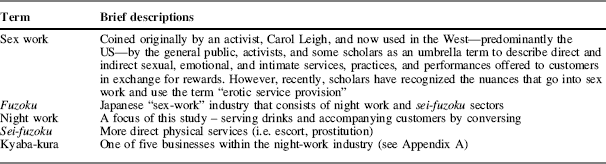
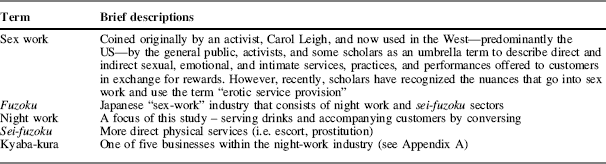
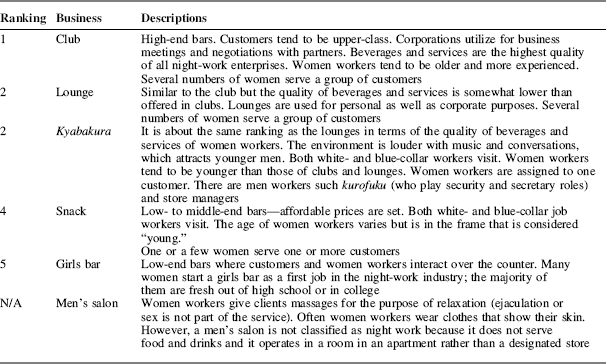
The Western popular “sex-work” discourseFootnote 4 and the radical-feminist discourseFootnote 5 may associate Japanese night work with prostitution and consider young women workers in this industry as victims. These hegemonic discourses are understood and used transnationally and obscure the particularity of “sex work” situated in a certain time and location. The voices and experiences of workers, and particularly those situated in Japan, may get lost “under western eyes.”Footnote 6 I call into question the transnational use of these sex-work discourses. I draw on US-based Western sex-work scholarship that understands the nuance of the work, that it is far more than prostitution, that emotional labour is involved, and that women exercise agency in the context of structural constraints. I also attempt to bridge Western sex-work and Japanese fuzoku literature; Japanese scholarship on fuzoku often does not reach an audience other than the Japanese public due to the language barrier. In doing so, I avoid using the term “sex work” and instead use terms that are used in Japanese contexts—by both the public and the young women I interviewed. Table 1 shows the terms I frequently use throughout this paper. As indicated in the table, kyaba-kura refers to one of five subcategories within night work, which are described in Appendix A. Sei-fuzoku is the arena of sexual-service work with high physical contact. When I use sex work/night work (with a slash), I am referring to the whole Western sex-work and Japanese night-work industries.
Terms used in the paper
Using Japanese terms in my research challenges the linguistic hegemony of sex-work discourses. Critical scholars, such as Mohanty, Fernandes, and Hemmings, offer critical feminist frameworks to challenge the hegemonic Western sex-work discourses, and Parreñas and Hoang’s polymorphous approach to the complex nature of sex work helps me theorize beyond the hegemonic sex-work discourses.Footnote 7 In so doing, I argue that night work is no longer a job that women in a desperate financial situation turn to. Instead, women who are young and from middle-class families enter into night work for a variety of reasons. Friendships with other women and curiosity are key motivations for entering the night-work industry. Moreover, I (re)conceptualize Japanese night work as my subjects describe as a “job that sells womanhood, skilled services, and entertainment” rather than sex per se. Lastly, and most importantly, I attempt to show these women’s complex experience with night work. Their experience is more complex than what is often presented by the Western popular sex-work and radical-feminist discourses as positive/negative, good/bad, or victim/agent dichotomies. My interviews with young Japanese night-work women show that they construct their experiences beyond the dichotomy of positive or negative. Their experiences are shaped around what they call shakai-keiken (which can be roughly translated as “social experience”). The understanding and meaning of shakai-keiken differ from woman to woman. But the common themes include maturing, becoming independent, knowing who they are, learning about how society functions, and seeing both good and bad in people. Therefore, night work becomes a stepping stone for young Japanese women to grow and advance their lives.
This research seeks answers to the following research questions: What are the motivations for Japanese young women to turn to night work in this historical and geographic context when they have ample options for other jobs? How do young Japanese women conceptualize their work? How do night-work women reproduce or transcend the dominant discourses of sex work as positive/negative, good/bad, or victim/agent experiences? In answering these research questions, I conducted interviews with young Japanese women (current college students and recent graduates). I selected this specific population because some Western studiesFootnote 8 show that college students in the US, UK, and Australia voluntarily turn to sex work for financial reasons, such as earning money to pay for college tuition. I was interested in examining whether young Japanese women enter the night-work industry for similar reasons. Moreover, the college-student population in fuzoku has not been a focus of studies by Japanese scholars. Therefore, I find it necessary to examine this population because college women (and recent graduates) contribute to shaping and altering new Japanese culture, and ultimately affect the discourses that construct the meaning of fuzoku.
This paper illustrates young Japanese women’s understandings and experience of night work situated in the Japanese context, instead of examining it through a Western sex-work lens. It starts with a literature review on different feminist critiques of the Western hegemonic discourses, then reviews Japanese literature on fuzoku, women’s (both in the West and in Japan) motivations to enter to sex work/night work, the nature of sex work and night work, and oppression, empowerment, and polymorphous paradigms of sex work/night work. I will then turn to methodologies, findings, and analysis. The findings and analysis section details narratives of night-work women’s trajectory from entering the night-work industry, to conceptualizing their work, to developing understandings of what they gain from night work.
2. LITERATURE REVIEW
2.1 Challenging the Hegemonic Sex-Work Discourses
Popular sex-work and radical-feminist discourses are employed to examine sex work across countries and cultures around the world. I challenge the transnational use and applicability of the Western popular discourse and radical-feminist discourse as a hegemonic Western conceptualization that fails to catch the nuance in sex work that differs across cultures. In doing so, I draw on transnational-feminist and Third-World-feminist frameworks to explain why it may be necessary to critique Western-dominant discourses and to move away from them. Moreover, these feminist frameworks allow me to examine Japanese night work situated in a particular geographical location, culture, politics, and history instead of looking through a Western lens.
In Under Western Eyes: Feminist Scholarship and Colonial Discourses, Mohanty problematizes “the assumptions of privilege and ethnocentric universality” that result in treating Third-World women as a unified group and producing an “average Third World woman.”Footnote 9 Under the hegemonic Western eyes, Third-World women are assumed to be women located geographically in Third-World countries and categorized in one ahistorical, apolitical, and subordinate group. Additionally, in analyzing transnational feminism and interdisciplinary studies, Fernandes also critiques an American national narrative and US-oriented approaches to “the creation and dissemination of knowledge about the world within and outside the academy in the United States.”Footnote 10 Such creation, consumption, and dissemination of knowledge are nationalized by institutionalizing popular or dominant frameworks in the US and it is a challenge to move away from the US nation-centred approach to examine transnational perspectives. These two feminist scholars point out the necessity to situate narratives in the particular historical, political, economic, and cultural contexts.
Transnational-feminist and Third-World feminisms allow us not only to transgress the Western sex-work discourses, but also foreground experiences and voices of women in the sex-work and Japanese night-work industries across the geographical regions and within the niche markets that compromise the industry that sells sexuality, emotions, intimacy, and fantasies. In this paper, I attempt to tell the story differently.Footnote 11 I attempt to tell a story about young women who are involved in night work in Japan in a way that diverges from a hegemonic Western narrative and approach that obscures the experiences of women in Japanese night work because of Western scholarship’s geopolitical power of political grammar, knowledge in “the global lingua franca” (common or universal language), and “dissemination.”Footnote 12 Work on Japanese night work conducted and published in Japanese often lacks widespread dissemination and recognition due to the language barrier. Therefore, in this paper, I attempt to bridge the Western sex-work scholarship and Japanese fuzoku (including night-work) scholarship while acknowledging the particularity of Japanese night work.
Much research in the WestFootnote 13 and JapanFootnote 14 shows that the dominant reason why people, including college women, turn to sex work and Japanese fuzoku is a financial one. Globally, and within Japan, neoliberal economic policies have resulted in a tuition increase among universities and colleges, a decrease in parents’ income, and a decrease in government financial support, all of which have provoked financial difficulty for college students to pursue their college degree.Footnote 15 Regardless of whether it is in the West or Japan, it is common to associate sex and night work with students’ need and desire to get by and pay for school. As such, often, women’s motivation to turn to sex work and night work is simply reduced to a financial one. This reduction and the equation of sex work and night work with poverty and financial motivations (re)produce the idea that sex work and night work are socially acceptable and morally justified if women are working in those industries to financially get by.
In her study of Japanese daughters who engage in sex work to “help their family” in Japan, Koch explains
the parameters of what constitutes a socially acceptable justification for entering the sex industry. Positive, agential motivations, such as choosing to do sex work in the absence of absolute financial necessity, bring scorn and discrimination. … The base assumption was that women’s entry into sex work should always be unwilling.Footnote 16
Furthermore, Miyadai conducts an ethnographic study on high-school girls who engage in a sugar-daddy–sugar-daughter relationship (danjo-kousai) in Japan. He shows that these girls give a variety of “motivation vocabulary” (douki no goi) related to “mammonism”Footnote 17 such as wanting to buy more brand items and just wanting money.Footnote 18 He then points out that girls purposely provide a financial motivation to protect themselves from being judged.
Miyadai brings a variety of motivations forward and undermines money as the dominant motivation for women working in fuzoku.Footnote 19 He poses girls’ desire for “sexual recognition” (sei-teki shonin) as their motivation to seek a sugar daddy and engage in sexual acts. He explains that these girls feel they do not receive recognition at home or school. They tend to degrade themselves and are able to find value in themselves by being (sexually) desired by men and fulfilling these men’s desires. Fuzoku sells and is a space for men to achieve daydreams and fantasies.Footnote 20 Miyadai argues that fuzoku can and is an illusionary space for women workers too. He describes that women are motivated to enter the industry and work to get thrills and excitements stemming from doing what is “considered bad in society.”Footnote 21
In the US sex-work context, Miller-Young highlights three motives that contribute to Black women working as pornography actors in the US.Footnote 22 Accordingly, money plays an important role when it comes to sex work because of its efficiency (i.e. high pay in a short number of hours). Nevertheless, Miller-Young finds that pleasure and fame are significant motives for Black women working in the porn industry. Her argument shows that money is merely one of several reasons that draw these women to enter the industry. Some Black women in the porn industry derive pleasure from performing and exploring their sexuality, and they also feel that they receive recognition, visibility, and value, which gives them a sense of fame. These findings indicate that working in pornography provides the women with not only money, but also positive experiences that empower them and give them strategies to overcome gender, racial, and occupational discrimination in the society in which they live.
The popular sex-work discourse that associates sex work with prostitution and workers’ motivation with poverty reduces sex work and night work to simple terms and does not recognize the complex nature of labour that goes into sex work/night work and the intertwined reasons as to why people do this job. Nevertheless, critical (transnational) sex-work scholarship, transnational feminism, and Third-World feminism offer frameworks to take a step back from the popular discourse and to catch the complexity that hegemonic discourses may fail to see as Miller-Young unpacks the complexity of Black women’s motivation to be porn actors.Footnote 23 The following section continues discussing critical (transnational) sex-work frameworks that critique the equation of prostitution with sex work and address the emotional and intimate labour involved in sex work/night work. These frameworks also challenge the radical-feminist discourse that creates dichotomous sex-work paradigms—sex work/night work as either oppressive or empowering.
2.2 Moving Beyond the Oppressive–Empowering Dichotomy in Sex Work and Fuzoku
Both Western sex work and Japanese fuzoku/night work do not merely provide sexual services. Rather than selling direct sexual acts and employing sexual physical labour, women workers engage in emotional and intimate labour.Footnote 24 Importantly, men consumers of sex work and fuzoku do not come solely for sexual satisfaction. In her study of male clients’ motivations to visit strip clubs, Frank shows key motivations of men for visiting strip clubs to be experiencing a different environment from work and home, getting “safe” and “exciting” experiences, and being personally and sexually accepted by women.Footnote 25 Western erotic-dance clubs and Japanese kyaba-kura sell fantasies and consumers often visit particular women to have a romantic relationship temporarily. Egan examines emotional consumption that operates between dancers and clients.Footnote 26 Women dancers provide care, attention, and love, and, although these interactions are temporary and fake, their clients cannot get those interactions anywhere else. Similarly, Hayashi explains, in studying kyaba-kura and women’s biographies, that kyaba-kura women engage in romantic interactions with their clients.Footnote 27 These women build and maintain delusional romantic relationships with multiple clients while making each client believe that they are in an authentic romantic-love relationship. Egan and Hayashi exemplify women workers’ engagement in emotional and intimate labour to sell their services and gain regular paying clients.
Besides the emotional and intimate labour of sex work and night work, Sanders points out the “humour” or “laughter” that occurs among sex workers as a coping strategy to bond with other workers and demonstrate resistance to clients.Footnote 28 Workers tell each other jokes about their clients in private settings. Sharing jokes or humour is another way of communication to not only establish friendships, but also to manage emotions. Women can protect each other from being both physically and emotionally hurt by clients by introducing humour. For example, Sanders examines humour used in relationships amongst workers and Kumada furthers this examination to analyze humour (warai) about clients, each other, and themselves in the context of Japanese fuzoku.Footnote 29 She describes that women engage in what they perceive as “play” (purei) and their humour derives from such play. Women find it fun, entertaining, and humorous by “letting men play.”Footnote 30 This play changes its meaning and operation among workers. The game turns into “who gets the most clients or money.” In this game, women find or make humorous stories and share them with other workers. Kumada’s analysis of laughter and humour is different from that of Sanders in the way that Japanese fuzoku women do not necessarily use laughter and humour as an emotional management strategy. Their laughter and sense of humour are self-expressions; they express who they are to their co-workers by integrating jokes and laughter in their conversations.
Western feminist debates over sexuality, known as the feminist sex wars in the 1970s and 1980s, placed radical and sex-radical feminists on opposing sides. On the one side, radical feminists profoundly engage in an anti-pornography discourse that is hostile to all sexual practice. Accordingly, pornography and commodified sex where male sexual fantasies come true render sex patriarchal, which in turn leads to violence against women. On the other side, sex-radical feminists acknowledge a “positive” side of sexual practice and that sex is both pleasurable and dangerous. They consider that sex brings women pleasure when involving mutual consensual pleasure between two parties. In this case, the act of sex that concerns women’s agency produces not only pleasure, but also an emotional connection.Footnote 31 Japanese scholars draw on Western sex-wars literature, but have also developed Japanese “sex-work” debates around “free will” (jiyu ishi). Japanese scholars such as Hashitume and Sechiyama support fuzoku work by claiming that people other than workers themselves cannot determine whether fuzoku is bad or immoral as long as workers engage in fuzoku based on their own free will.Footnote 32 Conversely, anti-fuzoku scholars argue that fuzoku workers’ “will” is made within social constraints and is merely free will within structures of inequality.Footnote 33 Moreover, fuzoku confirms the unequal power between genders and enforces the ideology that “women are what is controlled by money and men.”
Feminism has called into question the dichotomous approach to sex work. Weitzer suggests an alternative approach—the “polymorphous paradigm,” which addresses “sufficient variation across time, place, and sector to demonstrate that sex work cannot be reduced to one or the other” and “is sensitive to complexities and to the structural conditions shaping the uneven distribution of agency, subordination, and workers’ control.”Footnote 34 Scholars such as Bernstein, Hoang, Parreñas, and Chapkis align with this paradigm and address that workers are evaluated carefully with respect to the existing cultural, political, and historical conditions under which they live.Footnote 35 Bernstein argues that scholars cannot assess what is right or wrong with sex work without first understanding what it is.Footnote 36 She claims that there is a range of meanings behind sex work and it cannot be simply explained by one theoretical analysis (e.g. the radical-feminist approach to sex work). Moreover, Hoang asserts that sex workers in Vietnam play more important roles other than simply selling sexuality.Footnote 37 They assist entrepreneurs to build a partnership and sign contracts by loosening tensions and entertaining them while navigating male domination and submissiveness.
Western feminists often impose an idea that Third-World women need to be saved. Nevertheless, the sex workers in Vietnam refute this idea and claim that entering sex work liberated them from the poverty and abuse they experienced prior to sex work. Finally, Parreñas recognizes both aspects of sexuality and sex practices—the oppression and empowerment of women—in her ethnographic work with Filipina hostesses in Japan.Footnote 38 She also problematizes the popular sex-work discourse and “anti-sex trafficking activist” discourse because they neglect the autonomy and agency that hostesses have and practise. Similarly to Hoang’s study,Footnote 39 being a sex worker in Japan got those immigrant women out of poverty and gave them autonomy.
Furthermore, studiesFootnote 40 that employ Women of Colour feminisms demonstrate the intersectionality of race, gender, and sexuality in the field of sex work that is often disregarded in the popular sex-work and radical-feminist discourses. Nash examines complicated ways in which Black women in pornography engage not only in harmful overexposure and oversexualization that are created by racialization within a “white-dominated representational economy,” but also in the ecstatic possibilities of racialization—pleasures that are both deeply personal (e.g. aesthetic, erotic, sexual) and deeply social, and that form the basis of political communities and identities.Footnote 41 She offers “race pleasure” where Black women in pornography find Blackness the site of pleasure and desires—simultaneously the site of harm. Black women experience and express private and inward pleasure that does not necessarily cater to viewers.
People may often be caught in an idea that sex work/night work is either good or bad, right or wrong, positive or negative, or oppressive or empowering, as demonstrated by the feminist sex wars. In particular, radical feminists victimize sex workers and negate their agency. In contrast, critical and transnational sex-work scholarship and Women of Colour feminism take an approach to the polymorphous paradigm and address the agency that workers practise. For the rest of the paper, I draw on this polymorphous approach to highlight aspects of Japanese night workers’ experiences as they are situated in current Japanese history, culture, and politics.
3. METHODS
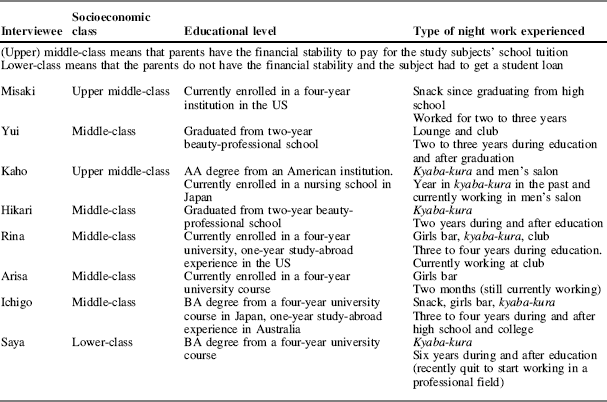
In this research, interviews and participant observation were employed as primary data-collecting methods. Eight women were recruited through the snowball-sampling method. Qualifications of workers were that they currently work in the fuzoku industry or have worked in the industry. All of them had started their work in the fuzoku industry when they were in college and many remained in the industry after they graduated from college. The demographics of interviewees and the night work they have engaged in are described in Appendix B. Semi-structured, in-person, and phone interviews were conducted. Each interview lasted approximately one hour. Interview topics included why they were motivated to enter the fuzoku industry, how they found their work, what kinds of benefits and experiences they had, what they got out of the work, and how the involvement with the work influenced their personalities and lives. At the end of each interview, I provided a space for women to reflect on my interview questions and tell me about what they want people in Japanese society to know about their work. These interview questions were developed based on grounded theory.Footnote 42 Instead of shaping interview questions to test a hypothesis, I shaped the questions openly so that themes would emerge from the interviews themselves. All interviews were conducted and transcribed in Japanese and coded by me for analysis. All interviewee’s names are replaced with pseudonyms to protect their privacy and confidentiality. Although I asked my interviewees the city they worked in, I did not ask the specific area or name of their bar to further protect my interviewees from being identified.
All interviewees were willing to share their stories with me and had a positive attitude towards being interviewed. However, many turned down the interview, indicating that they were reluctant to share their stories with a stranger. They might have accepted the interview if I had spent some time getting to know them, since they were comfortable talking about their work and experience with their friends who referred them to me as potential interviewees. In order to obtain a wide-ranging sample, I attempted to recruit women in sei-fuzoku as well (the arena with high-physical-contact sexual-service work). While I found a few potential interviewees, all sei-fuzoku workers rejected being interviewed. Sei-fuzoku is more stigmatized than night work due to the physical sexual contact and these women might have assumed that they would be discriminated against by me and the audience of my research. In order to connect to women in the sei-fuzoku industry, a researcher likely needs to share some experience with the women and/or engage in a longer process of gaining trust.
Additionally, participant observation was conducted in a snack bar (described in Appendix A) for three months. Although I am not using data from the participant observation in this paper, it adds validation to information provided by interviewees because I also witnessed and experienced work similar to what the interviewees described to me. I conducted participant observation at a snack bar, Blue (I am also using pseudonyms for the bars’ names). The snack bar is located in Saitama prefecture, a neighbouring city of Tokyo. Blue is a branch of the main snack bar, Silver, and located in the next town. It opened in October in 2017 and used to be a Philippine pub. My job duties included talking with customers, making drinks, lighting cigarettes, and cleaning before and after the business hours. These duties were the same as those of other workers. The store manager (mama) is responsible for opening and closing the bar, and I clocked in after her and clocked off when customers and mama were leaving. My shifts were normally from 9 p.m. to when the last client left, which could range from 1 a.m. to 3 a.m. The bar was closed every Sunday and Wednesday, and I worked an average of three nights per week. I took notes on my observations after I was home, since I did not have the time and space to write while working. Fieldnotes were typed into Word documents in English and also coded on the Word documents for analyses. I used the same codes for interview transcripts and fieldnotes to find overlap.
4. FINDING AND ANALYSIS
4.1 What Is Attractive about Night Work? Money Is Only One Piece of a Big Picture
Financial motivation was mentioned by a few women in my study, but similarly to Miller-Young’s findings,Footnote 43 it was not the only motivation. Women in my study are from middle-class families and in a stable financial situation. None of them entered the industry solely because of money. My interviews illustrate two main motivations—friends and curiosity, which are less discussed in fuzoku/night-work research.
4.1.1 Friendship
Even though there are no statistical data that show the number of college women who are involved in night work, it is apparent from the literature on Japanese fuzoku Footnote 44 and conversations with interviewees that female students’ involvement in night work is becoming normalized among the younger generation. Night work is popularly understood as a way to effectively make money while drinking, talking, and learning. The interviewees went to interviews, got recruited, and often got hired together. One interviewee, Ichigo, once had three types of night work—a snack bar, girls bar, and kyaba-kura, and she started working there because her friends introduced these jobs to her. Knowing that friends already work and have experiences in night work gives them peace of mind about their safety in these sites. As Kaho told me: “I thought it was kind of a risky job before talking with my friend.” Kaho’s friend disclosed to her that she had been working at the men’s salon for a while. “But I trusted her as my friend. She said it’s a fun high-paying job. So I tried it once because she kind of convinced me. I have been working there since.” Because a men’s salon takes place in a room in an apartment, Kaho once feared she may be attacked by a client. However, after listening to Kaho’s friend describing the job as fun and safe, Kaho got curious and decided to try the job. Nothing she feared happened when she did the one-day trial and she decided to keep the job.
4.1.2 Curiosity
Rina, another interviewee, came across as mature and calm. She stated:
I lived in a rural area and moved into a city when I started high school. Then I found out that there were many girls who were working at girl’s bars and other similar places. So I started it too. It wasn’t like my friends asked me. I went on my own.
Her way of speaking did not suggest that she was a college student; she sounds more mature and sophisticated. She continued: “I didn’t need money. I didn’t pay for school or rent. I just thought I could make money doing nightwork as an extension of a regular bar.” She envisioned that night work would be somewhat similar to a “regular bar” job—make drinks and converse with customers over the counter. After moving to a city for high school and college, she was exposed to aspects of city life that she had not known before. She was curious about what it would be like to do night work, especially because she had friends in the city who did so. She then chose night work over other traditional part-time jobs. She likes drinking, talking, and having a good time with people, and night work offers these: “I had an image that nightwork was kind of ‘dark,’ but my desire to try it once was stronger than that [negative] image.” She was curious to see how this dark image of night work would change after she tried it out. Although she did not necessarily hold a positive image toward night work, her curiosity transcended the fear.
“I was actually at the girl’s bar as a customer when the owner scouted me! Haha,” said Arisa, who is enthusiastic and friendly to everyone. She used to visit night-work places with her friends. She originally had no intentions to do night work; she just liked visiting as a customer and interacting with workers: “I talk a lot and am funny when I’m drunk. So I think the owner liked me and asked if I wanted to work.” I can see why the owner wanted to scout her. She is the type of person who attracts people’s attention and brightens her surroundings. She already had an izakaya job (food industry) at the time and was not in financial hardship. She even mentioned: “this girl’s bar pays you less than other places. But I didn’t care.” The money aspect did not appeal to her. Moreover, Ichigo, another interviewee, became interested in kyaba-kura after she watched TV programmes featuring kyaba-kura workers. As she said: “If you think of merits [of working in kyaba-kura bars], you can get to know more about what’s going on in society. I thought that you could hear so many different stories of people that would be fun.” Ichigo obtained information about night work through media, such as TV shows, and decided to work there in order to learn about society by interacting with people around her.
As my interviewees reveal, young women started working in the night-work industry for reasons that go beyond financial need and want. Some women are genuinely curious to explore night work, undermining the hegemonic assumption that women are unwillingly to do night work unless struggling with poverty. My interviewees showed that a monetary motive was not a significant reason. Friendship engenders curiosity, and curiosity drives young Japanese women to open the door to the night-work industry. They thought they knew about the work prior to their entry, since they gained knowledge from their friends, televisual media, and social media. However, the way they understand their work altered drastically after they began working.
4.2 How Night-Work Women Conceptualize Their Work
In this section, I demonstrate how young women performing night work perceive themselves and understand their work. I outline three themes that emerged from young women’s stories and my participant observation as a night worker: work that sells womanhood, service and entertainment work, and skilled work. These themes reveal that, unlike the popular sex-work discourse that associates sex work with prostitution, night workers themselves dissociate their work from prostitution or any sexual acts. Rather, they align it with a profession that requires abilities far more than “sex.”
4.2.1 Work that Sells a Woman
“Onna wo uru shigoto”—the work that sells womanhood or femininity—was a common phrase that women used when I asked them what they think of their work. When they say “selling womanhood,” it does not literally mean that they sell female bodies to their clients for sexual use. Each woman has a different definition and understanding of selling “onna.” Yui sees selling “onna” as selling her youth: “You are bubbly when you are young, you know. You can purely fawn on people and have fun. Selling a woman is like that—you are selling that young heart. It’s youth. You are selling youth.” She thinks youth is why young women are in high demand by male clients. The interviewees explained that young Japanese women are attractive to clients because the clients cannot meet, interact with, and get to know attractive young women at work or home, where they serve a societal role of an employee, husband, or father. These men are exhausted from taking up the responsibilities at work and home, and feel cheered by the vivacious energy of young women. This youth is not merely sexual; Yui thinks that men want the young energy to feel encouraged to go back to work and home to fulfil their roles. Yui continued: “They can be a hero during the time they are here [at the bar]. Young pretty women tell them that they are wealthy and handsome and praise them.” She added that night work is like nandemo-yasan (whatever work)—workers give men everything they want and the energy to rejuvenate for the next day. In this way, the interviewees suggest that night work sells an illusion; women workers become a woman that a man dreams of and temporarily play the role of a client’s uncritical friend and girlfriend.
“Nightwork has an image that workers are defrauding money from men,” said Hikari and Ichigo, who both worked at kyaba-kura during and after college. My interviewees expressed that there is an assumption that young women use their body, attractiveness, sexuality, and womanhood to seduce men to spend a large amount of money on women without “working hard.” Therefore, in hegemonic discourse, night-work women are seen as exploiters while men are seen as victims. Misaki rejects this assumption by saying: “we may be selling onna (womanhood), but it is certainly not an easy job like people think. It’s a skill and this [night work] should be acknowledged as a legitimate job.”
4.2.2 Skilled Service Work
In addition to women’s perception of night work as the work that sells a “woman,” my interviewees described their work as “sekkyaku gyo” (service work). This service aspect of night work requires workers to take care of customers’ needs and desires as well as to build a good relationship with clients so that the clients will come back to get service regularly. Also shown in the studies of kyaba-kura,Footnote 45 workers do not sell material goods such as alcohol, food, or their bodies to clients. They sell time and space—or “illusion” as a few of my interviewees called it—in which clients can become whomever they wish to be and have an illusionary relationship with attractive and attentive young. Women’s high quality of service, such as being a good listener and trying to satisfy clients’ needs, add high value to their services. Valued workers have regular customers and receive incentives such as extra monetary rewards and special recognition by both co-workers and clients.
To create an illusion for clients is skilled work. Communication and analytical skills, as necessary night-work skills, were mentioned repeatedly throughout the interviews with the night-work women. As soon as clients are seated, workers start to analyze what type of men they are and what they are seeking in women based on their appearance, body language, tone of voice, and their interactions with other workers. These skills help women to offer services that their clients expect to receive and, as a result, they build reliable client relationships with men. For example, Arisa examines and assesses her customers by using both formal and informal languages. If they react to and point out her informal language, she senses that the client is more likely to prefer a hierarchal and formal relationship with her. Night workers learn skills by watching how other workers interact, experimenting, making mistakes, and figuring out what works best for their client’s personality. Based on the type of clients and communication skills that the night-work women interact with, they perform irokoi (romantic) and/or tomodachi (friend-like) services.
In performing emotional and intimate labour to understand clients on a deeper level and offer services that they desire, night-work women learn and perform these two key types of strategic services: irokoi (romantic) and tomodachi (friend-like) services. Tomodachi service can be read as “strategic friendliness.”Footnote 46 Pierce examines the emotional work that lawyers employ to manipulate witnesses, jurors, and others to help them win cases. In her study, lawyers demonstrated their friendliness by being polite, gentle, welcoming, or by playing dumb. In doing so, the lawyers made the witness and jurors comfortable with and favourable towards them. In the case of night workers, the young women employ strategic friendliness to “win” their clients and manipulate them into paying regularly. Hikari, Saya, and Arisa employ tomodachi services and use strategic friendliness. Arisa described her work style and strategy in this way:
My clients and I are close and get along because [I do] tomodachi service. My clients casually message me like “what are you doing?” and I say “I’m working. Do you wanna come see me?” and they would come. They message me when I’m off like when they are just hungry and wanna grab something to eat with me [as their friend]. It’s easier for me to serve clients as if I was hanging with my friends. They think I’m their friend, but I have no intention to be their friend [haha].
Arisa’s clients bring their emotions to her and she empathizes, making them feel better and nurtured, especially when they feel vulnerable. Even though her friendliness seems authentic and natural, she does so as a strategy to be liked and keep a good worker–customer relationship. As a result, Arisa’s clients come back every week or so to converse with her, buy her drinks, and ultimately contribute to her earnings.
In contrast to tomodachi service, some clients visit night work to build a romantic relationship with a particular woman. If his purpose is to feel like they are in a romantic relationship, the woman must play along. Sanders asserts that women act a role that is desired by a customer.Footnote 47 This acting serves as a strategy and a coping mechanism to manage negative responses from their clients and to draw the line between their private and work lives. Women in Sanders’s study as well as night-work women provide a “calculated response” to their male clients as a strategy to not only preserve their true self, but also maximize their earnings. The majority of customers who seek a temporary romantic relationship with the woman doing night work understand the boundary between the illusion they get at a night-work club/bar and the real world in which they live outside. Yet, there are some who fail to see the boundary and cannot comprehend the worker–customer relationship. In such cases, women have to continue their irokoi services and keep a distance from the clients by giving them messages, as a few of my interviewees put it: “there is a rule that workers and clients are disallowed from dating. So I cannot date but am still here. You can come to see me anytime.” Building on strategic friendliness, irokoi service can be explained as strategic flirting.Footnote 48 Strategic flirting “encapsulates [women’s] rendition of power …. They use flirting as a behavioral strategy designed to induce customers to give them money …. Flirting was generally conceptualized as ‘making him feel special’.”Footnote 49
The tomodachi (friend-like) service is less intense than the irokoi service. However, it has its own way of providing services, and there are challenges as well. Since they do not seek a romantic relationship with the night workers, men feel that they can make inappropriate and insulting comments to their “friends.” Men’s comments, such as “you’re so fat and ugly,” frustrate the night workers and often hurt their feelings. The women build mental toughness and strategies to let go of clients’ comments and behaviours that upset them and to continue providing the services that the clients are requesting. These situations make the women gain strategies when they feel hurt or uncomfortable, such as redirecting conversations and making clients laugh. These strategies not only protect the workers, but also allow them to provide better services to satisfy their clients. The clients’ satisfaction leads them to return to the women for more services. Therefore, night work is indeed skilled work. Those who do not have or develop communication and analytical skills, and who do not make an effort to gain such skills, are either pressured to leave work by a store owner or manager or they give up altogether because they cannot attract any clients and earn money.
4.3 What Young Japanese Women Gain from Night Work: “Shakai-keiken,” Realization, and Growth
When interviewees were asked what they got out of doing night work, almost all of them felt they had received shakai-keiken (roughly translated as “social experience”) from their work. Shakai-keiken in this context means learning various kinds of perspectives, witnessing how the economy of night work works, seeing the “dirty” side of people, experiencing the lifestyle of wealthy people, and learning how to manage money (to name a few). The young night-work women claim that shakai-keiken cannot be gained from a college environment. Instead, shakai-keiken is garnered through knowing, seeing, hearing, tasting, touching, and feeling what different categories of adults do outside of the school environment.
My interviews with young Japanese night-work women show that they construct their experiences beyond the positive–negative dichotomy of hegemonic sex-work/night-work discourses. I cannot simply say that these women have had positive and/or negative experiences. Shakai-keiken emerged as a theme in this section of interviews and is more nuanced than a positive or negative experience. There is no direct translation for shakai-keiken, but it has a similar meaning to Western notions of “street smarts,” though that term is not mentioned in Western sex-work literature very often. I pay close attention to this aspect of my findings because shakai-keiken is a key component of how Japanese women interact with Japanese society and how they develop their identity or personality. They may not have had the intention to gain shakai-keiken through night work when they first started working. Nonetheless, all women I interviewed, at some point, realized the benefit of gaining shakai-keiken from night work. Shakai-keiken has provided women with the opportunity to grow, reflect, and develop strategies to navigate Japanese society.
Ichigo, Saya, and Kaho looked back and imaged what their lives would be like if they did not work kyaba-kura. They expressed benefits that night work brought to them.
Ichigo stated:
I would’ve been such a shame of human (ningen) if I didn’t do the kyaba-kura work [because she would have been ignorant, had no skills, and have not been employed]. I probably would’ve known nothing about [the existence of] this society. I honestly am grateful that I did nightwork. I got to learn society and understand there were so many different types of people. We [young night-work women] know how to manage money. We don’t recklessly spend a lot of money because we earn a lot. We know what to prioritize and how to use money properly. I seriously recommend everyone try nightwork! [Haha]
Similarly, Saya explained the value of night work in terms of gaining shakai-keiken:
I think nightwork is more wonderful work than people imagine. I try to tell my friends great things about nightwork. I would’ve been so ignorant of the society and a loser if I didn’t do kyaba-kura. I think I grew a lot as a person through nightwork. I was pretty introverted before doing this job. Now I have better communication skills and can sense what people are thinking. I’m wary of my surroundings and can pay attention to others. I also got to see good and bad in people and society. I think I didn’t have a chance to experience that if not for this work.
These quotes by Ichigo and Saya illustrate that night work was a site to grow and mature as a young adult. They described themselves as ignorant, incapable, and even shameful before working in night work. They see who they are now in a positive light and feel more confident about their knowledge, skills, and character after night work. Furthermore, they hope other young women will try night work and gain the similar beneficial experience they personally did. It is common for night-work women to share their experiences with other young people, and perhaps this contributes to the normalization of night work in Japanese society. Additionally, Kaho expressed gaining shakai-keiken through men’s salon work:
It’s been a [valuable] shakai-keiken. I got to visit places I would’ve never gone. I also made lots of connections and gained skills to analyze what people are thinking. I think it’s an important skill especially because I’m trying to be a nurse. I think I couldn’t have this quality of life if I didn’t do this job. I’m planning to continue this job for a while. I have fun and don’t want to cut the relationships with my clients. They are all good people.
Kaho has taken advantage of the benefits the men’s salon provides her with because she thinks she can both gain skills that are important to become a nurse and network through servicing her clients. As a nursing student who lives on her own and pays for tuition (although her family can afford to pay tuition for her, she chose to do so on her own), she cannot live an extravagant life. However, connections she makes through her work allow her to have nice meals and travel. These three night-work women’s comments illustrate that night work has benefitted them in various ways. My interviewees also expressed that, before entering the industry, they used to judge people’s personalities and actions based on their fixed assumptions about people and society. However, listening to stories of each client helped them to see that people’s personalities and actions are affected by their background and social factors such as ideology, culture, and political climates.
Furthermore, young night-work women gain understandings of clients from different demographic categories—another element of shakai-keiken. The women worked at both high-end and lower-high-end bars and clubs. Their clients were CEOs, doctors, lawyers, and often yakuzas (i.e. mobsters and/or gangsters). The more prestigious the bar or club, the more wealthy and prestigious are the people who come as customers. By interacting with people of high status, these women got to view society through these clients’ perspectives. Women make an effort to “scoop up” (kumitoru) the clients’ feelings, wants, needs, and perspectives. It makes women realize that there are many different ways to live and a variety of perspectives based on class. Wealthy people have their concerns and problems that they face, which other people may not understand. Yui commented on learning to understand wealthy people:
If the rich clients are of the 1% of the population, that means they only have that 1% of people who understand each other and share similar experiences. They are lonely. They may have money but not anything else; They have lost family and friends. So, these rich people may not have the happiness the 99% of the population have. They want to buy an illusion if what they only have is money. They are paying for the illusion that can replace what they are missing [family, friends, and what 99% of the population considers happiness]. I think these people come to fill in the loneliness. They may represent themselves cocky but don’t want to eat meals alone, so they buy food for women at the club and eat together.
Yui demonstrated a deep understanding of a particular type of customer and an analysis of her perception of the experiences of high-status people. She tried to understand how her wealthy clients feel rather than despising them because of their status and ego. She insisted that people should not simply assume that women are defrauding men and receiving a large amount of money because the wealthy clients believe that it is worth paying to get temporary happiness and to abate their loneliness.
Meeting and interacting with people and seeing a part of the social world that they had never experienced before provided them with insights into people and society that were both uplifting and disappointing. Arisa, who exudes a positive energy, explained:
This work [the girls-bar job] is like you are giving people energy. I make people feel fun. I mean there are so many dark people in this industry when I hear stories of other bars. But my bar is fun, so I feel just fine.
She recognizes that people and the world of night work are “dark” (dah-ku). “Dark” is another element of shakai-keiken that many women mentioned. The definition and understanding of “dark” differ from woman to woman. However, they all associated “dark” with illicitness—illegal and immoral practices that people engage in but that are concealed with the illusion of fun and peace. Ichigo explained her experience of witnessing this “dark” side of people and society:
It’s kind of common for mise [kyaba-kura bar] to change a bill depending on clients. They [the bar] definitely increase the bill, especially if the client is troublesome. And if a girl [night worker] is popular or ranked high, she would be so bashed on a chatroom. There is a chatroom for kyaba-kura workers, and it’s scary to see how women can be so jealous and envious.
Saya also witnessed the illicitness outside of work in the bar, describing: “I went to ‘bad’ places and saw ‘bad people’ doing a ‘bad thing.’ Not that I did anything bad, but I learned, like ‘whoa, there is a world like this’.” She had an opportunity to visit places where illegal and dangerous practices take place and was exposed to an environment that and people whom she would not encounter in her everyday life. Witnessing and experiencing the dark side of people and society have made the night-work women aware that some men whom the women thought were kind and fun customers actually lied and attempted to sexually abuse them. They also witnessed how Japanese society is driven by capitalism, and that the government does not truly care about the wellbeing and happiness of its citizens. The realization of the dark side of Japanese society and people developed a perception that people, especially men, are untrustworthy.
Because night-work women are exposed to the illicitness in people and society, they acquire an ability to examine both good and bad in people. Women expressed that they are disappointed that they cannot trust people, especially men, and that they cannot be optimistic about the society they live in. However, they know that this is a reality and they learned skills and strategies to face that reality by either making honest relationships with other workers or clients and/or networking to survive the society full of inequality and injustice.
Shakai-keiken described in this section included understanding the social factors that construct people’s various perspectives of society, gaining social skills, developing human relationships, witnessing darkness in people and society, and empathizing with clients’ frustration and stress. In total, these qualities point to more complicated stories of night-work women’s experiences that cannot be summarized as either positive or negative. What the women I interviewed have learned, realized, and experienced in night work has influenced the way in which they see and interact with the world. Their experiences are shaped implicitly by Japanese society—clients bring stories about their work and family lives, and night-work women listen and process their feelings based on that cultural knowledge. Some women mentioned to me that they think night-work women are smart, critical, and serious. Because these women have witnessed and learned about what reality awaits them outside of their school environment, and because this image may not be the bright future they once dreamed of, they gather knowledge and strategies to survive in the real, not naïve fantasy, world. Women collect such knowledge and strategies through night work, and it helps them live and survive in a society in which people are judged and treated unequally. These young night-work women’s futures may be dark, as Japan has faced societal issues such as gender inequality and the decline in fertility. However, they have goals and ambitions that they are trying to accomplish. Their goals may be to save up to study abroad so that they can learn English. Also, some of my interviewees expressed that they were inspired by their experience as night workers, and by their co-workers’ and clients’ entrepreneurialism, to establish their own business, such as to create a (childcare) service to help mothers take a break from childcaring and spend time on themselves. Night work is thus a site where they face realities about Japanese society and social inequalities, and strategize to pave the way to reach their goal.
5. CONCLUSION
This paper focused on Japanese young women who are college students or recent graduates working in the night-work industry in Japan. I examined why they entered the industry and how they conceptualized their work and their shakai-keiken (social experience) with night work. My theoretical approach was to step away from the hegemonic Western popular sex work and radical-feminist discourses that reduce this work to oppression or empowerment. These discourses and paradigms assume sex work/Japanese night work to be prostitution-related and cannot conceive of workers’ experiences outside of an oppression–empowerment dichotomy. These discourses and paradigms fail to capture the complex nature of sex work and the nuance that produces Japanese night work and experiences of young Japanese women in the industry. Instead of naming it “Japanese sex work,” I use the term “night work” as my interviewees do to refer to their work. Doing so allows me to examine night work in the Japanese context and from my subjects’ perspectives rather than evaluating it through the Western lens.
Money is one of the factors for women to go into night work and sex work, yet it is not the sole reason. According to hegemonic discourses, poverty justifies why young women enter the night-work industry, and at times night workers also provide this calculated response to avoid judgement and discrimination by society. But their reasons for entering night work go beyond financial ones, including factors such as curiosity and friendship. Some women are genuinely curious to explore night work, troubling the assumption that women are unwillingly doing night work unless they are struggling with poverty. Friends are a reliable source from which to collect information on night work, and doing so engenders curiosity.
In (re)conceptualizing night work, three aspects emerged: night work is work that sells womanhood, it is service and entertainment work, and it is skilled work. Women entered the industry with assumptions about it that were not necessarily positive, but they found that night work was different from what they expected. Furthermore, it required emotional labour to continually communicate with clients on and off the clock, and also required skills to successfully fulfil their clients’ needs and wants. Because of these aspects of night work, night-work women identify their work as service and entertainment work rather than sex work that is associated with prostitution. Significantly, as they expressed in the interviews, they decouple night work and mainstream understandings of sex.
A sense of sexuality and low-level sexual acts, such as clients touching night-work women’s breasts and asking them about their sexual history, do exist in services offered to men and interaction between them and night-work women. “Shakai-keiken” is a principle aspect of night work. This shakai-keiken, such as learning and seeing “bad” in people or the “dark” side of Japanese society, is valuable to young Japanese women transitioning from a college student to a young adult. The young women believe that night work has helped them grow as a person and become aware of things that they would not have been aware of if not for night work.
Importantly, I argued that these young Japanese women’s experiences were more complicated than what the oppression and empowerment paradigms offer.Footnote 50 Transnational-feminist frameworks provide a useful tool for examining Japanese night work because they take us outside of the hegemonic meanings of Western sex work. Third-World feminism and transnational feminism help us to hear the voices of Japanese women in the night-work industry and allow us to understand that their experiences are situated in a particular time and place. The acquisition of shakai-keiken is a significant component of the reason for young Japanese women entering the industry. Through night work, they learn truths about Japanese society and people at this moment in history. Through night work, women assess and develop the skills and strategies they need to direct their own way in Japanese society.
APPENDIX A. CLASSIFICATION AND TYPES OF NIGHT WORK
APPENDIX B. DEMOGRAPHY OF NIGHT-WORK WOMEN INTERVIEWED