Introduction
Both Hiroshima and Nagasaki were devastated by atomic bombs. One of the authors (Matsunari Y) had the opportunity to summarize “Individual testimonies of nursing care after the atomic bombing of Hiroshima in 1945”Reference Matsunari, Nozawa and Sakata1 and “Survey on the nurse's relief activity at Nagasaki atomic bombing”.Reference Nakao and Matsunari2 In these two investigations, the author noticed that while the atomic bomb used on Nagasaki had a larger potential for destruction, there seems to have been less damage in Nagasaki compared to that in Hiroshima.3 Although there are geographical differences that could account for the differences in outcomes for the two areas, there may be other factors or reasons for the differences.
Purpose
This study aimed to clarify the factors and reasons for the differences in the outcomes of rescue and relief efforts in Hiroshima and Nagasaki, mainly focusing on the numbers of rescue/relief staffs and casualties in the period within 72 hours of the atomic bombings, by retrieving the data and information from the records and reports concerning the disasters in the two cities.
Terminology Used In This Study
Region Directly Affected by Atomic Bombing—Hiroshima includes its adjoining cities, towns and villages. Nagasaki includes its adjoining cities, towns and villages.
Relief—Relief is defined as medical services, such as accommodation of the injured, first aid, and medical treatment.
Rescue—Rescue is defined as transportation of the injured, disposal of the dead, distribution of food and supplies, cleaning of contaminated areas and repair of infrastructure.
Temporary Relief Stations—This term includes places where relief activities were temporarily performed just after the atomic bombings, in addition to permanent relief stations, which were set up and managed by the wartime disaster protection regulations before the bombings.
Time of the Atomic Bombings—In Hiroshima, the atomic bomb was dropped at 8:15 am on August 6, 1945. In Nagasaki, another atomic bomb exploded at 11:02 am on August 9, 1945.
Disaster—Disasters were classified according to the Disaster Prevention Administration of Japan in 1977. OhyaneReference Ohyane4 states that a disaster occurs because a society is incapable of coping with the cause, and that the disaster creates stress in daily life in the society.
Methods
With regard to Hiroshima and Nagasaki respectively, the data and information concerning geographical and demographic characteristics, rescue and relief systems, the atomic bombings and their effects, rescue and relief activities within 12 hours and in 72 hours after the bombing, rescue and relief activities within 72 hours after the bombing, and transportation after the bombing were retrieved and analyzed mainly from nine documents, which recorded and reported on the wartime system and environments in Hiroshima and Nagasaki,3, 5–12 together with other research publications as to the damages by the atomic bombings and subsequent rescue and relief activities,Reference Matsunari, Nozawa and Sakata1 and restoration activities.Reference Minami, Shindo and Nakashima13 For the purpose of confirming the retrieved data/information, the testimonies of nursing staffs, who worked in Hiroshima or in Nagasaki at the time of the disasters, were also consulted.Reference Matsunari, Nozawa and Sakata1, Reference Nakao and Matsunari2 To increase the validity of analysis, an additional core researcher re-checked the data/information retrieved from these documents.
Results
Hiroshima Before the Atomic Bombing: Geographical and Demographic Characteristics
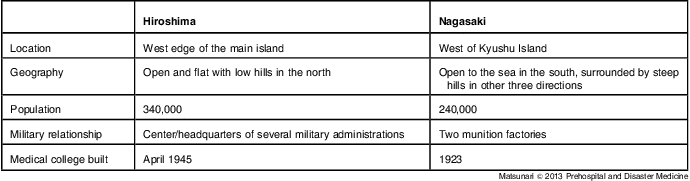
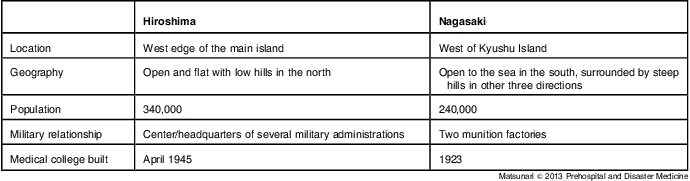
Hiroshima City is located at the western edge of the main island in Japan. The city has a rather open and flat field around the center, facing the sea in the south, with low hills in the north. Hiroshima was the largest city in Western Japan next to Osaka, with a population of approximately 340,000 before the atomic bomb attack.
At the time of the war, Hiroshima was the western military center in Japan, with a lot of military-related headquarters institutions. Thus, Hiroshima Prefecture and Hiroshima City were entirely devoted to the military as this area was designated as the “Forces County” and there were 40,000 or more persons involved in the military.3 On the other hand, between 1942 and June 1945, evacuation resulted in a shrunken population of 173,759.7
With regard to the medical background, the Hiroshima Prefectural Medicine Vocational School opened on March 24, 1945 for the first time in this area.
Nagasaki Before the Atomic Bombing: Geographic and Demographic Characteristics
Nagasaki is situated in the northwestern part of Kyushu, the western island apart from the main island in Japan. The city center is open to the sea in the south, surrounded by rather high hills in the other three directions. Before the atomic bomb attack in 1945, Nagasaki had a population of approximately 240,000.
At the time of the war, Nagasaki was a fortified zone.5 There were two munitions factories (Mitsubishi and another), and they were well organized and productive under the supervision of the [Japanese] Navy.8
Nagasaki had a history of development in medicine. In the 17th century, the Tokugawa Shogunate closed its doors to foreign countries and prohibited human transportation and commercial transactions with other countries, except Nagasaki. Nagasaki was the only place allowed by the Tokugawa authority to communicate with China and the Netherlands. Therefore, Nagasaki had the opportunity to have contacts with the advanced European knowledge with regard to science and medicine. Thus, the Nagasaki Medicine Vocational School has a long history. It became Nagasaki Medical College (the present Nagasaki University School of Medicine) in 1923. The Institute of Tropical Medicine, Nagasaki University was founded in March 1942 as the East Asia Research Institute of Endemics, Nagasaki Medical College in order to perform basic and applied studies on endemic diseases in East Asia. At the beginning, most of its research activities were field studies conducted in mainland China by the Departments of Pathology, Bacteriology, Internal Medicine, and Dermatology of Nagasaki Medical College. On August 9th, 1945, the atomic bomb was dropped in Nagasaki, and all the Institute's facilities and research materials were completely destroyed, together with Medical School. Subsequently, the development of the Institute and its research activities lagged significantly behind.
In April, 1946, the Institute changed its name to the Research Institute of Endemics, Nagasaki Medical College, and moved to Isahaya City that May to resume research activities. The Institute has extensive historical data about infection. Specialized care for victims of radiation was also established.10
Rescue and Relief System in Hiroshima
There were three organized civil defense units: the east area, the west area, and Ujina area. As a subsidiary organ of the police force, approximately 2407 additional staff members played an active role in air defense.6
In the wartime, physicians in Hiroshima were forbidden to evacuate under the prefectural air defense medical relief guidelines. Medical rescue squads of seven members were organized, and consisted of one doctor, one dentist, one pharmacist, three nurses, and one clerk. The uniform and personal tools for relief activities were provided for the medical staff as a sign of obedience-to-a-calling-up-order. The town association and the civil defense units were also in charge of relief for each area, and services were mainly provided by the relief squad.5 There were private measures for relief taken in parallel with prefectural authorities. A liaison group, a fire brigade group, and the relief squad were organized as parts of the team within a school district area as a civil defense unit subsystem. It was reported that there had been troubles and problems in control, and conflicts among these different-origin relief organizations.6
In Hiroshima, the prefectural government and the city municipal office were continuously trying to store goods for air defense relief. The stockpile, distribution, and evacuation of medicine were ongoing, but there were no consistent records about quantity or product types.7
Rescue and Relief System in Nagasaki
In Nagasaki, the rescue and relief organization system was established in 1945. The prefectural headquarters for relief organizations consisted of the governor as president, the mayors as vice presidents, relief directors under each mayor, and general directors under each relief director. There were 28 relief stations, and each station was managed by a relief station director. There was a specified chain of command, and a total of 610 persons were registered to serve in positions within the command structure. The chain of command also applied to air-raid drills.
The organization was often revised; improvement was demonstrated by a decrease in successive calls among the personnel within the chain of command. Moreover, after repeated air strikes, training maneuvers were performed with increased efficiency.8 After every air strike, the relief stations cared for injured persons who came from the immediate area and for those who traveled long distances. Triage of the injured was a common practice.
A refuge with a stockpile of medical supplies and food was in place before the bomb was dropped.Reference Nakao and Matsunari2 These stockpile supplies were listed in detail by name, quantity, and other characteristics.8
Japan tried to access the Potsdam ultimatum and policies when the atomic bomb was dropped in Hiroshima on August 6, 1945. The information about what happened in Hiroshima was transmitted to Nagasaki. On August 8, just one day before another atomic bombing, the defense system's ability to cope with the new style bomb was discussed in Nagasaki. The damages in Hiroshima were broadcast by the public broadcasting system. Evacuation of schoolchildren was discussed, but the bomb was dropped on August 9th before evacuation could be accomplished.Reference Shirabe, Yazaki and Matsuo11
The Atomic Bombing and Its Effects in Hiroshima
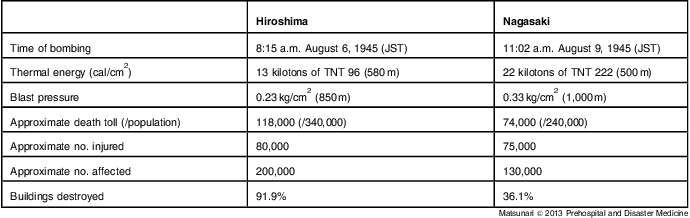
The US Air Force dropped the atomic bomb dubbed “Little Boy” in Hiroshima, and it exploded at 8:15 am on August 6, 1945 (Table 2). The thermal energy was 13 kilotons of TNT 96 (580 m). The blast pressure was 0.23 kg/cm2 at 850 m from the epicenter of the explosion. The casualties by heat rays were found 3.5 km from the epicenter. Approximately 118,000 people were killed and almost 80,000 were injured by shock wave, heat rays, and various forms of radiation release.
The Atomic Bombing and Its Effects in Nagasaki
Nagasaki was attacked by another atomic bomb at 11:02 am on August 9, 1945. The thermal energy was 22 kilotons of TNT 222 (580 m). The blast pressure was 0.33 kg/cm2 at 1000 m from the epicenter of the explosion. The casualties by heat rays were found 4.0 km from the epicenter. Approximately 74,000 people were dead and 75,000 were wounded by blast, heat rays, and radiation release.
Rescue and Relief Activities Within 12 Hours and 72 Hours of the Bombing in Hiroshima
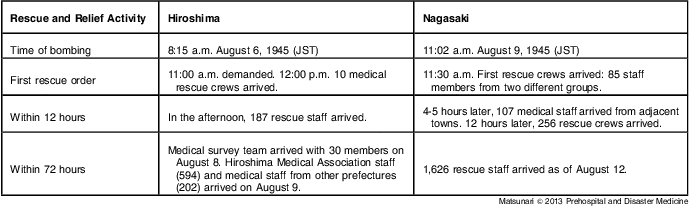
The first rescue mobilization demand was ordered to the branches of Hiroshima Prefectural Office through the police telephone lines at 11:00 am, almost three hours after the bomb explosion. Ten medical rescue crews arrived at a military clinic in the city center around 12:00. In the afternoon, 187 staff reached the clinic in the city center. On the evening of August 8th, a medical survey team with 30 members arrived in the city center. They started their rescue and relief activities on the morning of August 9th. At the same time, 594 medical staff belonging to Hiroshima Medical Association and 202 medical staff from other prefectures such as Osaka started their rescue and relief activities.6
Rescue and Relief Activities Within 72 Hours of the Bombing in Hiroshima
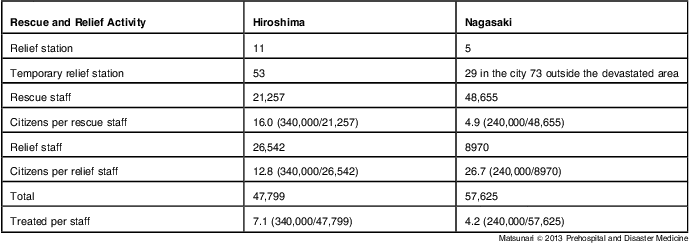
The total number of rescue staff, mainly organized by the police and the guard units, was 21,257, and that of relief staff was 26,542.6 That is to say, one rescue staff person dealt with 16.0 citizens (340,000/21,257), and one relief crew member treated 12.8 citizens (340,000/26,542). The rough average number of rescued/relieved people was 7.1 per one rescue/relief staff member (340,000/47,799).
Before the bomb attack, there were 11 relief stations for defense of air raids. After the disaster, 53 temporary relief stations were built in the city.
Immediately after the bombings, patients suffered from burns, penetrating, blunt or crush injuries, glass fragments embedded in the skin, and hemorrhage. In Hiroshima, diarrhea and bloody feces caused by radiation exposure occurred, and initially dysentery was suspected; thus, hospitals promptly initiated extraordinary infection control measures.5
Two nurses reportedReference Matsunari, Nozawa and Sakata1, Reference Nakao and Matsunari2 that in Hiroshima, a local medical practitioner was put in charge of relief efforts and temporary relief stations were set up. Every request for rescue and relief was received at each inhabitable area in which a temporary relief station was established.
The problems associated with wound care were described by nurses. The nurses who worked in Hiroshima in the disaster reportedReference Matsunari, Nozawa and Sakata1 that required goods, such as bandages for treating burns and injuries, were insufficient in Hiroshima. Any available material was used and adapted, for example, kimonos were cut for bandages. They also said that when maggots appeared on the surface of the wounds, the medical treatment became more difficult.5
Rescue and Relief Activities Within 12 Hours and 72 Hours of the Bombing in Nagasaki
The first rescue mobilization demand was ordered soon after the bomb explosion, and 85 people belonging to two different medical rescue groups arrived in the devastated city center at 11:30 am, in only approximately 30 minutes. Approximately four to five hours later, 107 medical rescue crew members reached the city center from Isahaya Navy Hospital and other institutions around the city. In 12 hours, there were 256 rescue staff members in the city from adjacent towns and villages. On August 12th, 72 hours after the event, 1,626 staff were mobilized for rescue and relief activities.
The nurses, who lived in Nagasaki at the time of the event, reportedReference Nakao and Matsunari2 that the civil defense unit and the fire brigade had begun rescue activities immediately. One of them also remembered that one family had been rescued from a collapsed house by the members of a young people's association.Reference Nakao and Matsunari2
Rescue and Relief Activities Within 72 Hours of the Bombing in Nagasaki
Before the atomic bombing, there were five relief stations for defense of air raids. After the disaster, 29 temporary relief stations were built in the city, and 73 temporary relief stations were developed around the devastated area. In Nagasaki, the victims thronged to the planned relief stations.
Nagasaki had 55 different rescue/relief service organizations. In addition, from outside the prefecture, 7,459 persons in total offered relief support, such as from Saga Prefecture and others. Finally, 8,970 persons in total were devoted to relief efforts in Nagasaki City,8 that is, 26.7 casualties received relief services per one relief staff (240,000/8,970).
Three nurses who worked in the devastated area in Nagasaki reportedReference Nakao and Matsunari2 that medical goods and supplies had been distributed to various places before the bombing in Nagasaki. Therefore, decontamination and care of the injured were able to be performed by resources within the Nagasaki area. It has also been reported by a nurse that the injured were cared for in the ruined school buildings by staff and students who themselves had barely survived.5 In this situation, Mr. Takashi Nagai, a medical doctor at Nagasaki Medical College at that time, immediately recognized the symptoms of radiation exposure, and he was in charge of medical treatment in Nagasaki;12 thus, the bloody diarrhea symptoms were not often mistaken as dysentery.
Transportation After the Bombing in Hiroshima
The Hiroshima Train Station was burned down. Many roads were blocked by collapsed houses or electrical fire damage and railroad tracks were broken in many sections; thus, trains, buses, and other types of vehicles could not pass on the road or rail system.7
Transportation After the Bombing in Nagasaki
On the day of the bombing, the injured were transported by the relief train, which started from the railway station located 1.4 km from the city center. The first train left the station at 1:50 pm, with approximately 3,500 injured people. The train ran four times that day.5 It is reported that 8,493 injured patients were conveyed to surrounding hospitals within eight institutions and five other cities, towns or villages,8 including other prefectures such as Fukuoka (personal contact). One member of the nursing staff rememberedReference Nakao and Matsunari2 that getting on a relief train the day after the bombing had been difficult because of the confusion, with a large number of people trying to escape from the city and rushing toward the railway platforms.
Discussion
Differences in Geographical Environment
As shown in Table 1, approximately 118,000 (34.7%) of 340,000 people were killed by the bombing in Hiroshima, and approximately 74,000 (30.8%) of 240,000 residents were killed in Nagasaki. However, it is reported that Hiroshima's population had shrunk to 173,759, 51.1% of the total number, before evacuation. Therefore, 67.9% of the actual residents of the city died because of the event. If the same rate of people in Nagasaki had evacuated and its population who lived in Nagasaki at that time had shrunk to 122,640, ie, 51.1% of 240,000, the rate of the death toll in Nagasaki's actual residents would have been 60.3%. In spite of the fact that the bomb dropped on Nagasaki was stronger than that dropped on Hiroshima, the death toll and death rate (of actual residents) were larger in Hiroshima than in Nagasaki. The larger population was one of the reasons for the higher death toll in Hiroshima. But it might be also that the shock wave affected a wider area of Hiroshima City, which was open and flat, compared to valley-shaped narrow Nagasaki. The rate of the destroyed buildings also shows that almost all the buildings were damaged in Hiroshima (91.9%). A major escape route was destroyed and the remnants of the route fell into the river; many died because they were not able to escape from the damaged area.Reference Matsuo and Tani14 Thus, many people lost their lives not only from the blast and acute radiation contamination, but also from the collapsed buildings and fires in the aftermath. It is likely that loss of the evacuation route greatly influenced the initial and overall death toll.
Characteristics of Hiroshima and Nagasaki Before the Atomic Bombings in August 1945
Two Atomic Bombs and Their Effects

Rescue/Relief Mobilization System
In Hiroshima, the responsibility for relief efforts was shared randomly by the town association and civil defense units which mainly consisted of relief squads made up of medical staff. A relief squad, a liaison group, and a fire brigade were formed in each area.6 Therefore, it took time to organize efficient cooperation among these groups at the time of the crisis. Relief responsibilities were not clearly defined and assigned in Hiroshima and rescue efforts by the relief squad were intermingled with the efforts by other rescuers. This might be the cause of the late arrival of rescue and relief teams to the devastated area, compared to those in Nagasaki.
In Nagasaki, on the contrary, the chain of command was much stronger and more clearly defined. The governor was the top of the command, and every city mayor was supervised by the governor. Every mayor controlled a general director of a city relief station, and the general director administered managers of relief station branches.5 The organization revision also corresponded to battle air-raid drills and included professional expertise related to relief efforts.
It is supposed, thus, that the difference in the organizational structure of rescue/relief organization influenced relief and rescue efforts, such as issuing the first rescue order and the arrival timing of the first rescue squad between the cities.
Effects of the Rescue and Relief Activities
It has been reported that, as of 1960, there were 85,278 survivors (35.5% of the whole population) in Nagasaki who were directly affected by radiation contamination, whereas 108,936 survivors (32.0%) were directly affected by radiation in Hiroshima. These differing survival rates were supposed to be caused by the following three factors.
In disaster management, it is argued that the first 72 hours are critical and the initial activities are important.Reference Hayashi15 One of the factors might be earlier arrival of the rescue and relief staffs and their numbers. Table 3 shows that the first rescue order was responded to by 85 rescue staff members’ arrival within 30 minutes in Nagasaki, but in Hiroshima, it took almost three hours to receive 10 rescue crews in the devastated area. Moreover, within 12 hours, rescue crews arrived in Nagasaki one after another, larger numbers than those in Hiroshima in the same period after the disaster event. The similar conditions continued in the 72 hours after the bomb explosion in both cities. This difference in arrival timing might be due to the organizational structure which was mentioned earlier in this paper.
Process and Timing of Rescue and Relief Activities in the Two Cities
Secondly, due to the large numbers of the rescue/relief staff, many casualties were treated by many staff. As shown in Table 4, in Nagasaki, an average of 4.2 citizens were treated by one crew member, compared with 7.1 citizens in Hiroshima. This means that Nagasaki's staff members were able to take care of fewer injured people than those in Hiroshima. In other words, the injured were taken care of much better than those in Hiroshima. This factor might lead to save more lives of the affected residents in Nagasaki.
Characteristics of Rescue and Relief Activities in the Two Cities
This study describes earlier the geographical and administrational differences that might be the third cause of the difference in the survival rates of both cities. Hiroshima City was an open and flat area, and the blast damaged almost all the buildings and infrastructure. This situation made it impossible to transport the injured by car or tram. The administration of rescue/relief organizations did not function well, which led to spontaneous temporary relief sites being developed at random in the devastated area to give immediate and direct care to victims. These factors mean that the injured people were made to stay in the contaminated, unhealthy places without having any means to evacuate.
In contrast to the condition in Hiroshima, Nagasaki's rescue/relief activities were well organized and managed. There were several relief stations placed far from the city center; these were prepared to receive and take care of the injured in clean and healthy conditions soon after the bomb attack. Medical materials were available because they had been moved to safer places beforehand. Nagasaki Medical College Hospital played a crucial role as a medical administration center, accumulating the disaster information and providing medical control. Fortunately, the railway was not damaged by the bombing, perhaps due to being protected by the hilly geography. Thus, the train transported many of the injured to areas other than the damaged city center on the day of the disaster, which might have contributed to saving more lives of the victims. Operation of the trains seems to have had a significant impact on the death toll and the movement of injured persons in a large-scale disaster.
Preparedness in Medical Science
In the early period after the bombings, there were differences between Hiroshima and Nagasaki with respect to medical services as rescue/relief activities.
In Hiroshima, diarrhea and bloody feces occurred among the victims because of radiation exposure. However, dysentery was suspected and extraordinary infection control measures were promptly started in the hospitals. In Nagasaki, bloody diarrhea was not often mistaken for dysentery. This means that proper medical diagnoses and treatments were provided in Nagasaki, thanks to its longer historical background in terms of accumulation of knowledge, skills and experiences in medical science in Nagasaki than in Hiroshima.
The above-mentioned misunderstanding also was likely to be caused by lack of medical colleges in Hiroshima that might have accumulated knowledge about radiation-induced symptoms. On the other hand, Nagasaki Medical College functioned as the medical center in the area before the wartime. In addition, a nursing staff member who worked for Nagasaki Medical College Hospital reported that the president of the college happened to pass through the damaged area in Hiroshima and observed the damages directly. He then reached Nagasaki and shared with the medical staff of the college the information on the atomic bombing, its effects and the knowledge concerning radiation-induced symptoms. He also warned his colleagues and the medical staff about the possibility of being attacked, on the morning of August 8, 1945, just a day before the attack upon Nagasaki.Reference Nakao and Matsunari2 The Japanese public broadcasting system, NHK Radio, also reported on the disaster in Hiroshima the night of August 8th, which alarmed the residents in Nagasaki. These fortunate events in Nagasaki might contribute to increasing the rate of the survivors who were harmed directly by radiation.
Limitations
This study compared the numbers of the casualties, victims and rescue/relief staffs within 72 hours of the atomic bombings between Hiroshima and Nagasaki. Thus, other elements which might have affected rescue/relief activities, such as the difference in attack timing (8:15 am in Hiroshima and 11:02 am in Nagasaki), the difference of consequences after 72 hours, effects of residual radiation contamination density, and conditions of triage, should be investigated in further research.
This research is also dependent mainly on the documented records, confirmed by testimonies collected from the nursing staff who worked in Hiroshima or Nagasaki at the time of the events. However, the number of the nurses who were involved in the previous research projects is limited (10 nurses). The events in Hiroshima and Nagasaki occurred more than 65 years ago, the survivors and witnesses were getting very old, and it was critical to gather narrative accounts as soon as possible in order to preserve the survivors’ impressions and memories, which would be lost forever if not recorded. Reference Matsunari, Nozawa and Sakata1, Reference Nakao and Matsunari2 Time for further research is running shorter and shorter.
Conclusions
It seems that there was less damage in Nagasaki, where a stronger atomic bomb was used, than in Hiroshima. There were crucial geographical factors which led to different effects in terms of the numbers of victims; however, systematic organization and mobilization of rescue and relief staffs, maintenance of functional transportation, and advanced medical knowledge and public warning with regard to disaster may have contributed to a lower death toll and increased the number of survivors. This study may be useful for large-scale natural disasters such as earthquakes, typhoons or tsunamis, but absolutely not for a disaster caused by atomic bombing, which should not occur again in human history.
Acknowledgements
The authors would like to acknowledge the valuable contribution of the nurses who participated in the study. We would like to express our special gratitude to Prof. Shinji Miyauchi, Associate Professor of Oita University of Nursing and Health Sciences for his helpful suggestions and comments.