INTRODUCTION
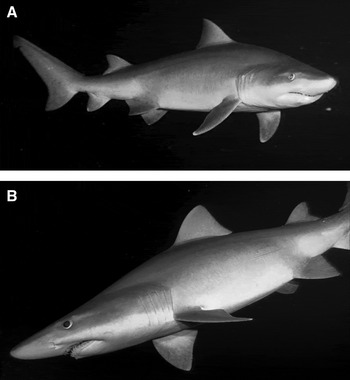
The smalltooth sand tiger shark Odontaspis ferox (Risso, Reference Risso1810) has a seemingly cosmopolitan distribution based on disjunct and widespread records from the Pacific, Atlantic, and Indian Oceans, with most of these localities based on few, or even single specimens or confirmed observations (Bonfil, Reference Bonfil1995; Fergusson et al., Reference Fergusson, Graham and Compagno2008). In the eastern Pacific Ocean, the species ranges from the northernmost records off southern California, USA (Daugherty, Reference Daugherty1964; Seigel & Compagno, Reference Seigel and Compagno1986; Long, Reference Long1994) and northern Baja California, Mexico (Long, unpublished data), and in the Sea of Cortez (Gulf of California) (Galvan-Magaña et al., Reference Galvan-Magaña, Neinhuis and Klimley1989; Abita-Cardenas et al., Reference Abita-Cardenas, Rodríguez-Romero, Galvan-Magaña, de la Cruz Aguero and Chávez-Ramos1994; Villavicencio-Garayzar, Reference Villavicencio-Garayzar1996; Castro-Aguirre & Balart, Reference Castro-Aguirre and Balart1996). There appear to be no records of this species from most of the Central American coast, but it has been observed from Cocos Island off the Pacific coast of Costa Rica (Cortés & Blum, Reference Cortés and Blum2008; Cortés et al., Reference Cortés, Sánchez-Jiménez, Rodríguez-Arrieta, Quirós-Barrantes, González and Blum2012; Cortés, Reference Cortés2013). The few South American records of this species include observations of living specimens at Malpelo Island off the Pacific coast of Colombia (Mejía-Falla et al., Reference Mejía-Falla, Navia, Mejía-Ladino, Acero and Rubio2007; Fergusson et al., Reference Fergusson, Graham and Compagno2008) and observations at Wolf Island in the northernmost Galápagos Archipelago (Acuña-Marrero et al., Reference Acuña-Marrero, Zimmerhackel, Mayorga and Hearn2013; Ritter & Compagno, Reference Ritter and Compagno2013). To date, there have been no other records of O. ferox from the western coast of South America (Fergusson et al., Reference Fergusson, Graham and Compagno2008; Compagno, Reference Compagno2001) and our observation (Figures 1 & 2) makes it the first recorded occurrence for this species in Chilean waters, the southernmost record in the eastern Pacific ocean, and one of just a few specimens documented along the entire Pacific and Atlantic coasts of South America.
Photographs of a female 337 cm total length Odontaspis ferox from 348 m depth off San Ambrosio Island, 25 February 2013: (A) lateral view of right side; (B) ventrolateral view of head and left side (photographs courtesy of A. Klapfer).

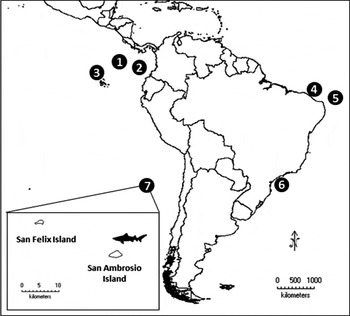
Map of known localities of Odontaspis ferox in South American coastal waters: (1) Cocos Island, Costa Rica; (2) Malpelo Island, Colombia; (3) Wolf Island, Galapagos Archipelago; (4) Santos City, Brazil; (5) Fernando de Noronha Island, Brazil; (6) Fortaleza, Brazil; (7) San Ambrosio Island, Chile, with inset showing specific locality within the Desventuradas Islands (26°19.456′S 79°52.281′W). See text and references for additional details.

MATERIALS AND METHODS
This expedition and study of the marine ecosystems of the Desventuradas Islands in the Chilean exclusive economic zone was intended to assess their biodiversity, conservation state and value, and to propose recommendations to the Chilean government for conservation. Observations of a single individual of Odontaspis ferox were made on 25 February 2013, during an expedition that lasted between 7 February 2013 and 28 February 2013. Observations of the shark (Figure 1) were documented by digital photographs and video, and by personal notes from observers aboard the manned submersible ‘DeepSee’, with its tending ship ‘Argo’. Initial observation of the shark, an adult female measuring 337 cm total length, estimated from underwater laser measurement, were made at approximately 11:00 a.m. on the northern slope of San Ambrosio Island (26°19.456′S 79°52.281′W), some 917.5 km due west of the mainland coast of Chile, at a depth of 348 m, with a water temperature of 9.2°C. The submersible was positioned at the base of a steep, almost vertical rocky wall that went down from 328 to 348 m, very close to the sedimentary bottom situated at the end of the wall. Ambient conditions were of total darkness, with no observable downwelling light, but the area was illuminated with halogen lights from the submersible. The shark approached the submersible, swimming directly over it, then made several turns around the vessel, even cruising the bottom and disturbing the sediment, then it disappeared into the dark. It was observed again a few minutes later but remained at a distance and did not approach the submersible. In total, the shark was observed, filmed and photographed for about five minutes.
As the entire body of the shark was photographed, the pelvic fins clearly showed the lack of claspers, indicating the sex as female. The body was a uniform silvery-sand colour with a whitish ventrum, and lacking in any obvious spots or other markings, other than some apparent abrasions on the left flank and the caudal peduncle. Observations of the head showed long, thin and vertically narrow teeth, with a prominent symphysis between the lower jaws, and the rostrum was roundly blunt at the tip. Overall body shape showed the deepest aspect of the body anterior to the dorsal fin, a very short caudal peduncle, broad triangular dorsal fins, with the first dorsal fin being significantly larger than the second and placed above the trailing edge of the pectoral fin, a large anal fin directly below the space between the second dorsal fin and the upper origin of the tail, broad pectoral fins, all characteristic of O. ferox. A close relative, the bigeye sand tiger shark (O. noronhai), known from the central Pacific and the coast of Brazil (Compagno, Reference Compagno2001), differs from O. ferox by having a uniformly blackish to chocolate brown colour, a slightly shorter snout, a larger eye and a markedly smaller anal fin. A more distant relative, the sand tiger shark (Carcharias taurus) is found along the Atlantic coast of South America but is completely absent from the eastern and central Pacific (Compagno, Reference Compagno2001), and differs in having dorsal fins of nearly equal size, placed well behind the pectoral fin.
DISCUSSION
This observation confirms the first record of Odontaspis ferox in Chilean waters, and extends the known southern range of this species in the eastern Pacific Ocean by more than 3319 km (Figure 2). Previous surveys of elasmobranchs along the Chilean coast (Ojeda, Reference Ojeda1983; Pequeño, Reference Pequeño1989, Reference Pequeño1997; Parín, Reference Parín1991; Sielfield & Vargas, Reference Sielfield and Vargas1996; Ojeda et al., Reference Ojeda, Labra and Muñoz2000; Sebastian et al., Reference Sebastian, Haye and Shivji2008; Reyes & Torres-Florez, Reference Reyes and Torres-Florez2009; Sáez et al., Reference Sáez, Pequeño and Lamilla2010; Bustamante et al., Reference Bustamante, Vargas-Caro and Bennett2014) and in the Juan Fernández Archipelago (Andrade & Pequeño, Reference Andrade and Pequeño2008), did not record this species. In fact, this occurrence is one of the few known records for all of South America (Figure 2). In addition to the previous in situ observations of live O. ferox from Malpelo Island and Wolf Island, there are several records from the Atlantic coast of South America, including two records from Fernando de Noronha Island off the north-eastern coast of Brazil (Menni et al., Reference Menni, Hazin and Lessa1995; Garla & Júnior, Reference Garla and Júnior2009), several records of sharks caught by long-liners based in Santos City, São Paulo State, Brazil (Amorim et al., Reference Amorim, Arfelli and Fagundes1998), and one from the shark fishery based in Fortaleza, Ceará State, Brazil (Santander-Neto et al., Reference Santander-Neto, Faria, Castro and Burgess2011).
Throughout their seemingly fragmented range O. ferox are widespread, though uncommon, and as new records fill in gaps of their biogeography, the species appears to have a cosmopolitan distribution in tropical and temperate coastal waters (Bonfil, Reference Bonfil1995; Fergusson et al., Reference Fergusson, Graham and Compagno2008). Such a pattern has been seen for other deep-water shark species where presumed isolated records are part of a much broader and likely continuous distribution that becomes more apparent as additional specimens are observed or collected (see Long et al., Reference Long, McCosker, Blum and Klapfer2011, as an example). It is interesting to note that many of the O. ferox records from the eastern Pacific Ocean are insular, and that no specimens have yet been found along the coast of the Central or South American mainland, but it is likely that additional specimens will occur in the future. Additionally, O. ferox has previously been recorded from Chile as fossil teeth, collected from the early Miocene Navidad Formation in central Chile near the town of La Boca (Suárez et al., Reference Suárez, Encinas and Ward2006) and from the late Miocene Bahía Ingles Formation in northern Chile (Gutstein et al., Reference Gutstein, Yury-Yañez, Soto-Acuña, Suárez and Rubilar Rogers2008), so it is likely that this species has been part of the Chilean ichthyofauna for some time.
ACKNOWLEDGEMENTS
The authors thank Blancpain, Davidoff Cool Water, National Geographic and Oceana-Chile for financial support for the expedition. We also thank Felipe Chacón, the driver of the ‘DeepSee’.