Introduction
In Malaysia, a rapidly developing South East Asian nation of almost 30 million people, smoking prevalence is 23% overall, but far higher among males (44%) than females (1%) (Institute for Public Health, 2012). An estimated 10,000 Malaysians die each year from conditions attributable to tobacco smoking (Ministry of Health, 2003), and a further 200,000 are likely to suffer tobacco-related harm (MMWR, 2003). Despite this toll, and the implementation of strategies detailed in the World Health Organisation's Framework Convention on Tobacco Control (WHO, 2003), Malaysia has in recent years seen little if any decline in smoking prevalence (Institute for Public Health, 2012). This situation is unlikely to improve in the short to medium term, in part due to a relatively weak tobacco control sector, compared with that in countries such as the US, Australia and New Zealand, where steady declines in smoking prevalence have been occurring (Australian Institute of Health and Welfare, 2011; Ministry of Health, 2012; Centers for Disease Control and Prevention, 2012). Of concern is that, according to the 2011 Global Adult Tobacco Survey (GATS), only 14% of Malaysian smokers were considering quitting within the next year, despite nearly 90% reporting they believed smoking causes serious harm (Institute for Public Health, 2012). Furthermore, only half of the smokers who visited a health practitioner reported being advised to quit.
Unless urgent action is taken to prevent smoking initiation and prompt and support current smokers to quit, it is inevitable the toll from the tobacco epidemic will climb higher over successive decades, with attendant health, social and economic costs.
Doctors are a key group to involve in addressing this major threat: they are perceived as having an authoritative voice on health matters, and can be influential as advocates for tobacco control. At a clinical level, they may provide effective cessation interventions, from brief advice to stop smoking (Stead et al., Reference Stead, Bergson and Lancaster2008) to prescribing evidence-based medications that can double or triple smokers’ chances of successfully quitting (Stead et al., Reference Stead, Perera, Bullen, Mant and Lancaster2008). Despite this, it appears many medical schools are failing to include teaching and practice on cessation in their curricula: only half of the students from medical schools surveyed in five Asian nations (Malaysia, India, Pakistan, Nepal and Bangladesh) reported having received teaching on tobacco control (Sreeramareddy et al., Reference Sreeramareddy, Suri and Menezes2010).
The situation in Malaysia appears no better several years later: a 2012 survey of 10 medical schools in Malaysia identified only one that set aside dedicated teaching to tobacco control (Amer Nordin, 2012). (This survey did not include the medical schools surveyed in the study by Sreeramareddy et al.).
Tee et al.'s (Reference Tee, Hairi and Hairi2012) study of Malaysian medical students found that only about half believed a doctor's advice played a part in motivating smokers to quit. While this was gratifyingly far higher than the reported 4.6% 20 years ago (Yaacob et al., Reference Yaacob and Abdullah1994), it still falls far short of what is needed, and raises concerns that such a simple effective intervention as brief cessation advice is not being taught – or if taught, not translated into beliefs nor presumably into clinical practice.
Medical students graduate and become doctors, and we are unaware of any study investigating cessation knowledge and practices in Malaysian doctors. Thus we sought to examine this question, with a view to using the information to inform development of training opportunities for current and future doctors.
Methods
Setting and Participants
Between August and October 2012 we conducted a cross-sectional survey of junior doctors at University Malaya Medical Centre (UMMC), a 900-bed teaching hospital in Kuala Lumpur, Malaysia, with a catchment population of around five million people. The study was approved by the UMMC Medical Ethics Committee.
All doctors wishing to practice in Malaysia are required to complete a two-year house officer period in a gazetted tertiary centre such as UMMC, in six major rotations: medicine, surgery, paediatrics, obstetrics, orthopaedics and either anaesthesiology or trauma medicine, as determined by the Ministry of Health. These doctors are graduates not only of Malaysian medical schools but also many other nations, because Malaysia recognises more than 300 medical degrees worldwide. After completing their rotations, doctors may be posted to a hospital within Malaysia, to serve in any capacity, including as a medical officer at one of the 300 government-run quit smoking clinics.
Measures
The questionnaire comprised two parts: the first part enquired about the demographic and educational characteristics of the respondent: age, gender, ethnic group, year and place of graduation. The second part, adapted from items in the Global Health Professional Student Survey (GHPSS) (Global Tobacco Surveillance Survey, 2005), was designed to be used amongst third year students in medicine, dentistry, pharmacy and nursing. It comprised 20 questions on tobacco control, including whether there was a tobacco control curriculum in their medical schools, their roles as doctors in tobacco control, and familiarity with tobacco dependence treatment. We pre-tested the questionnaire with 30 final year medical students to ensure ease of use, lack of ambiguity and timing (it takes 5–7 minutes on average to complete). We then made it available to be completed by the UMMC house officers during any of the six continuing medical education classes all must attend.
Statistical Analysis
Data were analysed with SPSS, Version 16.0. Descriptive (univariate analyses) and chi-square (multivariate analyses) were undertaken to calculate proportions and examine associations. A p value of <0.05 was regarded as indicating statistical significance.
Results
Demographic characteristics of participants
A total of 122 out of the 173 eligible house officers completed the questionnaire, a response rate of 70.5%. The mean age of the respondents was 26 years (±1.5 years). The majority were female (59%, n = 72), and predominantly ethnic Chinese (45%, n = 54) followed by Malay (41%, n = 49), Indian (11%, n = 13), others (3%, n = 4). Just over half graduated from local universities (55%, n = 67). The vast majority (97%, n = 117) stated they were non-smokers.
Smoking Education Information
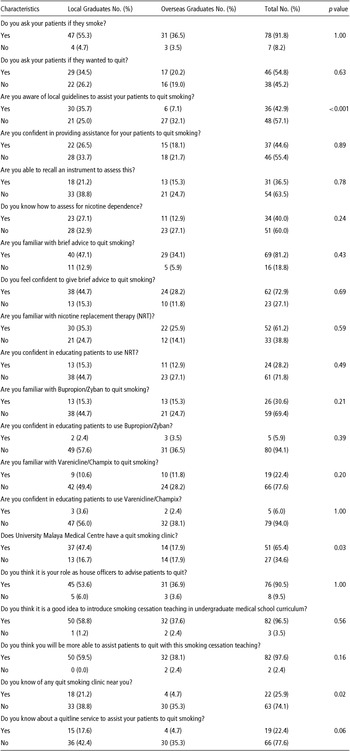
Just over two thirds reported learning about smoking cessation in medical school (71%; n = 85) and most (89%; n = 107) agreed it was their role as doctors to advise patients to quit smoking. Slightly more than half (58%; n = 71) reported being unaware of local clinical practice guidelines for tobacco dependence treatment. The proportion of local graduates aware of local guidelines was low (30%) but far higher than for overseas graduates (10%, p<0.05). Most agreed there was a need to introduce smoking cessation teaching in the undergraduate medical curriculum (93%; n = 113) and a large majority agreed if this had been the case when they trained, this would assist in their management of smokers (95%; n = 115).
Asking and Assessment Questions
Ninety pe rcent (n = 110) reported regularly asking their patients’ smoking status, but only 53% (n = 64) said they asked their patients to quit smoking. The majority (62%, n = 74) indicated the reason was a lack of confidence in providing assistance to help patients quit smoking. A similar proportion stated they did not know how to assess for nicotine dependence (62%, n = 76) nor were most able to recall any instrument to assess this (72%, n = 88). However, local graduates were twice as likely as overseas graduates to know how to assess for dependence (67% vs 33%, p<0.05).
Advising and Assisting Questions
Most respondents were familiar with the importance of giving brief advice to quit smoking (78%, n = 95) and two thirds felt confident to do so (68%, n = 83). More than half reported familiarity with prescribing nicotine replacement treatment (61%, n = 74) but almost three-quarters reported lacking confidence to educate patients how to use these treatments (73%, n = 89). A similar proportion reported being unfamiliar with varenicline (84%, n = 102) to treat tobacco dependence and also lacked confidence in educating patients in using this (93%, n = 114). These findings were similar for the use of bupropion.
Arranging Referral Questions
The doctors surveyed were unsure about the quit smoking services available within the hospital and community: while more than half reported correctly that a quit smoking clinic was available in UMMC (61%, n = 68), most did not know if there were any quit smoking clinics within the local community (80%, n = 98). Local graduates were significantly more familiar with these clinics than overseas graduates, and performed better in identifying local tobacco control activities such as service provision, guidelines and available treatments (16% vs 4%, p<0.05) but the overall level of familiarity was very low. Most doctors surveyed were unaware if quitline support services were available for people to call (82%, n = 100).
Discussion
To our knowledge, this is the only study investigating cessation practice among recently qualified medical doctors in Malaysia. A positive finding was that most respondents had received teaching on smoking cessation, despite previous studies reporting a lack of training in Malaysia (only two of 11 medical schools surveyed several years ago reported teaching in tobacco control) (Sreeramareddy et al., Reference Sreeramareddy, Suri and Menezes2010, Amer Siddiq, Reference Amer Siddiq2012). Our study included a higher proportion of locally trained graduates, so our findings may indicate that the other 24 medical schools in Malaysia may have teaching on cessation that has not been reported, or the teaching may be conducted by other disciplines via joint faculty teaching, such as with the dental and pharmacy schools.
Although nearly two thirds of those surveyed reporting previous education, the majority were unfamiliar with local guidelines, how to assess patients for nicotine dependence, how to educate and subsequently treat patients with available treatments and where to refer for additional support if needed. This mismatch suggests that teaching content or methods were insufficient, ineffective or inappropriate. (Table 1)
Smoking cessation practices among house officers who claimed to have received smoking cessation teaching during undergraduate studies (n = 85): difference between local university graduate house officers and overseas graduate house officers

While we found that nearly 90% of the doctors felt it was their role as doctors to advise patients to quit (a large improvement compared to the findings of other studies, [see, for example Tee, Reference Tee, Hairi and Hairi2012 and Yacoob, Reference Yaacob and Abdullah1994]) only 53% of our sample actually asked their patients to quit, a similar figure noted in the 2011 GATS Malaysia report. Malaysia is yet to implement mandatory documentation of tobacco dependence status and subsequent treatment provision in medical institutions, as has been done elsewhere, and this may explain the lack of initiative to enquire about smoking status and advise to quit. Our finding that most respondents were unfamiliar with the local guidelines on tobacco dependence treatment and available treatments, may also explain the low rate of asking patients if they smoke in both our study and the GATS. This gap in knowledge may explain our findings that most respondents supported better training on tobacco control in their undergraduate studies and also wanted more training and were keen to have a local conference on tobacco dependence treatment.
The current study found that most of the doctors surveyed were unfamiliar with local services for assisting those wanting to quit such as quit clinics and quit line services. This is unfortunate as Malaysia has nearly 300 publicly funded quit clinics. A 2010 study by Wee et al. (Reference Wee, West, Bulgiba and Lion2011) also found smokers who wanted to quit and who heard about the availability of the clinics tend to do better in treatment. Therefore, by not being familiar with available services, local doctors are missing an opportunity for enabling their patients to quit as compared to their colleagues in dentistry and pharmacy (Lee et al., Reference Lee, Hassali, Shafie and Abdul Aziz2011; Abdul Kadir, Reference Abdul Kadir, Amer Siddiq, Yahya, Rusdi, Hazli and Hussain2013).
Ours is the only study to date that has investigated recently graduated Malaysian doctors’ practice in providing tobacco dependence treatment. A further strength of the study is the response rate of 71%. However, there were a number of limitations. First, the cross-sectional study design means we are unable to make causal inferences about observed associations. Second, our sample of house officers in a large tertiary hospital may not be fully representative of all doctors, such as those who are more senior and those in primary care practice. However, while they may not currently be in senior decision making roles, such as specialists or general practitioners, they do represent the future medical profession in Malaysia.
We recommend that a standard curriculum on tobacco control, including teaching on how to deliver evidence-based smoking cessation advice and support, be developed and implemented in all undergraduate programmes. Tobacco cessation education and information about available cessation services should also be included in postgraduate continuing medical education programmes for all doctors in Malaysia. This is essential to develop knowledge and skills in those without exposure in their undergraduate programmes, and in those who have come to Malaysia from other countries where their training in such areas may have been very limited or non-existent. Our study and the GATS have highlighted the need for all doctors to document diagnosis of tobacco dependence in patients’ case notes so as to allow both treatment provision and to assist in follow-up care. Further surveys should be undertaken to track progress.
Conclusion
While some findings from our survey showed encouraging progress, there is an urgent need to up-skill medical practitioners in Malaysia in giving brief cessation advice and providing behavioural and pharmacological support for smokers who want to quit. Tobacco control teaching in the undergraduate medical school curriculum should include teaching and practice with tobacco dependence treatments. More needs to be done, and the sooner the better, if a significant reduction in tobacco use prevalence and health gain is to be achieved.
Acknowledgements
We thank the junior doctors who took part in our study. We also acknowledge the instructor and group members of the scientific writing workshop held in the Faculty of Medicine, University of Malaya, Kuala Lumpur on 19–23 November 2012 for their valuable input.
Financial Support
This work was supported by the University Malaya Centre of Addiction Sciences (UMCAS).
Conflict of Interest
ASAN has had previous speaking arrangements for Pfizer Malaysia and has received research support from the same company. CB has received support from McNeil AB with accommodation while a visiting speaker. MKMS and FMH have no interests to declare.
Ethical Standards
The study was approved by the University of Malaya Medical Ethics Committee.