Sow milk contains proteins, fats, vitamins, oligosaccharides, lactose and other nutrients and bioactive compounds. Among these substances, a fat content of only 5–8% can provide ≈50% of the energy required by newborns (Doppenberg, Reference Doppenberg2010; Zhang et al., Reference Zhang, Chen, Zhang, Lv, Heng, Min and Li2018). Colostrum is the first form of milk produced by the mammary glands of mammals immediately following delivery of the newborn. Colostrum is very digestible and plays an important role in piglet survival (Dividich et al., Reference Dividich, Rooke and Herpin2005; Luise et al., Reference Luise, Cardenia, Zappaterra, Motta, Bosi, Rodriguez-Estrada and Trevisi2018) since its composition reflects the nutritional requirements of piglets (Tan et al., Reference wTan, Zhai, Ni, Wang, Ji, Tang, Ren, Long, Deng, Deng and Yin2018). Piglets are totally reliant on their mother for access to colostrum and milk, and their growth rate is dependent upon the yield and composition of sow milk. Inadequate intake of milk has been shown to be the immediate cause of poor survival and market weight of piglets (Gerjets and Kemper, Reference Gerjets and Kemper2009). This premise could also be applicable to nutritional and growth studies of human infants, especially if mothers have an inadequate food supply (Xu et al., Reference Xu, Qi, Yu, Wang, Zhou, Sun, Jin and Wang2018). Scientific study of the composition and utilization of sow milk in relation to the nutrition, immunity and gastrointestinal health in humans is valid because humans and pigs have similar digestive and physiological systems (Lizardo et al., Reference Lizardo, Milgen, Mourot, Noblet and Bonneau2002; Sangild et al., Reference Sangild, Thymann, Schmidt, Stoll, Burrin and Buddington2013). Using the piglet model, Le et al. (Reference Le Huerou-Luron, Bouzerzour, Ferret-Bernard, Menard, Le Normand, Perrier, Le Bourgot, Jardin, Bourlieu, Carton, Le Ruyet, Cuinet, Bonhomme and Dupont2018) have demonstrated that the incorporation of both milk fat and milk fat globule membrane fragments in infant formulas could modify their physiological impacts (protein digestion, the dynamic of the immune system maturation and the fecal microbiota composition) by making their composition closer to that of human milk. In addition, most commercial formulas for piglets on the Chinese market are labeled as containing sufficient dietary energy levels (Spinka, Reference Spinka2017). However, whether this supplementation is appropriate for piglets is not known. Bjornvad et al. (Reference Bjornvad, Thymann, Deutz, Burrin, Jensen, Jensen, Molbak, Boye, Larsson, Schmidt, Michaelsen and Sangild2008) have reported that the ioncidence of necrotizing enterocolitis was significantly higher in formula compared with colostrum-fed piglets. Hence, it is important for piglets to be fed better sow-milk substitutes when there is a need to make up for lack of maternal milk. Triacylglycerols (TAGs) are the main components of milk fat and play an important role in the texture, flavor and nutritional value of milk and milk-related products (Mu and Porsgaard, Reference Mu and Porsgaard2005; Zhou et al., Reference Zhou, Gao, Zhang, Xu, Shi and Yu2014). Although the analysis of the fatty acid profile of milk fat is much simpler than the evaluation of TAG, most dietary fatty acids are consumed in the form of TAG. Thus, it is important to achieve a reliable TAG determination (Ten-Doménech et al., Reference Ten-Doménech, Beltrán-Iturat, Herrero-Martínez, Sancho-Llopis and Simó-Alfonso2015). Recently, ultra-performance liquid chromatography coupled with quadrupole time-of-flight mass spectrometry (UPLC-Q-ToF-MS) technique has been developed to successfully obtain more detailed information on TAG compositions in complex natural lipid matrixes such as vegetable oils and human milk fat (Wei et al., Reference Wei, Sun, Jiang, Zhang, Hong, Jin, Tao, Wang and Yang2019; Yuan et al., Reference Yuan, Qi, Dai, Xia, Sun, Sun, Yu, Zhou, Jin, Wei and Wang2019). However, the use of the technique for the analysis of TAGs in sow milk samples has not been reported to date. Studies have reported that saturated fatty acids in the TAGs of vegetable oils are located mainly at the sn-1 and sn-3 positions, whereas saturated fatty acids on the TAGs of animal fats are located mainly at the sn-2 position (Doppenberg, Reference Doppenberg2010; Haddad et al., Reference Haddad, Mozzon and Frega2012). This distribution plays an important part in increasing the absorption of calcium ions and fatty acids, and improving stool consistency (Farmer and Quesnel, Reference Farmer and Quesnel2009; Koletzko, Reference Koletzko2016; Zhang et al., Reference Zhang, Chen, Zhang, Lv, Heng, Min and Li2018).
The TAG components of human milk and other mammalian milks (cow, goat, donkey, and yak milk) have been studied widely because they are used as food sources for human infants (Pons et al., Reference Pons, Bargallo, Folgoso and Sabater2000; Zou et al., Reference Zou, Huang, Jin, Guo, Liu, Cheong, Xu and Wang2013; Scano et al., Reference Scano, Murgia, Demuru, Consonni and Caboni2016; Yu et al., Reference Yu, Yuan, Zhang, Jin, Wei and Wang2019). However, little information is available on the TAG composition of sow milk, since most studies have concentrated on the fatty acid composition (Bai et al., Reference Bai, Wang, Zhao, Shi and Shan2017; Ren et al., Reference Ren, Jin, Wang, Zhang and Jin2022). Luise and colleagues found that the composition of fatty acids of sow colostrum was similar to that of human colostrum (Luise et al., Reference Luise, Cardenia, Zappaterra, Motta, Bosi, Rodriguez-Estrada and Trevisi2018). Parodi (Reference Parodi1982) analyzed the positional distribution of fatty acids in TAGs from milk of several species of mammals (koala, dog, cat, horse, and pig). Large variations in fatty acid contents were found whereas there was a general similarity in fatty acid positional distribution patterns for all the species. For example, palmitic acid (C16 : 0) was mainly located at the sn-2 position, whereas stearic acid (C18 : 0) showed high sn-1 selectivity. In addition, the maternal diet (Bai et al., Reference Bai, Wang, Zhao, Shi and Shan2017) and sow breed (Farmer et al., Reference Farmer, Charagu and Palin2007; Klein et al., Reference Klein, Almstetter, Schlamberger, Nurnberger, Dettmer, Oefner, Meyer, Wiedemann and Gronwald2010; Yang et al., Reference Yang, Zheng, Zhao, Zhang, Han, Yang, Zhao, Li, Guo, Zang and Wang2016; Picone et al., Reference Picone, Zappaterra, Luise, Trimigno, Capozzi, Motta, Davoli, Nanni Costa, Bosi and Trevisi2018) could influence the fat composition in sow milk. TAGs account for 98% of the fat mass of sow milk (Lv et al., Reference Lv, Zhang, Guan, Chen, Zhang, Chen and Liu2018).
Given the paucity of published information, a thorough investigation into the influences of breeds and lactation stages on the TAG composition of sow milk could be important. We aimed to improve our knowledge on the composition of sow milk through: (i) the investigation of TAG characteristics of sow milk; (ii) the evaluation of the effects of different sow breeds and (iii) lactation stages (colostrum and milk) on the composition of TAG.
Materials and methods
All experimental procedures involving animals were performed according to the principles outlined in the Jiangnan University Animal Care and Use Committee's guidelines (protocol number: 20210915P0301107).
Chemicals
High-performance liquid chromatography (HPLC)-grade acetonitrile, methanol (MeOH), isopropanol (IPA), chloroform (CHCl3), formic acid, ammonium formate, and toluene (PhMe) were purchased from J&K Scientific (Shanghai, China). Analytical-grade anhydrous sodium carbonate, anhydrous sodium sulfate, and acetyl chloride were obtained from Sinopharm Group (Shanghai, China).
Samples
Sow milk samples from five breeds (Landrace × Large White: LLW, Landrace: L, Large White: LW, Duroc: D and Pietrain: P) were collected from 30 healthy sows, 6 of each breed. All the sows were assigned to the same dietary treatment and belonged to the same local farm of Shandong Province in China. Colostrum and milk samples were taken from the same sows. Colostrum samples (30 ml) were collected 1 h after the birth of the first piglet. At day 15 of lactation, milk samples (30 ml) were collected from healthy sows after an injection of 2 mL oxytocin. All mammary glands were milked as empty as possible by means of intermittent suction using a rubber tube connected to a milk container and an electric vacuum pump. The collected samples were transported to the laboratory on ice and stored at −80°C before analyses.
Fat extraction
Extraction of fat from sow milk was undertaken using the Röse-Gottlieb method as described by Sun et al. (Reference Sun, Zou, Yao, Jin, Xia, Huang, Jin and Wang2016).
Instrumentation and analytical conditions of UPLC-Q-ToF-MS
Extracted fats were dissolved in n-hexane at 1 mg/ml. Samples were injected into an UPLC system (Waters, Massachusetts, USA) coupled with a Q-ToF-MS system (Waters) according to methods reported previously (Zhang et al., Reference Zhang, Zhai, Gao, Jin, Zhong, Sun, Yan, Liu, Akoh, Jin and Wang2017; Wei et al., Reference Wei, Sun, Jiang, Zhang, Hong, Jin, Tao, Wang and Yang2019; Zhang et al., Reference Zhang, Qi, Zhang, Wei, Jin, Xu, Tao and Wang2019). Thermo Hypersil Gold column (2.1 mm × 100 mm, 1.9 μm, Thermo Fisher, USA) was used. The column temperature was maintained at 35°C during the whole process. The mobile phase A was acetonitrile/methanol/water (19 : 19 : 2, v/v/v) and mobile phase B was iso-propanol. Both mobile phase A and B contained 5 mm ammonium acetate and 0.1% of formic acid. Binary gradient elution was started with 70% of A and changed to 55% of A in 10 min and then held for 1 min; after that, the eluent was changed to 70% of A in 1 min and held for 3 min. The flow rate was 0.3 ml/min. The MS detector (Waters Xevo C2-S Q-ToF-MS) was set in the positive ion electrospray ionization mode. The capillary and sampling cone voltages were 3.5 kV and 30.0 eV, respectively. The ion source temperature was 100°C and desolvation temperature was 400°C. The desolvation gas and cone gas flow rates were 50 and 700 l/h, respectively. The MS scan and interval scan times of the survey scanning modes were 1 s and 0.02 s, respectively. The scan number was 4 for MS/MS. The MS/MS scan and interval scan times were 0.2 s and 0.02 s, respectively. The low collision energy was set to be 6 eV for MS. The high collision energy was in the 30–40 eV range for MS/MS. The scan range was 100–1200 m/z.
Statistical analyses
Measurements were analyzed in triplicate. Results are the mean ± sd. SPSS 22.0 (IBM, Armonk, NY, USA) was used to determine significant differences in data. Analyses of MS data were undertaken using MassLynx V4.1 (Waters). Hierarchical cluster analysis (HCA) and principal component analysis (PCA) were conducted using SIMCA v14.1 (MKS Umetrics, Umea, Sweden).
Results and discussion
Identification and quantification of TAG species in sow-milk fat by UPLC-Q-TOF-MS
In this study, the parent ion of TAG was detected as [M + NH4]+ or [M + Na]+, where M is the molecular weight of TAG. Based on previous studies, for TAGs that had shared fragment ions at the same retention time, the abundances of [DAG]+fragments contributed by each TAG was calculated according to the ratio of abundances of the fragments generated by the loss of sn-1, sn-2, and sn-3 as 1 : 0.6 : 1, with the abundances of the non-shared fragments from each TAG used as a reference (Fauconnot et al., Reference Fauconnot, Hau, Aeschlimann, Fay and Dionisi2004; Herrera et al., Reference Herrera, Potvin and Melanson2010; Zhang et al., Reference Zhang, Qi, Zhang, Wei, Jin, Xu, Tao and Wang2019). Therefore, the position of fatty acids could be clearly located according to the relative abundances of primary [DAG]+fragments of each TAG.
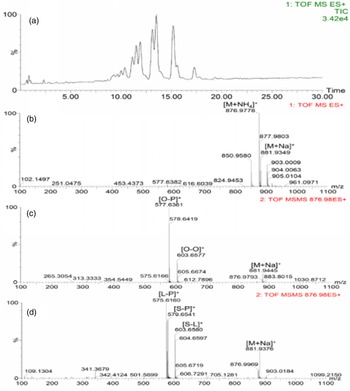
Figure 1 shows total ion chromatograms (TIC) of sow milk and the parent ion with 876.98 m/z selected as an example of the interpretations of MS and MS/MS data. Figure 1b shows the protonated molecules of MS spectrum, which were observed at 876.98 m/z ([M + NH4]+) and 881.93 m/z ([M + Na]+), respectively. According to the MS/MS spectra shown in Fig. 1c, the [DAG]+fragments ions generated from [M + NH4]+ at m/z 876.98, which referred to a chemical formula of C55H102O6. Two major fragment ions were 577.6361 and 603.6577 m/z, which corresponded to [DAG]+fragments [O-P]+, and [O-O]+, respectively. Two main fragment ions were related to the dominant TAG and indicate that they were derived from O-P-O. One very minor fragment ion at 575.62 m/z, and minor fragments derived from another TAG, which had the same mass charge (m/z) as the dominant TAG, are also present. At a later retention time, the dominant TAG decreased due to its gradual elution, whilst the fragment ions of the eluted minor TAG increased. Figure 1d with fragment ions of the second TAG were 575.62, 579.65, and 603.66 m/z, which corresponded to [DAG]+fragments [L-P]+, [S-P]+, and [S-L]+, respectively. The structure of TAG was identified to be S-P-L and the retention times of two TAGs were 15.23 and 15.55 min, respectively. The result demonstrates that more than two different TAGs were related to the same mass charge (m/z), and showed different retention times.
Total ion chromatograms of sow milk. (a); MS1 spectrum of 52 : 2 TAG (m/z: 876.98) (b); MS2 spectrum of O-P-O (RT: 15.28 min) (c); MS2 spectrum of S-P-L (RT: 15.55 min) (d).

Colostrum and milk have important roles in ensuring the survival and growth of piglets (Theil et al., Reference Theil, Lauridsen and Quesnel2014). If sow milk is insufficient, then replacement formulae (which if scientifically constituted are similar to the composition of sow milk) can be used to meet the nutritional needs of piglets (Hu et al., Reference Hu, Yang, Lv, Zhao, Wang and Zhu2019). TAGs are major components of sow milk fat, contributing about 50% of the total energy intake for newborn piglets (Doppenberg, Reference Doppenberg2010). Thus, we identified and analyzed the TAGs in sow milk during different lactation stages.
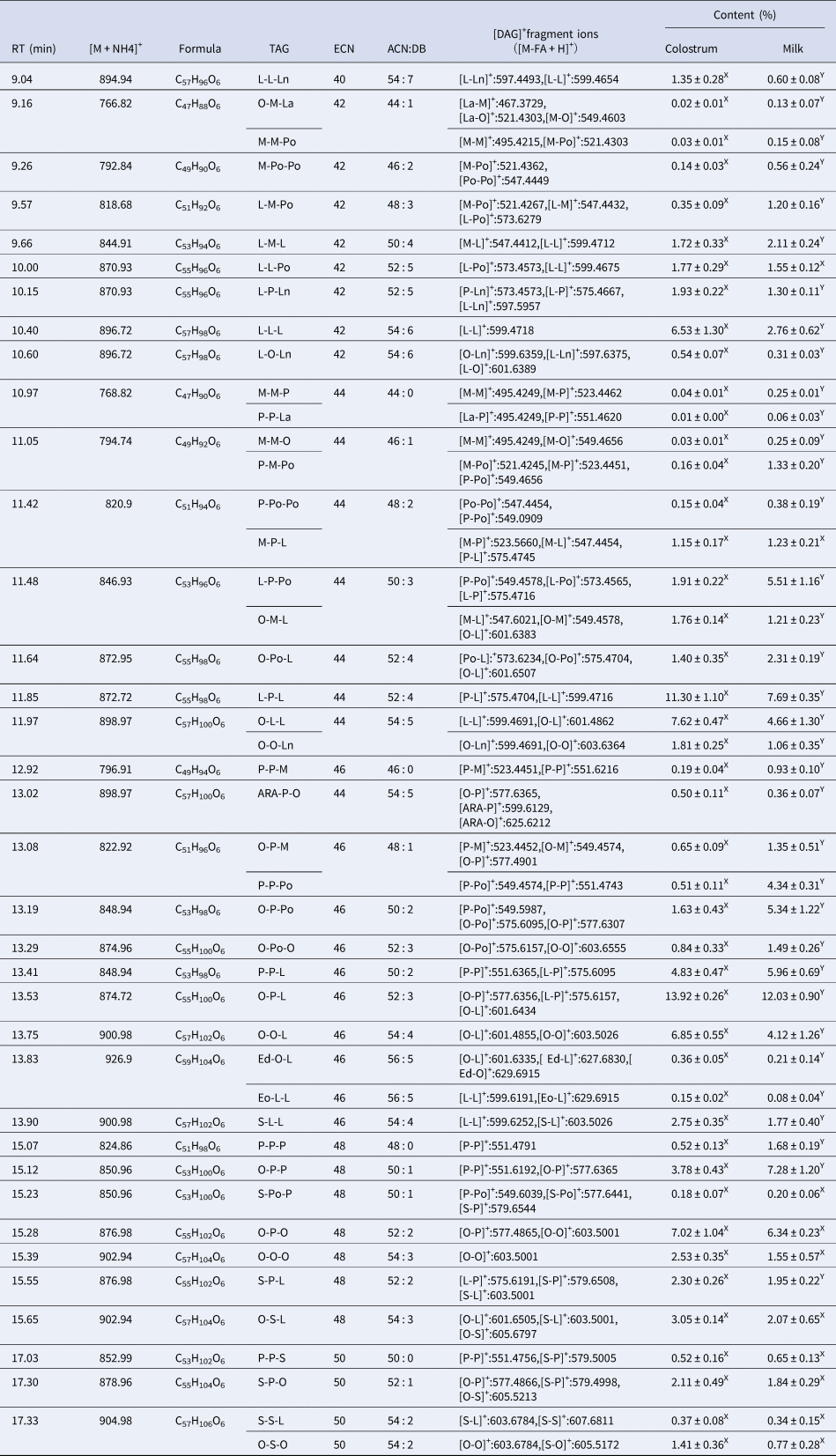
Summary data of the compositions and contents of all TAGs during different lactation stages are shown in Table 1. Forty-five main TAGs of sow milk fats were identified and quantified. The order of elution of TAGs on UPLC was determined by their equivalent carbon number (ECN = ACN − 2DB, where ACN is the acyl carbon number and DB is the number of double bonds). TAGs with a smaller ECN were eluted more readily than TAGs with a larger ECN. TAGs with the same ECN were separated according to the number of DB, and TAGs with fewer DB were eluted earlier than TAGs with more DB. In our study, the ACN of TAGs ranged from 44 to 56, and DB ranged from 0 to 7. The content of O-P-L (one of the most abundant TAGs) accounted for 13.92% and 12.03% in colostrum and milk, respectively, values that are similar to those of human milk (Zhang et al., Reference Zhang, Qi, Zhang, Wei, Jin, Xu, Tao and Wang2019). The next most abundant TAG was L-P-L (11.30% and 7.69% in colostrum and milk, respectively). Other major TAGs that accounted for >5% of all TAGs were L-L-L, O-L-L, O-P-O, and O-O-L in colostrum, and L-P-Po, O-P-Po, P-P-L, O-P-O, and O-P-P in milk. Among these TAGs, colostrum contained more L-L-L, O-L-L, O-P-O, and O-O-L than milk, whereas milk contained more L-P-Po, O-P-Po, P-P-L, and O-P-P than colostrum. Minor TAGs (content between 1% and 5%) were L-M-L, L-L-Po, L-P-Ln, M-P-L, O-M-L, O-Po-L, O-O-Ln, S-L-L, O-O-O, S-P-L, O-S-L, and S-P-O. Considering these results, this situation may be associated with the feed, which consists of vegetable oil rich in linoleic acid (corn oil). Several studies have indicated that the feed given to sows in early and late pregnancy has effects on the chemical composition of colostrum and milk (Macharia, Reference Macharia2012; Szyndler-Nędza et al., Reference Szyndler-Nędza, Różycki, Eckert, Mucha, Koska and Szulc2013; Więcek et al., Reference Więcek, Rekiel, Bartosik, Głogowski and Kuczyńska2018). Sows supplemented with conjugated linoleic acid during gestation had an altered composition of fatty acids in colostrum and milk (Bee, Reference Bee2000). Eastwood et al. (Reference Eastwood, Leterme and Beaulieu2014) also reported on fatty acid content in the colostrum and milk of sows, which was related to gestation and postpartum dietary profiles, respectively. Thus, further investigation of the relationship between the dietary structure of sows and the TAG composition of sow milk may be important for the development of dietary products for piglets.
Compositions and contents of TAGs in samples of sow-milk fat

RT, retention time.
Different superscript uppercase letters indicate significant differences (P < 0.05) with a column. Abbreviations of fatty acids: M, C14 : 0; Mo, C14 : 1; P, C16 : 0; Po, C16 : 1; S, C18 : 0; L, C18 : 1; O, C18 : 2; Ln, C18 : 3; E, C20 : 0; Eo, C20 : 1; Ed, C20 : 2; Et, C20 : 3; ARA, C20 : 4; EPA, C20 : 5.
Comparison of TAG compositions of colostrum and milk in sows according to breed
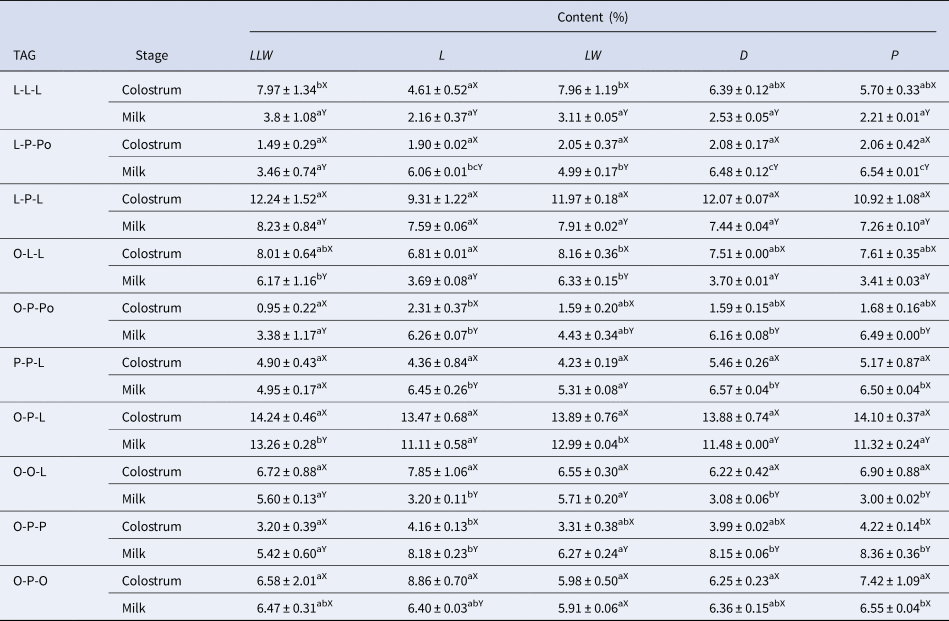
It was reported that the composition of colostrum is probably different among different sows breeds (Fahmy, Reference Fahmy1972). Very few studies have been carried out to confirm this finding with regard to TAG composition. Thus, we analyzed the TAGs of sow colostrum and milk during different breeds. Table 2 compares the major TAG species and contents (>5%) of sow milk during different lactation stages among LLW, L, LW, D, and P breeds. Other TAG species and contents (<5%) are listed in the online Supplementary Table S1. The predominant TAGs (>5%) were L-L-L, L-P-L, O-L-L, O-O-L, O-P-L, O-P-O, L-P-Po, O-P-Po, P-P-L, and O-P-P during different lactation stages. Although the TAG species were similar, significant differences were observed in TAG contents between colostrum and milk. Colostrum contained more L-L-L, L-P-L, O-L-L, O-O-L, O-P-L, and O-P-O than milk, whereas milk contained more L-P-Po, O-P-Po, P-P-L, and O-P-P than colostrum among all breeds (Table 2). It is noteworthy that L-P-Po and O-P-Po levels of colostrum were significantly lower than their levels in milk, which may be attributed to higher levels of palmitoleic acid (C16 : 1) in milk (Ren et al., Reference Ren, Jin, Wang, Zhang and Jin2022).
Major TAG species and contents (>5%) of sow milk during different lactation stages and in different breeds

Different superscript lowercase letters indicate significant differences (P < 0.05) with a row; different superscript uppercase letters indicate significant differences (P < 0.05) with a column. LLW, Landrace × Large White; L, Landrace; LW, Large White; D, Duroc; P, Pietrain.
In colostrum samples, O-P-L was the most abundant TAG, which accounted for 14.24%, 13.47%, 13.89%, 13.88%, and 14.10% among LLW, L, LW, D, and P breeds, respectively. This was followed by L-P-L (12.24%, 9.31%, 11.97%, 12.07%, and 10.92%, respectively). Significant differences were not found for O-P-L or L-P-L contents in colostrum among breeds. The other main TAGs in colostrum were L-L-L, O-L-L, P-P-L, O-O-L, and O-P-O. Significant differences were not found among the contents of P-P-L, O-O-L, and O-P-O of the five breeds. The LLW and LW breeds (7.97% and 7.96%, respectively) had significantly higher L-L-L contents than that in L, D, and P breeds (4.61%, 6.39%, and 5.70%, respectively), but no significant differences were observed between LLW and LW breeds. The L breed (6.81%) had significantly lower O-L-L content compared with that in the LW breed (8.16%), but no significant differences were found among LW, LLW, D, and P breeds (8.16%, 8.01%, 7.51%, and 7.61%, respectively).
In milk samples, the highest amount was O-P-L, in which LLW, L, LW, D, and P breeds accounted for 13.26%, 11.11%, 12.99%, 11.48%, and 11.32%, respectively. This was followed by L-P-L (8.23%, 7.59%, 7.91%, 7.44%, and 7.26%, respectively), significant differences were not detected for L-P-L contents in milk among breeds. The other main TAGs in milk were L-P-Po, O-L-L, O-O-L, O-P-Po, O-P-O, O-P-P, and P-P-L. Specifically, the O-P-O content was significantly lower in the LW breed (5.91%) than that in the P breed (6.55%), whereas no differences were found between LLW, L and D breeds (6.47%, 6.40% and 6.36%, respectively). The LLW and LW breeds had significantly lower P-P-L and O-P-P contents compared with those in L, D, and P breeds. The LLW breed (3.46%) had significantly lower L-P-Po content than that in L, LW, D, and P breeds (6.06%, 4.99%, 6.48%, and 6.54%, respectively), whereas the L, D and P breeds had a significantly higher L-P-Po content than the LW breed. The L, D and P breeds (6.26%, 6.16%, and 6.49%, respectively) contained more O-P-Po than that in LLW breeds (3.38%), but no significant differences were found among L, D, or P breeds.
Factors affecting the TAG compositions of sow milk
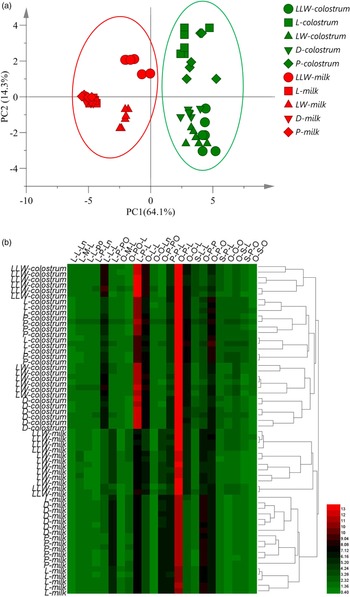
The score plots in Fig. 2 show that all sow milk samples were clustered into two categories. The first and second principal components revealed 64.10% and 14.30% of the total variance, respectively. Two principal components were sufficient to explain all TAG profiles as indicated by PCA results. The TAG profiles of sow milk samples during two lactation stages were distinguished significantly using PCA. The data for colostrum were obviously different from those in milk. In the score plot, PC1 clearly distinguished the lactation stage because colostrum and milk were separated. The HCA results were in accordance with the PCA result. This result also revealed that colostrum samples contained more O-P-L, L-L-L, L-P-L, O-L-L, O-O-L, and O-P-O than that in milk. Milk samples contained more L-P-Po, P-P-Po, O-P-Po, P-P-L, and O-P-P than that in colostrum. These results, taken together, indicated that the TAG composition of sow milk was affected mainly by the lactation stage rather than sow breed.
Principal component analysis (PCA) (a) and hierarchical clustering heatmap (HCA) (b) results of TAG compositions of sow milk fats. LLW, Landrace × Large White; L, Landrace; LW, Large White; D, Duroc; P, Pietrain; M, C14 : 0; P, C16 : 0; Po, C16 : 1; S, C18 : 0; L, C18 : 1; O, C18 : 2; Ln, C18 : 3.

TAG characteristics of sow milk during different lactation stages and breeds
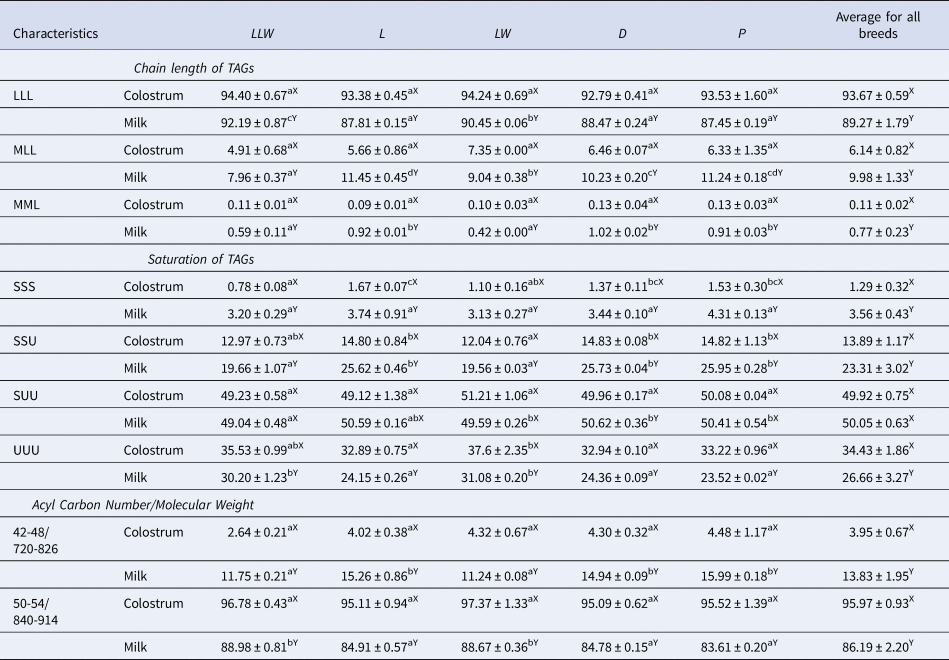
Table 3 shows the molecular-weight distribution of TAGs in sow-milk samples. We documented significant differences in the molecular-weight distribution of sow milk during different lactation stages and in different breeds. However, similar changes of TAGs were found in colostrum and milk of the five breeds. Sow-milk samples contained more TAGs of three long chain FAs (LCFAs) (LLL type) in colostrum than that in milk. No significant differences were found in the LLL type content of colostrum among the five breeds. However, the L, D, and P breeds showed significantly lower LLL type content in milk than that in LLW and LW breeds, whereas no differences were found among L, D, and P breeds. The percentages of medium-chain FAs (MCFAs) containing C8−C14 fatty acids existed with long-chain FAs (LCFAs) in the form of medium- and long-chain triacylglycerol (MLCT) (MML or MLL types) were lower in colostrum than in milk, and no significant differences in the MML or MLL contents of colostrum among breeds were noted. In milk, there were significant differences in MLL content, and the L breed had significantly higher MLL content than that in other breeds. Compared with L, D, and P breeds, LLW and LW breeds contained lower levels of MML in milk, whereas differences were not found between LLW and LW breeds. Furthermore, no TAGs containing short-chain fatty acids were found in sow milk fat in our study, which is in accordance with the previous research (Stinson et al., Reference Stinson, deMan and Bowland1966).
Molecular-weight distribution of TAGs in five breeds between colostrum and milk in sow

Different superscript lowercase letters indicate significant differences (P < 0.05) with a row; different superscript uppercase letters indicate significant differences (P < 0.05) with a column. M, medium-chain fatty acid; L, long-chain fatty acid; S, saturated fatty acid; U, unsaturated fatty acid.
With regard to the degree of saturation of fatty acids, most types of TAGs in sow milk contained unsaturated fatty acids (UFAs) such as TAG with three unsaturated fatty acids (UUU), TAG with one saturated fatty acid and two unsaturated fatty acids (SUU), and TAG with two saturated fatty acids and one unsaturated fatty acid (SSU). The content of the saturated TAG (SSS type) in milk was significantly higher than that in colostrum; and SSS content in colostrum was significantly higher in the L breed than in the LLW and LW breeds, whereas there were no significant differences among L, D, or P breeds. However, no significant differences were found for SSS content in milk among breeds. The most abundant type of TAG in sow milk of LLW, L, LW, D, and P breeds was SUU, which accounted for 49.23%, 49.12%, 51.21%, 49.96%, and 50.08% in colostrum and 49.04%, 50.59%, 49.59%, 50.62%, and 50.41% in milk, respectively. SSU content in colostrum was significantly lower in LLW and LW breeds than that in L, D, and P breeds, and showed the same variation in milk. UUU content was significantly higher in LLW and LW breeds than that among L, D, and P breeds, whereas no significant differences were found between LLW and LW breeds.
Short chain-TAGs (ACN ≤40) were not detected in our study, which agrees with previous studies of short-chain fatty acids of sow milk reported by our group and others (Park, Reference Park2011; Bai et al., Reference Bai, Wang, Zhao, Shi and Shan2017; Ren et al., Reference Ren, Jin, Wang, Zhang and Jin2022). In contrast, >80% of TAGs exhibited high molecular weight (≥840), the percentage of which was much lower in milk than that in colostrum. Significant differences were not found for different molecular weights of TAGs in colostrum among breeds. Furthermore, TAGs with a range of ACN from 42 to 48 in milk were significantly higher in L, D, and P breeds than in LLW and LW breeds. Conversely, considerably fewer TAGs with ACN from 50 to 54 in milk were found in L, D, and P breeds compared with those in LLW and LW breeds.
Comparison of TAG profiles during sow, commercial piglet formula, human, and other mammal milk fats
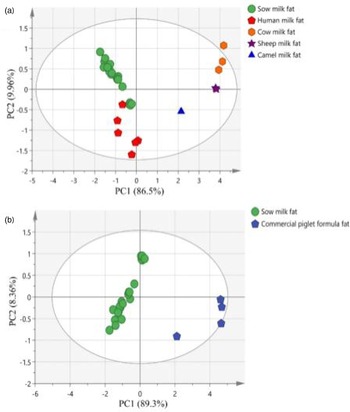
Two principal components were enough to explain the whole TAG profiles as indicated by the PCA results. As shown in Fig. 3a, and based on published data, TAG characteristics of sow milk are more similar to those of human milk than cow, sheep, and camel milks. Therefore, sow milk might be regarded as a potential source of nutrients for human infants. The score plots in Fig. 3b showed that there were significant differences between commercial piglet formulas and sow milk in the compositions of TAG. Hence, it is essential to investigate the TAG composition of sow milk fats, and prepare a high degree of similarity of fat substitutes to sow milk fats to meet different nutritional requirements for piglets. Furthermore, better understanding of the TAGs in sow milk would be desirable because people have become interested in using sows as a model for human studies.
Principal component analysis (PCA) of the TAG profiles of sow, commercial piglet formula, human (Yuan et al., Reference Yuan, Qi, Dai, Xia, Sun, Sun, Yu, Zhou, Jin, Wei and Wang2019; Zhang et al., Reference Zhang, Qi, Zhang, Wei, Jin, Xu, Tao and Wang2019), and other mammal milk fats (Stinson et al., Reference Stinson, deMan and Bowland1966; Pons et al., Reference Pons, Bargallo, Folgoso and Sabater2000; Zou et al., Reference Zou, Huang, Jin, Guo, Liu, Cheong, Xu and Wang2013).

In conclusion, we focused, for the first time, on the TAG composition of sow milks in China. Forty-five main TAG species were identified using UPLC-Q-ToF-MS. The most abundant TAG was O-P-L, which was more abundant in colostrum than that in milk. In addition, we showed that TAG profiles of sow milk fats are more similar to those of human milk fats compared with other mammal milk fats, such as cow, sheep, and camel milk fats. Significant differences were also observed between commercial piglet formulas and sow milk in the compositions of TAG. Hence, the study of TAG compositions of sow milk fats not only plays an important role in the production of commercial piglet formulas but also could be used as a new source of nutrients for human infants in future.
Supplementary material
The supplementary material for this article can be found at https://doi.org/10.1017/S0022029922000607.
Acknowledgements
The work was supported by China Postdoctoral Science Foundation (2021M691291).