Introduction
The tarnished plant bug, Lygus lineolaris (Palisot de Beauvois) (Hemiptera: Miridae), feeds on more than 130 economically important plants (e.g., cotton (Gossypium Linnaeus; Malvaceae), alfalfa (Medicago sativa Linnaeus; Fabaceae), soybeans (Glycine max (Linnaeus) Merrill; Fabaceae), apples (Malus pumila Miller; Rosaceae), strawberries (Fragaria × ananassa Duchesne ex Rozier; Rosaceae), and buckwheat (Fagopyrum esculentum Moench; Polygonaceae)) (Young Reference Young1986). Neutral-day strawberry fields in Québec, Canada, are severely threatened by L. lineolaris due to the long-lasting flowering period (usually from July to September) and its synchronism with the second generation of L. lineolaris. Lygus lineolaris has two to three generations by production season. Adults of the last generation hibernate before becoming active and reproducing late in April (Kelton Reference Kelton1975; Cleveland Reference Cleveland1982; Bostanian et al. Reference Bostanian, Mailloux, Binns and Thibodeau1990). The first generation emerges on spring hosts in May, develops and reproduces until the end of June. The second generation appears about mid-July and lasts until September. In September and October mainly adults are observed. Both adults and nymphs feed on developing strawberry fruits (Handley and Pollard Reference Handley and Pollard1993). The feeding puncture causes apical seediness of the achene that results in deformed fruits (Handley and Pollard Reference Handley and Pollard1993). Chemical treatments (mainly pyrethroid) are sprayed up to twice a year to control L. lineolaris. However, pyrethroid has a limited persistence in strawberry fields; it is effective for about a week after its application. Thus, the long-lasting period of flowering and the span of the overlapping second/third generation of L. lineolaris (from July to October) poses a real challenge to growers. Lygus lineolaris can develop resistance to pyrethroids, organophosphate, and cyclodiene insecticide (Snodgrass and Elzen Reference Snodgrass and Elzen1995; Snodgrass Reference Snodgrass1996; Snodgrass and Scott Reference Snodgrass and Scott1999). Insecticide sprays contribute to the development of resistance to commonly used insecticides (Perera et al. Reference Perera, Gore, Snodgrass, Jackson and Allen2015). Hence, integrated pest management strategies must overcome major challenges to minimise the use of pyrethroids (or other broad-spectrum insecticides) while providing an adequate protection against L. lineolaris.
The use of a broad variety of hosts by L. lineolaris provides the opportunity to implement trap crop nearby cultivated plants (Stern et al. Reference Stern, Bosch and Leigh1964, Reference Stern, Mueller, Sevacherian and Way1969; Sevecherian and Stern Reference Sevacherian and Stern1974; Godfrey and Leigh Reference Godfrey and Leigh1994; Rämert et al. Reference Rämert, Hellqvist, Ekbom and Banks2001; Swezey et al. Reference Swezey, Nieto, Hagler, Pickett, Bryer and Machtley2013). Trap crops consist of using alternative hosts (plants, shrubs, or trees) usually arranged at the edge of the field to attract pests and prevent damage to target crops (Shelton and Badenes-Perez Reference Shelton and Badenes-Perez2006). This strategy was used against different species from the genus Lygus Hahn (Hemiptera: Miridae) (Accinelli et al. Reference Accinelli, Lanzoni, Ramilli, Dradi and Burgio2005; Swezey et al. Reference Swezey, Nieto and Bryer2007). The efficiency of trap cropping depends on various factors, such as the attractiveness of plants used (relatively to the crop needing protection), the synchronicity between the bloom and the pest cycle, and the capacity of the trap crop to retain the pest (Banks and Ekbom Reference Banks and Ekbom1999; Shelton and Badenes-Perez Reference Shelton and Badenes-Perez2006). Some plants have been proposed as efficient trap crops in L. lineolaris management such as alfalfa and mustard (Sinapis Linnaeus; Brassacaceae). Moreover, the use of trap crop can be combined with repressive methods (e.g., insecticide sprays, physical methods) to increase its effectiveness (Accinelli et al. Reference Accinelli, Lanzoni, Ramilli, Dradi and Burgio2005; Shelton and Badenes-Perez Reference Shelton and Badenes-Perez2006). Swezey et al. (Reference Swezey, Nieto and Bryer2007) reported that combination of trap crop (alfalfa) and vacuums successfully decreased the population of the western tarnished plant bugs, Lygus hesperus Knight, by about 70–90% in strawberry fields. These authors estimated that vacuuming trap crop reduced expenses by 78% in organic strawberry fields compared with whole vacuuming practices. Accinelli et al. (Reference Accinelli, Lanzoni, Ramilli, Dradi and Burgio2005) reported a significant effect of localised insecticide treatments on alfalfa trap crop in the control of Lygus rugulipennis Poppius on lettuce.
In the present study, we tested the combined effect of trap crop and insecticide to control L. lineolaris on neutral-day strawberry plants. Both buckwheat and white mustard (Sinapis alba Linnaeus; Brassicaceae) were used as trap crop. These plants are highly attractive to L. lineolaris (Braun et al. Reference Braun, Erlandson, Baldwin, Soroka, Mason, Foottit and Hegedus2001), provide a high density of flowers for an extended (about two to four weeks) period of time, and their flowering period is synchronised with those of neutral-day strawberry plants. Thus, we first hypothesised that both buckwheat and white mustard can attract L. lineolaris in such a way that it concentrates on these trap crops rather than on strawberry plants. We then targeted chemical insecticide treatments directly on trap crops. Our second hypothesis was that the insecticide spayed uniquely on trap crops would kill sufficient L. lineolaris adult and larvae to reduce their presence on adjacent strawberry plants and provide adequate protection to crop.
Methods
Experimental site and design
This study was conducted on the experimental farm of the Centre de recherche agroalimentaire de Mirabel in Mirabel (Québec, Canada) (45.648934°N, 74.090042°W) during 2015 and 2016 summers. The voucher specimens from our study were deposited in the Centre de recherche agroalimentaire de Mirabel insect collection for future reference.
In May (both 2015 and 2016), four blocks of six plots were planted following a randomised complete-block design. A distance of 10 m separated each plot within a block, and a distance of 20 m between blocks. For each plot, two raised beds of 32 day-neutral strawberry plants of the variety “Albion” was planted under plastic mulches (two rows of 16 plants). The size of the mounds was 5 m long and 0.8 m tall. Trap crop was 5 m long and 1 m wide, planted 1 m from the strawberry mounds. Both white mustard and buckwheat were sown within a week after the strawberry plants were planted at a rate of approximately 65 plants/m2. Oats were planted between the plots and the block, and it was regularly mowed (which allows for an adequate control of weed).
Each plot received one of these treatments: (1) control treatment without adjacent trap crops or insecticide application; (2) conventional treatment without adjacent trap crops but insecticide applied directly on strawberry plants; (3–4) trap crop (either buckwheat or white mustard) without insecticide application; (5–6) trap crops (buckwheat or white mustard) with insecticide applied directly on trap crops but not on adjacent strawberry plants. Insecticides were applied carefully by a trained technician equipped with a manual backpack sprayer (447 L/ha of Ripcord 400 (BASF Canada, Mississauga, Ontario, Canada) effective concentration, cypermethrin). In 2015, a single cypermethrin treatment was applied on 24 July, whereas two applications were done in 2016 (24 July and 17 August).
Data collection
In each plot, the population of L. lineolaris was estimated by tapping all flowers of two strawberry plants from the inner rows, and of two trap crop plants (either buckwheat or white mustard) over a white fabric (0.64 m2). Sampling was performed in the morning (between 8 AM and 10 PM). Lygus lineolaris density was screened by sampling weekly from early July to late August (both 2015 and 2016). Only the adult and the large nymphs (fourth and fifth nymphal stages) were counted in this experiment because they are easily distinguished from other mirid species.
The strawberry flowers were removed until the beginning of July to allow plants to invest their energy in the vegetative grow. First fruits were observed about three weeks later (end of July). Strawberries were harvested three times a week (up to 12 repeated observations by plot) to quantify damages. Harvested fruits were classified as intact (hence marketable fruit), damaged by L. lineolaris, or classified as unmarketable due to disease or other reasons (these later fruits were discarded from the analysis). All strawberries harvested from a single row were pooled and weighted.
Statistical analyses: effects of treatments on Lygus lineolaris population
Generalised linear mixed models with a Poisson distribution were implemented to test the effect of host plant species, date (Julian day) (both linear and quadratic relationship), and the interaction between the quadratic term (date) and host on the number of L. lineolaris (adults or large nymphs) observed by plant in plot without insecticide treatments. The models included year and block as random effects. The analysis on adults and large nymphs were run independently.
The same approach (generalised linear mixed models) was used to test the effect of insecticide applications and date (linear and quadratic terms) on the number of L. lineolaris. A different model was implemented for each host plant (strawberry, buckwheat, and white mustard). Hence, untreated buckwheat trap crops were only compared with insecticide-treated buckwheat trap crops. The same goes for white mustard trap crops or strawberry plots without trap crops.
Similar models were used to test the abundance of L. lineolaris on strawberry plants (number of bugs/beating) as a function of the trap crop–insecticide treatments and the date (Julian day). The random structure of the model was composed of year and block. A model was run for each development stage (i.e., adults or large nymphs).
The proportion of intact (marketable) strawberries on the total fruit harvested was tested using a generalised linear mixed model for binomial distribution. The trap crop–insecticide treatments were included in the model as a fixed variable. The model included year and block as random effects.
In all models, the statistical significance of the fixed effects was determined using the likelihood ratio test. All pairwise comparisons of Tukey were implemented using the glht function (package multcomp; Hothorn et al. Reference Hothorn, Bretz and Westfall2008). Analyses were run on data collected after 15 July since the density of L. lineolaris and strawberries before this date were very low. The software R was used to implement these statistical analyses (R Core Team 2017).
Results
Effects of treatments on Lygus lineolaris population
Adults
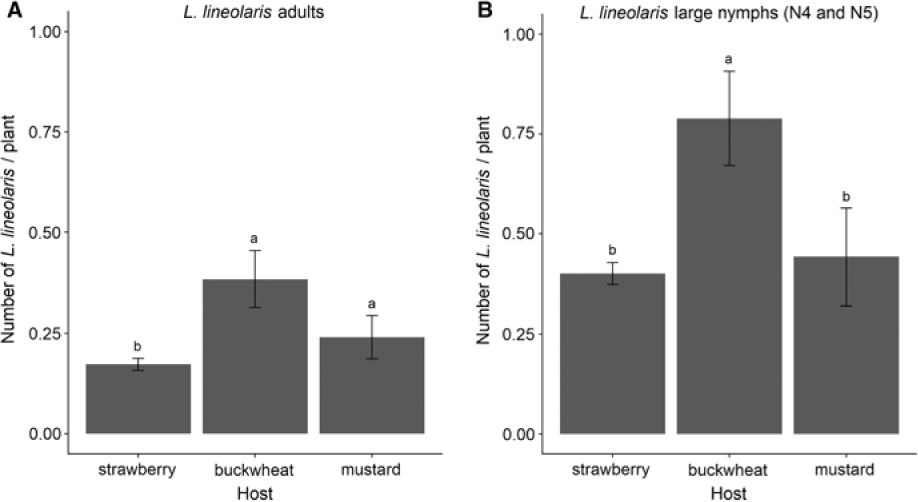
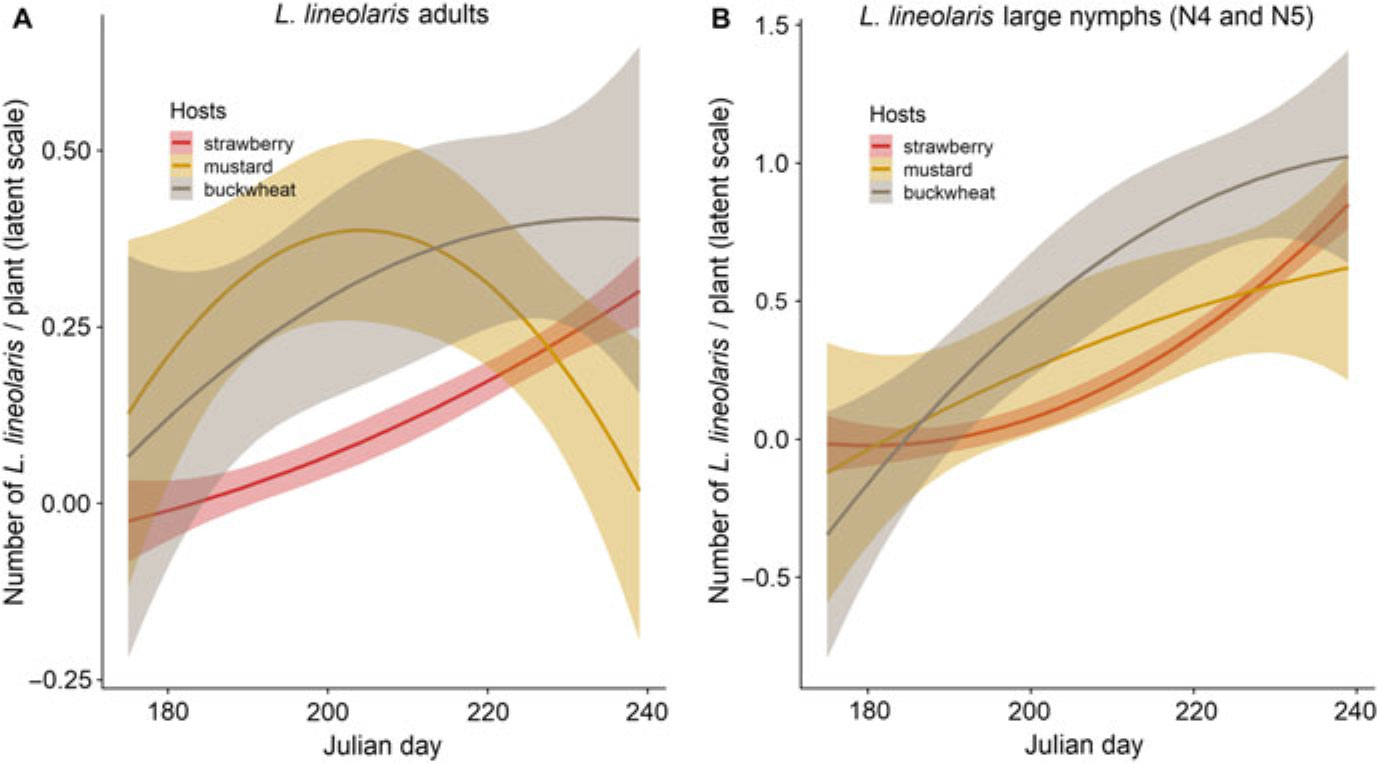
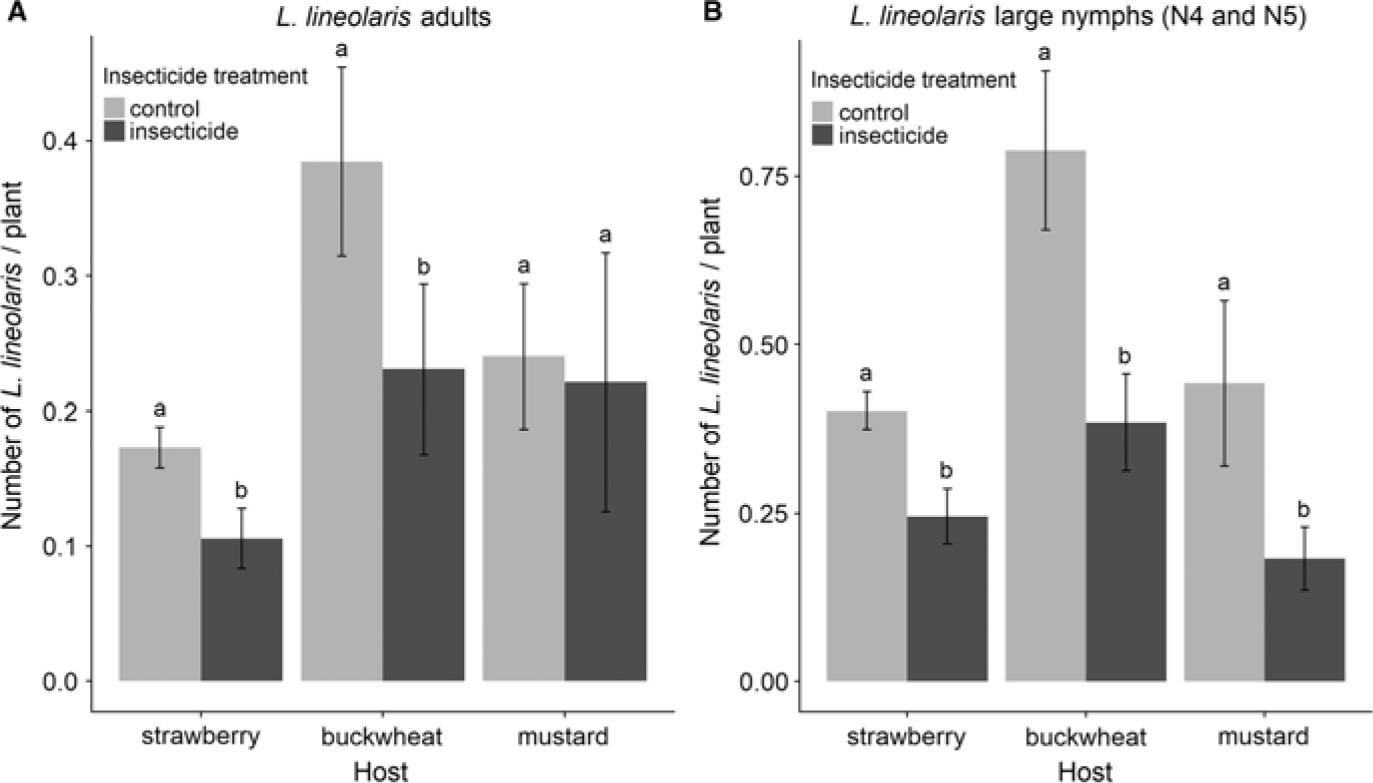
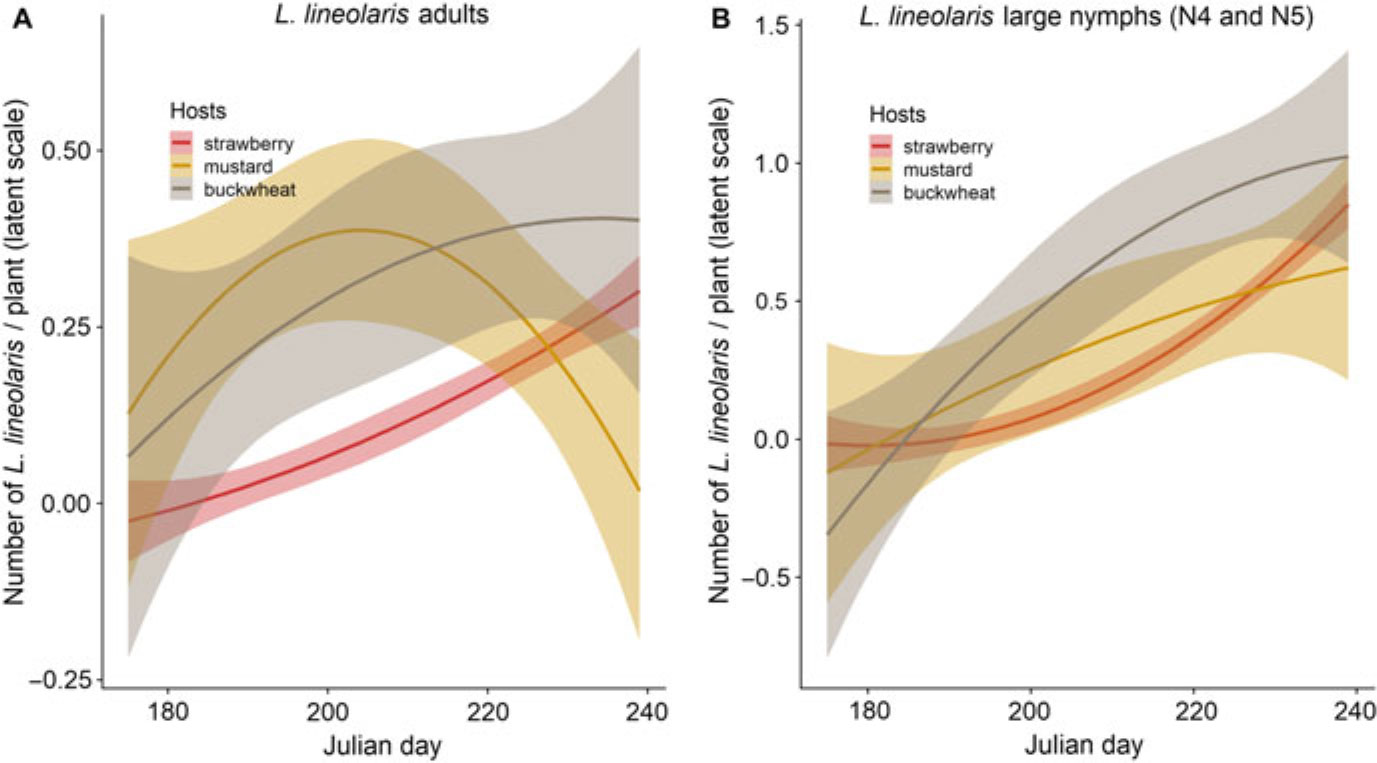
Over the two seasons, more adult L. lineolaris by plant was observed on untreated buckwheat (0.38 ± 0.07 standard error) and white mustard (0.24 ± 0.05) than on untreated strawberry plant (0.17 ± 0.02) (likelihood ratio test = 18.58; df = 2; P < 0.0001) (Fig. 1A). The interaction between the host and the date (quadratic term) indicated that the temporal variation of L. lineolaris adult population was significantly different among hosts (likelihood ratio test = 23.67; df = 2; P < 0.0001) (Fig. 2A). On strawberry plants, the adult population increased linearly over the whole observation period (Fig. 2A). In contrast, the relationship between the adult population density on white mustard plants and the time (Julian day) followed a bell-shaped curve (Fig. 2A). On buckwheat, this relationship is increasing linearly until reaching a plateau during the first week of August (Fig. 2A). Insecticide treatment applied on strawberry (likelihood ratio test = 5.40; df = 1; P = 0.02) and buckwheat (likelihood ratio test = 4.04; df = 1; P = 0.04) reduced L. lineolaris adult population by 38.9% and 40.0%, respectively, but had no significant effect on white mustard (likelihood ratio test = 0.08; df = 1; P = 0.77) (Fig. 3A).
Mean number of Lygus lineolaris adults (A) and large nymphs (fourth and fifth nymphal stages) (B) by host plant. Letters correspond to significant differences among treatments (α = 0.05).

Quadratic relationship between the number of Lygus lineolaris adults (A) and large nymphs (fourth and fifth nymphal stages) (B) tapped per strawberry (red), white mustard (yellow), and buckwheat (grey) plant and the Julian day.
Effect of insecticide treatments (cypermethrin) on the number of Lygus lineolaris adults (A) and large nymphs (B) per plant (strawberry, buckwheat, or white mustard). For each host, letters correspond to significant differences among treatments (α = 0.05).

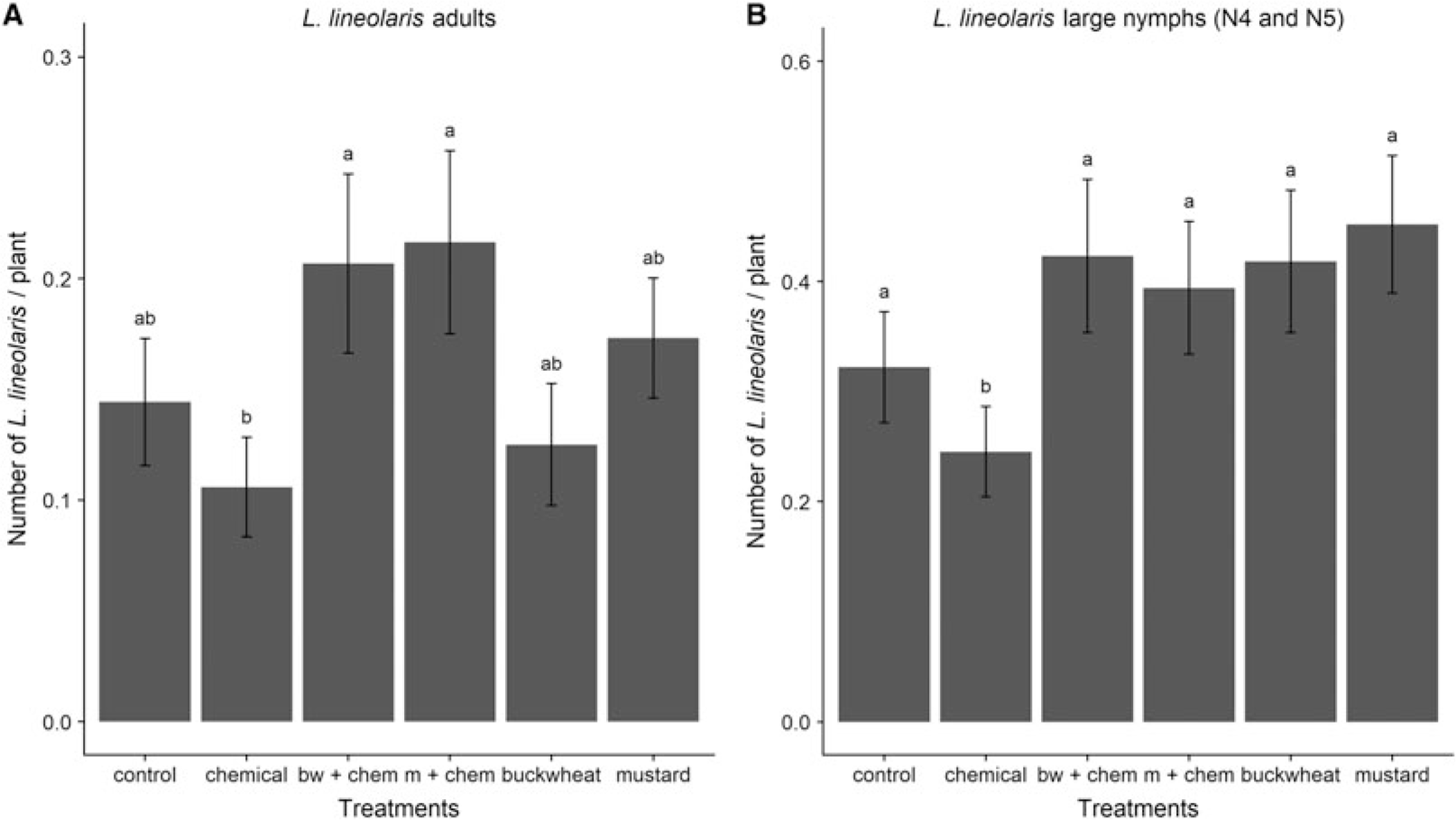
The adult population was higher on strawberry plants adjacent to trap crops of buckwheat or white mustard treated with an insecticide than the conventional treatment (likelihood ratio test = 12.91; df = 5; P = 0.02) (Fig. 4A).
Number of Lygus lineolaris adults (A) and large nymphs (B) as a function of trap crop and insecticide spray treatments. The chemical treatment refers to cypermethrin application directly on strawberry plant, whereas “bw + chem” and “m + chem” refer to insecticide treatment applied on buckwheat (bw) or white mustard (m), respectively. Letters correspond to significant differences among treatments (α = 0.05).

Large L. lineolaris nymph (fourth and fifth nymphal stages) density was nearly twice as much on untreated buckwheat (0.79 ± 0.12) than on untreated strawberry (0.40 ± 0.03) or white mustard (0.44 ± 0.12) (likelihood ratio test = 26.70; df = 2; P < 0.0001) (Fig. 1B). The temporal variation of L. lineolaris nymph population varied significantly among host (likelihood ratio test = 25.85; df = 2; P < 0.0001) (Fig. 2B). On strawberry plants, the relationship between L. lineolaris nymph density mostly followed an exponential relationship (Fig. 2B). On buckwheat and white mustard plants, L. lineolaris density increased linearly and reached a plateau at the first week of August (Fig. 2B). The insecticide treatments lowered L. lineolaris nymph population by 39.0% on strawberry plant (likelihood ratio test = 12.62; df = 1; P = 0.0004), by 51.1% on buckwheat (likelihood ratio test = 14.76; df = 1; P = 0.0001), and by 58.7% on white mustard (likelihood ratio test = 11.56; df = 1; P = 0.0007) (Fig. 3B).
Lygus lineolaris nymphs were more abundant on strawberry plants close to buckwheat or white mustard trap crop than those without nearby trap crop whether or not the trap crops were treated with insecticide (likelihood ratio test = 17.80; df = 5; P = 0.003) (Fig. 4B).
Effects of treatments on fruit damages
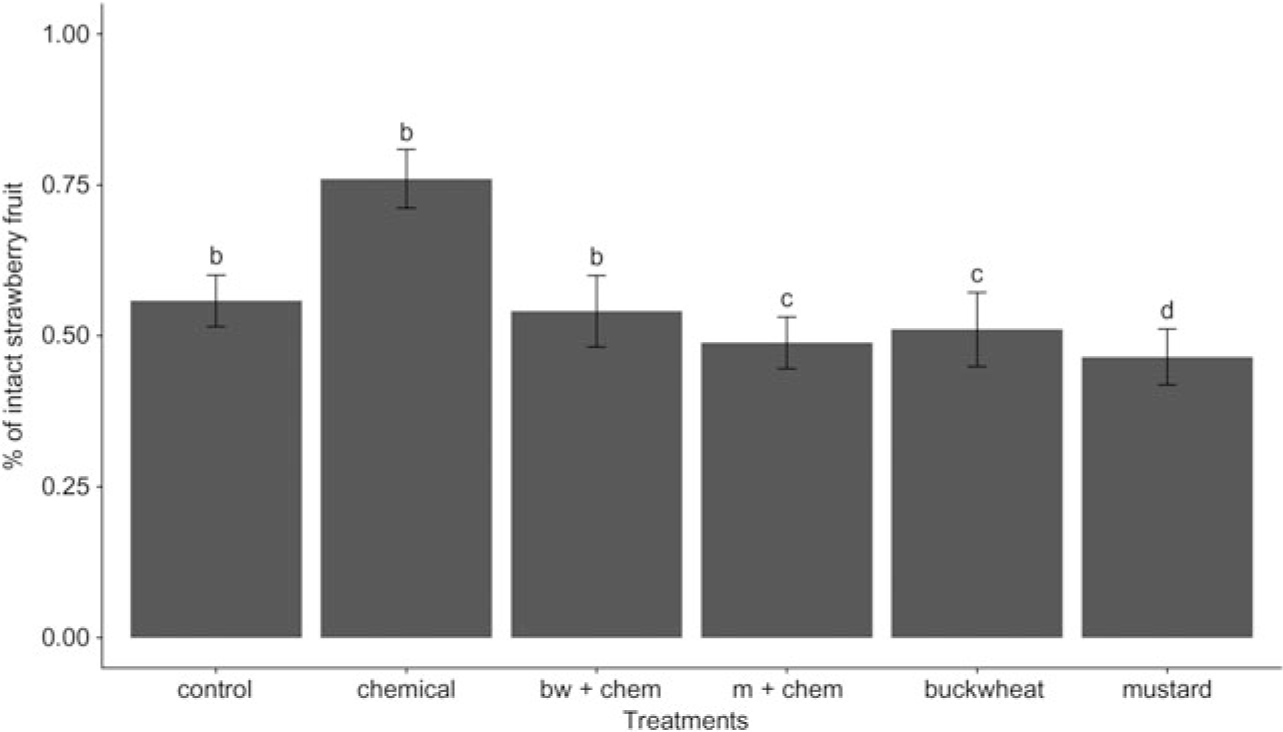
The trap crop–insecticide treatment had a significant effect on the proportion of undamaged (intact) strawberry fruit harvested on the total fruit harvested (likelihood ratio test = 8.70; df = 2; P = 0.01) (Fig. 5). The conventional treatment (insecticide applied on strawberry plants; no trap crop nearby) generated a higher proportion of undamaged fruits (0.76 ± 0.05) than any other treatments (Fig. 5). Conversely, white mustard trap crops lowered the proportion of undamaged fruits compared with other treatments. Untreated white mustard trap crops (0.47 ± 0.05) generated significantly lower proportion of undamaged fruits than the treated white mustard trap crops (0.49 ± 0.04) (Fig. 5). The proportion of undamaged fruits observed in treated (0.54 ± 0.06) and untreated (0.51 ± 0.06) buckwheat trap crop treatments generated results similar to the control treatment (0.56 ± 0.04) (Fig. 5).
Percentage of intact strawberry as a function of trap crop and insecticide spray treatments. The chemical treatment refers to cypermethrin application directly on strawberry plant, whereas “bw + chem” and “m + chem” refer to insecticide treatment applied on buckwheat (bw) or white mustard (m), respectively. Letters correspond to significant differences among treatments (α = 0.05).

Discussion
The combined use of trap crops and insecticide should aim to reduce the amount of chemical products sprayed on crop while providing an adequate protection to economically important plants. The success of this approach relies on the ability of trap crops to attract and retain (at least for a reasonable period of time) the targeted pest insect and on the efficiency of the insecticide in reducing the pest population. In our study, L. lineolaris (both adults and nymphs) were more abundant on buckwheat than on strawberry plants. The adults were also more abundant on white mustard than on strawberry. Insecticide treatments reduced the adult L. lineolaris population on strawberry and buckwheat plants, but not on white mustard plants. At the time of the insecticides application most white mustard flowering was finished and we found less adult L. lineolaris on these plants than on other hosts. Therefore, they would not have been exposed to the chemical treatments applied on white mustard plants. In contrast, insecticide treatment reduced L. lineolaris nymph population on all hosts. However, the combined use of trap crops (whether buckwheat or mustard) and insecticide spray (cypermethrin) did not significantly reduce L. lineolaris population on strawberry plant compared with control plot. Conversely, chemical treatments applied on buckwheat or white mustard increased adult L. lineolaris on adjacent strawberry plants. Thus, the insecticide may have had a repellent effect rather than a lethal effect on L. lineolaris adults. The result is that trap crops and insecticide treatments did not adequately protect the strawberry plants. Thus, only conventional treatment generated a higher percentage of intact strawberries than the control treatment. White mustard trap crops even resulted in higher damage rates than the control treatment.
Lygus lineolaris has been found on over 350 different hosts, some of which are used as trap crops (Young Reference Young1986). For instance, Gerber (Reference Gerber1996) demonstrated that six species from the genera Sinapis Linnaeus (Brassicaceae) (S. alba Linnaeus, S. arvensis Linnaeus) and Brassica Linnaeus (Brassicaceae) (B. carinata Braun, B. juncea (Linnaeus) Czernajew, B. napus Linnaeus, and B. rapa Linnaeus) are reliable and attractive hosts for both L. lineolaris adults and nymphs, and hence are potential trap crops. Our results indicated that white mustard is not an adequate trap plant for L. lineolaris management as it does not have sufficient flowering time, and L. lineolaris attracted by this plant contribute to increased damage to adjacent strawberry plants. Bodnaryk (Reference Bodnaryk1996) observed that L. lineolaris has low feeding rates on white mustard seeds because of a high concentration of glucosinolate (“sinalbin”). In our experiment, > 50% of white mustard plants lost their flowers and exhibited seeds two to three weeks after the beginning of the flowering period. It could have repelled L. lineolaris and forced them to move to adjacent strawberry plants. Alternatively, buckwheat has greater potential as a trap crop to attract adult L. lineolaris and be a host for oviposition. Buckwheat had L. lineolaris present for a period that lasted up to four weeks due to an extended flowering period. However, a decrease in L. lineolaris population on trap crops (both buckwheat and white mustard) coincided with the end of the flowering period of trap crops and an increase in the production of strawberries. This lack of synchronicity between the flowering period of trap crops and the peak of strawberry harvest may explain an increased damage to fruit in plots with trap crops compared with conventional plots. Successive sowing of trap crop seeds could increase their flowering period (and thus attractiveness) and synchronicity with the crop needing protection (Holden et al. Reference Holden, Ellner, Lee, Nyrop and Sanderson2012).
Our results demonstrated that trap crops could be only useful in L. lineolaris management when combined with an effective repressive method. In our experiment, although insecticide treatments reduced the number of L. lineolaris on buckwheat (but not on white mustard plants), these did not reduce the density on adjacent strawberry plants or the amount of damage observed on the fruits. The use of insecticide may explain this result. The efficiency of insecticides relies on the conditions under which they are applied. The insecticide (cypermethrin) used in our study is efficient against L. lineolaris on strawberry plants when applied at a threshold of 0.28 L. lineolaris per floral scape and at a dose of 250 mL per hectare. We used the same dosage and intervention threshold on buckwheat and white mustard than on strawberry plants. This may not be an optimal use of this insecticide on our trap crops that have a very different structure and density than strawberry plant.
The lack of efficacy of the combined use of trap crops and insecticide in our experiment could also be explained by the behavioural response of L. lineolaris. Cypermethrin operates when insects come into contact with or ingest it. Lygus lineolaris could adapt their behaviour after insecticide application by avoiding the flowers or plants that have been treated (Martini et al. Reference Martini, Kincy and Nansen2012). Lygus lineolaris use olfactory stimuli to choose their host. The insecticide may have a repellent odour, making L. lineolaris to avoid exposed areas. Moreover, L. lineolaris, particularly early reproductive females, has high flight abilities and easily colonises new habitat patches (Stewart and Gaylor Reference Stewart and Gaylor1994; Swezey et al. Reference Swezey, Nieto, Hagler, Pickett, Bryer and Machtley2013). Therefore, insecticide treatments on trap crops may have caused L. lineolaris to move to adjacent strawberry plants. The distance between the trap crops and the crop needing protection is a key parameter underlying the success of trap cropping (Shelton and Badenes-Perez Reference Shelton and Badenes-Perez2006). Swezey et al. (Reference Swezey, Nieto and Bryer2007) observed increased damages on strawberry fruits only in the first row next to untreated trap crops. While L. lineolaris can move from trap crops to strawberry plants, they nonetheless remain relatively close to the trap crop. In our experiment, strawberry plants, on which L. lineolaris populations and damages were measured, were nearer (< 2 m) to trap crops. Thus, it may explain the spill-over effect we observed in our experiment.
Lygus lineolaris may develop resistance to different pesticides (Snodgrass Reference Snodgrass1996; Holloway et al. Reference Holloway, Leonard, Otta, Pankey, Graves and Snodgrass1998; Snodgrass and Scott Reference Snodgrass and Scott2000; Zhu et al. Reference Zhu, Snodgrass and Chen2004). In our experience, insecticide applications have reduced L. lineolaris population (adults and nymphs) by almost 40% on strawberry. Thus, > 60% of the population remained on plants treated with cypermethrin. This proportion of the population may have some degree of resistance to the insecticide used. Insecticide resistance may be physiological (Zhu et al. Reference Zhu, Snodgrass and Chen2004) or behavioural (Martini et al. Reference Martini, Kincy and Nansen2012). For instance, Nansen et al. (Reference Nansen, Baissac, Nansen, Powis and Baker2016) observed that diamondback moth Plutella xylostella (Linnaeus) (Lepidoptera: Plutellidae) could evolve both physiological and behavioural resistance. Adults and larvae of this pest that do not have physiological resistance respond to the pesticide by selecting sites not exposed by the insecticide (Nansen et al. Reference Nansen, Baissac, Nansen, Powis and Baker2016). A similar phenomenon may have occurred in our experiment when one part of the population of L. lineolaris could exploit plots treated with cypermethrin and another part would respond by exploiting unexposed hosts. This hypothesis could explain the fact that despite a gain in terms of phytoprotection provided by chemical treatments directly on strawberries (conventional treatments), the level of damage in these plots was still relatively high.
Acknowledgements
The authors wish to thank Larbi Zerouala (Ministère de l’Agriculture, des Pêcheries et de l’Alimentation du Québec) for his advice on the project. We also thank Maud Lemay, Manon Laroche, Stefano Campagnaro, Mylène Vaillancourt, Myriam Bonneville Décarie, Anaïs Lucas, and Anaïs Douteur for their technical support. Thanks to Laura Chouinard-Thuly for the English editing. Funding for this project was provided by the 2013–2018 Prime-Vert programme (Ministère de l’Agriculture, des Pêcheries et de l’Alimentation du Québec).