Introduction
The genus Cucullanus comprises over 50 species, mainly from fishes, but a few from chelonians. Some studies on the biology and seasonal dynamics of Cucullanus spp. have been reported (Moravec, Reference Moravec1980, Reference Moravec1998; Køie, Reference Køie2000; Alves et al., Reference Alves, Luque and Paraguassu2001). Dogiel et al. (Reference Dogiel, Petrushevski and Polyanski1961) indicated that a variety of factors can determine or influence the parasite fauna of any species or group of hosts, and factors such as age of host, season of the year, food and mode of life of the host and geographical distribution of hosts modify or alter the helminth fauna of a host population with reference to time and space. The host, Orthopristis ruber (Cuvier) of the family Pomadasyidae, is a commercially important marine demersal fish. The juveniles are found along the coast in algal vegetation while adults reside in the rocky and coraline bottoms. Orthopristis ruber is carnivorous and feeds mainly on crustaceans (Cervigon, Reference Cervigon1966). The genus Cucullanus is found commonly in O. ruber along with other parasites. Bashirullah & Centeño (Reference Bashirullah and Centeño1998) reported the occurrence of Cucullanus in five species of Haemulon. The objective of this study is to analyse the qualitative and quantitative parameters of the temporal distribution and population structures of two species of Cucullanus: C. tripapillatus and C. chrysophrydes in the intestine of O. ruber in the Caribbean region of Venezuela.
Materials and methods
A total of 300 O. ruber were collected from commercial trawlers landed in Cumana, Venezuela between August 1982 and July 1983, and another 240 fish between August 1992 and July 1993. Fish were caught in the areas between 11°05′–11°20′N and 63°50′–64°25′W in the Caribbean Sea on the north of Margarita Island, Venezuela. Fish were sorted on board by species, and stored in baskets with ice in the cool room of the trawler. Monthly samples were collected from five boxes at random while unloading at the fish landing station in Cumana. Each fish was measured, sexed and autopsied within 4 h of collection, and parasites were collected from the digestive tract, counted, recorded and preserved in 70% ethyl alcohol for later studies. All nematode parasites were studied as wet mounts in a mixture of ethanol and glycerine. Use of the terms prevalence, intensity, mean intensity, abundance, and infrapopulation follows the recommendation of Margolis et al. (Reference Margolis, Esch, Holmes, Kuris and Schad1982) and Bush et al. (Reference Bush, Lafferty, Lotz and Shostak1997). The significance test for seasonal changes in abundance, prevalence, mean intensity of parasite and mean length of fish were carried out using one-way ANOVA and Kruskal–Wallis tests. Sex difference was tested using Student's t-test. The software JUMP IN (SAS Institute Inc.) version 3 for Windows was used to analyse the data.
Results
Host population structure
A total of 300 fish were examined during 1982–83, ranging in size from 116 to 258 mm with a mean of 182.3 ± 2.8, while 240 fish sampled during 1992–93, varied between 90 and 236 mm (X = 174.5 ± 3.7). The monthly mean length of fish sampled in 1992–93 was examined to determine any seasonal trend related to possible migratory patterns. The mean length remained stable, within the range throughout the sampling period, although larger fish were less frequent in the samples of 1992–93 than in those of 1982–83. This may be due to over-exploitation of resources in the area during the decade.
The prevalence of infection with Cucullanus was 59% during 1982–83, and 47% during 1992–93. More female fish were infected than male fish in both years of samplings, with a male to female ratio of 1:2.
Seasonal distributions of two species of Cucullanus
Cucullanus tripapillatus
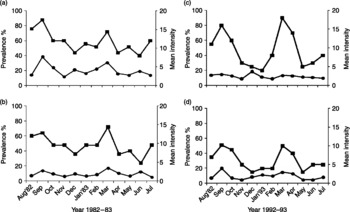
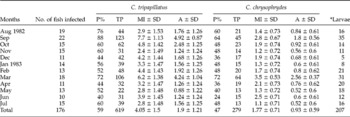
One hundred and seventy-six of 300 fish hosts examined during 1982–83 were found to be infected, with an average prevalence of infection of 59%. The prevalence of C. tripapillatus fluctuated between 40% and 88%, with two peaks in September and in March (fig. 1a), and monthly fluctuation in prevalence was statistically significant (F = 14.37, P < 0.05). Fish were found to be infected with this nematode throughout the year. A total of 619 adult nematodes were recovered from 176 infected fish, and the mean intensity varied from 2.4 ± 1.49 to 7.7 ± 1.13, while the abundance fluctuated from 0.88 ± 1.22 to 4.92 ± 0.87 (table 1). The presence of larval stages of Cucullanus was recorded but it was difficult to distinguish between the two species and they are shown as just larvae in table 1.
Monthly fluctuation of prevalence (●) and mean intensity (■) of Cucullanus tripapillatus (a, c) and Cucullanus chrysophrydes (b, d) in Orthopristis ruber during 1982–83 (a, b) and 1992–93 (c, d).

Monthly occurrence of Cucullanus tripapillatus and Cucullanus chrysophrydes in Orthopristis ruber during 1982–83 in northeast Venezuela.

Total number of fish examined = 300, 25 each month. A, abundance; MI, mean intensity; P, prevalence; SD, standard deviation; TP, total number of adult parasites; *larval stage of both species.
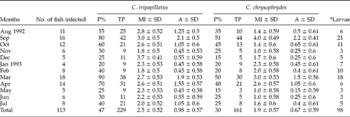
One hundred and thirteen of the 240 fish examined during 1992–93 were found to be infected, and 229 adult C. tripapillatus were recovered. Monthly prevalence of C. tripapillatus fluctuated between 20% and 90% with an average of 47%, exhibiting two peaks in September and March which were statistically significant (F = 11.4, P < 0.05). These peaks are more prominent than in earlier samples (1982–83). The mean intensity of infection varied from 1.8 to 3.7 and abundance fluctuated from 0.45 to 2.1 (table 2 and fig. 1c).
Monthly occurrence of Cucullanus tripapillatus and Cucullanus chrysophrydes in Orthopristis ruber during 1992–93 in northeast Venezuela.

Total number of fish examined = 240, 20 each month. A, abundance; MI, mean intensity; P, prevalence; SD, standard deviation; TP, total number of adult parasites; *larval stage of both species.
Cucullanus chrysophrydes
A total of 279 C. chrysophrydes were collected from 140 infected fish with an average prevalence of 47% during 1982–83. The fluctuation varied from 24% to 72% with peaks in September and March. The mean intensity varied from 1.1 to 3.5 (table 1 and fig. 1b). During 1992–93, the prevalence varied from 15% to 51% with similar peaks as in the earlier sample (fig. 1d). The mean intensity and abundance of this species varied from 1.0 to 4.0 and 0.15 to 2.2, respectively during 1992–93 (table 2). This species also occurred throughout the year like its congeneric species. Both species co-occurred most of the time with less intensity of C. chrysophrydes.
The mean intensity and abundance showed similar trends over the period of the study, and were found to be significant (one-way test, Chi square approximation with 23 df, P < 0.01), while further analysis revealed a difference in the mean intensity of infection between the sexes during the same year and between the years (ANOVA, P < 0.05).
Infection and host size
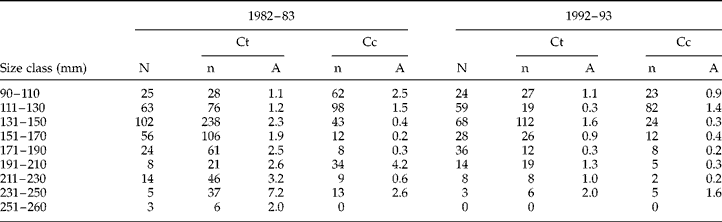
The prevalence and abundance of infection of both species of Cucullanus were monitored within nine size classes of fish using data collected during August 1982 and July 1983 and 1992 and 1993 (table 3). The overall size of fish sampled varied between 116 and 258 mm during 1982–83, and 90 to 238 mm during 1992–93. In both sampling periods, both species of Cucullanus tended to increase in prevalence and abundance with the increase in host size (table 3). The larger fish appeared to be more scarce during 1992–93, most probably due to over-exploitation of resources in the fishing areas. Male parasites were rarely observed in the larger fish. Analysis of variance of data indicated a statistical difference in intensity of infection in the different size groups (F = 8.95, P < 0.05).
Distribution of two species of Cucullanus in different size class of Orthopristis ruber during 1982–83 and 1992–93.
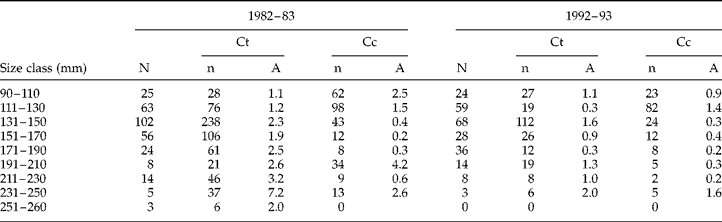
A, abundance; Cc, Cucullanus chrysophrydes; Ct, Cucullanus tripapillatus; n, number of parasites; N, total number of fish examined.
The highest abundance of C. tripapillatus was found in fish of length 131–170 mm, while C. chrysophrydes was most abundant in the 90–150 mm group during both years of sampling.
Influence of host sex on parasites
Of the total infected fish during 1982–83, there were 58 male and 118 female fish, with male to female ratio of 1:2, and a similar ratio of infected fish was found during 1992–93. The mean intensity of both species of parasites in female infected fish was twice that in male infected fish in both years of sampling.
The mean intensity of male and female infected fish was 2.72 ± 1.4 and 4.52 ± 2.8, respectively. During 1982–83, 898 adult parasites of two species were collected, of which 180 were male and 718 were female parasites, with male to female ratio of 1:4, without considering the larval worms. Female parasites constituted 80% while only 20% were male parasites of both species. During 1992–93, 33.6% male and 66.4% of female fish were infected with Cucullanus sp. Only 11.8% of the total parasites were male and 63% were female. The pattern of infection of both species of Cucullanus in O. ruber during the studies was almost identical. The ratio differs and it is evident that parasite burden in females was heavier than that in males. However, the levels of infection in female and male fish fluctuated in different months but no statistical difference was observed. The difference in prevalence and total number of parasites between female and male fish in all months was statistically significant (P < 0.05). The higher population of female parasite in the samples can be attributed to the shorter life span of male worms. Similarly, fewer parasites in larger fish may be due to higher mortality of parasites in older fish.
Interrelationships between species
Of the total Cucullanus spp., 68.9% were C. tripapillatus, and 31% C. chrysophrydes in the first year and 58.7% were C. tripapillatus and 41.3% C. chrysophrydes in the second year of sampling. Larval worms were not considered in this analysis. The difference in occurrence of parasites between the years was significant (P < 0.05). Both species of Cucullanus co-occurred in the same host species, indicating coexistence between two species in the intestine of fish hosts, though there is significant variation in the number of occurrences (P < 0.05) between C. tripapillatus and C. chrysophrydes. The proportion of adult C. chrysophrydes and C. tripapillatus during 1982–83 was 1:2.2 and 1:1.4 during 1992–93.
Parasite population
The parasite population of Cucullanus sp. was composed of three groups: immature (including third and fourth stage larvae), maturing adult and gravid female in all months of the study period. During 1982–83, the composition of parasites was 56% adult C. tripapillatus, 25% adult C. chrysophrydes and 19% immature worms of both species, while the composition of these nematodes during 1992–93 was 47% adult C. tripapillatus, 33% adult C. chrysophrydes and 20% immature worms of both species. Monthly distributions of larval worms of both species were clumped into the immature group without intending to identify to species and are shown in tables 1 and 2.
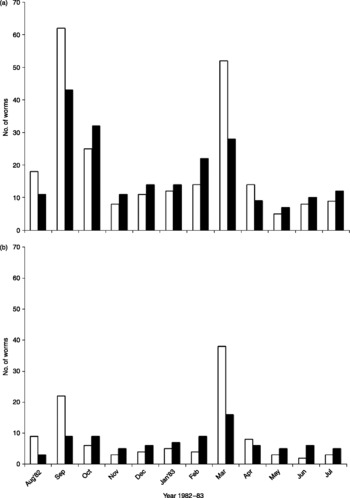
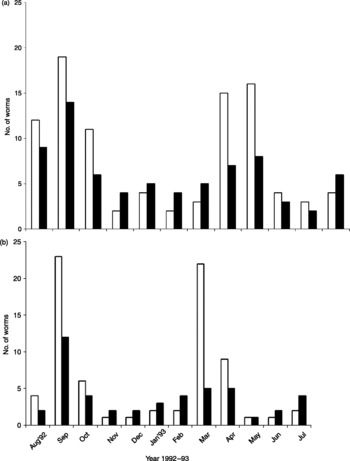
The adult C. tripapillatus and C. chrysophrydes were divided into maturing adult and gravid female for each species collected during 1982–83 (fig. 2) and 1992–93 (fig. 3). Both periods of sampling showed two peaks of gravid worms of each species, one in September 1982 and the other in March 1983; while in 1992–93, the first peak was in September 1992, and the second peak was in March to April 1993. Both mature and immature worms of each species were present throughout the year (tables 1 and 2). Larger recovery of immature worms coincided with the two peaks of adult worms, and it seems that the fish acquire infection throughout the year. Both species followed almost the same temporal patterns of distribution and periodicity.
Monthly distribution of gravid (□) and maturing (■) stages of Cucullanus tripapillatus (a) and Cucullanus chrysophrydes (b) in Orthopristis ruber during 1982–83.

Monthly distribution of gravid (□) and maturing (■) stages of Cucullanus tripapillatus (a) and Cucullanus chrysophrydes (b) in Orthopristis ruber during 1992–93.

Discussion
The present study is the first to provide full details of the population biology of Cucullanus species in O. ruber in Caribbean waters. Cucullanus tripapillatus and C. chrysophrydes in O. ruber appeared to show seasonal patterns in prevalence, abundance and mean intensity. The pattern tended to be maintained in the same host population, even 10 years later. The frequency of infection of a host by any parasite is at least partially a function of how often the host and parasite contact each other. Moravec (Reference Moravec1980) did not observe any distinct seasonal changes in the occurrence of infective larvae of Cucullanus truttae in the intermediate hosts; the rate of their infection increases with the increasing size of their bodies. Kennedy (Reference Kennedy1975) stated that infection patterns of helminths in fish populations are influenced by the availibility of infective larvae, feeding habits of hosts, mortality of parasites, and abiotic factors such as temperature. The interaction of these factors frequently results in an extreme variability in the prevalence and intensity of infection and over-dispersion of parasites in fish populations (Stromberg & Crites, Reference Stromberg and Crites1974). The host species constituted a relevant source of variation in morphometry, prevalence, abundance and reproduction of Cucullanus genypteri (Nascimento & Munoz, Reference Nascimento and Munoz1997). Prevalence and intensity of two species of Cucullanus in the present study increased with host size up to 170 mm and then gradually declined. This may reflect either the differences in food consumption by O. ruber, of different qualities of diets due to its migration towards deeper waters, or the fact that juvenile fish consumed more copepods in the shallower waters, where they had more chance of being infected, or adult female worms may simply have released the larvae and disappeared. Køie (Reference Køie2000) observed infection of Cucullanus cirratus in younger fish hosts throughout the year. Rohde et al. (Reference Rohde, Hayward and Heap1995) observed a significant correlation of parasite species richness, abundance and prevalence with host length. Dogiel et al. (Reference Dogiel, Petrushevski and Polyanski1961) stated that increase in incidence and intensity of infestation with age and the qualitative changes in the composition of the parasite fauna, are directly proportional to the extent of the changes in the ecology of the host. Changes in quality and quantity of parasite fauna may be a consequence of several interacting variables, including age, diet, immunity and changes in foraging patterns as the host ages. Nie & Kennedy (Reference Nie and Kennedy1991) indicated that temporal patterns of changes in infection levels are different in different localities and the cycle may be seasonal (Rautskis, Reference Rautskis1970; Andersen, Reference Andersen1978) or non-seasonal (Wierzbicki, Reference Wierzbicki1970; Skorping, Reference Skorping1980). Skorping (Reference Skorping1980) explained the non-seasonal pattern in infection levels as a result of overlap in seasonal rates of mortality and recruitment of the nematode, and concluded that a small shift in these rates would lead to a more pronounced seasonal pattern. The recruitment of Cucullanus appeared to be continuous as the larval forms were available throughout the year, with peaks in September and March.
Overall, fish samples contained almost twice as many female fish as male fish. Of the total infected fish, 67% were female. Similarly, female nematodes dominated by over four times. The male nematodes may have died early after copulation and allowed the females to mature and release the eggs. Carvajal (Reference Carvajal1972) reported that 195 mm was the minimum size for female O. ruber to begin sexual maturity. The majority of fish sampled in this study were smaller than this, suggesting that the occurrence of a large number of female Cucullanus in O. ruber does not have any influence on sexual maturity of the host.
The association between the two species of Cucullanus, C. tripapillatus and C. chrysophrydes, in the intestine of O. ruber, is positively correlated. Several factors may generate this positive relationship; as stated by El-Darsh & Whitfield (Reference El-Darsh and Whitfield1999) this relationship may arise from shared ecological habitats or hosts.
All three stages of development of nematodes were present throughout the year. There is a seasonal cycle of maturation of worms and invasion by larval worms. There are two peaks of gravidity of worms, one in September and the other in March, coinciding with the appearance of larval worms during the same period. The parasites recruited in September may release larvae in the next peak of March. As gravid and immature nematodes are found in all months of the year, it is difficult to determine the age of Cucullanus spp., because of the continuous recruitment of the parasite into the fish host. But judging from the peak occurrence of gravid worms in September and March, and the immature worms during the same peak period, one may speculate that Cucullanus may have taken some 6 months to reach maturity, those recruited in September may reach maturity in March. Moravec (Reference Moravec1980) studied the life cycle of Cucullanus truttae in Czechoslovakia and observed gravid worms in 89 days, and did not observe any seasonal cycles of maturation of nematodes. Nie & Kennedy (Reference Nie and Kennedy1991) observed third and fourth stage larvae of Camallanus lacustris in Anguilla anguilla from March onwards and gravid worms from May onwards, in other words, in about 90 days. Cucullanus cirratus may have a life cycle involving copepod transport hosts and fish intermediate hosts (Køie, Reference Køie2000): the third stage larvae in gobies grew to 800 μm in length in 6 months and the maximum prevalence of third stage larvae occurred in spring and summer in naturally infected cod. The greatest prevalence of gravid worms was observed in autumn (Køie, Reference Køie2000). Kennedy (Reference Kennedy1975) has correctly pointed out that there are number of fish parasites in which egg production by the adult and the maturation cycle as a whole can be closely correlated to annual changes in the water temperature. The development of larval nematodes in copepod intermediate hosts may be accelerated by increasing the temperature. An increase of 5°C increases the rate of development in Philonema oncorhynchi by two times (Ko & Adams, Reference Ko and Adams1969). With an increase of 3°C, there was an increase of rate of development in Camallanus adamsi by one and a half times (Bashirullah & Ahmed, Reference Bashirullah and Ahmed1976). Stromberg & Crites (Reference Stromberg and Crites1974) encountered almost the same rate of development in Camallanus oxycephalus in copepods, when increasing the temperature by 5°C. Kennedy (Reference Kennedy1975) urges caution in drawing conclusions with respect to the influences of temperature on these growth processes. Hormonal influence may also accelerate the development and maturity of nematodes (Bashirullah & Adams, Reference Bashirullah and Adams1983). Interspecific interactions can obviously affect the size of parasite populations and may possibly be involved in regulating them (Holmes et al., Reference Holmes, Hobbs, Leong and Esch1977). The interactions of the seasonal changes in status and behaviour of the populations of potential intermediate and definitive host species are also of vital importance in determining seasonal occurrence of the helminth parasites of fishes (Chubb, Reference Chubb1982). The water temperature in the Caribbean Sea does not fluctuate very much as it does in the temperate sea. Following Kennedy (Reference Kennedy1975), one can expect that temperature does not have any influence on the seasonality of Cucullanus in the sampling areas. The seasonality of two species of Cucullanus in the Caribbean may be due to some other biological factors.