‘We overestimated the ability of Greece to actually endorse and take ownership of measures that were needed, because we moved from one government to another to another to another.’ – International Monetary Fund (IMF) Director Christine Lagarde in an interview with Bloomberg Markets (2016).
Governments that embarked on a path of austerity during the European debt crisis encountered strong public opposition. This opposition, and the resulting political destabilization, took the economic policy community by surprise. As the quote by IMF Director Lagarde above indicates, many experts believed that governments could implement fiscal adjustment policies without major political disruptions. Empirically, this expectation has received some support: previous studies have found that fiscal adjustments do not systematically reduce governments’ vote shares or increase the risk of government turnover.
Our analysis suggests that this previous, generally observational research underestimates the electoral risk of fiscal consolidations. These studies tell us what happened to governments that could politically afford to consolidate, but they do not capture electoral risk in situations when weak governments strategically avoided these policies (Hübscher and Sattler Reference Hübscher and Sattler2017; Immergut and Abou-Chadi Reference Immergut and Abou-Chadi2014). It is possible that the negative impact of austerity on votes would have been much more substantial if governments had implemented austerity in a less strategic manner and purely based on economic fundamentals.
To avoid the pitfalls for empirical analyses that such strategic behavior creates, we conduct two sets of survey experiments in Germany, Italy, Portugal, Spain and the UK. The experimental analysis of voter preferences allows us to contrast the political consequences of consolidation with the effects of avoiding these policies while holding other factors constant. This comparison provides a more accurate estimate of the true political risks of consolidation, since fiscal retrenchment is not only observed for governments that have the political capital to pursue such policies.
Our results show that voters are not fiscal conservatives, and that the electoral risk of consolidation is much greater than is often claimed. In all countries, the loss of electoral support is smallest if the government avoids fiscal stabilization. Moreover, voters object particularly strongly to fiscal stabilization through spending cuts – precisely the measure often recommended by international economic institutions – and to a lesser extent to tax increases. These results are in line with the claims of earlier political economy research (Pierson Reference Pierson2001) and raise doubts about the adequacy of the most influential policy recommendations during the European debt crisis.
Are voters fiscal conservatives?
The idea that fiscal retrenchment has small costs and large benefits is deeply entrenched in major international economic institutions (Blyth Reference Blyth2013, also see the Appendix). This view has been reinforced by an emerging consensus in the current literature that austerity is also politically uncontested among voters. Alesina, Perotti and Tavares (Reference Alesina, Perotti and Tavares1998) unambiguously answer the question of whether fiscal consolidation negatively affects elections with a ‘loud no’ (p. 198). Giger and Nelson (Reference Giger and Nelson2011) even find that some parties gain votes after fiscal cuts. Arias and Stasavage (Reference Arias and Stasavage2019) show that austerity does not increase government turnover and conclude that ‘for those who believe austerity is detrimental to welfare our results pose a problem’ (p. 1,521). This literature is discussed in greater detail in the Appendix.
Two core arguments drive this ‘new conventional wisdom’. The first suggests that voters disapprove of deficit spending because large deficits have economic costs and constrain fiscal policy in the future (Barnes and Hicks Reference Barnes and Hicks2018; Brender and Drazen Reference Brender and Drazen2008; Hallerberg and Wolff Reference Hallerberg and Wolff2008). The second argument claims that fiscal adjustments have minor economic costs because lower public spending is offset by higher private investment (Alesina, Perotti and Tavares Reference Alesina, Perotti and Tavares1998). Taken together, the two arguments imply that voters are fiscal conservatives (Peltzmann Reference Peltzmann1992): voters support fiscal adjustments because they (a) heavily weight the costs of fiscal deficits and/or (b) understand that the costs of fiscal adjustments in fact are small.
At the same time, these claims stand in stark contrast to recent experiences in many European countries, such as Portugal, Ireland and Spain. Theoretically, they also contradict the prevailing view in a separate strand of the political economy literature that fiscal retrenchment bears substantial electoral risks (Pierson Reference Pierson2001). As we outline in greater detail in the Appendix, there are good theoretical reasons why voters object to fiscal austerity and electorally punish governments who implement such policies. Given this research, it is surprising that no association between austerity and electoral backlash is found at the aggregate level.
An alternative explanation: Strategic selection bias
How can the lack of empirical evidence of electoral punishment for austerity be explained? One explanation is that governments strategically avoid austerity in order to minimize electoral costs. Governments associate austerity with substantial risk and use a variety of strategies to avoid blame for these policies (Wenzelburger Reference Wenzelburger2011). A popular strategy is to delay consolidations before an election or fully avoid them if the government is politically vulnerable (Hübscher Reference Hübscher2018; Hübscher and Sattler Reference Hübscher and Sattler2017; Immergut and Abou-Chadi Reference Immergut and Abou-Chadi2014).
This leads to a ‘strategic selection bias’ in existing studies: they underestimate the electoral risk that stems from austerity because these policies are generally implemented when governments are less vulnerable. The presence of such a bias means that austerity impacts votes if governments implement these policies unstrategically and as recommended by pro-austerity economists. In other words, if governments had implemented austerity measures purely based on the state of economic fundamentals, then such policies would have had a significantly negative impact on votes for government parties. Yet in practice, governments strategically time and avoid austerity precisely because it impacts votes.Footnote 1
An analysis of the impact of austerity on votes thus requires that governments implementing austerity policies must be compared to identical, counterfactual governments that avoid such policies in similar situations. The causal effect of austerity on votes then is the difference between the vote share for government parties after austerity compared to the vote share for the same parties after no austerity under the same conditions. Given the existence of strategic selection bias, observational data will rarely provide such comparisons. Here, we instead use an experimental analysis of fiscal policy preferences to draw conclusions about how fiscal consolidation would have affected political outcomes in situations when consolidations did not occur.
Research design: Strategy and countries
We use a vignette-based and a conjoint experiment to address the challenge that the strategic behavior of governments presents for the analysis of fiscal austerity. We examine the causal effect of different types of fiscal adjustment policies by treating respondents with different policy scenarios. In particular, we present scenarios in which the government proposes various changes to spending and taxes, including no adjustment at all. Since respondents are randomly exposed to these scenarios, the difference in their responses represents the political effect of one policy solution compared to another.
The vignette experiment is based on a simple design: it randomly assigns respondents to read one of three different fiscal policy scenarios. The choice-based conjoint analysis presents respondents with more complex vignettes that vary in many different fiscal policy attributes. This helps advance our understanding of respondents' reactions to austerity by disaggregating the highly stylized policy propositions of the first experiment. In practice, fiscal adjustment packages are multi-dimensional and often (although not always) consist of a combination of different types of spending cuts and tax increases.
The survey experiments were conducted in five countries: Germany, Italy, Portugal, Spain and the UK. In each country, we surveyed around 2,200 individuals. We selected this diverse set of countries to enhance the external validity of our analysis. The significant variation among these countries on crucial fiscal policy dimensions allows us to examine the extent to which our results depend on country-specific circumstances. The case selection and experimental design are discussed in greater detail in the Appendix.
Study 1: Randomised Vignettes
Study 1 exposed respondents to three different fiscal scenarios. The vignettes include simplified descriptions of actual public policy choices and how they are presented by governments. All scenarios put the countries in a clear context of fiscal pressure with a sizeable budget deficit for a number of consecutive years. This implies that there is economic pressure on the incumbent to take action. Then, a respondent is shown one of three possible policy solutions proposed by the government: (a) decrease spending on public and social services, (b) increase income taxation or (c) keep spending and taxes unchanged. After reading one of these scenarios, respondents were asked to what extent they would approve of this announcement and whether they would vote for the prime minister in an election held after this announcement. These questions serve as dependent variables in our analyses.
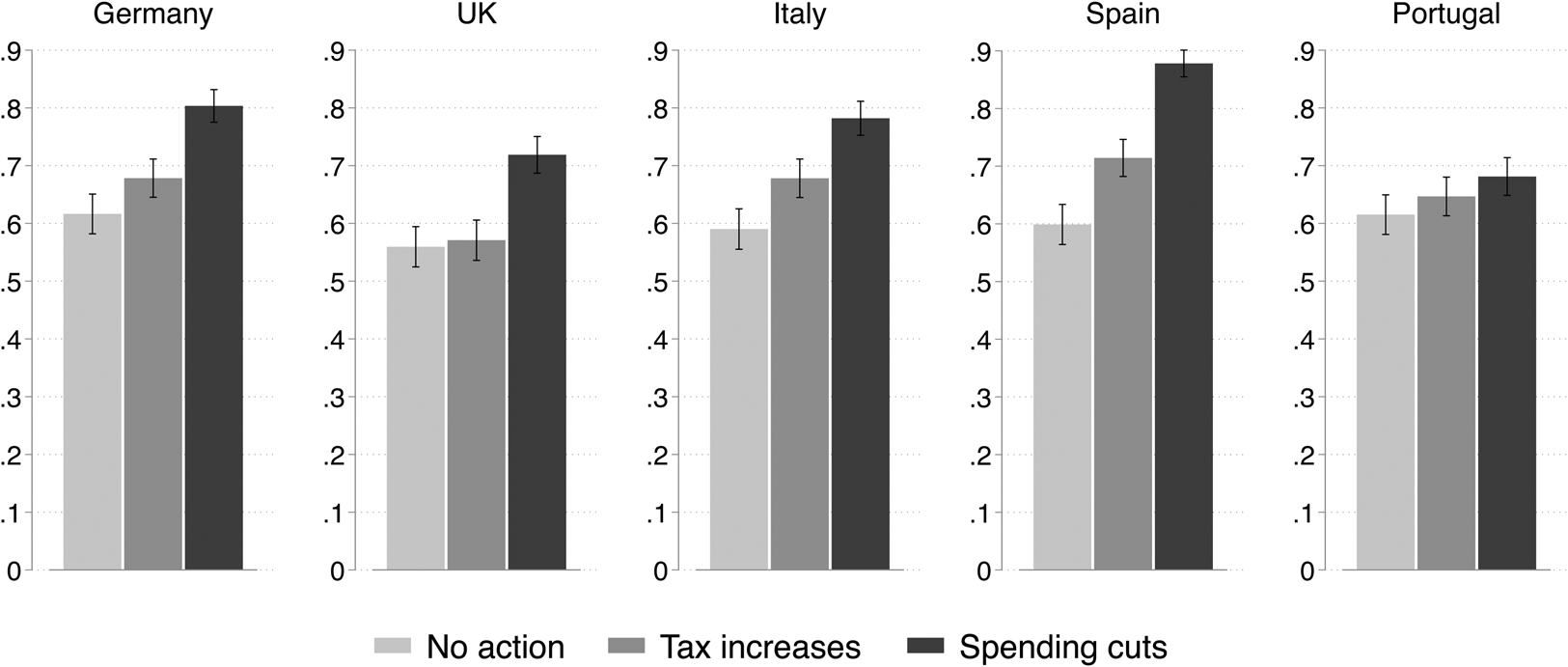
Figure 1 shows the raw distribution of vote intentions in response to the different fiscal policy solutions proposed by governments in our scenarios. The left bars present voter responses to announcements that the government will not change policy, the middle bars present responses to tax increases, and the right bars present responses to social and public spending cuts. The graphs clearly show that voters are less likely to support governments that announce austerity policies. Voters punish governments the most if they announce spending cuts. Tax increases are electorally less costly than spending cuts, but, with the exception of the UK and (to a lesser extent) Portugal, more costly than keeping policy unchanged. In all countries, governments minimize electoral punishment if they decide to do nothing.
Vote against government
Note: vote intentions after fiscal policy decisions, by fiscal adjustment type.

Appendix Figure A2 shows that patterns using policy approval instead of vote intentions are very similar. When we compare disapproval of fiscal adjustment measures with the respective votes against governments that propose such policies, we find that austerity has a smaller effect on votes than on disapproval. This is intuitive, because not all voters change their vote if they disapprove of one decision in one policy area.
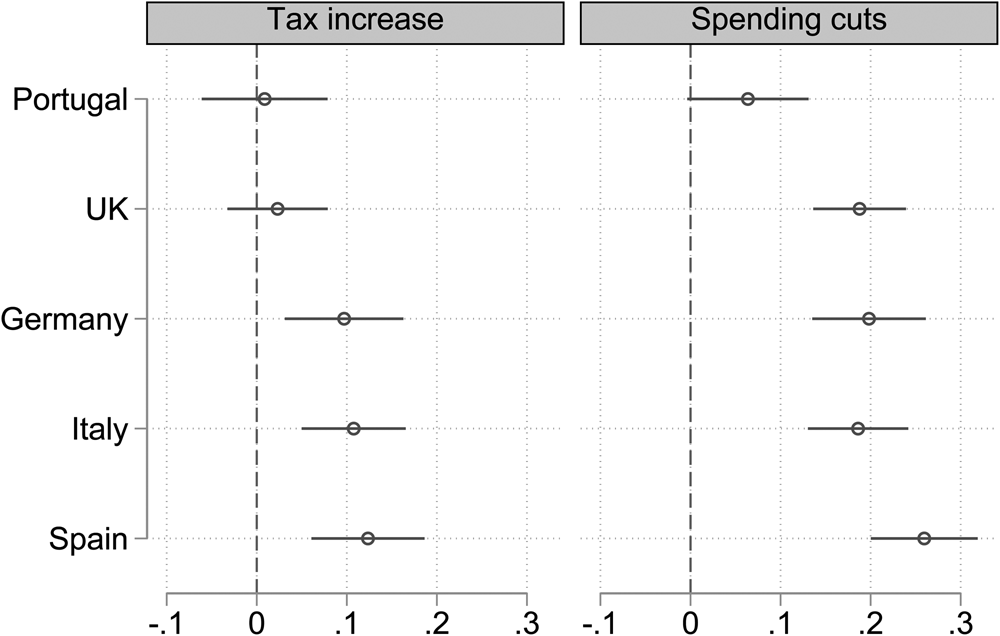
To more robustly analyse the treatment effects in our vignettes, Figure 2 presents the marginal effects given the occurrence of tax increases or spending cuts. In this and all subsequent analyses, we control for whether the respondent supports the current government to account for the possibility that respondents associate the government in our experiment with the current government in their country; the results do not depend on the inclusion of this control.Footnote 2 The graph shows the predicted probability of voting against the government for different announcements relative to doing nothing, the reference category. In most countries, the probability of voting against the government increases by up to 10 percentage points after tax increases and by up to 20 percentage points after spending cuts. The probability after spending cuts increases by more than 25 percentage points in Spain, but less than 10 percentage points in Portugal. As expected, the intention to vote against the government is higher after the announcement of spending cuts or tax increases.
Predicted effect of fiscal adjustment type on vote against government
Note: point predictions with 95 per cent confidence interval.

The estimated effects from our analysis are fairly large compared to the influence of economic policies on actual votes. This is because our survey isolates the effect of fiscal policy on votes from other factors that influence voter behavior. In reality, actual voting decisions are the result of a combination of various factors, and fiscal policy is only one of them. The impact of consolidations on actual voting is therefore smaller. Nonetheless, respondents’ strong responses to our treatments indicate that they do care about fiscal consolidation and take these policies into account (along with other factors) when they vote for or against the government.
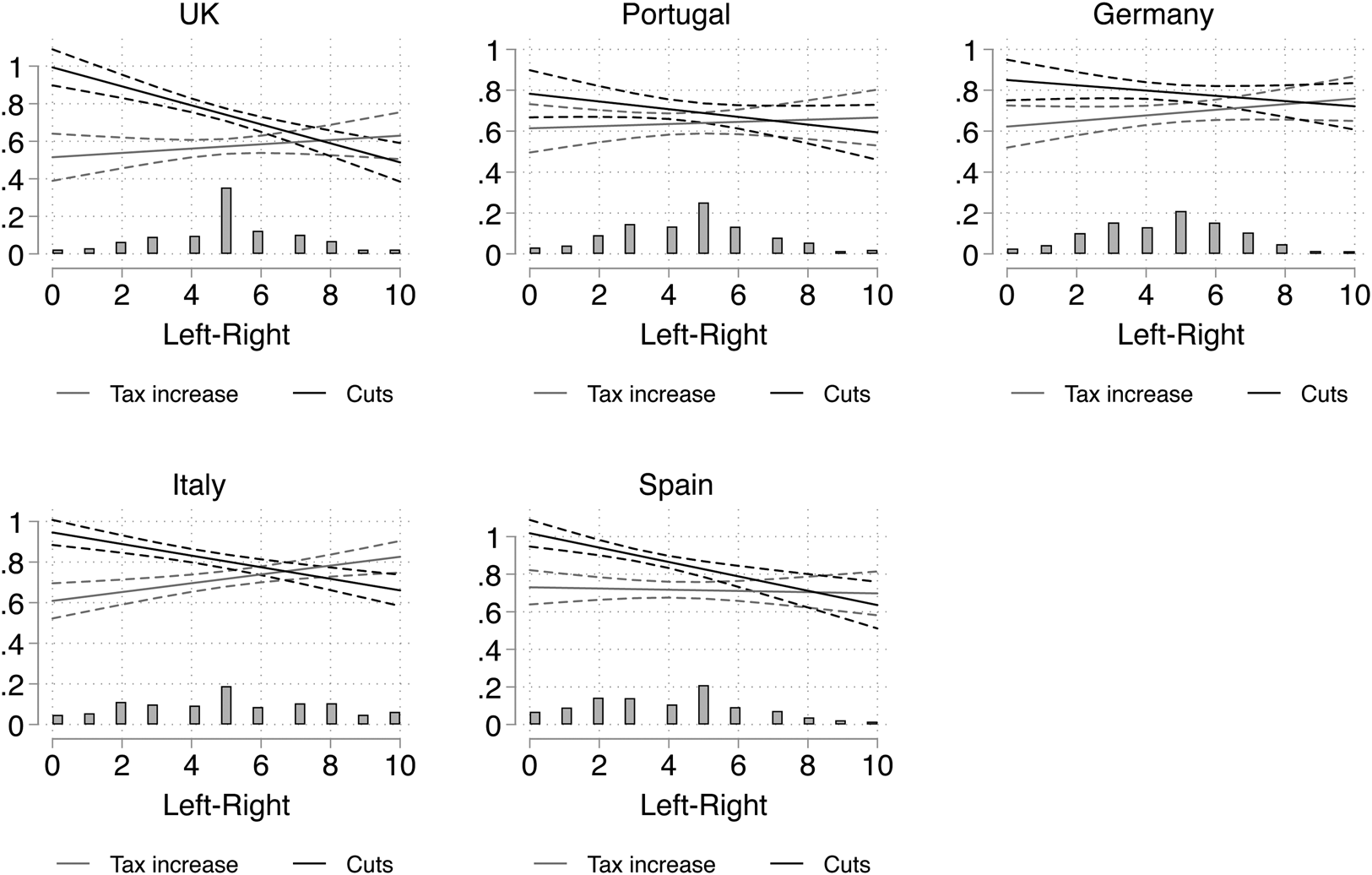
Our experiments also allow us to examine which voters respond negatively to fiscal consolidation. To do so, we first interact the fiscal policy treatments with voter ideology.Footnote 3 The lines in Figure 3 show how the predicted probability of voting against the government changes conditional on voter left–right ideology for both scenarios, relative to a policy of doing nothing. Consistent with the previous literature (Bechtel, Hainmueller and Margalit Reference Bechtel, Hainmueller and Margalit2014), we find that voter ideology strongly moderates the effect of fiscal policy announcements on vote intentions. Votes against governments decrease in all countries after spending cuts for more right-wing voters. However, more right-wing voters still punish governments, but to a lesser degree than left-wing voters do. We see the opposite effect for tax increases, but this effect is generally weaker and often not statistically significant.
Predicted effects of vote against government, by ideology
Note: effect of tax increases (gray) and spending cuts (black) on vote intention against the government. The figure shows the predicted probabilities of voting against the government as left–right position of voters’ changes; the y-axis shows the predicted share of voters who vote against the government conditional on voter ideology; point predictions with 95 per cent confidence interval.

Voters have to be relatively right wing to react similarly to tax increases and spending cuts: around 6 on the 0–10 scale in Portugal to almost 10 in Germany and Spain. In the latter two countries, voters from the right end of the political spectrum thus distinguish little between tax increases and spending cuts. This helps to explain our finding that voters, on average, prefer tax increases to cuts: only voters on the very right see spending cuts as being equally attractive as tax increases. The average voter prefers to increase taxes or do nothing rather than cut spending. In the Appendix, we also explore and discuss the interaction of other socio-economic characteristics with the fiscal policy treatments (that is, socio-economic background).
Study 2: Conjoint Analysis
In the conjoint experiment, respondents were presented with two policy programs, one proposed by the main centre-left, the other by the main centre-right party. The order of the two parties was randomized. The conjoint also included a brief description of the overall economic context: low growth/high public deficit or high growth/low public deficit. This attribute was the same for both policy proposals presented on one screen. Below that, we presented five policy items related to different spending dimensions: health care, public pensions, education, infrastructure and unemployment. Cuts could be small or large. The next policy dimension concerned taxation and varied between no tax increases, tax increases across the board and tax increases for the wealthy only. Lastly, the expected impact of the consolidation package on public finances could be small, modest or significant. This last item was not randomly assigned, but represents a summary of the policy mix previously presented.Footnote 4 For the conjoint analysis, each respondent was presented with five screens and thus evaluated a total of ten programs. Appendix Figure A22 shows a sample of conjoint screens.
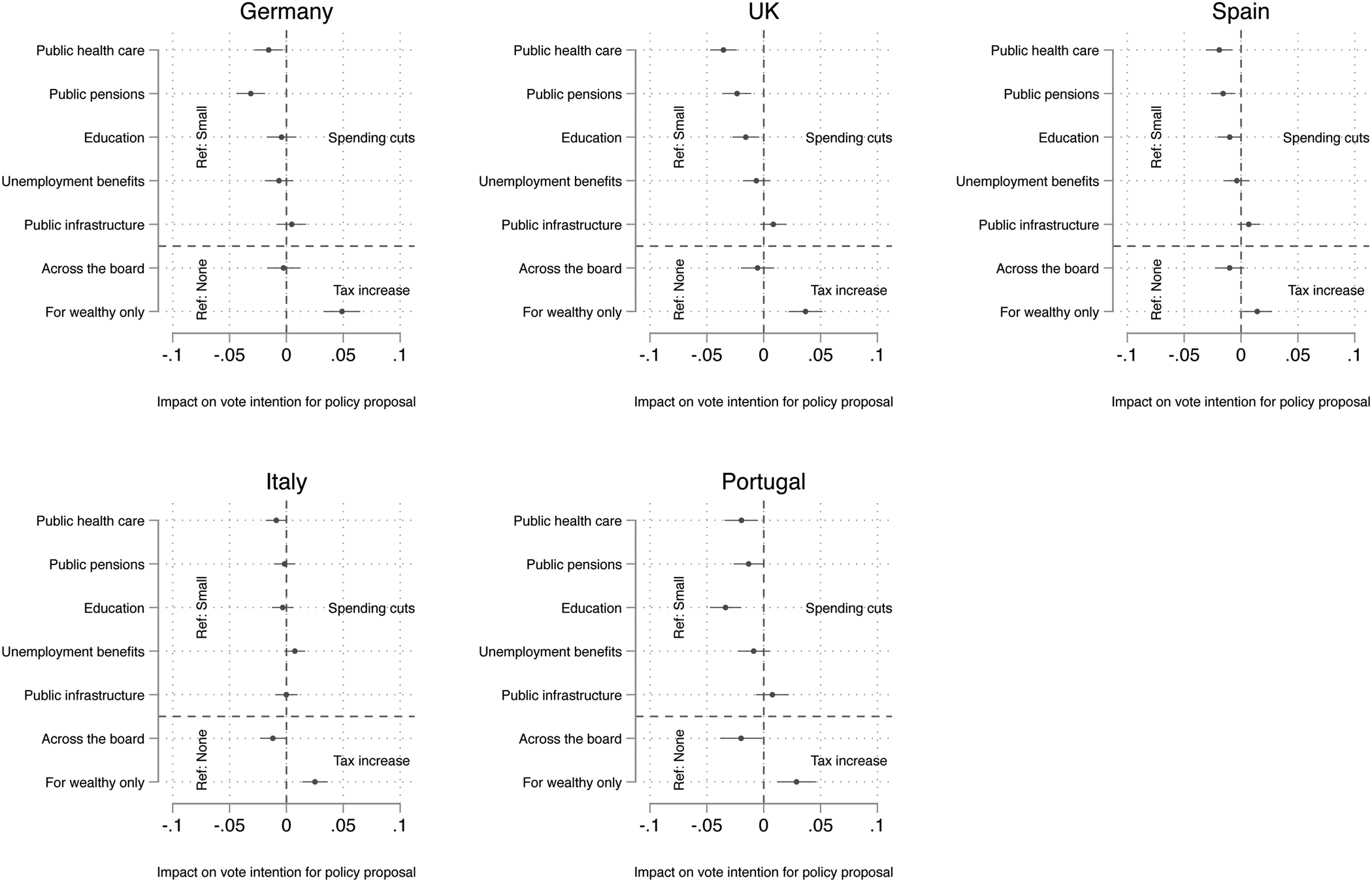
The results presented in Figure 4 confirm our previous results, but provide a more nuanced picture. First, voters in all five countries react more negatively to large cuts.Footnote 5 A large rather than small cut in one area of spending reduces the probability of voting for a party by 1–4 percentage point. Multiplying that by the five areas, total punishment can add up to a 20 percentage point decline in the probability of supporting a party. Cuts to health care and pensions are the least popular, with the exception of Portugal. These two programs represent universal schemes that most citizens benefit from at some stage of their life. Compared to the above, cuts in unemployment benefits, infrastructure and education (again with the exception of Portugal) are less unpopular.
Vote intentions based on fiscal policy proposals, by fiscal adjustment type
Note: x-axis shows the effect on vote intention for party in %. The effect of party proposing measure and its interaction with voter party support is included but not shown.

Secondly, these results confirm that the effect of tax increases across the board is generally negative. The negative effect is marginally statistically significant for Italy and Portugal, but not for Germany, Spain and the UK. If the party, however, proposes to increase taxes for the wealthy only, this increases the probability of supporting the party. This effect is statistically significant for all countries except Spain and increases the probability of voting for the party by 2 to 5 percentage point. This implies that voters prefer tax increases that include a progressive element.Footnote 6
Generally, the size of the effects is smaller for the conjoint than for the vignette experiment. We attribute this to three reasons. First, the conjoint experiment is cognitively more demanding, which may lead to less clarity in response patterns. Secondly, the characteristics of the spending attributes in the conjoint do not include ‘no cuts’, which would likely be the most preferred option; this may minimize the differences in the size of the effects. Finally, the conjoint experiment also includes party labels, which likely reduces the effects of other attributes.
While the overall patterns are similar across countries, there are some notable differences in effect sizes. This is particularly true for Italy. While in the first experiment, which does not assign a party to the government proposing a policy, Italy nicely aligns with Spain and the UK, most effects for the conjoint analysis are not statistically significantly different from zero. A potential explanation for these unclear findings is that our survey was fielded when Italy did not have a government and political parties were involved in negotiating a new coalition. Italian respondents compared policy packages proposed by Partito Democratico and Forza Italia; neither of these two parties became part of the new governing coalition. Respondents thus perhaps had difficulties associating the policy packages with the parties we suggested.
We also examined the impact of the political and economic context. Appendix Figure A12 shows that reactions to consolidation proposals only depend to a minor extent on political circumstances (left vs. right). This means that a sufficient number of voters considers fiscal adjustment salient enough to induce a change in vote intention even if the otherwise preferred party proposes to implement fiscal adjustment. Partisanship does not fully shield political parties and prevent disapproval of fiscal adjustments from translating into electoral losses. Also, and as Appendix Figure A13 shows, voter reactions to fiscal consolidation depend little on the economic circumstances (high growth/low deficit vs. low growth/high deficit). This finding further underlines the robustness of the mechanisms we propose.
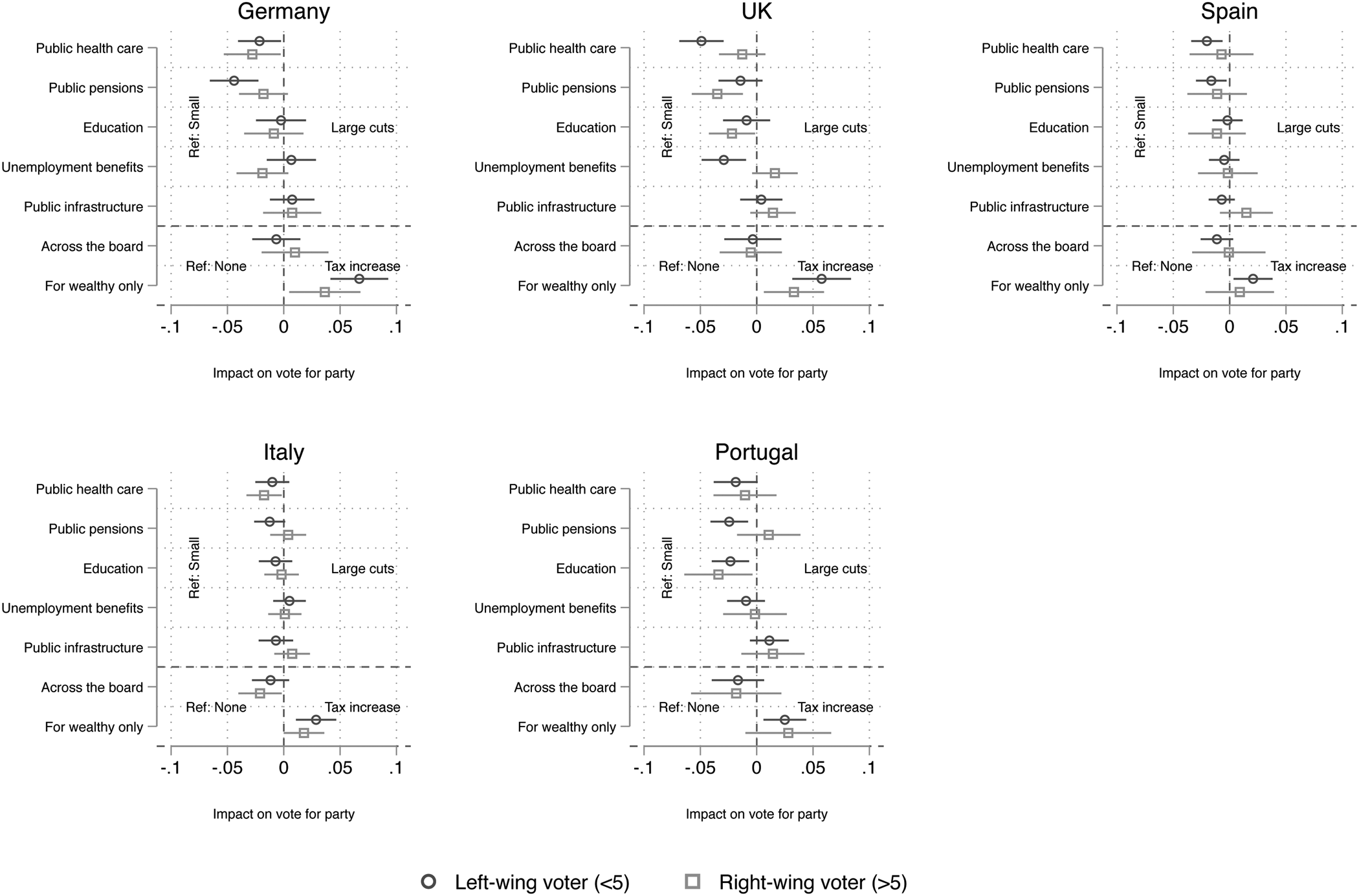
In line with the first experiment, voters react somewhat differently depending on voter ideology, but these differences are smaller and less consistent in Study 2. Figure 5 presents the results for left- and right-wing voters separately. In the majority of the countries included in our analysis, left-leaning voters punish parties more strongly than right-leaning voters for cuts in health care and public pensions. With a couple of exceptions (that is, right-wing voters in the UK reacting more negatively to pension cuts than left-wing voters), the results are in the expected direction. However, the differences between left- and right-wing voters never reach conventional levels of statistical significance. In all countries, the effect of tax increases for the wealthy is statistically significant and positive for leftist voters. In Germany, the UK and Italy, conservative voters also reward parties for tax increases for the wealthy, though to a lesser degree. The difference between left- and right-wing voters, however, is not statistically significant. In addition to the results shown here, we conducted a large range of supplementary analyses and robustness checks that are all described in the Appendix.
Vote intentions based on fiscal policy proposals, by fiscal adjustment type
Note: x-axis shows the effect on vote intention for party in %. The effect of party proposing measure and its interaction with voter party support is included but not shown.

Conclusion
Our results show that earlier research underestimated the negative effects of austerity on voting for parties in government. This finding is in line with recent studies that show that voters in European crisis countries care about austerity, but there is little evidence so far that this is also the case in less extreme economic situations (Talving Reference Talving2017). To our knowledge, our study is the first to show that a large share of voters systematically objects to fiscal consolidation, and do so not just in extreme situations when economic meltdown and fiscal cuts coincide. In turn, voters’ behavior is important for understanding the political incentives of governments. For instance, the strong opposition of left-leaning voters to spending cuts in our analysis is consistent with the finding that leftist governments tend to favor more modest cutbacks than right-leaning governments (Hübscher Reference Hübscher2018).
The findings stand in stark contrast to the recommendations of the major international financial institutions during the European debt crisis. The one-sided focus on spending cuts as the main fiscal strategy is clearly at odds with the preferences of the majority of voters. In line with recent calls for a more active fiscal policy, our study implies that governments should engage much more in counter-cyclical fiscal policy than they have in recent decades. The current pro-cyclical fiscal policies are not only economically damaging; they also magnify the political perturbations that generally occur during economic downturns. Deficit reduction should therefore not be a priority during economically difficult times.
Supplementary material
Data replication sets are available at https://doi.org/10.7910/DVN/VHS0J3 and online appendices are available at https://doi.org/10.1017/S0007123420000320.
Acknowledgements
We thank Cristina Bodea, Mark Copelovitch and Vera Tröger for comments. Nicolai Berk, Jascha Grübel, Alicia Lopez, Pedro Perfeito da Silva and Colin Walder provided great research support. Previous versions of this article were presented at the Annual Meeting of the European Political Science Association, Vienna, 21–23 June 2018, and the Annual Meeting of the Midwest Political Science Association, Chicago, 5–8 April 2018. The authors acknowledge financial support from the Thyssen Foundation, grant no. 10.18.1.008PO. Thomas Sattler acknowledges financial support from the Swiss National Science Foundation, grant no. 165480.