From the Arab Spring to the Occupy Wall Street movement, the Chilean student demonstrations and the environmental protests of German Wutbürger (angry citizens), a new wave of protest is spreading around the world that might even be compared with that of 1848 or 1968.Footnote 1 One of the key contributors to this wave of protest is opposition to the austerity policies adopted by several governments following the economic and financial crises of the late 2000s. Given the broad array of issues addressed and political contexts in which the protests take place, the question arises of how similar these new protest movements really are. To what extent do these movements constitute a new protest culture?Footnote 2 The rise of austerity movements in particular appears to challenge the dominant frame for the analysis of protest behaviour in Western Europe, which has focused on the rise of ‘new politics’ and associated ‘new social movements’ addressing issues such as the environment and peace. The main protagonists of these movements were generations socialized in affluent post-war economies that hold ‘post-materialist values’.Footnote 3 Anti-austerity protests, on the other hand, focus on ‘material’ issues, such as cuts in public expenditure, unemployment and inequality. Such protests could thus be expected to fit what Harold R. Kerbo termed ‘movements of crisis’ in contrast to ‘movements of affluence’.Footnote 4 A key question for understanding the recent mobilization against austerity is whether it represents a further manifestation of the impact of ‘new social movements’ or a different protest culture that is more akin to ‘old’ rather than ‘new’ politics.
While anti-austerity protest can be found in many countries, the sovereign debt crisis in the eurozone that accelerated in 2010 provides a specific focus. The country at the forefront of this development is Greece. To prevent a disorderly default on its debt, in May 2010 the socialist PASOK government negotiated the largest loan ever received by a single country (€110 billion) in return for enacting a draconian structural adjustment programme. Greece was of course not the only country to experience acute economic problems and be forced to adopt austerity policies. Spain, Italy and Portugal in Southern Europe, as well as Ireland and the UK, among others, were also in similar positions. However, anti-austerity protest appears to have been, at least thus far, much more intense in Greece than elsewhere, including in comparison to countries that have also had to resort to international financial rescues.
The aim of this article is twofold. First, it seeks to understand the determinants of anti-austerity protest in Greece in a comparative context, analysing the socio-political profile of protesters and the mechanisms through which they were mobilized in 2010. Despite the prevalence of strikes and demonstrations in Greece's political landscape, there is little empirical research on the individual and collective drivers of participation in protest activity.Footnote 5 Is there something specific about Greece that explains its higher level of mobilization compared to other countries, or is it a precursor of things to come elsewhere? Secondly, this article maps the characteristics of the anti-austerity movement by engaging with broader theoretical debates about the determinants of participation in protest. In particular, given the centrality of economic hardship in the austerity debate, to what extent can the theory of ‘relative deprivation’ return to the fore of political behaviour when tested against other classic theories, such as resource mobilization and rational choice approaches?
Crucially, the huge size and frequency of demonstrations and general strikes in Greece offer a unique opportunity to study protest behaviour by analysing individual-level data collected in a general population survey. We conducted a survey of the Greek adult population in December 2010. Of 1,014 people interviewed, 302 (29 per cent) stated that they had engaged in protest, a sizeable minority of the population. Unlike surveys of demonstrators, this survey gives us data on both participants and non-participants of a particular type of political protest. Furthermore, unlike many previous studies of political protest, this survey assesses the engagement of individuals in a specific protest movement and actions that preceded the data gathering process by days, weeks or (at most) months. This will allow us to first scrutinize opposition to austerity policies and support for protest action before exploring who, out of this pool of potential protesters, ended up taking part in actual protests.
The article argues that to explain the phenomenon of anti-austerity protest, we need to take adequate account of both the aggregate context at the national level and its dynamic interrelationship with the drivers of mobilization at the individual level. It thus begins with a brief overview of Greek protest culture, which informs the subsequent theorization about the individual drivers of protest and helps us generate relevant hypotheses. The collection of data is then discussed, followed by a discussion of the main findings and their theoretical and empirical implications for austerity politics. In the overall analysis, we will examine to what extent the economic circumstances of the austerity crisis (or the political context of a highly developed protest culture) are the primary drivers of anti-austerity protest in Greece. We find that relative deprivation plays an important role in defining protest potential, but socialization into taking particular forms of political action through prior protest involvement is an essential component of explaining who actually protests.
Protest in Greece: Contextual Factors
According to Charles Tilly, protest behaviour cannot be seen as simply reactive or spontaneous – or be fully understood by looking only at individual-level influences. Protest repertoires, Tilly argues, ‘are learned cultural creations’Footnote 6 that carry a different meaning, and whose parameters are defined by a shared culture that structures relationships of power and resistance. A range of related concepts has been employed to analyse the nation-specific political context of protest behaviour, including mentalities, ‘political cultures’ and ‘collective action frames’.Footnote 7 These concepts highlight the fact that the intensity and character of protest are historically contingent and dependent on a specific socio-political context, which may explain why there is greater protest mobilization in some countries than in others. To understand the drivers of anti-austerity protest in Greece, we thus have to first look at the unique national setting in which the movement developed.
Contentious politics evolved in Greece as a result of historical struggles, which gradually stretched the boundaries of the permissible expression of social demands through protest in a way that undermined state authority and glorified resistance to government policies.Footnote 8 A critical juncture in the development of this protest culture in modern Greek history can be traced to the student opposition against the military junta that ruled between 1967 and 1974. The uprising in the Polytechnic on 17 November 1973 is recognized in popular discourse as causing the regime's collapse and the return to democracy a year later. The ensuing romanticized vision of collective action, amplified by a widespread suspicion of any attempts by the authorities to impose stricter internal security controls in a nation that had experienced excessive police brutality during the junta's rule, provides fertile ground for new movements to elicit sympathy and obtain legitimacy.Footnote 9 Consequently, various forms of protest, such as the widespread practice of school occupations and the partisan activism of university student politics, have been institutionalized and are widely reproduced in social and political life.Footnote 10
The groups that led the resistance against the military junta were at the left of the spectrum. Despite their small size, many extra-parliamentary leftist groups, along with various anarchist groups, continued their ‘struggles’ after the transition to democracy, playing leading roles in almost all the social movements that have emerged since.Footnote 11 The socialist PASOK government in the 1980s was, to an extent, able to contain some of the most militant parts of these movements ‘by promising to change society from above’Footnote 12 and forming close relationships with the trade unions that organize the majority of protests.Footnote 13 Meanwhile, parliamentary parties of the Left, notably the Greek Communist Party (KKE) and later the Coalition of the Radical Left (Syriza), actively encouraged collective action but were unable to capitalize (in electoral terms) on the left-wing orientation of protests prior to the May/June elections of 2012.Footnote 14 Successive working-class struggles in Greece are thus, according to Lountos, not a manifestation of the organized Left's unifying role but rather the product of the sustained activity of ‘a layer of militant and radical minorities’, the influence of which is disproportionately high in the specific context and protest culture within which they operate.Footnote 15
A recent example identified in the literature as a manifestation of the influence of Greek protest culture were the violent demonstrations and riots that followed the shooting of a fifteen-year old student by a police officer in December 2008.Footnote 16 It is difficult, however, to establish a link between such an alleged ‘protest culture’ and protest events without data on the protesters. Although the historical narrative above suggests that there is such a protest culture in Greece, we need cross-national data to assess whether this leads to a greater propensity for protest compared to other countries facing similar conditions.
Reliable data on past protest behaviour is difficult to come by. One popular approach among social movement scholars has been using media reports to analyse protest events. Comparing the yearly mean number of protest events between 1990 and 1995Footnote 17 using the Protest and Coercion dataset,Footnote 18 Greece (with 224.17 events) came way behind countries such as France, Spain and Italy. However, if population size is taken into account,Footnote 19 Greece (with 21.3 protest events per million inhabitants) ranks at the same level as France (21.7) and above Spain (14.0), Portugal (6.9) and Italy (6.0), although well behind Ireland (75.1).
Comparative data from population surveys may provide some clues about the number of people involved in protest activities. The European Values Survey has asked since 1981 about participation in a range of political actions, including ‘attending lawful demonstrations’, but Greece was only involved in two studies, in 1999 and 2008.Footnote 20 In 1999, a staggering 48 per cent of Greek respondents claimed to have taken part in a demonstration at some point in their lives; by 2008, this figure had fallen to 24 per cent. The 1999 figure was the highest figure ever recorded in the European Values Survey – France came closest with 46 per cent in 2008 – and could thus be seen as evidence of an exceptionally strong protest culture. However, the 1999 figure appears to reflect the specific context of the time. Apart from a high level of protest against the military dictatorship in the 1970s, the 1990s also saw mass protest on a huge scale, in particular the movement on the Macedonian issue, about which protest was actively supported by all political forces.Footnote 21 The 2008 figure of 24 per cent, immediately preceding the 2010 protests, brought Greece back in line with other Southern European countries that have always displayed a rather high preponderance for protest behaviour, in particular Italy (2009: 38 per cent) and Spain (2008: 39 per cent).
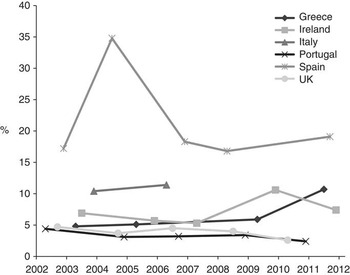
More recent figures have been collected by the European Social Survey since 2002 with a question on participation in ‘lawful’ demonstrations over the last twelve months.Footnote 22 The results for Greece and a host of other countries affected by the austerity crisis are plotted in Figure 1. These data confirm the slowing down of protest in Greece – as far as demonstrations were concerned – in the 2000s, a period of economic growth and prosperity during which Spain and Italy had a higher share of protesters.
Participation in ‘lawful’ demonstrations in the last twelve months, 2002–2011 Source: European Social Survey, Waves 1–5, 2002–2011, http://ess.nsd.uib.no, [accessed 2 April 2012]; own analysis restricted to citizens of the country aged eighteen or over, design weight applied. Question wording: ‘During the last twelve months, have you done any of the following: – taken part in a lawful public demonstration? (Yes/No)’.

On the other hand, Greece clearly stands out from others in the number of general strikes, which are largely absent from the repertoire of trade union actions in Northern Europe (including Ireland and the UK) and are uncommon in Southern Europe, but had become a regular feature of Greek life well before the austerity protests. Back in the early 1990s, there were multiple general strikes in protest of welfare retrenchment and cuts.Footnote 23 Over the last ten years, there has been at least one general strike called in Greece per year (except in 2003), peaking at seven in both 2010 and 2011 (see Table 1). The role of trade unions is crucial, as they are responsible for calling the strikes. Although figures on trade union membership do not suggest that Greece is a particularly radicalized society,Footnote 24 case studies have shown that unions have maintained a high degree of organizational cohesion and activism.Footnote 25
Number of General Strikes in South European Countries, 2002–2011

Sources: Hamann, Johnston, and Kelly Reference Hamann, Johnston and Kelly2013; European Industrial Relations Observatory (EIRO), http://eurofound.europa.eu/eiro/index.htm [accessed 5 April 2012]; authors’ database.
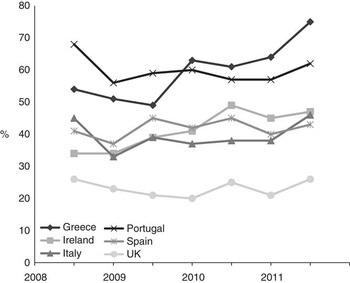
In terms of the economic outlook for Greece, the comparative data for 2010–2011 are fairly devastating; on all macroeconomic indicators such as gross national product, unemployment and gross national debt, Greece was doing worse than other countries hit by the sovereign debt crisis.Footnote 26 This has severely affected individual citizens who are most pessimistic in their evaluations of their economic circumstances, a sentiment captured in Eurobarometer surveys, plotted in Figure 2. Since early 2010, Greeks have perceived themselves as facing the toughest economic conditions, with more than 60 per cent considering their economic positions to be ‘rather bad’ or ‘very bad’.
Current financial situation of household ‘rather bad’ or ‘very bad’, 2008–2011 Source: Standard Eurobarometer 70–76, 2008–2011, http://ec.europa.eu/public_opinion/archives/eb_arch.en.htm [accessed 2 April 2012]. Question wording: ‘How would you judge the current situation in each of the following? – The financial situation of your household – Very good, rather good, rather bad, very bad’.

The overall analysis of patterns of activity suggests that Greece has some similarities with Spain and Italy, with which it also shares an authoritarian past, and stark differences with others, including Ireland, Portugal and the UK. The combination of media reports and population survey data show that Greece has a group of activists that generates a lot of protest events that can occasionally mobilize a sizeable number of people. Furthermore, while the socio-political context illustrates the presence of a left-leaning protest culture in Greece, not all of the major past protest events are linked to radical left-wing politics; the number of people mobilized greatly exceeds the electoral support that radical left parties received (before 2012). This historical overview implies that there is a large reservoir of people who have been engaged in protest before and who any protest mobilization in Greece may be able to draw on. Therefore, in our analysis of the individual-level determinants of participation in the anti-austerity movement, we will need to pay specific attention to these contextual factors, particularly previous protest participation, which may play an important role in accounting for involvement in protest activities in 2010. Another contextual factor that sets Greece apart is the depth of the economic hardship experienced. This factor reinforces the idea that any attempt to explain protest participation should consider the possible impact of factors linked to economic deprivation.
Theorizing Individual Drivers of Protest
Many different theories have been discussed to explain who becomes involved in protest behaviour; some have been more or less fashionable at different times. Considering the widespread detrimental impact of the crisis on individuals’ circumstances, as well as the suddenness with which grievances were imposed,Footnote 27 the first group of factors that we should investigate focuses on the idea of protest as a response to injustice and deprivation. This is one of the oldest theories of protest and revolution, and has been an important element of Marxist debate since the nineteenth century. In the 1940s and 1950s, empirical analysis of social behaviour generated a major refinement of the theory. A range of studies suggested that the ‘absolute’ level of deprivation, such as poverty and inequality, was not linked to protest behaviour; other factors also needed to be present. This shift in thinking led to the theory of ‘relative deprivation’, which focused on a range of other conditions necessary to turn the stimulus of ‘absolute’ deprivation into active protest. The most important aspect of Ted Robert Gurr's influential model, which included numerous other intervening variables, was that the ‘deprivation’ had to be perceived relative to what an individual feels entitled to.Footnote 28
The theory of relative deprivation, however, fell out of fashion in the 1970s, in large part due to its apparent inability to explain individual involvement in – as well as the size of – protest events such as the black ghetto riots in US cities in the 1960s.Footnote 29 There appeared to be a widespread consensus in the academic community analysing social movements by the 1980s and 1990s to reject relative deprivation theory and turn to rival explanations;Footnote 30 only social psychologists continued to express support for it.Footnote 31 More recently, relative deprivation models have been used to analyse various forms of political behaviour – such as election turnout,Footnote 32 protest potentialFootnote 33 and past protest behaviourFootnote 34 – which has generally confirmed the theory's lack of explanatory value.
The anti-austerity movement in Greece, which appears to be chiefly motivated by a ‘deprivation’-type stimulus, offers an ideal setting in which to test the theory. While there are no detailed data on how each individual is affected by the measures, our survey captures the level of deprivation by asking respondents a number of questions about their past and future economic situation. These data allow us to measure the perception of the size of the economic deprivation, which could be seen as an approximation of the ‘felt’ deprivation that is expected to be a key predictor of protest.
Apart from the actual experience of economic hardship, an essential element of deprivation theory involves aspects of ‘fairness’ and ‘blame attribution’. Conditions will not be perceived as ‘depriving’ unless individuals perceive that they are treated unfairly and are not themselves to blame for their situation. Within the Greek political discourse on austerity, issues of fairness and blame play an important role. A broad range of actors such as financial institutions (both international and domestic) and other foreign bodies such as the EU, Germany or ‘globalization’ in general, have been held accountable. While all sides appear to share some elements of blame attribution, the main dividing lines between proponents and opponents concern questions about the effectiveness and fairness of the proposed policies. We would thus expect a perception of unfairness to play an important role in the decision to protest. Furthermore, relative deprivation theory would suggest that those adopting an ‘internal’ blame attribution, for example unemployed people blaming themselves for their inability to find a job, are less likely to protest.Footnote 35 A test of relative deprivation theory would thus involve a range of variables that measures economic experiences and perceptions, as well as considerations of unfairness and blame.
Relative deprivation theory was replaced as the dominant theory of protest in the 1960s and 1970s by approaches that focus on individuals’ resources. To test whether relative deprivation makes an independent contribution to explaining protest in the context of Greece's extreme austerity situation in 2010, the first group of variables that we need to control for is defined by ‘resources’. The earliest major empirical study that covered the entire range of political actions taken in the United States used resource-based explanations of behaviour.Footnote 36 People participated in politics who had the resources to do so; this placed variables such as education, occupation and income – the ‘socio-economic status’ (SES) – at the centre of the analysis.
How can we adapt ‘resource’-based theories of social protest to the Greek situation? We propose to concentrate on two types of resource-based variables: biographical availability and social networks. We can easily test a basic model of political participation with reference to variables of individuals’ ‘biographical availability’,Footnote 37 such as age, gender, marital status, caring for children and education. Protest behaviour has in the past mainly involved younger people; lack of obligations linked to family and occupation could make young cohorts (under thirty) more likely to be involved. Engaging in protests such as demonstrations involves a degree of physical activity that may make it less likely for older cohorts, above fifty or sixty, to take part. Education has been found to be strongly associated with both conventional and unconventional political behaviour. In the context of protest associated with ‘new politics’, education is linked to the concept of ‘cognitive mobilization’. Inglehart conceived this concept as the basis of a ‘newer elite-challenging mode of participation’, in contrast to old types that relied on political parties and trade unions.Footnote 38
However, there are questions about the links between ‘biographical availability’ at different stages of mobilization and different kinds of protest. One of the few studies comparing protest potential and actual protest found biographical availability to be an important predictor of potential (but not actual) protest.Footnote 39 A study of participation in a movement of homeless people, a protest strongly associated with issues of economic deprivation, showed that those with less biographical availability were more likely to participate.Footnote 40 This finding may suggest that these variables are less likely to apply to protest that is mainly defined as a ‘movement of crisis’ in which economic survival is at stake.
In the 1990s, the SES approach was supplemented to create an extended model known as ‘civic voluntarism’,Footnote 41 which included other resource aspects, such as time, as well as a social link: people participated in politics if they had the resources – and the opportunity – to take part. People who are integrated into social networks that generated requests to take part in particular actions could be seen as having more opportunities, and were thus more likely to participate. Involvement of individuals in social networks has also been shown to be particularly important in turning ‘potential’ into ‘actual’ participants.Footnote 42 In line with the literature,Footnote 43 we would expect participation in social networks – such as political parties, trade unions and voluntary organizations – to be linked to protest behaviour. Union membership and full-time employment, especially in the public sector, would be particularly likely to increase the likelihood of strike participation, as they would expose individuals to greater mobilization attempts. In general, and contrary to expectations based on considerations of time availability, past surveys have shown that those in full-time employment are generally more likely to be involved in protest.Footnote 44
An additional important variable that can be termed a ‘resource’ is previous involvement in strikes and demonstrations. People socialized into a specific form of collective action could be expected to be more likely to engage in such behaviour in the future, although the probability of remobilization is likely to be affected by both ‘biographical availability’Footnote 45 and ‘social network’ involvement. Previous protesters who were mobilized through informal recruitment networks, such as friends and family links, may more easily participate in renewed protest activity.Footnote 46 In the absence of panel data stretching back to specific previous experiences of protest, however, we have to be careful about the exact nature and direction of causal links. Protest involvement may promote a process of politicization that makes protesters more likely to be involved in trade unions, voluntary organizations and political parties, thus providing a network connection. Protest involvement could also be conducive to adopting a left-wing ideology and attachment to left-wing politics. Finally, those with protest experience may have a different perception of the costs and benefits of protest. In order to test the independent effects of such variables, we must also include predictors of ideological position and rational choice criteria.
Greece has a bipolar political system that is dominated by the left-right divide. We could expect left-wing ideology to be an important predictor of protest participation. The parties of the Far Left, such as KKE, Syriza and DIMAR, have been particularly active in the anti-austerity movement, dominating much of its public relations and trying to promote a left-wing, anti-capitalist discourse of austerity politics. A second variable could measure an individual's past attachment to such parties, such as voting for Far Left parties in the 2009 general elections. If the anti-austerity protest is essentially a movement of the radical left, then past support for left-wing parties should be an important predictor of protest participation.
A key question is to what extent the anti-austerity movement reflects elements of ‘new’ or ‘old’ politics. The importance of ‘post-material value change’ for participation in a wide variety of protests has been well documented, even when demands are focused on material concerns. For instance, movements such as the Spanish indignados mainly involve young and highly educated people not connected with ‘old’ politics mobilization contexts like trade unions and political parties,Footnote 47 who challenge the entire basis of establishment politics and promote demands for more participation and democratization.Footnote 48 In addition to other variables, we thus also need to test whether holding post-materialist values is an independent predictor of protest involvement.
Finally, we should also consider the theory of rational choice, which is arguably the dominant approach in the analysis of political behaviour. A rational choice approach would predict that only people who perceive the benefits of taking part in protest to be greater than the costs are likely to participate. While some rational choice models of protest focus centrally on the measurement of general notions of political efficacy,Footnote 49 we introduce measurements of the perceived costs and benefits of the specific type of anti-austerity protest in which respondents might consider being involved. The cost element is measured by a question about the risk of being injured or arrested when taking part in a demonstration. The benefits (probability of success) are measured by two items that evaluate the likely effectiveness of taking part in strikes and joining demonstrations. Even with such a basic design, the main problem with applying a rational choice approach in our case is the limitation of our data to one time point. This means that there has to be a question mark about the direction of causal sequences. Still, the inclusion of rational choice variables remains important as controls for assessing the impact of relative deprivation and other predictors of protest.
We thus have established four general areas from which relevant hypotheses about protest behaviour can be drawn and tested: relative deprivation, resources (biographical availability and social networks), political ideology and rational choice. Before we discuss our findings, we need to describe our data collection and look more closely at some key methodological challenges.
Data and Methodology
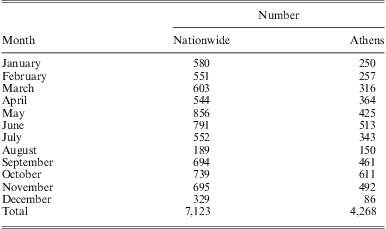
Unusually in the study of involvement in a specific protest movement, our analysis is based on a survey of the general population. This approach is rare in the literature, mainly because the share of the population involved in individual protest events is usually too small to generate enough cases. In the case of anti-austerity protest in Greece, this is different. In addition to seven general strikes during 2010, numerous protest marches were also organized. According to police figures, a total of 7,123 demonstrations took place in Greece during 2010, the vast majority of which we can assume was concerned with anti-austerity protest (see Table 2). Given an average figure of just over 200 protest events per year in the early 1990s, which were seen as a time of high protest incidence, this information about more than 7,000 events in just one year, with hundreds of marches every month, reveals a staggering degree of political mobilization.
Number of Demonstrations in Greece in 2010

Source: Hellenic Police Statistics, personal communication with press office, 2 April 2012.
There are few precedents for this kind of approach. As far as we are aware, the only previous attempt to use a general survey that is representative of the entire population at the national level to analyse involvement in a specific set of political demonstrations was carried out by Philip Converse and Roy Pierce in France in the late 1960s.Footnote 50 They conducted a general public attitude survey after the protest events of May 1968, finding that about 20 per cent of their sample was involved in strikes and 8 per cent had taken part in demonstrations. Two more studies used surveys to measure actual participation in widespread protest action in the East German town of LeipzigFootnote 51 and among the Latino population of the United States,Footnote 52 but these targeted a specific section of the population defined on geographical or ethnic grounds. Obviously, the Greek context is radically different from the politics of 1968 in France, the Communist regime in East Germany in 1989 and US immigration politics in 2006. In all these cases, however, the very widespread nature of protest action allows an analysis of who was (and was not) involved in a specific range of actions, and thus some aspects of the previous studies were useful in designing our study of protest in 2010.
Our approach has several advantages over more common ways of analysing protest participation. Previous empirical research on protest behaviour can be grouped into three main categories. The first approach is the analysis of protest ‘potential’. Pioneered in the 1970s, such studies analysed protest on the basis of respondents’ expressed likelihood of engaging in protest activity at some point in the future.Footnote 53 While such an approach has had a wide resonance, in particular in the study of the ‘new social movements’ and related protest events, with continued popularity in other general attitude surveys,Footnote 54 its main weakness was always its focus on ‘potential’ or ‘probable’ protest behaviour.Footnote 55 It thus remains uncertain to what extent inferences about actual protest behaviour can be drawn on the basis of survey questions about what type of behaviour an individual might or might not engage in at some unspecified time in the future on an unspecified issue of political controversy. Our data, on the other hand, allow us not only to analyse the determinants of ‘potential’ protest but also to scrutinize the factors responsible for turning ‘potential’ into ‘actual’ protest.
A second group of studies concentrates on the analysis of past protest behaviour. Major surveys such as the World Values Survey, the International Social Survey Programme, the European Values Study and the European Social Survey have included questions about past protest behaviour, such as attending demonstrations, either with no time restrictions or with reference to the previous twelve months. A number of analyses has been published on the basis of such large international datasets.Footnote 56 One weakness of this approach is its lack of specificity. Respondents are asked about participation in particular types of political behaviour, such as ‘attending a lawful demonstration’, without any reference to the type of issue or movement that this activity was related to. Thus a broad range of phenomena, including left-wing, environmental, anti-tax, law and order and other right-wing protest issues are mingled together. In our analysis of a specific protest movement, we can also examine what accounts for past protest involvement and assess the role of such an experience for participation in a contemporary movement.
A third group seeks to sidestep the limitations of general attitude surveys by surveying those engaged in protest directly, an approach that has become the dominant method of sociologists of social movements to analyse movement participation. After some pioneering empirical work in Belgium,Footnote 57 major comparative research projects involving surveys of demonstrators were conducted in the 2000s.Footnote 58 Such studies allow for excellent assessments of the background of demonstrators engaged in specific actions and on different types of movements, but are restrained by their inevitable lack of data on non-demonstrators.Footnote 59 This makes it very difficult, if not impossible, to analyse the recruitment process and answer the question of what determines whether an individual protests or not.
In order to take advantage of the unique opportunity to study protest behaviour presented by the events in Greece, a telephone survey was conducted by Kappa Research, Athens, in early December 2010. The selection method used was a stratified quota sample. Quotas were defined according to census data for gender and age. Telephone codes were first selected corresponding to each region in relation to its population size. The remaining dialing digits were generated randomly by computer software. The suitability of each respondent was first queried in terms of minimum age (eighteen) and voting rights (Greek citizen) before proceeding with each interview. Only one interview could be conducted per household. This process generated a dataset with 1,014 valid responses that is representative of the distribution of the Greek population in terms of geographical location, gender and age.
How do we analyse the determinants of anti-austerity protests and test our hypotheses? Our study's design is primarily inspired by the pioneering work of Bert Klandermans and Dirk Oegema,Footnote 60 who distinguished between a number of steps in the analysis of protest involvement. In adapting this model to our data, we identify four steps that can help us dissect the individual drivers for protest, while allowing the influence of contextual factors to shine through: (1) motivation potential: agreement with/sympathy for the goals of the protest; (2) protest potential: attitudes towards protest action; (3) protest opportunities: perceived access to protest and (4) actual participation.
The first step is to concentrate on the explanation of opposition to the government's austerity policy. Without controlling for the degree of opposition, it will be impossible to identify the factors that explain actual protest behaviour rather than the strength of attitudes on austerity. In response to the question: ‘To what extent do you support or oppose the government's austerity programme?’, 54 per cent expressed opposition to the programme. The second step in our model concerns attitudes toward protest. Some respondents may be opposed to the austerity programme but may not support the idea that people should protest against it. Respondents were asked to react to the statement ‘People should protest against the austerity measures’; 28 per cent strongly agreed and 37 per cent agreed. A clear majority of the population was thus in favour of protest. Of those opposed to the government's policy of austerity, more than 80 per cent supported protest.
The third step is to examine other obstacles that may prevent opponents of austerity who are willing to protest from joining an actual protest. As a wide variety of protests and strikes were organized during 2010, one might assume that everyone could have found a protest to join. While this might be true in the larger cities, in particular in Athens where more than half of all demonstrations (4,268) took place in 2010, it could not necessarily be assumed to apply in the rural and island communities. Protest behaviour is collective behaviour; that is, individuals are joining a strand of behaviour that involves many others. The vast majority of people participating in protests is not involved in organizing a protest, which poses a problem in that non-participation may simply reflect the fact that no protest was organized in the respondent's community. On the other hand, many people travelled to attend protest events outside their communities.
We asked respondents whether they were aware of any protest activities in their local community before inquiring about their own protest participation. This essentially follows the approach by Converse and Pierce in France. Such a construction also allows us to use this variable to measure the opportunity to protest. One-third of respondents reported that no strikes had taken place in their community, and slightly more than one-third, 37 per cent, reported that no demonstrations had been organized. About 57 per cent of respondents lived in towns or communities in which both strikes and demonstrations took place, and 26 per cent of respondents reported neither taking place. Given the widespread nature of strikes and demonstrations in 2010, this lack of protests in certain communities is rather higher than we expected. A closer look at the localities of respondents reveals that there is a major gap in the number of protests between the major cities, smaller towns and country villages. About 80 per cent of respondents residing in big cities reported strikes and demonstrations. This drops to between 47 and 55 per cent in the suburbs and small towns, and to 38 per cent in country villages. Thus there were considerably fewer protest opportunities in rural areas. This echoes Converse and Pierce's finding that protest in 1968 was also predominantly an urban phenomenon.Footnote 61
In order to develop an overall model of protest involvement that assesses the effect of various individual-level variables, we also have to consider past protest involvement. As suggested in our earlier discussion of the socio-political and historical contexts, past involvement may indicate the influence of a particular protest culture, or it may simply mean that participation barriers were reduced from the previous protest experience.Footnote 62 When asked about previous participation in strikes and demonstrations, eight out of ten anti-austerity protesters in 2010 reported having taken part in either demonstrations or strikes, or both, before. We thus have a closer look at the factors explaining both past and present protest, and can compare models with and without the previous protest involvement variable in order to assess the relative effect of various possible predictors of protest.
About one-fifth of all respondents, 21 per cent, reported that they had taken part in strike action. Nineteen per cent said that they had taken part in a demonstration in their local community. We also asked whether respondents had taken part in demonstrations ‘outside’ their own town or community; 8 per cent of respondents said they had done so. With some taking part in more than one form of protest, the total share of people taking part in at least one form of protest was slightly less than one-third, 29 per cent. Our main dependent variable is thus protest participation, which includes all forms of protest. As we do expect some differences between participation in strikes and demonstrations, both forms of protest are also analysed separately.
We begin by discussing opposition to the government's austerity programme, support for protest against the programme and the perception of opportunities to join the protest. Analytically, we are particularly interested in analysing ‘potential protest’ that could be the subject of mobilization efforts defined by opposition to the austerity programme, combined with the belief that people should protest against it. The primary purpose of this is, however, to define control variables for analysing actual protest participation. Accounting for opposition to austerity, support for protest and the opportunity to protest, which factors predict who is actually turning out to take part in strikes and demonstrations?
To develop an overall model of protest involvement that assesses the effect of various individual-level variables, one factor that we should include and are particularly interested in – following our discussion of Greek protest culture – is previous protest involvement. We thus have a closer look at the factors that explain both past and present protest activity, and compare models with and without the previous protest involvement variable in order to assess the relative effect of various possible predictors of protest.
Findings
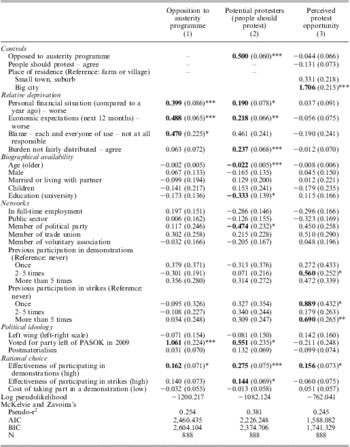
The results of the first step in our analysis – seeking to explain opposition to austerity, support for protest and perception of protest opportunities – are presented in Table 3. The strength of opposition to the austerity programme is associated with relative deprivation variables. Previous protest participation and other aspects of biographical availability play no role. Opposition is particularly strong, as could be expected, among supporters of far-left parties (KKE, Syriza). The perception of the effectiveness of protest also plays a role.
Determinants of Opposition to Austerity, Protest Potential and Perceived Protest Opportunity

Note: cell entries are ordered logit regression coefficients, robust standard errors in brackets, statistically significant coefficients in bold. *p < 0.05, **p < 0.01, ***p < 0.001. AIC: Aikaike's Information Criterion; BIC: Bayesian Information Criterion (both AIC and BIC are reported in the version as ‘used by Stata’, cf. Long and Freese Reference Long and Freese2006, 110–13.
Controlling for opposition to the austerity programme, what determines support for protest against the policy? Again, relative deprivation variables are associated with protest potential. Apart from supporters of far-left parties and rational choice variables, some aspects of biographical availability and political resources also play a part. Potential protesters are younger, less likely to have been to university and less likely to be members of political parties. Interestingly, previous protest involvement does not influence protest potential.
Place of residence is the most important predictor of perceived protest opportunity. Respondents in big cities are considerably more likely to perceive an opportunity to protest than rural residents. Previous protest involvement also makes it more likely that respondents perceive protest opportunities, as is a perception that demonstrations are an effective form of political action. Otherwise, relative deprivation, biographical availability and ideology play no role.
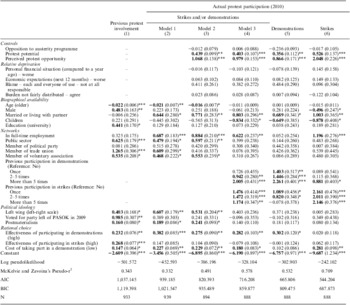
Turning to the main question of who protested against austerity in 2010, the role of previous protest involvement is clearly of central importance. More than four out of five protesters had participated in protest during the previous ten years. The first part of our analysis of actual protest behaviour is thus comparing the determinants of 2010 protest involvement with protest in previous years. Relative deprivation variables, for which we do not have historical data, and control variables that are only relevant to the austerity movement are omitted from this analysis (see Table 4).
Determinants of Protest Against Austerity Policy

Note: cell entries are binary logit regression coefficients, robust standard errors in brackets, statistically significant coefficients in bold. *p < 0.05, **p < 0.01, ***p < 0.001. AIC: Aikaike's Information Criterion; BIC: Bayesian Information Criterion.
The analysis of previous protest involvement (Column 1) confirms most of the classical hypotheses about protest involvement: protesters are found to be younger, male, highly educated, working in the public sector, members of trade unions and/or voluntary associations, with a left-wing ideology and post-materialist values, and with high perceptions of the effectiveness of protest and a low perception of the costs. Remarkably, the analysis of 2010 protest (Column 2) fits the same model rather well, with only a few exceptions: 2010 protesters are not as predominantly male, are married or living with a partner, and are in full-time employment. These results strongly suggest that protest in 2010 was essentially a continuation of previous protest trends rather than a radical break from the country's history of contentious politics.
How do these predictors of protest participation stand up if we control for the specific features of anti-austerity protest – namely opposition to austerity policies, support for protest against these policies and the perceived opportunities to join a protest? To what extent does the predictive power of relative deprivation also contribute to the explanation of how potential is turned into actual protest? The results of the analysis shown in Column 3 (Model 2) demonstrate quite clearly that relative deprivation is not a factor that mobilizes people to take part in actual protest. Otherwise, the coefficients of Model 2 are remarkably similar to those in Model 1, not including the control variables. While the effect of trade union membership is not statistically significant in this model, a separate analysis of strike participation (details not shown) suggests that this variable and full-time employment are important predictors in the public sector. Looking at the relative importance of different types of predictors (details not shown), network involvement and political ideology have the highest impact on protest participation, followed by rational choice. The effect of biographical availability is very small by comparison.Footnote 63 Overall, this model of 2010 protest participation confirms the earlier analysis that the significant individual-level predictors of anti-austerity protest, with some minor exceptions, fit the pattern of variables responsible for previous protests.
Moving on to our final analysis (Column 4), which adds previous protest experience to our model, we seek to answer two additional questions. First, how important is previous protest participation once we control for opposition to austerity policy, protest potential and protest opportunity, as well as all other individual-level predictors of protest, ranging from relative deprivation to resources and biographical availability, political ideology and rational choice? Secondly, once we control for previous protest participation, which of our variables explains the new mobilization process?
Dealing with the second question first, we have already seen in the analysis in Column 1 that biographical availability, network involvement, political ideology and rational choice variables are all independent predictors of previous protest involvement. This analysis confirms most of the standard theories of protest mobilization. But do the same factors also play a role in mobilizing new protests? Here the results throw up a few unexpected findings.
Age does not quite have the anticipated effect. Younger people are slightly more likely to engage in protest, but once previous protest is controlled for, the co-efficient is no longer statistically significant. This finding contradicts not only our theoretical expectations but also many of the journalistic accounts that often focus centrally on the role of youth culture and the internet as key elements of a new generation of protest.Footnote 64 Our results challenge these accounts. The Greek protesters of 2010 are not particularly young: their average age is only marginally lower than the national average; the age group with the highest share of both strikers and demonstrators consists of those between forty-five and fifty-four years – 48 per cent of this age group went on strike and 43 per cent attended a local demonstration. Even among those over sixty-five, involvement in protest is still strong, with 20 per cent attending demonstrations; the oldest demonstrator in the sample is eighty-eight years old. Therefore, unlike the social unrest of December 2008,Footnote 65 mass protest against the austerity measures in 2010 was not the preserve of the young but involves people of all ages, particularly the middle-aged.
Similarly, gender is not as important as could be expected for new mobilizations, and married people are slightly more likely to engage in strikes and demonstrations, while having children discourages people from taking part in protest. Individuals in full-time employment were more likely to be mobilized in 2010. Otherwise, education, membership of trade unions and voluntary associations, and political ideology are not significantly associated with the mobilization of anti-austerity protest once we control for past protest involvement. These results show that while factors such as age (youth), gender (male), education, public sector employment, membership of trade unions and voluntary organizations, left-wing ideology and postmaterialism have an indirect effect on 2010 protest behaviour through past protest experience, they do not have a direct effect once past protest involvement is controlled for.
The analysis presented in this model combines a number of different processes and types of protest. What factors determine whether ‘veteran’ protesters are re-mobilized in 2010 or not? What accounts for the recruitment of novice protesters? Are the effects different for strikes and demonstrations? We conducted analyses of all these separate mobilization processes; the main differences we found are between strikers and demonstrators, and separate models are presented for each form of protest in Columns 5 and 6.
Age is not a relevant variable in these more detailed analyses. However, gender features surprisingly strongly for participation in strikes, and a comparison of new and veteran strikers (details not shown) suggests that women are particularly noticeable among new recruits in strike action. Being married or living with a partner is positively associated with both striking and demonstrating. This variable is very strongly associated with the mobilization of veteran protesters (details not shown). Having children is negatively associated with protest participation, in particular for strike action. Being in full-time employment is a strong predictor of mobilization for strikes (for both new and veteran strikers). Finally, neither trade union membership nor left-wing ideology plays a role for either strikers or demonstrators, with the sole exception of trade union membership as a statistically significant predictor of new strike recruits.
What are we to make of these results? Some of these detailed findings may be the product of the specific mobilization context experienced in 2010. The violence associated with protest in 2008 as well as 2010 may have made parents more conscious of the risks involved; the extreme nature of the austerity measures could have motivated people not previously associated with protest to become active. Overall, the main thrust of these results appears to support the notion that people faced with extreme economic hardship may become mobilized, contrary to expectations on the impact of biographical availability factors.Footnote 66
This leaves us with what clearly is the most important group of predictors: previous protest involvement. With 80 per cent of protesters having taken part at least once in either strikes or demonstrations before, this is perhaps not surprising. Looking at the role of the frequency of previous protest involvement provides an additional perspective. In Model 3 (Table 4, Column 4), we find that the more often respondents had taken part in demonstrations before, the more likely they were to become involved in anti-austerity protest in 2010.
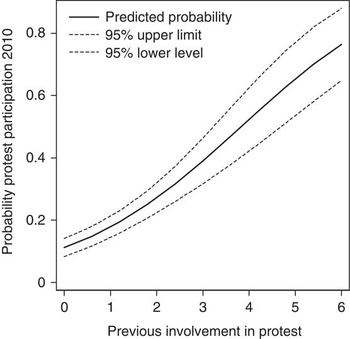
The strength of the predictive power of previous protest involvement is underlined even further once we combine the frequency of taking part in demonstrations and strikes. This analysis (details not shown) suggests that those who have been involved in both strikes and demonstrations multiple times before are the most likely to take part in anti-austerity protest. Those who have either taken part in both strikes and demonstrations more than five times over the last ten years, or who have taken part more than five times in one and at least two to five times in the other, are considerably more likely to take part in protest in 2010. Keeping all other variables constant (at their mean), the predicted probability of protest participation was calculated in relation to previous protest experience, combining the frequency of participation in strikes and demonstrations on a scale of 0 to 6. The result displayed in Figure 3 shows emphatically that protest participation in 2010 is, to a large extent, a function of the degree of previous protest involvement.
Predicted probability of protest participation in 2010 in relation to previous protest participation

Discussion
What does our analysis of the Greek case tell us about the drivers of political protest in general, and the anti-austerity movement in particular? A key finding is that different variables matter at different stages of the process: the drivers change as our focus shifts from explaining opposition to austerity to protest potential and, ultimately, actual protest participation.
Starting with the influence of economic deprivation and feelings of injustice, our results show that these are significant predictors of opposition to austerity policies and support for protest. However, relative deprivation does not predict turning potential into actual participation. The second group of variables associated with resources (biographical availability and network involvement) performs somewhat better in explaining actual protest. In line with the main tenets of civic voluntarism, people protest if they have the resources and the opportunity to do so. However, against expectations, some key variables, not least education, do not play the expected role in the Greek case. Yet this, in combination with other factors, characterizes the type of protest quite well. This is not a protest movement of a middle-class educational elite that is active in their spare time, as most ‘new social movements’ in Western Europe have been in recent decades. This is a mass protest in which ordinary people of all educational backgrounds and ages take part. It is also those in full-time employment who are most likely to be involved in both strikes and demonstrations, and this variable remains an independent predictor when previous protest is controlled for. In other words, those involved most closely in economic life, rather than people on the margins or outside of the labour force, are the main carriers of this protest movement.
The traditional network of trade union and voluntary group membership, as well as public sector employment, play a key role in recruiting protesters. However, these exert their influence through past protest experience; none of these network factors is an independent predictor of protest, once past protest is controlled for. The same applies to political ideology variables (left-wing ideology and postmaterialism), which are both significant predictors of past and present protest but are not independent predictors of anti-austerity protest, once past protest experience is taken into account.
The dominance of the role of past protest engagement should caution us to interpret this result in terms of the marginality of the involvement in social networks as a predictor of protest participation. It is beyond doubt that anti-austerity protest involves, to a large extent, mobilizing an existing pool of experienced strikers and demonstrators. The share of those with no previous participation is fairly small. There are hints that there are some new aspects in 2010, for example the role of women among strikers, but the drivers of first-time mobilization is a separate question altogether, which requires further elaboration.Footnote 67
Finally, one of the most intriguing findings is that the rational choice variables are found to play a role at all stages of the protest recruitment process. A high evaluation of the effectiveness of protest, in particular demonstrations, is an independent predictor of opposition to austerity, protest potential and perception of protest opportunity. Moreover, rational choice variables are also independent predictors of not only past but also actual protest in 2010, even when controlling for protest potential and the degree of past protest experience. Despite the inherent limitations of interpreting the results of a one-time survey, their robustness across the board suggests that rational choice considerations should be taken seriously in any model of protest behaviour.
Conclusion
Anti-austerity protest in Greece constitutes a mass movement; our survey found that about 30 per cent of the entire population engaged in some type of protest in 2010. The analysis of the profile of protesters demonstrates that protest was not the preserve of those with a high socio-economic status, high levels of education or lots of time on their hands. Nor was it primarily students, political extremists or dropouts who were involved in the actions. Protesters mainly came from the political left, but otherwise, it was the average Greek who took part, those in full-time employment, married, not particularly young or old, or highly educated. In other words, the protests came from the heart of society and lacked the ‘new social movement’ characteristics emphasized by the literature on protest of recent decades. Howard Kerbo's distinction between ‘movements of affluence’ and ‘movements of crisis’ offers a useful way to capture these differences – anti-austerity protest clearly falls in the latter category.
Protest against austerity also has a feeling of ‘old’ politics about it that may be reminiscent of the strike movements of previous decades. With four out of five participants having taken part in protest before, it is evident that many of the usual suspects were re-mobilized; that is, employed people who are trade union members and have left-wing political views. Still, protest in Greece is historically not limited to followers of Far Left parties. Once the influence of previous protest participation was accounted for, ideology does not play that much of a role, indicating that the high degree of mobilization of veteran and new protesters in 2010 was not limited to left-wing activists.
A more plausible explanation is that the usual suspects in Greece, through their organizational infrastructure, act as first movers in the generation of protest opportunities, who trigger the latent protest socialization of a broader public that is not strongly defined ideologically in left-right terms. This may also have some implications for the phenomenal rise in support for parties of the left, particularly Syriza, in the double elections of 2012. Their electoral success may partly be attributed to their ability to attract opponents of the austerity policy who are not necessarily radicalized in terms of ideology. If this holds true, the future electoral behaviour of these voters is likely to be in flux and largely defined by how the debt crisis develops and how it is managed by the governing coalition. Nevertheless, the medium- to long-term political impact of the anti-austerity movement remains completely open and cannot be established with a one-time survey alone or without panel data.
Based on these findings, there are two main theoretical and comparative implications for austerity politics that are of broader relevance beyond the Greek case. First, the factors that predict protest potential are not a good measure of who actually takes part in protest. High levels of deprivation can convince large sections of the population to embrace the idea of protest against government policy. However, while deprivation increases the potential for austerity protest, it is not an independent predictor of actual protest. The probability of significant anti-austerity protest movements thus depends on other contextual factors.
Secondly, the most significant implication for other countries is that previous protest participation, on its own, constitutes an important recruiting pool for actual protest. People are recruited into strikes and demonstrations through a process of socialization into taking particular forms of political action. Therefore we should expect that the potential for protest in the wake of austerity measures will depend notably on the extent to which people have been engaged in prior protest. In countries where there is a strong, established protest culture, where a significant minority regularly engages in such activities, it should be easier for protest potential to be transformed into actual protest participation. This would suggest that anti-austerity movements might struggle to reach high levels of mobilization in countries such as Ireland, the UK and Portugal, but are likely to have a broader appeal in Italy and Spain.
We obviously have to be careful in formulating conclusions about cross-national differences in protest behaviour on the basis of individual-level data analysis. Taking into account both the drivers of mobilization at the individual level and the aggregate context at the national level offers the most promising avenue for developing our understanding of protest behaviour. The analysis in this article clearly demonstrates the central role of the Greek protest culture and its dynamic interrelationship with individual drivers in producing anti-austerity protest. Future cross-national comparative research is necessary to take account of other contextual variables, such as the relative power of parliament,Footnote 68 in explaining the emergence and development of anti-austerity movements.