Introduction
Conventional theories of American federalism conceptualize conflicts between state and federal authority as institutional disputes over jurisdiction (Singh Reference Singh2026), constitutional balance (Bromley-Trujillo and Dichio, Reference Bromley-Trujillo and Dichio2024), or ideological preferences regarding centralization (Rodriguez Reference Rodríguez2017). In this literature, sovereignty conflicts are largely treated as race-neutral contests over power between levels of government. Yet American political development suggests otherwise. From constitutional compromises over slavery to contemporary voting rights disputes, conflicts between state autonomy and federal supremacy have repeatedly emerged around the governance of Black citizenship (Nelson Reference Nelson2022). By neglecting the racial foundations of these conflicts, prevailing federalism scholarship offers an incomplete account of both historical and contemporary intergovernmental politics. The Supreme Court’s decisions in Shelby County v. Holder (2013) and Allen v. Milligan (2023) highlight this limitation. A Court that dismantled the Voting Rights Act’s preclearance regime later reaffirmed its core protections, a divergence conventional constitutional explanations struggle to explain given the Court’s relatively stable ideological composition across the decade.
This article argues that sovereignty disputes in the United States are structured by racial hierarchy and must therefore be understood within what scholars describe as the American racial state (Palmer Reference Palmer2020). Federalism was designed as a compromise balancing state autonomy under the Tenth Amendment with the supremacy of federal law under Article VI, but this balance has never operated independently of race. From the Three-Fifths Compromise to the enforcement of Reconstruction Amendments and the Voting Rights Act of 1965, sovereignty conflicts have intensified when state actions threatened Black political participation and status equality (Nelson Reference Nelson2022). In these moments, disputes between state and federal authority concern not merely institutional power but the boundaries of citizenship itself. This article advances the theory of racialized dual sovereignty, which explains how conflicts between state autonomy and federal authority are structured by racial hierarchy and mediated by federal institutions in ways that preserve national democratic legitimacy while allowing substantial subnational inequality to persist.
The Voting Rights Act of 1965 marked a turning point by providing federal tools necessary for Black Americans, particularly in southern states, to realize their Fifteenth Amendment rights. Sections 4 and 5 curtailed state sovereignty through the preclearance regime, enabling federal oversight of election law in jurisdictions with documented racial discrimination (King-Meadows Reference King-Meadows2011). These provisions expanded Black electoral participation, facilitated the growth of Black political representation through institutions such as the Congressional Black Caucus, and reshaped the national political landscape (Nelson Reference Nelson2022). Yet federal intervention also provoked resistance. Protecting Black voting rights through federal authority carried significant political costs, contributing to partisan realignment in the South and fueling claims that federal oversight constituted illegitimate intrusion into state sovereignty. Alabama, through Governor George Wallace’s mobilization, became a central site of this backlash against Black citizenship.
These tensions resurfaced in the early twenty-first century. The election of Barack Obama in 2008 signaled a significant expansion of Black political influence, particularly in southern states where Black voters played decisive roles in primary elections (Philpot et al., Reference Philpot, Shaw and McGowen2009; Tate Reference Tate2014). At the same time, Obama’s victory intensified racial polarization and generated renewed efforts to reassert state control over election law (Barreto et al., Reference Barreto, Nuño and Sanchez2009; Tesler Reference Tesler2016). Republican legislators, concerned about constraints imposed by Section 5 of the Voting Rights Act, pursued strategies to reclaim sovereignty over electoral governance following the surge in Black voter participation (Bentele and O’Brien, Reference Bentele and O’Brien2013). Redistricting initiatives such as REDMAP and expanded political spending after Citizens United v. Federal Election Commission (2010) further facilitated these efforts (Hasen Reference Hasen2016; McGann et al., Reference McGann, Smith, Latner and Keena2016). Between 2006 and 2011, Alabama and other southern states enacted restrictive voting policies that disproportionately burdened Black voters (Voting Rights Lab 2023). Scholars note that these developments reflect the enduring relationship between race, voter suppression, and federalism in American political development (Bentele and O’Brien, Reference Bentele and O’Brien2013).
This history underscores the importance of what Timothy E. Lewis (Reference Lewis2019) describes as racially charged districts: locales where enduring racial inequalities structure political conflict and where Black voters view representation as a mechanism of collective advancement. Extending this insight, this article introduces the concept of the racially charged state: a sovereign unit in which historical legacies of racial domination, institutional design, and demographic dynamics make race the central axis of political conflict. Alabama exemplifies such a state. Its constitutional history, legislative strategies restricting Black political participation, and persistent racial cleavages render it a sovereign arena where disputes with federal authority are inherently racialized (Seidman Reference Seidman2022).
To address the limitations of race-neutral federalism theory, this article advances the concept of racialized dual sovereignty. The framework proposes that conflicts between state and federal authority become most acute when racially charged states deploy sovereign power in ways that threaten Black citizenship and, by extension, the legitimacy of the federal union itself. In these moments, federal institutions—particularly the Supreme Court—intervene not merely to resolve doctrinal disputes but to stabilize the broader political order. Judicial intervention therefore operates as a mechanism for managing racialized sovereignty conflicts, preserving national democratic credibility while allowing substantial subnational inequality to persist.
This analysis builds on scholarship in Black politics demonstrating that American institutions have historically mediated Black citizenship through layered jurisdictional authority rather than neutral constitutional design (Cohen Reference Cohen2010; Dawson Reference Dawson2001; Smith and King, Reference Smith and King2021). By situating federalism within the framework of the racial state, the theory of racialized dual sovereignty explains how sovereignty disputes become central arenas through which Black political incorporation is contested and regulated.
The article illustrates this framework through an analysis of two cases from Alabama: Shelby County v. Holder (2013), which invalidated the Voting Rights Act’s coverage formula and effectively dismantled federal preclearance, and Allen v. Milligan (2023), which reaffirmed Section 2 protections against racially discriminatory redistricting. Although these decisions appear contradictory, racialized dual sovereignty reveals continuity in how the Supreme Court mediates intergovernmental disputes when race is central to the conflict. Both cases demonstrate how federalism simultaneously enables racialized state resistance and provides institutional mechanisms for democratic stabilization. By situating these developments within broader debates on democratic backsliding, this article re-conceptualizes American federalism as a racialized institutional order rather than a race-neutral constitutional arrangement, clarifying the Supreme Court’s role in mediating sovereignty conflicts and highlighting the enduring relationship between race, citizenship, and democratic legitimacy in the United States.
Race, Sovereignty, and the Racial State
Proportional representation in the United States cannot be understood apart from race because the authority to draw electoral districts has historically been exercised within what David Theo Goldberg (Reference Goldberg2002) conceptualizes as the racial state. It is a political formation in which governance structures are organized through racial classification, hierarchy, and exclusion. Goldberg argues that modern states do not merely manage racial difference but actively produce and reproduce racial order through law, policy, and institutional design. Within this framework, sovereignty is never neutral; it operates as a mechanism through which racial hierarchies are constructed, maintained, and contested. American federalism, with its allocation of authority between national and subnational governments, has therefore functioned as a racialized system from its inception.
The historical legacy of chattel slavery in southern states made it impossible for Black Americans to participate meaningfully in district formation until Reconstruction and the ratification of the Thirteenth, Fourteenth, and Fifteenth Amendments (Nelson Reference Nelson2022). Even then, state sovereignty remained a central tool for reasserting racial hierarchy. As C. Vann Woodward (Reference Woodward1981) documents in Origins of the New South, most southern states rewrote their constitutions following Reconstruction as part of a broader effort to restore White political dominance. Eight of the eleven former Confederate states produced constitutions that imposed restrictive governance structures, including mechanisms designed to suppress Black political participation. These constitutional revisions were not merely administrative adjustments; they were exercises of sovereign authority intended to neutralize the political consequences of Black emancipation and citizenship.
Alabama exemplifies this pattern. In 1870, the state’s population was nearly evenly divided between Black and White residents, with Black citizens comprising approximately 47.7 percent of the population (U.S. Census 1872). Such demographic realities created the potential for significant Black political representation, which in turn prompted institutional responses aimed at preserving racial hierarchy. These developments contributed to the formation of durable racial divisions that structured political competition and governance at the state level. In the American South, race functioned not simply as a social identity but as a central organizing principle of political institutions, shaping how electoral rules, administrative procedures, and policy frameworks regulated citizenship and participation.
Recent scholarship demonstrates that state governments have often served as critical arenas where racial hierarchy is reproduced through institutional design. Jacob M. Grumbach (Reference Grumbach2022) shows that states have increasingly functioned as “laboratories of democratic backsliding,” where political actors manipulate electoral rules and governance structures in ways that can systematically disadvantage marginalized populations. Similarly, Victor Ray and colleagues (Reference Ray, Herd and Moynihan2022) argue that administrative systems frequently rely on formally race-neutral policies that nonetheless generate racially unequal outcomes in the governance of citizenship rights. Together, this research highlights how state institutions can embed racial hierarchy within ostensibly neutral political and administrative processes, reinforcing patterns of exclusion that shape the distribution of political power.
Building on Lewis’s (Reference Lewis2019) concept of racially charged districts, this article introduces the concept of the racially charged state: a sovereign political unit in which historical legacies of racial domination, demographic dynamics, and institutional design combine to make race the central axis of political conflict. In such states, patterns of proven inequity and persistent institutional racism render questions of governance inseparable from racial hierarchy, particularly when minority populations reach levels capable of influencing electoral outcomes. Under these conditions, struggles over political participation, representation, and citizenship become central to debates about the scope of state authority. Alabama exemplifies this dynamic. Its constitution has been repeatedly revised in ways that codified racial inequality, and its legislative strategies have frequently targeted Black political participation even as the state maintains a Black population significantly larger than the national average. In this context, appeals to sovereignty are not abstract constitutional claims but mechanisms through which racial hierarchy is defended within the institutional structure of the state.
Perceived racial progress frequently generates political backlash from dominant groups (Hewitt Reference Hewitt2005), and racially charged states often become institutional arenas through which such backlash is expressed. Legislative initiatives, administrative regulations, and legal challenges may emerge in response to the perceived expansion of Black political power, transforming routine governance disputes into highly visible conflicts over citizenship and participation (Hughes Reference Hughes2014). Contemporary scholarship further demonstrates that expansions of Black political engagement often provoke institutional responses aimed at preserving existing distributions of power. Cathy J. Cohen (Reference Cohen2010) argues that growing Black political participation, particularly among younger generations, has reshaped democratic engagement while simultaneously provoking resistance from actors invested in maintaining established racial hierarchies in American politics.
Similarly, Rogers M. Smith and Desmond King (Reference Smith and King2021) show that contemporary racial politics in the United States increasingly involve policy and institutional responses designed to counter demands for racial justice, a dynamic they describe as “white protectionism,” in which state institutions are mobilized to defend existing racialized distributions of political power. Within racially charged states, these dynamics frequently unfold through appeals to sovereignty, transforming conflicts over political participation into constitutional disputes concerning the balance between state authority and federal oversight (Grumbach Reference Grumbach2022). The visibility of these disputes reflects the broader stakes of racial governance within a federal system in which subnational actions can influence national democratic legitimacy.
The Supreme Court occupies a central role in adjudicating conflicts that arise when state sovereignty intersects with questions of citizenship and political inclusion. Through the doctrine of judicial review established in Marbury v. Madison (1803), the Court possesses the institutional authority to interpret constitutional principles and resolve disputes concerning the limits of governmental power. The Court’s role in defining the boundaries of constitutional citizenship has long been central to debates about democratic governance, as constitutional law provides the framework through which individuals are recognized as political actors within the state (Khvan Reference Khvan2025). These disputes often intensify when states exercise sovereign authority in ways that affect the scope of political participation, particularly for historically marginalized groups. Laws enacted under the banner of state sovereignty frequently regulate domains not explicitly enumerated in the federal Constitution, allowing states to claim jurisdictional authority while shaping the practical conditions of citizenship and belonging (Ray and Richards, Reference Ray and Richards2007).
When such policies restrict minority political participation, they raise broader concerns about the meaning of constitutional equality and the limits of legal remedies in addressing racial exclusion. As Louis Michael Seidman (Reference Seidman2022) argues, constitutional law has historically struggled to reconcile the formal commitments of democratic equality with the persistent racial hierarchies embedded within American political institutions. These tensions become particularly visible in disputes over voting rights and representation, where legal doctrines must confront the enduring legacy of racialized exclusion from political power. Because political participation is foundational to democratic legitimacy, restrictions on citizens’ ability to vote, organize, or compete politically inevitably attract national attention and invite judicial review. In these moments, the Court’s intervention reflects not only doctrinal interpretation but also broader struggles over the meaning of citizenship and inclusion within the constitutional order (King-Meadows Reference King-Meadows2011).
Racialized Dual Sovereignty
The American constitutional system is formally organized around the principle of dual sovereignty, which allocates authority between state and federal governments through the Tenth Amendment and the Supremacy Clause. Traditional federalism scholarship treats conflicts between these levels of government as institutional disputes over jurisdiction, regulatory authority, or ideological preferences regarding centralization. Yet these frameworks overlook a defining feature of American political development: sovereignty conflicts have repeatedly intensified when state actions threaten Black citizenship, political participation, or status equality. To account for this pattern, this article advances the concept of racialized dual sovereignty. The theory predicts variation in federal judicial recalibration of sovereignty, defined as Supreme Court decisions that shift the balance between federal oversight and state autonomy in response to racially exclusionary state practices. Rather than treating such decisions as inconsistent doctrinal outcomes, racialized dual sovereignty explains when and why the Court intervenes to reassert federal authority or restore state autonomy.
Racialized dual sovereignty describes a recurring dynamic in which conflicts between state autonomy and federal supremacy are structured by racial hierarchy and mediated by federal institutions in ways that preserve national democratic legitimacy while allowing substantial subnational inequality to persist. Rather than treating federal–state disputes as race-neutral struggles over jurisdiction, the framework situates sovereignty conflicts within a racialized institutional order in which state authority can both reproduce and contest racial hierarchy. The argument does not suggest that all federalism disputes are racialized or that federal intervention consistently protects minority rights. Instead, racialized dual sovereignty operates most clearly in jurisdictions where racial hierarchy has historically structured political authority and where demographic change renders minority political incorporation electorally consequential. Under these conditions, sovereignty conflicts surrounding voting rights become key arenas through which struggles over citizenship and political power are mediated.
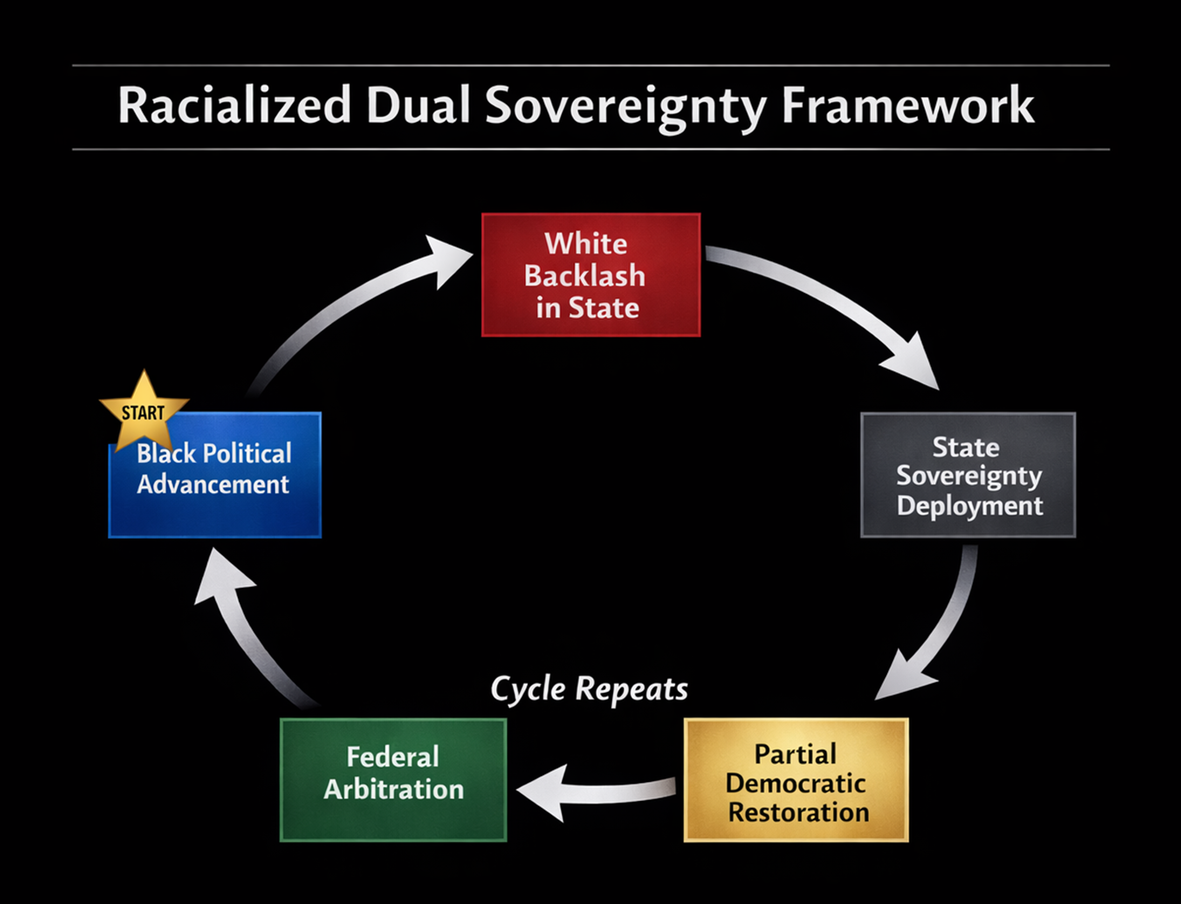
Racialized dual sovereignty unfolds through a cyclical process linking shifts in Black political citizenship to institutional responses across levels of government. Periods of Black political advancement, such as Reconstruction, the Civil Rights Movement, or expansions in Black electoral participation, can disrupt established racial hierarchies and alter the distribution of political power within states. These changes often generate backlash from dominant groups, particularly in jurisdictions with entrenched histories of racial inequality. State governments may respond by deploying sovereign authority through legislation, administrative practices, or constitutional claims designed to preserve existing power relations. When such actions threaten constitutional guarantees or national democratic legitimacy, federal institutions intervene to recalibrate the balance between state autonomy and federal supremacy. These interventions typically restore minimal democratic legitimacy without dismantling underlying inequalities, allowing the cycle of subnational resistance and federal correction to persist. Figure 1 illustrates this recurring dynamic. The theory therefore predicts that federal intervention will be most likely when racially exclusionary state actions generate legitimacy pressures that threaten the credibility of national democratic institutions.
Conceptual Model of Racialized Dual Sovereignty
The figure illustrates the cyclical dynamics through which expansions of Black political citizenship generate backlash within racially charged states, prompting the deployment of state sovereignty to restrict participation. Federal institutions subsequently intervene to restore democratic legitimacy, producing partial institutional correction rather than structural transformation. The cycle then repeats as new forms of Black political advancement emerge. This framework conceptualizes federalism as a racialized institutional order in which sovereignty conflicts are mediated to preserve the legitimacy of the broader political system. *AI graphic tools were used to produce this graphic.

This mechanism highlights a central distinction between racialized dual sovereignty and conventional federalism theory. Conflicts become most acute when state actions undermine Black political inclusion because such actions threaten not only individual rights but also the credibility of the federal democratic order.
The theory of racialized dual sovereignty asserts that federal intervention does not occur automatically in response to racial exclusion at the state level. Instead, recalibration of authority emerges when specific institutional thresholds are crossed, thresholds that implicate the legitimacy of the federal democratic order itself. Federal institutions do not function as continuous guarantors of racial equality; rather, they intervene selectively when racially charged state action generates pressures that threaten systemic credibility. To clarify the causal mechanism underlying this process, this section specifies the conditions under which federal actors, particularly the Supreme Court, are most likely to intervene.
Federal recalibration is triggered when racially charged state action produces one or more forms of legitimacy pressure. First, intervention becomes more likely when subnational racial exclusion threatens the perceived credibility of American democracy at the national level. National legitimacy threats may emerge through widespread media coverage, mobilization by national civil rights organizations, evidence that exclusion distorts representation in federal institutions such as Congress, or public discourse framing the issue as a constitutional crisis. In such contexts, allowing exclusionary state practices to persist risks signaling federal acquiescence to unequal citizenship. Because the federal government bears ultimate responsibility for safeguarding constitutional rights, visible subnational discrimination may undermine national democratic legitimacy if left unaddressed. Recalibration thus serves to restore minimal constitutional credibility without necessarily restructuring the underlying distribution of power.
A second mechanism involves institutional destabilization risk. Federal intervention is more likely when racially exclusionary practices threaten the functional stability of core political institutions. Districting practices that distort congressional representation, electoral access restrictions that risk large-scale disenfranchisement, or state actions that provoke sustained litigation and administrative volatility all create pressures that extend beyond localized inequality. When sovereign discretion produces institutional instability rather than contained subnational variation, federal actors face incentives to impose corrective boundaries. The goal of recalibration in such moments is not egalitarian transformation but the preservation of predictable institutional order.
A third mechanism concerns doctrinal exposure. When racially charged state action clearly conflicts with established federal statute, such as Section 2 of the Voting Rights Act, federal non-intervention risks signaling judicial abdication and undermining the Court’s legitimacy as a neutral arbiter of law. In such circumstances, recalibration may occur not to advance expansive conceptions of equality but to preserve institutional credibility and maintain the authority of federal legal standards. These legitimacy concerns can be further amplified by reputational and international pressures.
In an era of heightened global scrutiny of democratic institutions, visible patterns of subnational racial exclusion may carry reputational consequences beyond domestic political arenas. When such practices become salient in international discourse on democratic backsliding, federal inaction may risk signaling democratic erosion. Limited federal intervention may therefore function as a corrective signal that constitutional safeguards remain operative, even when the resulting remedies are narrowly tailored.
If racialized dual sovereignty accurately captures the dynamics of federal–state conflict over Black political citizenship, several observable implications follow. First, federal intervention should occur most frequently in racially charged states where Black political participation carries the potential to alter representation in national institutions. Second, judicial intervention should appear inconsistent across cases, expanding or contracting federal authority depending on whether subnational practices threaten the perceived legitimacy of national democratic institutions. Third, when intervention occurs, it should produce limited institutional recalibration rather than structural transformation, restoring minimal compliance with statutory or constitutional norms while leaving broader patterns of subnational inequality intact.
Theoretical Framing, Scope Conditions, and Contemporary Leverage
This article proceeds as a theory-building analytic case study situated within the traditions of American political development and public law. Its primary contribution is conceptual: to articulate racialized dual sovereignty as a framework for understanding how federal institutions mediate sovereignty conflicts when Black citizenship and political participation are at stake. Methodologically, the article employs a theory-building analytic case study that combines interpretive institutional analysis with paired case comparison of two Supreme Court decisions arising from the same jurisdiction. The analytic strategy follows the logic of a paradigmatic case study, in which a historically and institutionally revealing case is used to clarify causal mechanisms and specify theoretical scope conditions. Rather than testing a large-N hypothesis, the analysis engages in structured interpretive examination of judicial decisions, lower court findings, legislative responses, and administrative changes in electoral governance. Through this approach, the article identifies recurring patterns of institutional recalibration between state autonomy and federal authority that illuminate how sovereignty disputes are mediated when racial hierarchy intersects with democratic participation.
Alabama is examined not as an idiosyncratic case but as a paradigmatic racially charged state. Such states are characterized by the historical institutionalization of racial hierarchy, persistent racial polarization in electoral competition, and the recurrent mobilization of state sovereignty to regulate Black political participation. Alabama exhibits these dynamics in concentrated form: a constitutional history of exclusion, enduring racial cleavages in political competition, demographically significant Black voter participation, and prolonged federal oversight under the Voting Rights Act. These conditions make the state analytically valuable because they intensify the institutional and demographic pressures under which sovereignty conflicts surrounding Black citizenship emerge. Examining Alabama therefore provides a revealing site for observing the mechanisms identified in the theory of racialized dual sovereignty and for clarifying dynamics that may appear less visible in jurisdictions where these conditions are less pronounced.
The pairing of Shelby County v. Holder and Allen v. Milligan provides unusual analytic leverage because both cases arise from the same jurisdiction yet reflect divergent assertions of federal authority. Holding the state context constant allows variation in federal response to be examined more directly. In this sense, Milligan functions as a most-likely test of the theory. Given the Supreme Court’s contemporary ideological composition and its prior retrenchment of voting rights protections in Shelby County, a further narrowing of minority vote protections might reasonably have been expected. The Court’s partial reaffirmation of Section 2 therefore presents a critical site for evaluating whether institutional recalibration operates according to the legitimacy thresholds identified in the racialized dual sovereignty framework.
The framework advanced in this article is intentionally bounded. Racialized dual sovereignty does not purport to explain all federalism disputes or all instances of intergovernmental conflict. Rather, it applies most clearly in jurisdictions that meet the criteria of racially charged states, where sovereignty has been repeatedly mobilized to regulate Black citizenship and where demographic conditions render minority political participation electorally consequential. The theory is most applicable in policy domains that directly implicate citizenship, political participation, and representation, particularly voting rights and redistricting. It is strongest where subnational practices affect congressional representation or otherwise implicate federal institutions, thereby generating legitimacy pressures at the national level. Outside these conditions, conventional explanations rooted in partisanship, ideology, or routine jurisdictional competition may offer more complete accounts.
The analysis also unfolds at a transitional doctrinal moment. Milligan’s reaffirmation of Section 2 is currently shaping pending redistricting disputes before the Supreme Court in other jurisdictions. Because those cases remain under review, they cannot yet be incorporated into the empirical analysis without speculation. As they are resolved, however, they will provide additional empirical leverage for evaluating the threshold logic proposed here. If future decisions demonstrate similar patterns of selective intervention when subnational racial exclusion implicates congressional representation or clear statutory conflict, the framework’s explanatory power will be strengthened. If they do not, the theory’s scope conditions will require refinement. In this respect, the present study should be understood as conceptual development grounded in a paradigmatic case at a pivotal institutional moment, offering a structured explanation that can be further assessed as contemporary jurisprudence evolves.
Historical Foundations and the Operationalization of the Racially Charged State
The concept of the racially charged state extends Lewis’s (Reference Lewis2019) framework of racially charged districts from the local to the sovereign level, but it requires conceptual precision to avoid collapsing into a descriptive label. A racially charged state is not simply one in which racial inequality exists. Rather, it is a subnational unit in which race operates as a structurally embedded axis of governance, shaping constitutional design, electoral institutions, and sovereignty claims in ways that repeatedly generate federal intervention.
To distinguish racially charged states from jurisdictions characterized by episodic racial conflict, this article identifies four necessary and reinforcing conditions. First, a racially charged state exhibits a documented history of constitutionally or statutorily embedded racial exclusion in the domain of political participation. This includes formal mechanisms such as Black Codes, poll taxes, literacy tests, understanding clauses, racial gerrymandering, and felony disenfranchisement regimes disproportionately structured along racial lines. These are not isolated policies but institutional designs aimed at regulating Black citizenship.
Second, a racially charged state demonstrates persistent racial cleavage in political competition. Drawing on cleavage theory (Lipset and Rokkan, Reference Lipset and Rokkan1967; Marks et al., Reference Marks, Hooghe, Nelson and Edwards2021), race must function as a durable organizing principle of partisan alignment and institutional design. Where racial hierarchy structures party systems, voting coalitions, and legislative strategies across generations, sovereignty claims become inseparable from racial order.
Third, a racially charged state contains a demographic configuration in which Black political participation carries the potential to meaningfully alter representation. The relevant threshold is not numerical majority but political consequentiality: where Black populations are sufficiently large to influence electoral outcomes, shifts in participation generate institutional response. Demographic significance alone is not sufficient, but in combination with institutional exclusion and racial cleavage, it heightens the likelihood that sovereignty disputes will emerge around Black citizenship.
Fourth, and most critically, a racially charged state is empirically identifiable through sustained federal intervention under the Voting Rights Act of 1965. Sections 4 and 5 of the Act imposed preclearance requirements on jurisdictions with documented histories of racial discrimination in voting, while Section 3 authorized federal “bail-in” for jurisdictions found to have violated the Fourteenth or Fifteenth Amendments. The coverage formula was not random; it reflected congressional findings that certain states had persistently deployed sovereign authority to suppress Black political participation. That the majority of fully covered jurisdictions were located in the American South provides powerful evidence that racialized governance was institutionally entrenched at the state level.
Importantly, the Voting Rights Act also demonstrates that racially charged status is not reducible to geography. Section 3’s bail-in provision extended federal oversight beyond the original coverage formula when constitutional violations were demonstrated. This feature confirms that racially charged governance is defined by institutional behavior rather than regional identity. States outside the Deep South could, and in some cases did, fall under federal supervision when patterns of racial exclusion met statutory thresholds. Thus, racially charged status is operational, not merely historical.
The emergence of racially charged states in the American South is rooted in the immediate aftermath of emancipation, when southern legislatures deployed sovereign authority to regulate newly freed Black populations through Black Codes and labor controls (Blackmon Reference Blackmon2008; Foner Reference Foner1988). These measures were reinforced by racial terror, including lynching and convict leasing systems that functioned as instruments of racial governance (Equal Justice Initiative 2017; Tolnay and Beck, Reference Tolnay and Beck1995). Such practices were not isolated extralegal acts but operated alongside formal constitutional revision. Alabama’s 1901 Constitution, for example, explicitly sought to disenfranchise Black citizens through poll taxes, literacy tests, and registration barriers (Hamill Reference Hamill2002). Earlier and subsequent constitutional rewrites reflected similar strategies, revealing a pattern of sovereign recalibration in response to Black political advancement.
The Great Migration further illustrates how racially charged governance translated into national consequences. As millions of Black Americans left the South between 1915 and 1970 (Tolnay Reference Tolnay2003; Wilkerson Reference Wilkerson2010), local practices of racial exclusion generated national political pressure for federal intervention. Migration redistributed Black political power across regions, reshaped congressional coalitions, and increased the likelihood that racialized state practices would implicate federal representation. Federal oversight under the Voting Rights Act therefore emerged not only as constitutional assertion but as institutional necessity in a system where subnational racial exclusion threatened national democratic legitimacy.
The enactment of the Voting Rights Act in 1965 provides the clearest empirical evidence that racially charged governance was systematic rather than episodic. Congress concluded that certain states had repeatedly used sovereign authority to undermine Black citizenship despite constitutional amendments and judicial decisions. Preclearance was extraordinarily precise because ordinary judicial review had proven insufficient to dismantle entrenched patterns of exclusion. The Act thus stands as legislative recognition that sovereignty in certain states had been persistently racialized. Alabama is therefore paradigmatic not because it is uniquely discriminatory, but because it satisfies all four conditions: constitutionally embedded exclusion, persistent racial cleavage, demographically consequential Black political participation, and sustained federal oversight under the Voting Rights Act. These features distinguish racially charged states from jurisdictions characterized by isolated or temporary racial conflict.
By specifying these criteria, the concept of the racially charged state acquires clearer analytic boundaries. Not all states are racially charged in the same way or to the same degree. Rather, the category applies to jurisdictions in which sovereignty has repeatedly been mobilized to regulate Black citizenship and political participation in ways that have required extraordinary federal correction. In these contexts, the promise of federalism as a system of balanced autonomy breaks down because race structures the exercise of sovereignty itself. Federal intervention therefore emerges not merely as a question of constitutional authority but as a mechanism for managing the legitimacy crises produced by racialized governance.
This framework clarifies the apparent tension between Shelby County v. Holder and Allen v. Milligan. Rather than reflecting doctrinal inconsistency, the two decisions illustrate a patterned process in which the Supreme Court mediates sovereignty disputes to stabilize the federal system. When racially charged state actions threaten the credibility of democratic institutions, federal authority is recalibrated to restore minimal compliance with constitutional or statutory norms. The Alabama case illustrations that follow demonstrate how federalism can operate simultaneously as a mechanism of racial exclusion and as a site of limited democratic correction. Federal recalibration becomes most likely when three pressures converge: visible threats to national democratic legitimacy, institutional destabilization of federal political representation, and doctrinal exposure under federal law.
Case Illustration I: Shelby County v. Holder and the Reassertion of Racialized Sovereignty
The Supreme Court’s decision in Shelby County v. Holder represents a critical moment in the contemporary evolution of racialized dual sovereignty. At issue was Section 4(b) of the Voting Rights Act (VRA), the coverage formula that determined which jurisdictions, based on documented histories of racial discrimination, were required to submit election law changes for federal preclearance under Section 5. Alabama’s challenge framed federal oversight as an unconstitutional intrusion into state sovereignty, arguing that the preclearance regime unfairly targeted southern states and relied on outdated data. Although formally presented as a dispute over constitutional balance, the case reflected deeper tensions rooted in the racialized structure of American federalism.
From the perspective advanced in this article, Alabama’s legal argument illustrates how racially charged states mobilize sovereignty claims to contest federal oversight designed to protect minority citizenship. By reframing the dispute in terms of state dignity and equal sovereignty, rather than racial exclusion, the challenge redirected attention away from persistent inequalities in political participation and toward institutional principles associated with federal balance. This rhetorical strategy reflects a broader pattern within the racial state, in which governance practices that disproportionately affect minority citizens are defended through appeals to formally neutral constitutional doctrines.
Within the framework of racialized dual sovereignty, Shelby County illustrates a recalibration driven primarily by concerns about perceived legitimacy within federalism doctrine rather than by pressures associated with doctrinal exposure or institutional destabilization. The continued operation of the preclearance regime publicly marked certain states as jurisdictions requiring federal supervision nearly fifty years after the passage of the Voting Rights Act. Maintaining this structure placed visible strain on the doctrine of equal state sovereignty by preserving an institutional distinction between covered and noncovered states. By invalidating the coverage formula, the Court removed this marker of differentiated federal oversight, thereby restoring the appearance of constitutional symmetry among states within the federal system.
The Court’s 5–4 ruling struck down Section 4(b) and effectively disabled the preclearance regime that had served as the central enforcement mechanism of the Voting Rights Act. Chief Justice Roberts’ majority opinion emphasized that extraordinary federal oversight of state electoral administration was no longer justified by contemporary conditions and that continuing such supervision violated the principle of equal state sovereignty. From a doctrinal perspective, the ruling appeared to restore constitutional balance between federal authority and state autonomy. From the perspective of racialized dual sovereignty, however, the decision represents an institutional recalibration that prioritized doctrinal symmetry within federalism while tolerating renewed subnational variation in the regulation of political participation.
The consequences of the decision illustrate how sovereignty functions within racially charged states once federal constraints are relaxed. In the absence of preclearance, Alabama and other formerly covered jurisdictions implemented electoral policies that increased barriers to participation for voters of color. These measures included strict voter identification requirements, limitations on absentee voting, shortened registration periods, aggressive voter roll maintenance, and reductions in polling locations. Such changes were enacted through routine legislative and administrative processes, demonstrating how formally neutral exercises of state authority can reshape the practical conditions of citizenship.
Polling place reductions across Alabama further reveal how local electoral infrastructure was restructured after the removal of federal oversight. County officials closed or consolidated numerous voting locations, disproportionately affecting Black communities with historically limited access to transportation and electoral resources. These developments illustrate how, within racially charged states, sovereign authority over election administration can be deployed to regulate political participation in ways that remain formally lawful yet substantively unequal. In this sense, Shelby County reflects the broader dynamic of racialized dual sovereignty: federal institutions may recalibrate the balance of authority in ways that preserve the appearance of constitutional equilibrium within the federal system while allowing substantial inequality to persist within subnational governance. The consequences of this recalibration become visible not only in legal doctrine but also in the administrative structure of elections within formerly covered jurisdictions. Changes in polling infrastructure following Shelby County v. Holder provide a concrete illustration of how the removal of federal preclearance enabled racially charged states to restructure electoral governance through formally routine administrative decisions.
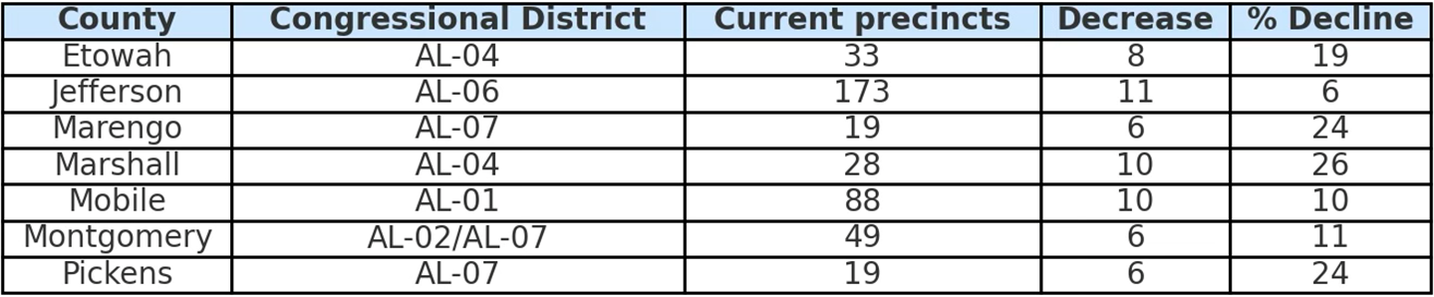
Figure 2 illustrates how electoral governance changed in Alabama following the removal of federal preclearance oversight. Several counties experienced significant precinct declines after the Shelby County v. Holder decision. The reductions were particularly pronounced in counties with substantial Black populations. Marengo and Pickens Counties each experienced a twenty-four percent decrease in precincts, while Montgomery County, the state capital with a large Black electorate, experienced an eleven percent reduction. Marshall County recorded the largest proportional decline at twenty-six percent, and major population centers such as Mobile and Jefferson Counties also experienced notable losses.
Polling Place Reductions Following Shelby County
Data illustrate precinct declines in multiple Alabama counties between 2010 and 2018. Reductions are especially notable in counties with substantial Black populations, including Marengo, Pickens, and Montgomery. These administrative changes demonstrate how local electoral governance can function as a mechanism of racialized state power following the removal of federal preclearance oversight.
Source: Alabama Secretary of State data compiled by BirminghamWatch (2018).

Figure 2. Long description
The table consists of five columns: County, Congressional District, Current precincts, Decrease, and % Decline. The data rows are as follows:
* Etowah: A L - 04, 33 current precincts, 8 decrease, 19 percent decline.
* Jefferson: A L - 06, 173 current precincts, 11 decrease, 6 percent decline.
* Marengo: A L - 07, 19 current precincts, 6 decrease, 24 percent decline.
* Marshall: A L - 04, 28 current precincts, 10 decrease, 26 percent decline.
* Mobile: A L - 01, 88 current precincts, 10 decrease, 10 percent decline.
* Montgomery: A L - 02 or A L - 07, 49 current precincts, 6 decrease, 11 percent decline.
* Pickens: A L - 07, 19 current precincts, 6 decrease, 24 percent decline.
These developments illustrate how electoral governance operates as a site of racialized state power. Decisions regarding precinct allocation and election administration are formally race-neutral, yet they shape the practical conditions of citizenship by affecting travel distance, wait times, access to transportation, and informational barriers. After Shelby County v. Holder removed preclearance oversight, Alabama and other formerly covered jurisdictions were able to restructure electoral administration without federal review. Polling place closures provide a particularly revealing example. The Leadership Conference Education Fund (2019) documented that Alabama lost seventy-two polling locations across twenty-three counties following the decision, with many closures concentrated in heavily Black areas of the Black Belt and urban centers. Data compiled by BirminghamWatch (Sell Reference Sell2018) similarly show significant precinct reductions between 2010 and 2018, including substantial proportional declines in majority-Black counties such as Marengo and Pickens.
Legislative changes reinforced these administrative shifts. Alabama enacted laws narrowing access to registration and absentee voting procedures, including stricter identification requirements and earlier submission deadlines (AL S 301, 2019; AL H 538, 2021), while revisions to felony disenfranchisement rules expanded categories of disqualifying offenses in ways that disproportionately affected Black men (Shannon et al., Reference Shannon, Uggen, Schnittker, Thompson and Wakefield2017). Framed as neutral administrative reforms or efficiency measures, these policies demonstrate how sovereign authority can be exercised through routine bureaucratic and legislative decisions that reshape access to political participation within the bounds of formal constitutional federalism.
Taken together, these changes show how federal retrenchment enabled racially charged states to reorganize electoral governance while preserving the appearance of constitutional balance. By restoring state autonomy in Shelby County, the Court reduced visible federal-state tension but created space for subnational variation in the protection of minority citizenship—illustrating how recalibration can maintain national legitimacy while permitting the expansion of localized inequality.
Case Illustration II: Allen v. Milligan and the Recalibration of Federal Authority
A decade after Shelby County v. Holder weakened federal oversight of voting rights, the Supreme Court again confronted Alabama’s electoral governance in Allen v. Milligan. The case concerned Alabama’s congressional redistricting plan following the 2020 Census. Although Black residents comprised more than one-quarter of the state’s population, the legislature created only one majority-Black district out of seven. Civil rights organizations challenged the plan under Section 2 of the Voting Rights Act, arguing that it diluted Black voting strength through classic instruments of racial gerrymandering. A three-judge federal district court agreed, finding that the map likely violated Section 2 by employing the techniques commonly known as packing and cracking.
Within the framework of racialized dual sovereignty, Alabama’s redistricting plan illustrates how racially charged states deploy sovereign authority over electoral design to preserve existing hierarchies in political representation. Packing concentrates minority voters into a single district, limiting their influence elsewhere, while cracking disperses cohesive communities across multiple districts to prevent the formation of effective electoral blocs. Scholars identify these strategies as core mechanisms of modern gerrymandering that generate large numbers of “wasted votes” and suppress minority political power (Ansolabehere Reference Ansolabehere2018; Buzas and Warrington, Reference Buzas and Warrington2020). Alabama’s plan employed both tactics simultaneously. Black voters were heavily concentrated in the Seventh Congressional District while historically Black counties in the Black Belt were fragmented across majority-White districts anchored in suburban and coastal regions (Caster v. Merrill 2022).
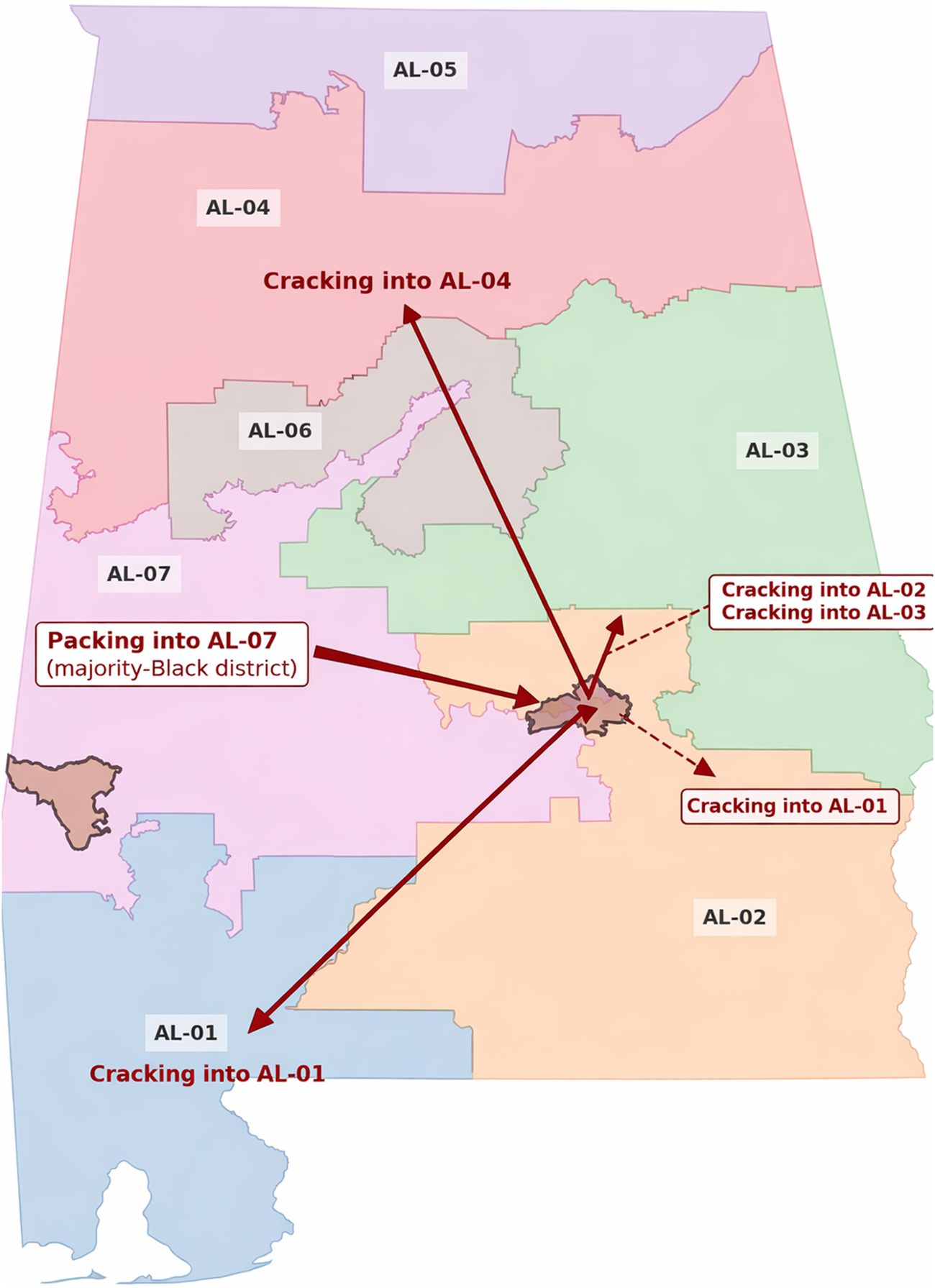
The enacted map demonstrates how these strategies operated spatially. Black voters were concentrated in AL-07 while neighboring districts divided counties such as Greene, Dallas, and Lowndes among majority-White constituencies. In some proposals Montgomery County, an enduring center of Black political mobilization, was also divided in ways that further diluted Black electoral influence (NAACP Legal Defense and Education Fund 2023). As illustrated in Figure 3, this district configuration concentrated Black political influence in a single district while dispersing surrounding Black communities across multiple districts, preventing the formation of an additional majority-Black seat despite demographic conditions that made such a district feasible.
Packing and Cracking in Alabama
*AI graphic tools were used to produce this graphic.

Figure 3. Long description
A map of Alabama is divided into seven color-coded congressional districts.
* In the North, A L dash 0 5 is purple and A L dash 0 4 is pink.
* In the Central region, A L dash 0 6 is grey, A L dash 0 3 is green, and A L dash 0 7 is light purple.
* In the South, A L dash 0 2 is orange and A L dash 0 1 is blue.
A central dark brown cluster serves as the origin for several red arrows.
* A thick red arrow points from a label Packing into A L dash 0 7 (majority-Black district) toward the central cluster.
* A solid red arrow points North from the cluster to A L dash 0 4, labeled Cracking into A L dash 0 4.
* A solid red arrow points Southwest from the cluster to A L dash 0 1, labeled Cracking into A L dash 0 1.
* Two dashed red arrows point Northeast into A L dash 0 2 and A L dash 0 3, labeled Cracking into A L dash 0 2 and Cracking into A L dash 0 3.
* A final dashed red arrow points Southeast into A L dash 0 2, labeled Cracking into A L dash 0 1.
Unlike the dynamics presented in Shelby County, the Milligan litigation activated two mechanisms identified in the racialized dual sovereignty framework: institutional destabilization risk and doctrinal exposure. The redistricting plan created the possibility that Alabama’s congressional delegation would systematically underrepresent a substantial segment of the state’s population, raising concerns about the legitimacy of representation in a federal institution. At the same time, the challenge rested on a clear statutory claim under Section 2 of the Voting Rights Act. Because the district court found strong evidence of vote dilution under established precedent, failure to intervene would have risked undermining the Court’s credibility as an interpreter of federal law. In this context, federal recalibration occurred not primarily to advance expansive notions of equality but to preserve institutional legitimacy and maintain the authority of statutory protections governing electoral representation.
Viewed through this lens, Allen v. Milligan represents a moment of selective federal correction within the broader pattern of racialized dual sovereignty. The Court’s intervention constrained a specific instance of racial vote dilution while leaving intact the broader structure of state authority over electoral design established after Shelby County. Federalism therefore continued to function as both a mechanism through which racial inequality can be produced at the subnational level and a limited institutional pathway through which particularly visible violations may be corrected.
Figure 3 illustrates how Alabama’s 2021 congressional plan concentrated Black voters in the Seventh Congressional District (AL-07) while dispersing Black Belt populations across adjacent majority-White districts, including AL-01, AL-02, AL-03, AL-04, and AL-06. Counties such as Greene, Dallas, and Lowndes were divided and paired with suburban or coastal constituencies, diluting Black electoral influence across multiple districts. This configuration reflects the mechanics of racial gerrymandering: minority voters are concentrated in a single district while surrounding communities are fragmented to prevent the formation of additional majority-Black electoral coalitions. Within the framework of racialized dual sovereignty, the map illustrates how redistricting authority, formally exercised as a neutral state prerogative, can function as a mechanism for structuring racial inequality in political representation.
Alabama defended its plan by invoking the familiar sovereignty claim that states retain primary authority to design congressional districts. State officials argued that requiring a second majority-Black district would itself constitute an impermissible racial gerrymander, reframing the Voting Rights Act as an unconstitutional demand for race-conscious policymaking. Scholars identify this argument as part of a broader strategy through which states portray racially motivated districting decisions as neutral partisan considerations in order to shield them from legal scrutiny (Cox and Katz-Holden, Reference Cox and Holden2011). In this sense, the state’s defense exemplified the racialized deployment of sovereignty: racial exclusion articulated through formally neutral constitutional principles.
In a narrow 5–4 decision, the Supreme Court rejected Alabama’s argument and affirmed the lower court’s finding that the congressional map likely violated Section 2 of the Voting Rights Act. Chief Justice Roberts, joined by Justice Kavanaugh, emphasized that the Act prohibits electoral arrangements that dilute minority voting strength and required the state to produce an additional majority-Black district. Although the ruling appeared to reaffirm federal authority over state electoral design, the intervention was limited in scope. The Court required only a modest alteration to the district configuration rather than a broader restructuring of Alabama’s electoral system.
From the perspective of racialized dual sovereignty, Milligan reflects the operation of the threshold mechanisms identified earlier. The redistricting plan created clear doctrinal exposure by directly conflicting with established Section 2 precedent, while also raising institutional destabilization concerns because congressional representation in a federal body would have systematically underrepresented a substantial segment of Alabama’s population. Allowing the map to stand risked undermining both the authority of federal statutory protections and the perceived legitimacy of national democratic institutions. The Court’s intervention therefore constituted a limited recalibration of authority within the federal system: federal supremacy was asserted narrowly enough to enforce Section 2 and preserve institutional credibility, yet restrained enough to leave intact the broader structure of state sovereignty over electoral governance established after Shelby County v. Holder. Viewed in this light, Milligan illustrates the central dynamic of racialized dual sovereignty: selective federal intervention when racially charged state practices threaten democratic legitimacy, without dismantling the deeper structures that permit subnational inequality to endure.
Recalibration as Threshold, Not Transformation
Taken together, the cases examined above illustrate a central feature of racialized dual sovereignty: federal intervention operates as a threshold-based recalibration rather than a rights-maximizing project. The mechanisms identified earlier, national legitimacy threats, institutional destabilization risk, and doctrinal exposure, help explain why federal institutions intervene in some moments while withdrawing in others. Intervention occurs when tolerating racially exclusionary state practices generates legitimacy pressures that threaten the credibility or stability of the national democratic order. When this threshold is crossed, federal actors impose limited corrective measures that restore minimal compliance with constitutional or statutory norms while leaving substantial subnational inequality intact.
The contrast between Shelby County v. Holder and Allen v. Milligan illustrates how these mechanisms operate in practice. In Shelby County, the Court concluded that the continued operation of the Voting Rights Act’s preclearance regime imposed reputational and federalism-based costs on the constitutional order. By invalidating the Act’s coverage formula, the Court recalibrated sovereignty in favor of formal state equality while removing an institutional marker that publicly identified certain states as persistent violators of voting rights. Although the decision weakened federal oversight and enabled renewed subnational variation in electoral governance, it reduced visible tensions between state autonomy and federal authority within the constitutional system.
The dynamics in Milligan activated a different set of pressures. Alabama’s congressional redistricting plan generated doctrinal exposure under Section 2 of the Voting Rights Act and raised institutional risks associated with the potential underrepresentation of Black voters in a federal legislative body. Allowing the map to stand would have signaled judicial retreat from statutory protections and risked further erosion of democratic credibility. Under these conditions, the Court required a limited corrective remedy—an additional majority-Black district—while leaving intact the broader structure of state authority over electoral design established after Shelby County. The decision therefore represented a narrow assertion of federal supremacy sufficient to restore institutional credibility without fundamentally restructuring the distribution of political power.
Viewed together, these decisions reveal that the Supreme Court functions less as a consistently progressive or regressive institution than as a stabilizing actor within a racialized federal order. Racially charged states, jurisdictions in which historical legacies of racial domination and institutional design make race a persistent axis of political conflict, regularly deploy sovereign authority to reshape political participation when shifts in Black political power threaten entrenched hierarchies. Federal intervention occurs selectively when such practices generate legitimacy pressures that exceed institutional tolerance. This pattern clarifies federalism’s relationship to democratic backsliding: subnational autonomy can facilitate incremental erosion of political inclusion, yet federal institutions retain the capacity to intervene when exclusion threatens the credibility of the national democratic order. Racialized dual sovereignty therefore reveals how federal systems simultaneously enable democratic erosion and provide mechanisms for limited institutional stabilization.
Democratic Backsliding, Federalism, and Racialized Sovereignty
The Alabama cases examined in this article illuminate a broader question in comparative politics, how federal systems both enable and constrain democratic backsliding when sovereignty disputes intersect with race. Contemporary scholarship defines democratic backsliding not as abrupt regime collapse but as the gradual erosion of democratic safeguards through formally legal mechanisms that weaken participation, competition, and accountability (Bermeo Reference Bermeo2016; Waldner and Lust, Reference Waldner and Lust2018). Such erosion typically unfolds through incremental institutional adjustments rather than overt authoritarian rupture, allowing political actors to justify restrictive policies within existing legal frameworks. The trajectory of voting rights governance in the United States after Shelby County v. Holder illustrates precisely this dynamic.
By dismantling the Voting Rights Act’s preclearance regime, Shelby County removed a central federal constraint on subnational electoral authority and expanded state discretion over election administration. In Alabama, this institutional shift produced a sequence of formally lawful policies, including polling place closures, voter identification requirements, administrative registration barriers, and revisions to felony disenfranchisement rules, that cumulatively altered access to political participation. Comparative scholars describe such strategies as plausibly deniable manipulations, rule bound changes that weaken democratic practice while preserving the appearance of constitutional compliance (Bermeo Reference Bermeo2016; Hyde Reference Hyde2020). The Alabama case demonstrates how federal systems can create institutional openings for democratic erosion from below when subnational authorities invoke sovereignty to justify exclusionary policies.
At the same time, federalism contains countervailing mechanisms of resilience. The constitutional architecture of the United States empowers federal institutions, through congressional legislation, judicial review, and the Supremacy Clause, to intervene when subnational practices threaten national democratic legitimacy. The Supreme Court’s decision in Allen v. Milligan illustrates this corrective capacity. By enforcing Section 2 of the Voting Rights Act and requiring Alabama to redraw its congressional map, the Court reasserted federal authority over state sovereignty in response to clear evidence of minority vote dilution.
Taken together, these cases reveal a patterned process of institutional recalibration rather than doctrinal inconsistency. Shelby County v. Holder expanded the discretionary authority of racially charged states over electoral governance, while Allen v. Milligan imposed a limited federal correction when Alabama’s redistricting practices threatened visible dilution of minority representation in Congress. Within the framework advanced here, federal intervention occurs when racially exclusionary state practices cross a democratic legitimacy threshold. A breach of this threshold arises when subnational racial exclusion extends beyond localized inequality and begins to threaten the stability, legal coherence, or credibility of the national democratic order. Such breaches occur when three conditions converge, when state actions undermine the representational integrity of national institutions, produce clear doctrinal conflicts with federal law, or generate legitimacy pressures that federal actors cannot ignore. When these conditions are met, federal institutions recalibrate the balance between state autonomy and federal supremacy, restoring minimal democratic functionality while leaving broader subnational hierarchies largely intact.
The concept of racialized dual sovereignty therefore provides a broader analytic framework for understanding how multi-level political systems mediate conflicts between regional autonomy and equal citizenship when historically marginalized groups seek political incorporation. Comparative scholarship increasingly demonstrates that democratic erosion often originates within subnational arenas, where regional authorities manipulate electoral rules and administrative institutions through formally legal yet substantively exclusionary mechanisms (Bermeo Reference Bermeo2016; Waldner and Lust, Reference Waldner and Lust2018). Multi-level systems, including federations such as India and Brazil and quasi federal structures such as the European Union, confront similar tensions between regional autonomy and equal citizenship. In India, state level electoral and citizenship policies have periodically prompted federal intervention when regional practices threaten national democratic legitimacy. Likewise, debates within the European Union over rule of law violations in Hungary and Poland illustrate how supranational institutions confront democratic erosion within multi-level governance systems.
The American experience suggests that federal institutions intervene selectively within these conflicts. Rather than consistently enforcing egalitarian principles, they tend to act when exclusionary practices threaten the legitimacy of the broader political order. Racialized dual sovereignty therefore contributes to comparative debates by identifying the conditions under which institutional correction occurs in multi-level democracies, intervention becomes more likely when subnational governance practices generate legitimacy pressures that exceed acceptable thresholds.
Ultimately, the persistence of sovereignty conflicts surrounding Black political citizenship reveals that democratic progress within federal systems is neither linear nor guaranteed. Periods of Black political advancement have repeatedly triggered institutional resistance at the state level, followed by episodic federal recalibration. Recognizing federalism as a racialized institutional order clarifies that struggles over sovereignty are fundamentally struggles over the boundaries of citizenship itself. The central question facing modern democracies, therefore, is not whether sovereignty will be contested, but how political systems mediate conflicts over inclusion, citizenship, and power when those disputes threaten the legitimacy of the democratic state.
Louisiana v. Callais, the 2026 Alabama Stay, and an Open Empirical Window
Since the case analysis above was finalized, two further developments in Alabama and Louisiana redistricting litigation deserve acknowledgment. On April 29, 2026, the Supreme Court decided Louisiana v. Callais (2026), holding that compliance with Section 2 of the Voting Rights Act can justify race-conscious districting. This is only possible where no race-neutral alternative map performs “just as well” on a state’s legitimate districting criteria, while tightening the evidentiary framework associated with Thornburg v. Gingles (1986). On June 2, 2026, applying Callais, the Court granted Alabama’s request to stay a district court order that had found, after an extensive evidentiary record, that Alabama’s 2023 congressional map reflected both intentional discrimination against Black voters and continued Section 2 vote dilution (Allen v. Milligan, Allen v. Singleton, and Allen v. Caster, 2026). Citing Callais and the Purcell principle against altering election procedures close to an election, the per curiam order permitted Alabama to use the enjoined map in its 2026 congressional elections; Justices Sotomayor, Kagan, and Jackson dissented. Both matters remain in active litigation, with Alabama’s appeal and certiorari petitions pending as this article is published.
These developments are deliberately excluded from the paired case comparison developed above. The June 2026 order is a preliminary ruling on the likelihood of success, not a merits disposition; the underlying constitutional and statutory claims remain before the lower courts, and Callais’s full doctrinal reach is still being worked out on remand. The empirical argument of this article therefore continues to rest exclusively on the two fully adjudicated decisions examined above, Shelby County and the 2023 Milligan merits ruling.
Read cautiously, the 2026 developments are consistent with the cyclical dynamic depicted in Figure 1 than with a claim that the Court has abandoned some prior, continuous commitment to Black political inclusion: a commitment the theory never attributes to the Court in the first place. Racialized dual sovereignty predicts that recalibration restores only minimal legitimacy and that renewed backlash is an expected feature of the cycle, not an anomaly; it does not predict that expansion, once granted, becomes permanent. If this reading survives the litigation now underway, the Alabama stay would represent a further turn of the same cycle identified in Shelby County and Milligan, in which doctrinal retrenchment reopens space for subnational recalibration rather than a genuine departure from the pattern.
The stay drew immediate public criticism, including from dissenting Justices and from civil rights organizations describing the order as reinstating a map found to intentionally discriminate against Black voters (American Civil Liberties Union 2026), and commentary characterizing both Callais and the stay as consequential for a mid-decade partisan gerrymander. The June 2026 order, unsettled public confidence in the Court more than a contrary ruling in the original Milligan decision, which suggests whatever calculus produced the stay was not primarily oriented toward mass-public legitimacy, consistent with the distinction between public and professional-legal credibility introduced earlier in this article.
Racialized dual sovereignty therefore reframes the central question of voting rights scholarship. Rather than asking why the Supreme Court alternates between protecting and restricting Black political representation, the theory asks how a constitutional order embedded within the racial state repeatedly reproduces the institutional conditions under which both expansion and retrenchment remain possible. This shift in perspective moves beyond explanations centered on judicial ideology, partisan realignment, or competing theories of statutory interpretation to expose the deeper constitutional architecture that sustains racialized political inequality across time.
The persistence of this cycle suggests that instability in Black political representation is not an episodic failure of American democracy or merely the product of changing judicial preferences. It is a predictable consequence of a federal system historically organized to preserve state authority over the distribution of political power while simultaneously claiming a national commitment to democratic equality. As Goldberg (2002) argues, the racial state continuously reproduces racial hierarchy through law, governance, and institutional design. Racialized dual sovereignty demonstrates how American federalism serves as one of the principal constitutional mechanisms through which reproduction occurs.
This allows moments of federal intervention to recalibrate, but not dismantle, the structures that sustain racialized political exclusion. The enduring significance of Shelby County, Milligan, Callais, and the 2026 Alabama stay, therefore, lies not simply in what they reveal about the Supreme Court’s voting rights jurisprudence, but in what they expose about the constitutional durability of the racial state itself. Until that underlying allocation of sovereign authority is fundamentally reconfigured, the struggle over proportional representation will remain cyclical rather than settled, making the expansion and contraction of Black political representation not anomalies of American democracy, but enduring features of its constitutional design.