

The global market for productive capital is more integrated than ever before. The growth of foreign direct investment (FDI) is a clear example. According to World Bank data, gross FDI as a percentage of total world production increased seven-fold from 1.2 percent to 8.9 percent between 1970 and 2000. Though such investments tend to be highly skewed across jurisdictions—developed countries account for more than 93 percent of outflows and 68 percent of inflows1
UNCTAD. FDI/TNC Database. Available at 〈http://www.unctad.org〉. Accessed 20 June 2006.
It is widely recognized that economic globalization requires market-supporting institutions to flourish. But unlike trade and monetary relations, virtually no multilateral rules for FDI exist.2
For a review of the relevant legal literature, see Dolzer 1981; Minor 1994; Sornarajah 1994; and Vagts 1987.
Why the profusion of bilateral agreements? The popularity of BITs contrasts sharply with the collective resistance developing countries have shown toward proinvestment principles under customary international law and the failure of the international community to make progress on a multilateral investment agreement.3
Guzman 1998.
Simmons, Dobbin, and Garrett, this volume.
The article is organized as follows. The first section describes the spread of BITs in some detail. The second section presents a model of competition for investment that could lead to diffusion among competitors. The third section discusses the methods we use to test our propositions (and a range of alternatives), and the fourth section discusses our findings. Our data are consistent with competitive pressures for BIT proliferation: governments are influenced by competitors' policies and by the mobility of FDI in manufactures, which tends to intensify competition among hosts. We interpret our findings as evidence of pressure for certain governments to adopt capital-friendly policies in highly competitive global capital markets.
Securing Investors' Legal Rights
From Customary Law to Bilateral Investment Treaties
FDI has always been subject to contractual and political hazards that raise the expected costs of investing.5
Henisz 2000.
For a discussion of the historical protection of foreign investment, see Lipson 1985.
See Cordell Hull's note to the Mexican Minister of Foreign Affairs during a 1938 dispute over land expropriations, reprinted in Green H. Hackworth, Digest of International Law v. 3, § 228 (1942). The Rule itself predates Cordell Hull's statement, and various statements of it can be found in decisions from the early part of the twentieth century. See Concerning the Factory at Chorzow (Ger. v. Pol.), 1926–29 P.C.I.L. (ser. A), Nos. 7, 9, 17, 19; and Norwegian Shipowners Claims Arbitration (U.S. v. Nor.) 1 Rep. Int'l Arb. Awards 307 (1922).
Both customary international law and its practice were under attack by developing country hosts by the 1950s. The nationalization of British oil assets by Iran in 1951, the expropriation of Liamco's concessions in Libya in 1955, and the nationalization of the Suez Canal by Egypt a year later served notice of a new militancy on the part of investment hosts. The nationalization of sugar interests by Cuba in the 1960s further undercut assumptions about the security of international investments.8
Guzman 1998.
These are discussed in Lipson 1985. In 1966 the General Assembly reaffirmed states' rights to nationalize resources without reference to international legal principles. In 1972, the UN General Assembly passed Resolution 3041 (XXVII), which contained an endorsement of the Trade and Development Board's resolution 88 (XII) of 19 October 1972, regarding permanent sovereignty over natural resources, and claimed that compensation for natural resource nationalization cases was to be fixed by the nationalizing state, with jurisdiction for such cases falling within the sole jurisdiction of the nationalizing country's courts. The 1973 Resolution on Permanent Sovereignty over Natural Resources (Resolution 3171) stated that in the event of nationalization “each State is entitled to determine the amount of possible compensation and the mode of payment.” The 1974 Charter of Economic Rights and Duties of States [GA Res. 3281(xxix), UN GAOR, 29th Sess., Supp. No. 31, 50] specified the right of each state “To nationalize, expropriate or transfer ownership of foreign property, in which case appropriate compensation should be paid by the State adopting such measures, taking into account its relevant laws and regulations and all circumstances that the State considers pertinent,” with national courts taking jurisdiction in case of disputes [Art. 2(c)].
See Kobrin 1980.
Bilateral treaties made their debut in the late 1950s, just as consensus on customary rules began to erode. BITs were innovative in a number of respects.11
Other mechanisms have been used to try to protect foreign investment, of course. One possibility since 1988 is to apply for insurance through the World Bank's Multilateral Insurance Guarantee Agency (MIGA). MIGA covers risks associated with transfer restriction, expropriation, breach of contract, and risks relating to war and civil disturbances. See 〈http://www.miga.org/〉. Accessed 20 June 2006. U.S. businesses can also insure against risks associated with currency inconvertibility, expropriation, and political violence by applying for investment insurance from the Overseas Private Investment Corporation (OPIC), a U.S. government agency. See 〈http://www.opic.gov/Insurance/〉. Accessed 20 June 2006.
For example, the 1994 U.S. Prototype Bilateral Investment Treaty, Office of the Chief Counsel for International Commerce, U.S. Department of Commerce; Article 2(1), 2(2)(a). For convenience, throughout this article we label the more developed partner in a BIT the “home” country (meaning the home of investors) and the less-developed partner the “host.” The treaty obligations bind both parties, but in the vast majority of treaties there is a developed country that will be the source of most FDI and a developing country that will be the recipient.
For example, 1994 U.S. Prototype BIT, Article I(d)(ii).
For example, ibid., Article V(1-2).
For example, ibid., Article IX.
The Spread of BITs
Despite the aggressive campaign waged by some developing countries against the relevant customary international law, BITs were embraced by many potential host governments.16
It is interesting to note, however, that some of the most vociferous opponents of the Hull Rule were in fact latecomers to the BITs movement. As of the late 1990s, Mexico for example had signed only two BITs, with Spain and Switzerland. Brazil did not sign a BIT until 1994, and as of the late 1990s none of its 10 bilateral agreements had entered into force. India's pattern is similar to that of Brazil. See 〈http://www.worldbank.org/icsid/treaties/treaties.htm〉. Accessed 10 December 2003.
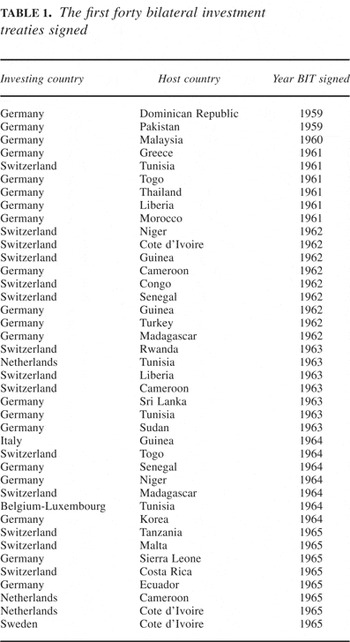
The first forty bilateral investment treaties signed


Number of bilateral investment treaties signed and mean global foreign direct investment as a proportion of GDP, by year, 1959–99
The United States embraced BITs later than did its West European counterparts. Between 1962 and 1972, during which time West Germany entered into forty-six BITs and Switzerland entered into twenty-seven, the United States eschewed such treaties and signed only two Friendship Commerce and Navigation Treaties—with Togo and Thailand.17
Vandevelde 1988.
“Multilateral or Bilateral Investment Negotiations: Where Can Developing Countries Make Themselves Heard” Briefing Paper No. 9. Available at 〈http://cuts-international.org/9-2002.pdf〉. Accessed 12 July 2006. Some observers note that the insistence on liberalization explains the inability of the United States to secure agreements with East and Southeast Asian countries until quite recent years; see Reading 1992.
It was not until 1981 that the United States changed its view on BITs. There is evidence that some officials in the administration of U.S. President Ronald Reagan viewed BITs as an alternative way to protect the principles contained in the embattled Hull Rule. Secretary of State George Schultz argued that BITs were designed “to protect investment not only by treaty but also by reinforcing traditional international legal principles and practice regarding foreign direct private investment.”19
George P. Schultz, transmission letter to the president recommending transmission of the U.S.-Turkey Bilateral Investment Treaty, 1985. Available at 〈http://www.state.gov/documents/organization/43615.pdf〉. Accessed 12 July 2006.
Turkey, Morocco, Haiti, Panama, Senegal, and Zaire.
George P. Schultz, transmission letter to the president recommending transmission of the U.S.-Turkey Bilateral Investment Treaty, 1985. Available at 〈http://www.state.gov/documents/organization/43615.pdf〉. Accessed 12 July 2006.
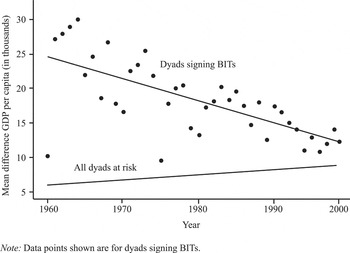
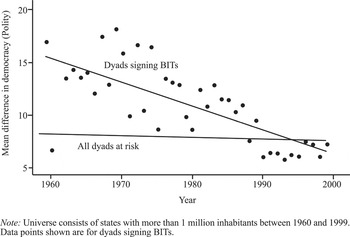
Early on, BITs were primarily agreements between countries of starkly varying developmental levels and political traditions. Figure 2, which plots the mean difference in gross domestic product (GDP) per capita between BIT partners as well as that between states in all other dyads “at risk” of signing in a given year, demonstrates that the economic differences within these dyads have declined fairly substantially over time, even while the wealth disparities between non-BIT dyads have increased. As is the case with wealth, the “political gap” between new BIT signers has also diminished significantly over the past thirty years. Figure 3 plots the mean difference in the level of democracy (as measured by Polity scores) of BIT partners in the year of their signing against that of all other dyads at risk of signing. Over time, new BIT partners have become more similar, evidence that the institution is spreading to a population of dyads of similar political and economic structure and, presumably, with less reason to sign such agreements.

Mean difference in GDP per capita between dyad members

Mean difference in democracy between dyad members
By the late 1990s, there emerged a few twists to the basic theme of wealthy countries picking off potentially lucrative but risky venues one at a time. From about 1999, developing countries began a rather more proactive effort to create bilateral investment treaties among themselves. These activities have been coordinated through the UN Conference on Trade and Development (UNCTAD), and sometimes with the assistance of a major capital exporting country, such as Germany or France. During a meeting jointly sponsored by UNCTAD, the Swiss government, and a group of fifteen developing countries (G-15), seven developing countries signed eight bilateral treaties among themselves.22
Egypt, India, Indonesia, Jamaica, Malaysia, Sri Lanka, and Zimbabwe.
Thailand-Zimbabwe, Thailand-Croatia, Thailand-Iran, Zimbabwe-Croatia, Zimbabwe-Sri Lanka, Croatia-Iran, Thailand-Kazakhstan, Zimbabwe-Kazakhstan, and Croatia-Kazakhstan. Sweden also participated and concluded a BIT with Thailand.
Participants included Cambodia, Eritrea, Malawi, Mozambique, Sudan, Uganda, and Zambia. Upon the request of these countries, Belgium, France, the Netherlands, and Sweden were both invited to participate and responded affirmatively.
Notice that even multilateral meetings of this sort have not yielded multilateral treaties on investment. The states involved have always chosen instead to sign a series of BITs. The question of why multilateral approaches are not adopted is interesting, but we leave it for another day.
Leaders and Followers in BIT Agreements
BITs present potential benefits for both capital-exporting and capital-importing countries. But which group of countries initiates and drives the signing of such agreements? Our theory, to anticipate the following section, assumes that potential host countries have an important (although not exclusive) role in initiating or nurturing BIT negotiations. Is this a plausible assumption? After all, power-based theories—or “coercive” theories in the language of Simmons, Dobbin, and Garrett26
Simmons, Dobbin, and Garrett, this volume.
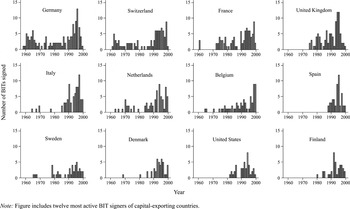
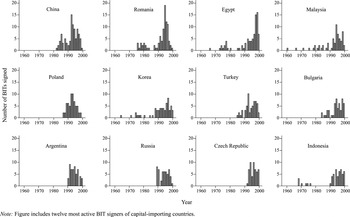
If the dominant powers determine the BIT schedule, then we should see evidence of home country “programs” when we look at BITs, by country, across time. Programs would look like clusters, or peaks, of activity in certain eras in a home country's history. By the same logic, if host countries take a lead role in producing BITs, their histories would also show some evidence of concerted, programmatic activity. Figure 4 and Figure 5 chart the number of BITs signed since 1959 for the twelve most active BIT signatories from both home (Figure 4) and host (Figure 5) countries. It appears that most home countries have BIT activity that lasts at least twenty years; most of these countries, in fact, sign BITs throughout the forty-year period. Spain is an exception, with a short spate of BITs in the 1990s only. Potential hosts, however, demonstrate a different pattern: their BIT signings spike up in a more clustered pattern, one indicative of programmatic activity (see Figure 5).27
Appendixes 1 and 2, available online at 〈https://netfiles.uiuc.edu/zelkins/www〉, also organized by capital-exporting and -importing countries, summarize the BIT history for all 178 countries that have ever signed a BIT.

Number of BITs signed, by country, 1959–99

Number of BITs signed, by country, 1959–99
Evidence of programmatic activity can be established statistically as well. Comparing the average kurtosis28
Kurtosis is the degree to which a distribution is peaked, or clustered, with high kurtosis indicating clustered data, and low kurtosis indicating a more uniform distribution.
The notion that home countries make take-it-or-leave-it offers to potential hosts and that hosts eventually decide to sign BITs is also consistent with the observed content of BITs. These treaties tend to provide consistent terms, even across different home countries. In particular, the core terms of the treaties are almost always present: mandatory dispute resolution before an international arbitration body, a private right of action for investors, monetary compensation in the event of a violation, national treatment, and most-favored-nation treatment. This uniformity suggests that host countries are “price-takers” with respect to the terms of these treaties, consistent with our assumptions. In essence, each home country has market power over the terms that will govern investment by its locals. Host countries, on the other hand, realize that they must compete with other potential hosts and, therefore, cannot demand changes to the core provisions of the treaties.
A Competitive Theory of BIT Diffusion
Our theory of BIT diffusion29
See Elkins and Simmons 2005, for a further elaboration of the concept of “diffusion.”
There is debate in the literature about the impact of BITs on investment flows. The small number of papers on the subject have generated inconsistent results. The most recent and sophisticated study of which we are aware, however, concludes that BITs do, indeed increase FDI and serve as a substitute for good domestic institutional quality; see Neumayer and Spess 2005. Other relevant studies include Hallward-Driemeier 2003; Tobin and Rose-Ackerman 2003; and UNCTAD 1998.
BITs as a Credible Commitment
Governments may have many motives to sign a BIT, but the most significant is to make a credible commitment to treat foreign investors fairly. BITs allow governments to make credible commitments because they raise the ex post costs of noncompliance above those that might be incurred in the absence of the treaty. They do this by (1) clarifying the commitment, (2) explicitly involving the home country's government, and (3) enhancing enforcement.31
We cast our argument in the credible commitments framework, but our competition argument may be compatible with signaling theories as well. Some of the empirical implications would be different than those we describe here, however. If a BIT is a signaling device, we would expect more reliable rather than less reliable property rights protectors to sign them. We might also expect less reliable governments to sign one treaty, rather than multiple treaties, since one should suffice to send the signal. Empirically, we tend to observe multiple signings per host, which leads us to frame the issue as one of credible commitments rather than costly signals that reveal type. Both frameworks could, however, explain a competitive dynamic to sign BITs.
BITs raise ex post costs of reneging on contracts by reducing the ambiguity of the host government's obligations. BITs are much more precise than customary international law in this area. They also provide a broader legal framework in which to interpret specific contractual obligations. Precision removes potential avenues of plausible deniability, making it clearer to a broader range of audiences (domestic audiences, other foreign investors, other governments), that an obligation has been disregarded. Clear violations imply a much greater reputational cost than do actions not clearly barred by law.32
The second way BITs raise ex post costs of reneging is by involving the investor's government as a treaty party. BITs are negotiated between sovereign states. State-to-state legal arrangements implicate the interests of the home government more directly than do simple investment contracts between private parties and host governments. The home government has an interest in broader principles of good-faith treaty observance. Treatment that violates a BIT qualifies as a breach of the fundamental principle of international law: pacta sunt servanda (treaties are to be observed). Reneging on a contract governed by a treaty arrangement can damage important foreign policy interests.
Finally, BITs raise ex post costs by significantly enhancing contract enforcement. These agreements contain mandatory dispute settlement provisions that investors are entitled to use when they feel the host state has violated the relevant BIT. Significantly, investors can begin arbitration proceedings without the approval or support of their home government. Moreover, the host can neither prevent the legal proceeding from going forward, nor control the final decision of the international arbitration tribunal. The international tribunal can require a host found to be in violation of its obligations to pay monetary damages. The sovereign host state could, of course, refuse to pay, but that decision could have even more profound reputational consequences: when a government spurns the decision of a neutral authoritative third party with which it has voluntarily precommitted to comply, a range of important actors—public and private—are likely to infer that that government is an unreliable economic partner. By giving private parties a right to pursue and receive a legal remedy, BITs boost the credibility of the host government's commitment. As a result, we would expect some violations to be deterred by a BIT commitment and expected returns to investments to increase accordingly.
Do these formal dispute settlement mechanisms actually come into play in the way we have described? Theoretically, we should expect such arbitrations to be rare, because fully informed parties should be able to settle “out of court” and avoid litigation costs. When we do observe arbitration, it would be more likely to indicate information asymmetries than the seriousness of the case.33
This point has long been recognized in the law and economics literature, see Bebchuk 1984.
UNCTAD 2004. This number omits, of course, disputes that were resolved prior to the arbitration stage.
See 〈http://www.bomchilgroup.org/argmar04.html#16〉. Accessed 20 June 2006.
For examples of awards, see reports of the International Institute for Sustainable Development, available at 〈www.iisd.org/investment〉. Accessed 20 June 2006. See also The National Law Journal, Arbitration Survey, “Global Litigation,” 15 September 2003. See also 〈http://blog.lewrockwell.com/lewrw/archives/Friedman-BITs-9-15-03.pdf〉. Accessed 20 June 2006.
In short, BITs represent a credible commitment because of the range of ex post costs—diplomatic costs, sovereignty costs, arbitration costs, and reputational costs—involved in both their observance and their violation. We argue below that some governments have incentives to increase these costs in order to attract FDI.
Competitive BIT Signings: Logic and Implications
In the previous section we argued that BITs allow governments to credibly commit themselves to protect investors' property rights. The ability to do so lowers risks and increases expected returns to investment. If this is the case, BITs can be a mechanism—such as favorable tax treatment, lower wages, and efficient infrastructure—for making a jurisdiction a more attractive place in which to invest. As with these other mechanisms, committing to a BIT involves costs for the host government. We characterize these as “sovereignty costs.” They are the costs any government pays when it negotiates, ratifies, and complies with an investment treaty. We would include here the political costs of assembling a coalition in support of foreign investors' rights, as well as the costs associated with giving up a broad range of policy instruments relevant to domestic social or developmental purposes (taxation, regulation, performance requirements, property seizure, and currency and capital restrictions). Most striking are the sovereignty costs associated with the delegation of adjudicative authority: virtually any legal change or rule that affects foreign investors is potentially subject to review by a foreign tribunal. The decision to sign a BIT always involves an assessment by the host of whether the expected benefit of attracting an additional increment of foreign capital outweighs these costs. In many cases, the answer is no. In this section, we discuss the conditions under which the expected benefits for a particular government might outweigh these sovereignty costs.
BITs can attract capital from two broad resource pools. First, they can shift resources from consumption or domestic investment, effectively stimulating new international capital investments that would not have been made absent the treaty. Second, and more importantly for our theory, BITs can redirect international capital flows from one venue to another. A BIT gives the host signatory a “reputational advantage” over otherwise comparable rivals in the competition for (re)distribution of an existing investment pool.37
This redistributive effect contrasts with customary international law, under which all potential hosts have the same obligations and enjoy the same benefits.
Guzman 1998 provides a more complete discussion of the potential impact of competition on BITs.
The strategic structure we are describing creates serious collective-action problems among potential host countries. Collectively, they might be better off resisting the demands of investors (avoiding the sovereignty costs described above), but individually it is rational to sign in hopes of stimulating capital inflows. In recognition of this dynamic, one finds cases of regional attempts to coordinate host resistance. In the Caribbean, for example, collective efforts have been made to reduce BIT concessions,39
CARICOM countries, for example, produced a document entitled “Guidelines for Use in the Negotiation of Bilateral Treaties” that states, among other things, that CARICOM countries should not accept any restriction on the use of performance obligations and that they should retain the right to nationalize and to “determine at the time of nationalization the quantum of compensation and the terms of payment.” Caribbean Community Secretariat, reproduced in “UNCTAD, International Investment Instruments: A Compendium,” Vol. III.
Jamaica, a member of CARICOM when the guidelines were adopted, signed a string of BITs with important partners in the late 1980s and early 1990s, including the United Kingdom (1987); Switzerland (1990); the Netherlands (1991); Germany (1992); France (1993); Italy (1993); the United States (1994); Argentina (1994); and China (1994). These BITs include performance requirements and compensation provisions that are inconsistent with the CARICOM guidelines.
A competitive theory of BITs has at least four observable implications. First, BITs should diffuse among host country competitors—countries that, from an investor's point of view, are closely substitutable venues for investment. It is precisely these countries that should display the clearest evidence of interdependent decision making. This is a unique prediction of competitive theory. No other diffusion mechanism—whether hegemonic, cognitive, or ideational—makes this specific prediction.
Second, BITs should spread most readily to countries where the competition for capital is the most intense. Competition intensifies where the number of plausible hosts for a particular investment project is greatest. For this reason, host competition for investment in extractive goods is far less intense than in light manufactures: while the number of countries in which bauxite mining is profitable is quite limited, almost any jurisdiction can host a Nike plant. If our competition hypothesis is correct, these treaties should be more prevalent where host competition is most fierce: in light manufactures rather than in primary production or extractive industries. This prediction is the exact opposite of what one might expect were BITs propelled in a “hegemonic” fashion, by the home country. From a home government's point of view, theories of obsolescing bargaining should predict the need for enforceable investment protections precisely in those industries that involve large upfront difficult-to-relocate investments. Obsolescing bargaining41
suggests that investors are more likely to demand treaties to protect their extractive and primary production investments, at least relative to easier-to-relocate light manufactures.42Kobrin 1987 finds that manufacturing is not characterized by the inherent, structurally based and secular obsolescence that is found in the natural resource-based industries.
Third, BITs should spread as the pool of available capital grows. As the pool of global capital grows, any competitive advantage (such as that conferred by a BIT) should yield a larger marginal increase in FDI inflows. Thus, the expected return per BIT should increase with the size of the investment pool, which encourages hosts to scramble to improve access to a share of the bigger “pie.” While other researchers have suggested that BITs may contribute to a growth in FDI,43
Neumayer and Spess 2005.
Finally, while all countries should be subject to some degree to the competitive pressures we have theorized above, BITs should diffuse somewhat more readily among host governments that lack credibility. For these countries, a BIT can be expected to make a real difference to investors, other factors held constant. In countries that already have institutions and practices that are favorable to investors, transparent, and predictable, a costly BIT adds relatively little value. These states may be able to compete for capital on the basis of their “inherent” credibility. This relationship is in principle consistent with power-based explanations (powerful home governments may be more likely to demand BITs from unreliable hosts than inherently reliable ones), but it is much less consistent with more sociological accounts discussed in Simmons, Dobbin and Garrett in this issue. If governments have been “socialized” to accept the dominant paradigm for investor protection, there would be no reason for the more credible host governments to largely exempt themselves.
A competitive theory of BITs predicts that the host countries most likely to sign treaties will be those whose competitors have signed, those who depend on manufacturing over extractive production, and those with a credibility gap. More generally, a competitive theory predicts increased treaties as the pool of available capital grows. In the following section, we develop an empirical strategy for testing these hypotheses against alternative explanations.
Empirical Methods and Data
Analytical Design
We use an event history framework to estimate the duration of time before two countries sign a BIT. Our analysis begins in 1958, the year before the first BIT, and includes those BITs concluded up to 1 January 2000, the last year for which we have accurate data. Since the focus of the analysis is a bilateral agreement between governments in a given year, the appropriate unit of analysis is the country dyad–year. In each dyad, we identify the potential “home” and the potential “host” country based on their relative level of development, as measured by GDP per capita. Of course, such designations become less meaningful the closer the members of the dyad are in their level of development. But treaties among countries of a similar level of development—especially at the higher end—are considerably less likely. In the reported analyses we exclude “developed dyads” from the sample in order to minimize the bias from estimates derived from “irrelevant dyads.”44
We exclude dyads in which both members are classified as “high income countries” by the World Bank [that is, dyads in which both members have a GDP per capita of over $6,000 (in 1987 $US) in a given year], thus excluding 125 BITs in the analysis.
Gleditsch and Ward 1999. Restricting our sample to those states (and their dates of existence) identified by Gleditsch and Ward means that we exclude eighteen BITs listed in the UNCTAD data, such as the fourteen to which Hong Kong was party as well as those involving states such as the United Arab Emirates and Slovenia, which occur several years prior to the dates that Gleditsch and Ward list the states as independent. The relatively inclusive sample ensures that we will encounter missing data, particularly for smaller countries. We experiment with several methods of managing missing data, none of which alter the substantive findings. For the results below, we have estimated missing values of time-varying covariates with decade means where possible and appropriate. Such extrapolations buy a more inclusive sample at the expense of potentially underestimated standard errors; see King et al. 2001.
Event history methods offer a convenient way to incorporate time dependence in models of policy or innovation adoption. Our formulation is slightly more complicated than most since the unit of analysis is the country dyad and the model includes variables measured for one or the other member of the dyad as well as for the dyad itself. We estimate the following equation:

where yij is the number of years without a BIT between countries i (host) and j (home), X is a vector of conditions that affect country i's calculations, Z is a vector of conditions that affect country j's calculations, V is a vector of characteristics of the relationship between countries i and j, and Wy* is a vector of spatial lag terms in which a count of BITs among other host countries in the previous year (y*) is weighted by various measures of their distance (W) to country i (see our discussion of spatial lags below). We estimate this equation with a Cox proportional hazard model, a useful estimator when one does not have strong assumptions about the effect of time on the baseline hazard.
Data and Measures
Our dependent variable is the number of years a dyad goes without a treaty, marked by the year of a treaty's signing, rather than the year in which it enters into force.46
While approximately forty dyads have entered into second and, in one case, third treaties, we predict the duration until the first treaty.
“As the great majority of BITs are ratified, it is reasonable to assume that, in the perception of investors, signing a BIT is the crucial action: Once a BIT is signed, or expected to be signed, the market has absorbed it or begins to absorb it”; UNCTAD 1998, 106.
Our comparison of the two data sets found that, for the years they overlapped (1959–97), UNCTAD included over two hundred treaties not included in the ICSID database.
Spatial lags of the dependent variable: Competition and cultural emulation
To assess the source and strength of the various influences of policy diffusion we construct a series of spatial lags, modeled largely after those in Simmons and Elkins.49
Simmons and Elkins 2004.
Anselin 1988.
This formulation assumes that it is the accumulation of treaties among peers, not the “event” of their recent signing, that provokes a response. We also experimented with an event trigger by calculating the number of BITs signed by others in the previous year. In fact, the results were largely comparable.

This computation of Wy* allows an intuitive interpretation of the spatial lag: it is the average number of BITs in force among other host countries, weighted by some distance to country i. Since the spatial lag is endogenous, we lag it one year to capture the behavior of other host countries in the previous year, a chronology that makes more sense for the causal logic of diffusion as well.52
While spatial lags are common solutions to estimating the relational effects that we hypothesize, they do introduce a potential degree of endogeneity. Unless nondiffusion predictors are included in the model, spatial lags can absorb these effects when the domestic variables are correlated within the network. For this reason, some scholars have moved towards simultaneous equation modeling, in order to model the endogeneity. Recent Monte Carlo evidence reported in Franzese and Hays 2004 suggests that the costs associated with such models may outweigh their benefits in large samples. Our solution is to specify the nondiffusion components as completely as possible and to lag the spatial lag one year. Nonetheless, we recognize that effects from spatial lags may be slightly inflated.
Our theory predicts interdependent decision making among host countries that compete for the same sources of global capital. Thus we need to determine the “competitive distance” between hosts. We create spatial weights that capture this distance in three ways. The first measures the degree to which host governments compete in the same foreign markets; that is, whether they have the same export trade relationships.54
We use the IMF Direction of Trade data to produce an N by N by T matrix of correlations (between countries) across the countries' proportion of exports to each of the 182 partner countries. Two countries that export goods in the same proportions to 182 countries will have a score of 1; while those with entirely opposite relationships will have score of −1. For a similar approach, see Finger and Kreinin 1979. Network analysts often use this sort of measure to identify competitors; see Wasserman and Faust 1994.
We calculate the distance between countries according to their export products, using information from the World Bank's World Development Indicators (WDI) that describes a country's export mix. These indicators tap the value of exports (in 1995 $US) in sectors such as food, fuel, agricultural raw materials, ores and metals, and arms. We calculate the correlation between countries for each year across thirteen such indicators. The result is a measure, ranging from −1 to 1, of the similarity between countries according to the products they export.
We compare such investment profiles by calculating correlations, by year, between countries across roughly fifteen educational and infrastructural variables selected from the WDI. These distances range from −1 to 1.
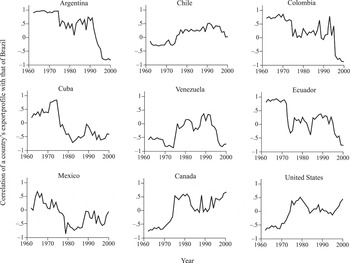
The competition distances themselves appear to have a fair degree of validity. For example, Figure 6 plots the values for the “distance” in export products between Brazil and select countries across time. If these values are to be believed, Brazil's products correlated quite highly with those of most Latin American countries in the 1960s and 1970s. This correlation decreased in the 1990s, at which time Brazil's export profile began to resemble that of the United States and Canada more than that of its Latin American neighbors. This finding is consistent with the common interpretation of the increasingly diversified Brazilian economy, whose exports in everything from technology to agriculture now compete directly with the United States and less directly with smaller Latin American states.57
Baer 2001.

A measure of export market similarity: The Brazilian case

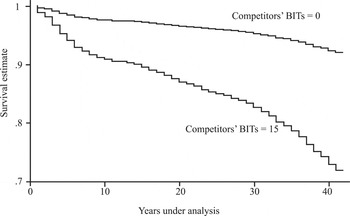
Survival estimates according to the average number of BITs of host's competitors (measured by export product similarity)

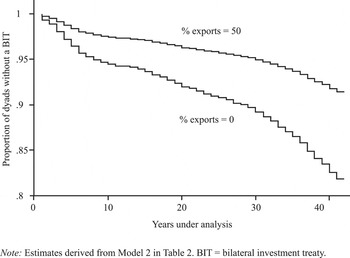
Survival estimates according to host's percent of exports in extractive industries
We also use spatial lags in a similar way to measure the influence of an important alternative explanation suggested in Simmons, Dobbin, and Garrett58
Simmons, Dobbin, and Garrett, this volume.
Alternative diffusion mechanisms: Learning and coercion
Finally, we seek to capture the effects of policy learning and coercion. Our notion of learning, consistent with that articulated in Simmons, Dobbin, and Garrett,59
Ibid.
In order to compute these results, we use only those data that are immediately available to us (and, more to the point, to policymakers). We reason that our informational constraints should match those of policymakers. As such, we use data reported in the World Bank's WDI and do not make efforts to impute or otherwise fill in missing data in these equations.
Because FDI data is sparse in the 1960s, the effect of the treaties is incalculable with any degree of certainty, both for us and for policymakers at the time. Throughout the 1970s and most of the 1980s, the apparent effect of BITs is effectively zero or even negative. However, by the early 1990s—the period in which more than half of existing BITs were signed—BITs appear to have obvious payoffs. Those countries with BITs in force in those years are clearly also the recipients of investment.61
Such mixed results do not seem surprising given the discrepant findings of scholars on this question (see fn. 30).
We consider one final interdependent mechanism, coercion. It may be that potential hosts are coerced or at least strongly encouraged to enter into BITs. If so, a likely juncture for the application of such pressure is at the time a country seeks International Monetary Fund (IMF) credits. We incorporate a dichotomous measure of whether or not a country has drawn on IMF resources in a given year. Though we do not believe the pursuit of or entry into BITs is explicitly stipulated in formal loan conditions, there may be more subtle pressures on a state in balance-of-payments difficulties to use these treaties to attract foreign capital.
Home country considerations
The proliferation of BITs could be explained by two home country considerations: the desire to protect existing overseas capital, and the desire for additional investments. These considerations could significantly influence the pool of BITs that is potentially available, independently of any competitive dynamic among potential hosts. In the analysis that follows, we control for the total FDI “exposure” of the home country; that is, the degree to which a country's capital is actually invested abroad. For this we use a measure of net FDI outflows as a proportion of GDP (scored positively when outflows outweigh inflows and negatively when inflows outweigh outflows). On average, we expect high outflows to produce a greater willingness to supply BITs on the part of investors' governments.
In models not reported here, we also include country dummies for the identity of home governments with the most active BIT programs (Germany, Switzerland, France, United Kingdom, Italy, and the United States) in order to absorb any idiosyncratic tendencies to pursue BITs and to capture the effect of large BIT programs.
Host country considerations
Our competitive story of the proliferation of BITs suggests that competitive reputation building, through BITs, can set off a sequence of treaty signings among countries that compete with one another. Although all countries may be subject to such competitive pressures to some degree, we expect governments with greater indigenous credibility to be less willing to pay the sovereignty and other political costs associated with concluding BITs. We capture this idea by using an indicator of investors' perceptions of corruption in the host country. The more corrupt a state is perceived to be, the more necessary it becomes to lure investors with an explicit promise to delegate adjudication to an authoritative third party. We complement this measure with one of the nature of the legal system itself. Some research suggests that common law systems tend to provide better property rights protections;62
civil law systems are more likely, these scholars argue, to implement regulatory solutions to perceived social conflict63Botero et al. 2002.
We use an indicator of a English Common law tradition generated by the World Bank and used by La Porta et al; see Easterly and Sewadeh 2001. We have some misgivings about using this measure to capture reputation for property rights protections, especially since Simmons (forthcoming) has shown that common law countries are much less likely to sign human rights treaties, which points to a more general orientation toward international treaties of all kinds.
Another important factor, and one with implications for our competition story, has to do with a country's exposure to competition. If BITs are driven by competition for capital, they should be most prevalent where that competition is most fierce. We have argued that competition for capital is most cutthroat in manufacturing; by comparison, there are limited sites worldwide that produce copper or other extractive commodities. The fewer the alternative investment sites, the more protected the host is from international competition, and the less likely a host is to sign a BIT. To capture this idea, we construct a measure of extractive industry dependence by summing the share of each country's exports of both fuel and “ores and metals,” as recorded in the World Bank's World Development Indicators (WDI). Approaches emphasizing the coercive role of dominant powers would anticipate a positive coefficient for extractive industries, since these are most subject to obsolescing bargaining and hence intensified political risks. Our expectation, however, is that this effect will be swamped by competition among hosts for manufacturing FDI, and we anticipate a negative effect. The outcome on the extractive industry variable thus provides a fairly crisp test of the importance of competition among hosts in explaining the proliferation of BITs.
Quite aside from indicators of the need for a credible commitment discussed above, a number of economic conditions make particular hosts especially attractive BIT partners. We control for the economic desirability of the investment site by controlling for market size of the host country (log of the host's GDP),65
the host's level of development (GDP per capita),66Henisz 2000.
The literature on agglomeration economies, stressing the increasing benefits of colocation by economic units, provides a justification for including prior FDI inflows; see Wheeler and Mody 1992. As current and future FDI is likely affected by the very agreements we predict in this model, we lag the measure one year.
Finally, we control for other political and policy conditions in the host country. Since investors may see democracies as less capricious, we control for the host's level of democracy. It is possible that the pattern of BITs is driven by a few countries' aggressive privatization programs, and so we control for the value of privatized assets in a given year. Finally, we recognize that to sign BITs requires a certain degree of diplomatic capacity. We account for the diplomatic and legal capacity to enter into BITs by controlling for the total number of embassies a country hosts and has established in foreign countries.69
See Guzman and Simmons 2005.
Characteristics of country pairs
In this analytic category we identify the relational variables that might be associated with the likelihood of an agreement between the two nations. We focus on three kinds of relationships: business, security, and cultural relationships. Since firms are likely to want to invest in or near their export markets and to otherwise take advantage of vertical downstream linkages,70
The literature that has focused on firm and industry level explanations for the location of FDI emphasizes that firms that depend on foreign sales are more likely to invest overseas. For example, some research suggests that a firm's decision to deepen its presence in a particular country is influenced by the extent of its prior experience in that jurisdiction; see Ball and Tschoegl 1982. Others have found that firms are more likely to invest where they have strategic advantages, and these are plausibly connected with vertical downstream linkages; see Kimura 1989. The measure proposed here assumed these effects may show up in the aggregate trade relationships at the national level.
Findings
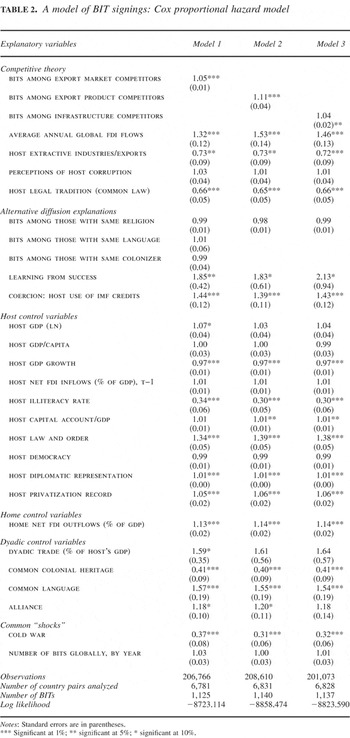
We present estimates (as hazard ratios) from three specifications of our model (Table 2). A hazard ratio of more than 1 represents a positive effect on the odds of a BIT; less than 1, a negative effect. The first regression includes the export partner lag together with the full set of covariates described above. The last two regressions include one of the remaining two competitive spatial lags (export product similarity and infrastructure/workforce similarity) in a reduced form of the model. Several clear empirical patterns begin to emerge. There is fairly consistent and convincing evidence of the importance of competition for capital among developing countries in explaining the proliferation of BITs over the past four decades. In all cases, higher rates of BIT signing among competitors (however measured) appear to have increased the rate at which a given country itself enters into a BIT at statistically significant levels. One can appreciate the size of these effects in Figure 7a, which plots the survival curve for two different values of the spatial lag calculated from the “export product similarity” measure, the competition variable with the largest impact. In this illustration, a country whose competitors average fifteen agreements has a markedly increased risk of signing an agreement compared with a country whose competitors have refrained from signing. In the late 1990s (40 years after the inception of BITs), the difference between such countries in their probability of signing is almost 0.20. The results of these three competition variables alone provide preliminary evidence that competition is central to the spread of BITs.
A model of BIT signings: Cox proportional hazard model

The evidence also suggests that as global FDI has increased, potential hosts have been more willing to sign BITs. One interpretation of this finding is that as the pool of FDI has increased, the competitive stakes for a share have grown. The pattern with respect to countries with predominantly extractive industries also provides corroboratory evidence for the competition theory. The results show that higher extractive production by the potential host reduces the propensity to negotiate a BIT (contrary to expectations based on investors' demands to address obsolescing bargains endemic to primary and extractive production). Figure 7b, which compares the signing rates for a government with a largely extractive-based economy versus one with an exclusively manufacturing-based economy, suggests that—ceteris paribus—signing rates can differ by as much as 10 percentage points depending on a state's level of extractive material exports. Both the magnitude and stability of this effect across models suggests that it is a fairly robust finding.
We found inconsistent evidence, however, to support our expectation that host countries with a credibility gap are most likely to sign a BIT. Contrary to expectation, BITs were more likely to be signed by countries with better reputations for “law and order.” We have already noted that this indicator only partially reflects our argument, as it conflates perceptions of the strength of the court system with perceptions of popular willingness to obey the law. Even so, the strong positive result is surprising. One possibility is that this measure is picking up the relatively favorable orientation of some countries toward legal solutions to conflicts generally. As we expected, perceptions of corruption were in the correct direction, although the hazard ratio is not statistically significant in any specification that also contains “law and order.” We should note that corruption is a significant determinant of signing a BIT whenever the law and order variable is not included. The common law variable did work as anticipated, but in light of the above findings, we think the prudent conclusion is that common law countries also refrain from entering into these agreements for reasons other than the reputational concerns developed here.72
In addition to the competition variables, our coercion variable (use of IMF credits) is significant in each of the models. This may mean that states seeking assistance from the IMF are encouraged to enter into BITs. Alternatively, it may be that the conditionality of IMF loans overlaps with the obligations of the BIT, reducing the costs of the latter. Interestingly, there is some evidence of learning from BIT outcomes. BITs are significantly more likely to be signed during years in which signatory states appear to be benefiting (in terms of FDI) from the treaties than when they are not. Such a pattern, of course, is consistent with our general theory of competition over shares of FDI. We found no evidence, however, that countries sign agreements in response to signings in their cultural networks. None of the spatial lags along religion, language, or colonial heritage had consequential effects.
Many of the variables that would predict home country interest in offering a BIT to a developing country had somewhat unpredictable, and muted, effects. The size of the host economy and previous FDI inflows (as a percentage of host GDP) showed effects in the predicted direction, although rarely statistically significant across the models we tested. Meanwhile GDP per capita and economic growth had, if anything, the opposite effects of what we would expect, although only the economic growth coefficients were significant. On the other hand, we did find evidence that countries with a high quality workforce, as measured by literacy rates, and with an export orientation (current accounts tending toward surplus), were more likely to sign BITs (illiteracy is associated with a reduced likelihood of a BIT). Our prediction that privatization programs in a host country would coincide with BIT agreements was borne out as well. Similarly, host countries with a larger diplomatic presence were also more likely to enter into BITs. Finally, host's degree of democracy had practically no effect.
Certain control variables describing the relationships between home and host countries were important predictors of BITs. While the direction of dyadic trade is as hypothesized, the effect is statistically insignificant in two of the three models. Political and cultural relationships seem to be more important. In accordance with expectations, BITs are more likely among allies, which could suggest a somewhat coercive element to their conclusion. A common language within the dyad makes it much more likely that a pair of countries will negotiate a BIT, but a colonial link reduces by about two-thirds the likelihood that a country pair will do so. Perhaps investors in home countries perceive the risk in their colonial “families” to be lower than in other states. After all, colonies' legal institutions are likely to be similar to, if not partially overlap with, legal institutions in the mother country and fellow former colonies. This fits with our conception of BITs as being created to establish a credible legal framework for investment that is otherwise lacking.
In models not reported here, we attempted also to control for the BIT “programs” of particularly active countries by including country dummy variables for the five most active hosts and the five most active home countries. All were highly significant, with the partial exceptions of Germany and the United States. Their inclusion reduced substantially the effect of two variables, the volume of bilateral trade between country pairs and the home country net FDI. The robustness of the other results to the country dummies, however, reassures us that our results are not driven by idiosyncratic policies in a few of the most active countries.
Finally, we consider the potential impact of commonly experienced “shocks” on the propensity to sign BITs. All countries could have been affected by the Cold War, and our results indicate a significantly lower propensity to sign BITs during that era. Our more general measure of BIT period effects (the number of BITs signed in a given year), however, is insignificant in the company of our fairly comprehensive model. Whatever temporal clusters were evident in Figure 1 are accounted for by predictors in our model.
Conclusion
The use of bilateral investment treaties has grown significantly since the early 1960s. Their growth is especially remarkable given the outright rebellion many hosts have staged against customary law understandings and multilateral codifications of investors' rights that are quite similar to those contained in these proliferating bilateral accords. Why the disjuncture? How can we understand the spread of these promarket agreements across time and space?
The diffusion mechanisms spelled out by Simmons, Dobbin, and Garrett in the introduction to this series of studies suggest a broad range of empirically verifiable hypotheses about movement towards BITs. Both theoretically and empirically, the competition model seems most apt in this case. These treaties are meant to improve conditions under which global capital relocates, prospers, and repatriates. They are also meant to raise the reputational stakes for governments of capital-poor economies by committing them to respect property and contractual rights of foreign investors and to agree to arbitration—effectively clipping their sovereignty—in the event of any disagreement over subsequent investment contracts. There are clearly possibilities here for mutual gain for hosts and investors, though we are agnostic about the global welfare effects of these treaties, given their potential redistributive consequences. We admit that some of the more recent treaties between very poor countries do not square with our straightforward competitive model; nonetheless, the strongest case can be made for a competitive diffusion dynamic in this case.
Let us begin with the project's null hypothesis: that country characteristics or commonly experienced shocks explain the pattern of BIT signings. There was plenty of support in the data for traditional economic explanations. Some of the most important drivers of the spread of BITs are likely factors that drive investment decisions more generally. The pattern of BITs shows that home governments want to secure investments in developing markets that are large, somewhat open, and with high quality labor. On the other hand, BITs are most valuable where political risk is endemic. China, which has concluded a large number of BITs with both rich and poor partners, would be the quintessential BIT partner, according to our model.
We also found strong evidence that dyadic characteristics explain BITs. BITs are much more likely to be negotiated among country pairs of the same culture (at least as measured by shared language) and among country pairs with strong security commitments. But if cultural linkages explain home-host pairs, cultural emulation is much less in evidence among potential hosts. Not one indicator of cultural emulation among hosts had any purchase at all on the adoption of BITs. These cultural arguments may in the end be a more satisfying account available for the growing category of “strange BITs” between highly indebted, capital-poor, noncontiguous country pairs. We know anecdotally that third parties (France, UNCTAD) facilitated many of these agreements, indicating that in many cases external political or cultural forces may be crucial. The strong positive effect of IMF borrowing and alliance relationships on the propensity to sign a BIT also reminds us that a certain degree of coercion may be at play in some cases.
We do not doubt that multiple motives exist for the spread of this form of protection for foreign investors. But the competitive explanation has strong theoretical foundations and is the most consistently supported by the data. First, it was well supported by three different measures of “competitive space”: by export market, export product, and workforce/infrastructural quality. When more of a host's closest competitors have signed BITs, that country is much more likely to do so itself. The remarkable consistency across these three highly nuanced measures of competitive space provides strong initial evidence of a tendency to match the policy choices of competitors.
Second, the size and character of markets for FDI have fed the competitive atmosphere in predictable ways. The sheer size of the available pool of investment has greatly raised countries' stakes in securing a share. More BITs are signed when the global capital pool increases. This finding is of course consistent with home countries' concern to protect their investors as well as hosts' desire to increase their access. But a second finding much more clearly indicates that the impetus for signing is host-country driven. Our theory of competition among hosts predicts more BITs where the market for FDI is most competitive—the manufacturing sector. We found, in contrast to what theories of obsolescing bargaining would predict, that dependence on extractive industries reduced the probability that a host would make such a commitment.
Finally, a theory of host-driven competition was supported by some of our findings about the qualities associated with those hosts most likely to sign. We expected BITs to be pursued most assiduously by host governments whose domestic institutions render them least able to make credible commitments to protect property rights. When we excluded the possibly confounded “law and order” variable from our analysis, hosts were much more likely to sign if their regime was perceived as corrupt by foreign investors. They were also more likely to sign depending on the nature of their legal institutions. Common law countries—legal systems that some well-documented empirical work has shown to be associated with better legal protection for property rights—are much less likely to sign than are civil law countries. We recognize there are other reasons for common law countries to be reluctant to enter into international treaty obligations generally, but it remains possible that the differential ability of various legal traditions indigenously to protect property rights is at work as well. In this context, our finding on “law and order” is somewhat puzzling. But we are far less convinced that this indicator captures the domestic institutional guarantees of protection and fairness that foreign direct investors seek.
The diffusion of norms that protect investment has been further advanced by host governments' desire to attract a share of the global capital pool. We have doubts that this phenomenon can be explained by the appeal of liberal ideas alone, for we have witnessed the proliferation of BITs just as multilateral and customary law approaches have foundered. Most governments would prefer to avoid the explicit commitments contained in these treaties; there continue to be few concluded between the wealthiest countries of the world. In some regions, developing countries have tried to coordinate their responses to BITs in hopes of gaining more favorable terms, with notably limited success. In short, we base our conclusions on the importance of competition for capital not just on statistical relationships that show up in the quantitative analysis, but also on the broader context in which our analysis is nested.
BITs are part of a larger process of globalization that has been furthered by the dynamics of competition. This competition is driven by the desire of developing countries to participate in the global capitalist system. But has this uncoordinated strategy of signing away the sovereign right to regulate a growing segment of national economic activity yielded the results developing countries have hoped for? The evidence as to whether BITs actually succeed in attracting capital is unclear on this point. Our research suggests why this may be the case. Competition for capital has important redistributive consequences. The result of the BIT competition may be only minimally improved access to capital at a high cost to national sovereignty.
Data Appendix: Summary Statistics and Sources for Variables Included in the Analysis