1. Introduction
The Sichuan–Yunnan–Guizhou (SYG) Pb–Zn metallogenic province (Fig. 1a) is one of the most important Pb–Zn production areas in China. This metallogenic province includes more than 400 Pb–Zn deposits (Liu & Lin Reference Liu and Lin1999; RJ Si, unpub. PhD thesis, Chinese Academy of Sciences, 2005; Wu et al. Reference Wu, Zhang, Mao, Ouyang and Sun2013; Zhou et al. Reference Zhou, Huang, Zhou, Li and Jin2013c) and has produced approximately 27% of the total Zn and Pb resources in China over the past decades (e.g. Zhang et al. Reference Zhang, Wu, Hou and Mao2015; Zhou et al. Reference Zhou, Luo, Wang, Wilde, Wu, Huang, Cui and Zhao2018a). Several giant deposits have been found, including the Huize (> 5.0 Mt of Pb+Zn reserves; Zhou et al. Reference Zhou, Wei and Guo2001), Daliangzi (c. 3.0 Mt of Pb+Zn reserves; Zheng & Wang, Reference Zheng and Wang1991), Maoping (> 2.5 Mt of Pb+Zn reserves; Wei et al. Reference Wei, Xue, Xiang, Li, Liao and Akhter2015), Tianbaoshan (> 2.0 Mt of Pb+Zn reserves; Zhou et al. Reference Zhou, Huang, Zhou, Li and Jin2013c), Nayongzhi (c. 1.5 Mt of Pb+Zn reserves; Zhou et al. Reference Zhou, Xiang, Zhou, Feng, Luo, Huang and Wu2018b) and Fule (> 1.0 Mt of Pb+Zn reserves; Lü, Reference Lü2014) Pb–Zn deposits. Among these deposits, the Fule deposit is hosted in the carbonate rocks of the middle Permian Yangxin Formation (Fig. 1b; RJ Si, unpub. PhD thesis, Chinese Academy of Sciences, 2005; Lü, Reference Lü2014) and spatially and stratigraphically close to the upper Permian Emeishan flood basalts. However, whether the Fule deposit is related to the Emeishan flood basalts has been debated for decades. Some studies have considered that a small portion of the ore-forming materials is derived from Emeishan flood basalts (Liu & Lin Reference Liu and Lin1999; Huang et al. Reference Huang, Chen, Han, Li, Liu, Zhang, Ma, Gao and Yang2004). Others researchers have proposed that the Emeishan flood basalts only act as a heat source or barrier layer for the Pb–Zn deposit (Li et al. Reference Li, Gu, Wen, Han, Sheng, Xu, Cao, Wu and Zou2012). Due to a lack of understanding of the sources of the ore-forming materials, the genesis type of the Fule deposit remains controversial; previous studies have suggested that it is a sedimentary exhalative (SEDEX) deposit or ‘sedimentary reworking-type’ deposit (Tu, Reference Tu1984; Zhao, Reference Zhao1995; Liu & Lin Reference Liu and Lin1999), a Permian Emeishan mantle plume-related Zn–Pb deposit (Xie, Reference Xie1963; Huang et al. Reference Huang, Chen, Han, Li, Liu, Zhang, Ma, Gao and Yang2004), a Mississippi Valley-type (MVT) deposit (e.g. CQ Zhang, unpub. Masters thesis, China University of Geosciences, 2005; ZL Li, unpub. Master thesis, University Chinese Academy of Sciences, 2016; Li et al. Reference Li, Ye, Hu and Huang2018a) or a Sichuan–Yunnan–Guizhou (SYG) -type deposit (Han et al. Reference Han, Zou, Hu, Hu and Xun2007b; Zhou et al. Reference Zhou, Wang, Wilde, Luo, Huang, Wu and Jin2018c). Accordingly, the Fule Pb–Zn deposit represents an excellent case study for understanding the origin of ore-forming materials and the mineralization of these Pb–Zn deposits in the SYG area.
(a) Regional geological location of the Fule deposit and the SYG Pb–Zn metallogenic province (modified after Zhu et al. Reference Zhu, Wen, Zhang, Fu, Fan and Cloquet2017). (b) Geological sketch map of the Fule Pb–Zn deposit (modified from Liu & Lin, Reference Liu and Lin1999; Lü, Reference Lü2014). (c) Cross-section of the Fule deposit (modified from RJ Si, unpub. PhD thesis, Chinese Academy of Sciences, 2005).

Isotope geochemistry is a useful research tool for studying hydrothermal deposits. Sulphur isotopic compositions can be used to determine the origin of S and the isotopic evolution of the fluids (Seal, Reference Seal2006; Barker et al. Reference Barker, Hickey, Cline, Dipple, Kilburn, Vaughan and Longo2009). Sulphur, the 14th most abundant element in the crust, has a stable isotope that can provide insight into the origins of sulphide minerals (Seal, Reference Seal2006; Haest et al. Reference Haest, Schneider, Cloquet, Latruwe, Vanhaecke and Muchez2010). The sulphur isotopic composition of sulphides is commonly expressed in delta notation (δ), which means δ34S = δ(34S/32S) (Seal, Reference Seal2006). Previous studies of the S isotopes of its sulphides have been based on the traditional bulk powder method (e.g. RJ Si, unpub. PhD thesis, Chinese Academy of Sciences, 2005; Lü, Reference Lü2014), which probably yields mixed δ34S values because mineral separation sometimes exceeds the scale of the particle variations in sulphide minerals (e.g. Tang et al. Reference Tang, Bi, He, Wu, Feng, Zou, Tao and Hu2011, Reference Tang, Bi, Fayek, Hu, Wu, Zou, Feng and Wang2014; Ye et al. Reference Ye, Li, Hu, Huang, Zhou, Fan and Danyushevskiy2016). Such an analytical method may have led to an inaccurate understanding of the S source. Nanoscale secondary-ion mass spectrometry (NanoSIMS) has been widely applied for in situ isotope analysis (Zhang et al. Reference Zhang, Lin, Yang, Shen, Hao, Hu and Cao2014), which is characterized by high spatiotemporal resolution and analytical sensitivity (Hoppe, Reference Hoppe2006; Herrmann et al. Reference Herrmann, Ritz, Nunan, Clode, Pett-Ridge, Kilburn, Murphy, O’Donnell and Stockdale2007; Yang et al. Reference Yang, Hu, Zhang, Hao and Lin2015) and can yield in situ S isotopic data (34S/32S) from micron- or submicron-scale sulphides (e.g. Gerdes et al. Reference Gerdes, Klenke and Noffke2000; Pósfai et al. Reference Pósfai, Cziner, Márton, Márton, Buseck, Frankel and Bazylinski2001; Algeo et al. Reference Algeo, Shen, Zhang, Lyons, Bates, Rowe and Nguyen2008; Wacey et al. Reference Wacey, Kilburn, Saunders, Cliff and Brasier2011) with high accuracy (Winterholler et al. Reference Winterholler, Hoppe, Andreae and Foley2006).
In this research, NaonoSIMS was used to analyse the S isotopic compositions of pyrite and sphalerite of the Fule deposit together with geological and mineralogical data to (1) identify the possible source of the reduced sulphur; (2) constrain the mineralizing process in the Fule deposit; and (3) understand the ore genesis of the Fule deposit.
2. Geological setting
2.a. Regional geology
The Fule Pb–Zn deposit in the western Yangtze Block, southwestern China, is located in the southeastern part of the SYG polymetallic metallogenic province (Fig. 1a) and the southern part of the NE Yunnan depression carbonate-bearing basin in the SYG (Han et al. Reference Han, Liu, Huang, Chen, Ma, Lei and Ma2007a). The basin formed during late Sinian time and underwent tectonic uplift during Late Jurassic time (Zhang et al. Reference Zhang, Mao, Wu, Li, Liu, Guo and Gao2005). The regional faults are dominated by NE–SW- and N–S-trending faults, and the basement comprises the Proterozoic Kunyang group, which is mainly formed of metamorphic rocks. The exposed units in this region include Devonian, Carboniferous, Permian and Triassic rocks, all of which are primarily composed of carbonate, basalts and clastic sedimentary rocks. More than 400 Pb–Zn deposits have been found in this area (Liu & Lin, Reference Liu and Lin1999), and these deposits are characterized by high Pb and Zn ore grades, irregular ore bodies, simple mineralogies and weak degrees of alteration (e.g. Zhou et al. Reference Zhou, Wei and Guo2001, Reference Zhou, Huang, Bao and Gao2013a). These deposits are mainly hosted in the carbonate strata underlying the upper Permian Emeishan flood basalts (e.g. Huang et al. Reference Huang, Chen, Han, Li, Liu, Zhang, Ma, Gao and Yang2004, Reference Huang, Li, Zhou, Li and Jin2010).
In the Fule mining area, the major structures are NNE–SSW- and N–S-trending faults (Fig. 1b), all of which are reverse faults except F1, which is a normal fault. In particular, the N–S- and NE–SW-trending reverse faults play important roles in controlling the formation, distribution and enrichment of Pb and Zn deposits.
2.b. Geology of the Fule deposit
Ordovician, Silurian, Upper Triassic and some Tertiary strata are absent from the Fule mining district. The stratigraphic sequence consists of the upper Carboniferous Maping Formation, middle Permian Yangxin Formation, upper Permian Emeishan Formation, upper Permian Xuanwei Formation, Lower Triassic Yongningzhen Formation, Middle Triassic Guanling Formation and some Quaternary rocks (Fig. 1b). The upper Carboniferous Maping Formation is composed of light grey and thick-bedded limestone with some coarsely crystalline dolostone. The middle Permian Yangxin Formation is the main ore-hosting unit, and its thickness exceeds 1 km. This formation is dominated by alternating grey (light to dark) dolostone and limestone and contains some flint nodules in the uppermost layer. The upper Permian Emeishan Formation, which is > 2 km thick and predominantly consists of vesicular, amygdaloid basalts and volcanic breccia, unconformably overlies the middle Permian Yangxin Formation. The upper Permian Xuanwei Formation consists of mudstone and sandstone. The Lower Triassic Yongningzhen Formation conformably overlies the upper Permian clastic rocks and is chiefly composed of light grey limestone and clastic rocks. The Middle Triassic Guanling Formation consists primarily of sandstone, mudstone and dolostone. The wall rock of the ore bodies is dominated by dolostone and minor limestone (Fig. 1b, c).
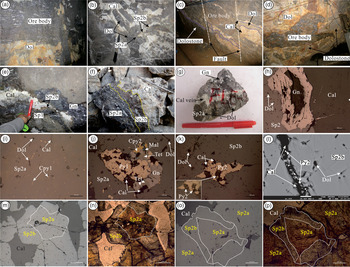
A total of 20 ore bodies have been recognized in the Fule deposit, and their elevations range from 1450 to 1536 m (Fig. 1c). These ore bodies have a general trend of NW–SE, and the mining area is approximately 3 km long and 1.5 km wide. These ore bodies commonly occur as stratiform, lenticular (Fig. 1c) and veined bodies along the bedding planes of the middle Permian Yangxin Formation (Figs 1c, 2a), and are occasionally hosted in fracture zones (Fig. 2b). These ore bodies are strictly controlled by faults (Fig. 2c) and many breccias can be found around karstic caves, which were affected by faults. Some Pb–Zn ores cemented the breccias or filled in the open space within karst caves (Fig. 2d).
Field and microscope photographs of ore bodies and mineral paragenesis in the Fule deposit. (a) Ore bodies hosted in dolostone and occurring as horizontal stratiform bodies. (b) Pb–Zn ores filling in an interlayer fracture. (c) Ore bodies strictly controlled by faults and associated with some broken dolomite and calcite veins. (d) Pb–Zn ores filling in the open space of a karst cave. (e) The principal ore minerals are sphalerite and galena. (f) Black-brown sphalerite (Sp2a) formed earlier than brown sphalerite (Sp2b). (g) Galena formed later than the other sulphides and replaced by gangue minerals. (h) Galena formed later than the sphalerite. (i) Emulsion droplet chalcopyrite (Cpy1) distributed in sphalerite as a disease texture, which suggests that they formed during the same stage. (j) Anhedral pyrite (Py1) was replaced by late sulphide minerals (including galena, chalcopyrite (Cpy2), tetrahedrite and malachite). (k) Euhedral pyrites (Py2) intergrown with calcite in fissures of sphalerite. (l) Aggregates of pyrites (Py2) filling in a calcite vein (backscattered image). (m) Single sphalerite particle under reflected light. (n) Sphalerite has different colours from core to rim (transmitted light), corresponding to black-brown (Sp2a), brown (Sp2b) and light yellow (Sp2c) sphalerite, respectively. (o) Sphalerite under reflected light. (p) Sphalerite has two mineralization stages under transmitted light. Sp – sphalerite; Gn – galena; Py – pyrite; Cpy – chalcopyrite; Tet – tetrahedrite; Ma – malachite; Cal – calcite; and Dol – dolomite.

2.c. Mineralogy and paragenesis
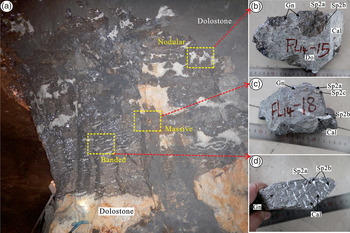
The principal ore minerals are sphalerite and galena (Fig. 2e–g), with minor pyrite (under microscopy and scanning electron microscopy, Fig. 2j–l) and Cu-bearing minerals (Fig. 2i, j). Some oxidized ores, including smithsonite and malachite, are also present (Fig. 2j). The gangue minerals are composed of dolomite and calcite (Fig. 2c). The sulphides are fine to coarse grained, with anhedral to euhedral granular textures. The ore structures are dominated by nodular (Fig. 3b), massive (Fig. 3c), banded (Fig. 3d), disseminated and veined structures. Dolomitization and calcitization are present in the wall rock.
Sampling locations of the ores. (a) The overall view of the ore body. (b–d) Samples with different ore structures, that is, (b) nodular, (c) massive and (d) banded structures.

The mineralization process can be divided into three stages (Fig. 4): (1) diagenetic stage, dolomite + calcite; (2) hydrothermal stage, sulphides + dolomite + calcite; and (3) supergene stage, oxidized minerals. The sulphides of the deposit are mainly formed in the hydrothermal stage, which can be further divided into three generations: (1) generation 1, fine pyrite + dolomite + calcite; (2) generation 2, sphalerite + galena + coarse pyrite + emulsion droplet chalcopyrite + dolomite + calcite; and (3) generation 3, chalcopyrite + tetrahedrite + Zn-tennantite + dolomite + calcite.
Paragenetic sequence of the minerals in the Fule deposit.

The microscopic observations reveal several key findings. (1) There are two types of Cu-bearing minerals in the Fule deposit. The first type is the early-formed emulsion droplet chalcopyrite (distributed in sphalerite with an exsolution texture that simultaneously formed in generation 2 with sphalerite, labelled Cpy1 in Fig. 2i). The second type of Cu-bearing minerals is relatively late-formed (generation 3) and replaced the early sulphides (sphalerite, galena and pyrite), including chalcopyrite (Cpy2), tetrahedrite (Tet), Zn-tennantite (Tt) and malachite (Mal) (Li et al. Reference Li, Ye, Huang, Zhou, Hu and Nian2018b). (2) The pyrites are divided into two types, both of which formed in hydrothermal stage. The first type of pyrite (Py1) formed in generation 1, was replaced by later sulphides (sphalerite, galena and Cu-bearing minerals, Fig. 2j) and appears as anhedral granules. The second type of pyrite (Py2, formed in the latter stages of generation 2) mainly replaced sphalerite (Fig. 2k) and is present as fine veins in calcite (Fig. 2l). This type of pyrite formed later than the other sulphide minerals and occurs as subhedral–euhedral granules, such as cubic (close-up image in Fig. 2k) and pyritohedron granules (Fig. 2l). (3) In addition, three types of sphalerite (Fig. 2e) were observed under the microscope under transmitted light (Fig. 2n, p and Fig. 5d–f) and formed in generation 2. From early to late (i.e. core to rim), the generation sequence is black-brown sphalerite (Sp2a), brown sphalerite (Sp2b) and light yellow sphalerite (Sp2c) (Fig. 2f, m–p).
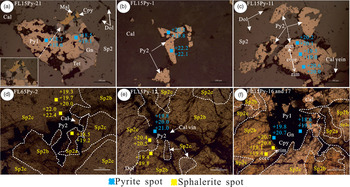
The analysed locations and δ34S values of pyrite and sphalerite in the Fule deposit. (a) Anhedral pyrite (Py1) was replaced by later sulphides and showed relative lower δ34S values than the subhedral–euhedral pyrites (Py2) shown in (b). (c) The δ34S values of subhedral pyrite (Py2) exhibit a weakly increasing trend from core to rim. The δ34S values of sphalerite under transmitted light: (d) no difference between black-brown (Sp2a), brown (Sp2b) and light-yellow (Sp2c); (e) no difference between the δ34S values of sphalerite and pyrite; and (f) the δ34S values of sphalerite are weakly increased from the early to late mineralization stages.

Based on the macro- to micro-scale geological observations related to the generation sequence, replacement and colours of minerals, the mineralization stages in the Fule deposit were divided into diagenetic, hydrothermal (sulphide + carbonate) and supergene stages, and the simplified paragenetic sequence (Fig. 4) of the sulphide minerals is:
Pyrite (Py1) → sphalerite (Sp2a → Sp2b → Sp2c) + emulsion droplet chalcopyrite (Cpy1) → pyrite (Py2) → galena (Gn) → Cu-bearing minerals (Cpy2, Tet, Tt, Mal).
3. Samples and analytical methods
The sampling locations are shown in Figure 3a. Three sulphide samples representative of nodular (Fig. 3b), massive (Fig. 3c) and banded (Fig. 3d) ores were chosen. Diverse types of pyrite (Py1 and Py2) and sphalerite (Sp2a, Sp2b and Sp2c) were selected for in situ S isotopic analysis. Because no galena standard was available (e.g. Zhang et al. Reference Zhang, Lin, Yang, Shen, Hao, Hu and Cao2014), the in situ S isotopic compositions of galena were not obtained in this study. The polished thin-sections were observed with a transflective optical microscope in the Institute of Geochemistry, Chinese Academy of Sciences, Guiyang, China. In situ S isotopic analyses were performed at the NanoSIMS Laboratory of the Institute of Geology and Geophysics, Chinese Academy of Science, Beijing, using a Cameca NanoSIMS 50L.
This experiment used an FC-EM-EM-EM model (Yang et al. Reference Yang, Hu, Zhang, Hao and Lin2015) to meet the spatial resolution requirements. 32S was counted with a Faraday cup (FC), while 33S, 34S and 36S were counted with an electronic multiplier (EM) (Zhang et al. Reference Zhang, Lin, Yang, Shen, Hao, Hu and Cao2014). High-resolution images of the distributions of seven elements and isotopes (32S, 34S, 63Cu, 75As, 80Se, 197Au and 208Pb) were simultaneously obtained. During the measurement process, (1) the thin-sections were carbon-coated for conductivity at high voltage and placed in the sample compartment; (2) a Cs+ primary ion beam with 7 pA (impact energy of 16 keV) and a diameter of 0.3 μm rastered across the sample surface, sputtering out positive and negative secondary ions that were separated in the magnetic field based on their mass-to-charge ratios; (3) the signals (seven elements or isotopes) were detected by seven FCs or EMs; and (4) a 20 × 20 μm analysis area was eroded with two or three spots (1.5 × 1.5 μm) being chosen for analysis in the eroded area (Fig. 6). For more details about these operating conditions, refer to Zhang et al. (Reference Zhang, Lin, Yang, Shen, Hao, Hu and Cao2014) and Yang et al. (Reference Yang, Hu, Zhang, Hao and Lin2015).
The mapping of characteristic elements in the pyrite and sphalerite in the Fule deposit: (a) analysed locations of the sulphides (under microscope); and (b, c) element maps of sphalerite and pyrite, respectively.

The standards used in this study were pyrite grains collected from a drill core (ZK117) from Qulong, Tibet, China, and sphalerite grains collected from Mengya’s skarn Pb–Zn deposit, eastern Gangdese metallogenic belt, China. All of these standards have been calibrated by international standards included Balmat (pyrite and sphalerite) and CAR 123 (pyrite) (Zhang et al. Reference Zhang, Lin, Yang, Shen, Hao, Hu and Cao2014). The pyrite and sphalerite standards are PY-1117 (δ34SVCDT = 0.3, SD (1σ) = 0.01) and MY09-12 (δ34SVCDT = 3.1, SD (1σ) = 0.06), respectively. The analytical precision calculated from replicate analyses was better than 0.2‰ (1σ). The S isotopic analyses comprised 102 analyses on pyrite and 61 analyses on sphalerite from different stages of the mineralization process. The results are summarized in Table 1 and online Supplementary Table S1 (available at http://journals.cambridge.org/geo) and shown in Figs 5–8.
Analysed results of the δ34S values of sphalerite and pyrite in the Fule deposit. SD – standard deviation.

Histograms of S isotopic compositions in the Fule deposit: (a) sulphide minerals in different stages; (b) of pyrite; and (c) of sphalerite.

Box plot of the δ34S values of sulphide minerals based on generation sequence.

4. Analytical results
4.a. S isotopic compositions
Sulphide minerals were analysed to assess their generation sequence, and a total of 163 analyses (102 pyrite and 61 sphalerite analyses) were obtained (Table 1, online Supplementary Table S1 and Figs 7, 8). The overall δ34S values of pyrite and sphalerite in the Fule deposit range from +16.1 to +23.0‰, which represents a wider range than the values obtained from bulk analysis of sphalerite and galena (+10.04 to +16.43‰; Zhou et al. Reference Zhou, Luo, Wang, Wilde, Wu, Huang, Cui and Zhao2018a). In this study, we correlate the in situ S isotopic data with the generation sequence of sulphide minerals (Figs 2, 5). The S isotopic values of sulphides are not obviously correlated with their generations (Fig. 8), that is, the early-stage pyrite (Py1) (+18.4 to +20.7‰; average, +19.3‰; n = 18) was replaced by sphalerite (specifically, black-brown sphalerite (Sp2a) (+17.1 to +19.2‰; average, +18.1‰; n=5) → brown sphalerite (Sp2b) (+18.1 to +22.1‰; average, +19.8‰; n=24) → light yellow sphalerite (Sp2c) (+18.2 to +22.4‰; average, +20.1‰; n=32)), which was in turn replaced by late-stage pyrite (Py2) (+16.1 to +23.0‰; average, +20.3‰; n = 84), which is present as fine veins. The δ34S values of different stages exhibit partial overlap (Fig. 7a) but show a smaller difference. The main δ34S concentrations (Fig. 8) range from +17.3‰ to +18.8‰ with an average of +18.1‰ (Sp2a) → +18.6‰ to +20.8‰ with an average of +19.8‰ (Sp2b) → +18.9‰ to +21.0‰ with an average of +20.1‰ (Sp2c) → +19.2‰ to +22.3‰ with an average of +20.3‰ (Py2) (Fig. 8). The δ34S values of single crystals of sphalerite (Fig. 5f) and pyrite (Fig. 5c) from cores to rims show a weak increased trend, that is, +19.1 to +19.4‰ (average, +19.3‰) → +20.7 to +20.8‰ (average, +20.8‰) for sphalerite and +19.0 to +19.5‰ (average, +19.3‰) → +20.0 to +20.6‰ (average, +20.2‰) for pyrite.
4.b. Distribution characteristics of elements in pyrite and sphalerite
The element distribution images of 32S, 34S, 63Cu, 75As, 80Se, 197Au and 208Pb are shown in Figure 6. These elements are uniformly distributed in the sphalerite (Fig. 6b), implying that 63Cu, 75As, 80Se and 208Pb exhibit isomorphism in the sphalerite.
The isotopes of 32S, 34S and 75As show homogeneous isotopic compositions in pyrite (Fig. 6c), whereas 63Cu, 208Pb and 80Se are unevenly distributed in pyrite; this likely indicates that these elements exist as micro- or nano-inclusions in the pyrite.
5. Discussion
5.a. Sulphur origin
Sulphur isotopic compositions provide strict constraints on the origin of reduced S in hydrothermal fluids and the genetic processes of mineralization (Ohmoto & Rye Reference Ohmoto and Rye1979; Carr et al. Reference Carr, Dean, Suppel and Heithersay1995; Haest et al. Reference Haest, Schneider, Cloquet, Latruwe, Vanhaecke and Muchez2010). The striking S isotopic signatures of the pyrite and sphalerite in the Fule deposit are both enriched in heavy S isotopes, and their values largely overlap (Table 1, online Supplementary Table S1 and Figs 7, 8), implying that the pyrite and sphalerite may stem from the same source.
Previous researchers have proposed that many non-traditional stable isotopes, such as Fe, Zn and Cd, increase gradually with metal precipitation. The early precipitates are therefore enriched in light isotopes and the late ones are enriched in heavy isotopes, which could be interpreted as reflecting kinetic Rayleigh fractionation (e.g. Beard et al. Reference Beard, Johnson, Skulan, Nealson, Cox and Sun2003; Ellis et al. Reference Ellis, Johnson and Bullen2004; Kelley et al. Reference Kelley, Wilkinson, Chapman, Crowther and Weiss2009). The main δ34S values from early to late stage (Fig. 8) and from the cores to rims in some single sulphide crystals show a slight increasing trend (Figs 5c, f), implying that partial Rayleigh fractionation (e.g. Tang et al. Reference Tang, Bi, Fayek, Hu, Wu, Zou, Feng and Wang2014; Zhu et al. Reference Zhu, Wen, Zhang, Fu, Fan and Cloquet2017) took place in the Fule deposit. In this scenario, the early precipitation of sulphides (core) has relatively enriched 32S, and the remaining fluid has relatively higher 34S values (rim), which could be interpreted as an open system.
The S isotopic compositions of the sulphides could have been affected by the temperature, pH and ƒO2 of the fluids as well as by the S isotopic composition of the fluids (Sakai, Reference Sakai1968; Ohmoto, Reference Ohmoto1972). Even if the pH and ƒO2 did not significantly change, the δ34S values of the pyrite also have a large range (Ohmoto, Reference Ohmoto1972) in their stability field; the narrow range of δ34Spyrite values in the Fule deposit should therefore not have been constrained by pH and ƒO2. Interestingly, previous studies have considered that the degree of S isotopic fractionation between different S species (e.g. H2S, ZnS, PbS and FeS2) is less than 3‰ when ore-forming temperatures are lower than 350 °C (Ohmoto, Reference Ohmoto1972; Peevler et al. Reference Peevler, Fayek, Misra and Riciputi2003). Hence, the narrow range of δ34S values in the sulphides (Table 1, online Supplementary Table S1 and Figs 7, 8) of the Fule deposit was more likely to have been controlled by the ore-forming temperature than pH or ƒO2. Furthermore, the S isotopic compositions of the sulphides were also affected by those of the ore-forming fluids.
The in situ S isotopic compositions of galena were not obtained in this study, due to the lack of a galena standard. Furthermore, the δ34S values of the galena from bulk traditional analysis (+10.04 to +11.86‰, Zhou et al. Reference Zhou, Luo, Wang, Wilde, Wu, Huang, Cui and Zhao2018a) that were significantly lower than the δ34S values of pyrite and sphalerite (+16.1 to +23.0‰) in the Fule deposit. The sulphides (sphalerite, galena and pyrite) often enclose a lot of micro-gangue minerals (e.g. dolomite) and sulphide minerals (e.g. sphalerite and pyrite; Fig. 2h–l), suggesting that the bulk S isotope analysis represents a mixed value. The in situ δ34S values of the pyrite and sphalerite (+16.1 to +23.0‰) could therefore represent the real δ34S values of the Fule deposit. The potential sources of S in hydrothermal mineralization contain mantle-derived S (0‰, Chaussidon et al. Reference Chaussidon, Albarède and Sheppard1989) and marine sulphate (c. 20‰). The δ34S values of the Fule deposit range from +16.1 to +23.0‰, which are similar to the value of marine sulphate (gypsum and barite, +12.9‰ to +25.9‰; Ren et al. Reference Ren, Li, Zeng, Qiu, Fan and Hu2018), indicating that the S in the Fule deposit derived from marine sulphate. Primary sulphides in the Fule deposit are composed of sphalerite, galena, pyrite with minor Cu-bearing minerals; however, sulphate is lacking in the Fule paragenetic assemblage. Generally, because sulphates were not observed in the paragenetic assemblage, the δ34S values of sulphides could be equivalent to that of the responsible ore fluids. The δ34S values of the sulphides therefore represent the total δ34S values of the ore-forming fluids (Ohmoto, Reference Ohmoto1972; Pinckey & Rafter Reference Pinckey and Rafter1972; Seal, Reference Seal2006), that is, Σδ34Sfluid c. Σδ34Ssulphidesc. +16.1 to +23.0‰.
Numerous studies (e.g. CQ Zhang, unpub. Master thesis, China University of Geosciences, 2005; Zhou et al. Reference Zhou, Huang, Zhou, Li, Ding and Bao2010, Reference Zhou, Huang, Gao and Wang2012, Reference Zhou, Huang, Gao and Yan2013b; Shentu et al. Reference Shentu, Han, Li and Qiu2011; Zhong et al. Reference Zhong, Liao, Song and Zhang2013; Yuan et al. Reference Yuan, Mao, Yan, Wu, Zhang and Zhao2014) have shown that the S isotopes of the Pb–Zn deposits in different strata in the SYG province are basically consistent with those of coeval marine sulphates (Fig. 9, Table 2). Namely, the S in these Pb–Zn deposits principally originated from the S in the ore-bearing strata (e.g. Liu, Reference Liu1995; CQ Zhang, unpub. Master thesis, China University of Geosciences, 2005; CQ Zhang, unpub. PhD thesis, Chinese Academy of Geological Sciences, 2008; Zhou et al. Reference Zhou, Huang, Bao and Gao2013a). The in situ S isotopic analyses of the Fule deposit have shown that the δ34S values of the sulphide minerals vary from +16.1‰ to +23.0‰, which are higher than the δ34S value of the marine sulphate in the Permian rocks (c. +11‰, Claypool et al. Reference Claypool, Holser, Kaplan, Sakai and Zak1980) but largely similar to that of the sulphates (gypsum and barite) over a broader area older than the Permian strata (+12.9‰ to +25.9‰, Ren et al. Reference Ren, Li, Zeng, Qiu, Fan and Hu2018). Even if sulphur originated entirely from Permian marine sulphate (c. +11‰), the theoretical δ34S values of these sulphides could drop to –4‰ based on the effect of TSR for S isotopic fractionation (0‰ to 15‰; Ohmoto, Reference Ohmoto1972). The theoretically predicted δ34S values of these sulphides range from –4‰ to +11%, which does not correspond well with the δ34S values observed in our study. The δ34S values of the sulphates (gypsum and barite) hosted in the regional rocks are +12.9‰ to +25.9‰ and match the observed results reasonably well (+16.1‰ to +23.0‰), which can be attributed to low fractionation of Δδ34Ssulphate-sulphide. The S of the Fule deposit may therefore have been chiefly derived from the marine sulphates in regional rocks. The ore-forming fluid flowed through the regional strata and mixed with sulphates with different S compositions. The S source of the Fule deposit is significantly different from that of most other Pb–Zn deposits, which originated primarily from the ore-bearing strata in the SYG Pb–Zn mineralization province.
The S isotopic compositions of Pb–Zn deposits in the main ore-bearing strata of the Sichuan–Yunnan–Guizhou (SYG) metallogenic province, modified after Claypool et al. (Reference Claypool, Holser, Kaplan, Sakai and Zak1980).

S isotopic compositions of Pb–Zn deposits in the main ore-bearing strata of the SYG province. Py – Pyrite; Sp – Sphalerite; and Gn – Galena.

Seal (Reference Seal2006) found δ34S values of approximately 20‰ for sulphides in MVT deposits, which coincides with those of the composition of the associated sulphates and produced by TSR (Kesler, Reference Kesler1996). The δ34S values of pyrite and sphalerite in the Fule deposit range from +16.1 to +23.0‰, which coincide with the sulphates hosted in the regional area rocks (+12.9 to +25.9‰, Ren et al. Reference Ren, Li, Zeng, Qiu, Fan and Hu2018). Moreover, some organic materials (e.g. bitumen and CH4) were found in the Fule deposit (RJ Si, unpub. PhD thesis, Chinese Academy of Sciences, 2005; Lü, Reference Lü2014), which could participate in TSR and fractionate 0–10‰ (Orr, Reference Orr1974; Kiyosu, Reference Kiyosu1980). The sulphate reduction likely caused kinetic Rayleigh fractionation. Combined with previous studies (Barton, Reference Barton1967; Merce et al. Reference Merce, Carlos and Esteve2004), the appropriate chemical reactions are as follows:
 $${\rm{S}}{{\rm{O}}_4}^{2 - } + {\rm{C}}{{\rm{H}}_4} = {{\rm{H}}_2}{\rm{S}} + {\rm{C}}{{\rm{O}}_3}^{2 - } + {{\rm{H}}_2}{\rm{O}}$$
 $${{\rm{M}}^{2 + }} + {{\rm{H}}_2}{\rm{S}} = 2{{\rm{H}}^ + } + {\rm{MS}} \downarrow $$
where M represents metallic elements such as Zn, Pb and Cu.
5.b. Mineralization process of the Fule deposit
The S in sulphate mainly enters the fluid in the form of reduced S, and the possible precipitation mechanisms of reduced S are bacterial sulphate reduction (BSR) and thermochemical sulphate reduction (TSR) (Seal, Reference Seal2006). BSR occurs at relatively low temperatures (with an optimum temperature of 30–40 °C; Seal, Reference Seal2006), but the mineralization temperatures (111–232 °C; ZL Li, unpub. Master thesis, University Chinese Academy of Sciences, 2016) of the Fule deposit are higher than the bacterial survival temperature; BSR therefore played a minor role in the mineralization process of the Fule deposit. Generally, BSR results in a product enriched in light isotopes (Seal, Reference Seal2006; Xue et al., Reference Xue, Chi and Fayek2015); the sulphides that are produced by BSR therefore have negative S isotopic values. BSR can produce sulphate-sulphide fractionations that typically range from 15‰ to 46‰ (Canfield & Teske Reference Canfield and Teske1996; Habicht et al. Reference Habicht, Canfield and Rethemeier1998). In contrast, the δ34S values of the Fule deposit are significantly positive and exist within a narrow range, implying that BSR likely played no role in the mineralization process of the Fule deposit. In contrast, TSR normally occurs at relatively high temperatures (100–140 °C; Machel et al. Reference Machel, Krouse and Sassen1995; Worden et al. Reference Worden, Smalley and Oxtoby1995), and its S isotopic fractionation is 0–20‰ (Kiyosu & Krouse Reference Kiyosu and Krouse1990; Machel et al. Reference Machel, Krouse and Sassen1995). Abundant reduced S can be produced by TSR, and the δ34S values produced by TSR are relatively stable (Ohmoto et al. Reference Ohmoto, Kaiser, Geer, Herbert and Ho1990). TSR is likely the main mechanism of the Fule deposit, and this conclusion is supported by the following aspects: (1) the homogenization temperatures of sphalerite inclusions from the Fule deposit range from 111 to 232 °C (average, 157 °C; Fig. 10; data from ZL Li, unpub. Master thesis, University Chinese Academy of Sciences, 2016); (2) TSR can produce a large amount of reduced S, consistent with the Pb–Zn reserves of the Fule deposit (> 1 Mt), which require abundant reduced S; and (3) the δ34S values of the sulphates (gypsum and barite) hosted in the regional rocks (+12.9‰ to +25.9‰) match the observed values well (+16.1‰ to +23.0‰), suggesting that the δ34S values of the deposit were influenced by the small degree of fractionation produced during the TSR reaction (normally 0–20‰).
The scatter diagrams of the (a) homogenization temperatures and (b) salinities of fluid inclusions in the sphalerite of the Fule deposit (data from ZL Li, unpub. Master thesis, University of Chinese Academy of Sciences, 2016).

The Fule deposit is a typical deposit hosted in Permian strata in the SYG province (CQ Zhang, unpub. Master thesis, China University of Geosciences, 2005; Lü, Reference Lü2014; ZL Li, unpub. Master thesis, University Chinese Academy of Sciences, 2016; Li et al. Reference Li, Ye, Hu and Huang2018a). The fluid inclusion analyses (Fig. 10; data from ZL Li, unpub. Master thesis, University Chinese Academy of Sciences, 2016) showed that there were at least two types of ore-forming fluids, and this is in accordance with the evidence from in situ Pb isotope that the metal Pb was derived from a well-mixed source (basalts, sedimentary and metamorphic rocks; Zhou et al. Reference Zhou, Luo, Wang, Wilde, Wu, Huang, Cui and Zhao2018a), implying that fluid mixing was the main mechanism responsible for Pb–Zn precipitation in the deposit. With the precipitation of sulphides, acid is produced by fluid mixing (Anderson, Reference Anderson, Kisvarsanyi, Sheldon, Pratt and Koenig1983); this process explains the widespread occurrence of carbonatization and dissolution-related collapse breccias in the Fule deposit. The base metal sources of the Pb–Zn deposits in the SYG province originated primarily from the folded basement (e.g. Huang et al. Reference Huang, Chen, Han, Li, Liu, Zhang, Ma, Gao and Yang2004; Han et al. Reference Han, Zou, Hu, Hu and Xun2007b; Zhou et al. Reference Zhou, Huang, Bao and Gao2013a). The hydrothermal mineralization process of the Fule deposit can therefore be described as follows: the marine sulphates hosted in the regional rocks produced reduced S by the TSR reaction. When the metalliferous fluids (carrying abundant Pb and Zn) migrated upwards along the tectonic channel, they then mixed with a H2S-rich fluid from the regional strata, resulting in the precipitation of metallic sulphides in the middle Permian Yangxin Formation where the faults and carbonate rocks are well developed.
5.c. Ore genesis
The sulphur source is important for MVT deposits because sulphur is critical for the deposition of metals, and the reduced sulphur is important for the precipitation of sulphide minerals in MVT deposits. Consequently, the sulphur source could indicate the genesis and mineralization of the deposit. Most of the MVT deposit metals were extracted from the basement, and the reduced sulphur was derived from the reduction of marine sulphate by TSR; fluid mixing is the main mechanism of precipitation for metallogenic materials, such as lead and zinc in MVT deposits (Leach et al. Reference Leach, Macquar, Lagneau, Leventhal, Emsbo and Premo2006; Leach & Taylor, Reference Leach and Taylor2009).
Numerous studies have shown that most of the Pb–Zn deposits in the SYG area are MVT deposits, including Huize (Han et al. Reference Han, Liu, Huang, Chen, Ma, Lei and Ma2007a), Tianbaoshan (Ye et al. Reference Ye, Li, Hu, Huang, Zhou, Fan and Danyushevskiy2016), Daliangzi (Yuan et al. Reference Yuan, Mao, Yan, Wu, Zhang and Zhao2014), Maoping (Wei et al. Reference Wei, Xue, Xiang, Li, Liao and Akhter2015), Wusihe (Xiong et al. Reference Xiong, Gong, Jiang, Zhang, Li and Zeng2018) and Jinshachang (Bai et al. Reference Bai, Huang, Zhu, Yan and Zhou2013) deposits. Interestingly, the Fule deposit is hosted in the middle Permian Yangxin Formation, and the distance between the Fule Pb–Zn ore bodies and upper Permian Emeishan flood basalts is less than 50 m (Fig. 1c). Some authors have suggested that the upper Permian Emeishan flood basalts played an important role in the formation of the Fule deposit (Si et al. Reference Si, Gu, Pang, Fu and Li2006; Zhou et al. Reference Zhou, Luo, Wang, Wilde, Wu, Huang, Cui and Zhao2018a); however, typical MVT deposits have no general relationship with igneous activity (e.g. Leach et al. Reference Leach, Sangster, Kelley, Large, Garven, Allen, Gutzmer and Walters2005). Some researchers have therefore indicated that the Fule deposit is not an MVT deposit (Si, Reference Si, Gu, Pang, Fu and Li2006; Zhou et al. Reference Zhou, Luo, Wang, Wilde, Wu, Huang, Cui and Zhao2018a). The Fule deposit is located in the southern part of the NE Yunnan depression carbonate-bearing basin in the SYG area (Han et al. Reference Han, Liu, Huang, Chen, Ma, Lei and Ma2007a). The basin formed during late Sinian time and underwent tectonic uplift during Late Jurassic time (Zhang et al. Reference Zhang, Mao, Wu, Li, Liu, Guo and Gao2005). The study of the sulphur and lead isotopes of the Fule deposit indicates that these metallogenic materials are not derived from Permian Emeishan basalts (Si, Reference Si, Gu, Pang, Fu and Li2006; Zhou et al. Reference Zhou, Xiang, Zhou, Feng, Luo, Huang and Wu2018b), implying that the ore genesis of the deposit is not related to basalts.
As mentioned above, the most important characteristics of the Fule deposit are: (1) it is epigenetic; (2) it is hosted in the Permian dolostone (Fu et al. Reference Fu, Gu, Wang, Li and Zhang2004; RJ Si, unpub. PhD thesis, Chinese Academy of Sciences, 2005; Yang & Xue Reference Yang and Xue2012; Lü, Reference Lü2014); (3) its simple mineral paragenesis (dominated by sphalerite, galena and pyrite; RJ Si, unpub. PhD thesis, Chinese Academy of Sciences, 2005; Si et al. Reference Si, Gu, Pang, Fu and Li2006; ZL Li, unpub. Master thesis, University Chinese Academy of Sciences, 2016; Reference Li, Ye, Hu and HuangLi et al. 2018a, b); (4) it is a stratiform ore body; and (5) its ore-forming fluids of 5–16 wt% NaCl equivalent at 120–210 °C (ZL Li, unpub. Master thesis, University Chinese Academy of Sciences, 2016). Interestingly, all of these features are similar to those of MVT deposits (Sangster, Reference Sangster1996; Leach et al. Reference Leach, Sangster, Kelley, Large, Garven, Allen, Gutzmer and Walters2005; Leach & Taylor, Reference Leach and Taylor2009). Moreover, the Pb isotope ratio of sulphides (sphalerite, pyrite and galena) in the Fule deposit has been derived from metamorphic basement rocks and a small amount of lead originating from the hosted ore strata (Zhou et al. Reference Zhou, Luo, Wang, Wilde, Wu, Huang, Cui and Zhao2018a).
Combining the results of the geology and Pb and S isotopes, the Fule deposit is an MVT Pb–Zn deposit.
6. Conclusions
This study presents NanoSIMS analyses of the micromineralogy in the Fule Pb–Zn deposit, SW China. The δ34S values of sulphide minerals vary from +16.1‰ to +23.0‰, exhibiting a narrow variation range and implying that the S of the Fule deposit is likely derived from the sulphates in the regional rocks (older than the Permian strata) rather than the middle Permian carbonates. Fule sulphide precipitation resulted from the mixing of a metalliferous fluid with a H2S-rich fluid derived from the regional strata, and the S isotopic fractionation was dominated by TSR.
From the early to late mineralization stages, the δ34S values of the sulphide minerals, namely, anhedral pyrite (Py1) → black-brown sphalerite (Sp2a) → brown sphalerite (Sp2b) → light yellow sphalerite (Sp2c) → subhedral–euhedral pyrite (Py2) and some single sulphide crystals, from the cores to rims, show a weak increased trend, implying that partial Rayleigh fractionation took place in the Fule deposit.
The ore genesis of the deposit is an MVT, which is not related to upper Permian Emeishan flood basalts during the mineralization process.
Acknowledgments
This research project was jointly supported by the National Natural Science Foundation of China (grant nos 41673056, 41173063), the State Key Program of National Natural Science Foundation of China (grant no. 41430315) and the National ‘973 Project’ (grant no. 2014CB440906). We would like to thank Dr Jianchao Zhang (NanoSIMS laboratory, Beijing) for his assistance with NanoSIMS analysis, and Dr Shaohua Dong (State Key Laboratory of Ore Deposit Geochemistry, Institute of Geochemistry) for her assistance with SEM analysis.