I
Economic nationalism experienced a change during the first decades of the twentieth century. Defensive strategies designed to protect infant industries and threatened landowners were extended to include the endowment of natural resources. The public bias against the destructive effects of external trade turned progressively against the influx of foreign assets and the risk of denationalisation of water flows, roads, railways, mining, and gas and electricity production. Whereas price competition and upholding tariffs formerly were the concerns of economic policy, capital investments in urban services and mining henceforth started to occupy a role, not only in decision making but also in the politics of mass mobilisation. Particularly in some Latin America countries, the nationalisation of natural resources became an issue to filter down to large urban populations. In Mexico and Argentina popular mistrust of foreign enterprises mingled with accusations of internal corruption hastened a political overturn carried out by new leaders as a sign of rupture with the past. With the expropriation of foreign oil companies under the inclusive autocratic corporatist regime of Lázaro Cárdenas in Mexico and the expropriation of railways at the beginning of the populist regime of Juan Perón in Argentina (in 1938 and 1948 respectively), there was an upswing of presidential prestige accompanied by popular euphoria, enthusiasm and national pride.
Reactions in Europe were in this respect more muted. Economic nationalism directed towards the reappropriation of natural resources was a theme discussed within political, technical, business and labour groups, but it did not constitute a core issue for mass mobilisation. In Mediterranean countries much of the debate soon evolved into a critique of north–south dependency and to discussing the possibility of the recovery of the more backward countries through strategic imitation of patterns of investment led by industrialised nations. But could the south really emulate the north? And what would be the side effects of such a process? The rest of this article will examine the different proposals and achievements of economic nationalism in twentieth century and its consequences. Two crucial factors are emphasised: the time-path of development and the intensity of factor endowments. Through the first it is recognised that the moment of entry into the procedure of closing the gap with more developed countries conditions the scope and the opportunities that are available; the second recognises that comparative advantages can make a difference in the outcome of economic policies.
It is particularly in the field of energy and electrification that the nationalisation of resources levelled its appeal, a fact that explains the technological pitch of twentieth-century economic nationalism. In reality the diffusion of electricity represented an opportunity and a turning point both to counterbalance the dependence on imported coal and the high distribution costs to inland regions, and to reduce the scope of action of foreign enterprises. At a more ambitious level electricity could also be instrumental in changing industrial output and its mix through the development of new clusters of electromechanical equipment, metallurgy and electrochemical production. Opportunities thus arose both in the replacement of general-use technologies and in the specific applications to industry. In this context investment in energy became the touchstone for proposals of rapid industrial development, establishing a link between modernisation and the nationalisation of resources. It was after the shortages and disturbing times of the First World War that governments, public opinion, engineers and entrepreneurs of southern Europe turned their attention to the potential of hydro-turbines to generate power, exploring the abundant, renewable and still relatively unexplored resources of water flows and rivers. This tendency was further favoured by the mainstream perspective of autarchic growth that characterised the regimes of Mussolini in Italy, Salazar in Portugal, and Primo de Rivera and Franco, in the initial phase of his regime, in Spain.
The next part of this article provides a comparative description of the economic uses of energy in Mediterranean and in north European countries underlining the double pattern of allocation of resources characterised as electricity substitution and electricity adding. The concrete proposals of economic nationalism are presented next, focusing on the Portuguese and Spanish cases, which offer a more contrasting example of energy use in southern Europe. The consequences of nationalism, whether in the short or long run, are examined in the final pages.
II
In the last decades of the nineteenth century a group of northern countries, accompanied by Switzerland, put itself forward as the core of the development of hydroelectricity in Europe, benefiting from entrepreneurial initiatives already under way and from the presence of subsidiaries of engineering companies. This evolution resulted from a high hydrological potential, low population density and reasonably advanced levels of development, expressed in the fact that industrialisation was already in progress when electricity first appeared. Differences in natural endowments, geographical conditions and per capita income set up a historical bifurcation between nations with abundant renewable hydrological resources and those not so well endowed. While the former embraced a model of electricity adding, with the embodiment of this form of energy in capital and intermediate goods, the latter followed a path of electricity substitution, with mixed strategies of the replacement of inputs in established sectors of industry, public utilities, transport and private consumption. Evolution through ‘adding’ prevailed in the first case; evolution through ‘replacement’ prevailed in the second. Carlo Bardini drew some important conclusions from the Italian experience, remarking that electrical power was mainly used ‘as a source of the generic power input, attempting to substitute for older power sources by mimicking their tasks. It was efficient in this role, however, only in a few backward sectors, whereas in most cases . . . it was a cause of disadvantage.’Footnote 1
In northern Europe the open trajectories for industrial innovation became a function of economies of scale, brought about not only by the availability of energy resources but also their rapid transformation into economies of cost minimisation, achieved though the interconnection of power stations and systems in local networks. In the late 1920s these regional interconnected systems were already at work in Norway, Sweden, Switzerland and even the late starter, Finland. The expansion of connectivity and distribution networks accelerated the process of technical standardisation around the pattern of 50 Hz triphasic supply, leading sometimes to the complete abandonment of previous equipment (for instance, Energie de l'Ouest's network extension in Switzerland).Footnote 2 What is more, the expansion of connectivity had feedback effects on the rationalisation of production, since it allowed an equilibrium towards time-of-day lowest generating cost, the regulation of complementary watercourses and the regulation of lakes and water reservoirs. The best example of this kind of rationalisation were the 300-km lines set up in the 1920s to connect the hydro-power plants of Trollhättan and Älvkarleby in east and west Sweden, through the common node of the thermal power plant in Västeras.Footnote 3
The investment in super-central hydro-power stations soon created an excess supply that could be valuable in terms of low-priced energy available to industrial manufacturers, following the US pattern of the ‘Niagara Falls’ corporate complex. Quite often it was the manufacturers who built their own power stations and power lines, fully integrating the self-generation and distribution of energy into the main industrial business. Such micro-embodiment of electricity in the capital goods of firms was particularly intense in Norway, Finland and north-central Sweden, opening up the way for a split between the market of commercial and domestic clients on one hand and the market of motive power on the other. Since a significant part of the industrial undertakings was buying energy from a nearby factory or producing it themselves, the utility companies could specialise in the residential market with the creation of special tariffs for the promotion of household consumption.Footnote 4 Several authors have accurately pointed out the importance of industrial self-generation both as a distinctive feature of Scandinavian development and as a dynamic factor for further expansion through technological change.Footnote 5 This fact, combined with the domination of state-owned enterprises in the wholesale market, pushed the industry on to a co-operative path characterised by self-regulation, price leadership and yardstick competition.Footnote 6
The comparative advantage of cheap electricity prompted the substitution of productive factors like capital and work by energy, thus stimulating a wide range of intensive industrial uses of hydroelectricity. First there emerged the new sector of electrochemical and electromechanical manufacturing, which took advantage of competitive energy inputs to produce nitrates, carbide, carborundum, corundum and cynamid. At the beginning of the twentieth century, electrochemical production consumed 50 per cent of the hydropower produced in Norway, 34 per cent in Switzerland, 30 per cent in Sweden and only 2 per cent of the more expensive Finnish electricity products.Footnote 7 As Timo Myllyntaus pointed out, the contrast between mountainous Scandinavia and flat Finland created a dependence path, in which the moment of entry into a process of sustained growth of energy production conditioned the scope and timing of change; when cheap electricity was finally available, the sector that benefited most was the Finish paper industry.Footnote 8 The advantages to be gained from the exploration of vast hydro-potential also stimulated the emergence of companies specialising in the production of power and transmission equipment and of electrical companies that became outstanding competitors in international markets. The Swiss Compagnie de l'Industrie Électrique/Sécheron and Brown Boveri, the Swedish A.S.E.A., Stal-Laval and Electrolux, the Finnish Tampella, Srömberg and Kone, and the Norwegian Tamdberg are the best-known examples of the maturity achieved by this sector of electrical machinery and equipment. Finally, there was the electro-metallurgical industry, strongly based in the manufacture of aluminium, where Norway and Sweden soon ranked among the largest exporting countries.
All these features point to the direct effects of the path taken by industrialisation. The increase in the production of hydroelectricity shifted the European lottery of natural resources, and endowed the Nordic countries with integrated clusters of energy-manufacturing activities, a course of action in some ways similar to the earlier clusters set out by the coal- or steam-manufacturing technologies in Britain and Belgium.
From a long-term perspective, the concept of electricity adding is consistent with the idea that the expansion of electricity is not simply the result of a reaction to falling prices, in which the different forms of energy act as direct substitutes for general-purpose technologies (supply-side factors), but is also the upshot of technological changes in the production process that resulted in greater demand for specific qualities of electricity in relation to other forms of energy (demand-side factors). The research project carried out by Lennart Schön revealed precisely the role of technological change and structural transformation (demand-side factors) in the Swedish electrification process.Footnote 9
This kind of integration was much more limited in southern Europe, and the benefits of electrification and hydroelectrification were principally felt indirectly, either by incremental increases in the productivity of economic activity or by welfare effects achieved through time-saving, income from domestic business and education benefits.Footnote 10 Instead of the embodiment of energy in capital and intermediate goods, energy became initially embodied in a mix of consumer goods and welfare enhancement. Within this framework, the availability of hydro-resources affected the substitutability and the innovation of energy carriers for a certain level of income and industrialisation.
Three main factors would influence the window of opportunity brought about by the improvements in the technology of dam-building and by long-distance transmission: (i) the hydrological and income potential; (ii) the physical interdependence between different energy carriers; and (iii) the institutional rules of entry into business and market regulation. A comparison of these factors will allow us to spell out the potential for southern Europe to emulate the north.
III
The concepts of thermodynamic limit and of physical interdependence in the flow of materials and of energy, synthesised by Stern and Cleveland,Footnote 11 offer interesting insights for comparing the impact of hydroelectricity in northern and southern Europe. The first idea underscores the fact that some technological improvements show diminishing returns as they approach thermodynamic limits, while others have room for upgrading the efficiency of energy and material use (for instance, the thermal efficiency of power plants in developed and developing countries after the Second World War). The second underscores the macroeconomic physical interdependence lying in the flow of materials and energy, which means that producing more of the substitute requires more of the thing that is supposed to be substituted. Thus, the substitution directly calculated at the sectoral level can overtake the net aggregate of the potential of energy saving (insulation for houses requires fuel to manufacture it). With the emphasis on the technical and economical limits of energy substitution, the view of a straight line of evolution is replaced by a more complex picture, where more efficient resources often supplement traditional forms of the supply of heat, illumination, traction and force. But these concepts can also be applied at a sectoral level, to disentangle the effects of electricity production; the hydrological potential of one country or region is in some way comparable to the technological thermodynamic limit, because investments show diminishing returns as the technical and economical potential for dam building is approached. On the other hand, the investment in dam building directly stimulates the consumption of fossil fuels through defined patterns of integration of hydroelectricity with thermal power. The physical interdependences in the flow of energy are generally created by alternate splits between the base load and the reserve load for peak hours, maintaining the thermal power for the reserve load.
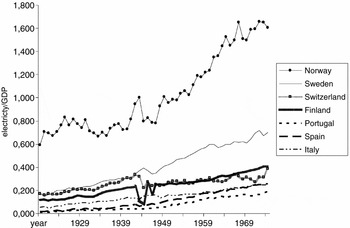
Assuming that there were no economical or climatic constraints, and that the technical productive potential from rivers could be fully explored, Norway could deliver to its citizens and enterprises an annual electricity consumption of almost 45,300 KWh per capita, Sweden 11,200 KWh, Finland 5,300 KWh, as opposed to the Swiss potential of 8,000 KWh (average 1950–5). By comparison, the figures for the hydropotential technically available to the southern countries are very different, these varying between 600 KWh per capita (Italy), 1500 KWh (Portugal) and 2200 KWh (Spain). In terms of per capita income, the development gap was not particularly pronounced at the beginning of the twentieth century: with the exception of Switzerland at one extreme and Portugal at the other, all countries converge at 60–90 per cent of average gross domestic product (GDP) per capita for western Europe.Footnote 12 The main feature is, nonetheless, the earlier promotion of the potential of river resources in northern Europe and a rapid move into high electricity intensities, taking advantage of the technological achievement of alternate current, hydro-turbines, transformers and dam building with concrete structures reinforced by iron. After the end of the First World War, each unit of GDP from the aforementioned Nordic countries and Switzerland required more electricity than the corresponding unit of the more industrialised and wealthier economies, such as Germany, Britain or France. The subsequent trend depicts a tendency for a sustained increase in the electrical intensity, and acceleration can even be seen in the annual electricity growth relative to the increase of GDP after 1950s (see Figure 1). Switzerland, which slows its consumption in a period of increasing GDP, is the exception.
Electricity intensity of northern and southern European countries (primary electricity/GDP; KWh/1990 Geary-Khamis dollars)
Sources: B. Etemad and J. Luciani, World Energy Production 1800–1985 (Geneva: Droz, 1991); A. Maddison, Dynamic Forces in Capitalist Development (Oxford: Oxford University Press, 1991); A. Maddison, The World Economy: A Millennial Perspective (Paris: OECD, 2001); D. Baptista et al., New estimates for Portugal's GDP 1910–1958 (Lisbon: Banco de Portugal, 1997); M. Pinheiro, Séries Longas para a economia Portuguesa pós II Guerra Mundial (Lisbon: Banco de Portugal, 1997); A. Carreras, ‘Gasto nacional bruto y formación de capital en España, 1849–1958: primer ensayo de estimación’, in P. Aceña and L. Prados de la Escosura, ed., La nueva Historia Económica en España (Madrid: Tecnos, 1985), 17–51; L. Prados de la Escosura, Spain's Gross Domestic Product, 1850–1993: Quantitative Conjectures (Madrid: Papeles de Trabajo de la Universidad Carlos III, 1995).

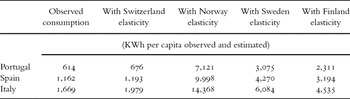
While Nordic prime movers set up a tendency to sustainability in the first half of the twentieth century, the take-off in the Iberian Peninsula occurred only in the golden age of European reconstruction, and on another scale. Italy is to some extent a mixed case, with an early start and relative preferences for hydro-power but restricted resources for the larger population. It is possible to achieve a clear picture of the differences involved by means of counterfactual reasoning: the main point is to know what consumption would be, in KWh per capita, if the southern countries had the same elasticity of primary electricity relative to GDP as the other nations. In other words, for a given level of development, what would the expected level of electricity consumption be per capita be, assuming that the paths of Switzerland, Norway, Sweden and Finland could be followed? The results, presented in Table 1, show observed and expected consumption after the take-off and consolidation of energy investments in the Mediterranean area (1966). Although this was a period of enthusiasm, with modernisation and effective catch-up relative to the most developed world, the progress in electrical intensity falls far behind Scandinavian standards: to be integrated in the group of leading hydropower nations, consumption would have to be three to eleven times higher than it actually is (Table 1).
Primary electricity consumption in Southern European countries in 1966.*

*Estimated elasticity deduced from the regression of electricity consumption on gross domestic product for the period 1920–1974 for Switzerland, Norway, Sweden and Finland.
Sources: as Figure 1.
The less expressive embodiment of electricity in the average income of the southern countries is partly a function of lower levels of total energy consumption, and partly a function of the availability of hydrological resources, and the economies of scale achieved through production, distribution and interconnection. Moreover, these basic differences in potential had also aggregated effects in the use of thermal power, with a split between, on the one hand, countries with an installed over-capacity sufficient to ensure supply during peak periods and support functions almost through the intensification of dams' production and the management of accumulation reservoirs (Switzerland, Norway and Sweden) and, on the other, the group of nations where peak supply is dependent on the support of subsidiary thermal stations, and where the drier and flatter southern parts make electricity generation in these zones reliant on coal until some interconnection of national networks is finally set up (Finland, Spain, Portugal). Italy follows a double trajectory, beginning close to the group of nations entirely based on hydro-electricity, and finishing closer to the other group. Prompt exploration of the technically available hydro-potential guaranteed six decades of self-production (Italy was the nation with the best ratio between its hydropotential and the electricity effectively produced). As this resource became progressively exhausted and a widespread national network demanded further inputs, a swift transition was thereafter made to a half-thermal–half-hydro partition, aligning the country to the French yardstick of energy production (in 1960–70).Footnote 13
Thus the principle that producing more of the substitute requires more of the thing that is supposed to be substituted applies directly at the sector level of countries characterised by necessary complementarities between hydropower and thermal power. In the Iberian peninsula these kinds of constraint affected both the industrial structure and the regionally competitive cost of energy; under a framework of open conditions of access to concessions and a slow transfer of technology and capital, the possibility of investment in central power stations for regional supply led to the separate developments of local networks, with restricted economies of scale in distribution and interconnection. While the northern regions of the peninsula saw an inflow of capital fuelled by investments from national banks and large entrepreneurial syndicates, as in the case of Hidroeléctrica Espanola, Hidroeléctrica Ibérica in the Basque country, and União Eléctrica Portuguesa on the coastline of Oporto, in the southern regions of thermal power this role was taken by foreign capital linked to the electrical equipment manufacturers – Compania Madrileña de Electricidad, Barcelona Traction, Sevillana de Electricidade and Companhias Reunidas de Gás e Electricidade in Lisbon, associated respectively with the foreign firms AEG, General Electric and SOFINA, and the American–Canadian entrepreneur Frank Pearson.Footnote 14
Because thermal power was obtained mainly through coal imports and thus bore transportation costs, the Atlantic regions enjoying competitive coastal access to British coal received a premium for thermal production and for their integration into technical systems (in Portugal and Spain these regions were the coastal towns or cities of Oporto, Lisbon and Bilbao).Footnote 15 The situation did not change significantly when the Mediterranean states began to promote the industrial use of domestic coal through tariff protection, subsidies and quotas for national consumption, because the mines, too, were located close to the seashore outposts (the Basque and León provinces, and the Oporto hinterland).
Aggregated data shows that the flows of investment into dam building were followed by declining prices in the supply of electricity to private and business consumers.Footnote 16 The possibility of a general cost advantage brought about by more intensive exploitation of hydro-potential is also a consequence of the gains in the economies of scale achieved through the expansion of existing distribution networks. This idea points to the use of thermal energy, in small and isolated networks, as the less competitive component of the sector. Nevertheless the drive towards hydroelectricity and long transmission lines can also be a source of inefficiency and dissipation of income: whenever there is an extension of the distribution lines without a corresponding increase in voltage, what follows is an increasing loss of transmission. Because the resistance of a conductor increases according to its length, great distances will boost the difference between the inputs of energy supplied in productive stations and the volume that consumers effectively receive at home. A possible alternative would be to change the cross-sectional area of the conductors, but this technological solution has the drawback of changing the entire physical infrastructure of the lines. It was particularly in Spain that the decentralising of private distribution networks worsened the levels of energy loss, with a total of 25 per cent loss in electricity produced in 1935.Footnote 17
To sum up, the argument of limited substitution in the hydroelectricity development of the southern countries emphasises factors that work against the multiplier and the looping effects of energy in industrial innovation: minor useful hydro-potential, industrial dispersion, constraints on interconnection and price asymmetries direct the opportunity cost of electricity towards the replacement of customary energy sources of light industry, transport and private consumption, but do not provide the incentive for the embodiment of this form of energy in capital goods, nor the supply of cheap inputs to large industrial consumers. Hence electricity substitution rather than electricity adding, played a dominant role in the this stage of economic development.
A concluding issue relates to the institutional environment of the markets in northern and southern Europe. A contrast exists between the expansion conducted by the private sector, with little direct involvement of public authorities, that is characteristic of the formative years of electricity development in Italy, Spain and Portugal, and the strong commitment of the public authorities in northern Europe, where the promotion of electrical undertakings and the expansion of networks was pioneered by investments from the municipalities (Norway and Switzerland), or by a mix of state-owned enterprises and private companies (Sweden and Finland). Hence private dominance, public–private mix and municipal guidance constituted three different roots of financing and ownership, roots that affected the speed of industrialisation.
According to Robert Millward, the municipalisation of European public utilities started to take over in regions with strong local government, in a technological context that favoured the progress of small networks and was linked to the vital need for revenues from growing industrial towns. Conversely, regions with small units or limited powers developed to a limited extent municipal management infrastructures.Footnote 18 In the particular cases analysed here, municipalisation also appears stimulated by the flexibility of capital requirements, since the varied assortment of waterfalls and rapids in Norway and Switzerland, often at high altitudes, gave more freedom of choice in installed capacity, allowing for either small-scale hydropower plants or super power plants, and generally supplying one load centre. Moreover, this diversity also had consequences in the size of the transmission lines, which could be significantly shorter than in other countries, thus improving the cost-efficiency ratios of supply (voltage of the lines: losses in transmission).
The nature of Swedish and Finnish watercourses is quite distinct. In this case, the imbalance between exploitable waterfalls and the main areas of urban settlement ‘favoured institutions and organisational solutions with considerable capital resources and expertise’.Footnote 19 The direct engagement of the central state through large-scale investments was the way to overcome the shortages of local networks, and this created an integrated (planned) synchronism between the boost in hydroproduction and the expansion of distribution. The result was the emergence of a public entrepreneurial sector, with all the characteristics of ‘national champions’ guidance: market power to set reference prices for private actors; expanded geographical coverage to serve as a vertebral column for a wide national grid; supply to both private households and industrial consumers, with competitive prices (Swedish Vattenfall in 1921 and the Finnish Imatra Voiman Oy in 1932).
The Mediterranean countries faced a similar challenge from their northern counterparts, namely the need to build large-scale trunk lines to deliver the energy produced to centres located far away, with the additional drawback that there was considerably inferior potential for hydropower for the larger population. The absence of the state seems therefore paradoxical, or, at least, a denial of the Gerschenkron rule that the less advantageous the situation, the more intense will be state intervention. A common factor of the institutional environments of Italy, Spain and Portugal was the ‘granting of concessions to applicants on a first-come, first-served basis’, establishing the tradition of open licensing, with limited scrutiny for negative externalities, through farmers' and fishermen's claims, in the use of water flows and with minimal requirements for technical and financial expertise on the part of the applicants.Footnote 20 The acquisition of property rights in the access to watercourses and the capture of the supply to major urban centres by private enterprises and financial syndicates was the consequence of this institutional layout. Because the concessions were extended to fifty or sixty years, the margin of intervention of public powers was progressively narrowed and the principal watercourses taken by private rights. As the years passed, the goals of public authorities converged on limiting the effects of private ownership, through the establishment of price ceilings for the KWh paid by consumers.
The absence of the state combined with weak municipal powers indicates therefore that the risks of initial investments were allocated to the private sector. There were, it is true, attempts to change the institutional environment of south Mediterranean countries – in particular some official initiatives to set up a national electricity grid in the 1920s (in Spain, Italy and Portugal) – but these attempts did not go beyond the projects and studies phase. In terms of per capita consumption of electricity, the gap between these and the other European countries widened in the period between the wars. Another consequence was that co-operation – essential for the interconnection of electric networks – seems to have developed more steadily whenever public authorities were part of the voluntary agreements. It became difficult for Portuguese, Spanish and Italian enterprises to sign accords, to harmonise frequencies and, above all, to realise these objectives in a capillary-linked distribution system. Pressure and criticism about the performance of the private electric sector, combined with appeals for rationalisation, were amplified by the difficulties of the Second World War. The contrast with the Scandinavian model of club regulation assumes here an overriding significance.
IV
The attempt to emulate the northern patterns of electricity adding is likely to be groundbreaking the more a country lags behind all the others in income and energy consumption. In the first half of the twentieth century, Portugal had the lowest consumption of electricity per capita, and ranked below Spain and Italy also in its primary energy consumption and GDP per capita, in the level of urbanisation and in the high-voltage trunk lines per square kilometre. Although private networks began to acquire visibility in comparison with the production of isolated engines and generators, changes were slow due to the reduced installed capacity in thermal and hydropower stations, the fragmentation of markets, the huge regional disparities in prices and conditions of energy use, and the lack of a coherent relationship between production and distribution.
The clearest evidence of the relative stagnation that affected the whole energy sector is to be found in the consumption of primary energy per capita, with an annual maximum of 240 km of coal equivalent per person reached in 1913, and only equalled at the end of the 1930s. At this juncture a generation of young engineers began to call for an active programme of modernisation and investment, through determined intervention by the public authorities. The question was nonetheless equated strictly in terms of electricity substitution and import substitution. Portugal was dependent on coal, which represented 88 per cent in 1920–5 and 80 per cent in 1930–5 of all commercial energy inputs used by society. Nationalist leaders and technical experts looked on the flow of watercourses as a pure waste of resources that could be better used to improve the trade balance. Investment in hydropower was thought of as part of macroeconomic policy, and only secondarily as an object of industrial policy. The idea that the interconnection of the different private stations was one of the keys to solving the problem of backwardness started to absorb the attention of engineers. Ezequiel de Campos, one of the exponents of electrification and a remarkable engineer from the First Republic (1910–26), stated that such interconnections would make it possible to turn the monthly load charts ‘blue’ – that is, once co-operation had been ensured in network terms, electricity would be produced mainly by dams, relegating the burning of coal to a secondary position. Interconnection and the co-operation between producers is thereby viewed earlier as an alternative to the investment in generation capacity, since it allowed the distribution of peak loads over a broad interconnected production base. Moreover, a complementary move into hydroelectricity was also viewed as a national imperative, since there was the threat of granting the main concessions of Portuguese water resources to foreigners. Campos refers explicitly to Spanish investments in the large production facility and strategic distribution network located in the north.Footnote 21
Another perspective of the purposes, targets and means of public intervention in the electric sector emphasised not the substitution macroeconomic effect, but rather the multiplier microeconomic effects. Its exponent was also an engineer, Ferreira Dias, whose importance in the administration of the recently created authoritarian New State (‘Estado Novo’) grew as the 1930s unfolded. In Ferreira Dias's view, the promotion of electricity was part of an integrated programme of industrial modernisation, based on the launching of new manufacturing activities and on the restructuring of traditional production through concentration, rationalisation and competitiveness. Electricity consequently became an argument in favour of fostering economies of scale through a global strategy to clean up the myriad small-size firms, while (exceedingly) cheap electricity became the necessary incentive for the introduction of new industrial sectors of electrochemicals and electrometallurgicals. Instead of the gains achieved through electricity substitution, Ferreira Dias appealed to the gains achieved through electricity adding and to a closer embodiment of energy in capital goods and intermediary goods.Footnote 22 This change of vision also brought about a redistribution of the institutional roles of agents in the markets: while Ezequiel de Campos's focus on coal replacement led him to favour municipalities and private enterprise as the appropriate actors in development, these bodies now seemed too weak to drive the strong surge that was needed. Only the central state had the conditions and capacity to surpass the achievements of and embark on a path different from the developing municipal and private undertakings. Where the liberal-nationalist version of Ezequiel Campos endorsed the idea of pull-out planning, with the pooling of energy from utilities but preserving their legal identities, primarily as distributors of such energy, the state nationalist version of Ferreira Dias understood that a more radical switch was necessary: if the country's ambition was to emulate the pattern of the electricity adding of industrialised nations, then the system must be made entirely anew, in parallel with the previously existing infrastructures. ‘Subordination’ rather than ‘integration’ becomes the keyword of industrial policy. In the presence of very ambitious plans, the past could be made a vacuum. State nationalism introduces thereby the most radical version of planned systems, a version in which the productive system can be ‘born’ from the singularity of a legislative initiative.
Paradoxically the several attempts at pull-out planning led by Ezequiel Campos were doomed to failure both at central state level and at municipal level, while the hard version of state pull-over succeeded in achieving its goals. An important factor in this outcome was the ongoing change of relations between the state and private forces that took place in the 1930s during the and ending of the liberal First Republic and the consolidation of the regime of the authoritarian New State. During the Second World War Ferreira Dias was invited to become secretary of state for industry. Despite resistance to his heavy industrialisation programme on the part of conservative and agrarian political supporters of the Portuguese authoritarian regime, there was an argument for urgency that was difficult to counteract: supply difficulties caused by the world conflict now hit the country severely, with a general shortage of energy and primary foodstuffs. Entire woodlands were levelled and the consumption of traditional fuels increased to 74 per cent of the total industrial energy consumption, corresponding to the use of roughly 676,000 tons of fuel wood and 18,000 tons of charcoal.Footnote 23 A clarification was made to hasten along events: through the Order of 7 June 1943 the state undertook a first test of the interconnection of high-voltage distribution systems, interfering in the load maps of private producers. Under this compulsory policy, five private hydro companies of the north were grouped in the Commission for the Interconnection of Power Stations, with the aim of reducing the activity of the thermal power stations as much as possible. The most profound intervention in the economic circuit of distribution had the aim of introducing rationing and resulted, in the energy sector, in a policy of replacing ‘black coal’, an imported good that was becoming scarce, with the ‘white coal’ of the hydroelectric power stations.
The state of emergency justified such a subordination of private interests to the priorities of public order. The authorities condemned the ‘individualistic spirit’ ‘which is more concerned with the private needs of each company at a certain period in its existence than with the needs of the whole’ (Edict of 17 February 1945). In those difficult times public good was identified with the economy of networks – that is, with co-operation processes based on centralised decisions that affected the whole. In practical terms, this reality was embodied in the subjection of the load plans of each producer to the network's demand requirements. The most important conclusion to be drawn from the interconnection experience is that of the network's general debility and the need for improvisation: the idea proved to be too ambitious with regard to the available technology. The joining together of the various producers in a system of co-ordinated distribution met with the objections of the individual directors of each company and caused fragility in the switching stations.
With the publication of Law No. 2002 in 1944, the first steps were taken towards the creation of an economic and legal framework for a national electricity grid. The main strategic lines pointed to the creation of a new system from the vacuum of incipient private and municipal undertakings. In order to do this, gross investments had to be planned with a clear synchronisation between the increase on the supply side (new dams and overwhelming amplification of the installed capacity) and the increase on the distribution side (augmentation of the nominal voltages of the lines and a broad extension of the network to serve the main centres of consumption).
Such a two-fold scenario materialised over the next few years. Through a legal document signed in October 1945, the companies Hidroeléctrica do Cávado and Hidroeléctrica do Zêzere were set up, enshrining the model of a joint venture, financed by public and private capital, for the exploitation of large-scale hydroelectric power stations on the Zêzere and Cávado-Rabagão rivers. In 1947, a new company was formed – Companhia Nacional de Electricidade (CNE) – which was given the concession for the transport and distribution network, with primary trunk lines of 150 KW, under the same joint-venture model. The government attempted an inclusive policy of integration of private power companies in the national goal of electrification by offering them the possibility of becoming shareholders in the new ‘champions’ of the sector. However, a problem remained: if the primary network were to be built from scratch, what would be the future of the high-tension networks already installed and operated by private companies? Duplication of trunk lines would undermine the benefits of a monopoly position and shrink the economies of scale in energy distribution. The issue was debated mainly by the private enterprise that had the largest distribution network and the ambition to develop its lines into the backbone of a national infrastructure: União Eléctrica Portuguesa (UEP) had patiently led the expansion of distribution to new villages and regions, from a small line of 36 km in 1923, which grew to 612 km in 1930, to 1,001 km in 1940 and to 1,493 km in 1945.Footnote 24 Now the competition from state planning carried the threat that this effort could turn out to be completely redundant, since the new trunk lines would be superimposed on an already existing system. UEP tried in every way to defend the idea that there should not be a monopoly of high-voltage distribution, and that competition between the new ‘common pool’ and the older, private trunk lines was desirable. Looking further ahead, the administration even presented a project for building new lines to supply electrochemical firms in the near future.Footnote 25 However, these manoeuvres were defeated by the unwavering stance of the public authorities, and the principle of a natural monopoly in electricity distribution was once again reiterated.
The legal distinction between the primary network built from scratch by Companhia Nacional de Electricidade, and the secondary networks which included the lines already exploited by private companies, led to a compromise between the past and the future, between the rights acquired by the companies and the innovations introduced by public-investment policies. In practical terms, the seven-fold increase in installed hydroelectric power reconfigured the whole system; private companies abandoned their roles in national distribution and progressively reduced their investment in production, thereafter taking the role of regional distributors of electricity, most of which was bought from the large hydropower plants and delivered through the national grid.
V
A technological and political impasse regarding the integration of small and medium-sized private networks offered the state the opportunity to build a new infrastructure and to redesign the entire system. Local production, regional distribution and national interconnection became simultaneously the components of energy take-off.
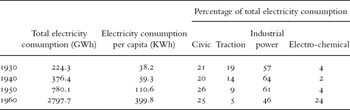
Not surprisingly, contemporaries understood these events as the legitimate ‘foundation’ of the industrial surge of the country, the ‘big bang’ of modernisation. But how deep could the embodiment of energy be in capital goods and intermediary goods? Reference to Table 2 shows that the expansion of electricity use is explained, in the first place, by the accumulated weight of industrial activity in total consumption, reaching almost 70 per cent by the 1960s (given as industry and electrochemicals in Table 2). The interesting point is that this advance does not offset the place occupied by civic consumption: the progress of industrialisation and the introduction of heavy industry goes together with the increasing share of private households and services in modern energy forms, designated in the table as ‘civic consumption’. This is perhaps due to a low starting point, since distribution networks covered only 40.8 per cent of the population in 1930–2, and of these potential users only 15 per cent effectively had electricity at home. Although it is not within the scope of this paper to analyse the indirect consequences of electrification through asymmetric effects on welfare, it is worth noting its coincidence with a cycle of progress in literacy.
Electricity consumption in Portugal, 1930–1960

Sources: Population Census 1932–1962 (Lisbon: INE, 1933–63); Statistics of Electric Installations (Lisbon: Imprensa Nacional, 1930–60).
In both absolute and relative terms the industrial consumption of electricity increased. Within the manufacturing sector, the tendency was for the decline of the traditional sectors (textile, extractive industries, wood and cork manufacture), where input substitution had shown some progress. This decline can be observed both in the added-value and in the volume of energy consumption, and was compensated for by the growth of the high-intensive (electrochemicals, ceramics and glass, metallurgy) and medium-intensive sectors (paper and paper products, metal products, chemicals).Footnote 26 Electricity adding instead of electricity substitution appeared as the main outcome of industrial policy.
The more rapid increase in electricity consumption relative to industrial output was contemporaneous with the surge in supply through large hydropower investments that drew the country closer to European levels of primary-energy consumption; from fewer than 200 kg of coal equivalent (kgce) per capita before the Second World War, there was an increase to more than 500 kgce in the 1950s and over 1,000 kgce after 1969. This period has been seen as the precise moment of acceleration in economic growth, resulting in a real convergence with the more developed nations, and signalling Portugal's entry into a phase of ‘modern economic growth’, according to Kuznets's classical definition.Footnote 27 But if the multiplier effects of the diffusion of modern energy carriers seem undisputable, the surge of hydroelectricity was nevertheless a short-lived one, particularly when compared with the Nordic countries. This means that the goal of feeding the productive sector with cheap electricity soon reached its limit, and only through direct state cross-subsidisation of industrial prices could the competitiveness of intensive sectors be maintained. By the 1960s the abandonment of the cluster hydroelectricity-intensive industries already lay on the desks of ministers and entrepreneurs. As the price of cross-subsidisation went up and the periods (days) of supply grew shorter, the government decided to authorise the production of nitrates, sulphates, ammoniac and other goods using chemical/oil-based processes, dumping the priority of electrolytic technologies that were responsible for the high consumption of electricity. After the move of electrochemical industries to chemical/oil-based processes, the major railway line also became ‘fuelised’, and investment was concentrated thereafter in thermal power stations that burned liquid fuels, most notably the Carregado (1964) and Setúbal (1973) power stations, with an installed capacity of 500 MW and 1,000 MW respectively. On aggregate, the demand for hydroelectricity reached its peak in 1967, with a share of 45 per cent of the total primary energy consumption, and its importance declined thereafter: in 1973 it accounted for 30 per cent of consumption, and in 1982 only 15 per cent.Footnote 28
The emulation of the most-developed nations, the emphasis on electricity adding and the aim of swift industrialisation led a southern country with hydro-resources very different from those of the Nordic countries, to follow the path of the stimulus to manufacturing of cheap electricity. The paradox is that if the ‘nationalisation’ of inputs caused the economy to drift towards more intensive industrial sectors, what really sustained these intensive sectors shortly thereafter were oil imports. Scarcities in the hydro-potential set a ceiling on electricity–adding strategies. Modernisation could proceed as long as the international price of oil was low and accessible. The bill to be paid for that course of development reached a dramatic moment in 1974 when the Organization of the Petroleum Exporting Countries (OPEC) suddenly raised the price of crude oil.
VI
For most of the first decades of the twentieth century Spain also faced proposals of pull-over planning and integrated industrial development. Unlike Portugal, this country did not follow the path of centralised interconnection based on hydroelectricity. Without going into detail, it is safe to say that the Spanish electrical system took a more decentralised route as far as participants and decision making were concerned; hydroelectricity was of minor importance in primary energy consumption (similar to oil), and emphasis was placed on increasing capacity rather than on capacity saving through networking. The emulation of northern patterns was consequently weaker than in Portugal and the embodiment of electricity in capital and intermediate goods based in a wide scope of power sources.
History partially explains this trajectory. In Spain the most ambitious plans for state intervention through the creation of integrated clusters based in electricity acquired momentum throughout the 1920s. This was the golden age of the expansion of hydroelectric capacity, pushed by relative price advantages towards the alternative use of coal (both imported and national) by an industrial spurt that boosted the demand for energy products and services and by the escalation of foreign investment.Footnote 29 The doubling of capacity and the fourfold increase in total electricity production within ten years (1,027 Kv of capacity and 2,433 GWH produced in 1929) awakened the idea of a demand-side push to foster economies of scale, either through the electrification of railways or through the advancement of the incipient electrochemical sector. These views linked central state involvement in setting up a high-voltage distribution network to a leap in the level of production, obtained from coal (mainly domestic coal from Asturias) and from hydroelectric expansion on the Ebro and Duero rivers. Interconnection plus increased capacity thus become a joint issue to justify centralised schemes of pull-over planning. But despite the appointment of successive commissions under the dictatorship of Primo de Rivera (1923–30) and during the Second Republic (1931–5), the initiatives finished in a dead end.Footnote 30 Afterwards, the victory of General Franco in the civil war and the implementation of a crude autarkic style of traditional interventionism (1939–51)Footnote 31 sidetracked the hydroelectric sector from having any possible influence in the capital goods industries. In an atmosphere of unrelenting political repression, the regime embraced the solution of a controlled economy characterised by isolation from foreign markets, limitations on foreign investments, interference in the allocation of resources, price ceilings and rationing of goods. The twisted economy of coupons and black markets that surfaced encouraged the diversion of scarce energy resources to the priorities defined by the state, favouring administrative services and import substitution industries such as cement, iron and steel, and metallurgy. Overall strict control over production, prices and the consumption of coal, combined with the freezing of electricity tariffs, resulted in excess demand, blockage of investments and underutilisation of industrial power in certain regions, principally Catalonia.Footnote 32 On the other hand, the overt hostility towards foreign enterprises embodied in the linkage between the Franco government and the forerunners of corporative-nationalist leaders of the National Review of Economics (Revista Nacional de Economía).Footnote 33 The difference is that the nationalisation of resources could now be achieved without the expropriation of assets, using instead the weapons of administrative conditioning and economic asphyxia. By taking this path Franco tore up part of the entrepreneurial map. The bankruptcy of the largest foreign electrical corporation operating in Spain, the Barcelona Traction (1951) introduced a period in which Spanish firms remained steadily at the forefront of electricity companies.Footnote 34
Liberalisation come cautiously with the nomination of a new government in 1951, prompted by the atmosphere of European reconstruction, monetary co-operation and free-trade policy, by the unexpected consequences of the Korean War and also by the attempt to jump on the US aid bandwagon. The removal of most of the impediments to markets and the rise in electrical tariffs brought some return of investments, but only in 1954 was it finally possible to meet the full demands of society. The burden of fifteen years of underinvestment and restrictions on consumption directed capital towards increased capacity, which became the faster track to normalisation and expansion. Thus instead of speeding up the rational alternative of capacity saving through investment in transport and networking, the efforts of the authorities were primarily concentrated on increasing the productive capacity of the electricity companies and in the direct promotion of aluminium, fertiliser and transport equipment industries, particularly through state ownership of business enterprises grouped in a public holding.Footnote 35 This period was further characterised by the failure to emulate the autarkic example of West Germany's centralised coal economy and a switch to the hydroelectric path. Enabled by swift economic development and ‘catch-up’ industrialisation, the second blow of hydroelectricity attained its maximum 26 per cent of total commercial primary energy consumption in the 1960s. After that, oil imports come to occupy a primary position in energy production, with a weight similar to that of Portugal.Footnote 36
Restricted to the basic facts, this ‘eventful’ explanation needs to be complemented by the causal analysis of the cost to opportunity of central state command. A recent study by Isabel Bartollomé stresses in this respect the low opportunity cost of networking in Spain, given the homogeneity of the electrical regional subsystems, at different scales of production, which rendered less profitable the co-ordination of small and large centres and the gains achieved through water-flow regulation.Footnote 37 So the historical trajectory, the structural characteristics of Spanish economy or both, turned nationalist policies away from the earliest nationalist ambitions: without pull-over planning decisions became more decentralised; without central command of the network of hydroelectric power stations the regime did not face the issue of a centralised allocation of surplus energy to particular firms. Electrical development was therefore not so clustered in a ground-breaking strategy as in the Portuguese case. In these circumstances the possibility of direct intervention through the enterprises of the public holding INI is not unaccountable.
VII
Portugal and Spain followed a path of electricity substitution, with the replacement of inputs in established sectors of light industry, public utilities, transport and private consumption. As a result, their societies consumed not only more electricity, but also more total energy for each unit of goods and services produced, which meant that the total energy consumption and electricity consumption both moved in the same direction. Three long waves are detected: a slow rise of total consumption up to 1945; a phase of total energy increase coinciding with the post-war industrialisation surge, more pronounced in Portugal than in Spain; and a non-linear decline in the ratio of energy use relative to GDP from the 1960s onwards. Because electricity-substitution opportunities were limited in the first half of the twentieth century, each unit of GDP still demanded further inputs of energy produced from coal, firewood, oil and other non-electrical sources. It was only after a transition period of high consumption that the countries of the Iberian peninsula started to incorporate energy in capital and intermediate goods, and to improve the quality of energy services, making gains in overall macroeconomic efficiency. Albeit slightly, the decline from the 1960s in the ratio of energy use relative to GDP put the Iberian peninsula on the path taken by the Scandinavian countries fifteen years earlier. This is the positive side of copying from the hydroelectricity pattern of development. However, the case study presented here of Portuguese industrialisation also highlights the dark side: the potential in the south of hydro-resources constituted a comparative advantage only in the initial phases of energy take-off. Once the economy drifts towards high-intensity industrial uses, prompting a demand-side pull, the exponential growth of consumption brings to light the technical and economical limits of fossil-fuel substitution. Moreover, the enthusiasm generated by dam building began to wane in the face of the cheap oil that invaded the world markets. Compared with northern Europe, this is a new circumstance in which the moment of entry into a process of electricity adding conditions the scope and the opportunities available. The Portuguese case demonstrates the paradox that the pattern of industrial development based on hydroelectricity only came to be fully realised with imported oil. From this point of view one of the primary consequences of state nationalism was for the economy to drift towards more intensive energy usages irrespective of the potential of national resources available.