INTRODUCTION
The Erlitou site is located on the south bank of the Luo River, 9 km southwest of Yanshi city in Henan Province, China. The Bronze Age site was discovered by archaeologists in 1959 when they investigated the Xia people’s remains (Xia ruins). This region was once inhabited by the Xia people according to ancient documents (Hsu Reference Hsu1959).
The site immediately attracted great attention as soon as it was discovered. Since then, there has been a standing debate about whether the site belongs to the Xia or Shang dynasty. By the mid-1990s, there had been hundreds of discussion articles on the issue, but it was still unresolved (Zheng Reference Zheng2002).
Ancient documents indicate that there was a Xia dynasty in ancient China that preceded the Shang dynasty. The Xia dynasty existed from about ∼2100 to ∼1600 BC, and the Shang dynasty was in about ∼1600 to ∼1000 BC. The existence of the Shang dynasty has been proven by the inscriptions on oracle bones unearthed at Yinxu (Ruins of Yin), the site of the late Shang dynasty in Anyang, Henan Province. Large tombs, royal mausoleums, and handicraft workshops have also been found, along with many precious cultural relics. However, sites of the Xia dynasty have not yet been found.
Regarding whether the Erlitou site belongs to the Xia dynasty, it seems that evidence from an accurate chronology is critical. In the mid-1960s, under the leadership of the famous archaeologist N. Xia, the director of the Institute of Archaeology, Chinese Academy of Social Sciences, S. H. Qiu and L. Z. Cai established the first 14C dating laboratory in China—the 14C Laboratory of the Institute of Archaeology, Chinese Academy of Social Sciences (Xia Reference Xia1955; 14C Lab 1972). In the mid-1970s, the laboratory began to date samples from various archaeological sites, and the history of 14C dating of the Erlitou site began at that time.
BRIEF OVERVIEW OF THE ERLITOU SITE
From the time of the discovery of the Erlitou site to the mid-1990s, more than 60 excavations have been carried out at the site, and the work is still ongoing.
The first stage of these efforts gradually clarified the overall outline of the site. The orientation of the site trends slightly northwest-southeast. The longest axis, from east to west, is about 2400 meters; and the widest portion, from north to south is about 1900 meters. The total area is about 3 million square meters (Xu et al. Reference Xu, Chen and Zhao2004).
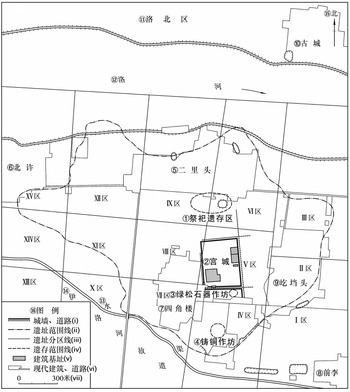
The second stage of the work determined the general layout of the site. It is mainly composed of a central area and a residential area for common people. The central area occupies the southeast part of the site, and extends to the middle part, including a palace area (district V), a copper workshop area (district IV), the sacrificial activity area (district VI and the southern part of district IX), and some residential areas for the nobility (district II-IX).The residential area for common people is in the western part and the northern part of the site (the western part of district VII and VIII; district XI, XII, XIV, XV, and the northern part of district VI and IX), including small ground-level and semi-subterranean houses, small tombs, etc. (shown in Figure 1).
Layout plan of the Erlitou site (Xu and Yuan Reference Xu and Yuan2019). Relics: ① sacrificial relic area; ② capital city; ③ turquoise workshop; ④ copper casting workshop. Modern village and administrative district: ⑤ Erlitou village; ⑥ Beixu village; ⑦ Sijiaolou village; ⑧ Qianli village; ⑨ Gedangtou village; ⑩ Gucheng village; ⑪ Luobei district. River, cutline, etc.: ⑫ Luo River; ⑬ water channel; ⑭ old course of Yiluo River; ⑮ north; ⑯ cutline. (i) city wall, road; (ii) site boundary; (iii) site districting line; (iv) relic boundary; (v) building foundation; (vi) modern architecture, road; (vii) meter.

Dozens of rammed-earth building foundations were found in the palace area of the site, ranging from 20 to 400 square meters. Many of these belong to large-scale palace foundations. In addition to these foundations, a drainage system among the foundations and road network outside the palace building foundations were also discovered (Erlitou 2004).
The capital city was established in the palace area in the late period. Many medium-sized tombs were found in the northeast section of the capital city, with luxury artifacts such as bronze, jade, and lacquer. A total of about 400 tombs were found in the site. Pottery kilns, ash pits with waste aggregates and semi-finished bone tools, and ash pits with turquoise waste were also found in the site.
The Erlitou culture of the Erlitou site is divided into four phases. The remains of the first phase were mainly found in the middle and eastern part of the site, covering an area of up to 1 million square meters. Large-scale building foundations were constructed primarily during the second and third phases. Most of them were still in use in the fourth phase, and some were expanded in that period.
In the second phase, the palace area was constructed in the southeast part of the site, and two large-scale palace foundations were found there. Copper casting workshops appeared in the south of the palace area, and a network of roads was located outside the complex. The site area at this time reached millions of square meters.
In the third phase, a rammed-earth wall was built around the palace area to form the capital city, and five large-scale palace foundations were built there. The layout of the palace foundations is symmetrical from east to west.
In the fourth phase, three more palace foundations were built in the palace area. The quality of bronze vessels, jade, pottery, etc. found in the tombs was better than found associated with the third phase, and the quantity also increased in this period.
According to archaeological research, from the Neolithic Age to the Erlitou culture of the Bronze Age in the Central Plains we find the Peiligang culture-Yangshao culture-the phase II of Miaodigou culture-Longshan culture. After the Erlitou culture was the Shang culture. While in the period between the Longshan culture and the Shang culture, a large number of Erlitou cultural sites were discovered around the Erlitou site in this area and the Erlitou culture became dominant in the area at this time (Xu Reference Xu2009).
Regarding the discussion of the Erlitou site, the views of the scholars can be summarized into four main categories.
-
a. The first phase to the fourth phase belong to the Xia culture.
-
b. The first phase to the third phase belong to the Xia culture, and the fourth phase belongs to the Shang culture.
-
c. The first phase to the second phase belong to the Xia culture, and the third phase to the fourth phase belong to the Shang culture.
-
d. The first phase belongs to the Xia culture and the second phase to the fourth phase belong to the Shang culture (Zheng Reference Zheng2002).
14C DATING OF THE ERLITOU SITE
Looking back at the entire process of the dating research of the Erlitou site, we can identify two stages. The first stage is from the mid-1970s to the early 1990s. The second stage is the period since the Xia-Shang-Zhou Chronology Project started in the mid-1990s.
The First Stage of Dating Research of the Erlitou Site
During this initial period, the laboratory completed dating several batches of samples from the Erlitou site, and the research in this stage is represented by these results.
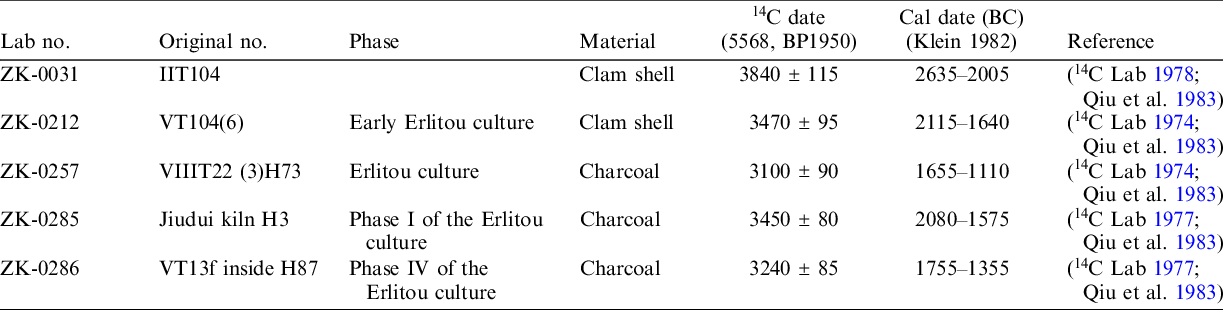
From 1974 to 1978, there were 5 dates from clam shell and charcoal samples, as shown in Table 1.
Data of the Erlitou site dated during 1974–1978.

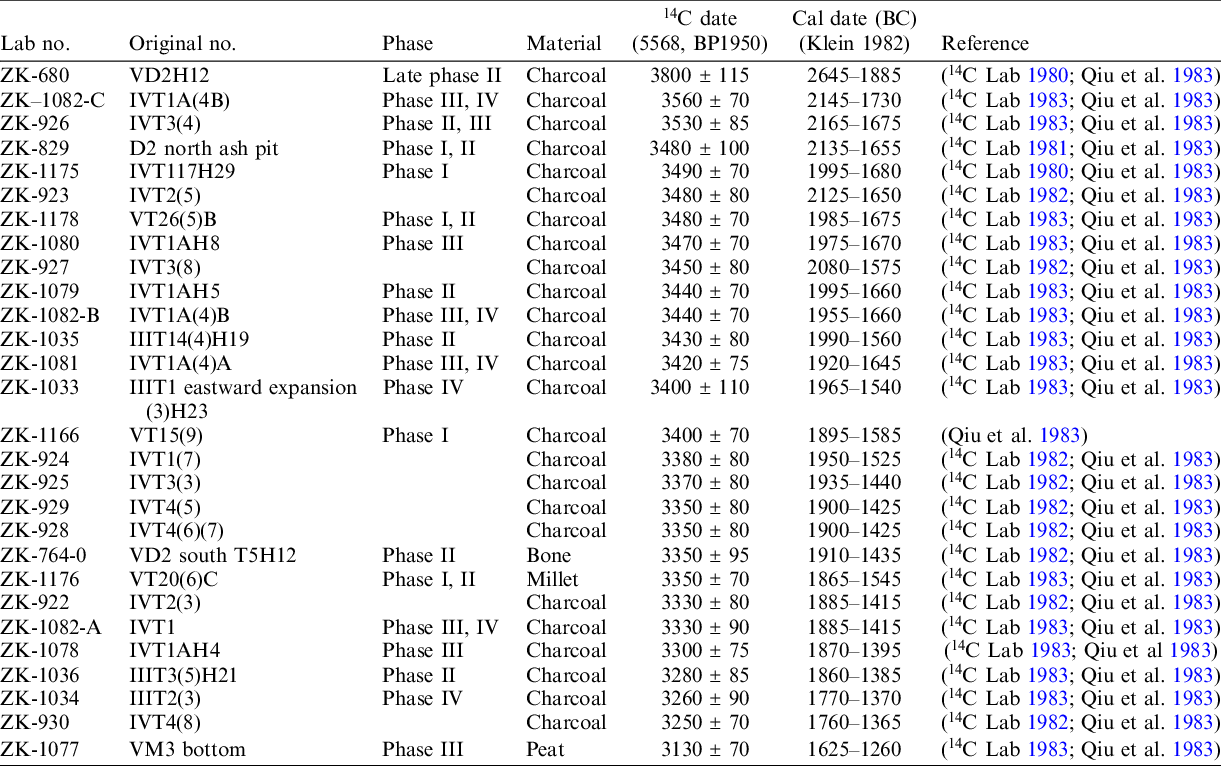
From 1980 to 1983, there were 28 dates measured, as shown in Table 2. Most of these are from charcoal, and several are from millet, bones and peat.
Data of the Erlitou site dated during 1980–1983.

Among the data in Table 1, it can be seen that a data from a clam shell, with an error over 100 years, is as early as 2600 BC, and the rest is 2115–1110 BC, covering the early to late Erlitou culture according to their phases.
The data in Table 2 are basically in the range of 2100–1300 BC except for two or three with large errors or deviations in age.
Compared with that in Table 1, the dates represented in Table 2 are more numerous, and these are associated with definite phases or specific strata, for the most part. It was reported that these samples were strictly reviewed (Qiu et al. Reference Qiu, Cai, Xian and Bo1983). Among the samples there is a millet sample which, as an annual plant, is least likely to be older in age. Moreover, it has been corrected by δ13C, ensuring its reliability.
From 1984 to 1991, there were also some dates measured from charcoal. They are basically in the range mentioned above, but most of them are not phased (Institute of Archaeology 1991).
According to the literature, it was reported that in a meeting on the Xia culture, held at an archaeological site in Henan province in November 1977, the archaeologist N. Xia mentioned the dating of the Erlitou site on the Xia and the Shang, stating that “at present, there are still some problems to be solved in radiocarbon dating. One is its own error, and the other is the accuracy of the data calibrated by tree-ring” (Xia Reference Xia1977). This quotation summarizes the progress of the Erlitou site 14C dating effort at that time.
In 1983, S. H. Qiu and L. Z. Cai systematically assessed the date of the Erlitou site using the data in Tables 1 and 2, 33 dates in total (Qiu et al. Reference Qiu, Cai, Xian and Bo1983). This was also the first research article to analyze the dating data of the Erlitou site from the perspective of radiocarbon dating. In the first part of the article, the possible problems and various influencing factors in 14C dating were sorted out. For example, if the charcoal sample is taken from heartwood, it would be older than that from sapwood in age. The later strata may be older in age due to mixing of deposits from earlier strata.
Due to the isotope fractionation effect imparted by organisms, there are age differences for different types of carbonaceous samples. Millet, for example, would be more than 200 years younger if it was not corrected. There are also errors that may be caused by various experiments, radioactivity measurement statistics, calibration curve and so on.
In the second part of the article, the 33 data points of the Erlitou site were investigated and screened thoroughly, according to sample characteristics, their sequence of phases, stratum relations, errors, the period of the calibration curve, etc. Through such a comprehensive and careful screening protocol, questionable dates were removed and true dates maintained. The date of the Erlitou culture at the Erlitou site was then acquired based on statistics, and is about 1900 BC to 1500 BC. This result provided a reliable approximate age range for the Erlitou culture at the Erlitou site. Referring to the literature, the dating result obtained is obviously within the range of the Xia-Shang period.
However, at this stage the results also showed that in the face of the problems, such as wide calendar date ranges and wide dating boundaries caused by radiocarbon dating errors and fluctuations in the calibration curve and so on, it was impossible to obtain a better chronology by trying to date more samples. This dilemma was resolved during the second stage of the dating research.
The Second Stage of Dating Research of the Erlitou Site
The specific work in this stage includes two parts: the work in the Xia-Shang-Zhou Chronology Project and in the Project on Origin of Chinese Civilization, respectively.
The Work in the Xia-Shang-Zhou Chronology Project
A Study on the Accuracy of Dating
In May 1996, a national research project-the Xia-Shang-Zhou Chronology Project began. The task of 14C dating in the project was to provide the basis for the establishment of a three-generation chronology of the Xia, Shang and Zhou dynasties. The dating of the Erlitou site was an important part of the project because it involved the study of the Xia and Shang periods.
By the beginning of the Xia-Shang-Zhou Chronology Project in the mid-1990s, 14C dating capabilities in China had gone through 30 years of development. During the period, with the continuous development of radiocarbon dating methods and techniques, thousands of 14C results had been obtained, and the prehistoric archaeological chronology since the late Neolithic Age had been established (Xia Reference Xia1977; Qiu and Cai Reference Qiu and Cai1990). At the same time, the “Chinese Sucrose Charcoal Standard” named by the National Bureau of Standards, a reference material for dating, had been developed successfully (Qiu et al. Reference Qiu, Cai, Xian and Bo1983). All of these demonstrate that 14C dating research in China had reached a good level.
However, there were challenges for 14C dating with regard to the Xia-Shang-Zhou Chronology Project at this time. This was because the periods of the dynasties, and historical stages were significantly shorter than those of the prehistoric archeological cultures and the frequency of change was faster. This required higher precision and accuracy for 14C dating, and further advances in existing 14C dating technology.
According to the requirements of the project, the research group, jointly formed by the Institute of Archaeology of the Chinese Academy of Social Sciences, Peking University, etc., carried out the following three special subjects on improving dating accuracy, dating method and technology: (1) technological transformation of conventional dating, (2) research aimed at bone sample preparation, and (3) technological transformation and development of accelerator mass spectrometry dating capabilities. Through these special studies, the precision of conventional dating reached 3‰, and that of the accelerator mass spectrometry dating was better than 5‰, which provided the necessary technical requisites to obtain high-precision dates (Guo et al. Reference Guo, Liu, Ma, Lu, Yuan and Li2000; Yuan et al. Reference Yuan, Wu, Gao, Wang, Cai, Liu, Li and Ma2000; Zhang et al. Reference Zhang, Qiu and Cai2003; Qiu Reference Qiu2015).
Calibrating of 14C Dates and Advancing of the Chronology Research on Archaeology-14C Dating
To get an accurate date, in addition to the dating precision, there is another factor to be considered—calibration errors. As we all know, the error from the 14C date to the calendar date is usually greater than that of the 14C date due to the fluctuation of atmospheric 14C levels. This is a long-standing problem in 14C dating research.
Since 1986, with the establishment of a high-precision calibration curve (e.g., Pearson Reference Pearson1986), the implementation of a method that used multiple dates and curve-fitting (wiggle-matching) has helped substantially to solve this problem. By the mid-1990s, many successful cases of using this method had appeared (e. g. Kojo Reference Kojo, Kalin and Long1994; Liu et al. Reference Liu, Wei, Qiu, Cai, Xian, Bo, Zhong and Yang1997). Therefore, in order to reduce the errors, the wiggle-matching method was employed in the Erlitou research. In fact, S. H. Qiu and L. Z. Cai had already used this method, fitting the data to a calibration curve by visual observation, as there was no computer application at that time. From the research results, it can be seen that although there was no significant change for the date, as compared to previous results, the wiggle-matching results were more robust (Qiu and Cai Reference Qiu and Cai1998).
After the project started, S. H. Qiu and L. Z. Cai made a survey and summary on the research and application of the wiggle-matching method, and evaluated the OxCal calibration program in order to prepare for the data fitting work for a series of samples in the project (Cai et al. Reference Cai and Qiu1999; Ma et al. Reference Ma and Guo2000).
Regarding the application of the wiggle-matching method, they concluded that three basic conditions must be met: (1) a high-precision calibration curve, (2) high-precision dating results with reasonable errors, and (3) a series of samples with a clear archaeological sequence. With the three basic conditions proposed, standards were established for the implementation of the wiggle-matching method in the project (Qiu and Cai Reference Qiu and Cai2001).
To obtain samples that meet the conditions of the wiggle-matching method, the research group went to various archaeological sites to introduce and explain the concept of the wiggle-matching method in detail, and proposed specific requirements for sample collection, which enabled the implementation of the wiggle-matching method to be conducted in a stable and effective way and ensured an optimal sample collection protocol.
The Dating Work during the Xia-Shang-Zhou Chronology Project
On the basis of the above work, the research group first dated some tree-ring samples. Tree-ring samples are the most ideal for this purpose, according to the requirements of a series of samples because their order and sampling interval are known unambiguously. Hence, the accuracy and reliability of the dating results can be assessed. After satisfactory results of the tree-ring sample dating were obtained, sample series dating from various sites began.
These samples include a series of tombs of the Western Zhou in Liulihe, Beijing; a series of late Shang from the Yin Ruins, Anyang, Henan province; a series of Zhengzhou Shang city, in Zhengzhou, Henan province; a series of the Erlitou site, and others. Among them, the first dating results were from the tomb M8 of Marquis Jin. Tomb M8 is located in Tianma-Qu village, Beiwo, Shanxi province. According to archaeologists’ research, a bell of a marquis named Su, of the Marquis family of Jin, was unearthed from tomb M8. Hence, tomb M8 was determined to be the Su’s tomb of Marquis Xian of the family Jin, in the Western Zhou dynasty. In light of “The Family Jin” in “Historical Records,” Su, the Marquis Xian, died in the 16th year of King Xuan (812 BC), and the date of tomb M8 by 14C dating is 808 ± 8 BC, which is consistent with the historical records of “The Family Jin.” So, the result shows that these 14C dating results are reliable (Qiu and Zhang Reference Qiu and Zhang1999).
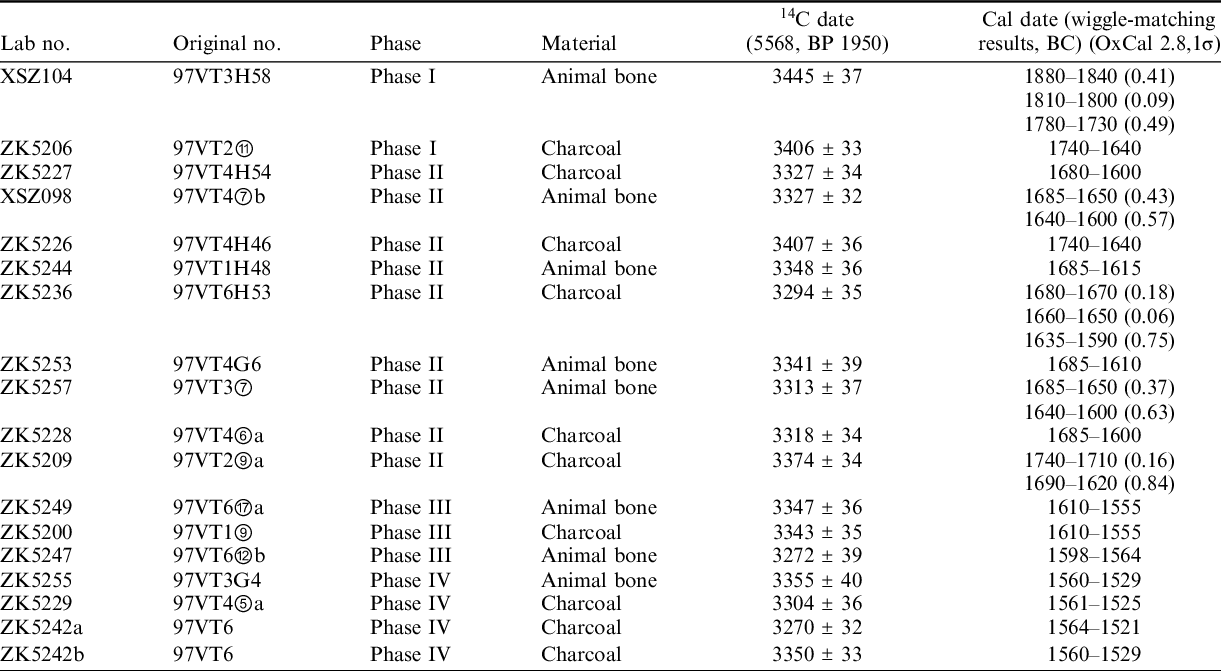
In this investigation of the Erlitou site, 18 samples, most from charcoal and some from bone, covering the first phase to the fourth phase of the Erlitou culture, were dated, as shown in Table 3. The dating results show that on the basis of high-precision dating, that error item is reduced to about 40 years, which provides conditions for the application of the wiggle-matching method. By fitting the data to a calibration curve, the date of the Erlitou culture obtained is from about 1880 BC to 1520 BC.
Radiocarbon dates of the Erlitou site during the Xia-Shang-Zhou Chronology Project.

The research result was reported in the periodic report on the Xia-Shang-Zhou Chronology Project, published in 2000 (Expert 2000). However, referring to the characteristics in the period of the calibration curve, it can be seen that there is still much more chronological uncertainty in the period of the first phase of the Erlitou culture from about 1880 BC to 1730 BC, for the results were obtained under the conditions that there were no data before the first phase of the Erlitou culture. Under such conditions and in such a period of fluctuation of the calibration curve, it is possible to allow the extension of the upper limit of the first phase to a greater extent, that is to say it may bring a greater error in date (Qiu et al. Reference Qiu, Cai and Zhang2006).
The Work in the Project on the Origin of Chinese Civilization
In 2001, another research project, the Project on the Origin of Chinese Civilization, was launched. From the perspective of chronology, it extends on the chronological study of the Xia-Shang-Zhou Chronology Project. During the Project on the Origin of Chinese Civilization, two works on the dating of the Erlitou site were completed.
The first was the dating of the samples from the late Longshan culture and the Xinzhai culture periods at the Xinzhai site by accelerator mass spectrometry dating, which was completed by Peking University. Since the stratigraphic sequence of the late Longshan culture-Xinzhai culture-the early Erlitou culture was discovered at the Xinzhai site in 1999 (Archaeology 2000), this provided conditions for the study of the age of the early Erlitou culture. Eighteen bone samples from the Xinzhai site were dated and five of them were also compared with measurements at the Vienna International Accelerator Mass Spectrometry Laboratory (Liu et al. Reference Liu, Han, Guo, Wu, Yuan, Kutschera, Ma, Priller, Steier, Wild and Zhao2005). These data of the Xinzhai site and the data of the Erlitou site were fitted together on the calibration curve, and it could be seen that the date of the first phase of the Erlitou culture was no earlier than 1750 BC (Qiu et al. Reference Qiu, Cai and Zhang2006).
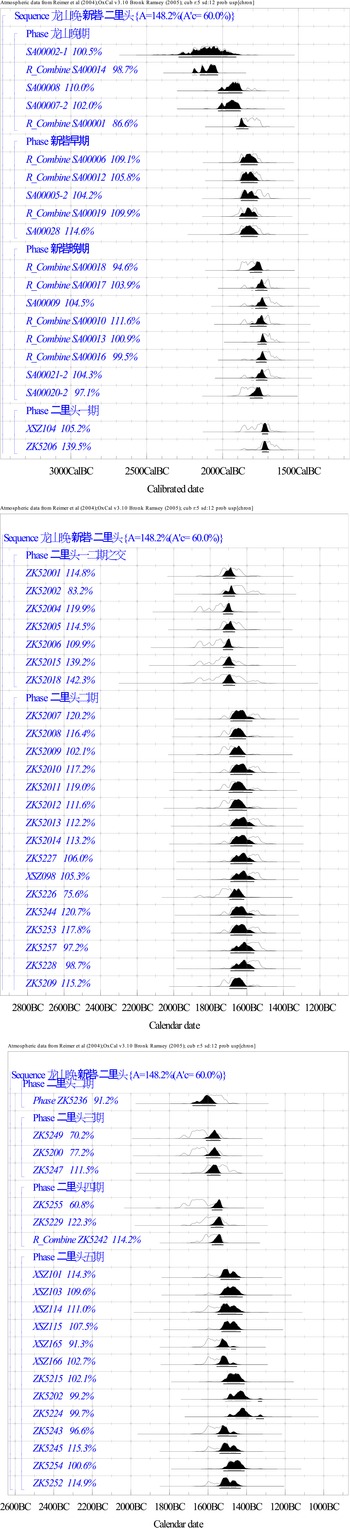
The second was the dating of the samples from the turn between the first phase and the second phase as well as the second phase unearthed in the relic units T12G10 and T12H84 of the Erlitou site in 2002. These samples, all charcoal, 18 in total, were dated by the 14C Laboratory of the Institute of Archaeology, CASS. These data were fitted to the calibration curve, together with the previous data of the Erlitou site and that of the Xinzhai site, and the results showed that the previous conclusion that the first phase of the Erlitou culture was no earlier than 1750 BC was more definite (Zhang et al. Reference Zhang, Qiu, Cai, Bo, Wang and Zhong2007). The fitting results are shown in Figure 2 (Institute of Archaeology 2014).
Calibration curve-fitting results of the late Longshan culture-Xinzhai culture-Erlitou culture sequence. Figure notes: 龙山晚-新砦-二里头:late Longshan-Xinzhai-Erlitou culture sequence; 龙山晚期:late Longshan culture; 新砦早期: early Xinzhai culture; 新砦晚期:late Xinzhai culture; 二里头一期:the first phase of the Erlitou culture; 二里头一、二期之交:the turn between first phase and second phase of the Erlitou culture; 二里头二期:the second phase of the Erlitou culture; 二里头三期:the third phase of the Erlitou culture; 二里头四期:the fourth phase of the Erlitou culture; 二里头五期:the fifth phase of the Erlitou site (belonging to the Erligang culture of the early Shang culture).

CONCLUSION
In summary, the dating research of the Erlitou site has progressed from its initial stage to that of using the wiggle-matching method based on high-precision dating. Dating accuracy has improved significantly, and the date of the first phase of the Erlitou site has been refined gradually from about 1900 BC to no earlier than 1750 BC.
At the same time, according to the long-sequence chronological framework of the late Longshan culture—Xinzhai culture—Erlitou culture—Erligang culture established gradually based on high-precision dating research since the Xia-Shang-Zhou Chronology Project, the Erlitou culture is difficult to move any more in age for a chronological fit of archaeological cultures on the sequence (Qiu Reference Qiu2015). Such an accurate chronological result also provides a reference for the combination of archaeology and ancient literature. (Because of space limitations, research on the date of the Erligang culture is omitted here.)
ACKNOWLEDGMENTS
Thanks to the Xia-Shang-Zhou Chronology Project and the Project on the Origin of Chinese Civilization for funding the dating research of the Erlitou site.