INTRODUCTION
Echinococcosis, caused by accidental ingestion of the eggs of several species of the genus Echinococcus, is now recognized to be a more serious health concern than once believed (Abuladze, Reference Abuladze and Skrjabin1964; Eckert et al. Reference Eckert, Gemmell, Meslin and Pawlowski2001; Torgerson and Budke, Reference Torgerson and Budke2003; Budke et al. Reference Budke, Deplazes and Torgerson2006; Torgerson et al. Reference Torgerson, Oguijahan, Muminov, Karaeva, Kuttbaev, Aminjianov and Shaikenov2006, Reference Torgerson, Keller, Magnotta and Ragland2010; Craig et al. Reference Craig, Budke, Schantz, Li, Qiu, Yang, Zeyhle, Rogan and Ito2007; Schweiger et al. Reference Schweiger, Ammann, Candinas, Clavien, Eckert, Gottstein, Halkic, Muellhaupt, Prinz, Reichen, Tarr, Torgerson and Deplazes2007; Fuglei et al. Reference Fuglei, Stien, Yoccoz, Ims, Eide, Prestrud, Deplazes and Oksanen2008; Ito et al. Reference Ito, Yanagida, Sako, Nakao, Nakaya, Knapp, Ishikawa and Liu2011a; Jenkins et al. Reference Jenkins, Peregrine, Hill, Somers, Gesy, Barnes, Gottstein and Polley2012; Combes et al. Reference Combes, Comte, Raton, Raoul, Boué, Umhang, Favier, Dunoyer, Woronoff and Giraudoux2012; Konyaev et al. 2012, Reference Konyaev, Yanagida, Nakao, Ingovatova, Shoykhet, Bondarev, Odnokurtsev, Loskutoba, Lukmanova, Dokuchaev, Spiridonov, Alshinecky, Tatyana, Andreyanov, Abramov, Krivopalov, Karpenko, Lopatina, Dupal, Sako and Ito2013; Torgerson, Reference Torgerson2013; Schneider et al. Reference Schneider, Aspöck and Auer2013). Cystic echinococcosis (CE) and alveolar echinococcosis (AE) are the most common echinococcoses worldwide. It has been shown that CE is caused by a variety of genotypes (G1–G10) and that pathogenicity to humans differs among these genotypes. The majority of human CE cases are believed to be caused by E. granulosus (G1–G3), with fewer cases of E. granulosus (G5–10) infection (Thompson and McManus, Reference Thompson and McManus2002; Thompson, Reference Thompson2008). Recent molecular re-evaluation of E. granulosus sensu lato has revealed that it consists of five independent species: E. granulosus sensu stricto (G1–G3), E. equinus (G4), E. ortleppi (G5), E. canadensis (G6–G10) and E. felidis (Nakao et al. Reference Nakao, McManus, Schantz, Craig and Ito2007; Hüttner et al. Reference Hüttner, Nakao, Wassermann, Siefert, Boomker, Dinkel, Sako, Mackenstedt, Romig and Ito2008; Knapp et al. Reference Knapp, Nakao, Yanagida, Okamoto, Saarma, Lavikainen and Ito2011, Nakao et al. Reference Nakao, Yanagida, Konyaev, Lavikainen, Odnokurtsev, Vladimir, Zaikoy and Ito2013b). In contrast, it has been shown that E. multilocularis can be differentiated into four genotypes (North American, Asian, European and Mongolian) (Bretagne et al. Reference Bretagne, Assouline, Vidaud, Houin and Vidaud1996; Nakao et al. Reference Nakao, McManus, Schantz, Craig and Ito2007; Ito et al. Reference Ito, Agvaandaram, Bat-Ochir, Chuluunbaatar, Gonchingsenghe, Yanagida, Sako, Myadagsuren, Dorjsuren, Nakaya, Nakao, Ishikawa, Davaajav and Dulmaa2010; Konyaev et al. Reference Konyaev, Yanagida, Nakao, Ingovatova, Shoykhet, Bondarev, Odnokurtsev, Loskutoba, Lukmanova, Dokuchaev, Spiridonov, Alshinecky, Tatyana, Andreyanov, Abramov, Krivopalov, Karpenko, Lopatina, Dupal, Sako and Ito2013).
After the collapse of the Soviet Union in 1991, Mongolia's infrastructure to collect data on echinococcosis cases and implement control measures broke down (Torgerson et al. Reference Torgerson, Oguijahan, Muminov, Karaeva, Kuttbaev, Aminjianov and Shaikenov2006). Even though people recognized that CE was common in Mongolia due to the traditional nomadic life-style, there are no published nationwide data. Information on very few AE (Davaatseren et al. Reference Davaatseren, Otogondalai, Nyamkhuu and Susher1995; Spira, Reference Spira1995; Ebright et al. Reference Ebright, Altantsetseg and Oyungerel2003; Ito et al. Reference Ito, Agvaandaram, Bat-Ochir, Chuluunbaatar, Gonchingsenghe, Yanagida, Sako, Myadagsuren, Dorjsuren, Nakaya, Nakao, Ishikawa, Davaajav and Dulmaa2010, Reference Ito, Yanagida, Sako, Nakao, Nakaya, Knapp, Ishikawa and Liu2011a; Gurbadam et al. Reference Gurbadam, Nyamkhuu, Nyamkhuu, Tsendjav, Sergelen, Narantuya, Batsukh, Battsetseg, Oyun-Erdene, Uranchimeg, Otgonbaatar, Temuulen, Bayarmaa, Abmed, Tsogtsaikhan, Usukhbayar, Smirmaul, Gereltuya and Ito2010) and CE cases (Davaatseren et al. Reference Davaatseren, Otogondalai, Nyamkhuu and Susher1995; Ebright et al. Reference Ebright, Altantsetseg and Oyungerel2003; Ito et al. Reference Ito, Agvaandaram, Bat-Ochir, Chuluunbaatar, Gonchingsenghe, Yanagida, Sako, Myadagsuren, Dorjsuren, Nakaya, Nakao, Ishikawa, Davaajav and Dulmaa2010, Reference Ito, Yanagida, Sako, Nakao, Nakaya, Knapp, Ishikawa and Liu2011a; Jabbar et al. Reference Jabbar, Narankhajid, Nolan, Jex, Campbell and Gasser2011; Dorjsuren et al. unpublished) has ever been described from Mongolia. Therefore, several meetings have recently been conducted to establish a network to improve the diagnosis of echinococcosis in Mongolia as well as plan regional epidemiological studies on Echinococcus spp. (Gurbadam et al. Reference Gurbadam, Nyamkhuu, Nyamkhuu, Tsendjav, Sergelen, Narantuya, Batsukh, Battsetseg, Oyun-Erdene, Uranchimeg, Otgonbaatar, Temuulen, Bayarmaa, Abmed, Tsogtsaikhan, Usukhbayar, Smirmaul, Gereltuya and Ito2010; Ito et al. Reference Ito, Okamoto, Li, Wandra, Dharmawan, Swastika, Dekumyoy, Kusolsuk, Davajav, Davaasuren, Dorjsuren, Mekonnen, Negashi, Yanagida, Sako, Nakao, Nakaya, Lavikainen, Nkouawa and Mohammadzadeh2011b).
In addition to very limited data on human echinococcosis, there are no data on Echinococcus spp. infections in animals from Mongolia. This is in contrast to the large number of studies from Russia (Abuladze, Reference Abuladze and Skrjabin1964). Therefore, in this study, we examined the intestines of foxes and wolves for detection of adult worms of Echinococcus spp.
MATERIALS AND METHODS
Wild animals and parasite samples
Small intestines from foxes and wolves captured by hunters, trappers and wildlife rangers throughout Mongolia during the winters of 2009 - 2011 were sent to the Mongolian Academy of Science in Ulaanbaatar. Geographic locations for the samples were obtained at the province level. The intestines were frozen at −80 °C until they could be examined. A total of 111 corsac foxes (Vulpes corsac), 191 red foxes (Vulpes vulpes) and 118 wolves (Canis lupus) were examined for Echinococcus spp. (Table 1, Fig. 1).
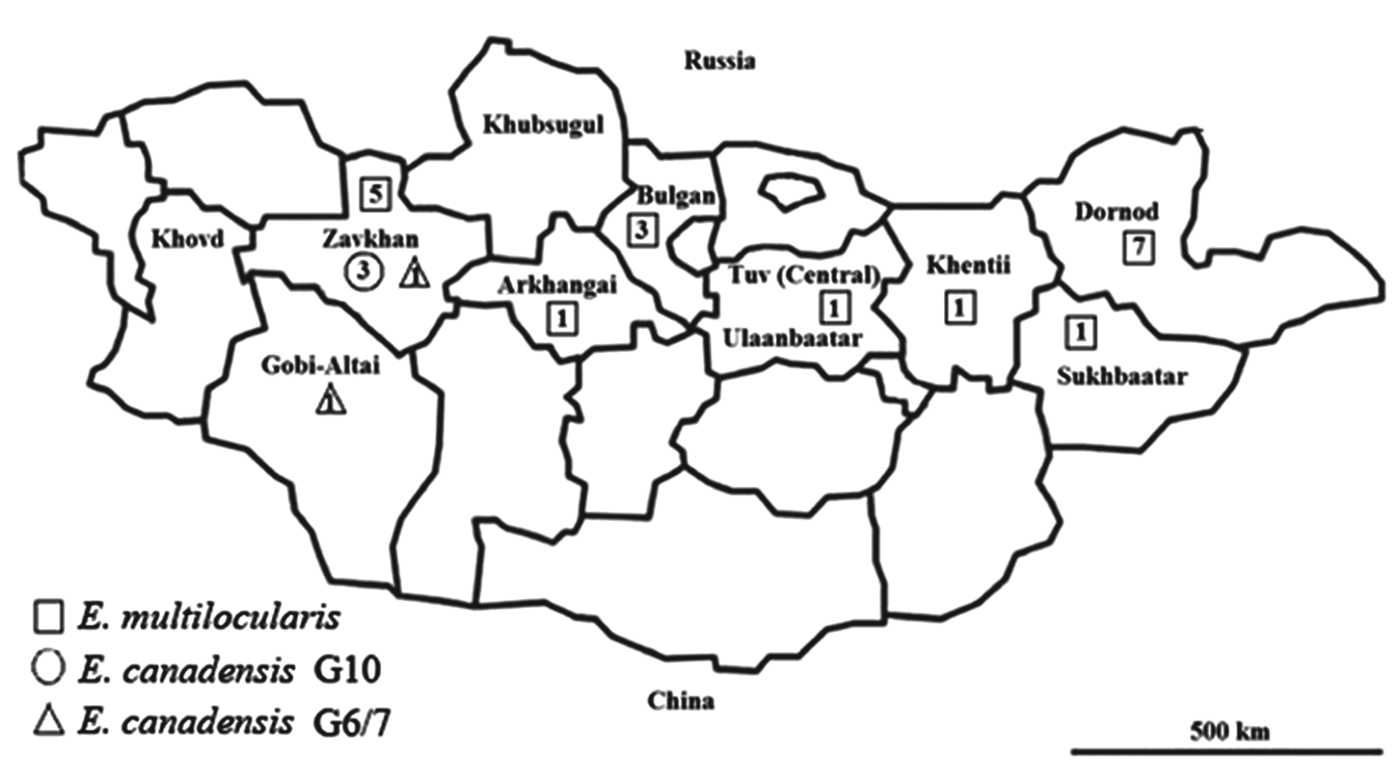
A map of Mongolia showing the number of Echinococcus-positive regions.

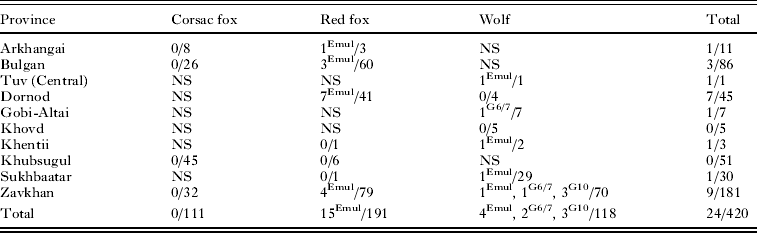
Occurrence of Echinococcus spp. in corsac foxes, red foxes and wolves from 10 Provinces, Mongolia
NS: no sample.
Emul: E. multilocularis.
G6/7: E. canadensis (G6/7).
G10: E. canadensis (G10).
Detection of Echinococcus spp
The sedimentation method was used to detect parasites in the small intestines provided. Each small intestine was opened with scissors and all intestinal contents were collected in a 500 ml plastic beaker. Water was added, the beaker contents were mixed and the supernatant was discarded. This process was then repeated several times. The remaining contents were kept in 50 ml screw cap tubes. Echinococcus specimens were confirmed by microscopic examination (Matoba et al. Reference Matoba, Yamada, Asano, Oku, Kitaura, Yagi, Tenora and Asakawa2006).
Mitochondrial DNA analysis
Genomic DNA was extracted from ethanol-fixed adult worms using the DNeasy blood and tissue kit (Qiagen). DNA obtained was used as templates for polymerase chain reaction (PCR). One to twelve worms from each host animal were used for the analysis. The entire mitochondrial cytochrome c oxidase subunit I (cox1) gene was amplified by PCR as reported previously (Hüttner et al. Reference Hüttner, Nakao, Wassermann, Siefert, Boomker, Dinkel, Sako, Mackenstedt, Romig and Ito2008). PCR amplicons were treated with illustra ExoStar (GE Healthcare) to remove excess primers and dNTPs, and directly sequenced with a BigDye™ Terminator v3.1 and a 3500 DNA sequencer (Life Technologies). Sequences obtained for each cox1 haplotype were aligned by Clustal W 2.0 (Larkin et al. Reference Larkin, Blackshields, Brown, Chenna, McGettigan, McWilliam, Valentin, Wallace, Wilm, Lopez, Thompson, Gibson and Higgins2007) with representative cox1 sequences of Echinococcus spp. available in the GenBank database. A phylogenetic tree was constructed using the neighbour-joining method and Kimura's two-parameter model (Kimura, Reference Kimura1980) in Phylogenetic Analysis Using Parsimony (PAUP) version 4.0b (Swofford, Reference Swofford2002). The robustness of the phylogenetic tree was tested by bootstrapping with 1000 replicates. For tree construction, Versteria mustelae was used as an out-group because the species is a sister to members of the genus Echinococcus (Nakao et al. Reference Nakao, Lavikainen, Iwaki, Haukisalmi, Konyaev, Oku, Okamoto and Ito2013a).
RESULTS
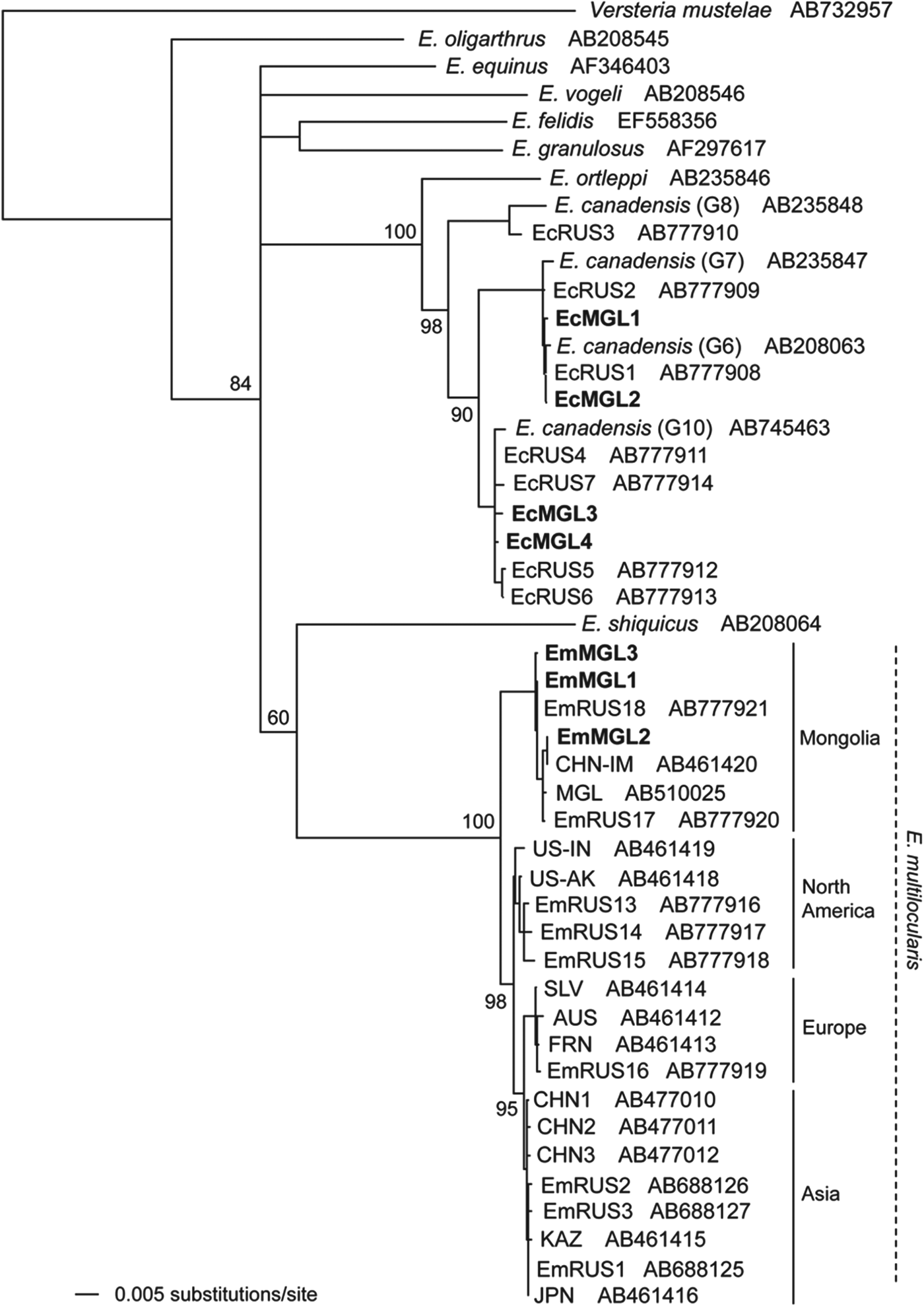
Table 1 summarizes the results from the intestinal analyses of the wild canids provided, with samples collected from 10 of the 17 provinces in Mongolia (Fig. 1). A total of fifteen red foxes and nine wolves were confirmed to be harbouring adult Echinococcus. Nucleotide sequences of the cox1 gene (1608 bp) were determined for a total of 99 isolates of Echinococcus spp. and 7 haplotypes were obtained. The nucleotide sequences of these haplotypes were deposited into DDBJ/EMBL/GenBank databases under the accession numbers AB813182–AB813188. Based on the phylogenetic analysis, these isolates were identified as E. canadensis (G6/7 and G10) and E. multilocularis (Fig. 2). Three cox1 haplotypes of E. multilocularis (EmMGL1–3) were further categorized as belonging to the Mongolian genotype.
A neighbour-joining tree of Echinococcus spp. constructed from the nucleotide sequences of mitochondrial cox1 gene. Numbers on the nodes are bootstrap values. The names of the haplotypes obtained in the present study are shown in bold. CHN-IM, Chinese Inner Mongolia; MGL, Mongolia; US-AK, Alaska (St Lawrence Island); US-IN, Indiana; US-SD, South Dakota; SLV, Slovakia; AUS, Austria; FRN, France; KAZ, Kazakhstan; CHN, China (Sichuan); JPN, Japan (Hokkaido).
E. multilocularis was confirmed in red foxes from Arkhangai, Bulgan, Dornod and Zavkhan provinces (Table 1 and Fig. 1). In Dornod, E. multilocularis was found during 2011 (6/16) and 2013 (1/5), but not in 2012 (0/20). Two of the three cox1 haplotypes (EmMGL1 and 2) were found in red foxes, with three foxes in Dornod harbouring both haplotypes. While EmMGL1 was confirmed in red foxes from all four provinces, EmMGL2 was confirmed only in Arkhangai and Bulgan (Fig. 2). Adult E. multilocularis worms were found in four wolves in Khentii, Sukhbaatar, Tuv (Central) and Zavkhan (Table 1). EmMGL1 was found in Sukhbaatar and Tuv, EmMGL2 was found in Khentii and Zavkhan and EmMGL3 was found in Sukhbaatar. E. canadensis G6/7 was confirmed in 1/7 wolves from Gobi-Altai and in 1/56 wolves from Zavkhan. The wolf from Gobi-Altai harboured both cox1 haplotypes (EcMGL1 and 2), and the wolf from Zavkhan harboured the EcMGL2 haplotype. E. canadensis G10 was confirmed in 3/5 wolves from Zavkhan. EcMGL3 and EcMGL4 were obtained from two and one wolves, respectively.
DISCUSSION
This is the first report of Echinococcus spp. from animals in Mongolia. Although we believe that both red foxes and corsac foxes are important in the transmission of E. multilocularis in Mongolia, in this study we only found red foxes infected with E. multilocularis. By contrast, wolves were found to be definitive hosts to both E. canadensis and E. multilocularis in Mongolia (Table 1).
The Mongolian genotype is, thus far, the only E. multilocularis genotype confirmed from wild canids in Mongolia (Ito et al. Reference Ito, Agvaandaram, Bat-Ochir, Chuluunbaatar, Gonchingsenghe, Yanagida, Sako, Myadagsuren, Dorjsuren, Nakaya, Nakao, Ishikawa, Davaajav and Dulmaa2010). This genotype was originally described by Tang et al. (Reference Tang, Cui, Qian, Kang, Wang, Peng, Lu and Chen2007) as a new species, E. russicensis, found in corsac foxes in Inner Mongolia, China. Subsequently, it was confirmed to be an intraspecies variation of E. multilocularis and described as the Inner Mongolian genotype (Nakao et al. Reference Nakao, Xiao, Okamoto, Yanagida, Sako and Ito2009). Recently, genetic variations have been described in two human AE cases, infected with this genotype, originating in Mongolia (Ito et al. Reference Ito, Agvaandaram, Bat-Ochir, Chuluunbaatar, Gonchingsenghe, Yanagida, Sako, Myadagsuren, Dorjsuren, Nakaya, Nakao, Ishikawa, Davaajav and Dulmaa2010). This has resulted in the Inner Mongolian genotype being re-described as the Mongolian genotype (Ito et al. Reference Ito, Agvaandaram, Bat-Ochir, Chuluunbaatar, Gonchingsenghe, Yanagida, Sako, Myadagsuren, Dorjsuren, Nakaya, Nakao, Ishikawa, Davaajav and Dulmaa2010; Konyaev et al. Reference Konyaev, Yanagida, Nakao, Ingovatova, Shoykhet, Bondarev, Odnokurtsev, Loskutoba, Lukmanova, Dokuchaev, Spiridonov, Alshinecky, Tatyana, Andreyanov, Abramov, Krivopalov, Karpenko, Lopatina, Dupal, Sako and Ito2013). Our results do not exclude the possibility that corsac foxes are definitive hosts of the Mongolian genotype, since corsac foxes are well known as definitive hosts of E. multilocularis and E. granulosus s.l. in Russia (Abuladze, Reference Abuladze and Skrjabin1964). A more interesting finding is that red foxes, as well as wolves, can harbour the Mongolian genotype. Therefore, the Mongolian genotype may in fact be the major genotype in Mongolia. This study is only the first to show direct evidence of Echinococcus spp. infection in animals from Mongolia. Additional studies, including evaluation of seasonal differences in infection rates and confirmation of the intermediate host animals are needed to understand the local life-cycle of Echinococcus spp.
Three human AE cases were recently identified from Mongolia. One of the cases was confirmed to be infected with the Asian genotype and the other two cases were confirmed to be infected with the Mongolian genotype (Ito et al. Reference Ito, Agvaandaram, Bat-Ochir, Chuluunbaatar, Gonchingsenghe, Yanagida, Sako, Myadagsuren, Dorjsuren, Nakaya, Nakao, Ishikawa, Davaajav and Dulmaa2010). This was the first report describing AE cases in Mongolia using a molecular approach. We expect that the primary definitive host for both the Mongolian and Asian genotypes in Mongolia is the red fox since the red fox is known as the definitive host for the Asian genotype in other countries (Nakao et al. Reference Nakao, Xiao, Okamoto, Yanagida, Sako and Ito2009). It is also expected that E. multilocularis is widely distributed in wild animals in Mongolia (Fig. 1). Additional studies are needed to confirm which genotypes predominate among the various wild canid definitive hosts as well as to better understand the role played by the corsac fox in the transmission of E. multilocularis in Mongolia. There are no published studies on the parasitic fauna in any animals in Mongolia. We are, therefore, in the process of analyzing intestinal helminthic fauna from a variety of species for future publication.
The importance of wolves in the transmission of both E. multilocularis and E. granulosus has been reported previously (Rausch, Reference Rausch, Thompson and Lymbery1995). E. multilocularis has been reported from wolves in Russia (Abuladze, Reference Abuladze and Skrjabin1964; Dzhabarova et al. Reference Dzhabarova, Zbarskii and Bulanova1993; Konyaev et al. Reference Konyaev, Yanagida, Nakao, Ingovatova, Shoykhet, Bondarev, Odnokurtsev, Loskutoba, Lukmanova, Dokuchaev, Spiridonov, Alshinecky, Tatyana, Andreyanov, Abramov, Krivopalov, Karpenko, Lopatina, Dupal, Sako and Ito2013), China (Wang et al. Reference Wang, Wu and Ding1989), Bulgaria (Breyer et al. Reference Breyer, Georgieva, Kurdova and Gottstein2004), Latvia (Bagrade et al. 2009), Iran (Beiromvand et al. Reference Beiromvand, Akhlaghi, Massom, Mobedi, Meamar, Oormazdi, Motevalian and Razmjou2011) and Kazakhstan (Abdybekova and Torgerson, Reference Abdybekova and Torgerson2012), whereas E. canadensis and E. granulosus s.l. have been reported from wolves in Eurasia and North America (Rausch and Schiller, Reference Rausch and Schiller1951; Abuladze, Reference Abuladze and Skrjabin1964; Dzhabarova et al. Reference Dzhabarova, Zbarskii and Bulanova1993; Hirvelä-Koski et al. Reference Hirvelä-Koski, Haukisalmi, Kilpelä, Nylund and Koski2003; Rausch, Reference Rausch2003; Breyer et al. Reference Breyer, Georgieva, Kurdova and Gottstein2004; Guberti et al. Reference Guberti, Bolognini, Lanfranchi and Battelli2004; Tang et al. Reference Tang, Quian, Kang, Cui, Lu, Shu, Wang and Tang2004; Moks et al. Reference Moks, Jõgisalu, Saarma, Talvik, Järvis and Valdmann2006; Schantz, Reference Schantz2006; Sobrino et al. Reference Sobrino, Gozalez, Vicente, Fernández de Luco, Garate and Gontázar2006; Bagrade et al. 2009; Foreyt et al. Reference Foreyt, Drew, Atkinson and McCauley2009; Abdybekova and Torgerson, Reference Abdybekova and Torgerson2012; Bryan et al. Reference Bryan, Darimont, Hill, Paquet, Thompson, Wagner and Smits2012; Guerra et al. Reference Guerra, Armua-Fernandez, Silva, Bravo, Santos, Deplazes and Madeira de Carvalho2013; Konyaev et al. Reference Konyaev, Yanagida, Nakao, Ingovatova, Shoykhet, Bondarev, Odnokurtsev, Loskutoba, Lukmanova, Dokuchaev, Spiridonov, Alshinecky, Tatyana, Andreyanov, Abramov, Krivopalov, Karpenko, Lopatina, Dupal, Sako and Ito2013). Among these reports, E. granulosus genotypes G1 and G10 have been confirmed from Bulgaria (Breyer et al. Reference Breyer, Georgieva, Kurdova and Gottstein2004) and Estonia (Morks et al. 2006), respectively, genotypes G8 and G10 have been confirmed from Canada (Bryan et al. Reference Bryan, Darimont, Hill, Paquet, Thompson, Wagner and Smits2012), and genotypes G6, G8 and G10 have been confirmed from Russia (Konyaev et al. Reference Konyaev, Yanagida, Nakao, Ingovatova, Shoykhet, Bondarev, Odnokurtsev, Loskutoba, Lukmanova, Dokuchaev, Spiridonov, Alshinecky, Tatyana, Andreyanov, Abramov, Krivopalov, Karpenko, Lopatina, Dupal, Sako and Ito2013). In addition, genotype G7 has been confirmed from Portugal (Guerra et al. Reference Guerra, Armua-Fernandez, Silva, Bravo, Santos, Deplazes and Madeira de Carvalho2013). The present study is the first report on the sympatric occurrence of the G6/7 and G10 genotypes in wolves. Both E. multilocularis and E. granulosus s.l. have also been confirmed from wolves (Abuladze, Reference Abuladze and Skrjabin1964; Dzhabarova et al. Reference Dzhabarova, Zbarskii and Bulanova1993; Bagrade et al. 2009; Beiromvand et al. Reference Beiromvand, Akhlaghi, Massom, Mobedi, Meamar, Oormazdi, Motevalian and Razmjou2011; Abdybekova and Torgerson, Reference Abdybekova and Torgerson2012; Konyaev et al. Reference Konyaev, Yanagida, Nakao, Ingovatova, Shoykhet, Bondarev, Odnokurtsev, Loskutoba, Lukmanova, Dokuchaev, Spiridonov, Alshinecky, Tatyana, Andreyanov, Abramov, Krivopalov, Karpenko, Lopatina, Dupal, Sako and Ito2013) in the same geographic locations, with dual infections also reported (Abuladze, Reference Abuladze and Skrjabin1964; Beiromvand et al. Reference Beiromvand, Akhlaghi, Massom, Mobedi, Meamar, Oormazdi, Motevalian and Razmjou2011). Recent increases in wolf populations in Europe and North America, and especially in Arctic and Sub-Arctic areas, should be noted with caution in terms of transmission of E. multilocularis (Martínek et al. Reference Martínek, Kolářová, Hapl, Literák and Uhrin2001; Bagrade et al. 2009), E. canadensis, and E. granulosus s.s. (Rausch, Reference Rausch, Thompson and Lymbery1995, Reference Rausch2003; Moks et al. Reference Moks, Jõgisalu, Saarma, Talvik, Järvis and Valdmann2006; Schantz, Reference Schantz2006; Sobrino et al. Reference Sobrino, Gozalez, Vicente, Fernández de Luco, Garate and Gontázar2006; Bagrade et al. 2009; Foreyt et al. Reference Foreyt, Drew, Atkinson and McCauley2009; Abdybekova and Torgerson, Reference Abdybekova and Torgerson2012).
Additional studies are needed to evaluate infection prevalence in wolves located in the three main eco-regions of Mongolia (the Gobi Desert in the south, the mountainous or forest region in the north and west, and the steppes). As shown in Fig. 1 and Table 1, E. multilocularis worms have been found in red foxes living in the mountainous and steppe regions of Mongolia where nomadic or semi-nomadic herdsmen live. Therefore, monitoring E. multilocularis infections in both red and corsac fox populations is also necessary for future control programmes.
E. canadensis (G6/7 and G10) was found in wolves living in the western part of Mongolia. Recent studies, using 50 human CE samples from Mongolia, revealed that E. granulosus s.s. (n=30) was confirmed mainly from the eastern regions of the country, whereas patients infected with E. canadensis (G/7 and G10) (n=20) were from the western part of the country, including Gobi-Altai and Zavkhan provinces (Jabbar et al. Reference Jabbar, Narankhajid, Nolan, Jex, Campbell and Gasser2011). The fact that E. granulosus s.s. was not detected in wild canids in the present study may support the belief that E. granulosus s.s. tends to be associated primarily with domestic dogs. Therefore, we would anticipate detecting adult worms of E. granulosus s.s. from dogs located in the eastern part of the country where Jabbar et al. (Reference Jabbar, Narankhajid, Nolan, Jex, Campbell and Gasser2011) confirmed human infection with E. granlulosus s.s.
Our results suggest that E. canadensis is strongly linked with wolves in Mongolia and possible definitive hosts should be evaluated for Echinococcus spp. in all provinces. Special attention should be given to the Northern provinces that border Russia and to the north-western provinces that border China or China and Russia since these regions are mountainous and provide suitable habitats for wolves and foxes. As shown in Fig. 1 and Table 1, Zavkhan Province is an important area for further studies. Zavkhan is unique in that an ethnic minority here is primarily composed of reindeer herders, with reindeer (Rangifer tarandus) expected to be a suitable intermediate host for E. canadensis (Konyaev et al. Reference Konyaev, Yanagida, Nakao, Ingovatova, Shoykhet, Bondarev, Odnokurtsev, Loskutoba, Lukmanova, Dokuchaev, Spiridonov, Alshinecky, Tatyana, Andreyanov, Abramov, Krivopalov, Karpenko, Lopatina, Dupal, Sako and Ito2013). Neighbouring Khubsugul Province is also believed to be important, since human CE cases infected with genotype G6/7 have been identified from this province (Jabbar et al. Reference Jabbar, Narankhajid, Nolan, Jex, Campbell and Gasser2011). Although only four red foxes were examined from Khubsugul, additional samples from red foxes, corsac foxes, wolves and dogs from this province are needed since this region contains a national park and is considered the largest resort area in Mongolia.
Prior to the current study, only human infections with Echinococcus spp. have been reported from Mongolia. As an initial evaluation of infections in animals, we focused on wild canids due to availability of these animals from local hunters, trappers and rangers. Infection in domestic dogs needs to be studied since the nomadic life style of the Mongolian people brings them in close contact with dogs. It is expected that dogs in nomadic households might show similar levels of infection as the red foxes and wolves in this study. Furthermore, each household typically has at least one dog which is usually not tied and is often left to hunt for its own food during the summer season. In these situations, dogs will hunt small mammals and scavenge offal from domestic livestock. It is also common for herdsmen to train dogs to hunt marmots (Marmota sibirica), which could potentially be an intermediate host for Echinococcus spp.
Recent serological studies of dog owners in Ulaanbaatar carried out at the National Center of Communicable Diseases (NCCD) (Davaasuren et al. unpublished) have revealed that a higher proportion of dog owners are positive for CE by both ELISA and immunoblot using the recombinant Antigen B8/1 compared to individuals who do not own dogs (Mamuti et al. Reference Mamuti, Yamasaki, Sako, Nakao, Xiao, Nakaya, Sato, Vuitton, Piarroux, Lightowlers, Craig and Ito2004; Mohammadzadeh et al. Reference Mohammadzadeh, Sako, Sadjjadi, Sarkari and Ito2012). Therefore, it is imperative to evaluate Echinococcus spp. infection in dogs.
The number of echinococcosis patients treated surgically at the First Hospital of Ulaanbaatar in 1993 was approximately twice as high as the number treated in 1950. The proportions of surgical cases due to CE and AE at the same hospital in 1950 were 7·8 and 1·9%, respectively, with AE cases numbering approximately a quarter of CE cases (Spira, Reference Spira1995; Ebright et al. Reference Ebright, Altantsetseg and Oyungerel2003). In the last decade, there have only been three reports on human echinococcosis in Mongolia, one describing three cases of AE (Ito et al. Reference Ito, Agvaandaram, Bat-Ochir, Chuluunbaatar, Gonchingsenghe, Yanagida, Sako, Myadagsuren, Dorjsuren, Nakaya, Nakao, Ishikawa, Davaajav and Dulmaa2010) and the other describing fifty cases of CE (Jabbar et al. Reference Jabbar, Narankhajid, Nolan, Jex, Campbell and Gasser2011). Only three AE cases, with samples kept at the Pathology Center, Ulaanbaatar, were available for molecular analysis (Ito et al. Reference Ito, Agvaandaram, Bat-Ochir, Chuluunbaatar, Gonchingsenghe, Yanagida, Sako, Myadagsuren, Dorjsuren, Nakaya, Nakao, Ishikawa, Davaajav and Dulmaa2010). We expect that many AE cases in rural areas have been misdiagnosed as hepatic cancers and that greater numbers of AE cases would be identified if a national notification system for echinococcoses was established. It is important that the NCCD and the Mongolian Center of Infectious Diseases with Natural Foci (CIDNF) form collaborations with other academic institutions and hospitals. Therefore, we strongly recommend that the Mongolian government establishes a network for the control of echinococcoses in humans, which includes a monitoring system for infection in dogs, wild animals and livestock (Gurbadam et al. Reference Gurbadam, Nyamkhuu, Nyamkhuu, Tsendjav, Sergelen, Narantuya, Batsukh, Battsetseg, Oyun-Erdene, Uranchimeg, Otgonbaatar, Temuulen, Bayarmaa, Abmed, Tsogtsaikhan, Usukhbayar, Smirmaul, Gereltuya and Ito2010).
ACKNOWLEDGEMENTS
We are grateful to the anonymous reviewer and to Christine Budke for valuable comments to improve this article.
FINANCIAL SUPPORT
The studies were supported by Grant-in-Aid for scientific research (21256003 and 24256002), Asia-Africa Scientific Platform Funds (2006–2008, 2009–2011) from the Japan Society for the Promotion of Science, the Hokkaido Translational Research Fund (2007–2011) and the Special Coordination Fund for Promoting Science and Technology (2003–2005, 2010–2012) from the Ministry of Education, Culture, Sports, Science & Technology in Japan (MEXT) to A. Ito. The content is solely the authors’ responsibility and does not necessarily represent the official views of the funders.