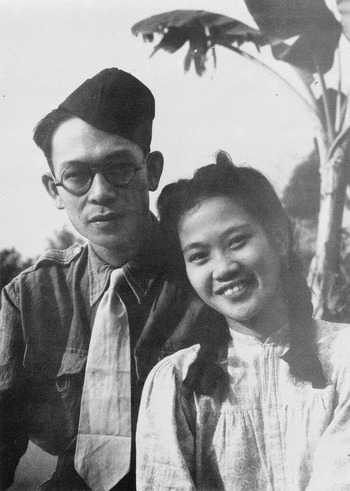
Phạm Duy, a noted Vietnamese composer, has published his memoirs in four volumes.Footnote 1 These memoirs have not, to my knowledge, received much attention, which is surprising because he is one of Vietnam's most famous song composers and has led a colourful life, marked by some remarkable transformations. In the late 1940s, for example, he was composing songs for the anti-French, communist-led Resistance; in the 1960s he was attending hootenannies with the legendary American CIA agent Edward Lansdale and writing songs for the anticommunist Rural Reconstruction Program.
The lack of critical attention to Phạm Duy's memoirs is not, however, the only thing that is curious about them. I will consider other curious aspects, including: Phạm Duy's insistence that he had to have lovers to create, which becomes his justification for committing adultery; his love affair, while he was married and in his late 30s and early 40s, with a young woman just entering puberty — a relationship which inspired his most famous love songs; his failure to reveal any awareness that his glorification of Vietnamese womanhood could be seen as self-serving; and his remarkable outspokenness about his love affairs and other matters.
I am well aware that what I, an American student of Vietnamese culture and language, find ‘curious’ or ‘remarkable’ about Phạm Duy's memoirs might not be considered so by Vietnamese readers. His memoirs may not have provoked much reaction because Vietnamese readers find little that is remarkable in them. They may find them to be the story of a fairly typical Vietnamese male artist, certainly more talented and more widely travelled than most, perhaps a little more hyperbolic in his personal behaviour than most, but otherwise not too different from the general type. After discussing some things I find curious about Phạm Duy's memoirs I will return to this question of how far Phạm Duy departs from cultural norms.
A brief overview of Phạm Duy's life
Phạm Duy Cẩn, known as Phạm Duy, is now in his nineties. As a young man in Hanoi in the 1930s, he became intrigued by what was called ‘new music’ (tân nhạc) or ‘renovated music’ (nhạc cải cách) — songs with Vietnamese words and Vietnamese melodies. Before this new music arrived, Vietnamese singers who wanted to sound modern sang French or American melodies with Vietnamese lyrics. Phạm Duy played a leading role in popularising this ‘new music’ and throughout his life has composed hundreds of songs in this style, including some which are known by many Vietnamese, particularly those from the South.Footnote 2
Some of his best-known works, songs like ‘Remembering the wounded soldier’ [Nhớ người thương binh] (1947) and ‘Mother of Gio Linh’ [Bà mẹ Gio Linh] (1948), were written when Phạm Duy belonged to a performing arts group attached to the anti-French Resistance movement. Partly for artistic reasons, partly for personal reasons, Phạm Duy broke with this communist-led movement in 1950. He did not like it when its leaders, influenced by their Chinese advisors, told him that some of his songs, including ‘Mother of Gio Linh’, ‘lacked positivism’ (tiêu cực) and others — ‘By the border bridge’ [Bên cầu biên giới], for example — were too ‘romantic’ (lãng mạn). Also, his wife, Thái Hằng, was then six months pregnant with their first child and he worried about her having to give birth in the mountain hideouts of the North. They therefore left the area controlled by Resistance forces and made their way first to Hanoi and then to Saigon, where Phạm Duy continued to compose songs, including some immensely popular love songs that were, according to one observer, ‘heard almost every day on the radio and in the tea houses; they were the songs on the lips of everyone who had ever been in love’.Footnote 3
When the American-backed Saigon regime fell in 1975, Phạm Duy and his family came to the United States where he lived for 30 years. In 2005, however, he moved back to Vietnam to live because, as he explained, as a falling leaf returns to its source,Footnote 4 he wished to return to the land of his ancestors.Footnote 5 Other factors probably influenced his decision. His wife of 50 years died of lung cancer in 1999 and at least three of his children planned to live and work in Ho Chi Minh City. He had also agreed to sell exclusive distribution rights to his music and other intellectual property to a company called Phương Nam Culture (Công ty Văn hóa Phương Nam), which is based in Ho Chi Minh City.
His return to Vietnam is not described in his memoirs, which end with the death of his wife and his recovery from heart surgery in early 2000. His return was, however, covered extensively by Vietnamese media in Vietnam and in the Vietnamese diaspora. The Phương Nam Culture Company organised various events to promote him and his music, including a live show in Ho Chi Minh City in February 2006, called ‘Phạm Duy: The day of return’ (Phạm Duy: Ngày trở về), featuring a full orchestra to accompany some of Vietnam's best-known singers as they sang a selection of his songs. Phạm Duy, dressed in a yellow sports jacket and with his white hair shining, introduced each song. In March 2009 he and his music were featured in a similar show, also called ‘Phạm Duy: The day of return’, in Hanoi at the most prestigious venue in town — the beautifully restored Great Theatre (Nhà hát lớn). His return was controversial. Some artists welcomed him, but others did not. ‘A person,’ comments the writer Chu Lai, ‘who abandoned the Resistance and went over to the French imperialists, then when the French withdrew went over to Ngô Đình Diệm, and when the puppet regime collapsed ran off to America where he wrote a series of anticommunist articles reeking with bellicosity. And now, seeing that Vietnam has become strong, he asks to return. Is this something to shout about and praise?’Footnote 6
Others, however, including Phan Thị Lệ, the General Director of the Phương Nam Culture Company, have pointed out that the decision to let Phạm Duy return was in accordance with Politburo Resolution 36, promulgated in 2004, which aims to nurture better relations with overseas Vietnamese and encourage them to return to help develop the nation.Footnote 7 In officially greeting Phạm Duy upon his return in 2005, Deputy Minister for Foreign Affairs Nguyễn Phú Bình described the event as ‘adding a link in the bridge connecting overseas Vietnamese to their native land’.Footnote 8
Phạm Duy's love partners
Phạm Duy's memoirs proceed chronologically. The first volume, Childhood and young adulthood, describes his early schooling and experiences travelling around the country as a singer for the Đức Huy-Charlot Miều reformed opera troupe. The second volume, The Revolution and Resistance periods, describes his involvement with, and eventual break from, the Resistance. The third volume, The period of Nationalist–Communist division, is an account of Phạm Duy's years in Saigon, where he composed a wide variety of works — some famous love songs, some propagandistic songs for the Republican army and Rural Reconstruction Program, some off-colour ‘indecent songs’, and some called ‘songs of the heart’ (1966), in which he laments the escalation of the war. His last volume, My sojourn abroad, describes his and his family's adjustment to the United States and his experiments with new forms of music, including ‘new age’ music employing ‘electro-acoustic effects in order to evoke a feeling of the cosmos’ (IV, xx, 186).
In all four volumes Phạm Duy concentrates on his accomplishments in the field of music. This is his main theme, but an important secondary theme is the pleasure that he has derived from his experiences with various ‘love partners’ (người tình) throughout his life. This theme is closely related to his primary theme because in his view it was his love experiences that provided him with inspiration for his songs. Phạm Duy does not reveal in his memoirs the precise number of his partners (that number, he said in an interview,Footnote 9 will be revealed by his children after his death), but roughly 25 are mentioned.Footnote 10 Comments like ‘I surely must have dropped many offspring by the wayside in the course of this journey’, made in reference to his travels with an opera troupe, suggest the number is higher (I, xxxvii, 204).Footnote 11 Here are some of the partners he mentions, along with the approximate dates of his liaisons with them: a fellow worker at an electricity-generating plant in Móng Cái (1939) (I, xiii, 93); an older itinerant vendor of hot meat-stuffed pastries (giò nóng) (1941) (I, xv, 111); two country girls from Yên Thế: Hạ, the unmarried daughter of a canton chief, and Khuê, a grass-cutter whose husband was in a neighbouring village (1942–43) (I, xvi, 120–1); two actresses, Tình and Châu, with the Đức Huy opera troupe (1944–45) (I, xxii, 175–6); a girl of mixed Chinese–Vietnamese blood bestowed on him by the poet Lưu Trọng Lư when the troupe was in Tourane (Da Nang) (1944) (I, xx, 177; II, x, 40); an ‘ex-bride of a westerner’ named Phượng Nga, with ‘green eyes and gold in her teeth’ (1944) (I, xxxiii, 182); the wife of an opera promoter in Trà Vinh (1944) (I, xxvii, 203); a singer named Thương Huyền who sang at the Thiên Thai teahouse in Hanoi (1945) (II, vi, 27); a dancing girl named Định, who performed at the Tabarin dance hall in Hanoi (1945) (II, vi, 27); and an ‘ultra-modern’Footnote 12 married woman named Hiếu, the inspiration for a famous song called ‘The sound of my instrument’ [Tiếng đàn tôi], who had, Phạm Duy says, ‘a beautiful and curvaceous body in no way inferior to that of the Venus de Milo, a wanton and challenging glint in her eyes, a charmingly out-of-line tooth, and a heart of fire’ (1948) (II, xxiii, 91).
Liaisons with the above women took place when Phạm Duy was a bachelor. In 1949 he married Phạm Thị Quang Thái, whom he came to know while they both were in Thanh Hóa as members of a performing arts group attached to Regiment 9 of the Resistance army. Phạm Thị Thái's parents, previously owners of a candied-fruit store in Hanoi, had come to Thanh Hóa to be near four of their children who were all in military arts groups (II, xxiii, 89–90, 104, 108). Apparently Phạm Duy's reputation as a lady-killer had preceded him. Phạm Duy says that Phạm Thị Thái knew he was ‘susceptible to pretty faces’ before she agreed to marry him, but others assured her this was ‘the most inconsequential of faults’ (II, xxvii, 111). Thế Lữ, a well-known poet and dramatist, had wanted Phạm Thị Thái to join his drama group and had given her the stage name Thái Hằng, a name she used throughout her life. Both Thái Hằng and her younger sister Phạm Băng Thanh, whose stage name was Thái Thanh, were fine singers. Their performances of Phạm Duy's songs — particularly Thái Thanh's, who was a better singer — greatly assisted Phạm Duy in his rise to fame.Footnote 13
Phạm Duy's marriage (Illustration 1) did not prevent him from pursuing love affairs. Some partners involved in his post-1949 extramarital affairs include a Perfume River songstress from Huế named Ngọc Túy (1954) (III, iv, 26); various women he met while studying in France (some prostitutes, some not), including ‘an azure-eyed girl named Lucy’ whom he thanks for ‘teaching me the French way of making love’ (1954–55) (III, v, 33, 40, 42); some ‘partners of carnal romance’ (người tình xác thịt) encountered in the teahouses of Saigon (1955) (III, vii, 52); a 17-year old French cellist named Annie Couchet, who played for an orchestra in Saigon (1955) (III, xi, 84); and the wife of his brother-in-law, an actress named Lan Nam who used the stage name Khánh Ngọc (1956) (III, viii, 56–7).
Phạm Duy and Thái Hằng on their wedding day in Thanh Hóa, 1949 (Source: Phạm Duy 2010, http://www.phamduy2010.com/galleries/hinhanh.html)

Phạm Duy calls this last affair an ‘unseemly romance’ (cuộc tình không đẹp) adding that it was ‘a romance (cuộc tình)Footnote 14 that by rights I should have avoided — but to tell the truth, I couldn't have avoided it even if I had wished to' (III, viii, 57). After he returned to Saigon from France, some friends of his were making anticommunist films and they asked Phạm Duy to work with them. Lan Nam was married to Thái Hằng's younger brother, Phạm Đình Chương (stage name: Hoài Bắc), and they lived with Thái Hằng and Phạm Duy in the same house on Bà Huyện Thanh Quan Street in Saigon. Lan Nam and Phạm Duy worked for the same film companies and they travelled together to Manila and Hong Kong to make films. Phạm Duy says his ‘effortless successes — both in music and cinema — had made [him] reckless’ (III, viii, 56), but he also blames ‘excessively close contact’ for precipitating this ‘romantic disaster’. Some ‘literary figures’ persuaded relatives of Thái Hằng, but not Thái Hằng herself, to make the affair public and, Phạm Duy says, ‘the Saigon press had a field day over the matter’ (III, viii, 57).
Unsurprisingly the press seized on this story as it features both tragic and comic elements. Phạm Đình Chương was a successful musician in his own right and he and his wife both sang in a group called Ascending Dragon (Hợp Ca Thăng Long). Though Phạm Đình Chương and Lan Nam appeared to be a happy couple, they differed in appearance and personality. Lê Hoàng Long says that Phạm Đình Chương was ‘skinny and looked like a refined student, like someone too weak to tie up a chicken’; Lan Nam, on the other hand, was a ‘volcano’, known in musical circles as ‘the Vietnamese Marilyn Monroe’.Footnote 15 Lê Hoàng Long provides details of how the affair ended. When Phạm Duy left the house one night in his car, Phạm Đình Chương and a legal process server (Thừa Phát lại) followed in another car and caught Phạm Duy and Lan Nam in a suburb of Saigon called Nhà Bè. The car was parked, the lights were out, and they were sitting together on the ground. After identifying himself, the legal server asked Phạm Duy and Lan Nam what they were doing. Phạm Duy said they were eating pudding (ăn chè). After this event, the expression ‘to eat chè in Nhà Bè’ (ăn chè Nhà Bè) became a humorous way to refer to a love tryst.Footnote 16
Phạm Duy was sad when this affair became known, he says, ‘because I knew that the damage I had caused could never wholly be mended’ (III, viii, 57). But he was soon buoyed up by another affair, one that was ‘non-carnal’ but which, since it involved a young girl ‘just entering puberty’, was not without its curious aspects (III, viii, 58). Besides Alice?s youth — she was over twenty years younger than Ph?m Duy — another curious aspect of this affair is that Phạm Duy had also had a platonic relationship with Alice's mother, a woman named Hélène Defrosse, the daughter of a Protestant missionary from Great Britain and a Vietnamese woman from Phan Thiết. Hélène married a man of mixed Chinese and Vietnamese ancestry with whom she had two children, one of whom was Alice (I, xxv, 189). Phạm Duy first met Hélène, whose husband had passed away after only two years of marriage, when he travelled through Phan Thiết with his cải lương opera troupe in 1944. On this trip he also met Alice, who was two years old at the time,Footnote 17 and her young brother. After the Revolution broke out in 1945, he did not see Hélène for over 10 years, though she sent him many letters and poems. Then one day in 1956 he ran into her by chance at the Bến Thành market in Saigon. This time, however, Phạm Duy was more interested in her daughter, Alice, who was then either 14 or 16 years old. His preference may have been partly due to the fact that Hélène had remarried and so Alice was more available. ‘Not liking her stepfather, she no doubt confided little in her mother,’ Phạm Duy says. ‘I was the person who had the good fortune to listen to Alice pour out the confidences of a girl just entering puberty.’ (III, viii, 58)
Phạm Duy explains that when he met Alice in 1956, he was ‘unable to clamber out of the deep pit I had thrust myself into’ (III, viii, 59), a reference to the scandal caused by his recent affair with his brother-in-law's wife. Alice, his ‘beloved poetess’, made him feel better (63). The affair with his brother-in-law's wife was a ‘dose of shame’, he says; his affair with Alice was a ‘dose of sweetness’ (57). Phạm Duy would drive to Alice's house every weekend and they would go on excursions. She wrote more than 300 poems for him and he wrote many songs as gifts to her (59).Footnote 18
Phạm Duy appears to be proud of himself for keeping his relationship with Alice platonic, especially since, he says, it required some exertion on his part:
Because of the disparity between our ages, and because I didn't wish to cause trouble to those around me yet again, I decided right from the beginning that this would be a love between two souls only. I exerted myself to avoid any carnal involvement in this relationship, and I am proud to say that Alice was still a virgin when she went far away to step into the bridal sedan bearing her to her husband's family. As an artist I needed love in order to create, just as people need air to breathe — but I didn't need to make a conquest of anyone, and especially not of a girl still at a tender age. (III, viii, 60)
In passages like the above, Phạm Duy suggests that he avoided ‘carnal involvement’ with Alice because he did not want another scandal and also because of moral reservations stemming from her ‘tender age’. But his description of her reaction when he confessed his love to her suggests that even if he had ‘exerted himself’, he might not have been successful: ‘One autumn afternoon in 1957, I confessed my love to Alice and received a noncommittal acknowledgement from her — a casual “Mmmmn”. I resolved at that moment that this love must have the same ideal character as my love for Hélène [Alice's mother].’ (III, viii, 59) Here Phạm Duy suggests that his resolution to avoid carnal involvement derived from Alice's non-committal response. In reflecting on his affair in a later passage, however, Phạm Duy appears to be saying that he held back out of fear that if his relationship with Alice moved from the platonic to the carnal then he would lose his wife:
[E]ven in the most intense or the most poignant moments in our love, and in moments when we both silently understood that we both shared a desire to be ‘tightly bound’ to each other, I exerted myself to escape from those ties. If I wasn't willing to relinquish this love for the sake of my gentle wife and good children, I was also unable to forsake my wife and children for my love. (III, xii, 91)
Whatever the reasons for his keeping his relationship with Alice platonic, one thing is clear: musically this was an extremely productive relationship for him. ‘I spent ten years cultivating this relationship the result of which was,’ Phạm Duy says, ‘a number of love songs that I composed as gifts for her, from “Song of love” [Thương tình ca], 1956, to “It's no more than that” [Chỉ chừng đó thôi].’ (1975) (III, viii, 59) Tạ Tỵ, a friend and confidant of Phạm Duy's, says that all the songs in the collections On that day the two of us love each other [Ngày đó chúng mình yêu nhau], Entering life singing [Hát vào đời], Giving each other a life [Cho nhau riêng một đời] and Tears for our love [Giọt lệ cho tình ta] were inspired by and written as gifts for her.Footnote 19 These collections include Phạm Duy's most famous love songs — songs such as ‘On that day the two of us’ [Ngày đó chúng mình] and ‘A thousand leagues apart’ [Nghìn trùng xa cách], a song which he wrote to say goodbye to the young girl he called his ‘beloved poetess’ (III, xxvii, 136).Footnote 20
Love, romance and inspiration
Phạm Duy says he needed lovers to create and makes clear in his memoirs that he was inspired by both his carnal and his platonic love partners. His platonic relationship with Alice was the most fruitful. Relationships that he describes in his memoirs as being joyfully physical were also fruitful but yielded fewer hits; and, interestingly, the songs he links to these relationships either contain no references to sexual love or hint at it so subtly and indirectly that apparently singers and listeners were not aware of any sexual content.Footnote 21 What explains this seeming disconnect between Phạm Duy's ‘inspiration stories’ in his memoirs and the actual songs he composed?
Part of the answer lies in Vietnamese notions of romantic love, notions which have been shaped by folk poetry (ca dao), and also by French romanticism as expressed by Alphonse de Lamartine, Victor Hugo, Alfred Musset, Alfred De Vigny, Alexandre Dumas fils, Edmond Haraucourt and other French writers. The so-called New Poetry of the 1930s and 1940s produced by Xuân Diệu, Huy Cận, Lưu Trọng Lư, Thế Lữ and others was heavily influenced by French romantic poets. For example, Xuân Diệu's famous poem ‘To love’ [Yêu], with its oft-quoted refrain ‘To love is to die a little in the heart’,Footnote 22 reveals the influence of Haraucourt's ‘Partir, c'est mourir un peu’.Footnote 23 Early Vietnamese novels, including Hoàng Ngọc Phách's famous Pure heart [Tố tâm], were influenced by the European sentimental love novel — works such as Lamartine's Graziella, Rousseau's Julie, and Dumas fils' Camille.Footnote 24
Phạm Duy acknowledges these influences in the Road back to folk songs Footnote 25 and in his memoirs. In the former work he describes how what he calls ancient folk songs (dân ca cổ) developed from oral poetry (ca dao) and how he and other early composers of Western-style songs (called modern music [tân nhạc] or reformed music [nhạc cải cách]) purposely imitated ancient folk songs to give their modern music, or ‘new folk songs’ [dân ca mới], a national character [dân tộc tính]. Phạm Duy studied folk poetry and ancient folk songs, many of which were very lyrical and romantic, and clearly they influenced his approach to life and art. He also admired the New Poets and set quite a few of their works to music to please Alice, his beloved poetess (III, viii, 63).Footnote 26 He also acknowledges the influence of sentimental novels. His quick entry into ‘the realm of romance’ (cõi tình), he says in his memoirs, ‘was perhaps due to some extremely romantic novels then current in Vietnam, such as the Tearful history of Snowpink [Tuyết hồng lệ sử], translated from Chinese by Mai Khê,Footnote 27 and Pure heart [Tố Tâm], by Hoàng Ngọc Phách’ (I, ix, 60).
In both of these novels the heroines die of love, willing themselves to death because they cannot marry the man they love. These works affected Hanoi readers deeply — especially Pure heart, which, Phạm Duy says, ‘enthralled people to such a degree that some youths imitated these characters and went out to the Bách Thú zoological garden to dig graves to bury wilted flowers in, and then composed poems and couplets so as to “weep for the flowers”’ (I, ix, 61). Phạm Duy remembers putting on a mourner's turban, burying flowers and weeping along with adults for the unfortunate lovers, Tố Tâm and Đạm Thủy.Footnote 28 ‘Just when I was preparing to enter life's affairs,’ he says, ‘my soul was heavily infected by the sentimental spirit of the age’ (I, ix, 1).
Phạm Duy's love affair with Alice, which, as both he and his close friend and biographer, Tạ Tỵ, testify, inspired most of his famous love songs, can be seen as a re-creation of Tố Tâm and Đạm Thủy's relationship in Pure heart. Like these famous fictional characters, Phạm Duy and his ‘beloved poetess’ discuss poems and songs they like and share their compositions with each other. ‘Our meetings were usually occasions when we would talk about poetry or music,’ Phạm Duy explains, ‘and, seeing how she loved poetry, whenever I came across some fine poem, either of a former era or the one we were living in, I would set it to music so as to bestow it on her as a gift’ (III, xviii, 143). For example, one day Alice read to him the following folk poem (ca dao), one fittingly about impossible love: ‘A head of hairFootnote 29 has short and long strands/We can't be married so our feelings last a thousand years.'Footnote 30 As a gift for her he then wrote his song ‘Long and short strands’ [Tóc mai sợi vắn sợi dài] (III, xviii, 143).
The theme of impossible and therefore unfulfilled love is a common theme and is found in the texts of most cultures. It is especially prominent in the Vietnamese tradition. ‘Love is only beautiful when it is incomplete/Life loses joy when pledges are fulfilled.’ Students I knew in Huế in the late 1960s and early 1970s used to repeat these lines from a popular song composed by Thủy Tiên.Footnote 31 Vietnamese find a sweet pleasure in the pain of a hopeless love affair; and in a society in which, until relatively recently, marriages were arranged by — or at least had to be approved by — one's parents, hopeless affairs were common. For lovers involved in these doomed affairs, the sweet sadness that stems from their incompleteness becomes a consolation prize.
In his memoirs Phạm Duy says that in regard to love he has ‘picked up some pointers from people of olden times’, who, he explains, divide love or feeling (tình) into three categories: ‘romantic love (tình yêu), romantic destiny (tình duyên), and conjugal obligation (tình nghĩa)’. Phạm Duy then defines these three kinds of love:
To love each other and then go separate ways — that is ‘romantic love’ (tình yêu). When two people join each other in marriage, that is ‘romantic destiny’ (and ‘tie/debt’)Footnote 32 (tình duyên (và nợ)). When children have come to fill the household, ‘destiny’ mutates into ‘obligation’ (nghĩa). Love can be fragile, sometimes existing and sometimes not, but once a couple enters into the realm of destiny and tie/debt (duyên và nợ), and then of gratitude (ơn) and obligation (nghĩa), they must cleave firmly to each other — it is as simple as that. (III, xii, 92)
Ideally, all three kinds of love would be combined in one harmonious and loving relationship. In other words, the person one falls in love with would be also the person one is destined to marry and the marriage would continue to be romantic, though it would, of course, involve obligations. The existence of the three categories suggests the ideal is seldom achieved. In Vietnamese poems, songs and novels both male and female characters have to make difficult choices between love and duty and, in Vietnam's family-oriented, collectivist society, duty usually wins, hence the many sad stories of unfulfilled love. Circumstances arise and, like Kiều in the Tale of Kiều, Vietnam's most beloved poem, one must ‘bow’ to them and marry for duty, not to fulfil one's individual desires. Men trapped in a dutiful but loveless marriage, however, have always had an escape, provided they had a kind wife willing to sacrifice to maintain family harmony: they have been able to have concubines, second wives, lovers. Women traditionally have had no such outlet and so if they were trapped in a loveless marriage, the only kind of ‘romantic love’ (tình yêu) available to them was the unfulfilled variety; and if a secret love were discovered — even if unfulfilled — it would still bring disaster down on their heads.
What is interesting about Phạm Duy's relationships of the first category, those in which ‘you love each other and then go your separate ways’, is that as he describes them in his memoirs they do not sound very romantic — at least not in the traditional sense just described. This is perhaps because in most of these relationships Phạm Duy becomes quickly ‘fulfilled’. If to be romantic a liaison cannot involve any physical sex at all, if it must remain unfulfilled and involve a great deal of pining for an impossible love, then there is no way that these affairs can be considered romantic. Phạm Duy says that he ‘had absorbed lessons in love while still a child and [had] been involved in love affairs that unfolded effortlessly as I grew up’ (III, viii, 56). This sounds like a good thing, but for someone trying to write romantic love songs in a culture that defines romantic love as ‘unfulfilled’, effortless success can be a problem.
At least it is a problem if you are convinced, as Phạm Duy is, that one's songs must be based on personal experience with love partners.Footnote 33 And this belief of Phạm Duy's leads to further problems. By repeatedly insisting that he must have lovers to create, he makes his love partners a means to an end, a way to overcome writer's block.Footnote 34
In his memoirs a brief description of a joyful night with a love partner is frequently followed by the lines of a sad song inspired by the encounter. The effect — probably unintended — of this juxtaposition is to reveal Phạm Duy's powers of transformation.Footnote 35 How to write a sad song about a wonderful night of sex! That would appear to be the (formidable) challenge he set for himself. ‘Summer days and months’ [Ngày tháng hạ], one of three songs that Phạm Duy explicitly says ‘celebrate carnal love’, provides a good example of Phạm Duy's skill (III, vii, 55). This song, he says, is the hottest of his three carnal songs. ‘Red summer’ [Hạ hồng] is ‘burning hot,’ he says, but this song is ‘sweltering’.Footnote 36 ‘I had reached the age,’ he continues, ‘when a man's vital forces are at their height, and wasn't able to exercise restraint when I slipped and fell into the embraces of southern women hot as burning fire. And after a bout of love, I lay listless as a corpse on my bed of passion and wrote “Summer days and months”’ (55). But if the experience was fulfilling, the song based on it is packed with traditional images found in romantic poems and songs, especially songs about young love during school days. The hearts of the lovers are compared to a deserted school playground and the flame trees (Royal Poinciana) are in bloom and the cicadas singing — both conventional images associated with the beginning of summer vacation. This is also a sad song. The word ‘sad’ (buồn) is used three times. The ‘days and months of summer’ are ‘immensely sad’, a time when ‘the rain sows sadness’ (mưa gieo buồn). It is so sad, it seems, that ‘even houses are crying’ (Nhà nghiêng xuống khóc ai). In this ‘carnal song’ Phạm Duy reveals his mastery of the Vietnamese romantic idiom that he knew his audience expected in a love song.
Traces of carnality remain in some of his songs, however; indications, perhaps, that the experiences that inspired them were too joyful for even a composer as accomplished as Phạm Duy to represent as sad. Though Phạm Duy says ‘Red summer’ [Hạ hồng] is less ‘hot’ than ‘Summer days and months’, its lyrics are more explicit: in it he speaks, for example, of ‘loving each other naked on the ground’. It seems that in some songs Phạm Duy was trying to redefine romantic love so it included the physical as well as the spiritual — so it was not always so frustratingly unfulfilled! Trần Văn Ân seems to lean toward this interpretation. He observes that the lovers in Phạm Duy's music are ‘real flesh and blood characters, completely different from the imaginary lovers in the songs of Văn CaoFootnote 37 or the lovers who have not yet reached each other (người tình chưa với tới) in the ‘No name’ songs of Vũ Thành An'.Footnote 38 For Phạm Duy, Trần Văn Ân says, ‘sex is bound to love like a shape and its shadow. The highest peak of love is the harmony, the unsurpassable unity, of sex and love. The love songs of Phạm Duy are that unity.’Footnote 39
It seems likely, however, that long exposure to stories, poems and songs of sublimated desire had left Phạm Duy's audience ill-prepared for an ‘unsurpassable union’ of sex and love, and so the composer, well aware of his audience's sensibilities, muted all references to carnality. He did such a good job of this that his audience apparently did not detect any carnality in his songs. Trần Văn Ân identifies Phạm Duy's ability to ‘poeticise’ (thi vị hóa) his carnal experiences, to ‘encase them in a beautiful, poetic frame’, as one of the secrets of his success as a composer. He did it so ‘naturally and easily,’ Trần Văn Ân says, that ‘neither those singing or listening to Phạm Duy's music were aware of the sexual character of the song.’Footnote 40 Sexual meanings were, Trần Văn Ân continues, ‘overpowered and enveloped’ by other qualities: ‘solemnity, a dreamy and romantic quality, a light and flowing style’. Another way Phạm Duy mutes sexual meanings is by employing ambiguous references. Consider, for example, the opening lines of ‘Summer days and months’:
If they did not know that these lines are from a ‘sweltering’ song about ‘sexual love’, most people probably would interpret the comparison of flame tree blossoms to blood as a poetic description. After reading his memoirs, however, they would no doubt assign racier meanings to ‘those drops of blood’.
Phạm Duy must have found it difficult to turn nights of joyful sex into sad songs of unfulfilled love. It is possible that listeners sensed his songs based on carnal experiences lacked sincerity, that they were expressions of a conventional and literary sadness not the outpouring of a heart that is truly broken, and that this is why they have not been as popular as his ‘Alice’ songs. In any event, his discovery of Alice, his ‘beloved poetess’, was certainly a godsend. Arriving as she did just after his disastrous affair with his brother-in-law's wife, Phạm Duy knew he should avoid carnal involvement with her. Fears of further scandal ensured that his relationship with Alice would remain romantic in the traditional sense — unfulfilled sexually — and therefore fully capable of inspiring what have become his most famous love songs.Footnote 42 ‘[Phạm] Duy loved,’ Tạ Tỵ explains, ‘but couldn't love sufficiently to fulfill his dreams. But as a result he was able to create his spellbinding and sad love songs.’Footnote 43
Glorifying the sacrifices of women
In Vietnamese culture sacrifice is a virtue associated with women. The Vietnamese word for sacrifice, hy sinh, also connotes endurance (chịu đựng) and faithfulness (chung thủy). In descriptions of the traditional Vietnamese woman one frequently encounters some combination of these three compound words. Through a process some researchers call ‘triangulation’, women play an important mediating role between family and nation: their sacrifices are seen as key not only to the well-being of their families but also to the survival of the Vietnamese nation.Footnote 44 In wars against foreign invaders, women with soldier husbands were expected to keep the home fires burning — to take care of their children and their husbands' ageing parents while their husbands defended the nation.Footnote 45 Many folk poems, songs and poems glorify the sacrifices of women and Phạm Duy has made significant contributions to this body of work. He praises women for the sacrifices they have made for the family and nation in many songs — for example, in ‘The mother of Gio Linh’ [Bà mẹ Gio Linh], ‘The mother of the delta’ [Bà mẹ phù sa] and ‘The country mother’ [Bà mẹ quê].
Throughout his life he was, he explains, ‘obsessed by the legendary image of the Mother’ and strove to create ‘a mythology of motherhood’, a mythology which, he says, he brought to ‘supreme prominence in the song cycle “The mothers of Vietnam”’ [Mẹ Việt Nam] (III, iii, 22; see also IV, xi, 83). This song cycle, which consists of four parts and a finale — 22 individual songs in all — is a glorification of the traditional virtues of Vietnamese women. It is packed with references to well-known images, poems, stories and legends which have helped to define Vietnamese womanhood. In part II, ‘Núi mẹ’ [Mother's mountains], war descends on the land. While her husband fights in the mountains, the young Mother Vietnam waits at home for him, tending to their mulberry bushes and raising their son. To assist him in evoking this image of the waiting woman, an iconic image in Vietnamese culture, Phạm Duy refers to several texts including an eighteenth-century poem called ‘Song of a soldier's wife’ [Chinh phụ ngâm], a folk tale about a woman from Nam Xương,Footnote 46 and stories about women who waited so long for their husbands that they and the child they were holding turned into stone, an image referred to as ‘hòn vọng phu’ (waiting-for-husband rock).
Nowhere in his memoirs does Phạm Duy reveal any awareness that his glorification of Vietnamese women, especially their capacity for sacrifice, could be seen as self-serving. Take, for example, his account of two songs that he wrote concerning Vietnamese young women in the United States. In the first, ‘A girl of Vietnam cut off from her land’ [Người con gái Việt rời xa tổ quốc], he praises this ‘girl of Vietnam’ for continuing to honour the traditional virtues of diligence (công), physical grace (dung), deferential speech (ngôn), and faithfulness, proper conduct (hạnh) (IV, xi, 83). These virtues, carefully described in ‘Song on family education’ [Gia huấn ca], a verse guide for feminine conduct usually attributed to Nguyễn Trãi (1380–1442), assume that women's activities will be confined to the domestic sphere. Phạm Duy also praises young Vietnamese women in America for honouring the most sacred of all the traditional virtues reserved for women: chastity. ‘Girl of Vietnam living in a foreign land’, Phạm Duy's lyrics say, ‘You still keep a heart as pure as a flower’.
Phạm Duy was worried, however, that this purity was threatened in the United States, where ‘freedom was carried to extremes’, and so, he says, he wrote a second song, ‘Please keep for me, my dear’ [Xin giữ dùm anh] (IV, xi, 84). In it, Phạm Duy says, he ‘expressed the hope that the young women of Vietnam living as refugees in the U.S. … would preserve intact both their spirits and their bodies’. Nothing too startling about that hope, but in the song the speaker says he wants the girl to preserve her purity for him — to keep her ‘delicious lips’ and lovely eyes, hands, feet, etc. for him. He sums up his plea in the final line: ‘Please keep for me your dear unsullied purity’ (84).
Some will argue that we should not confuse the protagonist of a poem, song or novel with its creator, but in his account of how he came to write this song Phạm Duy encourages us to make that association: ‘I wanted to swim in her flowing tresses’, he says of this young refugee girl; ‘I wanted her to preserve for my sake some corner of the stunning countryside that had been imprinted on her soul and in her swelling form’ (IV, vii, 84). There is something arguably disturbing about a notorious womaniser and adulterer begging young Vietnamese refugee girls to preserve their purity for him.
In exploring the self-serving quality of Phạm Duy's praise for women it is instructive to consider passages in which he discusses his relationship to his wife. He expresses pride that this relationship was harmonious. ‘Throughout our married lives,’ he says, ‘my wife and I have never raised our voices with each other, even in the most severe of crises’ (III, xii, 91). Given Phạm Duy's infidelities, including one with the wife of Thái Hằng's brother, and the fact that he and his wife had eight children together,Footnote 47 this is a remarkable claim. When they lived in Saigon they had a cook who had two younger sisters who ‘acted as wet nurses and nannies for the littlest of [their] offspring’ (III, xiv, 107). No doubt this help in the home reduced stress.
Phạm Duy says his marriage was harmonious because his wife never feared that she would lose him and because he was, except for one vice, a model husband:
My wife doubtless knew that I had a full array of qualities desirable in a husband and had only one vice typical of men. It seems that all men either have, or wish to have, this defect, and are either forgiven or not forgiven by their wives for it. I often boast to my friends that, even though I am a person fond of amorous diversions, I am never absent from regular meals at home, and very seldom pass the night somewhere else. (III, xii, 91)
I will take up Phạm Duy's assumption that adultery is a minor vice, a defect fully compensated for by regular attendance at family meals, in my next section. Here I wish to mention what appears to be a curious inconsistency. In the passage quoted above, Phạm Duy says he ate regularly at home but only a few pages earlier, in describing his schedule in Saigon, he says he kept ‘regular hours’ at the Movie Center, and mentions breakfasting every morning with friends at a café on Tự Do street called La Pagode. He returned to this café for lunch and in the late afternoon played games of ‘Tilt’ on La Pagode's pinball machine with some young friendsFootnote 48 (III, xi, 80–2). Saturday and Sunday he spent with Alice. Perhaps Phạm Duy means he was home for evening meals.
Phạm Duy also boasts that he never smoked or drank and that he allowed his wife to be ‘minister of the interior’ (nội tướng) and keep the key to the money box: ‘I never object to my wife's decisions, even in the smallest matters, and above all in matters concerning money. From the time I started my family until now [1991], whenever I have made a bit of money, I have always turned it directly over to my wife to keep. I never know how much money is in my pockets, in the bank, or in my wife's reserve purse.’ (III, xii, 91) ‘Minister of the interior’ is an impressive title but, as Wendy Duong points out, for a wife it ‘involves managing all aspects of family affairs so that her husband can be free to pursue other ‘noble’ things, such as poetry or other cultural pursuits'.Footnote 49 Certainly Phạm Duy benefited from having Thái Hằng to handle affairs at home while he pursued women and fame as ‘minister for external affairs’.
In an important passage Phạm Duy does acknowledge that he profited from his wife's forbearance:
In the relatively peaceful environment of the First Republic [1955–63], I accepted the diverse entanglements of human life, and moreover got to drink two medicinal doses, a dose of shame and a dose of sweetness, in the form of two love affairs, one a bottomless abyss and one exalted as the heavens, so as to create love songs for many generations of lovers to sing without cease when in the midst of love. I was moreover protected and supported by the forgiveness and sacrifice of a kind wife, which allowed me to fully indulge the diverse emotions of a person fated to live an artist's life. (III, xxvi, 218)
Though he praises his wife in this and other passages, he seems insufficiently aware of how much he and other men profit from a culture that turns women into self-sacrificing martyrs. He remains blissfully unaware of social injustices resulting from gender inequality.
Phạm Duy makes clear his attitude toward his wife's sacrifices in a 2007 interview published in Đẹp [Beauty] magazine. The reporter, a woman named Dương Thúy, engages Phạm Duy in an interesting exchange. In response to a question about his many lovers, Phạm Duy says he has to have lovers to create, and then brags that he has praised his wife continually and written two songs for her. Then the interviewer tries to get Phạm Duy to acknowledge that the praise of married men with many lovers for their sacrificing wives can be seen as self-serving. ‘Do you think,’ she asks, ‘that those songs praising your wife have no significance in comparison to the selfishness of men who love their wife and love their lover?’Footnote 50 In response Phạm Duy says that adultery is common — even the Prince of England had a lover. As proof that his views are correct, he says his family life has been harmonious (‘Not a single bowl or plate has been broken’). Could that be, the interviewer asks, because of ‘the tremendous sacrifices made by women?’ Phạm Duy's reply: ‘I also have made sacrifices. If I hadn't made sacrifices for Madame Hằng [his wife], then I would have abandoned Madame Hằng in order to marry a lover. But I couldn't abandon her.’Footnote 51
Why is Phạm Duy not aware that his glorifying of the sacrifices of women could be seen as self-serving? And why does he refuse to realise the irony involved in his begging young refugee women to save their purity for him? I will consider this second question first. It is possible that in the song ‘Please keep for me, my dear’ Phạm Duy is striving for that ‘unsurpassable unity of sex and love’ that he aimed for in his carnal songs. But this is a very high-minded work: Phạm Duy says he wrote this song to encourage Vietnamese women to ‘keep intact their spirits and their bodies’ in a land where ‘freedom is carried to extremes’ (IV, xi, 84). A more likely explanation, I think, is that Phạm Duy is such a sexual being that he finds it very difficult to keep sensual elements from appearing in his compositions. One can find these elements even in ‘Mothers of Vietnam’, probably the most high-minded of all his works. In the opening lines of this song cycle he describes the S-shaped map of Vietnam as if it were a woman's body waiting to be impregnated. Northern Vietnam is the ‘plump shoulders and full breasts’, central Vietnam the narrow waist, and the south is the lower torso. This young Mother Vietnam is portrayed as lying on a beach stretching her long legs into the sea. Nguyễn Trọng Văn says the image of a sensual sunbather is not a typical image of a Vietnamese mother and suggests that Phạm Duy has in mind European women he saw on beaches at Cannes, or prostitutes he encountered in French brothels. Phạm Duy's image of a voluptuous Mother Vietnam who lies waiting for the cut of the plough and soothing rain has been influenced, he says, by the composer's memory of prostitutes ‘staring absentmindedly at the ceiling, waiting for customers engrossed in untying their shoes’.Footnote 52
As for his failure to see anything self-serving in his celebration of the traditional female virtues, I believe he celebrates these virtues because they suggest a notion of femininity that he believes is widely shared by those who listen to his songs and by those who will read his memoirs. In Vietnamese culture, womanhood, as traditionally depicted, is considered a national essence, and therefore praising the traditional female virtues is an act of patriotism. The Four Virtues (diligence, physical grace, deferential speech, and proper conduct) stress domestic and familial duties. To mobilise women for the war effort communist leaders found it necessary to un-domesticate female virtue, which they did by promoting the eight ‘golden’ words (in Vietnamese, four compound words, eight syllables): anh hùng, bất khuất, trung hậu, đảm đang (heroic, indomitable, loyal, and resourceful); and the ‘Three Responsibilities’ (ba đảm đang): take charge of agricultural and industrial production, manage the family, support soldiers at the front, and take up arms if necessary.Footnote 53
As Ashley Pettus explains, however, communist leaders have, from time to time, found it necessary to re-domesticate and re-traditionalise feminine virtue in order to control ‘the disease of immoderate female desire’.Footnote 54 In the late 1960s and early 1970s culture managers in North Vietnam were worried about city girls who talked loudly, used bad language and did not help their mothers with the housework. Pettus summarises articles in Phụ nữ Việt Nam [Vietnamese Woman], a newspaper published by the Women's Union, which urged women to seek some balance between ‘revolutionary ideals and traditional feminine qualities’. After the move, in the mid-1980s, to a market economy led to ‘social evils’ (tiêu cực xã hội) — prostitution, drugs, excessive greed and money-mindedness — these culture managers again pushed the traditional virtues because they needed, Pettus explains, ‘an ethical-moral counter to the unruly forces of Western capitalism’.Footnote 55 Phạm Duy was responding to similar concerns when he wrote his songs addressed to refugee women in the United States. Like the culture managers in socialist Vietnam, Phạm Duy was worried that Western-style freedoms were corrupting Vietnamese womanhood. But he infused these songs with his own unbridled sexuality, raising questions about whose ‘immoderate’ desire needed curbing — that of refugee women or his own.
Phạm Duy and cultural norms
Phạm Duy lets his wife handle the money, but since he pursued other women so flagrantly, most Western readers, I believe, will be surprised (or amused, or horrified) by Phạm Duy's confidence that by letting his wife manage the house, by his good attendance at meals and by not smoking or drinking,Footnote 56 he fully compensated for his sole ‘defect’. Phạm Duy seems confident, however, that his Vietnamese readers will accept his defence. What explains his confidence? Obviously one factor is the continuing influence of a patriarchal Confucian morality that legitimises a double standard for judging sexual behaviour. Women were expected to embody the supreme feminine virtue of chastity (tiết nghĩa), which required that they be virgins at marriage and once married remain sexually faithful and loyal to their husbands even after their husbands had died. In other words, widows could not remarry.Footnote 57 If a woman committed adultery she could be lashed to a banana plant raft and pushed out into the river (bè chuối trôi sông). This punishment amounted to execution because if the boat came near shore villagers would push it out into the middle again.Footnote 58 Punishments were severe because in Vietnam's patrilineal system men could not tolerate any uncertainty as to the paternity of their children. The responsibility for maintaining ancestral rites was entrusted to the eldest son of the principal wife. Any uncertainty regarding this son's father would produce an intolerable situation.Footnote 59
As for men, no one cared whether they were virgins before marriage; their extramarital affairs were disapproved of, but often forgiven, even by their wives. Thái Hằng's apparent forgiveness of Phạm Duy for his infidelities was not unusual behaviour. In traditional Vietnam many men took second wives if they could afford them, a practice that created what was essentially a polygynous system.Footnote 60 Phạm Duy's father died when he was two years old, but Phạm Duy says that all his father's friends, including the three men who were like godfathers to him,Footnote 61 ‘had two women to sleep with; and if my father had lived long, he would probably have “needed” two wives as well’ (I, ix, 62). The general acceptance of this double standard in judging sexual behaviour was no doubt one reason why Phạm Duy does not consider a penchant for ‘amorous diversions’ to be a major character flaw.
Women had reasons for tolerating philandering husbands. Wendy Duong says that the Vietnamese woman is a product of a culture which ‘prioritizes the good of the community before all other concerns, including gender issues’ and so she ‘ultimately seeks consensus building with her male counterpart, instead of adversarial competition for a place in society …. The tendency to belittle individual needs preconditions women to think of family needs as superior to their own, and causes them to view the adoption of a gender-equality doctrine as a selfish act.’Footnote 62 Nha Trang makes a similar point in discussing the following folk poem: ‘I advise you, my husband, to stay away from gambling/Though you can please yourself with wine and with women.’ Gambling, drinking and chasing other women were all vices, Nha Trang explains, but ‘wine’ and ‘women’ hurt only a man's reputation; gambling, on the other hand, could ruin the family. For a traditional Vietnamese woman ‘the well being of her family was more important than her own personal feelings which would certainly be hurt by her husband's indulgence with other women’.Footnote 63 Phạm Duy says his wife, Thái Hằng, was assured before she married him that his women chasing was ‘the most inconsequential of faults’ (II, xxvii, 111). These beliefs probably gave Phạm Duy confidence that his readers would agree that his good qualities more than compensated for what he says proudly is his only ‘defect’.
But how about all the women that Phạm Duy slept with? How do we account for their apparent disregard for the rules of chastity? Phạm Duy's love partners were so various it is difficult to generalise, but most were marginalised members of Vietnamese society — prostitutes, peasants, foreigners, wives of Westerners, métisses and performers.Footnote 64 Phạm Duy was from a respected family in Hanoi. His father was a well-known journalist and short-story writer and his mother was a refined woman. Phạm Duy himself travelled in rougher circles; from a young age his companions were performers — not a respected group in traditional Vietnamese society. ‘Singers and actors are worthless’ (Xướng ca vô loại) is a well-known saying. Their sexual mores differed from women who lived at home under the watchful eye of their parents.
Some of Phạm Duy's partners were from the country, where women have always been freer and more flirtatious — less burdened by Confucian virtues — than women in the cities. Their work in rice cultivation, as small traders and as rowers of river sampans made it easier for them than for city women to meet men. There are many folk songs that testify to the romanticism and flirtatiousness of rural people, including this one: ‘You, dear young girl, who are cutting grass alone!/Let me cut it with you and together we will form a compatible couple.’Footnote 65 In 1941 Phạm Duy became the tutor of the children of Lê Đình Trân, a province chief in Hưng Yên. The province chief and his wife, who considered Phạm Duy their adopted son, sent him to help out at a farmstead they owned in Yên Thế district in Bắc Giang province. While in Yên Thế he learned how to sing courting songs called quan họ. He gives this example, which, like the song quoted above, features a grass-cutter: Women cutting grass: ‘Who goes along that road, oh who?/Could it be that the bamboo has missed the plum and has come in search of her?’ Man: ‘Oh young miss cutting the green grass/If you wish to return to Lan Giới [name of canton] with me, then let's return’ (I, xvi, 121). One of Phạm Duy's love partners in Yên Thế was an itinerant grass-cutter, which perhaps is why this example comes to his mind.
Phạm Duy's time in the country with his foster parents and his travels with the opera troupe and the Resistance gave Phạm Duy a chance to learn folk songsFootnote 66 and to experience the freer approach to love and courtship that these songs expressed. Phạm Duy says that Hạ, his other love partner in Yên Thế, was ‘beautiful in an uncivilized way, and was as strong and healthy as a panther. We liked to engage in wrestling matches in the night on piles of straw, and I would always be defeated in the first round’ (I, xvi, 120). Clearly Phạm Duy's country lovers did not observe the Confucian rule ‘Boys and girls should never touch each other’ (Nam nữ thọ thọ bất thân).
For the sake of art
There are, however, other explanations for Phạm Duy's confidence that his sole defect will be overlooked. In a 2007 interview Phạm Duy says that before his wife died she told their children: ‘I know all the stories about your father. I let your father do those things for the sake of art.’Footnote 67 If Thái Hằng did tell her children this, then it suggests that she believed what Phạm Duy insists on often in his memoirs: namely, that he had to have love affairs in order to compose his songs. It seems therefore that both Thái Hằng and Phạm Duy understood that her forgiveness and sacrifice were for the sake of art as much as for family harmony.
Since art was important to both Phạm Duy and his wife, it is worth considering their view of art. In the 1930s Vietnamese intellectuals discussed the proper relation of art to politics. Should artists be impartial and disinterested and devote themselves to beauty and truth or should they become politically committed and work to liberate the oppressed? In Vietnam this debate came to be called the ‘art for art's sake’ or ‘art for life's sake’ debate after Hải Triều used these terms to refer to the two factions in an article published in 1935.Footnote 68 Hải Triều advocated art for life's sake. Although he was a member of the Indochinese Communist Party, not all party members, or those soon to be party members, sided with him. The literary critic Hoài Thanh, who became the leading advocate for the art for art's sake position was, in the 1930s, leaning toward becoming a party member and did so in 1947.Footnote 69
In other words, in the early years of the revolutionary struggle, the purpose of art was open for debate, but as the struggle intensified and after war broke out, party leaders conducted meetings with writers and artists and told them that art was to serve not art or life but the party's political goals. The People's General Conference of the Arts that Phạm Duy and Thái Hằng attended in 1950 at Yên Giã was one of these meetings. This conference, Phạm Duy writes, ‘had no other objective than to assume control of the arts from that point on, under the iron fist of Tố Hữu’ (II, xxxii, 148). Tố Hữu was a poet and a leading figure in the official oppression of writers and artists. At the conclusion of this meeting, after Phạm Duy was told that some of his songs lacked positivism and were too romantic, he declined an invitation to join the party. As years went on writers similarly criticised would feel compelled — if they wished to continue working — to formally repudiate any allegiance to the art for art's sake doctrine.Footnote 70
Ph?m Duy seems to believe that art is for art?s sake but also for expressing a love of country, unattached to any specific political faction. Guided by this view of art, he could switch sides and write songs for opposing factions. Guided by this view he felt no need to apologise for his reckless love life because it was all for art's sake. ‘I wish to express my gratitude to all my lovers,’ Phạm Duy says, ‘because they made the sap of life in me surge upward, even if only for brief instants, but these moments were sufficiently delightful to enable me to create love songs to present to life as offerings’ (I, ix, 63).
Phạm Duy's love affairs were ‘delightful’, but a sense of duty hovers over them — a duty to art. In places in his memoirs Phạm Duy sounds like a food critic, who, half-jokingly, complains about having to eat fine meals at fancy restaurants. But Phạm Duy is not joking. He knows his readers will understand that fine art requires sacrifices — that a composer, even one blessed with a happy marriage, must accept a little strain in his life as an occupational hazard. It seems that Thái Hằng, who was herself an artist, also understood that art requires sacrifices. Probably it was her tolerance that kept voices low and pottery intact in the Phạm household.
A hyperbolic exhibition of the natural?
In Gender trouble: Feminism and the subversion of identity, Judith Butler discusses ‘hyperbolic exhibitions of “the natural” that, in their very exaggeration, reveal [gender's] fundamentally phantasmatic status’ — the fact that it is a ‘politically enforced performativity’.Footnote 71 Butler is talking about subversive and parodic depictions of gender that reveal it to be not ‘an intractable depth and inner substance’ but a cultural artefact — an act, a performance. I believe Phạm Duy's behaviour as depicted in his memoirs can be usefully seen as a ‘hyperbolic exhibition of the natural’ though there is no evidence that Phạm Duy intends self-parody. The fact that readers do not perceive his memoirs to be intentionally or unintentionally parodic confirms the naturalness — in Vietnam's patriarchal culture — of the behaviour they describe.
In judging the extent to which Phạm Duy's attitudes and behaviour conform to cultural norms it is important to realise that in Vietnam's art-loving culture the rules governing behaviour are considerably relaxed for artists. Excess in personal habits and in love was expected of artists. Some composers, contemporaries of Phạm Duy, were heavy drinkers.Footnote 72 Others had complicated love lives. Vietnamese of Phạm Duy's generation believed that great love songs emerged from intense suffering caused by a woman and so if a man were happily married, it would be difficult to compose a moving work. ‘At least one work of any artist will bear the deep imprint of a woman,’ writes Lê Hoàng Long in his portrait of composers around the same age as Phạm Duy. ‘If that woman and the artist marry and enjoy life together then they are like hundreds of other couples, and there is nothing worth saying, or remembering, or feeling sorry about; and there is no way that that artist can produce a work written in blood from the bottom of his heart.’ Europe and Asia agree on this point, he says, and then quotes these famous lines from Alfred de Musset's ‘La nuit de mai’: ‘The most hopeless songs are the most beautiful/And I know the pure immortals sob.’Footnote 73 Lê Hoàng Long's book is about the unhappy love relationships that inspired some of Vietnam's most famous love songs.
As we have seen, this view of composing creates problems for Phạm Duy. He was happily married and his external flower-and-bee romances were joyfully fulfilling. Only his relationship with Alice involved some suffering and so he ‘cultivates’ (xây dựng) it for 10 years and reaps a harvest of hit songs. Phạm Duy's use of the word ‘xây dựng’Footnote 74 is revealing. One senses that if a composer did not have an unhappy and complicated love affair he would have to find one. Lê Hoàng Long describes how Đoàn Chuẩn, another famous composer, cultivated a relationship with the singer Mộc Lan. Đoàn Chuẩn was married but confided to Lê Hoàng Long that he had a lover on every street in Hải Phòng, the city in which he resided. Apparently, however, he did not feel he had enough lovers, or found that his current relationships were not agonising enough to produce good songs, or maybe he just fell head over heels in love. In any event, after he heard Mộc Lan sing ‘A trip to the Hương pagoda’ [Đi chơi Chùa Hương] he concocted an elaborate scheme to win her affections. He had a florist send fresh flowers to her home every day for weeks. Finally Mộc Lan obtained the name and address of her secret admirer and wrote to the composer, saying she would like to meet him. According to Lê Hoàng Long, after receiving Mộc Lan's letter, Đoàn Chuẩn sat down and wrote his famous song ‘Send the wind to make the clouds fly’ [Gửi gió cho mây ngàn bay]. This anecdote and others like it in Lê Hoàng Long's book suggest that commonly accepted assumptions related to song writing may have encouraged composers to ‘cultivate’ complicated love affairs.
Is Phạm Duy therefore just a typical composer? Or does the term ‘hyperbolic’ describe his behaviour? Trần Văn Ân suggests that Phạm Duy's love life was more ‘libidinous’ than that of other composers. ‘It seems,’ he says that ‘sexual desire strongly controlled him in terms of his emotions, his thinking, and his actions.’Footnote 75 Phạm Duy speaks of needing lovers for poetic inspiration but many passages in his memoirs suggest he was driven by physical needs. ‘I could just not get along without the company of a woman throughout the year!’ he exclaims in volume I (ix, 62). ‘I was a fellow very devoted to the pleasures of the flesh,’ he says in volume III (iv, 27). Phạm Duy's wife knew about this aspect of his character before she married him, as did his comrades and superiors in the Resistance. In 1950 when the composer Nguyễn Xuân Khoát, speaking for the Resistance, invited Phạm Duy to join the party, he told him bluntly: ‘You have to give up your taste for pleasure’ (Mày phải bỏ cái tính chơi đi), clearly a reference to Phạm Duy's womanising (II, xxxiii, 153).
In some passages Phạm Duy himself seems to acknowledge that his behaviour, while not unnatural, has nevertheless been hyperbolic, even for an artist, and therefore some defence is necessary. Take this passage for example: ‘To help defend my (no doubt reckless) outlook on love in the life of an artist who relies on his heart to live, I beg to state plainly that I have never been a saint or a moralist. I have always gone in search of love, but I have never wished to destroy anyone's domestic happiness’ (III, xii, 92). He makes clear that he knows his affair with his brother-in-law's wife was unnatural and one senses that it taught him that even in a patriarchal culture there are limits to male desire. ‘I had always travelled the paths of romance in perfect peace,’ he writes. ‘Neither in my “internal” romanceFootnote 76 which became both romantic destiny and conjugal obligation (cuộc ‘nội’ tình đã trở thành duyên thành nghĩa) with my good and gentle wife, or in my “external” flower-and-bee romances (cuộc ‘ngoại’ tình hoa bướm),Footnote 77 had I ever been visited by a destructive storm' (III, viii, 56). He is aware that this affair with his brother-in-law's wife was such a storm.
Hàn Vĩ says that what makes Phạm Duy different from other people is that ‘he has to be completely free; he absolutely will not be tied down’.Footnote 78 This seems accurate. Like a butterfly or a dragonfly, creatures he likes to compare himself with,Footnote 79 Phạm Duy flits — in both his love life and his artistic career — from one passion to the next. This refusal to be constrained emerged early in his life. When he failed to qualify for the public school, his brother sent him to a trade school. He was expelled for fighting, sneaking away from school, and raising a hammer to threaten a French teacher who liked to box students' ears (II, xii, 80). Hoàng Cầm, who travelled and performed with Phạm Duy during the Resistance, identifies this ‘butterfly’ quality as a key aspect of Phạm Duy's personality. He treated love affairs very lightly, Hoàng Cầm says, and never seemed attached to any woman or locale. Hoàng Cầm suggests that this is why his early works were light and easy to memorise but did not provoke any deep reflection.Footnote 80 Phạm Duy left the Resistance primarily because its leaders wanted to constrain him artistically. ‘I was an artist. I worshipped freedom,’ he says of this decision. ‘I demanded to be treated in a manner worthy of an independent artist’ (II, xxxiv, 165).
Phạm Duy is also unusually outspoken. He demonstrates, Eric Henry says, a ‘quasi-confessional compulsion to tell the entire truth about his experiences’.Footnote 81 Tạ Tỵ agrees. ‘[Phạm] Duy has an unusual trait,’ he says. ‘He never hides anything or searches for a more delicate way of talking about the love affairs, good or bad, in his life. Duy talks about them very spontaneously and truthfully to the point that listeners react with disbelief or surprise.’Footnote 82 ‘In Phạm Duy,’ Tạ Tỵ continues, ‘one sees something spontaneous: no matter what, speak it out (có sao nói vậy). Don't hide anything.’ This makes him better, in Tạ Tỵ's opinion, than those who put on a dignified and serious air but are actually ‘embezzling, smuggling, deflowering virgins, and bowing and scraping and flattering to get ahead’.Footnote 83
Celebrating the song of the self
Phạm Duy's openness about his love affairs would be more impressive if he did not sound as if he were bragging about them. Is his openness unusual honesty or braggadocio? Could it be the boastful tone that Phạm Duy adopts in discussing his love partners, not simply the fact that he mentions them, that causes people to react with ‘disbelief or surprise’? This seems possible because Phạm Duy considers all his affairs, except the one with his brother-in-law's wife, to be fine. Because he was famous, Phạm Duy says, this affair was not handled according to the proverb ‘Display what is fine, conceal what is ugly’.Footnote 84 Not only was it not ‘concealed’ (đậy lại) it was headlined in newspapers. But because he considers all his other affairs ‘fine’ (enjoyable, impressive evidence of virility, necessary for his work, etc.), he ‘displays’ (phôi ra) them in his memoirs. And he displays many of them in a tactless and crude manner. Vietnamese enjoy what might be called ‘inspiration narratives’, poeticised and probably partially fictionalised accounts like those by Lê Hoàng Long of the suffering that lies behind a song. Phạm Duy stories of his encounters are not like these narratives: they have a ‘kiss and tell’ quality that makes them sound like boasting.
Phạm Duy does not boast about his affair with his brother-in-law's wife but his mention of it is not a bold act of self-revelation: this affair had been discussed in the Hanoi and Saigon press and so most people knew about it. ‘If I had been living in an American or European society,’ Phạm Duy says, ‘this romantic disaster would have been easy to face down’, a comment that indicates he feels Vietnamese are too judgemental. Phạm Duy probably has been influenced by the freer sexual mores in the United States — at least by his understanding of these mores. Some passages describing his love partners also suggest Western influence. Though less explicit, they resemble the lurid prose of men's magazines, as in the earlier cited descriptions of his lover Hiếu with her ‘beautiful and curvaceous body’ or of falling into ‘the embraces of southern women hot as burning fire’.
Although he may not have done so consciously, passages like the above suggest that Phạm Duy has told the story of his life with a male audience in mind. Mary Gergen contrasts ‘manstories’ with ‘womanstories’. In telling their life stories, she says, men ‘celebrate the song of the self’.Footnote 85 They stress their career accomplishments and devote little attention to personal relationships. In a womanstory, the emphasis is reversed: women, Gergen argues, stress personal relationships and devote less attention to their careers, even if they have, like Beverly Sills, for example, enjoyed great success.Footnote 86 Phạm Duy celebrates his lovers because he feels that they have been crucial to his success as a composer, but he dwells on his relationship to only one of them — Alice, his ‘beloved poetess’ — and his focus in the sections devoted to her is on the songs she inspired.
Gergen discusses autobiographies by American men who seem insufficiently aware of the sacrifices their wives have made to their careers, men like Chuck Yeager, the test pilot, whose wife stayed home taking care of their four children, and who was ill during her pregnancies. ‘Whenever Glennis needed me over the years, I was usually off in the wild blue yonder,’ Yeager writes.Footnote 87 Phạm Duy appears to have been home more than Yeager — he boasts of always being home at least for the evening meal — but he and his wife had twice as many children as the test pilot. Phạm Duy's ‘blue yonder’ was the world of lovers that he deemed necessary for his career. In Vietnam celebrating one's lovers the way Phạm Duy does in his memoirs might be considered unusual openness, but viewed from a more general perspective one could conclude that Phạm Duy is just doing what men do when they write their life stories.
It seems unlikely, however, that English (or French) autobiographies or men's magazines influenced Phạm Duy to any great degree: he was too steeped in his own culture. This raises the issue as to whether there are literary antecedents within Vietnamese culture for the approach Phạm Duy takes in his memoirs, including the type of masculinity that he works hard to project. Phạm Duy calls his account a memoir (hồi ký), but his focus on his own achievements makes it more autobiography (tự truyện) than memoir. Until Vietnam adopted a market economy in the 1980s, few, if any, autobiographies were published in Vietnam, though plenty of memoirs appeared. For linguistic and cultural reasons it has been difficult to celebrate the self in Vietnam: the culture encourages communalism, not individualism. Phạm Duy, however, is not shy about touting his own achievements as singer and lover. How can we account for this seeming ‘unnaturalness’?
First, it should be pointed out that although Phạm Duy may not have been directly influenced by autobiographies by Americans, he was writing (and publishing) his memoirs in the United States where individualism and freedom of speech prevail and government censorship is virtually non-existent. Even in Saigon during the American war he would have had to have been more circumspect. Second, although the writing of autobiographies — including tell-all, self-revelatory autobiographies by celebrities — is a recent phenomenon in Vietnam, there is a long-standing tradition of what might be called ‘literary connoisseurship’: writing in which men praise, in loving detail, fine and beautiful things, including women, tea, orchids, wine, food, poetry and song. In Vietnam connoisseurs typically write in a prose genre Vietnamese call ‘tùy bút’ (informal reflective essay). The literal meaning of ‘tùy bút’ is ‘following the pen’, and a digressive and associative, rather than logical, structure is a key characteristic of the genre. Other common features are a nostalgic fondness for a former time and an intense subjectivism, a focus on the writer's feelings and perceptions.
The most famous modern literary connoisseur is Nguyễn Tuân (1910–87) who wrote in various genres — informal literary essay (tùy bút), travel notes (du ký), reportage (phóng sự) and short story (truyện ngắn) — but, as the critic Vũ Ngọc Phan observes, all of his early writing, no matter the form, had a tùy bút quality.Footnote 88 Nguyễn Tuân's interest in cultivating the senses led him to frequent and write about opium dens and songstress houses, where an art form called hát ả đào, or ‘the singing of songstresses’, was practised. These songstresses, similar to geishas, were carefully trained singers who sang poems written by others for the entertainment of men. By the 1930s and 1940s this refined art had become commercialised and had become, as Jason Gibbs explains, ‘a backdoor to social vices, leading men into questionable liaisons,Footnote 89 and even worse — to venereal disease, gambling, and opium addiction'.Footnote 90 Nguyễn Tuân's rather dissolute life and his ‘art for art's sake’ approach to writing did not endear him to party members. Unlike Phạm Duy, however, who refused to be controlled and broke with the Resistance, Nguyễn Tuân agreed to confess his sinsFootnote 91 and repudiate his former works. At a 1953 conference to rectify (chỉnh huấn) writers and artists, Nguyễn Tuân, using language the party expected, announced that he had ‘shed his old skin’ (lột xác) and would become a loyal and obedient party member. Then he ceremoniously tied his earlier works in a bundle and hung them for their sins. The next day he burned them.Footnote 92 In 1958 the party asked him to confess his sins again, and he did, writing that ‘before I belonged to the art for art's sake faction, that is, I supported the position that art does not serve politics’, but now, he said, he understood the errors of his ways and felt ‘closer to the party than ever before’.Footnote 93
Though I do not wish to push the comparison too far, I believe it is useful — in assessing how hyperbolic a figure he was — to relate Phạm Duy to this tradition of literary connoisseurship represented by writers like Nguyễn Tuân. Phạm Duy can be seen as an uncontrollable and unrepentant Nguyễn Tuân. Like Nguyễn Tuân before he repudiated his bourgeois past, Phạm Duy cultivates the senses and is a connoisseur of women and song; and his memoirs, like much of Nguyễn Tuân's writing, have a tùy bút quality. Since Phạm Duy travelled a great deal, parts of his memoirs read like a travel journal, as do many of Nguyễn Tuân's works. The overarching structure of Phạm Duy's memoirs is chronological, but individual volumes and chapters are only loosely organised. Phạm Duy's writing is less literary and more utilitarian than Nguyễn Tuân's, and he does not aestheticise his experiences as persistently as does Nguyễn Tuân, at least not in his prose. Phạm Duy's aestheticising of his experiences, including his sexual encounters, occurs, as we have seen, in his songs, not in his prose.
What distinguishes Phạm Duy from Nguyễn Tuân and from most Vietnamese writers and poets of his generation is his flamboyant and unapologetic individualism. For Nguyễn Tuân and also poets like Xuân Diệu, Phạm Duy's friend Lưu Trọng Lư, and the critics Hoài Thanh and Hoài Chân, who were all influenced by the French romantic movement, individualism was like a powerful drug that their upbringing had not prepared them to withstand. ‘Our lives now lie within the sphere of “I”,’ Hoài Thanh and Hoài Chân wrote. ‘Having lost breadth, we seek depth. But the deeper we go, the colder it gets …. Along with our sense of superiority, we have lost the peace of mind of previous times.’Footnote 94 Before the party pressured Nguyễn Tuân to confess his sins, he was, it seems, on the brink of disintegration and apparently suicidal.Footnote 95 In 1944 Lưu Trọng Lư suffered from anguish and despair and an addiction to opium, ‘occasionally overdosing himself until he fell into a coma’.Footnote 96 Neil L. Jamieson, who has described how individualism affected Vietnamese writers in the 1930s and 1940s, does not discuss Nguyễn Tuân, but argues that Xuân Diệu, Lưu Trọng Lư and other writers were saved by their involvement in the revolutionary movement, which enabled them to ‘combat the feelings of inferiority, impotence, alienation, and despair that blighted their lives’.Footnote 97 Working together in a collective effort gave them a feeling of belonging and self-worth which they valued more than personal independence — the very thing that Phạm Duy could not live without.
Nguyễn Tuân and his male friends visited the houses of songstresses, which in the 1950s were thinly disguised brothels.Footnote 98 Phạm Duy and his friends also visited brothels. When Phạm Duy went to work in Móng Cái, he rented a room from a ‘fearsomely devoted seeker of pleasure’ named Đỗ Tử Côn, who, Phạm Duy adds — presumably to emphasise his fearsomeness — ‘had been a good friend of Nguyễn Tuân when he was young!’ (I, xiii, 92). Mr Côn was married, but this was apparently only a mild impediment to his pleasure-seeking. He took the young Phạm Duy with him when he visited ladies of the night (đi chơi gái). He also took with him what was called a ‘prime minister’ (lục quốc phong tướng) — ‘a little circular device with a rubber thorn used to help men perform sexually’ (I, xiii, 93). At this time Phạm Duy was sleeping with ‘a sweet and sexy factory worker’, whom, he says, he could fully satisfy with no help from the prime minister.
In 1953 Phạm Duy encounters ‘stiffer’ competition from Hồ Hán Sơn, a man Phạm Duy grew close to because, he says, he had ‘a fearsome appetite for pleasure’ (III, iv, 29). Hồ Hán Sơn took Phạm Duy to Bình Khang district in Saigon, an area with ‘gigantic, openly run brothels’ complete with mirrors around the walls and on the ceiling. ‘I must acknowledge,’ Phạm Duy writes, ‘that Hồ Hán Sơn was a formidable performer as a lover. Even the prostitutes had to pat him on the rear end and cluck their tongues in admiration’ (III, iv, 29).Footnote 99
In accounts of episodes like the above and throughout Phạm Duy's memoirs we become aware of women who depart from the traditional norms for feminine behaviour. In fact, of all the women mentioned in Phạm Duy's memoirs, women who follow these norms are in a distinct minority. They exist primarily in some of Phạm Duy's songs — ‘The country mother’ [Bà mẹ quê] and ‘Mother of Gio Linh’ [Mẹ Gio Linh], for example, and in his song cycle ‘Mothers of Việt Nam’. In the lyrics of these songs we encounter images of chaste, sacrificing and patriotic women; in Phạm Duy's prose accounts of his sexual encounters, however, we meet a different kind of woman. This does not mean that virtuous (in the traditional sense) women appear only in song lyrics — there is, after all, Phạm Duy's wife, Thái Hằng, who is described as embodying the traditional virtues. But it does suggest that normative notions of womanhood were being contested, and this helps us understand why people who have a stake in preserving normative notions of womanhood, such as Phạm Duy and culture managers in post-renovation Vietnam, constantly feel the need to re-domesticate and re-traditionalise Vietnamese women.
Criticism, censorship and Phạm Duy's legacy
Writing in 1971, Nguyễn Trọng Văn, author of, to my knowledge, the only book-length unsycophantic account of Phạm Duy's life and work, argues that Phạm Duy, because of his early Resistance songs, his new folk songs, and his song cycles the Mandarin Road and Mother Vietnam, was so associated with the country of Vietnam that he was shielded from criticism. ‘To praise Phạm Duy,’ he says, ‘is really to praise the national culture, the tradition of struggle, the patriotism of the race; to criticise Phạm Duy is to smear the national culture, to betray tradition.’Footnote 100 Phạm Duy's service in the Resistance established his patriotic credentials and his break with it — when, as he says, its ‘iron hand’ became visible (III, xxxiv, 167) — endeared him to anticommunists in the South. After a little editing, the anti-imperialist songs he wrote during the Resistance could be sung in support of the US-backed regimes in Saigon,Footnote 101 and he wrote new songs in service to these regimes, including ‘A mythological history of a person named Nation’ [Huyền sử ca một người mang tên Quốc], a song about the death of a South Vietnamese airforce pilot who was shot down over North Vietnam (whose given name was ‘Quốc’ [Nation]).
Though not a politician, Phạm Duy was an important political as well as cultural figure in Saigon, which is why the Americans courted him and arranged for him to visit the United States twice, in 1966 and again in 1970. Given Phạm Duy's stature in pre-1975 Saigon, only a fearless leftist like Nguyễn Trọng Văn would dare to attack him.Footnote 102 Unfortunately, his book is far from an objective appraisal. Although it raises some important issues, it ascribes all Phạm Duy's shortcomings — personal and artistic — to his failure to align himself with progressive forces.
Today in the Socialist Republic of Vietnam Phạm Duy still appears to be shielded from criticism. As mentioned, some artists who knew Phạm Duy in the Resistance have recently expressed their resentment at all the fanfare surrounding his recent return to Vietnam,Footnote 103 but this resentful attitude is not in line with government policy. Phan Thị Lệ, the General Director of the Phương Nam Culture Company, the company which is promoting Phạm Duy in Vietnam, objected to the writer Chu Lai's comments about Phạm Duy abandoning his country in its time of trouble and only returning when it was strong. Comments like this, she said in a report to her superiors, ‘will surely discourage and offend those who have returned or intend to return. They are arrogant and irresponsible and will produce a lack of confidence in the policies and positions of the party.’ The article in which Chu Lai's comments appeared was published in Investment [Đầu tư], a fact that particularly upset General Director Lệ:
We believe that Investment is a journal primarily for business people, including Vietnamese business people abroad, one of the audiences we wish to appeal to. Publishing an article that insults an overseas Vietnamese who wants to return to his native land and who received permission to return, as the musician Phạm Duy did, could awaken other people and cause them to ponder whether they should return or not return and thereby avoid all the troubles that beset the musician Phạm Duy.Footnote 104
The Vietnamese government owns a controlling interest in the Phương Nam Culture Company and so Director Lệ is clearly stating the official position. Phạm Duy is part of the party's plan to reach out to overseas Vietnamese, particularly potential investors, and to make some money selling Phạm Duy's songs and books. Continued criticism of this endeavour, even if it is allowed,Footnote 105 is not likely to have much effect.
The Phương Nam Culture Company's ability to promote Phạm Duy has been hampered by the fact that the Ministry of Culture, Sport, and Tourism has allowed only about 50 songs, out of total of over 1,000, to be publically performed or recorded. Writing in 2006 after Phạm Duy's first ‘Live show’ in Ho Chi Minh City, Phạm Quang Tuấn, a musician who lives in Australia, argues that ‘we must consider Phạm Duy, with 98 per cent of his works still banned, as an artist who has had his wings clipped, even though on the surface there are friendly handshakes and beautiful performances, the aim of which is to propagandise the overseas Vietnamese community’.Footnote 106 He believes that a balanced appraisal of his achievement will not occur until more songs can be performed and sold. He points out that Phạm Duy's songs have been banned in socialist North Vietnam since 1951, when Phạm Duy left the Resistance, and they have been banned from 1975 until very recently in the region that was the Republic of Vietnam. As a result, young people in the North and those born in the South after 1975 have mistaken and negative opinions about his music. According to Phạm Quang Tuấn, they believe, for example, that he wrote only a couple of old-fashioned love songs. Or they believe that all his songs are overly sentimental.
Probably an increasing number of Phạm Duy's works will be allowed for public performance, but exposure to more songs may not turn young people into fans. Jason Gibbs discusses the so-called ‘shocking music’ (nhạc gây sốc) popular with youth in Ho Chi Minh City.Footnote 107 These songs feature everyday mundane language, suggestive lyrics, and, in some cases, heated exchanges between two or three people about love relationships. Geared for the age of YouTube, these songs, and the accompanying videos, reveal the influence of Korean and Chinese songs and films. It is hard to imagine young people who are fond of this kind of music embracing Phạm Duy's much more literary and polished songs. Culture managers in the Ministry of Culture, Sports, and Tourism do not like this ‘shocking music’ and in 2007 Phạm Đình Thắng, Director of the Performing Arts Bureau (Cục Nghệ Thuật Biểu Diễn), vowed to stamp it out — not an easy job in the age of the Internet and the market economy.Footnote 108 Culture managers may decide that Phạm Duy's songs are preferable to shocking music and release more of them, but their ability to dictate what people listen to is rapidly eroding.
How will people feel about Phạm Duy the person and about his memoirs in which his personality is fully revealed? In 2005 the Phương Nam Culture Company published a condensed and edited version of his memoirs and so information about his life is now readily available, even to those without access to a computer.Footnote 109 This condensed version, which focuses on Phạm Duy's travels with the Đức Huy-Charlot Miều reformed opera company and his years with the Resistance, is more truly a memoir, less an autobiography: it appears to be designed to feature Phạm Duy's portraits of other famous artists — the composers Văn Cao and Lê Thương, for example, and especially the poet Hoàng Cầm. Personal information abounds, however, including details concerning love affairs. Eric Henry, whose English translation of Phạm Duy's complete memoirs is soon to be published by Cornell University, says that ‘it is inevitable that Phạm Duy's memoirs and music will one day join the Tale of Kiều in the school curricula of youngsters throughout Vietnam’.Footnote 110 Even Phạm Duy's most fervent admirers might hesitate to put his music, never mind his memoirs, on the same footing with the Tale of Kiều, the most celebrated literary work in the culture. The tradition of extravagant praise for Phạm Duy continues.
By his own admission,Footnote 111 Phạm Duy was not the first person to compose or perform what is called ‘new music’ (tân nhạc) or ‘renovated music’ (nhạc cải cách) — that honour goes to Nguyễn Văn Tuyên — but he played a key role in popularising it. His ‘new folk songs’ (dân ca mới), songs which were perceived as new, i.e. different from traditional folk songs, but also quintessentially Vietnamese, quickly became popular. Phạm Duy began composing these new folk songs when he was in the Resistance and so his early Resistance songs, works such as ‘The poor village’ [Quê nghèo] and ‘Mother of Gio Linh’ [Bà Mẹ Gio Linh], are good examples of his rapidly developing talents. These songs and others like them are likely to remain in circulation. It seems likely, too, that his love songs, maybe especially his ‘Alice songs’ — works like ‘On that day the two us’ [Ngày đó chúng mình] and ‘A thousand leagues apart’ [Nghìn trùng xa cách] — will remain popular. These love songs were popular in pre-1975 Saigon and have remained popular in the Vietnamese diaspora. They are moving songs with beautiful melodies and lyrics and seem well designed to survive the test of time. The same could be said of the songs mentioned earlier that Phạm Duy wrote based on poems by well-known New Poets: ‘Melancholy’ and ‘Afternoon song’, for example. These songs have garnered much praise and will no doubt remain a respected part of the Phạm Duy canon.
The extent to which Phạm Duy's ‘butterfly’ character — his changing political loyalties, his flitting from woman to woman — will affect future appraisals of Phạm Duy remains to be seen. Those convinced that artists' lives should not influence judgements of their art will not let Phạm Duy's butterfly character affect their appreciation of his songs. It is possible to see Phạm Duy's changing political loyalties not as opportunism but as a remarkable display of independence. Eric Henry says that Phạm Duy memoirs reveal ‘a man highly allergic to intellectual coercion’, a man who has shown that ‘an ethnic and cultural patriot can exist who has no loyalty to any doctrine, person, or faction’.Footnote 112 In making the case that Phạm Duy has been a ‘cultural patriot’, not a songwriter for hire, one could point to the fact that he wrote songs that displeased both sides. The cultural czars of the Resistance ruled that ‘By the border bridge’, ‘When will you take the French outpost’ and ‘Mother of Gio Linh’ lacked positivism; political authorities in Saigon felt that ‘A souvenir for my sweetheart’ [Kỷ vật cho em], a song about soldiers returning on stretchers and in wooden caskets, weakened soldiers' will to resist communist forces.Footnote 113 Phạm Duy's claim that this last song ‘transcended politics’ seems fair (III, xxii, 174), but while he was writing it and his Ten songs of the heart, which he calls ‘protest music … evolving into anti-war songs’ (III, xiv, 14), he was also propagandising for the Republican Army, Repatriation Ministry, and Rural Reconstruction Program. ‘In his Songs of the heart,’ Đặng Tiến says, ‘Phạm Duy sang with great fervour “I will sing louder than the guns next to the old rice field”, but then he put on a black shirt and stood with groups involved in the Rural Reconstruction Program.’Footnote 114
The image of returning looms large in Phạm Duy life and work. Phạm Duy is, it seems, constantly returning somewhere. Some see his returning as an admirable striving toward some essence of Vietnamese culture that lies deeper than the petty politics of the day; others, like Nguyễn Văn Lục, see it as ‘practicalism’ or ‘opportunism’.Footnote 115 Former colleagues of Phạm Duy's in the Resistance are not likely to forget that before Phạm Duy returned, he left, leaving them with the task of liberating their country.
As for Phạm Duy's womanising, until there is a rise in feminist consciousness and more gender equality in Vietnam, this trait, so carefully revealed in his memoirs, will probably not hurt, and may even enhance Phạm Duy's reputation. After Ted Kennedy's death one journalist suggested that the Senator's skirt-chasing hurt his reputation because ‘changing mores turned the family tradition of skirt-chasing from a mark of virility to the sign of a cad’.Footnote 116 Mores may someday change in Vietnam, too, and if they do Vietnamese may begin to see Phạm Duy's affairs with his love partners in a different light.
In fact, mores in Vietnam are changing, but not in a way that promotes gender equality and the dignity of Vietnamese women. Nguyễn-võ Thu-hương describes how in the new market economy buying sexual pleasure for male government bureaucrats in order to obtain access to information and contracts has become widespread. In addition, she describes the emergence of a new genre of ‘socialist realism’, the primary purpose of which appears to be to sensationalise urban night life — prostitution, drugs, wild dancing — in order to sell newspapers and films. Works in this new genre may reveal the dangers of excessive behaviour, Nguyễn-võ Thu-hương says, but the attitude they assume toward the reality they expose is more ‘ambivalent’ than that presented in earlier genres of socialist realism.Footnote 117 In a Vietnam where sex continues to be commodified and sensationalised it is hard to imagine Phạm Duy's ancient peccadilloes causing much of a stir. His outspokenness in his memoirs about enjoying love partners may come to be seen as a harbinger of the new socialist realism of which Nguyễn-võ Thu-hương speaks.
‘If you wish to gain a clearer knowledge of the life of a “free Vietnamese man” — me — in the last fifty years of the twentieth century,’ Phạm Duy says in the introduction to the first volume of his memoirs, ‘then I invite you to keep on with the volumes that will follow this one.’ Phạm Duy's memoirs deliver on that promise. And that ‘free Vietnamese man’ is still doing things his way as we begin the second decade of the twenty-first century.