Partnerships in cardiothoracic surgery, or any surgical subspecialty for that matter, are subject to the pressures and vagaries of daily life, which have the potential to place enormous strain on a collegial and friendly association. It is the unusual relationship that persists for more than 18 years. More often than not, the partnership succumbs to problems inherent in maintaining fairness in allocation of time for leisure, selection of cases, production of manuscripts, internal competition, satisfying the ego, and remuneration.
For a number of reasons, foremost among them rigorous attention to the state of the partnership, we have managed to conduct our careers and personal aspirations to coincide with the vital notion of maintaining a just and caring association that strives to enhance the well-being and eudaimonia of both parties. This we have achieved by unselfishly seeking to advance one another. The purpose of this treatise is to consider the place of “the Virtuous Partnership”, and relate it to the writings of Plato,1 Aristotle,2 and the tenets of the Ancient Greek polis.
The ancient Greek Polis
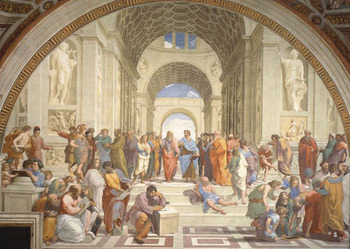
Most students of western civilization have come to appreciate the Ancient Greek polis, or city state, as the geographical milieu in and around which took place the golden age of Pericles, the Peloponnesian Wars, the evolution of philosophy, as well as numerous other scientific, artistic, and architectural advances (Fig. 1). The ancient Greeks introduced the idea that the polis, when conceived with virtuous institutions, has a natural association with its citizens that nurtures what is best in the people, and defines their character. Plato, in The Republic, considered the organizational structure and moral values of the city state which, by the very nature of its structure, extends to the person. In other words, the person and the polis are mirror images. They reflect in each other all that is good or bad. The condensed message is that, if the polis is conceived properly, the people will follow with virtuous acts.
The School of Athens, fresco by Raphael, 1509–1510. Vatican City, Apostolic Palace. Plato and Aristotle are the central figures in the fresco. Plato (said to be Raphael’s depiction of Leonardo da Vinci) points upwards and holds his Timaeus, while Aristotle points downwards and holds the Nichomachean Ethics. Other figures represent classical scholars of antiquity. The identity of many are in dispute, however, among those agreed upon, Pythagoras is depicted at the lower left perusing a book, Diogenes sprawls on the central steps, Heraclitus leans upon a stone block (and is said to be Raphael’s depiction of Michelangelo), Ptolemy has his back to the viewer at the lower right (and faces the self-portrait of Raphael, gazing outward), and Socrates is the balding, bearded figure to the left of Plato, facing away from the center. Reproductions of the painting are to be found at the University of Virginia, the University of North Carolina-Asheville, at the Königsberg Cathedral in Kaliningrad, and at the Sigma Alpha Epsilon fraternity’s national headquarters in Evanston, Illinois.

Aristotle was also a great protagonist of the polis. He wrote in The Metaphysics,3 “Man is, by nature, a social animal whose inclination is to live in the company of others.” Aristotle then explains the nature of friendship, and defines the relationship in terms of affection, utility, and virtue. Daniel Robinson,Reference Robinson4 in his analysis of Aristotle’s Nichomachean Ethics, points out that this “affiliative tendency” transcends the benefits of common defense, laws, commerce, and other forms of utility. The importance of this treatise on friendship is perhaps best expressed by Robinson, paraphrased as follows:
“Aristotle is found pausing to examine the nature of that most basic form of social affiliation, friendship. If we pause to examine Aristotle on friendship, it serves up one of the summoning essays in the history of thought….all the more summoning, all the more penetrating, all the more poignant for its matter-of-factness….on the principles of social cohesion and political affiliation in general.”
So, what are the different forms of friendship? Aristotle begins his examination with a friendship grounded only in the considerations of pleasure. There are many examples of these types of relationships, which include sensuous pleasures, intellectual attractions, interactions for amusement, and pleasures of the moment. Aristotle maintains that, as strong as these attractions are, they tend to last only as long as the interrelated pleasure survives. Aristotle points out that such relationships tend to be ephemeral, unless the friendship moves on to a more virtuous grounding.
The relationship grounded in utility is another form of friendship considered by Aristotle, that is two or more people who are useful to each other. It need not be any more complex than an interaction at a grocery store, where a consumer displays a pleasing personality to the butcher, who responds with attentive service. The consumer obtains an excellent cut of meat, whilst the butcher maintains a loyal customer. Another example is served by two scientific investigators who perform interrelated experiments, which help them attract grant support, but who never see each other outside their professional relationship. Aristotle notes that this type of friendship cannot extend much beyond the instance when the participants cease being useful to one another. Such a friendship, based on utility, could easily be supplanted by another party who could serve better one of the existing friends. This change in affiliation, while potentially damaging, need not be draconian or heartless. It can be, and usually is, a simple change in the direction of the given individual leading to a “new best friend”,5 who satisfies the new paradigm.
Aristotle’s third type of friendship, which he refers to as teleia philia, is best translated as completed or perfected friendship. As with many ancient Greek phrases, the English translation pales in the attempt to condense the meaning in just two words. The true meaning of teleia philia is a friendship that is grounded in virtue. Aristotle defines moral virtue or moral excellence as “The habit of choosing the golden mean, between extremes as it relates to an emotion or action.”2 Moral virtue may be attained through a lifetime of training, self-assessment, and successive re-adjustments in a person with an excellent state of character. This process results in nurturing the very best responses, irrespective of conditions, regarding the cardinal virtues of temperance, prudence, courage, and justice. The individual with moral virtue, when presented with a complex situation that requires an action, ponders a response, taking enough time to consider all options, but not undue time that could jeopardize the situation. The response must be measured and deliberate, to achieve the desired outcome with reference to the cardinal virtues. Considering the conditions and competing responsibilities, the individual with moral excellence will make the best decision, and perform the fitting action for that particular situation. This achievement of moral virtue then is the basis of the teleia philia, a friendship that “is grounded in a sharing by the friends of a set of principles and precepts of an essentially and irreducibly moral nature. In this kind of friendship, what A wants for B is what is good for B for the sake of B, and what B wants for A is what is good for A for the sake of A.”Reference Robinson4 This principled friendship results in a relationship that fosters and encourages a sustained and honorable cohesion. These are friendships of a lifetime, and instantiate what is good, and what is worthy. To be sure, Aristotle notes that these kinds of friendships do not come along every day. If one applies a principle of proportionality, nonetheless, one could extend these kinds of relationships to others. As cardiac surgeons, we respect moral virtue in each other. We can also respect and celebrate our relationship and moral excellence in affiliated physicians, nurses, perfusionists, administrators, and all concerned. By extension, we arrive at the virtuous programme for congenital cardiac surgery, which instantiates and promotes all that is good, and all that is envisioned in the Ancient Greek polis. The virtuous programme for congenital cardiac surgery, therefore, can be viewed as a microcosm of the Ancient Greek polis with separate, but interrelated, parts.
The world of today and the modern environment
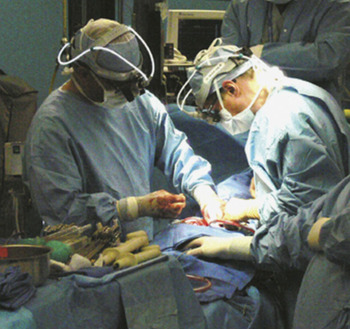
A summoning and unwritten tenet greets us as we enter the operating room, “Check your ego at the door.” Oftentimes we operate together, which results in “on-the-spot mini-symposiums” to determine the course of action in the setting of uncertainty.Reference Mavroudis6 The operative choice is always determined by discussion, citations of literature, considered opinions, and relevance to the particular patient (Fig. 2). Bravado, personal biases, and unsubstantiated actions are avoided. We endeavour to establish and maintain collegial relationships at the highest professional level with our colleagues in anaesthesia, nursing, and perfusion. This careful posture also extends to the patient who is being attended with the greatest regard for his or her dignity. If the programme, or its surrogate the polis, is developed with the aforementioned tenets in mind, individuals will act in the same manner.
The virtuous partnership at work in the operating room, with Gus Mavroudis to the left, and Carl Backer to the right.

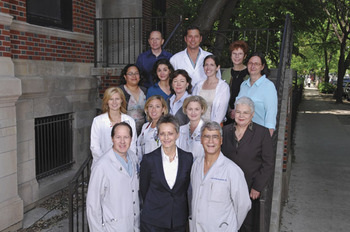
The continuity of care after the operating room leads to the paediatric intensive care unit, where collegial relationships extend to the intensivists, cardiologists, advanced practice nurses, nurses, respiratory therapists, and administrative personnel, among others. While we like to think of ourselves as “captains of the ship,” we readily recognize that there are other captains who bring expertise, industry, and experience to the programme, which ultimately results in the best possible care for our patients (Fig. 3).
The polis comprising cardiovascular surgery, cardiology, anaesthesia, and intensive care at Children’s Memorial Hospital, Chicago is comprised of many individuals who work in concert with one another. Gathering them all together for a photograph was an impossible task. Pictured here are, in the front row, Carl Backer, Barbara Deal, and Constantine Mavroudis; in the second row, advanced practice nurses Carrie Gabrys, Susan Pepp, Elizabeth Preze, and intensivist Zehava Noah; in the third row, executive assistant Silvana Illescas, office coordinator Dena Zabilka, cardiac services manager Karen Graham, and medical editors Kim Kupferberg and Melanie Gevitz; and in the top row, systems analyst Sean McKenna, perfusionist Steven Moss, and medical editor, Patricia Heraty.

Perhaps nowhere in modern medicine do medical and surgical colleagues collaborate as extensively as in the disciplines of paediatric cardiology and paediatric cardiac surgery. Differences of opinion, and their eventual resolution, play an important role in arriving at the proper course of action for our patients. We have found the question, “What do you think?” a positive influence in our deliberations. This simple query initiates academic discourse, establishes professional integrity, and enhances personal dignity. Taking time to consider collegial input cements the building blocks of the polis.
We endeavour to empower others to act on our behalf, based on their expertise and training. We instill skills in solving problems, and avoid micromanagement. We encourage and expect everyone on the team to take part in personnel recruitment, development of protocols, and multi-institutional studies. We include all colleagues in our academic visiting professorships, which are highlighted by celebratory dinners. Some of the more enjoyable activities are impromptu “road trips”7 to ethnic restaurants. These events complement the annual football game held on Thanksgiving Day, an annual triathlon race, and a winter holiday party.
This 18-year friendship has taken place within the confines of the programme developed for congenital cardiac surgery at Children’s Memorial Hospital in Chicago. Our programme can only function at its current high level within the virtuous environs of our physically circumscribed polis, the hospital, which is dedicated to delivery of paediatric healthcare, research into the prevention, causes, and treatment of diseases that affect children, education of its professional and support staff, and advocacy for the well-being of children.8 Beyond this, we must also depend upon leadership in government at the municipal, state, and federal levels, to maintain as a core value the health and well-being of its citizenry, most particularly the most vulnerable among us, our children.
Whether we have achieved moral excellence and entered into the teleia philia, that is the completed or perfected friendship, is for others to judge. For our part, we have found a way to develop a favourable environment that we have established by hard work, unselfish attitudes, and celebration of our mutual accomplishments. We see similar relationships in other programmes at other institutions. We were not the first to forge this kind of professional association, and happily we will not be the last.