INTRODUCTION
Archives are power-laden spaces. For Foucault, the archive is “the first law of what can be said, the system that governs the appearance of statements as unique events.”Footnote 1 In this way, the archive is not merely a neutral repository. It is a system governed by those who have the power to choose what gets archived and therefore produce meaning through that discursive formation.
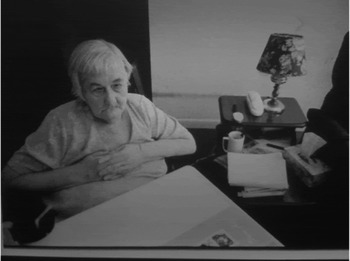
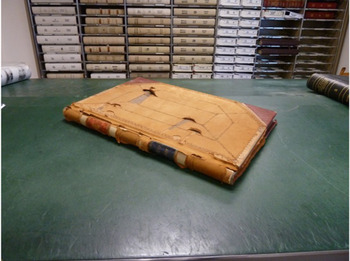
In Richard Robinson's documentary film, “Rothstein's First Assignment,” Mary Frances Corbin's story (see Figure 1) functions as a counternarrative to the historical archives of Shenandoah National Park and the Colony for the Epileptic and Feebleminded.Footnote 2 Her name is listed in several ledgers (housed in various archives and institutional records offices) such as the US Census, the “Tabulations” of a social worker, and a “Record of Persons Adjudged Insane” (see Figure 2), which contains the commitment records for individuals placed in state institutions. These traditional, monolithic ledgers are part of an archive that tells a particular kind of story not only about Mary Frances, but also about the institutions that were a significant part of her life. However, Robinson's film underscores that those ledgers do not tell Mary Frances's whole story and in turn do not reveal the entirety of the history of the founding of a national park and its intersection with a state-run medical institution.
Mary Frances Corbin, photography by Richard Robinson.

Page from public ledger book “Record of Persons Adjudged Insane,” Madison County Court House.

In this article, I present a theory of “alternative ledgers” – a kind of nonlinear storytelling created from “fragments” and hidden narratives not often included in historical archives. As a theory, alternative ledgers tries to account for the “interior” – the local, anecdotal knowledge that is often eclipsed by the official record. Based on this intermingling of theory, archival research, collaboration, and storytelling, I propose here a theory of alternative ledgers. As Sue Currell suggests in her work, “You Haven't Seen Their Faces,” “Examining the intersection of eugenic and welfare imperatives uncovers the inadequacy of the historical method that reconstructs the past using only evidence obtained from documents created by those whose voices are already privileged over their subjects.”Footnote 3 The theory and methodology discussed in this essay, therefore, attempt to address this inadequacy and document three things: (1) the process of researching and producing the documentary film, (2) the collaborative dialogues with Richard Robinson and Sue Currell about this history and its representation, and (3) the personal connections I have with some of the research informants. In this way I ask what counts as the archive and how we use the archive without reinforcing the power that it represents.
A THEORY OF MUDDLING: REFLECTION, REFLEXIVE COLLABORATION, AND ALTERNATIVE LEDGERS
Before I describe the process of researching and producing the film further, it is important to discuss a theoretical stance toward archives, which informs the way I approach archival research. Archives are typically thought of as repositories for material selected hierarchically by someone in a position of authority. As Derrida points out, “archive” inherently means power, order, and permanence.Footnote 4 That is, traditional archives, including ledger books, are listings – monolithic, statistical, and often static data. Both Foucault and Derrida challenge this static notion of the archive, stressing how notions of power and the truth of the archive are inherently unstable and exclusionary. Additionally, queer and feminist approaches to the archives ask us not only to understand what has been excluded from an archive, but also to value and provide a space for change, interaction, and additions, and to recognize the constantly changing state of the archive.Footnote 5 Archives, especially those documenting one's life, represent “living texts,”Footnote 6 texts that challenge the decision-making processes by which artifacts are chosen for inclusion within an archive. Framing historical records or ledgers to include counterhistories and -narratives challenges us to focus not on numbers, statistics, identity cards, and columns in a ledger book, but rather to search for the human qualities in people located in those lists. Furthermore, as we deliberate issues such as institutionalizing people, human rights and public-sphere scholars have drawn our attention to the importance of inclusion in understanding the democratic process.Footnote 7 As Fraser suggests, so-called “private” or individual issues are often deemed “inadmissible” in the public sphere and therefore do not count for the public record.Footnote 8 Mary Frances's private experience of forced displacement and subsequent institutionalization was not admissible into the public sphere in so far as she was not granted access to that space in which to deliberate. But Mary's story is of public concern: forced regulation of female bodies is a “widespread systematic feature of male-dominated societies.”Footnote 9 Berlant suggests that “narratives are read as autobiographies of collective experience. The personal is general. Publics presume intimacy.”Footnote 10 However, when in the interest of regulating the “peculiar” body, “discussion is restricted to the ‘common good’ … in which inclusion of ‘private interests’ is ruled out.”Footnote 11
Because archives are “neither universal across space nor stable across time,”Footnote 12 the methodology of researching and building archives, I propose, would always assume that there are gaps in knowledge, whether known or unknown. My approach, then, adopts a methodology that is influenced by poet and classics scholar Anne Carson. Carson's approach to her creative work and scholarly methodology, particularly regarding Sappho, provides for us a methodology for archiving that finds fragments and gaps not only tolerable but actually the state of reality. In her translation of Sappho's poetry, Carson's method includes editing Sappho's fragments as they exist, making the fragments and gaps visible and explicit. In her introduction to the collection, she discusses her rationale for editing Sappho's lyrical poems as a way to embrace the fragments.Footnote 13 A radical departure from others’ editions of Sappho, Carson leaves the gaps and fragments as they are, to reveal the “layers of time” and to uncover the various uses and interpretations of the artifact. She says,
this is the magic of fragments – the way that poem breaks off leads into a thought that can't ever be apprehended. There is the space where a thought would be, but which you can't get hold of. I love that space. It's the reason I like to deal with fragments. Because no matter what the thought would be if it were fully worked out, it wouldn't be as good as the suggestion of a thought that the space gives you.Footnote 14
She therefore highlights the unanswered questions, which in turn recognizes the unanswerability of most things in life rather than presenting a false sense of any one truth of a life.Footnote 15 At the same time, Carson examines the gaps through her expertise as a classicist, providing thorough footnotes within the Sappho volume. She provides links, historical context, translation and interpretation, and speculations – it's almost as if we're in the archive with her, reading the fragments with the benefit of her knowledge, expertise, and speculation to accompany our reading. In this way, we can interpret for ourselves, yet we're also taught how to scrutinize the empty spaces through deeper and deeper research.
Based on Carson's theory for fragments combined with feminist and queer understandings of the archive, I propose a theory of “alternative ledgers” that challenges what is contained in ledgers of lists and suggests a poetics of reading and establishing archives that values the notion of fragments. Alternative ledgers provide impressions, stories, musings, reactions, testimony, and subsequently a fuller picture even if a complete picture is “impossible to see.”Footnote 16 As Sue Currell suggests, “Rather than avoid interpretive, circumstantial and conflicting readings using partial evidence, my argument here is that these problematic methodologies are probably the only way that we can explain and piece together the story of American eugenics’ murky past.”Footnote 17 If we see archives not as “pristine storehouses of historical documentation that has piled up, but a reflection of and often justification for the society that creates them”Footnote 18 then we explicitly highlight the power relationships inherent in creating the archive. Feminist and queer archive theories provide further valuable insights into Foucault and Derrida's deconstruction of the truth of the archive and the kinds of discourse that are produced about histories and bodies within the archives. With this theoretical stance, we understand that the ordinary and the everyday are also archivable, not only the great achievements of the powerful. Archiving the ordinary, the domestic, and the informal conversations taking place outside places of power recognizes the exclusion of women from most of those spaces and takes into account those voices. Furthermore, queer archiving accounts “for the past that confronts historical erasure and omission, incorporates affects and trauma, and undermines an unequivocal embrace of longevity.”Footnote 19 In this way, understanding the archives as power-laden, shifting, able to be undermined, and never quite complete allows us to recognize research at the borders, seemingly inconsequential conversations, and chance encounters as part of the archive-building process. Finally, because the ill, sick, disabled, or displaced are particularly vulnerable to hegemonic archival practices, a theory of alternative ledgers attempts to reverse those exclusionary practices by highlighting layers of research and documenting processes.
The layers of research and dialogue around the founding of Shenandoah and the history of eugenics in Virginia, as seen through Richard Robinson's film and Sue Currell's scholarship, together with my own (and others researching this area), are examples of what Carson describes. As each reveals the layers found, more can be understood not only about an individual person but also about a moment in history. Yet our work – and the work of the SNP archives, the Library of Congress, the National Archives, archaeologist Audrey Horning's work – are all incomplete: they are fragments.Footnote 20
Richard's film, which does not present a neat, linear narrative progression, mirrors in art form the chaotic ways that uncovering the past represents what I call an alternative ledger. Ledgers are typically thought of as lists, columned bits of information stored neatly in a book to document a group of people, an event. The effort to create alternative ledgers such as Richard's film can seem a “muddled one, and the final narrative of the film reflects this chaotic process.”Footnote 21 In a discussion of the ethics of appropriation and the implications of the mediated forms of representing one's life, I have discussed how, even in our desire to reveal a hidden story necessary to be told, “we only see Mary Frances through the context of her life at the Colony.” Uncovering these processes seeks to see Mary's life outside the Colony, as deserving a multidimensional representation.
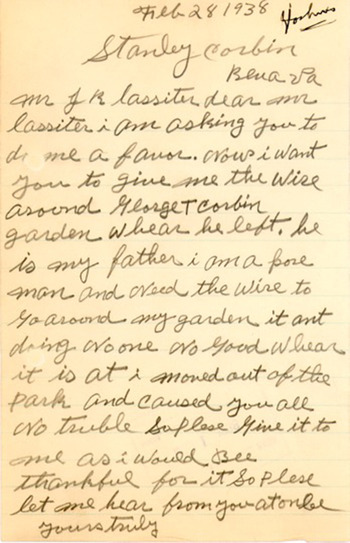
By the time I worked on the documentary film with Richard and interviewed Mary Frances, I had written two books on the history of Shenandoah. I have known about the displacement of families from Shenandoah National Park my whole life – I grew up in the foothills of the Virginia mountains where the park is located. When my parents took us hiking on the trails of the park, we often discussed the history of the land as we passed by family cemeteries, crumbling stone fences, and rows of boxwood bushes left behind at old home sites. When I later conducted research into this history and studied handwritten letters by displaced families (See Figure 3), I learned more about the complicated series of events that led to the displacements, and the lasting effects on individual and community identity that the park has had. However, it was not until I worked on the film with Richard that I learned of the “converging crises” of resettling the poor and of racial-integrity laws.Footnote 22 In her article about these issues, Sue Currell suggests that the “competing but intersecting ideologies” were at work in the “story of American eugenics' murky past.”Footnote 23 In this article and in some of her earlier work on the history of US eugenics, Currell points to what she calls “intersections,” “collisions,” and “contradictory narrative threads” that destabilize the history of places like Shenandoah and the Colony. Through our dialogues about the archival work necessary to create arguments about history and story, the necessity of revealing the layers of stories often hidden within archives was clear. When I was conducting archival research on my own, I was aware of these contradictions, but it was not until our collaboration that I began to see what underlies those contradictions and the theoretical implications of them. As Currell suggests, competing narratives from systems, policy, and state agents all contribute different layers to the story. This essay, therefore, is the response to a rare opportunity to discuss the intersections between and among Sue Currell's, Richard Robinson's, and my own work as they inform contemporary representations of vulnerable bodies. In addition to discussing our collaborations and their impact on my own work, this essay also examines what tends to remain hidden in the writing up of research – those stories and personal connections that, while not archived in any official way, still have significant impact on the way researchers approach, examine, and report on archival materials. This includes the ways my family's life intersected with Mary Frances's and how in turn her life has influenced my desire for alternative modes of archiving.
Letter by Stanley Corbin.

A METHODOLOGY OF HIDDEN ARCHIVES
When I have discussed the history of the people of Shenandoah with various audiences, I'm often asked what sparked my interest in this story. My answer has often included an explanation of how I grew up in Madison County, one of the counties impacted by the formation of the park, and that I don't remember not knowing the history of family removals from the park. I heard stories from my childhood friends, my parents’ friends and acquaintances, and from my father, who often took us to Shenandoah for hikes and swims in the waterfalls.
After researching and writing about Shenandoah extensively, I began an oral-history project with descendants of the displaced. During this time, I began working with Richard, where we conducted interviews with descendants together and produced his film. Before our work together, I had conducted research in the National Archives, historical societies, county records offices in eight different counties, ancestry.com, family genealogy websites, and descendants’ living rooms as I interviewed them about their ancestors. The most significant place where I researched was the Shenandoah National Park Archives – where they have photographs, land-use records, and correspondence, including the handwritten letters discussed in my first book. But it was while working with Richard, and especially after we interviewed Mary Frances, that my perspective on the story shifted. I was not expecting to discover that our family histories were connected and that I was not the detached neutral recorder, but that my own family had been implicated in her institutionalization.
After we interviewed Mary Frances together, Richard went to the Madison County Court House to explore the records there and to find more information about Mary's family. While there, the clerk showed Richard a little-known resource, the ledger book titled “Record of Persons Adjudged Insane.” Richard found Mary Frances's name in the book, confirming her “commitment” to the Virginia Colony for Epileptic and Feebleminded in 1941, and noticed my grandfather's name as the physician's signature in Mary's case. When Richard called to tell me what he'd discovered, I was emotionally shaken but not that surprised – my grandfather was the local doctor in the area during that time. What did surprise me, indeed what troubled me, was the connection between us, between Mary and me, and the hidden story of her family and her story, and my grandfather's role as a leader in the community in contributing to that story. I had to wonder what it meant that I was part of revealing more of that story, some sixty years later.
In 1941 my grandfather, referred to by everyone as “Doc,” had just finished his residency at the University of Virginia, which trained its students in eugenics theories.Footnote 24 Doc was the signing physician on many of the people committed to the state hospitals at that time. Together with the presiding judge and a caseworker, these signatures were necessary for one to be committed involuntarily. Not long after Richard told me about the ledger, I went back to my hometown to have a look myself, chatting with the deputy clerks I'd grown up with and who had offered crucial help in my research a few years earlier when I had been there reconciling land records with the archival materials from Shenandoah. Looking at my grandfather's signature in the ledger column next to Mary's name, my memories of driving into the mountains flooded back to me. I came to understand that anything I knew about the story of families who lived in the mountains also was intertwined with the work of my grandparents.
My grandmother, who served as my grandfather's nurse, had a deep commitment to the mountain families they tended. When I was a kid, I often crawled into the back of their Chevrolet Caprice to sit atop the window-high pile of Journal of the American Medical Association magazines. We'd ride up to homes just outside the boundaries of Shenandoah Park and Doc would pull out his stethoscope while grandma talked to a spouse or children. I'd stand by the car, or on a porch, mostly waiting and sometimes talking with the children. My grandfather, the only doctor in the county for decades, was trained at a university leading in eugenics discourse, and he and my grandmother both had a paternalistic sense of their responsibilities toward the “Negroes” and the “mountain folks” steeped in the Progressive Era attitudes of the white upper class of the time. Our lives obviously stood in contrast to each other. But because I had visited families with my grandparents, I knew that Mary's name in the ledger book was not her whole story. Yet that story was the only story available in the archive. My personal connection informed my desire to understand how it could happen that Mary's family could be forcibly removed from their homes in order to form a public park.
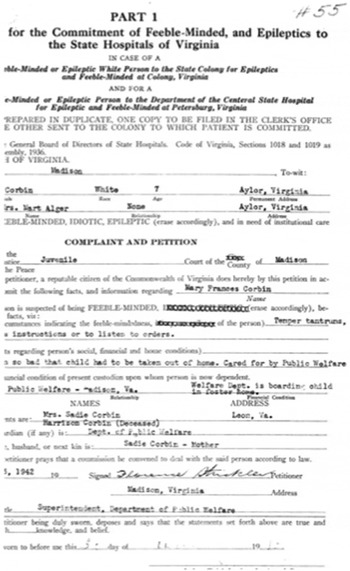
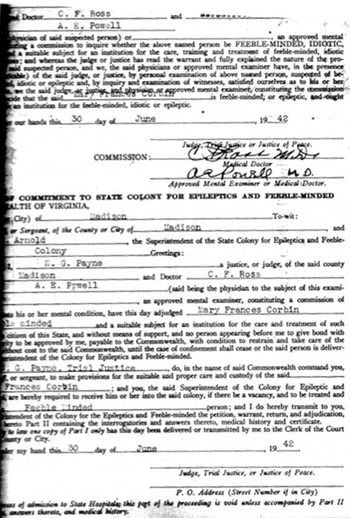
In addition to my grandparents, my parents also held community advocacy positions. My father served as circuit court clerk (and later an attorney) and my mother worked as a social worker. She knew Florence Strickler, the social worker who had signed Mary Frances's commitment papers (See Figures 4 and 5). As the letter Currell discusses in her 2017 article shows, Mollie Corbin, a cousin of Mary Frances, was scheduled for sterilization at the Colony
under the direction of Florence Strickler, her Federal Relief social worker. There is no firm evidence that Strickler had accompanied Rothstein during his visit, but it is highly possible that she was there to guide Rothstein's camera eye and even to provide the phrases that would become the captions Stryker decided to use.Footnote 25
The firm evidence of this connection might be in the form of Florence Strickler's records. However, I knew from my mother that all of these records were routinely shredded to protect families’ privacy. While not advocating for a different practice of privacy protection, I point this out to highlight that where “firm evidence” does not exist, some puzzles in the story can be addressed, even if not solved. So knowing that these records existed at all led me to ask, what did these records contain about Mary and her family that would fill in the gaps of this collective history generally and her story particularly? Why do social worker's records require shredding but Rothstein's photographs of poor southerners get archived on the publicly available Library of Congress website?Footnote 26
Mary's commitment paper.

Mary's commitment paper.

Since making the film and collaborating with Richard and Sue, what we found is that Mary's story not only resists the dominant narrative of the founding of Shenandoah and the history of eugenics, but also impacts the contemporary story of the place where she was institutionalized. The Colony, now named the Central Virginia Training Center (CVTC), serves as a residential facility for persons with intellectual and developmental disabilities. Because of a violation of the Americans with Disabilities Act, the VTCs are being closed and hundreds of residents will be displaced. When I found out about the 2012 closures, it was because of Mary Frances and having a fuller awareness of the place that I decided to investigate what the closures would mean for the residents who lived there now. Though the closure policies were passed in order to assure equity for persons with disabilities, many living there did not want to leave the only home they'd known for twenty or thirty years. The policies were passed ostensibly for equality but in some cases they work against the most vulnerable and precarious as their families and guardians seek the necessary resources to care for their medically fragile family members.Footnote 27 As Currell states, eugenics worked to “frame disability as a way to rationalize scientific exclusion,” and as I've found in more recent interviews with families of the residents of the VTC, these competing narratives continue to operate in contemporary discourses about the care of persons with disabilities. Like Mary's records that were destroyed to maintain her privacy, current residents’ experiences are also hidden during the closure process. Mary's story, however, prompts us to ask how might we understand the impact of their impending relocations without understanding the process more fully.Footnote 28 Mary's willingness to share her story with us has significantly impacted the research I'm doing today in another context.Footnote 29
There is so much we don't know about Mary's family, that she didn't know, and the practice of destroying archival documents for privacy reminds us as researchers that there is only so much of the picture we will ever see. This practice, together with the practice of not archiving certain artifacts deemed unimportant (or inadmissible), makes for an incomplete story. My personal connection to Mary's hometown and the anecdotal or vernacular evidences that remain hidden are difficult to address in research training courses. In addition, these stories cannot count as evidence per se and are therefore thought not important enough to be included in research reports or in academic journals. Yet, because they led me to other sites of evidence and more questions, they were critical to the way I wrote up my research, to what I found, to what I looked for afterward, and, as stated above, to the current direction of my work examining the institution rooted in Mary's history and its contemporary impact on the community.
This autobiographical information about me may not seem important in understanding the history of the park or of regulating the bodies of the poor. These are the archival, ledger stories that don't often get told in the methodology sections of our research articles. Yet these were the critical instances that led to the connections made across disciplines, across continents, and across histories. Because my understanding of the work is deeply informed by uncovering these hidden archives, I propose a theory of alternative ledgers that includes the muddled, chaotic, and disconnected aspects of research. This theory of alternative ledgers is deeply informed by the layered contradictions, gaps in information, and countless informal conversations and collaborations across time and space while working on this project formally for over fifteen years and thinking about it informally for longer than that. My ability to conduct research as I did was because of my family history – I wouldn't know some things about the park without going on home visits with my grandparents. In fact, some of the people I interviewed spoke to me because of my family connection or in spite of it. For instance, I was able to interview one park descendant because a colleague in my father's law practice knew her and let her know it would be okay to talk to me. Her voice and the voices of other descendants had been silenced from the record. Their stories implicated the truth and evidence of the historical record of the founding of the park. If I hadn't interviewed them, I would never have known that one of the park's residents did not want a particular photograph of her distributed and asked the park not to publish it. I had seen the photograph, which depicts federal agents forcibly removing a woman from her home. Before an interview with her niece, I saw the photo as depicting an act of resistance. But my access to her family let me know that the woman was ashamed of the photo. She had waited in the car while her nieces asked the archivist not to share the photograph with the public any longer. This and other examples highlight the constant questioning and re-questioning of what is or should be private, of who gets to determine what is private, and of how what is private is interpreted, represented, and disseminated. This spectral evidence of trauma and the importance of this local, anecdotal knowledge remind us that the removal of families will always be a story, as much as some in power don't want to talk about it, as generations continue to be impacted by the event.
When all we know of Mary Frances is through the context of her commitment paper to the Colony, she is (at least) doubly subjugated: first by her literal confinement and second by the ledger that contains her record of “feeblemindedness.” In a theory of alternative ledgers, however, her voice, her story, would be included in that archive. As Richard describes in his blog, when Mary asked him for copies of her family's photographs, it could be argued that she was insisting that this part of her history be known. Together, Mary's family history as recorded in the public archives, and her history as documented by Richard's film, lead to a new voice and history for Mary. For Mary, those photos are not merely a record in the Library of Congress documenting poverty in the South (which had been Rothstein's FSA assignment). Rather, they are a record of her family, they are a record of her family being taken from her. Mary's act of asking for the photos draws attention to the social structures limiting her identity. In this way, Mary took back some part of the record for herself, despite having been essentially erased of her family and her identity. Her request challenges and disrupts the context of her identity as only steeped in the Colony, and makes us rethink how her life has been catalogued, saved, and layered for future work and interpretation. Foucault states, “This turning of real lives into writing is no longer a procedure of heroization; it functions as a procedure of objectification and subjection.”Footnote 30 The ledger located in the Madison County Court House, which frames her life in terms of disability and poverty, is incomplete and therefore subjugates and contains her in a particular historical narrative. An alternative ledger recognizes that subjugation and provides additional material to counter that narrative.
Constructing history from fragments, then, is a necessary part of constructing history. Significant parts of the story (a government imposing shame through forcible removal) are not fully visible without these fragments. Often these layered connections are not reported in our research, not because they aren't significant, but because there usually isn't space for them. I think also that there hasn't been a theoretical space for them. There is often sufficient “documented” evidence, but what counts as evidence excludes these little vignettes. Yet they are part not only of who I am as a researcher, but also of how I interpret and analyze the material and interact with and inform my collaborators.
A theory of alternative ledgers, then, counters the static ledgers with which we are already familiar: “land-use records” are very traditional, business-like accounts of the human bodies (much like refugee intake ledgers, much like the ledger titled “Record of Persons Adjudged Insane”) that were displaced from Shenandoah. Films like Richard's, interactive digital archives, and other innovative renderings can be seen as “alternative ledgers,” transgressive ways of reporting information about history that upturn our understanding of a particular event and highlight the individual in doing so. In this way, the decision-making power of what gets archived is questioned, and new ways of seeing an event are exposed.
Based on this discussion, then, a theory of alternative ledgers includes (1) a recognition of interiority and private life/experience as critical to understanding collective history and (2) a recognition of incompleteness and fragmentation. Below I include a third component that discusses alternative ledgers as a space where additions, interactions, and questions can be documented.
A THEORY OF ALTERNATIVE LEDGERS IN PRACTICE
One way to imagine alternative ledgers in practice is to digitally archive fragments, even if they do not tell a complete story, which would include pieces of the story. This archival practice would include fragments of story, would highlight the potential for further connections, and would chart these connections despite, indeed because of, the unknown and unknowable. Knowing these limitations, the archived materials included here are intended to evoke a methodology toward this theory, as a way to fill in the gaps of the standard archive and to facilitate interaction and participation with those archives. Wernimont proposes a “radical feminist approach” to digital archives where
the facilitation of such interactions is crucial for ongoing feminist work in digital literary studies. “Interaction” resonates with the ongoing emphasis on collaboration in the field, but also suggests the use or inhabiting of the space between actions – between “use” and “creation/making,” or between “making” and “theorizing.” As “thresholds,” digital archives are complex negotiations of the spaces between “thing and theory” – where “thing” signified both the media through which a user interfaces and the material object being represented or reproduced.Footnote 31
As a threshold in Wernimont's sense, the approach to creating such a digital archive is also informed by the feminist maker spaces, where reciprocal relationships between theories of social justice and practices of dissemination for social change and transformation have a possibility to occur. Maker spaces (also known as hackspaces) are community-operated workspaces where people with interests in technology and digital arts can build, collaborate, and communicate. Traditionally gendered structures of technology production, research, design, and development practices can perpetuate inequality.Footnote 32 As a consequence, the benefits of knowledge and technology tend to be distributed unequally and therefore perpetuate the marginalization of underrepresented groups (e.g. non-Western peoples, laypersons, people of color, low-caste and low-income persons, people with disabilities, and members of LGBTQ communities). Strategies for “undone” technologiesFootnote 33 that may be of most utility to marginalized populations need more attention in order to more effectively distribute technology's possible benefits. Based on theories of recognition justice,Footnote 34 which advocates for the facilitation of underrepresented groups’ participation in decision-making processes, Alternative Ledgers is conceived to facilitate transformative research and knowledge production about marginalized communities.
Producing alternative ledgers with these theories in mind, these spaces would operate with the understanding that “past environments are the ghosts inside us”Footnote 35 and therefore shed critical light on the infrastructures causing damage to individuals and across communities. However, the stories on this site focus away from damage and victimization (which is how the stories tend to be told) to stories of transformation and day-to-day living. This commitment moves away from creating digital spaces for spectators of trauma to a digital space where the displaced become agents of social change and where audiences are called into responsibility to these stories, histories, events. As Michelle Murphy states, doing so is a “decolonial interruption,” a moment where audiences are asked to take responsibility rather than be passive spectators. These contested narrations of an individual's past “undo” the audience, counter expectations, and challenge us to think of what's possible despite the atrocities experienced by the displaced.
Several scholars are engaged in such feminist spaces that are transforming our notions of traditional archives and seek interaction and co-archiving with users. Kate Dossett's digital archives, “Feminist Archives, Feminist Futures,”Footnote 36 focusses on the ways that digital spaces can alter they ways we narrate stories, in particular the history of twentieth-century feminism. Her focus on the processes of archive production highlights for us the ways that decision-making powers are intertwined with the ways archives are constructed and used. Similarly, K. J. Rawson's “Digital Transgender Archives”Footnote 37 argues for the inclusion of born digital materials in the archives, illustrating the ways that digital spaces, particularly those that encourage user participation and contribution, push boundaries about what archival spaces are “supposed” to look like. In these and other emergent digital spaces, interaction with and among users is a key component to ensuring that fragments, untold stories, and incomplete pieces become part of the historical record.
Most displacement stories follow a traditional narrative arc where the “victim” is saved by a Western entity. However, this traditional (and gendered) structure of storytelling perpetuates the rescuer/rescued trope of the displaced that maintains entrenched power structures and thus perpetuates inequality. In a potential alternative-ledger digital archive, however, I imagine the curation and facilitation of participation through this “feminist maker space” As transformative and collaborative.Footnote 38 At the same time, this alternative ledger would also recognize the space as always already mediated and that “the final destination of the archive is therefore always situated outside its own materiality.”Footnote 39 So while striving for a space for equitable representation, I recognize that digital spaces are mediated and access remains limited. But with artifacts like handwritten letters, historic photographs of houses, and audio clips from a descendant's interview available on the site, hopefully more will become known, available, disseminated. While this digital representation might become an “alternative ledger” of information about the people who lived in Shenandoah National Park, it would highlight its incompleteness and invite users to contribute additional information. In this way, a theory of alternative ledgers, both conceptually and in practice, (1) recognizes interiority and private life/experience as critical to understanding collective history; (2) recognizes incompleteness and fragmentation; (3) provides a space where additions, interactions, and questions can be documented; and (4) suggests a decolonial interruption, where audiences are asked to take responsibility for what they encounter rather than be passive spectators of the process.