Introduction
The relationship between reproduction of animals and environmental factors is important for understanding the effects of global climate change. It is particularly important for endangered animals due to the requirements for conservation management. Reproductive activities of sea turtles have attracted attention because most sea turtle species are endangered, according to the IUCN Red List of Threatened Species (IUCN, 2019). Phenological changes in nesting season (Weishampel et al., Reference Weishampel, Bagley and Ehrhart2004; Mazaris et al., Reference Mazaris, Kallimanis, Sgardelis and Pantis2008), hatchling mortality (Laloë et al., Reference Laloë, Cozens, Renom, Taxonera and Hays2017) and skewed sex ratio (Laloë et al., Reference Laloë, Cozens, Renom, Taxonera and Hays2014) have been a concern in sea turtles with temperature-dependent sex determination.
Sea turtle nesting events observed at nesting beaches vary annually due to variation in remigration intervals (i.e. intervals between successive reproductive seasons) correlated with water temperature (Solow et al., Reference Solow, Bjorndal and Bolten2002; Neeman et al., Reference Neeman, Spotila and O'Connor2015) and prey species production (e.g. plant foods for the green turtle Chelonia mydas; Broderick et al., Reference Broderick, Godley and Hays2001), in addition to upward or downward trends in abundance (Mazaris et al., Reference Mazaris, Schofield, Gkazinou, Almpanidou and Hays2017). Intra-annual variation in the number of nesting events has also been observed as nesting seasonality. Sea turtle nesting generally peaks in early summer (e.g. Hirth, Reference Hirth1980; Kikukawa et al., Reference Kikukawa, Kamezaki and Ota1999; Cheng et al., Reference Cheng, Huang, Hung, Ke, Kuo and Fong2009; Aini Hasanah et al., Reference Aini Hasanah, Nik, Amiruddin and Nurolhuda2014). In some tropical regions, peaks of sea turtle nesting are observed, but nesting occurs year-round (e.g. Hendrickson, Reference Hendrickson1958; Chan et al., Reference Chan, Joseph and Liew1999; Yasuda et al., Reference Yasuda, Tanaka, Kittiwattanawong, Mitamura, Klom-in and Arai2006; Beggs et al., Reference Beggs, Horrocks and Krueger2007; Revuelta et al., Reference Revuelta, León, Feliz, Godley, Raga and Tomas2012; Bourjea et al., Reference Bourjea, Dalleau, Derville, Beudard, Marmoex, M'Soili, Roos, Ciccione and Frazier2015). Higher numbers of nests have been observed at higher air temperatures (Godley et al., Reference Godley, Broderick and Hays2001) and sand temperatures (Godley et al., Reference Godley, Broderick, Frauenstein, Glen and Hays2002). Higher ambient temperatures shortened inter-nesting intervals (i.e. intervals between successive nesting events in one reproductive season) (Sato et al., Reference Sato, Matsuzawa, Tanaka, Bando, Minamikawa, Sakamoto and Naito1998; Hays et al., Reference Hays, Broderick, Glen, Godley, Houghton and Metcalfe2002); therefore, more nests might be found during a hot season.
In addition to the effects of temperature, rainfall and humidity may affect the seasonality of sea turtle nesting. In the Seychelles, hawksbill turtles (Eretmochelys imbricata) nest during the rainy season (Mortimer & Bresson, Reference Mortimer and Bresson1999; Allen et al., Reference Allen, Shah, Grant, Derand and Bell2010). Moist sand may enhance sea turtle nesting by making it easier for the turtles to dig nest chambers (Pike, Reference Pike2008). In contrast, more green turtle nests were observed during the dry season in Sarawak, Malaysia (Hendrickson, Reference Hendrickson1958), and rainfall had no significant impact on nesting success in Ascension Island (Godley et al., Reference Godley, Broderick and Hays2001). Inter-specific differences might exist in the influence of precipitation on nesting; many nesting emergences were observed in hawksbill turtles (Mortimer & Bresson, Reference Mortimer and Bresson1999; Allen et al., Reference Allen, Shah, Grant, Derand and Bell2010) but not in green turtles (Mortimer et al., Reference Mortimer, Camille and Boniface2011) during the rainy season. The effect may also vary among populations because green turtle nesting peaks have been reported during both the austral summer (wet season) and the austral winter (dry season) within a relatively narrow geographic range (Dalleau et al., Reference Dalleau, Ciccione, Mortimer, Gamier, Benhamou and Bourjea2012; Bourjea et al., Reference Bourjea, Dalleau, Derville, Beudard, Marmoex, M'Soili, Roos, Ciccione and Frazier2015). Thus, the effect of rainfall on sea turtle nesting events remains unclear.
In this study, we reveal the relationship between the number of green turtle nesting events and environmental factors at Penang Island, Malaysia. In this study, a generalized additive modelling (GAM) approach was applied for incorporating the non-linear effects of environmental factors on the number of green turtle nests at Penang Island. Sea turtle nesting data have been collected at Penang Island since 1995 by the Malaysia Department of Fisheries (DoF) (Sarahaizad et al., Reference Sarahaizad, Mansor and Shahrul-Anuar2012). Recent intensive beach surveys and tagging surveys provide the possibility of assessing the fluctuation of the number of nests (Sarahaizad et al., Reference Sarahaizad, Mansor and Shahrul-Anuar2012; Sarahaizad & Shahrul Anuar, Reference Sarahaizad and Shahrul-Anuar2015).
Materials and methods
Beach survey
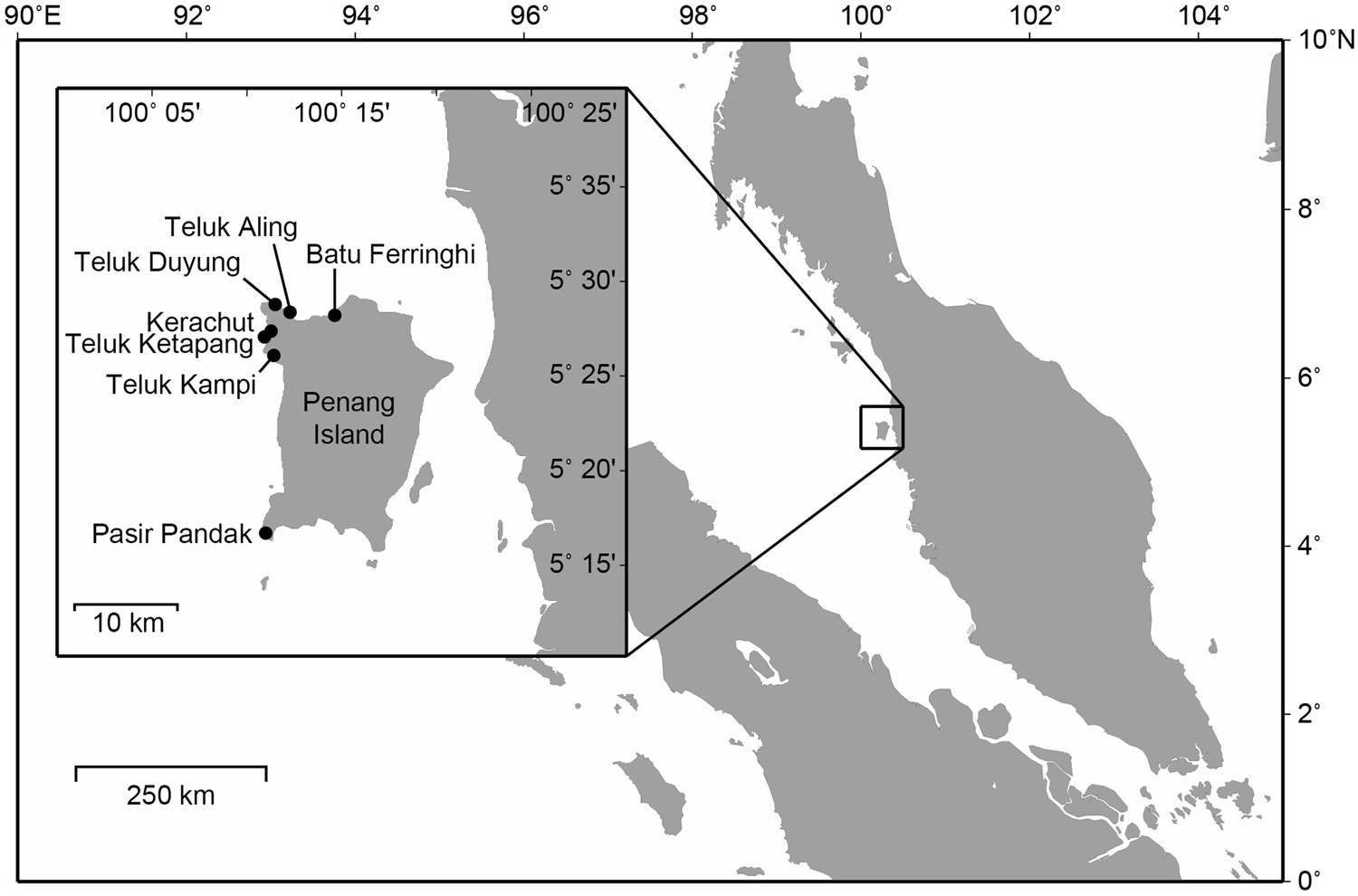
During 2010–2016, DoF staff counted the monthly number of green turtle nests on the beaches of Penang Island, north-west coast of Peninsular Malaysia, South-east Asia (Figure 1). The beaches are locally named Teluk Duyung, Teluk Aling, Kerachut, Teluk Ketapang, Teluk Kampi, Pasir Pandak and Batu Ferringhi (Figure 1). Surveying efforts used in this study are described by Sarahaizad et al. (Reference Sarahaizad, Mansor and Shahrul-Anuar2012), and Sarahaizad & Shahrul Anuar (Reference Sarahaizad and Shahrul-Anuar2015). In short, nocturnal surveys were performed at Kerachut and Teluk Kampi four times from 2100 h to 0500 h every night throughout the year. During the nocturnal surveys, the staff strictly adhered to the procedure stated in the official DoF guidelines (Sukarno et al., Reference Sukarno, Mohamed-Ridzuan, Mohamad-Zabawi, Mohd-Najib, Abdul-Aziim, Mansor, Azwa, Farizan, Mohd-Khalil-Khasah, Robert, Abd-Karim, Zakaria, Syed-Abdullah, Zulkifli, Wahidah, Abdul-Wahab and Norul-Fahiezah2007).
Geographic location of Penang Island and surveyed beaches.

If turtles were spotted on land, the light source was switched off, and the nesting activity was monitored about 5 m away from the turtles. Nesting activity was allowed to proceed undisturbed until oviposition was complete (Chan, Reference Chan2013). Curved carapace length (CCL) and curved carapace width (CCW) were measured using a 2-m tape except during inclement weather (i.e. rough seas and heavy rainfall). The turtles were then checked for tags. If the tags were unreadable or missing, Inconel tags were clipped onto both front flippers between the proximal second and third front flippers' scales (Broderick & Godley, Reference Broderick and Godley1999). Clutch frequency, inter-nesting interval and remigration were quantified based on tag data.
Nesting activity is reported to be low at beaches other than Kerachut and Teluk Kampi (Sarahaizad et al., Reference Sarahaizad, Mansor and Shahrul-Anuar2012). Therefore, data of these beaches were recorded based on reports from local fishermen. Clutch size was recorded in the same manner as for Kerachut and Teluk Kampi. At Teluk Duyung and Teluk Aling, turtles were tagged on both front flippers and CCL and CCW were measured.
Environmental data
Monthly mean air temperature and precipitation for 2010–2016 were obtained from the Malaysian Meteorological Department. Environmental data were monitored at Bayan Lepas Station, Penang Island (5°17′49″N 100°16′20″E; elevation 2.46 m).
Statistical analysis
By using mgcv package (Wood, Reference Wood2004) of R ver. 3.6 (R Core Team, 2019), additive models for monthly number of nests were estimated and compared. The predictor variables of month of year, air temperature, precipitation, and trend were evaluated. Smoothing basis for month of year was cyclic cubic regression splines, while those for the other variables were thin plate regression splines. Poisson distribution was assumed and autocorrelation structure of order 1 was incorporated. Variables were selected by stepwise forward selection, but up to a maximum of 2 variables and their tensor product interaction in order to avoid convergence error. Selection was generally based on Akaike Information Criterion (AIC) values, but autocorrelation of standardized residuals was graphically checked for selecting the best model.
Results
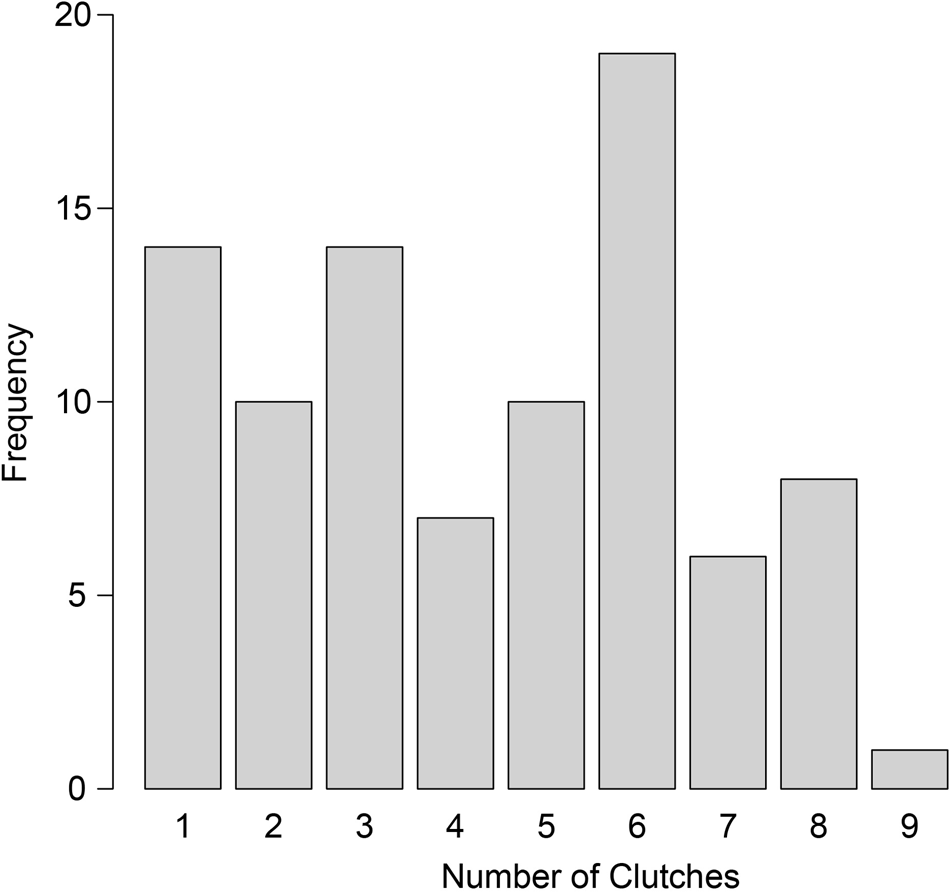
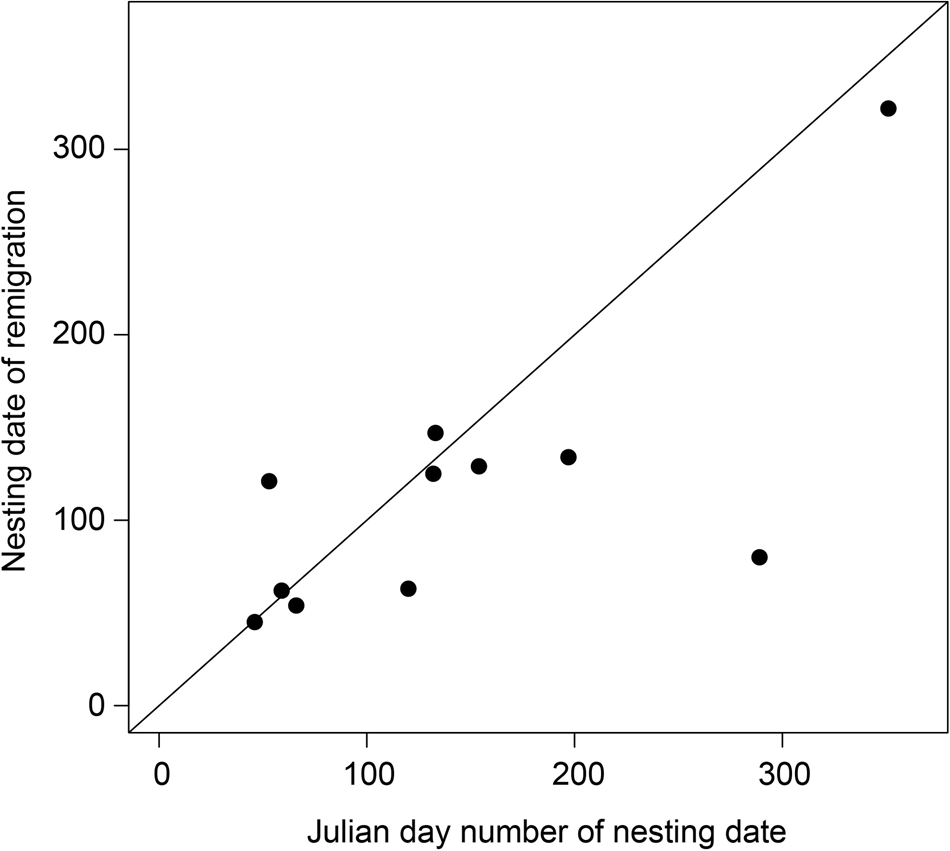
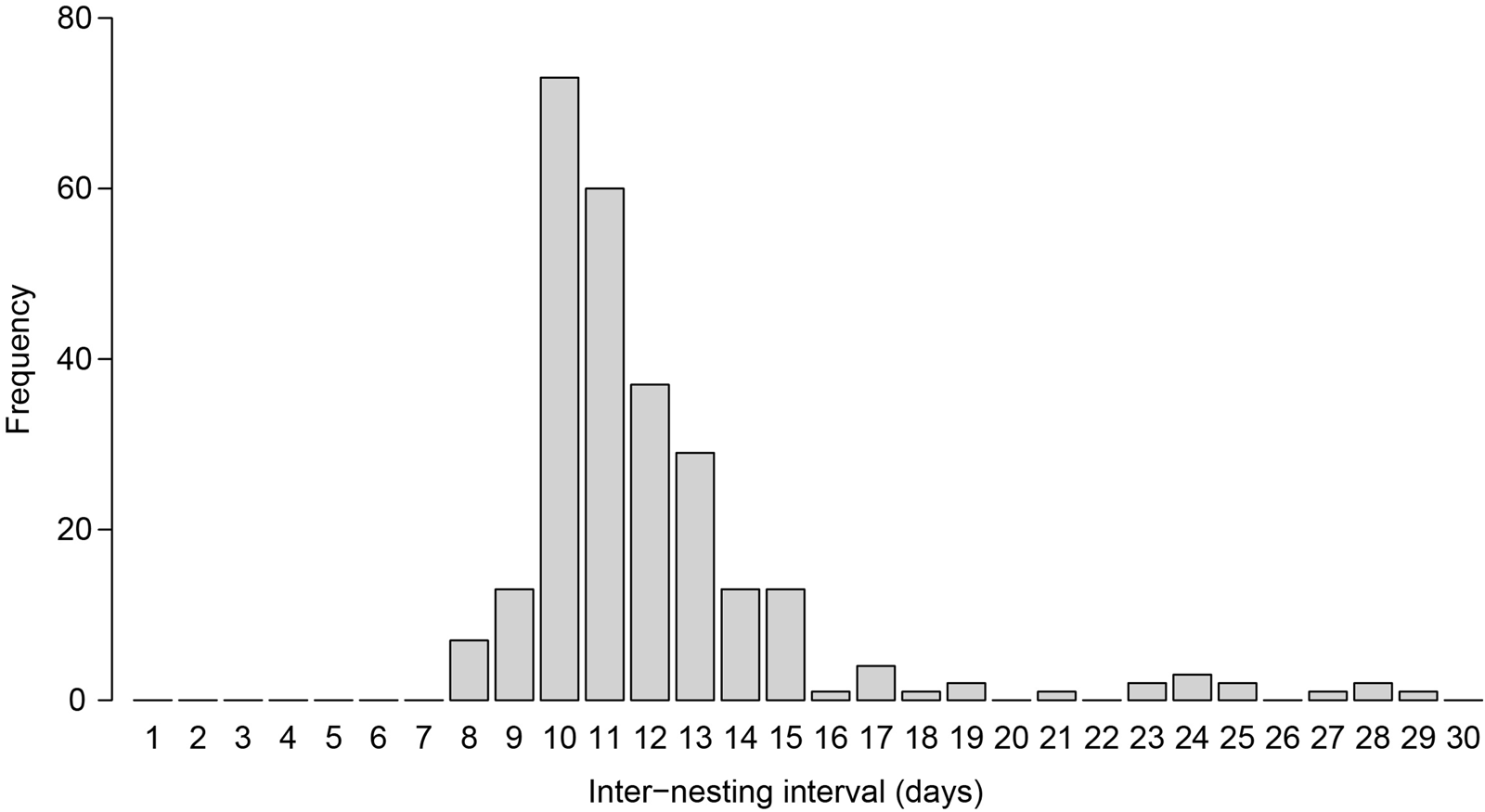
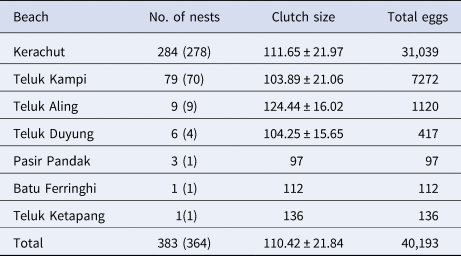
In total, 383 nests were identified. Kerachut had the highest number of nests and Teluk Kampi the second highest (Table 1). Tagging identified 93 female turtles in total, each of which nested 1–9 times in one season (Figure 2). Eleven female turtles were confirmed to remigrate at intervals of 1.5–6 years (17–71 months between the first dates of nesting over two seasons) and the most frequent remigration interval was 3 years (34–37 months). The relationship between the first nesting dates of nesting over two seasons of each individual was plotted (Figure 3) for individual preference for the nesting time of year. Except one individual, the first nesting dates of nesting over two seasons were similar (Figure 3). Inter-nesting intervals determined from 265 nesting events ranged from 8–29 days and the most frequent interval was 10 days (Figure 4). CCL and CCW were measured for 51 out of 93 females, and the mean ± SD values were 101.0 ± 5.1 cm (range: 90.0–110.0 cm) and 89.3 ± 7.3 cm (range: 67.5–102.0 cm), respectively.
Clutch frequencies of green turtles nesting on beaches of Penang Island.

Relationship between the first nesting dates of nesting over two seasons. The line indicates 1:1.

Inter-nesting intervals of green turtles nesting on beaches of Penang Island.

Number of nests (number without poached nests in parentheses), clutch sizes (mean ± SD), and total eggs during 2010–2016

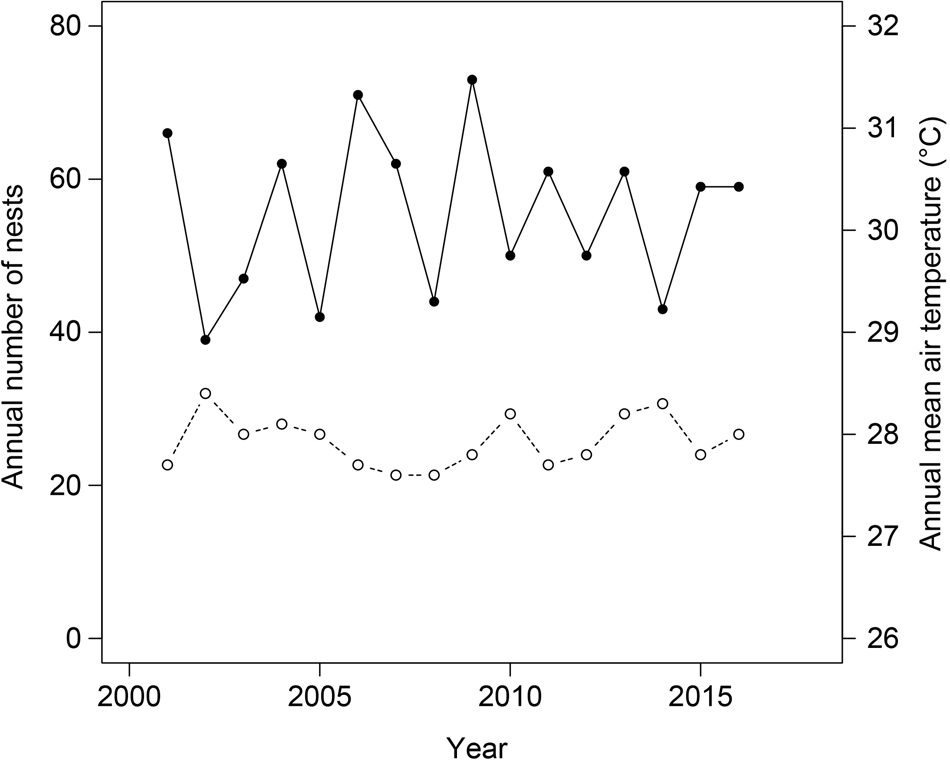
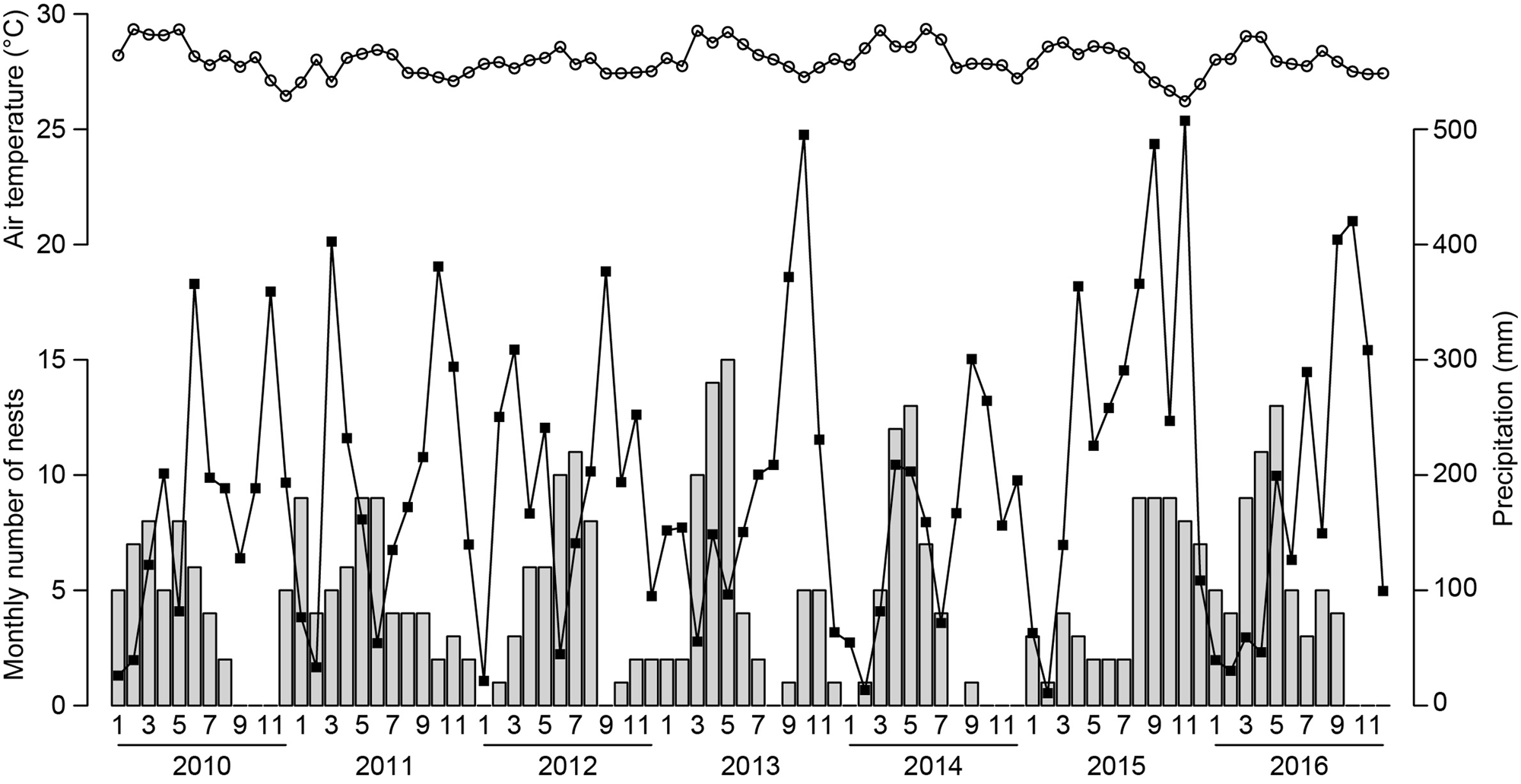
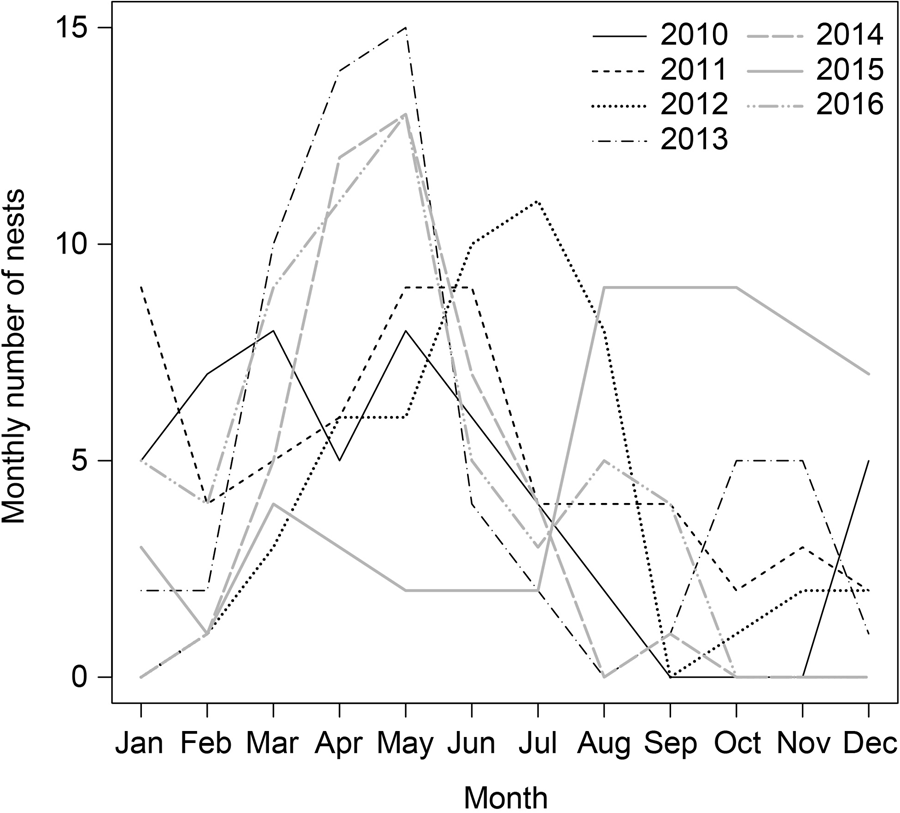
Annual number of nests during 2010–2016 was 43–61, and there were no upward or downward trends in comparison with 39–73 nests annually observed in 2001–2009 by Sarahaizad et al. (Reference Sarahaizad, Mansor and Shahrul-Anuar2012) (Figure 5). Over 84 months during 2010–2016, the monthly number of nests ranged from 0–15 (Figures 6 & 7). The number of nests each month had high variability across years (Figure 7). Overall during these observations, peaks of the number of nests generally occurred in April–May. However, peaks also appeared in March 2010, June–July 2012 and August–September 2015 (Figures 6 & 7).
Annual number of green turtle nests (solid line and filled circles) and annual mean air temperature (dashed line and hollow circles) at Penang Island. Annual number of nests during 2001–2009 was extracted from Sarahaizad et al. (Reference Sarahaizad, Mansor and Shahrul-Anuar2012).

Monthly number of green turtle nests (grey bars), temperature (hollow circles) and precipitation (solid squares) on Penang Island during 2010–2016.

Monthly number of green turtle nests observed in each month at Penang Island.

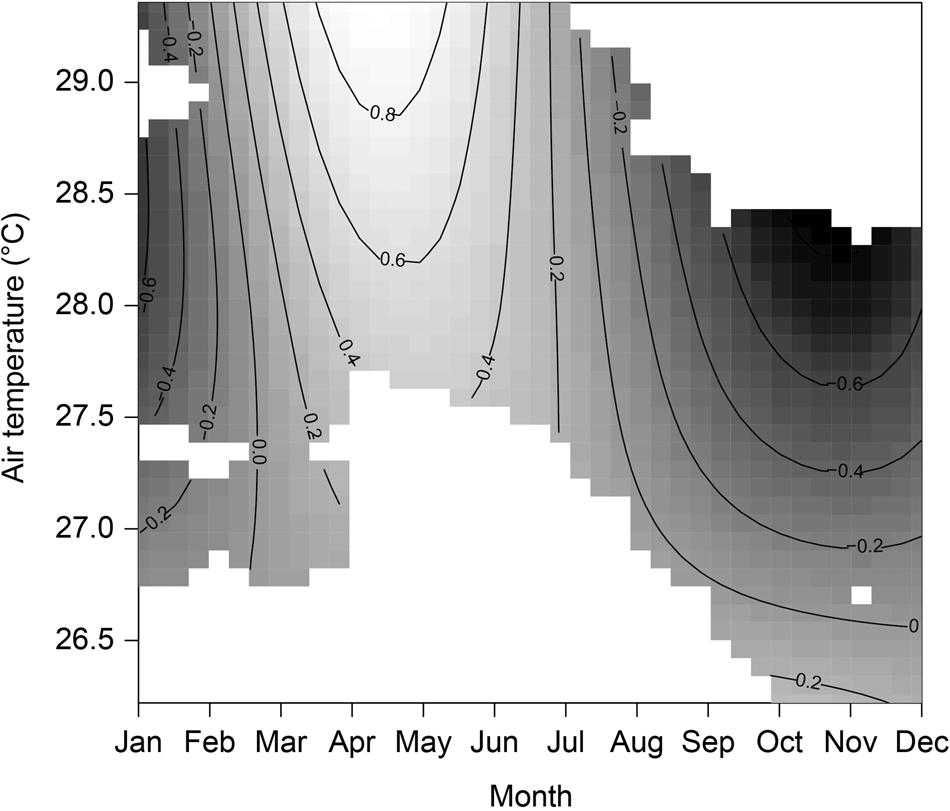
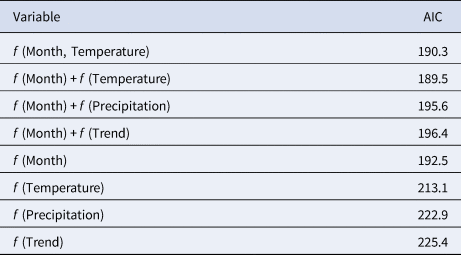
In the GAM approach, the month of year and temperature were included for explaining number of nests in the lowest AIC model (Table 2). The tensor product interaction did not result in obvious improvement (Table 2), but reduced the autocorrelation of the model; therefore, we selected the model including the tensor product as the best. Month of year had the most explanatory power and the model indicated higher numbers from March to July and lower numbers from August to February (Figure 8). At the same time, higher temperature resulted in relatively higher numbers of nests from March to July, whereas lower temperature tends to result in relatively higher numbers of nests from August to February (Figure 8).
Predicted effect of the smoother that incorporates month of year, temperature, and their interaction. Darker indicates lower numbers of nests, while lighter indicates higher numbers of nests. The white indicates out of prediction due to the lack of data.

AIC values of generalized additive models

Discussion
Green turtle nests were observed mainly on the beaches of Kerachut and Teluk Kampi, as was the case during the years 2001–2009 (Sarahaizad et al., Reference Sarahaizad, Mansor and Shahrul-Anuar2012). The annual number of nests recorded in this study (43–61 nests) was smaller than other green turtle rookeries in Malaysia (e.g. 221–687 nests at Redang Island) (Chan, Reference Chan2010), but comparable to those recorded (39–73 nests) during the years 2001–2009 (Sarahaizad et al., Reference Sarahaizad, Mansor and Shahrul-Anuar2012). In fact, long-term upward or downward trends in the number of nests were not observed, in contrast with upward trends due to conservation success in some regional management units in the world (Mazaris et al., Reference Mazaris, Schofield, Gkazinou, Almpanidou and Hays2017). Rather, the number of nests varied across months of year and tended to be higher from March–July and lower from August–February. This phenology may be attributable to the seasonal philopatry of nesting individuals (Yasuda et al., Reference Yasuda, Tanaka, Kittiwattanawong, Mitamura, Klom-in and Arai2006) that is possibly genetically determined. In fact, except one individual, different individuals tended to nest at different times of year in this study.
Nevertheless, the additive modelling in this study showed that the number of nests relates to air temperature rather than precipitation. Higher numbers of nests in response to higher temperature during March–July is not surprising since warmer sand temperatures (Godley et al., Reference Godley, Broderick, Frauenstein, Glen and Hays2002) and water temperatures during the inter-nesting interval (Sato et al., Reference Sato, Matsuzawa, Tanaka, Bando, Minamikawa, Sakamoto and Naito1998; Hays et al., Reference Hays, Broderick, Glen, Godley, Houghton and Metcalfe2002) are thought to promote sea turtle nesting. Air temperature might not directly affect nesting sea turtle physiology and behaviours, but is assumed to be closely related to sand and water temperature.
Increase in the absolute number of nests with temperature may be possible due to increases in (1) the number of females landing on the beach, or (2) clutch frequency (i.e. the number of nests per female per reproductive season). However, the former seems implausible because the number of females landing on the beach depends upon factors involved in the remigration intervals (Broderick et al., Reference Broderick, Godley and Hays2001; Solow et al., Reference Solow, Bjorndal and Bolten2002; Neeman et al., Reference Neeman, Spotila and O'Connor2015). An increase in the sporadic nesting of straying turtles (Maffucci et al., Reference Maffucci, Corrado, Palatella, Borra, Marullo, Hochscheid, Lacorata and Iudicone2016) may also account for the number of nesting females. Nevertheless, since most individuals had clutch frequencies ≥2, the effect of straying turtles at Penang Island was relatively small. Further study is required to determine the effects of temperature on clutch frequency and for the possible underestimation of clutch frequency by beach patrolling and flipper tagging (Esteban et al., Reference Esteban, Mortimer and Hays2017), but there were relatively constant annual numbers of nests that seem not to be related to annual mean temperature.
The pattern of nesting seems to be due to intra-annual changes in the timings of nesting. The tendency of relatively higher numbers of nests in response to lower temperatures during August–February may be attributable to the relatively low temperature throughout the year that elongates the inter-nesting interval. While shorter inter-nesting interval during warm temperatures (Sato et al., Reference Sato, Matsuzawa, Tanaka, Bando, Minamikawa, Sakamoto and Naito1998; Hays et al., Reference Hays, Broderick, Glen, Godley, Houghton and Metcalfe2002) results in concentration of nests in higher temperatures during March–July, relatively low temperatures may homogenize the distribution of the number of nests. In fact, the tendency is observed because there are relatively higher numbers of nests during August–February in 2011 and 2015 when the overall temperature was relatively low. In addition, as generally observed in loggerhead turtles, the nesting season might become earlier as sea surface temperature increases (Weishampel et al., Reference Weishampel, Bagley and Ehrhart2004; Mazaris et al., Reference Mazaris, Kallimanis, Sgardelis and Pantis2008); therefore, the timing of nesting might be shifted to August–February in cooler years. This phenological change has not been supported in green turtles (Pike, Reference Pike2009), but further studies are needed.
Although increased precipitation raises sand moisture levels and may promote sea turtle nesting (Mortimer & Bresson, Reference Mortimer and Bresson1999; Pike, Reference Pike2008; Allen et al., Reference Allen, Shah, Grant, Derand and Bell2010), this was not confirmed in green turtle nesting on Penang Island. Nesting peaks there corresponded to the troughs in the precipitation time series for 2011–2013 and 2016. In contrast, the nesting peak corresponded to precipitation peaks in 2014 and 2015. Rainfall may facilitate sea turtle egg chamber construction and inhibit nest depredation, but the hypothesis is not always confirmed (Pike, Reference Pike2008), and extremely heavy rainfalls disturb nesting (Plotkin et al., Reference Plotkin, Rostal, Byles and Owens1997). Consecutive rainy days increase total accumulated precipitation, but the restricted sunshine during that time may result in lower temperatures, which may have a negative effect on sea turtles nesting.
In conclusion, the fluctuation of the number of green turtle nests on Penang Island can be explained by month of year and temperature. It is still unknown whether the increase in the number of nests would continue at temperatures beyond the range of this study (e.g. >30°C). Although there might be differences in temperature between a nest chamber and the ambient air, and between the time of nesting and the thermal-sensitive period during development, a temperature surpassing 35°C in a nest chamber could reduce hatching success (Hamann et al., Reference Hamann, Fuentes, Ban, Mocellin, Wyneken, Lohmann and Musick2013; Howard et al., Reference Howard, Bell and Pike2014). Even if it does not, it may still result in a biased sex ratio due to temperature-dependent sex determination (Hamann et al., Reference Hamann, Fuentes, Ban, Mocellin, Wyneken, Lohmann and Musick2013). Continuous nest monitoring and individual animal identification may help explain some of the complex factors involved in the reproductive biology of sea turtles.
Acknowledgements
We thank Director Mrs Noraisyah, Mr Mansor Yobe and Mr Sharol (Department of Fisheries in Malaysia) for their contribution to beach patrols and data collection. Clutch size and egg survivorship data were collected with the help of the hatchery keepers at the Kerachut Turtle Conservation Centre (Khairi, late Zaini, late Nizam, Akim and Safwan) and the licensed eggs collector (Che Mat). We also acknowledge the Center for Marine and Coastal Studies, CEMACS, for their help in boat transportation between Teluk Bahang and Kerachut. We express sincere gratitude to the local residents, especially those from the Teluk Bahang area, who cooperated in the green turtle project. The field survey was authorized by the Director of Penang National Park, PERHILITAN (Mr Saat). Accommodation at Kerachut during the field survey was provided by the Department of Fisheries. The map in this paper was created using the Maptool program from SEATURTLE.org. We acknowledge two anonymous reviewers for their constructive comments.
Financial support
The first author's scholarship is sponsored by MyBrain15 (MyPhD) from the Ministry of Education Malaysia and Postdoctoral Fellowship from the Universiti Sains Malaysia (2020–2021). Research was financially supported by a Postgraduate Research Grant Scheme (PGRS) from the Universiti Sains Malaysia, a grant from the Ministry of Education Malaysia (Grant no: 6711134) to S.A.M.S. The authors are also grateful to the Research Management Centre, International Islamic University Malaysia for partially funding through Post-Doctoral Fellow Research Initiative Grant Scheme (RPDF:18-003-0003).