1. Introduction
Language is a product of the synergistic effects of both genetic and environmental influences on a child. Humans may be born with a biological predisposition to speak, yet the quality and amount of their experiences will shape what language(s) they speak and how they speak it (Crain & Pietroski, Reference Crain and Pietroski2001). Indeed, Gass and Selinker (Reference Gass and Selinker2008) name and define 37 types of bilinguals that linguists study based on age of acquisition, proficiency, and the experiences that led to acquisition. The purpose of this review is to examine differences between several types of language users, focusing on the relation between language acquisition and psychological assessment. Indeed, understanding the relation between language development and outcomes on tests of cognitive abilities is critical given the reliance on intelligence assessment for learning disability accommodations and intellectual disability diagnoses.
In order to frame this discussion, we will begin with a background section on types of language users. We will then delineate how different types of language users perform on tests of verbal cognitive abilities and tests of non-verbal cognitive abilities, concluding with research regarding neurobiological differences between types of language users.
1.1. BACKGROUND
At the simplest level, there are three types of language users (i.e., monolinguals, bilinguals, and multilinguals). As their prefixes suggest, a monolingual is an individual who knows one language, a bilingual knows two languages, and a multilingual knows more than two languages (Montrul, Reference Montrul2004). Multilinguals are excluded from discussion, however, as the cognitive implications of knowing more than two languages are outside the scope of this paper as research suggests that multilinguals are qualitatively different than bilinguals and monolinguals (Shanon, Reference Shanon1991).
Bilingualism can be further dichotomized into those who learn the languages simultaneously or sequentially (Gass & Selinker, Reference Gass and Selinker2008). A simultaneous bilingual can be defined as an individual who learns two languages concurrently and whose input in both languages is present before the onset of speech (i.e., before the age of one; McLaughlin, Reference McLaughlin1978). A sequential bilingual can be defined as an individual who learns a second language after their first language has already begun developing. Sequential bilinguals can be dichotomized further into early and late bilinguals (Padilla & Lindholm, Reference Padilla, Lindholm, Martinez and Mendoza1984). Early bilinguals are typically referred to as those people who acquire their second language before the age of six (Archila-Suerte, Bunta, & Hernandez, Reference Archila-Suerte, Bunta and Hernandez2016), whereas late bilinguals acquire their second language any time after early childhood. Although six is a common cut-off age, there is still much debate regarding what age to use as a cut-off for early versus late bilingualism; thus, the cut-off age used may differ between studies (de Bruin, Reference Bruin2019). Many factors may affect an individual’s ultimate success in learning a language, but age may be the most important extraneous variable affecting the acquisition of a language (Davison & Hammer, Reference Davison and Hammer2012; Gass & Selinker, Reference Gass and Selinker2008).
Indeed, research suggests the presence of different sensitive periods for each language domain (e.g., sounds, words, grammar; Costa & Sebastián-Gallés, Reference Costa and Sebastián-Gallés2014; Purves et al., Reference Purves, Augustine, Fitzpatrick, Katz, LaMantia, McNamara and Williams2001). Holding all else constant, early bilinguals will more often reach fluency equivalent to that reached by simultaneous bilinguals than late bilinguals, who will have to work harder to achieve the same levels of fluency, and may never be able to acquire certain skills easily mastered by simultaneous and early bilinguals, such as accent (Bosch & Sebastián-Gálles, Reference Bosch and Sebastián-Gálles2003; Montrul, Reference Montrul2004; Padilla & Lindholm, Reference Padilla, Lindholm, Martinez and Mendoza1984). This may be due to the loss of ability to perceive differences in phonemes (i.e., sounds) not present in their input language at the approximate age of eight months, and the decreasing plasticity of our brain as we age, making it more difficult for late language learners to perceive minute differences in sounds or to acquire the fine motor movement necessary to pronounce foreign phonemes, respectively (Best & McRoberts, Reference Best and McRoberts2003). Researchers often study simultaneous bilinguals in comparison to monolinguals, but in the United States bilinguals are often sequential, either because they emigrated to the US from a foreign country, or because they grew up in a monolingual home and learned a second language in school (Shin & Kominski, Reference Shin and Kominski2010).
Moreover, bilingualism as it is used in this nomenclature does not suggest full mastery of the language, but instead suggests competency ranging from minimal (i.e., mastery of only a few words and phrases) to maximal (i.e., mastery characterized by complete control of the language) command of the language, with most people falling in between (e.g., can read and understand spoken second language, but cannot speak or write it; Gass & Selinker, Reference Gass and Selinker2008). These people may consider themselves to be dominant in one language over the other or, alternatively, to have a balanced command of both languages (Hoff & Ribot, Reference Hoff and Ribot2017). As such, careful consideration needs to be taken into account when examining cognitive performance in bilinguals.
Until relatively recently, bilingualism was thought to be a disadvantage (Darcy, Reference Darcy1953), yet scholars now promote bilingualism as an advantage. Indeed, a simple Google search of bilingualism reveals numerous links promoting the ‘bilingual advantage’. But, is being bilingual truly an advantage? Even in the most methodologically sound research studies, controlling for extraneous variables and considering different types of bilinguals, the answer is not a simple ‘yes’ or ‘no’ (Gold, Reference Gold2016). Against this convoluted backdrop, it is unsurprising that research findings in this camp have been mixed. Keeping in mind the different types of bilinguals delineated above (i.e., simultaneous/sequential, early/late, English dominant/balanced / Spanish dominant), this paper presents a systematic review of the existing literature for the most common language spoken in the US aside from English: Spanish (i.e., approximately 21% of the US population speaks Spanish; US Census Bureau, 2015; Worldatlas, 2018). Including only studies with monolingual comparison groups, identifying experimental controls, and recognizing which type of bilinguals are included in each study when available, this review goes beyond current reviews that indiscriminately lump together and compare different types of bilinguals speaking various different languages (e.g., Bialystok, Craik, Green, & Gollan, Reference Bialystok, Craik, Green and Gollan2009). Monolinguals were chosen as the comparison group considering tests of cognitive development are normed on monolinguals, to which bilinguals are compared when they take these tests.
2. Methodology
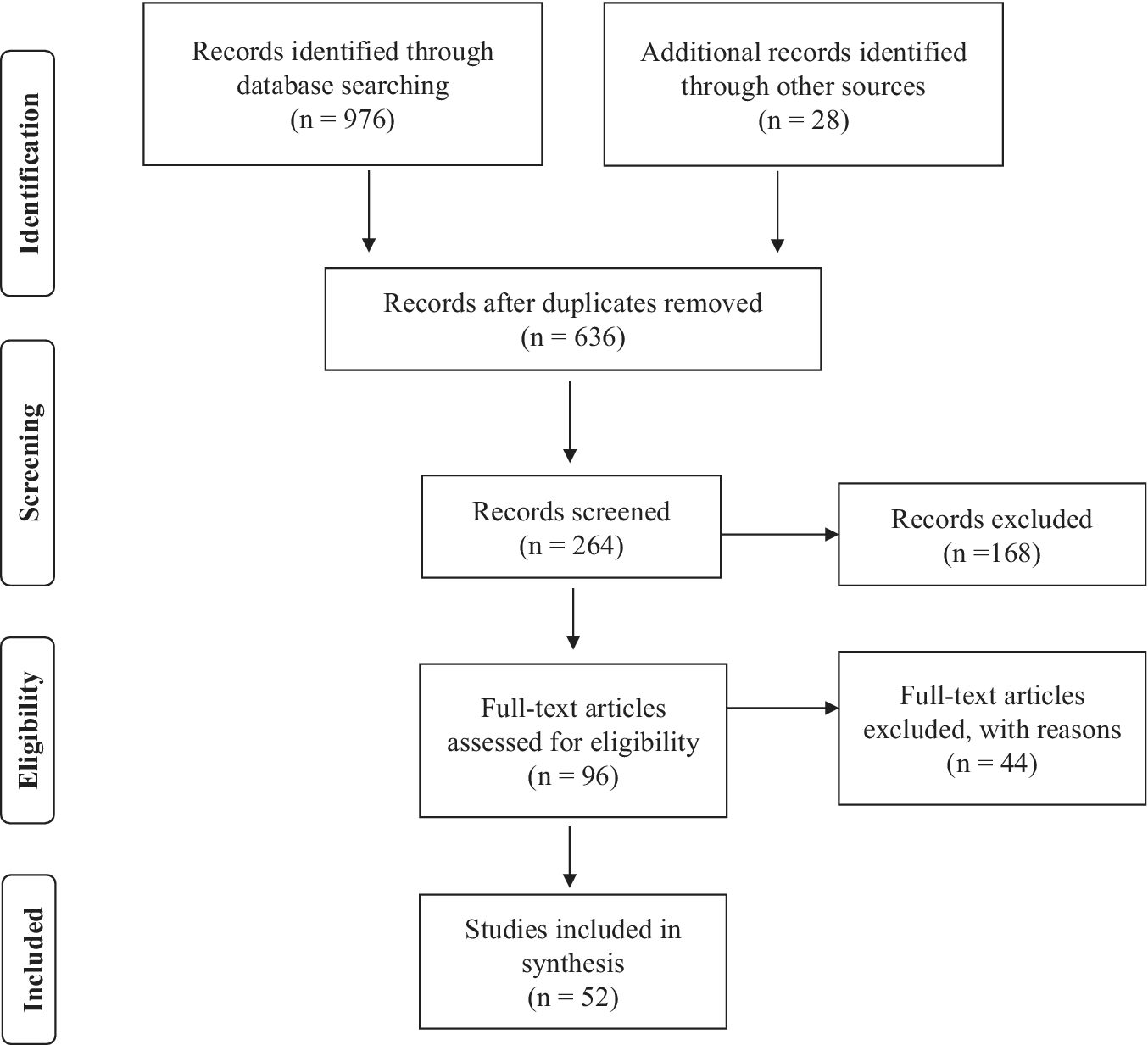
To conduct the systematic review, guidelines from the Preferred Reporting Items for Systematic Reviews and Meta-Analyses (PRISMA) were used (Liberati et al., Reference Liberati, Altman, Tetzlaff, Mulrow, Gøtzsche, Ioannidis and Moher2009). A systematic review answers a research question by compiling and synthesizing empirical studies discovered by a search of extant literature using pre-selected terms and eligibility criteria. Unlike a meta-analysis, which uses statistical methods to evaluate and synthesize empirical studies, a systematic review takes a descriptive approach in summarizing such studies. In order to be included for consideration in the review, the study had to be (1) peer-reviewed; (2) available in English or Spanish; (3) clearly specify the inclusion of English–Spanish bilingual participants; (4) assess the participants’ performance on some measure of cognitive ability; and (5) compare bilingual participants with monolingual participants. Any study that examined any measure of mental performance, including, but not limited to, performance on tasks of reasoning, perception, memory, verbal ability, and problem-solving was included as a test of cognitive ability. No restriction was placed on year of publication (earliest year of publication was 1968) and broad Boolean language was used to allow for a more comprehensive search. We compiled and used the following Boolean string: (“bilingual” OR “bilingualism”) AND (“assessment” OR “performance” OR “evaluation” OR “test” OR “ability”) AND (“Spanish”) AND (“English”) NOT (“meta-analysis”). Various databases were used, including all those pertaining to anatomy and physiology; applied sciences; biology; chemistry; complementary and alternative medicine; education; ethnic and cultural studies; health and medicine; language and linguistics; life sciences; nursing and allied health; pharmacy and pharmacology; public health; science; social sciences and humanities; and social work. Papers on multilinguals and studies examining outcomes related to pedagogical interventions were excluded. Also excluded were commentaries, case studies, and poster presentations. The last search was conducted in December 2018. A total of 1,004 papers were identified. Following the removal of duplicates (n = 368), 636 articles were screened for inclusion on the basic level of being (1) peer-reviewed; (2) available in English or Spanish; and (3) clearly specifying the inclusion of English–Spanish bilingual participants, leaving 264 papers. Of the 264 papers that remained, titles, abstracts, and in some cases partial manuscripts were reviewed for the inclusion of (4) the assessment of performance on some measure of cognitive ability and (5) a comparison of bilingual participants with monolingual participants, leaving an n of 96. The remaining 96 articles were reviewed in full, and the 52 articles that met complete eligibility criteria are included in this review (see Figure 1).
Flow diagram of steps for PRISMA.

Each study that met the eligibility criteria is summarized in Table 1 (see ‘Appendix’). Special attention was paid to the participants section of each study, and participants were labeled as either simultaneous or sequential, early or late, and for their level of proficiency. Age of acquisition was used to determine whether study participants were ‘early’ versus ‘late’ bilinguals rather than the label given by study authors, in order to keep labeling consistent across studies. When age of acquisition was not present, this category was labeled as ‘does not say’. Key findings of each study and other participant variables that were controlled for in each study are also delineated in Table 1.
We aimed to be comprehensive in our search for relevant studies. However, we acknowledge that some papers of knowledge to the research team were not found using the systematic PRISMA criteria (e.g., Incera & Mclennan, Reference Incera and Mclennan2016). We cannot be certain why some studies did not appear in our initial searches but took precautions to only include studies that meet PRISMA search criteria, rather than adding articles post-hoc that supported researchers’ suppositions. We also note limitations to our methodological plan to be kept in mind when reading the results. For example, the elimination of studies without an English monolingual control group, and inclusion of only Spanish–English bilinguals limits the scope and generalizability of our review. As such, the limited nature of this review may reveal differences from extant literature.
3. Results
3.1. TESTS OF VERBAL ABILITY
Overall, a thorough review of the literature suggests that simultaneous bilinguals perform more similarly to native speakers than sequential bilinguals on linguistic measures, except when sequential bilinguals learn their second language in early childhood (e.g., Mayo, Florentine, & Buus, Reference Mayo L, Florentine and Buus1997). Research suggests that practice and proficiency improve performance (e.g., Alt, Meyers, & Figueroa, Reference Alt, Meyers and Figueroa2013; Berens, Kovelman, & Petitto, Reference Berens, Kovelman and Petitto2013; Gollan, Montoya, Fennema-Notestine, & Morris, Reference Gollan, Montoya, Fennema-Notestine and Morris2005; Proctor, Silverman, Harring, & Montecillo, Reference Proctor, Silverman, Harring and Montecillo2012), but that there are certain impediments to performance, even when highly proficient, that clearly separate late from early language learners and bilinguals from monolinguals (Fabiano-Smith & Bunta, Reference Fabiano-Smith and Bunta2012).
Indeed, not only do bilinguals have significantly smaller vocabularies in each respective language, on average, than monolinguals, but also their vocabularies are often context specific (Alt et al., Reference Alt, Meyers and Figueroa2013; Gross, Buac, & Kaushanskaya, Reference Gross, Buac and Kaushanskaya2014; Misdraji-Hammond, Lim, Fernandez, & Burke, Reference Misdraji-Hammond, Lim, Fernandez and Burke2015; Roberts, Garcia, Desrochers, & Hernandez, Reference Roberts, Garcia, Desrochers and Hernandez2002; Sheng, Lam, Cruz, & Fulton, Reference Sheng, Lam, Cruz and Fulton2016; Windsor & Kohnert, Reference Windsor and Kohnert2004). Take, for example, the bilingual individual who grew up speaking only Spanish in the home, and only English at school. Context-specific words, such as those associated with school life (i.e., academic activities, objects, subject matter, etc.), may only be known to the individual in that context’s language (i.e., English), even if that individual is more fluent in their mother tongue (i.e., Spanish). As such, it is often the case that bilinguals will perform better on measures of expressive and receptive vocabulary in their language of instruction rather than their native language due to not having the context-specific lexicon in their native tongue (Berens et al., Reference Berens, Kovelman and Petitto2013). Furthermore, context non-specific words, such as emotions and body parts, may be known to the individual in both languages (i.e., Spanish and English; Gross et al., Reference Gross, Buac and Kaushanskaya2014).
Understanding how the language of assessment influences performance has led to the creation of alternative scoring methods for bilinguals, namely conceptual and total vocabulary scoring. Conceptual scoring is a measure of vocabulary in which answers are accepted in either English or Spanish. For example, a response of horse, dog, cow, gato (i.e., ‘cat’), perro (i.e., ‘dog’) would score a four because perro and dog mean the same thing (i.e., represent the same concept). On the other hand, total vocabulary scoring is a measure of vocabulary in which answers are accepted in both English and Spanish. For example, a response of horse, dog, cow, gato, perro would score a five because a total of five words were produced, even though there is overlap in meaning.
Yet, research suggests that monolinguals still outperform simultaneous bilinguals by 30 months of age on tests of expressive vocabulary when conceptual scoring is used (Core, Hoff, Rumiche, & Señor, Reference Core, Hoff, Rumiche and Señor2013; Gollan, Montoya, & Werner, Reference Gollan, Montoya and Werner2002; Pearson, Fernández, & Oller, Reference Pearson, Fernández and Oller1993), and that the gap widens with age (Core et al., Reference Core, Hoff, Rumiche and Señor2013). Moreover, the discrepancy in performance is exacerbated when participants are sequential bilinguals, as they significantly underperform simultaneous bilinguals even when using conceptual scoring (Gross et al., Reference Gross, Buac and Kaushanskaya2014). Total scoring, on the other hand, has been found to reduce the performance gap between simultaneous bilinguals and monolinguals enough to remove the statistical significance between groups, yet there is a possible ethical concern regarding potential over-inflation of vocabulary, and underestimation of language impairment using such lenient scoring (Core et al., Reference Core, Hoff, Rumiche and Señor2013; Pearson et al., Reference Pearson, Fernández and Oller1993). Finally, no studies examined the effect of total scoring on sequential bilinguals.
Furthermore, this effect may be exacerbated when expressive vocabulary is measured under timed requirements. Indeed, researchers found that adult bilinguals produced fewer answers when asked to name things in a certain category, things starting with a certain letter, or proper nouns starting with a certain letter, with the biggest difference existing for the category task (Gollan et al., Reference Gollan, Montoya and Werner2002; Sandoval, Gollan, Ferreira, & Salmon, Reference Sandoval, Gollan, Ferreira and Salmon2010). Researchers suggest that bilinguals have the greatest difficulty on the category task because the category will elicit answers in both languages, causing them to have to suppress their desire to give the answer in the language not being tested, which is further supported by the fact that bilinguals tend to produce more cognates (i.e., words that sound the same in both English and Spanish) than monolinguals on these tasks (Sandoval et al., Reference Sandoval, Gollan, Ferreira and Salmon2010). Additionally, the struggle to inhibit the other language is less present when producing words that start with a certain letter, because the other language will only be activated if the word shares the same first letter in both languages. Finally, researchers suggest that the want to answer in both languages is least present for the proper noun category, as names are the least language-specific (Gollan et al., Reference Gollan, Montoya and Werner2002). These deficits in expressive vocabulary have been demonstrated in children as well and persist even when the child is given the opportunity to answer in both languages (Gross et al., Reference Gross, Buac and Kaushanskaya2014).
Moreover, receptive vocabulary may also be affected in bilinguals, but to a lesser extent, such that both simultaneous and sequential bilinguals often had poorer, but statistically non-significant scores when compared to monolinguals (Bialystok, Majumder, & Martin, Reference Bialystok, Majumder and Martin2003; Gross et al., Reference Gross, Buac and Kaushanskaya2014; Kaushanskaya, Blumenfeld, & Marian, Reference Kaushanskaya, Blumenfeld and Marian2011; Pearson et al., Reference Pearson, Fernández and Oller1993; Proctor et al., Reference Proctor, Silverman, Harring and Montecillo2012; Valicenti-McDermott et al., Reference Valicenti-McDermott, Tarshis, Schouls, Galdston, Hottinger, Seijo and Shinnar2013; Windsor & Kohnert, Reference Windsor and Kohnert2004). However, some studies identified for this review recognized a bilingual advantage for receptive vocabulary (e.g., passage comprehension), but further examination of these studies suggested a third variable, metalinguistic awareness, was responsible for the better performance for bilinguals, not receptive vocabulary (Berens et al., Reference Berens, Kovelman and Petitto2013; Proctor et al., Reference Proctor, Silverman, Harring and Montecillo2012).
Indeed, bilinguals have been found to have an advantage in metalinguistic awareness, or one’s ability to analyze a piece of language with respect to the rules allowed by that language, irrespective of semantics (Berens et al., Reference Berens, Kovelman and Petitto2013; Bialystok et al., Reference Bialystok, Majumder and Martin2003; Proctor et al., Reference Proctor, Silverman, Harring and Montecillo2012). Take, for example, the sentence, the cat writes with a pen; although impossible semantically, that sentence adheres to the rules of grammar allowed by the English language. Yet, the cat drink the milk is a semantically possible event, which is incorrect due to verb–subject disagreement (i.e., the cats drink, the cat drinks). Researchers found that being bilingual to any degree was associated with metalinguistic awareness, or more explicit knowledge of the language, than was being monolingual (Berens et al., Reference Berens, Kovelman and Petitto2013). As such, and staying with the above example, bilinguals would be more aware of the grammatical error present in the sentence the cat drink the milk than would be a monolingual. One explanation is that the effortful processing that puts bilinguals at a disadvantage for many of the aforementioned tasks may serve as an advantage in increasing metalinguistic awareness. This may be due to the necessity of managing and monitoring two different languages, and of choosing to employ the correct linguistic structure (Fabiano-Smith & Goldstein, Reference Fabiano-Smith and Goldstein2010b). As such, bilinguals may be more explicitly aware of their linguistic choice than monolinguals, who do not have to choose between two competing languages (Proctor et al., Reference Proctor, Silverman, Harring and Montecillo2012). Indeed, research suggests that, even when only one language is required for a task, both language systems are active, as evidenced by language interference by the unneeded language. Such interference has been measured by both the reaction time of response (i.e., slower in bilinguals; Gollan et al., Reference Gollan, Montoya, Fennema-Notestine and Morris2005; Windsor & Kohnert, Reference Windsor and Kohnert2004), Stroop-test performance (Rosselli et al., Reference Rosselli, Ardila, Santisi, Arecco, Salvatierra, Conde and Lenis2002), and tip-of-the tongue phenomena (i.e., feeling like they know the answer, but being unable to articulate it; Gollan & Acenas, Reference Gollan and Acenas2004). Both simultaneous and sequential bilinguals experienced more tip-of-the-tongue phenomena, even when only highly proficient bilinguals were examined. Yet, when only cognates are examined this difference goes away, further supporting the existence of translinguistic interference as at least one explanation for poorer performance for bilinguals on many linguistic tasks (Gollan & Acenas, Reference Gollan and Acenas2004).
Another domain closely related to metalinguistic awareness is statistical learning (i.e., learning new words by analyzing input to draw conclusions about where novel words end and begin based on the frequency of having heard that novel word in various contexts). As such, it is not surprising that bilinguals also tend to excel on statistical learning tasks (Bialystok et al., Reference Bialystok, Majumder and Martin2003). Indeed, typical speech does not have distinct phonemic boundaries between words, resulting in what is referred to as ‘linking’. For example, in asking “What is her name?” we may say whatsername rather than enunciating each word individually (Bialystok et al., Reference Bialystok, Majumder and Martin2003; Yim & Rudoy, Reference Yim and Rudoy2013). Research suggests it takes hearing a word in multiple contexts for individuals to statistically learn novel words, a process that may be facilitated by exposure to two languages, which enhances linguistic cognitive flexibility (Kan, Sadagopan, Janich, & Andrade, Reference Kan, Sadagopan, Janich and Andrade2014). This effect seems to be specific to linguistic domains, however, as monolinguals and early sequential bilinguals perform similarly on non-verbal auditory and visual statistical learning tasks (i.e., analyzing tones and images to draw conclusions about where tones and images end and begin, respectively), suggesting that there may only be an advantage on language tasks (Yim & Rudoy, Reference Yim and Rudoy2013).
Learning through fast mapping, or the process by which a semantic referent is given a fixed name after a few pairings, is another way we learn language but requires less metalinguistic awareness (Alt et al., Reference Alt, Meyers and Figueroa2013). Research reveals the attenuation of the bilingual advantage (Archila-Suerte et al., Reference Archila-Suerte, Bunta and Hernandez2016; Buac, Gross, & Kaushanskaya, Reference Buac, Gross and Kaushanskaya2016; Kan et al., Reference Kan, Sadagopan, Janich and Andrade2014; Padilla, Mendez, Jimenez, & Teng, Reference Padilla, Mendez, Jimenez and Teng2016; Poepsel & Weiss, Reference Poepsel and Weiss2016), and sometimes a bilingual disadvantage (Alt et al., Reference Alt, Meyers and Figueroa2013; Kaushanskaya, Gross, & Buac, Reference Gross, Buac and Kaushanskaya2014; Windsor & Kohnert, Reference Windsor and Kohnert2004) for both early and late sequential bilinguals learning novel words for novel referents (i.e., fast mapping). Yet, when a familiar referent or two object / one label paradigm is used, sequential bilingual children show an advantage over monolingual children on the novel word learning fast mapping task (Kaushanskaya et al., Reference Gross, Buac and Kaushanskaya2014; Poepsel & Weiss, Reference Poepsel and Weiss2016). This finding is likely due to the stronger mutual-exclusivity bias in monolinguals (i.e., a tendency to assign only one label to only one referent), than is present in bilinguals, who typically have various names for the same referent and require more cognitive flexibility to manage their linguistic world (Davidson, Jergovic, Imami, & Theodos, Reference Davidson, Jergovic, Imami and Theodos1997; Kaushanskaya et al., Reference Gross, Buac and Kaushanskaya2014). An early example of mutual-exclusivity bias includes a toddler only accepting one word to refer to their household canine. For example, if the toddler knew the word dog, they would be hard to convince that they could also call the pet a canine, mammal, or (wo)man’s best friend.
Moreover, English monolinguals have been found to reach basic linguistic milestones (e.g., grammar, expressive vocabulary, phonological acquisition) earlier than bilinguals learning English, with the largest difference existing for Spanish-dominant bilinguals, and the smallest difference existing for English-dominant bilinguals, with balanced bilinguals falling in between, suggesting language dominance is an important factor to consider in evaluation (Bunta, Fabiano-Smith, Goldstein, & Ingram, Reference Bunta, Fabiano-Smith, Goldstein and Ingram2009; Gildersleeve-Neumann, Kester, Davis, & Peña, Reference Gildersleeve-Neumann, Kester, Davis and Peña2008; Hoff et al., Reference Hoff, Core, Place, Rumiche, Señor and Parra2012; Hoff & Ribot, Reference Hoff and Ribot2017). Indeed, Fabiano-Smith and Goldstein (Reference Fabiano-Smith and Goldstein2010a, Reference Fabiano-Smith and Goldstein2010b) indicated that not only do early bilinguals (i.e., both simultaneous and sequential not separated for analyses) have a slower rate of phonological acquisition in both English and Spanish than their respective monolingual counterparts, but that their pattern of phoneme acquisition is different from that of monolinguals. This finding may be a result of qualitatively different infant-directed speech on behalf of bilingual adults speaking to early bilingual children in comparison to monolingual parents speaking with monolingual children (Fish, García-Sierra, Ramírez-Esparza, & Kuhl, Reference Fish, García-Sierra, Ramírez-Esparza and Kuhl2017), or it may be a result of competing inputs from two different languages requiring the managing and monitoring of two different languages (Fabiano-Smith & Goldstein, Reference Fabiano-Smith and Goldstein2010b).
The former hypothesis (i.e., English monolinguals reach basic linguistic milestones earlier than bilinguals due to qualitatively different input from adults) is partially supported by a study conducted by Fabiano-Smith and Bunta (Reference Fabiano-Smith and Bunta2012), which found that even highly proficient simultaneous and early sequential English second language users (not separated for analyses) receiving English input largely from native Spanish, English as a second language bilingual adults at both home and school produced qualitatively different phonemes (i.e., as measured by voice onset time; i.e., the time between the release of a stop consonant and subsequent voicing) than monolingual English speakers. Yet, the same group of children performed equally as well as Spanish monolingual peers. Conversely, the latter hypothesis (i.e., English monolinguals reach basic linguistic milestones earlier than bilinguals due to competing inputs from two different languages) is partially supported by a study on the same group of children in which consonant production was significantly less accurate for bilingual children speaking in both English and Spanish when compared to their monolingual English and Spanish counterparts, respectively, suggesting interference between languages (Bunta et al., Reference Bunta, Fabiano-Smith, Goldstein and Ingram2009; Fabiano-Smith & Goldstein, Reference Fabiano-Smith and Goldstein2010b). Further, these findings may be largely driven by the sequential bilinguals in the sample, as other research exclusively examining a group of sequential bilinguals performing a phonemic repetition task produced similar findings to those reported above (Windsor, Kohnert, Lobitz, & Pham, Reference Windsor, Kohnert, Lobitz K and Pham G2010). Yet, the statistical difference between bilingual and monolingual groups disappeared when examining solely simultaneous bilinguals on measures of phonological complexity, consonant accuracy, or phonological target approximations in both English and Spanish when compared to English or Spanish monolinguals, respectively (Burrows & Goldstein, Reference Burrows and Goldstein2010). Interestingly, findings were reversed, such that sequential bilinguals outperformed monolinguals on a phonemic repetition task in which the novel non-words violated phonological rules in both English and Spanish. Together, results suggest that, when the impediment of language interference is removed by introducing a completely incompatible language system, the enhanced cognitive flexibility of bilingualism produces an advantage (Kaushanskaya & Marian, Reference Kaushanskaya and Marian2009). These findings have important implications for phonological assessment, especially considering that current measures did not reliably differentiate typically developing bilinguals from participants with a phonological disorder (Fabiano-Smith & Hoffman, Reference Fabiano-Smith and Hoffman2018; Windsor et al., Reference Windsor, Kohnert, Lobitz K and Pham G2010).
Yet, not only has research demonstrated that phonological production is affected by bilingual status, studies have also found phonological perception to be reliably impaired under certain conditions (Rogers, Lister, Febo, Besing & Abrams, Reference Rogers, Lister, Febo, Besing and Abrams2006). Indeed, although bilinguals may perform at ceiling (i.e., 100%) levels under quiet conditions, numerous studies have consistently demonstrated a bilingual disadvantage for speech perception when background noise is present, such that the ability to differentiate between similar sounding words is disproportionately negatively affected for bilinguals (Nelson, Kohnert, Sabur, & Shaw, Reference Nelson, Kohnert, Sabur and Shaw2005). Moreover, when parsing out simultaneous bilinguals from early sequential and late sequential bilinguals, this effect disappears for simultaneous and early sequential bilinguals, providing further evidence that age of acquisition is an important factor for comprehensive processing and distinguishing of phonemes (Mayo et al., Reference Mayo L, Florentine and Buus1997). This research also furthers the argument for separate bilingual norms considering the conditions under which evaluations are administered are not typically silent. Yet, differences in performance on verbal measures is only half of the picture, as it seems whatever processes are at work creating differences in linguistic development also drive differences in non-verbal domains.
3.2. TESTS OF NON-VERBAL ABILITY
Given that most assessments of cognitive abilities are language bound (e.g., directions presented orally or written), it is important to understand how bilingual status affects tests of non-verbal abilities as well. A wide range of performance on non-verbal measures has been studied, including executive functioning, memory, and spatial-reasoning. Yet, research on non-verbal topics reveal more mixed findings, and our systematic search produced fewer available studies. Nonetheless, one thing remains constant between verbal and non-verbal domains; proficiency affects cognitive ability (e.g., Danahy, Windsor & Kohnert, Reference Danahy, Windsor and Kohnert2007; Diaz & Farrar, Reference Diaz and Farrar2018; Francis & Baca, Reference Francis and Baca2014).
For example, studies on simultaneous and early sequential bilinguals find a bilingual advantage for executive control (i.e., the cognitive control of behavior; Guirguis & Antigua, Reference Guirguis and Antigua2017), but often only after proficiency (i.e., in both languages or in the language of assessment) is controlled for (Carlson & Meltzoff, Reference Carlson and Meltzoff2008, Diaz & Farrar, Reference Diaz and Farrar2018, Park, Ellis Weismer, & Kaushanskaya, Reference Park, Ellis Weismer and Kaushanskaya2018). Additionally, rather than broadly asserting that bilingualism confers an advantage for all executive control tasks, it seems more accurate to specify that bilinguals are advantaged for conflicting attentional control tasks (i.e., wherein participants have to respond differentially according to the specific stimuli presented), rather than delayed gratification tasks (i.e., wherein participants have a choice of whether or not to wait for a reward; Carlson & Meltzoff, Reference Carlson and Meltzoff2008). This makes sense considering that the proficient bilingual needs to constantly inhibit one set of linguistic representations in favor of the other (i.e., minimize translinguistic interference) and consistently monitor which language they must speak in different contexts (Costa, Hernández, Costa-Faidella, & Sebastián-Gallés, 2009). Following suit, bilinguals only seem to be at an advantage for non-verbal tasks requiring high levels of cognitive monitoring, rather than executive function tasks requiring lower levels of cognitive monitoring, such as impulse control (Carlson & Meltzoff, Reference Carlson and Meltzoff2008; Kaushanskaya et al., Reference Gross, Buac and Kaushanskaya2014; Park et al., Reference Park, Ellis Weismer and Kaushanskaya2018). As such, mixed findings in the field may be a function of the aggregation of all types of executive functions into one broad category for measurement.
Furthermore, bilingual children have been found to be more accurate at several types of false belief tasks (i.e., tasks that test one’s understanding that another’s belief may be factually wrong) than monolingual children, but only when proficiency was accounted for (Diaz & Farrar, Reference Diaz and Farrar2018; Gordon, Reference Gordon2016), such that the more proficient the bilingual in both languages, the greater the number of false belief tasks that were passed, with less proficient bilinguals performing more like monolinguals. This proficient bilingual advantage is hypothesized to be due to the ineffectiveness of using the mutual-exclusivity bias when learning a new language (i.e., the need to attribute two names to one referent in bilingualism [e.g., dog and perro], rather than the one-to-one relationship in monolingual language acquisition [e.g., dog]), and, thus, a need to rely on other cues (Davidson et al., Reference Davidson, Jergovic, Imami and Theodos1997). Instead, social cues (e.g., gestures, changes in tone of voice, facial expressions) are more utilized by bilinguals, facilitating the quicker development of theory of mind, and thus better performance on false belief tasks in childhood (Diaz & Farrar, Reference Diaz and Farrar2018).
Another non-verbal domain that seems to rely on proficiency is memory (e.g., Buac et al., Reference Buac, Gross and Kaushanskaya2016; Diaz & Farrar, Reference Diaz and Farrar2018; Francis & Baca, Reference Francis and Baca2014; Kaushanskaya et al., Reference Kaushanskaya, Blumenfeld and Marian2011). However, how bilingualism affects memory is less clear. For example, short-term memory for verbal stimuli has been documented as both significantly worse in bilinguals (Buac et al., Reference Buac, Gross and Kaushanskaya2016; Francis & Baca, Reference Francis and Baca2014; Kohnert, Windsor, & Yim, Reference Kohnert, Windsor and Yim2006) and having no statistical difference between bilinguals and monolinguals (Diaz & Farrar, Reference Diaz and Farrar2018; Francis & Baca, Reference Francis and Baca2014; Kaushanskaya et al., Reference Kaushanskaya, Blumenfeld and Marian2011; Padilla et al., Reference Padilla, Mendez, Jimenez and Teng2016). One reason for the mixed findings may be the type of task used, including the repetition of numbers, non-words, or real words (i.e., although memory is considered a test of non-verbal ability, the test is often verbal in nature considering the memorization of verbal stimuli often needed for such tasks); or being required to repeat stimuli in the order given or being allowed to repeat in any order. Indeed, Francis and Baca (Reference Francis and Baca2014) found that on more mentally tasking measures (e.g., ordered recall) monolinguals outperformed bilinguals, yet there was no significant difference on a free recall, non-ordered task. However, it is difficult to be certain of the cause of mixed findings across studies as data from measures were often aggregated for analyses, or measures were unspecified. Alternatively, findings may be spurious, as Kaushanskaya and colleagues (Reference Kaushanskaya, Blumenfeld and Marian2011) found similar results for monolinguals in comparison to both simultaneous bilinguals and native English late sequential learners of Spanish on an English short-term memory task, suggesting that no degree of bilingualism affected results, and that significant findings are likely due to some other variable. Moreover, research on working memory for verbal stimuli shows an equally muddy picture, with certain studies showing no difference (Buac et al., Reference Buac, Gross and Kaushanskaya2016; Danahy et al., Reference Danahy, Windsor and Kohnert2007; Garcia, Ros, Hart, Graziano, Reference Garcia, Ros, Hart and Graziano2018; Kohnert et al., Reference Kohnert, Windsor and Yim2006) and others showing a bilingual advantage (Kaushanskaya et al., Reference Gross, Buac and Kaushanskaya2014). However, these studies suffer from the same issues as mentioned for short-term memory.
Finally, research on several other domains has delivered consistent results, but the small number of studies suggests the need for repetition before any theories are made or conclusions are drawn from results. For example, a bilingual advantage for creativity in children (Galindo, Reference Galindo2012) and visuospatial working memory in both children (Garcia et al., Reference Garcia, Ros, Hart and Graziano2018) and older adults (Padilla et al., Reference Padilla, Mendez, Jimenez and Teng2016) have been reported. On the other hand, there was no difference found between monolingual and bilingual groups on a long-term memory task for real word (Padilla et al., Reference Padilla, Mendez, Jimenez and Teng2016) or non-word lists (Kan & Sadagopan, Reference Kan and Sadagopan2014), or on visual and auditory reaction time tests (Kohnert & Windsor, Reference Kohnert and Windsor2004).
3.3. NEUROBIOLOGY
In addition to the aforementioned differences in cognitive abilities, bilinguals show performance differences in several neurological areas and functioning. Due to the paucity of research in this area, however, we could not use the same inclusion criteria as was used in the earlier part of this review. As such, language groups will be identified throughout the following section, and we qualify reported findings by acknowledging that differences may exist from what is reported if researchers were to carry out the same studies exclusively on Spanish–English bilinguals.
From toddlerhood to old age, researchers have found neurological differences between monolinguals and bilinguals (Abutalebi et al., Reference Abutalebi, Annoni, Zimine, Pegna, Seghier, Lee-Jahnke and Khateb2008; Bialystok, Craik, & Freedman, Reference Bialystok, Craik and Freedman2007; Bialystok, Craik, & Luk, Reference Schweizer, Ware, Fischer, Craik and Bialystok2012; Gold, Reference Gold2016; Luk, Bialystok, Craik, & Grady, Reference Luk, Bialystok, Craik and Grady2011; Perani & Abutalebi, Reference Perani and Abutalebi2005; Schweizer, Ware, Fischer, Craik, & Bialystok, Reference Schweizer, Ware, Fischer, Craik and Bialystok2012). Indeed, as early as two years old, researchers have been able to reliably differentiate between monolinguals and bilinguals using an activity in which children were presented with pictures with either congruent or incongruent labels, while event related potentials (i.e., electrical changes in the brain that occur in response to different stimuli) were measured (Kuipers & Thierry, Reference Kuipers and Thierry2012 [Welsh–English]; see Kuipers & Thierry, Reference Kuipers and Thierry2010, for similar results in Welsh–English adults). Similarly, monolingual and bilingual children demonstrated differences in non-linguistic areas of the brain as measured by event related potentials during an interference-suppression executive functioning task (i.e., wherein participants had to respond differentially according to the specific stimuli presented), but not on a simple delayed gratification executive functioning task (i.e., wherein participants had a choice of whether or not to wait for a reward; Barac, Moreno, Bialystok, Reference Barac, Moreno and Bialystok2016 [various languages]), mirroring findings regarding executive functioning reported above. Further, in children, being bilingual was associated with structural modifications in parts of the brain associated with language, such as the left inferior occipitofrontal fasciculus, which is involved in semantic processing, with greater structural differences existing for simultaneous over sequential bilinguals (Mohades et al., Reference Mohades, Struys, Van Schuerbeek, Mondt, Van De Craen and Luypaert2012 [various languages]).
In adolescents and young adults, using neurological measures, researchers found differences in brain activity and structure, such as the left caudate (partially responsible for suppression of irrelevant linguistic information), the anterior cingulate cortex (involved in executive control and task switching), superior temporal gyrus, (involved in speech processing), and left temporal pole (partially responsible for lexical retrieval), for example (Abutalebi et al., Reference Abutalebi, Annoni, Zimine, Pegna, Seghier, Lee-Jahnke and Khateb2008 [German–French]; Abutalebi et al., Reference Abutalebi, Canini, Della Rosa, Sheung, Green and Weekes2014 [English–Mandarin/Cantonese or Mandarin–Cantonese]; Archila-Suerte et al., Reference Archila-Suerte, Bunta and Hernandez2016 [Spanish–English]), suggesting bilingual brains are qualitatively different from those of monolinguals. Further, this difference in activity was not confined to brain areas typically associated with language, revealing differences in overall grey matter density, left inferior frontal gyri (involved in inhibition and attentional control) activity, and greater activity in the right hemisphere, and varied due to language proficiency (Bialstok et al., 2012; Gold, Johnson, & Powell, Reference Gold, Johnson and Powell2013 [various languages]; Mechelli et al., Reference Mechelli, Crinion, Noppeney, O’Doherty, Ashburner, Frackowiak and Price2004; [various languages]; Perani & Abutalebi, Reference Perani and Abutalebi2005 [various languages]; Reiterer, Pereda, & Bhattacharya, Reference Reiterer, Pereda and Bhattacharya2009 [English–German], Rodríguez-Pujadas et al., Reference Rodríguez-Pujadas, Sanjuán, Ventura-Campos, Román, Martin, Barceló and Ávila2013 [Catalan–Spanish]). Additionally, bilingualism was associated with greater neural plasticity, recruiting brain areas not usually used for linguistic purposes (e.g., the frontal lobe, which is integral for higher cognitive processing) for those languages requiring more effortful control (i.e., in less proficient languages), and more closely approximating typical brain region activation as fluency in the second language increased (i.e., fluency comes with more automaticity in second language production; Bialystok et al., Reference Bialystok, Craik and Luk2012; Reiterer et al., Reference Reiterer, Pereda and Bhattacharya2009).
The implications of these differences between monolinguals and bilinguals have been most researched in older adults, specifically through the study of dementia, Alzheimer’s disease, and cognitive reserve. Cognitive reserve can be defined as the use of brain regions based on neuroplasticity that help maintain cognitive functioning in the context of neuropathology (Gold, Reference Gold2016 [various languages]; Schweizer et al., Reference Schweizer, Ware, Fischer, Craik and Bialystok2012 [various languages]). Some researchers have demonstrated that lifelong bilingualism is related to higher levels of white matter, a type of cognitive reserve, in the face of declining grey matter, such as that found in neurodegenerative disorders (Luk et al., Reference Luk, Bialystok, Craik and Grady2011 [various languages]). Additionally, select researchers found a later average age of onset of Alzheimer’s disease and dementia, more broadly, in bilinguals (i.e., on average three years and two years, respectively; Bialystok et al., Reference Bialystok, Craik and Freedman2007 [various languages]; Bialystok et al., Reference Bialystok, Craik and Luk2012), even after controlling for education, SES, IQ, literacy, or immigration status (Gold, Reference Gold2016). Specifically, bilinguals enjoyed enhanced cognitive functioning as compared to monolinguals with the same degree of neural deterioration, delayed symptoms, and, ultimately, identification of these diseases, likely due to the increased neural plasticity and functional reorganization of brain networks essential to learning a second language (Lezak, Howieson, Bigler, & Tranel, Reference Lezak, Howieson, Bigler and Tranel2012). Once symptoms presented, however, there was no difference in the rate or progression of the disease, suggesting continued proportional advantage even with decline (Bialystok et al., Reference Bialystok, Craik and Freedman2007; Luk et al., Reference Luk, Bialystok, Craik and Grady2011).
Yet, other researchers have not found the presence of a unique bilingual advantage for the onset and progression of neurocognitive decline, attributing statistically significant findings to flaws in study methodology (Lawton, Gasquoine, & Weimer, Reference Lawton, Gasquoine and Weimer2015; Mukadam, Sommerlad, & Livingston, Reference Mukadam, Sommerlad and Livingston2017; Zahodne, Schofield, Farrell, Stern, & Manly, Reference Zahodne, Schofield, Farrell, Stern and Manly2014). For example, a systematic review and meta-analysis by Mukadam and colleagues (Reference Mukadam, Sommerlad and Livingston2017) determined that researchers are less likely to find delays in the onset of dementia for bilinguals if study methodology was prospective rather than retrospective in the report of age of dementia onset and cognitive decline. Researchers also note several participant characteristics and differences in sampling methodology that have important implications for outcomes. Participants obtained from referrals to specialist memory clinics were more likely to reveal a bilingual advantage than participants obtained from community samples (Lawton et al., Reference Lawton, Gasquoine and Weimer2015), while premorbid functioning and cultural differences of participants were more related to cognitive reserve and dementia symptomatology than bilingualism alone (Mukadam et al., Reference Mukadam, Sommerlad and Livingston2017; Zahodne et al., Reference Zahodne, Schofield, Farrell, Stern and Manly2014).
Overall, bilinguals may be considered neurologically unlike monolinguals in terms of neural plasticity, brain structure, and network connections, yet the implications for behavioral outcomes, cognitive functioning in old age, and onset of neurodegenerative disorders is less clear (Bialystok, Reference Bialystok2017). Nonetheless, not only may cognitive tests normed on Caucasian, occidental, Anglo-Saxon individuals pose a problem for administration and interpretation on bilinguals due to obvious differences in language and culture, but bilingualism itself is a confounding variable on performance, likely due to neurological differences from monolinguals (Lezak et al., Reference Lezak, Howieson, Bigler and Tranel2012).
4. Discussion
The purpose of this systematic review was to evaluate the empirical literature published on Spanish–English bilinguals and monolinguals focusing on the relation between language acquisition and psychological assessment. We followed PRISMA guidelines faithfully and used clear search criteria and broad Boolean language to arrive at the final 52 papers that were selected for inclusion in our study.
Spanish–English bilinguals were chosen for the current study as Spanish speakers are the fastest growing non-English linguistic population in the US (US Census Bureau, 2015; Worldatlas, 2018). As monolingual Spanish-speaking adults become acculturated to the US, they become more bilingual (Mulvaney-Day, Alegría, & Sribney, Reference Mulvaney-Day, Alegría and Sribney2007); as inter-racial and inter-ethnic marriages become more common, the number of simultaneous bilingual offspring increases (Bialik, Reference Bialik2017); and as children of monolingual Spanish speakers begin to attend English daycare and school, the number of sequential bilinguals increases (Passel & D’Vera, Reference Passel and D’Vera2014). Due to the current linguistic state of the nation, the current study focused on Spanish–English bilinguals to provide specific recommendations with practical implications. Yet, we acknowledge that the narrow scope of the review limits generalizability to other linguistic groups, and findings in our study may vary from the wider available literature.
For example, three recent meta-analyses on bilinguals across an amalgam of languages come to the conclusion that the bilingual advantage for executive functioning documented in some studies is eliminated in all domains (e.g., inhibitory control, task-shifting, etc.) when publication bias accounting for unpublished null finding are taken into account (Donnelly, Brooks, & Homer, Reference Donnelly, Brooks and Homer2019; Lehtonen et al., Reference Lehtonen, Soveri, Laine, Järvenpää, de Bruin and Antfolk2018; Paap, Reference Paap, Schwieter and Paradis2019). Yet, a recent meta-analysis by Bialystok (Reference Bialystok2017) came to similar conclusions as presented in this review, wherein particular bilinguals generally perform better than monolinguals on certain executive functioning tasks. We are also aware of a study of Spanish–English bilinguals, not contained in original searches, that concluded that a bilingual advantage for task-shifting exists for highly proficient bilinguals, further highlighting the importance of separating bilinguals minimally by what languages they speak (Prior & Gollan, Reference Prior and Gollan2011).
We are also aware that the elimination of studies without an English monolingual control group may limit our findings. We felt that this was an important decision to make, as bilinguals are compared to a monolingual normative group on tests of cognitive abilities. Finally, we acknowledge that more studies exist that compare bilingual subgroups to one another without a monolingual comparison group, which may help strengthen the argument for bilingual norms separated by subgroup (e.g., balanced versus unbalanced bilinguals; Gollan, Fennema-Notestine, Montoya, & Jernigan, Reference Gollan, Fennema-Notestine, Montoya and Jernigan2007) in addition to language of use. Incorporating such studies into a review is a direction for future research.
5. Conclusion
In sum, Spanish–English bilinguals typically perform worse than monolinguals across most measures of verbal ability, and this deficit persists throughout the lifespan (Gross et al., Reference Gross, Buac and Kaushanskaya2014). Yet, these results cannot be attributed solely to a decreased vocabulary. Taken together, these results suggest that bilinguals have an additional processing deficit for activities requiring activation of verbal ability on both timed and untimed tests (Gross et al., Reference Gross, Buac and Kaushanskaya2014; Luo, Craik, Moreno, & Bialystok, Reference Luo, Craik, Moreno and Bialystok2013). Differences in verbal abilities can be seen as early as 8 months old in simultaneous bilinguals (Bosch & Sebastián-Gálles, Reference Bosch and Sebastián-Gálles2003). Although researchers acknowledge that bilinguals eventually progress through the same stages of linguistic development as monolinguals, some have observed delays in reaching those stages, different orders of stages, language mixing, and the influence of one language on the other, resulting in errors in one language that would be considered correct if used in the other language (Döpke, Reference Döpke1999; Gildersleeve-Neumann et al., Reference Gildersleeve-Neumann, Kester, Davis and Peña2008; Korkman, et al., Reference Korkman, Stenroos, Mickos, Westman, Ekholm and Byring2012; van der Linden & Blok-Boas, Reference Linden and Blok-Boas2005; Vásquez Carranza, Reference Vásquez Carranza2007).
Notwithstanding the advantages present for bilinguals in metalinguistic awareness, statistical learning, theory of mind development, and certain areas of effortful control, bilinguals tend to perform below monolingual norms on tests used to place individuals in special education or gifted and talented educational programs, possibly due to the integral nature of language in these tests (Bialystok & Luk, Reference Bialystok and Luk2012; Bialystok, Luk, Peets, & Yang, Reference Bialystok, Luk, Peets and Yang2010; Gross et al., Reference Gross, Buac and Kaushanskaya2014; Lezak et al., Reference Lezak, Howieson, Bigler and Tranel2012; Poulin-Dubois, Bialystok, Blaye, Polonia, & Yott, Reference Poulin-Dubois, Bialystok, Blaye, Polonia and Yott2013; Thordardottir, Reference Thordardottir, Paradis and Grüter2014). As such, results from these instruments may overestimate the prevalence of specific language problems in bilinguals, as many available measures cannot differentiate monolinguals with a language impairment from bilinguals with a high degree of reliability and accuracy (Kohnert et al., Reference Kohnert, Windsor and Yim2006; Roberts et al., Reference Roberts, Garcia, Desrochers and Hernandez2002). Although researchers have examined the effects of testing in both languages (i.e., conceptual scoring and total scoring), these methods have not been found to reliably eliminate the performance discrepancy between bilinguals and monolinguals (Gross et al., Reference Gross, Buac and Kaushanskaya2014). Complicating matters more is the wide variety of bilinguals that exist (Gass & Selinker, Reference Gass and Selinker2008). Comparing monolinguals to bilinguals is one fallacy, but comparing simultaneous to sequential bilinguals, or early to late bilinguals, or balanced to unbalanced bilinguals, is another (Luk & Bialystok, Reference Luk and Bialystok2013; Marton, Reference Marton2016).
At present, there are no measures that perform with a high degree of reliability and accuracy for differentiating people with language impairment from non-impaired bilinguals, and although some measures exist in other languages and allow for answers to be provided in more than one language (e.g., Batería III; Mather et al., Reference Mather, Woodcock, Wolfson, Mcgrew, Schrank, Ruef and Marshall2008; Woodcock, Muñoz-Sandoval, Ruef, & Alvaado, Reference Woodcock, Muñoz-Sandoval, Ruef and Alvaado2005), research shows that this does not eliminate the discrepancy between bilinguals and monolinguals (Gross et al., Reference Gross, Buac and Kaushanskaya2014; Kohnert et al., Reference Kohnert, Windsor and Yim2006; Roberts et al., Reference Roberts, Garcia, Desrochers and Hernandez2002). Indeed, the Batería III, a commonly used measure of cognitive abilities and achievement in Spanish speakers in the United States, has been normed, and deemed acceptable for use only with individuals who have been in the United States for less than two years, eliminating the utility of this measure for millions of bilinguals (Mather et al., Reference Mather, Woodcock, Wolfson, Mcgrew, Schrank, Ruef and Marshall2008; Woodcock et al., Reference Woodcock, Muñoz-Sandoval, Ruef and Alvaado2005). Indeed, bilingualism is more common than monolingualism in the world, and is on the rise in the United States (Gollan et al., Reference Gollan, Montoya and Werner2002; Shin & Kominski, Reference Shin and Kominski2010). Thus, the need for appropriate assessment instruments and norms is increasing.
Although significantly more well-controlled research is necessary, based on the current review and uniqueness of the bilingual Spanish–English speaking population, developmentalists, linguists, and psychologists alike would benefit from the creation of bilingual norms. It may yet be extremely difficult, if not impossible, to create instruments that are normed on bilinguals, taking into account the myriad extraneous factors related to the ‘37 different types’ of bilinguals (Gass & Selinker, Reference Gass and Selinker2008). Nevertheless, future research should endeavor to norm instruments specific to bilingual samples. Indeed, we have years of research suggesting the utility of norm categories resulting from the permutation of the different types of bilinguals (i.e., simultaneous/sequential, early/late, English dominant / Spanish dominant/balanced). Such a norming scheme would provide separate norms for (1) simultaneous, early, English dominant, (2) simultaneous, early, Spanish dominant, (3) simultaneous, early, balanced, (4) sequential, early, English dominant, (5) sequential, early, Spanish dominant, (6) sequential, early, balanced, (7) sequential, late, English dominant, (8) sequential, late, Spanish dominant, and (9) sequential, late, balanced bilinguals stratified by age. Although a serious undertaking, similar feats have been accomplished for clinical versus non-clinical samples, males versus females, and correctional versus community samples.
The American Speech-Language-Hearing Association calls for the “appropriate use of published test materials in language assessment including standardized norm-referenced tests and criterion-referenced tests, including analyzing normative sampling limitations, general psychometric issues […] and inherent cultural and linguistic biases in these test materials” (American Speech-Language-Hearing Association, 2004). Yet, even when we adhere to these requests, pointing out limitations in testing, psychometric issues, and inherent biases, the participant is still left with unclear answers, and results may even be detrimental to him or her, leading him or her down incorrect remediation roads and potentially having a life altering effect on the individual’s future (Gollan et al., Reference Gollan, Montoya and Werner2002). Indeed, many organizations go even further to require the use of testing materials that are free from linguistic bias (e.g., American Psychological Association Ethics Code, [APA, 2002]; Individuals with Disabilities Education Act [IDEA, 2004]). Yet, at present, we are not living up to these expectations.
Appendix
Summaries of studies reviewed for the current paper

Notes: y/o = year-old; Eng = English; mono = monolingual; bi = bilingual; M = male, F = female; ESL = English as a second language; DNS = does not say; EFL = English as a first language, SES = Socioeconomic Status.