Introduction
Accessory nerve injury is an unfavourable outcome that can result from the clearance of cervical lymph nodes during the surgical management of head and neck cancer.Reference Chaplin and Morton1 Varying degrees of accessory nerve injury can occur during neck dissection. This can range from neurotmesis resulting from radical neck dissection, to neurapraxia or axonotmesis following selective or modified radical neck dissections. Injury to the accessory nerve results in trapezius muscle weakness, leading to abnormal scapular biomechanics and, in turn, reduced shoulder mobility and pain.Reference Stuiver, van Wilgen, de Boer, De Goede, Koolstra and van Opzeeland2 In an attempt to limit the post-operative shoulder morbidity associated with accessory nerve sacrifice in radical neck dissection, more conservative approaches to neck dissection surgery have become increasingly common.Reference Terrell, Welsh, Bradford, Chepeha, Esclamado and Hogikyan3 However, even with a macroscopically intact accessory nerve, microtrauma caused by traction, skeletonisation and devascularisation of the nerve may still occur during surgery. This can impair nerve function for prolonged periods.
The prevalence of shoulder dysfunction following accessory nerve-sparing neck dissection is reported to be as high as 67 per cent.Reference van Wilgen, Dijkstra, van der Laan, Plukker and Roodenburg4 A recent electromyography (EMG) study consisting solely of neck dissection patients with an intact accessory nerve demonstrated significantly reduced trapezius muscle activity in both the operated and non-operated sides compared with healthy controls.Reference McGarvey, Osmotherly, Hoffman and Chiarelli5 Despite the trend in neck dissection surgery towards accessory nerve preservation, shoulder morbidity remains a relatively common and debilitating post-operative problem.
Lower cranial nerves are also at risk of injury during head and neck cancer surgery because surgical dissection or local tumour masses may compromise the course of normal neural anatomy. The use of intra-operative nerve monitoring has been reported since 1986.Reference Harner, Daube and Ebersold6 Intra-operative nerve monitoring is a convenient and readily available tool for minimising peripheral nerve injury and limiting post-operative morbidity associated with surgery. It typically involves continuously monitoring bursts and trains of motor unit potential activity during surgery, as well as electrically stimulating the nerve while recording a compound muscle action potential from the innervated muscle. A requirement for a higher degree of nerve stimulation to induce a compound muscle action potential at the end of surgery compared with the beginning of surgery may indicate nerve injury.Reference Harper7
Immediate auditory and visual feedback regarding both nerve location and mechanical stimulation of motor axons may direct the surgical procedure to avoid potential nerve injury.Reference Harper7 Motor cranial nerves typically at risk of iatrogenic damage during neck dissection are the facial, superior laryngeal and recurrent laryngeal (RLN), hypoglossal, and spinal accessory nerves. Nerve selection for monitoring during head and neck surgery depends on which nerves are likely to be at risk of iatrogenic injury. The facial nerve is typically monitored during parotidectomy,Reference Fukuda, Oishi, Hiraishi, Saito and Fujii8, Reference Grosheva, Klussman, Grimminger, Wittekindt, Beutner and Pantel9 the superior laryngeal nerve and RLN during thyroidectomy,Reference Shindo10 and the spinal accessory nerve during neck dissection.Reference Witt, Gillis and Pratt11 However, as noted by Witt et al.,Reference Witt, Gillis and Pratt11 although there is abundant literature regarding the use of intra-operative nerve monitoring to reduce nerve injury prevalence and help predict post-operative functional outcomes in the facial nerve and the RLN, there are fewer reports regarding its use for the spinal accessory nerve.
The primary aim of this systematic literature review was to establish the level of evidence for the use of intra-operative accessory nerve monitoring in predicting the prevalence of nerve injury and resultant post-operative shoulder morbidity.
Methods
Search strategy
A search of the Medline, Scopus and Cochrane databases from 1995 to October 2012 was undertaken. The keywords and MeSH search terms were ‘monitoring, intra-operative’ and ‘accessory nerve.’ The review search was limited to studies published in the English language and conducted on adult humans. An author (ACM) screened titles and abstracts for eligibility for inclusion in the review.
Study selection criteria
If the abstract pertained to intra-operative accessory nerve monitoring or accessory nerve monitoring that may have been undertaken during surgery, then the entire article was retrieved and reviewed. Studies that were descriptive, did not involve nerve monitoring during surgery, lacked outcomes related to shoulder function or included cranial nerve monitoring not involving the accessory nerve were excluded. The reference lists of retrieved articles were screened and further articles with titles pertaining to intra-operative accessory nerve monitoring were retrieved. These papers were included in the review if exclusion criteria were absent. An author (PGO) assessed the eligibility of studies, and consensus was reached by discussion with ACM.
Results
Literature search
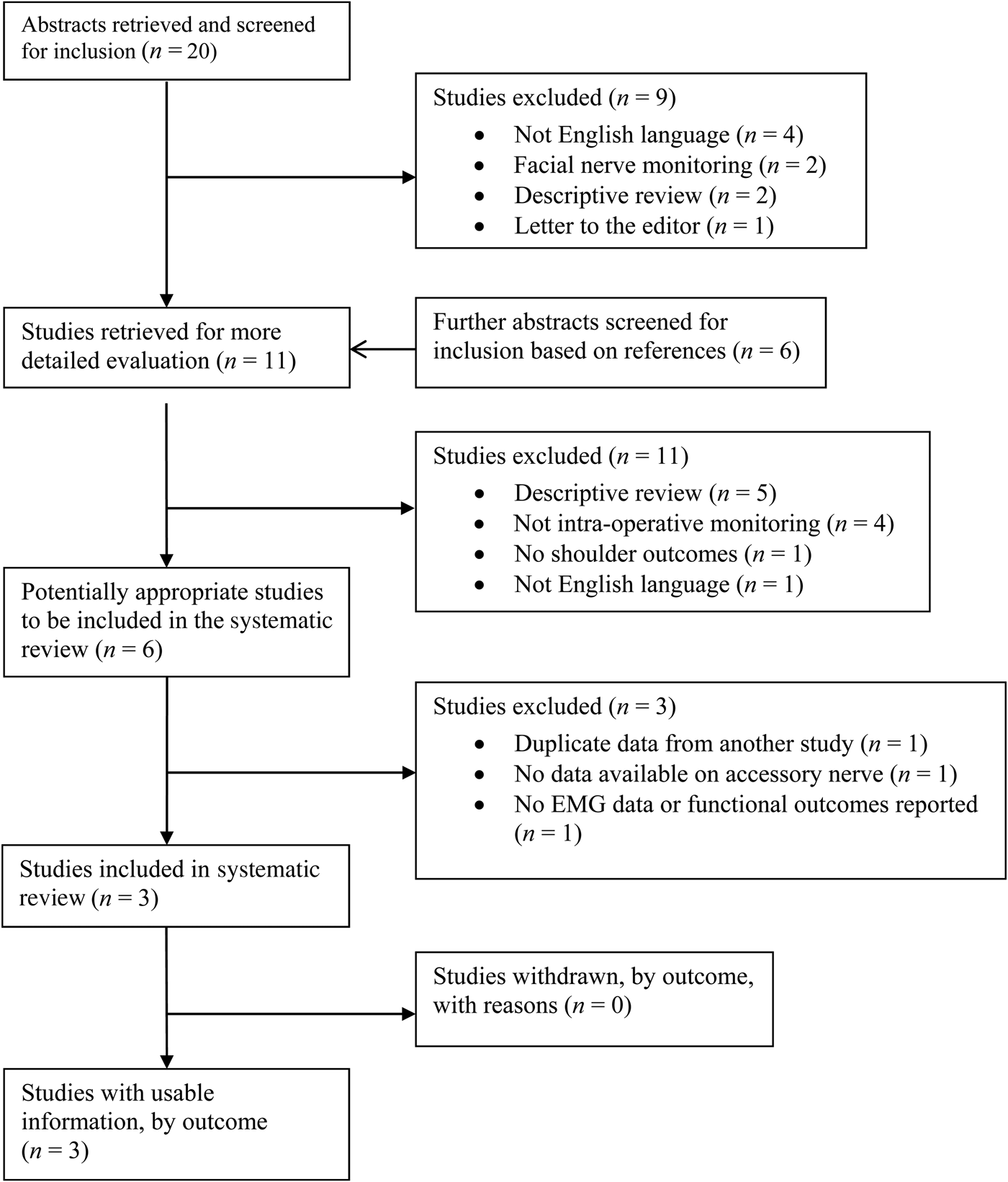
The initial literature search identified twenty studies. All abstracts were screened, and study inclusion and exclusion criteria were applied (outlined in Figure 1). Of the 20 articles, 9 were excluded: 4 were not in EnglishReference Lefaucheur, Neves and Vial12–Reference Zhang, Yang and Liang15; 2 were based on intra-operative monitoring of the facial nerveReference Zhao, Wang, Ji, Wang, Yu and Ding16, Reference Bu, Zhou, Xu, Yu, Zhang and Wei17; 2 were descriptive reviewsReference Leppanen18, Reference Sugiyama, Yokoyama, Ryu and Namba19; and 1 was a letter to the editor.Reference Beck, Maves and Stith20 The remaining 11 articles were retrieved in full. The reference list of each article was screened, and a further six articles containing the initial search term ‘intra-operative’ and either ‘cranial nerve’ or ‘accessory nerve’ in the article title were retrieved.Reference Witt, Gillis and Pratt11, Reference Friedenberg, Zimprich and Harper21–Reference Dillon25 Of the total of 17 articles retrieved, 11 were excluded because 5 were descriptive reviews,Reference Harper7Reference Dillon25–Reference Skinner28 4 did not describe accessory nerve monitoring in the intra-operative period,Reference Friedenberg, Zimprich and Harper21, Reference Orhan, Demirel, Baslo, Orhan, Yucel and Guldiken22, Reference Laughlin, Spinner and Daube29, Reference Donner and Kline30 1 did not describe any outcomes pertaining to shoulder morbidityReference Soo, Strong, Spiro, Shah, Nori and Green31 and 1 was not in English.Reference Sekiya, Hatayama, Akasaka and Suzuki32 A total of six articles were then reviewed for possible inclusion in the systematic review.Reference Witt, Gillis and Pratt11, Reference Schlake, Goldbrunner, Milewski, Krauss, Trautner and Behr23, Reference Witt and Rejto24, Reference Karlikaya, Citci, Guclu, Ture and Bingol33–Reference Topsakal, Al-Mefty, Bulsara and Williford35 Of these, three were excluded because one was a preliminary study for which the data were subsequently included in a later, larger study,Reference Witt, Gillis and Pratt11 one cranial nerve study lacked EMG data pertaining to the accessory nerve,Reference Schlake, Goldbrunner, Milewski, Krauss, Trautner and Behr23 and another did not document either EMG or functional shoulder outcomes.Reference Midwinter and Willatt34 The remaining three articles were included in the systematic review.Reference Witt and Rejto24, Reference Karlikaya, Citci, Guclu, Ture and Bingol33, Reference Topsakal, Al-Mefty, Bulsara and Williford35
Consolidated Standards of Reporting Trials (‘CONSORT’) diagram of systematic literature review. EMG = electromyography

Study characteristics
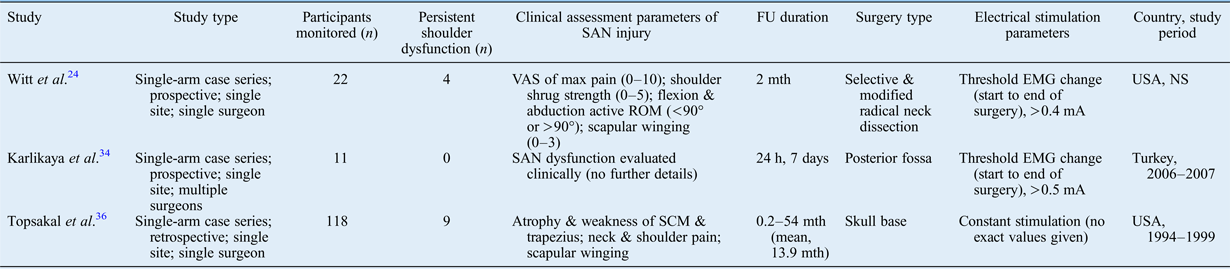
The characteristics of the three included studies are described in Table I. Each study described a single-arm case series: one in a neck dissection patient group; one consisting of patients undergoing posterior fossa surgery; and one related to surgery at the skull base. The prevalence of post-operative accessory nerve shoulder dysfunction ranged from 0 per cent to 18 per cent, with the highest morbidity reported in the study involving neck dissection patients. The time of post-operative assessment of shoulder function varied, from immediately post-operative to 54 months after surgery. The study with the largest sample size was related to skull base surgery, and had a large range of follow-up periods (0.2–54 months). The other two studies had shorter follow-up periods of up to 7 days and 2 months, respectively, following surgery.
Study characteristics
SAN = spinal accessory nerve; FU = follow up; VAS = visual analogue scale; max = maximum; ROM = range of motion; mth = months; EMG = electromyography; NS = not specified; h = hours; SCM, sternocleidomastoid
The threshold EMG change from the start to the end of surgery considered to be important was greater than 0.4 mA for one studyReference Witt, Gillis and Pratt11 and greater than 0.5 mA for another,Reference Karlikaya, Citci, Guclu, Ture and Bingol33 while the third study (with the largest sample size) did not record a threshold difference.Reference Topsakal, Al-Mefty, Bulsara and Williford35 The only study of a neck dissection population found that only two of the four patients (50 per cent) with demonstrated shoulder dysfunction had significant threshold EMG changes. This suggests that EMG sensitivity for detecting shoulder dysfunction is low. However, the same study found that 17 out of 19 patients (89 per cent) without a significant EMG change did not demonstrate shoulder dysfunction, suggesting that the specificity of intra-operative nerve monitoring is better. Nevertheless, the small sample size and lack of a comparison group limits the reliability of such inferences. The larger studyReference Topsakal, Al-Mefty, Bulsara and Williford35, with a sample size of 118 skull base surgeries, found that EMG had a higher rate of specificity than sensitivity in detecting shoulder dysfunction, with a true negative rate of 66.9 per cent and a true positive rate of 44.4 per cent.
Discussion
Evidence in the literature for the usefulness of intra-operative nerve monitoring in potentially reducing injury to the accessory nerve and for predicting post-operative function in neck dissection patients is minimal and contradictory. Only one article included in this systematic literature review pertains to its use in a neck dissection patient group.Reference Witt and Rejto24 The lack of a sample size calculation in this small study (with only 22 patients) and the lack of a control group result in insufficient statistical strength to reliably conclude whether intra-operative nerve monitoring of the accessory nerve during neck dissection is useful.
In contrast, many studies have assessed the effect of intra-operative nerve monitoring for the facial nerve and RLN. While the facial nerve is commonly monitored during parotid surgery, some reports suggest that intra-operative nerve monitoring does not improve post-operative facial nerve function.Reference Grosheva, Klussman, Grimminger, Wittekindt, Beutner and Pantel9, Reference Witt36 Although these studies had moderate sample sizes of 100 and 53, respectively, both lacked a sample size calculation based on the incidence rate of facial nerve injury. Transient facial paresis was found in 17 per cent of patients in one study, all of which resolved within three months.Reference Witt36 The second study reported transient facial paralysis in 41 per cent of patients immediately post-operatively, with persistent facial dysfunction in 6 per cent. This study had a variable follow-up period of 0.2–7.9 months.Reference Grosheva, Klussman, Grimminger, Wittekindt, Beutner and Pantel9
The low prevalence rates of nerve injury require a larger study sample size to detect possible differences in nerve injury rates and functional outcomes between groups that do and do not utilise intra-operative nerve monitoring. Indeed, this was recently highlighted in a large meta-analysis evaluating the efficacy of intra-operative monitoring of 64 699 RLNs during thyroidectomy in reducing nerve injury and predicting post-operative outcomes.Reference Higgins, Gupta, Ketcham, Sataloff, Wadsworth and Sinacori37 The largest randomised controlled study in this meta-analysis included 1000 nerves in each study arm.Reference Barczynski, Konturek and Cichori38 It found that the RLN monitoring group had a significantly lower prevalence of temporary paresis of the RLN compared with the control group, where the nerve was visualised. However, despite the positive result of this randomised study,Reference Barczynski, Konturek and Cichori38 the pooled results of the meta-analysisReference Higgins, Gupta, Ketcham, Sataloff, Wadsworth and Sinacori37 indicate no difference in the rate of true vocal fold palsy between groups. Such contradictory reports mean that the use of intra-operative monitoring of facial nerves and RLNs is controversial. However, this may simply reflect variations in nerve monitoring outcomes in different types of surgery performed by different surgeons using different EMG monitoring settings, protocols and functional outcome measures.
The prevalence of accessory nerve injury appears to be greater than that of facial nerve injury, with reports that up to 67 per cent of neck dissections are associated with accessory nerve injury despite an intact nerve.Reference van Wilgen, Dijkstra, van der Laan, Plukker and Roodenburg4 It is therefore surprising no further research has been done into its use. However, this may result from the controversy surrounding the clinical usefulness of intra-operative nerve monitoring. The nerve monitor signal may not always be reliable, with false positive and false negative alarm signals occurring during surgery. In the largest study included in this systematic review,Reference Topsakal, Al-Mefty, Bulsara and Williford35 a false positive rate was found in 33 per cent of cases and false negatives were found in 55.5 per cent of cases. Concern has been raised regarding possible over-reliance on nerve monitoring by surgeons, which may preclude the use of keen visual observation and anatomical nerve identification, and may lead to inferior surgical technique.Reference Witt36, Reference Higgins, Gupta, Ketcham, Sataloff, Wadsworth and Sinacori37
Several articles have investigated the use of needle EMG to establish possible links between post-operative nerve monitoring and functional shoulder outcomes.Reference Friedenberg, Zimprich and Harper21, Reference Orhan, Demirel, Baslo, Orhan, Yucel and Guldiken22, Reference Donner and Kline30 However, there are limitations in the clinical usefulness of this tool in the post-operative setting. Post-operative use of needle EMG is invasive and less feasible owing to patient discomfort and lack of accessibility. It may also be more resource intensive, and therefore costly, than intra-operative nerve monitoring.
Therefore, intra-operative nerve monitoring might be a useful adjunct method for identifying and monitoring at-risk nerves during surgery. The motor contribution to the trapezius muscle has variable anatomy. Although the spinal accessory nerve is the primary motor innervation to the trapezius, there are varying contributions from the C2–C4 cervical plexus. This was demonstrated by study of needle EMG during supraomohyoid or modified neck dissections.Reference Soo, Strong, Spiro, Shah, Nori and Green31 Thus, it would be prudent to identify and monitor the deep cervical plexus contributions to the trapezius muscle intra-operatively. Furthermore, the ‘Suarez manoeuvre’, an eponym describing the manoeuvre to mobilise the accessory nerve during delivery to level 2b,Reference Gavilán, Herranz and Martín39 may cause sufficient microscopic injury via skeletonisation and devascularisation to affect the integrity of the accessory nerve. Intra-operative monitoring of the accessory nerve may help to limit injury in the form of neurapraxia and axonotmesis. Any differences between pre-operative and post-operative accessory nerve firing may then predict post-operative functional outcome. This may limit the development of post-operative shoulder morbidity after neck dissection, which may improve post-operative symptomatic outcomes by reducing pain and improving shoulder function and quality of life.
There is a distinct lack of intra-operative nerve monitoring studies involving the accessory nerve that are randomised and include a control group. Randomised controlled trials, with one group of patients receiving intra-operative nerve monitoring and the other not, are necessary to explore the efficacy of intra-operative nerve monitoring. Such trials should include a predetermined sample size calculation to provide adequate power for data analysis, and utilise blinded assessors to measure functional outcomes at specific, clinically reasonable time points (ideally more than one) after surgery. Given the slow rate of neural recovery following injury, follow up should continue for at least six months post-operatively. Clinically useful outcome measures in neck dissection patients are those focused on shoulder morbidity associated with accessory nerve injury.
Active shoulder abduction range of motion is a pertinent outcome of interest because this movement is most limited following accessory nerve injury. The aim of active shoulder abduction would be restoration of the pre-operative range of motion. Other outcome measures may include questionnaires to assess shoulder pain, regional function and quality of life. Any difference in scores between groups with and without intra-operative nerve monitoring should reflect the minimally important clinical change. The Neck Dissection Impairment Index is one such measure, a region-specific quality of life questionnaire focused on the neck dissection patient population.Reference Taylor, Terrell, Ronis, Fowler, Bishop and Lambert40 Although the Neck Dissection Impairment Index has been found to be a valid and reliable instrument, what constitutes a meaningful clinically important difference is still unclear. The Shoulder Pain and Disability Index is also a validated and reliable tool to assess shoulder pain and function.Reference Heald, Riddle and Lamb41 The minimal important difference reported to be clinically meaningful is a change in score of more than 13 points.Reference Schmitt and Di Fabio42 Thus, a mean difference between intra-operative nerve monitoring and no intra-operative nerve monitoring groups of 13 points in the Shoulder Pain and Disability Index scores would indicate a clinically important change.
Differences in nerve monitor output (i.e. the EMG threshold difference) between pre- and post-operative levels would also need to be recorded, to assess correlations with the presence or absence of shoulder dysfunction. In accessory nerve monitoring studies, an EMG threshold difference of more than 0.4 mA between the start and end of surgery is reported to be significant.Reference Witt and Rejto24
Conclusion
Evidence for the usefulness of intra-operative nerve monitoring in limiting the prevalence of accessory nerve injury or as a method of predicting post-operative shoulder dysfunction outcomes following neck dissection is inconclusive. Limitations of this literature review include heterogeneity in the included studies, the small sample size of the only study based on accessory nerve monitoring during neck dissection,Reference Witt and Rejto24 and the lack of sample size calculations in all three studies. There is therefore a need to accurately determine the clinical usefulness of intra-operative nerve monitoring of the accessory nerve in neck dissection patients using scientifically robust methods, including a larger cohort size and inclusion of a control group.